Friday, November 13, 2026
Home Blog Page 263

Dozens of Clinical Trials Have Been Frozen in Response to Trump’s USAID Order

0

Asanda Zondi received a startling phone call last Thursday, with orders to make her way to a health clinic in Vulindlela, South Africa, where she was participating in a research study that was testing a new device to prevent pregnancy and H.IV. infection.

The trial was shutting down, a nurse told her. The device, a silicone ring inserted into her vagina, needed to be removed right away.

When Ms. Zondi, 22, arrived at the clinic, she learned why: The U.S. Agency for International Development, which funded the study, had withdrawn financial support and had issued a stop-work order to all organizations around the globe that receive its money. The abrupt move followed an executive order by President Trump freezing all foreign aid for at least 90 days. Since then, the Trump administration has taken steps to dismantle the agency entirely.

Ms. Zondi’s trial is one of dozens that have been abruptly frozen, leaving people around the world with experimental drugs and medical products in their bodies, cut off from the researchers who were monitoring them, and generating waves of suspicion and fear.

The State Department, which now oversees U.S.A.I.D., replied to a request for comment by directing a reporter to USAID.gov, which no longer contains any information except that all permanent employees have been placed on administrative leave. Secretary of State Marco Rubio has said that the agency is wasteful and advances a liberal agenda that is counter to President Trump’s foreign policy.

In interviews, scientists — who are forbidden by the terms of the stop-work order to speak with the news media — described agonizing choices: violate the stop-work orders and continue to care for trial volunteers, or leave them alone to face potential side effects and harm.

The United States is signatory to the Declaration of Helsinki that lays out ethical principles under which medical research must be conducted, requiring that researchers care for participants throughout a trial, and report the results of their findings to the communities where trials were conducted.

Ms. Zondi said she was baffled and frightened. She talked with other women who had volunteered for the study. “Some people are afraid because we don’t know exactly what was the reason,” she said. “We don’t really know the real reason of pausing the study.”

The stop-work order was so immediate and sweeping that the research staff would be violating it if they helped the women remove the rings. But Dr. Leila Mansoor, a scientist with the Centre for the AIDS Programme of Research in South Africa (known as CAPRISA) and an investigator on the trial, decided she and her team would do so anyway.

“My first thought when I saw this order was, There are rings in people’s bodies and you cannot leave them,” Dr. Mansoor said. “For me ethics and participants come first. There is a line.”

In the communities where her organization works, people have volunteered for more than 25 years to test H.I.V. treatments, prevention products and vaccines, contributing to many of the key breakthroughs in the field and benefiting people worldwide.

That work relied on a carefully constructed web of trust that has now been destroyed, Dr. Mansoor said. Building that trust took years in South Africa where the apartheid regime conducted medical experiments on Black people during the years of white rule. Those fears are echoed in a long history of experimentation by researchers and drug companies in developing countries and in marginalized populations in the United States.

The Times identified more than 30 frozen studies that had volunteers already in the care of researchers, including trials of:

  • malaria treatment in children under age 5 in Mozambique

  • treatment for cholera in Bangladesh

  • a screen-and-treat method for cervical cancer in Malawi

  • tuberculosis treatment for children and teenagers in Peru and South Africa

  • nutritional support for children in Ethiopia

  • early-childhood-development interventions in Cambodia

  • ways to support pregnant and breastfeeding women to reduce malnutrition in Jordan

  • an mRNA vaccine technology for H.I.V. in South Africa

It is difficult to know the total number of trials shut down, or how many people are affected, because the swift demolition of U.S.A.I.D. in recent days has erased the public record. In addition to the disabled website, the agency no longer has a communications department. And the stop-work order prohibits any implementing agency from speaking publicly about what has happened.

In England, about 100 people have been inoculated with an experimental malaria vaccine in two clinical trials. Now, they no longer have access to the clinical trial staff if that vaccine were to cause an adverse reaction in their bodies. The trial is an effort to find a next-generation vaccine better than the one now used in Africa; that shot protects children against about a third of malaria cases, but researchers hoped to find a vaccine that offered much more protection. Malaria remains a top global killer of children; 600,000 people died of the disease in 2023, the latest figure available.

Had the trial not been frozen, the participants would be coming to a clinic routinely to be monitored for adverse physical effects, and to have blood and cell samples taken to see whether the vaccine was working. The participants are meant to be followed for two years to assess the vaccine’s safety.

A scientist who worked on the trial said she hoped that partners at the University of Oxford, where it was being conducted, were shuffling staff to respond if any participant fell ill. But she was fired last week and no longer has access to any information about the trial. She spoke on condition of anonymity because she feared jeopardizing her ability to work on malaria research the U.S. might conduct in the future.

“It’s unethical to test anything in humans without taking it to the full completion of studies,” she said. “You put them at risk for no good reason.”

Had the stop-work order come later this year, the newly-vaccinated volunteers might have been in an even more precarious position. They were scheduled to be deliberately infected with malaria to see if the experimental vaccine protected them from the disease.

Dr. Sharon Hillier, a professor of reproductive infectious diseases at the University of Pittsburgh, was until this week director of a five-year, $125 million trial funded by U.S.A.I.D. to test the safety and efficacy of six new H.I.V. prevention products. They included bimonthly injections, fast-dissolving vaginal inserts and vaginal rings.

With the study suspended, she and her colleague cannot process biological samples, analyze the data they have already collected, or communicate findings to either participants or the partnering government agencies in countries where the trials were conducted. These are requirements under the Helsinki agreement.

“We have betrayed the trust of ministries of health and the regulatory agencies in the countries where we were working and of the women who agreed to be in our studies, who were told that they would be taken care of,” Dr. Hillier said. “I’ve never seen anything like it in my 40 years of doing international research. It’s unethical, it’s dangerous and it’s reckless.”

Even trials that were not funded in whole or part by U.S.A.I.D. have been thrown into turmoil because they were using medical or development infrastructure that was supported by the agency and is no longer operational. Millions of dollars of U.S. taxpayer funds already spent to start those trials will not be recuperated.

The shutdowns have business consequences as well. Many of those trials were partnerships with U.S. drug companies, testing products they hoped to sell overseas.

“This has made it impossible for pharmaceutical companies to do research in these countries,” Dr. Hillier said.

Another H.I.V. trial, called CATALYST, has thousands of volunteers in five countries testing an injectable drug called long-acting cabotegravir. Participants were receiving bimonthly injections to maintain a sufficient level of the drug in their bodies to prevent H.I.V. infection. Without regular injections, or a carefully-managed end to use of the drug, the participants will not have enough cabotegravir to stop a new infection, but there will be enough in their systems that, if they were to contract the virus, could easily mutate to become drug-resistant, said Dr. Kenneth Ngure, president-elect of the International AIDS Society.

This is a significant threat to the trial volunteers and also to the millions of people living with H.I.V. because cabotegravir is closely related to a drug that is already used worldwide in standard treatment of the virus. Development of resistance could be catastrophic, Dr. Ngure said: “It’s wrong on so many levels — you can’t just stop.”

A clinical trial run by the development organization FHI 360, which implemented many U.S.A.I.D.-funded health programs and studies, was testing a biodegradable hormonal implant to prevent pregnancy. Now there are women in the Dominican Republic with the devices in their bodies without continuing care.

Another trial, in Uganda, was testing a new regimen of tuberculosis treatment for children. The stop-work order cuts those children off from potentially lifesaving medication.

“You can’t walk away from them, you just can’t,” a researcher in that trial said.
DOGE Senate Republican’s bill to consolidate software licenses could save $750M

0

As the Trump administration’s Department of Government Efficiency (DOGE) works to slash government waste, a bipartisan bill in Congress is aiming to bring the federal government’s computer systems “out of the Stone Age.” 

The bipartisan Strengthening Agency Management And Oversight Of Software Assets (SAMOSA) Act passed the House in December, and Sen. Joni Ernset, R-Iowa, is leading efforts to get it passed in the upper chamber. 

Ernst, the chair of the Senate DOGE Caucus, said the SAMOSA Act will “bring Washington out of the Stone Age and into the 21st century.” 

Fox News Digital is told the bill could potentially save $750 million annually for taxpayers by consolidating federal agencies’ cloud computing software licenses. A source close to the proposal said “fixing federal IT procurement will be a key part of her sweeping efforts as chair of the Senate DOGE Caucus to downsize government and eliminate more than $2 trillion in waste.” 

TRUMP ANNOUNCES EXECUTIVE ORDER CREATING TASK FORCE TO ‘ERADICATE ANTI-CHRISTIAN BIAS’

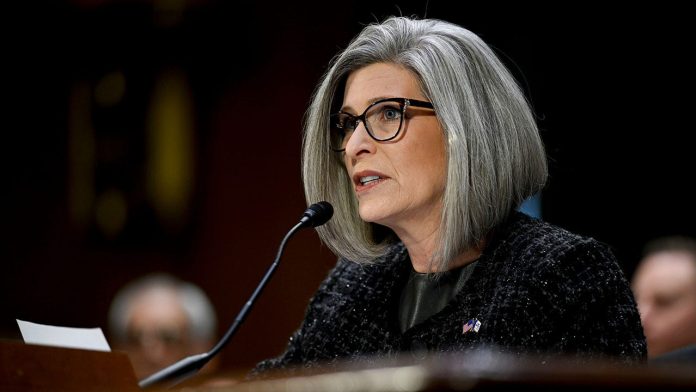
Sen. Joni Ernst, R-Iowa, introduces Tulsi Gabbard, President Donald Trump’s nominee to be director of National Intelligence, during a Senate Intelligence Committee confirmation hearing in Washington, D.C., on Thursday, Jan. 30, 2025.  ( Daniel Heuer/Bloomberg via Getty Images)

“If the government allowed meaningful competition in bidding for software, taxpayers could save up to $750 million a year,” Ernst said in a statement to Fox News Digital. “Let’s pass my bill to force federal agencies to take commonsense steps when purchasing software, instead of throwing away taxpayer dollars like monopoly money.”

The legislative proposal has the support of industry groups. 

“The SAMOSA Act is a vital step toward modernizing the federal IT infrastructure, ensuring fair software licensing practices in its procurement and saving money for taxpayers,” Ryan Triplette, Executive Director of the Coalition for Fair Software Licensing, said in a statement to Fox News Digital. “There aren’t many areas in Congress where we see bipartisan support, but ensuring our IT infrastructure is as efficient, secure and cost-effective as possible is one of them. The Coalition for Fair Software Licensing will continue working with partners in Congress to get the SAMOSA Act across the finish line and signed into law.”

The bill gives the Chief Information Officer of every government agency no more than 18 months to organize a “comprehensive assessment” of the software paid for or deployed throughout the agency. The review should include an inventory of all the current software, identify contracts for the use of the software and their expiration dates and list additional fees or costs, including fees or costs for the use of cloud services, not included in the initial costs of the contract. The review should then give each agency the information necessary to “consolidate software entitlements of each agency,” reduce unnecessary costs and “develop criteria and procedures for how the agency will adopt cost-effective acquisition strategies.” 

Musk at Trump inauguration

Elon Musk arrives for the inauguration of U.S. President-elect Donald Trump in the U.S. Capitol Rotunda on Jan. 20, 2025 in Washington, D.C.  (Kenny Holston-Pool/Getty Images)

On the House side, the SAMOSA Act was introduced by Rep. Matt Cartwright, D-Pa., and co-sponsored by a bipartisan group of 20 members of Congress.  

Ernst penned a letter in November to Elon Musk and Vivek Ramaswamy (who has since exited DOGE while reportedly weighing a potential Ohio gubernatorial bid), outlining “a trillion dollars’ worth of ideas for trimming the fat and reducing red ink.” 

WHITE HOUSE CALLS DEMOCRAT CRITICISM OF DOGE ‘UNACCEPTABLE’ AND ‘INCREDIBLY ALARMING’

Among the options, Ernst said “consolidating agencies’ cloud computing software licenses could save $750 million every year.” 

She cited a study by Michael Garland, a software and government procurement industry expert, that found Microsoft and Oracle, the world’s two largest software companies, received 25% to 30% of their contracts “without meaningful competition.” 

Citing one example of “vendor-lock,” the study found the government spent $112 million more to buy Microsoft Office than Google Workspace “in order to avoid perceived costs to switch.”

DOGE office protest

AFL-CIO President Liz Shuler speaks at a rally against the Department of Government Efficiency (DOGE) outside the U.S. Department of Labor (DOL on Feb. 5, 2025 in Washington, D.C.  (Kena Betancur/VIEWpress)

“A five percent improvement in price performance, due to enhanced software competition, could produce savings up to $750 million annually,” the report said. 

It also described how the U.S government spent almost $2 trillion on Information Technology (IT) since 1994, and about $300 billion of that expenditure has been on commercial off-the-shelf (COTS) software. 

“On an annual basis, the government collectively spends $10 to $15 billion on new software and for the maintenance and support of previously purchased software. Unfortunately, the majority of the COTS software spend has been destined for only a limited set of software companies who have managed to create a largely vendor-locked COTS software estate,” Garland wrote. “Until now, the government has had little visibility into how resoundingly its incumbent software estate has been captured by so few. As a result, an oligarchy of software companies has been free to use fear, uncertainty, and sometimes questionable business practices to make authentic competitions against incumbent software applications relatively rare.” 

Ernst’s letter also pointed to how the U.S. Government Accountability Office (GAO) identified 10 critical federal IT legacy systems – or systems that are outdated or obsolete – that were most in need of modernization in 2019. The legacy systems were said to provide “vital support to agencies’ missions” but ranged from about eight to 51 years old and “collectively cost about $337 million annually to operate and maintain.” 

Several of the systems used older languages, such as Common Business Oriented Language (COBOL). 

CLICK HERE TO GET THE FOX NEWS APP

“The government runs on ancient computers & software. Needs an upgrade!” Musk wrote on X in November.

All Languages Follow This Pattern. So Does Humpback Whale Song.

0

The English language is full of wonderful words, from “anemone” and “aurora” to “zenith” and “zodiac.”

But these are special occasion words, sprinkled sparingly into writing and conversation. The words in heaviest rotation are short and mundane. And they follow a remarkable statistical rule, which is universal across human languages: The most common word, which in English is “the,” is used about twice as frequently as the second most common word (“of,” in English), three times as frequently as the third most common word (“and”), continuing in that pattern.

Now, an international, interdisciplinary team of scientists has found that the intricate songs of humpback whales, which can spread rapidly from one population to another, follow the same rule, which is known as Zipf’s law.

The scientists are careful to note that whale song is not equivalent to human language. But the findings, they argue, suggest that forms of vocal communication that are complex and culturally transmitted may have shared structural properties.

“We expect them to evolve to be easy to learn,” said Simon Kirby, an expert on language evolution at the University of Edinburgh and an author of the new study. The results were published on Thursday in the journal Science.

“We think of language as this culturally evolving system that has to essentially be passed on by its hosts, which are humans,” Dr. Kirby added. “What’s so gratifying for me is to see that same logic seems to also potentially apply to whale song.”

Zipf’s law, which was named for the linguist George Kingsley Zipf, holds that in any given language the frequency of a word is inversely proportional to its rank.

There is still considerable debate over why this pattern exists and how meaningful it is. But some research suggests that this kind of skewed word distribution can make language easier to learn.

If these word distributions evolved because they helped learning, scientists might also expect to find similar patterns in other complex, culturally transmitted communication systems. “And whale song is a great place to look,” said Inbal Arnon, an expert on language acquisition at Hebrew University and an author of the new study.

Male humpback whales sing long, elaborate songs, which are composed of a variety of sounds strung together in repeated phrases and themes. All the male whales in a particular humpback population sing the same song, but that song evolves over time — sometimes gradually and sometimes all at once.

“We have song revolutions, and that’s when a song is introduced from a neighboring population,” said Ellen Garland, an expert on humpback whale songs at the University of St. Andrews and an author of the new paper. “So the song type turns up, and then it completely takes over.”

Precisely how that happens remains a mystery, and whale song researchers face a challenge that human language researchers don’t: They’re not native speakers.

So the scientists’ first challenge was to divide the songs into meaningful units, determining where one “word” ended and another began. To do so, they used a quantitative approach inspired by human babies. Infants, research suggests, use basic statistical reasoning to identify discrete words in a continuous stream of human speech; syllables that occur together are likely to be part of the same word.

The researchers transformed humpback whale songs, recorded over eight years in the waters around New Caledonia, into long sequences of basic sound elements, including various types of squeaks, grunts, whistles, groans and moans. Then, they identified “subsequences” of sounds that frequently occurred together — such as a short ascending whistle followed by a squeak — and might be roughly analogous to a word.

The frequency with which these subsequences were used followed Zipf’s law, the researchers found. In 2010, for instance, groan-groan-moan was the most common subsequence, appearing about twice as often as the next most common sequence, which was a moan followed by three ascending cries. The most frequently used subsequences were also generally shorter than the rarer ones.

Humans and humpback whales are not closely related, and whale song does not carry the same semantic meaning that human language does, Dr. Garland said. But both communication systems are culturally transmitted, learned from others in the community and passed down over the generations. “So this really points to the crucial role of learning and transmission in the emergence of structure,” she said.

Shane Gero, a marine biologist who was not involved in the research, said that he found the study “elegant” and convincing. The results raise the possibility that linguistic laws derived from studies of human communication may actually be broader biological principles, he said.

“The fact that maybe they generalize if we know enough and we study long enough, then that’s really interesting,” said Dr. Gero, who is a scientist-in-residence at Carleton University. “Anytime we look deeper and listen longer, we find interesting complexity.”

Indeed, the next step is to determine whether the phenomenon extends to other animals with similar communication systems.

“We should find these statistical properties in any culturally transmitted system of sequential signaling,” Dr. Arnon said. “So we have bats to look at, we have songbirds to look at, we have elephants, maybe, to look at.”

The findings dovetail with another paper published this week, which found that the vocalizations produced by 11 species of dolphins and whales follow one of the efficiency rules observed in human language. The rule, known as Menzerath’s law, holds that the longer a sequence becomes, the shorter its individual components tend to be; long sentences, for instance, tend to have shorter words.

The study, which was published in Science Advances on Wednesday, documented this same pattern in a diverse array of cetaceans, including humpbacks, which produce melodic songs; sperm whales, which issue sequences of clicks; and bottlenose dolphins, which are known for their whistles.

“Regardless of what their vocalizations are used for, they all seem to try to communicate as efficiently as they can,” said Mason Youngblood, a postdoctoral researcher at Stony Brook University and the author of the study.

The pattern, which has also been documented in birds and nonhuman primates, may have evolved as a way to reduce the costs of communication.

“Things like bird song and whale song are very hard to learn,” Dr. Youngblood said. “And then when you sing, it’s very energetically costly. It can attract the attention of predators. And so because of that, you would expect communication systems to evolve to cut those costs wherever it’s possible.”

Trump’s Gaza ‘takeover’ rankles America First conservatives, allies suggest negotiator-in-chief is at work

0

Join Fox News for access to this content

Plus special access to select articles and other premium content with your account – free of charge.

By entering your email and pushing continue, you are agreeing to Fox News’ Terms of Use and Privacy Policy, which includes our Notice of Financial Incentive.

Please enter a valid email address.

President Donald Trump’s comments about the U.S. “taking over” Gaza sent shock waves through Washington – but allies suggest the negotiator-in-chief is using the suggestion as a tactic to apply pressure on the region and find workable solutions to the Israel-Palestinian conflict. 

“The U.S. will take over the Gaza Strip, and we will do a job with it, too,” Trump said Tuesday in remarks that set off a media firestorm. “We’ll own it and be responsible for dismantling all of the dangerous, unexplored bombs and other weapons on the site.”

He suggested that Palestinians be cleared out of Gaza and taken in by neighboring nations like Egypt and Jordan – an idea Arab leaders have roundly rejected. 

Trump’s proposal would be a momentous departure from current policy – and run afoul with America First conservatives who want to see the U.S. less involved in the Middle East, not more. 

ARAB AMERICANS FOR TRUMP GROUP CHANGES NAME AFTER PRESIDENT’S GAZA TAKEOVER PROPOSAL

Trump suggested the U.S. “take over” Gaza and Palestinians be cleared out  (Reuters )

“I thought we voted for America First,” Sen. Rand Paul, R-Ky., wrote back to the president’s suggestion on X. “We have no business contemplating yet another occupation to doom our treasure and spill our soldiers’ blood.”

The idea of a U.S. takeover of Gaza originated with Trump himself, who questioned why Palestinians would want to live among the rubble, and was not formally mapped out by his aides before he announced it next to Israeli Prime Minister Benjamin Netanyahu at the White House.

Sources told the New York Times that Trump had been toying with the suggestion for weeks, and his thinking was reaffirmed when Middle East envoy Steve Witkoff returned from Gaza and described the dismal conditions there. 

ISRAELI DEFENSE MINISTER ORDERS IDF TO PLAN FOR GAZANS TO LEAVE IN LINE WITH TRUMP’S CONTROVERSIAL PROPOSAL

Trump questioned why Palestinians would want to

Palestinians walk past the rubble of destroyed buildings during a ceasefire between Israel and Hamas, in Gaza City, Feb 6, 2025. (Reuters/Dawoud Abu Alkas )

Taking over ownership of Gaza would suggest U.S. forces on the ground to ensure security – and require Congress to get on board with appropriating funds to rebuild the territory. 

Trump explained his idea further in a Truth Social post Thursday morning. 

“The Gaza Strip would be turned over to the United States by Israel at the conclusion of fighting. The Palestinians, people like Chuck Schumer, would have already been resettled in far safer and more beautiful communities, with new and modern homes, in the region,” he wrote, calling out the Senate’s Jewish Democratic leader. 

“They would actually have a chance to be happy, safe, and free. The U.S., working with great development teams from all over the World, would slowly and carefully begin the construction of what would become one of the greatest and most spectacular developments of its kind on Earth. No soldiers by the U.S. would be needed! Stability for the region would reign!!!”

White House press secretary Karoline Leavitt also sought to quiet fears from the briefing podium. 

“I would reject the premise of your question that this forces the United States to be entangled in conflicts abroad,” she told a reporter on Wednesday. “The president has not committed to putting boots on the ground in Gaza. He has also said that the United States is not going to pay for the rebuilding of Gaza.”

Israeli Prime Minister Benjamin Netanyahu and President Donald Trump speak at a press conference

President Donald Trump and Israeli Prime Minister Benjamin Netanyahu answer questions during a joint press conference in the East Room at the White House, Feb. 4, 2025. (Reuters/Leah Millis)

“This is an out-of-the-box idea. That’s who President Trump is. That’s why the American people elected him. And his goal is lasting peace in the Middle East for all people in the region.”

Sen. John Fetterman, a Pennsylvania Democrat who typically finds little common cause with Trump, told Puck News his idea is a “provocative” way to “to kind of shake things up and to start a very more honest conversation of Gaza.”

“Trump is speaking the language of the Middle East,” Simone Ledeen, deputy assistant secretary of defense for the Middle East during Trump’s first term, told Fox News Digital. 

“Middle East negotiations, they often happen in public, and public posturing is kind of part of the process. This is not President Trump’s messaging to the U.S., he is messaging to the Middle East… [that] the paradigm has failed, and so we need new ideas.”

“I think it’s going to bring the entire region to come with their own solutions,” national security advisor Mike Waltz mused about the comments on CBS on Wednesday.

Waltz went on: “He’s not seeing any realistic solutions on how those miles and miles and miles of debris are going to be clear, how those essentially unexploded bombs are going to be removed, how these people are physically going to live there for at least a decade, if not longer, it’s going to take to do this.” 

More than 46,000 Palestinians had been killed in the war between Israel and Hamas, according to the Hamas-run Gaza health ministry as of last month. Nearly 2 million have been displaced from their homes. 

TRUMP SAYS US WILL ‘TAKE OVER’ GAZA STRIP, REBUILD IT TO STABILIZE MIDDLE EAST

A view shows destroyed buildings, amid a ceasefire between Israel and Hamas, as seen from Israel's border with Gaza, Israel

“Why would they want to return? That place has been hell,” Trump said of Gaza. (Reuters/Amir Cohen)

An Israeli official suggested that Trump’s idea may not actually be met with opposition by Gaza’s neighbors. 

“Egypt and Saudi Arabia and United Arab Emirates that in the end of the day are threatened by Hamas would not shed a tear to see that the United States is actually taking control over the Gaza strip, because they don’t really want to do that,” Avi Melamed, a former Israeli intelligence official and Arab affairs adviser for Jerusalem, told Fox News Digital. 

“They will not, of course, express formally, because it will be breaking the cause of unity in the Arab world.” 

“Trump is being presented right now a construct of a ceasefire deal that is headed for a train wreck,” said Rich Goldberg, president of Foundation for Defense of Democracies, adding that there is a “fundamental disconnect” between what Israelis will accept and what Hamas will accept. 

“So he’s moving the Overton window, changing the strategic paradigm.”

CLICK HERE TO GET THE FOX NEWS APP

Goldberg said the first priority was convincing other Muslim nations in the region to take in Palestinians. 

“The Egyptians and the Jordanians should be honest with the world. We don’t want the Gaza population. We’re afraid of the Gaza population. We think they may be radicalized. We think they might bring down our government. Or we don’t want to give up the political weapon against Israel.” He suggested Trump could leverage U.S. relationships with Middle Eastern countries – offering those who accept Palestinians major-non-NATO status and threatening to revoke such a status for countries who don’t. “The status itself is gravitized in the world.” 

Trump’s Plan for Gaza Gives No Immediate Answers About the Hostages or the War

0

Barely a week ago, Israelis rallied in Tel Aviv’s Hostage Square, waving placards thanking President Trump and his Middle East envoy for their role in helping secure an initial cease-fire deal in Gaza and getting some hostages freed.

Many of them were hoping that Mr. Trump would strong-arm Israel’s long-hesitant prime minister, Benjamin Netanyahu, into agreeing to negotiate an end to the war with Hamas and get the rest of the hostages released when the two leaders met in Washington on Tuesday.

Instead, they woke up to news of Mr. Trump’s fantastical idea of removing the population of roughly two million Gazans from the devastated enclave to make way for a glittering, American-owned Middle Eastern Riviera.

Far-fetched as Mr. Trump’s vision for Gaza may be — the Arab world has roundly rejected it and any forcible removal of a population violates international law — it abruptly shifted attention away from the future of the cease-fire deal, whose initial, six-week phase is due to end in early March.

As Mr. Trump sketched out his grandiose plans for Gaza, he placed little public pressure on Mr. Netanyahu to proceed with talks via Qatari and Egyptian mediators to turn the temporary cease-fire into a permanent cessation of hostilities. That left Israel with a wide berth on how it might deal with Gaza next.

The talks, which were meant to start this week, are now up in the air. And Mr. Netanyahu will leave Washington with Mr. Trump’s endorsement of what far-right members of the Israeli government have effectively been calling for: the mass migration of Palestinians from Gaza.

That leaves the fate of the hostages still held by Hamas in question as the militant group assesses how to move forward and many Palestinians worrying about whether the war might resume again.

“On the one hand, we are very grateful for what Trump has been doing,” said Idit Ohel, whose son, Alon Ohel, 23, was kidnapped from a bomb shelter as he tried to flee a music festival during the Hamas-led assault of Oct. 7, 2023, which started the war.

“Now,” Ms. Ohel said of Mr. Trump, “I don’t understand the implications of what he is saying or how this is going to bring my son home.”

Mr. Netanyahu, in an interview with Fox News late Wednesday, hailed Mr. Trump’s idea as “remarkable,” saying it should be “pursued,” drowning out any talk of the details of how to move cease-fire negotiations forward.

And on Thursday morning, Mr. Netanyahu’s loyal defense minister, Israel Katz, issued a statement saying he had instructed the Israeli military to prepare a plan to facilitate the exit of “any resident of Gaza who is interested to leave to any place in the world that agrees to accept them.”

The initial phase of the cease-fire deal took effect on Jan. 19 and provides for Hamas to release 33 hostages in exchange for hundreds of Palestinians imprisoned in Israel. About 79 hostages remain in Gaza, at least 35 of whom are presumed to be dead.

Talks were due to start on Monday — Day 16 of the deal — on a second phase, which is supposed to result in the rest of the living hostages being released and to usher in a permanent cessation of hostilities. That would mean a full withdrawal of Israeli troops from Gaza.

Wording about the transition to the second phase had been left intentionally vague, since Israel and Hamas are holding out for mutually exclusive demands.

Mr. Netanyahu has vowed to continue the war until Hamas no longer holds sway in Gaza and to resume fighting, if necessary. Hamas refuses to give up control or disarm.

In repeated statements in Washington, Mr. Netanyahu laid out his three priorities for Gaza, with the hostages only coming in second.

“In Gaza, Israel has three goals: Destroy Hamas’s military and governing capabilities, secure the release of all our hostages and ensure that Gaza never again poses a threat to Israel,” he said.

Mr. Netanyahu could stand to lose his own grip on power, with the far-right flank of his governing coalition having threatened to quit if he ends the war in Gaza with Hamas still in control there.

As of Thursday, no Israeli delegation had yet set out to Doha, Qatar, for negotiations, according to two Israeli officials who were not authorized to discuss the sensitive issue publicly.

Mr. Trump also sounded less committal than he has in the past about the fate of the hostages and ending the war, saying it was unclear if the cease-fire would hold. He said he would like to get all the hostages out. “If we don’t, it will just make us somewhat more violent,” he said, possibly indicating U.S. backing for a resumption of the fighting.

In the Middle East, analysts were parsing what Mr. Trump’s tectonic diversion on the future of Gaza might mean in the more immediate term.

“I think what he did was throw the old checkers board off the table and replaced it with Monopoly,” said Kobi Michael, an expert in the Israel-Palestinian conflict at the Institute for National Security Studies at Tel Aviv University. “He didn’t just change the rules of the game but the game itself,” he said.

Both Israel and Hamas are likely to want to buy time — Hamas to rehabilitate itself and its forces after 15 grueling months of war and Mr. Netanyahu to keep his right-wing coalition together — and may try to extend the first phase of the deal, allowing for more hostage-for-prisoner exchanges.

Mr. Michael said Mr. Trump’s vision for a Gaza without Gazans could work as a threat and put significant pressure on Hamas to release more hostages. Conversely, he said, it could cause Hamas to walk away from the deal altogether.

“Mr. Trump is a businessman,” Mr. Michael said. “He takes risks.”

Zakaria al-Qaq, a Palestinian expert in national security, said that even the mere suggestion of relocating two million Gazans was likely to complicate the cease-fire negotiations by making Hamas more cautious, and to destabilize the entire Arab world.

Mr. Trump’s declaration, he said, was “The perfect recipe for recruiting more people to Hamas,” adding that Mr. Trump’s “new colonialism” had given Hamas “easy marketing tools.”

Many people believe Mr. Trump’s vision for Gaza is not feasible, but regardless of the reality, Mr. Netanyahu has come out with no sign of being pressured by Mr. Trump, or of any daylight between them. His government intact, for now.

An Israeli official who briefed Israeli political reporters in Washington after the Netanyahu-Trump meeting said it was now clear to Mr. Netanyahu’s coalition partners that bringing down his right-wing government with Mr. Trump as president would be irresponsible and foil “historic” opportunities in the coming years.

Relatives of the hostages warn that they do not have time.

“I live in daily fear,” said Alon Nimrodi, the father of Tamir Nimrodi, an Israeli soldier who is slated to be released only under a second phase of the deal.

Mr. Trump’s vision for Gaza was not a bad one, Mr. Nimrodi said. “But this is not the time to talk about it,” he said. Plans for Gaza should wait till “after the hostages are out,” he said.

CISA staffers offered deferred resignations with just hours to decide : NPR

0

Employees at the Department of Homeland Security’s Cybersecurity and Infrastructure Security Agency, or CISA, have been given deferred resignation offers as part of the Trump administration’s broader efforts to shrink the federal government. CISA plays a key role in defending critical U.S. infrastructure.

Jim Watson/AFP via Getty Images


hide caption

toggle caption

Jim Watson/AFP via Getty Images

Employees at the Department of Homeland Security’s Cybersecurity and Infrastructure Security Agency, or CISA, were initially excluded from broader government offers to take deferred resignation offers, in part due to their role in national security and defending critical infrastructure.

However, on Wednesday, some CISA staffers were given the offer and just hours to decide whether to accept it, according to three sources who spoke to NPR on condition of anonymity.

It’s the latest move in the Trump administration’s broader efforts to shrink the federal government.

“Team CISA, I am writing to provide an update that CISA employees may participate in the Deferred Resignation program (‘Fork in the Road’),” wrote Bridget Bean, who was identified in an email shown to NPR as the “senior official performing the duties of director” at CISA. “This is a deeply personal decision, and whichever decision you make, we support you.”

Bean also wrote that the offer expires on Thursday, February 6, 2025 before midnight. It’s unclear whether the offer is legally binding or whether Congress will appropriate funds to pay for it after March.

The “Fork in the Road” program mirrors language posed to then-Twitter employees after the social media company was acquired by Tesla and SpaceX CEO Elon Musk, who is now leading President Trump’s government advisory team called DOGE, or the Department of Government Efficiency.

DOGE staffers have been entering federal agencies from the State Department to the Treasury Department for the past week, demanding access to sensitive files and systems and prompting widespread protests and legal challenges.

Government cybersecurity employees are panicking over the level of unfettered access given to the young, often inexperienced DOGE staffers working under Musk. That access reportedly extends to the Treasury Department’s payments system, as well as controlled access systems for making sensitive aid payments at agencies like the U.S. Agency for International Development, one of the Trump administration’s top targets for elimination or dismantling.

Now, the ranks of cybersecurity experts within the federal government itself might get thinner.

“At this time, CISA employees may be considered for the Deferred Resignation program,” wrote a CISA spokesperson in an email to NPR. “CISA remains committed to ensuring the continuity of our mission while supporting our workforce through this process.”

CISA was established during the first Trump administration in 2018. At the time, President Trump described the legislation establishing the agency as “vital.”

“Every day, America’s adversaries are testing our cyber defense,” he said. “They attempt to gain access to our critical infrastructure, exploit our great companies, and undermine our entire way of life. And we can’t let that happen.”

In 2020, CISA created a website called “Rumor Control” to debunk disinformation concerning election security during the 2020 U.S. presidential election. While the agency concluded there was no evidence of election tampering, the Trump administration claimed otherwise, and pushed out then CISA Director Chris Krebs.

After President Trump was inaugurated for his second term in January, the White House acted quickly to remove all members of DHS’s advisory boards, including the CISA cybersecurity advisory committee and the Cyber Safety Review Board, which conducts reviews of major breaches. President Trump’s pick to lead DHS, Kristi Noem, vowed to shrink the agency and return it to its mission of protecting critical infrastructure.

Even so, Republican lawmakers and Trump officials toned down their criticisms of CISA in recent weeks.

CISA was a key part of discovering and responding to a broad espionage campaign targeting U.S. telecoms by Chinese-state sponsored hackers called “Salt Typhoon.” Those hackers stole phone records from the U.S. telecoms, including from President Trump and his then vice-presidential running mate JD Vance.

Experts concluded that CISA might be safe from a broader Trump effort to whittle down federal agencies, replace staff or eliminate programs.

Now, that conclusion is in question.

CISA isn’t the only agency that might lose experts experienced in battling nation state hackers, defending critical infrastructure and gathering digital intelligence.

Earlier this week, “eligible” intelligence officers from the Office of the Director of National Intelligence, the Central Intelligence Agency and the National Security Agency were given a similar offer, though it’s unclear which sensitive or high-ranking positions would be excluded.

Meanwhile, all staffers at the United States Agency for International Development, or USAID, will be put on administrative leave by Friday as overseas employees will be asked to leave their posts and return to the U.S. within the next month. The agency, which distributes billions of dollars in aid worldwide, is already impacted by the staffing disruptions and the Trump administration’s pause in foreign aid funding.

At USAID, the relatively new Office of Digital Technology is no longer advising its partners on cybersecurity, technology and human rights. The Agency’s digital strategy, no longer available online, was developed during the first Trump administration and lauded by the conservative think tank Heritage Foundation’s Project 2025 as a way to “promote safe 5G access in emerging markets and combat Beijing’s efforts to equip regimes with tools to stifle democracy.”

GOP senators to join Trump for Mar-a-Lago dinner ahead of campaign wing retreat

0

Most of the Senate Republican conference will dine with President Donald Trump at his Mar-a-Lago estate on Friday evening as the lawmakers prepare for a weekend campaign retreat. 

The dinner between Trump and the GOP senators was confirmed by several sources to Fox News Digital. 

Also in Florida, many of the senators will be attending the National Republican Senatorial Committee (NRSC) retreat afterward. The committee is preparing for the 2026 midterm election cycle. 

INSIDE SEN. TOM COTTON’S CAMPAIGN TO SAVE TULSI GABBARD’S ENDANGERED DNI NOMINATION

Trump is hosting the senators at Mar-a-Lago. (Getty Images)

While most of the GOP conference will be at Trump’s Mar-a-Lago dinner, not all of the senators are going. 

Sen. Bill Cassidy, R-La., will instead be at dinner with his daughter, who lives in the area. 

Cassidy has had a fractured relationship with Trump in the past, as one of the handful of Republican senators who voted to convict him for allegedly inciting the Capitol riot on Jan. 6, 2021. 

LEADER THUNE BACKS SENATE GOP BID TO SPEED PAST HOUSE ON TRUMP BUDGET PLAN

Sen. Bill Cassidy, R-La.

Sen. Bill Cassidy, R-La., is up for re-election in 2026. (Reuters)

The Louisiana Republican is notably up for re-election in 2026 and will be at the NRSC retreat for the remainder of the weekend. While Cassidy’s state isn’t likely to pick a Democrat, he faces threats of primary challenges from the right. 

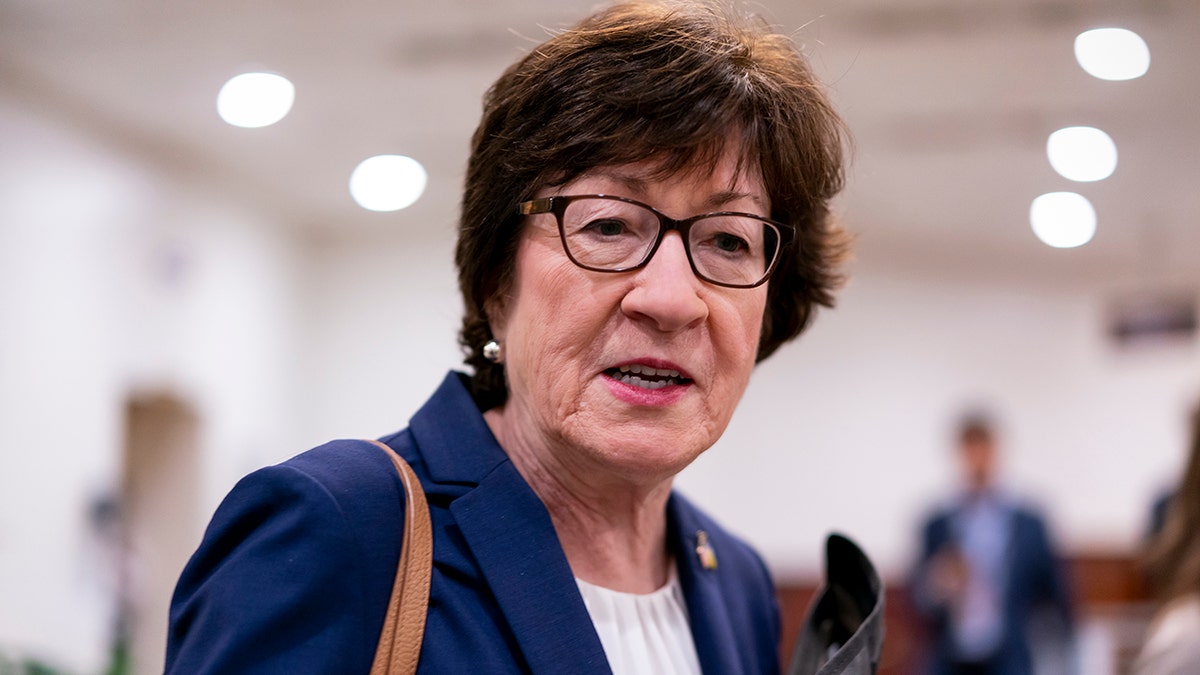
The office of moderate Sen. Susan Collins, R-Maine, whose race will be one of the NRSC’s most competitive this cycle, did not provide comment to Fox News Digital when asked whether she would be at the Mar-a-Lago dinner. 

FORMER NFL PLAYER SCOTT TURNER CONFIRMED TO LEAD HOUSING AND URBAN DEVELOPMENT

Susan Collins speaking to reporters

Collins has a reputation as a moderate Republican. (AP Photo/J. Scott Applewhite)

Republicans will be put on defense in 2026 in key states North Carolina and Maine, protecting the seats of Sen. Thom Tillis, R-N.C., and Collins, respectively. At the same time, the party is looking to expand its majority in the Senate, eyeing vulnerable Democrat-held seats in Georgia and Michigan. 

FORMER GOP LEADER MCCONNELL FALLS WHILE EXITING SENATE CHAMBER AFTER TURNER CONFIRMATION VOTE

Jon Ossoff

Ossoff is seeking a second term in Georgia. (Jessica McGowan/Getty Images)

CLICK HERE TO GET THE FOX NEWS APP

Sen. Jon Ossoff, D-Georgia, is seeking re-election in swing state Georgia for the first time. Michigan is already a swing state, and with Democratic Sen. Gary Peters’ announcement that he isn’t running again, the party is losing an incumbent advantage. 

‘Screams and Smoke’: How a Deadly Mass Shooting Unfolded in Sweden

0

It was about 12:30 p.m. on a gray Tuesday in Orebro, Sweden, when gunfire erupted at an adult education center, with students and teachers in class. Minutes later, as an alarm wailed, the police charged into the center, Campus Risbergska, where they encountered a chaotic, smoke-filled scene. It would be hours before they gave an all-clear.

“An inferno. Dead people. Injured people. Screams and smoke,” Lars Wiren, Orebro’s police chief, said Thursday at a news conference as he described the scene.

The shooting in Orebro, a quiet university town in central Sweden that has become a haven for migrant communities, has left the country reeling. The national government has described the attack as the worst mass shooting in Sweden’s history, and flags around the country are flying at half-staff. In the days after the attack, the authorities are still seeking to understand why a man entered the campus and opened fire. At least 11 people were found dead, the police said, and the suspect was believed to be among them.

The police have not publicly identified the gunman or shared any details about a possible motive. Swedish news outlets have identified him as Rickard Andersson, a 35-year-old who lived alone in an apartment near the school.

The police have not confirmed the reports, and The New York Times has yet to independently confirm the gunman’s identity. Officials have begun to share how the attack unfolded, describing a heavily armed assailant who worked alone.

When officers entered the school on Tuesday, it was filled with smoke from pyrotechnics, Mr. Wiren said. The police came under a hail of gunfire so intense that officers could not tell how many shooters were on the scene, he added. Through the smoke, officers saw a man approaching them and carrying what appeared to be a rifle.

The man continued to shoot, emptying several magazines of ammunition. In the chaos, none of the 130 police officers chose to return fire, the police chief said.

“You have to respect the situation. There’s panic among the students, the teachers,” Mr. Wiren said. “There’s smoke. The circumstances must be right in order to fire.”

After about an hour, officers later found the gunman among the dead. Near his body were three weapons, including the rifle. Scattered nearby were at least 10 empty magazines and unused ammunition, Mr. Wiren said.

Police officers fanned out across the four-acre campus, searching for victims and possibly more perpetrators in an operation that lasted over three hours, according to a police timeline of events.

In one of the classrooms, Hellen Werme and other students hid for at least two hours under tables and hospital beds used for training. As soon as shots rang out, they locked the door and hid on the far side of the room, she said. At one point, they heard the gunman pass by.

“We were very quiet. He was close,” Ms. Werme, 35, recalled a day later. “I could hear his steps, but then the shots were further and further away.”

The students and their teacher huddled in fear until they heard loud raps on the door, and voices yelling, “Police!”

“When we saw the police I cried tears of joy,” she said. “I just looked at the police and followed them all the way out.”

By late afternoon, the police had enough reason to believe that the suspect in the shooting had been rushed to a nearby hospital, according to an online statement. With the school still under lockdown, they started an investigation that included nearby suburbs, questioning residents.

Police said they have identified the suspect and were awaiting DNA confirmation, Anna Bergqvist, an investigating officer, said on Thursday at the news conference. He had no prior convictions and was not previously known to the police. Investigators have traced four firearm licenses to the suspect, Ms. Bergqvist said.

In the last two days, officers have searched his apartment, seizing computer equipment and telephones. They were also studying hours of video and audio recordings.

“We think the picture is starting to come into focus, but we can’t provide any details yet,” Kristoffer Zickbauer, another investigating officer, said Thursday.

A news outlet, Aftonbladet, reported that Mr. Andersson, the man local media have identified as the shooter, lived an isolated life, alienated from friends and family.

How regulations became intractable : NPR

0

The U.S. Capitol is shown June 5, 2003, in Washington, DC.

Stefan Zaklin/Getty Images


hide caption

toggle caption

Stefan Zaklin/Getty Images

California Gov. Gavin Newsom did something revealing after his state’s recent fires. He issued an executive order suspending permitting and review requirements to allow people to rebuild quickly. Newsom also directed state agencies to identify regulations that “can safely be suspended or streamlined.”

Which raises a question: If some building regulations “can safely be suspended,” does California need them at all?

Writer and progressive Marc J. Dunkelman argues that, in some cases, it does not.

Dunkelman’s forthcoming book, Why Nothing Works: Who Killed Progress—and How to Bring It Back, argues that progressives “cultural aversion to power,” has weakened the administrative state to the point of stifling the country’s ability to take on big issues such as regulating corporations and expanding public works.

He says that in attempting to keep checks on the establishment, governments across the country have added years to many projects by mandating extensive reviews and setting up complex permitting requirements for large infrastructure projects. He adds that the process enables almost anyone—nearby residents, political activists and local officials—to object, delay, or even derail a project and argues that his fellow progressives often block beneficial initiatives rather than working to improve them.

And yet, Dunkelman, a fellow at Brown University’s Watson Institute for International and Public Affairs, says hope remains, “there’s nothing wrong with progressivism that can’t be fixed by what’s right with progressivism.”

NPR’s Steve Inskeep spoke with him about why this issue matters and what to do about it.

This interview has been edited for length and clarity.

Steve Inskeep: When New York City built its subway system in the first part of the 1900s, it took about three years to build the first subway line through Manhattan. It’s impossible to do anything in three years in the United States today, certainly anything of that scale. What do you make of that comparison?

Marc J. Dunkelman: I think that’s exactly right. We had a long period in our history where we gave centralized power to certain authority figures to make big decisions that were designed to help everybody. And often they weren’t beneficial. Sometimes they were abusive. There are lots of stories where we awoke to that in the 1960s and seventies.

There was a central figure named Robert Moses who was sort of the czar of everything on the New York City landscape. He had power for 40 years, and he was enormously effective at building roads and tearing down neighborhoods and building up public works, much to certain people’s detriment and to other people’s benefit. And we awoke to that with a famous book in 1974 called The Power Broker, and saw how abusive he had been. And so we’ve spent the last 50 years trying to prevent that sort of situation from recurring, and inadvertently, we’ve stopped good things from happening as well.

Inskeep: But isn’t this good in a country with individual rights that if I own a house and I’m upset about the thing that’s being built down the street. I have all these tools to object and question it?

Dunkelman: There needs to be some sort of process. It just can’t be endless, right? And we’ve swung from one extreme where folks like Robert Moses could do almost whatever they wanted without anybody being able to say anything to another, where almost any objection stops everything cold.

Inskeep: You’ve mentioned public works. But has this also affected private real estate, the housing that most of us live in?

Dunkleman: That’s one crisis where we have too few homes in this country. That’s why prices are up on the main. It’s almost impossible for someone who wants to build a big new housing development to get approval expeditiously.

Inskeep: Did progressives cause the government to be discredited in many people’s eyes by pushing for these initiatives?

Dunkleman: You know, these were well intentioned initiatives at the beginning. Today, it’s apparent to absolutely everyone, I think that the government just doesn’t work well. So if you want the government to work. Well, which progressives should want and do want? They need to look at the actual machinery of how it works.

Inskeep: Are there other cases where progressive initiatives are blocked by progressive governance?

Dunkleman: the classic example is a transmission line that would have brought clean hydro power from Canada into the New England grid, and it’s still not online. Progressive efforts to protect woodlands, to protect small communities, have put up so many barriers that we are unable to harness the clean energy that’s available to

us.

Inskeep: Do you see any signs that more conservative people might be embracing the regulations? Because it does give them a chance to keep their neighborhood the way it is?

Dunkleman: You see that all the time, people who claim to be against red tape, and then when someone proposes that there be some middle income housing in their neighborhood, suddenly they’re vociferously in favor of certain housing regulations or zoning regulations, or are certainly very worried about what the impacts will be on local wildlife. Absolutely, we all, every American, have some interest in preserving what they themselves have, even as they want the country to thrive. And you just can’t have a system where everyone has a veto, the bridge has to go somewhere, and someone’s going to be inconvenience by the bridge, and everyone’s going to benefit, but someone’s going to be inconvenienced more than anyone else, and you can’t let that stop you from making progress expeditiously. We need to be able to build, improve and drive progress in this country.

Trump allies push Education Dept rollback after DOGE crackdown of USAID

0

Congressional allies of President Donald Trump have rallied around his and Elon Musk’s efforts to roll back the U.S. Agency for International Development (USAID). Now, they’re urging the administration to set its sights on another core agency.

“I think the conversation about the Department of Education getting drastically cut is the right conversation,” Rep. Andy Ogles, R-Tenn., told Fox News Digital. “I trust the Tennessee General Assembly to craft curriculums for Tennessee students more than I do the California or the D.C. legislative bodies. And I think we all face that back home.”

Republican lawmakers who spoke with Fox News Digital this week named several federal offices that they wanted to see audited or scaled back by Musk’s Department of Government Efficiency (DOGE).

Rep. Andy Biggs, R-Ariz., rattled off a list of suggestions when speaking to Fox News Digital, “OSHA, EPA, Department of Education, ATF.”

SCOOP: KEY CONSERVATIVE CAUCUS DRAWS RED LINE ON HOUSE BUDGET PLAN

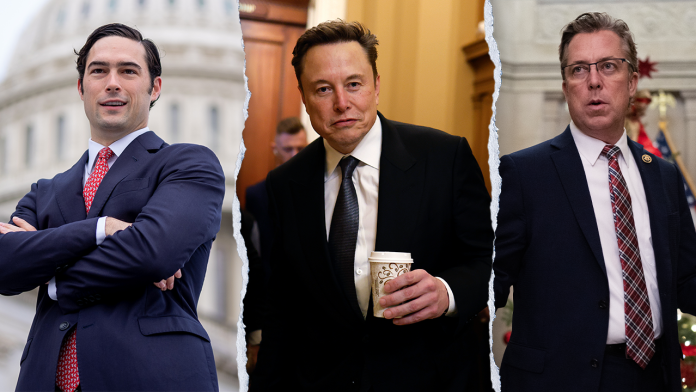
Reps. Brandon Gill, left, and Andy Ogles, right, are among those who want to see Elon Musk and President Trump audit or roll back the Department of Education. (Getty)

But most coalesced around the Department of Education as a worthy next target, amid rumors that Trump could soon sign an executive order dismantling the Cabinet agency.

“In order to get buy in, you could eliminate the Department of Education, but you would take at least a portion of the money and give it back to the states in the form of block grants or something like that,” Biggs suggested.

Freshman Rep. Brandon Gill, R-Texas, said, “I think we need to get rid of the Department of Education. We need to get rid of the ATF. I’ve co-sponsored bills to do that for both of those.”

He said the Department of Education was a “good place to start,” accusing it of sinking millions of taxpayer dollars into diversity, equity, and inclusion (DEI) efforts and other progressive causes.

Donald Trump smiles in a navy suit and red tie

President Donald Trump is expected to sign an executive order eliminating the Department of Education. (Evan Vucci/AP)

“I mean, the American people are sick of funding left-wing activism with their taxpayer dollars,” Gill said.

Conservatives have long been critical of the Cabinet department, which first opened its doors in 1980 after President Jimmy Carter split it off from what is now the Department of Health and Human Services.

“Education Department should’ve been gone or reined in a long time ago,” said Rep. Ralph Norman, R-S.C. 

He said he hoped Musk would “put a dollar tag on it, trace the money, where it’s going.”

A bill introduced by Rep. Thomas Massie, R-Ky., this week to eliminate the Department of Education already has 30 House GOP co-signers.

BLACK CAUCUS CHAIR ACCUSES TRUMP OF ‘PURGE’ OF ‘MINORITY’ FEDERAL WORKERS

Rep. Thomas Massie

Rep. Thomas Massie reintroduced his bill this week to eliminate the Department of Education. (Tom Williams/CQ-Roll Call, Inc via Getty Images)

Meanwhile, Speaker Mike Johnson, R-La., suggested on Wednesday there was an appetite for Congress to back up Trump if he follows through with an executive order on the department.

CLICK HERE TO GET THE FOX NEWS APP

“The teachers unions will viciously fight, of course, any idea of disbanding the federal Department of Education. But I think the principle is one whose time has come. We’ve all seen the ratings. I mean, the U.S. is falling far behind other countries because the system is not working,” Johnson said in response to a question by Fox News Digital.

The speaker stressed that further details were necessary, but added, “You’re going to see a lot of support among House and I think Senate Republicans, for the general idea of pushing the decisions down, back down to the local level. I think that’s something that would serve us all well.”