Thursday, November 12, 2026
Home Blog Page 293

Trump’s Tariffs Would Reverse Decades of Integration Between U.S. and Mexico

0

When Dennis Nixon started working at a regional bank in Laredo, Texas, in 1975, there was just a trickle of trade across the border with Mexico. Now, nearly a billion dollars of commerce and more than 15,000 trucks roll over the line every day just a quarter mile from his office, binding the economies of the United States and Mexico together.

Laredo is America’s busiest port, and a conduit for car parts, gasoline, avocados and computers. “You cannot pick it apart anymore,” Mr. Nixon said of the U.S. and Mexican economies. Thirty years of economic integration under a free trade deal has created “interdependencies and relationships that you don’t always understand and measure, until something goes wrong,” he said.

Now that something is looming: 25 percent tariffs on Mexican products, which President Trump plans to impose on Saturday as he looks to pressure the Mexican government to do more to curb illegal immigration. Mr. Trump is also expected to hit Canada with 25 percent levies and impose a 10 percent tax on Chinese imports.

A longtime proponent of tariffs and a critic of free trade deals, Mr. Trump seems unafraid to upend America’s closest economic relationships. He is focusing on strengthening the border against illegal immigration and the flow of fentanyl, two areas that he spoke about often during his 2024 campaign.

But the president has other beefs with Mexico, including the economic competition it poses for U.S. workers. The president and his supporters believe that imports of cars and steel from Mexico are weakening U.S. manufacturers. And they say the United States-Mexico-Canada Agreement, the trade deal Mr. Trump signed in 2020 to replace the North American Free Trade Agreement, needs to be updated — or perhaps, in some minds, scrapped.

Many businesses say ties between the countries run deeper than most Americans realize, and policies like tariffs that seek to sever them would be painful. Of all the world’s major economic partners, the United States and Mexico are among the most integrated — linked by business, trade, tourism, familial ties, remittances and culture. It’s a closeness that at times generates discontent and efforts to distance the relationship, but also brings many benefits.

“Our countries have a symbiotic relationship,” said Juan Carlos Rodríguez, managing director in Tijuana for Cushman & Wakefield, one of the world’s biggest commercial real estate companies.

“Our economies are so intertwined that it would take decades to decouple,” Mr. Rodríguez said. “Such a scenario would have a catastrophic impact on Mexico.”

Mexico’s immense reliance on trade with the United States dates back at least to the 1960s, when manufacturers began opening factories just across the border as a response to climbing labor costs in the United States and Japan.

Trade picked up when NAFTA took effect in 1994. For many Americans, that trade pact is now synonymous with offshoring and decimated factory towns. But economists calculate that many parts of the United States benefited as the agreement increased trade and economic activity.

Other parts of the United States were severely hurt as manufacturers moved to Mexico in search of cheaper labor. As factory towns hollowed out, that ended up fueling a trade backlash, helping pave the way for anti-trade candidates like Mr. Trump to win office.

In an interview, Peter Navarro, the president’s senior counselor for trade and manufacturing, called NAFTA a “catastrophe” and bad for both Mexico and the United States.

“The fact of the matter is China was so much worse that people tend to forget how bad NAFTA was,” he said.

In his first term, Mr. Trump threatened tariffs on Mexico over border issues, but instead settled for a deal. He also repeatedly threatened to withdraw from NAFTA, but instead decided to renegotiate it. His advisers added provisions to the pact they believed would bolster U.S. steel and auto manufacturing, but some now say they have fallen short.

Since Mr. Trump was last in the White House, Mexico’s importance to the U.S. economy has grown. The Covid-19 pandemic disrupted global supply chains and started a “nearshoring” boom.

Companies were already looking to move out of China, to avoid tariffs Mr. Trump imposed there, as well as rising costs and political risk. Manufacturers rushed to open plants in Mexico, seizing on the country’s low-cost industrial base and proximity to the United States.

Those changes helped make Mexico the United States’ top trading partner in goods in 2023. As trade between the countries has expanded, so has the bilateral trade deficit with Mexico, a metric that Mr. Trump is particularly focused on.

American consumers may be as reliant on foreign products as ever. But economists argue that imports from Mexico can have quite different implications for the U.S. economy than imports from China.

That’s because there are many integrated supply chains that run back and forth across North American borders. Goods like cars, electronics and bluejeans are volleyed back and forth among the United States, Mexico and Canada as they are turned from raw materials into parts and then final products.

According to economists at S&P Global, of the imports coming into the United States from Canada and Mexico, more than 18 percent of their value was created in the United States, before being sent to those countries. That’s far more than the proportion for other countries, and a sign of how closely the economies are integrated.

Proximity creates other benefits: Research by the Federal Reserve Bank of Dallas has found that a 10 percent increase in factory output in Ciudad Juárez, Mexico, leads to a 2.8 increase in total employment in El Paso, Texas, concentrated in areas like transportation, retail and real estate.

“There’s this perception that the border is all about walls and illegal crossings,” said Diego Solórzano, the founder of Desteia, which helps companies making supply chain decisions. “This line in the sand is actually the most powerful economic corridor on Earth.”

Roughly $800 billion worth of goods were transported across the border last year, Mr. Solórzano said, an amount that would position the U.S.-Mexico border in striking distance of the world’s 20 largest economies.

The two economies rely on each other for their energy needs. Mexico, which depends on the United States for an estimated 70 percent of its natural gas consumption, is more vulnerable to any disruptions.

But the United States also imports about 700,000 barrels of crude oil a day from Mexico. Imposing import taxes on such cargoes could produce increases in fuel prices, particularly diesel, energy analysts warn.

Food production is also closely integrated. Mexico supplies roughly half of America’s fresh fruit and vegetables, and that proportion rises in winter months. Mexico also emerged last year as the top market for American agricultural exports, totaling $30 billion.

Bob Hemesath, a fifth-generation farmer in northeastern Iowa, said that Mexico was the biggest buyer of American corn and also a big purchaser of hogs, both of which he produces.

Tariffs would “put an added cost on a product that doesn’t need to be there, and it’ll drive those countries to go look somewhere else,” Mr. Hemesath said. He spoke by phone from his farm on an unseasonably warm day, where he had just finished power-washing a hog facility.

“It puts me as a farmer at an economic disadvantage,” he said. “Although I understand wanting to use tariffs as a negotiating tool, what harm do you do?”

Some Trump officials think corn exports haven’t been entirely benign. Mr. Navarro said that NAFTA had kick-started America’s illegal immigration problem, because when the United States began exporting corn to Mexico after the trade pact took effect, that put Mexican agricultural workers out of jobs, sending some of them into the United States.

“That’s where that began, our illegal immigration problem,” he said.

Mr. Trump and his supporters have other criticisms of the United States-Mexico relationship. Some argue that Mexico has violated the terms of an agreement it made to limit its steel exports to the United States. They say Mexican shipments of steel to the United States have exceeded the levels set by that agreement, which was signed alongside the U.S.M.C.A.

(The Mexican steel industry has its own complaints. On Tuesday, Canacero, a Mexican steel organization, claimed in a statement that it had seen a significant surge in exports of finished steel products from the United States that did not comply with the agreement.)

There are also growing concerns about Mexico’s trade with China, particularly in the auto sector. Chinese car exports to Mexico have soared, and some Chinese car companies have been scouting for Mexican factory sites.

That has fueled concerns that Chinese companies will use Mexico as a jumping off point to export to the U.S. market at much lower tariff rates than if they were shipping goods from China.

Brad Setser, an economist at the Council on Foreign Relations, said that Mexico’s role as a conduit for Chinese goods to the United States had been overstated, but that “there absolutely is an issue in the autos sector.” One out of three cars sold in Mexico last year came from China, he said. That means Chinese exports are now meeting Mexican demand for cars, rather than exports from the United States, a blow to the U.S. auto industry.

Other business owners argue that the United States and Mexico should work together to limit imports from China — but say that doesn’t call for high tariffs on Mexican products.

Greg Owens, the chief executive of Sherrill Manufacturing, a flatware manufacturer in Sherrill, N.Y., said he would like to see tariffs structured in a way that inhibits China from using Mexico as a back door to the United States. But he opposes putting tariffs on Mexico outright, saying China is a much larger threat.

“China packing up a flatware factory in Guangzhou, setting up shop in Mexico just to circumvent tariffs — that needs to be dealt with,” he said. “But you can’t destroy your trade relationship with Mexico.”

Week in politics: Trump's tariffs and other executive actions

0

President Trump is fulfilling an often-repeated campaign promise to impose tariffs on Mexico and Canada, while also issuing a flurry of executive actions bypassing Congress.

FDA classifies chocolate recall to the most serious level

0

The Food and Drug Administration has reclassified a recall of chocolate products to its most serious level. 

On Dec. 12, 2024, the Cal Yee Farm LLC of Suisun Valley, California, issued a recall for several of its chocolate and yogurt-covered products, as well as its trail mix and toffee, due to undeclared allergens. 

“People who have an allergy or severe sensitivity to milk, soy, wheat, sesame, FD&C #6 and almonds run the risk of serious or life-threatening allergic reaction if they consume these products,” according to a release from Cal Yee Farm that was published on the FDA’s website at the time.

WALMART RECALLS OVER 12,000 CARTONS OF CHICKEN BROTH IN 9 STATES

The products were sold in nine states — California, Arizona, Virginia, New Mexico, Texas, Tennessee, Oregon, Ohio and Pennsylvania — the release said. 

The company also operates an online store. 

The FDA has now designated a recall of chocolates at the “Class I” level.  (REUTERS/Andrew Kelly/File Photo)

In the Jan. 29 weekly enforcement report, the FDA classified the recall of eight Cal Yee Farm products as a “Class I” designation.

A “Class I” recall is “a situation in which there is a reasonable probability that the use of, or exposure to, a violative product will cause serious adverse health consequences or death,” according to the FDA’s website. 

THIS AMOUNT OF DARK CHOCOLATE DAILY COULD REDUCE DIABETES RISK, STUDY FINDS

These eight products involved are:

  • Cal Yee’s Dark Chocolate Almonds
  • Cal Yee’s Tropical Trail Mix (assorted nuts and dried fruits)
  • Cal Yee’s Cajun Sesame Hot Sticks
  • Cal Yee’s New Orleans Hot Mix
  • Cal Yee’s Dark Chocolate Raisins
  • Cal Yee Farm Dark Chocolate Apricots
  • Cal Yee’s Yogurt Coated Almonds
  • Cal Yee’s Dark Chocolate Walnuts
Stack of almonds dipped in milk chocolate.

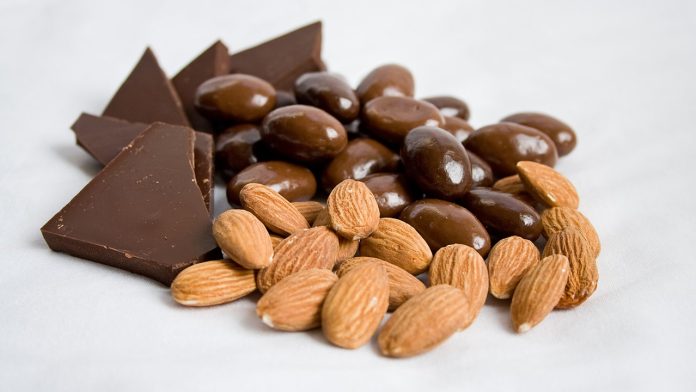
The chocolate-covered almonds from the company (not pictured) were recalled due to the presence of an undeclared allergen.  (iStock)

All but the Cal Yee’s Cajun Sesame Hot Sticks and New Orleans Hot Mix products were recalled due to undeclared milk. 

The Cajun Sesame Hot Sticks and New Orleans Hot Mix were both recalled due to undeclared wheat and soybean oil, the FDA’s website said.

For more Lifestyle articles, visit www.foxnews.com/lifestyle

Two fruit basket products, various butter toffee products and a mango with chili product that were part of the initial recall announcement were not included in the FDA’s most recent enforcement report and have not been classified. 

CLICK HERE TO SIGN UP FOR OUR LIFESTYLE NEWSLETTER

No illnesses related to the candies have been reported, the FDA’s website said.

Dark chocolate pieces, almonds and dark & milk chocolate covered almonds.

The recalled products (not pictured) were sold in nine states as well as online.  (iStock)

“The recall was initiated after an FDA inspection of our facility where it was discovered that products containing milk, soy, wheat, sesame, FD&C #6 and almonds were distributed in packaging that did not reveal the presence of milk, soy, wheat, sesame, FD&C #6 and almonds,” said a release from Cal Yee Farm that was published by the FDA. 

CLICK HERE TO GET THE FOX NEWS APP

Those with allergies to those foods and who believe they might have the recalled products “should not consume the product and should dispose of them or return them to us for a full refund,” the release said. 

American-Israeli Hostage Is Released Under Truce Deal

0

Hamas has included an American-Israeli in its hostage releases for the first time since the militant group’s cease-fire agreement with Israel came into effect two weeks ago.

On Saturday, Hamas handed the hostage, Keith Siegel, over to the Red Cross at a ceremony in Gaza City, with dozens of rifle-wielding militants standing nearby.

Mr. Siegel, 65, and his wife, Aviva Siegel, 63, were abducted in the Hamas-led attack on Israel on Oct. 7, 2023. They were taken from Kibbutz Kfar Aza, a small farming community near Israel’s border with Gaza.

Palestinian militants released his wife, Aviva, during a short-lived cease-fire in November 2023, and she has since been campaigning for her husband’s freedom.

Mr. Siegel, a North Carolina native, immigrated in 1980 to Israel, where he has worked as an occupational therapist. He and his wife have nine children and grandchildren.

In June, Mr. Siegel’s brother, Lee Siegel, described the agony of watching rounds of cease-fire talks, only to have his hopes be dashed days later.

“It’s incredibly frustrating to have this yo-yo experience once again,” Lee said at the time. “Every day that goes by, it becomes exponentially more difficult to continue with hope.”

The current cease-fire was reached after more than a year of indirect negotiations between Israel and Hamas.

On Saturday, Leora Schwartz, Lee’s sister-in law, said she felt some relief in seeing Keith walk out of captivity.

“You feel like you can breathe again,” she said in a phone interview.

The Israeli authorities have said they believe that only two other American-Israeli hostages are still living. One is due to be freed in the coming four weeks, and the other in the second phase of the cease-fire.

The Israeli authorities have said they believe that Palestinians militants in Gaza are holding four bodies of dual American-Israeli citizens.

Hamas and Israel have not yet negotiated the details of the second phase of the cease-fire, but those talks are expected to start in the coming days.

Relatives of hostages scheduled to come out in the second phase have expressed concerns that Israel could return to war against Hamas after the first phase if the militant group does not agree to give up its control over Gaza. They worry that such a scenario could endanger their loved ones.

How this key senator decided to back Hegseth after last-minute allegations

0

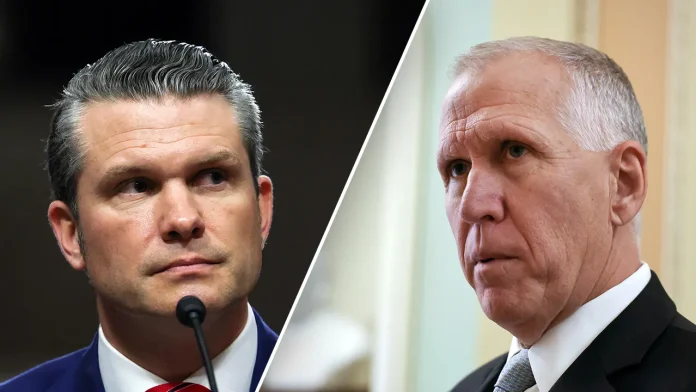
FIRST ON FOX: Sen. Thom Tillis, R-N.C., whose vote cemented Defense Secretary Pete Hegseth’s confirmation last month, opened up about the effort to corroborate last-minute allegations against President Donald Trump’s nominee.

“Anytime you have an allegation and somebody is willing to put it in sworn testimony, you owe it to the process to review it and not just dispose it out of hand,” the North Carolina Republican told Fox News Digital in an interview. 

“And that’s exactly what I did. And then I arrived at the conclusion that I’d support Pete’s nomination”

DEMS DISMISS CALLS FOR APOLOGY AFTER JEFFRIES VOWS ‘FIGHT’ AGAINST TRUMP AGENDA ‘IN THE STREETS’

In an interview with Fox News Digital, Sen. Thom Tillis walked through his thought process in the hours leading up to Defense Secretary Pete Hegseth’s confirmation vote. (Reuters)

Hegseth was confirmed after a tie-breaking vote from Vice President JD Vance, making the final margin 51-50. 

Three Republicans — senators Mitch McConnell, R-Ky., Susan Collins, R-Maine, and Lisa Murkowski, R-Alaska, voted against Hegseth.

Given the Republican conference’s 53-seat majority, nominees can only afford to lose three votes, assuming all Democrats are opposed and each senator is in attendance. 

ELIZABETH WARREN GRILLED RFK JR. ON DRUG COMPANY MONEY, BUT RECEIVED OVER $5M FROM HEALTH INDUSTRY

Tillis’ decision on whether to back Hegseth was not disclosed until minutes before he cast his vote. If he became the fourth Republican to oppose Hegseth, the confirmation would have failed. 

The senator asked Hegseth several additional questions after the new allegations surfaced and the hours until his confirmation vote wound down. 

The nominee’s response letter, which proved to be to Tillis’ satisfaction, was shared on X by Hegseth during the vote. 

Speaking on the subject with Fox News Digital, the senator explained he had “developed a reputation for completing due diligence” and that he takes his role seriously. 

According to Tillis, he agreed to speak with Hegseth’s former sister-in-law, Danielle, before she filed a sworn affidavit alleging that he made his ex-wife Samantha fear for her safety, in addition to claims of alcohol abuse.

‘OVERDOSE EPIDEMIC’: BIPARTISAN SENATORS TARGET FENTANYL CLASSIFICATION AS LAPSE APPROACHES

Danielle is not the sister of Hegseth’s ex-wife. She is the former wife of his brother. 

The call between the senator and Danielle was about “what conceptually would be in the affidavit,” Tillis said.

“And I said, ‘If that’s true, and it could be corroborated, then it would carry weight,'” Tillis recalled. 

However, he said the lack of corroboration left the allegations without credibility. 

“I could never speak directly to a person who could corroborate the testimony of one person,” he said. 

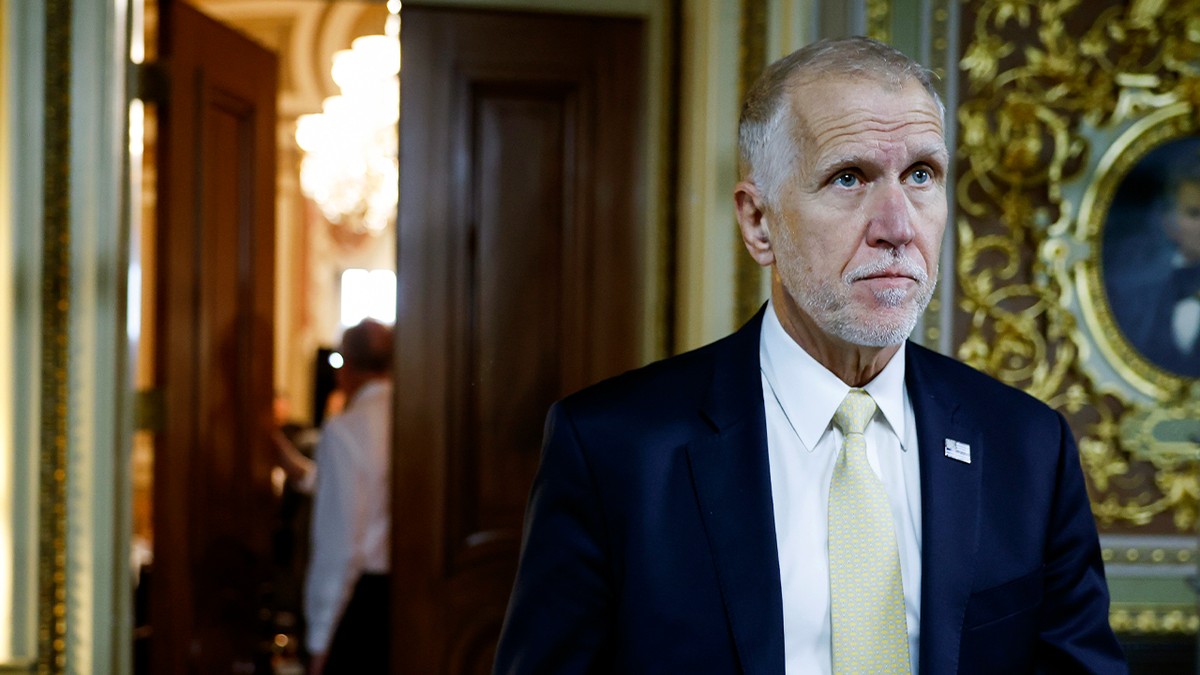
Sen. Thom Tillis

Tillis cemented Hegseth’s confirmation with his vote. (Anna Moneymaker/Getty Images)

After Hegseth’s confirmation, it was reported that sources said Tillis had “personally assured” Danielle that if she provided the affidavit, it would be significant and might persuade Republicans to oppose the defense secretary nominee, according to The Wall Street Journal. 

Asked about the report, Tillis emphasized that he gave the caveat that it must be corroborated in his conversation with Danielle. 

“Corroboration means at least two people have to be involved, and they have to be involved in the event, not a bystander. And I was unable to. I attempted to do it, but I was unable to get to that point. And, therefore, I had to make the same judgment that I did with the other allegations,” he explained. 

TENSION BUILDS AROUND TULSI GABBARD’S CONFIRMATION WITH KEY GOP SENATORS UNDECIDED

Hegseth outside the Pentagon with joint chief of staff

Hegseth was sworn in shortly after being confirmed.  (AP Photo/Kevin Wolf)

Tillis wouldn’t divulge whether Danielle or her attorney suggested she had been a witness to the alleged events. 

CLICK HERE TO GET THE FOX NEWS APP

“I’m not going to get into those discussions because I do know that my conversation was leaked a couple of hours after I had it on Sunday. Clearly, I would have no reason to do it. But I don’t leak private conversations. I don’t even discuss them at any level of detail,” he said.

Multiple requests for comment to Danielle’s attorney, Leita Walker, from Fox News Digital went unanswered. 

Renewed Resolve

0

On the first day of February, consider a monthly intention-setting ritual, even if you think you don’t have a minute to spare.

Eaton, Palisades fires in Southern California 100% contained, officials say

0

Join Fox News for access to this content

You have reached your maximum number of articles. Log in or create an account FREE of charge to continue reading.

By entering your email and pushing continue, you are agreeing to Fox News’ Terms of Use and Privacy Policy, which includes our Notice of Financial Incentive.

Please enter a valid email address.

The Palisades Fire and Eaton Fire that burned a total of nearly 40,000 acres in the Los Angeles area have been 100% contained, fire officials said on Friday.

The Palisades Fire burned 23,448 acres on the west side of Los Angeles and the Eaton Fire set 14,201 acres ablaze starting on Jan. 7, according to the California Department of Forestry and Fire Protection.

The two major fires and several smaller ones created the worst natural disaster in Los Angeles County history, killing 28 people and damaging or destroying more than 16,000 structures, Cal Fire said.

CALIFORNIA MAN PLEADS GUILTY AFTER HIS DRONE COLLIDES WITH AIRCRAFT FIGHTING PALISADES FIRE

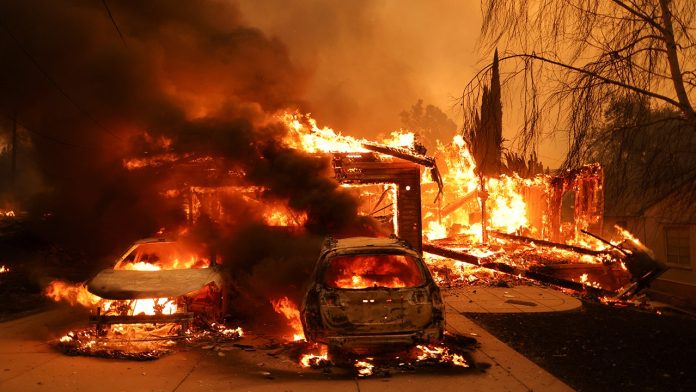
Vehicles and a house burn as powerful winds fueling devastating wildfires in the Los Angeles area force people to evacuate, at the Eaton Fire in Altadena, California, U.S. January 8, 2025.  (REUTERS/David Swanson)

At the height of the fires, 180,000 people were under evacuation orders, according to Los Angeles County officials.

Damage and economic losses are estimated at more than $250 billion, according to private forecaster AccuWeather.

Rain finally fell in Southern California in the past week, which aided firefighters in containing the fires but also increased the risk of flash floods and mudslides in the hills and the spread of toxic material left behind in the fire’s devastation.

Powerful Winds Fuel Multiple Fires Across Los Angeles Area

A view of homes destroyed by the Eaton Fire on January 9, 2025, in Altadena, California. (Justin Sullivan/Getty Images)

Full containment is largely symbolic at this point as fires still remain isolated in steep mountain terrain, fire officials said.

“It’s more important when we say forward progress is stopped,” Los Angeles Fire Department spokesperson Margaret Stewart told Reuters.

Progress was stopped about a week after the Palisades and Eaton fires swept through the region.

LOS ANGELES AGENCY REVEALS ESTIMATED ECONOMIC IMPACT OF DEADLY WILDFIRES AS INFERNOS STILL RAGE

plane drops water on palisades fire

A Super Scooper plane drops water on the Palisades fire on Tuesday, Jan. 7, 2025, in Pacific Palisades, California. (Brian van der Brug / Los Angeles Times via Getty Images)

CLICK HERE TO GET THE FOX NEWS APP

Stewart said the rain was “more of a hindrance” because it led to mudslides and blocked roads first responders needed to access.

“Had this rain come two weeks ago, it might have been more helpful,” Stewart said.

Reuters contributed to this report.

Life After a Rebel Takeover

0

After a week of fighting, rebels backed by Rwanda have wrested almost full control over Goma, a city of two million in the eastern Democratic Republic of Congo.

Hospitals are overflowing with the wounded, and the city morgue with the dead. Goma’s residents are beginning to emerge from their hiding places, desperately searching for water and food. And the Congolese military that was supposed to protect them has been vanquished.

On Thursday, in a yard outside Goma’s biggest stadium, rebels with the Rwanda-backed M23 militia loaded more than 1,000 soldiers they had captured into truck beds, where the men stood packed together. Most wore the uniforms they were captured in. Many of them were furious.

But the curses they spat were not directed at their captors; rather, at Felix Tshisekedi, the Congolese president, whom they accused of selling them out, and at the military commanders who had abandoned them. Their commanders, together with government officials, had left behind their vehicles, seen in videos and photographs, and boarded boats in the early hours of Monday morning as M23 arrived in the city, escaping across a moonlit lake while leaving their men to fight alone.

Many of the soldiers in the trucks had fought on, alongside armed groups known locally as the Wazalendo. But no reinforcements had been sent.

“Tshisekedi will pay for this,” one soldier shouted.

“We’ll capture him with our own hands,” another said.

“God will pay him back,” yelled another.

A commander of the 231st infantry battalion of the Congolese Army — known by its French acronym, F.A.R.D.C. — climbed down from the cabin of one of the trucks, where his seniority had earned him a comfortable spot. The captured commander, Lt. Col. John Asegi, explained that they had no choice but to surrender. M23 was taking them somewhere to give them some training, he said, adding that they would now do whatever their new masters commanded.

“If we are sent to fight the F.A.R.D.C.,” he said, “we will fight the F.A.R.D.C.”

As the M23 rebels strode around the yard preparing for the trucks’ departure, they looked more like an army with their rocket-propelled grenades, fatigues and helmets, while the Congolese soldiers looked like a tired, ragtag rebel group.

The rebels, who already control vast tracts of mineral-rich Congo, have said they plan to march to the capital, Kinshasa, nearly a thousand miles to the west, and take over the whole country.

The rebels had already handed over to Rwanda hundreds of captured Romanian mercenaries who had been fighting alongside Congolese forces.

Hundreds of civilians stood around the trucks full of soldiers, watching this reversal of roles, and getting a good look at the men who were now in charge. A dozen women and children were crying inconsolably, having just spotted their husbands and fathers among the men in the trucks.

“I don’t know where they’re taking him to,” wept Marie Sifa, who had a baby girl on her back and three other children in tow. She was from Fizi, 270 miles south of Goma, she said, and she lost everything in the attack on Minova last week. They sought shelter in a school, but they could not stay.

“We have been chased out of the school,” Ms. Sifa said, crying as if she were in mourning. “How will I survive? How will I get these children back to Fizi?”

Later on Thursday, a rebel leader, Corneille Nangaa, gave Goma’s citizens a taste of their new reality under the powerful militia — which some experts say counts 6,000 troops in eastern Congo, backed by up to 4,000 Rwandan troops.

“Go back to normal activities,” Mr. Nangaa told Goma’s residents at a two-hour news conference at a local hotel. He was flanked by men in helmets and battle gear.

But the situation in Goma, a city built around black lava streams from a nearby live volcano, is far from normal.

Dead bodies lie in the streets. Stores, supermarkets, and humanitarian agencies’ warehouses have been looted. Cholera is breaking out. People with bullet wounds — those who survived — are finally managing to get to clinics for treatment, only to find a lack of medicine and of surgical staff.

And many families who were split up as they fled have yet to find each other.

Elysée Mopanda lost track of her two children in the chaos. The rebels were holding her husband, a soldier, prisoner. The events of the past week had left her family in ruins.

“I don’t know where to go,” she said.

Wounded, harrowed, hungry, thirsty or lost, many of Goma’s residents are in an extremely precarious situation.

Most vulnerable is Goma’s displaced population, which numbers in the hundreds of thousands.

For more than a year, people have fled the rebel advance through eastern Congo’s countryside and small towns, seeking refuge in and around Goma, in sprawling, unsanitary camps that are particularly dangerous for women and girls.

As M23 closed in on these camps last week, thousands of people who had been barely surviving there fled the clashes, carrying the little they had on their heads toward Goma, which would itself soon be overtaken.

Three families who fled one of the camps just outside Goma hid in an educational center, surviving on some beans and rice they were given.

Without that kindness, “I don’t know how we would have survived,” said Furaha Kabasele, a 34-year-old mother whose youngest child is only 5 months old.

They did survive this perilous week. But they have no idea what they will do now.

For many, the most pressing need is water. The city’s water supply, as well as its power and internet, was cut during the battle for Goma, and those who had managed to save some watched it dwindle over the week. Those who had no water tried to beg it from those who did, or paid a hawker as much as $5.20 for a jerrycan that usually costs 20 cents.

As the fighting subsided, hundreds of people have ventured to the edge of Lake Kivu to collect water, adding a little chlorine to try to keep waterborne diseases at bay.

One of those fetching water on Thursday morning was Tailor Mukendi, 13, who carried two stained yellow jerrycans to the lakeshore, took off his flip-flops, and plunged into the shimmering lake. As the fighting blazed, his family had run out of water to drink.

“We couldn’t leave the house because of the gunshots and the bombs falling,” he said.

He filled the cans, and struggled to lug them out of the lake.

Can Trump’s 2nd act work for the working class while giving back to his super donors? : NPR

0

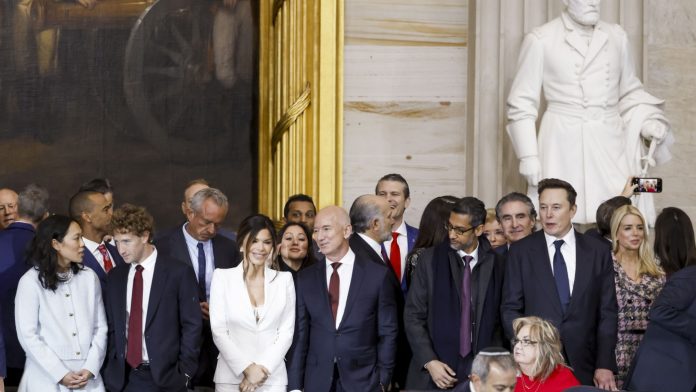
Priscilla Chan, Meta CEO Mark Zuckerberg, Lauren Sanchez, businessman Jeff Bezos , Alphabet’s CEO Sundar Pichai and businessman Elon Musk, among other dignitaries, attend the United States Capitol on Jan. 20.

Shawn Thew/Pool/Getty Images


hide caption

toggle caption

Shawn Thew/Pool/Getty Images

It has long been said that politics “makes strange bedfellows,” but some such alliances are surely stranger than others.

Take, for example, the emerging collaboration of working-class voters with the very, very wealthy in America who have increasingly allied themselves with President Trump.

Who could fail to see a row of billionaires — including Amazon’s Jeff Bezos, Tesla’s Elon Musk and Meta’s Mark Zuckerberg – invited to sit with the new president’s Cabinet appointees in the Capitol at the inauguration ceremony? Yet network exit polls tell us Trump’s share of the popular vote in 2024 was higher among those with household income of less than $50,000 than among those whose households made more. Among voters with household income above $100,000 Democratic nominee Kamala Harris won rather easily.

Historically, this is beyond anomalous. Household income has been strongly correlated with party preference for generations with the higher income groups tending to be more Republican. “Rich versus poor” has been as common a narrative as North versus South, Protestant versus Catholic or urban versus rural.

But today we are confronted with an alliance between those whom political scientists might call plutocrats and those who are increasingly labeled populists. The contrast is stark, but the symbiosis is unmistakable. And we all await the outcome as the populist in Trump tries to co-exist with his newfound ally Musk, the world’s richest man with abundant clout in the new administration.

Going back to even during colonial times, some writers used plutocrat to describe wealthy men who entered politics to protect their fortunes and those of their class. Where their influence prevailed, the result was sometimes called plutocracy, or the rule of the rich. (Today, it might be closer to rule by the richest.) It comes from the Roman god Pluto, lord of the underworld and the hidden wealth of the Earth, and as that derivation suggests, it has been an epithet associated not just with privilege but with unfair advantage and exploitation.

Far more common and more eagerly embraced is the term populist, which has historically attached to advocates for ordinary farmers and wage earners. Populism has pressed the claims of the less powerful against those of the landowners, the financiers, the industrialists and other species of elite. In successive eras of cartoons and caricature, it has been the “little guy” against the “fat cats.”

President Donald Trump, beneath a portrait of populist President Andrew Jackson, speaks at the White House on Feb. 1, 2017.

President Donald Trump, beneath a portrait of populist President Andrew Jackson, speaks at the White House on Feb. 1, 2017.

Pool/Getty Images


hide caption

toggle caption

Pool/Getty Images

Trump has shown a certain affinity with, and owes a clear debt to, many of the little guys — what he called in 2017 “the forgotten men and women.” But he also has shown a certain affinity with and owes an enormous debt to some of the fattest cats of all. Musk alone has been reported to have directed $250 million to the Trump cause during the campaign. How will he and other ultra-wealthy business figures mesh with the Trump who made a show of working a shift at a McDonald’s last fall?

Big names from class struggles past

Presidents Theodore Roosevelt and Franklin D. Roosevelt, both scions of an old and prosperous Dutch dynasty in New York, enlarged their vision and political prospects by transcending allegiance to their economic caste. The former Roosevelt warned of “malefactors of great wealth” and the latter drove the moneyed classes to distraction with his Depression-era New Deal and his challenge to their hegemony. (“I welcome their hatred,” he proclaimed to the Democratic National Convention that renominated him in 1936.)

Neither Roosevelt cared that much for the term populist, associated as it was in the early 1900s with smaller and primarily rural movements. The high point for those movements had come in 1896, when an orator named William Jennings Bryan gave a speech at the Democratic National Convention condemning the gold standard for setting the value of the currency. Bryan and like-minded figures wanted to use silver as well, making it easier for farmers and others to pay their debts to banks.

That “Cross of Gold” speech carried him to the Democratic nomination that year and again in 1900 and 1908. But he lost each time. Bryan had briefly been a congressman from Nebraska but was far better known as a newspaper editorialist and a spell-binding speaker who addressed numerous crowds from makeshift stages on railroad cars.

Trump, too, entered politics from a background in the news and entertainment media of his era. And with his small town, egalitarian rallies and appeals to “the forgotten man and woman,” he has revived the term populism in the political lexicon and gone further with it than anyone since Bryan’s heyday.

Hickory Grant, a machinist and a member of the Forks town council, unfurls a Trump flag at his workshop in Forks, Wash., on Oct. 15, 2024 in Clallam County.

Hickory Grant, a machinist and a member of the Forks town council, unfurls a Trump flag at his workshop in Forks, Wash., on Oct. 15, 2024 in Clallam County.

Robyn Beck/AFP via Getty Images


hide caption

toggle caption

Robyn Beck/AFP via Getty Images

When Trump won his first nomination in 2016, he was competing for crossover voters with a candidate on the Democratic side, Vermont Sen. Bernie Sanders, who wowed big crowds by vowing to govern for “all the people” and “not just the 1%.” Sanders did well among working-class voters and in the most populous states but ultimately had fewer delegates at the 2016 national convention than Hillary Clinton. 

Meanwhile, Trump humbled a huge field of rivals on the Republican side that year, winning primaries and caucuses largely by energizing those who had not voted in recent election cycles. He was not another establishment-credentialed Republican and that was his secret weapon. When he won, his campaign strategist Steve Bannon compared it to Andrew Jackson’s frontier-bred uprising in 1828. Trump went on to hang a portrait of Jackson in the Oval Office.

Trump in his first term

But if Trump’s rapid rise as a Washington outsider recalled those of 19th century populists, Trump’s actual performance as president was quite different. In fact it had more in common with the record of President William McKinley, the Ohio Republican who defeated Bryan in 1896 and again in 1900 while defending the gold standard and representing the interests of business and industry.

Trump may recall Bryan’s magnetic power over his followers, but his policies seem quite consciously modeled on McKinley. In his most recent campaign, Trump lavished explicit praise on the “great” William McKinley and his protective tariffs, which Trump insists dictated terms to U.S. trading partners and made America rich.

 Although long out of fashion with most economists and blamed for trade wars and depressions, tariffs have retained a strong fascination for Trump.

McKinley was quite popular with the Republican Party of his day, dominated as it was by the ultra-rich railroad, financial and manufacturing interests of the “Gilded Age.” So it was almost eerie when Trump in his second inaugural address decreed that Alaska’s Mount Denali would again be officially Mount McKinley. The tallest peak in the U.S. had been Mount McKinley before President Obama changed the name to the one preferred by most Alaska native tribes. The timing of this latest switch is certainly notable given Trump wants to restore McKinley’s reliance on protective tariffs on imports as a means to replace income taxes and help make America great again.

McKinley’s time in office also included the Spanish-American War and the acquisition of colonial territories such as the Philippines and other islands. Trump referred to this idea in his second inaugural address as well, saying the U.S. “will once again consider itself a growing nation,” one that “expands our territory.” Trump has proposed such an expansion: adding Greenland and perhaps Canada – and part of Panama as well.

Trump improvises his own populist narrative

Trump had built his political following over a quarter century not as a champion of the economic elite from which he came – the son of a real estate mogul and product of private schools – but rather on familiarity to a media audience. He was a high-profile businessman and tabloid celebrity in Manhattan in the 1980s and 1990s. His first foray into presidential politics was made early in the 2000 cycle in what was called the Reform Party.

Donald Trump works behind the counter during a campaign event at McDonald's restaurant on Oct. 20, 2024 in Feasterville-Trevose, Pa.

Donald Trump works behind the counter during a campaign event at McDonald’s restaurant on Oct. 20, 2024 in Feasterville-Trevose, Pa.

Doug Mills/Pool/Getty Images


hide caption

toggle caption

Doug Mills/Pool/Getty Images

It was the creation of another businessman-candidate named Ross Perot, who ran two presidential campaigns in the 1990s. Perot was a billionaire when that term still inspired awe. But he campaigned as the independent voice of the common folk, stressing his plain Texan talk. He soared in the early polls in 1992, bringing out voters who made modest livings with less than a college degree and had felt unseen by most convention candidates for president.

When Perot decided not to run a third time in 2000 he turned over his movement to a wide assortment of unconventional candidates competing for his mantle. They included pro wrestler and Minnesota governor Jesse Ventura and, for a while, Trump himself. But it was not yet Trump’s time. He stepped back and conceded the field to Pat Buchanan, a former speechwriter for Richard Nixon who had become a media star on TV talk shows and then challenged the first President Bush for the GOP nomination in 1992. Buchanan’s campaign motto in 2000 was “America First.”

Trump became a media star in his own right with a primetime hit – the network TV “reality show” The Apprentice (and later The Celebrity Apprentice). Now known to a far wider audience, he used his fame and Twitter account to popularize a fringe theory about then-President Obama being foreign born and thus ineligible to be president. Even after Obama had released his official long-form birth certificate from Hawaii, Trump persisted in promoting the “birther” myth. He did not back off that claim until after he had become the official GOP nominee in the late summer of 2016, at which time he took credit for settling the controversy.

But Trump’s willingness to champion this and other fringe theories connected him to a hardcore of voters such as those who told pollsters they believed Obama was a Muslim throughout his tenure as president. Trump first broke out from the GOP pack late in 2015 after calling for a “complete ban” on Muslims entering the U.S.

The governing philosophy

Once in office, having surprised most political prognosticators and perhaps even himself, Trump in his first term pursued a relatively familiar list of Republican priorities. His main legislative achievement came in his first year with the passage of an enormous tax cut that was popular among Republicans generally but that greatly benefited high-income earners and holders of wealth. Of at least equal importance was his appointment of more than 300 federal judges, including three members of the Supreme Court. Joining with three conservatives already in place, these three were able to overturn the Roe v. Wade decision that established a right to abortion nationwide.

As Trump’s second term unfolds, the issues most likely to be vigorously pursued may be those where the interests of his populist base can be braided with those who sat in billionaire’s row on Inauguration Day. Here the renewal of the 2017 tax cuts is an area of commonality, as is the promise to shrink government. But conflicts could arise over other potent parts of the 2024 agenda. There was friction over H1-B work visas that Trump’s core populists consider anathema but that his backers in the tech world depend on. It was a battle between the Bannon and Musk wings of Trump’s movement.

But in a sense Trump needs both wings in order to accomplish not only the government changes he has proposed but the full measure of retribution he seems to want. Musk may have already made his main contribution with the super PAC that pumped a reported $250 million into the Republican effort in 2024. Or he may be a war chest unto himself as the next phases of political wars arrive.

We may only be at the beginning of an era in which certain political figures can serve what are plausibly called populist causes by calling on the resources of the ultra-rich.

‘Real Housewives’ star Luann de Lesseps says no salads after 6pm keeps her fit at 59

0

Join Fox News for access to this content

Plus special access to select articles and other premium content with your account – free of charge.

By entering your email and pushing continue, you are agreeing to Fox News’ Terms of Use and Privacy Policy, which includes our Notice of Financial Incentive.

Please enter a valid email address.

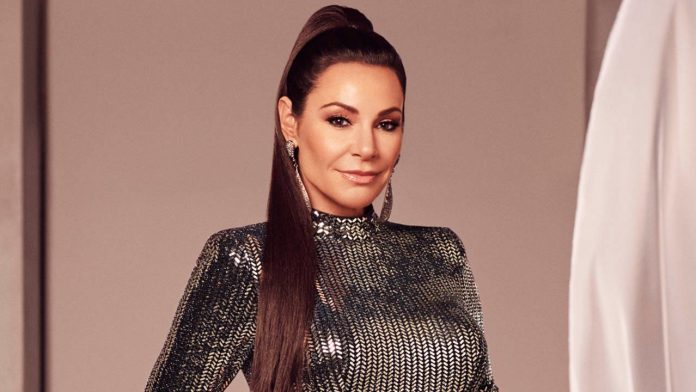
“Real Housewives of New York City” star Luann de Lesseps shared her surprising secrets for staying fit at 59.

During a recent interview with Fox News Digital, the TV personality and cabaret performer, who recently launched her new Countess Cabaret Tour, revealed her top three tips for maintaining a svelte physique.

“You should not drink while you eat,” de Lesseps said, citing health and wellness advice she received during stays at Austrian spas.

‘REAL HOUSEWIVES’ STAR LUANN DE LESSEPS EXPLAINS WHY SHE STARTED DRINKING AGAIN AFTER TOUTING SOBRIETY

“The Real Housewives of New York City” star Luann de Lesseps shared her secrets to staying in top shape at 59. (Sophy Holland/Bravo)

“People are drinking cold drinks while they eat. And what happens is digestion starts in the mouth. That’s why we salivate because, like when we’re hungry, you think — the burn — the digestive juices are already going. So, the most important thing is to chew a lot while you eat. Pay attention to that. And don’t drink while you’re eating.

“Europeans are thinner because they sip wine,” de Lesseps added. “They don’t drink big, cold drinks. That’s not their thing. And this is a very key thing in order to stay in good shape. Drink water 20 minutes before you eat or drink — whatever you want to drink. But 20 minutes before you eat and 20 minutes after. So, not while [eating] because it waters down your digestive enzymes and juices that metabolize your food.”

De Lesseps also advised people to practice portion control to avoid overeating and incorporate intermittent fasting into their diet regimens. 

WATCH: LUANN DE LESSEPS SHARES HER THREE ‘BIG TIPS’ FOR STAYING FIT 

“In America, we eat a lot. We get big portions. So, it’s about portion control as well,” she explained. “And eating slowly. And when you eat slowly, you don’t eat as much because it takes time for your brain to register that you have actually kind of had enough.

“So, it’s taking time to eat and taking your time and eating slowly and chewing well,” de Lesseps added. “And, this way, you feel satiated. And a lot of people just skip over that point and just eat everything.

“And, you know, listen, I’m guilty of the same thing sometimes,” she added. “But that’s how I stay fit.”

the real housewives of nyc season 5 cast

De Lesseps starred on “RHONYC” for 13 seasons. (Michael Rosenthal/Bravo/NBCU Photo Bank/NBCUniversal via Getty Images)

The TV personality told Fox News Digital she is an advocate for intermittent fasting, an increasingly popular diet method of time-restricted eating. 

“I love fasting,” de Lesseps said. “Intermittent fasting, which is you eat late in the morning and you try not to eat [after] 6 p.m. because digestion will wake you up during the middle of the night. Like, if you have a steak at night, you’re bound to wake up in the middle of the night because digestion needs energy, so it wakes you up.”

De Lesseps also advises against eating a dish commonly labeled as healthy after a certain time.

“Another tip I got for you — [eat] protein and salad for lunch, something like that, because salad you should not eat after really 6 p.m,” she said.  

“People think they’re eating — like they’re having a salad at night with their protein and all that, dressing, with parmesan cheese and croutons — and they’re like, ‘This is light.’ Well, the problem with salad is it’s 99% water. So, what is that doing? It’s watering down your digestion, just like if you had a drink.

‘REAL HOUSEWIVES’ STAR KYLE RICHARDS SAYS PHYSICAL CHANGES AFTER GIVING UP ALCOHOL ARE ‘INCENTIVE’ TO BE SOBER

“People are washing it down with drinks as well, so digestion’s out,” she added. “So, salad is a no-no after 6. Instead of that, cooked vegetables. Cooked vegetables have much more to give you than a salad ever will. Not to say that dark greens aren’t good for you. Arugula, spinach, iron filled with vitamins, but during the day. Or you make sautéed spinach at night, and you don’t have salad.”

luann de lesseps smiling in a green top

De Lesseps also encourages people to stay active. (Luann de Lesseps Instagram)

The Connecticut native explained that staying active is another step that people should take to reach their health goals.

“I’m a jock,” she said. “I love sports. So, I’m very active. I think being very active is one of the best things that you can do in order to stay fit.

“It can be water aerobics. It can be just a walk to get your metabolism going in the morning or SoulCycle, if you really want to kill it. I’m not a big SoulCycle person, but sometimes I do SoulCycle. But I just feel like you have to be physically active.

“So, those are big tips,” she added. “It’s really about digesting, the way you eat and just keep it moving.”

WATCH: ‘REAL HOUSEWIVES’ STAR LUANN DE LESSEPS SAYS NO SALADS AFTER 6PM KEEPS HER FIT AT 59

De Lesseps, who is an original cast member of “The Real Housewives of New York City” and appeared in 13 seasons of the hit Bravo series, made her cabaret debut in 2017 with her show “#CountessAndFriends.” De Lesseps became a countess after she married French Count Alexandre de Lesseps in 1993. 

The two divorced in 2009, and de Lesseps officially lost the title when she married Tom D’Agostino Jr. in 2016. 

De Lesseps’ cabaret show, which aired during the Season 10 finale of “RHONYC” and featured appearances by her “RHONYC” co-star Sonja Morgan and actress Rachel Dratch, became a hit with fans. 

After the success of her debut performance, de Lesseps launched her nationwide “#CountessAndFriends” tour. Last fall, she embarked on her “F Marry Kill” tour, which was directed by acclaimed Broadway director and producer Richard Jay-Alexander. 

In December, de Lesseps returned to the road for her “A Very Countess Christmas” tour. The reality star is now headlining her international Countess Cabaret tour, which kicked off Saturday at Harrah’s Lake Tahoe in Stateline, Nevada. For her latest tour, de Lesseps teamed up again with Jay-Alexander, who previously directed shows for Barbra Streisand, Bette Midler and Kristin Chenoweth. 

luann de lesseps in cabaret promo photo

De Lesseps is on her Countess Cabaret tour. (Mike Ruiz)

During all of her performances, de Lesseps wears ensembles pulled from the showroom of the fashion brand Jovani. De Lesseps and Jovani have a longtime partnership, and the prom dress retailer is a favorite with many of the other “Real Housewives.” 

In 2019, de Lesseps released her original song, “Feelin’ Jovani,” along with an accompanying music video starring herself, “Real Housewives of Atlanta‘s” Cynthia Bailey and “Real Housewives of Beverly Hills‘” Lisa Rinna. “The Real Housewives” executive producer and “Watch What Happens Live” host Andy Cohen also made a cameo appearance. 

the real housewives of new york city season 1 cast

De Lesseps is an original cast member of “RHONYC.” (Jay Sullivan/NBCU Photo Bank/NBCUniversal via Getty Images )

“Feelin’ Jovani” was de Lesseps’ fourth single after 2010’s “Money Can’t Buy You Class,” 2011’s “Chic C’est la Vie” and 2015’s “Girl Code.” In 2020, de Lesseps released her fifth song, “Viva La Diva,” which she co-produced with Grammy-winning songwriter and producer Desmond Child. 

During her interview with Fox News Digital, de Lesseps shared that her cabaret tour shows will feature performances of all her original songs along with covers of hits by famous artists, including Tina Turner and Stevie Nicks. 

LIKE WHAT YOU’RE READING? CLICK HERE FOR MORE ENTERTAINMENT NEWS

“What I enjoy most is the shock on people’s faces because they don’t know my cabaret show from watching the ‘Housewives’ because it’s always about the drama, because of music rights. Bravo was not paying for me to sing ‘What’s Love Got To Do [With It]?'” she said. “They’re not playing Tina Turner because that ain’t going to fly.

“I love the freedom I have with cabaret because I can do anything I want, say anything I want, sing anything I want.”

WATCH: ‘REAL HOUSEWIVES OF NEW YORK CITY’ STAR LUANN DE LESSEPS SAYS HER CABARET SHOW WAS INSPIRED BY FORMER CO-STARS

De Lesseps told Fox News Digital her songs were inspired by the friendships and feuds that she has had with her “Real Housewives” co-stars.

“Regardless of what those women have done to me over the years, cabaret? Life is not a cabaret. Well, it is for me because cabaret is my story that I write,” she said. “You know, it’s like life. You write your story. Nobody’s going to write your story for you. This is my story, right? And I think that they were always so jealous of the fact that I was successful at it.”

CLICK HERE TO SIGN UP FOR THE ENTERTAINMENT NEWSLETTER

“It’s like ‘Jovani, Jovani.’ I’m like, ‘Well, “Feelin’ Jovani.”’ That’s where it comes from,” de Lesseps continued. “So, I’m inspired by these women all the time to write music. I won’t tell you who ‘Money Can’t Buy Class’ is after. But I’m inspired by them all the time.

“All my music stems a lot from the ladies, from my experience on the show,” she added. “And then when people come to my show, they’re in for a real treat.”

luann de lesseps performing cabaret

De Lesseps made her cabaret debut in 2017. (Joseph Okpako/WireImage)

De Lesseps will also soon be seen again on the small screen. She is starring in the “Real Housewives” dating show spinoff series, “Love Hotel,” which will air on Peacock. De Lesseps filmed the show alongside “The Real Housewives of Orange County’s” Shannon Beador and “The Real Housewives of the Potomac’s” Gizelle Bryant and Ashley Darby.

CLICK HERE TO GET THE FOX NEWS APP

While de Lesseps told Fox News Digital she couldn’t reveal many details about “Love Hotel,” she said she was excited for fans to watch it.

“”It’s the first dating show for Bravo,” she said. “And we had a great time. I’m excited. I think people are going to love it. And it’s coming out in the spring, and so I’m super, super excited.”