

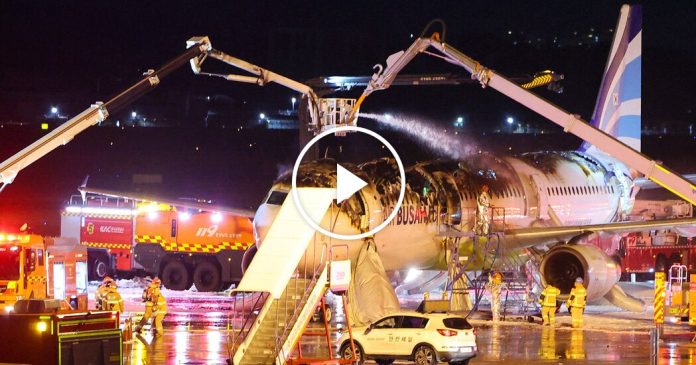
The Airbus A321 plane was engulfed in flames as it prepared to take off for Hong Kong from an airport in Busan, South Korea.
Army Black Hawk helicopter collides midair with American Airlines flight at Reagan National Airport
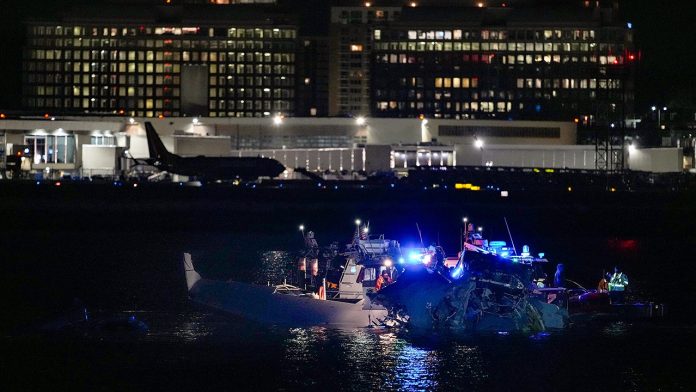
A massive search and rescue effort was underway after an Army Black Hawk helicopter collided midair with an American Airlines jet at Reagan National Airport in Arlington, Virginia on Wednesday evening.
According to the Federal Aviation Administration (FAA), a PSA Airlines Bombardier CRJ700 regional jet collided in midair with a Sikorsky H-60 helicopter while on approach to Runway 33 at Reagan National Airport (DCA) around 9 p.m. local time.
PSA was operating as Flight 5342 for American Airlines, and it departed from Wichita, Kansas. There was no immediate word on casualties or the cause of the collision.
White House press secretary Karoline Leavitt told Fox News’ Sean Hannity that President Donald Trump is aware of the situation, calling it tragic. Trump later released a statement, writing: “I have been fully briefed on the terrible accident which just took place at Reagan National Airport. May God Bless their souls. Thank you for the incredible work being done by our first responders. I am monitoring the situation and will provide more details as they arise.”
PLANE VEERS OFF AIRPORT RUNWAY IN SOUTH KOREA AND CRASHES, KILLING 179: REPORTS
Emergency response units assess airplane wreckage in the Potomac River near Ronald Reagan Washington Airport on January 30, 2025 in Arlington, Virginia. An American Airlines flight from Wichita, Kansas collided with a helicopter while approaching Ronald Reagan National Airport. (Andrew Harnik/Getty Images)
According to American Airlines, there were 60 passengers and four crew members on board the CRJ-700 aircraft.
“Our concern is for the passengers and crew on board the aircraft,” the airline said in a statement. “We are in contact with authorities and assisting with emergency response efforts.”
There were three soldiers on the helicopter at the time of the crash, according to an Army official.
“We can confirm that the aircraft involved in tonight’s incident was an Army UH-60 helicopter from Bravo Company, 12th Aviation Battalion, out of Davison Army Airfield, Fort Belvoir during a training flight,” the Army confirmed to Fox News Digital. “We are working with local officials and will provide additional information once it becomes available.”
The Sikorsky UH-60 Black Hawk is a four-blade, twin-engine, medium-lift utility military helicopter, which can carry 15 people, including two pilots, two crew chiefs and two rescue specialists.
Jack Potter, the president and CEO of Metropolitan Washington Airports Authority, said during a press conference that flights will resume from the airport at 11 a.m.
At the time of the crash, Reagan National Airport reported clear skies, visibility of 10 miles and winds sustained out of the northwest at 16 mph, gusting to 26 mph. The temperature at the time was 50 degrees.
Transportation Secretary Sean Duffy said he was on the scene and closely monitoring the situation. He was just sworn in earlier in the day on Wednesday.
He later posted that he has directed the U.S. Department of Transportation and FAA to provide full support to the National Transportation and Safety Board, as well as all responding agencies and authorities.
“I have spoken with Washington D.C. Mayor Bowser, Virginia Governor Youngkin, Kansas Governor Kelly, and NTSB Chair Homendy to offer our agency’s complete assistance. Thank you to all first responders who are on the scene and conducting the search and rescue operations,” Duffy wrote on X.
The FBI said it’s Washington Field Office’s National Capital Response Squad was responding to “an aviation incident at Ronald Reagan Washington National Airport” in support of law enforcement and public safety partners.
Department of Homeland Security Secretary Kristi Noem said every available U.S. Coast Guard resource is being deployed to assist with search and rescue efforts. She also said her department is actively monitoring the situation and stands ready to support local responders.
The DC Fire and EMS Department confirmed that fireboats were on the scene.
Fire and EMS Chief John A. Donnelly, Sr., said there are currently about 300 responders working at the scene.
AIRLINER’S FINAL 4 MINUTES OF RECORDINGS ARE MISSING AFTER CRASH THAT KILLED 179: INVESTIGATORS

A screenshot from an EarthCam appears to show the moment an Army Black Hawk helicopter collided midair with an American Airlines jet at Reagan Washington National Airport. (Credit: EarthCam) (EarthCam)
A few minutes before landing, air traffic controllers asked the arriving commercial jet if it could land on the shorter Runway 33 at Reagan National and the pilots said they were able. Controllers then cleared the plane to land on Runway 33. Flight tracking sites showed the plane adjust its approach to the new runway.
In audio from the air traffic control tower around the time of the crash, a controller is heard asking the helicopter, “PAT25 do you have the CRJ in sight,” in reference to the passenger aircraft.
Fox News has learned that the helicopter did respond, but on a different frequency. A frequency for helicopters.
“Tower did you see that?” another pilot is heard calling seconds after the apparent collision.
One video posted to X and captured from the webcam at the Kennedy Center caught what appeared to be the midair explosion near the Potomac River.
Trump posted further reaction to the crash on Truth Social.
“The airplane was on a perfect and routine line of approach to the airport,” he wrote. “The helicopter was going straight at the airplane for an extended period of time. It is a CLEAR NIGHT, the lights on the plane were blazing, why didn’t the helicopter go up or down, or turn. Why didn’t the control tower tell the helicopter what to do instead of asking if they saw the plane. This is a bad situation that looks like it should have been prevented. NOT GOOD!!!”
Vice President JD Vance took to X to call on people to stay positive as the tragedy unfolded.
“Please say a prayer for everyone involved in the mid-air collision near Reagan airport this evening,” Vance wrote. “We’re monitoring the situation, but for now let’s hope for the best.”
American Airlines CEO Robert Isom released a video statement early Thursday morning saying the airline’s “go team” was heading to the area, and he would also be on his way to the scene shortly. He also said the airline set up a special helpline for friends and family to call. That number is 1-800-679-8215.
Kansas Gov. Laura Kelley said she was aware of the incident.
“I am aware that a plane inbound from Wichita was involved in a crash at Reagan National Airport,” she said. “I am actively in contact with authorities. My thoughts go out to those involved. I will share more information as it becomes available.”

A screenshot from an EarthCam appears to show the fireball as an Army Black Hawk helicopter collided with a jet at Reagan Washington National Airport. (Credit: EarthCam) (EarthCam)
Sen. Roger Marshall, R-Kans., also posted on X about the crash.
“My prayer is that God wraps his arms around each and every victim and that he continues to be with their families. There are no words that can make telling this story any easier,” he wrote. “I ask the world to join me in praying for Kansas this evening, the first responders, rescue crews, and all those involved in this horrific accident. I have been in contact with local and national authorities asking for answers and will continue to demand more information on how this unfolded.”
The collision marked the first time there has been a crash involving a U.S. commercial flight since 2009.
Colgan Air Flight 3407, a flight from Newark, New Jersey, to Buffalo, New York, stalled and crashed during landing approach near Buffalo Niagara International Airport on Feb. 12, 2009. The plane slammed into a house.
All 45 passengers and 4 crewmembers were killed at the time.
CLICK HERE TO GET THE FOX NEWS APP
Fox News Digital has reached out to the Metropolitan Washington Airports Authority for more information. The FAA and NTSB will investigate. The NTSB will lead the investigation.
The Associated Press contributed to this report.
Thursday Briefing – The New York Times
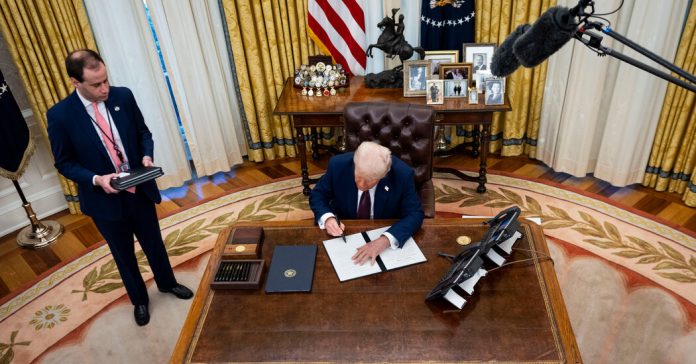
Trump reversed an order to freeze federal funds
The White House yesterday walked back President Trump’s order to freeze trillions of dollars in federal grants and loans. A federal judge had on Tuesday temporarily blocked the order after it caused mass confusion across the country.
The Trump administration had struggled to explain the funding freeze, a decision that interrupted the Medicaid system, which provides health care to millions of low-income Americans.
Karoline Leavitt, the White House press secretary, wrote on social media that “This is NOT a rescission of the federal funding freeze.” She said the president’s executive orders on federal funding “remain in full force and effect, and will be rigorously implemented.”
The decision by the Trump administration to pull the directive was a significant reversal. Democratic leaders celebrated the announcement.
Grilling: Robert F. Kennedy Jr., Trump’s pick for health secretary, faced tough questions and struggled to convince senators that he was not against vaccines during confirmation hearings in Washington. Kennedy — who has been vocally skeptical of vaccines, supports unorthodox diets and has spouted conspiracy theories — is one of Trump’s most polarizing choices.
Guantánamo Bay: Trump has ordered his administration to prepare to house 30,000 “criminal aliens” at the Navy base. In recent weeks, about 40,000 immigrants have been held in private detention centers and local jails around the country.
More on Trump
Russian forces seized another town in Ukraine
Building on their momentum, Russian forces have seized control of yet another small town in eastern Ukraine, military experts say — another step in their grinding push to conquer the entire Donetsk region.
Battlefield maps from independent groups show that the town, Velyka Novosilka, is now under Russian control, and the Kremlin claimed its capture on Sunday. Ukraine’s military acknowledged its withdrawal from most of the town but said that its troops maintained a foothold on the northern outskirts.
Context: The gain, though modest, underscores the effectiveness of a Moscow’s tactics in eastern Ukraine: using its overwhelming personnel advantage to attack relentlessly, gradually trapping Ukrainian forces in a pincer movement and forcing them to retreat to avoid encirclement.
A plane crashed near Washington, D.C.
An American Airlines passenger plane collided with an Army helicopter before crashing in the Potomac River yesterday evening near Washington, D.C., the authorities said. All takeoffs and landings were halted at Ronald Reagan National Airport nearby.
Dozens of people were reported to have been on the flight, but there was no immediate information about casualties.
MORE TOP NEWS
Seuk Kim left behind a finance career to chase his dream of becoming a pilot. Late last year, he took off with four shelter dogs on board — a trip that would see only some of its passengers make it home safely.
Lives lived: Mauricio Funes, a former president of El Salvador who fled to Nicaragua to escape corruption investigations, died at 65.
A Chinese chatbot argues with itself
As DeepSeek rattled markets this week with its new chatbot, my colleague Vivian Wang had a question: Given that the start-up is from China, how does it navigate Beijing’s censorship?
“I was absolutely fascinated by the way the chatbot talked to itself during the reasoning process as it tried to negotiate with itself what was and wasn’t acceptable to share,” Vivian said, after testing it out. “It felt a little like watching someone argue with themselves.”
DeepSeek was far less censored than most Chinese platforms, but it also couldn’t answer questions like, “Who is Xi Jinping?” Read more about Vivian’s test.
Other news about DeepSeek:
That’s it for today’s briefing. And a correction: Yesterday’s briefing incorrectly identified a tourist destination in a photo as being in Croatia. It was in Copenhagen.
See you tomorrow. — Natasha
Reach Natasha and the team at [email protected].
Trump order cracks down on antisemitism and could deport foreign student protesters : NPR

People dance and wave large Israeli flags during a rally against campus antisemitism at George Washington University in May 2024 in Washington, D.C.
Andrew Harnik/Getty Images
hide caption
toggle caption
Andrew Harnik/Getty Images
An executive order signed Wednesday by President Trump outlines a broad federal crackdown on antisemitism in the U.S., especially on college campuses, and suggests foreign students who take part in prohibited activities like supporting terrorist organizations could be deported.
The order cites “an unprecedented wave of vile anti-Semitic discrimination, vandalism and violence” and states that U.S. policy “shall be” to use “all available and appropriate legal tools to prosecute, remove, or otherwise hold to account the perpetrators of unlawful anti-Semitic harassment and violence.” It also directs all U.S. department and agency heads to come up with new means they could employ to combat antisemitism within 60 days.

The order also suggests that some student protests could be considered a violation of federal law barring individuals from supporting terrorism, and it directs officials to encourage schools to monitor and report any such activities by foreign students so they could be investigated and possibly deported.
Trump’s order refers to existing immigration law that authorizes the deportation of a non-citizen who “endorses or espouses terrorist activity or persuades others to endorse or espouse terrorist activity or support a terrorist organization.” The U.S. government officially considers Hamas a terrorist organization.
The order was welcomed by students who’ve been reporting an alarming spike in antisemitism since Oct. 7, 2023, when Hamas led the attack on Israel that triggered the current war.
Cornell University junior Amanda Silberstein says she has been physically assaulted and harassed online and in person, and feels unsafe on campus. But now, she says she feels some relief that “universities that have turned a blind eye to the harassment and assault of Jewish students can no longer ignore their basic responsibility to protect all students equally.”
“No other minority group is expected to tolerate constant threats and intimidation without recourse, yet Jewish students have been treated as the exception,” she said. “For far too long, Jew hatred festered under the guise of activism.”
But critics immediately denounced the move as an overreach and as unconstitutional.
“The revocation of student visas should not be used to punish and filter out ideas disfavored by the federal government,” said Sarah McLaughlin, a senior scholar with the Foundation for Individual Rights and Expression. “Students who commit crimes — including vandalism, threats or violence — must face consequences, and those consequences may include the loss of a visa.” But McLaughlin said students must not be punished “for protest or expression otherwise protected by the First Amendment.”

The Council on American-Islamic Relations called the executive order an “attempt to smear” the diverse group of student protesters, who “like the college students who once protested segregation, the Vietnam war, and apartheid South Africa […] deserve our country’s thanks.”
Many campuses do not have a clearly-stated definition of what crosses the line into antisemitism, and many student protesters have complained that their anti-Israel demonstrations have been unfairly conflated with antisemitism.
But many Jewish students reject that notion, saying what they’ve experienced has clearly veered into the realm of violence and harassment.
“I do think universities should be a place where the First Amendment is sacred and where students can have hard conversations about any issue,” says University of Pennsylvania senior Noah Rubin.
However, he says, extremists have made it clear that “they’re not here for conversation at all. Many of them have strict policies, actually, not to engage in conversation at all. This is not a First Amendment issue. It’s a question of violence and intimidation and harassment.”
VP Vance doubles down on WH’s ‘ambitious’ goal
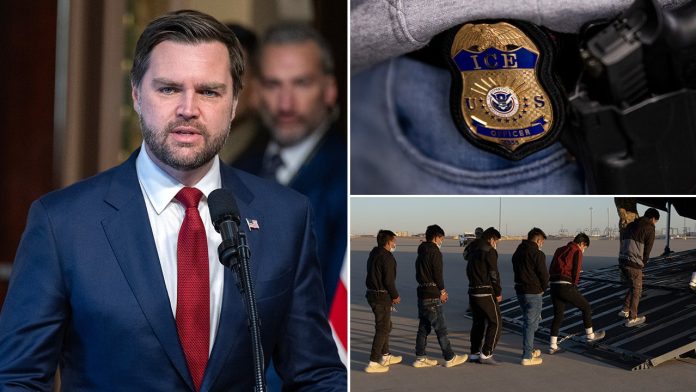
Vice President JD Vance said the Trump administration is doing exactly what it said it would with regard to the nationwide U.S. Immigration and Customs Enforcement (ICE) raids targeting migrants who have committed crimes.
Vance told Fox News host Sean Hannity on Wednesday the White House has an “ambitious” goal of getting criminal migrants off the street at a rate of nearly 2,000 per day.
“If you think [about it], we’ve got 20 plus million illegal aliens in this country. We have got to get these people out of our country and regain control of our own border,” he said in a sit-down interview from the nation’s capital on “Hannity.”
ICE and DEA migrant raids NYC (Drug Enforcement Administration New York)
The number of migrants arriving at the southern border since Trump took office last week has dropped dramatically by more than 60%.
Data obtained by Fox News Digital shows there were roughly 7,200 migrant encounters in Trump’s first seven days in office, compared to more than 20,000 in former President Biden’s final seven days.
“I guarantee we’re going to cut it even further,” Vance said of the more than 60% decrease. “Policy matters. Elections have consequences and President Trump ran explicitly on regaining control of the border and redelivering American prosperity. That’s exactly what we’re doing.”
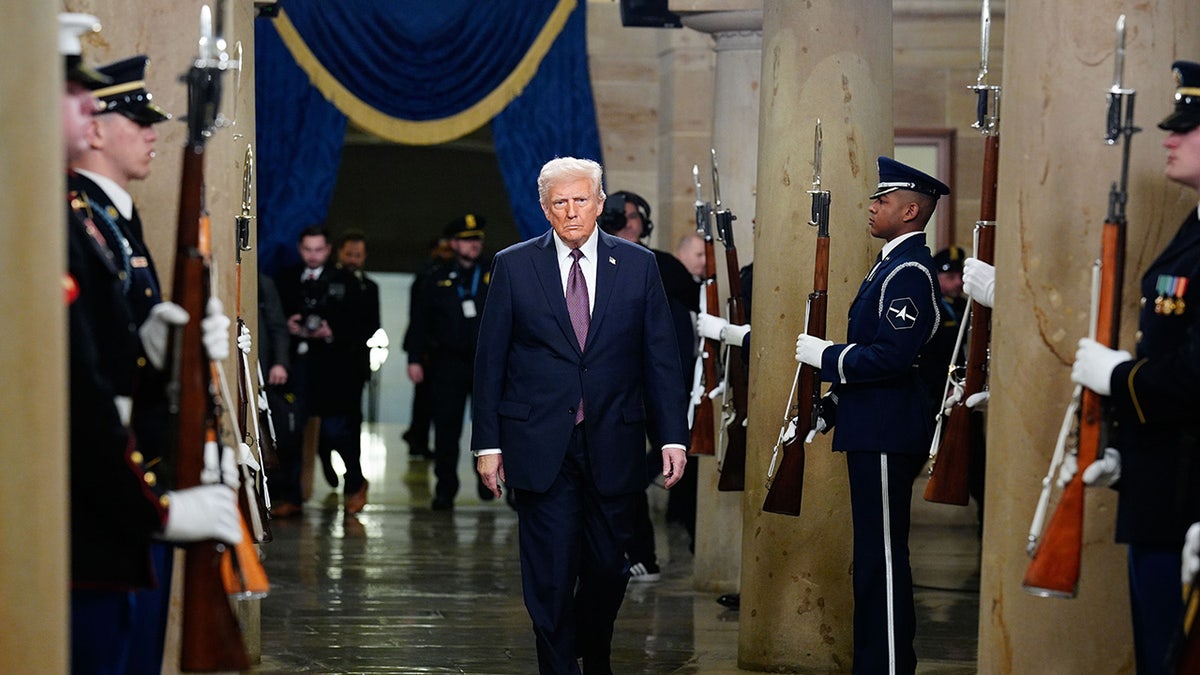
U.S. President-elect Donald Trump arrives prior to the inauguration of President-elect Donald Trump at the United States Capitol on January 20, 2025 in Washington, DC. Donald Trump takes office for his second term as the 47th President of the United States. (Melina Mara – Pool/Getty Images)
Migrants are being repatriated to their home countries, including Mexico, Colombia, Brazil, Guatemala and Ecuador.
“The take-home message here is, ‘Not today. Not today, not tomorrow, not next week. Do not come to the United States and enter illegally,’” said U.S. Border Patrol Special Operations Supervisor Hamid Nikseresht after more than 80 illegal migrants were loaded onto a C-17 military plane and deported from El Paso, Texas, back to Ecuador.
Vance took aim at the hysteria from the left over the mass deportation efforts, pointing to Trump’s win in November and his “mandate” from the American people.
“Now he’s doing it,” the former Ohio senator said about Trump’s immigration crackdown. “That’s how democratic politics in this country works and thank God for that.”
The vice president made a shocking admission about the arrests of criminal migrants, telling Hannity the United States government, in some cases, knew their names and addresses.
“We just needed to send somebody to go to their house and get them the hell out of the country,” Vance said.
CLICK HERE TO GET THE FOX NEWS APP
“We’ve known at least that they had violent criminal backgrounds. And we haven’t done anything until about eight days ago when Donald Trump became the President of the United States again. It really should shock the conscience of the American people.”
The Southport Killer Was Fixated on Extreme Violence. But Was it Terrorism?

On Oct. 4, 2019, a 13-year-old British boy called a child welfare hotline from his home in Banks, a village in northwest England, and asked: “What should I do if I want to kill somebody?”
The teenager, Axel Rudakubana, said that he had started taking a knife to school because he was being bullied. After counselors from the hotline called the police, he told officers that he thought that he would use the weapon if he became angry.
It was the first of several warnings about Mr. Rudakubana, now 18, and his increasingly violent tendencies. But five years after that call, on July 29 last year, he was able to commit one of the worst attacks on children in recent British history, murdering three girls at a Taylor Swift-themed dance class in Southport, a town near Banks, and attempting to kill eight other children and two adults who tried to protect them.
Last week Mr. Rudakubana was sentenced to life in prison, bringing a small degree of closure to the atrocity that provoked outrage across Britain. In other ways, however, the reckoning has only begun, as the country faces profound questions raised by the attack.
How did he slip through the nets of multiple agencies — including a counterterrorism initiative called Prevent, to which he was referred three times? How should the authorities deal with young people who become fixated on violence for its own sake, rather than in service of Islamist or other extremist ideologies, and who access a torrent of graphic content and encouragement online? And do laws crafted in the wake of the terrorist attacks of Sept. 11, 2001, “need to change to recognize this new and dangerous threat,” as the British prime minister, Keir Starmer, suggested last week?
‘Poisonous Online Extremism’
In police interviews, Mr. Rudakubana refused to give any motive for his knife attack. The ensuing riots that broke out across England were fueled by false claims that it was an act of Islamist terrorism committed by a recently arrived undocumented migrant.
In fact, Mr. Rudakubana was a British citizen, born in Wales to a Christian family from Rwanda. At his sentencing last week, the prosecutor, Deanna Heer, said: “There is no evidence that he ascribed to any particular political or religious ideology; he wasn’t fighting for a cause. His only purpose was to kill.”
The police later found 164,000 documents and images across his digital devices, including images and videos of dead bodies, torture and beheadings, demonstrating a “longstanding obsession with violence, killing and genocide,” Ms. Heer said.
His research spanned a chaotic range of conflicts, including those involving Nazi Germany, Gaza, Ukraine, Sudan and the Balkans. He had also downloaded an Al Qaeda training manual which included knife attack methods. He had made ricin, a biological toxin, and kept it in a plastic lunchbox under his bed.
Teachers concerned about his interest in violence had reported him to Prevent three times, when he was 13 and 14. Prevent, which started in 2003, aims to identify people who show early signs of terroristic leanings and divert them from violence before it happens. But its focus is on ideology, and after each referral of Mr. Rudakubana, officials closed the case because he appeared to lack any ideological motivation.
Diagnosed with autism at 14, he had become increasingly reclusive, anxious and aggressive in the years before the attack. He received mental health treatment for four years but “stopped engaging” with clinicians in 2023, officials said in a statement. But his defense lawyer said there was “no psychiatric evidence which could suggest that a mental disorder contributed” to his actions.
Counterterrorism officials have warned for some time that they are seeing more individuals with amorphous, ill-defined extremist traits. Ken McCallum, the head of MI5, Britain’s domestic security service, said last year that “very young people are being drawn into poisonous online extremism,” and that would-be terrorists had a “dizzying range of beliefs and ideologies.”
Earlier this month, another British teenager, Cameron Finnigan, was sentenced to jail after being part of an online Satanist group with neo-Nazi links called 764, which has been the subject of a public warning by the F.B.I. The group blackmails other children into filming or livestreaming self-harm, violence and sexual abuse. Mr. Finnigan, 19, used the Telegram app to encourage contacts to commit murder and suicide.
And in 2021, a 22-year-old man, Jake Davison, murdered his mother in Plymouth, England, before roaming the streets with a shotgun and killing a three-year-old girl, her father and two other passers-by before killing himself. Mr. Davison was immersed in online communities of incels — so-called “involuntary celibates” who blame women for their perceived inability to form relationships.
Like Mr. Rudakubana, Mr. Davison had previously been reported to the Prevent program. A careers adviser who made the referral told an inquest that a Prevent official had said Mr. Davison did not meet the criteria for intervention.
While each case was unique, in all three, isolated young men were able to access a wealth of material online glorifying mass murder, and then encouraged or carried out real world violence. Yet none would fit neatly into Britain’s current definition of terrorism, which requires a purpose of “advancing a political, religious, racial or ideological cause.”
Britain’s Home Office, which oversees Prevent, said that in the case of Mr. Rudakubana, “opportunities were missed to intervene,” and Mr. Starmer has announced an inquiry into “our entire counterextremist system,” saying he understood why the case made “people wonder what the word ‘terrorism’ means.’”
But proposals to expand the definition of terrorism are contentious. Jonathan Hall, Britain’s independent reviewer of terrorism legislation, warned in an opinion article last week that broadening the definition to include “violence clearly intended to terrorize,” as Mr. Starmer suggested, would risk “too many false positives.” He also worried it would stretch counterterror resources. Mr. Hall called instead for “a wholly new capability to deal with those motivated by noninstrumental extreme violence.”
‘Mixed, Unclear and Unstable Ideology’
Islamist terrorism remains the largest security threat facing Britain, responsible for approximately 75 percent of counterterrorism work by M15, the agency says, while extreme right-wing terrorism is responsible for most of the rest.
But Vicki Evans, the U.K.’s senior national coordinator for counterterrorism policing, acknowledged that authorities had been grappling with an emerging cohort of people that the Prevent program labeled “mixed, unclear and unstable ideology,” which Mr. Rudakubana fell into. “There are a growing number of young people with complex fixations with violence and gore in our casework, but with no clear ideology other than that fascination,” she said.
Prevent has since split the “mixed, unclear and unstable” category into several parts, including incels and school shooting obsessives. But almost one in five people referred in the year to March 2024 were still simply categorized as “conflicted.”
Gina Vale, a University of Southampton criminologist who studies teenage terror offenders, said the trend has grown internationally for several years. “There are less clearly defined ideological fault lines, particularly among young people — that’s a reality that we now need to adapt to,” she said.
A 2024 study of 140 convicted terrorists in England and Wales found that 57 percent of lone attackers had some form of “mental illness, neurodivergence or a personality disorder,” and that the internet was “found to play an important role in radicalization pathways and attack preparation.”
Teenage terror offenders are often socially isolated, Dr. Vale said, and for many, “violence in whatever form is seen to be the answer — to gain status, to connect with a network, to have a feeling of belonging, to seek revenge, whatever it is.”
A review into Prevent’s response to Mr. Rudakubana is set to be published within days. Yvette Cooper, the home secretary, has already told Parliament that the review concluded that “too much weight was placed on the absence of ideology” without considering his obsession with extreme violence.
But amid the debate over whether his attack could have been prevented, experts note that a small subset of individuals have always been capable of appalling violence.
“People don’t need a coherent worldview to embark on mass violence,” said Tim Squirrell, who researches violent movements at the Institute for Strategic Dialogue, a research institute in London. “We cannot prevent every single case but we need to be looking at mass violence as a problem in itself rather than as a subset of terrorism.”
The White House has rescinded its federal spending freeze memo : NPR

On Wednesday afternoon, the White House rescinded a memo that ordered a government spending freeze. But the White House says its effort to align government programs with Trump’s priorities remains.
MARY LOUISE KELLY, HOST:
The White House this afternoon rescinded a memo that ordered a government spending freeze. But the White House says the overall effort remains, that effort being aligning government programs with Trump’s priorities. All this comes after swift backlash and a full day of confusion over the memo’s release. So what does it all mean for Trump’s attempts to wrest control of the U.S. government? NPR senior political editor and correspondent Domenico Montanaro is here. Hi, Domenico.
DOMENICO MONTANARO, BYLINE: Hey, Mary Louise.
KELLY: OK, so what does it all mean? It sounds like the memo is out, but the intent behind it very much continues.
MONTANARO: Yeah, I mean, this much we know. OK, the original two-page memo that ordered a freeze of a lot of federal funding has now been rescinded. That order was supposed to take effect at 5 p.m. last night, but a federal judge blocked it. Bottom line, this seems to get the administration out of court.
But this is not the end of it. I mean, shortly after the memo was rescinded, White House press secretary Karoline Leavitt posted on social media this afternoon, quote, “this is not a rescission of the federal funding freeze,” and that the president’s executive orders, quote, “on federal funding remain in full force and effect and will be rigorously implemented.”
In other words, their intention, like you said, remains to cut programs they don’t like, which is not unusual, for new administrations to want to cut discretionary programs. The problem with yesterday’s memo was that it was so vague, it caused mass confusion across the country and seemed to indicate it would stop funding programs, even ones specifically authorized by Congress, if Trump didn’t like them.
KELLY: Right. And what I’m trying to work out is could that still happen – the stopping of funding programs, even once authorized by Congress – given that the White House is contending, hey, the funding freeze is on?
MONTANARO: Yeah, it’s not clear what they intend to target exactly. You know, they say they don’t like diversity programs, climate change initiatives and other things like that. But what the memo did yesterday was call into question whether this administration will honor funding programs that came into – that were passed by Congress before Trump came into office. Here’s Stephen Vladeck, constitutional law professor at Georgetown University.
STEPHEN VLADECK: What the memo is effectively claiming is that Congress’ most important, its first, its most basic regulatory power under the Constitution – the power to spend money – is actually entirely dependent upon the President’s beneficence. That’s never been the understanding. And a world in which that was the law would be a world in which Congress would basically be impotent and wholly dependent upon the president’s support to have any of its actions given effect.
MONTANARO: Yeah. This country was designed to have a system of checks and balances. Other presidents have also chafed at the limitations of, you know, the presidency. But the Congress and courts have been things that they’ve had to run up against, and this president seems intent to take it farther than other presidents in the past.
KELLY: Well, big picture, we are now – what? – 10 days into Trump’s second term. There has been a fire hose of executive actions, orders, changes and so forth. My question – is that deliberate? Is it part of a strategy?
MONTANARO: Yeah, it seems to be ripped from the Trump playbook of distracting, trying to confuse, to gain attention for what they want us all to pay attention to – something former Trump strategist Steve Bannon used to talk a lot about. The idea is what you’ve seen – make things unclear, make people exhausted, make it harder for the media to focus on one thing and make it harder for the opposition to organize a message around what to focus on.
But the backlash to this spending freeze memo shows that there are limits to that kind of strategy. Just because something is done fast, doesn’t necessarily mean it’s the best way to run the government. And this is now the first major misstep by the Trump administration. But don’t think this is going to mean any kind of dialing back.
KELLY: Right.
MONTANARO: Trump wants to test the powers and the limits of the presidency. And we’re going to see just how far Congress and the courts will let him go.
KELLY: Domenico Montanaro. Thank you.
MONTANARO: You got it.
Copyright © 2025 NPR. All rights reserved. Visit our website terms of use and permissions pages at www.npr.org for further information.
NPR transcripts are created on a rush deadline by an NPR contractor. This text may not be in its final form and may be updated or revised in the future. Accuracy and availability may vary. The authoritative record of NPR’s programming is the audio record.
President Trump, lawmakers react to Reagan National Airport crash

Lawmakers across the U.S. expressed sympathy and grief after a passenger plane collided with a military helicopter near Reagan National Airport in the Washington, D.C. area on Wednesday night.
A PSA Airlines Bombardier CRJ700 regional jet operating as an American Airlines flight collided in midair with a Sikorsky H-60 helicopter approaching Reagan National Airport in Arlington, Virginia, around 9 p.m. local time, according to the Federal Aviation Administration (FAA). The flight left Wichita, Kansas, earlier that day.
The passenger flight was carrying 60 people, but officials have not confirmed the exact number of injuries and fatalities. Secretary of Defense Pete Hegseth, who started work on Monday, said that he was aware of the incident in a post on X.
“DoD actively monitoring,” Hegseth’s tweet read. “Poised to assist if needed. Prayers for all involved.”
Transportation Secretary Sean Duffy confirmed that he was at the FAA building and investigating the incident. White House Press Secretary Karoline Leavitt also shared a message from President Donald Trump on Wednesday night.
“I have been fully briefed on the terrible accident which just took place at Reagan National Airport,” the statement read. “May God Bless their souls. Thank you for the incredible work being done by our first responders. I am monitoring the situation and will provide more details as they arise.”
Rep. Anna Paulina Luna, R-Fla., expressed sorrow after hearing of the crash.
“Our prayers are with all families impacted by the tragic plane crash that just took place here in DC,” Luna’s post read. “Incredibly heartbreaking.”
Virginia Lt. Gov. Winsome Earle-Sears said that she was keeping all those impacted in her prayers.
FEDERAL JUDGE PAUSES TRUMP ADMIN’S TEMPORARY FEDERAL GRANTS, LOANS FREEZE
A collision took place near Reagan National Airport on Wednesday. (Fox News Digital)
“My office is following the breaking and tragic news of a collision at @Reagan_Airport,” the lieutenant governor wrote. “We pray for the victims, first rescuers, and all those impacted.”
Homeland Security Secretary Kristi Noem wrote on X that she was “deploying every available US Coast Guard resource for search and rescue efforts in this horrific incident at DCA.”
“We are actively monitoring the situation & stand ready to support local responders,” the former South Dakota governor wrote. “Praying for the victims and first responders.”
Fox News Digital has reached out to the Metropolitan Washington Airports Authority, the FAA and American Airlines for more information.
An Army Black Hawk helicopter collided midair with an American Airlines jet at Reagan Washington National airport. (EarthCam)
Authorities are actively investigating the crash.
Fox News Digital’s Greg Wehner and Louis Casiano contributed to this report.
Leaving the W.H.O. Could Hurt Americans on a Range of Health Matters
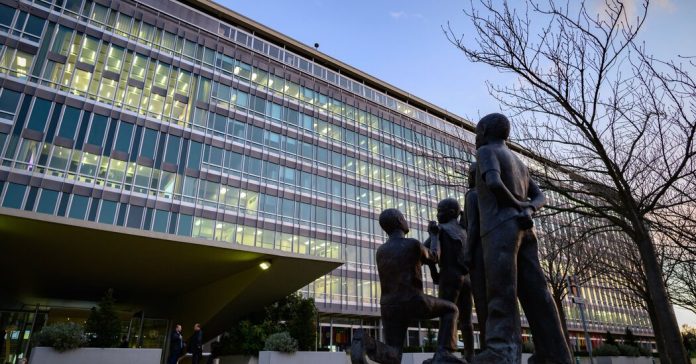
President Trump’s decision to withdraw the United States from the World Health Organization could have harsh consequences for countries around the world that rely on the agency to achieve important health goals, including routine immunizations, outbreak control and nutrition programs.
But it could also have unfortunate, unintended repercussions for Americans.
Disengaging from the W.H.O. would rob the United States of crucial information about emerging outbreaks like mpox and resurgent dangers like malaria and measles, public health experts said. It may also give more power to nations like Russia and China in setting a global health agenda, and it could hurt the interests of American pharmaceutical and health technology companies.
The W.H.O.’s work touches American lives in myriad ways. The agency compiles the International Classification of Diseases, the system of diagnostic codes used by doctors and insurance companies. It assigns generic names to medicines that are recognizable worldwide. Its extensive flu surveillance network helps select the seasonal flu vaccine each year.
The agency also closely tracks resistance to antibiotics and other drugs, keeps American travelers apprised of health threats, and studies a wide range of issues such as teen mental health, substance use and aging, which may then inform policies in the United States.
“There’s a reason why there was a W.H.O.,” said Loyce Pace, who served as an assistant secretary of health and human services under former President Joseph R. Biden Jr. “It’s because we saw value, even as a superpower, in the wake of the world war to come together as a global community on global problems.”
“America, no matter how great we are, cannot do this work alone,” she said.
Though it will take a year for the withdrawal to take effect — and it is not entirely clear that it can happen without congressional approval — Mr. Trump’s announcement has already prompted drastic cost-cutting measures at the W.H.O.
In a memo to employees, the director general, Dr. Tedros Adhanom Ghebreyesus, announced a hiring freeze and limited renegotiation of major contracts, adding that more measures would follow. He also said all meetings without prior approval should be fully virtual from now on and “missions to provide technical support to countries should be limited to the most essential.”
Late Sunday night, employees of the U.S. Centers for Disease Control and Prevention were instructed, effective immediately, to stop engaging with the W.H.O. in any way. The employees were later told not to participate in meetings or even email conversations that included W.H.O. staff.
The W.H.O. is often criticized as a lumbering bureaucracy, too conservative in its approach and too slow to action. Mr. Trump cited the organization’s “mishandling of the Covid-19 pandemic” as one of the main reasons the United States is pulling out.
Many public health experts have for decades called for reforms of the agency, noting that it is too timid in calling out its members’ missteps, holds a rigid view of what constitutes medical evidence and has too many areas of focus. The criticisms escalated during the pandemic, when the W.H.O. was months late in acknowledging that the coronavirus was airborne and that the virus could spread in the absence of symptoms.
Yet there is no other organization that can match the W.H.O.’s reach or influence in the world, said Dr. Thomas Frieden, who has worked with the W.H.O. for decades, including as a former C.D.C. director.
“Are there lots of things they could be better at? Of course,” he said. But, he added, “are they indispensable? Yes.”
For all its scope, the W.H.O. has a relatively modest budget, totaling about $6.8 billion for 2024 and 2025. For comparison, the health department of the tiny state of Rhode Island spent just over $6 billion in 2024 alone.
The United States is the W.H.O.’s largest donor, accounting for nearly 15 percent of its planned budget.
In the executive order, Mr. Trump complained that the W.H.O. “continues to demand unfairly onerous payments from the United States, far out of proportion with other countries’ assessed payments,” adding that China contributes nearly 90 percent less.
Both of those assertions are inaccurate.
The obligatory fees are calculated according to each country’s population and income, using a formula approved by member states. For the two-year 2024-25 budget, that amount was $264 million for the United States and $181 million for China, a difference of about 31 percent.
Mr. Trump’s claim that China pays much less may have been based on voluntary contributions, which are usually motivated by specific interests such as polio eradication: The United States has so far provided $442 million in voluntary contributions for 2024-25, while China has given only $2.5 million. Even so, China’s total contribution is about 74 percent less than the United States’, not 90 percent.
Mr. Trump’s decision was “not based on sound, factual ground,” said Helen Clark, a former prime minister of New Zealand and former administrator of the United Nations Development Program.
On Monday, the Trump administration halted the distribution of H.I.V. drugs purchased with U.S. aid. Abruptly ending treatment will jeopardize the health of people living with H.I.V. and lead to more infections and may drive resistance to available medications, health experts warned.
The W.H.O.’s programs monitor drug resistance worldwide to antibiotics and medications for H.I.V., malaria and other diseases.
“These are not invincible drugs, and having that ability to know when resistance occurs and why we need to change strategies can be very important,” said Dr. Meg Doherty, who directs W.H.O. programs on H.I.V. and sexually transmitted infections.
“They are things that people in the United States should be aware of and should be concerned could come to them in the future,” she said.
If the United States loses access to the W.H.O.’s information and data sharing, online reports and informal communications may fill some of the void, but they may be muffled, filtered or marred by misinformation. And the W.H.O. and other countries are not obligated to share information, such as genetic sequences, with the United States, let alone heed its advice, if the country is not a member.
“If we’re not there, we don’t get to have a voice at all,” Dr. Frieden said.
The W.H.O. began in 1948 as a branch of the United Nations focused on global health. Over the decades, it led the eradication of smallpox, nearly vanquished polio and has helped control use of tobacco and trans fats.
Countries that do not have the equivalent of a C.D.C. or a Food and Drug Administration rely on the W.H.O. for public health guidelines, childhood vaccinations and drug approvals, among many other health efforts.
“Ministries of health typically won’t move unless there’s a W.H.O. guideline,” said Dr. Chris Beyrer, director of the Duke Global Health Institute and an adviser to the W.H.O.
That dynamic has implications for American businesses, allowing pharmaceutical and health technology companies to operate in countries that adhere closely to W.H.O. recommendations, said Anil Soni, chief executive of the W.H.O. Foundation, an independent entity that facilitates partnerships and funding for the organization.
“The U.S. won’t be at the table to set the evidence and quality standards that enable competitive positioning of U.S. companies and directly lead to U.S. business,” Mr. Soni said.
Mr. Trump and others have criticized the W.H.O. for not holding China accountable early in the pandemic, and for taking too long to declare the Covid-19 pandemic a public health emergency.
But the W.H.O. cannot reprimand its member countries, noted Ms. Clark, who was a co-chair of the Independent Panel for Pandemic Preparedness and Response, which led an inquiry into the W.H.O.’s response to the Covid-19 pandemic.
“W.H.O. has no power to compel countries to do anything,” Ms. Clark said. “It has only the power of persuasion. China was not transparent, and that hindered W.H.O.’s response.”
Mr. Trump has also said that China has too much influence over the W.H.O. But “actually, the real problem is that tiny Pacific islands with 100,000 people have too much power,” Dr. Frieden said.
“W.H.O. works by consensus, and so any country can throw a monkey wrench in and stop proceedings,” he said.
It is unclear whether Mr. Trump can unilaterally sever ties with the W.H.O. Unlike most international agreements, which may stem from executive action or require Senate ratification, membership in the W.H.O. was enshrined by a congressional joint resolution and may have to be dissolved in the same way.
“There’s a very good argument to be made that the president cannot do this himself — that is, without congressional participation,” said David Wirth, a former State Department official and an expert in foreign relations law at Boston College.
If Congress approves, the United States must still give one-year notice of withdrawal and fulfill its financial obligations for the year.
Some experts worry that Mr. Trump’s action will prompt nations like Hungary and Argentina, whose leaders are ideologically similar, to follow suit. Already, Italy’s deputy prime minister has proposed a law to leave the W.H.O.
U.S. withdrawal may also empower authoritarian member states in the organization, like Russia and China. Public health decisions in Russia and China are “much more politically controlled, and that’s a danger to everybody,” Dr. Beyrer said. “None of us wants to live in a world where Russia has a larger voice in global health governance.”
In his executive order, Mr. Trump said the United States would cease negotiations on amendments to the International Health Regulations, legally binding rules for countries to report emerging outbreaks to the W.H.O. But the latest amendments were adopted by the World Health Assembly last year and are expected to come into force in September.
Ironically, it was the first Trump administration that proposed the amendments because of frustration with the lack of transparency from certain countries during Covid-19, said Ms. Pace, who oversaw negotiations during the Biden administration.
Ms. Pace also led negotiations for a pandemic treaty that would allow countries to work together during an international crisis. The treaty had been stalled and may now collapse.
Trump’s Commerce Secretary pick is Howard Lutnick. Here’s what to know : NPR
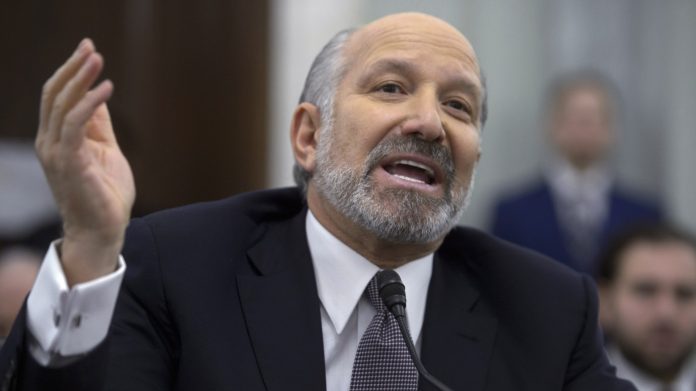
Howard Lutnick, a billionaire Wall Street CEO whom President Trump’ has tapped to lead the Commerce Department, appears before the Senate Commerce Committee for his confirmation hearing.
Rod Lamkey/AP
hide caption
toggle caption
Rod Lamkey/AP
We’re following the confirmation hearings for the incoming Trump administration. See our full politics coverage, and follow NPR’s Trump’s Terms podcast or sign up for our Politics newsletter to stay up to date.
Who: Howard Lutnick
Nominated for: Commerce Secretary
You might know them from: Lutnick is a billionaire investor and long-time Wall Street CEO.
- His investment bank, Cantor Fitzgerald, was headquartered in the World Trade Center during the Sept. 11 attacks; almost 700 employees were killed, including Lutnick’s brother.
- In recent years, Lutnick became a major Republican donor after previously donating to politicians of both parties. If confirmed, he’ll be a member of the wealthiest White House ever.
- Lutnick led President Trump’s transition team, enthusiastically supporting plans to impose more tariffs on imported goods and parts.
What does this role do: The Commerce Department is responsible for enforcing tariffs on foreign imports and granting any exemptions from those import taxes. The Commerce Secretary negotiates trade deals, promoting U.S. businesses and exports. The department also includes the National Oceanic and Atmospheric Administration with the National Weather Service, the Census Bureau and the National Telecommunications and Information Administration, which focuses on the use of wireless airwaves and broadband access.
Here’s what happened at the hearing
Howard Lutnick, the billionaire Wall Street CEO, fielded questions about tariffs’ impact on U.S. manufacturers and farmers, federal funding for broadband access, China’s progress on artificial intelligence and reviving American domestic mining, logging and semiconductor production.
Much of Lutnick’s comments came down to two themes.
He extolled the virtues of the United States, saying the country has the world’s brightest innovators, the greatest land in the world and the best farmers, fishers and ranchers who grow the most superior steers for “much more beautiful” steak.
But, Lutnick repeatedly argued, the world has treated the U.S. with disrespect; that includes China but also allied nations in Europe, Canada, Japan and Korea, taking advantage of “of our good nature” to grow their own economies.

Lutnick called for across-the-board tariffs.
“My way of thinking … is country by country, macro, let America make it more fair,” he said. “We are treated horribly by the global trading environment… And we can use tariffs to create reciprocity, fairness and respect.”
Mexico and Canada, however, could avoid broad tariffs if they shut their borders to stop the flow of fentanyl, Lutnick said, adding that President Trump for now has directed a federal study of “the tariff model” expected to complete in the spring.
Several lawmakers asked Lutnick about rising costs for both U.S. companies and consumers — especially if other countries retaliate with tariffs of their own on American exports.
“A particular product’s price maybe go up. But all of them… It is just a nonsense that tariffs cause inflation,” Lutnick said.
He wants the U.S. to set the standards on AI for the world.
He accused China of “leveraging what they’ve taken from us, stolen from us” to develop its groundbreaking DeepSeek chatbot, arguing that export controls on technology should be combined with stricter tariffs. Lutnick also said the government’s use of artificial intelligence tool would over time “rid the world of criminals using blockchain for illicit activity.”
Lutnick wants more rare-earths mining and semiconductor manufacturing in the U.S.
Much of the hearing focused on the bipartisan CHIPS Act that pledged $54 billion to revive America’s semiconductor manufacturing industry, now dominated by Taiwan, South Korea and China. Trump has panned the program as wasteful, and Lutnick called it “an excellent down payment” that still needed to be reviewed to get it right.
This led to tense exchanges on Lutnick’s allegiance to Trump versus the American people.
Several Democrats pushed Lutnick to commit to dispersing federal subsidies appropriated by Congress, for example for broadband access, even if President Trump directs him otherwise. In response, Lutnick repeated that his goal was to “give Congress the benefit of the bargain,” by ensuring programs were actually effective and efficient.
“If President Trump directed you to unlawfully withhold federal spending that was authorized by Congress, would you comply with that order?” asked Sen. Ed Markey, D-Mass.
“I guess I’d be spending a lot of time with lawyers, but I do not think that’s the way it will work,” Lutnick answered.
“If President Trump directed you to do something illegal or unconstitutional, would you refuse to obey?” Sen. Tammy Duckworth, D-Ill., later returned to the question.
“He won’t,” Lutnick replied.
And again, Sen. Ben Ray Luján, D-N.M., asked: “If President Trump asks you to cut infrastructure funding as passed by this Congress in a bipartisan way … will you oppose that?”
“I work for the president,” Lutnick said.
Overall, the hearing was amicable.
Lutnick was introduced at the hearing by Vice President JD Vance, who described him as a personal friend, a wildly successful businessman and “just a good dude.” Senators praised Lutnick’s resilience after the death of both his parents at his young age and his fundraising to support the families of his colleagues who died in the Sept. 11 attacks.
Lutnick told lawmakers he was committed to divest all his assets before assuming the Cabinet position to avoid financial conflicts of interest. He previously disclosed stakes in at least 800 firms and legal entities. It’s unclear whether Lutnick might sell his assets to his adult children.