Thursday, November 12, 2026
Home Blog Page 360

In Pursuing Canal, Trump Could Push Panama Closer to China

0

As Panama’s president laid a wreath to honor those who died protesting the American occupation 60 years ago, the ceremony attendees were resolute.

The commemoration this month came just days after President-elect Donald J. Trump falsely claimed China was controlling the Panama Canal and suggested he could use military force to retake the waterway.

The threat rippled through a country still haunted by the events of 1964, when students trying to plant the Panamanian flag in the U.S.-occupied canal zone were met with deadly force.

“My brother did not die for nothing,” said Carlos E. Bonilla Cacó, whose brother was killed in the demonstrations that sparked the movement leading Panamanians to regain sovereignty.

The country’s leader agreed.

In the foothill near the Panama Canal Authority’s office, President José Raúl Mulino was firm. “The canal is and will continue to be Panamanian,” he said.

The statement directly challenged Mr. Trump, who some analysts say is only posturing to press Panama to lower fees for American goods traversing the canal, a subject he has recently railed against.

But former American officials warn that he may alienate Panama at a time when China is trying to woo the country as an ally and expand its influence in Latin America.

“Trump’s saber rattling could dampen the Panamanian government’s desire to broaden the relationship with the U.S. economically,” said Ramon Escobar, who until September served on the National Security Council and is currently the managing director at Actum, a global consultancy firm.

He “may end up pushing them away at a time when there is a real opportunity to get Panama back into our orbit,” Mr. Escobar said.

The canal was constructed by the United States in the early 20th century, but Panama took back full control in 1999 and has since operated the waterway through the Panama Canal Authority.

Today, Panama holds special strategic significance for China because of the canal, but Beijing has been working to expand its influence in Latin America, and among developing countries more broadly. It has portrayed itself as an alternative to what it calls American hegemony and bullying, casting itself as a more sympathetic, fellow developing country.

And with significant investments in port construction worldwide, China is positioning itself to influence global commerce and monitor international activities.

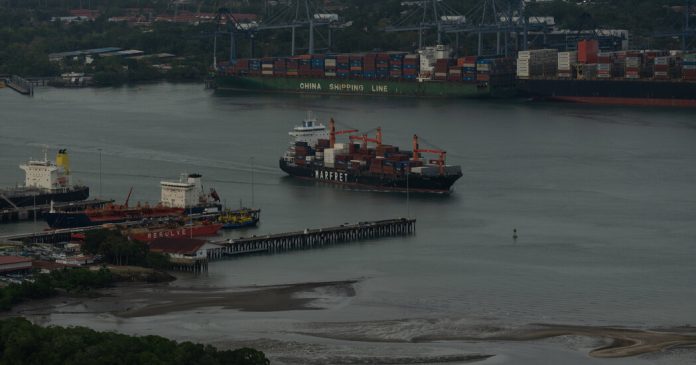
Specifically, U.S. officials have grown increasingly concerned about two seaports at each end of the Panama Canal, which have been operated for decades by CK Hutchison Holdings, a company based in Hong Kong.

While CK Hutchison is a publicly listed conglomerate whose largest owner is a Hong Kong billionaire family, Beijing could still use its national security laws to force the company to assist in intelligence-gathering or military operations.

Panamanian officials argue, however, that China doesn’t pose a risk. The canal is open to the public, they say, and any Chinese interference would be visibly obvious.

“Anyone can use a satellite to see what is going in and out of the port,” Ilya Espino de Marotta, the deputy administrator of the Panama Canal, said in an interview last week. “The canal runs through the country, along national roads and is visible to the public.”

During his first administration, Mr. Trump did bring up the Panama Canal internally, indicating that he sees the waterway as unfinished business, said John Feeley, who served as U.S. ambassador to Panama from 2015 until 2018.

In June 2017, Mr. Trump met with the Panamanian president at the time, Juan Carlos Varela, and complained that the U.S. Navy was paying too much to traverse the canal — about $1 million annually, Mr. Feeley said. (That cost is so minuscule it would be akin to a rounding error in the Pentagon’s budget, analysts say.)

But Mr. Trump never brought up China’s presence or supposed influence over the canal even though just weeks previously Panama had broken off relations with Taiwan and aligned with Beijing, said Mr. Feeley, who attended the White House meeting between the leaders.

The former ambassador said he tried to get the White House to focus on China’s rising influence in Panama, but the issue never grew to a level of serious alarm.

At the time, China was promising to invest in big-ticket infrastructure items in Panama, including a canal bridge, as part of its Belt and Road Initiative. Through the initiative Beijing has increased its influence globally by investing in seaports, roads and trains from Kenya to Sri Lanka and, most recently, Latin America. Critics say Beijing uses the program to saddle foreign governments with failing projects or unsustainable debt in order to wield China’s leverage.

Mr. Feeley said he tried to get American companies to bid on such projects to counter China. But the U.S. Embassy in Panama City never got the White House’s backing to persuade American companies to bid, he said.

“It’s not that we are losing to China in Latin America; in most cases we aren’t even showing up to the commercial battlefield,” Mr. Feeley said.

Latin American governments like Panama’s have complained that when they put out bids for expensive infrastructure projects, the United States is often absent, forcing them to rely on others from Europe to China to get the work done.

“The U.S. isn’t bidding on big infrastructure projects here, but China is,” said Giulia de Sanctis, the president of the Panamanian Association of Business Executives. “Are we supposed to tell them now: ‘It’s time to get out of Panama; Trump doesn’t like you.’ Would anyone feel safe investing here then?”

The Panama Canal Authority has said that while the United States built the canal for military purposes, the Panamanians developed it into a major hub of global trade.

Once the U.S. military handed it over, the authority invested more than $5 billion to widen the waterway and accommodate the giant cargo ships that travel from the United States to East Asia, its most popular route.

“If it wasn’t for our investment, the canal would be irrelevant on the scale of global trade,” said Ms. Espino de Marotta.

“Our neutrality is our greatest business asset, and it enables us to be a route for global commerce,” she said. At the Atlantic entrance of the canal, three ports are separately operated by companies based in Hong Kong, Taiwan and the United States, she said.

“These ports have been managed by Hong Kong since 1997, throughout Trump’s first administration,” she added. “Trump never said a thing about it then, so why now?”

Some Panamanians are reluctant to allow China to invest further in the country. Although Mr. Varela shifted Panama’s diplomatic recognition to China from Taiwan and entered into several business agreements with Beijing, subsequent governments have sought to scale back these commitments.

Ramón Martínez, who served as the minister of commerce after Mr. Varela stepped down, expressed his discomfort with the political and economic agreements made by the earlier administration with China. He said he halted a free-trade agreement with China that was under negotiation. The bridge over the canal that China pledged to build was also paused.

Mr. Martínez emphasized that for Panama, its most important ally will always be the United States.

Last week, hundreds of tourists gathered on a terrace at the Miraflores Visitors Center, giving them a bird’s-eye view of the Panama Canal. They waved as a towering cruise ship squeezed its way through the canal.

“At first it made me laugh, the insanity of it all,” said Jacqueline Williams of Mr. Trump’s threats against Panama as she waved to a passing cruise ship. The 67-year-old nonprofit educator was visiting the canal from New York City.

“But then you think: This is a guy who idolizes Putin,” she said, referring to the Russian president. “Trump said on the campaign trail he wanted to restore peace to the world, but now he is threatening military expansionism.”

Alex E. Hernández contributed reporting from Panama City, Vivian Wang from Beijing and Emiliano Rodríguez Mega from Mexico City.

Republican Sen. Ron Johnson says fire aid to California should come with conditions

0

Republican Sen. Ron Johnson of Wisconsin talks about why he and many of his Republican colleagues believe fire aid for California should only come if there are some strings attached.

User’s Manual: Why some Trump nominees could be confirmed with a voice vote – and why some could not

0

Join Fox News for access to this content

Plus special access to select articles and other premium content with your account – free of charge.

By entering your email and pushing continue, you are agreeing to Fox News’ Terms of Use and Privacy Policy, which includes our Notice of Financial Incentive.

Please enter a valid email address.

The Senate will likely have a few Cabinet nominees who are relatively non-controversial. In the interest of time, senators could agree to expedite the process and confirm an individual nominee or several nominees by voice vote or unanimous consent.

As long as there are no objections among all 100 (currently 99) senators.

This speeds things up in the Senate, where floor time is at a premium.

However, there’s a good reason why some Democrats may oppose a streamlined process for this.

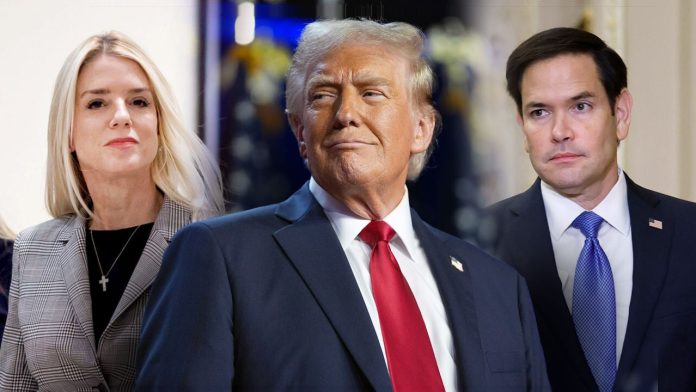
From left to right, Pam Bondi, President-elect Donald Trump and Sen. Marco Rubio. (Fox News)

It’s not because they’re trying to clog up the Senate plumbing. Democrats may demand a roll call vote on nominees they support in order to show that they voted in a bipartisan fashion to confirm some of President-elect Donald Trump’s nominees.

Democrats are likely to reject the nomination of Pete Hegseth to be Defense secretary. However, other relatively easy to confirm nominees like Sen. Marco Rubio, R-Fla., picked to serve as secretary of state, or Sean Duffy for Transportation secretary, could require roll call votes.

CLICK HERE TO GET THE FOX NEWS APP

As a result, Democrats can then argue that they voted in favor of “X” number of Mr. Trump’s nominees – and argue they operated in a bipartisan fashion.

Are Biden and Trump at Odds on Global Energy Strategy? Maybe Not So Much.

0

At their confirmation hearings on Wednesday, the two men in line to oversee the United States’ global energy policies, Senator Marco Rubio and the fossil fuel executive Chris Wright, are expected to assail President Biden as overly concerned with climate change.

According to a spokeswoman, Mr. Wright, who was picked to lead the Department of Energy, will say that Mr. Biden “viewed energy as a liability instead of the immense national asset that it is.” President-elect Trump has pledged to immediately begin rolling back electric-vehicle tax credits and to undo a pause on new permits for gas export terminals.

But the Biden-Trump split, at least on major policy issues like natural gas exports, battery supply chains and competition with China, may turn out to be more in tone than in deed.

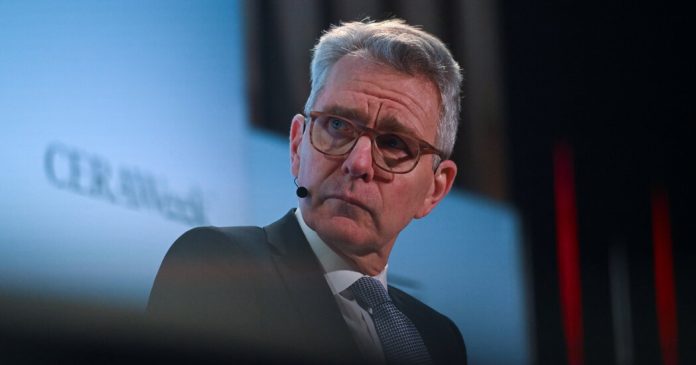
In an interview before the confirmation hearings began, Mr. Biden’s top energy diplomat at the State Department, Geoffrey Pyatt, used similar language to Mr. Wright’s. Energy is “a strategic asset to strengthen our allies” and “a national security attribute,” Mr. Pyatt said, referring in no uncertain terms to fossil fuels. If confirmed as Secretary of State, Mr. Rubio would choose Mr. Pyatt’s replacement.

Mr. Pyatt noted that U.S. crude oil production is 70 percent higher than it was 8 years ago and that U.S. exports of liquefied natural gas, which went from near-zero in 2016 to now dominating the global market, are set to double over the course of Mr. Trump’s upcoming term. “The U.S. is an energy giant,” he said. “We are energy secure in a way we’ve never been before. We have no dependence remaining on the Middle East from an energy standpoint, which is quite different than where we were a decade or two ago.”

Under Mr. Biden’s administration, the United States is currently producing more oil than any nation at any time in history. It is also the world’s largest producer of gas, and its leading exporter. After Russia’s invasion of Ukraine, Mr. Pyatt, a former ambassador to Ukraine and Greece, spearheaded U.S. efforts to wean Europe from Russian fuels by replacing them with U.S. gas, liquefied and shipped from the Gulf Coast across the Atlantic Ocean.

Mr. Pyatt also noted that, in congratulatory calls from Europe and Japan that Mr. Trump received upon winning re-election, there was unsurprising reaffirmation of gas’s key role in trade and mutual security.

The Biden administration’s pause on approving new applications for gas export terminals will almost certainly be reversed by Mr. Trump, but experts said the original move had little bearing on U.S. dominance of the global gas market and any efforts Mr. Trump may make to further increase exports would be met with the reality of uncertain long-term growth in the market as the price of renewables continues to drop around the world.

“Generally speaking, I think we’re likely to see changes in policy but continuity in energy-market outcomes,” said Jason Bordoff, who leads the Center on Global Energy Policy at Columbia University.

The main difference may well be, Mr. Bordoff said, that the Biden administration couched its energy policies in terms of emissions reduction and climate change, and the Trump administration will more publicly and explicitly allude to gas prices and national security, even if the latter clearly underpinned Mr. Biden’s policies, too.

Even if Mr. Trump manages to slow growth in the U.S. domestic market for electric vehicles, for instance, he will still be compelled by a fear shard by the Biden administration over China’s dominance in battery supply chains “at a time of growing demand for power for artificial intelligence and data centers,” Mr. Bordoff said.

China currently controls most of the global supply chain for clean energy technologies. More than 90 percent of rare earth mineral processing happens there, as well as more than three-quarters of all battery cell production. Most components of solar and wind power are also dominated by China, though provisions in Mr. Biden’s signature climate legislation, the Inflation Reduction Act, have accelerated U.S. production of late.

American investments in battery supply chains and mineral extraction in Africa and elsewhere will almost certainly remain in place and may grow, experts say. The U.S. International Development Finance Corporation, which has led efforts to counter China’s control of that sector, was founded by the first Trump administration.

Trump’s new team will have to “figure out what are the sectors which are probably so far gone that we’re never going to catch up,” said Mr. Pyatt, who questioned the wisdom of politicizing electric vehicles when the rest of the world has already “cast the die” on committing to transitioning away from fossil fuels.

“The rest of the world is going to keep going and I think our companies that are globally active have figured that out,” Mr. Pyatt said, adding that he hoped those same companies would be bold enough to tell Mr. Trump, “‘Hey, we shouldn’t be walking away from this stuff because this is how we’re going to make money in the future.’”

Six of Trump's Cabinet nominees face confirmation hearings Wednesday

0

Six of President-elect Trump’s Cabinet nominees face confirmation hearings Wednesday on Capitol Hill. Some will face easier paths than others.

House GOP resolution would overturn Biden’s gas water heater ban

0

EXCLUSIVE: A new, GOP-introduced congressional resolution could block President Biden’s recent ban on natural gas water heaters, Fox News Digital has learned.

In the waning days of the Biden administration, the Department of Energy (DOE) announced a new rule banning non-condensing, natural gas-fired water heaters by 2029 in an effort to reduce carbon emissions. Republicans in Congress, however, are seeking to intervene.

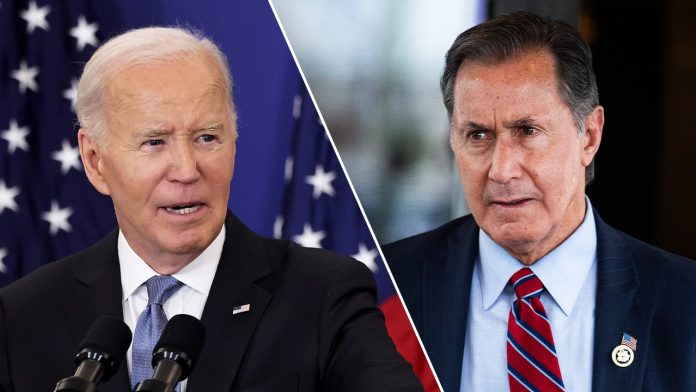
On Wednesday, Rep. Gary Palmer, R-Ala., introduced a Congressional Review Act (CRA), which allows Congress to overturn rules enacted by federal agencies, to circumvent the administration’s appliance crackdown, shared first with Fox News Digital.

“It’s a radical ban on water heaters. Another example of government overreach under the Biden administration on their way out the door. They care nothing about consumers,” Palmer told Fox News Digital in an exclusive interview. 

NEW BIDEN WATER HEATER BAN WILL DRIVE UP ENERGY PRICES FOR POOR, SENIORS: EXPERT

Rep. Gary Palmer, R-Ala., leaves a meeting of the House Republican Conference at the Capitol Hill Club on Tuesday, Jan. 30, 2024. (Tom Williams)

Proponents of Biden’s regulation, such as the Appliance Standards Awareness Project (ASAP), suggest it will eliminate 32 million metric tons of carbon dioxide emissions from water heaters sold over 30 years. 

But Palmer said it will have serious economic implications on working Americans, given the amount a household would have to pay out of pocket for a new water heater that complies with the rule.

The Alabama congressman expressed confidence that the CRA is going to pass in the House, as several other Republican lawmakers have signed on as sponsors.

Rep. Eric Burlison, R-Mo., one of the cosponsors of the CRA, told Fox that “Joe Biden’s last-ditch effort to ban gas water heaters in his final days in office is nothing short of another green energy scam.”

President Biden speaks in Roosevelt Room

President Biden speaks in the Roosevelt Room at the White House in Washington on Jan. 10. (AP/Ben Curtis)

“This latest assault on American consumers isn’t about saving the planet; it’s about control, higher costs, and forcing an unsustainable, radical agenda on every household,” Burlison said in a statement shared with Fox News Digital. “It’s time we stand up against this tyranny of regulations and protect the freedoms and choices of the American people.” 

NEW. NYC ‘CHAR BROIL’ RULE WOULD FORCE RESTAURANTS TO CUT EMISSIONS BY 75%

Other Republican co-sponsors include Reps. Julia Letlow of Louisiana, Mike Collins of Georgia, Randy Weber of Texas, Stephanie Bice of Oklahoma, Barry Moore of Alabama, Andy Ogles of Tennessee, Claudia Tenney of New York, Russ Fulcher of Idaho, Jack Bergman of Michigan, Dan Crenshaw of Texas, Michelle Fischbach of Minnesota, Jeff Hurd of Colorado, and Jim Baird of Indiana.

The National Propane Gas Association also supports overturning the ban, telling Fox that it “threatens to eliminate the non-condensing instantaneous gas water heaters market.”

Angel Gomez (L) and Franes Mendez, technicians at heating, cooling and plumbing company John G. Webster, remove a gas water heater from a home in Washington, DC, on Aug. 28, 2024.

Angel Gomez (L) and Franes Mendez, technicians at heating, cooling and plumbing company John G. Webster, remove a gas water heater from a home in Washington, DC, on Aug. 28, 2024. (Bastien Inzaurralde)

“This rule would compel families to replace their existing equipment with unnecessary expensive retrofits, imposing an undue financial burden for a marginal level of energy savings and questionable economic benefits,” Steve Kaminski, President and CEO of the National Propane Gas Association told Fox News Digital.

Biden has introduced regulations on several different household appliances during his term, such as washing machines, gas stoves, and ceiling fans. 

CLICK HERE TO GET THE FOX NEWS APP

But the Republican-controlled congress is reportedly going to be “very aggressive in rolling back” some of the regulations that evolved from Biden’s climate agenda, Palmer said.

What China Wants in Panama: More Trade, Projects and Influence

0

There was talk of a high-speed rail line that China would build in Panama. A new subway line in Panama City. A modern container port.

China has been working to build ties and influence in Panama for years, part of its broader ambition to expand its footprint in Latin America. The effort has had some successes, but also plenty of setbacks.

In 2017, China scored a major victory when Panama cut diplomatic ties with Taiwan, the self-governing island that China claims as its territory, and recognized Beijing instead. Panama had been one of the few countries worldwide to recognize Taiwan as a sovereign state.

The following year, Panama became the first Latin American country to sign onto the Belt and Road Initiative, the Chinese leader Xi Jinping’s signature global infrastructure program, which is aimed at enlarging China’s geopolitical heft and countering American influence.

A flurry of ambitious promises followed. China proposed to build a 250-mile high-speed rail line from Panama City, the capital, toward the western border with Costa Rica. It offered to help build a new subway line in Panama City. A consortium of Chinese companies, led by the conglomerate Landbridge, began developing a container port that was promised to be Panama’s most modern one.

A Chinese state-owned company also won a $1.4 billion contract to build a fourth bridge over the Panama Canal. Eventually, the two countries said they would negotiate a free-trade agreement.

Beijing made clear that it wanted to solidify its support in Panama City. In early 2018, a visiting Chinese official told then-President Juan Carlos Varela that “the establishment of diplomatic relations with Panama was the most important diplomatic achievement for China during 2017,” according to a Panamanian government news release. Later that year, Mr. Xi became the first Chinese leader to visit.

China also stepped up its soft-power efforts, opening a Confucius Institute to promote Chinese culture and language, and donating health care supplies during the Covid pandemic.

But as China’s influence grew, so did wariness among Panamanians, as well as pressure from the United States for Panama to distance itself from Beijing. After Mr. Varela left office, his successor, Laurentino Cortizo, suspended the proposed railway project. The trade negotiations have stalled.

The Panamanian government revoked Landbridge’s rights to the container port project in 2021, after an audit found that the company had violated the terms of its contract, investing less money and employing less local labor than had been promised.

Still, China has also had some successes. The new Panamanian president, José Raúl Mulino, has revived the idea of the railway, and Chinese diplomats and companies have made clear that they want to participate. Construction has resumed on the fourth bridge over the Panama Canal, after a pause.

In 2021, the Hong Kong company CK Hutchinson won a 25-year extension of its control over two ports at the canal’s entrances.

CK Hutchison is a publicly listed conglomerate whose largest owner is a family of Hong Kong billionaires. It is not a Chinese state-owned company. But Beijing has tightened its control over Hong Kong in recent years, and it has the power to compel private companies to comply with its demands in the name of national security.

Panama has been the focus of special attention from China, because of the canal and its previous ties to Taiwan, but China has also been working to expand its influence in Latin America more broadly. It has positioned itself as an alternative to the United States in global leadership, casting itself as a fellow developing country more attuned to such nations’ needs.

Beijing has also invested heavily in Peru, where it opened a new Chinese-funded port in a city 40 miles north of Lima in November. China is South America’s top trading partner and the second-biggest, after the United States, for Latin America as a whole.

In response to accusations from President-elect Donald J. Trump, Chinese officials have denied having any interest in infringing on Panama’s sovereignty or bending it to its own interests against Washington. They have said that China would always respect the canal as a permanently neutral international waterway.

Chinese scholars have denounced American concerns about Beijing’s growing presence in Latin America as smear campaigns.

Zhou Bo, a retired colonel in the People’s Liberation Army of China who is now a senior fellow at the Center for International Security and Strategy at Tsinghua University in Beijing, said Mr. Trump’s recent remarks about a Chinese military presence in Panama were so absurd as to “not deserve a specific reply” from Beijing.

“China has many investments around the world. They’re not limited by region, or whether it’s supposedly ‘America’s backyard,’” he said.

Cui Shoujun, director of the Research Center for Latin American Studies at Renmin University in Beijing, expressed confidence that China’s relations with Panama would keep growing, despite American efforts to stymie them.

Mr. Trump might even push Panama closer to Beijing, he added. “You have an extremely domineering American president, and a pragmatic Chinese partner,” he said. Faced with that choice, he said, “the answer is self-evident.”

DHS Secretary says border is more secure than before pandemic : NPR

0

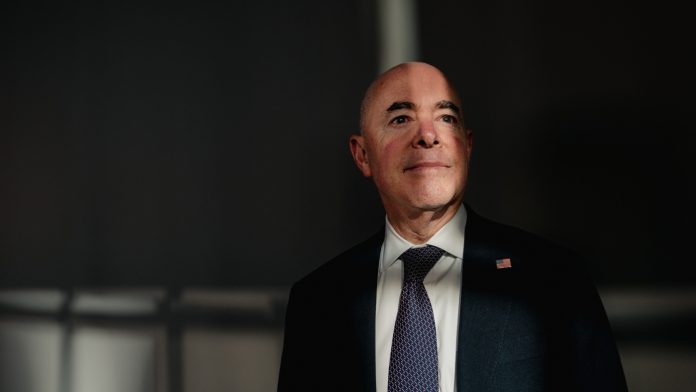
U.S. Secretary of Homeland Security Alejandro Mayorkas poses for a portrait at NPR Headquarters in Washington, DC, on Jan. 7.

Shuran Huang for NPR


hide caption

toggle caption

Shuran Huang for NPR

Secretary of Homeland Security Alejandro Mayorkas is talking about what went wrong, and making a case for what went right on his watch during the Biden administration.

Mayorkas will step down next week after four contentious years as DHS secretary come to an end.

His sprawling department encompasses everything from the Coast Guard to the Secret Service—and also border protection and immigration enforcement agencies. That put Mayorkas at the center of a ferocious immigration debate that was a major issue in the election that Democrats lost in 2024.

Mayorkas spoke about how immigration played a role in that defeat with NPR.

“In terms of the narrative, I don’t think we prevailed in communicating to the American people successfully the challenges of migration at an historic level since World War II,” he told Morning Edition‘s Steve Inskeep.

Mayorkas did not criticize administration policies, but alluded to disagreements within the Biden White House over what to do—saying there are “differences of opinion” but that “once a decision is made, we all move forward as one team. And that is indeed what we have done and will continue to do until this administration comes to a close.”

The number of migrants and asylum seekers peaked at the U.S. southern border in December 2023. Mayorkas blamed circumstances beyond the administration’s control, but Republicans blamed Mayorkas, and the House impeached him in early 2024. The Senate rejected both articles of impeachment after the House’s narrow vote.

President Biden later took executive actions in June making it easier to block asylum seekers. And as the administration departs, Mayorkas says fewer people are crossing these days, than during parts of the first Trump administration.

“The border right now is more secure than it was at the end of 2019, the last year before the pandemic struck,” Mayorkas said.

U.S. Secretary of Homeland Security Alejandro Mayorkas speaks with NPR’s Steve Inskeep after an exit interview at NPR Headquarters in Washington, DC.

U.S. Secretary of Homeland Security Alejandro Mayorkas speaks with NPR’s Steve Inskeep after an exit interview at NPR Headquarters in Washington, DC.

Shuran Huang for NPR


hide caption

toggle caption

Shuran Huang for NPR

He added that deportations are up sharply in the past year. In short, the departing secretary suggested that he has already delivered on much of the security that President-elect Donald Trump promised.

Mayorkas reflected on border enforcement, DHS staffing needs, foreign terrorism and domestic extremism.

This interview has been lightly edited for length and clarity.

Inskeep: Let’s start at the border. In what state, in your view, are you leaving the border for the next administration?

Mayorkas: The border right now is more secure than it was at the end of 2019, the last year before the pandemic struck. The number of individuals encountered at the border on a daily basis is lower than it was at that time, and that has been consistently the case now for approximately six months.

Inskeep: Some people will just not believe that. Let’s go through the numbers. There was a peak in late 2023, right? And then they began declining—The numbers of people encountered each month—is that correct?

Mayorkas: In late 2023, December, specifically, we reached a peak among the four years of this administration, and that was directly attributable to the fact that in that month the Mexican enforcement agency, IME, was unfunded. It did not have funds. And people might recall that as a result of that, the president dispatched Secretary Blinken and me to Mexico to meet with the president and members of his cabinet to speak of the imperative of funding the enforcement agency. It’s as though we did not have any Border Patrol presence on our side of the border. There was no interdiction of migrants seeking to reach the southern border between the United States and Mexico. President Lopez Obrador, in fact, funded the enforcement agency. There were interdiction efforts resumed and the numbers dropped. But the most precipitous drop really occurred upon our swift and effective implementation of the President’s proclamation in June of 2024 that restricted the ability of individuals to claim asylum at our southern border.

Men seeking asylum, including Peruvians, line up as they wait to be processed after crossing the border with Mexico nearby, on April 25, 2024, in Boulevard, Calif.

Men seeking asylum, including Peruvians, line up as they wait to be processed after crossing the border with Mexico nearby, on April 25, 2024, in Boulevard, Calif.

Gregory Bull/AP


hide caption

toggle caption

Gregory Bull/AP

Inskeep: Up until 2023, though, you had gradually, steadily, in fact, dramatically increasing numbers. And people will ask why you did not act sooner. If it was within your power, as it turned out, to drastically reduce the number of people crossing, why not do that years earlier?

Mayorkas: The answer is multipart. Remember where we were up until May of 2023. In the first part of our administration, we were climbing out of the COVID-19 pandemic. Once we did that and it was not, of course, instantaneous. It took time. There was a tremendous amount of pressure on both sides of the aisle to maintain the public health order under Title 42 of the United States code, a public health provision because people were concerned that we were not yet out of the woods in our fight against the pandemic.

Inskeep: That people with COVID would cross the border? 

Mayorkas: Or quite frankly, that we could be infected, people could cross the border infected, and it could spin out of control. In May of 2023, the Title 42 public health order was lifted. We turned very quickly to Congress to seek supplemental funding of a woefully underfunded and perennially underfunded immigration system. We did not succeed in gaining additional funds. Funds for additional Border Patrol agents, Immigration and Customs Enforcement officers, asylum officers, immigration judges. The administration tried a second time to obtain supplemental funding. Again, Congress did not provide it, and we turned quickly into our bipartisan Senate negotiations for legislation which proved successful until they were politically torpedoed. So that is one important element of the answer. At the same time, Steve, we had to put elements in place to effectively implement and swiftly implement the President’s June 2024 proclamation, which we did. We had worked with countries in the region to accept the return of their nationals, not only to accept the return, but to accept the return more swiftly and more readily. We built lawful pathways to provide alternative ways of people reaching the United States who are qualified to do so. We built new labor pathways with Canada, Spain and others. We negotiated agreements with countries outside of our hemisphere, across the Atlantic to impose restrictions on the migratory path. A whole suite of measures that enabled us ultimately to so swiftly and effectively implement the President’s proclamation. So it’s a combination of factors.

U.S. Secretary of Homeland Security Alejandro Mayorkas at NPR Headquarters.

U.S. Secretary of Homeland Security Alejandro Mayorkas at NPR Headquarters.

Shuran Huang for NPR


hide caption

toggle caption

Shuran Huang for NPR

Inskeep: Do you think that on some level the administration lost the narrative on this, however? Politically, this was a loser throughout the administration, this issue.

Mayorkas: So it’s not for me to comment on the politics. But in terms of the narrative, I don’t think we prevailed in communicating to the American people successfully the challenges of migration at a and at an historic level since World War II. The challenge of our southern border was not unique to the United States. In my bilateral and multilateral engagements with other countries around the world, they spoke of the challenges of migration they themselves were enduring. We have a level of displacement of people in the Western Hemisphere and in the world that is in fact the greatest in about 80 years.

Inskeep: So you acknowledge you didn’t communicate as well as you would have liked to. When you look back, what would you have done differently?

Mayorkas: You know, I am a big believer, Steve, that the front windshield is bigger than the rearview mirror for a reason. We look forward. We provide our input to those who will govern in the future, and we move forward. But there’s no question that the narrative was not a successful one.

Inskeep: That said, I study history, so I look in the rearview from time to time. 

Mayorkas: As do I.

Inskeep: When you do look from time to time, is there anything you regret about the way that you did this job on immigration specifically?

Mayorkas: I would say the following, Steve. You know, there are differences of opinion on many complex and challenging issues. Immigration is no different in that regard. Once a decision is made, we all move forward as one team. And that is indeed what we have done and will continue to do until this administration comes to a close.

Inskeep: Because the number of encounters has declined so sharply. And we should emphasize still thousands of people, but it’s like less than a third of what it was. Are you willing to say to the incoming administration?

Mayorkas: It’s actually below a thousand quite often and sometimes above a thousand, you.

Inskeep: You mean per day?

Mayorkas: But remember, in 2018, and I’ll be approximate in my numbers, in 2018 there were about 550,000 to 560,000 individuals encountered at the southern border. Throughout the year in 2019, that number was almost double. And so what has driven displacement around the world did not begin in 2021. We saw it climbing from the 2018 to 2019 period. And then, of course, COVID hit.

Inskeep: Are you at the point where you might be willing to hand the border over to the next administration and say, actually, the problem is sort of solved? We’ve done this for you.

Mayorkas: I would say that the model that we have built of restricting asylum at our southern border and building accessible, lawful, safe and orderly pathways for individuals to seek relief under our laws is the model that should be sustained. And we have delivered the border and those accessible pathways to the incoming administration. And that’s with respect to the border. We then have the challenge of individuals already present in the United States who avail themselves of the court process, the immigration court process. And when they don’t succeed, they are subject to removal and that process needs to continue.

President-elect Donald Trump speaks during a news conference at Austin-Bergstrom International Airport, Friday, Oct. 25, 2024, in Austin, Texas.

President-elect Donald Trump speaks during a news conference at Austin-Bergstrom International Airport, Friday, Oct. 25, 2024, in Austin, Texas.

Alex Brandon/AP


hide caption

toggle caption

Alex Brandon/AP

Inskeep: How many people have you deported, say, in the last year?

Mayorkas: I believe the number is well over 250,000. A very significant number.

Inskeep: Is that higher than it would have been a few years ago?

Mayorkas: Yes, it is. And we have built that capacity and we’ve built those processes.

Inskeep: And I’m just trying to think about what is necessary, from a layman’s perspective, to have capacity. You need agents, you need courts, you need court rulings. You need airplanes in some cases or buses you need a country to ship them to one that will take them. 

Mayorkas: Transportation assets, personnel and personnel across the spectrum of the system, individuals to apprehend. We also need facilities in which to detain individuals. We need immigration court judges. We need legal personnel to represent the government in proceedings. And so it is a woefully underfunded system. And so if the administration that is coming in intends to execute on what it has articulated publicly, it will need substantial additional resources to do so.

Inskeep: The president-elect has talked about a mass deportation. He’s been general or vague about exactly what that means. And people around him give different definitions. As someone who knows the law, as someone who knows the systems, what is practical?

Mayorkas: Well, I believe the border czar Tom Homan, with whom I have worked in the past in the Department of Homeland Security, has spoken of prioritizing individuals unlawfully present in the United States who pose a public safety or national security risk. If that is indeed the case, and that will hold, that is precisely what we have been doing and have done.

Inskeep: I want to underline that, you’re saying that they’re promising to do the thing that you’re already doing?

Mayorkas: On Sept. 30, 2021, I issued immigration enforcement guidelines that identified categories of individuals for a prioritized enforcement effort because our resources are not sufficient to remove everyone who is unlawfully present. We have more than 12 million undocumented individuals in the United States. And so the priorities I set were the priorities that have been set in the past. Individuals who pose a threat to our national security. Individuals who pose a threat to our public safety. And individuals who pose a threat to our border security.

Inskeep: What about someone who’s committed a crime? Are they automatically considered someone who poses a threat?

Mayorkas: I think there are a number of factors. It depends on the crime. What if, for example, it’s a misdemeanor that a majority of people would say doesn’t necessarily constitute a public safety threat, but is nevertheless a violation of our laws? It becomes an issue of discretion. How long has that individual been resident in the United States? Are there other negative factors that would warrant the removal of the individual? Are there positive factors that might militate against removal? The individual has been here for decades, has been otherwise a contributing member of society, is a sole caretaker of a United States citizen. I can paint a picture. It’s a matter of discretion. But when we have limited resources, we have to use those limited resources to effect the greatest public interest.

Inskeep: John Thune, the new Republican Senate leader, said on NBC the other day that he believed there were more than one million people who were here without authorization, here illegally who had committed crimes. If I understood him correctly, does that sound like an accurate number to you, and is it pragmatic to begin to take them out?

Mayorkas: So I don’t I’m not familiar with that particular figure. I think individuals who pose a public safety threat should be removed from the United States when they do not have a basis to remain in the United States. I also think that individuals who have had their day in court, who have made their claims and have lost, should be removed from the United States. Otherwise, why execute on a system? We’re a nation of laws as well as a nation of immigrants.

Inskeep: If the administration goes broader and tries to deport more people than those you would consider to be a public safety threat or a national security threat, what are the limits? How far can they go? And what would stop them from going farther and farther?

Mayorkas: Steve, I’ve identified a group of individuals who might not necessarily be a public safety threat, but who I think warrant removal. Individuals who’ve had their day in court, have lost, have not succeeded in making a claim to remain. And if they’ve pursued their legal rights, they have not prevailed, they should be removed.

U.S. Secretary of Homeland Security Alejandro Mayorkas poses for a portrait at NPR Headquarters on Jan. 7.

U.S. Secretary of Homeland Security Alejandro Mayorkas poses for a portrait at NPR Headquarters on Jan. 7.

Shuran Huang for NPR


hide caption

toggle caption

Shuran Huang for NPR

Inskeep: And there’s a fair number of people in that category in the United States today?  They’re all lost their court hearing, but they’re still here.

Mayorkas: Correct. And there are also individuals who have never been in the system because they evaded detection when crossing the border and perhaps many years ago. I think now for many, many years, we have to fix what everyone agrees is our broken immigration system. There was a bipartisan group of senators a number of years ago who proposed legislation to repair the system to provide a pathway to individuals who qualified under certain criteria. I hope that is resuscitated. President Biden presented such a piece of legislation on his very first day in office.

Inskeep: The president-elect has been asked about mixed status families. NPR has reported there are millions of such families across the country where maybe not everybody is here illegally, but somebody in the family is here illegally. When the president elect was asked about that, one of the things he said was, ‘well, I don’t want to break up families, so maybe we’ll just make the whole family go, deport the whole family.’ What are the legal, practical and moral aspects of that situation as you think about it?

Mayorkas: So what President Biden did was he took executive action. We termed it Keeping Families Together. When a U.S. citizen was married to an individual who did not have lawful presence, the individual nevertheless met certain criteria, we provided a path for keeping that family together.

Guatemalan migrants deported from the U.S. stand at La Aurora International Airport after landing in Guatemala City, Friday, Dec. 27, 2024.

Guatemalan migrants deported from the U.S. stand at La Aurora International Airport after landing in Guatemala City, Friday, Dec. 27, 2024.

Moises Castillo/AP


hide caption

toggle caption

Moises Castillo/AP

Inskeep: In the United States? 

Mayorkas: In the United States. That was thwarted in the courts. What the incoming administration has articulated is that, and once again, Mr. Homan has communicated this, that if there are undocumented parents who have U.S. citizen children, then it will be the undocumented parents’ decision if they are subject to removal, whether they want to be removed with their children or whether they will choose to separate their family and have their U.S. citizen children remain here and they will be removed alone. People can agree or disagree on that policy. I believe that one of the objectives of our immigration system is family unity. There are three primary objectives. Humanitarian relief. That is why we have our refugee system. It is economic prosperity. We have economic visas for individuals to come here. We have economic pathways. A very outdated system, by the way. And then we have laws that provide for family unification. And I believe in keeping families together. And we saw the very tragic results of the prior administration’s family separation policy.

Inskeep: If the new administration keeps families together by deporting American citizens, what do you make of that?

Mayorkas: The American citizens wouldn’t be technically deported.

Inskeep: They would be agreeing to leave. 

Mayorkas: They would be accompanying. Deported relatives, sometimes the very relatives upon whom they rely to live.

Inskeep: Would they have any legal defense against that situation?

Mayorkas: They would not. We’re getting into technical legal issues, but presumably the removal, the deportation of the individuals, would be pursuant to law. And then it is a matter of election as to whether the family would choose to stay together. It’s an election, the freedom of which we can debate. Because that’s a very difficult choice. And some would posit, in some ways, and inhumane choice to compel.

Inskeep: Since the election, some of the Republicans I’ve spoken with have had interesting things to say about the border and about immigration. They have said, “well, yes, we need to secure the border. That’s absolutely a priority. And there are people who are here illegally, and that is wrong.” And then they begin talking about perhaps expanding work visas. They would actually like people to stay who are in the community and who are working. And maybe they don’t want them to be citizens, but they would like them to stay. What do you make of that strand of thinking and how does that match up with what you see from the incoming administration?

Mayorkas: This really highlights the complexity of the issues of immigration. I, in my position as secretary, certainly have received bipartisan advocacy in support of expanding economic visa programs. Bipartisan support. The H-1B visa program for highly skilled labor. If one speaks to the business community, many chief executives, especially in the technology industry, for example, will advocate for a greater number of high skilled visas, the H-1B. I received bipartisan support for the H-2B visa program and the need to raise the number of non-agricultural temporary workers. Very difficult jobs for Americans to fill. Who can afford to move temporarily from their home during a particular season? Take Alaska and the seafood industry. Take Maine and the hospitality. Can the ordinary American seeking to make ends meet move for three months to address seasonal labor, pay the cost of housing, pay the cost of transportation, only to return to their homes after that temporal season? Very, very difficult. And that’s proven to be the case. The difficulty is, and what a powerful example of how broken the system is, that the H-1B numeric cap was set, I believe, in the 1990s.

Mayorkas speaks with NPR’s Steve Inskeep during an exit interview.

Mayorkas speaks with NPR’s Steve Inskeep during an exit interview.

Shuran Huang for NPR


hide caption

toggle caption

Shuran Huang for NPR

Inskeep: Meaning the number of people who can be let in?

Mayorkas: The H-2B, the non-agricultural temporary worker. The numeric caps were sent in the 1990s. If one looks northward to Canada, Canada calibrates those numeric limits according to market needs year to year. We’re decades behind.

Inskeep: As you know, there’s a ferocious debate among Trump’s own supporters about the H-1B visa program. There are allegations, and we’re doing some reporting on this ourselves, that the program has been abused from time to time. That employers use this to bring in cheaper workers. At the same time, they’re laying people off. There’s even an example involving Elon Musk’s Tesla. Is this program abused from time to time?

Mayorkas: The answer is yes. And when I was the director of U.S. Citizenship and Immigration Services that administers the H-1B visa program, I established the Fraud Detection and National Security Directorate dedicated to rooting out fraud and national security concerns in our immigration system.

Inskeep: Did this include undercutting American workers’ wages?

Mayorkas: Well, there are requirements to ensure that a job cannot be filled by an American worker before we look elsewhere. But I agree with Mr. Musk and his advocacy in support of the H-1B visa program. I agree with the many executives who clamor for more high-skilled workers from other countries. It is unfortunate – and I believe the president-elect has spoken of this as well – it is unfortunate that we have individuals coming from other countries to study in our institutions of higher learning, our colleges and universities gain tremendous skills, want to remain in the United States. We can use their labor. Nevertheless, our visa system does not permit it. We lose them to countries that compete with us. That is, I would say, suboptimal.

Inskeep: I want to ask a few questions more broadly about your job. You’ve spent four years now at the head of a giant agency that has many sub agencies and was put together rapidly after 9/11, having had the opportunity to run it for these four years. Does the Department of Homeland Security, as a department, make sense?

Mayorkas: Yes. And I think it is more fit for purpose than it ever has been. And I think our components, the agencies, the operational agencies within the department, along with our many offices, are working more cohesively than they ever have before. I think, Steve, that our country’s national security has converged more than ever before with our homeland security, the globalization of so many aspects of our lives, the interconnectedness of people and countries around the world have helped fuel advances in technology. And so I do think, as the department makes sense, and I think it is working more effectively than ever before as a cohesive unit. We have a diverse range of missions. We have a diverse range of agencies. But the interplay between them is quite compelling and quite necessary.

Inskeep: What’s a security threat that you think DHS is particularly well-suited to handle?

Mayorkas: I can name many, but the cybersecurity threat is one. The threat of foreign terrorism is something that we do not combat alone. We combat in close partnership with our fellow agencies and departments in the federal government, as well as with state, local, tribal, territorial, campus law enforcement. The threat of domestic violent extremism. Individuals already resident here in the United States radicalized to violence by reason of a foreign terrorist ideology, anti-government sentiment, ideologies of hate, personal grievance. We’ve seen that materialize tragically in New Orleans. The threat of adverse nation states. We handle in a number of different ways, again in partnership with other entities and the general public, whether it is online child sexual exploitation, cyber attacks from foreign countries, forced labor. It’s quite a diverse range of responsibilities. And I haven’t even touched upon extreme weather events.

A member of the emergency services walks past a police barricade after a vehicle drove into a crowd on New Orleans' Canal and Bourbon Street, Wednesday Jan. 1, 2025.

A member of the emergency services walks past a police barricade after a vehicle drove into a crowd on New Orleans’ Canal and Bourbon Street, Wednesday Jan. 1, 2025.

Gerald Herbert/AP


hide caption

toggle caption

Gerald Herbert/AP

Inskeep: You mentioned domestic violent extremism and mentioned New Orleans. Of course, there was also the attack in Las Vegas. What did those incidents tell you about the threat environment when it comes to threats from within this country?

Mayorkas: We are in a heightened threat environment, Steve. It’s something about which I, Director Chris Wray of the FBI, Attorney General [Merrick] Garland and many others have spoken of publicly. I’ve identified three very primary threat vectors: adverse nation states, foreign terrorism, domestic violent extremism that fuel a heightened threat environment. We saw ideologies of hate grow in prominence and virility following Oct. 7.

Inskeep: Do you think, from what you’ve seen, that the new administration will view domestic violent extremism the same way that you do?

Mayorkas: It is certainly my hope that they do, because what we are not speaking of is an ideology in isolation. What we are speaking of is an ideology that is manifested in acts of violence, which are untenable and unacceptable and illegal.

Inskeep: How as a law enforcement official do you approach individuals like the New Orleans attacker or the veteran, the service member in Las Vegas, who weren’t directed by anybody and maybe picked up an ideology along the way, but maybe their attack is not really about that? It’s hard to say truly what motivated them to do that. How do you even battle that threat?

Mayorkas: So those are two very different cases and I think it’s important that we speak of them separately. And also I should just communicate that the investigations are still underway. So we have more to learn. The Federal Bureau of Investigation, with our local partners and our support has done an extraordinary job from an investigative perspective. Let’s take New Orleans. The evidence thus far suggests that the individual was radicalized to violence by indeed a foreign terrorist ideology, and specifically ISIS. He claims to have been a member of ISIS. And there is documentary evidence to support that. The issue is how do we, as a society, identify when an individual is descending into or down a path of violence? Increasing isolation, withdrawal from important people in their lives, statements made either in person or online through channels that are publicly accessible. How do we identify that and intervene? From a public health perspective, we have efforts underway. We have a center for prevention and partnership where we are taking a health informed approach in communities across the country. Really locally based, federally supported, where a community’s ecosystem is working as a community to identify when that is occurring and seeing if we can intervene and prevent an individual from actually committing an act of violence before it’s too late, not after it has occurred. And really then turning to the law enforcement architecture for accountability, but rather an effort of intervention and saving a community.

Inskeep: Let me ask about an agency within DHS that had to respond to threats in the last year. The Secret Service. Is the Secret Service understaffed?

Mayorkas: It is understaffed. It is under-resourced. The failure of July 13 was a failure of operation, not attributable to a lack of resources. That was a failure of operation. But let me say the following. The Secret Service is under-resourced. It is understaffed. And I continue to believe quite strongly that it remains and is nevertheless the best protective service in the world. And what people do not see is its successes. Success means that there is nothing to see. The U.N. General Assembly, an extraordinarily, extraordinarily complex security undertaking, precedes without incident year in, year out. The Democratic convention, the Republican convention of this past year, successfully executed. I can go on and on, but there’s no question that there were failures and that those failures had causes that are being remediated.

Inskeep: Isn’t Customs and Border Protection also understaffed?

Mayorkas: Yes, it is. And we need more Border Patrol agents. We need more customs officials. And this is not only to serve our nation’s physical security, in terms of the border and, by the way, not just the United States Border Patrol, Office of Field officials. Individuals whose staff are ports of entry. But it also facilitates lawful trade and travel and will serve to fuel America as an economic engine.

A U.S. Border Patrol flag hangs in front of the sector office in the Big Bend area of west Texas on Nov. 22, 2017 near Van Horn, Texas. (John Moore/Getty Images)

A U.S. Border Patrol flag hangs in front of the sector office in the Big Bend area of west Texas on Nov. 22, 2017 near Van Horn, Texas.
(John Moore/Getty Images)
hide caption

toggle caption

Inskeep: The Government Accountability Office had a report recently which found that you had made efforts to recruit more border agents, offering bonuses and so forth, but that you still weren’t keeping up with attrition the number of people who leave. Why do you think that is?

Mayorkas: Well, I think it’s been a tough time for law enforcement in this country. I do hope that we turn that corner very rapidly. It is an extraordinarily noble profession. And let me share with you an image that proves its nobility and the heroism of the men and women on the front lines across this country every day. There was footage from the New Orleans tragedy where there are a number of officers captured on video. One can see them receiving in their earpieces news of an event that turned out to be indeed tragic. And they all run towards that event. They run towards danger with the sole mission of helping others. That is a remarkably heroic image of heroic people. And that’s what law enforcement does and the first responder community writ large does every single day. And I hope recruiting flourishes by reason of that.

Inskeep: I’m thinking about the fact that you came into office with a lot of government experience, a lot of knowledge of DHS. You’ve now spent four very contentious, very dramatic years at the head of DHS. You’ve been impeached. A lot of different things happened. You were at the center of the news very often. At the end of it is there something that you feel that you’ve learned, large or small?

Mayorkas: I think I’m in between the 22nd and 23rd year in federal service. I’ve learned a number of things. I should say the lessons I learned early on have been highlighted. We are the greatest country in the world. There’s no greater service than public service. The public servants in the Department of Homeland Security constitute, in my opinion, the greatest workforce in the world. I learned that in late 2009. That lesson has only been emphasized during my tenure and throughout it as the secretary. An incredible honor. I would do it again and I would do it for longer. I will not have that option.


Majority say Biden will be remembered poorly as president says farewell to the nation: poll

0

More than half of Americans say that President Biden will be remembered as a below-average or one of the worst presidents in the nation’s history, according to a new national poll.

Just over a third of adults nationwide questioned in a Marist poll released on Wednesday said Biden will be remembered as one of the worst presidents in American history, with another 19% saying he will be considered a below-average president.

Twenty-eight percent of participants offered that Biden’s legacy will be considered average, with 19% saying he would be regarded as an above average or one of the best presidents in the nation’s history.

The poll was released just hours before the president delivers his farewell address to the nation, with just days left before Biden’s term ends and he is succeeded by President-elect Trump in the White House.

WILL HISTORY BE KIND OR UNKIND TO PRESIDENT BIDEN?

With less than a week left until his term in office ends, President Biden delivers an address at the State Department in Washington, D.C., on Jan. 13, 2025. (AP)

In his Oval Office speech, Biden will likely aim to cement his legacy as a president who pushed to stabilize politics at home while bolstering America’s leadership abroad, and as a leader who steered the nation out of the COVID-19 pandemic and made historic investments in infrastructure and clean energy.

The Marist poll is the second straight national survey to indicate history will likely not view Biden kindly.

According to a USA Today/Suffolk University survey released on Tuesday, 44% of voters nationwide said history will assess Biden as a failed president, with another 27% saying he will be judged as a fair president.

HEAD HERE FOR THE LATEST FOX NEWS POLLING RESULTS

Twenty-one percent of those questioned said history will view Biden as a good president, with only 5% saying he will be seen as a great president.

The president’s single term in the White House ends next Monday, Jan. 20, as Trump is inaugurated as Biden’s successor.

However, according to the USA Today/Suffolk University poll, 44% also said that Trump will be seen by history as a failed president. 

Trump speaking at MAL

President-elect Donald Trump makes remarks at his Mar-a-Lago club in Palm Beach, Florida, on Jan. 7, 2025. (REUTERS/Carlos Barria)

One in five said that Trump would be viewed as a great president, with 19% saying good and 27% saying he would be judged a fair president.

Trump ended his first term in office with approval ratings in negative territory, including 47% approval in Fox News polling from four years ago.

In Marist polling four years ago, as Trump finished his first term, 47% thought he would be remembered as one of the nation’s worst presidents.

A MAJORITY OF AMERICANS SAY THIS IS HOW THEY’LL VIEW BIDEN’S PRESIDENCY

Biden stands at 42% approval and 50% disapproval in Marist’s new survey, as the president departs the White House. He stood at 43%-54% approval/disapproval in the USA Today/Suffolk University poll.

Biden’s approval rating hovered in the low to mid 50s during his first six months in the White House. However, the president’s numbers started sagging in August 2021 in the wake of Biden’s much-criticized handling of the turbulent U.S. exit from Afghanistan, and following a surge in COVID-19 cases that summer that was mainly among unvaccinated people.

The plunge in the president’s approval rating was also fueled by soaring inflation – which started spiking in the summer of 2021 and remains to date a major pocketbook concern with Americans – and the surge of migrants trying to cross into the U.S. along the southern border.

Biden’s approval ratings slipped underwater in the autumn of 2021 and never reemerged into positive territory.

Biden and Trump chat

President Biden, right, meets with President-elect Donald Trump in the Oval Office of the White House on Wednesday, Nov. 13, 2024, in Washington. (AP Photo/Evan Vucci)

As Trump gets ready to once again assume the presidency, the Marist poll indicates opinions of him remain low, with 44% of Americans viewing him favorably and 49% holding an unfavorable opinion of the incoming president.

However, opinions about Trump’s first term have risen in numerous polls conducted since his convincing victory in November’s presidential election over Vice President Kamala Harris. The vice president succeeded Biden in July as the Democrats’ 2024 standard-bearer after the president dropped out of the race following a disastrous debate performance against Trump.

The poll also indicates that Americans have high expectations for Trump when it comes to the economy.

“While many Americans feel the current economy is not working well for them, residents nationally have grown more optimistic about the future of their own finances,” the poll’s release highlights.

The survey also indicates Americans are divided about Trump’s proposed mass deportations of undocumented immigrants. 

CLICK HERE TO GET THE FOX NEWS APP 

According to the poll, more than six in 10 disapprove of Trump’s pledge to pardon his supporters who were convicted in the Jan. 6, 2021 riot at the U.S. Capitol.

The Marist poll was conducted Jan. 7-9, with 1,387 adults nationwide questioned. The survey’s overall sampling error is plus or minus 3.2 percentage points.

Hun Sen Adviser Wanted in Thailand Over Lim Kimya Killing

0

A Thai court issued an arrest warrant for an adviser to the Cambodian strongman Hun Sen on Wednesday, charging him with hiring others to commit “premeditated murder” in the brazen killing of a former Cambodian opposition politician in Bangkok last week.

The warrant was the strongest indication so far that Lim Kimya, who was gunned down on a busy street, was the victim of a political assassination. He was a former legislator with the Cambodia National Rescue Party, an opposition party that was dissolved under pressure from Mr. Hun Sen, who ruled Cambodia as prime minister for nearly four decades. Mr. Hun Sen handed that job to his son Hun Manet in 2023 but remains the leader of his political party and the country’s senate.

The person named in the arrest warrant is Somwang Bamrungkit, 42, a dual Thai-Cambodian national who is known in Cambodia as Ly Rotanakraksmey. Thai prosecutors brought three charges against him, including one involving carrying firearms and firing guns. His current location remains unclear.

Sok Eysan, a spokesman for the Hun dynasty’s Cambodian People’s Party, said even though Mr. Ly Rotanakraksmey was an adviser to Mr. Hun Sen, “what he does illegally, it is that person’s responsibility.” Mr. Hun Sen has appointed dozens of advisers, and the exact nature of his relationship with Mr. Ly Rotanakraksmey was not immediately clear.

Last Tuesday, a gunman shot Mr. Lim Kimya, 73, who was a dual French and Cambodian citizen, after he got off a bus from Cambodia to neighboring Thailand. The gunman fled on a motorcycle and boarded a pickup truck before he crossed into Cambodia. But in the following days, he was arrested and extradited to Thailand, where authorities identified him as Ekaluck Paenoi. He confessed to the killing but told Thai investigators that he could not reveal the mastermind out of fear for his family’s safety.

Cambodian dissidents, including Sam Rainsy, who once led the C.N.R.P., have said the ultimate blame for the killing lies with Mr. Hun Sen.

The killing was seen as a major escalation of a campaign of transnational repression by Cambodia, which in recent months has secured the deportation of dissidents from Thailand and Malaysia. It was condemned by France, which said it would closely monitor the investigation by the Thai authorities.

“It sends a terrifying message that no one is safe,” said Elaine Pearson, the Asia director for Human Rights Watch. “If they can target someone of that stature and do it in such a blasé way, on the streets of downtown Bangkok in daylight hours, in front of CCTV footage, imagine what they could do to someone who doesn’t have a big profile, who’s not an opposition politician and who doesn’t have a second nationality.”

Ms. Pearson said in the wake of the killing, Cambodians in Thailand have contacted her organization, fearing for their security. She said there was an urgent need for foreign governments to quickly resettle Cambodian refugees and exiles.

Before it was crushed, the Cambodia National Rescue Party posed the biggest threat to Mr. Hun Sen’s rule. Mr. Ly Rotanakraksmey, the fugitive, was an official of the C.N.R.P. in Thailand. But in 2022, he joined the C.P.P. and became an adviser to Mr. Hun Sen last January.

Separately, Thai news media reported that Interpol has sought the arrest of Pich Kimsrin, a 24-year-old Cambodian man whom Thai authorities have identified as the so-called spotter in the killing. Mr. Pich Kimsrin appears to be the younger brother of Pich Sros, a pro-government politician who is most well-known for filing the complaint that led to the dissolution of the C.N.R.P. in 2017, according to a family photograph and his birth certificate. Mr. Pich Kimsrin remains at large.

Mr. Pich Sros is a member of the government’s Supreme Consultative Council, giving him a rank equivalent to senior minister and government adviser, and is the founder of his own minor political party, the Cambodian Youth Party, which is aligned with the C.P.P. He declined to comment.

In May 2023, Mr. Pich Kimsrin was appointed as the deputy head of the Phsar Kandal market in Phnom Penh, reporting to Kieng Chak, another adviser to Mr. Hun Sen.

Muktita Suhartono contributed reporting from Bangkok, and Sun Narin contributed from Phnom Penh.