


Republicans are set to have unified government with control the House, Senate and White House. But they’re not yet on the same page about how to move forward on Trump’s biggest legislative priorities.
Deion Sanders reveals only way he would coach in NFL

Deion Sanders made clear last month before the Alamo Bowl that he planned on staying to coach the Colorado Buffaloes for the long-term future despite rampant rumors he could jump.
On Wednesday, Sanders appeared to throw in a caveat to his previous statement. He suggested the only way he would ever leave for the NFL was for an opportunity to coach his sons.
CLICK HERE FOR MORE SPORTS COVERAGE ON FOXNEWS.COM
General view of an advertisement for the Colorado Buffaloes football team featuring head coach Deion Sanders during the second half of a game between the Iowa State Cyclones and the Colorado Buffaloes at CU Events Center in Boulder, Colorado, on Dec. 30, 2024. (Ron Chenoy-Imagn Images)
“You know what? The only way I would consider it is to coach my sons,” he said Wednesday on “GMA3.” He put an emphasis on “sons,” suggesting he would want to coach both Shedeur and Shilo Sanders.
“I love Colorado. I love my Buffaloes. I love everything we’re building. I love what we’re doing, and I love Boulder, Colorado,” he added.
He said in a trailer for the upcoming season of “Coach Prime” on Amazon Prime Video that the 2024 season was special because he was “99%” sure it would be the final opportunity for him to coach his sons.
Sanders could very well do that, but it would take a lot.

Colorado Buffaloes head coach Deion Sanders, left, and quarterback Shedeur Sanders, #2, talk with the media after the game against the Brigham Young Cougars at Alamodome in San Antonio on Dec. 28, 2024.. (Troy Taormina-Imagn Images)
Of the top 10 picks in the NFL Draft, the New England Patriots, Jacksonville Jaguars, Las Vegas Raiders, New York Jets, New Orleans Saints and Chicago Bears each have head coach openings. Only the Raiders could really have a shot at selecting a quarterback.
Shedeur Sanders is expected to be one of the first players taken in the draft, but it will all depend on what the five teams in front of them do. The Tennessee Titans definitely need a quarterback and will likely choose one if they stay at No. 1. The Cleveland Browns need a quarterback but could opt to go for a veteran free agent. The New York Giants are also in need of a quarterback, but they also have a bunch of other needs to address as well.
Shilo Sanders may not be a first-round pick, which could make it easier for Deion Sanders and whatever team he may coach to select him.

Colorado head coach Deion Sanders watches his players warmup prior to the game between the Kansas Jayhawks and the Colorado Buffaloes at GEHA Field at Arrowhead Stadium in Kansas City, Missouri, on Nov. 23, 2024. (Nick Tre. Smith-Imagn Images)
CLICK HERE TO GET THE FOX NEWS APP
It is a lot of hypothetical work for each of the Sanders boys to play together. A perfect storm will have to be created, but crazier things have happened in the NFL.
Follow Fox News Digital’s sports coverage on X, and subscribe to the Fox News Sports Huddle newsletter.
Lebanese Lawmakers Choose a President After 2 Years of Gridlock

Lebanon’s fractured Parliament overcame more than two years of gridlock on Thursday to choose a new president, a critical step toward bringing stability to a country attempting to recover from economic catastrophe and a devastating war.
Lawmakers elected Gen. Joseph Aoun, the commander of the Lebanese military, by an overwhelming majority in the second round of voting, after he failed to achieve the necessary majority in the initial vote. It marked a breakthrough toward forming a government with a mandate to lead the country after stalemate under weak caretaker rule.
The vote was seen as a crucial milestone for Lebanon, which has endured a series of disasters in recent years, including an economic collapse and a war between Israel and the Lebanese militant group Hezbollah that has left large parts of the country in ruins.
The election — which frequently descended into shouting matches — also came at an unnerving time for Lebanon and the wider region. In neighboring Syria, an untested new government is attempting to chart a path forward and rebuild after years of civil war. The fall of the Assad regime in Syria and the defeat of Hezbollah mean a sudden loss of power for their patron, Iran.
Lebanon’s international backers, including the United States, have implied that postwar financial support is contingent on the election of a president. According to the World Bank, the Israel-Hezbollah war, which has been suspended during a fragile 60-day cease-fire, has cost Lebanon $8.5 billion in damages.
Since October 2022, when Michel Aoun stepped down as president at the end of his six-year term, the Parliament has failed in 12 previous votes to elect a successor. But Hezbollah, long a dominant political force in Lebanon, was deeply weakened by the war with Israel and analysts noted that the group likely felt it had to make concessions because of the scale of Lebanon’s financial need.
The new president, who is not related to Michel Aoun, is considered by analysts to have U.S. backing and is widely respected in Lebanon. He has led the country’s armed forces since 2017, a role that placed him at the helm of the single national institution that enjoys cross-sectarian support.
“He is seen as an acceptable figure by all of Lebanon’s political elite,” said Lina Khatib, an associate fellow at Chatham House, a London-based research organization. “This is tied to the perception in Lebanon that the Lebanese army is an institution working in the national interest.”
Diplomats hope Mr. Aoun’s stature will allow him to exercise continued influence over the military and lead to the full implementation of the U.N. Security Council’s Resolution 1701 — a 2006 agreement that ended the previous Israel-Hezbollah war but failed to keep the peace. They hope it will be a blueprint for a longer-term peace once the current cease-fire ends.
Mr. Aoun is now expected to appoint a prime minister, in consultation with Parliament, and the prime minister will then form a government. With no faction holding a majority, that could be a long process.
U.S. markets close to honor former President Jimmy Carter : NPR

WASHINGTON, DC – JANUARY 8: The flag-draped casket of former U.S. President Jimmy Carter lies in state in the U.S. Capitol Rotunda on January 8, 2025 in Washington, DC. Carter, the 39th President of the United States, died at the age of 100 on December 29, 2024 at his home in Plains, Georgia. (Photo by Andrew Harnik/Getty Images)
Andrew Harnik/Getty Images North America
hide caption
toggle caption
Andrew Harnik/Getty Images North America
Wall Street’s opening bells will remain silent on Thursday.
The New York Stock Exchange and the Nasdaq will both close for trading today, as the financial industry joins a national day of mourning for former President Jimmy Carter. The global humanitarian died on Dec. 29, at age 100, and will be eulogized at a state funeral today in Washington.
The rare mid-week trading shutdown continues a Wall Street tradition that goes back to 1865. After President Abraham Lincoln was assassinated, the New York Stock Exchange closed for days.
Since then, the U.S. stock markets have regularly shuttered to mourn deceased presidents. The last such closure was in 2018, after the death of former President George H.W. Bush.
When Carter died, the financial industry “collectively made a decision to honor what he’s done, the service he’s provided as president — and after he’s been president,” says Tal Cohen, president of Nasdaq.
NYSE President Lynn Martin also praised Carter’s “lifetime of service to our nation” in a press release announcing her exchange’s closure for today.
Not all financial markets are taking the day off: Bond markets are staying open until 2 p.m., according to a recommendation from the SIFMA trade association for investment banks and asset managers.
It’s rare for the stock market to close in the middle of the week. And it’s not always planned: Both the NYSE and the Nasdaq closed in reaction to the September 11th terrorist attacks and Hurricane Sandy.
Cohen tells NPR that the Nasdaq had some time to prepare for today, as Carter died almost two weeks ago. His company made its plans with other exchanges, regulators, and other parts of the financial industry.
“It was a large undertaking,” he says. “But we thought it was worth the effort.”
Jimmy Carter was a man of faith and that’s how we should remember him

NEWYou can now listen to Fox News articles!
When Jimmy Carter began attending the First Baptist Church in Washington after becoming president, I thought it a unique opportunity to better understand his faith. He taught a Sunday School class as he had done for years in his native Plains, Georgia, and I joined it.
Carter was an excellent teacher. He knew the Scriptures well and on one occasion he asked me to teach the class, which was an experience I shall never forget.
After the service, we went downstairs for coffee. There was a basket on the table for people to pay 25 cents for the beverage. Carter reached in his pocket and found no money. He asked wife Rosalynn if she had brought any change. She had not. I said, “How far have we declined when the president of the United States can’t pay for coffee?” I gave him a quarter and he laughed.
FAITH A STRONG FORCE IN JIMMY CARTER’S LIFE, SAY LEADERS: ‘HEART OF A SERVANT’
Years later, after he had left the presidency, we met at a function and I reminded him of that time in the church basement. He reached in his pocket and this time had a quarter which he handed to me and said, “we’re even.” I kept that quarter on my desk for years, unable to prove he gave it to me, but we both knew.
President Jimmy Carter’s faith was a huge part of his life. FILE: Carter addressing a town meeting.
When Carter announced during the 1976 presidential campaign that he was a born-again Christian, most of the media were flummoxed. John Chancellor of NBC News announced that he had looked up the term and “it is nothing new.” If he had read the Bible that Carter read, he would have known this. Carter’s announcement and faithful church attendance attracted many newly energized evangelical voters which helped him defeat Gerald Ford in the November election.
CLICK HERE FOR MORE FOX NEWS OPINION
By 1980 most of those voters had abandoned him in favor of Ronald Reagan, not because they necessarily doubted Carter’s declaration of his faith, but because they disagreed with his application of it. Carter had made Sarah Weddington part of his administration. Weddington was the attorney who argued the Roe vs. Wade case before the Supreme Court, resulting in the overturning of all state election laws restricting the procedure. Carter also hosted a “White House Conference on Families,” which included same-sex couples, anathema to most conservative Christians.
No one should question the sincerity of another person’s faith, but its application is fair game for analysis. Mark Tooley of the Institute for Religion and Democracy says Carter’s faith was more in line with liberal Protestantism: “Although he professed admiration for Christian realist Reinhold Niebuhr, Carter’s accommodation of foreign adversaries, pseudo-pacifism, undermining of allies, and endless faith in personal diplomacy all more resembled the religious left’s utopian aspirations. It’s appropriate that Carter’s controversial UN Ambassador, Andrew Young, whom he removed for prematurely meeting PLO chief Yasir Arafat, later served as president of the National Council of Churches,” a theologically and politically liberal organization.
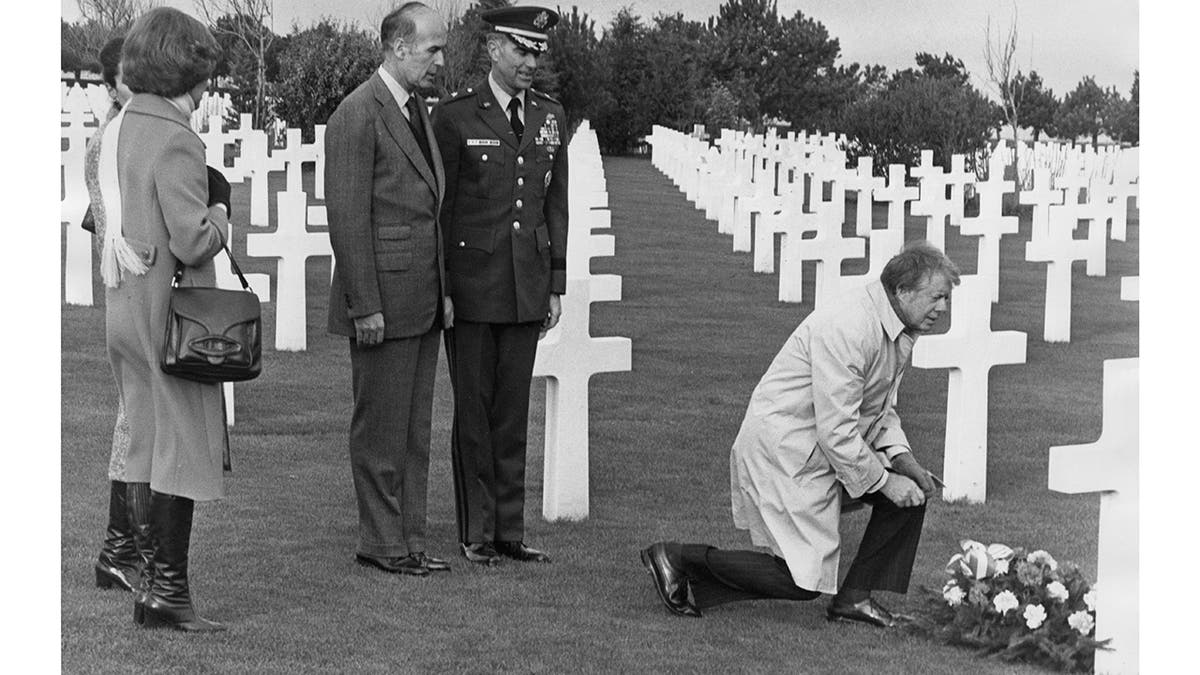
President Jimmy Carter places a wreath on the grave of Brigadier General Theodore Roosevelt Jr., son of former President Theodore Roosevelt, in Normandy, France, watched by his wife Rosalynn and French President Valéry Giscard d’Estaing, January 6, 1978. (Photo by Keystone/Hulton Archive/Getty Images)
In 1979, at the National Prayer Breakfast in Washington, Roman Catholic Bishop Fulton J. Sheen began his remarks this way: “Fellow sinners.” Turning to Carter, he added, “and that includes you, Mr. President.” Carter laughed along with the audience.
CLICK HERE TO GET THE FOX NEWS APP
Carter’s faithfulness in church attendance inspired many who had given up the practice to return to Sunday worship. He was a man of good character, kindness and other characteristics Scripture calls “fruits of the spirit.” Whether you agreed with its application or not (and his focus on human rights while president and helping build houses for the poor after leaving office were in line with the commands of Jesus), his faith was genuine.
He also paid his debts. The quarter he gave me proves it.
Putin Gets a Snub in the Vast Wine Cellars of a Former Soviet Republic
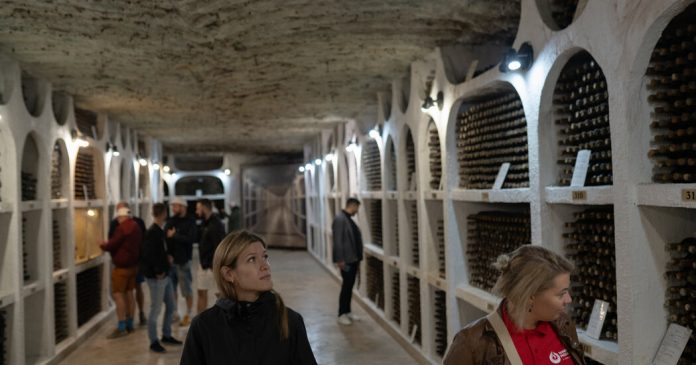
Hermann Goering, Hitler’s right-hand man, survived the cut. His bottles of wine — part of a collection seized by the Soviet army as a trophy at the end of World War II and deposited in a labyrinthine underground cellar in Moldova — are still on display.
A gift of 460 bottles given in 2013 to then Secretary of State John Kerry when he visited the former Soviet republic is also there, kept in his name in a cubbyhole in the vast system of tunnels. (The State Department reported their value as $8,339.50, which might explain why Mr. Kerry chose to leave them behind.)
But President Vladimir V. Putin of Russia, who twice visited the cellars operated by the state-owned Cricova Winery, has been banished. His wine bottles, along with his photograph, have been removed from view in the vast complex of underground tunnels that twist and turn over 75 miles under vineyards north of the Moldovan capital, Chisinau.
After Mr. Putin began a full-scale invasion of Moldova’s neighbor, Ukraine, in 2022, the winery “got lots of questions that we could not answer about why he was still here,” said Sorin Maslo, the director.
Mr. Putin’s wine collection, a gift to him from Moldova’s former communist president, has not been destroyed, Mr. Maslo said. The bottles, he added, had been moved to a dark, sealed-off corner of the cellar so that “nobody has to deal with him.”
For a country that takes viniculture very seriously, the banishment of Mr. Putin’s bottles sent a blunt divorce message in a long-strained relationship that Moldova recently declared doomed by irreconcilable differences.
It was part of a decisive rupture that in October led voters to endorse, albeit by a tiny majority, changing Moldova’s Constitution to lock in the country’s exit from Moscow’s sphere of influence and align more closely with Europe.
That course was first set in 2006 when Russia, previously Moldova’s biggest wine export market, imposed a two-year ban on imports from Cricova and other Moldovan wineries during an early tiff between Moscow and Chisinau.
The ban, Russia claimed at the time, was needed to protect consumers from impurities, but it was widely seen as retaliation for demands by Moldova that Russia stop supporting the breakaway Moldovan region of Transnistria.
Russia lifted the ban on Moldovan wine the following year but reimposed it in 2013 after Moldova expressed a desire to forge closer ties with the European Union.
The 2006 embargo forced Moldova’s winemakers to look West for markets and convinced them that “the future for us is definitely not Russia,” said Stefan Iamandi, the director of the National Office for Vine and Wine in Chisinau. Russia, which once accounted for 80 percent of Moldovan wine sold abroad, today buys 2 percent, with more than 50 percent going to the European Union. That has meant moving away from sugary “semisweet” wines produced to suit Soviet palates, to high quality wines that regularly win international prizes.
Georgia, another former Soviet republic, was hit by a similar ban in 2006, prompting its winemakers, too, to start looking West.
Wine has for centuries played an outsize role in Moldova’s relationship with Russia, both lubricating and at times poisoning ties between what, until the collapse of the Soviet Union in 1991, were two parts of the same country.
Moldova has traces of grape cultivation stretching back thousands of years, and started exporting wine to Russia in large volumes in the 14th century. This trade expanded dramatically during the Soviet Union when vineyards in Moldova and Georgia provided much of the wine consumed in Russia.
Moldovan wine enjoyed a particularly good reputation. That became a curse when the last Soviet leader, Mikhail Gorbachev, identified alcoholism as one of the Soviet Union’s most serious problems in 1985 and overzealous Communist Party officials ordered that vineyards in Moldova, Georgia and Crimea be destroyed. Moldova ripped up some vines but left most intact, arguing that it needed grapes to make fruit juice.
Before that, Moscow and Moldova bonded over booze.
In 1966, when Yuri Gagarin, a Russian cosmonaut and the first man in space, visited what was then a Soviet republic called Moldavia, he spent two days at the Cricova Winery, where, like other visitors, he was offered wine tastings.
Legend has it that he tasted so much he had to be carried away in a stupor.
Mr. Maslo said that is not true, insisting “Gagarin was not drunk” and was just happy at the quality of the wine.
Unlike Mr. Putin, Mr. Gagarin has not been canceled and is still celebrated in Cricova’s underground cellar with a photograph and a plaque. Displayed proudly on the wall is the handwritten thank-you note he left at the end of his 1966 visit: “In these cellars is a great abundance of wonderful wine,” he wrote. “Even the most fastidious person will find here wine to their liking.”
There is certainly a lot to choose from. The vast wine cellar, housed in the shafts and meandering tunnels of a former limestone mine, holds 1.2 million bottles. The tunnels, lined with wine racks, barrels and large wooden casks, are part of a sprawling subterranean city. It has a wine shop for tourists, tens of thousands of whom visit each year, a movie theater and opulent tasting and banqueting halls for visiting dignitaries.
Tunnels dug for limestone miners have become streets, each one named after type of wine — Cabernet, Pinot Noir, Champagne and local varieties like Feteasca. There are street signs and traffic lights. Electric buggies transport winery workers and visitors around the labyrinth. The temperature is constant at around 55 degrees Fahrenheit, and the humidity of the air is always the same.
Also unchanging is the tedious labor of a team of workers who spend each day deep underground methodically turning bottles of sparkling wine stored neck down in high racks. The motion ensures that sediment gathers at the neck and can be easily removed before final bottling. All the bottle-turners are women because men, Cricova’s management decided, get bored too easily and take too many breaks.
Lybov Zolotko, who trained for the job by twisting her wrists in a bucket of sand, said she turns at least 30,000 bottles a day. It is boring work, she conceded, “but you get used to it” — and it pays a steady salary in a country where stable jobs are hard to come by.
Another Moldovan winery, Milestii Mici, has even longer tunnels — they stretch 150 miles — but Cricova has had far more high-profile visitors, including Mr. Putin, who celebrated his 50th birthday in its cellars; President Volodymyr Zelensky of Ukraine; and Angela Merkel, when she was still chancellor of Germany.
Tatiana Ursu, employed at Cricova for 30 years, has hosted a stream of dignitaries in the underground tasting rooms and banquet halls. Particularly warm, she said, was a 2002 visit by Mr. Putin, who was on excellent terms with Moldova’s president at the time, Vladimir Voronin, Europe’s first democratically elected Communist Party head of state after the collapse of communism.
The visit used to be a source of pride for the winery, Ms. Ursu added, but “not so much any more” given that the seemingly mild-mannered man she met in 2002 — who had only been in the Kremlin two years when he visited — has since turned against Moldova.
Mr. Voronin gave the Russian president a bottle of wine in the shape of a crocodile, she recalled.
Mr. Putin and others in the Russian delegation did not drink too much and left a good impression on their Moldovan hosts, Ms. Ursu recalled.
“They were all friends back then. It was a different time,” she said.
All 5 living presidents expected to attend Jimmy Carter’s National Cathedral funeral : NPR

The flag-draped casket of former President Jimmy Carter lies in state in the U.S. Capitol in Washington, D.C., on Jan. 8.
Maansi Srivastava for NPR
hide caption
toggle caption
Maansi Srivastava for NPR
Political leaders in Washington will honor the life of former President Jimmy Carter with a funeral service at the National Cathedral this morning. Carter, who died on Dec. 29 at 100, was the nation’s longest-living president.
Thursday’s event marks the final public tribute to Carter, following additional funeral services and ceremonies since Saturday at the U.S. Capitol, the Carter Presidential Center in Atlanta and his hometown of Plains, Ga. Following his national funeral service, the late president’s remains will be transported back to Georgia for a private ceremony and burial in Plains.
The funeral at the National Cathedral is part of a national day of mourning, which President Biden declared in Carter’s honor after his death.
Tune in 9:30 a.m. for NPR’s live special coverage just ahead of the National Cathedral service. Watch here:
Biden was a longtime colleague of Carter and will deliver a eulogy during the service, according to a White House official.
In remarks after Carter’s death, Biden called the late president a “dear friend” and praised his character, highlighting Carter’s record as president and his more than four decades of humanitarian work after leaving the White House.
“What I find extraordinary about Jimmy Carter, though, is that millions of people all around the world, all over the world, feel they lost a friend, as well, even though they never met him,” Biden said. “That’s because Jimmy Carter lived a life measured not by words but by his deeds.”
All four living former presidents are expected to be in attendance at Carter’s funeral, including President-elect Donald Trump, who takes office in less than two weeks. Trump recently criticized Carter’s presidential record during a news conference, arguing that the late former president lost his 1980 reelection bid due to his decision to relinquish control of the Canal Zone in Panama.

President-elect Donald Trump and former first lady Melania Trump pay their respects in front of the flag-draped casket of former President Jimmy Carter at the U.S. Capitol Rotunda in Washington, D.C., on Jan. 8.
Tyrone Turner/WAMU
hide caption
toggle caption
Tyrone Turner/WAMU
“Nobody wants to talk about the Panama Canal now because, you know, it’s inappropriate, I guess,” Trump said. “Because it’s a bad part of the Carter legacy.”
“He was a good man. I knew him a little bit, and he was a very fine person, but that was a big mistake,” Trump added. On Wednesday evening, the president-elect and his wife, former first lady Melania Trump, paid their respects to Carter, who was lying in state at the Capitol Rotunda this week. Trump later told reporters he met with members of the Carter family earlier in the day.
The public was also able to pay tribute to the former president. While waiting in line outside the Capitol, Carter’s supporters praised his long career in public life.

The public write notes in condolence books in the Capitol Visitor Center, near the flag-draped casket of former President Jimmy Carter lying in state in the U.S. Capitol in Washington, D.C., on Jan. 8.
Maansi Srivastava for NPR
hide caption
toggle caption
Maansi Srivastava for NPR
Mark Wentzell of Minneapolis, Minn., who traveled to the memorial with his daughter, told NPR that Carter was “a real role model for everyone.”
“He was so sincere in everything he did,” he said.
“I view him as a really good man, high moral values” Washington, D.C., resident Bruce Meredith said as he got in line. “He seriously was a public servant. He gave all he had to this country. And that’s why I respect him so much.”
Susan Prolman was just 11 years old when Carter ran for president, but she recalled fondly how he stayed in her family’s home in New Hampshire during the 1976 primary.
“Instead of staying at hotels, they stayed at people’s houses,” she said. “It was very exciting.”

Susan Prolman, 59, holds up a sign from when she campaigned for President Jimmy Carter as a child growing up in New Hampshire. She remembers him coming to stay with her family during a campaign visit. Prolman visited the flag-draped casket of former President Jimmy Carter lying in state in the U.S. Capitol in Washington, D.C., on Jan. 8.
Maansi Srivastava for NPR
hide caption
toggle caption
Maansi Srivastava for NPR
Standing outside the Capitol, Prolman, who now lives in D.C., held up her handwritten ‘Carter for President’ poster that she made nearly 50 years ago. Under those words were small hand-drawn peanuts, a nod to his time as a peanut farmer.
“He was a truly kind man,” she said. “He brought so much to this country.”
As a Berkeley professor, I see the impact H-1B visas and AI have on students’ job opportunities
NEWYou can now listen to Fox News articles!
The H-1B visa program was intended to bring in specialized talent from abroad, but instead it has become a tool for employers to hire lower-cost labor for ordinary jobs.
The result is a distorted job market, where highly skilled workers are being squeezed out of the H-1B visa program by spam applications for ordinary workers who then take entry-level positions that are already in short supply. This misuse of H-1B visas has a negative synergy with growing impact of AI on the job market and is part of a larger problem that urgently needs attention.
The impact of this visa-farming problem is particularly acute among young people and recent college graduates, who face a bleak job market despite moderate overall unemployment rates. According to government data, the ratio of unemployment for college grads under 25 to those over 25 has hit an all-time high of more than four to one. This means that entry-level jobs are already four times more scarce than jobs requiring experience or advanced expertise.
Program applicants explicitly should be people with specialized skills, and those specialized skills should not be readily available from existing resident workers.
I have seen firsthand the symptoms of decreasing demand for entry-level tech jobs. These symptoms include fewer job notices from recruiters targeting fresh CS grads, job fairs with fewer companies, and concerned advisees getting fewer offers with lower pay or in some cases not getting any offers at all. Awarding the H-1B visas to low-paid, non-specialist workers only exacerbates this scarcity while doing little to fill the actual demand for workers with specialist skills.
H-1B VISAS HURT ONE TYPE OF WORKER AND EXPLOIT ANOTHER. THIS MESS MUST BE FIXED
The problem here is not about the number of visas issued, but rather how they’re being used. Program applicants explicitly should be people with specialized skills, and those specialized skills should not be readily available from existing resident workers. However, the bureaucratic review process allows employers to exaggerate claims and hire workers with ordinary skills at low wages. There is an entire sub-profession of HR staff and attorneys that specialize in dressing up pigeons to look like peacocks.
This abuse of the application process has created a lottery system where workers with the needed special skills often lose out to those who don’t have any specialized skills. As a result, recent graduates are finding it harder to get entry-level work, while at the same time companies that really need specific specialized skills can’t get visas for those workers. Imagine a person who is suffering from both malnutrition and diabetes because instead of vitamins, they have been gobbling sugar pills.
I want to emphasize that I’m not advocating for insular restrictions on the number of H-1B visas. The issue is about ensuring that people with real specialized skills that are actually needed are being welcomed through the H-1B program. When used properly, an H-1B visa brings in someone who supplements the workforce with skills that are both needed and specialized, potentially benefiting the whole country. Whether it’s retaining a graduating international student or bringing in someone from outside the country, the U.S. has historically benefited immensely from immigrants with needed skills.
Many people who are invested in visa farming insist unconvincingly that the H-1B visas are already going to specialized workers as intended, but the statistics on H-1B visa recipients don’t agree.
TRUMP SAYS HE’S NOT CHANGED HIS MIND ON H-1B VISAS AS DEBATE RAGES WITHIN MAGA COALITION
According to the annual report from the U.S. government’s Office of Citizenship and Immigration Services, nearly 63,000 of the 2023 H-1B visa recipients were in “Computer-Related Occupations” and the median salary for this group was $99,000 per year with 25% of them earning less than $85,000. A salary of $99,000 or $85,000 per year is certainly a good amount to be earning, but it is quite low for what I would expect someone with rare specialized skills in this field to be earning.
One would think that people with specialized, hard-to-find skills would earn exceptionally good salaries, but instead these data show the opposite. In fact, the more I dig into the data in the agency’s annual report, the less it appears that approved applications are for exceptional people for specialized jobs. It looks more like some specially skilled workers mixed in with a lot of regular workers who are being paid on the low end of what I’d expect.
These observations are consistent with my own experiences in hiring tech workers and advising CS students, what has been related to me first hand by others, and numerous recently published analyses. The only clear explanation I see for these inconsistencies is that employers are submitting entry-level positions, not ones requiring special rare skills, that even for entry-level the salaries are low, and that those non-conforming applications are not being rejected.
Looking at the bigger picture, misuse of H-1B visas is not the only obstacle that U.S. job seekers face because AI automation is also eliminating jobs, compounding scarcity. Currently, the impact of AI is disproportionately on entry-level jobs, which exacerbates the problems caused by abuse of the H-1B program. However, AI will continue to improve, both in capability and ease of use, and its impact on the job market will grow as the range of tasks that can be done by AI expands.
MAGA’S H-1B ‘CIVIL WAR’ IS EXACTLY HOW POLITICS IS SUPPOSED TO WORK
While AI and H-1B visa abuse may appear to be distinct problems, they interact in a way that most people don’t appreciate. Even when it can’t totally replace a human worker, AI facilitates moving work away from regular employees to contractors or remote workers.
The explanation is that AI often removes the need for an advanced specialized skill or knowledge, and replaces it with a lesser requirement of only needing the ability to review work for correctness. The result is that tasks which previously were too complex for moving to contractors or remote workers now become simpler due to AI and more suitable for externalizing.
As AI technology continues to improve employers will find that more and more jobs can be done by less-skilled workers, and there will be increased motivation to use H-1B visas for hiring those less-skilled workers cheaply.
The review process for the H-1B visa program needs to be reformed to prioritize applicants with real specialized talents and to ensure that recipients don’t unfairly compete with workers already in the U.S. We must also address the growing threat of AI automation and its growing impact on the job market.
CLICK HERE FOR MORE FOX NEWS OPINION
Roughly 90% all of U.S. tax revenue comes from taxing the income of working individuals, so if unemployment continues to expand then tax revenue will dramatically shrink. At the same time, the number of unemployed people needing public assistance needs will skyrocket. That combination doesn’t work mathematically and is a clear recipe for disaster.
This situation demands radical change to avoid a dystopian future. Overall unemployment numbers may appear robust, but high levels of entry-level unemployment and overall underemployment indicate that a much bigger problem is developing.
CLICK HERE TO GET THE FOX NEWS APP
Disclaimer: Any opinions expressed in this article are only those of the author as a private individual. Nothing in this article should be interpreted as a statement made in relation to the author’s professional position with any institution.
In Tibet, Chinese Boarding Schools Reshape the ‘Souls of Children’

Across China’s west, the party is placing children in boarding schools in a drive to assimilate a generation of Tibetans into the national mainstream and mold them into citizens loyal to the Communist Party.
Tibetan rights activists, as well as experts working for the United Nations, have said that the party is systematically separating Tibetan children from their families to erase Tibetan identity and to deepen China’s control of a people who historically resisted Beijing’s rule. They have estimated that around three-quarters of Tibetan children age 6 and older — and others even younger — are in residential schools that teach largely in Mandarin, replacing the Tibetan language, culture and Buddhist beliefs that the children once absorbed at home and in village schools.
When China’s top leader, Xi Jinping, visited one such school in the summer, he inspected a dormitory that appeared freshly painted and as neat as an army barracks. He walked into a classroom where Tibetan students, listening to a lecture on Communist Party thought, stood and applauded to welcome him.
Mr. Xi’s visit to the school in Qinghai Province in June amounted to a firm endorsement of the program, despite international criticism. Education, he said, must “implant a shared consciousness of Chinese nationhood in the souls of children from an early age.”
Chinese officials say the schools help Tibetan children to quickly become fluent in the Chinese language and learn skills that will prepare them for the modern economy. They say that families voluntarily send their children to the schools, which are free, and that the students have classes in Tibetan culture and language.
But extensive interviews and research by The New York Times show that Tibetan children appear to be singled out by the Chinese authorities for enrollment in residential schools. Their parents often have little or no choice but to send them, experts, parents, lawyers and human rights investigators said in interviews. Many parents do not see their children for long stretches.
Dozens of research papers and reports from experts and teachers within the Chinese system have warned about the anxiety, loneliness, depression and other psychological harm of the schools on Tibetan children.
The Times reviewed and analyzed hundreds of videos posted to Chinese social media sites by Tibetan boarding schools, state media and local propaganda departments that showed how the schools operate and serve the party’s objectives.
Student life is heavy with political indoctrination. Schools, for instance, celebrate what China calls “Serfs’ Emancipation Day,” referring to the anniversary of the Communist Party’s full takeover of Tibet in 1959, after a failed Tibetan uprising and a Chinese crackdown that forced the Dalai Lama into exile. The party accuses the Dalai Lama, the Tibetan spiritual leader, of having ruled over a slaveholding society.
The Times also found video accounts of boarding school teachers and travelers that showed how some schools are underfunded and overstretched. We are not crediting some of the accounts by name to avoid drawing a backlash against them.
China has been expanding its boarding schools for Tibetan children even as countries like the United States, Canada and Australia have been grappling with the trauma inflicted on generations of Indigenous children who were forcibly removed from their families and placed in residential schools. (President Biden in October apologized on behalf of the U.S. government for the abuse of Indigenous children in residential schools from the early 1800s to the late 1960s, calling it a “a sin on our soul.”)
China has been eager to show that happy, well-fed Tibetan children are proudly declaring that they are Chinese.
Chugqensumdo Town Tibetan Boarding Central Primary School/Tencent Video
Songpan County Caoyuan Township Central Primary School/WeChat
Strangers in Their Own Homes
Gyal Lo, a Tibetan education researcher, became alarmed by the boarding schools in 2016, when he saw that his two preschool-aged grandnieces, who were attending one in his hometown in northwestern China, preferred to speak Mandarin, not Tibetan.
When the grandnieces, then ages 4 and 5, went home on the weekend, he said in an interview, they appeared withdrawn and spoke awkwardly in Tibetan with their parents, much changed from when he saw them in the previous year. Now they behaved “like strangers in their own home,” he said.
“I said to my brother, ‘What if you don’t send them to the boarding school?’” Gyal Lo said. “He said he had no choice.”
Gyal Lo set out to investigate the changes that families were going through as the schools expanded across Tibetan regions in China. Over the next three years he visited dozens of such schools, and saw that many Tibetan students spoke little of their mother tongue and were sometimes only able to see their parents once every several weeks or even months.
Children as young as preschool age were being sent away, he said, and parental visits were limited. The Times talked to three Tibetan parents with children of elementary-school age in residential schools who said that they had no choice and that they were not allowed to visit their children at will.
Many Tibetan parents accept that their children should learn Chinese for a chance at better jobs, said Gyal Lo, who now lives in Canada and is an activist working to draw attention to the schools. But most also want their children to first gain a strong grounding in their mother tongue.
“Children should learn from their grandparents, their parents, about their local language, about the names of things, about their traditions and their values,” Gyal Lo said in an interview. “Boarding schools create a physical and emotional distance from their parents and family members.”
Under Mr. Xi, such schools have sharply cut classes in Tibetan. Instead most classes are taught in Chinese, a language unfamiliar to many rural Tibetan children, who mix little with the Han Chinese majority.
Chinese officials insist that enrollment is voluntary. In reality, the government has closed village schools and privately run Tibetan language schools, while strictly enforcing mandatory education laws.
“One can hardly speak of any choice if local schools are all closed down,” said Fernand de Varennes, a human rights expert.
He and two other independent experts with the United Nations investigated the boarding schools and expressed alarm in 2023 at what they said appeared to be a “policy of forced assimilation of the Tibetan identity into the dominant Han-Chinese majority.”
At Risk of Abuse and Neglect
The text messages and voice memos trickled in, carrying urgent questions from Tibetans in China seeking legal advice about the treatment of children in boarding schools.
One man wrote to ask about what redress to demand for a child who suffered permanent injury from a classroom fight while the teacher was absent. Another said that a child was found dead in the bathroom of a boarding school, of unclear causes, and that the child’s parents wanted answers. The questions had been sent over the past three years to volunteers offering online legal advice to Tibetans. Times reporters reviewed several such messages, which were shared with us, but were unable to independently verify the accounts.
In 2021, a video surfaced online showing an elementary schoolteacher in eastern Tibet beating a child with a chair in his classroom. The video circulated on the internet in China more than 1,000 times before it was taken down. The school at which the beating took place has been described in state media reports as having students who lived on campus.
The video set off a public outcry. In response, the local government conducted an investigation and said in an official statement that the beating had left a three-inch-long wound on the child’s forehead and that the teacher had been suspended.
Physical punishment is outlawed in Chinese schools, but studies by Chinese academics have found that the practice persists in Tibetan boarding schools. A 2020 study by Chinese researchers on boarding schools for children from ethnic minorities said that some teachers “lacked concern for the students,” treated them roughly and were “even resorting to physical punishment.”
Local legislators and researchers in Tibetan areas have reported that the already overcrowded schools face serious shortages of teachers and support staff.
A 16-year-old living in a Tibetan village in Sichuan Province told The Times that beatings by teachers were a constant at the residential school he attended. He said that over the years he had accumulated several scars on his back from beatings by teachers, sometimes by hand and other times with a wooden ruler.
A Generation of Cultural Erasure
The Chinese government does not say how many Tibetan children are in boarding schools. The Tibet Action Institute, an international group that has campaigned to close the schools, estimates that among children aged 6 to 18, the figure is at least 800,000 — or three in every four Tibetan children.
The group arrived at its estimate, which it published in a report in 2021, based on local government statistics. Lhadon Tethong, a co-founder and director of the group, likened the Chinese schools to the colonial residential schools in Canada, Australia and the United States.
“Different time, different place, different government, but same impact,” she said, “in the sense of breaking cultural and familial bonds and roots, and psychologically damaging and traumatizing kids at their foundation.”
Statistics collected by The Times from local government documents across Tibetan areas show similar numbers in boarding schools, with some areas notably higher than others.
In Golog, a Tibetan area of Qinghai Province, 95 percent of middle school students were in such schools, according to a study published in 2017 in China’s main journal on education for ethnic groups. A report from the local legislature in 2023 said that 45 of the 49 elementary schools in Golog were residential.
The expansion of boarding school enrollment in Tibetan areas runs counter to the national trend. Chinese government guidelines issued in 2018 say that elementary school children should not, in general, be sent to such schools.
But children from ethnic minorities in border regions seem to be treated as an exception. In the far western region of Xinjiang, children of the Muslim Uyghur ethnic group have also been sent to residential schools in large numbers.
Chinese officials say such schools help children in the Tibetan region avoid long commutes. But official websites also promote instructions from Mr. Xi on minority education, arguing that youth in ethnic minority regions were at risk of having “erroneous” ideas about religion, history and ethnic relations.
To counter those threats, Mr. Xi said in 2014, children of the right age should “study in school, live in school and grow up in school.” The government’s hope is that those children will then become champions of the Chinese language and the party’s values.
In one video, which appears to be filmed and uploaded on social media as part of a school assignment, a Tibetan fourth-grader at a boarding school described how she saved the day when a Chinese cashier could not understand the girl’s mother, who spoke only Tibetan. She then called on other students to teach their parents Mandarin. “Be a Civilized Person, Speak Mandarin,” the video was titled.
Warnings From Within China
China’s drive to assimilate the Tibetans echoes history elsewhere in the world where Indigenous people were seen by their foreign occupiers as savages who needed to be civilized with boarding schools, causing trauma and abuses. It’s a parallel that Chinese officials reject.
But some of the starkest warnings about the toll that boarding schools are taking on Tibetan children come, strikingly, from within China’s education system.
Teachers, education researchers and local legislators in China have written reports describing Tibetan children as suffering from being separated from their families and from being largely confined within their schools.
In education journals, teachers have shared advice on helping Tibetan children cope: Create a homier feel by decorating dorm rooms and cafeterias, and be ready for students to be anxious about when they could return home.
Many boarding schools in more remote Tibetan areas appear to be underfunded and lacking in facilities, teachers and trained counselors. Local lawmakers found in 2021 that one school for elementary children in Golog, the Tibetan area of Qinghai, had no tap water or power connection for its cafeteria until they complained.
“Because boarding schools lack staff like dormitory supervisors, security guards and medical carers, the teachers must take on 24-hour duty weeks while also fulfilling their daily teaching duties,” said a 2023 survey conducted by the Golog legislature.
In video diaries uploaded to social media, teachers in Tibetan regions have described days in which, on top of teaching, they must also deliver food to students, show them how to make beds and tuck them in at night.
A teacher at an elementary school in Tibet, who goes by Ms. Chen on social media, posted a series of video blogs in 2022. In one, she documented a typical day that started with a morning study session before dawn and ended with her checking on the children before bedtime.
Another teacher, who identifies himself as Mr. Su on social media, says he teaches at an elementary and secondary school in Ngari, Tibet. He shot a video while patrolling the dormitories of younger students while on duty one night in 2023.
“All of us are basically standing in as their parents,” he wrote in one social media post.
Videos from Chinese travelers show how difficult it can be for rural schools to meet the needs of their students. In 2021, a traveler who recorded a visit to one school in Garze, a Tibetan area in Sichuan Province, said that the dorms looked nice but that there weren’t enough beds. Two children shared a bed and huddled to keep each other warm in the winter, as there was no central heating.
Some teachers defend the schools as ultimately for the good of children. Others described encountering widespread opposition to the policy.
A 2023 study from Garze concluded that parents, teachers and school administrators were reluctant to send young children to boarding schools. Many parents, the study said, conveyed “helplessness, worry, incomprehension and an inability to speak out” about the changes.
Education, especially in minority areas, is a politically sensitive topic. Tibetans who oppose the boarding schools risk imprisonment if they protest. Tashi Wangchuk, a Tibetan businessman who petitioned the government to preserve schooling in Tibetan and spoke to The Times about his efforts, was sentenced to prison for five years in 2018.
Yet, some still voice their worries. On Douyin, China’s version of TikTok, parents lamented the diminishing role that the Tibetan language plays in their children’s lives.
“After just one month in kindergarten, my child basically no longer speaks Tibetan. Now when we speak to our child in Tibetan, they only respond in Mandarin,” one person wrote in a comment.
“No matter how we try to teach Tibetan now, they won’t learn it. I’m really heartbroken.”
What’s next for Canada? 5 questions will help decide Canada’s future after Trudeau : NPR

Conservative Party leader Pierre Poilievre has built a sizeable lead in the race to be Canada’s next prime minister. He’s seen here in December, speaking at a news conference in Ottawa.
DAVE CHAN/AFP via Getty Images/AFP
hide caption
toggle caption
DAVE CHAN/AFP via Getty Images/AFP
Canada is entering a major transition in its national politics after Prime Minister Justin Trudeau confirmed he will resign. Questions about his political future had been raging for weeks, but his exit raises even more issues.
After losing support within his own party and at the polls, Trudeau said on Monday that he will no longer lead the Liberal Party but will remain in office until a successor is elected.

Canadians now face months of changes, as first Trudeau’s party and then the nation will vote for the next prime minister. Meanwhile, to the south, U.S. President-elect Donald Trump has been making mocking comments about Canada, suggesting it could become the 51st state.
“The Canadians are rightly freaked out about Trump’s repeated remarks about Canadian sovereignty,” Shachi Kurl, president of the Angus Reid Institute, a non-profit polling firm based in Vancouver, tells NPR. She questions how Canada can effectively expect to engage with a new White House administration “when we basically now have a lame duck prime minister?”
Here’s a rundown of questions about Canada’s future:
When will the two key elections take place?
Canada’s next general election had been set for Oct. 20, 2025, based on the timing of the last election in 2021. That plan is now changing drastically.
As Trudeau announced his resignation, he indicated that Parliament would be prorogued, or suspended, until March 24. When that session begins, rival parties say, they will immediately call for a non-confidence vote and force a new general election.
“The next general election depends on when the current government loses confidence, which will likely happen at the next sitting of Parliament,” Semra Sevi, an assistant professor of political science at the University of Toronto, tells NPR. “An election could be called as early as late March 2025.”
That means the Liberal Party now has less than three months to select Trudeau’s replacement — a vote in which every party member can cast a ballot. For now, the exact details of that process are unknown.
“We still don’t know what the rules are going to be for Liberal Party members to select their leader,” Kurl says, noting that Liberals must visit their rulebook because they haven’t needed to choose a new candidate for more than a decade. She adds, “It all speaks to a really compressed timeline, and a much faster selection than may be ideal in this situation.”
Trudeau could also request another prorogation, Sevi says. In the past, prime ministers have used these parliamentary suspensions as a delay tactic.
Who are the contenders to be the next prime minister?
The current favorite is Pierre Poilievre, whose Conservative Party has gained a 24-point lead over Trudeau’s Liberals as of this week, according to the CBC’s poll tracker.
Poilievre, a populist who served in former prime minister Stephen Harper’s cabinet, has harnessed social media to tap into Canadians’ frustrations over rising housing costs and inflation. He has often railed against the national carbon tax law enacted under Trudeau.
Also in the running: Jagmeet Singh, whose New Democratic Party has allied with the Liberals. His polling numbers are slightly lower than Trudeau’s.
Among Liberals, recently resigned finance minister Chrystia Freeland and Mark Carney, the former head of the Bank of England and Bank of Canada, “are the leading names” to replace Trudeau, Sevi says, “though rising stars within the party could also emerge.”
“The key for the Liberals will be choosing a leader who can rebuild the party’s image and reconnect with disillusioned voters,” she adds. “The party’s future hinges on selecting a leader quickly and recalibrating its platform.”
Liberals aren’t the only ones needing to connect with voters.
“We’re in a unique situation in Canadian politics at the moment,” Kurl says. “Because traditionally when one leader is really unpopular, there is another leader who by contrast is very popular. What we’re dealing with in 2025 in Canada is a situation wherein [among] the three leaders of the three major national parties… their unfavorability ratings are higher than their favorability ratings.”
Their unpopularity signals a deep disconnect between voters and the political establishment, Sevi says, “indicating widespread dissatisfaction and frustration with the status quo, potentially leading to volatile election results.”
What about Canada’s relationship with the U.S.?
Canadians’ cost of living will be a central issue in the next election, Sevi says. But foreign policy — especially Canada’s relationship with the U.S. — is also likely to be on voters’ minds.
Trump’s rhetoric about Canada could make him an “X-Factor” in the race, according to Kurl. The incoming president has threatened to impose new tariffs on Canada and has even commented on the possibility of the U.S. annexing Canada.
When Freeland resigned, she sharply criticized Trudeau, saying he didn’t have a plan to deal with Trump. As Trudeau said he would step down, Trump said he wants Canada to be a U.S. state — and plans to use economic, not military, force to make that a reality.
“It’s funny, but it’s not funny,” Kurl says of the prospect of being forced to join the United States. “Because It underscores something else, which is the tariff.”
A U.S. tariff of 25% on Canadian exports could potentially lead to a loss of at least 1 million jobs in Canada and carve deeply into the country’s GDP, she adds.
With Trudeau on the way out and Trump reiterating his plans, Kurl says voters may want to consider how candidates plan to engage with Trump.
“Does anyone in Canada have his ear?” she asks. “Can anyone in Canada gain his ear? And then how does that play on domestic politics?”
In recent comments, Trudeau and the leading candidates for the prime minister’s job have rejected Trump’s idea of annexing Canada and spoken against imposing new tariffs.
In a December poll, Poilievre was seen as the best choice to cope with Trump. Although he has been compared to the U.S. politician, the two don’t hold identical views. Poilievre’s Conservative Party recently called Trump’s tariff threat “unjustified.” Last month, Poilievre himself vowed in a CTV appearance, “Canada will never be the 51st state of the U.S.”