Thursday, November 12, 2026
Home Blog Page 418

How Jimmy Carter made a lasting impact on mental health policy in the U.S. : NPR

0

From legislation passed as he was leaving office to decades of fighting stigma, Jimmy Carter made a lasting impact on how mental health is treated and thought of in this country.


MARY LOUISE KELLY, HOST:

Among President Jimmy Carter’s list of accomplishments is a piece of landmark legislation that was passed but never realized. It remains an important milestone in national policy around mental health. NPR’s Katia Riddle reports.

KATIA RIDDLE, BYLINE: Let us journey back for a few moments to the 1960s. A movement was taking hold around the rights of patients – an idea that people with significant mental health disorders should not be held captive in hospitals. Keith Humphreys studies health policy at Stanford University.

KEITH HUMPHREYS: So there’s fewer and fewer state mental hospitals, fewer beds in general hospitals, and fewer and fewer psychiatric hospitals. So this has an effect as you get into the ’70s, which is there are more and more people with serious mental illness who are out on the street and are being noticed.

RIDDLE: The country rallied around the idea that people with mental health illnesses also have human rights, but there was no consensus on how to help them. Enter Jimmy Carter. He introduced something called the Mental Health Systems Act. The idea was to fund community health centers all over the country that would support this population.

HUMPHREYS: So now, reaching down into communities around the country, the federal government would build and support, in the long term, community mental health centers all over, and they would help take care of people who had serious mental illness as well as other types of psychiatric disorders.

RIDDLE: Carter had a rocky relationship with Congress. But still, he got the act passed. It was 1980. Months later, Reagan was elected. He dismantled the legislation. But Humphreys says Jimmy Carter introduced the country to a radical proposition with the Mental Health Systems Act – one that was ahead of its time.

HUMPHREYS: That taking care of our fellow citizens who have conditions like schizophrenia and bipolar disorder and major depression is as important a national priority as taking care of people who have cancer, taking care of the elderly, taking care of people who have heart disease.

RIDDLE: Though some of President Carter’s ideas have been realized in the decades since, much of the work is still unfinished.

Katia Riddle, NPR News.

(SOUNDBITE OF TIWA SAVAGE SONG, “LOST TIME”)

Copyright © 2025 NPR. All rights reserved. Visit our website terms of use and permissions pages at www.npr.org for further information.

NPR transcripts are created on a rush deadline by an NPR contractor. This text may not be in its final form and may be updated or revised in the future. Accuracy and availability may vary. The authoritative record of NPR’s programming is the audio record.


HGTV star Christina Hall’s tense fight with estranged husband Josh caught on camera

0

Josh and Christina Hall’s volatile marriage was seen first-hand during a sneak peek of the upcoming series premiere of “The Flip Off.”

Hall and her ex-husband, Tarek El Moussa, are competing in a real estate-flipping contest. Tarek’s new wife, former “Selling Sunset” star Heather El Moussa, is also on the show.

Christina and her then-husband, Josh, were filming together when cameras caught a heated conversation in the car, days before the couple decided to end their marriage, with Josh citing “irreconcilable differences.” 

HGTV STAR TAREK EL MOUSSA, HEATHER RAE ADMIT ONE THING CAUSES ‘TENSION’ ON SET WITH HIS EX-WIFE CHRISTINA HALL

Christina Hall and Josh Hall both filed for divorce in July. (Getty Images)

The show was announced in May and began production shortly afterwards. Josh and Christina both filed for divorce in July.

“This is a competition. We gotta pull out all stops. Whatever it takes to win, I’ll do it. Halls rule!” Josh told Christina while driving. “You’re supposed to say it with me, or repeat it, or something that shows that you’re with me.”

“Remember, you’re a Hall now. Don’t get confused in this competition about what your last name is. You’re rude.”

— Josh Hall

He continued, “Remember, you’re a Hall now. Don’t get confused in this competition about what your last name is. You’re rude.”

“I don’t over talk,” Christina finally replied to her then-husband in a low tone.

The conversation took a turn.

APP USERS CLICK HERE FOR INSTAGRAM POST

“Yeah, the s— you say, and I’m just like, ‘I wish you’d shut up already,'” Josh said.

Christina sighed, to which Josh replied, “My wife’s pissing me off already.”

The HGTV star ended the hostile conversation with her then-husband by asking, “Are we there yet?” 

The footage is included in the two-hour series premiere that will air on Jan. 29. The incidents seen on-camera were filmed prior to Josh filing for divorce from Christina in July 2024.

In the comment section of the video that was shared on Christina and HGTV’s official Instagram accounts, Heather chimed in on Josh’s exit from the series.

“Not everyone makes the cut—and that’s the real reality,” she commented. 

HGTV stars Tarek El Moussa and wife Heather El Moussa coordinate in matching black outfits

Tarek El Moussa’s wife, Heather, weighed in on Josh Hall’s exit from the series. (Amanda Edwards)

In November, Christina told Entertainment Tonight that Josh had an issue with her relationship with her first husband.

“[Josh] doesn’t like our dynamic, because Tarek and I have our own dynamic, and some could call it ‘flirty,’” she said. “For me, it’s like a sibling type of thing.”

Christina and Tarek remained cordial following their explosive 2016 divorce and continued to film “Flip Or Flop” together until the series ended in 2022. The former couple share kids Taylor, 14, and Brayden, 9.

Christina told the outlet that it was “not fun” to film with Josh.

Christina Hall walks red carpet at Barbie premiere with husband Josh

Josh Hall filed for divorce from Christina in July. (Axelle/Bauer-Griffin)

“When someone is insecure by you and doesn’t like to watch you win, that really puts a damper on everything, I feel like I was not shining as bright, to try to not make him feel emasculated. But who wants to live like that?” 

Although the explosive argument between Christina and Josh seemingly concluded in the preview clip for “The Flip Off,” there was another emotional moment captured in the teaser clip.

In the scene, Christina tells Tarek that her relationship with Josh was over.

LIKE WHAT YOU’RE READING? CLICK HERE FOR MORE ENTERTAINMENT NEWS

“We had a blow-up … middle fingers in my face,” Christina said, adding, “Things with Josh have been bad for a long time.”

A photo of Tarek El Moussa

Christina told Tarek El Moussa that things have been “bad” with Josh for a while. (Roy Rochlin/Getty Images for Empire State Realty Trust)

Christina told her ex-husband that their children played a role in her reason to end her marriage with Josh.

“The kids literally asked me to leave,” she said. “They told me he’s not nice to me. Why would I stick around?”

Christina’s second husband, Ant Anstead, joined “The Flip Off” following Josh’s exit. A source confirmed to Fox News Digital in November that Anstead is “filming a portion of the show” with Christina.

In August, Christina weighed in on the idea of replacing Josh with Anstead as her co-star in “The Flip Off.”

Ant Anstead Christina

Christina and Ant Anstead were married in 2018. (Allen Berezovsky)

In the comments section of an Instagram post shared by Christina, a fan suggested that her second ex-husband Anstead step in for Josh on the show.

CLICK HERE TO SIGN UP FOR THE ENTERTAINMENT NEWSLETTER

“How awesome would it be to have Ant replace Josh on The Flip Off? Ratings would go through the roof. If it happens, I need some credit. Lol,” the social media user wrote, according to People.

“LOL that would be genius ‘ratings’ idea just saying,” Christina replied.

Christina Haack

Christina Hall was a fan of Ant Anstead joining “The Flip Off.” (Allen Berezovsky/Getty Images)

CLICK HERE TO GET THE FOX NEWS APP

In December 2018, Christina married Anstead at their home in Newport Beach, California, and they welcomed son Hudson in 2019. However, the two announced that they were separating in September 2020, and Christina filed for divorce two months later. 

Fire Engulfs Eight-Story Building South of Seoul

0

Fire officials responded to the blaze Friday afternoon at a commercial building in Seongnam, Gyeonggi Province.

Biden blocks U.S. Steel’s sale to Nippon, citing national security concerns : NPR

0

President Biden blocked the sale of U.S. Steel to Japan’s Nippon Steel.

Drew Angerer/Getty Images


hide caption

toggle caption

Drew Angerer/Getty Images

President Biden is blocking Nippon Steel’s $14.9 billion takeover of U.S. Steel, citing national security concerns.


In a statement, Biden said a deal would have imperiled U.S. supply chains.

“Today’s action reflects my unflinching commitment to utilize all authorities available to me as President to defend U.S. national security, including by ensuring that American companies continue to play a central role in sectors that are critical for our national security,” Biden said in a statement.

The move wasn’t unexpected despite efforts by the Japanese government to persuade the Biden administration to approve the sale. Before the November election, Biden took the unusual step to weigh in on the deal. He sided with union workers and said the Pittsburgh-based company should remain in the hands of the United States. President-elect Trump had also said he would block the sale.


Business groups including the U.S. Chamber of Commerce have warned Biden’s intervention could discourage foreign investment. U.S. Steel itself has said stopping the sale would put thousands of union jobs at risk.

Trump’s legacy goals, Liz Cheney’s Presidential Medal, and more from Fox News Opinion

0

NEWYou can now listen to Fox News articles!

Welcome to the Fox News Opinion Newsletter.

GUTFELD – Fox News guests discuss the New Orleans attack, the Las Vegas Cybertruck explosion and the FBI’s latest assertion that there is no correlation between the two events. Continue watching…

HUGH HEWITT – What are President Trump’s second term legacy goals? Continue reading…

MAKING HISTORY – How Donald Trump can win 3 Nobel Peace Prizes. Continue reading…

CARRY A BIG STICK – Trump needs to channel Teddy Roosevelt in battling global threats. Continue reading…

DAVID MARCUS – Biden gives Liz Cheney the Presidential Medal of Insufferability. Continue reading…

RAYMOND ARROYO – Fox News contributor calls out the commutation of death row inmates. Continue watching…

RECKONING – Democrats paid the price for abandoning moderate Clinton-era policies. Continue reading…

HOUSE GOP – Congress must deliver President Trump’s agenda quickly. Continue reading…

DOCTOR’S ORDERS – 5 ways to get healthier in the New Year. Continue reading…

CARTOON OF THE DAY – Check out all of our political cartoons…

South Korea Fails to Detain Impeached President in Standoff at His Home

0

When around 100 criminal investigators and police officers entered a hilly compound in central Seoul on Friday morning, they tried to achieve something that has never been done before in South Korea: detain a sitting president.

First, they made it through two blockades formed by parked vehicles and people. Then, when they came within 650 feet of the building where President Yoon Suk Yeol was believed to be holed up, they came face to face with an even more formidable barrier: 10 buses and cars along with 200 elite soldiers and bodyguards belonging to Mr. Yoon’s Presidential Security Service. Small scuffles erupted as the investigators tried in vain to break through and serve a court-issued warrant to take Mr. Yoon away.

Three prosecutors were allowed to approach the building. But there, Mr. Yoon’s lawyers told them that they could not serve the warrant because it was “illegally” issued, according to officials who briefed news media about what happened inside the compound.

Outnumbered, the 100 officials retreated after a five-and-a-half-hour standoff.

“It’s deeply regrettable,” the Corruption Investigation Office for High-Ranking Officials, the independent government agency that led the raid into the presidential compound on Friday, said in a statement. It accused Mr. Yoon — who has already been suspended from office after being impeached by Parliament last month — of refusing to honor a court-issued warrant. “We will discuss what our next step should be.”

The failure to bring in the deeply unpopular president deepened a growing sense of helplessness among South Koreans, exacerbated by the country’s sharply polarized politics. The nation appears rudderless and distracted by infighting at a time when it faces major challenges at home and on the international scene.

There is already uncertainty around its alliance with the United States as the unpredictable Donald J. Trump prepares to return to the White House. Seoul’s decades-old foe North Korea has sought to score propaganda points from the South’s political quagmire, with its state media reporting that its neighbor was in “paralysis of its state administration and spiraling sociopolitical confusion.”

And, at home, the crash of a Jeju Air passenger jet that killed 179 of the 181 people on board on Sunday has added to as list of challenges that range from widespread labor strikes to rising household debts. On Thursday, the finance ministry sharply downgraded its growth forecast for 2025.

A Constitutional Court is deliberating whether to remove Mr. Yoon, who was impeached on Dec. 14 by the National Assembly. That came after he abruptly declared martial law 11 days earlier, prompting national outrage and calls for his ouster.

On Friday, the besieged Mr. Yoon vowed to fight to return to office through the Constitutional Court trial and showed he had no intention of voluntarily subjecting himself to criminal investigations. Mr. Yoon faces accusations that he committed insurrection by sending armed troops into the National Assembly during his short-lived military rule.

By refusing to honor the warrant, Mr. Yoon “kept adding more reasons he should be removed from office through impeachment,” said Lim Ji-bong, a professor of law at Sogang University in Seoul.

“He may think he survived today, but what he did today would not go down very well with the justices at the Constitutional Court and judges who would eventually try his insurrection case.”

Mr. Yoon is not the first South Korean politician who has defied court warrants to detain them. In 1995, prosecutors wanted to question the former military dictator Chun Doo-hwan on insurrection and mutiny charges stemming from his role in a 1979 coup and a massacre of demonstrators the following year. He defied the summons and headed to his southern hometown, trailed by a crowd of supporters.

The prosecutors chased him there. After an overnight standoff, Mr. Chun surrendered himself.

But unlike Mr. Yoon, Mr. Chun was out of office when he faced the insurrection charge. Mr. Yoon, though suspended, is still guarded with the full support of his Presidential Security Service, a government agency that hires teams of elite bodyguards and anti-terrorist experts selected from the police, military and other government services.

“People who have seen him rely on his bodyguards as a shield against his legal trouble will see him as a coward,” Mr. Lim said.

The investigators warned that they would charge the presidential bodyguards with obstruction of justice.

“We will do everything we can to provide security for the object of our service according to laws and principles,” the Presidential Security Service said in a statement.

Public surveys showed that a majority of South Koreans wanted Mr. Yoon ousted and punished for insurrection. But his governing party, which opposed his impeachment, denounced attempts to hold him.

Mr. Yoon also has die-hard supporters — mostly among mostly older South Koreans. Thousands of his supporters have been camped out for days on the pavement, chanting, “Let’s protect Yoon Suk Yeol!”

In a message delivered on New Year’s Day, Mr. Yoon called them “citizens who love freedom and democracy” and thanked them for braving the cold weather to show their support out on the street near his home.

“I will fight with you to the end to save this country,” Mr. Yoon said.

When the officials withdrew from Mr. Yoon’s compound, they shouted: “We have won!”

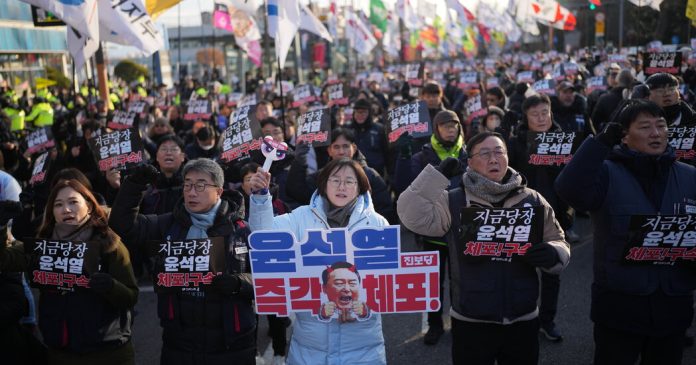
Protesters who have been clamoring for Mr. Yoon’s arrest began gathering again on Friday, marching near Mr. Yoon’s residence and shouting “Arrest Yoon Suk Yeol!” They, as well as the country’s opposition parties, expressed fury over the failure to detain Mr. Yoon, calling his presidential security service “accomplices” in an insurrection.

“I’m so angry,” said Lee Ye-seul, 19, a university student in Seoul. “I will speak out until he is removed and the people involved in the insurrection are punished.”

To Mr. Yoon’s supporters outside his residence, the security service was the last line of defense to save Mr. Yoon.

“The presidential guard should throw grenades if necessary to stop them from coming near the president,” said Lee Young-jin, 65.

But Mr. Yoon’s tactic of stoking political divides to avoid his legal trouble reflected poorly on South Korea, said Ahn Byong-jin, a professor of political science at Kyung Hee University in Seoul.

It “exposed weaknesses in South Korea as a democracy,” he said.

Congress begins a new session, starting an era of full GOP control in Washington : NPR

0

Congress is returning to full GOP control. President-elect Donald Trump is calling on his party to stay on the same page despite tight margins and threats of intraparty fighting.


MARY LOUISE KELLY, HOST:

Congress begins a new session tomorrow. That’s the first step in shifting full control in Washington to the GOP. President-elect Donald Trump is calling on his party to stay on the same page despite tight margins and threats of intraparty fighting. Joining me now is NPR congressional correspondent Claudia Grisales. Hi, Claudia.

CLAUDIA GRISALES, BYLINE: Hey, there.

KELLY: OK, so Trump’s demand for Republicans – stay united, stay on the same page. What is that page? What’s the to-do list for this incoming Congress?

GRISALES: Right. It is quite the page. There is plenty on it. They have some big tasks on their housekeeping lists this year – that is, address the U.S. debt limit that will be hit in the coming months, and keep the government’s lights on after a stopgap spending plan expires in March. But even sooner than all that, they want to attend to some partisan priorities that were part of their campaign pledges, namely legislation to address the U.S.-Mexico border, curtailing immigration, as well as extending a tax package from President-elect Donald Trump’s last term that is set to expire this year. But first, Republicans need to elect leaders in each of these chambers before they can get started on any of this work.

KELLY: Right. And stay with what those elections of leaders are going to look like because we know – on the Senate side, we know how this is going to land. South Dakota Republican John Thune is expected to easily take over as the new majority leader. On the House side, Louisiana Republican Mike Johnson would like to continue as speaker. That looks a little more complex.

GRISALES: Yes, very complex. He faces pretty much an uphill battle at this stage. He was elected to the role about 14 months ago. This was after a tumultuous few months when House Speaker Kevin McCarthy was ousted from the job, and several other GOP candidates lost their bids to replace him. So House Republicans had a bigger margin in all of that, and this year, it’s down to one GOP member who can wreak havoc.

KELLY: Well, that’s the thing. Republicans controlled the House by a big margin, as you said, but they were constantly fighting in the last Congress. Does that give us any window into how this new Congress may function – or dysfunction?

GRISALES: Yes, we think it does. We saw Johnson struggle to pass even partisan plans in the last term, and some in his own party would just not get on board for various reasons. And often, we saw Democrats bailing him out with bipartisan proposals instead. So with job one for the House tomorrow to elect a new speaker, he’s already facing this opposition, and there will be no House business until this gets done. No new members will be sworn in, no legislative business. And we already heard from House Republicans at the end of last year who were not so sure they would vote to reelect Johnson to the speakership. They may stick with this opposition, even with President-elect Donald Trump’s recent endorsement.

KELLY: Remind us what the process will actually look like to elect a new House speaker, whoever it may be.

GRISALES: Right. A new House speaker will need a simple majority of the 435-member House, so the magic number is 218 votes. Republicans have just 219 members, so not much breathing room at all, especially since Democrats are not expected to help Johnson or any other Republican get over the line. And we know already Kentucky Republican Thomas Massie – he’s been pretty vocal he will vote against Johnson, and that could open the floodgates for other House Republicans to join him. And some Republicans will use this time for attention in the media. Some are unhappy with Johnson’s speakership during this last session. Or some may look at this as an opportunity to make a favorable deal for themselves – for example, keep rules that would make it easy for them to kick Johnson out as speaker later, or whoever is elected. And that’s something Johnson wants to also change this year.

KELLY: NPR congressional correspondent Claudia Grisales, thank you.

GRISALES: Thank you.

Copyright © 2025 NPR. All rights reserved. Visit our website terms of use and permissions pages at www.npr.org for further information.

NPR transcripts are created on a rush deadline by an NPR contractor. This text may not be in its final form and may be updated or revised in the future. Accuracy and availability may vary. The authoritative record of NPR’s programming is the audio record.

DAVID MARCUS: Biden gives Liz Cheney the Presidential Medal of Insufferability

0

NEWYou can now listen to Fox News articles!

One thing that Washington politicians and Hollywood celebrities have in common is a tendency to give themselves pointless and unearned awards, and this week President Joe Biden took the practice to a whole new level of absurdity.

On Thursday, former Wyoming House representative, and Trump hater-in-chief, Liz Cheney received the Presidential Citizens Medal for her work co-chairing the House Select Committee on the January 6 Attack along with the other co-chair, Rep. Benny Thompson.

BIDEN AWARDS LIZ CHENEY, JAN. 6 COMMITTEE CHAIRMAN A MEDAL: US ‘IS BETTER BECAUSE OF THEIR DEDICATION’

So, here’s the thing: Regardless of how one feels about the events of J6, the January 6 committee, with its glitzy prime-time hearings, was by any reasonable measure an abject and total failure.

The American people were promised a smoking gun that would forever end Donald Trump’s political career. Instead, Cheney and Thompson delivered a bone-dry super soaker. Oh, and by the way, Trump is going to be back in office in two weeks.

Cheney’s hatred of Donald Trump may have cost her her seat on the House. (AP Photo/Julia Demaree Nikhinson; Reuters/Kevin Lamarque)

Bang up job, guys! Here’s your medal.

Just how big of a failure was the Cheney-led, Soviet-style show trial? Well, according to Monmouth University, prior to the hearings in 2022, 42 percent of Americans held Trump directly responsible for the riot on January 6, and after the ridiculous spectacle, that number had fallen to 38 percent.

Millions of dollars were wasted, thousands of man hours were blown, a former ABC News producer was brought in to glam things up and all to no avail, because the American people know a sham trial when they see one.

This is the same Liz Cheney, after all, who, prior to succumbing to Trump Derangement Syndrome, said in 2020, that actions taken against Trump by the FBI during Russiagate sounded, “like a coup,” and might even be “treason.”

But by the summer of 2022, Cheney saw a chance to get rid of Donald Trump once and for all, and restore the Republican Party to the good old-fashioned establishment types such as herself.

Bennie Thompson in hearing

Rep. Bennie Thompson (D-MS). who chaired the January 6 committee, also received the medal. (Photo by Kent Nishimura/Getty Images) ((Photo by Kent Nishimura/Getty Images))

Trump, Cheney argued, was an insurrectionist who illegally opposed the certification of ballots in a free and fair election! Never mind, of course, that Co-Chair Thompson himself refused to vote to certify the 2004 election. That was apparently different somehow.

In these hearings, a parade of disgruntled former White House officials and a handful of Capitol Police officers, among others, were profusely praised from a dais full of seething Trump-despising Democrats and two Republicans, Cheney and Rep. Adam Kinzinger, who might hate Trump even more.

What really did in Cheney was how unrelentingly insufferable she became once the Trump obsession kicked in.

The entire ridiculous enterprise had all the fidelity to fairness of flipping a coin and yelling, “heads I win, tails you lose.”

And speaking of losing, in the midst of the committee’s ten televised hearings in the summer of 2022, Liz Cheney lost her primary to Harriet Hageman by nearly 40 points. The fire of her hatred for Donald Trump had finally consumed Liz Cheney’s political career.

What really did in Cheney was how unrelentingly insufferable she became once the Trump obsession kicked in.

CLICK HERE FOR MORE FOX NEWS OPINION

Nothing else mattered. Not the border, not the economy, not Joe Biden’s corruption or incapacity. The only thing that existed in the universe was the unique and evil supposed threat of Trump.

Even the boneheaded Kamala Harris campaign trotted out old Angry Liz to monger fear amongst non-existent “Republicans for Harris.” Trump’s most fanatical detractors cannot understand why everyone isn’t waking up in cold sweats over Trump like they are.

Liz Cheney could have stood by her party and her caucus in 2022. She could have refused to participate in the unfair trial of Trump, even while being critical of him. Had she done so, she would likely still be in Congress. But, instead, the insufferable scion of the Cheney political dynasty threw it all away because she thought she knew better than the people she served.

Now, instead of a seat in the halls of power, Cheney has a useless bauble bestowed upon her by a defeated, lame-duck president.

CLICK HERE TO GET THE FOX NEWS APP

Who can say what is next for Liz? Maybe her own Netflix special, after all, if someone as brutally unpopular as Meghan Markle can get a show, maybe someone as insufferable as Cheney can, too.

Perhaps, one day Cheney will add an Emmy to her Presidential Citizens Medal, but one thing is for sure: Liz Cheney will never again be anywhere near power in the Republican Party, and that is very good news, indeed.

Enjoy the medal, Liz. And the early retirement.

CLICK HERE TO READ MORE FROM DAVID MARCUS

After Fierce Lobbying, Treasury Sets Rules for Billions in Hydrogen Subsidies

0

The Biden administration on Friday made final its long-awaited plan to offer billions of dollars in tax credits to companies that make hydrogen, in the hopes of building up a new industry that might help fight climate change.

When burned, hydrogen mainly emits water vapor, and it could be used instead of fossil fuels to make steel or fertilizer or to power large trucks or ships.

But whether or not hydrogen is good for the climate depends on how it is made. Today, most hydrogen is produced from natural gas in a process that emits a lot of planet-warming carbon dioxide. The Biden administration wants to encourage companies to make so-called clean hydrogen by using wind, solar or other low-emission sources of electricity.

In 2022, Congress approved a lucrative tax credit for companies that make clean hydrogen, which is still expensive. But the Treasury Department needed to issue rules to clarify what, exactly, companies had to do to claim that credit. The agency released proposed guidance in 2023 but many businesses have been waiting for the final rules before making investments.

The final guidelines that were released Friday followed months of intense lobbying from lawmakers, industry representatives and environmental groups and roughly 30,000 public comments. They include changes that make it somewhat easier for hydrogen producers to claim the tax credits, which could total tens of billions of dollars over the next decade.

“Clean hydrogen can play a critical role decarbonizing multiple sectors across our economy, from industry to transportation, from energy storage to much more,” said David Turk, the deputy secretary of energy. “The final rules announced today set us on a path to accelerate deployment.”

Initially, Treasury had imposed strict conditions on hydrogen subsidies: Companies could claim the tax credit if they used low-carbon electricity from newly built sources like wind or solar power to run a machine called an electrolyzer that can split water into hydrogen and oxygen. Starting in 2028, those electrolyzers would have to run during the same hours that the wind or solar farms were operating.

Without those conditions, researchers had warned, electrolyzers might draw vast amounts of power from existing electric grids and drive a spike in greenhouse gas emissions if coal- or gas-fired power plants had to run more often to meet the demand.

Yet many industry groups and lawmakers in Congress complained that the proposed rules were so stringent, they could throttle America’s nascent hydrogen industry before it even got going.

Among the concerns: The technology to match hydrogen production with hourly fluctuations in wind and solar power is still in its infancy. Owners of nuclear reactors also said that they had been left out.

So the final rules contain several significant tweaks:

  • Hydrogen producers will get two extra years — until 2030 — before they are required to buy clean electricity on an hourly basis to match their output. Until then, they can use a looser annual standard and still claim the tax credit.

  • In certain states that require utilities to use more low-carbon electricity each year, hydrogen producers will now have an easier time claiming the credit, on the theory that those laws will prevent a spike in emissions. For now, Treasury said, only California and Washington meet this criterion, but other states could qualify in the future.

  • Under certain conditions, companies that own nuclear reactors that are set to be retired for economic reasons can now claim the credit to produce hydrogen if it would help the plants stay open. Existing reactors that are profitable would not be able to claim the credit.

  • The final rules also lay out criteria under which companies could use methane gas from landfills, farms or coal mines to produce hydrogen — if, for instance, the methane would have otherwise been emitted into the atmosphere.

The guidelines “incorporate helpful feedback from companies planning investments,” said Wally Adeyemo, the deputy Treasury secretary.

Some hydrogen producers said that many, though not all, of their biggest concerns had been addressed in the final guidance, which runs to 427 pages.

“There’s a degree of relief that the rules are, on balance, an improvement from the original draft,” said Frank Wolak, chief executive of the Fuel Cell and Hydrogen Energy Association, a trade group. “But there’s a lot in the details that needs to be evaluated.”

The lack of clear guidance had been holding up investment, said Jacob Susman, chief executive of Ambient Fuels, a clean hydrogen developer that is planning roughly $3 billion in projects across the United States. “Now that we actually have something solid, we can get down to the business of building,” he said.

Environmentalists said that most of the safeguards in the original proposal to prevent emissions from surging had been kept in place.

“The extra flexibilities granted to the green hydrogen industry are not perfect from a climate perspective,” said Erik Kamrath at the Natural Resources Defense Council. “But the rule maintains key protections that minimize dangerous air and climate pollution from electrolytic hydrogen production.”

The Energy Department estimates that the use of cleaner forms of hydrogen could grow to 10 million tons per year by 2030, up from virtually nothing today.

But political uncertainty looms. A new Congress could repeal the tax credits, although hydrogen generally enjoys support from both Democrats and Republicans and a number of oil and gas companies have invested in hydrogen technologies. The Trump administration could also revise the rules around the credits, although that could take years.

Economics are another hurdle. Producing cleaner hydrogen still costs $3 to $11 per kilogram, according to data from BloombergNEF. By contrast, it costs about $1 to $2 per kilogram to make hydrogen from natural gas.

The new tax credit will be worth up to $3 per kilogram, which could bridge the gap in some cases but not all. Technology costs would have to decline sharply.

Even with hefty subsidies to produce hydrogen, it’s not clear that enough buyers will emerge. Around the world, hydrogen companies have canceled several major projects over the last few years because of lack of demand. Steel makers and electric utilities that might have interest in the fuel often balk at the costly equipment required to use it.

“These new rules will probably help, even if they don’t go as far as many in industry wanted,” said Aaron Bergman, a fellow at Resources for the Future, a nonpartisan Washington research organization. “But there’s still the challenge of finding the people to consume the hydrogen you produce.”

What we learn about Jimmy Carter from the president’s “Crisis of Confidence” speech : NPR

0

President Carter delivered a crucial speech on July 15, 1979. As we look back at his life and administration — what does his so called “malaise” speech say about Carter?


MARY LOUISE KELLY, HOST:

When American presidents address the public, even during times of strife, they often try to strike a hopeful tone.

(SOUNDBITE OF MONTAGE)

RONALD REAGAN: The things that unite us – America’s past, of which we’re so proud.

BARACK OBAMA: This nation is great because we built it together. This nation is great because we worked as a team.

DONALD TRUMP: As long as we never, ever stop fighting for a better future, then there will be nothing that America cannot do.

(CHEERING)

KELLY: That was presidents Trump, Obama and Reagan, hitting notes of uplift. Contrast to that, with a speech from July 15, 1979 – height of an energy crisis, unemployment, inflation, and President Jimmy Carter spoke to what he saw in the spirit of the American public.

(SOUNDBITE OF ARCHIVED RECORDING)

JIMMY CARTER: The threat is nearly invisible in ordinary ways. It is a crisis of confidence. It is a crisis that strikes at the very heart and soul and spirit of our national will.

KELLY: That address became known as the malaise speech, and it’s probably the most widely debated speech of Carter’s career. Well, as we remember the 39th president this week, we wanted to look back at that speech and its legacy, so we called historian Kevin Mattson. He literally wrote the book on that speech – a book titled “What The Heck Are You Up To, Mr. President?” Kevin Mattson, welcome.

KEVIN MATTSON: Great to be here with you.

KELLY: So I just ticked through some of the problems the country was facing when Carter came out and delivered this speech. Would you flesh out just what was happening in the country in July 1979? What was the backdrop?

MATTSON: Well, OPEC was making it difficult for Americans to think that they could get gas at an affordable amount – and get gas, period – because they were cutting off a lot of the oil that they exported to the United States and other countries of the West. And what I think is important about that is that, you know, obviously, America feels like it’s being beholden to a third world set of countries, to use a pejorative term. But it’s basically cutting off supplies, and what happens then is, because of that, the impact is felt immediately on the gas lines that start to form – people rushing out to get gas as best they can.

And one of the stories that I tell about the gas lines, where I think you really see the kind of corrupt individualism that Jimmy Carter is going to decry, is a story of a woman who cuts into the gas line and says, I’m pregnant, and so, therefore, I think I should go before other people. And she gets up out of her car to do something, and the two pillows that she had shoved up into her blouse fall down on the ground, making it clear that she was not pregnant, and she was just playing for – trying to get first place. And I think that that’s the sort of thing that Jimmy Carter is reflecting upon himself, is the corrosive element of individualism, self-interest, people who can’t see, you know, a public good any longer. And that’s, I think, what’s deeply troubling to him, and that’s the issue that he addresses in the speech.

KELLY: So I read that Carter was originally scheduled to give a speech, address the nation, on Independence Day. He canceled at the last minute, and then, 11 days later, he comes out swinging with this speech. What was he trying to do?

MATTSON: Well, what he did between the cancellation of the original speech to the one that’s known as the malaise speech, he was basically trying his best to draw from some of the conversations that he decided to hold at Camp David. And this is a vast array of type of people – priests, political leaders, civil rights activists, people like that, across a broad spectrum. And he listens to what they say is wrong, and he then translates that into his own language to basically make an argument that, I am a part of the problem – no doubt. He’s not above it all. But at the same time, he thinks that the American people need to do some soul-searching and ask themselves, how did we get into the position where there’s this kind of rampant individualism that seems to be out of control?

KELLY: So initially, it went down quite well, right?

MATTSON: Yes.

KELLY: His approval – within hours, his approval ratings had jumped 11 points.

MATTSON: Yep.

KELLY: And then what happened?

MATTSON: Right. I should point out that, having spent a lot of time at the Carter Library, I was able to go through written notes that were being sent to the president from ordinary citizens about what they were going to do. One person said, I’m going to ride my moped to work. I’m not going to ride my car. Another person has talked about using a bicycle to get to work. People talked about keeping their thermostats lower than they usually would. I think that the speech hit people because it was a desire for citizen activity, at least in part, to solve the problem. And so he does quite well. He gets the biggest bump that he has had for quite some time. And he decides, for some reason or other, to fire his entire cabinet, which just creates this, like, maelstrom of despair and confusion on the part of the American people because that didn’t seem to really be what he suggested in the speech. And so his polls plummet after that, and he’s back into the place that he was probably before July 5 and July 15.

KELLY: The full title of your book argues that Carter’s speech should have changed the country. Did it? I mean, did this speech ultimately change America, Americans’ behavior in any measurable way?

MATTSON: I think that among some of those people that I mentioned who were sending notes to the White House, there was a kind of flickering of some sort of enthusiasm for unity. But I think that, you know, some people asked the question – and I think it’s a fair question – is it just too late in the game to really make a significant dent on the consumer culture that’s creating so many problems as he sees it? The other problem is that he can’t get – seem to get across the point that he’s not blaming the American people, which he will immediately be described as in the words of Ronald Reagan and Ted Kennedy, who’s running in a – in the upcoming primary against Jimmy Carter. You know…

KELLY: Yeah. I mean, Reagan in his campaign, when he announced his presidency, he said, I find no national…

MATTSON: Yes.

KELLY: …Malaise of the American people. It became a talking point for the opposition.

MATTSON: That’s absolutely right. And the other thing that Reagan says in his inaugural speech is that – not only what you mentioned, but also that we have the right to dream what we want to dream and hope for what we hope for, and we don’t need sacrifice. Sacrifice is a bad word for Ronald Reagan as it would be a positive word for Jimmy Carter.

KELLY: Do we know – later in his life, years after he delivered this speech, do we know how Jimmy Carter himself came to think of it?

MATTSON: He said it was his best speech. He felt like he nailed it, you know? It was, like – it worked for him. He had said – about the original plan for a speech, he said, I just don’t want to – and I don’t know if I’m allowed to say this on air, but he says, I just don’t want to [expletive] the American people any longer. I want to be realistic. I want to talk about some significant crises that the country faces, and I want to do that. And I think he thinks at the time that he’s doing exactly that. If it hadn’t been for the cabinet, you know, firings, who knows what might have happened?

KELLY: Kevin Mattson is a professor of history at Ohio University and author of the book “What The Heck Are You Up To, Mr. President?: Jimmy Carter, America’s ‘Malaise,’ And The Speech That Should Have Changed The Country.” Kevin Mattson, thank you. Happy New Year.

MATTSON: Thank you. Happy New Year.

(SOUNDBITE OF MUSIC)

Copyright © 2025 NPR. All rights reserved. Visit our website terms of use and permissions pages at www.npr.org for further information.

NPR transcripts are created on a rush deadline by an NPR contractor. This text may not be in its final form and may be updated or revised in the future. Accuracy and availability may vary. The authoritative record of NPR’s programming is the audio record.