Nicole Eggert made a surprising revelation about her days starring in the iconic TV series “Baywatch.”
For over a decade, fans around the world tuned in to watch the show’s team of red swimsuit-clad lifeguards run in slow motion down California’s sun-soaked beaches. While the weather on “Baywatch” appeared idyllic, Eggert, 52, told Fox News Digital that in reality, she and her co-stars frequently endured frigid temperatures during filming.
“The cold days you have — the bad always outweighs the good,” she said with a laugh when asked what she remembered most about her time on “Baywatch.”
“Baywatch” star Nicole Eggert recalled enduring freezing temperatures while filming the mega-hit show.(Getty)
Eggert continued, “So, it was like being on the beach is the most amazing job in the world. But the cold days, the freezing days, the days getting rained out and you have to be in the ocean — you’re going, ‘What did I sign up for? What did I do?’”
“You know, fighting hypothermia. Like just trying to find a dry towel anywhere,” she added. “Those were really hard moments.”
The actress — who is currently battling cancer — played lifeguard Summer Quinn on two seasons of “Baywatch” from 1992 to 1994. The beach drama series, which ran from 1989 to 2001, featured an ensemble cast that included David Hasselhoff, Pamela Anderson, Michael Newman, Alexandra Paul, Jeremy Jackson, Gregory Alan Williams, David Chokachi, Parker Stevenson, Geena Lee Nolan, Billy Warlock, Erika Eleniak, David Charvet and Yasmine Bleeth among others.
WATCH: Nicole Eggert admits ‘Baywatch’ wasn’t the glamorous job it appeared to be
“Baywatch” was primarily filmed at Santa Monica’s Will Rogers State Beach, though some scenes were shot in Long Beach and Malibu. In season 10, the show was retitled “Baywatch: Hawaii,” with the production moving to the islands from 1999 to 2001.
Eggert starred alongside Pamela Anderson on “Baywatch.”(Fotos International/Getty Images)
“Baywatch” premiered in 1989, but the show was canceled by NBC after one season due to low ratings and high production costs. However, “Baywatch” found new life through syndication and went on to become a ratings juggernaut and a cultural phenomenon.
At the height of its popularity, the series was the most-watched show in the world, drawing 1.1 billion viewers per week, according to Forbes.
The success of “Baywatch” spawned the spin-off series “Baywatch Nights” as well as three direct-to-video movies, including “Baywatch the Movie: Forbidden Paradise,” “Baywatch: White Thunder at Glacier Bay” and “Baywatch: Hawaiian Wedding.”
In 2017, “Baywatch” was adapted into a feature film of the same name, starring Dwayne “The Rock” Johnson, Zac Efron and Alexandra Daddario with Hasselhoff and Anderson reprising their original roles. The movie was a box office hit, raking in $177.9 million in ticket sales worldwide.
Eggert said that the actors were “fighting hypothermia” on set.(Getty Images)
Last March, Fox Entertainment and “Baywatch’s” production company Fremantle announced a TV reboot of the show, with Lara Olsen serving as the series’ writer and showrunner.
While speaking with the Los Angeles Daily News, Eggert, a former child actor who had recurring roles in the police drama “T.J. Hooker” and the sitcom “Who’s the Boss” and starred in the sitcom “Charles in Charge,” explained why she had decided to leave “Baywatch” after its fourth season.
“I needed to grow up and kind of work on myself,” she said. “At the time, for my own happiness, I just needed to take some downtime.”
WATCH: ‘Baywatch’ star Nicole Eggert on how celebrity life in the ’90s differs from being famous today
During her interview with Fox News Digital, Eggert shared her thoughts on how celebrity life in the ’90s differs from star culture today.
“I think the word ‘celebrity’ is used much more loosely now,” she said. “It encompasses so much more, should I say.”
“And celebrity has its funny things, because the ’90s is now nostalgic again,” Eggert continued. “So, it’s actually fun, because people are excited to think about ’90s actors and actresses and people that they watched.”
“So, it’s a fun time right now because the 90s are cool again, so it’s good for me,” she added with a laugh.
The actress recently produced the docuseries “Baywatch: Moment in the Sun.’(Fotos International/Getty Images)
Eggert recently produced the Hulu docuseries “Baywatch: Moment in the Sun,” which examined how the show became an international sensation and the ups and downs the actors faced after suddenly rising to fame. According to Hulu, the docuseries features never-before-seen home videos and interviews with over 35 cast members and creators.
While producing “Baywatch: Moment in the Sun,” Eggert was facing a major health crisis after being diagnosed with Stage 2 cribriform carcinoma breast cancer in December 2023.
In an August interview with People magazine, Eggert said that working on the docuseries and raising her 12-year-old daughter Keegan have motivated her in her cancer battle.
“Having a young daughter and having this project has been a great motivation for me to not just sit and think about my health and my wellbeing,” Eggert, who is also mother to daughter Dilyn, 25, told the outlet.
“It’s giving me purpose,” she added. “It’s keeping me driven every day. I think the timing of life is always for a reason. It’s been a great distraction, and my daughters kept me on my toes.”
After receiving her diagnosis, Eggert underwent a mastectomy. The actress completed chemotherapy earlier this year and recently started her radiation therapy.
While speaking with Fox News Digital, Eggert shared that her “Baywatch” co-stars had extended their support during her health struggles. She noted that she was “in the middle of shooting “Baywatch: Moment in the Sun” while undergoing treatment, and many of her cast members made appearances in the docuseries.
“So, I was very much in touch with most of the cast,” she said. “Almost all of the cast. And, yes, many of them have been extremely supportive and reached out. Alexandra Paul, Brande Roderick, Gina Lee, Erika Eleniak . . . David Chokachi, these are people that really kind of check on me and make sure I’m OK. And it’s lovely.”
Eggert has been candid about her battle with breast cancer.(Gilbert Flores/Variety via Getty Images)
The actress also reflected on the advice that she would give her younger self.
“I would tell my younger self to not be so scared of life — to just really go out and enjoy things more,” she said. “You got nothing to lose. Go live life, you know?”
She continued, “I spent so many years just scared and holding things in and covering up for things and pretending like everything was okay. And you don’t have to do that. You don’t have to do that.”
WATCH: ‘Baywatch’ star Nicole Eggert shares the advice she would give her younger self
“It feels so good to face the darkness and bring that darkness into light and just enjoy yourself. It’s not that serious,” she added.
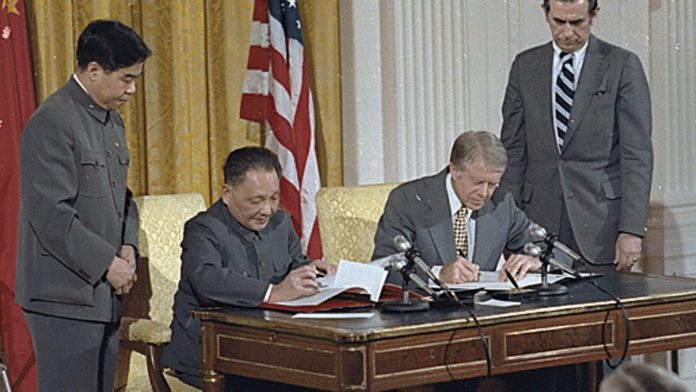
China’s then-paramount leader Deng Xiaoping and President Jimmy Carter sign historic diplomatic agreements between the United States and China in 1979.
Jimmy Carter Library
hide caption
toggle caption
Jimmy Carter Library
One of Carter’s most enduring foreign policy legacies was his decision to establish formal diplomatic relations with the People’s Republic of China at the start of 1979 —– nearly 30 years after the Communist Party seized power.
The establishment of ties between Washington and Beijing ushered in an era of engagement that brought China out of isolation and underpinned its meteoric economic rise.
Chinese ambassador Xie Feng earlier this year said that “historic decision” by Carter and China’s then-paramount leader Deng Xiaoping was taken with “extraordinary political courage and vision”.
In an email, Chinese Embassy Spokesperson Liu Pengyu expressed condolences to the Carter family, saying the former president “played a pivotal role in the normalization and development of China-U.S. relations.”
“His historic decision to establish diplomatic relations with China demonstrated his extraordinary political courage and vision. Since then, the bilateral relationship has benefited both the two peoples and the world. President Carter’s longstanding commitment and contribution to China-U.S. relations will always be remembered,” he said.
In recent years, competition has eclipsed cooperation in bilateral ties, and the relationship has deteriorated across the board. That concerned Carter. In a 2021 interview, he expressed the hope that relations would improve.
“Even in a competitive economic environment, there is room for mutual growth and cooperation. Our societies are entwined, and our governments need to protect this important societal and economic connection,” he said.
Gal Gadot was diagnosed with a “massive blood clot” on her brain while eight months pregnant with her daughter.
The “Wonder Woman” star shared an emotional post on social media detailing the “profound challenges and deep reflections” of her year with a hospital photo from shortly after her baby girl was born.
Gadot, 39, kept her fourth pregnancy with husband Yaron Varsano a secret and announced she gave birth to their daughter in a post shared online in March.
Gal Gadot suffered a brain clot while pregnant with her fourth child.(Kevin Winter)
“In February, during my eighth month of pregnancy, I was diagnosed with a massive blood clot in my brain,” Gadot wrote. “For weeks, I had endured excruciating headaches that confined me to bed, until I finally underwent an MRI that revealed the terrifying truth.
“In one moment, my family and I were faced with how fragile life can be. It was a stark reminder of how quickly everything can change, and in the midst of a difficult year, all I wanted was to hold on and live.”
She continued, “We rushed to the hospital, and within hours, I underwent emergency surgery. My daughter, Ori, was born during that moment of uncertainty and fear. Her name, meaning ‘my light,’ wasn’t chosen by chance. Before the surgery, I told Jaron that when our daughter arrived, she would be the light waiting for me at the end of this tunnel.”
Gadot thanked her team of doctors at Cedars Sinai in Los Angeles for “weeks of dedicated care.”
“I made it through and began the road to recovery. Today, I am fully healed and filled with gratitude for the life I’ve been given back,” she wrote.
Gadot was experiencing excruciating headaches before she had an MRI.(REUTERS/Mike Blake)
Gadot and Varsano married in 2008 and also share daughters Alma, Maya, and Daniella.
This isn’t the first time the actress was able to keep her pregnancy quiet. In 2017, Gadot told Marie Claire that she kept her second pregnancy a secret while filming “Wonder Woman” because she didn’t want to be treated any differently on set.
“I gutted it out,” she told the magazine. “I started to come to set with sunglasses. I had this jug of water with huge pieces of ginger. One of the producers kept on asking, ‘Why are you drinking that potato water?’ They thought I’d gone Hollywood.”
Gal Gadot and husband Yaron Versano have four children.(VALERIE MACON/AFP via Getty Images)
In 2022, Gadot, who served in the Israel Defense Forceswhen she was younger, told InStyle, “Shooting a movie while being pregnant, or when you have a baby” is the most “bad—” thing she’s done.
“I started young,” she added. “I was 25 when I was pregnant with Alma. I always wanted to be a young mother. Yeah, three kids. No joke, woman. God bless them, but it’s so much work.”
Gadot explained, “I love giving birth. I would do it once a week if I could. It’s so magical. And I always take epidurals, to be fair, so it’s not so painful. Just the moment you feel like you’re creating life, it’s incredible.”
Fox News Digital’s Brie Stimson contributed to this report.
Tracy Wright is an entertainment reporter for Fox News Digital. Send story tips to [email protected].
Jeon Je-young was among the hundreds of family members waiting for news from the authorities about Jeju Air Flight 2216, which crashed at an airport in South Korea.
World leaders from across the globe are expressing their sincere condolences as the U.S. mourns the death of former President Jimmy Carter, who passed away at the age of 100 on Sunday.
Cuban President Miguel Diaz-Canel took to X to give his commiserations in the wake of Carter’s death, writing, “Condolences to the people and government of the United States, especially to the family and loved ones of President James Carter. Our people will remember with gratitude his efforts to improve relations, his visits to Cuba and his statement in favor of the freedom of the (Cuban) Five.”
In his one term in the White House, Carter struck the Camp David Accords between Israel and Egypt, helped take the world further from nuclear proliferation with the second Strategic Arms Limitation Treaty (SALT), signed the Panama Canal Treaties, which ended a century of direct American control over the crucial canal, and deregulated the nation’s airline industry.
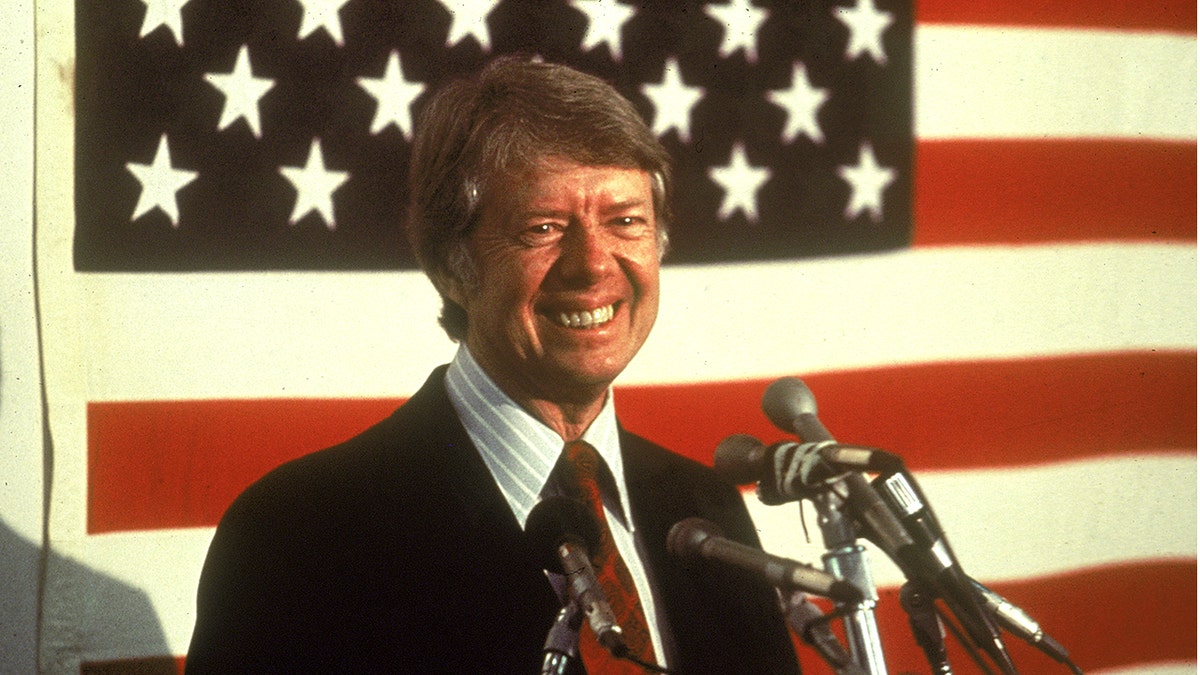
President Jimmy Carter addressing a town meeting. American flag is hung in background.(Fox News)
Carter was awarded the Nobel Peace Prize in 2002 for his efforts to find peaceful solutions when dealing with international conflicts, leaving many world leaders to applaud his work promoting economic and social development as well as human rights.
“We express our heartfelt condolences to the American people and to the family of former US President Jimmy Carter on his passing. He was a leader who served during a time when Ukraine was not yet independent, yet his heart stood firmly with us in our ongoing fight for freedom. We deeply appreciate his steadfast commitment to Christian faith and democratic values, as well as his unwavering support for Ukraine in the face of Russia’s unprovoked aggression. He devoted his life to promoting peace in the world and defending human rights. Today, let us remember: peace matters, and the world must remain united in standing against those who threaten these values. May his memory be eternal,” said Ukrainian President Volodymyr Zelensky.
Former U.S. President Jimmy Carter and former First Lady Rosalynn Carter wear traditional Ghanaian attire, a gift from the chief of Tingoli village in northern Ghana, where The Carter Center, in partnership with Ghana’s Ministry of Health, has worked to eradicate Guinea worm disease and eliminate trachoma. The Carters visited the village Feb. 8, 2007, as part of a two-week health tour of remote African villages.(The Carter Center)
Long-time allies of the U.S. the Royal Family’s King Charles also took to social media to express his sorrow.
“It was with great sadness that I learned of the death of former President Carter. He was a committed public servant, and devoted his life to promoting peace and human rights. His dedication and humility served as an inspiration to many, and I remember with great fondness his visit to the United Kingdom in 1977. My thoughts and prayers are with President Carter’s family and the American people at this time.”
Queen Elizabeth meets President Jimmy Carter and other heads of state at a 1977 summit at Buckingham Palace (National Archives and Records Administration)(National Archives and Records Administration)
Carter died at his home in Georgia surrounded by his family.
“My father was a hero, not only to me but to everyone who believes in peace, human rights, and unselfish love,” said Chip Carter, the former president’s son. “My brothers, sister, and I shared him with the rest of the world through these common beliefs. The world is our family because of the way he brought people together, and we thank you for honoring his memory by continuing to live these shared beliefs.”
A Sunday night overtime thriller unfolded in the nation’s capital, and playoff implications were riddled throughout the battle between the Atlanta Falcons and Washington Commanders.
While this one came down to the wire, the Commanders were victorious with a 30-24 win over the Falcons to earn their spot in the postseason.
The Commanders improved to 11-5 on the year, giving them a playoff spot as a wild card team.
Washington Commanders wide receiver Olamide Zaccheaus (14) celebrates with teammates after scoring a touchdown against the Atlanta Falcons during the first quarter at Northwest Stadium.(Geoff Burke-Imagn Images)
Meanwhile, the Falcons head into Week 18 needing a win and a Buccaneers loss to secure the NFC South – their only chance at reaching the playoffs as other teams hold better records.
As noted, extra time was needed for this contest, but the reason behind it was a true rookie moment for Michael Penix Jr., the Falcons’ eighth overall pick who went up against the Commanders’ No. 2 overall pick in Jayden Daniels.
All season long, Daniels cemented himself as an Offensive Rookie of the Year frontrunner, making tremendous plays to put Washington in the position to reach the playoffs.
But Penix, in the second start of his young career, found himself down a touchdown with less than five minutes to play in the fourth quarter and a playoff spot on the line.
Penix capped a surgical drive on fourth-and-goal with a 13-yard strike in between multiple Commanders defenders to find tight end Kyle Pitts, which tied the game after the extra point went through the uprights.
After a three-and-out by Daniels and the Commanders’ offense, who had a chance at a game-winning drive, Penix and the Falcons had just over one minute to try to get into field goal range for Riley Patterson.
They came very close after Penix found Darnell Mooney for a 25-yard pickup that got them near midfield. However, on third-and-5 from the Atlanta 49-yard line, a pass from Penix to Mooney resulted in defensive pass interference, which allowed Patterson to at least try a 56-yarder for the win.
The ensuing kick was on line, but it didn’t have enough leg as it landed in the back of the end zone to force overtime.
Atlanta Falcons running back Bijan Robinson (7) celebrates after scoring a touchdown against the Washington Commanders during the first half at Northwest Stadium.(Amber Searls-Imagn Images)
But as Penix had his rookie moment, Daniels added yet another game-winning drive to his resume after winning the coin flip and keeping the ball from Atlanta.
Just as Daniels did against the Philadelphia Eagles last week, he drove downfield in 12 plays using his arms and legs, killing 7:18 of overtime clock to eventually find himself third-and-goal from the Atlanta two-yard line.
Daniels dropped back to pass and lasered the ball to Zach Ertz, his trusty tight end, whose second touchdown of the night was the game-winner.
Daniels finished the game with 227 passing yards with three touchdowns and one interception, while rushing for a game-high 127 yards on 16 carries.
Olamide Zaccheaus was the first touchdown scorer for Washington, and he led the team with 85 yards on eight receptions. Ertz finished with 72 yards on six catches.
Washington Commanders quarterback Jayden Daniels (5) prepares to throw the ball against the Atlanta Falcons during the first half at Northwest Stadium. (Amber Searls-Imagn Images)
For the Falcons, Penix ended the night 19-for-35 for 223 yards with one touchdown and one interception. Drake London was the game’s top receiver with 106 yards on seven catches.
Bijan Robinson also had 90 yards on 17 carries with two touchdowns.
Carter’s interest in promoting renewable energy was on display at his January 20, 1977 presidential inauguration. Solar panels were installed to warm the reviewing stand near the White House, where Carter watched the inaugural parade.
“It happened to be one of the coldest days of the year that morning and very little sun,” says Paul Muldawer, the Atlanta architect Carter tapped to design his inauguration facilities.
“We made a statement, although it honestly didn’t work as well as I would have liked it to work,” Muldawer says. Wind chill that day was in the teens, according to the National Weather Service.
Carter wanted a ceremony that reflected his values. That extended to the reviewing stand, which was built so it wouldn’t end up in a landfill after the ceremony. Instead of wood, it was made of steel.
“After the inauguration, we had it disassembled, shipped to Atlanta, and then it was recycled as a bandstand,” says Muldawer, who’s now 92. The structure was in a public park where free concerts were held. “Carter was just thrilled with that. He really liked the idea of repurposing that facility.”
A peanut-shaped float passes by the Presidential reviewing stand for the inauguration of Jimmy Carter in Washington, D.C. on January 20, 1977. The stand, instead of being sent to a landfill, was recycled and sent to Atlanta where it was used as a band stand for free public concerts.
REUTERS
hide caption
toggle caption
REUTERS
A peanut-shaped float passes by the Presidential reviewing stand for the inauguration of Jimmy Carter in Washington, D.C. on January 20, 1977. The stand, instead of being sent to a landfill, was recycled and sent to Atlanta where it was used as a band stand for free public concerts.
REUTERS
The inauguration set the stage for Carter’s four years as President. His environmental legacy has shaped how the country is responding to climate change today.
“At the time that Jimmy Carter was president, his biggest concern was energy security,” says Amy Myers Jaffe, director of the Energy, Climate Justice and Sustainability Lab at New York University.
In 1977, the U.S. was importing 8.81 million barrels of petroleum a day, mostly from the Organization of Petroleum Exporting Countries, or the OPEC cartel. That made the U.S. vulnerable during the 1973 Arab oil embargo, which led to long lines at gas stations.
In several ways Jaffe says Carter was ahead of his time by being an early advocate for conserving energy and boosting renewable electricity, such as solar power. But Carter also promoted domestic coal mining. The subsequent growth of that industry contributed to the warming climate the world is experiencing now.
Carter boosted energy efficiency and solar
Shortly after Carter took office in 1977, he delivered what has become known as the “sweater speech.” Sitting by a lit fireplace, he wore a cardigan sweater and addressed the country on television.
President Jimmy Carter wears a sweater during a meeting with members of his cabinet at the White House, April 20, 1977. Carter encouraged Americans to turn down thermostats to save energy.
AP
hide caption
toggle caption
AP
President Jimmy Carter wears a sweater during a meeting with members of his cabinet at the White House, April 20, 1977. Carter encouraged Americans to turn down thermostats to save energy.
AP
“All of us must learn to waste less energy. Simply by keeping our thermostats, for instance, at 65 degrees in the daytime and 55 degrees at night we could save half the current shortage of natural gas,” Carter said.
Energy efficiency seems like a given today, but it wasn’t really on Americans’ minds after the 1950s and ’60s, Jaffe says. Back then, it seemed like the oil would always flow. Jaffe says some even made fun of Carter’s efficiency plea — an indication of how unusual the request was at the time.
Still, energy experts then were thinking about the possibility that oil and gas could run out. That prompted Carter to encourage alternative sources of energy. “He even put solar panels, famously, on the White House,” Jaffe says.
At a press event unveiling the solar panels that would be used to heat water, Carter made clear that energy security was at the top of his mind.
“Today, in directly harnessing the power of the sun, we’re taking the energy that God gave us, the most renewable energy that we will ever see, and using it to replace our dwindling supplies of fossil fuels,” Carter said.
By the end of the 20th century, Carter wanted the U.S. to get “20% of all the energy we use from the sun.” The country still hasn’t reached that goal, though more than 80% of new generating capacity this year is expected to come from solar and battery storage.
As if to highlight the risk of experimenting with new energy sources, Carter told reporters at the solar panel unveiling, “A generation from now, this solar heater can either be a curiosity, a museum piece, an example of a road not taken, or it can be just a small part of one of the greatest and most exciting adventures ever undertaken by the American people.”
The panels were removed less than a decade later during the Reagan administration.
“Had the United States stayed the course, and we had not had volatility in our federal efforts in alternative energy, we would maybe still be the premier country for alternative energy,” Jaffe says. Instead, she says, the U.S. is playing catch-up with countries like Denmark and Spain on wind energy, and China for solar and electric vehicles.
The panels removed from the White House were stored in a government warehouse until Unity College acquired them, according to Maine Public. Sixteen panels were re-installed on a roof at the college in Central Maine and used to heat water for the dining hall. One of the panels, about the size of a picnic table, is displayed on the campus with a marker describing its historical significance.
A solar panel that once sat atop the White House is on display at Unity College in Central Maine. A marker commemorates it’s historical significance.
Murray Carpenter/Maine Public
hide caption
toggle caption
Murray Carpenter/Maine Public
A solar panel that once sat atop the White House is on display at Unity College in Central Maine. A marker commemorates it’s historical significance.
Murray Carpenter/Maine Public
A climate change warning and promoting coal
The summer after Carter took office, he received a memo with the subject “Release of Fossil CO2 and the Possibility of a Catastrophic Climate Change.” It warned that increasing concentrations of carbon dioxide in the atmosphere has a “greenhouse effect” that “will induce a global climatic warming.”
The memo was from Frank Press, Carter’s chief advisor on scientific matters and the director of the White House Office of Science and Technology Policy. Press wrote, “The present state of knowledge does not justify emergency action to limit the consumption of fossil fuels in the near term.” But he did write that considering the “potential CO2 hazard” should become part of the country’s long-term energy strategy.
The top of the memo is marked “THE PRESIDENT HAS SEEN.” Climate change, though, was not an issue Carter highlighted during his time in office. He actually boosted domestic coal production. Coal is the most carbon-intense fuel for generating electricity.
Carter’s 1980 campaign speech to miners in West Frankfort, Illinois includes a level of boosterism rarely seen outside of the coal industry these days.
“America indeed is the Saudi Arabia of coal, and my goal as President of the United States is to see on the world energy markets Arab oil replaced with Illinois coal,” Carter told miners and employees of the Old Ben Coal Mine No. 25. He also boasted that the country would, “produce more coal in 1980 than has ever before been produced in the United States of America.”
The greenhouse gas emissions from burning more coal are an issue the country still grapples with as the effects of climate change become clear.
“I calculated once that we had roughly five full extra years of emissions at roughly the 2000 level of CO2 emissions due to Carter’s energy coal policies,” says Philip Verleger, an economist who worked on energy issues in the Treasury Department during the Carter administration.
In a 1978 speech Carter did recognize the polluting nature of coal by announcing a commission on the coal industry. “Ultimately, we will learn to harness the energy of the Sun and the oceans with fusion power to meet our energy needs. But for now, we have no choice but to continue to rely heavily on fossil fuels, and coal is our most abundant fossil fuel,” Carter said.
But even Verleger comes back to Carter’s work advancing energy efficiency and renewable energy.
“Carter really started the ball rolling, created many of the ideas that are now coming to the fore. And that’s good. The downside in terms of environment was the emphasis on coal,” Verleger says.
An enduring environmental legacy
Preserving land also was a priority for Carter. Near the end of his presidency, he signed into law the Alaska National Interest Lands Conservation Act. It provided protections for 157 million acres of land through the creation of national parks, refuges and conservation areas.
The legislation doubled the size of the National Park System and was the largest expansion of protected lands in history, according to the National Park Service.
Former President Jimmy Carter fishes for native rainbow trout on Turniptown Creek, near his mountain cabin near Ellijay, Ga., May 23, 1988. Carter signed legislation that doubled the size of the National Park System.
Joe Holloway, Jr./AP
hide caption
toggle caption
Joe Holloway, Jr./AP
Former President Jimmy Carter fishes for native rainbow trout on Turniptown Creek, near his mountain cabin near Ellijay, Ga., May 23, 1988. Carter signed legislation that doubled the size of the National Park System.
Joe Holloway, Jr./AP
Carter also signed legislation in 1977 creating the Department of Energy, which is implementing much of the climate-focused Inflation Reduction Act that Congress passed and President Joe Biden signed last year. The law dedicates money to boosting renewable energy and research on new technologies.
“Over four decades ago, Carter was putting in place policies that we are now enhancing today,” Jaffe says. The IRA’s focus on domestic manufacturing also is helping fulfill Carter’s goal of putting “the United States back to where it needs to be, and dominating supply chains for things like solar panels, manufacturing and electric cars,” explains Jaffe.
Jason Carter, the grandson of former President Jimmy Carter, explains how solar panels work to sons Thomas, right, and Henry, left. This was at a Feb. 8, 2017 ribbon cutting ceremony for a solar panel project on farmland Jimmy Carter owned in his hometown of Plains, Ga.
David Goldman/AP
hide caption
toggle caption
David Goldman/AP
Jason Carter, the grandson of former President Jimmy Carter, explains how solar panels work to sons Thomas, right, and Henry, left. This was at a Feb. 8, 2017 ribbon cutting ceremony for a solar panel project on farmland Jimmy Carter owned in his hometown of Plains, Ga.
David Goldman/AP
In his final years, Carter’s environmental legacy came full circle. In 2017 he leased 10 acres of his land in Plains, Georgia for a solar power project that produces enough electricity to supply about half the demand of his hometown.
At the dedication event he told the crowd, “This site will be as symbolically important as the 32 panels we put on the White House,” according to The Atlanta Journal-Constitution. “People can come here and see what can be done.”
Miami Hurricanes guard Hanna Cavinder directs traffic during the game against the Indiana Hoosiers in the second round of the NCAA Women’s Basketball Championship Greenville Regional 2 on March 20, 2023, at Assembly Hall in Bloomington, Ind.(Jeffrey Brown/Icon Sportswire via Getty Images)
Cavinder has been spotted at numerous Georgia games this season supporting her boyfriend, the two-time national champion who is hoping to make it three titles by the end of the College Football Playoff.
However, Beck’s announcement comes before Georgia’s fate in the playoff is known due to surgery needed to repair an injury that ends his 2024 campaign. Beck suffered an elbow injury in Georgia’s SEC Championship win over Texas on the final play of the first half as he tried to heave a Hail Mary.
Gunner Stockton, Beck’s backup who helped lead the Bulldogs to that SEC title win over the Longhorns, will be starting the rest of the way for Kirby Smart’s group.
“First off I want to thank God, for blessing me with the opportunity to play the game I love,” Beck wrote in his Instagram post. “Through the ups and downs, the highs and lows, everything that this game produces and provides I’m eternally grateful for. Football has taught me lessons that will last a lifetime and has grown me into the person I am today.”
Beck, 22, finishes his Georgia career with 3,485 yards and 28 passing touchdowns against 12 interceptions in 2024.
Georgia’s Carson Beck (15) speaks with teammate Gunner Stockton prior to the game against Tennessee Tech at Sanford Stadium on September 7, 2024, in Athens, Ga.(Todd Kirkland/Getty Images)
It will be interesting to see how Beck’s draft stock comes out after interviews and the NFL Scouting Combine, as his production dipped in a season in which some believed he could cement himself as a top pick if he continued to improve upon his 2023 season, when he was full-time starter for the first time.
Beck’s play, especially toward the end of the season, brought about many questions about how his game would translate to the NFL.
Meanwhile, Cavinder, whose twin sister, Haley, already dates an NFL star in Dallas Cowboys tight end Jake Ferguson, continues to play her women’s basketball season with the Hurricanes. They both star for Miami after helping them reach the Elite Eight in last season’s NCAA Tournament.
Former U.S. President Jimmy Carter speaks to a group of Duke University alumni at the Carter Center in Atlanta in 2012.
John Bazemore/AP
President Jimmy Carter in the White House’s Oval Office in 1977.
AP
Carter as governor-elect walks the grounds of the governor’s mansion in Atlanta in January 1971. In his arms is his daughter, Amy Carter, then 3.
AP
Carter embraces his wife, Rosalynn Carter, after receiving the final news of his victory in the presidential election on Nov. 2, 1976.
Hulton Archive/Getty Images
Rosalynn Carter watches her husband take the oath of office as the 39th U.S. president on Jan. 20, 1977.
AP
President Jimmy Carter discusses the energy shortage during a special Cabinet meeting in 1977. Next to him is James Schlesinger, who was then his adviser on energy.
John Duricka/AP
On April 25, 1980, Carter addressed the American people via television about the failed mission to rescue the American hostages in Iran.
AP
Two days after Carter’s successor, Ronald Reagan, was sworn in as president, Carter tearfully greeted 52 former hostages at the U.S. Air Force hospital in Wiesbaden, Germany, after their release from 444 days of captivity in Iran. Here, he waves with former hostage Bruce Laingen, who had been the chargé d’affaires at the U.S. Embassy in Tehran, from the hospital balcony on Jan. 22, 1981.
AP
Former President Jimmy Carter works on a Habitat for Humanity project in Charlotte, N.C., in July 1987.
Mark Humphrey/AP
In his acceptance speech for his Nobel Peace Prize in 2002, Carter, who was recognized for many years of public service, urged others to work for peace.
Arne Knudsen/Getty Images
Carter stands with former President George H.W. Bush (from left), President-elect Barack Obama, President George W. Bush and former President Bill Clinton in the Oval Office at the White House on Jan. 7, 2009. George W. Bush had invited all the former presidents and the president-elect to lunch at the White House.
Saul Loeb/AFP/Getty Images
Carter steps off a plane with Aijalon Mahli Gomes on Aug. 27, 2010, in Boston. Gomes, held in custody in North Korea after crossing into the country illegally that January, was released at Carter’s behest.
Darren McCollester/Getty Images
Few presidents have come as far as fast in national politics as Jimmy Carter. In 1974, he was nearing the end of his single term as governor of Georgia when he told the world he wanted to be president.
Two years later, he was the president-elect.
Although his name recognition nationally was only 2% at the time of his announcement, Carter believed he could meet enough people personally to make a strong showing in the early presidential caucuses and primaries. He embarked on a 37-state tour, making more than 200 speeches before any of the other major candidates had announced.
When voting began in Iowa and New Hampshire in the winter of 1976, Carter emerged the winner in both states. He rode that momentum all the way to the presidential nomination and held on to win a close contest in the general election.
His career as a highly active former president lasted four full decades and ended only with his death Sunday in his hometown of Plains, Ga. He was 100 and had lived longer than any other U.S. president, battling cancer in both his brain and liver in his 90s.
A life that bridged political eras
James Earl Carter Jr. was the 39th U.S. president, elected as a Democrat displacing the incumbent Republican, Gerald Ford, in 1976. Carter would serve a single tumultuous term in the White House, beset by inflation, energy shortages, intraparty challenges and foreign crises. But he managed to win the nomination for a second term.
He lost his bid for reelection to Republican Ronald Reagan in a landslide in 1980. Thereafter, he worked with Habitat for Humanity and traveled the globe as an indefatigable advocate for peace and human rights. He was given the U.N. Prize in the Field of Human Rights in 1998 and awarded the Nobel Peace Prize in 2002.
Carter was the first president from the Deep South elected since the Civil War. He entered politics at a time when Democrats still dominated in his home state and region. He had begun his career as a naval officer in the submarine corps, but in 1953 he left the service to take over the family peanut business when his father died. He later served four years in Georgia’s state legislature before making his first bid for governor in 1966.
In that contest, he finished behind another Democrat, Lester Maddox, a populist figure known for brandishing a pickax handle to confront civil rights protesters outside his Atlanta restaurant.
Carter shared much of the traditional white Southern cultural identity. But he was also noted for his support for integration and the Civil Rights Movement led by fellow Georgian Martin Luther King Jr. Four years after losing to Maddox, Carter was elected his successor and declared in his inaugural speech that “the time for racial discrimination is over.”
Judge Robert H. Jordan administers the oath of office to incoming Gov. Jimmy Carter at the Georgia State Capitol in Atlanta on Jan. 12, 1971.
AP
hide caption
toggle caption
AP
Judge Robert H. Jordan administers the oath of office to incoming Gov. Jimmy Carter at the Georgia State Capitol in Atlanta on Jan. 12, 1971.
AP
Time magazine would feature him on its cover four months later, making him a symbol of the “New South.” And as his term as governor ended, he was all in on a presidential bid. But he did not burst onto the national stage so much as he crept up onto it, appearing before small groups in farming communities and elsewhere far from the big media centers.
A meteoric rise to the White House
Beyond his earnest image and rhetoric, Carter also had a savvy game plan based on the new presidential nominating rules that the Democratic Party had adopted in the early 1970s. Carter’s team, led by campaign manager Hamilton Jordan, mastered this new road map, with Carter climbing from a strong showing in the still-new Iowa caucuses to a clean win in New Hampshire’s primary. So though in January 1976 he was the first choice of only 4% of Democrats nationally, he won the first two events and leveraged that attention to capture the imagination of voters in other regions.
Carter shut out segregationist champion George Wallace in the Southern primaries and also dominated in the industrial states of the North and Midwest. Democrats held 48 primaries or caucuses around the United States that year, and Carter won 30, with no other candidate winning more than five.
An estimated crowd of 35,000 people gathered for a speech by presidential candidate Jimmy Carter on Oct. 29, 1976, in Philadelphia.
AP
hide caption
toggle caption
AP
An estimated crowd of 35,000 people gathered for a speech by presidential candidate Jimmy Carter on Oct. 29, 1976, in Philadelphia.
AP
Wherever he went, he was able to connect with rural voters and evangelicals wherever they were to be found — doing well in big cities but also in the sparsely populated parts of Ohio and Pennsylvania.
While Carter’s juggernaut lost momentum in the summer and fall, with Republican President Gerald Ford nearly closing the polling gap by Election Day, the Georgian held on to win 50% of the popular vote in November. By winning in his home state and everywhere else in the South (save only Virginia) while holding on to enough of the key population centers in the Northeast and Great Lakes regions, Carter was able to cobble together nearly 300 Electoral College votes without winning California, Illinois or Michigan.
Troubles in office
The surprisingly modest margin of Carter’s victory over Ford augured more difficulties ahead. And as well as the Carter persona may have suited the national mood in 1976, it did not fit well in the Washington he found in 1977. All presidential candidates who “run against Washington” find it necessary to adjust their tactics if and when they are elected. But the former peanut farmer and his campaign staff known as the “Georgia mafia” never seemed to lose faith in the leverage they thought they had as outsiders.
Almost immediately upon taking office, Carter encountered difficulties with various power centers in Congress. He and his tight circle of aides brought along from Georgia and the campaign were not attuned to congressional customs or prerogatives, and a variety of their agenda priorities ran afoul of their own party’s preferences.
A case in point was a “hit list” of Western water projects that the Carterites regarded as needless pork barrel spending. For a raft of Democratic senators and representatives facing reelection in thirsty states and districts, the list came as a declaration of war. Although Congress fought Carter to a draw on the projects, many of these Western seats would be lost to Republican challengers in 1978 and 1980.
Carter did have signal successes in brokering a historic peace deal between Israel and Egypt and in securing Senate ratification of his treaties ceding the Panama Canal to Panama. He also managed to achieve significant reforms in regulations — especially those affecting energy production and transportation — that would eventually lower consumer prices.
Carter had taken office amid historically high inflation and energy prices that had persisted since the Arab oil embargo of 1973. Carter appointed a new chair of the Federal Reserve, Paul Volcker, whose tight money policies eventually tamed inflation but also triggered a recession and the highest unemployment rates since the Great Depression. Along the way, there was more grief on the oil front as Iran’s Islamic Revolution in 1979 caused not only a price spike but long lines at the pump — worse than in 1973.
Carter and the Democrats paid a price, suffering more than the usual losses for the president’s party in the 1978 midterm elections, which greatly reduced Democratic margins in both the House and the Senate.
Yet the Iranian crisis had even worse consequences. The revolution saw the overthrow of the Shah, a longtime ally of the U.S., and the installation of a stern theocratic regime led by Ayatollah Ruhollah Khomeini, a fierce critic of the United States. When Carter agreed to grant the Shah a visa to receive cancer treatments in the U.S., young followers of the ayatollah overran the U.S. Embassy in Tehran. Fifty-two Americans were taken hostage for 444 days. Carter’s efforts to free them were unavailing. An airborne raid intended to free them ended in catastrophe in the Iranian desert, leaving eight U.S. service members dead after a collision of aircraft on the ground.
Afghanistan becomes an issue
Yet another blow was dealt to Carter’s standing when the Soviet Union invaded Afghanistan to prop up its client regime there. Opposing that aggression was popular, but Carter’s decision to retaliate by having the U.S. boycott the 1980 Olympics in Moscow was less so.
Carter was able to use the hostage crisis to his advantage in suppressing the challenge to his nomination mounted by Sen. Edward Kennedy of Massachusetts. Carter refused to debate Kennedy and made the primaries a kind of referendum on the Iranian situation. Enough Democrats rallied to his side that Kennedy’s bid, a favorite cause of liberal activists and organized labor, fell far short. Still, it contributed to the weakness of Carter’s standing in the general election. And what had worked against a challenger from the Democratic left did not work when Carter faced one from the Republican right.
Ronald Reagan was a former two-term governor of California who had sought the nomination twice before, and he did not begin 1980 as the consensus choice of his party. But he wove a complex set of issues into a fabric with broad appeal. He proposed sweeping tax cuts as a tonic for the economy, more spending on defense, a more aggressive foreign policy and, just as important, a return to the traditional values of “faith, freedom, family, work and neighborhood.” He also opposed abortion and busing for racial integration and favored school prayer — the three hottest buttons in social policy at the time.
After a come-from-behind win in New Hampshire and a sweep of the Southern primaries, Reagan never looked back. His triumph at the Republican National Convention in Detroit set the tone for his campaign.
The election looked close at Labor Day and even into October. But the single debate the two camps agreed to, held on Oct. 28, 1980, the week before the election, was a clear win for the challenger. Carter failed in his attempts to paint Reagan as an extremist. The Republican managed to be reassuring and upbeat even as he kept up his attacks on Carter’s handling of the economy and on the rest of Carter’s record.
Carter begins construction on homes in Philadelphia on June 20, 1988. Carter and his wife, Rosalynn Carter, were among dozens of Habitat for Humanity volunteers repairing five row houses for low-income residents.
Bill Cramer/AP
hide caption
toggle caption
Bill Cramer/AP
Carter begins construction on homes in Philadelphia on June 20, 1988. Carter and his wife, Rosalynn Carter, were among dozens of Habitat for Humanity volunteers repairing five row houses for low-income residents.
Bill Cramer/AP
The polls broke sharply in the final days, and in November, Reagan captured nearly all the Southern states that Carter had carried four years earlier and won the 1980 presidential election with 489 Electoral College votes. Carter conceded before the polls had even closed on the West Coast.
Reassessment in retrospect
Historians have generally not rated Carter’s presidency highly, and he left office with his Gallup poll approval rating in the low 30s. But there has been a steady upward trajectory in assessments of his presidency in recent years, and his Gallup approval rating has climbed back above 50% and has remained there among the public at large.
This reflects the work of several Carter biographers and former aides and the natural comparison with the presidents who have followed him.
In 2018, Stuart E. Eizenstat, Carter’s chief domestic policy adviser, published President Carter: The White House Years, which historians have praised both as a primary source and as an assessment of Carter’s term. In it, Eizenstat wrote that Carter “was not a great president, but he was a good and productive one. He delivered results, many of which were realized only after he left office. He was a man of almost unyielding principle. Yet his greatest virtue was at once his most serious fault for a president in an American democracy of divided powers.”
As far back as 2000, historian Douglas Brinkley wrote that in the first 20 years after Carter lost the presidency, he had become “renowned the world over as the epitome of the caring, compassionate, best sort of American statesman … an exemplar of behavior for all national leaders in retirement.”
A new life out of office
But the greatest factor in Carter’s rising reputation was his own performance in his post-presidential career. He worked with Habitat for Humanity to rehabilitate homes for low-income families. He taught at Emory University and established his own nonprofit, the Carter Center. And over the ensuing decades, he published more than two dozen books and became an international advocate for peace, democratic reforms and humanitarian causes.
As former president, Carter did not shy from controversy, particularly when it came to the Middle East, the region that gave him his greatest foreign policy achievement and also his most damaging setback as president.
He opposed the Gulf War in 1991 and the U.S. invasion of Iraq in 2003, and he angered many when he likened Israel’s treatment of Palestinians to apartheid in South Africa. He also riled many Americans by suggesting that opposition to President Barack Obama was rooted in racism. More recently, he earned new admirers and detractors alike with his public disapproval of then-President Donald Trump.
President Biden addressed the nation on Sunday in the wake of former President Jimmy Carter’s death, commending the late statesman while also taking a swipe at the current president-elect during his speech.
Biden, who sounded hoarse during the speech, said he “lost a dear friend” on Sunday, noting that he had known Carter for more than 50 years. Carter passed away in Plains, Georgia, at the age of 100, after nearly two years of being in hospice care.
During his remarks, Biden said Carter is a model “of what it means to live a life of meaning and purpose, a life of principle, faith and humility.”
“Some look at Jimmy Carter and see a man of a bygone era with honesty and character. Faith and humility mattered, but I don’t believe it’s a bygone era,” Biden said. “We’d all do well to try to be more like Jimmy Carter.”
Biden criticized Donald Trump during a speech about Jimmy Carter’s legacy on Sunday.(Getty Images)
Biden said his fondest memory of Carter happened in the 1970s when the then-Georgia governor asked Biden for help with his presidential campaign.
“He grabbed me by the arm and said, ‘I need you to help with my campaign,'” Biden recalled. “I said, ‘I’ve only been around a couple of years, Mr. Governor.’ He said, ‘No, it’ll make a difference.'”
“I said, ‘I’m not sure it will,” Biden added. “When I endorsed him for president, I told him why [I] was endorsing him and that it was not only his policies but his character, his decency, the honor he communicated to everyone.”
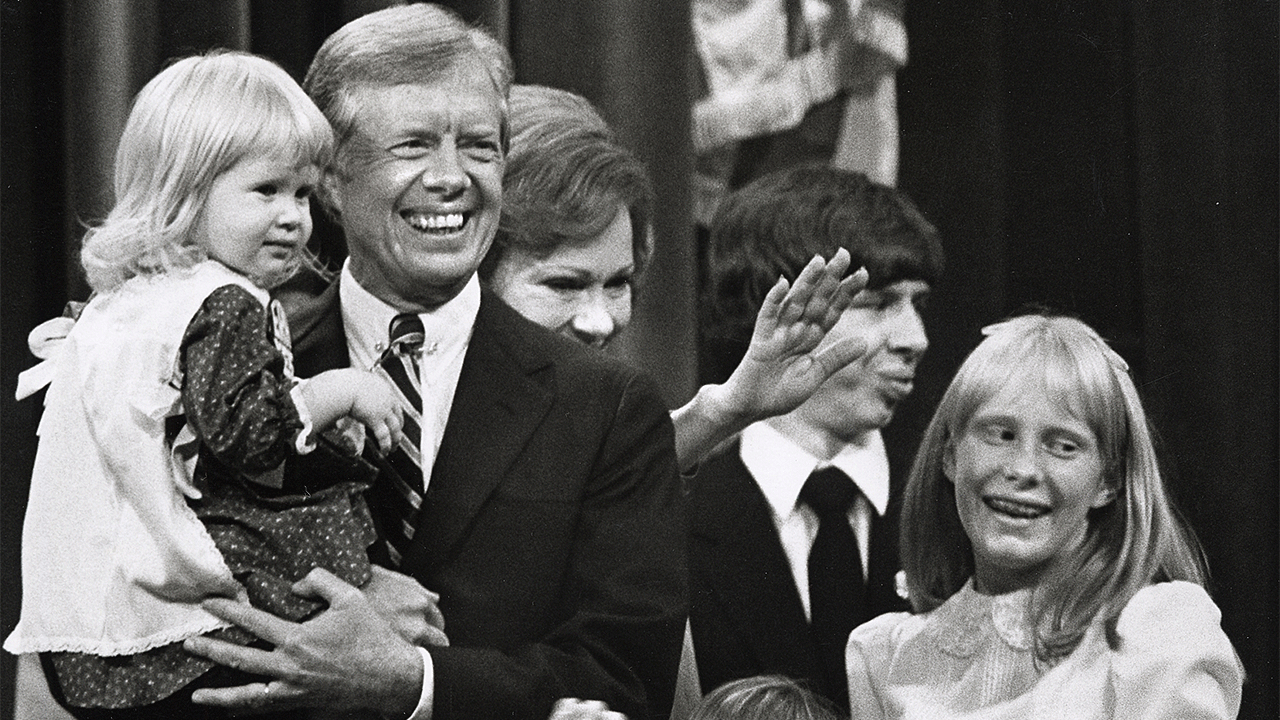
Jimmy Carter, Rosalynn Carter and their children are shown during the 1980 Democratic National Convention in New York City.(Ron Galella)
When a reporter asked Biden what President-elect Trump should take from Carter’s legacy, Biden replied, “Decency.”
“Decency, decency, decency. … Can you imagine Jimmy Carter walking by someone who needed something and just keep walking? Can you imagine Jimmy Carter referring to someone by the way they look or the way they talk?”
Biden’s speech came after Trump issued his own statement about Carter’s death.
Former President Jimmy Carter(Hulton Archive/Getty Images)
“Those of us who have been fortunate to have served as President understand this is a very exclusive club, and only we can relate to the enormous responsibility of leading the Greatest Nation in History,” Trump wrote on Truth Social. “The challenges Jimmy faced as President came at a pivotal time for our country and he did everything in his power to improve the lives of all Americans. For that, we all owe him a debt of gratitude.”
Trump later wrote that although he “strongly” disagreed with Carter philosophically and politically, he realized that the former president “truly loved and respected” the U.S. and all it stands for.
“He worked hard to make America a better place, and for that I give him my highest respect,” Trump said. “He was truly a good man and, of course, will be greatly missed. He was also very consequential, far more than most Presidents, after he left the Oval Office.”
Fox News Digital’s Greg Wehner contributed to this report.
Andrea Margolis is a writer for Fox News Digital and Fox Business. Readers can send story tips to [email protected].