Wednesday, November 11, 2026
Home Blog Page 537

Tariff Threats Show Trump’s Commitment to Upending Global Trade

0

President-elect Donald J. Trump’s threats to impose damaging tariffs on Canada, Mexico and China may ultimately be an opening wager to try to use the power of the American market to persuade other countries to stem a flow of drugs and migrants across U.S. borders.

But even if the threat to impose vast tariffs on some of the world’s largest economies is a negotiating tactic, it is also a gambit that has immediate real-world consequences.

Before Mr. Trump even sets foot in the Oval Office, his threat to put tariffs on America’s three largest trading partners on his first day in office was reverberating around the world, shocking international businesses, rocking diplomatic relationships and calling into question two big trade deals that Mr. Trump negotiated during his first term.

Mr. Trump’s pronouncement late Monday that he would impose a 25 percent tariff on all goods from Canada and Mexico and a 10 percent tariff on products from China was immediately denounced by business groups, who said such a move would cause economic harm. Foreign officials rushed to reassure the incoming Trump administration that they had been working to stop drugs and migrants from coming into the United States — while warning that they were also ready to turn around and impose their own tariffs on American exports.

Mr. Trump’s threats may have been intended to silence investors and economists who have recently questioned whether the president-elect would go through with imposing the big levies he promised while campaigning. In the run-up to the election, Mr. Trump pledged to put a 60 percent tariff on goods from China and a tax of at least 10 percent on all other imports. Such a move could ignite a global trade war, slowing economies around the world.

Whether Mr. Trump’s threats ultimately show his prowess as a deal-maker or simply sow chaos, they are a reminder that the president-elect is eager to upend global relationships to try to secure points for the United States. That includes a willingness to potentially topple the trade pacts that he himself worked to put in place with Mexico, Canada and China during his first term after he used bruising tariffs to force them into making concessions.

One of those deals was the United States-Mexico-Canada Agreement. That trade pact replaced and updated the previous deal, the 30-year old North American Free Trade Agreement, which Mr. Trump called the “worst trade deal ever made.”

Under the U.S.M.C.A., goods that meet certain requirements can move around the continent without being subject to tariffs. A 25 percent tariff on all Mexican and Canadian products would be a clear violation of that agreement, and could call into question the future of the deal itself.

Wendy Cutler, a vice president at the Asia Society Policy Institute and former U.S. trade negotiator, said the threats put Mexico and Canada “in a tough spot” given their dependence on the U.S. market. The pressure on them to take measures to placate the president-elect would be strong, she said.

“Like Trump’s first term, some of these tariff threats may never lead to the actual imposition of tariffs,” she said. “Nevertheless, our trading partners need to be prepared for additional threats, and many are developing strategies as we speak for navigating around them.”

The threats offered a preview of what could be another four years of trade tumult, mirroring Mr. Trump’s first term when he scrambled the country’s economic and diplomatic relationships. The president-elect has long viewed tariffs as a powerful source of leverage that, when coupled with his unpredictable style, encourages other countries to swiftly make concessions.

After taking office in 2017, Mr. Trump hit a slew of countries with tariffs on steel and aluminum. He wielded those taxes as leverage against Canada and Mexico to renegotiate NAFTA. He also put significant tariffs on China in 2018, then continued to ratchet them up over the next 18 months until his administration signed a trade deal with Beijing in January 2020.

This time, Mr. Trump said he would hit China for failing to prevent chemicals used in fentanyl from coming into the United States. He said he would impose tariffs on Mexico and Canada to force those countries to stem the flow of fentanyl and end illegal migrant crossings into the United States.

In a public letter on Tuesday, President Claudia Sheinbaum of Mexico said her country had developed a comprehensive policy that had led to far fewer encounters at the U.S. border and said tariff threats would not solve the problem.

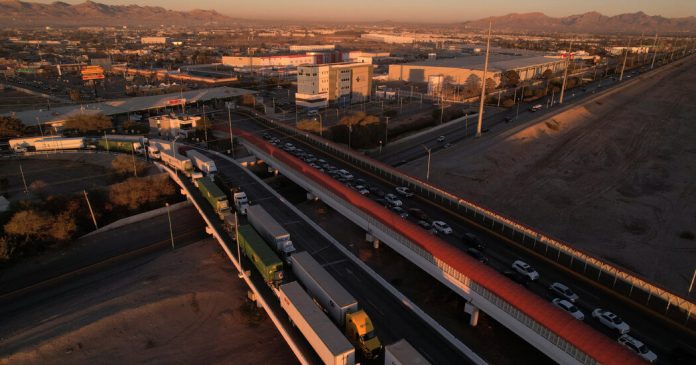
The number of illegal border crossings from Mexico has fallen significantly in 2024, in part because of a Mexican crackdown on migrants crossing through their country, as well as new U.S. restrictions on asylum at the southern border.

Ms. Sheinbaum also threatened to answer Mr. Trump’s tariffs with levies on American products, even if that harmed automakers and other businesses that trade goods along both sides of the U.S.-Mexico border.

“For every tariff, there will be a response in kind, until we put at risk our shared enterprises,” she said.

Justin Trudeau, the Canadian prime minister, said Tuesday that he would hold an emergency meeting on Mr. Trump’s tariff proposal with all of Canada’s provincial and territorial leaders. He also responded to accusations in the House of Commons that he was not acting forcefully enough by saying he was working to defuse the threats.

“Rather than panicking, we’re engaging in constructive ways to protect Canadian jobs like we have before,” Mr. Trudeau said. “The idea of going to war with the United States isn’t what anyone wants.”

Speaking in Ottawa, Pierre Poilievre, the Conservative opposition leader, indicated that he was open to removing Mexico from the free trade agreement.

Asked by reporters if he would exclude Mexico from any talks to prevent Mr. Trump’s proposed tariffs, Mr. Poilievre said he would put Canada first and “do what is necessary to preserve that relationship above all others.”

Imposing 25 percent tariffs on Canada and Mexico could cause significant damage to many industries that organized themselves around an integrated North American market. Since NAFTA was signed more than three decades ago, makers of cars, textiles, snack foods and other products have set up supply chains that snake between the countries, as they move from raw materials to their final consumers.

Kim Glas, the chief executive of the National Council of Textile Organizations, which represents American textile makers, said that her industry welcomed an increase on tariffs on Chinese textiles and apparel, but that imposing tariffs on Mexican and Canadian goods could undermine American manufacturing.

Factories in the United States, Mexico and Canada are linked together in a co-production chain under the current trade agreement, she said. The U.S. textile industry exports 53 percent of its products to factories in Mexico and Canada, where they are turned into finished products that then come back into the United States.

“This is a vital supply chain that sustains U.S. textile manufacturers, our regional trade partners and their workforces,” she said, adding that the arrangement “competes directly with China and Asia.”

David McCall, the president of the United Steelworkers, a trade union that represents metal makers and other industries in both Canada and the United States, said in a statement that tariffs on Canada would “dramatically harm workers in both our countries,” because the economies are so integrated.

“There is no question that we must address the holes in our global trading system, but Canada is not the problem,” he said.

Trade lawyers said Mr. Trump would have the legal authority to sign an executive order on his first day in office to issue the tariffs, though he might choose to delay the date at which the tariffs go into effect in order to force countries to the negotiating table. Mr. Trump took that approach when he first imposed tariffs on Chinese goods.

U.S. markets shrugged off the threats on Tuesday, with the Dow Jones industrial average rising to offset losses in the morning.

Analysts at Goldman Sachs said in a note Tuesday that they still expected it was more likely that Mexico and Canada would avoid across-the-board tariffs. If the tariffs were imposed, however, they estimated they would raise the U.S. effective tariff rate by 8.6 percentage points and push up a core inflation index closely watched by central bankers by 0.9 percent.

John Murphy, a senior vice president at the U.S. Chamber of Commerce, said in a statement on Tuesday that Mr. Trump was right to focus on fentanyl, but that the business community believed those issues could be addressed “without the harm to the American people that tariffs would bring.”

“If imposed,” he said, “tariffs themselves would not solve our border problems, and instead would send prices soaring, costing the typical American family more than $1,000, with significant harm to U.S. manufacturers, farmers and ranchers.”

Hamed Aleaziz and Ian Austen contributed reporting.

Former German Chancellor Angela Merkel shares her advice for Americans

0

NPR’s Mary Louise Kelly speaks to former chancellor of Germany Angela Merkel about a new chapter of leadership in the United States.

SJSU trans player Blaire Fleming joins teammate Brooke Slusser on conference honors list amid lawsuits

0

San Jose State’s women’s volleyball team had two players listed on the Mountain West’s all-conference honorable mention list this year who are also on opposing sides of explosive lawsuits. 

Senior Blaire Fleming and Brooke Slusser were both on the list as well as Annie Kaminski and Kiki Remensperger from Boise State, San Diego State’s Jasmine Davis, Basia Latos and Chloe Thomas from UNLV, Utah State’s Kaylie Kofe and Wyoming’s Sarah Holcomb.

Slusser is part of two lawsuits alleging the university and Fleming actively sought to prevent Slusser and other players on the team from knowing Fleming is a biological male. 

CLICK HERE FOR MORE SPORTS COVERAGE ON FOXNEWS.COM

The 2024 Mountain West volleyball season all-conference honorable mentions include San Jose State players Blaire Fleming and Brooke Slusser. (Courtesy of the Mountain West)

On the court, Fleming and Slusser anchored one of the best offenses in the Mountain West.

The Spartans finished the regular season with the third-best hitting percentage in the conference. 

Slusser finished with a top 10 individual hitting percentage in the conference. 

Fleming was second in the conference in kills per set with a .386, still well behind Colorado State’s Malaya Jones, who led the way at .457. 

Fleming had a signature moment in the second-to-last game of the season against first-place Colorado State at home on Senior Day. Fleming led the game in kills with 24 and total attacks and clinched victory in the fifth set with a match-point service ace. 

Right after the play, Fleming was swarmed by teammates in celebration. Even Slusser got involved. This group celebration took place just days after Slusser and other Mountain West players filed a second lawsuit over Fleming’s presence on the team against San Jose State and the conference. 

SJSU WOMEN’S VOLLEYBALL’S 1ST OPPONENT DIDN’T KNOW ABOUT TRANS PLAYER, SUGGESTS MATCH WOULDN’T HAVE HAPPENED

Slusser previously joined a lawsuit against the NCAA headed by former NCAA swimmer Riley Gaines over the governing body’s policies on gender ideology that have allowed transgender athletes to compete as women. 

In both lawsuits, Slusser has alleged Fleming’s spikes travel at 80 mph. 

“Brooke estimates that Fleming’s spikes were traveling upward of 80 mph, which was faster than she had ever seen a woman hit a volleyball,” Slusser’s complaint states. “The girls were doing everything they could to dodge Fleming’s spikes but still could not fully protect themselves.”

Fleming previously set a single-game record at John Champe High School with 30 kills in a match and a single-season record of 266 kills for the school’s girls’ volleyball team. 

Footage from the athlete’s Hudl page of the school-record 30-kill match in September 2019 shows how hard and fast Fleming’s spikes came down at the high school level against girl opponents.

Brooke Slusser and Blaire Fleming

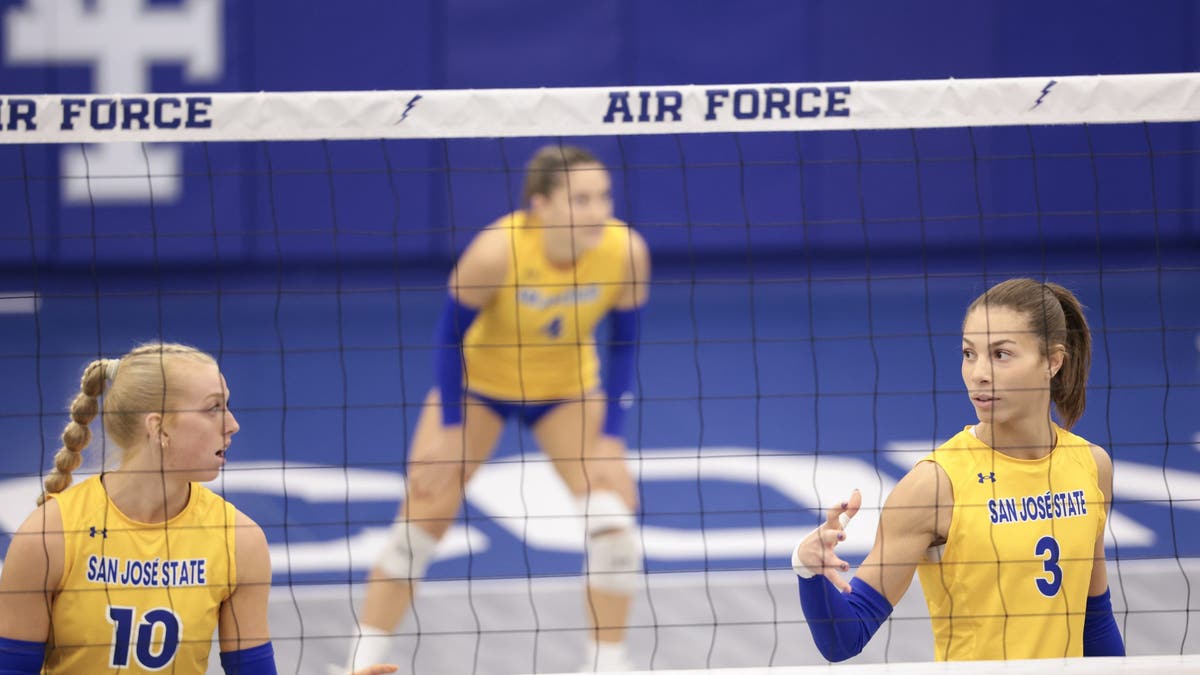
Brooke Slusser, left, and Blaire Fleming of the San Jose State Spartans call a play during the first set against the Air Force Falcons at Falcon Court at East Gym Oct. 19, 2024, in Colorado Springs, Colo. (Andrew Wevers/Getty Images)

President-elect Trump even commented about footage of one of Fleming’s plays in which the player spiked a ball at San Diego State player Keira Herron in a match earlier this season.

“I saw the slam. It was a slam. I never saw a ball hit so hard,” Trump said during a Fox News town hall before he was elected to a second term. “But other people, even in volleyball, they’ve been permanently — I mean, they’ve been hurt really badly. Women playing men.”

In another match against New Mexico Oct. 18, one of Fleming’s spikes knocked an opposing player to the court. 

CLICK HERE TO GET THE FOX NEWS APP

Despite the lawsuits and the controversy, Slusser and the rest of her teammates have taken the court with Fleming during a season that has included several forfeits. 

San Jose State finished with a 12-6 conference record, earning a No. 2 seed in the Mountain West Tournament. The team achieved this with six of those 12 wins coming via forfeit after Utah State, Boise State, Nevada and Wyoming all refused to face the program amid the ongoing controversy involving Fleming. Boise State and Wyoming each forfeited two matches against San Jose State. 

In matches they’ve played, Fleming’s spiking ability is the centerpiece of the team’s strategy. Even Slusser has set up Fleming for one of the athlete’s feared spikes throughout the season while being part of the lawsuit that has alleged safety concerns with those spikes. 

As the team gears up to play in the Mountain West tournament in Las Vegas this week, it is bound to face a team that has already forfeited a match against San Jose State.

Blaire Fleming hits it

Blaire Fleming of the San Jose State Spartans attacks the net during the first set against the Air Force Falcons at Falcon Court at East Gym Oct. 19, 2024, in Colorado Springs, Colo. (Andrew Wevers/Getty Images)

Utah State and Boise State will meet in the quarterfinals for the right to advance and face San Jose State in the semifinal after the Spartans got a first-round bye. 

Slusser previously told Fox News Digital her team doesn’t know if the Spartans’ upcoming tournament opponents will face them. 

“We’re just mostly wondering, are teams even gonna play us, period, if we go there? Because of just everything that’s happened this season,” Slusser said. “It seems like every few days it looks like it’ll be a fine day and everything’s normal, and then something else happens. So, I truly do think everyone’s just kind of taking things day by day and taking the punches as they come.”

Follow Fox News Digital’s sports coverage on X, and subscribe to the Fox News Sports Huddle newsletter.

Israel Approves Cease-Fire With Hezbollah to Halt War in Lebanon

0

The Israeli security cabinet on Tuesday night approved a deal for a cease-fire with Hezbollah in Lebanon, signaling that more than a year of conflict will soon be suspended, and raising hopes around the region that Lebanon’s deadliest war in decades could be over.

The cease-fire will take effect at 4 a.m. local time on Wednesday, President Biden said at the White House.

The 10 to 1 vote by Israeli ministers came after Prime Minister Benjamin Netanyahu of Israel publicly embraced the proposal in a televised speech to the nation.

Just hours earlier, Israeli forces had pounded the heart of Beirut and Hezbollah-dominated neighborhoods south of the city with some of the heaviest airstrikes of the war, sending residents fleeing in a panic.

Mr. Biden said he had spoken with Mr. Netanyahu and with Prime Minister Najib Mikati of Lebanon, and “I’m pleased to announce their governments have accepted the United States proposal to end the conflict between Israel and Hezbollah.”

Mr. Biden said the agreed-on cease-fire is for 60 days, but that “This is designed to be a permanent cessation of hostilities.”

But Mr. Netanyahu said in his televised address, “The length of the cease-fire will depend on what happens in Lebanon.”

“With the full understanding of the United States, we are preserving full military freedom of action — if Hezbollah breaks the agreement and seeks to arm itself, we will attack,” he said.

Mr. Netanyahu said there were three main reasons for a cease-fire: It would allow Israel to focus on Iran, which backs Hezbollah and Hamas; would give the military an opportunity to rest and rebuild its stockpiles; and would isolate Hamas, the group Israel has been fighting in the Gaza Strip since it led the attacks of Oct. 7, 2023.

Mr. Netanyahu did not reveal the terms of the cease-fire or when it might take effect, and it is not yet certain that Israel’s understanding of the truce matches Hezbollah’s.

But the proposed deal, mediated by American and French diplomats, had called for Israeli troops to withdraw from Lebanon and Hezbollah’s fighters to move north of the Litani River, allowing the Lebanese Army — which is not a party to the conflict — and a U.N. peacekeeping force to fill the vacuum. The cease-fire would be overseen by several countries, including the United States and France, as well as by the United Nations.

“It is imperative that this cease-fire be respected, and that it be lasting, in order to restore the security of the Lebanese and Israeli people,” President Emmanuel Macron of France said on Tuesday, in a video address. He added that his country would “spare no effort to support the implementation of this agreement,” including by helping the Lebanese army increase its presence in southern Lebanon.

The truce arrives just eight weeks before Mr. Biden is scheduled to relinquish his office to Donald J. Trump, and it follows months of intensive but frustrating diplomacy by the president and his administration in search of peace. They have tried to balance steadfast support for Israel with efforts to temper its retaliatory campaigns in Gaza and Lebanon, often to little apparent effect.

Mr. Biden said the cease-fire in Lebanon creates an opening to halt the fighting with Hamas in Gaza, as well, and his administration will renew peace talks on that front.

The Biden administration hopes that a truce will become a durable peace and open a path to greater regional stability after more than a year of escalating conflict pitting Israel against Iran and its regional proxies, including Hamas in Gaza, Hezbollah in Lebanon and the Houthis in Yemen.

Israel’s conflict with Hezbollah began in October 2023 after the group began firing rockets into northern Israel in solidarity with Hamas, which had just raided southern Israel, killing 1,200 people and taking another 250 to Gaza as hostages.

Israel returned fire into Lebanon, and the conflict escalated into a low-level war that displaced tens of thousands on both sides of the Israeli-Lebanese border. Since September, Israel has sharply escalated the war, detonating thousands of Hezbollah pagers and walkie-talkies it had booby-trapped, intensifying its bombing campaign in Lebanon, assassinating Hezbollah’s leader and launching a ground invasion.

“Let’s be clear: Israel did not launch this war,” Mr. Biden said. “The Lebanese people did not seek this war, either.”

Hezbollah has sustained blow after blow over the past few months, including the deaths of many of its fighters and its longtime leader, Hassan Nasrallah. Israeli officials say they have achieved their goals in Lebanon and that they are ready to turn their focus squarely to destroying the last remnants of Hamas in Gaza.

“Hamas relied on Hezbollah to fight by its side,” Mr. Netanyahu said on Tuesday. “With Hezbollah out of the picture, Hamas is now alone in the battle. Our pressure on them will grow.”

Reiterating Israel’s determination to fight in Gaza, Mr. Netanyahu said on Tuesday, “I promised you victory, and we will achieve victory.”

The war in Lebanon has killed nearly 3,800 Lebanese, according to the government, and has displaced more than a million people in the country, or nearly a quarter of the population. About 100 Israelis have been killed and tens of thousands have been displaced from their homes in northern Israel.

The pace of attacks has only intensified in recent days. On Tuesday, as Israeli ministers were discussing the cease-fire proposal, Israeli airstrikes rocked the center of Beirut, shortly after the Israeli military issued a series of evacuation warnings, the first for the area since the war began.

The areas targeted by the warnings included an upscale neighborhood on Beirut’s seafront, home to the American University of Beirut. The streets soon clogged with traffic as people tried to get out.

Lebanon’s health ministry said that at least 10 people had been killed and dozens of others injured in the strikes. Many were presumed to be trapped under rubble, with rescuers working into the night as Israeli surveillance drones whirred overhead.

Southern Lebanon, where Israeli ground troops have been operating, also experienced heavy strikes throughout the day that killed at least eight people, including children, according to the health ministry.

Bachir Khodr, the governor of a hard-hit region in eastern Lebanon, said he had urged residents via social media and television networks to wait until Wednesday morning to return. “Baalbek is still under attack,” he said, referring to his region’s capital.

The Israeli military said it had struck 180 targets in Lebanon over the past day.

Some of the strikes were aimed at Al-Qard Al-Hasan, a financial institution tied to Hezbollah, in what appeared to be an attempt to destroy Hezbollah’s financial capabilities in the final days of the war. The de facto bank had also been targeted last month in a wave of Israeli strikes across Lebanon.

Air-raid sirens wailed across northern Israel on Tuesday, warning of incoming rockets and drone attacks from Lebanon.

Despite their heavy losses, Hezbollah fighters have regularly fired missiles and drones at Israel over the past year, many of which have been intercepted by Israel’s air defenses. On Sunday, Hezbollah fired about 250 projectiles into Israel, one of its heaviest barrages of the war, a day after an Israeli strike in Beirut killed more than 25 people.

Many questions about the cease-fire proposal remain unanswered, including how the Lebanese Army, overseen by the ailing Lebanese government, would exert authority over heavily armed Hezbollah militants. Lebanon’s government was set to meet on Wednesday morning to discuss the cease-fire.

A U.N. spokesman, Farhan Haq, said the U.N. peacekeeping forces in southern Lebanon and the U.N. special coordinator for Lebanon “stand ready to enforce” a cease-fire. He added that the United Nations was “seriously concerned” about the heavy Israeli bombardment campaign still underway in Lebanon.

Hezbollah, which is not a formal party to the agreement, and has addressed peace negotiations through an intermediary, did not immediately comment on it on Tuesday. But the group’s leader, Naim Qassem, suggested last week that Hezbollah would accept a truce if Israel stopped striking Lebanon and Lebanon retained its sovereignty. That would represent a concession for Hezbollah, which had vowed to attack Israel until Israel ended the war in Gaza.

Despite Mr. Netanyahu’s support for a cease-fire, some far-right Israeli leaders who hold power in his coalition expressed strong opposition to the agreement. Itamar Ben-Gvir, the hard-line national security minister, called the cease-fire “a historic mistake” on social media.

Without a “security zone” inside Lebanon to ward off Hezbollah, the situation would ultimately lead to another war with the Lebanese armed group sometime in the future, he said.

Israel and Hezbollah last fought a major war in 2006, a 34-day campaign that killed more than 1,000 Lebanese and 150 Israelis before ending in an internationally backed cease-fire. For years, the two sides observed an uneasy truce, punctuated by periodic cross-border strikes, as both prepared for what they viewed as an inevitable major conflict.

Reporting was contributed by Patrick Kingsley, Ephrat Livni, Farnaz Fassihi, Michael D. Shear and Aurelien Breeden.

Trump's defense pick says women shouldn't serve in combat. These veterans disagree

0

President-elect Trump’s nominee to lead the Department of Defense, Pete Hegseth advocates a purge of what he calls “woke” policy and leadership at the Pentagon.

Girl on school field trip in Canada finds message in a bottle written by her own mother 26 years ago

0

A young girl and her classmates came across a mysterious message in a bottle, only to find out that the bottle’s previous owner wasn’t a stranger.

Scarlet Van Eyk, a fourth grader at St. John the Baptist Catholic Elementary School, was visiting the Great Lakes while on a field trip when another child pointed out a mysterious looking bottle, FOX 8 WJW reported.

When a teacher started to read the letter contained in the bottle, Scarlet Van Eyk was left stunned after realizing it was written by her very own mother, Makenzie Van Eyk.

‘DOOMSDAY FISH,’ RUMORED TO BRING BAD OMENS, WASHES ASHORE IN POPULAR SURF TOWN

“This letter is coming from Makenzie Morris and I go to St. John the Baptist School. I am in Grade 4 in Mr. St. Pierre’s class,” the letter stated, according to the Canadian Broadcasting Corporation (CBC).

A fourth grader found a long-lost message in a bottle (not pictured) only to discover that the author was her mother from 26 years ago. (iStock)

“My letter is about water in the Great Lakes. We read a book called ‘Paddle-to-the-Sea.’ It was a very good book.”

The message in the bottle dates back to 1998, when Makenzie Van Eyk was a fourth grader at the time at St. John the Baptist Catholic Elementary School in Belle River, Ontario, just like her daughter is now, according to FOX 8.

‘WIZARD OF OZ’ RUBY SLIPPERS TO GO ON DISPLAY FOR FANS NEARLY 20 YEARS AFTER BEING STOLEN

Makenzie Van Eyk and her classmates at the time were assigned to write letters about the Great Lakes, before placing the notes in bottles and tossing them into the water, the outlet reported.

finding a message in a bottle

Makenzie Van Eyk was tasked with writing a letter about the Great Lakes in 1998 when she was in fourth grade and “absolutely” remembers throwing the message into the water 26 years ago. (iStock)

Makenzie Van Eyk told the CBC that she “absolutely” remembers writing the message in a bottle and sending it off into the Great Lakes.

CLICK HERE TO SIGN UP FOR OUR LIFESTYLE NEWSLETTER

While this particular message stayed close to home, this is not the first time a mysterious letter found floating in a bottle has made its way back to its originator.

For more Lifestyle articles, visit foxnews.com/lifestyle.

Last year, a letter written in 1997 by a fifth grader in Sandwich, Massachusetts, was found on the beaches of France.

message in a bottle found

Scarlet Van Eyk was stunned when her teacher read the letter (not pictured) and discovered that the author of the note was her own mother. (iStock)

The message was still in good condition even after 26 years, and it was successfully returned to the school.

CLICK HERE TO GET THE FOX NEWS APP

Fox News Digital reached out to the Van Eyk family for comment.

Trump team signs a key transition agreement with Biden White House : NPR

0

The White House, as seen on Election Day on Nov. 5, 2024.

Roberto Schmidt/AFP


hide caption

toggle caption

Roberto Schmidt/AFP

After a significant delay, the Trump transition team has signed a key agreement with the Biden White House to ease the transfer of power.

“This engagement allows our intended cabinet nominees to begin critical preparations, including the deployment of landing teams to every department and agency, and complete the orderly transition of power,” Susie Wiles, chief of staff to President-elect Donald Trump, said in a statement on Tuesday.

The memorandum of understanding was supposed to have been signed by Oct. 1 — along with a second MOU with the General Services Administration (GSA) that would provide funding, office space and technology. The deadline and process is set out in a law called the Presidential Transition Act.

The transition team said it has ruled out signing the GSA agreement, saying it would use “an existing ethics plan” for its team, and would post it on the GSA website.

“The transition already has existing security and information protections built in, which means we will not require additional government and bureaucratic oversight,” the Trump transition team said in a statement, noting it would disclose its donors publicly.

Now that the MOU is signed, authorized members of the Trump transition team can have access to agency and White House employees, facilities and information because it has “agreed to important safeguards to protect non-public information and prevent conflicts of interest, including who has access to the information and how the information is shared,” said Saloni Sharma, a spokeswoman for the White House.

While the White House would have preferred that the Trump transition team sign the GSA agreement, it decided that a disruption in the transfer of power would be more risky.

A third agreement, with the Department of Justice, is required for FBI background checks and security clearances. That agreement has not yet been signed. Those background checks are traditionally required by the Senate during the confirmation process, along with an ethics agreement with the Office of Government Ethics, and responses to a detailed questionnaire.

Expert touts Trump’s energy sector nominations, outlines hopes for administration agenda to spark energy boom

0

President-elect Trump is expected by many of his supporters to preside over an energy “boom” in the United States by slashing Biden administration regulations, and one industry expert told Fox News Digital that she is encouraged by Trump’s energy sector cabinet nominees while outlining specific moves she hopes to see over the next four years.

“I think the three cabinet picks that Trump has so far chosen to lead EPA, Interior and Energy are a vast improvement to who we have currently in those respective positions,” Gabriella Hoffman, Independent Women’s Forum Center for Energy & Conservation Director, told Fox News Digital. 

“They’re going to be taking a more tactful approach to energy development. They’re not going to be keeping things in the ground. They’re going to be prioritizing reliable energy sources like coal, oil, natural gas, nuclear even, and most recently, geothermal has also taken a renewed interest by Congress, and we will probably see geothermal as well unleashed. But also there’s going to be this balance of this energy abundant mindset with promoting land stewardship, expanding hunting and fishing opportunities, expanding ocean access, and reevaluating so-called clean energy projects that promise to be greener or are believed to be green but actually might be worse for the environment and don’t produce enough reliable energy or electricity.”

Hoffman told Fox News Digital the country is going to see a “reassessment of what conservation looks like” that is “balanced out by this robust kind of development of energy here in the United States.

I KNOW WHAT PRESIDENT TRUMP’S ENERGY POLICY WILL BE. I USED TO RUN HIS ENERGY REGULATORY AGENCY

President-elect Trump has vowed to unleash American energy  (Getty Images)

“So it’s going to be great for the economy, we believe. As a center, we believe it’s going to lead to better national security with more energy being produced here. We’re going to be less reliant on countries that produce certain energy sources less cleanly, less environmentally friendly than we do.”

In recent days, President-elect Trump has named former Republican Congressman Lee Zeldin to head the EPA, Liberty Energy CEO Chris Wright to head the Energy Department, and North Dakota Gov. Doug Burgum to oversee the Interior Department. 

Hoffman outlined several top line agenda items that her center hopes to see from the three departments.

TRUMP’S PROPOSED TARIFFS COULD DRIVE UP FOOD PRICES, EXPERTS SAY

Trump speaks campaign event

Then-Republican presidential nominee former President Donald Trump speaks during a campaign event, Wednesday, Sept. 25, 2024, in Mint Hill, N.C.  (AP Photo/Evan Vucci, File)

“Emphasizing reliable energy production, moving away from sources that are subsidized like solar and wind to reliable sources that don’t really need to be subsidized or that are actually very plentiful and can be extracted safely and responsibly here in the United States,” Hoffman said. 

“Another priority is to kind of clamp down on this regulatory overreach we have seen across all three agencies. We have seen them take extreme positions with devising so-called tailpipe emissions standards, all these different green energy efficiency, household appliance directives. We’ve seen them take extreme positions on policies like the America the Beautiful Plan, or the 30 by 30 plan to protect so-called 30% of waters in lands by 2030, which is a very extreme position, not rooted in conservation whatsoever. It’s a control mechanism, not a conservation tool.”

Hoffman said she anticipates a “return back to true conservation” under Trump “where you don’t see environmentalist groups suing agencies in perpetuity to block different measures of progress to go into effect.”

Trump often vowed on the campaign trail to unleash an energy boom in the United States by slashing regulations and expanding drilling in the United States and Hoffman told Fox News Digital she is optimistic that will happen.

ENVIRONMENTAL GROUPS PRESENT DIFFERING OPINIONS OF TRUMP’S ENERGY AND ENVIRONMENT APPOINTEES

A Valero refinery in Benicia, California, US

A Valero refinery in Benicia, California, US (David Paul Morris)

“Our center is very optimistic that there will be an energy boom,” Hoffman said. “It’s not going to happen overnight, but it could be seen within a couple of months. I think realistically, once we hit the six-month mark, perhaps the year-end mark if President-elect Trump is going to be able to repeal some of the Biden-Harris directives as it relates to all the climate measures, the day one executive orders are really going to be a weight off of the administrative state’s shoulders and then all other policies that emanate from that tackling the climate crisis executive order will similarly be probably clamped down.”

Trump has for months vowed to “undo” the Inflation Reduction Act, the Democrats’ marquee climate and clean energy spending legislation that allocates $369 billion in subsidies aimed at re-shoring investments for electric vehicle manufacturing and battery production as well as new utility-scale wind and solar projects.

CLICK HERE TO GET THE FOX NEWS APP

Hoffman told Fox News Digital that repealing the IRA will be critical to unleashing American energy despite possible opposition from some Republicans in Congress who like certain aspects of the bill. 

“For gas prices, electricity prices to truly be lowered, you’re going to have to see that law terminated or repealed, because that is what invited a lot of the so-called energy or environmental inflation,” Hoffman said. “These higher prices at the pump, higher utility bills, higher food costs, because everything emanates from energy, transportation, food delivery, things of that sort. So that law really does have to be kind of called into question. And perhaps Trump will work with Congress to ensure that that is repealed.”

Hoffman also explained that a focus on nuclear energy will be critical over the next four years.

“It is a really safe technology, especially produced here, and we don’t want China or Russia to have an edge,” Hoffman said. 

Fox News Digital’s Breanne Deppisch contributed to this report.

Women volleyball players feeling ‘unsafe’ over trans player lose appeal of Biden judge’s ‘shameful’ ruling

0

An emergency appeal to a Biden-appointed federal judge’s ruling that will let a trans athlete compete at the Mountain West women’s volleyball tournament was denied on Tuesday. 

Colorado District Judge Kato Crews ruled on Monday that San Jose State senior Blaire Fleming, who has been identified as a biological male in multiple lawsuits, is eligible to compete after multiple players contested that Fleming should not be allowed to play in Las Vegas this week. 

The Independent Council on Women’s Sports (ICONS) filed an emergency appeal to the ruling to the 10th Circuit Court of Appeals. But the 10th Circuit agreed with Crews’ ruling, in a decision that came Tuesday afternoon. Crews rejected the request for an emergency injunction, finding the players and others who challenged the league’s policy for allowing transgender athletes to participate should have filed the complaint earlier.

NCAA women’s volleyball players Brooke Slusser, Kaylie Ray, Macey Boggs, Sierra Grizzle, Jordan Sandy, Katelyn Van Kirk and Kiersten Van Kirk were all listed on the complaint and the appeal to have Fleming removed. Slusser is Fleming’s San Jose State teammate, and has alleged she was made to share living spaces and changing spaces with Fleming while the university withheld Fleming’s natural birth sex from Slusser and other players on the team. 

CLICK HERE FOR MORE SPORTS COVERAGE ON FOXNEWS.COM

“It is shameful that the administrators at the Mountain West Conference and the NCAA are unwilling too do their jobs, which is solely to protect fair competition and the safety of athletes who compete in college sports. However, because Mountain West Conference Commissioner Gloria Nevarez and NCAA President Charlie Baker won’t do their jobs and are apparently afraid to stand up for the rights of women student-athletes, we are forced to ask the federal courts to do their jobs for them,” said ICONS legal counsel Bill Bock.

San Jose State provided a statement to Fox News Digital saying the university, saying it was “gratified” with Crews’ ruling. 

“San José State University will continue to support its student-athletes and reject discrimination in all forms. All San José State University student-athletes are eligible to participate in their sports under NCAA and Mountain West Conference rules. We are gratified that the Court rejected an eleventh-hour attempt to change those rules,” the statement read. 

Biden’s judicial appointments have been a point of controversy during his presidency. By the end of his first year in office, Biden had nominated 73 individuals for federal judgeships, one more than Donald Trump during the same point in his presidency.

President Joe Biden speaks after pardoning the national Thanksgiving turkey, Peach, during a pardoning ceremony on the South Lawn of the White House in Washington, Monday, Nov. 25, 2024.  (AP Photo/Susan Walsh)

Crews was one of Biden’s appointees who was confirmed, and ended up presiding over this case. When the hearing was held last Thursday, Crews dedicated the first 45 minutes of the hearing debating what pronouns to use when referring to Fleming or whether the player’s name should be used for security and safety reasons. 

However, safety has been just as much a concern for Fleming’s female teammates. 

Slusser previously told Fox News Digital that the situation involving Fleming and the athlete’s protection by San Jose State and the governing institutions of their sport has left her and her teammates feeling “unsafe,” and has even resulted in moments where players have cried. 

“I think anyone can see that’s in my circle and in the gym that they’re not here to support me. They’re here to support Blaire, and they have decided that they will basically do anything to keep supporting Blaire and to not be there for me and my needs,” Slusser said. “I just have decided you can’t really trust anyone here.” 

San Jose State suspended associate head volleyball coach Melissa Batie-Smoose, who filed a Title IX complaint against the school alleging that San Jose State showed favoritism for Fleming at the expense of the women on the team. 

SJSU WOMEN’S VOLLEYBALL’S 1ST OPPONENT DIDN’T KNOW ABOUT TRASN PLAYER, SUGGESTS MATCH WOULDN’T HAVE HAPPENED

“After we found out that she was released, a lot of the team just kind of broke down and was kind of freaking out, and even one of my teammates was like, ‘I don’t feel safe anymore,’ because there’s no one now that we feel like we can go and talk to about our concerns or our actual feelings and can actually speak freely in front of,” Slusser said.

Slusser says she does not feel safe speaking with anyone else involved in the program, not even head coach Todd Kress. 

“You can’t truly voice how you’re feeling without them just trying to cover it up or act like it’s all OK. With Melissa, you could voice how you felt, and she could comfort you and validate your feelings and at least make you feel heard compared to the other coaches,” Slusser said.

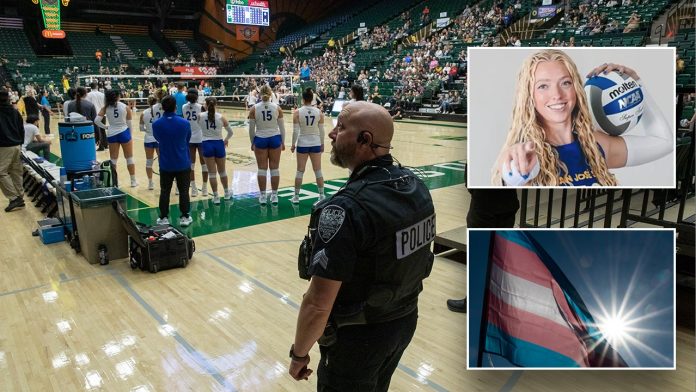
The San Jose State University Spartans are flanked by Moby Arena security, campus police and their own private guard during an NCAA Mountain West women’s volleyball game against the Colorado State University Rams at Moby Arena in Fort Collins, Colo., on Thursday, Oct. 3, 2024.

The San Jose State University Spartans are flanked by Moby Arena security, campus police and their own private guard during an NCAA Mountain West women’s volleyball game against the Colorado State University Rams at Moby Arena in Fort Collins, Colo., on Thursday, Oct. 3, 2024. (Santiago Mejia/San Francisco Chronicle via Getty Images)

Mountain West Commissioner Gloria Nevarez says the conference did not find sufficient evidence to confirm the claims in the Title IX complaint. The complaint alleged Blaire Fleming conspired with a player on Colorado State to influence the outcome of the game and have Fleming’s teammate Brooke Slusser hit in the face with a ball during that game.

The letter did not directly address the notion that there was a conspiracy to have Slusser hit in the face. The letter simply refers to all the allegations listed in the complaint as “manipulation of the competition.” Nevarez says the conference’s investigation included interviews with head coaches and student-athletes initiated by both institutions. However, the letter does not specifically state which individuals had been interviewed. The conference has denied multiple requests from Fox News Digital to name the individuals who were interviewed. 

Those same allegations have been cited in a recent lawsuit that Slusser has filed against The Mountain West and San Jose State. Slusser’s legal team has since provided a statement to Fox News Digital questioning the validity of the conference’s investigation. 

Still, Crews has ensured that Slusser, her teammates and all the other players at the Mountain West Tournament will have to share a tournament with Fleming in Las Vegas this week. 

A Mountain West Conference spokesperson told Fox News Digital last week it planned to crown San Jose State champions if it reached the final and the opposing team there forfeited. Four teams in the conference have already forfeited games to San Jose State, including two that will compete for the right to face the Spartans in the semifinal round. 

CLICK HERE TO GET THE FOX NEWS APP

Blaire Fleming

Blaire Fleming of the San Jose State Spartans attempts to block a shot during the first set against the Air Force Falcons at Falcon Court at East Gym on October 19, 2024 in Colorado Springs, Colorado.  (Andrew Wevers/Getty Images)

Utah State and Boise State are set to play in the quarterfinal match that will determine who faces Fleming and Slusser in the next round. 

Boise State was so unwilling to play San Jose State during the regular season that it forfeited two scheduled matches against the Spartans, taking a pair of conference losses on its record. Meanwhile, Utah State, which only forfeited one game, has joined a recent lawsuit against The Mountain West over the presence of Fleming. 

San Jose State has repeatedly defended the presence of Fleming on the team. 

“Our athletes all comply with NCAA and Mountain West Conference policies and are eligible to play under the rules of those organizations. Our volleyball team members have earned the right to compete, and we are deeply disappointed for them and with them that they are being denied those opportunities through cancellations and forfeits. We are also proud of how they have persevered through these challenges on the court,” a statement provided to Fox News Digital by a university spokesperson said.

Follow Fox News Digital’s sports coverage on X, and subscribe to the Fox News Sports Huddle newsletter.

Federal judge sides with SpaceX after environmental group tried to stop rocket launches

0

A federal judge sided with SpaceX after an environmental group sought to stop its rocket launches just months before the company’s CEO is slated to work closely with the incoming Trump administration.

During static fire tests and launches, SpaceX uses a “deluge system” that applies water to the rocket engine exhaust to absorb heat and prevent explosions during takeoff.

SpaceX has said the system uses “clean, potable (drinking) water” for the tests, but a Texas-based environmental group claims the process poses a risk to the environment.

In an October lawsuit, Save RGV, a nonprofit based in the Rio Grande Valley of Texas, claimed SpaceX was violating the Clean Water Act by releasing wastewater from the launches at Starbase in Boca Chica Beach, roughly 25 miles east of the city of Brownsville. 

FEDERAL COURT UPENDS DECADES OF ENVIRONMENTAL REGULATIONS

A SpaceX Falcon Heavy rocket with a NASA spacecraft bound for Jupiter lifts off from pad 39A at the Kennedy Space Center Oct. 14, 2024, in Cape Canaveral, Fla. (John Raoux)

The group requested a restraining order be put in place to block SpaceX from using the deluge system, which would put a hold on rocket launches.

In a post on X, formerly Twitter, after the suit was filed, the aeronautics company said an environmental review had already been conducted that cleared the system from any environmental hazards.

TRUMP PLANNING TO LIFT BIDEN’S LNG PAUSE, INCREASE OIL DRILLLING DURING 1ST DAYS IN OFFICE: REPORT

“The Texas Commission on Environmental Quality (TCEQ) conducted a technical review of Starship’s water-cooled flame deflector, which uses potable (drinking) water and determined that its use does not pose risk to the environment,” SpaceX said in an Oct. 10 post. “Save RGV acknowledged that they are aware of these straightforward facts and still filed an unwarranted and frivolous lawsuit.”

Elon Musk

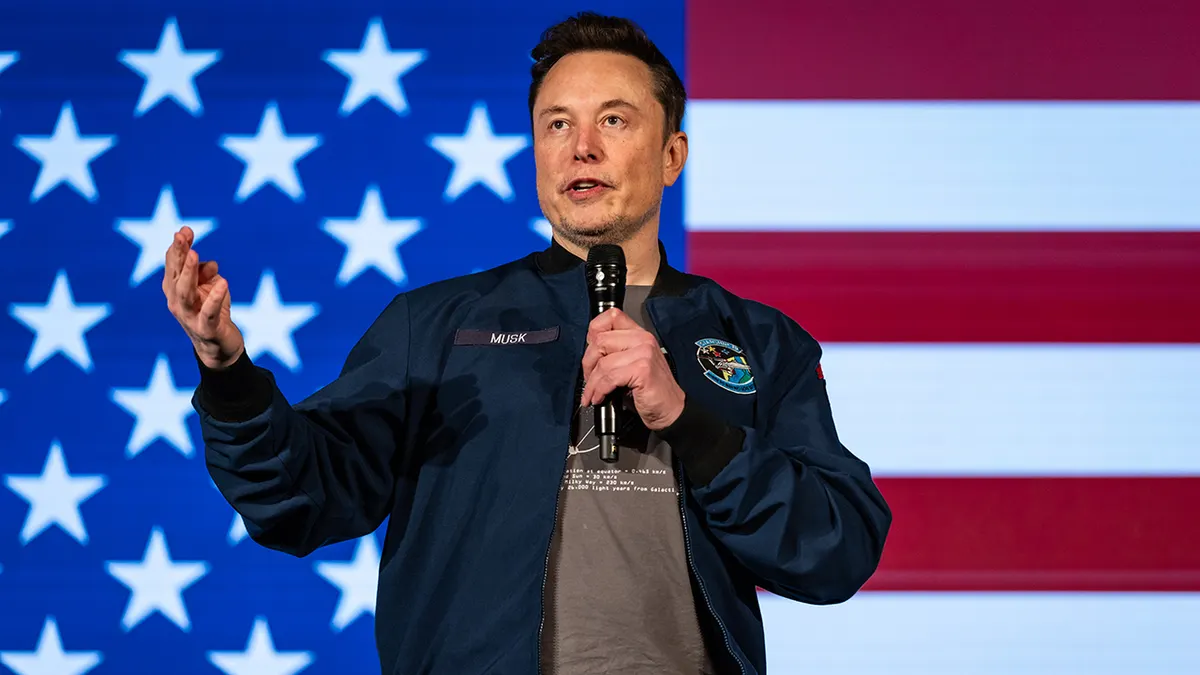
SpaceX and Tesla founder Elon Musk speaks during an America PAC town hall Oct. 26, 2024, in Lancaster, Pa. (Samuel Corum/Getty Images)

In a new ruling, U.S. District Judge Rolando Olvera denied the restraining order request, saying that halting the rocket launches could have various negative implications, including for NASA.

“Being unable to launch would create various consequences for not only Defendant, but also the public at large. It would significantly delay and possibly destroy Defendant’s contracts with NASA to further the Artemis Program and Human Landing System Program — worth billions of dollars,” Olvera wrote.

The judge also ruled that SpaceX has not been harming the environment, citing environmental reviews that have already been conducted on the launch system.

“At the beginning of the Starship-Super Heavy Launch System’s development, it became evident that a deluge water system was necessary to protect the launch site and surrounding areas during launches,” the judge wrote. “A deluge water system sprays large quantities of potable water at the base of the spacecrafts during launch to prevent fires and reduce dispersal of dust and debris.”

rocket launch

A SpaceX Falcon 9 rocket with a crew of two lifts off from launch pad 40 at the Cape Canaveral Space Force Station Sept. 28, 2024, at Cape Canaveral, Fla. (AP Photo/John Raoux)

The decision comes just two months before Musk is expected to work closely with President-elect Trump’s administration.

CLICK HERE TO GET THE FOX NEWS APP

Musk is planning to work with Trump and entrepreneur Vivek Ramaswamy on the newly formed Department of Government Efficiency to cut government spending.