Thursday, November 12, 2026
Home Blog Page 100

Voice of America staff sue Kari Lake and Trump administration : NPR

0

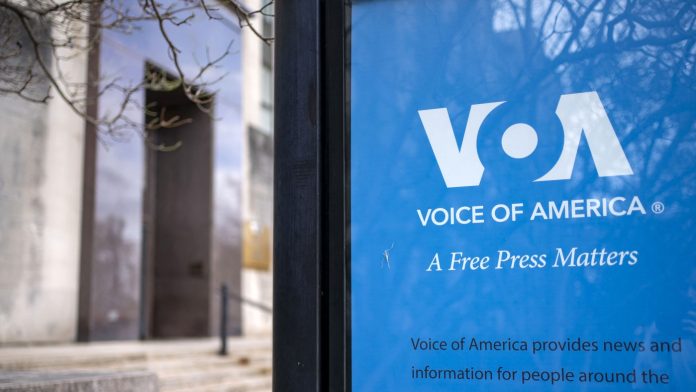
Staff at the government broadcaster Voice of America have filed a lawsuit against the Trump administration, which put nearly 900 employees on leave and froze funding last week.

BONNIE CASH/AFP via Getty Images/AFP


hide caption

toggle caption

BONNIE CASH/AFP via Getty Images/AFP

Six Voice of America journalists sued Kari Lake and the Trump administration on Friday, alleging their moves to shut down the U.S.-funded network were unlawful and unconstitutional.

The journalists say that the government’s acts violate their First Amendment rights on free speech grounds and usurp the U.S. Congress’s control of the power of the federal purse.

More than 900 full-time network employees were placed on indefinite leave last weekend; 550 contractors were terminated from their jobs. Most employees at the federal parent, U.S. Agency for Global Media, were also placed on indefinite leave.

The lead plaintiffs include Patsy Widakuswara, until recently Voice of America’s White House bureau chief and Jessica Jerreat, its press freedom editor. Four other journalists sued anonymously as John Does. Kathryn Neeper, the director of strategy and performance assessment at the U.S. Agency for Global Media, is also a named plaintiff. She was also placed on leave.

Few Voice of America journalists are known inside the U.S.; the network is prohibited from broadcasting to American audiences. Nonetheless, Widakuswara made headlines twice: First in pressing Trump’s then-Secretary of State Mike Pompeo in early 2021 over the siege of the U.S. Capitol and, earlier this month, in asking Irish Taoiseach Micheál Martin about “the president’s plans to expel Palestinians from Gaza” at an appearance with President Trump at the White House.

Irritated, Trump asked Widakuswara what outlet she worked for. Upon hearing the answer, he replied, “No wonder,” and called on another reporter.

Lake is Trump’s special adviser overseeing USAGM. “Waste, fraud, and abuse run rampant in this agency and American taxpayers shouldn’t have to fund it,” Lake said in announcing the moves last weekend.

The effect was to shut Voice of America down. The most recent stories on its home page and its audio headlines feed are a week old; live streaming services are unavailable.

The suit, which additionally names acting USAGM Chief Executive Victor Morales as a defendant, seeks immediate reinstatement of all full-time staffers and contractors. It points to regulations and law which specify a firewall to insulate Voice of America and the other international networks funded by the agency from political tampering. Those measures are intended to ensure their professionalism.

“Tragically, Kari Lake lives in the MAGA fantasy world, but she makes decisions that have real-world consequences for hundreds of journalists,” said David Seide, the lead attorney on the suit. Seide is senior counsel at the Government Accountability Project, a non-profit that seeks to protect the rights of whistleblowers.

“We’ve assembled a coalition of journalists, unions, and advocacy groups to stop and reverse the DOGE machine,” Seide added. Among the other backers of the suit are the press-rights group Reporters Without Borders and unions representing federal employees, journalists, and foreign policy staffers.

Lake and the agency did not immediately reply to NPR’s request for comment on the suit; nor have they replied to NPR’s prior repeated requests for interviews and comment.

Congress has appropriated funds for the Voice of America every year since the broadcaster’s founding during World War II. Lawmakers allocated additional money for the broadcaster and other federally funded networks as part of the stopgap spending measure passed last week..

In addition to Voice of America, the U.S. Agency for Global Media also oversees Radio/TV Martí, which broadcasts to Cuba. The agency also disburses the money Congress allocates for privately incorporated networks – Radio Free Europe/Radio Liberty, Radio Free Asia, the Middle East Broadcasting Networks – as well as the Open Technology Fund, which propels the open-source tech undergirding Signal and other secure communication programs.

The networks are intended to serve as a demonstration of soft power in places without a robust or free press. By providing news that incorporates political debate and dissent inside the U.S., the networks aim to promote and model pluralistic American ideals.

According to the agency, the networks together reach more than 420 million people in 63 languages and more than 100 countries each week. They are fully funded by federal dollars.

The withholding of federal dollars from the non-profit broadcasters has had immediate repercussions. Radio Free Asia on Friday furloughed three-quarters of its U.S.-based staff as it burns through the remaining money it has; Steve Capus, the chief executive of Radio Free Europe/Radio Liberty told NPR’s Leila Fadel this week that without a restoration of funds, the network would face “pretty drastic actions.”

Radio Free Europe/Radio Liberty sued Lake and the Trump administration earlier this week; the Open Tech Fund filed suit Thursday. Their suits were filed in the District of Columbia; the Voice of America plaintiffs sued in federal court in Manhattan.

The lawsuits are a replay of the litigation that ensued during Trump’s first term. His pick to run USAGM, Michael Pack, sought to overhaul the agency. His tenure was marked by one controversy after another; a formal federal investigation found that he had abused his powers.

Soon after taking office in mid-2020, Pack sought to deny work visas for foreign nationals employed by the network.

In the newest litigation against Lake, Morales and USAGM, two of the unnamed plaintiffs are described as freelance journalists working under contract to VOA. Each is said in the lawsuit to be a foreign national authorized to work in the U.S. under a J-1 visa; their visas will expire on March 31 if their visas are not renewed and the agency is not operational once more. In that case, they would have to return to their home countries.

John Doe 3 would return to a nation under rule by an authoritarian regime that has labeled Voice of America a “subversive organization,” according to the lawsuit; the plaintiff risks imprisonment for 15 years.

John Doe 4 is described as “a member of the LGBTQ community and is from a home country which persecutes and discriminates against LGBTQ people.”

Kari Lake, a former local TV news anchor in Phoenix, ran twice for statewide office in Arizona as a MAGA Republican candidate. She lost both times. Last month, she became a senior adviser to the U.S. Agency for Global Media..

Trump initially touted her as the next director of Voice of America but his top budget-slashing adviser, Elon Musk, and other administration officials called for the network to be shut down altogether.

Lake has since embraced that charge.

“From top-to-bottom this agency is a giant rot and burden to the American taxpayer—a national security risk for this nation—and irretrievably broken,” the agency said in its release last Saturday. “While there are bright spots within the agency with personnel who are talented and dedicated public servants, this is the exception rather than the rule.”

U.S. Says Decision to Turn Back French Scientist Had Nothing to Do With Trump

0

The French government’s claim that a scientist was denied entry into the United States because of an opinion he expressed about the Trump administration is “blatantly false,” a U.S. official has said.

Even as the authorities in France continued to call the case a concerning violation of academic freedom, the U.S. official, Tricia McLaughlin, who is a spokeswoman for the Department of Homeland Security, said the scientist had been turned away for reasons unrelated to his personal beliefs.

“The French researcher in question was in possession of confidential information on his electronic device from Los Alamos National Laboratory — in violation of a nondisclosure agreement — something he admitted to taking without permission and attempted to conceal,” Ms. McLaughlin said late Thursday.

Philippe Baptiste, the French minister for higher education, said this week that the scientist, who has not been publicly identified and who specializes in outer space research, was traveling to a conference near Houston earlier this month.

The scientist was not allowed to enter the United States, Mr. Baptiste said, because his phone contained message exchanges with colleagues and friends in which he gave his “personal opinion” on President Trump’s scientific and research policies.

But Ms. McLaughlin rejected that assessment. “Any claim that his removal was based on political beliefs is blatantly false,” she said. She did not provide further details.

It was unclear when or how the scientist might have worked at or interacted with the laboratory at Los Alamos, N.M.

Los Alamos National Laboratory is best known as a place that was crucial to the development of the atomic bomb.

Today, it is a top research facility for the National Nuclear Security Administration, but it also conducts scientific work on other topics. Jennifer Talhelm, a spokesperson for the laboratory, said it was “working with federal officials to understand more about the incident” involving the scientist.

The scientist was working for France’s publicly funded National Center for Scientific Research. Representatives for the center said that he did not wish to speak to the media, but they did not immediately respond to the Department of Homeland Security’s allegations against him.

Neither did the office of Mr. Baptiste, who used to lead the French National Center for Space Studies before he became minister in 2024.

But on Friday, Mr. Baptiste repeated his claim that the scientist had been targeted because of private discussions and opinions about the Trump administration’s policies.

He told Sud Radio in an interview that he had not spoken with the scientist directly but that his ministry was in touch with him.

“Each country is free to regulate their borders,” Mr. Baptiste acknowledged. But he said the scientist’s case was “extraordinarily atypical” and a “subject of concern.”

That concern was shared by the French Academy of Sciences, which said in a statement on Thursday that the scientist’s deportation “seriously undermines the fundamental freedoms of the academic world: freedom of thought, expression and travel.”

Zolan Kanno-Youngs contributed reporting from Washington, D.C., and Ségolène Le Stradic from Paris.

China Watchers See Parallels in American Politics

0

China scholars in the U.S. compare China’s Cultural Revolution and current American dynamics, and see similarities between MAGA and what’s called ‘the China Dream.’

Tate Brothers, Trailed by Human-Trafficking Charges, Are Returning to Romania

0

Andrew Tate and his brother, Tristan Tate, the online influencers who decamped last month to the United States while facing human-trafficking charges in two European countries, were set to return on Friday to Romania ahead of a criminal proceeding, one of them said Friday.

The British American siblings were expected to arrive at night in Bucharest, Romania’s capital, a representative for them told The New York Times.

The pair, who have millions of followers on social media and are known for their misogynistic views and for flaunting their wealth, arrived in Florida on Feb. 27 after a Romanian court lifted travel restrictions against them.

“Spending 185,000 dollars on a private jet across the Atlantic to sign one single piece of paper in Romania,” Andrew Tate wrote Friday on X. “Innocent men don’t run. THEY CLEAR THEIR NAME IN COURT.”

The Tates’ visit to the United States was polarizing and spawned speculation about whether President Trump, with whom the brothers have openly aligned themselves, had used his influence to allow them to travel. But Mr. Trump said he knew nothing about it. Marcel Ciolacu, the prime minister of Romania, said on social media last month that the United States had not made any requests in connection with the influencers.

The brothers received a chilly reception from two top Florida officials, with Gov. Ron DeSantis saying that they were not welcome there and the state’s attorney general, James Uthmeier, also a Republican, opening a criminal investigation into them.

It was not clear how long the Tates were planning to stay in Romania, where they were arrested in 2022 on accusations of luring women to the country and sexually exploiting them.

Joseph McBride, their lawyer in the United States, did not immediately respond to a request for comment on Friday.

According to Romanian prosecutors, the brothers misled several women into believing that they wanted a relationship with them. The women were instead housed in a compound near Bucharest and forced to appear in online pornographic videos, prosecutors said.

But a Bucharest court set back the case in December, when it found that it did not meet the requirements for a trial. Prosecutors vowed that they would continue to pursue the charges.

While the criminal proceedings have been playing out in Romania, the British authorities have pursued the Tates’ arrest on charges of rape and human trafficking. A group of women suing Andrew Tate there over claims of sexual assault has pressed the British government to have him and his brother extradited from Romania.

And an American woman filed a lawsuit against the brothers last month in Florida, accusing them of luring her to Romania, conspiring to coerce her into sex work and defaming her after she gave testimony to the Romanian authorities.

Benjamin Bull, a lawyer for the woman who is the plaintiff in the civil case and the general counsel for the National Center on Sexual Exploitation, said in a statement on Friday that the lawsuit was proceeding.

“The Florida court still has jurisdiction over them no matter where they are physically located, so we are not concerned that they are going back to Romania,” he said.

The arrival of the Tate brothers in the United States divided conservatives, including those in the media. The brothers, who have not responded to requests for an interview, have appeared on podcasts that support Mr. Trump and were welcomed by Dana White, the chief executive of the Ultimate Fighting Championship and an ally of the president.

The president’s eldest son, Donald Trump Jr., has also sided with the brothers in the past, calling the jailing and house arrest of Andrew Tate “absolute insanity” in a May 2023 social media post.

Not all conservatives have sympathized with the brothers, who have been criticized by the commentators Megyn Kelly and Ben Shapiro.

It was not clear whether the Tates’ departure from the United States might play a role in the preliminary criminal inquiry that Mr. Uthmeier, Florida’s attorney general, opened earlier this month.

His office did not immediately respond to a request for comment on Friday. Nor did a spokesman for Mr. DeSantis.

While the brothers were staying in Florida, Andrew Tate confronted Mr. DeSantis over his recent comments that they were not welcome there and that the state was looking into whether it had jurisdiction in the matter.

“I dare you to arrest me and charge me so I can clear my name in a court of law,” Mr. Tate wrote on X. The brothers even met with the rapper Ye, formerly known as Kanye West, during their time in the United States, according to their lawyer.

“I AGREE WITH EVERYTHING ANDREW TATE HAS EVER SAID,” the rapper said on X this month.

DHS cuts jobs in civil rights and ombudsmen offices : NPR

0

Secretary of Homeland Security Kristi Noem speaks to staff at DHS headquarters in Washington, D.C., on Jan. 28.

Manuel Balce Ceneta/Pool/AFP via Getty Images


hide caption

toggle caption

Manuel Balce Ceneta/Pool/AFP via Getty Images

The Department of Homeland Security is cutting jobs in the oversight divisions focused on civil rights as a part of a broader reduction in force effort across the federal government.

The affected offices, confirmed by DHS spokesperson Tricia McLaughlin, are the Office for Civil Rights and Civil Liberties (CRCL), the Office of the Immigration Detention Ombudsman and the Office of the Citizenship and Immigration Services Ombudsman.

“These offices have obstructed immigration enforcement by adding bureaucratic hurdles and undermining [the department’s] mission,” McLaughlin said in a statement. “Rather than supporting law enforcement efforts, they often function as internal adversaries that slow down operations.”

The two ombudsman offices provide oversight of the DHS immigration portfolio. This includes detention, by working with those detained who face issues with Immigration and Customs Enforcement; and the U.S. Citizenship and Immigration Services (USCIS), to help resolve issues with those seeking immigration-related benefits.

“DHS remains committed to civil rights protections but must streamline oversight to remove roadblocks to enforcement,” McLaughlin said. “These reductions ensure taxpayer dollars support the Department’s core mission: border security and immigration enforcement.”

Across the government, federal agencies have announced their plans for job cuts as directed by the White House. The latest round of firings, which were first reported by Bloomberg, come after an initial round in February focusing primarily on the other parts of the agency that do not handle immigration enforcement. At that time, 405 DHS workers were laid off across cybersecurity, disaster response and science and technology. USCIS lost under 50 employees.

Last week, ahead of the cuts, the Democratic ranking members of Senate Homeland and Governmental Affairs Committee and the Judiciary Committee, which primarily oversee immigration issues, sent a letter to Homeland Security Secretary Kristi Noem warning against cuts to the Civil Rights and Civil Liberties Office, noting that its role is “statutorily-required.”

“A decision to eliminate the CRCL office or make significant reductions in CRCL staff will jeopardize DHS’s ability to comply with statutory requirements and to protect the civil rights and civil liberties of the American people,” wrote Sens. Gary Peters, D-Mich., and Dick Durbin, D-Ill.

What Caused the Fire That Shut Down Heathrow Airport?

0

Investigators combed through the burned-out remains of a power substation near London’s Heathrow Airport on Friday, seeking the cause of a spectacular blaze that shuttered Europe’s busiest travel hub for much of a day and raised broader questions about Britain’s energy infrastructure.

Officials and energy experts said a fault in a transformer with 275,000 volts running through it probably sparked a massive, oil-fueled fire that severed the airport and tens of thousands of nearby homes from the power grid. Systems designed to prevent such a fire apparently failed, and the size of the blaze appeared to keep a second, nearby transformer from restoring electricity.

But the mystery of what caused that fault in the first place remained far from solved by the end of the day on Friday, even as flights resumed at Heathrow.

The Metropolitan Police in London said that counterterrorism specialists had taken charge of the investigation, “given the location of the substation and the impact this incident has had on critical national infrastructure.” At the same time, political leaders and industry experts said it appeared most likely that the fire was an accident.

Both possibilities left residents of Britain and global travelers rattled.

If a malicious adversary can so dramatically disrupt worldwide travel by causing a fire in a neighborhood power station, it raises new concerns about the ability of open societies like Britain’s to guard against such nontraditional attacks.

And if the fire was the result of an undetected weakness in the basic infrastructure of Britain’s power grid, the scope of the chaos that was unleashed could undermine confidence in the nation’s ability to fix crumbling systems at a time when finances are already strained.

Prime Minister Keir Starmer and Sadiq Khan, the mayor of London, sought to reassure residents and travelers on Friday, with Mr. Khan telling Sky News in an interview that despite the involvement of counterterrorism officers in the investigation, there was “no reason at all for anyone to be concerned or alarmed.”

The London police later on Friday also played down the possibility of foul play, saying in a statement that after an initial assessment, they “are not treating this incident as suspicious, although inquiries do remain ongoing.”

Still, neither the prime minister nor the mayor offered answers to some of the urgent questions being asked by frustrated travelers, nervous neighbors of the airport and political officials across the country.

Why didn’t the airport have sufficient power backups? Did the electric utility not plan for the possibility of such a fire, either from sabotage or technical malfunction? Do major airports usually have backup systems that can power the entire operation, or do they rely on one main source of energy?

John McDonnell, a lawmaker who represents Hayes, the area where the fire broke out, said that any investigation undertaken in the days ahead would need to look at “why backup arrangements have not worked.”

“There are lessons that have got to be learned here,” he told reporters on Friday afternoon.

By early afternoon on Friday, Britain’s National Grid said the network of the North Hyde substation, where the fire happened, had been reconfigured to restore power to the airport and neighborhood, calling it an “interim solution” while repairs get underway. Officials with National Grid did not respond to an email requesting information about the incident.

That announcement paved the way for a partial opening of the airport, where the first flights began landing again by the evening.

“We will now work with the airlines on repatriating the passengers who were diverted to other airports in Europe,” airport officials said in a statement. “We hope to run a full operation tomorrow.”

But even as Heathrow attempts to return to normal operations, a sense of uncertainty remains.

Ed Miliband, Britain’s energy secretary, said in an interview early on Friday with Sky News that the fire at the electrical substation that crippled Heathrow Airport also took out at least one of the main backup systems designed to keep the power running.

“There was a backup generator, but that was also affected by the fire, which gives a sense of how unusual, unprecedented it was,” Mr. Miliband said.

Transformers convert current from one voltage to another, and are often filled with oil that acts as both an insulator and a coolant. The types of oil used can withstand high temperatures, but they can ignite if they get hot enough.

In the case of the transformer near Heathrow, experts said it would have been turning 275,000 volts into 66,000 volts when it apparently failed. Jonathan Smith, the deputy commissioner for the London Fire Brigade, said the blaze involved “a transformer comprising 25,000 liters of cooling oil that was fully alight” at the substation.

The failure of at least one backup system to quickly restore power after such a major outage is likely to be at the center of questions about the reliability of Britain’s infrastructure in the aftermath of the fire and airport closure.

Britain’s National Infrastructure Commission, which makes recommendations to the government on major infrastructure, said that the fire had underscored the need for better preparedness for shocks, and for operators to build resilience into their systems and conduct regular stress testing.

“We’ve been clear the U.K. needs national resilience standards for our transport, digital, energy and water infrastructure,” said the commission’s chair, John Armitt, in a statement. “These will give clarity to operators and users about what levels of service they should expect in the face of short- and long-term disruptions, and ensure regulators have a clear yardstick against which they can ensure sufficient investment in resilience is made.”

In a post on social media, Willie Walsh, the director general of the International Air Transport Association, a global trade association of airlines, wrote: “How is it that critical infrastructure — of national and global importance — is totally dependent on a single power source without an alternative.”

“If that is the case — as it seems,” he added, “then it is a clear planning failure by the airport.”

In a statement, Heathrow Airport said that the facility had “multiple sources of energy” but that there was no backup that would supply enough power to operate the entire airport, which it said “uses as much energy as a small city.”

The statement said that backup diesel generators and uninterruptible power supplies did kick in that would have allowed planes to land and passengers to disembark. But they would not have been enough to allow the airport to operate fully.

Simon Gallagher, a former senior executive at Britain’s largest power provider, said that he believed the substation near Heathrow had been designed so that if the first transformer had a problem, a second one could kick in quickly. “Basically, we designed things so that something can fail,” and the system can still continue working, he said.

But, he said, a number of things must have gone wrong, seemingly allowing the fire to rage through the prevention systems and damage both of the transformers.

That is highly unusual, said Mr. Gallagher, who is now the managing director at U.K. Networks Services, which advises clients on the resilience of their electricity networks.

Mr. Gallagher said the emergency generator systems mentioned in the Heathrow statement were designed to keep runway lights and control tower systems working even during an incident like the one that took place on Friday.

But he said that it would have been impossible to continue to land planes, barring an emergency, because there would have been no electricity to move luggage, light the terminals, operate doors and more. By his estimation, doing all of that would require at least 20 massive diesel generators the size of 40-foot shipping containers, each one capable of generating a megawatt of power.

Heathrow does not have such a system, which would have been capable of keeping the power to the entire airport flowing for about six hours before needing to be refueled, he said. But he added that other major power customers, such as data centers, had installed big backup generators to ensure power in the event of an emergency.

“I think things will change,” Mr. Gallagher said. “I think Heathrow and other airports will install backup generation.”

Georgetown professor Badar Khan Suri has been detained. Here’s what we know : NPR

0

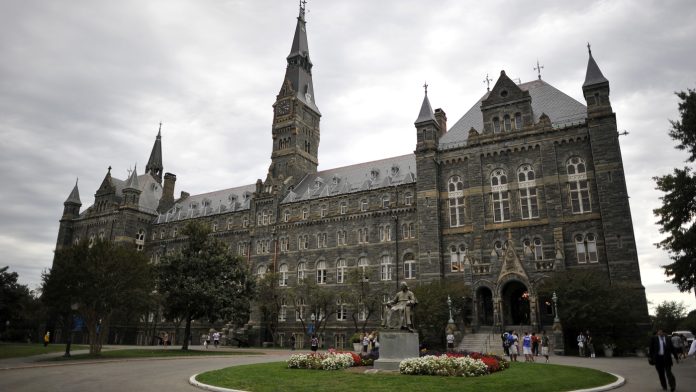
Healy Hall, the flagship building of Georgetown University’s main campus in Washington, D.C., is seen in 2011.

Mladen Antonov/AFP via Getty Images


hide caption

toggle caption

Mladen Antonov/AFP via Getty Images

A federal judge has blocked immigration officials from deporting a Georgetown University professor and postdoctoral scholar who was detained by the Trump administration earlier this week.

In a ruling Thursday, U.S. District Judge Patricia Tolliver Giles in Alexandria, Va., said Badar Khan Suri, an Indian national, can’t be removed from the U.S. “until the Court issues a contrary order.” Giles’ order stopped short of releasing Suri back to his Rosslyn, Va., home where his wife and three young children are still living. His lawyers are still working to get him released.

Suri is just the latest scholar to be detained or deported by the Trump administration for their support for Palestinian rights or for criticizing Israel for the war in Gaza. Just like the high-profile arrest of Columbia graduate student Mahmoud Khalil, Suri is being accused by Department of Homeland Security officials of spreading Hamas propaganda.

Tricia McLaughlin, assistant secretary of the Department of Homeland Security (DHS), said on X: “Suri was a foreign exchange student at Georgetown University actively spreading Hamas propaganda and promoting antisemitism on social media. Suri has close connections to a known or suspected terrorist, who is a senior advisor to Hamas.”

His lawyers deny this. Attorneys with the Virginia ACLU have said in court filings that the government is retaliating against Suri for his and his wife’s support for Palestinians and for the couple’s ties to Gaza.

“Ripping someone from their home and family, stripping them of their immigration status, and detaining them solely based on political viewpoint is a clear attempt by President Trump to silence dissent,” ACLU of Virginia Senior Immigrants’ Rights Attorney Sophia Gregg said in a statement on Suri’s case. “That is patently unconstitutional.”

A representative for DHS didn’t immediately respond to a request for comment.

Here’s the latest on Suri’s case.

Who is Badar Khan Suri?

At the time of his arrest on Monday, Suri was teaching a course and attending Georgetown as a postdoctoral fellow at the university’s Alwaleed Bin Talal Center for Muslim-Christian Understanding at the Edmund A. Walsh School of Foreign Service, according to his bio on the school’s website.

He’s in the U.S. under a J-1 visa, which according to the U.S. Citizenship and Immigration Services, is for people who take part in approved programs of teaching, studying, training and research. In 2020, Suri completed his Ph.D. in Peace & Conflict Studies from the Nelson Mandela Center for Peace and Conflict Resolution at Jamia Millia Islamia, a public research university in New Delhi.

In a statement calling for Suri’s release, Georgetown’s Alwaleed Center had strong words for the Trump administration.

“[Suri] has committed no crime. Like Mahmoud Khalil before him, he was arrested in the context of a campaign by the Trump Administration to destroy higher education in the United States and punish their political opponents,” the center said.

Badar Khan Suri, a postdoctoral fellow at Georgetown’s School of Foreign Service, is currently being held in an immigration detention center in Louisiana, according to his lawyers.

Badar Khan Suri, a postdoctoral fellow at Georgetown’s School of Foreign Service, is currently being held in an immigration detention center in Louisiana, according to his lawyers.

Andrew C. Condon/Alwaleed Bin Talal Center for Muslim-Christian Understanding


hide caption

toggle caption

Andrew C. Condon/Alwaleed Bin Talal Center for Muslim-Christian Understanding

Suri’s wife, Mapheze Saleh, is a U.S. citizen of Palestinian descent and her father is Ahmed Yousef, a former adviser to Hamas, according to the Associated Press. Yousef told The New York Times that his son-in-law wasn’t involved in any “political activism,” including on behalf of Hamas. Yousef, for his part, has criticized the Oct. 7, 2023, attack on Israel and left his role in the Hamas-run government more than a decade ago, the Times said.

Nader Hashemi, a professor of Middle East and Islamic politics at Georgetown, also told the Associated Press that Suri was focused on teaching and wasn’t involved in political activism on the highly prestigious college campus.

Suri’s attorneys say he and Saleh have faced harassment and threats for speaking out in support of Palestinians and have been featured on sites dedicated to bullying and defaming academics and students involved in the pro-Palestine movement.

A photo of Salah and information about her, including her school and former employer is featured on an anonymously run website, Suri’s attorneys write in court filings. They said the site “maintains a blacklist of individuals perceived to support Palestinian rights and is infamous for bullying, slandering, and defaming academics and students.”

What happened?

Suri’s plight started March 17, when upon returning home following a Ramadan meal celebration, he was approached by masked federal agents who identified themselves as part of the Department of Homeland Security. They informed him that the government had revoked his visa.

“He is here legally. There was no ongoing issue with his visa,” Eden B. Heilman, legal director of the ACLU of Virginia, told NPR.

The agents quickly took him into custody in front of his wife, Heilman said. But there was never any real explanation to Suri or Saleh about where he was going, what was happening or why, Heilman says.

Suri was never charged with any crime. But in just under 72 hours, he has been moved from one immigration center to the next, eventually landing in Louisiana where he is currently held. Both the speed and obscure nature of Suri’s arrest “is really alarming,” Heilman said.

What is the government saying?

McLaughlin, the assistant secretary of DHS, said Secretary of State Marco Rubio made the determination to remove Suri on March 15, two days before he was arrested. She said on X that Rubio determined that Suri’s “activities and presence in the United States rendered him deportable under INA section 237(a)(4)(C)(i).”

The Trump administration is using the same “rarely used” federal provision to attempt to remove Suri as they did in the case of Khalil, the former Columbia student, according to the professor’s lawyers.

This was done “… to retaliate against and punish noncitizens like Mr. Suri solely for their family ties to those who may have either expressed criticism of U.S. foreign policy as it relates to Israel, or who are perceived to hold such critical views imputed to them due to familial relationship.”

Baher Azmy, legal director of the Center for Constitutional Rights and and one of Khalil’s lawyers, said the use of this policy by the federal government is “largely unprecedented, save for ugly historical precedents, including the Red Scare and McCarthyism,” the Columbia Spectator reported.

Suri’s attorneys are currently working to get him relocated closer to his family, and legal representation, in Virginia, Heilman said.

Flights Resume at Heathrow After Substation Fire Shut Down Airport

0

Heathrow Airport in London was plunged into chaos after a fire at an electrical substation shut down operations at one of Europe’s busiest air hubs, forcing the airport to cancel or divert more than 1,000 flights on Friday and removing a global linchpin of air travel.

Heathrow’s chief executive, Thomas Woldbye, described the disruption as “unprecedented,” telling reporters on Friday that the airport had lost power equal to that of a midsize city, and that though a backup transformer worked as it should, there had not been not enough to power the entire airport.

But he said, “We expect to be back in full operation, so 100 percent operation as a normal day,” by Saturday.

The British authorities said the counterterrorism police would lead the investigation into the cause of the blaze, which broke out at an electrical substation in North Hyde, northeast of Heathrow. But the Metropolitan Police in London said later Friday, “After initial assessment, we are not treating this incident as suspicious, although inquiries do remain ongoing.”

It was too early on Friday to calculate the precise cost of the outage. But the outage raised questions about the resilience of Britain’s largest airport and why it appeared to be so reliant on a single electrical substation.

Residents of the Hayes neighborhood near the airport described hearing two loud bangs and seeing “a massive ball of flame” shoot into the sky on Thursday night. Minutes later, the airport said it was shutting down all air traffic, incoming flights were diverted, and passengers at Heathrow were sent home. Nearby residents were also evacuated.

By Friday morning, roads around the power station were cordoned off, and a helicopter hovered above. An odd stillness had descended on Heathrow. The runways were empty, the check-in desks quiet, digital flight information screens were blank, and passageways were dimly lit by emergency lighting. It was a lifeless calm not seen even during the early panicked weeks of the coronavirus pandemic.

Britain’s National Grid said on Friday afternoon that it had reconfigured its network to partly restore power at Heathrow on an interim basis. The London Fire Brigade said in the afternoon that 10 percent of the fire was still burning but that it was under control.

The closure resulted in dozens of flights from the United States landing far from their original destination. They were diverted to airports in Glasgow, Madrid and even Happy Valley-Goose Bay, a tiny town in the Canadian province of Newfoundland and Labrador.

John Connor, 22, sat at Newark Liberty International Airport in New Jersey on Friday, waiting in vain to get home to England after backpacking abroad for two years.

“We sat on the plane for about five hours before they said the flight was called off,” he said. “I’m trying to get a plane somewhere close — Paris, Dublin, anywhere else,” he added. “We’re being told straight up no.”

Frantic travelers swarmed social media to ask airlines about managing canceled flights and upcoming departures, claiming in posts on X that airline apps were lagging in notifying passengers about cancellations and that customer service could not be reached by phone.

Some travelers stuck in Europe were urged to consider traveling to Britain by rail. A Delta spokesperson said the airline would reimburse the cost of traveling to London by train for passengers who had their flights diverted to Amsterdam.

By Friday morning, only a few British Airways passengers remained camped out in Terminal 8 at Kennedy International Airport in New York. After making new travel arrangements, some waited for cars to take them to nearby hotels. Others said they planned to spend all day Friday in the terminal.

Some airlines affected by the outage said they would issue waivers allowing free rebookings, including British Airways, Delta Air Lines, American Airlines and United Airlines. Cirium, an aviation data company, estimated that as many as 290,000 passengers could be affected by Heathrow’s closure.

By late Friday, several flights had landed at Heathrow, as the airport began to rumble back to life, about 16 hours after the fire. The first to touch down was a British Airways plane. It had not traveled far, arriving from Gatwick Airport in London after being diverted there from its original destination, Singapore, according to the flight-tracking service FlightAware.

A Heathrow spokeswoman said the airport was working to first restore “repatriation flights and relocating aircraft” as it sought to untangle a day of disrupted service. Officials said that airlines would make it a priority to also relocate planes and crews and bring in flights diverted to other cities.

Britain’s Department of Transport said it was temporarily lifting restrictions on overnight flights to ease congestion while Heathrow Airport resumes normal operations.

But the chief executive of British Airways, Sean Doyle, warned earlier that Heathrow’s closure would have “a huge impact” on the airline’s customers over the coming days. British Airways had been set to operate more than 670 flights carrying about 107,000 customers on Friday, and similar numbers were planned over the weekend, he added.

“We have flight and cabin crew colleagues and planes that are currently at locations where we weren’t planning on them to be,” he said.

The Heathrow crisis was likely to upset not only the movement of people, but the flow of goods, as well. The closure of such a crucial aviation hub, even for a short while, would cause delays and logistical headaches for the many businesses that ship products through Heathrow, supply chain experts said.

Heathrow has two runways and four terminals that serve more than 230 destinations in 90 countries. Last year, about 83.9 million passengers and 1.7 million tons of cargo were flown through the airport. It is the third-largest hub for air cargo in Western Europe, measured in metric tons shipped. Goods worth nearly 200 billion pounds ($258 billion) went through Heathrow in 2023, about a fifth of the value of the British goods trade.

“Goods move around the globe in a really precise, timed way on a daily basis,” said Ben Farrell, chief executive of the Chartered Institute of Procurement and Supply, a global network of supply chain professionals based in London. “Any disruptions to any part of that leads to a knock-on effect elsewhere.”

British businesses will likely be most affected, experts said. Global trade can be handled by other large airports in Europe, said Eytan Buchman, chief marketing officer at Freightos, a digital shipping marketplace. “This will likely be a localized problem rather than a broader European or global one,” he said.

Mr. Woldbye, Heathrow’s chief executive, apologized to travelers for the shutdown and said the airport had done well to resume flights by Friday evening, given the scale of the outage. But he said such disruption had “never happened before.”

The closure of Heathrow came 15 years after one of Europe’s most severe air travel disruptions, when a volcano eruption in Iceland sent ash miles into the sky and obstructing travel for millions, including at Heathrow.

The ash cloud grounded more than 100,000 flights over nearly a week in April 2010 as it drifted across Northern Europe, including the English Channel. The airline industry’s losses from the volcanic disruption were estimated at $1.7 billion.

Reporting was contributed by Christine Chun, Michael Levenson, Michael D. Shear, Peter Eavis, Christopher Maag, Ivan Penn, Stephen Castle, Niraj Chokshi, Ceylan Yeğinsu and Claire Moses.

Why Shoppers Abroad Are Boycotting U.S. Goods

0

Bo Albertus, a school principal in Denmark, finds the Spanish raisins he now snacks on less tasty than his favorite Sun-Maid ones from California. There is no perfect substitute for Heinz tomato soup, a staple in his pantry. And he misses Pepsi Max.

But as long as President Trump pursues policies that Mr. Albertus, 57, believes put Europe’s economy and security at risk, he will boycott these and other U.S. products. He is one of a growing number of Europeans, Canadians and others who are forgoing American goods to show their anguish and dismay at Mr. Trump’s treatment of longtime allies.

“I felt a sense of powerlessness,” said Mr. Albertus, who is an administrator of a Danish Facebook group dedicated to boycotting American goods that has 90,000 members. “We all feel that we are doing something,” he added. “We are acting on our frustration.”

The strongest momentum behind such consumer action appears to be in countries that Mr. Trump has directly antagonized, like Denmark, whose territory of Greenland he has threatened to take, and Canada, which he has repeatedly said should become America’s 51st state.

But as Mr. Trump embraces President Vladimir V. Putin of Russia and imposes tariffs on European goods, groups dedicated to boycotting U.S. goods and swapping tips on local alternatives have popped up in several European countries.

In a Swedish Facebook group with over 80,000 members, users ask for tips on buying non-American laptops, dog food and toothpaste. Members of a French group sing the praises of European laundry detergents and smartphone apps, and debate whether Cognac or Scotch whisky is the better alternative to bourbon.

There are also detailed discussion threads about what exactly constitutes an “American” product — does Coca-Cola manufactured in Europe count, or ice cream from Ben & Jerry’s, now owned by the British company Unilever? — that illustrate how boycotts in an era of globalized commerce are far from straightforward. But the groups are mostly a place for anxious Europeans and others to share stories and vent about their opposition to U.S. policies.

Majken Jensen, 49, a coordinator for a government agency in Copenhagen, acknowledged that many millions of people buy U.S. products worldwide, and boycotts by some consumers in a few countries may not make a huge difference, at first. Still, she has stopped buying Oreos and Heinz ketchup, and has swapped Estée Lauder night serum for a local brand, Beauté Pacifique.

“I’m not even a drop in the ocean,” she said. “But that’s my little way to protest.”

Ms. Jensen emphasized that her decision to stop buying U.S. goods was in opposition to the Trump administration, not the American people. “We want our friends back,” she said.

The backlash has led some stores to implement changes that make it easier for customers to identify local products. Canada’s largest grocery chain, Loblaw, is using a “T” symbol to denote U.S.-made products that are more expensive because of retaliatory tariffs Canada recently put in place. In Denmark, the grocery store chains Netto, Bilka and Fotex added stars to the price tags of European goods after customers requested clearer labeling, their parent company said.

Elisabeth Braw, a senior fellow at the Atlantic Council, said that social media and the interconnected global economy gave consumers more of a voice than ever before.

“America has done many questionable things over the years,” she said, “but I don’t think even the Vietnam War could have triggered a campaign like this, simply because social media was not available.”

Business leaders are aware of the potential costs. Beyond Meat, the plant-based food company with headquarters in California, warned in its latest financial report that it could lose customers internationally because of “anti-American sentiment.”

Michael Medline, the chief executive of Canada’s second-biggest supermarket company, Empire, said this month that the company’s sales of U.S. products were “rapidly dropping” because of a growing demand for non-American products. That decline will continue as the company sources more products from countries other than the United States, the company said, as Canada’s retaliatory tariffs make U.S. goods more expensive to import.

The Swiss chocolate maker, Lindt, said this month that in Canada, it would start selling chocolate made in Europe rather than the United States, both to avoid tariffs and to reduce the risk of a consumer backlash.

One of the hardest-hit American brands abroad may be the electric carmaker Tesla, whose chief executive, Elon Musk, has become a key figure in Mr. Trump’s administration. He has also promoted far-right parties in Europe on X, the social media platform he owns. In Germany, Europe’s largest market for electric vehicles, sales of Tesla cars fell 76 percent in February compared with a year earlier, according to the German Association of the Automotive Industry.

Boycotts have hit the digital world, too, with consumers saying they have canceled subscriptions to Netflix, Disney+, Amazon Prime Video and other streaming services — even though substitutes with similar offerings were not easy to find. Mr. Albertus subscribed to Viaplay, a Swedish streaming service, where he recently started watching “Monk.” “It’s an American series, but life isn’t perfect,” he said.

Mads Mouritzen, who began the Danish Facebook group, said he had deleted his accounts on Airbnb and Hotels.com, and had stopped using Google and Microsoft Office. (He justified his use of Facebook, based in California, as a platform for the group because it was the easiest way to reach the most people.)

“It’s very important to say we still like the Americans, we still like the country,” he said. “There’s a current situation that we don’t like, and there’s a current administration we don’t like.”

Mr. Mouritzen, a 57-year-old janitor, said he hoped relations between the United States and Europe would eventually get back to where they were. But if that takes time, Mr. Mouritzen is prepared: He has a stockpile of 12 bottles of American-made Tabasco hot sauce, the one thing he can’t live without, purchased just before he started the boycott.

For Trump and Netanyahu, Similar Strategies With Similar Goals

0

If it wasn’t obvious that Prime Minister Benjamin Netanyahu of Israel believes he has an ally in his battle against the country’s attorney general, its judges and even the head of its domestic security service, he made it clear on Wednesday evening.

“In America and in Israel, when a strong right wing leader wins an election, the leftist Deep State weaponizes the justice system to thwart the people’s will,” he wrote in a social media post. “They won’t win in either place! We stand strong together.”

The defiant, Trumpian blast was the latest evidence that Mr. Netanyahu and President Trump are running the same playbook to achieve strikingly similar goals: to neuter the judiciary, dismantle a system of oversight that puts a check on their authority and discredit national security professionals they see as arrayed against them.

These moves come as Mr. Trump has aligned his Middle East policy squarely to benefit Mr. Netanyahu, including giving the Israeli prime minister freedom to renew the war in Gaza and launching U.S. airstrikes against the Houthis in Yemen, a group that is an avowed enemy of Israel.

In just this week in Washington, Mr. Trump called for the impeachment of a federal judge who was seeking basic information about his mass deportation efforts, fired two Democratic commissioners of an independent trade commission and was rebuked by a judge who said his administration’s gutting of the agency in charge of foreign aid most likely violated the Constitution.

This week in Jerusalem, Mr. Netanyahu’s cabinet fired Ronen Bar, the head of Shin Bet, Israel’s equivalent of the F.B.I., after the agency started investigations into the prime minister’s aides. Among other claims, the aides are accused of mishandling classified information and leaking a document to a foreign newspaper. Mr. Netanyahu’s office has strongly denied the allegations.

Mr. Netanyahu’s move against the Shin Bet chief came weeks after his administration announced plans to fire the attorney general, Gali Baharav-Miara, an apolitical judicial official appointed by the previous government who has frustrated Mr. Netanyahu by blocking some of his decisions on legal grounds.

Like Mr. Trump, Mr. Netanyahu is seeking to rein in domestic watchdogs and judicial authorities that, like in the United States, have pursued investigations against him or his allies.

Like Mr. Trump, the Israeli prime minister has faced criminal charges that he says are false claims fomented by left-leaning and unelected bureaucrats. In Mr. Netanyahu’s case, he is standing trial in a yearslong corruption case that requires him to appear in court several times a month.

“Trump’s own illiberalism has given Netanyahu an unprecedented opportunity to impose his own on Israel,” said Aaron David Miller, a Middle East expert at the Carnegie Endowment for International Peace. “Trump’s popularity in Israel and the Vulcan mind meld between Trump and Netanyahu on undermining the independence of the courts, and fighting the ‘woke left’ protects and energizes Netanyahu.”

Mr. Miller said Mr. Netanyahu had long taken cues from other authoritarian leaders, like Prime Minister Viktor Orban of Hungary. And Mr. Netanyahu’s battle against what he calls the “deep state” predates Mr. Trump’s presidency.

He was first questioned by the police about the corruption charges in early 2017, weeks before Mr. Trump took office for his first term. When Mr. Netanyahu’s trial began in 2020, he stood on the steps of the court in Jerusalem, accusing the prosecution, the police and the media establishment of a joint attempt “to thwart the will of the people.” He is accused of granting regulatory favors to businessmen and media moguls in exchange for gifts and favorable news coverage, which he denies.

The prime minister’s formal attempts to undermine judicial power began in 2022, when his coalition government introduced legislation intended to limit the power of the Supreme Court and give the government more control over the appointment of its judges. After mass protests, the government suspended most of these moves for more than a year.

But Mr. Netanyahu appears galvanized after Mr. Trump’s election in November. Since then, his government revived the overhaul of the judicial appointments process and is pushing the bill through Parliament.

One Israeli official briefed on Mr. Netanyahu’s thinking said that Mr. Trump’s election had given the prime minister greater confidence to take provocative steps at home and in the war in Gaza, which escalated this week after the collapse of a cease-fire deal that had been brokered earlier this year. The official spoke on the condition of anonymity.

For his part, Mr. Trump has found common cause with other illiberal leaders like Mr. Orban, Prime Minister Narendra Modi of India and President Vladimir V. Putin of Russia. Mr. Trump said this month that Mr. Putin “went through a hell of a lot with me,” referring to the F.B.I’s investigation into Russian interference in the 2016 election and contacts between the Trump campaign and Russian operatives.

It was in the midst of that investigation when Mr. Trump fired James B. Comey, the F.B.I director who had refused to publicly clear him of any ties to Russia. Mr. Comey had also refused to give in to Mr. Trump’s pressure to drop an F.B.I. investigation into Michael T. Flynn, the former White House national security adviser.

Eight years later, Mr. Netanyahu persuaded his cabinet to fire Mr. Bar, despite large street protests in Jerusalem this week denouncing his threats to remove the Shin Bet chief. On Friday, Israel’s Supreme Court issued an injunction freezing Mr. Bar’s dismissal until the justices could hear petitions that had been filed against it.

Alon Pinkas, a political commentator and Israel’s former consul-general in New York, said it was doubtful Mr. Netanyahu would have moved against the Shin Bet chief had Mr. Trump not been president. The two leaders were kindred spirits politically, he said, and had “both adopted an identical language that would make George Orwell cringe with envy.”

Mr. Trump and Mr. Netanyahu also regularly use this language to discredit the news media, another institution they often view with contempt. Israel’s national broadcaster, Kan, reported this week that it was during a meeting with Mr. Trump in Washington last month when Mr. Netanyahu was inspired to fire Mr. Bar.

Asked to comment on that report, Mr. Netanyahu’s spokesman, Omer Dostri, responded with a terse text message: “fake news.”