Thursday, November 12, 2026
Home Blog Page 103

Firefighters Tackle Substation Fire That Cut Power at Heathrow Airport

0

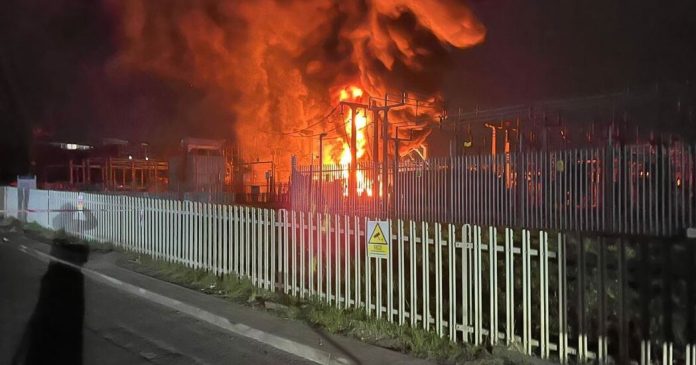
Five hours after a fire at an electrical substation knocked out power for Heathrow Airport and thousands of homes in western London, the city’s fire brigade said early Friday that it was still trying to bring the blaze under control.

By 4 a.m. Friday, half of a transformer remained on fire, the London Fire Brigade said, warning that the disruptions caused by the blaze would increase into the morning.

The blaze at the North Hyde substation, around two miles north of Heathrow, left more than 16,000 homes without power, according to the regional power utility, Scottish & Southern Electricity Networks.

“This will be a prolonged incident, with crews remaining on scene throughout the night,” Pat Goulbourne, assistant commissioner at the London Fire Brigade, said in a statement. “As we head into the morning, disruption is expected to increase, and we urge people to avoid the area wherever possible.”

The London Fire Brigade said it had deployed around 70 firefighters to the substation, where a transformer was ablaze. Thick smoke was seen rising from the burning substation in a photo posted on social media by the fire brigade.

Around 150 people were evacuated, and the authorities set up a 650-foot cordon around the substation as they tried to bring the fire under control.

The cause of the fire was not yet known, the fire brigade said.

Fire Engulfs London Substation – The New York Times

0

new video loaded: Fire Engulfs London Substation

transcript

transcript

Fire Engulfs London Substation

A substation in Hayes, in western London, caught fire and disrupted one of the busiest airports in the world.

Fire in Hayes. Look! Fire in Hayes. Oh my God, look at that! West London, Hayes.

Recent episodes in International

International video coverage from The New York Times.

International video coverage from The New York Times.

DOJ prosecutor leaves Trump administration in sharp resignation letter : NPR

0

Sean Murphy worked for the Department of Justice for years, and served in the group that prosecuted crimes stemming from the Jan.6 attack on the U.S. Capitol.

Stefani Reynolds/Bloomberg via Getty Images


hide caption

toggle caption

Stefani Reynolds/Bloomberg via Getty Images

A prosecutor with years of experience at the U.S. Department of Justice has resigned amid major changes from the Trump administration, telling NPR, “It just was not a Department of Justice that I any longer wanted to associate with.”

In a sharp resignation letter shared with NPR, former Assistant U.S. Attorney Sean Murphy warned of the erosion of the Justice Department’s independence from the president, writing to his coworkers, “you serve no man.”

In response to NPR’s request for comment, a spokesperson for the Department of Justice said in a statement, “This Department of Justice is acutely focused on Making America Safe Again and ensuring one tier of justice for all Americans after historic political weaponization under the previous administration.”

Murphy is a veteran prosecutor who previously worked for the Bronx District Attorney in New York. In 2018, during Trump’s first term, he joined the U.S. Attorney’s Office in Puerto Rico and worked on drug trafficking and illegal gun prosecutions. Most recently, he served in the Department of Justice’s Capitol Siege Section, which prosecuted more than 1,500 people for crimes stemming from the Jan. 6, 2021, attack on the U.S. Capitol.

When Trump took office, he immediately granted clemency to all of the Jan. 6 defendants — even the most violent offenders and those with lengthy criminal records — and his administration fired and demoted many prosecutors who worked on those cases.

As a result, Murphy said, he simultaneously faced threats and harassment from Jan. 6 defendants, who were emboldened by their presidential pardons, while also having to fear retaliation from the administration.

“There are some posts on social media saying that prosecutors ‘need to fry,’ that prosecutors need to ‘get the rope,'” Murphy said, “comments naming prosecutors directly, saying, ‘now it’s your turn.'”

Murphy said he did not feel that federal law enforcement under Trump’s leadership would protect Jan. 6 prosecutors. In addition to the pardons, Trump has praised the Capitol riot defendants as “patriots” and described the prosecutions as a “grave national injustice.”

“I don’t think the safety of those that caused that ‘injustice’ is a priority for the current administration,” Murphy said.

Murphy has three children, all of whom are still in school. He said getting fired would cause serious consequences for his family’s financial situation.

Still, over the course of the last two months, Murphy told NPR that he questioned whether he could remain in the Department of Justice given its new direction under Attorney General Pam Bondi, a Trump loyalist. The recently installed FBI Deputy Director, a former Secret Service agent turned podcaster named Dan Bongino, has also repeatedly called for prosecuting Trump’s political opponents.

Sean Murphy resigned from the Department of Justice this month, after agonizing over his decision.

Sean Murphy resigned from the Department of Justice this month, after agonizing over his decision.

Sean Murphy


hide caption

toggle caption

Sean Murphy

Seven federal prosecutors resigned from the Justice Department last month over ethical concerns about the administration’s decision to drop corruption charges against New York Mayor Eric Adams. Another veteran prosecutor in Washington, D.C. resigned after refusing to follow an order she believed was unsupported by the law.

Most concerning to Murphy has been the erosion of the Justice Department’s independence from the president. After the Watergate scandal during Richard Nixon’s presidency, subsequent administrations put more distance between the president and federal law enforcement to prevent politicization and abuses of power. The new administration has rejected that independence, all while arguing that the Biden administration “weaponized” law enforcement.

“We all work for the greatest president in the history of our country,” Bondi said in a speech to the Justice Department last week. “We are so proud to work at the directive of Donald Trump.”

After Bondi spoke, Trump gave a speech where he described himself as the “chief law enforcement officer in our country,” and railed against his political opponents and other perceived enemies.

“To maintain credibility, there has to be some separation between the President and the Department of Justice, some measure of independence,” Murphy told NPR. “And that’s nearly gone.”

He also pointed to a statement posted on social media from Ed Martin, interim U.S. Attorney for the District of Columbia, and an activist for Jan. 6 defendants.

“The interim U.S. Attorney for the District of Columbia repeatedly referred to his office and himself as ‘the president’s lawyers.’ And that we are not,” Murphy said. “An Assistant United States Attorney’s only client is the people of the United States of America. None of us are ‘the president’s lawyers.'”

Trump has nominated Martin to take that position full-time, but he has not yet been confirmed by the U.S. Senate.

Another message from Bondi also got under Murphy’s skin — not because of its importance, but its insignificance.

Earlier this month, the department issued a three-paragraph memo announcing a ban on paper straws.

“I mean, it was just so crazy to me that the attorney general of the United States would be writing a memo about the dangers of paper straws,” Murphy said.

Eventually, Murphy accepted an offer to work at a private practice in Puerto Rico, so his family would not have to uproot if he were to be reassigned by the Justice Department, or if he was fired. All of the changes at the Justice Department, he said, had, in a way, made his decision for him.

“It became for me the question of how high do you let the water rise before you get in the boat?” Murphy said. “And if it was just me, the calculus would have been different. But I have to think of my family. And I made a choice.”

Murphy resigned on Friday, March 14. In his resignation letter he mocked the memo on paper straws, took time to praise the work of his fellow Jan. 6 prosecutors and rebuked Trump’s criticism that they had committed a “national injustice.”

“Together we addressed the grave national injustice (methinks this be a better use of the phrase) that occurred on January 6, 2021, at the seat of our nation’s government, the U.S. Capitol,” Murphy wrote, and went on to commend the police officers who protected the Capitol that day.

He ended his letter with an entreaty to his now-former coworkers and bosses.

“May you renew daily your dedication to justice, and always seek to end each day secure in the knowledge that you showed up and sought justice for your one and only client, the people of the United States of America,” he wrote. “You serve no man.”

London’s Heathrow Airport Shuts After Fire Triggers Power Outage

0

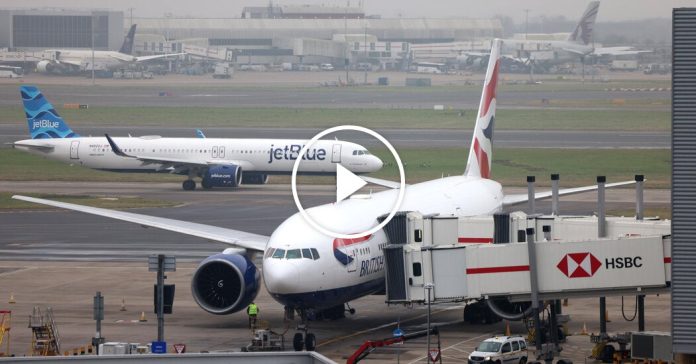
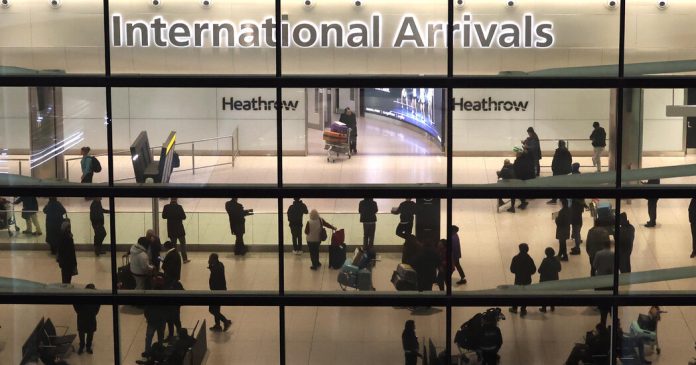
London’s Heathrow Airport, one of the busiest in the world, was closed early Friday after it lost power because of a fire at a nearby electricity substation, the airport’s operator said.

Heathrow said it would be closed until 11:59 p.m. local time. It was not immediately clear how many flights would be affected.

Dozens of firefighters were trying to put out the blaze at the substation in Hayes, in western London, the London Fire Brigade said in a statement. A large number of businesses and homes had lost power, it said, without providing a number.

Around 150 people were evacuated from the area around the substation, Pat Goulbourne, assistant commissioner at the fire brigade, said in a statement.

Fire crews will be on scene throughout the night, Mr. Goulbourne said, adding, “As we head into the morning, disruption is expected to increase, and we urge people to avoid the area wherever possible.”

This is a developing story that will be updated.

Are Tesla attacks considered domestic terrorism? : NPR

0

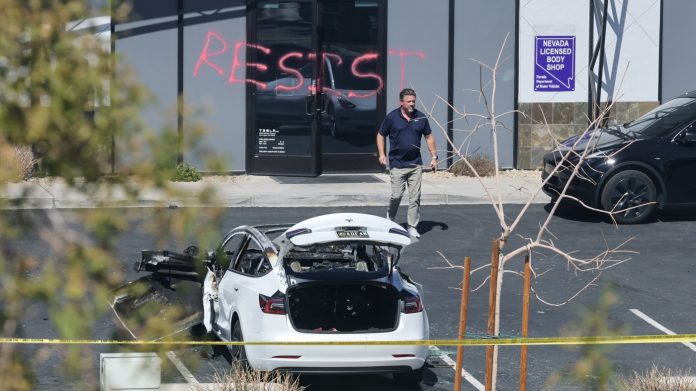
An investigator looks over the scene at a Tesla Collision Center after a person used incendiary devices to set several vehicles on fire on Tuesday in Las Vegas. The Las Vegas Metropolitan Police Department said that five Teslas were damaged and believe that the suspect fired three rounds from a firearm at the vehicles and spray painted the word “RESIST” on the entrance.

Ethan Miller/Getty Images


hide caption

toggle caption

Ethan Miller/Getty Images

The Department of Justice announced charges Thursday against three people it says are allegedly responsible for violent incidents targeting Elon Musk’s Tesla cars, showrooms and charging stations across the country.

The Justice Department says three people — in Charleston, S.C., Loveland, Colo., and Salem, Ore. — are facing criminal charges that carry a minimum penalty of five years and up to 20 years in prison for a range of violent acts. They include using Molotov cocktails to set fire to Tesla cars and charging stations and possessing other “incendiary devices” and a suppressed AR-15 rifle, U.S. Attorney General Pam Bondi said in a statement Thursday.

“The days of committing crimes without consequence have ended,” Bondi said. “Let this be a warning: if you join this wave of domestic terrorism against Tesla properties, the Department of Justice will put you behind bars.”

President Trump and White House Senior Advisor, Tesla and SpaceX CEO Elon Musk deliver remarks next to a red Tesla Model S on the South Lawn of the White House on March 11.

President Trump and White House senior adviser, Tesla and SpaceX CEO Elon Musk deliver remarks next to a Tesla Model S on the South Lawn of the White House on March 11 in Washington, D.C.

Andrew Harnik/Getty Images


hide caption

toggle caption

Andrew Harnik/Getty Images

The strong statement came less than two days after Bondi promised that such attacks on Tesla also would be considered “nothing short of domestic terrorism.” A representative for the DOJ didn’t immediately respond to NPR’s additional questions on what the agency plans to do next on this issue.

Trump, for his part, has criticized the attacks and efforts to boycott Musk’s companies and, last week, said he would purchase a Tesla vehicle to support his advisor.

In Las Vegas, police said Tuesday that five Teslas were damaged in an attack on a sales and service center. Police believe the suspect also shot a gun at the cars and spray-painted the word “RESIST” on the entrance. No one was injured, which was also the case in the Colorado, Oregon and South Carolina incidents.

While no one has been injured or killed by these attacks, three professors and researchers of domestic terrorism and extremism tell NPR that they consider these cases to be acts of domestic terrorism.

“It’s absolutely domestic terrorism. I know that may discomfort many people. But vandalism is a crime that if it’s committed with a political motive, can certainly be defined as terrorism,” says Bruce Hoffman, senior fellow for counterterrorism and homeland security at the Council on Foreign Relations. He is the co-author of the forthcoming book, God, Guns, and Sedition: Far-Right Terrorism in America.

These days, the concept of domestic terrorism has become increasingly complex, Hoffman says. While there are official definitions of domestic terrorism, there is no federal law on the matter. Here’s a breakdown of what constitutes domestic terrorism, how the U.S. has approached this issue in the past, and why it’s important despite the lack of a specific law.

Why are Tesla and Musk the target of vandalism?

Public anger toward Musk, a White House advisor, Tesla and SpaceX CEO and one of the world’s richest men, is growing as he leads efforts to slash government spending with his Department of Government Efficiency team. So far, this Trump administration entity has orchestrated the mass firings of thousands of government workers across multiple agencies in the past month.

In response, a grassroots protest has emerged in the form of the #TeslaTakedown movement. It is calling on Tesla drivers to sell their cars, dump company stock and join picket lines at Tesla showrooms.

People protesting Musk's actions in the Trump administration stand in front of signs shaped like tombstones with phrases such as "RIP Democracy." One man holds a sign that says "Stop Musk To Save Lives & Restore Democracy." They are protesting outside a Tesla showroom in Seattle on Feb. 13.

People protesting Musk’s actions in the Trump administration hold signs outside a Tesla showroom in Seattle on Feb. 13

Manuel Valdes/AP


hide caption

toggle caption

Manuel Valdes/AP

But in some cases — including one of the people included in Bondi’s announcement Thursday — the protests have taken a more violent turn. Two people have been arrested and are now facing state and federal charges tied to two separate attacks on a Tesla dealership in Loveland, Colo., which involved throwing Molotov cocktails at the cars and, in one instance, spray-painting expletive-ridden messages on the showroom’s windows. No one was killed or injured during either incident.

Who is facing charges?

Lucy Grace Nelson, Daniel Brendan Kurt Clarke-Pounder and Adam Matthew Lansky are facing charges tied to their alleged vandalism of Tesla cars and dealerships in Colorado, South Carolina and Oregon, respectively.

Nelson is facing two charges of possession of an unregistered firearm and the malicious (attempted) destruction of property. She could face up to 30 years in prison.

Court documents allege that Nelson traveled to a Tesla dealership in Loveland, Colo., on multiple nights in January and February, allegedly lighting Molotov cocktails and throwing them in the dealership’s parking lot and spraying graffiti on the building’s windows and walls.

Nelson’s attorney, Mary V. Butterton, declined to comment on her client’s case.

Lansky is facing one charge of unlawful possession of an unregistered firearm. But an affidavit alleges he is also responsible for throwing Molotov cocktails and shooting a gun at Tesla vehicles and dealership facilities in Salem, Ore., on at least two separate occasions in January and February. Lansky’s attorney, Mark Patrick Ahlemeyer, didn’t immediately respond to a request for comment.

Court documents allege that witnesses say they saw Clarke-Pounder on March 7 using red spray paint to write obscenities against Trump and “Long Live Ukraine” on a Tesla charging station parking spot in North Charleston, S.C. Clarke-Pounder then allegedly started lighting bottles on fire and throwing them at the Tesla charging stations, according to court documents. He’s facing one charge of arson affecting interstate commerce.

Patrick Chisum, Clarke-Pounder’s attorney, told NPR that Clarke-Pounder is feeling overwhelmed.

“He’s being accused of something that’s very, very serious. And I think that the realization of how serious it’s being taken, especially with Attorney General Bondi’s statements, is kind of becoming self-evident. Both he and his family are very, very concerned and very scared,” Chisum said.

He added that his client “is a troubled young man who’s been suffering from multiple mental health issues.”

What falls under ‘domestic terrorism’

The U.S. doesn’t have a stand-alone federal domestic terrorism law. But at least 32 states and Washington, D.C., have their own state-level domestic terrorism laws. The FBI defines domestic terrorism as, “Violent, criminal acts committed by individuals and/or groups to further ideological goals stemming from domestic influences, such as those of a political, religious, social, racial, or environmental nature.”

People might look at vandalism at a Tesla dealership and question whether it’s terrorism, says Hoffman.

But going back to the 1990s, the FBI, as the lead agency responsible for investigating terrorism in the United States, has investigated acts of vandalism and arson like those committed by eco-terrorism groups and treated them as domestic terrorism, he says.

One of the more famous cases of eco-terrorism was committed by the group known as The Family. The FBI says the group has been linked to more than 40 criminal acts between 1995 and 2001, including arson and vandalism, causing more than $45 million in damages. The group’s most notorious act was the 1998 arson attack on a ski resort in Vail, Colo. — which caused around $26 million in damages.

“To me, regardless of one’s opinions of Tesla cars, and its owner, this isn’t new,” Hoffman says.

A key element in determining what is domestic terrorism is the intent of the perpetrator. That can include a desire to intimidate or coerce a civilian population, influence government policy, or affect government conduct, says Faiza Patel, senior director of the Brennan Center For Justice’s Liberty and National Security Program.

And the intent of the Tesla vandals falls under this umbrella, she says.

“The whole point … is that [the vandals] are trying to influence government conduct. Everybody knows that Elon Musk is not only a federal employee, but is at the center of a lot of controversies about what the government is doing right now,” Patel says.

The act would also have to fall under one of the laws listed in the federal code as a domestic terrorism offense. These include attacks that use certain types of weapons — for example, weapons of mass destruction — or include acts such as hostage-taking or involve special federal interest, such as attacks on federal officials.

Other protesters have spray-painted swastikas and smashed windows of Tesla showrooms. But Patel says it’s unlikely authorities will consider those cases of petty vandalism — or of someone keying a Tesla — to be domestic terrorism.

Investigators look over the scene at a Tesla Collision Center after a person set several vehicles on fire on Tuesday in Las Vegas.

Investigators look over the scene at a Tesla Collision Center after a person set several vehicles on fire on Tuesday in Las Vegas.

Ethan Miller/Getty Images


hide caption

toggle caption

Ethan Miller/Getty Images

Why the U.S. doesn’t have a federal domestic terrorism law

Extremism experts have long warned that domestic terrorism, mainly coming from far-right and white supremacy groups, posed a far greater threat than foreign terrorism. Still, despite sporadic efforts to do so, no federal domestic terrorism law has been created due to a lack of consensus.

Because of this, people involved in acts determined to be domestic terrorism are still just charged with offenses such as arson, murder, kidnapping and assault.

The perpetrators of the most famous incident of U.S. domestic terrorism, the Oklahoma City Bombing that killed 168 people, were never actually charged with domestic terrorism. Rather, Timothy McVeigh and his co-conspirator Terry L. Nichols were found guilty of several counts of murder and the use of a weapon of mass destruction or conspiracy to use a weapon of mass destruction.

Although there is no federal domestic terrorism law, prosecutors can point to a perpetrator’s motive to classify a crime as terrorism during a trial and sentencing, which can affect a convicted person’s punishment, says Laura Dugan, a professor of human security and professor of sociology at The Ohio State University. If a crime is determined to be an act of terrorism, a perpetrator could receive additional years on their sentence.

Even after the Oklahoma City bombing, there was never enough agreement in Congress to support a domestic terrorism law, Hoffman says. It was always considered a highly politicized issue, he says.

“When you walked into a room going back to the 1990s and you talked about domestic terrorism there was a half of the room that immediately thought far-left radicals. And there was another half of the room that immediately thought white supremacists or seditious-minded conspiracy [believers],” Hoffman says.

Hoffman believes it’s “a huge problem” that the U.S. has no domestic terrorism statute. But Patel, whose Brennan Center has long opposed such a law, says this would only be weaponized by the federal government and would make it too easy for “an administration to label unpopular groups or political enemies as a domestic terrorist outfit.”

“I don’t see how it benefits anybody,” she says. “Given how polarized our current political environment is, it seems to me a particularly bad idea.”


Delta Plane Crash Report Finds Jet Flipped in High Speed Landing

0

A Delta Air Lines passenger jet that flipped over, burned and lost a wing after landing in Toronto last month was descending at what experts called an excessive speed when it touched down, according to a preliminary report from the Canadian authorities.

The report from the Transportation Safety Board of Canada, an independent agency, found that a warning about the plane’s rapid descent had sounded just before it touched down, and the plane was dropping at nearly twice the rate that qualifies as a “hard landing” in the flight operations manual of the Delta subsidiary, Endeavor Air, that was operating the jet.

A descent greater than 600 feet per minute is considered a “hard landing,” according to the manual. Just before the crash, the plane was descending at 1,100 feet per minute, the report said.

When the plane landed, a part attached to the main landing gear on the right side broke, according to the report. In a matter of seconds, the jet rolled to its right, still skidding down the runway, the right wing snapped off, the plane burst into flames and it came to a stop upside down.

“It was descending much too fast,” said Jeff Guzzetti, a former U.S. accident investigator for the Federal Aviation Administration and National Transportation Safety Board. “It’s possible that the rate of descent was so great that it exceeded the design stress limits of that landing gear.”

Despite the dramatic events, all 80 people on board, including 76 passengers and four crew members, were able to evacuate safely. After the plane was empty, there was an explosion near the left wing.

The report did not assign a cause for the Feb. 17 crash or the explosion, and the safety board said that its work was ongoing.

“Accident and incidents rarely stem from a single cause,” Yoan Marier, chairman of the Transportation Safety Board of Canada, said in a video statement.

The plane, a CRJ 900 made by Bombardier, had left Minneapolis and was arriving at Toronto Pearson International Airport in windy conditions, which aviation safety experts said can complicate the landing process.

According to the safety board’s report, the plane’s air speed increased, apparently from a wind gust, less than 15 seconds before landing.

The pilot reduced thrust, which experts described as a typical response. But, less than three seconds before landing, the alert sounded warning that the plane was dropping too fast.

The plane’s nose was also pointed upward at a one-degree angle, lower than the three to eight degrees recommended by the operations manual.

“Everything went to hell in the last seconds,” said Ben Berman, a safety consultant who is also a former airline pilot and federal crash investigator in the United States. The conditions the pilots faced that day can make flying “very difficult,” he added.

The captain of the plane, who was also a simulator instructor, had worked for Endeavor since 2007, and had 764 hours of flight time on the type of plane involved in the crash.

The first officer, who was flying the plane, had worked for the airline since January 2024 and had nearly 420 hours of experience with that aircraft model. Such experience is not unusual for pilots at smaller airlines like Endeavor, aviation experts said.

At least 21 people were injured in the crash. Passengers hung upside down in their seats after the crash, held up by their seatbelts, the report said.

Two days after the crash, Delta Air Lines offered each passenger $30,000, which the company said came with “no strings attached.” Passengers have filed several lawsuits against the company in the United States, and Vincent Genova, a Toronto-based lawyer, said his firm has been retained by 12 Canadian passengers.

Congress may kill the program that saved thousands of veterans from foreclosure

0

An NPR investigation helped lead to 15,000 veterans being saved from losing their homes, but some in Congress want to kill the rescue program.

Musk Set to Get Access to Top-Secret U.S. Plan for Potential War With China

0

The Pentagon is scheduled on Friday to brief Elon Musk on the U.S. military’s plan for any war that might break out with China, two U.S. officials said on Thursday.

Another official said the briefing will be China focused, without providing additional details. A fourth official confirmed Mr. Musk was to be at the Pentagon on Friday, but offered no details.

Providing Mr. Musk access to some of the nation’s most closely guarded military secrets would be a dramatic expansion of his already extensive role as an adviser to President Trump and leader of his effort to slash spending and purge the government of people and policies they oppose.

It would also bring into sharp relief the questions about Mr. Musk’s conflicts of interest as he ranges widely across the federal bureaucracy while continuing to run businesses that are major government contractors. In this case, Mr. Musk, the billionaire chief executive of both SpaceX and Tesla, is a leading supplier to the Pentagon and has extensive financial interests in China.

Pentagon war plans, known in military jargon as O-plans or operational plans, are among the military’s most closely guarded secrets. If a foreign country was to learn how the United States planned to fight a war against them, it could reinforce its defenses and address its weaknesses, making the plans far less likely to succeed.

The top-secret briefing for the China war plan has about 20 to 30 slides that lay out how the United States would fight such a conflict. It covers the plan beginning with the indications and warning of a threat from China to various options on what Chinese targets to hit, over what time period, that would be presented to Mr. Trump for decisions, according to officials with knowledge of the plan.

A White House spokesman did not respond to an email seeking comment about the purpose of the visit, how it came about, whether Mr. Trump was aware of it, and whether the visit raises questions of conflicts of interest. The White House has not said whether Mr. Trump signed a conflicts of interest waiver for Mr. Musk.

After The Times published this article, Sean Parnell, the chief Defense Department spokesman, said in a statement: “The Defense Department is excited to welcome Elon Musk to the Pentagon on Friday. He was invited by Secretary Hegseth and is just visiting.”

The meeting reflects the extraordinary dual role played by Mr. Musk, who is both the world’s wealthiest man and has been given broad authority by Mr. Trump.

Mr. Musk has a security clearance, and Defense Secretary Pete Hegseth can determine who has a need to know about the plan. A choice of sharing lots of technical details with Mr. Musk, however, is another matter.

Mr. Hegseth; Adm. Christopher W. Grady, the acting chairman of the Joint Chiefs of Staff; and Adm. Samuel J. Paparo, the head of the military’s Indo-Pacific Command, are set to present Mr. Musk with details on the U.S. plan to counter China in the event of military conflict between the two countries, the officials said.

Operational plans for major contingencies, like a war with China, are extremely difficult for people without extensive military planning experience to understand. The technical nature is why presidents are typically presented with the broad contours of a plan, rather than the actual details of documents. How many details Mr. Musk will want or need to hear is unclear.

Mr. Hegseth received part of the China war plan briefing last week and another part on Wednesday, according to officials familiar with the plan.

It was unclear what the impetus was for providing Mr. Musk such a sensitive briefing. He is not in the military chain of command, nor is he an official adviser to Mr. Trump on military matters involving China.

But there is a possible reason Mr. Musk might need to know aspects of the war plan. If Mr. Musk and his team of cost cutters from the Department of Government Efficiency, or DOGE, want to trim the Pentagon budget in a responsible way, they may need to know what weapons systems the Pentagon plans to use in a fight with China.

Take, for example, aircraft carriers. Cutting back on future aircraft carriers would save billions of dollars, money that could be spent on drones or other weaponry. But if the U.S. war strategy relies on using aircraft carriers in innovative ways that would surprise China, mothballing existing ships or stopping production on future ships could cripple that plan.

Planning for a war with China has dominated Pentagon thinking for decades, well before a possible confrontation with Beijing became more conventional wisdom on Capitol Hill. The United States has built its Air Forces, Navy and Space Forces — and even more recently its Marines and Army forces — with a possible fight against China in mind.

Critics have said the military has invested too much in big expensive systems like fighter jets or aircraft carriers and too little in midrange drones and coastal defenses. But for Mr. Musk to evaluate how to reorient Pentagon spending, he would want to know what the military intends to use and for what purpose.

Mr. Musk has already called for the Pentagon to stop buying certain high-priced items like F-35 fighter jets, manufactured by one of his space-launch competitors, Lockheed Martin, in a program that costs the Pentagon more than $12 billion a year.

Yet Mr. Musk’s extensive business interests make his access to strategic secrets about China a serious problem in the view of ethics experts. Officials have said revisions to the war plans against China have focused on upgrading the plans for defending against space warfare. China has developed a suite of weapons that can attack U.S. satellites.

Mr. Musk’s constellations of low-earth orbit Starlink satellites, which provide data and communications services from space, are considered more resilient than traditional satellites. But he could have an interest in learning about whether or not the United States could defend his satellites in a war with China.

Participating in a classified briefing on the China threat with some of the most senior Pentagon and U.S. military officials would be a tremendously valuable opportunity for any defense contractor seeking to sell services to the military.

Mr. Musk could gain insight into new tools that the Pentagon might need and that SpaceX, where he remains the chief executive, could sell.

Contractors working on relevant Pentagon projects generally do have access to certain limited war planning documents, but only once war plans are approved, said Todd Harrison, a senior fellow at the American Enterprise Institute, where he focuses on defense strategy. Individual executives rarely if ever get exclusive access to top Pentagon officials for a briefing like this, Mr. Harrison said.

“Musk at a war-planning briefing?” he said. “Giving the CEO of one defense company unique access seems like this could be grounds for a contract protest and is a real conflict of interest.”

Mr. Musk’s SpaceX is already being paid billions of dollars by the Pentagon and federal spy agencies to help the United States build new military satellite networks to try to confront rising military threats from China. SpaceX launches most of these military satellites for the Pentagon on its Falcon 9 rockets, which take off from launchpads SpaceX has set up at military bases in Florida and California.

The company separately has been paid hundreds of millions of dollars by the Pentagon that now relies heavily on SpaceX’s Starlink satellite communications network for military personnel to transmit data worldwide.

In 2024, SpaceX was granted about $1.6 billion in Air Force contracts. That does not include classified spending with SpaceX by the National Reconnaissance Office, which has hired the company to build it a new constellation of low-earth orbit satellites to spy on China, Russia and other threats.

Mr. Trump has already proposed that the United States build a new system the military is calling Golden Dome, a space-based missile defense system that recalls what President Ronald Reagan tried to deliver. (The so-called Star Wars system Mr. Reagan had in mind was never fully developed.)

Perceived missile threats from China — be it nuclear weapons or hypersonic missiles or cruise missiles — are a major factor that led Mr. Trump to sign an executive order recently instructing the Pentagon to start work on Golden Dome.

Even starting to plan and build the first components of the system will cost tens of billions of dollars, according to Pentagon officials, and most likely create large business opportunities for SpaceX, which already provides rocket launches, satellite structures, and space-based data communications systems, all of which will be required for Golden Dome.

Separately, Mr. Musk has been the focus of an investigation by the Pentagon’s inspector general over questions about his compliance with his top-secret security clearance.

The investigations started last year after some SpaceX employees complained to government agencies that Mr. Musk and others at SpaceX were not properly reporting contacts or conversations with foreign leaders.

Air Force officials, before the end of the Biden administration, started their own review, after Senate Democrats asked questions about Mr. Musk and asserted that he was not complying with security clearance requirements.

The Air Force, in fact, had denied a request by Mr. Musk for an even higher level of security clearance, known as Special Access Program, which is reserved for extremely sensitive classified programs, citing potential security risks associated with the billionaire.

In fact, SpaceX has become so valuable to the Pentagon that the Chinese government has said it considers the company to be an extension of the U.S. military.

“Starlink Militarization and Its Impact on Global Strategic Stability” was the headline of one publication released last year from China’s National University of Defense Technology, according to a translation of the paper prepared by the Center for Strategic and International Studies.

Mr. Musk and Tesla, an electric vehicle company he controls, are heavily reliant on China, which houses one of the auto maker’s flagship factories in Shanghai. Unveiled in 2019, the state-of-the-art facility was built with special permission from the Chinese government, and now accounts for more than half of Tesla’s global deliveries. Last year, the company said in financial filings that it had a $2.8 billion loan agreement with lenders in China for production expenditures.

In public, Mr. Musk has avoided criticizing Beijing and signaled his willingness to work with the Chinese Communist Party. In 2022, he wrote a column for the magazine of the Cyberspace Administration of China, the country’s censorship agency, trumpeting his companies and their missions of improving humanity.

That same year, the billionaire told The Financial Times that China should be given some control over Taiwan by making a “special administrative zone for Taiwan that is reasonably palatable,” an assertion that angered politicians of the independent island. In that same interview, he also noted that Beijing sought assurances that he would not sell Starlink in China.

The following year at a tech conference, Mr. Musk called the democratic island “an integral part of China that is arbitrarily not part of China,” and compared the Taiwan-China situation to Hawaii and the United States.

On X, the social platform he owns, Mr. Musk has long used his account to praise China. He has said the country is “by far” the world leader in electric vehicles and solar power, and has commended its space program for being “far more advanced than people realize.” He has encouraged more people to visit the country, and posited openly about an “inevitable” Russia-China alliance.

Aaron Kessler contributed reporting.

President Trump names new acting head of Institute of Museum and Library Services : NPR

0

The IMLS offers grant funding to museums and libraries across the country.

Shannon Finney/Institute of Museum and Library Services


hide caption

toggle caption

Shannon Finney/Institute of Museum and Library Services

President Trump has appointed Keith E. Sonderling as the new acting director of the Institute of Museum and Library Services.

The IMLS is an independent federal agency responsible for awarding grant funding to many museums and libraries across the country. Last week, President Trump issued an executive order calling for the IMLS’ elimination. According to AFGE Local 3403, the union representing workers at the IMLS, Sonderling entered the lobby of the building Thursday morning along with a team of security and a “handful of DOGE staff,” and was sworn-in.

“I am committed to steering this organization in lockstep with this Administration to enhance efficiency and foster innovation,” Sonderling wrote in a press release. NPR has reached out to the President’s Committee on the Arts and Humanities for more information, but did not immediately hear back.

While libraries are mostly funded by city and county taxes, federal funding helps pay for things like workforce training, supports pilot programs, and bolsters basic library services such as computer and internet access in rural libraries. The IMLS says it awarded $266 million in grants and research last year.

Jeff Jankowksi, president of Hoopla Digital, which helps library users access eBooks, music, movies and audiobooks, sent NPR a statement that warns “without necessary funding, it’s likely that many libraries may be forced to scale back digital services, or in some cases, eliminate access entirely.”

Following President Trump’s executive order last week, the American Alliance of Museums, a group which advocates for museums, issued a statement saying: “There is no efficiency argument when IMLS represents just 0.0046% of the federal budget, while museums generate $50 billion in economic impact.”

A spokesperson for AFGE Local 3403, the union representing workers at IMLS, said Sonderling “appears committed to following federal law,” but that it expects most employees will be placed on administrative leave over the weekend. “It remains unclear whether funding for existing grantees will continue, and whether new grants will be available in the future.”

Friday Briefing: Hamas Targets Tel Aviv

0

Hamas fired its first barrage of rockets in months into Israeli territory yesterday as Israeli troops expanded ground operations across Gaza. After the collapse of a two-month cease-fire, the fighting now looks as if it is escalating back to full-scale war.

Despite street protests in Israel, Prime Minister Benjamin Netanyahu was expected to fire the head of Shin Bet, the domestic intelligence agency.

For some insight on the situation, I reached out to Patrick Kingsley, our Jerusalem bureau chief.

Patrick: We are back in a familiar standoff. Israel’s leadership wants both the safe return of Hamas’s hostages, as well as Hamas’s military defeat. But Hamas won’t hand over the hostages without Israel’s guaranteeing the group’s survival in Gaza. And Israel can’t defeat Hamas by force without harming many hostages. The cease-fire that collapsed this week was always likely to fall apart unless one of the sides softened its stance. But neither did. So Israel has returned to war in order to break Hamas’s resolve by force. And that leaves things roughly where they were before the cease-fire began in January: in a deadlock.

Do the protests in Israel feel more impactful this time?

For now, Netanyahu doesn’t seem swayed by the protesters calling for a new truce to save the hostages in Gaza. His biggest domestic priority is to pass a state budget by the end of the month. To do that, he needs the support of right-wing lawmakers, many of whom support the return to war and could abandon him if there’s another truce.

Is President Trump’s Gaza plan still on the table?

After proposing the expulsion of Gaza’s population in January, Trump has said that the idea was only a recommendation and that no Palestinians would be expelled. His aides also said that it was less a definitive plan of action than an attempt to provoke Arab leaders into suggesting a viable alternative.

Several Arab leaders, led by Egypt, did later propose their own plan for postwar Gaza — in which the territory would be governed by an apolitical committee as part of a Palestinian state. But the plan was vague, didn’t explain how Hamas would cede power and was swiftly rejected by the Israeli government, which seeks to avoid discussion of Palestinian statehood.


Smoke rising from the attack on an airfield in Russia’s Saratov region, yesterday.Credit…Reuters

Ukraine attacked an airfield deep inside Russia, officials said yesterday, as the U.S. worked to iron out a partial cease-fire. In Ukraine, Russian drones killed at least five people and injured 26 others, according to local authorities.

The Kremlin said yesterday that preparations were underway for a new round of Russia-U.S. talks that would be held on Monday in Saudi Arabia. Ukraine will also send representatives there to meet with U.S. officials.

A U.S. proposal: President Trump has floated the idea of controlling Ukraine’s nuclear power plants. What would it mean if the U.S. took them over?


President Trump is trying to cement control over the courts, Congress and even U.S. society and culture. But his latest target — the courts — has been described by constitutional scholars and historians as perhaps the most alarming power play to date.

Economy, finance and business

Sports

Three hours north of Manila, a small beach house built for Romana de Vera, the creator of the Philippines’ beloved Romana Peanut Brittle, was falling apart.

The family chose to resurrect it. One of her sons decided to help — but only if he could do it his way. As artistic tensions grew, so did the home. It’s now unlike anything else in the islands.

Lives lived: K.W. Lee, a pioneering Asian American journalist, died at 96.

The British series “The Office” usually gets the credit for influencing cringe humor, but its contemporary, “Peep Show,” which ran for nine seasons until 2015, helped reinvent television comedy.

The show is not for the faint of heart: One episode ends with someone violently ill in a bathroom with no door, an entire party watching. But how does “Peep Show” maintain an ever-widening fan base, all these years later? “Fortunately,” one of the show’s creators said, “self-loathing is pretty universal.”