Thursday, November 12, 2026
Home Blog Page 109

Trump calls for the impeachment of a judge, as lawsuits pile up : NPR

0

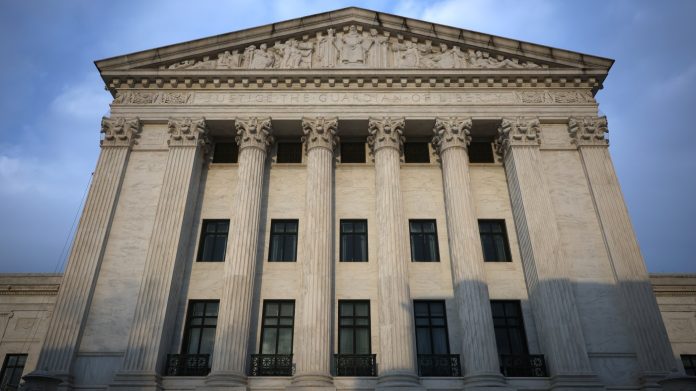
The U.S. Supreme Court is likely to be the final arbiter of many of the challenges to the Trump administration’s actions.

Win McNamee/Getty Images


hide caption

toggle caption

Win McNamee/Getty Images

President Trump on Tuesday called for the impeachment of the judge who ordered a temporary halt to the deportation of alleged Venezuelan gang members.

Without naming James Boasberg, the chief judge of the district court of Washington, D.C., Trump said, “This judge, like many of the Crooked Judges’ I am forced to appear before, should be IMPEACHED!!!” He also called Boasberg a “Radical Left Lunatic of a Judge, a troublemaker and agitator who was sadly appointed by Barack Hussein Obama.”

Boasberg on Saturday halted Trump’s deportation order for two weeks after the president, in a highly controversial move, used the 1798 Enemy Aliens Act, a law not used since World War II, to deport the alleged gang members.

Reacting to the president’s social media post, Chief Justice John Roberts issued a written statement of his own: “For more than two centuries it has been established that impeachment is not an appropriate response to disagreements concerning a judicial decision. The normal appellate review process exists for that purpose.”

Boasberg is known as a highly respected judge and former prosecutor who was previously appointed by Roberts to serve on the super-secret Foreign Intelligence Surveillance Court, which reviews federal government applications to conduct foreign intelligence surveillance, particularly in the United States. He has long ties with conservatives and liberals alike, having shared a house with Supreme Court Justice Brett Kavanaugh at Yale Law School.

The Trump-inspired furor is only the latest in many contretemps between the administration and federal district court judges who are presiding over lawsuits seeking to block the Trump administration’s actions.

As of Tuesday, 127 such lawsuits have been filed against the administration since Trump took office, according to a database maintained at New York University. The cases challenge an enormous range of subjects — from the president’s national security powers to the firing of tens of thousands of federal employees at the Pentagon, the Department of Justice, and agencies created by Congress that are supposed to be independent.

Here is an abbreviated summary of the pending Trump legal cases.

National security cases

The “national security” cases involve the area where the president has the most power.

Most prominently, last Friday Trump invoked the Alien Enemies Act of 1798 to deport several hundred alleged Tren de Aragua gang members from Venezuela — as well as alleged members of the Salvadoran gang Mara Salvatrucha, or MS-13 — by claiming they were part of an illegal invasion. The statute, however, has only been invoked during three periods in American history: The War of 1812, World War I and World War II.

Judge Boasberg on Saturday ordered the administration not to proceed with the deportations for two weeks, but the administration did it anyway. This prompted Boasberg to order the planes that were in the air to turn back, which the administration did not do. The standoff could lead to what many legal experts predict will be a constitutional crisis, a hypothetical (or seemingly, now reality) in which the Trump administration refuses to abide by court orders issued by federal judges.

The Trump administration, however, may be on shaky ground in this case because, according to legal scholars, the Alien Enemies Act was meant to and is written to deal with wartime emergencies only. In addition, even people who should be deported are guaranteed due process under the Constitution, and it is not clear that all the people being deported have had a final hearing. The president has likely picked this battle because it’s provocative, and immigration is an issue that he ran — and won — on.

Trump also ordered the detention and deportation of Columbia University graduate student Mahmoud Khalil for his role in the school’s student-led protests last spring. Khalil is a lawful permanent resident in the United States who is of Palestinian descent. Days after Khalil was taken into custody, immigration officials sent Rasha Alawieh, a doctor who was legally working in the U.S., back to Lebanon, citing her alleged support for Hezbollah.

The administration has also made an effort, so far unsuccessful, to ban automatic citizenship for some people born in the United States. This is a right pretty explicitly guaranteed by the U.S. Constitution for all people born or naturalized in the U.S.

Elon Musk + cases

These cases are what former ambassador Norman Eisen, who is shepherding a lot of the lawsuits, calls “core rule of law” cases.

Many cases involving Elon Musk’s Department of Government Efficiency, or DOGE, allege that Musk, who was hired by the president as a special government employee, may not take actions that Congress has not authorized, such as halting funding to federal agencies. Other cases cast doubt on DOGE’s ability to access to sensitive federal records, which it has been doing in agencies like the IRS and the Social Security Administration.

Also in this category are cases challenging efforts by the Trump administration to undo established labor agreements.

Other challenges seek to prevent the administration from gutting agencies and Cabinet departments by summarily firing tens of thousands of federal employees.

Trump’s attacks on the ‘deep state’

Related, but somewhat different are cases concerning Trump’s attacks on the control of federal agencies. For instance, the president is trying to fire a member of the National Labor Relations board who has three years left on her five-year term. The U.S. Supreme Court in 1935 said the president could only fire agency commissioners for cause, meaning misconduct of some kind. The court’s current conservative supermajority, however, has been eating away at the outer edges of that precedent, so the Trump administration has a decent chance of prevailing when and if these cases get to the Supreme Court.

First Amendment challenges

These are cases that concern the administration’s efforts to make life much more difficult for lawyers who bring cases against the administration, and news organizations that cover them.

The Trump administration revoked the security clearance for the law firm Perkins Coie, known for representing Hillary Clinton and other prominent Democrats. Without security clearances, the firm would be unable to represent its clients as effectively, which could hurt its business.

Trump signed a similar executive order limiting federal contractors’ and the government’s ability to retain Paul Weiss, a major New York law firm, citing the firm’s connection to one of its former lawyers who was involved in leading an investigation into Trump.

Similarly, Trump revoked security clearances for lawyers at Covington & Burling, which represented former special counsel Jack Smith, who led the federal government’s investigation into Trump after the 2020 election. In the same memorandum, Trump ordered the termination of existing contracts between Covington and the federal government.

The Equal Employment Opportunity Commission has targeted 20 major law firms, including Perkins Coie, in an investigation into their DEI practices, though this investigation has not yet been challenged in court.

The Associated Press was also barred from accessing the Oval Office or Air Force One for failing to change its style guide to comply with a Trump executive order renaming the Gulf of Mexico to the Gulf of America. After releasing a statement raising alarm bells that “the Trump administration would punish AP for its independent journalism,” the AP sued the administration to regain access.

Israeli Ground Forces Seize Part of Gaza Corridor, Raising Pressure on Hamas

0

Israel ground forces pushed deeper into the Gaza Strip on Wednesday, taking over parts of a major corridor that bisects the Palestinian enclave, in the most significant ground operation since the collapse of the cease-fire with Hamas.

The operation followed wide-scale Israeli aerial bombardment in Gaza that began early on Tuesday morning, ending the fragile truce between Israel and Hamas that had held since mid-January. More than 400 people were killed, according to the Gaza health ministry, which does not distinguish between civilians and combatants.

The Israeli military said soldiers had begun “targeted ground activities” along the road — known as the Netzarim Corridor — to create a “partial buffer zone” between northern and southern Gaza. Israeli forces had widened their control “to the center of the Netzarim Corridor,” the military said.

Israel has not returned to full-scale war in Gaza that would match the intensity of its 15-month aerial bombardment and ground invasion. But by gradually stepping up attacks, Israeli leaders appeared to be trying to force Hamas to come to more favorable terms for a settlement.

In a televised address, Benjamin Netanyahu, the Israeli prime minister, vowed that Israel would negotiate only alongside attacks on Hamas. He said the latest wave of airstrikes was “just the beginning.”

“From now on, Israel will act against Hamas with increasing might,” Mr. Netanyahu said in a televised statement. “And from now on, negotiations will only take place under fire.”

During the 15-month campaign against Hamas, Israeli forces captured and fortified the area around the Netzarim Corridor, which cuts the enclave roughly in half. Control of the road enabled the Israeli military to prevent hundreds of thousands of displaced Palestinians from returning to their homes in northern Gaza.

Israeli troops gradually withdrew from Netzarim after the truce with Hamas went into effect in mid-January. Palestinians returned home en masse in emotional scenes, often finding little but rubble where their homes and neighborhoods once stood.

Can you get a stimulus check from the IRS? What to know : NPR

0

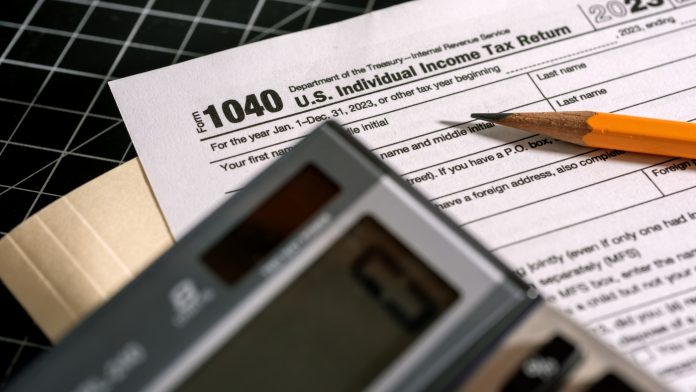
The IRS says Americans have until April 15 to claim refunds for the 2021 tax year, including some pandemic-era relief payments.

Michael Bocchieri/Getty Images


hide caption

toggle caption

Michael Bocchieri/Getty Images

Some Americans might still be eligible for a pandemic-era stimulus payment, but only for a few more weeks.

That’s according to the Internal Revenue Service (IRS), which says some 1.1 million people have an estimated $1 billion in unclaimed refunds for tax year 2021. They must file their tax returns by April 15 to claim them.

“Under the law, taxpayers usually have three years to file and claim their tax refunds,” the agency said in a notice last week. “If they don’t file within three years, the money becomes the property of the U.S. Treasury.”

That three-year window is standard. But there is extra incentive for people to pay attention this year: the government’s pandemic relief payments.

The agency says that while most people who were eligible for stimulus checks — officially called Economic Impact Payments (EIPs) — in the early days of the COVID-19 pandemic have received them, not everyone did.

That means people who didn’t file taxes for 2021 — which would have been done in the winter or spring of 2022 — may have reason to do so now.

Who is eligible?

Three rounds of EIPs totaling $814 billion went to households impacted by the pandemic between March 2020 and March 2021.

Eligible individuals received up to $1,200 per filer and up to $500 per child in March 2020 through the CARES Act, $600 per filer and child in December 2020 through the Consolidated Appropriations Act and $1,400 per filer and child in March 2021 through the American Rescue Plan Act.

The IRS says most taxpayers who were eligible for EIPs have already received either the stimulus payment or a Recovery Rebate Credit. That’s a refundable credit for eligible taxpayers who did not receive one or more EIPs — or in this case, the full amount of the March 2021 payment — during the pandemic.

But the agency says it discovered in December that some 1 million taxpayers who were eligible for a Recovery Rebate Credit did not claim it on their 2021 tax returns, either leaving the data field blank or mistakenly filling it out as $0.

It said at the time that it would fix that by sending a notification letter and a payment of up to $1,400 to eligible individuals — either through direct deposit or a check mailed to their 2023 address on file — in the weeks ahead, to arrive by late January.

Separately, it said there may also be implications for people who didn’t file in 2021 (whether because they were unemployed or for other reasons). It turns out some of those people might be eligible for the Recovery Rebate Credit as well, provided they file their 2021 return by the April 15 deadline.

“Eligible taxpayers who did not file must file a tax return to claim a Recovery Rebate Credit, even if their income from a job, business or other source was minimal or non-existent,” the agency said.

The agency says taxpayers can view the amount of their EIP through their IRS online account (under the “Tax Records” page), to calculate their Recovery Rebate Credit.

The IRS says, “start now”

In its reminder last week, the IRS urged people to start gathering the past information they need to file their 2021 tax return “to make sure they have enough time to file before the April deadline,” and offered suggestions for ways to do that. The fastest and easiest method, it says, is to create or log in to an IRS individual online account.

Taxpayers can also request copies of key documents from their employer or bank, or ask the IRS to mail a tax return or tax account transcript to them directly. They can also file a form 4506-T with the IRS to request a wage and income transcript, but the IRS warns that those written requests can take several weeks to fulfill and should be a last resort.

It also notes that people’s 2021 refunds may be withheld if they have not yet filed tax returns for 2022 and 2023. Plus, it says, any refund amount for 2021 will be applied to amounts owed to the IRS, a state tax agency or possibly past federal debts such as child support or student loans.

People can check the status of their refund online — the IRS says status updates should appear around 24 hours after electronically filing a current year return, three-four days after electronically filing a prior year return and four weeks after filing a paper return. Learn more about that process here.

An especially turbulent tax season

Cuts to the IRS’ workforce and funding are expected to make it harder for taxpayers to get answers to their questions this tax season, as NPR has reported.

More than 6,000 IRS positions were cut in late February as part of the Trump administration’s efforts to downsize the federal government, spearheaded by the informal Department of Government Efficiency (DOGE).

Many of those were probationary employees who were relatively new to the job. After years of being understaffed and underfunded, the IRS got a boost from the 2022 Inflation Reduction Act, which provided billions of dollars over a decade to modernize technology and hire staff, including thousands of customer service phone operators.

However, Congress has since clawed money back from the IRS, and staffing cuts are expected to continue. The Washington Post, citing a document, reported Tuesday that the Trump administration is poised to cut more than 20% of the staff at the agency’s Taxpayer Advocate Service, which operates as an internal watchdog.

The IRS encourages people who need help to always check its online resources before calling the agency directly.

Trump Has Hinted at a Xi Visit. China Is Still Wondering What He Wants.

0

President Trump fueled new speculation this week about a meeting with China’s top leader, Xi Jinping, when he told reporters that Washington needed to be cleaned up to prepare for a summit between the two leaders in the “not too distant future.”

Mr. Trump provided no details, and China has said nothing publicly about any such meeting. The stakes of a visit would be high: Mr. Trump has imposed 20 percent tariffs on China’s shipments to the United States and may order another round next month. China wants to try to head off further escalations in the trade war that would set back its efforts to revive the country’s beleaguered economy, experts say.

But before any summit can take place, China still needs answers to two pressing questions: What does Mr. Trump want? Who can Beijing talk to in Washington whom Mr. Trump might listen to?

To try to answer these questions, China sent scholars to the United States to take part in unofficial diplomatic talks last month with Trump administration officials and American foreign policy experts. China has grown concerned that the officials Beijing has been dealing with at the State Department and the National Security Council, who are outside Mr. Trump’s inner circle, are not conveying their messages to him, some of the scholars said.

“We talk through the diplomatic channel,” said Da Wei, the director of the Center for International Security and Strategy at Tsinghua University in Beijing, who was among the scholars. “That’s the normal channel. But can that reach President Trump? Do those people we talked to really know what President Trump is thinking?”

China has also been publicly signaling its interest in talks. The Chinese commerce minister said this month that he wrote a letter to the U.S. commerce secretary and U.S. trade representative inviting them to meet. And Chinese officials describing Beijing’s efforts to curtail the production of fentanyl last week urged the United States to return to dialogue.

Mr. Trump and Mr. Xi held a phone call days before Mr. Trump’s inauguration in January, but high-level communication between China and the United States has been limited ever since. China’s top diplomat, Wang Yi, and Secretary of State Marco Rubio spoke in late January, and Vice Premier He Lifeng talked to Treasury Secretary Scott Bessent late last month.

Beijing wants to know what Mr. Trump wants from China in a potential trade deal as well as how he might respond to China’s wish list. China probably wants Mr. Trump to lift the tariffs; loosen restrictions on U.S. technology exports and Chinese investment in the United States; and offer assurances that he will not provoke Beijing over Taiwan, the self-governed island claimed by China.

At the same time, China has been trying to hold firm against the Trump administration. Beijing responded to the tariffs with countermeasures like levies on U.S. agricultural imports that are calibrated to exact some pain, but also leave the door open for future trade negotiations. A Chinese official said Beijing would “fight to the end” in a “tariff war, trade war or any other war” with the United States.

But China also thinks a high-level meeting needs to take place before Mr. Trump has an opportunity to impose more tariffs on Chinese goods, analysts said. Such a move would raise tensions between the two sides to the point where Mr. Xi would look weak for agreeing to come to the table.

“The challenge is, can we move quickly enough before the window of opportunity is closed?” Mr. Da said. “When you see these negative signals sent out without any positive agenda to offset them,” he continued, then “bilateral relations could sour.”

China may see the lack of urgency from the U.S. side for high-level talks as reflecting an effort by Mr. Rubio and Mr. Trump’s national security adviser, Michael Waltz, to stonewall China. (Both are considered hawks on China.)

“Rubio is not in the mood to do anything” in terms of talks because he considers China a threat, said Wang Dong, executive director of the Institute for Global Cooperation and Understanding at Peking University.

The next month will be critical for U.S.-China relations, analysts say. Mr. Trump may impose a third round of tariffs on Chinese goods unless there are serious talks between senior officials, said Wu Xinbo, the dean of the Institute of International Studies at Fudan University in Shanghai, who also attended back-channel talks in the United States last month.

“My impression is that at the moment there is no substantive contact, let alone negotiations” between the two governments, Mr. Wu said.

Mr. Trump’s blunt-force approach to diplomacy, as it were, is a challenge for China’s officials. The American leader has shown a willingness to use economic coercion and strong-arm tactics even on his country’s allies. He considers unpredictability to be his signature weapon. Chinese officials are often focused on protocol, on maintaining control and on ironing out details before summits to avoid surprises or loss of face.

Mr. Trump’s comment on Monday about a visit by Mr. Xi to Washington was probably more an indication of Mr. Trump’s interest in a meeting with the Chinese leader rather than a reflection of any summit that is actually in the works, said Evan Medeiros, a professor of Asian studies at Georgetown University who served as an Asia adviser to President Barack Obama.

China is likely to want Mr. Trump to come to Beijing, rather than have Mr. Xi travel to the United States, as a matter of pride, Mr. Medeiros said.

Trump officials appear to be concerned that any first moves by Mr. Trump to engage the Chinese or visit Beijing would reward China before officials have made any moves to benefit the United States and could lock the United States into a cycle of drawn out and unproductive negotiations that characterized previous administrations. U.S. officials may also want to put a firmer agenda around any such meeting, to prevent Mr. Trump from impulsively striking a deal with Mr. Xi that could compromise U.S. interests, analysts said.

In the absence of official meetings between the governments, other figures are stepping up to pitch themselves as emissaries. Senator Steve Daines of Montana, who will be visiting China this week to attend a business forum, said on Tuesday on Fox News that he would be “talking with the Chinese leadership about what they can do” about fentanyl. He will also discuss the purchases by China of more American planes, beef, wheat and other products. China has not commented on any meetings with Mr. Daines.

The tougher question for China is what deal, if any, can be made between the countries. Trump administration officials may want China to buy more from the United States, but the challenge is that America doesn’t have that much to sell, from China’s perspective, said Yun Sun, the director of the China program at the Stimson Center in Washington.

The United States refuses to sell high-tech products to China, and some officials regard Chinese investment as a threat. China has said any deal would be acceptable only if it is in line with market principles, meaning the United States can’t simply sell China products at a much higher price to meet a target.

For now, Mr. Trump may be biding his time to build leverage in a future negotiation with China, Ms. Sun said, dealing with other trading partners while letting the Chinese “stew in their own juice at the same time.”

Ana Swanson contributed reporting from Washington.

Trans people, women, people of color erased from federal sites : NPR

0

Across the federal government, agencies have been busy scrubbing photographic and written references about women, people of color and members of the LGBTQ+ community from their websites.

Tara Anand for NPR


hide caption

toggle caption

Tara Anand for NPR

People applying for grants and certificates using the Small Business Administration’s website used to see a photograph of a group of people of varying ages, genders, and skin tones smiling in front of a white board.

In mid-February, the SBA removed the image from its website, documents shared with NPR show.

A person with knowledge of the SBA’s website update said the minor task of removing the photo was strangely urgent.

“If someone says stop everything, do this specifically … it’s reserved for just instances where there’s like a system failure” said the person, who requested anonymity to share internal documentation fearing reprisal. “To have an immediate deployment of … a visual change is very, very uncommon.”

SBA did not respond to NPR’s requests for comment.

Across the federal government, agencies have been busy scrubbing photographic and written references about women, people of color and members of the LGBTQ+ community from their websites.

In at least one instance, NPR’s reporting shows that the Department of Veterans Affairs is aware that removing categories of people from the agency’s website can affect the delivery of the services it provides.

Agencies say the removals are to comply with President Trump’s executive orders removing “diversity, equity, inclusion, and accessibility policies.” The removals aren’t universal, and sometimes pages are restored as agencies figure out what compliance means.

Transgender and non-binary people, on the other hand, are explicitly targeted by a separate executive order and faced the most consistent removal from government websites.

Historians warn that this kind of systematic erasure has in the past come when governments strip rights from people, starting from the most marginalized groups.

“If you erase the memory, we really forget the people,” said Alessio Ponzio, whose research focuses on LGBTQ history and women’s studies and is a visiting professor at Memorial University of Newfoundland. “It’s an act of violence that is very subtle but can really destroy the psychology of people. Basically, ‘I’m telling you that I do not recognize you.'”

“Women”, “girls”, people of color

“Immigrant children, children with disabilities, and those who are LGBTQ+” were removed from a 2022 letter from the Biden administration to governors about supporting school-based health services in late January.

The Department of Education did not respond to NPR’s requests for comment.

The State Department instructed its staff to not mention a list of terms and phrases including “women” and “girls” when trying to attract international students to come to study in the US, though the agency later rescinded the direction, NPR reported recently.

In a screenshot of a since-rescinded document, obtained by NPR, titled "EducationUSA Messaging Guidance: "America First," employees were encouraged to avoid phrases in their external and internal communication that included "women," "girls" and "underserved."

In a screenshot of a since-rescinded document, obtained by NPR, titled “EducationUSA Messaging Guidance: “America First,” employees were encouraged to avoid phrases in their external and internal communication that included “women,” “girls” and “underserved.”

Obtained by NPR’s Jenna McLaughlin


hide caption

toggle caption

Obtained by NPR’s Jenna McLaughlin

The Defense Department issued a Feb. 26 memo instructing the military to remove digital content that “focus on immutable characteristics, such as race, ethnicity or sex” by early March.

Arlington National Cemetery removed its education programs about the history of women and people of color in the armed services though some biographies remain available on its site. The Army and the Navy removed web pages about the history of women in the military and ones about a decorated Japanese-American Army unit and pages about Navajo Code Talkers.

A page celebrating the military service of baseball legend Jackie Robinson, who integrated major league baseball, has also been taken down. The Air Force took down, among other pages, a 2019 profile of the 10 women who piloted one specific stealth bomber that carried out important missions. The archived profile shows that at that point, the 10 women made up about 2% of all the pilots who flew the aircraft.

Some of the pages about the Japanese-American unit and the Code Talkers have since been restored after their removal received attention and media coverage.

The Pentagon marked tens of thousands photographs for removal, the Associated Press reported. Some were of war heroes, many photos feature women and people of color.

“This administration has hung a sign outside the armed forces saying if you’re not a white male, you are no longer welcome,” said Sue Fulton, senior advisor to advocacy group SPARTA Pride and formerly an assistant secretary at the Department of Veterans’ Affairs.

“And that’s a tragedy because it’s going to make our military weaker,” says Fulton. “It’s not just about getting rid of trans people and gay people and women and black folks. It’s about getting rid of leaders. It’s about disrupting units, taking people out of those units who are fully trained and fully qualified and replacing them with who? People who pass Trump’s ideological test?”

Spokespersons from the military branches say they’re complying with the memo and executive orders.

“The Navy continues to execute and implement all directives issued by the President with professionalism, efficiency, and in full alignment with national security,” said Navy spokesperson, Lieutenant Commander Lauren Chatmas.

“Social media posts were removed, archived, or changed to avoid noncompliance with executive orders,” said Army spokesperson Major Travis Shaw.

The Air Force did not respond to requests for comment.

Agencies respond differently to Trump orders

While there’s no comprehensive analysis on how much content each agency has removed, each agency seems to be going about it their own way. NASA asked its staff to scrub “anything specifically targeting women” off of its website in late January, according to 404 Media.

Following the directive, some articles featuring women went dark, including one about Rose Ferreira, who was born in the Dominican Republic and was featured when she was an intern at NASA. The incident prompted a public outcry, and Ferreira’s page, along with some others, were restored. According to the Internet Archive records, her profile went dark at least on Feb 7 before it went back up again.

But Ferreira said the restoration of the feature invited more harassment. “I started getting messages from people, who I guess were late to the conversation, calling me a liar, or saying that I was attacking NASA and that I was trying to cause drama,” she told NPR.

Ferreira said that she was proud when NASA profiled her – but she now resents how her story was subject to the whims of a changed administration. “I didn’t ask for it [the feature]. You didn’t give it to me. I earned it … If it’s so easily removable, then what was the point?”

In a statement to NPR, NASA said the agency is “looking at content that was previously removed out of an abundance of caution and restoring content as appropriate,” as it complies with executive orders.

Historical articles on agency websites have also been edited as a result of the executive orders. The National Park Service removed references to transgender people from an article by historian Wendy Rouse titled “The Very Queer History of the Suffragist Movement” as part of the agency’s commemoration of the movement. When Rouse requested that the original version of her article be restored, the Park Service took it down.

“While we initially attempted to edit your article in an attempt to keep the rest of the content active, we have since removed it so as not to alter your work,” the agency wrote to Rouse, in an email Rouse shared with NPR.

The U.S. Department of Veterans Affairs building in Washington, DC in a 2024 file photo.

The U.S. Department of Veterans Affairs building in Washington, DC in a 2024 file photo.

Tierney L. Cross/Getty Images


hide caption

toggle caption

Tierney L. Cross/Getty Images

Transgender people are the biggest targets

Rolling back societal recognition of transgender people was a key part of President Trump’s campaign platform that was quickly expressed as a series of executive orders after he took office. Many agencies have removed references to transgender people, including the Centers for Disease Control, the National Park Service, the State Department, and the Social Security Administration.

The Department of Health and Human Services effort to remove references to transgender people from its websites, including the CDC’s, was halted by a court order. The removal of transgender people from the Park Service’s website introducing the Stonewall monument has led to protests at the monument itself.

The administration’s actions targeting transgender people follow a drumbeat of misleading content about transgender people spread by far-right activists in recent years. Those narratives focused on unsubstantiated threats of sex crime, concerns about fairness in women’s sports and healthcare for minors with gender dysphoria diagnoses, as conservative influencers used transgender issues to garner money, fame and support for Trump.

It’s not the first time transgender people became a target of governments, historians say. They were one of the groups that were persecuted early alongside suspected communists and Jews by Nazi Germany, said Laurie Marhoefer, a specialist on the history of Weimar and Nazi Germany at the University of Washington who also studies transgender and queer history.

“Transgender people are the canary in the coal mine of democracy,” said Marhoefer.

There are instances in which these efforts could have serious consequences for people the government is supposed to serve. The Department of Veterans Affairs’ suicide prevention strategy mandates community outreach to veterans vulnerable to suicide, including transgender veterans, whom the department now declines to name.

The agency’s own research shows that LGBTQ veterans are more likely than the average veteran to take their own lives, and transgender veterans even more so. Veterans already have a higher average suicide rate than the general population.

In an internal memo that NPR obtained dated Feb. 20, the Department of Veterans Affairs proposed editing all external communication, which includes its website, to remove the term “gender” and only use “sex”, as well as taking out the letter “T” from the term “LGBTQ+ Care”.

The memo also included an analysis of risks of the proposals, which includes “potential to impact Veteran access to care of Veteran perception of welcome at HVA facilities”.

This week, the department says it will deny gender-affirming treatment to new patients altogether.

The VA did not respond to NPR’s request for comment.

NPR’s Selena Simmons-Duffin and Greg Myre contributed reporting

Have a tip? NPR’s Huo Jingnan can be contacted through encrypted communications at _J_H.07 on Signal.

As Pope Francis Ails, Outlandish Rumors Run Wild

0

On Tuesday night, outside the Rome hospital where Pope Francis is being treated for a complex lung infection, the 8th King of Rome, a self-described “trash influencer” embarked on a secret mission. He wore a wig, hid his pink-and-blue-dyed beard behind a surgical mask and then ventured inside the hospital to show his followers what he thought was the truth: that the pope was not actually there.

The 8th King of Rome, a former funeral home worker whose real name is Simone Basile, is one of many Italians who have flooded social media, telegram channels and WhatsApp chats with unsubstantiated claims that Francis has in fact died and that the papal deep state is hiding the news.

Roman Catholic cardinals have issued calls to “free ourselves from much fake news” on the pope’s health and blamed anti-Francis forces for the circulation of false information. Vatican officials said they were privately discussing the reports as the misinformation traveled from the internet to bar counters, locker rooms and the officials’ own smartphones.

“They say we, the Roman Curia, keep Francis frozen so that we can do our scheming,” said Cardinal Gianfranco Ravasi.

The chatter seems impervious to the new, more forthcoming communication strategy of the Vatican. The church has broken from its long tradition of secrecy and obfuscation on matters relating to the health of popes by issuing daily, granular updates on Francis’ condition. Some have included graphic detail, such as the pope inhaling on his own vomit.

To online skeptics, that has not been enough. It does not seem to matter that the Vatican said that Francis had improved, and posted a photo and an audio recording of his voice. The church’s reputation as a den of intrigue, coupled with an age in which nothing is taken at face value, has let conspiracy theories run wild.

“It’s the first time, Cardinal Ravasi said, that they are saying the raw truth about the pope’s condition.” Still, he added, “It doesn’t work.”

He said that even reputable reporters were inquiring about unfounded rumors. One found him in St. Peter’s square, the cardinal said, and asked if he had seen Francis being taken back to his residency to die.

“It’s a toxic atmosphere,” Cardinal Ravasi said.

Often the talk of machinations involving the Holy Father has come from unorthodox sources.

“He is really dead,” Fabrizio Corona, an Italian celebrity paparazzo involved with many of the country’s sordid scandals, said onstage outside a shopping mall in Italy’s northern Emilia-Romagna region. He offered no evidence for the claim, and he dismissed the material put out by the Vatican.

“The audio is fake,” he said. “It’s done with artificial intelligence.”

It is unclear how many Italians have been taking the spurious claims seriously, but there’s no doubt there are a lot of false reports. Cyabra, a social media intelligence company in Tel Aviv that monitors disinformation, said that of a sample of over 3,600 accounts posting about Pope Francis’ health that it looked at, about a third were fake.

“It becomes worrying and incredibly alarming,” said Rafi Mendelsohn, a spokesman for the company.

The death of a pope, Mr. Mendelsohn noted, is an emotional topic that can trigger strong reactions. “It’s really ripe as a topic, if your objective is to create chaos and create distrust and spread confusion,” he said.

The Catholic Church, ideologically divided as it is between Francis’ supporters and his critics on the right, is no stranger to machinations and conspiracy theories.

In 2020, the American Cardinal Raymond Burke, a vocal critic of the pope, repeated a conspiracy theory that Covid vaccines were being used to implant microchips “under the skin of every person, so that at any moment, he or she can be controlled.”

And while social media has offered a megaphone to spread it, rumor has long run rampant inside and outside Vatican walls. A Vatican official said that he had come across a theory that Pope Paul VI, during his pontificate in the 1960s and 70s, had been shut in the basement of the Vatican and replaced by a look-alike.

Now, obscure social media accounts claim that the photo of Francis the Vatican shared on Sunday was old, or generated by A.I. A former member of the European Parliament questioned Francis’ supposed “tan” in the photo.

The Gemelli hospital, where Francis is being treated, has become a new TikTok destination. Mr. Basile has already gone three times, the videos of his visits gathering millions of views. Another influencer, who goes by Er Bombolino and has a tattoo of Francis’ face on his forearm, also made a trip.

“I want to know if the pope is dead or alive!” he said before peering through a hospital window and asking, “Is the pope dead?”

Nicola Cerbino, a spokesman for the hospital, said that the influencers “are going to places that have absolutely nothing to do” with Francis’ ward. The pope’s private apartment, he said, was “impregnable.”

But the 8th King of Rome was not buying it.

“I did not find him,” he said as he left the hospital on Tuesday. “It’s an unmistakable sign that he is no longer.”

Judges moves Mahmoud Khalil’s immigration case to New Jersey : NPR

0

Columbia University student Mahmoud Khalil (R) talks to the press during a press briefing organized by Pro-Palestinian protesters in June 2024.

Selcuk Acar/Anadolu via Getty Images


hide caption

toggle caption

Selcuk Acar/Anadolu via Getty Images

A federal judge in New York transferred an immigration petition filed by Columbia University graduate student Mahmoud Khalil to New Jersey.

The decision on Wednesday offers a compromise in the bellwether case, while Khalil’s lawyers and the Trump administration argue about whether Khalil should have been arrested by immigration authorities in the first place.

Khalil, a lawful permanent resident, has been held in an immigration detention center in Louisiana for over a week. Trump administration lawyers wanted to move his case to Louisiana, where he is being held, and where any appeals are likely to end up in a more conservative-leaning court.

But Khalil’s lawyers sought to move the case to New York, where he resides and was first arrested. New York Judge Jesse Furman granted the transfer to New Jersey instead, where Khalil was briefly held at the Elizabeth Contract Detention Center while his attorneys filed a petition challenging his arrest order from Secretary of State Marco Rubio.

“Given the undisputed fact that Khalil was detained in the District of New Jersey at the time his lawyer filed the Petition, this Court lacks jurisdiction over most, if not all, of Khalil’s claims,” Furman said in his decision. He added that the New Jersey court will need to decide on the various issues in Khalil’s petition, including whether he should be released from the Louisiana detention center.

In his decision, Furman kept in place his previous order that barred the government from moving forward with deporting Khalil while his case plays out.

Khalil’s arrest has been seen as a test case in President Trump’s efforts to increase deportations and strip legal protections from those who go against the administration’s priorities. Khalil, who was born in Syria but is of Palestinian descent, was one of the pro-Palestinian students who negotiated on behalf of campus protesters pressing Columbia University to divest from Israel over its war with Hamas in Gaza.

Khalil’s lawyers, who include the American Civil Liberties Union (ACLU), are asking federal courts to declare the Trump administration’s detention of Khalil unlawful, and that he be allowed to return to New York, where his 8-week pregnant U.S. citizen wife resides.

“This is just the beginning, but it is a moment to celebrate,” Brett Max Kaufman, senior staff attorney at the ACLU, said in a statement. “The court’s ruling sends a critical message to courts across the country, who are sure to face similar unprecedented challenges to their authority in the days that come, that the judiciary must not shy from its constitutional role.”

Officials have defended Khalil’s arrest, doubling down on a little-known provision in immigration law that gives the secretary of state discretion to move to deport noncitizens when officials have “reasonable ground to believe that [their] presence or activities in the United States would have potentially serious adverse foreign policy consequences for the United States.”

“We’ve invited and allowed the student to come into the country, and he’s put himself in the middle of the process of basically pro-Palestinian activity,” said Department of Homeland Security Deputy Secretary Troy Edgar, speaking to NPR. “And at this point, the secretary of state can review his visa process at any point and revoke it.”

Khalil’s lawyers have asked for him to be released while the litigation continues, for a judge to prohibit his deportation under foreign policy grounds while this case is litigated, and for a judge to prohibit the government from arresting, detaining and removing noncitizens who engage in “protected expressions in support of Palestine or critical of Israel” while this case plays out in courts.

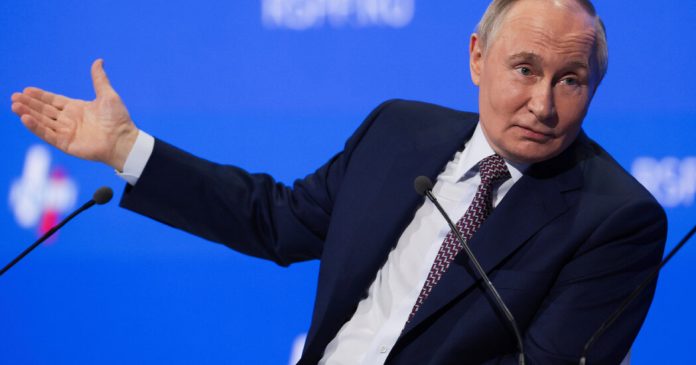
In Call With Trump, Putin Concedes Little on Ukraine

0

When the Kremlin released its summary of President Vladimir V. Putin’s call Tuesday with President Trump, one thing was unmistakable: The Russian leader hadn’t retreated from his maximalist aims in Ukraine and so far has conceded little.

Much of what Mr. Putin agreed to during the call — including a limited 30-day halt on energy infrastructure strikes by both sides, a prisoner exchange and talks about security in the Black Sea — was spun as a concession to Mr. Trump in the respective summaries of the conversation released by Moscow and Washington.

But all were goals that the Kremlin has pursued and seen as advantageous in the past. Russia and Ukraine previously reached a tacit mutual agreement to refrain from energy infrastructure strikes, which have caused pain for both Moscow and Kyiv. Russia has long conducted prisoner exchanges with Ukraine, seeing the repatriation of its soldiers as a key Kremlin interest. And uninterrupted trading in the Black Sea is critical to Russia’s economy.

The lack of clear concessions on the Russian side stoked fears among Ukraine’s backers that Mr. Putin was playing for time, hewing to his staunch demands while hoping, in the meantime, that Washington’s tattered relationship with Kyiv fully breaks or that Ukrainian forces face a battlefield collapse.

Mr. Putin’s demands on Ukraine appeared unchanged. During the call, according to the Kremlin, Mr. Putin reiterated requirements for a comprehensive 30-day cease-fire that he knows are nonstarters for Ukraine. According to the Kremlin, he claimed that the Ukrainians had sabotaged and violated agreements in the past, and accused Ukraine of committing “barbaric terrorist crimes” in the Kursk region of Russia.

By Wednesday, the Kremlin was already accusing Kyiv of violating the limited cease-fire on energy infrastructure, even though President Volodymyr Zelensky of Ukraine had yet to be briefed by Washington on the call or formally agree to the deal.

During Tuesday’s call, the Kremlin said, Mr. Putin also identified his “key condition” for settling the conflict more broadly: a complete cessation of outside military and intelligence support for Kyiv. Such an outcome, analysts say, would make Ukraine, a country far smaller than Russia, permanently hostage to Moscow’s overwhelming military superiority and forever stranded within the Kremlin’s orbit, without any counterbalancing backers.

The Kremlin may be hoping that during the course of negotiations, an already impatient Washington walks away from Ukraine for good, freeing Mr. Putin to continue his war while also separately re-establishing relations with the United States. Russia may also be counting on the possibility that Kyiv, facing an increasingly dire picture on the battlefield and the loss of its biggest backer, ultimately agrees to an erosion of its sovereignty that benefits the Kremlin.

“The best outcome for Putin is one where he accomplishes his aims in Ukraine and can normalize relations with the U.S.,” said Andrea Kendall-Taylor, a former U.S. intelligence official who is now an analyst at the Center for a New American Security, a think tank in Washington. “So Putin wants to string Trump along to give him just enough to see if he can accomplish that.”

Ms. Kendall-Taylor added that Mr. Putin will feel he has little to lose, believing that Mr. Trump, who has made no secret of his dim view of Ukraine and of Washington’s European allies, “won’t be willing to really ramp up pressure on Russia or recommit to Europe.”

“There is a lot of incentive for the Russians to participate, to play along and look for every opportunity to use this construct to their maximum advantage,” Ms. Kendall-Taylor said.

Mr. Putin also has significant advantages on the battlefield. His forces are winning back territory. Ukraine’s biggest and most important supporter, the United States, is openly itching to abandon Kyiv, as well as Europe more broadly. Europe, suddenly realizing its peril without U.S. backing, has been caught flat-footed and is now scrambling to figure out how to secure its own defense — let alone that of Ukraine.

“In Russian diplomatic functioning, negotiations often are just tools of winning time and depriving the adversary of its balance,” said Andras Racz, a senior research fellow at the German Council on Foreign Relations.

Mr. Racz said that Washington’s stated desire to reach a quick resolution to the conflict confers a certain advantage to Moscow, which is “not in a hurry.”

He held out the possibility that the Trump administration, faced with Mr. Putin’s refusal to cede ground on Ukraine, could begin applying pressure on Russia. Mr. Trump has made such threats in the past.

The White House could also offer Mr. Putin more.

After the breakup of the Soviet Union, Washington’s power in Europe grew significantly, with many of the countries that once answered to Moscow joining NATO and ultimately the West. Mr. Putin has never accepted that outcome, making him eager to hold broader discussions on European security with the Trump administration. His apparent hope is that Washington will not only agree to an arrangement that places Ukraine in Russia’s orbit but also will concede a broader curtailment of U.S. influence on the continent. Washington’s ability to grant those broader wishes gives the White House some measure of leverage, even if previous administrations ruled them out as impossible.

“Trump has few options to counter either a Russian rejection or protracted feigned compliance,” wrote Alexander Baunov, a Russian author and political analyst. “The most effective method will be the carrot rather than the stick: the temptation of a major deal.”

Russia, while giving little on Ukraine, has begun trying to lure Washington with the fruits of a rapprochement. Russian officials have been touting their vast reserves of rare earth metals, saying they would be happy to exploit them with American companies, and holding out possible deals for American investors in the Russian energy sector.

Mr. Putin and Mr. Trump spent part of the discussion on Tuesday talking about what the Kremlin called “a wide range of areas in which our countries could establish interaction,” including ideas about cooperation in the energy sector. The Russian leader, according to the Kremlin, secured Mr. Trump’s agreement to hold hockey tournaments with Russian and American professional players facing off against one another.

Alexander Gabuev, director of the Carnegie Russia Eurasia Center, said that the Kremlin would be hoping to get the United States to restore ties without predicating renewed relations on an end to the fighting in Ukraine. That’s why, he added, the Kremlin is front-loading the discussion with all the potential benefits for the United States from a renewed relationship with Russia.

“The impression is that they have a very, very, very good reading of Trump,” Mr. Gabuev said of the Kremlin. “They know where the weak spots are, they know how to massage his ego. To me, the Russian team is winning at this point.”

Can Europe’s New Military Spending Help Its Economies?

0

From Brussels to Berlin, leaders across Europe are getting ready to spend hundreds of billions to rebuild their armies. The spending, they say, is necessary to prepare Europe for the dangers of a world where the United States no longer guarantees its security.

But many of them are also hoping that the surge of money will have another important effect: revitalizing the continent’s slumping industrial sector and opening a new front for economic growth.

That connection between defense investment and competitiveness is one of the topics European leaders are likely to discuss when they meet in Brussels on Thursday, after the European Commission publishes a long-awaited paper on the future of European defense on Wednesday.

“Economic strength and Europe’s plan to rearm are two sides of the same coin,” Ursula von der Leyen, president of the European Commission, said in a recent speech, calling the potential investments a “powerful tailwind for important industries.”

But whether that will be the case is far from certain, and the challenges to Europe actually making it happen are enormous.

While there is a growing consensus that new military spending is likely to offer some boost to European economies in the near term, just how much will depend on how well that money is spent and where.

Most European economies have relatively modest defense industries, though France and Germany in particular are seeking to grow theirs. For decades, Europe has depended significantly on imports of American arms and equipment, particularly when it comes to the most sophisticated weapons. That makes the continent not particularly well suited to absorb new military spending immediately.

But European leaders are keen to change that, in order to keep tighter control over their own security, and to best reap the economic impact from that investment.

President Emmanuel Macron of France is pushing allies, including Germany, to buy French missile-defense systems instead of American ones. Portugal’s defense minister said last week that the country might replace aging fighter jets with European ones, not American-made F-35s, citing concerns over the Trump administration’s embrace of Russia.

The European Union’s recently unveiled 150 billion euro loan program — meant to finance shared military development — will prioritize European-made products, officials announced on Wednesday. Members states must ensure that 65 percent of the costs of what they buy comes either from within the E.U. or from partners including Ukraine and Norway.

But building out Europe’s modest military industries to meet those ambitions will take time.

Friedrich Merz, Germany’s likely incoming chancellor, laid out the challenges to lawmakers on Tuesday, before Germany’s lower house of parliament voted to loosen constitutional limits on debt to allow more billions more in spending to revamp the country’s military. The measures must now pass the upper chamber and survive legal challenges before becoming law.

“Now we need to rebuild defense capabilities, in part from scratch, with a technology-driven defense and procurement strategy, with automated systems, with independent European satellite surveillance, with armed drones and with many modern defense systems and, above all, with reliable and predictable orders that should go to European manufacturers whenever possible,” Mr. Merz said.

European nations have increased spending on defense by nearly a third since 2021. But even combined, their annual military budgets remain less than half of the United States’. Defense industries employed just under 600,000 Europeans last year. By comparison, automobile manufacturers alone employed more than 3 million.

In some cases, like tanks and missile batteries, Europe will need to scale up existing industries or repurpose other industrial production lines. In others — including drone technology and some of the most cutting-edge weapons and military support equipment — Europe will need to quickly build its own rivals to compete with American players. Defense officials caution it could take years to pull that off, if not a decade.

And there is a risk that when European nations buy close to home, they will want to buy domestically rather than from Germany or France — duplicating efforts across the bloc. Europe already has some redundancy problems in defense. Ukraine, for example, has been sent at least 17 different kinds of howitzers, not all of which use the same type of shell.

If Europe’s new spending ends up being duplicative, both the economic and strategic benefits could be muted.

That is why some economists caution that the economic lift, while likely, might not be enough to buffer European governments against the populist backlash they have faced in recent years.

But if the E.U. can add new industries with coordinated investment and purchasing, then the growth effects could be significant.

They might even be enough to help aging European countries temper a downward spiral of shrinking workforces and plunging investment, spurring new technologies that would spill over into civilian sectors and providing a more lasting benefit.

Much depends on how the new spending plans play out.

The philosophy, at the moment, appears to start with spending big — and staying close to home. In Brussels, European Union officials have made clear that they want to build up defense production abilities across their 27-member block. To catalyze investment, they have pitched a 150 billion euro loan program.

They have also proposed loosening European fiscal rules so that individual nations will be able to spend more, which they estimate could unleash as much at 650 billion euros, more than $710 billion, in additional spending. Whether that much spending actually happens will hinge on whether national governments are willing to take on more debt for military spending.

Even with the challenges of buying local, many economists think that European growth as a whole will see some benefit from the defense buildup. Goldman Sachs estimated a modest bump in the eurozone in each of the next three years, with the largest benefit in 2027.

The Goldman economists upgraded their growth estimates in part because of the German plan to ease debt limits. But others tempered expectations.

The German military spending plan “is really about security,” said Clemens Fuest, an economist who is the president of the ifo Institute in Munich, and who helped advise Mr. Merz.

“It’s good for the country because we want to avoid war in Europe,” Mr. Fuest said in an interview. But, he added, “It’s not good in terms of, ‘It’s going to create more growth,’ or anything.”

Still, at a time when German automakers and their suppliers have shed some 46,000 jobs since 2019, some Germans wonder if it may be time to turn idled automotive factories into cutting-edge plants for tanks or drones.

The German arms maker Rheinmetall has already taken a lead role in scaling up the country’s weapons-production capacities. It has provided new jobs to dozens of workers from one of Germany’s struggling auto suppliers, Continental AG. It has also been in talks with Volkswagen about the possibility of taking over an underperforming factory near Osnabrück.

“If German taxpayer money is being spent, then we need to create German jobs,” Armin Papperger, Rheinmetall’s chief executive, told reporters last week, adding that he expected Rheinmetall alone to add 10,000 jobs in Germany over the next two years.

That growth may be felt beyond Germany, too. Since the outbreak of the war in Ukraine, Rheinmetall has built new factories in Spain, Lithuania and Romania, growing into the one of the largest munitions producers in the West.

Every new factory creates 500 to 1,000 new jobs directly, and several thousand more in the surrounding area, Mr. Papperger said.

And even though France has limited room to borrow to scale up its own spending, it, too, could benefit from higher military outlays in the rest of the region, Goldman Sachs economists say. It hosts the largest military in the E.U. and is a major arms exporter.

Vicky Redwood, an economic adviser at Capital Economics, wrote in a March 13 analysis that in general, increasing military spending by 1 percent of G.D.P. would lift growth by around 0.5 percent. Outside of Germany, she wrote, a “reasonable” estimate is that European nations will raise their military spending by between 0.5 and 1.5 percent as a share of output.

But several factors could affect how much military expenditure boosts growth, she wrote. Those include how much of the spending goes toward research and development and how efficiently the spending is done. Nothing is certain.

Apart from Reinmetall, “the others are rather smaller players,” said Marcel Fratzscher, president of the German Institute for Economic Research. “I have doubts that this will be the future of Germany’s comparative advantage, changing from building cars to building tanks.”

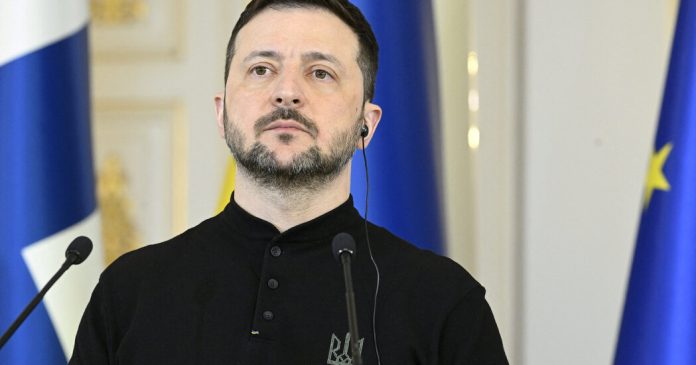
Zelensky Says He’ll Speak to Trump About ‘Next Steps’ After Putin Call

0

President Volodymyr Zelensky of Ukraine said that he expected to speak with President Trump later on Wednesday to “discuss the details of the next steps” after the American leader’s call with President Vladimir V. Putin of Russia.

The Kremlin said that in a call with President Trump on Tuesday, Mr. Putin had agreed to a limited cease-fire that would halt attacks on Ukrainian energy infrastructure. The proposal fell short of a 30-day unconditional truce that Kyiv had agreed to at Washington’s urging.

On Wednesday, Mr. Zelensky appeared open to the latest offer of a limited cease-fire, but said he thought that such a truce would need U.S. monitoring to work.

“If the Russians do not strike our facilities, we will definitely not strike theirs,” Mr. Zelensky told a news conference in Helsinki alongside Finland’s president, Alexander Stubb.

Underscoring the lack of trust between Ukraine and Russia, the two countries traded accusations on Wednesday about attacks against each others’ energy infrastructure.

Mr. Zelensky has characterized some of the conditions Mr. Putin has set for a broader cease-fire — such as a demand for a complete cessation of foreign military and intelligence aid to Ukraine — as an attempt to stall for time so that Russia can improve its forces’ positions on the battlefield and its negotiating hand.

The Ukrainian president reiterated that point on Tuesday night after the call between Mr. Putin and Mr. Trump, saying that it was clear Russia was “not ready to end this war.”

“They are not even prepared to take the first step toward a cease-fire because they will continue to impose additional conditions,” he said.

The 30-day cease-fire proposal that Ukraine had agreed to after talks with U.S. officials in Saudi Arabia was more extensive. It would have applied to land, air and sea — the first cessation of hostilities since Russia’s full-scale invasion of Ukraine more than three years ago. That monthlong truce, Mr. Zelensky has said, was meant to give time for fuller negotiations about a longer-term peace.

Anastasia Kuznietsova contributed reporting.