Thursday, November 12, 2026
Home Blog Page 113

John “Paddy” Hemingway, Last Surviving Pilot of the Battle of Britain, Dies at 105

0

Addressing the British House of Commons in August 1940, Prime Minister Winston Churchill paid tribute to the pilots of the Royal Air Force who were staving off an impending German invasion of the British Isles in what would be known as the Battle of Britain.

“Never in the field of human conflict was so much owed by so many to so few,” Churchill proclaimed.

When John A. Hemingway died in Dublin on Monday at 105 — the Royal Air Force announced his death — he was the last known survivor of the “few,” nearly 3,000 pilots and crew who saved Britain in the early stages of World War II.

Mr. Hemingway, who was known as Paddy, piloted Hurricane fighters in the battle, which took place in the skies above Britain between July 10 and Oct. 31, 1940.

Hitler had planned a September 1940 invasion of the British Isles, known as Operation Sea Lion. But he postponed it indefinitely when the R.A.F. — vastly outnumbered at the height of battle, with 749 fighter aircrafts compared with the Luftwaffe’s 2,550 — beat back German bombers and fighters, foiling his quest to establish the air supremacy that Germany needed to support invading ground troops. However, the Blitz, Germany’s bombing of London and other British cities, extended into the spring of 1941.

“Britain, facing a Continent dominated by her enemies, prepared for a fight to the death,” The New York Times had reported that June.

Flying over France, Britain and Italy in World War II, Mr. Hemingway was shot down four times between 1940 and 1945. He received Britain’s Distinguished Flying Cross in July 1941 for downing and damaging German planes.

“During the war, all my closest friends were killed, and my memories and thoughts about them I have always regarded as a private affair,” Mr. Hemingway told the British newspaper The Telegraph on the 80th anniversary of the beginning of the Battle of Britain.

“But being the last of the Battle of Britain veterans has made me think of those times,” he said. “Fate was not democratic. New pilots with just a few hours in Hurricanes did not have the instincts of us more experienced pilots and were very vulnerable in combat. Many did not last long.”

John Allman Hemingway was born on July 17, 1919, in Dublin. After attending St. Andrew’s College there, he enlisted in the R.A.F. in 1938 and graduated from flight school.

He first saw combat in the spring of 1940 when he flew in support of the British Expeditionary Force’s ultimately futile quest to turn back the German invasion of France. He shot down a German bomber in May, but the next day he had to make a forced landing when his plane was hit by antiaircraft fire.

The British Army, routed by the Germans, returned home in the storied evacuation from the French port of Dunkirk in late May and early June. France capitulated to Hitler with the signing of an armistice on June 22.

Flying afterward in defense of Britain, Mr. Hemingway was intercepting German bombers over the English Channel on Aug. 18 when his Hurricane was shot up.

“Somebody clobbered me,” he told The Daily Mirror in 2018. “They hit me in the engine. It covered the inside of the cockpit with oil, and things got very smelly and hot. I had no hope of getting to England, so I bailed out and landed in the sea.

“There were jellyfish everywhere,” he continued. “I started swimming. Two hours later, a rowboat from a lightship bumped into me.”

He climbed aboard, grabbed an oar and helped the crew return with him to England.

Later in August, Mr. Hemingway survived a third close call, this time while pursuing a German bomber over southeastern England. As he told The Daily Mirror: “I got a Dornier in my sight and started to pull around and have a second go. That was it — ‘bang, bang’. There was smoke everywhere.” He bailed out. “I landed in the Pitsea marshes, where I faced the local Home Guard,” he said.

He added wryly, “I could speak reasonable English, so they didn’t shoot me.”

Mr. Hemingway was an Allied flight controller during the D-Day invasion of Normandy in June 1944. The next year, in April, he was a squadron commander in Italy when his Spitfire fighter was downed by the Germans. He bailed out again and was rescued by farm workers, who disguised him in peasant clothing and smuggled him to the British lines.

After the war, Mr. Hemingway held posts with Britain’s Air Ministry and its delegation to NATO in Paris. He retired from the R.A.F. in 1969 as a group captain, the equivalent of an American colonel, and lived in Britain and Canada before returning to Ireland in 2011.

The Royal Air Force Benevolent Fund, which assists current and former R.A.F. personnel and their families, announced on May 8, 2020 — the 75th anniversary of V-E Day, which marked Germany’s surrender — that Mr. Hemingway had become the last living veteran of the Battle of Britain after the death of William Clark a day earlier at 101.

“We owe so much to Paddy and his generation for our freedoms today,” William, the Prince of Wales, said on social media on Tuesday, paying tribute to Mr. Hemingway.

In its statement, the R.A.F. said of Mr. Hemingway, “He never saw his role in the Battle of Britain as anything other than doing the job he was trained to do.”

Mr. Hemingway’s survivors include three children, Susan, Michael and Brian. His wife, Bridget, died in 1998. He died in a nursing home in Dublin.

“I am here because I had some staggering luck and fought alongside great pilots in magnificent aircraft with ground crew in the best air force in the world at that time,” Mr. Hemingway told The Irish Independent in September 2020. “It was just a matter of taking each day at a time. Others write the history — we were doing our job.”

Lynsey Chutel and Ash Wu contributed reporting.
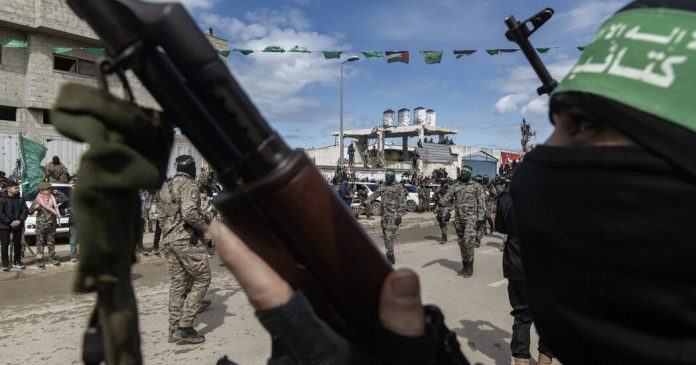
Hamas Does Not Respond to Renewed Israeli Attack on Gaza

0

Hours after Israel launched a massive bombing campaign across Gaza on Tuesday, Hamas’s military wing had not mounted a discernible counterattack.

It was by far the deadliest day since a cease-fire in Gaza began about two months ago. The Gaza health ministry, which doesn’t distinguish between civilians and combatants, said that more than 400 people had been killed in the aerial bombardment that started before dawn.

But throughout the day, there was a notable absence of rocket fire by Palestinian militants or attempts to ambush Israeli soldiers.

Suhail al-Hindi, a Hamas official, reacted to the assault by saying the group hopes to restore the cease-fire but reserves the right to respond.

“How to respond is left to those on the ground,” he said in a telephone interview. “They know and understand how to respond to the occupation.”

There is no question that Israel’s 15-month war against Hamas weakened the group that has long ruled Gaza. Israel killed thousands of its fighters and destroyed much of its tunnel network which was used, among other things, to store weaponry. And it undermined Hamas’s ability to fire rockets at Israel.

Mr. al-Hindi acknowledged that the capabilities of Palestinian militant groups in Gaza were degraded by the war, but he said they still had both the ability and the desire to fight.

“The issue isn’t one of equipment and weapons,” he said. “It’s about will, and I believe there’s lots of will to resist this occupation.”

Hamas has worked to regroup over the last two months since a cease-fire agreement with Israel came into effect. It has been collecting unexploded bombs throughout Gaza and repurposing them as improvised explosive devices, according to one member of the Qassam Brigades, Hamas’s military wing. It has also been recruiting new members and replacing commanders who were killed, the member said, speaking on condition of anonymity to discuss sensitive details.

Seven members of the Israeli parliament’s foreign affairs and defense committee said in a letter that they recently learned that Hamas and Palestinian Islamic Jihad, another militant group in Gaza, have more than 25,000 and 5,000 fighters, respectively, still in the territory.

“The Qassam Brigades is still able to confront the Israeli occupation,” said Ibrahim Madhoun, a Palestinian analyst from Gaza who is close to Hamas.

The lack of any military response to the new Israeli onslaught could mean the group was focused on preparing for a fight in case of an Israeli ground invasion, he said.

The Israeli military has said it was attacking Hamas and Palestinian Islamic Jihad, a smaller militant group in Gaza, targeting groups of fighters, missile launch posts and weapons stockpiles.

The Israeli bombardment followed weeks of unsuccessful negotiations to extend the cease-fire between Israel and Hamas.

Despite the intensity of Israel’s attacks, Mr. Madhoun said Hamas wouldn’t relent to Israeli demands to end its role in Gaza or hand over large numbers of the remaining hostages without guarantees of a permanent end to the war.

“Hamas doesn’t want an escalation, but it will not surrender,” he said.

Israel has been trying to pressure Hamas to release living hostages in exchange for an extension of the cease-fire, without giving the group the reassurances it seeks that the war will end permanently.

Israel has vowed throughout the war that it will not allow Hamas to continue to govern Gaza and will ensure that it can never again mount another attack like the one on Oct. 7, 2023, that set off the war. Prime Minister Benjamin Netanyahu has said that for the war to end, Hamas’s government and military wing must be dismantled, a position shared by his right-wing coalition partners in the government.

While Hamas has suggested it was willing to give up civilian governance of Gaza, it has firmly rejected dissolving its military wing, a critical source of its power in the enclave.

During the initial phase of the cease-fire, the group tried to use handovers of hostages to show it was still a powerful forces in Gaza. Nearly every time it transferred Israeli captives to the Red Cross, it put on theatrical ceremonies featuring hundreds of mask-wearing and gun-toting militants.

Michael Milstein, a former Israeli military intelligence officer specializing in Palestinian affairs, said Hamas may be trying to first gauge whether Israel was planning a long-term assault or a limited salvo before it responds.

“They want to know where things are going,” Mr. Milstein said. “If everything is going to end in two hours, they don’t want to waste what remains of their ammunition. But if it goes on for a long time, they will respond.”

Iyad Abuheweila and Aaron Boxerman contributed reporting to this article.

DOGE staff entered the U.S. Institute of Peace with D.C. police help : NPR

0

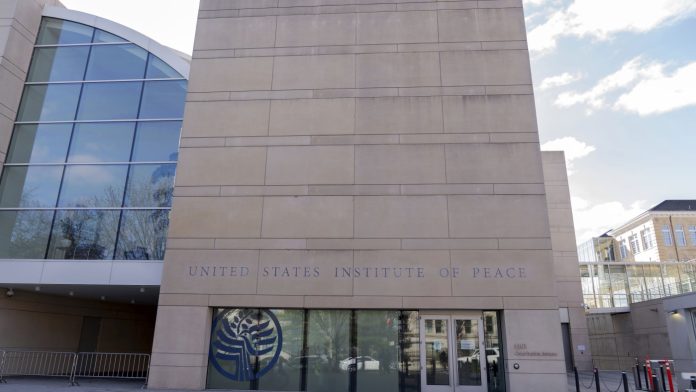
The United State Institute of Peace building is seen, Monday, March 17, 2025, in Washington.

Jose Luis Magana/FR159526 AP


hide caption

toggle caption

Jose Luis Magana/FR159526 AP

The US Institute of Peace was the scene of a dramatic standoff between a Department of Government Efficiency team and Institute members on Monday. D.C. police attended the scene after being contacted both by USIP staff and the DOGE team on site.

Former diplomat and President and CEO of USIP George Moose told NPR, “D.C. police showed up at my office and said it is time for you to go.” USIP is a think tank funded by Congress.

NPR spoke to him on the steps of the Institute just across from the State Department during the day-long standoff on Monday.

Some members of DOGE, as the Elon Musk efficiency team is known, tried several times to get inside to install a new president.

White House deputy press secretary Anna Kelly, posted on X Monday evening, along with a screenshot of a resolution from USIP’s three remaining board members appointing Kenneth Jackson USIP’s acting president on March 14.

Moose was fired last week along with most of the board members. According to USIP’s website, the bipartisan board of directors is composed of 12 members plus four “ex-officio” members including the US Secretaries of State and Defense.

But Moose and the USIP is challenging the administration in court. He was held up in his office for some time on Monday before being escorted out by police. Moose called it a sad day.

“This building really was it was built not just as a platform for the work that we do. It was built as a symbol of the aspiration of the American people to be peace builders in the world. That’s why it is as beautiful as it is,” Moose told NPR.

“I have to believe that in the long term, that purpose, that mission will be reaffirmed and that we will, in one way or another, be allowed to continue. “

And that mission he told reporters, should be in line with what the Trump administration wants, including coming up with ideas to resolve conflicts and promote peace.

Moose, like many of the employees at USIP, is a retired diplomat. He spent much of his career in Africa and says he’s shocked by the way the Trump administration has been dismantling the US aid agency and other parts of America’s soft power.

DOGE posted a statement on social media late Monday, claiming that “Mr. Moose denied lawful access to Kenneth Jackson, the Acting USIP President.”

DOGE staff were previously refused access to the building on Friday. In a statement on Saturday, Gonzalo Gallegos, a USIP spokesperson said the DOGE staff were informed of the nonprofit’s “private and independent status as a non-executive branch agency.”

The administration continues to claim this is all about saving money. But a lawyer for USIP claims their actions are illegal. The President can fire board member, but it has to have a reason to do so and the USIP is not a government agency.

USIP’s lawyer George Foote told reporters that the building was “seized by force, by police officers with guns acting under the authority of a resolution that we are going to get a court to declare invalid.”

Why Did Israel Resume Airstrikes on Gaza? What to Know About the Attacks

0

Israeli forces on Tuesday launched the largest and most deadly attacks on Gaza since a cease-fire with Hamas that began roughly two months ago. The barrage killed hundreds of people, according to health authorities in the enclave.

As of midday Tuesday, it remained unclear whether the strikes were a brief attempt to force Hamas to compromise in cease-fire talks or the beginning of a new phase in the conflict.

Just before 2:30 a.m. local time, the Israeli military announced that it was conducting “extensive strikes” on Hamas targets. At least 400 Palestinians, including children, were killed in the strikes, according to the Gaza health ministry. The ministry’s figures do not differentiate between civilians and combatants.

Hamas publicly announced the deaths of at least five senior officials among the group’s Gaza leadership. Two were officials in the group’s political bureau, and three others — including Bahjat Abu Sultan, the director of Hamas’s feared internal security agency — held senior security roles.

When Israel launched the strikes, some people were preparing a special meal before the daily Ramadan fast. Others were jolted out of their sleep. After two months of relative calm, the widespread explosions left Gazans with an unmistakable message: The war had returned, at least for now.

The Israeli authorities explained the assault as a response to intransigence by Hamas in talks over extending the cease-fire.

The office of Prime Minister Benjamin Netanyahu of Israel also said that Hamas had demonstrated a “repeated refusal” to release the rest of the hostages that it seized during its raid on Israel on Oct. 7, 2023. Around 1,200 people were killed and about 250 taken hostage in that attack, which began the war. “From now on, Israel will act against Hamas with increasing military strength,” it said in a statement.

That message was echoed by Israel’s foreign minister, Gideon Saar, who said that the cease-fire talks had reached a dead end and that Israel had “no alternative but to give the order to reopen fire.”

The talks stalled because of disagreement over fundamental issues. Hamas, which has attempted to use the hostages as leverage throughout the conflict, has refused to release significant numbers of additional captives until Israel promised to permanently end the war.

Israel and Hamas had been negotiating the next steps in the truce. The next phase is supposed to end the war and free more hostages. But Mr. Netanyahu’s government has refused to agree to end the war unless Hamas gives up control of Gaza or dismantles its military wing.

Israel’s hand in the talks has been strengthened in recent weeks by backing from the Trump administration, which has delivered more weapons to the country. The White House press secretary, Karoline Leavitt, said Israel had consulted the White House before launching the strikes.

To increase pressure on Hamas, Israel halted the delivery of aid and humanitarian supplies into Gaza earlier this month. That decision exacerbated hardships faced by civilians in the shattered enclave, where Palestinian health authorities say more than 46,000 people have been killed, a majority of them women, children or the elderly.

The cease-fire deal, which came into effect on Jan. 19, was designed to unfold in several stages toward a comprehensive end to the conflict. Under the initial phase, which lasted six weeks, Hamas released 30 Israeli and foreign hostages and handed over eight bodies. In exchange, Israel released 1,000 Palestinian prisoners.

Hamas accused Israel of deciding to “overturn the cease-fire agreement, exposing the prisoners in Gaza to an unknown fate,” referring to the remaining hostages.

Hamas has not yet responded militarily to the attacks.

Of the 250 people seized, more than 130 have been released, including more than 100 during an initial cease-fire in the early months of the war and 30 more during the truce that began in January. The hostages were exchanged for hundreds of Palestinians held in Israeli prisons.

The Israeli military has also retrieved the bodies of at least 40 others. Less than half of the 59 who remain in Gaza are alive, according to the Israeli government.

The main advocacy group for the families of hostages held in Gaza accused the Israeli government of effectively abandoning those still held there with its decision to launch large-scale airstrikes.

Reporting was contributed by Patrick Kingsley, Yan Zhuang, Rawan Sheikh Ahmad and Aaron Boxerman.

The 1798 law is Trump’s new deportation tool : NPR

0

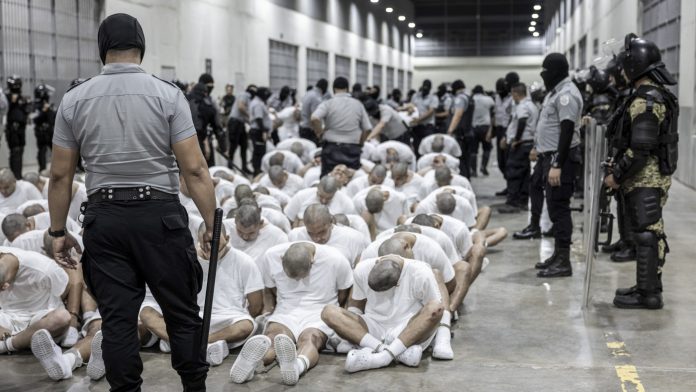
In this photo provided by El Salvador’s presidential press office, a prison guard transfers deportees from the U.S., alleged to be Venezuelan gang members, to the Terrorism Confinement Center in Tecoluca, El Salvador on Sunday.

El Salvador presidential press office/AP


hide caption

toggle caption

El Salvador presidential press office/AP

As part of his efforts to crack down on immigration, President Trump has invoked the Alien Enemies Act of 1798, an obscure law that has been used sparingly throughout U.S. history to detain or deport nationals of an enemy nation during wartime or an invasion. 

Trump’s directive targets members of Tren de Aragua, a Venezuelan prison gang that has grown into a multinational crime organization over the last decade and was designated a terrorist organization by the U.S. State Department in February. 

The proclamation authorizes expedited removal of all Venezuelan citizens ages 14 and older deemed members of the group and who are not U.S. citizens or lawful permanent residents, calling them “a danger to the public peace or safety of the United States.” 

“I find and declare that [Tren de Aragua] is perpetrating, attempting, and threatening an invasion or predatory incursion against the territory of the United States,” the proclamation reads, borrowing the language of the centuries-old act. 

The Alien Enemies Act is a wartime law: It has its roots in a conflict between the U.S. and France, and the three times it has been used until now were all during major wars. 

Legal experts have long been skeptical of the Trump campaign promise — and facet of the 2024 Republican Party platform — to utilize the act during peacetime since immigration hasn’t historically constituted an invasion. Immigration advocates worry the act could lead to the targeting of other groups of immigrants, regardless of their criminal history.

Trump’s proclamation was immediately blocked by a federal judge, who ordered deportation flights to turn around — though the administration still deported some 250 people to El Salvador. 

“The Trump administration is seeking to circumvent the process that we have in our country in order to just expand power and do something with no process at all,” Skye Perryman of Democracy Forward — which, along the American Civil Liberties Union, sued over the administration’s use of the law — told NPR, adding, “It’s highly concerning and should be concerning for all Americans.” 

The last time the act was invoked was during World War II, when it was used to put thousands of noncitizens of Japanese, German and Italian descent in internment camps — for which the federal government formally apologized decades later. 

“History shows the risks,” wrote Katherine Yon Ebright, counsel with the Brennan Center’s Liberty and National Security Program.

Here’s what else to know about the act and Trump’s efforts to use it. 

What’s the purpose of the Alien Enemies Act?

The Alien Enemies Act specifically allows the president to detain, relocate, or deport non-citizens from a country considered an enemy of the U.S. during wartime:

“Whenever there shall be a declared war between the United States and any foreign nation or government, or any invasion or predatory incursion shall be perpetrated, attempted, or threatened against the territory of the United States, by any foreign nation or government, and the President of the United States shall make public proclamation of the event, all natives, citizens, denizens, or subjects of the hostile nation or government, being males of the age of fourteen years and upwards, who shall be within the United States, and not actually naturalized, shall be liable to be apprehended, restrained, secured and removed, as alien enemies.

Congress, with the support of President John Adams, passed the Alien Enemies Act as part of the four Alien and Sedition Acts of 1798 as the U.S. stood on the brink of war with France.

“There was a lot of fear-mongering about French supporters in the United States and about conspiracies to basically get the United States in on France’s side,” Georgetown University Law Center professor Steve Vladeck told NPR during the presidential campaign last fall.

The controversial group of laws severely curtailed civil liberties, including by tightening restrictions on foreign-born Americans and limiting speech critical of the government.

After President Thomas Jefferson was elected in 1800, he either repealed or allowed most of the acts to expire, except for the Alien Enemies Act, which does not have an expiration date.

It not only remained on the books but continued to expand in scope: Congress amended it in 1918 to include women.

When has the act been used before?

This 1918 photograph shows "enemy aliens" being corralled by Secret Service operatives at Gloucester, N.J., on their way to internment in the South.

This 1918 photograph shows “enemy aliens” being corralled by Secret Service operatives at Gloucester, N.J., on their way to internment in the South.

HUM Images/Universal Images Group via Getty Images


hide caption

toggle caption

HUM Images/Universal Images Group via Getty Images

The Alien Enemies Act has been used only three times before in American history — all in connection with major military conflicts.

During the War of 1812, all British nationals living in the U.S. were required to report information including their age, length of time in the country, place of residence, family description and whether they had applied for naturalization.

A century later, during World War I, President Woodrow Wilson invoked it against nationals of the Central Powers: the German Empire, Austria-Hungary, the Ottoman Empire and Bulgaria.

According to the National Archives, U.S. authorities used the law to place over 6,000 “enemy aliens” — many of them Germans — in internment camps, with some remaining in detention up to two years after fighting had ended.

The U.S. Marshals Service says it registered 480,000 German “enemy aliens” and arrested 6,300 between the declaration of war in April 1917 and the armistice in November 1918.

Most recently, President Franklin Roosevelt invoked the act after the attack on Pearl Harbor, designating Japanese, German and Italian nationals as “alien enemies” during World War II.

Roosevelt’s proclamation required residents from all three countries to register with the U.S. government and authorized the internment of any alien enemy “deemed potentially dangerous to the peace and security of the US.”

A man points to a poster reading "Notice: Alien Enemy prohibited area."

Tom C. Clark, coordinator of the Alien Enemy Control program of the Western Defense Command, points to the first warning card telling “enemy aliens” in Los Angeles to evacuate prohibited areas by midnight, Feb. 15, 1942.

Bettmann/Bettmann Archive/Bettmann Archive


hide caption

toggle caption

Bettmann/Bettmann Archive/Bettmann Archive

By the end of WWII, over 31,000 suspected enemy aliens and their families — including Jewish refugees from Nazi Germany — had been interned at camps and military facilities across the U.S., according to the National Archives. Several thousand of them were ultimately repatriated to their country of origin, either by choice or by force.

Vladeck says the Alien Enemies Act was used to detain mostly Italian and German nationals. The bulk of the more than 100,000 Japanese Americans who were placed in internment camps during the war were U.S. citizens, detained under different legal grounds.

How strong is Trump’s case?

The act’s fine print states that the president can only assume this authority once Congress has declared war. While the U.S. has been involved in plenty of conflicts over the decades, it hasn’t done so formally since 1942.

“It hasn’t been a source of contemporary controversy because we haven’t had a declared war,” Vladeck explains. “And no one has tried to argue that that invasion or predatory incursion language could be used in any context other than a conventional war.”

Until Trump, that is. The former president — who has a long history of using dehumanizing language against minority groups and political opponents — has repeatedly referred to the influx of migrants to the U.S. as an “invasion” and vowed mass deportations.

Ebright, with the Brennan Center, called Trump’s argument a  “flagrantly illegal” power grab. 

“The president has falsely proclaimed an invasion and predatory incursion to use a law written for wartime for peacetime immigration enforcement,” she wrote after Trump invoked the act. “The courts should shut this down.”

The Trump administration has defended its actions and pushed back against a federal judge’s attempts to intervene, even refusing to answer basic questions about its deportation flights.

White House press secretary Karoline Leavitt told reporters that the administration “acted within the confines of the law” and is “wholly confident that we are going to win this case in court.”

But even some anti-immigration advocates in favor of deploying the act have acknowledged the likely legal obstacles.

Defining illegal immigration as an invasion and migrant gangs as foreign nations would be an “uphill climb in federal court,” George Fishman, former deputy general counsel at the U.S. Department of Homeland Security under Trump, wrote in 2023.

What are some possible outcomes?

Rep. Ilhan Omar stands next to a sign reading "neighbors not enemies."

Rep. Ilhan Omar, D-MN, re-introducing the Neighbors Not Enemies Act on Capitol Hill in January. It would repeal the Alien Enemies Act.

Kent Nishimura/Getty Images


hide caption

toggle caption

Kent Nishimura/Getty Images

Trump doesn’t need the Alien Enemies Act to go after undocumented immigrants, Vladeck says, noting that presidents already have the authority to arrest, detain and remove them.

“The issue that has hamstrung each of the last four presidents, of both parties, has not been legal authority — it’s a lack of resources,” he says. “The federal government doesn’t have the capacity to identify, track down, round up and remove every single one of the 11 million-plus undocumented immigrants in this country.”

He said he doesn’t expect courts to look kindly upon Trump invoking the act “where, one, he doesn’t need it, and two, it would really be a stretch in what is already a pretty controversial legal power.” 

Ebright agreed that “immigration law already gives the president ample authority to deport Tren de Aragua members who inflict harm on our communities.” Still, she said, it’s not completely clear what the courts will do.

The last time the Supreme Court heard a case on the act, in 1948, it deemed questions about the definition of wartime too political to answer. On the other hand, she noted, a lot has changed since then. Ebright wrote last year that the surest way to prevent the act from being abused would be for Congress to proactively repeal it.

Rep. Ilhan Omar of Minnesota and Sen. Mazie Hirono of Hawaii, both Democrats, have tried to do so in recent years by introducing the “Neighbors Not Enemies” Act, which would repeal the Alien Enemies Act, but hasn’t gained traction.

The lawmakers reintroduced the act in January, two days after Trump took office. 

“We cannot allow antiquated laws to continue enabling discriminatory practices that harm immigrant communities,” Omar said at the time. “Repealing this law is a necessary step toward creating an immigration system rooted in justice and compassion.”

A version of this story originally published in October 2024.

These Sudanese Refugees Fled War. Now, Crucial U.S. Aid Is Running Out.

0

Fatehiyya Mohamed Adam is a Sudanese refugee who first fled war in 2023 and then lost everything after an accidental fire ripped through this refugee camp along the Chad-Sudan border. HIAS, a refugee advocacy N.G.O. that was poised to help her with emergency services, couldn’t after the U.S. government suspended its work in massive foreign aid cuts announced in January. We traveled to the remote Aboutengue Camp in Chad, where many of the resources for tens of thousands of refugees, mostly women and children, have come to a sudden halt. HIAS had been providing refugees with critical support. And while its work suspension was lifted in early March, it remains unclear which of its programs will continue to be funded and for how long. One woman who asked us to hide her identity for fear of retribution, told us how HIAS helped intervene after a domestic violence incident with her husband. She still lives here with her husband and toddler, and had been receiving family counseling from the N.G.O., which has had to freeze workers’ salaries and sessions for her and for other victims of gender-based violence. Almost everywhere in the Aboutengue Camp, we came across stories of people who rely heavily on U.S. foreign aid on a daily basis. Schools like this one, run by Jesuit Refugee Services, were a lifeline for more than 32,000 students like Kawsar Mahamat Yakub, before it abruptly had to close its doors in January. A month later, some of its teachers returned to volunteer or work for minimum pay, but more than half of the students were now gone, and it’s unclear how much longer the school will be able to keep its doors open. As of March, the Trump administration has eliminated 83 percent of U.S.A.I.D. programs and 40 percent of State Department grants, citing widespread waste and claiming they do not serve U.S. interests. The cuts total tens of billions in overall U.S. assistance worldwide.

Russia Escalated Sabotage to Pressure U.S. and Allies on Ukraine, Study Says

0

Russia significantly stepped up its sabotage campaign over the past two years as it sought to pressure Europe and the United States to curb their support for Ukraine, according to a new study released on Tuesday.

The report, by the Center for Strategic and International Studies, is one of the first that try to quantify the scale of Moscow’s covert campaign that targeted undersea cables, warehouses and railways. It found that Russian attacks in Europe quadrupled from 2022 to 2023 and then tripled again from 2023 to 2024.

“This is an important tool that the Russians are using in coordination with their conventional war in Ukraine,” said Seth G. Jones, the author of the study and a former adviser to the U.S. military. “It makes very little sense now for Russia to push troops across the border to the Baltic States or Finland. But their payback for these countries that are providing weapons is going after their companies, assassination plots against officials and threatening critical infrastructure.”

Amid the push by Washington to halt the war in Ukraine, Russia has tamped down its sabotage efforts in recent weeks, according to a Western official. But experts believe the campaign against European targets could continue once governments put in place new plans to support Ukraine with weapons or peacekeepers.

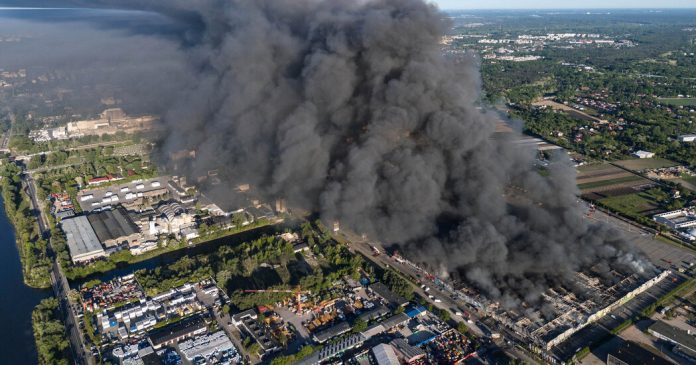
Anger at Russia’s sabotage efforts has the potential to influence European reactions to the U.S.-led push for an end to the war in Ukraine. Prime Minister Donald Tusk of Poland noted in a social media post on Monday that Lithuanian officials had confirmed his assessment that Russia was responsible for a series of fires in shopping centers in Warsaw and Vilnius, the Lithuanian capital. “Good to know before negotiations,” Mr. Tusk wrote. “Such is the nature of this state.”

The message to countries supporting Ukraine has been that Russia can impose costs — and increase them. There is little evidence that the Russian campaign was effective last year. But as the United States apparently retreats from its backing of Ukraine and European allies, the question will be whether a covert Russian campaign can become more successful at pushing countries to reconsider their support.

The report by the Center for Strategic and International Studies found that about 27 percent of Russia’s attacks were against transportation targets, 21 percent against industrial targets and 21 percent against undersea cables, pipelines and other infrastructure. Overall, the study tracked 52 separate acts of sabotage from 2022 to the present.

Russia has tried to control its campaign and not escalate too much. It tried to cap the level of violence to avoid inadvertently driving up support for Ukraine, Mr. Jones said.

“We don’t see a lot of people dying right now,” he said. “If a train was derailed carrying weapons, that would be one thing. If it were full of people, that would be a whole different thing.”

People who have been killed as part of the covert campaign, such as a former Russian helicopter pilot in Spain, were mainly defectors. While Russia has tried to avoid killing foreigners, Western intelligence officials said last year that it had sought to kill the chief executive of a prominent German arms maker.

American and European officials have been concerned about miscalculation by Russia and its inability to precisely control some of its own operatives.

After Russian intelligence plotted to place incendiary devices on DHL cargo planes last year, the Biden administration warned President Vladimir V. Putin that sabotage that brought down aircraft would elicit a serious response. European leaders and NATO have repeatedly called out the attacks, issued warnings and expelled Russian diplomats and spies over them. But the report found that those efforts “failed to coerce Russia” from stopping its campaign.

The effort is part of a Russian tradition of covert sabotage, known as active measures, that the K.G.B. honed during the Cold War. Russian military intelligence, known as the G.R.U., has led the current campaign, The New York Times reported in May.

The operation intensified last year, when the Kremlin approved a push after Britain and Germany announced new support for Ukraine, according to the Western intelligence official. The German publication WirtschaftsWoche reported the decision to expand the sabotage campaign, including the use of other Russian intelligence services.

The new study found no recorded attacks in European countries friendly to Russia, such as Serbia and Hungary. On the other hand, Poland, which has been the hub of Western aid flowing to Ukraine, has been repeatedly targeted.

“They are clearly making concrete decisions of whom they go after and whom they don’t go after,” Mr. Jones said of Russia.

While the cutting of cables by Russia’s shadow fleet of ships trying to evade sanctions has received much of the attention in recent months, Mr. Jones said a majority of attacks were explosive or incendiary devices causing fires at factories, warehouses and other facilities.

He added that there had not been any instances of sabotage around U.S. bases in recent weeks. Last year, as the sabotage campaign stepped up, military officials ordered U.S. bases in Europe to raise their alert level.

“I have not seen a U.S. target in the last couple weeks,” Mr. Jones said, “so they appear to be holding off from U.S. targets right now.”

Why Germany Wants to Loosen Its Debt Brake

0

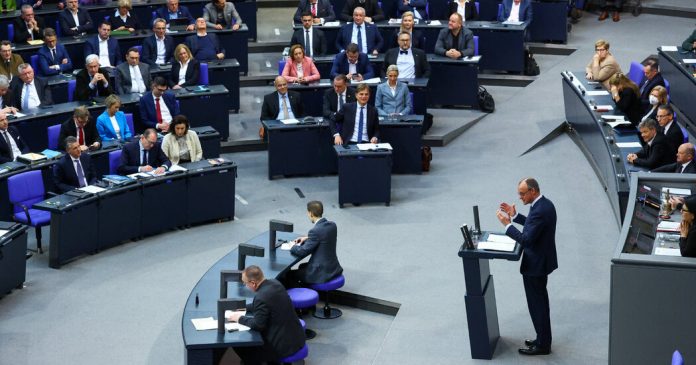
The German Parliament is set to vote on Tuesday on a plan to loosen government borrowing limits in order to spend heavily on defense and infrastructure, in an effort to offset America’s pivot away from Europe and to lift the country out of years of economic stagnation.

If the measure eventually becomes law, it will radically reorient Germany’s relationship to government debt — and, its authors hope, allow Germany to shoulder a more powerful leadership role at a critical moment for Europe.

The center of the plan is a push led by Friedrich Merz, the likely next chancellor, to relax what is colloquially known as the “debt brake,” a limit on government borrowing that Germany enshrined in its Constitution.

That brake has reduced German debt, but it has also kept the government from investing in roads, software, bridges, tanks and other areas. Lawmakers say that spending is now urgently needed to address declining German competitiveness and shrinking American security guarantees.

Here is a quick guide to the debt brake, how Mr. Merz and his allies want to change it, and the challenges they will face.

Like most wealthy nations, Germany borrows money to help balance its annual federal budget. But unlike some peers, most notably the United States, Germany has a Constitution that limits its yearly borrowing to just 0.35 percent of the country’s gross domestic product. There are exceptions for economic downturns and natural disasters.

German lawmakers have voted in recent years to circumvent the limits with some special pots of money, including emergency pandemic spending starting in 2020 and a recent bump in military spending. But by and large, the debt brake has constrained borrowing.

In 2009, when the debt brake was introduced, Germany, the United States and Britain had roughly similar levels of debt as a share of their economies. Since then, that share has soared in Britain and America, but fallen in Germany.

The debt brake was added to Germany’s Constitution after the country’s budget deficit grew during the 2008 financial crisis. It became a signature economic policy and a point of national pride.

But the country’s aversion to large deficits and debt predates the crisis. Its leaders borrowed heavily to help smooth reunification between West and East Germany in the early 1990s, with mixed economic effects. More notoriously, high government debt helped drive hyperinflation in the Weimar government of the 1920s, aiding the rise of Hitler.

That historical trauma has remained a neuralgic pain that has defined the public and political debate around government debt in Germany for generations.

The debt brake didn’t just depress borrowing. Its critics say it also handcuffed German’s ability to spur its economy, invest in its future and lead in European security affairs.

German spending has lagged well behind its needs to upgrade its transportation networks, digitize its public services and make a host of other investments essential to its global competitiveness.

The country’s net public investment has been negative for the last 25 years, holding back economic growth, said Marcel Fratzscher, the president of the German Institute for Economic Research.

The brake was also a major reason German lawmakers spent relatively little on their military for decades, under the belief that the United States would continue to protect their country as it has since the end of World War II.

Now, releasing the debt brake has become urgent as the German economy continues to shrink and President Trump threatens to scale back or remove America’s security role in Europe.

“It’s now or never for a big spending increase,” Mr. Fratzscher said.

Even officials at Germany’s staid central bank, the Bundesbank, have called for changes to the debt brake to free up money for government investment to drive growth.

“Rarely in Germany’s postwar history has government investment been as necessary as it is today — and rarely since reunification have the potential returns been so promising,” economists at the Deutsche Bank Research Institute wrote last week. “Germany has successfully used the good years of the past decade to create fiscal flexibility for more challenging times. And times will likely remain challenging for the rest of the decade.”

After resisting calls for debt-limit changes during the recent election campaign, Mr. Merz, of the center-right Christian Democrats, now says the brake much be changed. So do many center-left lawmakers.

“The reform of the debt brake is of central importance in view of the epochal change that the U.S.A. is no longer Germany’s reliable ally,” Anton Hofreiter, a member of Parliament for the Green Party, said in a text message this week.

With it, he said, “It is now possible to finance satellites, intelligence services, cyberdefense and support for Ukraine alongside the urgently needed upgrading of the Bundeswehr” — the German military.

The agreement Mr. Merz struck with the Greens and the center-left Social Democrats would create an exemption from the debt brake for all spending on defense above 1 percent of gross domestic product. It would define “defense” broadly, to include domestic intelligence, aid to allies and other measures alongside weapons purchases. Effectively, Germany lawmakers could borrow whatever sums the government bond market would allow to fund those items.

Mr. Merz also agreed to create a new infrastructure fund of 500 billion euros — almost $550 billion — spread over 12 years, outside of the debt brake’s limits. Of that, €100 billion would be earmarked for projects to fight climate change.

Good, but hurdles remain.

Having decided to change the Constitution to allow extra borrowing, Mr. Merz has taken the unusual step of passing the measure in the final days of a lame-duck Parliament, before he can even become chancellor.

On Tuesday, with the help of the Greens and Social Democrats, Mr. Merz hopes to get two-thirds of the Parliament’s vote needed to change the Constitution. The margins are slim, and they will depend on some lawmakers who will leave office after this week.

If the vote passes, the change will still need to be approved by the Federal Council of the States on Friday before it can go into effect. That, too, could turn out to be very close.

Even then, the plan faces legal challenges, including from the far-right party Alternative for Germany. Courts have refused to stop the vote thus far.

Lawmakers from the three big centrist parties supporting the package say they are confident they will prevail.

“We should not let this opportunity pass us by — it’s a big opportunity for our country and also a real change in politics,” Mr. Merz said on Sunday.

Israel Carries Out Deadly Strikes in Gaza: Live Updates

0

Prime Minister Benjamin Netanyahu’s sudden attempt to remove the head of Israel’s domestic intelligence agency is the latest salvo in a two-year campaign by the Israeli government to exert more control over different branches of the state.

The move prompted calls on Monday for mass protests and led to criticism from business leaders and the attorney general, summoning memories of the social upheaval in 2023 that was set off by a similar push to reduce the power of state watchdogs.

Mr. Netanyahu’s plan to hold a cabinet vote on the future of Ronen Bar, the head of the agency known as the Shin Bet, was announced less than a month after his government announced a similar intention to dismiss Gali Baharav-Miara, the Israeli attorney general. It also came amid a renewed push in Parliament by Mr. Netanyahu’s right-wing coalition to give politicians greater control over the selection of Supreme Court justices.

These moves mark a return to Mr. Netanyahu’s failed efforts in 2023 to reduce the power of institutions that had acted as a check on his government’s power, including the Supreme Court and the attorney general.

That program — often described as a judicial overhaul — proved deeply divisive, setting off months of mass protests and widening rifts in Israeli society. The campaign was suspended only after the Hamas-led attack on Israel in October 2023 revived a sense of national unity.

Now, amid a shaky cease-fire in Gaza, the easing of tension appears to have ended.

“The removal of the head of the Shin Bet should not be seen in isolation,” said Amichai Cohen, a law professor and fellow at the Israel Democracy Institute, a Jerusalem-based research group. “It’s part of the general trend of taking on these independent agencies and increasing the power of the executive.”

“The judicial overhaul is back,” Professor Cohen added.

Months of mass protests took place in 2023 against Mr. Netanyahu’s judicial overhaul plan.Credit…Avishag Shaar-Yashuv for The New York Times

The attempt to fire Mr. Bar prompted calls on Monday from opposition leaders and grass-roots activists for Israelis to demonstrate outside the government headquarters in Jerusalem on Wednesday, when the cabinet is set to vote on Mr. Bar’s future. A coalition of 300 major business leaders also issued a rare statement, criticizing Mr. Bar’s dismissal.

Ms. Baharav-Miara, the attorney general, issued a statement saying that Mr. Netanyahu could not begin the process of firing Mr. Bar until it was determined whether it would be lawful to do so. She said there were concerns that it would be a conflict of interest for Mr. Netanyahu — raising the prospect of a constitutional crisis if the prime minister ignored her warning.

In response, Mr. Netanyahu said that the cabinet would listen to her analysis before their vote. But he added that her intervention constituted “a dangerous undermining — and not the first — of the government’s explicit authority.”

The clash evoked similar bitter disputes in 2023, when hundreds of thousands held weekly protests against the government’s earlier attempt to overhaul the judiciary and the business leaders at one point joined labor unions to hold a national strike.

The immediate context to the attempt to fire Mr. Bar was a personal dispute between the security chief and the prime minister. For months, Mr. Bar had angered Mr. Netanyahu by investigating officials in the prime minister’s office over claims that they had leaked secret documents and also worked for people connected to Qatar, an Arab state close to Hamas. Mr. Netanyahu has denied wrongdoing; the Qatari government did not respond to requests for comment.

The final straw for Mr. Netanyahu, analysts said, was most likely a rare public intervention last week from Mr. Bar’s predecessor, Nadav Argaman. In a television interview, Mr. Argaman said he might reveal further accusations of wrongdoing by the prime minister if he believed that Mr. Netanyahu was about to break the law.

Such comments from a close ally of Mr. Bar were “too much” for Mr. Netanyahu, said Nadav Shtrauchler, a former adviser to the prime minister. “He saw it as a direct threat,” Mr. Shtrauchler said. “In his eyes, he didn’t have a choice.”

But the broader context, analysts said, is a much wider dispute between Mr. Netanyahu’s right-wing alliance and its opponents about the nature and future of the Israeli state.

Mr. Netanyahu’s governing coalition is formed from parties that variously represent ultrareligious Jews seeking to preserve their privileges; and settler activists aiming to deepen Israel’s control over the West Bank and further curb Palestinian rights.

For years, these groups have resented the independence of watchdogs like the judiciary, the attorney general and the security services, which have variously moved to limit some privileges for the ultra-Orthodox; block certain moves by the settler movement; and prosecute Mr. Netanyahu for corruption. He is standing trial on charges that he denies.

Mr. Netanyahu’s effort to fire Ronen Bar, the Shin Bet head, underscored longstanding tensions between the prime minister and leading members of Israel’s security establishment.Credit…Yossi Zeliger/Agence France-Presse — Getty Images

The government and its supporters say that reining in the judiciary and other gatekeepers like the Shin Bet actually enhances democracy by making lawmakers freer to enact what voters elected them to do. They also say that Mr. Bar should resign for failing to prevent the Hamas-led Oct. 7, 2023, attack that ignited the war in Gaza.

The Shin Bet has “poked their noses into matters of governance, control, values, social cohesion and, of course, democracy,” Eithan Orkibi wrote in column on Monday for Israel Hayom, a right-wing daily newspaper. After Mr. Bar’s dismissal, Mr. Orkibi continued, the Shin Bet will “slowly be returned to their natural professional territory.”

But the opposition says such moves would damage democracy by removing a key check on government overreach, allowing Mr. Netanyahu’s coalition — the most conservative and nationalist in Israel’s history — to create a less pluralist and more authoritarian society. The opposition argues that Mr. Netanyahu should also take responsibility for the Oct. 7 attack, not just Mr. Bar.

“With a submissive coalition of yes men, Netanyahu is on his way to dismantling all of Israel’s gatekeepers,” Barak Seri wrote in a column for Maariv, a center-right daily. “To dismantling everything that is protecting Israel as we have known it since its establishment.”

In a separate development, the Israeli military said it had conducted strikes in central and southern Gaza against people trying to bury explosives in the ground. Hamas said the victims were civilians. While Israel and Hamas are formally observing a cease-fire, negotiations to formalize the truce have stalled and Israel is conducting regular strikes on what it says are militant targets. Hamas has said the strikes have killed more than 150 people, some of them civilians.

Reporting was contributed by Myra Noveck from Jerusalem, Johnatan Reiss from Tel Aviv and Abu Bakr Bashir from London.

DOGE staff enter the U.S. Institute of Peace with D.C. police help

0

The U.S. Institute of Peace, a think tank funded by Congress, was the scene of a hostile takeover by the Department of Government Efficiency. DOGE has tried to install new leadership at the institute.