

Republican lawmakers are fielding critical questions on the economy. Senate Minority Leader Chuck Schumer may face backlash for the short-term spending bill passed by the Senate Friday afternoon.
Syrian Druse Pilgrims Pay Rare Visit to Israel

A delegation of Syrian Druse made a rare visit to Israel over the weekend for a pilgrimage to a shrine as Israel seeks to extend its influence inside Syria after the fall of the dictator Bashar al-Assad.
Both Israel and Syria have sizable minorities who belong to the Druse sect — an Arabic-speaking religious minority scattered across the Levant region. But with Israel and Syria formally at war for decades, Syrian Druse were generally unable to enter Israel to visit sites holy to their faith.
Sheikh Muwafaq Tarif, a Druse leader in Israel who helped organize the two-day visit, said roughly 100 people arrived on Friday in a convoy from Syrian territory. They also visited the Tomb of the Prophet Shuaib in the northern Galilee region of Israel, a site deeply revered in their faith.
“After being cut off for decades, to see our people arriving in our country — it’s a moment of great joy,” said Mr. Tarif, adding that he knew most of the visitors only from phone conversations, given the great difficulty of traveling between the two countries.
In Israel, many Druse hold Israeli passports, serve in the national military and are viewed as loyal “brothers in arms.” Others in the Golan Heights, territory that Israel captured from Syria in the 1967 Middle East war, still hold Syrian identity and have Israeli residency cards, not citizenship.
Since the collapse of Mr. al-Assad’s dictatorship in early December, Israel has launched a barrage of airstrikes on Syria which it says are aimed at preventing hostile forces from massing near its borders. But the moves have prompted fears among Syrians of a protracted Israeli occupation of Syrian territory.
At the same time, Israel has reached out to the Syrian Druse, many of whom live in villages and cities in southern Syria, as potential partners.
The Druse militias in Syria are under pressure to integrate into a unified national military that the new president is trying to establish. Israeli officials have suggested that Israel could intervene on behalf of the Druse, including militarily, if they came under threat from government forces.
David Mencer, an Israeli government spokesman, said this week that Israel was “prepared to defend, if needed, the Druse population in Syria from the forces of the new regime.” The major Syrian Druse militias flatly rejected the offer.
Israel Katz, the Israeli defense minister, said this week that Israel was preparing to allow some Syrian Druse into Israel to work in the Golan Heights.
The Druse belong to a sect that broke away from Islam roughly 1,000 years ago, ultimately becoming a separate religion. Its members, now scattered between Syria, Lebanon, Jordan and northern Israel, have often found themselves on opposing sides of conflicts in the region.
Since the fall of Mr. al-Assad, Israeli troops have marched into Syrian territory, seizing a 155-square-mile buffer zone and bombarding targets across the country. Israeli officials have denounced the new government in Damascus for its Islamist leadership and said that their forces will remain in Syrian territory for the foreseeable future.
The new Syrian president, Ahmed al-Shara, has called on the international community to pressure Israel to withdraw. He has also maintained that his government poses no threat to its neighbors or to religious minorities like the Druse because Syrians are weary of war.
After Schumer's abrupt U-turn to pass the spending bill, what comes next for Democrats?

House Democrats trumpeted unity at their annual retreat only to be blindsided by their Senate counterparts who gave critical votes to pass a Republican spending bill.
U.S. Puts Sanctions on Thai Officials for Sending Uyghurs to China
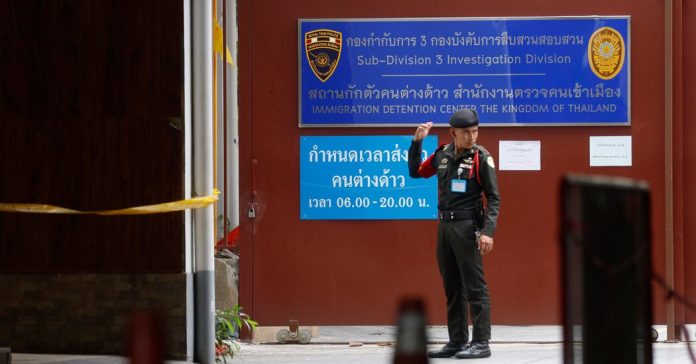
The United States has imposed visa sanctions on several Thai officials over the surprise deportation of 40 Uyghurs back to China last month, a rare instance of punishment for countries that have repatriated members of the persecuted Muslim minority despite warnings that they might face torture and long-term imprisonment upon their return.
The visa restrictions could limit the ability of former and current Thai officials responsible for, or complicit in, the forced return of Uyghurs, to travel to the United States. The State Department did not disclose the officials’ names, citing confidentiality.
“We are committed to combating China’s efforts to pressure governments to forcibly return Uyghurs and other groups to China, where they are subject to torture and enforced disappearances,” Secretary of State Marco Rubio said in a statement on Friday.
The move came a day after the European Parliament passed a resolution condemning the deportation and calling on Thailand to “halt any further forced returns of refugees to countries where their lives are at risk.”
The dual announcements could complicate matters for the Thai government at a tricky time. The Thai authorities are trying to ward off potential tariffs from the United States, with which the country has a $35 billion trade deficit. They are also trying to wrap up a free-trade agreement with the European Union.
China has used its power and influence to silence its critics abroad and pressure governments to repatriate citizens fleeing persecution. In recent years, the government has detained as many as one million Uyghurs and others in internment camps and prisons, stepped up birth control measures for Muslim women and placed Muslim children in boarding schools.
Julian Ku, a Hofstra University law professor who is a close observer of U.S. policy on Uyghurs, said on social media that the visa restriction policy was “a pretty dramatic step,” and that he could not “recall this kind of sanction on third-party countries before.”
Thailand’s vice minister for foreign affairs said this month that the deportation of the Uyghurs was in the country’s best interest because of the possibility of retaliation from Beijing if they were sent elsewhere. He said that some countries had offered to resettle the Uyghurs, but he described the offers as “unrealistic” given that resettling them would not shield Thailand from a potential fallout with China.
Global Times, a state-owned newspaper in China, denounced the U.S. visa policy as “hypocritical meddling in China’s internal affairs under the guise of human rights.”
Here’s what’s ahead with mass layoffs at federal agencies : NPR
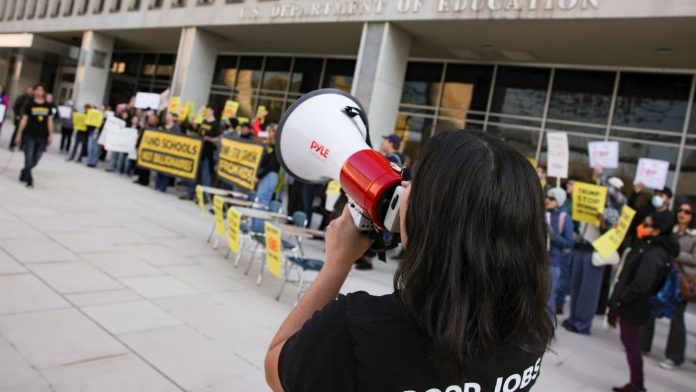
Demonstrators gather outside the U.S. Department of Education in Washington, D.C., on Thursday to protest against planned mass layoffs at the agency.
Bryan Dozier/Middle East Images/AFP via Getty Images
hide caption
toggle caption
Bryan Dozier/Middle East Images/AFP via Getty Images
Federal agencies have begun to announce plans to implement President Trump’s request for large-scale job cuts and the elimination of government functions.
Already, the Department of Education is moving forward with a proposal to get rid of nearly half its workforce, the Department of Veterans Affairs is targeting a reduction of 80,000 employees and the Social Security Administration has offered voluntary buyouts ahead of a reduction in force.
The outlined changes are in service of Trump’s vision of drastically reducing the size and scope of the federal government — an effort that has been led so far by Elon Musk and his Department of Government Efficiency (DOGE).
Tens of thousands of employees on probationary status — typically those new to government or who have recently started in a new role — have been fired, though these terminations have been challenged in court and the administration has been ordered to issue sweeping job reinstatements.


But the firings of probationary workers, DOGE’s cuts and a broad hiring freeze are just initial elements of an effort to stop spending on people and programs that the president does not want to be part of the future of the federal government.
In the coming months, agencies are directed to continue restructuring their programs and personnel, canceling contracts and consolidating government buildings — while also increasing productivity and delivering “better service for the American people.”
Here’s what to know about the restructuring plans:
What are agencies supposed to do?
A Feb. 26 memo from the leaders of the Office of Personnel Management (OPM) and the Office of Management and Budget (OMB) spelled out how to meet Trump’s demand for a “workforce optimization initiative.”
Federal agency plans, according to the memo, should focus on identifying “statutorily mandated” functions and seek to achieve five things:
- Better service for the American people;
- Increased productivity;
- A significant reduction in the number of full-time equivalent (FTE) positions by eliminating positions that are not required;
- A reduced real property footprint; and
- Reduced budget topline.
Agencies were also encouraged to cut back on layers of management and the use of consultants and contractors, and to consider consolidating field offices.
As NPR has previously reported, the General Services Administration and DOGE made plans to shed up to 25% of the government’s 360 million square feet of real estate, including closing Social Security buildings, IRS taxpayer assistance centers and Bureau of Indian Affairs offices across the United States.

Agencies were supposed to submit initial reorganization proposals by Thursday, as well as timelines for implementing each part of their plans to eliminate positions and functions.
What does implementing Trump’s plan look like?
Federal agencies have some leeway in how many employees they let go and when they do, but federal law is specific about the process that must be followed. OPM has a 119-page handbook that details how a reduction in force (RIF) and other workforce restructuring must be done.
On Thursday, both federal judges who reinstated fired workers emphasized that the government has the right to reduce its workforce, but it has to follow the law in doing so.
The first step in a RIF is identifying positions and areas that may be affected, which OPM in this case says should have been done by Thursday.
From there, agencies are supposed to consider other strategies, like voluntary early retirement authority (VERA) and voluntary separation incentive payment (VSIP), to find employees who choose to leave, before a RIF takes place.
VERA allows agencies to temporarily lower age or years-of-service thresholds to qualify for retirement, while VSIP is a buyout of up to $25,000 for employees who choose to leave.

For agencies that move forward with a RIF, they may need to notify unions or Congress, and then they must draft official notices to send to affected employees. These notices must include certain information like the reasons for the RIF and the effective date.
Employees must be given 60 days’ notice of their end date, unless OPM grants a waiver to shorten that period to 30 days.
What cuts do we know about so far?
Certain agencies have been targeted early by the Trump administration for dismantling. Some have been revealing details about their reorganization plans in broad public pronouncements; others have been obtained by NPR. Some plans will affect tens of thousands of employees; others are smaller, so far.
Here’s some of what’s known, as of Friday afternoon:
— The U.S. Agency for International Development has been effectively shuttered by the DOGE initiative, and Trump officials said most of its contracts have been canceled.
— The Education Department will cut nearly 50% of its staff. More than 1,300 positions will be eliminated through the RIF — plus about 600 people took the “Fork” deferred resignation offer or the department’s VSIP offer. Affected employees will be placed on administrative leave starting March 21 and will receive full pay and benefits until June 9, 90 days after the department announced its RIF plans.
— The VA aims to “return to our 2019 end-strength numbers of 399,957 employees,” according to an internal memo obtained by NPR, which would be a reduction of roughly 80,000 employees. A specific RIF plan will be developed soon, the memo says.
— A Defense Department memo, obtained by NPR this week, calls for the elimination of probationary positions that are “non-mission critical” in an effort to reduce the civilian workforce by 5% to 8%, targeting at least 55,000 jobs. The Pentagon has some 780,000 civilian employees.
The memo says it will start by seeking job cuts through early retirement and voluntary separations, “which must be fully realized by June.” Managers are expected to provide their plans no later than March 20.
— The Social Security Administration announced Feb. 28 that it would aim to slash 7,000 jobs.
— In recent weeks, the General Services Administration‘s Public Buildings Service has fired more than 1,000 permanent and probationary employees and has sent RIF notices to eliminate nearly the entire staff in three of 11 regions across the country.
— The National Oceanic and Atmospheric Administration is planning to cut more than a thousand employees, according to information shared with NPR by a NOAA employee who was not authorized to speak publicly.
What comes next?
As agencies move forward with eliminating positions, they must submit another set of plans by April 14 outlining a “positive vision for more productive, efficient agency operations,” according to the OPM/OMB memo.
This includes proposed relocations of people and offices outside the Washington, D.C., area, changes to regulations or agency policies to help facilitate downsizing and more details about the implementation of RIFs.
For agencies that provide direct services to citizens, they must also include explanations of why the reduction in staff and resources will “have a positive effect on the delivery of such services.”
Agencies will deliver monthly progress reports and are expected to wrap up the process by the end of the fiscal year, Sept. 30.
Have information you want to share about agency reduction-in-force plans and other changes to the federal government? Reach out to this author through encrypted communications on Signal: Stephen Fowler is at stphnfwlr.25.
With reporting by NPR’s Tom Bowman, Quil Lawrence, Shannon Bond, Jenna McLaughlin and Alejandra Borunda.
A Hectic Week in Canadian Politics and Trade, With More Action on the Way
[Listen to “The Daily”: Elbows Up: Canada’s Response to Trump’s Trade War]
What’s next: Mr. Ford, along with Dominic LeBlanc, the new international trade minister, and François-Philippe Champagne, the new finance minister, met with their counterparts in Washington: Howard Lutnick, the U.S. commerce secretary, and Jamieson Greer, the U.S. trade representative. The message they received, Matina reports, is “there was no way Canada, or any other country in President Trump’s cross hairs, could avoid a new round of sweeping tariffs on April 2.”
[Read: Tariff Pain First, Deals Later, U.S. Tells Canada in Key Meeting]
Those tariffs will be “reciprocal” — that is, the United States will apply the same tariffs against exports from Canada that Canada puts on exports from the United States.
Because of the U.S.M.C.A. (or CUSMA, as it’s called in Canada), the free trade agreement signed under the first Trump administration, Canada has relatively few tariffs on American imports aside from some farm products, particularly dairy, that are part of the supply management system. So, in theory, reciprocal tariffs may have relatively little effect.
But there is a wild card. Mr. Trump sees value-added taxes, like the goods and services tax, as tariffs because they are not applied to exports — a view not shared by most trade economists. How Mr. Trump might go after the G.S.T., and how that could affect trade between Canada and the United States, is unclear.
A much larger trade problem may explode on April 2, when Mr. Trump’s suspension of a sweeping and potentially devastating 25 percent tariff on most Canadian exports and a 10 percent tariff on energy and some minerals expires. (Those charges are already being imposed on some Canadian exports that are not certified as complying with the U.S.M.C.A.’s North American content rules.)
Why people are arguing Nazi salutes are just a joke : NPR
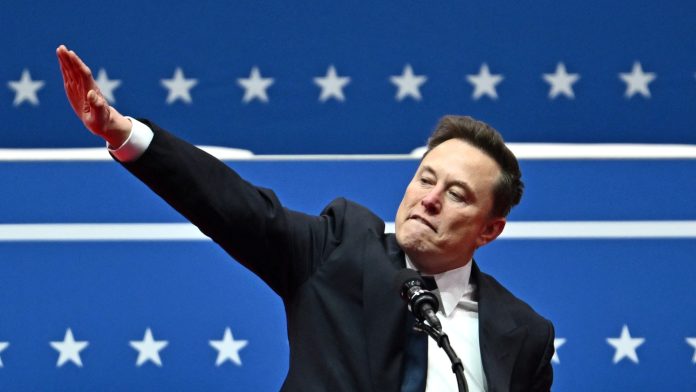
Elon Musk salutes as he speaks during an inaugural event in Washington, DC, on Jan. 20, 2025.
Angela Weiss/AFP via Getty Images
hide caption
toggle caption
Angela Weiss/AFP via Getty Images
The stiff-armed, fascist salute used to have a fairly narrow meaning.
“I think generally most people still find the Sieg Heil to be indicative and reminiscent of World War II, the Holocaust,” said Kurt Braddock, a communications professor at American University who studies extremist recruitment.
“It signifies that somebody is, if not physically and socially, part of a far right neo-Nazi group, then they at least ideologically align with them,” he said, adding that at times, it’s also been used to signal a kind of nihilistic subversion and nonadherence to what’s socially accepted.

But after one of the world’s richest men, and now a prominent White House advisor, gave two stiff-armed salutes on Inauguration Day with few repercussions, the gesture’s meaning has been expanding again for some, to the great alarm of others. After Elon Musk’s salutes, NPR has counted at least a dozen other people mimicking the salute, many posting public videos themselves. Some have lost jobs — for others, little has changed.
Musk has repeatedly made jokes after the public outcry, including making puns with the names of Nazi leaders like Joseph Goebblels. He did so again recently as a guest on Joe Rogan’s podcast. Musk has endorsed antisemitic tropes on his social media platform X, though he has denied being antisemitic.
Prominent figures on the right have mirrored Musk’s example with no serious repercussions, including Steve Bannon and actor Eduardo Verástegui at the Conservative Political Action Conference in February.
Examples are also accumulating daily of ordinary people recreating the spectacle. Online, anonymous posters say they’re seeing the salutes from coworkers, customers, armed service members and students. This week, an Israeli student was arrested at the Auschwitz concentration camp in Poland for reportedly trying to spoil a class picture with the gesture.

Former Trump advisor Steve Bannon, speaks at the Conservative Political Action Conference in Oxon Hill, MD on on Feb. 20, 2025. Bannon delivered the same straight-arm salute that Musk had the month before.
DOMINIC GWINN/Middle East Images/AFP via Getty/AFP
hide caption
toggle caption
DOMINIC GWINN/Middle East Images/AFP via Getty/AFP
Some people have been fired or resigned from their jobs over the salutes, including the CEO of an Idaho construction company, a Texas realtor, a county official in Pennsylvania and a priest in Michigan.
“They’re not insulated by political power in the same way that Bannon and Musk” are, said Braddock, “so although they might feel as though they’re part of this subversive little in-group, they are not going to get the same benefits … that the elites do.”
Calvin Robinson, the Michigan priest and right-wing political commentator, had his U.S. visa temporarily revoked and lost his license to minister to Anglican Catholic churches after capping off an anti-abortion speech with the salute. Both he and his supporters have tried to raise money following the backlash. Robinson said he’s not a Nazi, but that he’s not sorry and described the salute as a joke.
“Yes it was cheeky,” said Robinson on his Youtube show. “I am cheeky, first and foremost. But it wasn’t immoral. It wasn’t unethical. I didn’t bring the church into disrepute.” Robinson didn’t respond to an interview request from NPR.
What is and isn’t a joke
The “Overton window” is a concept in political science that describes what public conversation is acceptable in the mainstream in a given timeframe.
“What a joke does is that it throws a brick right through the Overton window and it smashes it. And in doing so, I think it opens up the space for others to say equally provocative and norm-breaking things,” said Nick Butler, the author of The Trouble with Jokes: Humour and Offensiveness in Contemporary Culture and Politics. He researches organizational studies at Stockholm University.
Jokes create in-groups and out-groups of those who are laughing and those who are not. Butler described jokes as a kind of sonar that detects like-mindedness.
Butler said humor has been celebrated as a form of emancipation and pushing back against oppressors or authoritarians. But he argued that comedy is a tool that can be used by anyone, including “some pretty problematic actors who want to destroy the key tenets of liberal democracy.”
“I think some have tried to kind of put boundaries between: ‘Ok, this, we can call humor, because it ‘punches up’ rather than ‘punches down,'” said Butler. “But if someone is laughing, then we have to accept that it is some kind of humorous intervention and it is a joke of some kind.”
Part of the power of offensive humor, he said, is also that it lays a kind of trap for anyone hearing it who’s uncomfortable or feels motivated to stick up for democratic values.
“You can accuse them of being oversensitive, lacking a sense of humor. Basically you can accuse them of being an insufferable killjoy. And no one wants to be an insufferable killjoy,” said Butler.
‘We’re the fun ones’
Ridiculing critics as humorless is a strategy that’s been cultivated for years by figures on the right, said Nick Marx, a media studies professor at Colorado State University and the co-author of That’s Not Funny: How the Right Makes Comedy Work for Them.
“Part of what you’re seeing is an experimentation period — seeing what you can and cannot get away with. But it’s all in support of the right’s bigger goal of saying: ‘Hey, come over here, we’re the fun ones,'” said Marx.
He noted that while the right may have seen success in depicting itself as a home for comedy and free expression, Republican policies continue to target LGBTQ and reproductive rights, protestors and hundreds of words perceived as “woke.”

A reveler disguised as President Trump walks next to a car bearing a picture of Elon Musk’s salute during the yearly carnival parade in the streets of Aalst, Belgium on March 2, 2025.
Nicolas Maeterlinck/AFP via Getty Images
hide caption
toggle caption
Nicolas Maeterlinck/AFP via Getty Images
Marx said while it’s not clear that right-wing comedy is more popular or profitable than more other kinds of comedy, “if we’re talking about political outcomes and whether comedy has successfully supported one side or the other’s political outcomes, I think the results speak for themselves.”
Protestors seize on the salute
Days after Inauguration Day, a still shot of Musk’s salute was projected onto a Tesla factory in Berlin along with the words “Heil Tesla.” It’s one of several examples of the image and Musk’s general likeness that have been reproduced as forms of protest against Musk and his companies. More recently, some Tesla drivers have reported seeing Nazi salutes from people expressing anti-Musk outrage.
Regardless of intent, stiff-armed salutes are protected speech under the Constitution. But as for those performing them as jokes, Braddock, the extremism researcher, warned that ordinary people should understand they are far more likely to face social and professional repercussions than the political elites they may be imitating.
“It’s not going to matter to your employer,” said Braddock. “And unfortunately, it’s not going to matter to the hard line neo-Nazis, the hard line right-wing extremists who are looking for an excuse to normalize their ideologies and begin engaging in violence on behalf of those ideologies.”
Bread Lines and Salty Drinking Water: Israeli Aid Block Sets Gaza Back Again
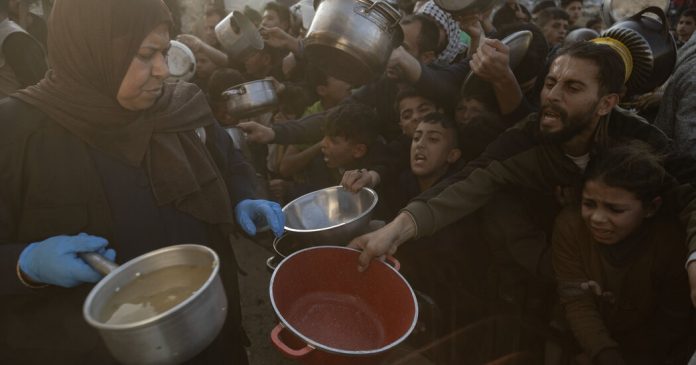
Outside the Zadna Bakery in central Gaza one recent afternoon, the long lines of people waiting for bread were threatening to dissolve into chaos at any minute.
A security guard shouted at the crowds that pushed toward the bakery door to wait their turn. But no one was listening.
Just a few steps away, scalpers were hawking loaves they had gotten earlier that day for three times the original price. The sunset meal that breaks Muslims’ daylong fast during the holy month of Ramadan was approaching and across Gaza, bread, water, cooking gas and other basics were hard to come by — once again.
Lines had not been this desperate, nor markets this empty, since before the Israel-Hamas cease-fire took hold on Jan. 19. The truce had allowed aid to surge into Gaza for the first time after 15 months of conflict during which residents received only a trickle of supplies.
But no aid has gotten in since March 2. That was the day Israel blocked all goods in a bid to pressure Hamas into accepting an extension of the current cease-fire stage and releasing more hostages sooner, instead of moving to the next phase, which would involve more challenging negotiations to permanently end to the war.
Now, the aid cutoff, exacerbated by panic buying and unscrupulous traders who gouge prices, is driving prices to levels that few can afford. Shortages of fresh vegetables and fruit and rising prices are forcing people to once again fall back on canned food such as beans.
Though the canned food provides calories, experts say, people — and children in particular — need a diverse diet that includes fresh foods to stave off malnutrition.
For the first six weeks of the cease-fire, aid workers and traders delivered food for Gazans, many still weak from months of malnutrition. Medical supplies for bombed-out hospitals, plastic pipes to restore water supplies and fuel to power everything also began to flow in.
Data from aid groups and the United Nations showed that children, pregnant women and breastfeeding mothers were eating better. And more centers started offering treatment for malnutrition, the United Nations said.
These were only small steps toward relieving the devastation wrought by the war, which destroyed more than half of Gaza’s buildings and put many of its two million residents at risk of famine.
Even with the sharp increase in aid after the truce began, Gaza health officials reported that at least six newborn babies had died from hypothermia in February for lack of warm clothes, blankets, shelter or medical care, a figure cited by the United Nations. The reports could not be independently verified.
Most hospitals remain only partly operational, if at all.
Aid groups, the United Nations and several Western governments have urged Israel to allow shipments to resume, criticizing its use of humanitarian relief as a bargaining chip in negotiations and, in some cases, saying that the cutoff violates international law.
Instead, Israel is turning up the pressure.
Last Sunday, it severed electricity supplies to the territory — a move that shuttered most operations at a water desalination plant and deprived about 600,000 people in central Gaza of clean drinking water, according to the United Nations.
The Israeli energy minister has hinted that a water cutoff might be next. Some wells are still functioning in central Gaza, aid officials say, but they supply only brackish water, which poses long-term health risks to those who drink it.
Israel had already closed off all other sources of electricity that it used to provide for Gaza, a measure that followed the Oct. 7, 2023, Hamas-led attack on Israel that began the war. That left essential services to run on solar panels or generators, if power was available at all.
Now there is no fuel coming in for anything, including generators, ambulances or cars.
Israel argues that about 25,000 truckloads of aid that Gaza has received in recent weeks have given people sufficient food.
“There is no shortage of essential products in the strip whatsoever,” the Foreign Ministry said last week. It repeated assertions that Hamas is taking over the aid entering Gaza and that half the group’s budget in Gaza comes from exploiting aid trucks.
Hamas has called the aid and electricity cutoffs “cheap and unacceptable blackmail.”
Gaza residents say that, for the moment, at least, they do have food, though often not enough.
But supplies that humanitarian groups amassed in the first six weeks of the cease-fire are already dwindling, aid officials warn. That has already forced six bakeries in Gaza to close and aid groups and community kitchens to reduce the food rations they hand out.
The order to block aid also cut off Gaza’s access to commercial goods imported by traders.
In the city of Deir al-Balah in central Gaza, a street market was quiet this week as the vendors’ stocks of fruits, vegetables, oil, sugar and flour ran low. Vegetable sellers said the price of onions and carrots had doubled, zucchini had nearly quadrupled and lemons cost nearly 10 times as much. Eggplants were hard to find and potatoes impossible.
As a result, the sellers said, the few customers who still came bought only a couple of vegetables, not by the kilogram as many once did. Others had not had the means to buy anything for months.
Many Gazans lost their jobs and spent their savings to survive the war. When prices skyrocketed, they were left almost completely reliant on aid.
Yasmin al-Attar, 38, and her husband, a driver, wandered from stall to stall in the Deir al-Balah market, looking for the cheapest prices on a recent day. They have seven children, a disabled sister and two aging parents to support.
It had been hard enough to afford the bare minimum of ingredients for iftar, the meal that breaks the daily fast during Ramadan, Ms. al-Attar said. But with fuel blocked, it was also getting tough to find fuel for her husband’s car and for cooking.
“Just three days ago, I felt a little relief because prices seemed reasonable,” she said. Now, the same money would only be enough for a much smaller quantity of vegetables.
“How can this possibly be enough for my big family?” she said.
That night, she said, they would probably make do with lentil soup, with no vegetables. And after that? Maybe more canned food.
Stall owners and shoppers alike blamed large-scale traders for the shortages, at least in part, saying they were hoarding supplies to push up prices and maximize their profits. Any vegetables available at reasonable prices were being snapped up and resold for much more, said Eissa Fayyad, 32, a vegetable seller in Deir al-Balah.
It did not help that people rushed out to buy more than they needed as soon as they heard about the Israeli decision to blockade aid again, said Khalil Reziq, 38, a police officer in the city of Khan Younis in central Gaza whose division oversees markets and shops.
Hamas police officers have warned businesses against price-gouging, vendors and shoppers said. In some cases, Mr. Reziq said, his unit had confiscated vendors’ goods and sold them for cheaper on the spot.
But such measures have done little to solve the underlying supply problem.
Beyond the immediate challenge of supplying food, water, medical supplies and tents to Gazans — many thousands of them still displaced — aid officials said their inability to bring in supplies had set back longer-term recovery efforts.
Some had been distributing vegetable seeds and animal feed to farmers so Gaza could start raising more of its own food, while others had been working on rebuilding the water infrastructure and clearing debris and unexploded ordnance.
None of it was easy, aid officials said, because Israel had restricted or barred items including the heavy machinery required to repair infrastructure, generators and more. Israel maintains that Palestinian militants could use these items for military purposes.
For many Gazans now, the focus is back on survival.
“There’s no bombing at the moment, but I still feel like I’m living in a war with everything I’m going through,” said Nevine Siam, 38, who is sheltering at her brother’s house with 30 other people.
She said her sister’s entire family had killed during the fighting. Her children ask her to make Ramadan meals like the ones they remember from before the war. But without an income, she can get nothing but canned food in aid packages.
Where she is, she said, there are no celebrations and no festive decorations for the holy month.
“It feels as if the joy has been extinguished,” she said.
Erika Solomon, Ameera Harouda and Rania Khaled contributed reporting.
Canada Gets a New Leader Amid Trump’s Trade War

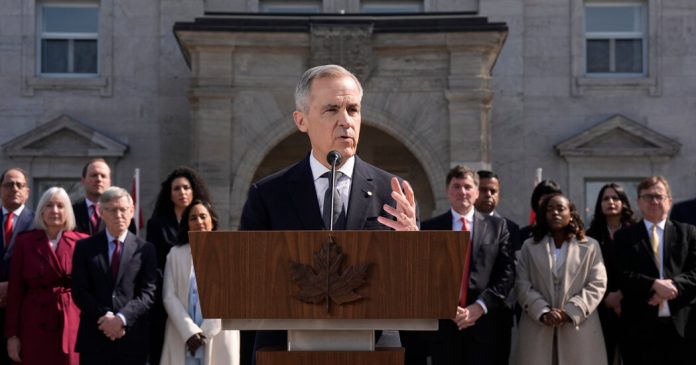
Mark Carney, Canada’s incoming prime minister, is no stranger to crises. Now he faces what is arguably the challenge of a lifetime: President Trump. Matina Stevis-Gridneff, the Canada bureau chief for The New York Times, describes what to know about Mr. Carney.
Trump Tries to Use White South Africans as Cautionary Tale

To hear President Trump and some of his closest supporters tell it, South Africa is a terrible place for white people. They face discrimination, are sidelined from jobs and live under the constant threat of violence or having their land stolen by a corrupt, Black-led government that has left the country in disarray.
The data tell a different story. Although white people make up 7 percent of the country’s population, they own at least half of South Africa’s land. Police statistics do not show that they are any more vulnerable to violent crime than other people. And white South Africans are far better off than Black people on virtually every marker of the economic scale.
Yet Mr. Trump and his allies have pushed their own narrative of South Africa to press an argument at home: If the United States doesn’t clamp down on attempts to promote diversity, America will become a hotbed of dysfunction and anti-white discrimination.
“It plays into the fears of white people in America and elsewhere: ‘We whites are threatened,’” Max du Preez, a white South African writer and historian, said of Mr. Trump’s description of his country.
But, Mr. du Preez added, white people have flourished since the end of apartheid in 1994.
The parallels between South Africa’s attempts to undo the injustices of apartheid and the long struggle in the United States to address slavery, Jim Crow laws and other forms of racial discrimination have become a common refrain among some Trump supporters.
Ernst Roets, a white activist and author in South Africa, said that when he spoke to like-minded conservatives in the United States, they often told him, “Oh, yes, we need to look at South Africa, because that’s what’s in store for us if we’re not cautious.”
After apartheid fell three decades ago, South Africa’s democratic government rose to power on a promise to undo the inequities of a system that had left much of the country’s Black majority in squalor. Yet President Nelson Mandela largely allowed white South Africans to keep their wealth, in an effort to maintain a peaceful transition to democracy.
His party, the African National Congress, has passed laws to try to close the gap for Black people. Most recently, South Africa enacted one that allows the government to take private land in the public interest, sometimes without providing compensation.
The law has not yet been used, but some white South Africans — and Mr. Trump — say it unfairly targets the country’s landowners and commercial farmers, who remain mostly white despite decades of anti-apartheid policies.
Mr. Trump has built his political identity in part as a protector of white America. He has fought to save symbols of the Confederacy in the South, blasted racial sensitivity training as “un-American propaganda” and publicly defended white supremacists.
Cutting off aid to most of Africa while championing Afrikaners — the white ethnic minority in South Africa that led the apartheid government — appears to be the latest illustration of Mr. Trump’s commitment to white interests.
Last month, the president signed an executive order granting refugee status to Afrikaners and suspending all aid to South Africa, partly in response to its land-reform law. He said on social media last week that the United States would offer a rapid pathway to citizenship to South African farmers, many of whom are Afrikaner. Then on Friday, Secretary of State Marco Rubio called South Africa’s ambassador to the United States, Ebrahim Rasool, “a race-baiting politician who hates America” and expelled him.
“Trump is signaling to white people everywhere that he will use his power to protect and advance their interests, no matter the facts,” said Khalil Gibran Muhammad, a professor of African American studies at Princeton University.
Some Afrikaners have welcomed Mr. Trump’s embrace. Activists traveled to Washington last month to lobby his administration for more support. A White House official described the Afrikaner delegation as “civil rights leaders.”
Many of Mr. Trump’s allies have long spotlighted the grievances of Afrikaners. Elon Musk, who was born in South Africa but is not of Afrikaner descent, has accused the country’s government of promoting racist laws, and falsely claimed that white farmers in South Africa were being killed every day.
After Mr. Roets appeared on Tucker Carlson’s Fox News show in 2018, Mr. Carlson posted on social media that “White farmers are being brutally murdered in South Africa for their land.”
Mr. Carlson later ran a segment describing land seizures and homicides. Mr. Trump, who was in his first term at the time, then tagged Mr. Carlson in a social media post in which he said he was ordering an investigation into farm seizures “and the large scale killing of farmers” in South Africa, though to this day no farms have been seized by the government.
In Mr. Trump’s orbit, these themes are now being recirculated as warning signs for the United States.
Mr. Roets said in an interview that he had become close to Jack Posobiec, the American far-right influencer who recently accompanied Defense Secretary Pete Hegseth on a trip to Europe.
During an earlier conversation with Charlie Kirk, an influential Trump ally, Mr. Posobiec said that South Africa was in shambles because of its laws meant to produce racial equity. He added that the United States was headed down the same path by hiring “on the basis of race, gender and sexual orientation.”
Many South African voters, regardless of their race, agree that the African National Congress has created a country plagued by corruption, poor infrastructure, high crime and inequality, with persistent poverty among Black people. In the last election, the party lost its outright majority in Parliament for the first time since the end of apartheid.
Analysts note that the party went to great lengths to embrace market-oriented policies that allowed white South Africans to maintain their economic power. In fact, many South Africans criticize Mr. Mandela for not requiring a more aggressive redistribution of white-owned land to Black South Africans, whose families had been forced off of it during apartheid and colonial times.
Supporters of the new land law hope that it will speed up the long-held goal of giving back more land to Black South Africans.
But to Mr. Trump, it is Afrikaners who are the “victims of unjust racial discrimination,” as he said in his executive order signed last month.
Descended primarily from Dutch colonizers who arrived in southern Africa in 1652, Afrikaner people became international darlings in the early 1900s as a small tribe that stood up to the mighty British Empire in battles over territory (though they ultimately lost the war). The ruling British then looked down on Afrikaners as uncouth, and those fights sowed bitter divisions between South Africa’s two largest white populations that exist to this day.
While the president has generally tried to prohibit refugees or asylum seekers from entering the United States, he has carved out a special avenue for some white Africans to come into the country.
That has not necessarily lined up with the wishes of his target audience. Many Afrikaners have said that while they appreciate Mr. Trump supporting their claims of persecution, they would rather stay in South Africa, which they consider their rightful home.
Willem Petzer, an Afrikaner online influencer whose social media posts have been shared by Trump supporters, said he was considering Mr. Trump’s offer. But he said he hoped more than anything that South Africa’s government would end what he called its racism toward people who look like him.
“By the time I was a conscious human being, apartheid had been long gone,” Mr. Petzer, 28, said. “All I have ever known is discrimination against white people.”
That sort of rebranding of Afrikaners as victims has great resonance among the American far-right, said Mr. du Preez, the Afrikaner writer and historian, who founded the first anti-apartheid newspaper in Afrikaans.
“They’re playing on the thing of the white Christian civilization being threatened,” he said. “And that has a lot of appeal among the evangelicals and others in the United States.”
Zolan Kanno-Youngs contributed reporting from Washington.