Thursday, November 12, 2026
Home Blog Page 121

Trump orders strikes on Iran-backed Houthi rebels in Yemen and issues new warning : NPR

0

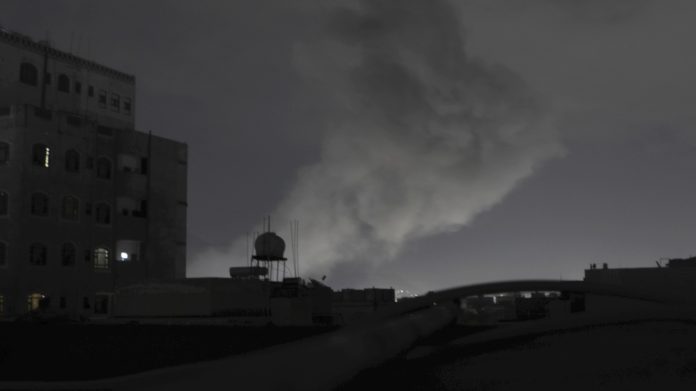
Smoke rises from a location reportedly struck by U.S. airstrikes in Sanaa, Yemen, on Saturday.

Osamah Abdulrahman/AP


hide caption

toggle caption

Osamah Abdulrahman/AP

WEST PALM BEACH, Fla. — President Trump said he ordered a series of airstrikes on Yemen’s capital, Sanaa, on Saturday, promising to use “overwhelming lethal force” until Iranian-backed Houthi rebels cease their attacks on shipping along a vital maritime corridor. The Houthis said nine civilians were killed.

“Our brave Warfighters are right now carrying out aerial attacks on the terrorists’ bases, leaders, and missile defenses to protect American shipping, air, and naval assets, and to restore Navigational Freedom,” Trump said in a social media post. “No terrorist force will stop American commercial and naval vessels from freely sailing the Waterways of the World.”

He also warned Iran to stop supporting the rebel group, promising to hold the country “fully accountable” for the actions of its proxy. It comes two weeks after the U.S leader sent a letter to Iranian leaders offering a path to restarting bilateral talks between the countries on Iran’s advancing nuclear weapons program that Trump has said he will not allow to become operational.

The Houthis reported a series of explosions in their territory Saturday evening. Images circulating online showed plumes of black smoke over the area of the Sanaa airport complex, which includes a sprawling military facility.

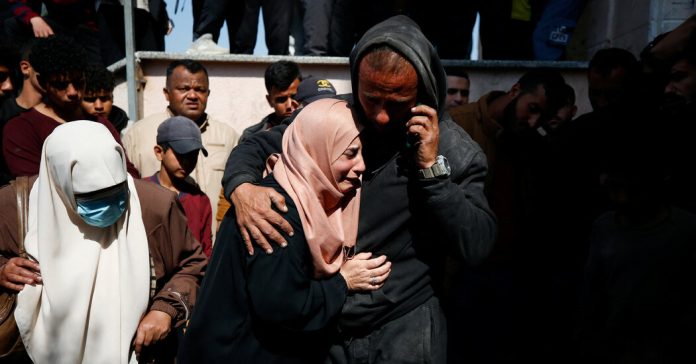
At least nine people were killed, said Anees al-Asbahi, spokesman for the Houthi-run health ministry. In a statement on social media, he said another nine were wounded.

Nasruddin Amer, deputy head of the Houthi media office, said the airstrikes won’t deter them and they would retaliate against the U.S. “Sanaa will remain Gaza’s shield and support and will not abandon it no matter the challenges,” he added on social media.

The airstrikes come a few days after the Houthis said they would resume attacks on Israeli vessels sailing in waters off Yemen in response to Israel’s blockade on Gaza. There have been no Houthi attacks reported since then.

Earlier this month, Israel halted all aid coming into Gaza and warned of “additional consequences” for Hamas if their fragile ceasefire in the war isn’t extended as negotiations continue over starting a second phase.

The Houthis had described their warning as taking hold in the Red Sea, the Gulf of Aden, the Bab el-Mandeb Strait and the Arabian Sea.

The Houthis targeted over 100 merchant vessels with missiles and drones, sinking two vessels and killing four sailors, during their campaign targeting military and civilian ships between the start of the war between Israel and Hamas in late 2023 and January of this year, when a tenuous ceasefire in Gaza took effect.

The attacks raised the Houthis’ profile as they faced economic problems and launched a crackdown targeting dissent and aid workers at home amid Yemen’s decade-long stalemated war that’s torn apart the Arab world’s poorest nation.

The Houthi media office said the U.S. strikes hit “a residential neighborhood” in Sanaa’s northern district of Shouab. Sanaa residents said at least four airstrikes rocked the Eastern Geraf neighborhood in Shouab district, terrifying women and children in the area.

“The explosions were very strong,” said Abdallah al-Alffi. “It was like an earthquake.”

The United States, Israel and Britain have previously hit Houthi-held areas in Yemen. Israel’s military declined to comment.

Saturday’s operation against the Houthis was conducted solely by the U.S., according to a U.S. official. It was the first strike on the Yemen-based Houthis under the second Trump administration, and it comes after a period of relative quiet in the region.

Such broad-based and pre-planned missile strikes against the Houthis were done multiple times by the Biden administration in response to frequent attacks by the Houthis against commercial and military vessels in the region.

The USS Harry S. Truman carrier strike group, which includes the carrier, three Navy destroyers and one cruiser, are in the Red Sea and were part of the mission. The USS Georgia cruise missile submarine has also been operating in the region.

Trump announced the strikes as he spent the day at his Trump International Golf Club in West Palm Beach, Florida.

“These relentless assaults have cost the U.S. and World Economy many BILLIONS of Dollars while, at the same time, putting innocent lives at risk,” Trump said.

Slowly, Ukrainian Women Are Beginning to Talk About Sexual Assault in the War

0

A 77-year-old former high school teacher, turned out in a neat dress and hat, has been creating a quiet revolution in the villages of Kherson region in southern Ukraine.

Standing before a group of 10 women in a tent in the center of a village in Ukraine’s south last summer, she recounted her ordeal three years ago under Russian occupation.

“What I went through,” said the woman, named Liudmyla, her voice wavering. “I was beaten, I was raped, but I am still living thanks to these people.”

Beginning last year, Liudmyla and two other survivors, Tetyana, 61, and Alisa Kovalenko, 37, have spoken at a series of village meetings to raise awareness about conflict-related sexual violence. The meetings have been among the first efforts by survivors of sexual assault to bring into the open one of the most painful aspects of the Russian invasion of Ukraine: what prosecutors and humanitarian workers say is widespread sexual assault of Ukrainian women under Russian occupation.

Liudmyla and Tetyana asked that their surnames and village names not be published to protect their privacy. Ms. Kovalenko has long spoken openly about the assault on her, which occurred in 2014 during the war with Russian-backed separatists in eastern Ukraine.

Relatively few women in Ukraine have come forward to report cases of rape during the conflict because of the stigma attached to sexual assault in Ukrainian society, which is deeply religious and conservative, especially in rural areas. Prosecutors have registered more than 344 cases of conflict-related sexual violence in Ukraine since the Russian invasion in February 2022, 220 of them women, including 16 underage women.

But women’s groups estimate the real number runs into the thousands, with at least one case in almost every village that has been occupied by Russian troops. United Nations human rights reports have documented dozens of crimes of sexual violence committed by Russian soldiers but have not detailed evidence of any abuses by Ukrainian soldiers. A recent report noted only “two cases of human rights violations against alleged collaborators committed by the Ukrainian authorities.”

Support groups and rights organizations have assisted many women with health services and psychological rehabilitation in the 1,800 settlements recaptured from Russian occupation, but said that not all of them were prepared to give testimony to the police. Many victims remain silent and isolated, and in some cases suicidal, according to members of SEMA Ukraine, part of a global community spanning 26 countries that helps survivors of conflict-related sexual violence with psychological, medical, legal and financial support.

Set up in 2019 by Iryna Dovhan, herself a survivor of a vicious assault by armed separatists in eastern Ukraine in 2014, SEMA Ukraine has encouraged 15 survivors to come forward and join its community over the last six months, bringing the total membership to more than 60 — all survivors of sexual violence in war, she said in an electronic message.

This month Ms. Dovhan is leading a group from SEMA Ukraine to the United Nations Commission on the Status of Women, where they will show a film featuring some of Ukraine’s survivors of sexual violence during the war. They are also presenting an appeal, along with a group of Ukrainian male survivors, for Russia to be named by the United Nations secretary general as a party responsible for crimes of sexual violence committed in Ukraine.

Liudmyla was one of the few who reported her assault to the Ukrainian police. Her daughter, Olha, insisted she report the crime once she escaped from Russian-controlled territory. “I was against it,” Liudmyla recalled in an interview, “but Olha said the Russians have to pay. Of course she was right to expose this crime.”

The attack against her as she described it was particularly brutal. A soldier banged on her kitchen door at 10:30 p.m. one night in July 2022. Scared that he would break the door down, she opened it, and the soldier smashed her in the face with his rifle butt, knocking out her front teeth. He dragged her by the hair, hit her repeatedly with his rifle butt in the ribs and kidneys, and threw her on a couch, throttling her. He made cuts on her abdomen with a knife, and then raped her.

“I was helpless against him,” she said. He left six hours later, saying he would come back in two days and kill her with a bullet.

Badly battered, with four broken ribs, Liudmyla hid at a neighbor’s house and later traveled with a family to Ukrainian-held territory to join her daughter.

She subsequently received a diagnosis of tuberculosis and was hospitalized for six months. “I was depressed, I could not eat,” she said.

But two years after the event, she found purpose in speaking to women’s groups. She said it was the community of survivors at SEMA Ukraine that helped her recover.

The SEMA Network was founded in 2017 by Dr. Denis Mukwege of the Democratic Republic of Congo, who has spent decades working with victims of sexual violence during wartime. The network promotes solidarity within communities, bringing women together to speak out and tell their truths, and helping them stand up for their rights. The word SEMA means “speak out” in Swahili.

“Thanks to this community I started to eat,” Liudmyla said.

“I am holding myself together so that the world knows that they are aggressors, and despots, even to civilians,” she said of the Russian forces.

Ms. Kovalenko, a filmmaker who in 2019 became one of the first women to join SEMA Ukraine, has recorded many women’s testimonies for a documentary. “It’s important to talk in these village communities,” she said. “It can help to reduce the level of stigma, so that people understand that they are not being judged.”

Ms. Kovalenko was detained in an apartment and sexually assaulted by a Russian intelligence officer when covering the early conflict in eastern Ukraine in 2014 as a filmmaker. She was one of the first women in Ukraine to speak publicly and to rights organizations about her ordeal.

“Compared to 2019, it is a revolution that women are speaking out now,” she said. “It’s a real revolution when a woman like Mefodiivna speaks out, and Tetyana.” She referred to Liudmyla by her patronymic, Mefodiivna, in a term of respect.

Tetyana, who owns a store with her husband, Volodymyr, in a village in the Kherson region, gave her first interview to a journalist from The New York Times, and spoke for the first time at a village meeting last summer.

Russian soldiers occupying their village frequently visited their store, and when it was closed they would break in. Then one night in April 2022, two soldiers broke into their house. They shot at Volodymyr — he managed to dodge the bullet and hide, she said — but they caught Tetyana as she tried to run away. They pinned her down in the yard, pulling her hair and beating her, and then one of the men raped her. They left only when an artillery attack began on the village.

After months of counseling, and stays in the hospital and refuges, Tetyana said she had discarded feelings of rage and hate but still could not bear the physical touch of a man, including that of her husband. She was unsure whether she would manage to speak at the meeting organized by SEMA Ukraine.

She finally did speak, but kept to a prepared script, explaining the stages of trauma a victim of sexual assault will display, and how to help them.

The most important consideration, she said, was to reassure victims that they are safe.

Over the longer term, she compared the trauma of sexual violence to sand clogged in an hourglass. “If it is blocked, then nothing will pass through,” she said.

It was clear she spoke from experience, but she was talking to women in the audience who had also lived through the terror of occupation. One woman said she had been buried under rubble when her house was hit in a shell strike, while another said she had been forced to host Russian soldiers in her home.

“All of us have some level of vicarious trauma after living in occupied communities,” Tetyana said. “You need to work out your pain so it does not stay inside of you for too long.”

Schumer faces backlash from Democrats, Trump and the DOJ : NPR

0

Republican lawmakers are fielding critical questions on the economy. Senate Minority Leader Chuck Schumer may face backlash for the short-term spending bill passed by the Senate Friday afternoon.


(SOUNDBITE OF ARCHIVED RECORDING)

CHUCK SCHUMER: Donald Trump owns the chaos in government. He owns the chaos in the stock market. He owns the damage happening to the economy.

SCOTT SIMON, HOST:

But Senate Democratic leader Chuck Schumer may end up owning some political pain from the shutdown that wasn’t. NPR’s senior contributor Ron Elving joins us. Ron, thanks so much for being with us.

RON ELVING, BYLINE: Good to be with you, Scott.

SIMON: What is in this spending agreement to keep the government funded, and why might it come back to haunt the minority leader politically?

ELVING: It’s already haunting him. First off, this is not the main event for this year in spending and policy. It’s not the package Trump calls his one big, beautiful bill. That showdown is coming later. Last night was a vote on what’s called a continuing resolution. We sometimes call it a stopgap spending bill. It’s a hangover from last year’s failed budget process, and it keeps the government running even though the regular spending bills were not enacted last year. We’ve been running on these stopgaps since last October. They extend the budgeting resolutions of last year with relatively small changes for defense and domestic spending.

So the real fight this week was over what this resolution did not do. It was written by Republicans in the House and Senate. It did not put up a stop sign or guard rails for Trump and Elon Musk. So the current assault on federal agencies and their employees will continue with the only pushback really coming from the courts. And a lot of Democrats, certainly the House Democrats, thought the Senate Democrats ought to vote no and confront Trump here, even if it meant a shutdown. Here’s House Democratic leader Hakeem Jeffries, yesterday being asked about Schumer’s future.

(SOUNDBITE OF ARCHIVED RECORDING)

UNIDENTIFIED REPORTER: Is it time for new leadership in the Senate?

HAKEEM JEFFRIES: Next question.

ELVING: Yeah. No, the next question. Like no comment.

SIMON: Yeah.

ELVING: Look, Schumer and nine other Democrats decided voting for a resolution they hated was the lesser of two evils. They know Trump will see it as a green light, but they believe a shutdown right now would be worse, like waving a red cape in front of a bull. We’ve seen 21 shutdowns in the last 50 years. They always create chaotic situations, and the executive branch does a lot of scrambling, calling some employees essential and calling others not. That is exactly the kind of power Trump and Musk have been reaching for and trying to get.

SIMON: President Trump went to the Department of Justice yesterday and delivered, like, a political rally speech in what has traditionally been an arm of the government that has steered away from politics. Same time, the courts aren’t exactly cooperating with the president, are they?

ELVING: No, they’re not, and you will never convince Trump or his supporters that the Justice Department has shied away from politics. They think it’s all been about politics because Trump and some of his associates were prosecuted. They see what Trump is doing now as simply payback. Meanwhile, you’re right, the federal courts are proving to be the most effective resistance to Trump, at least temporarily. Two federal judges this week said Trump had to rehire the probationary federal employees he fired at several agencies, and other judges have said he can’t fire people without cause, or he can’t ignore laws or override legal directives.

SIMON: Lots of questions about the economy this week, and here’s Jake Tapper with Montana Senator Tim Sheehy.

(SOUNDBITE OF ARCHIVED RECORDING)

JAKE TAPPER: A new CNN poll out today shows that the public, the American people, are not happy – majority, at least – with President Trump’s handling of the economy. Fifty-six percent say they disapprove. Now that’s the highest disapproval rating on the economy that Trump has seen ever, including in his first term. What do you think is behind it?

TIM SHEEHY: Well, first of all, the stock market’s been on a sugar-high for a long time, Jake.

ELVING: So yeah, so sugar high there may have been a lot of froth in the tech stocks and elsewhere in recent months, and you can always say the market has been overbought or oversold. But this week, the University of Michigan released its regular monthly measure of consumer confidence, and it was the lowest it’s been since COVID – lower than it was right after the 2008 Wall Street meltdown that started the Great Recession. And no one was calling that a healthy development.

SIMON: Two major conflicts – are we any closer to peace in Gaza and Ukraine?

ELVING: Let’s hope so, Scott. It’s better to be at least talking about a ceasefire in Ukraine and a permanent ceasefire in Gaza, but Russia and Hamas are still stressing their preconditions for further talks, so we are not there yet.

SIMON: NPR’s Ron Elving. Thanks so much.

ELVING: Thank you, Scott.

Copyright © 2025 NPR. All rights reserved. Visit our website terms of use and permissions pages at www.npr.org for further information.

NPR transcripts are created on a rush deadline by an NPR contractor. This text may not be in its final form and may be updated or revised in the future. Accuracy and availability may vary. The authoritative record of NPR’s programming is the audio record.

Haiti’s Biggest Hospital, Dependent on U.S.A.I.D., Is Set on Fire by Gangs

0

Two days before last Christmas, Dr. Pierre S. Prince took an exciting new job as director of Haiti’s largest public hospital, which the United States spent tens of millions of dollars renovating and is so deep in gang territory that it has been closed for a year.

Dr. Prince, a 57-year-old thoracic surgeon, looked forward to returning to the State University Hospital of Haiti, which had been ravaged by the 2010 earthquake that decimated the country’s capital.

He did his residency there and was going to oversee a new wing, a 500-bed facility with nearly $100 million in renovations and a range of services, including operating rooms, orthopedics and a maternity and neonatal unit.

On Christmas Eve, as he headed to work, gangs attacked a news conference scheduled to announce the hospital’s partial reopening, killing a police officer and two reporters, and seriously injuring seven other journalists. The reopening never happened.

The situation worsened last month: Videos that circulated on social media and were verified by The New York Times showed an older building at the general hospital, as it is commonly known, engulfed in flames. Gang members had apparently set it on fire.

“The doctors are scared, and our residents and interns are depressed,” Dr. Prince said. “Some of them have left. The morale is very low.”

The hospital’s fate underscores the increasingly desperate conditions facing Haiti and its international donors as they try to rescue Port-au-Prince from the control of armed gangs, which have targeted foreign-financed health facilities.

Haiti, where the United Nations says about 20 percent of its 10 million people is enduring acute levels of hunger and 1 million have fled their homes because of violence, is particularly dependent on foreign aid and had been receiving up to $400 million a year from the United States alone.

But as Elon Musk takes an ax to American foreign aid around the world, and dismantles the U.S. Agency for International Development, programs like the continued renovation of the general hospital in Port-au-Prince are in the cross hairs.

The hospital’s new wing, which U.S. A.I.D. helped pay for, was already plagued by large cost overruns and a decade of construction delays. Now it is being battered by repeated assaults from criminal groups as Haiti’s capital has become a lawless quagmire despite billions of dollars in international aid.

“The general hospital is sort of like a case study on how it goes wrong,” said Jake Johnston, a researcher at the Center for Economic and Policy and Research who wrote “Aid State,” a blistering account of how billions in international aid failed to bolster Haiti’s public institutions. “And they never finished the work, and the general hospital is closed for all these other reasons.”

Haiti’s general hospital was built next to the presidential palace in downtown Port-au-Prince by the U.S. Army Corps of Engineers during the American occupation of Haiti, from 1915 to 1934.

For years, many patients were gunshot and torture victims. In a country where politicians and wealthy elites travel to the Dominican Republic or Miami for health care, the general hospital served the overwhelmingly poor masses.

“It housed the only dialysis machines in the country,” said David Ellis, an American who runs a medical helicopter service in Port-au-Prince. “It was, when open, the most comprehensive surgical center in the country.”

It was so badly damaged in the 2010 earthquake that no one was able to treat the hundreds of severely injured people gathered outside, their bloody mangled limbs exposed to the dusty air.

Renovating the hospital was one of the first projects approved by an international reconstruction committee formed to rebuild Haiti after the earthquake. France committed $40 million, the United States $25 million.

After a series of delays and contract disputes, it was slated for completion in June 2023 — nine years later than originally planned.

At the same time, the political situation in Haiti deteriorated precipitously. The president was assassinated in 2021, and kidnappings and killings soared.

In July 2022, U.S. A.I.D. increased its contribution by $10 million because the Haitian government could not pay its share, according to a 2023 report by the Government Accountability Office, a congressional watchdog agency.

The hospital was just one of several projects the G.A.O. examined that ended up over budget. The United States spent $2.3 billion to support Haiti’s reconstruction in the decade after the quake, and only half of the eight major projects G.A.O. reviewed were completed.

While a key power plant and roughly 900 homes were built in Port-au-Prince, two projects, including building a new port, were scrapped when costs soared and two others — including the general hospital — were still ongoing.

Technical and political disputes caused significant delays and cost overruns at the hospital, the G.A.O. said.

But the hospital limped along, half-open, while work on the new wing stalled.

Then a year ago, a coalition of gangs banded together to attack police stations, prisons, hospitals and communities. Gangs set homes on fire, and entire neighborhoods — including the downtown area that is home to the hospital — cleared out.

The former prime minister had to dodge gunfire during an official visit to the general hospital last year and was whisked away by his security detail while CNN cameras rolled.

With the area too perilous, the more than 800 people who work at the hospital, including doctors and nurses, have been paid to stay home for nearly a year.

“It seems that there is an intense desire to make us waste time,” said Dr. Stevens Gabriel, a resident surgeon who complained of not being reassigned to another facility to continue advancing his skills and training.

Even though police barracks are nearby, gangs plundered the general hospital. The governments of the United States, France and Haiti had already spent about $90 million on it. Electrical wiring, plumbing and equipment were stolen, though much of the new medical equipment had not yet been installed, Dr. Prince said.

The damage was estimated at $3 million to $4 million and could set the project back another two years — if the security situation ever improves enough for the hospital to reopen, he said. Now Dr. Prince says they are scouting for a new temporary place to work.

Eleonore Caroit, the French member of Parliament for citizens living overseas in Latin America and the Caribbean, who sits on the board of the development agency that helped finance the project, said drone footage was being used to assess damage from the recent fire.

“France is willing to do what it can to help,’’ she said, “but the situation is very complicated. My constituents tell me it’s never been this bad.”

Satellite imagery captured eight days after the fire by the commercial satellite company Planet Labs shows one older building charred and at least two others damaged.

Dr. Barth Green, the chairman of Project Medishare for Haiti, a Miami-based charity and a major supporter of health services in the country, said the attack was particularly dispiriting because the general hospital was where generations of nurses and doctors trained.

“That’s the national university hospital,” he said, “And so, by destroying this, it’s a symbol.”

The issue is critical: Only one of three major hospitals in the capital area is open. Of the 92 health facilities in the metropolitan area, only 39 are operational, according to the Pan American Health Organization.

Under the Trump administration’s new push to eradicate foreign aid, funds for most projects financed by U.S.A.I.D. were frozen, although a judge recently ruled that the agency had to fulfill past contracts.

Asked about the hospital’s status, the U.S. State Department, which has assumed control of the aid agency, said it would conduct a review with the goal of “restructuring assistance to serve U.S. interests.”

“Programs that serve our nation’s interests will continue,” the State Department said in a statement. “However, programs that aren’t aligned with our national interest will not.”

The Haitian Ministry of Health did not respond to requests for comment.

Responding to a post on X criticizing the billions spent in Haiti after the earthquake, Prime Minister Alix Didier Fils-Aimé agreed that much of the American assistance had been squandered.

“You’re right!!” he wrote in a message directed at Mr. Musk, “USAID spent billion (sic) on Haiti with no accountability. Haiti needs economic development and security, not corruption and cronyism.”

He added that he looked forward to working with President Trump to achieve economic prosperity for Haiti.

Devon Lum contributed reporting. Dmitriy Khavin contributed video editing.

‘Bloody Saturday’ at Voice of America and Radio Free Asia : NPR

0

President Trump’s late-night decree Friday led to orders gutting the Voice of America and other U.S.-funded international broadcasters.

Andrew Harnik/AP


hide caption

toggle caption

Andrew Harnik/AP

Journalists showed up at the Voice of America today to broadcast their programs only to be told they had been locked out: Federal officials had embarked on indefinite mass suspensions.

All full-time staffers at the Voice of America and the Office for Cuba Broadcasting, which runs Radio and Television Martí, were affected — more than 1,000 employees. The move followed a late Friday night edict from President Trump that its parent agency, called the U.S. Agency for Global Media, must eliminate all activities that are not required by law.

In addition, under the leadership of Trump appointees, the agency has severed all contracts for the privately incorporated international broadcasters it funds, including Radio Free Europe/Radio Liberty, Radio Free Asia and the Middle East Broadcasting Networks.

The termination notices for the funded networks, two of which were reviewed by NPR, carried the signature of Trump’s senior adviser Kari Lake, whom he placed at USAGM, not the agency’s acting chief executive. Lake does not appear in her current job to have the statutory authority to carry out that termination.

Grant Turner, the former chief financial officer at the U.S. Agency for Global Media, called it “Bloody Saturday” for the agency and its networks.

“From what I hear, this is shaping up to be a really sad day. USAGM networks share important news, information and American values around the world,” Turner said. “It took decades to build this goodwill and an audience of hundreds of millions every week. Seeing arsonists just set fire to it all is awful.”

Voice of America Director Michael Abramowitz declined to comment but acknowledged he had been among those put on indefinite paid leave.

This story is based on interviews with 16 current and former employees of the U.S. Agency for Global Media and the networks it funds. All but Turner spoke on condition they not be named due to fear of professional retribution. NPR has reviewed internal notifications about the suspensions and the killed contracts. USAGM and the White House did not reply to requests for comment.

Taken together, the federally-funded broadcasters and their sister networks covering the Middle East and Cuba reach 420 million people in 63 languages and more than 100 countries each week, according to the agency. They are fully funded by federal dollars.

The networks’ mission is to deliver news coverage and cultural programming to places where a free press is threatened or doesn’t exist. They are also designed as a form of soft diplomacy, modeling independent journalism that incorporates dissent from government policy.

Trump’s budget-slashing adviser, Elon Musk, and other administration officials have called for Voice of America and some of the sister networks to be shut down. The scope and legality of these acts are not yet in full focus, but they appear to be designed to gut them and place whatever coverage survives under tighter control of politically appointed officials.

Trump placed Lake, a two-time unsuccessful MAGA candidate, as his senior adviser over USAGM. She did not reply to a detailed request for comment for this story. USAGM’s media relations team has not replied to NPR’s repeated and detailed requests for comment about developments at the networks in recent days, including today. Trump’s pick to lead the agency permanently, the conservative media critic L. Brent Bozell III, has not yet been scheduled for confirmation hearings in the U.S. Senate.

The broadcasters’ reporting has angered some powerful figures abroad, including those who have close links to Trump.

The reporting of Radio Free Europe/Radio Liberty, for example, has vexed autocratic-minded leaders in Russia and Hungary, as well as their allies. The network’s journalists have been imprisoned or detained in Russian-controlled Crimea, Belarus, Azerbaijan and Russia itself.

Trump has struck warm relations with Russian President Vladimir Putin and Hungarian Premier Viktor Orbán.

Similarly, Radio Free Asia’s reports on the oppression of Uighur Muslims by Chinese authorities helped to bring their plight to international attention. In 2020, North Korean officials executed the owner of a fishing fleet for secretly listening to broadcasts by Radio Free Asia while at sea, the network reported. Authorities brought in 100 of his peers to watch the execution as a warning of the dangers of tuning in.

A reporter for the English language Shanghai Daily, controlled by the Chinese Communist party, exulted at the developments: “EXCELLENT NEWS,” Andy Boreham tweeted. He called Radio Free Asia “one of the US’s most insidious anti-China propaganda outlets.”

Despite strong criticism from Trump administration officials and their allies on Capitol Hill, the networks have largely won strong bipartisan support over the years.

U.S. Rep. Michael McCaul, the Republican former chairperson of the House Committee on Foreign Affairs, said in a statement to NPR earlier this week that he appreciated the ability of USAGM networks to disseminate information in China that the ruling Chinese Communist party censors sought to block there.

“That’s why I strongly support many of its programs,” McCaul said. “Programs like [Radio Free Asia] provide day-to-day updates on far-off regions, uphold a free press even in authoritarian countries, and ensure Americans—and people everywhere—are not subject to our adversaries’ propaganda.”

The suspended staffers include reporters, editors, managers — journalists in the English-language core newsroom in Washington D.C. and those offering coverage and programs in dozens of languages serving audiences across the globe. The memos informing recipients that they can no longer perform their jobs say the action was not being done “for any disciplinary purpose.” It does not affect those on personal service contracts, who can be suspended or dismissed more readily.

Employees at the U.S. Agency for Global Media also received the notification, technically an indefinite leave with “with full pay and benefits until otherwise notified,” ordering the cessation of all work related activities and the surrender of all government property, including devices and records.

Three staffers for DOGE, the government cost-slashing initiative led by Musk, have been camped out at the agency gaining access to its budget, social media and other activities, according to several people with knowledge. (They spoke anonymously due to potential professional repercussions.)

In recent days, administration officials had already taken actions that placed severe pressure on the ability of the networks to function.

The agency had cut contracts with major news services, including the Associated Press, Agence France Presse, and Reuters, which is used to supplement the broadcasters’ reporting.

It had withheld money needed by Radio Free Asia to meet payroll, triggering the prospect of furloughs there, as first reported by Politico. Freelancers tell NPR they haven’t been paid since last month because the aides assigned to USAGM from DOGE have frozen funds.

And Lake ratcheted up the pressure with her own rhetoric.

On Friday evening, before Trump’s order, Lake posted a video of the new headquarters for USAGM and the Voice of America to argue that it’s an exemplar of profligate spending.

“I’m sitting here on the 13th floor of a shiny, brand-new beautiful skyscraper building that is costing you, the taxpayer, a fortune,” Lake said, as camera footage lingered over features including glass walls, interior waterfalls, and modern conference rooms. “Here’s the kicker: They already have a building that they’re located in, that is paid off, that they could have renovated or updated.”

Former USAGM CFO Grant Turner says she’s got it backwards. According to the USAGM’s announcement last September, the lease, thanks to a slow real estate market caused by the pandemic, stands to save the federal government $150 million over 15 years.

“That’s a bunch of lies and misinformation coming out of her mouth,” said Turner, who left the agency in January. “In fact, it’s probably one of the best deals struck by a tenant in D.C. history.”

Four USAGM and Voice of America staffers backed up Turner’s account on condition of anonymity, citing fears of retribution in the current climate. For one thing, they note, the new building is not new. It’s nearly two decades old — built in 2006, according to the general contractor on the project. For another, the old building wasn’t “paid off” — the agency doesn’t own it. The agency got three years in free rent at the new headquarters, and was drawing staffers out of the old Wilbur J. Cohen building, they said, thus sizeably reducing its footprint and rent paid to the federal government.

And the new building’s landlord gave $27 million toward the construction of state-of-the-art studios. That would have been necessary in the technologically archaic Cohen building — absent the existential question now hovering over the networks.


As Trump Stirs Doubt, Europeans Debate Their Own Nuclear Deterrent

0

Germany’s next chancellor, Friedrich Merz, set European pigeons flying in circles when he suggested last month that given rising mistrust in President Trump’s commitment to NATO, he wanted to talk to France and Britain about extending nuclear deterrence over Germany.

Warning that a “profound change of American geopolitics” had put Poland, as well as Ukraine, in an “objectively more difficult situation,” Prime Minister Donald Tusk of Poland suggested the same, while hinting that Poland, with its long history of Russian occupation, might eventually develop its own bomb.

Then Poland’s president, Andrzej Duda, said this week that it was time for the United States to consider redeploying some of its nuclear weapons from Western Europe to Poland. “I think it’s not only that the time has come, but that it would be safer if those weapons were already here,” Mr. Duda told the Financial Times.

The uproar was immediate, given the sensitivity and complications of the nuclear issue and the whole concept of extended deterrence — the willingness of a nuclear-armed country to use its nuclear weapons in defense of a nonnuclear ally. That commitment is at the heart of NATO’s Article Five, promising collective defense, and hinges on the massive American nuclear arsenal.

Mr. Trump and his officials say they remain committed to extending the American nuclear umbrella over Europe, the vital deterrent to any serious Russian aggression, and to the alliance itself. But his evident hostility toward Europe has so unnerved America’s traditional European allies that it has provoked strong doubts that they can depend on the United States.

There are fears that talking too much about a European replacement, let alone trying to construct one, would only encourage Mr. Trump to withdraw his pledge. Even so, European allies are now engaged in the most serious debate in generations about what Europe’s nuclear defense should be.

Like many things when it comes to European defense, replacing the American commitment would not be easy.

Today France and Britain are the only two Western powers in Europe who possess nuclear weapons. For others, like Germany, to join the nuclear club would be expensive, require leaving the Nuclear Nonproliferation Treaty and could seem more threatening to Moscow, raising risks rather than lowering them.

But together, the French and British have only about 500 warheads compared with some 3,700 in the American arsenal, with another 1,300 or so waiting to be deactivated. The Americans also have what is known as the “triad” — nuclear weapons on land-based missiles, bombers and submarines.

The French have no land-based missiles but do have nuclear-equipped bombers and submarines, while the British have only submarines.

And only the French nuclear arsenal is truly independent of the United States, technically and politically. France has always refused to join NATO’s nuclear planning group, keeping sole authority on the use of its weapons in the hands of the French president, currently Emmanuel Macron.

The British deterrent depends on American Trident II missiles, launching mechanisms and maintenance, raising at least the question of whether the British government has full authority to launch these weapons.

French doctrine has always been kept a bit vague, part of the uncertainty that is the heart of deterrence. “We have a pretty good idea what the French will not do, but not such a clear understanding of what they are willing to do,” said Claudia Major, head of trans-Atlantic security studies for the German Marshall Fund.

Since 2020, Mr. Macron has sometimes spoken of France’s vital national interests as having “a European dimension,” without specifying what that is. Earlier this month, he announced a “strategic debate on using our deterrence to protect our allies on the European continent.”

“But how far does that ‘European dimension’ go?” Ms. Major asked. “The French won’t define it and of course don’t want Russia to know.”

The security of neighboring Germany and perhaps Poland would likely qualify as vital French national interests, said Erik Jones, director of the Robert Schuman Center at the European University Institute.

But it is far from clear that a quick conventional Russian attack on Estonia or Lithuania would prompt a French nuclear threat or response. “The vital interests of France do not reach that far,” he said.

The French nuclear deterrent is not meant to provide an American-style extended deterrence on the cheap, said Camille Grand, a former French and NATO defense official. But it does provide another degree of uncertainty for Moscow that complements and even strengthens NATO nuclear policy, he said.

Since both France and Britain are European, their national interests are more likely to stretch to the European neighborhood than is the case for the distant United States, Mr. Grand argued.

Then there is the question of the next French president. Should it be Marine Le Pen, the head of the far-right National Rally, she might have a narrower view of French interests. That could undermine the credibility of an extended French nuclear deterrent in the same way that Europeans have become anxious over Mr. Trump’s commitment.

Still, with both bombers and submarines, France maintains an “escalation ladder,” with the ability to threaten use without doing so. For example, in February 2022, after the Russian invasion of Ukraine, France put a third nuclear submarine out to sea, “a quiet but explicit message that the Russians saw,” Mr. Grand said.

As Mr. Merz and the Polish leaders suggested, France might also consider “nuclear sharing,” as the Americans now do. There are five European countries — Germany, Italy, Belgium, the Netherlands and Turkey — that currently host American B61 nuclear bombs and have their own airplanes to deliver them.

Poland would like to be a sixth. While French nuclear-capable bombers have been refueled by Italy, for instance, for France to decide to place some of its nuclear weapons and bombers in other countries would be a break with its current doctrine. In any case, France and its president would retain total control over their use.

Submarines by themselves do not provide an escalation ladder, because they are supposed to remain hidden, and either fire missiles or don’t. That is one reason British officials are considering restoring the air leg of their deterrent. Ideally, the British would also benefit from another nuclear-capable submarine, so more than one can be at sea. But the expense is enormous.

And there is no way to share a submarine with another country, the way an air-launched bomb or missile can be shared.

In the end, the core of NATO’s nuclear deterrent remains the United States, said Ivo Daalder, a former U.S. ambassador to NATO.

The question for him is less the number of warheads than the credibility of the deterrence. “How to make a deterrent versus Russia credible when you’re an ocean away and convince allies you’re willing to make the ultimate sacrifice for them?” he asked. “Unfortunately, Trump answers those questions without even raising them.”

Given all the uncertainty, Germany might have to go nuclear itself, said Thorsten Benner, director of the Global Public Policy Institute. “So far talk of a German bomb has been limited to fringe types, but now it becomes more mainstream,” he said. But he prefers discussing nuclear sharing with France, with French bombers on German bases.

Matthew Kroenig, a former defense department official who directs the Scowcroft Center for Strategy and Security at the Atlantic Council, thinks the debate has been beneficial to get Europeans to take defense more seriously.

“NATO allies should do a lot more of the nuts and bolts of conventional defense, but some high-end stuff like nuclear deterrence — only the United States can provide,” he said.

Ms. Major has another concern, widely shared. “The more we do for defense the better for us,” she said. “But does it send the wrong signal and have the unintended consequence of America leaving? It’s the decoupling argument that we fear so much.”

Israel Keeps Up Attacks in Gaza Despite Truce

0

Israeli forces killed at least nine Palestinians in Gaza in strikes on Saturday, according to the Gaza health ministry, the latest in a string of Israeli attacks on the enclave that have kept up despite a roughly two-month-old truce with Hamas.

Since the cease-fire went into effect in mid-January, the military has conducted constant strikes in Gaza. Israel has accused militants of threatening its forces by laying explosive devices, flying drones or by approaching where Israeli troops are deployed.

Hamas has claimed those attacks have killed more than 150 people since the truce took effect, at least some of them civilians. And it has accused Israel of repeatedly violating the agreement by continuing military operations.

On Saturday, the Israeli military said it struck two militants who were operating a drone that posed a threat, and then struck a vehicle carrying others who had arrived to collect the drone operating equipment. It did not elaborate on how they posed a threat to Israeli troops.

Ismail Thawabteh, the director-general of the Hamas-controlled government media office in Gaza, said the nine Palestinians killed in the strike were working for a charity. The identities and statuses of those killed could not be independently verified.

The Israeli military said earlier on Saturday that it had struck three militants in central Gaza who were attempting to install explosive devices on the ground near Israeli soldiers. Officials in the Gaza health ministry did not respond to requests for comment.

The steady drumbeat of Israeli strikes is a reminder that while Israel and Hamas have reached an agreement that paused most fighting in Gaza, a comprehensive truce is still nowhere in sight. In Lebanon, Israel is conducting a similar aerial campaign against the Lebanese armed group Hezbollah — a Hamas ally — during the U.S.-brokered cease-fire there, saying Israeli forces are attacking sites and operatives that have breached the agreement.

The war in Gaza began after Hamas’s deadly Oct. 7, 2023 attack on southern Israel, which killed about 1,200 people, mostly civilians, according to Israel’s government. About 250 others were taken back to Gaza as hostages.

Israel’s subsequent military campaign against Hamas has killed more than 48,000 people, including thousands of children, according to the Gaza health ministry. The figures do not distinguish between civilians and combatants and the Israeli military claims to have “eliminated” nearly 20,000 Hamas operatives.

Israeli leaders say they will not end the war against Hamas until they topple the group’s rule in Gaza and the territory no longer poses a threat to Israel. Hamas has shown some willingness to give up civilian governance of Gaza, but has drawn a red line on disbanding its battalions of armed fighters.

Israel and Hamas are supposed to be negotiating the next steps in the cease-fire agreement, which would involve a permanent end to the war, the release of the remaining living hostages, and a full withdrawal of Israeli forces from Gaza.

Mediators including the United States, Qatar, and Egypt have made little headway so far given the entrenched disagreements between the two sides.

Israeli forces remain deployed in a buffer zone inside Gaza and along the Philadelphi Corridor, which runs along Gaza’s border with Egypt. Under the terms of the cease-fire, Israel was supposed to have withdrawn from the Philadelphi Corridor by mid-March.

Iyad Abuheweilaand Lia Lapidotcontributed reporting.

Social Distance – The New York Times

0

Where were you in March of 2020? When did you realize Covid was a thing that was going to disrupt life as you knew it? I was hiking in Joshua Tree, spending my days delirious at the natural beauty of the desert, unsure if I should return to New York. Each time I refreshed The Times’s coverage, it seemed more and more evident that going home would mean staying indoors for the foreseeable future.

I came back. I began working at The Times a few months later (from my living room) and soon started writing a newsletter called At Home, wherein I tried to help people lead full, cultured lives from their living rooms. It was a project intended to help people find distraction, comfort, meaning, joy, sense, commiseration and community in the midst of what felt at times like intolerable uncertainty. Here’s what to watch, read, cook, listen to, think about. You could attend this virtual disco, or this virtual poetry reading or someone’s virtual birthday party, where you’ll squint at screen after screen of squares of people you know and people you don’t, smiling and focused, so close up and so far away. Remember virtual happy hours? Remember Zoom shirts? Remember when it was weird to see your colleagues’ bedroom décor on video calls? Who would have thought Brian from analytics would choose those table lamps?

I spent so much time thinking about coping in those days. We all did. In the midst of a lot of confusion and sadness, there was creativity. Pandemic pods. Sourdough mania. Alfresco dining enabled by every conceivable form of outdoor heating element. A friend of mine started a dance troupe in her town that practiced its choreography on Zoom then performed their dances on neighbors’ lawns. Another built a bed in the back of her SUV and drove across the country, sleeping in her car. I reconnected with college pals I hadn’t spoken to in decades; once we realized how easy it was to FaceTime, it seemed ridiculous that we hadn’t been doing it all along.

Five years isn’t long enough to get perspective, not really. It’s a roundish number so it feels meaningful: a good time for retrospectives, to ask what we learned, how we’ve changed, how we haven’t. The things we swore we’d do differently once “the world opened up again” — are we doing them? I vowed more socializing, more dinner parties, more dancing, more trips, more visiting people just because. No more taking in-person contact with other humans for granted! I’d like to renew these vows, but the world opened up and so did the options. There was so much room for longing in lockdown, so much time to romanticize freedom of movement and to fantasize about the possible lives we’d lead in the future. But unless you put some kind of plan in place for executing these intentions, it was easy enough to just slide back into how it once was: Other humans are lovely at times and annoying a lot of the time and it takes effort to plan a dinner party.

Syrian Druse Pilgrims Enter Israel in a Historic Visit

0

Syrian Druse pilgrims entered Israel from Syria in a rare visit to a shrine, and were welcomed by the local Druse community.

Russia Presses Offensive in Kursk Amid Cease-Fire Talks With U.S.

0

Moscow is pressing its offensive to retake the full territory of Russia’s Kursk region from Ukraine as negotiations between the White House and the Kremlin continue over a possible cease-fire in the three-year war.

Russia’s Defense Ministry said on Saturday that its forces had retaken two villages outside Sudzha, the main Russian town that Ukraine occupied since its surprise offensive into Russia last summer but appears to have lost in recent days. Ukrainian officials did not immediately comment on Russia’s newest claim and have not confirmed a retreat by its forces from Sudzha.

Moscow’s advances on the Kursk front came a day after President Vladimir V. Putin of Russia called on Ukrainian forces still fighting in the region to lay down their arms. Mr. Putin said he would spare their lives if they surrendered.

The Kremlin spokesman, Dmitri S. Peskov, reiterated Mr. Putin’s demand in comments to the state news agency Tass on Saturday.

“It’s still valid,” Mr. Peskov said, although he added that “time was running out.”

The Russian leader has said that Ukrainian forces are encircled in the region, an assertion that President Trump repeated in a message on Truth Social.

But President Volodymyr Zelensky of Ukraine denied that the Ukrainian troops were surrounded.

“Our troops continue to hold back Russian and North Korean groupings in the Kursk region,” Mr. Zelensky said in a post Saturday on Facebook, referring to North Korean fighters who have been assisting Russia in Kursk. “There is no encirclement of our troops.”

Mr. Zelensky said Russia was not only pressing an offensive in the Kursk region, but also planning a new assault on the neighboring Sumy region of Ukraine.

“We are aware of this and will counter it,” Mr. Zelensky said. “I would like all partners to understand exactly what Putin is planning, what he is preparing for and what he will be ignoring.”

Mr. Putin said last year that Russia would not hold any negotiations with Ukraine so long as Ukrainian troops were still in Russia’s Kursk region. He has also talked about a need for “buffer zones” in Ukraine’s border regions to prevent attacks on Russian soil.

On Thursday, he appeared in no hurry to accept the offer of a 30-day truce made by Ukraine and the United States — telling a news conference that he was open to the proposal but that he would seek to negotiate over issues like Western weapons deliveries to Ukraine.

As the battlefield in Kursk shifted, Prime Minister Keir Starmer of Britain was convening a virtual summit on Saturday of global leaders committed to aiding Ukraine. “We can’t allow President Putin to play games with President Trump’s deal,” Mr. Starmer said in a statement as he prepared to host the meeting.

“The Kremlin’s complete disregard for President Trump’s cease-fire proposal only serves to demonstrate that Putin is not serious about peace,” the British leader said.

While Ukraine reeled from a temporary cutoff of U.S. military aid and intelligence assistance last week, Moscow stepped up its efforts to retake Kursk. In recent days, Russian forces have been escalating attacks in the area and in the Sumy region.

The Russian attacks there have included attempts to enter Ukrainian territory using small sabotage groups and increased shelling of the border and the regional capital, the city of Sumy, according to Ukrainian officials. A total of 161 explosions were reported in the Ukrainian region over the last night, officials said.

Shahed drones also targeted critical infrastructure in Sumy, leading to power outages and disruptions to the water supply, they said.

The operations in Kursk and Sumy come as part of a broader jump in attacks.

Overnight, Russia launched two Iskander-M ballistic missiles and 178 drones at Ukrainian cities, the Ukrainian authorities said. The missiles struck a residential district in Kryvyi Rih, Mr. Zelensky’s hometown in central Ukraine, injuring 14 people, including two children, according to the local authorities

Small assault groups from Russia entered the northern border region of Ukraine on Friday but were pushed out, Andriy Demchenko, the spokesman for the State Border Guard Service of Ukraine, said in a phone interview.

“Their task is to break through and wedge their way in, but so far they haven’t succeeded,” Mr. Demchenko said.

He said that Russian forces had tried to use armored vehicles and three all-terrain vehicles to break through the border but had been unsuccessful. In their latest attempt, soldiers tried to enter Ukrainian territory on foot in small groups of up to five soldiers, he said.

Russia’s Defense Ministry also said that Russian engineering forces had begun demining areas that its forces had retaken in the Kursk region near the border with Ukraine.