Thursday, November 12, 2026
Home Blog Page 124

Trump Foreign Aid Cuts Threaten Refugees’ Survival: ‘People Will Die’

0

More than a million people in the world’s largest refugee camp could soon be left with too little food for survival.

In the camp in Bangladesh, United Nations officials said, food rations are set to fall in April to about 18 pounds of rice, two pounds of lentils, a liter of cooking oil and a fistful of salt, per person — for the entire month.

The Trump administration’s freeze on aid has overwhelmed humanitarian response at a time when multiple conflicts rage, with aid agencies working feverishly to fill the void left by the U.S. government, their most generous and reliable donor. Many European nations are also cutting humanitarian aid, as they focus on increasing military spending in the face of an emboldened Russia.

The world is left teetering on “the verge of a deep humanitarian crisis,” U.N. Secretary General António Guterres warned on a visit to the Rohingya refugee camp in southeastern Bangladesh on Friday.

“With the announced cuts in financial assistance, we are facing the dramatic risk of having only 40 percent in 2025 of the resources available for humanitarian aid in 2024,” he said, addressing a crowd of tens of thousands of Rohingya refugees. “That would be an unmitigated disaster. People will suffer, and people will die.”

At the refugee camp at Cox’s Bazar, overcrowded warrens of bamboo and tarp huts on mounds of dirt house more than a million Rohingya people driven from their homeland, Myanmar, by a campaign of ethnic cleansing that intensified in 2017.

Fenced off from the rest of Bangladesh, and almost entirely cut off from opportunities to find work or integrate into the country, the Rohingya refugees remain entirely at the mercy of humanitarian aid. The United Nations, with the help of the Bangladeshi government and dozens of aid organizations, looks after the needs of the traumatized people — education, water, sanitation, nutrition, medical care and much more.

The sudden drop in humanitarian aid threatens a wide range of programs and communities around the world, but the plight of the Rohingya is unusual in its scale and severity.

“Cox’s Bazar is ground zero for the impact of budget cuts on people in desperate need,” Mr. Guterres said. “Here it is clear budget reductions are not about numbers on a balance sheet. Funding cuts have dramatic human costs.”

Even at the current food allowance of $12.50 per person, per month, more than 15 percent of the children at the camp are acutely malnourished, according to the United Nations — the highest level recorded since 2017, when hundreds of thousands of refugees arrived after a sharp escalation of violence in Myanmar.

When a funding shortfall slashed the monthly food allowance to $8 in 2023, malnutrition and crime soared. People tried to flee the camp by embarking on dangerous and often fatal boat journeys.

During Mr. Guterres’s visit to the camp, U.N. officials had set up on a table sample food baskets showing what refugees currently get at $12.50 per person, and what that will be slashed to next month if, as they now project, the allotment falls to $6, barring a last-minute rescue.

Pointing to the sparse basket marked “$6,” Dom Scallpelli, the Bangladesh country director for the World Food Program, said, “If you give only this, that is not a survival ration.”

Even the $6 diet expected for the month of April would be made possible only because the United States unfroze its in-kind contribution, agreeing to send shipments of rice, beans, and oil, Mr. Scallpelli said. The cash contributions — the United States provided about $300 million to the Rohingya response last year, a little over half the entire response fund — remain halted.

“If we didn’t even have that, it would have been a total nightmare situation,” Mr. Scallpelli said about the in-kind donations. “At least we are thankful to the U.S. for this.”

Abul Osman, a 23-year-old refugee who arrived at Cox’s Bazar in 2017, said the refugees were already struggling with the bare minimum and the slashing of rations would be devastating for a population with no livelihood options. The Rohingya in Bangladesh are only allowed schooling inside the camp, and are not allowed access to higher education or jobs outside.

Pregnant women and children will suffer the most from dire food shortages, but the resulting mental health crisis will affect everyone, he said.

“It’s a threat to our survival,” he said.

Mr. Guterres was speaking at a Muslim breaking of fast meal, or Iftar, organized by Bangladesh’s government for what officials said were 100,000 Rohingya refugees. He was joined by Bangladesh’s interim leader, the Nobel laureate Muhammad Yunus. The presence of the two leaders was an expression of solidarity with a refugee population that feels largely forgotten and forsaken by the world.

The event itself turned deadly, with at least one refugee man killed and five others injured in the rush of the crowd leading up to the Iftar meal, Mr. Yunus’s office confirmed.

While the immediate focus remains on food, aid officials also worry that the cuts are affecting every part of the humanitarian response.

The camp, a severely congested collection of shelters, remains deeply vulnerable to fires, disease and flooding.

Sumbul Rizvi, the Bangladesh country head for the U.N.’s refugee agency, said every year, ahead of the monsoon downpours that typically start in June, agencies bolster the slopes most vulnerable to mudslides with bamboo. Up to half of the shelters require fixing and renovation to counter the extreme weather.

This year, because of the aid freeze, all that has been upended.

“I dread to think what is going to happen in the monsoon — or even a cyclone just passing us,” Ms. Rizvi said.

Consider This from NPR : NPR

0

The S&P 500 posted its fourth straight week of losses on Friday.

Timothy A. Clary/AFP via Getty Images


hide caption

toggle caption

Timothy A. Clary/AFP via Getty Images


The S&P 500 posted its fourth straight week of losses on Friday.

Timothy A. Clary/AFP via Getty Images

“A little disturbance,” “a period of transition,” “a detox period.” These are all phrases that President Trump and his administration have used to describe the economy, as the stock market has plunged in response to one tariff announcement after another.

Trump is adamant that his tariffs will ultimately bring revenue, jobs and factories to the U.S.

But economist Matt Slaughter, dean of the Tuck School of Business at Dartmouth College, is skeptical. He thinks Trump’s strategy is a recipe for long-term economic pain, and that a recession is getting more likely by the day.

For sponsor-free episodes of Consider This, sign up for Consider This+ via Apple Podcasts or at plus.npr.org.

Email us at [email protected].

This episode was produced by Michael Levitt and edited by Connor Donevan and Nadia Lancy. Our executive producer is Sami Yenigun.

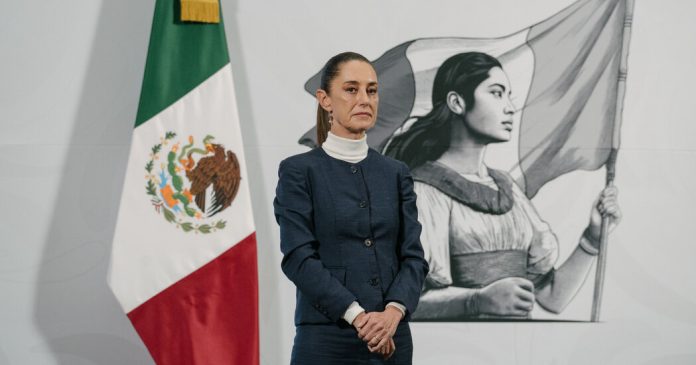
How Mexico President Claudia Sheinbaum Won Trump’s Praise

0

With a trade war brewing, President Trump gave the Mexican president a sign of grudging respect: “You’re tough,” he told her in a phone call last month, according to four people with knowledge of the exchange.

By their most recent conversation, the two leaders were trading compliments and carving out a reprieve from some tariffs in real time, the people familiar with the call said.

When Claudia Sheinbaum became president on Oct. 1, the first woman to ever govern Mexico, there were doubts about how she would handle the relationship with the United States, especially if Mr. Trump won the election.

A proud leftist and a scientist by training, Ms. Sheinbaum had little foreign policy experience in her previous post as mayor of Mexico City. Unlike her predecessor, Andrés Manuel López Obrador, who got along with Mr. Trump and shared his bombastic style, Ms. Sheinbaum was seen more as a reserved technocrat than a political show woman.

But she has surprised many in her country not only by fending off a barrage of threats from Mr. Trump, but also by forging, somewhat improbably, a relationship of budding public respect with her American counterpart.

“Nobody expected her to be this good, or this lucky,” said Carlos Bravo Regidor, a Mexican political analyst. “Whatever it is, it’s working.”

On the campaign trail, Mr. Trump made Mexico a clear target of his attacks. Once elected, he vowed to impose tariffs on America’s southern neighbor until fentanyl stopped flowing into the United States.

Yet lately, he has been lavishing praise on Ms. Sheinbaum, even as he excoriates more seasoned world leaders. He’s called her “a wonderful woman” with whom he has a “very good” relationship.

Her calm demeanor and the results she’s delivered on migration and fentanyl seem to have won his respect, officials from both countries say, impressing key members of his administration, including deputy chief of staff Stephen Miller, who has oversight of domestic policy and is a homeland security adviser.

Her rapport with the American president is helped in part by the contrast with Mr. Trump’s much more contentious relationship with Prime Minister Justin Trudeau of Canada, who left the post on Friday.

At the start of their most recent conversation last week, Ms. Sheinbaum spent about five minutes ticking through everything she had done to secure the border and fight fentanyl trafficking, according to two people familiar with the talks. Ahead of the call, she had sent Mr. Trump data to back up her points. She suggested that the tariffs would only make it harder for her to explain this level of cooperation to her citizens.

Mr. Trump stayed silent for a long beat after she stopped talking — and then, after complimenting Ms. Sheinbaum, abruptly launched into an attack on Canada, the people said. He asked what Ms. Sheinbaum thought of Mr. Trudeau. She said she didn’t talk much with the Canadian leader. Mr. Trump said she was lucky.

At the end of the call, the people said, Mr. Trump offered to exclude many Mexican goods from tariffs and then started dictating, out loud, a Truth Social post announcing the deal. Ms. Sheinbaum and her team were elated.

Mr. Trump posted that he was delaying tariffs until April 2 “out of respect” for the Mexican president, adding: “Thank you to President Sheinbaum for your hard work and cooperation!” Ms. Sheinbaum said the call was “excellent and respectful” in a post on X.

She has also made bold moves against drug cartels known for exacting revenge on those who threaten them. Perhaps the most drastic: the transfer of 29 drug lords to the United States to face criminal charges in late February. That move was a colossal blow to organized criminal groups and sent a message that Ms. Sheinbaum was serious about combating them.

Soon after the handover, Ms. Sheinbaum’s cellphone was hacked, according to several people familiar with the matter. A spokesman for the Mexican presidency declined to comment.

While cooperating intensely with Mr. Trump, Ms. Sheinbaum has also drummed up nationalist sentiment at home, reminding Mexicans that the country is “not a colony of anyone,” and repeating some version of the phrase “coordination, yes; submission, never.”

In recent months, her approval ratings in Mexico have rocketed above 75 percent.

Still, despite Ms. Sheinbaum’s efforts, Mexico hasn’t been shielded from Mr. Trump’s unpredictability. Like the rest of the world, the country awaits another round of potential tariffs on April 2. It’s also contending with steel and aluminum tariffs imposed this week, as well as duties on goods not included in the United States-Mexico-Canada Agreement, which were about half of the country’s U.S. exports last year, according to a White House official not authorized to speak publicly. The trade disruptions have already rattled the Mexican economy.

But as Mr. Trump continues to hammer Canada with new threats of steep levies and annexation, Mexicans are mostly enjoying a break from the drama — at least for now.

“This is like a real life episode of ‘The Apprentice,’” said Mr. Bravo Regidor, referring to the 2000s reality series starring Mr. Trump. “The purpose of the whole show is to survive until the next episode, and she has been able to do that so far.”

The two leaders have come a long way in just a few months.

Mr. Trump has charged that Mexico is run by cartels and threatened military strikes on Mexican soil. And while Mr. Trump often publicly said he had a terrific relationship with Ms. Sheinbaum’s predecessor and mentor, Mr. López Obrador, he also harbored concerns about the former Mexican leader’s management of cartel violence.

Mr. Trump and some key members of his team were initially skeptical of Ms. Sheinbaum, two people familiar with his thinking said, in part because of media coverage that portrayed her as an ideologically committed leftist.

Early on, her rhetoric toward Mr. Trump was at times adversarial.

At a news conference in November, she read aloud a sharply worded letter she had written Mr. Trump responding to his threat of tariffs. “For every tariff, there will be a response in kind, until we put at risk our shared enterprises,” she said.

The missive was viewed by some members of Mr. Trump’s transition team as scolding and an unnecessary provocation, according to five people familiar with their thinking.

Then, in early January, after Mr. Trump said he would rename the Gulf of Mexico the Gulf of America, Ms. Sheinbaum joked that the United States be renamed “Mexican America.” The comments were widely interpreted as poking fun at Mr. Trump.

But her style started to shift as some of her advisers began hearing that confrontational tactics would only anger Mr. Trump.

She won points by deciding to speak to Mr. Trump in English on their calls, three people familiar with talks said. Mr. López Obrador spoke to Mr. Trump in Spanish, through an interpreter, and talked for such a long time that he often bored the president, officials said.

By contrast, Ms. Sheinbaum has come to her conversations with the president extremely prepared, three U.S. and Mexican officials said. She has studied his speeches, watching the videos, to try to understand Mr. Trump’s communication style.

Her tone with him has been calm, and she has come across to officials as serious and transparent. That even-keeled approach has made an impression particularly because it’s so different from that of Mr. Trudeau, who has had more contentious exchanges with Mr. Trump.

Mexico observers pointed to the escalating spat between the United States and Canada as a sign that perhaps Ms. Sheinbaum’s lighter touch with Mr. Trump has shielded the country from further disruptions.

“She has been dignified and discreet in not picking a fight,” said Enrique Krauze, a prominent Mexican historian. “Her natural characteristics have worked well, for now, in the face of a personality like Trump.”

Maria Abi-Habib contributed reporting.

Tesla, led by Elon Musk, warns of export retaliation due to new Trump tariffs : NPR

0

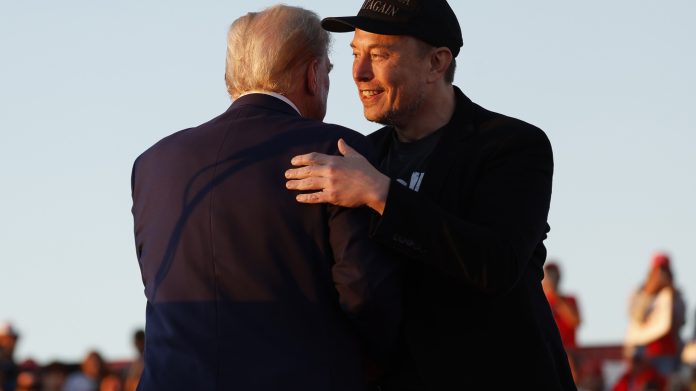
Elon Musk embraces then candidate Donald Trump during a campaign rally in Butler, Pennsylvania in 2024.

Anna Moneymaker/Getty Images North America


hide caption

toggle caption

Anna Moneymaker/Getty Images North America

Tesla Inc., warned this week that the company could face retaliation in the export market due to President Trump’s aggressive tariff policies.

In a public letter to U.S. trade representative Jamieson Greer, Tesla stated, “U.S. exporters are inherently exposed to disproportionate impacts when other countries respond to U.S. trade actions.”

These tariffs have already alienated some of the United States’ closest partners and sent global markets into a tailspin, as NPR has reported.

“For example, past trade actions by the United States have resulted in immediate reactions by the targeted countries, including increased tariffs on EVs imported into those countries.”

Greer’s office did not immediately respond to a request for comment.

Tesla’s comments come as its billionaire CEO, Elon Musk, has emerged as one of Trump’s most loyal supporters in an administration that’s pushing the country into a more nationalistic stance than seen in generations.

Despite Musk’s previously seemingly liberal public bent and Trump’s harsh past criticisms of electric vehicles, the two unlikely bedfellows have forged a close alliance.

The source of the unsigned letter was not immediately clear, and Tesla did not respond promptly to questions regarding whether Musk had any involvement in drafting it.

Musk heads up the new and controversial Department of Government Efficiency, which seeks to decimate the size of the federal workforce and reduce government spending.

Trump’s new trade policies have already led to retaliatory tariffs affecting billions of dollars of American products, including steel, aluminum and Kentucky bourbon.

In its letter to Greer, Tesla said that even with the strongest efforts to ensure that its products are manufactured domestically, there are still limitations to what can be fully procured within the United States, specifically lithium-ion batteries.

“Tesla supports a process by USTR to further evaluate domestic supply chain limitations to ensure that U.S. manufacturers are not unduly burdened by trade actions that could result in the imposition of cost-prohibitive tariffs on necessary components, or other import restrictions on items essential to support U.S. manufacturing jobs,” the letter said.

“Trade actions should not (and need not) conflict with objectives to further increase and support domestic manufacturing.”

G7 Foreign Ministers Agree on Ukraine Policy Amid Tensions Over Trump Tariffs

0

Despite high tensions between the Trump administration and some of America’s closest allies over tariffs and Ukraine, foreign ministers from the Group of 7 industrialized democracies who were meeting this week in Canada forged common ground in a communiqué that glossed over many of their sharp differences.

Top diplomats from Canada, the host of the gathering, the United States, Britain, France, Germany, Italy, Japan and the European Union meeting at the idyllic resort town of La Malbaie in Charlevoix, Quebec, presented a cautiously united front, notably on Ukraine, a key point of divergence since President Trump took office.

In a statement released on Friday, the group affirmed its support for Ukraine’s sovereignty and committed to supporting the “political aspirations” of Israelis and Palestinians, although it did not mention support for a two-state solution.

Reaching some consensus on Ukraine and Russia was considered a feat given Mr. Trump’s public criticism of Kyiv, although the group’s language on the subject was less vehement than in past years.

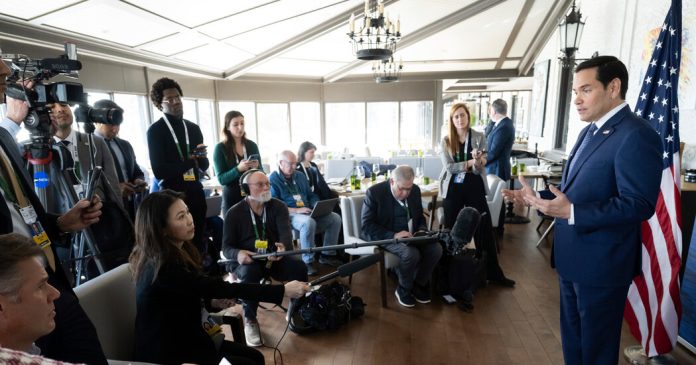
Secretary of State Marco Rubio found himself among allies in difficult circumstances, especially with his Canadian hosts, who resent Mr. Trump’s talk of annexing their country and turning it into “the 51st state.”

That rhetoric, which loomed over the 48 hours that ministers spent together in Quebec, drew a sharp rebuke from Canada’s foreign minister, Mélanie Joly, who told reporters on Friday that she had told Mr. Rubio that “Canada’s sovereignty is not up to debate, period.”

“There’s no argument, there’s no conversation about it, there’s no need to talk about it,” she added. “You’re here, you respect us, you respect our sovereignty, you’re in our country, you respect our people. Period.”

Canada has also been more assertive in demanding that allies stand up for its sovereignty, but ministers in Quebec walked a fine line between supporting Canada and avoiding getting on the wrong side of Mr. Trump.

Annalena Baerbock, the German foreign minister, and Kaja Kallas, the top European Union diplomat, posted photos of themselves dressed in red and white, Canada’s national colors. “We’ve got your back,” their post, addressed to Ms. Joly, said.

Mr. Trump on Thursday threatened to slap 200 percent tariffs on European Union exports of alcohol, a message that went down badly with France and Italy, the bloc’s major alcohol-exporting nations among the Group of 7.

And more tariffs are looming on April 2, as Mr. Trump has promised a comprehensive reboot in the United States’ trade relationship with the world, applying what he calls “reciprocal” tariffs on trading partners globally.

At the center of the storm was Mr. Rubio, making his first appearance at an international summit since he became Mr. Trump’s top diplomat.

It was an awkward assignment for Mr. Rubio, given the anger and confusion over Mr. Trump’s policies among the officials at the meeting, and there were signs that he was not eager to spend more time with them than necessary. Mr. Rubio was notably absent from a Wednesday social event at which other ministers nibbled on s’mores and from another event on Thursday that featured Canadian maple taffy.

Complicating the situation for Mr. Rubio was the shadow of Mr. Trump’s talk of annexing the gathering’s host nation.

When asked by reporters on Monday about the president’s recent talk that a 1908 treaty delineating the U.S.-Canada border could be torn up, Mr. Rubio briefly seemed at a loss for words. He then dismissed the topic by saying that it was “not on the agenda” for the Group of 7 gathering.

Asked again on Wednesday about Mr. Trump’s threats, Mr. Rubio emphasized points of unity between the United States and Canada, adding: “It is not a meeting about how we’re going to take over Canada.”

Mr. Trump returned to the subject on Thursday, telling reporters in the Oval Office that “Canada only works” as an American state. The border treaty, he added, had created “an artificial line” that “makes no sense.”

On Friday, Ms. Joly and Mr. Rubio each made comments characterizing the relationship between their two countries in nearly identical ways: “We won’t let things that we don’t agree on stop us from agreeing on other things,” Ms. Joly said.

The group’s final statement affirmed Ukraine’s “territorial integrity and right to exist,” and referred to Russian “acts of aggression.” But it was milder than the G7’s previous leaders’ statement, in November 2024, which proclaimed “unwavering support for Ukraine for as long as it takes” and called Russia “the sole obstacle” to peace.

As he flew back from Canada, Mr. Rubio announced he was expelling the ambassador to the United States from South Africa, Ebrahim Rasool. Mr. Rubio wrote on social media that the ambassador was a “race-baiting politician who hates America” and Mr. Trump. He added that “we have nothing to discuss with him and so he is considered PERSONA NON GRATA.”

Mr. Rubio made his comments above a re-post of an article from Breitbart, a conservative news site, on remarks Mr. Rasool made on Friday at an institute in Johannesburg. The article highlighted Mr. Rasool saying Mr. Trump was leading a “supremacist” movement against “the incumbency.”

Mr. Rubio said on social media last month that he would not attend the meeting of top diplomats from the Group of 20 nations in South Africa, criticizing the South African hosts for having a focus of the meeting be on “solidarity, equality and sustainability.”

Mr. Trump has signed an executive order to help the resettlement in the United States of white South African Afrikaners farmers who have had their land taken by the government, even though that is not a widespread practice in South Africa. He also ordered the federal government to cut off all aid to South Africa.

Edward Wong contributed reporting from Washington

Trump vows to crack down on crime in remarks at DOJ

0

President Trump gave an address at the Justice Department, vowing a renewed Justice Department and aggressive law enforcement. He also talked about retribution.

Duterte Makes First Appearance at International Criminal Court

0

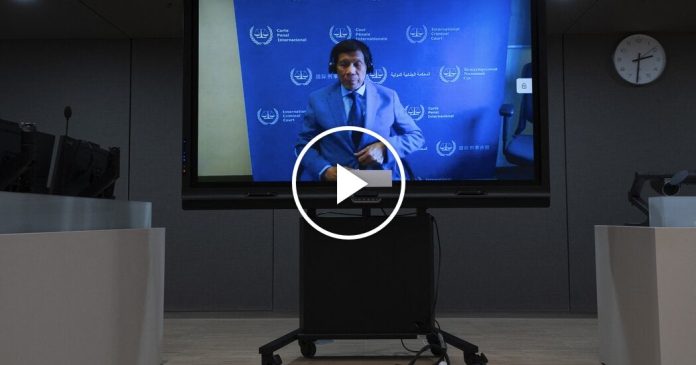
new video loaded: Duterte Makes First Appearance at International Criminal Court

transcript

transcript

Duterte Makes First Appearance at International Criminal Court

Rodrigo Duterte, the former president of the Philippines, appeared by video at a pre-trial hearing on charges of crimes against humanity for the killing of tens of thousands of civilians in his antidrug campaign.

“I would like, firstly, to confirm your identity.” “Rodrigo Roa Duterte.” “Justice for the victims of Duterte’s crimes. Justice — to the memory of his victims.” “We hope that the I.C.C. stands with the Filipino people and jail Duterte, who allowed the murder, the massacres of Filipino children.” “Many, many names — the tens of thousands of people who were killed.” “Drag him back. Send him back.” “Duterte, Duterte.” “We assert that those allegations will, of course, remain allegations. Allegations until it is proven, right? We maintain that the former president, Rodrigo Roa Duterte, should be brought back to the Philippines.”

Recent episodes in Asia Pacific

Senate advances plan to avert shutdown, in vote that exposes Democratic rifts : NPR

0

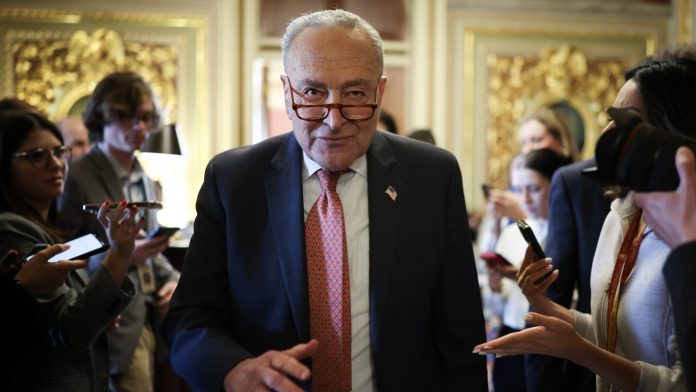
A six-month spending bill advanced in the Senate after Democrats split on the bill. Senate Minority Leader Chuck Shumer, D-NY, announced Thursday that he would back the bill, creating an opportunity for others to follow and vote to avoid a shutdown, despite their own misgivings about the bill.

Kayla Bartkowski/Getty Images


hide caption

toggle caption

Kayla Bartkowski/Getty Images

The Senate voted to advance a Republican-backed bill to fund the government, setting the measure on a glide-path to final passage ahead of a midnight funding deadline.

While Republicans control the Senate, they do not hold the 60 seats necessary to break a filibuster. The final vote was 62-38, as 10 Democrats joined Republicans in supporting the measure. Kentucky Republican Sen. Rand Paul and all other Democrats opposed.

The vote highlights deep divisions within the Democratic party over how to respond to President Trump in his second term. The decision by Senate Minority Leader Chuck Schumer, D-N.Y., to support the funding bill sparked an intense backlash from House Democrats, who almost unanimously opposed it.

“I think there is a deep sense of outrage and betrayal and this is not just progressive Democrats — this is across the board, the entire party,” New York Rep. Alexandria Ocasio-Cortez told reporters Thursday night at a party retreat in Leesburg, Va.

“I think it is a huge slap in the face,” she said.

The Senate Democrats who opposed the bill — a stopgap measure known as a continuing resolution, or CR — argued that helping to pass it would give Trump and his advisor Elon Musk the leeway to continue slashing the federal government without oversight. But they also acknowledged that a shutdown would bring pain and disruption. New Mexico Sen. Martin Heinrich said Thursday that Democrats were wrestling with what the “least worst outcome” would be.

“This president has put us in a position where, in either direction lots of people’s constituents are gonna get hurt, and hurt badly,” said Heinrich, who voted against advancing the bill. “I think when you confront a bully, you have to confront a bully. And I’m not gonna vote for this CR. But I fully respect people who’ve come to a different conclusion because in either pathway — this is a president who is very comfortable with the pain that either direction will create.”

Schumer also said that Democrats were given a choice between two bad options, but he determined that keeping the government open would “minimize the harms to the American people.”

“As bad as passing the CR is, allowing Donald Trump to take even more power via a government shutdown is a far worse option,” Schumer said on the Senate floor Thursday.

Shutdown averted, but Democrats walk away divided

The backlash to Schumer’s decision has turned to rumblings of frustration about his future. House Democratic Leader Hakeem Jeffries, D-N.Y., was asked directly about whether Democrats need a new leader in the Senate. He evaded.

“Next question,” he said, moving on.

Multiple Democratic senators refused to answer whether they had confidence in Schumer as leader of the party.

When asked by reporters, freshman Sen. Ruben Gallego, D-Ariz., remained silent. He later told NPR that while the party was united “it would help us unify more if we had a [postmortem.]”

Sen. Chris Coons, D-Del., told reporters that there was a “clear division in strategy” between Jeffries and Schumer.

“I think leader Jeffries does reflect some of the concerns I’m hearing from colleagues, from the House who have also reached out to me,” he said.

Coons told reporters he believes House and Senate democrats can band together in opposition to Trump’s agenda moving forward, especially as the GOP works to pass their reconciliation bill.

“There’s plenty to unite us on the other side of today’s vote,” he added.

New Mexico Democratic Rep. Teresa Leger Fernandez told NPR Friday that Schumer was thinking “short-term.”

“What Democrats in the House took very seriously was that this wasn’t about a government shutdown. This was about giving Musk and Trump the ability to shut down the programs they didn’t like,” she said. “A shutdown is temporary. It forces them back to the table.”

Carl Lundstrom, Who Financed the Pirate Bay, Dies in Plane Crash

0

Carl Lundstrom, the heir to a Swedish crisp bread fortune who financed the Pirate Bay, a notorious file-sharing service that was popular in the mid-2000s, was killed on Monday in a small plane crash in Slovenia, according to Alternative for Sweden, the far-right party that he supported.

Mr. Lundstrom, 64, was the pilot and sole occupant of the plane, a Mooney M20, which had taken off from Zagreb, the Croatian capital, and was en route to Zurich, the party said in a statement.

Air traffic controllers reported that they had lost contact with the plane in the mountainous Velika Planina area of northern Slovenia, according to the Slovenian police.

Extremely bad weather made it impossible for rescuers to use helicopters, forcing them to take a gondola and then hike on foot to reach the remote crash site, the police said. They discovered pieces of the plane lodged in a wooden hut, which was practically cut in half, the police said.

A body was later found amid the rubble, said the police, who added that the cause of the crash had not been determined.

Mr. Lundstrom was a grandson of the founder of the Swedish crisp bread brand Wasabröd, and an heir to the company fortune, according to Swedish media reports.

He was a financier of the Pirate Bay, which was founded in Sweden in 2003 and became one of the largest so-called Bit Torrent trackers, which allow users to download large digital files by enlisting the help of other computers.

The Pirate Bay, which provided links to thousands of songs, movies and video games, was once estimated to have more than 20 million users.

Industry groups like the Motion Picture Association accused the site of making a mockery of copyright laws, and Swedish prosecutors took action.

In 2008, they charged Mr. Lundstrom and the site’s three founders with having facilitated copyright infringement by helping users download music, movies and other copyrighted material.

The Pirate Bay trial unfolded amid a carnival-like atmosphere in Stockholm, with bands playing outside the courtroom and bloggers documenting every step of the proceedings.

Mr. Lundstrom and his co-defendants, Frederik Neij, Gottfrid Svartholm Warg and Peter Sunde, maintained that they were not violating copyright law because they did not actually host any of the copyrighted material on their own servers.

During the trial, a prosecutor tried to tie Mr. Lundstrom to the Pirate Bay as a “co-owner,” but he testified that he had only sold hosting and internet services to the site’s operators, Wired magazine reported in 2009.

Mr. Lundstrom acknowledged giving the Pirate Bay’s operators moral support and sympathy, Wired reported, but said he had not become their business partner, finding the prospect legally risky.

A Swedish court convicted Mr. Lundstrom and his co-defendants in 2009 and sentenced them each to a year in prison.

They were also ordered to pay 30 million kronor, or about $3.6 million at the time, in damages to leading entertainment companies, including Warner Brothers, Sony Music Entertainment, EMI and Columbia Pictures.

An appeals court later upheld the convictions of Mr. Lundstrom, Mr. Neij and Mr. Sunde, but reduced their sentences to between four and 10 months and raised the amount they had to pay in damages to 46 million kronor, or about $6.5 million at the time.

Mr. Warg did not participate in the appeal, citing an illness.

The verdict was a major victory for the entertainment industry in its campaign to curb online piracy on sites like Napster, which became hugely popular in the late 1990s and early 2000s.

“We are not triumphant,” John Kennedy, the chief executive of the International Federation of the Phonographic Industry, said after Mr. Lundstrom and his co-defendants were convicted. “But we are satisfied that the court has clearly said that what they were doing was wrong.”

In addition to his role in the Pirate Bay, Mr. Lundstrom was a longtime supporter of right-wing causes in Sweden. He helped back a movement against allowing refugees to settle in Sjöbo, a town on the southern tip of Sweden, in the late 1980s, Alternative for Sweden said in its statement.

When Alternative for Sweden, an anti-immigrant party, was formed in 2018, Mr. Lundstrom became involved as a district manager and then as an unsuccessful candidate for office, the party said.

It called him “a legend and veteran of Swedish nationalism.”

But Mr. Lundstrom was better known for his role in the Pirate Bay, said Mikael Sundstrom, a senior lecturer in the Department of Political Science at Lund University in Sweden.

“Lundstrom’s overt political life was spent in far-right circles, but with limited impact,” he said in an email.

USPS agrees to DOGE’s help with finding ‘further efficiencies’ : NPR

0

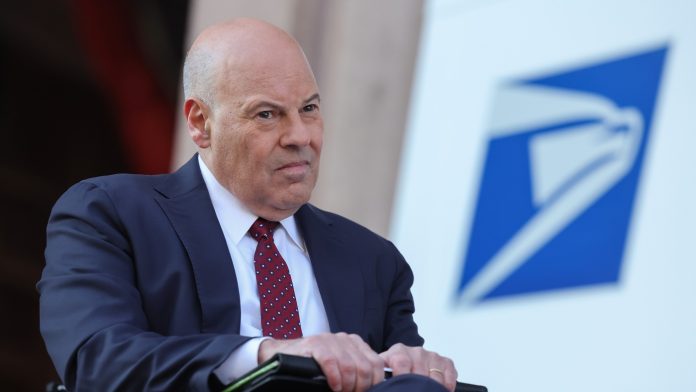
Louis DeJoy, the U.S. postmaster general, attends a 2022 event at the Postal Service headquarters in Washington, D.C.

Kevin Dietsch/Getty Images


hide caption

toggle caption

Kevin Dietsch/Getty Images

The head of the U.S. Postal Service has agreed to allow the DOGE team of President Trump’s billionaire adviser Elon Musk to help find “further efficiencies” at the country’s mail service, according to a letter to congressional leaders released Thursday.

Postmaster General Louis DeJoy signed the agreement with DOGE Wednesday night, the outgoing USPS head confirmed in the letter, noting that the Postal Service — which has been undergoing a controversial 10-year reorganization since 2021 to try to right its troubled finances — is “happy to have others to assist us in our worthwhile cause.”

Leaders of two USPS employee unions tell NPR that DeJoy assured them there are provisions in the agreement that prevent members of Musk’s team, known as the Department of Government Efficiency, from having unfettered access to information in the records of the Postal Service’s more than half-million employees. NPR has not reviewed the agreement.

“We are very much in support of that type of protection, assuming that they comply with it,” Brian Renfroe — president of the National Association of Letter Carriers, the union for carriers in cities — tells NPR. “There’s reason for skepticism based on what we’ve seen from some of the other federal agencies.”

Mark Dimondstein, president of the American Postal Workers Union, says in a statement to NPR that the union representing postal clerks and other USPS employees “will use everything in our power, including every legal tool, to ensure that data related to employee information and information on individual customers remains private and out of the hands of Elon Musk and his Muskrats.”

Spokespeople for DOGE and the USPS did not respond to requests for comment on the agreement’s provisions.

It’s not clear what DOGE will try to do while the USPS continues its “self-help” strategies

This new arrangement comes as the Trump administration faces more than a dozen lawsuits over DOGE’s access to data at other federal agencies amid a push to slash the U.S. government workforce and programs.

Until now, there had been no public sign that DOGE’s efforts had reached the Postal Service. In recent months, however, Trump and his officials have suggested transforming the USPS, including expressing support for privatizing the service and proposing to fold what Congress set up to be an independent agency into the Commerce Department, a move that would likely be challenged in court.

Those suggestions, along with Musk’s broad attempts to reshape the federal government, have drawn outcries from Democrats on Capitol Hill. Rep. Gerry Connolly of Virginia — the top Democrat on the House Oversight Committee, who released DeJoy’s letter — criticized the agreement DeJoy signed as a way to allow Musk to “infiltrate” the Postal Service.

“This capitulation will have catastrophic consequences for all Americans — especially those in rural and hard to reach areas — who rely on the Postal Service every day to deliver mail, medications, ballots, and more. Reliable mail delivery can’t just be reserved for MAGA supporters and Tesla owners,” Connolly said in a statement.

It’s not clear exactly what DOGE will try to do at the USPS. DeJoy’s letter emphasized that the Postal Service has been using “self-help” strategies to achieve “efficiency gains, cost savings and revenue growth.” Those include, the postmaster general noted, a voluntary early retirement program that was first announced in mid-January to Postal Service employees. The program is expected to reduce the USPS labor workforce by an additional 10,000 people in the next 30 days after an earlier loss of about 30,000 workers from fiscal year 2021.

Still, asked by DOGE representatives for “the big problems they can help” with, DeJoy said he gave them a list of “intractable” issues that he described as out of the Postal Service’s control and in the hands of Congress. One is a longstanding dispute over how the Office of Personnel Management calculates the Postal Service’s liabilities for pre-1970 pension benefits. DeJoy also pointed to the Postal Regulatory Commission, which Congress set up to monitor the USPS, as “an unnecessary agency” whose members “stand in the way of the timely and necessary changes required to succeed as a self-funded enterprise in a competitive environment.”

The postmaster general, who had been a top Trump donor before joining the USPS, has often tussled with the commission over its criticism of his reorganization plan. In a statement responding to DeJoy’s letter, the PRC says it “has done more than its part to help” the Postal Service while following the law to “ensure that USPS provides universal service to all Americans” and “safeguards fair competition in package markets by preventing the Postal Service from abusing its monopoly position.”

As for whether DOGE can make any progress on the challenges facing the USPS, Renfroe, president of the city mail carriers’ union, says he’s taking a “wait-and-see” approach.

“The way that the Postal Service accepts and processes and moves and delivers mail is incredibly complex,” Renfroe adds. “I think it would be completely unreasonable, based on what I know about the way DOGE looks at things, for them to really dig deep in the operations just because of the complexity of it.”

Edited by Benjamin Swasey