Thursday, November 12, 2026
Home Blog Page 125

Mark Carney Becomes Canada’s Prime Minister at Crucial Moment

0

Mark Carney, who has never held elected office but has a long résumé in economic policymaking and investing, was sworn in Friday morning as Canada’s 24th prime minister. He will have no time to ease into his role.

Canada is experiencing a period of severe instability as its relationship with its closest ally, the United States, has been plunged into an extraordinary crisis since President Trump was elected and began unleashing attacks on its economy and sovereignty.

Mr. Carney will attempt to negotiate with Mr. Trump, who has unfurled a slew of tariffs and threats on Canada including a desire to take over the country entirely, while simultaneously heading straight into a campaign for a federal election.

He does not hold a seat in Parliament, and his party controls only a minority of the seats in the House of Commons, which means he has little choice but to immediately call for a federal election, likely to take place by May.

Mr. Carney, who turns 60 on Sunday, replaces Justin Trudeau who led Canada for nearly a decade. He was elected as Liberal Party leader on Sunday by some 152,000 members of the party, securing 86 percent of the vote.

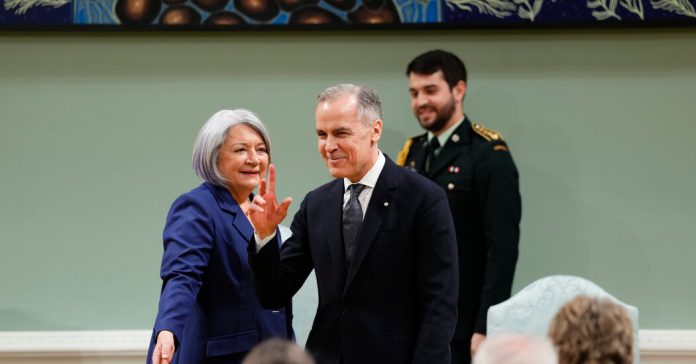
In a traditional ceremony that involved pledging allegiance to King Charles III, Mr. Carney was sworn in by Mary Simon, Canada’s governor-general, who represents the king as the official head of state. Ms. Simon is the first Indigenous person to serve in that role.

Mr. Carney, speaking to reporters after he was sworn in, called Mr. Trump’s threats to make Canada the 51st state “crazy.”

He has no plans for now, he said, to meet with Mr. Trump. Instead, his focus will be on strengthening Canada’s economy against trade threats.

“We know that by building together, we can give ourselves far more than anyone else can take away,” he said.

Mr. Carney had served as governor of the Bank of Canada during the global financial crisis of 2008 and later as governor of the Bank of England — the first and, so far, only foreigner to be hired to the job — from 2013 and through the Brexit transition.

Before becoming a central banker, he worked at Goldman Sachs for more than 10 years. Since leaving the Bank of England he has served in top positions on corporate boards and has emerged as a key global advocate for green investment.

Mr. Carney has made it clear that he plans to continue taking a hard line against Mr. Trump, while also trying to reach a trade deal with the president. Canada has applied two rounds of retaliatory tariffs against U.S. exports and said it was prepared to do more.

“My government will keep our tariffs on until the Americans show us respect — and make credible, reliable commitments to free and fair trade,” he told the party faithful in Ottawa on Sunday as he accepted the role of party leadership.

And in a sign that he is looking for new best friends for Canada now that its relationship with the United States is badly frayed, his first overseas visits will be to London and Paris.

Dealing with the complex problems that Mr. Trump’s statehood threats and tariffs create for Canada will leave little time for anything else, but Mr. Carney has made policy promises that suggest he is a centrist.

He has vowed to introduce an era of fiscal prudence and to cut taxes, while leveraging his business experience to help Canada attract investments that can help boost the country’s economy.

Mr. Carney will also need to turn his attention to pressing domestic issues, like a persistent high cost of living and the effects of record immigration that spurred Mr. Trudeau’s resignation.

But the economic fallout from the suite of tariff measures imposed by Mr. Trump, will dominate Mr. Carney’s first days in office.

He will need to try to stop Mr. Trump from bringing in fresh surcharges on more Canadian goods as he has threatened. Economists say they expect that the current measures taken against Canada by the U.S. administration, as well as the slowdown in investment that comes from the uncertainty around what will happen next, will hurt the Canadian economy and could push it into a recession.

Then there is the looming election. Mr. Carney will need to prove that despite never having run for political office, he is still the best person for the job, not just to a group of party members who broadly agree with him but to the entire electorate.

In the federal election he will face off against Pierre Poilievre, the Conservative leader who has helped his party gain a robust lead in public opinion polls and collect almost double the amount of fund-raising dollars as the Liberals in 2024.

Mr. Trump’s arrival in the White House, however, has upended the political landscape.

A lifelong politician who knows how to deliver a punchy slogan, Mr. Poilievre, 45, is trying to pivot his messaging, political analysts say, to position himself as the strongest candidate to take on Washington, while not alienating pro-Trump conservatives in Canada.

Mr. Poilievre’s main angle of attack had long been to present Canadians with all the ways that the Liberal Party had “broken” Canada, with a focus on crime, housing prices, an unpopular consumer carbon tax and a surge in immigration.

“That is the choice: more of the same,” Mr. Poilievre told reporters on Friday after Mr. Carney was sworn in. “Or Canada-first change for the Canadian people.”

But Mr. Trump’s ascent and his attitude toward Canada, coupled with the resignation of Mr. Trudeau, who had become deeply unpopular, have nearly evaporated the Conservatives’ lead in a remarkable reversal.

Several recent opinion polls have shown that, under Mr. Carney’s leadership, the Liberals would have a chance of eking out a victory.

From his expansive qualifications in the finance world, there’s little doubt of Mr. Carney’s ability to get his message across in a boardroom or a monetary policy meeting. In his central banking roles he was often seen as being sermonic, and at times dismissive of the news media.

But he’ll need to find a common touch and a different level of engagement to be able to campaign effectively.

Mr. Carney’s challenge will be to quickly master “retail politics” — the art of energizing a room with a speech, making individual supporters feel important and heard and finding a way to engage with the news media that gets his point across clearly, said Fen Hampson, a professor of international affairs at Carleton University in Ottawa.

“Those glad-handing skills do not come automatically to someone who’s spent his life being a banker,” Mr. Hampson said. “His Achilles’ heel is that his communication skills and his retail politics skills are not finely honed yet.”

In forming a cabinet, Mr. Carney has maintained the roughly 50-50 split of men and women, a standard Mr. Trudeau set when announcing Canada’s first gender-balanced cabinet after he was elected in 2015.

The foreign minister, Melanie Joly, will remain in her position and Dominic LeBlanc, a close friend of Mr. Trudeau, will be the new minister of international trade, taking a central role in tariff discussions along with the new finance minister, François-Philippe Champagne.

The former finance minister, Chrystia Freeland, who was the runner-up in the Liberal leadership race, will remain in the cabinet as minister of transport and internal trade.
Trump’s anti-DEI crackdown targets over 50 universities in investigation : NPR

0

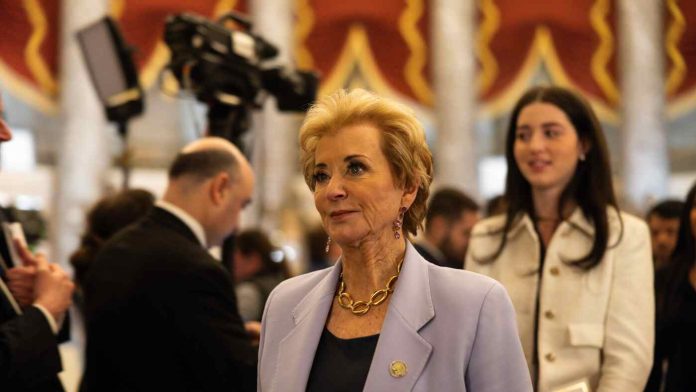
Secretary of Education Linda McMahon arrives to President Trump’s joint address to Congress on March 4 in Washington, D.C.

Tierney L. Cross/Getty Images


hide caption

toggle caption

Tierney L. Cross/Getty Images

The U.S. Department of Education has launched investigations into 52 universities in 41 states, accusing the schools of using “racial preferences and stereotypes in education programs and activities.”

On Friday, the department’s Office of Civil Rights said that 45 schools, particularly their graduate programs, violated the 1964 Civil Rights Act by partnering with The PhD Project, a nonprofit that helps students from underrepresented groups earn doctoral degrees in business. The program focuses on supporting Black, Latino and Native American students.

The Education Department alleges that The PhD Project limits eligibility based on the race of participants, and therefore, universities involved with the organization are engaging in “race-exclusionary practices.”

“Students must be assessed according to merit and accomplishment, not prejudged by the color of their skin. We will not yield on this commitment,” Education Secretary Linda McMahon said in a statement.

The PhD Project did not immediately responded to a request for comment.

The schools under investigation include dozens of state schools and two Ivy Leagues, namely Cornell and Yale. A number of private schools are also facing scrutiny, include Duke, Emory, Georgetown, Vanderbilt, Rice, Massachusetts Institute of Technology, and New York University. The full list of schools is here.

Six additional institutions of higher education are being probed for awarding alleged “impermissible race-based scholarships.” Another one has been accused of “administering a program that segregates students on the basis of race.”

The seven schools affected are: Grand Valley State University; Ithaca College; New England College of Optometry; University of Alabama; University of Minnesota, Twin Cities; University of South Florida; and University of Oklahoma, Tulsa School of Medicine. The Department of Education did not respond to NPR’s request to clarify which school is being accused of segregation.

The American Association of Colleges and Universities and

the N

ational Association of Independent Colleges and Universities also did not immediately respond to NPR’s requests for comment.

The department’s inquiries come a month after it issued a letter warning institutions to stop using “race-based preferences” in admissions, financial aid, hiring, training and other areas or risk losing federal funding. The directive specifically accused American educational institutions of discriminating against white and Asian students.

Two of the country’s largest teacher unions — the National Education Association and the American Federation of Teachers — have filed separate federal lawsuits against the Education Department memo, arguing that it was unfounded and vague.

The letter and the onslaught of investigations are all part of the Trump administration’s aim to ban diversity, equity and inclusion programs in the name of fighting “wokeness.”

The Education Department has also been investigating 60 universities over allegations of antisemitic discrimination. A handful of schools are involved in both sets of investigations, including Cornell, George Mason, Rutgers, Yale, University of Wisconsin, Madison, and University of Washington-Seattle.

Earlier this week, the department warned that universities could face “potential enforcement actions” if officials determine that schools failed to protect Jewish students on campus.

The growing number of investigations against higher education institutions also comes as the Education Department faces drastic cuts in staff. This week, at least 240 employees in the department’s Office for Civil Rights were laid off, many of whom were attorneys who investigate complaints from families who believe a school has discriminated against their child.

What Syria’s New Temporary Constitution Says

0

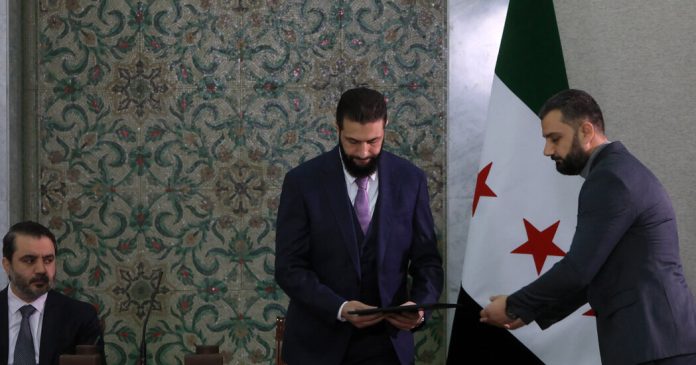
Syria’s new government has adopted a temporary constitution that concentrates much power in the hands of the interim president and retains Islamic law as the foundation of the legal system.

The interim president, Ahmed al-Shara, signed the constitutional declaration on Thursday following the dissolution in January of the previous constitution under the authoritarian president, Bashar al-Assad. Mr. al-Shara, who led the overthrow of Mr. al-Assad in December, had promised to form an inclusive government and he heralded this as the beginning of what he called “a new history” for the nation after decades of dictatorship and a long civil war.

The declaration guarantees “freedom of opinion, expression, information, publication and press.” If upheld, this would be a dramatic departure from the draconian surveillance state under Mr. al-Assad. It also pledges to safeguard women’s rights and the rights of all Syrians during a five-year transitional period, after which a permanent constitution will be adopted and elections for a president and parliament will be held.

However, some among Syria’s diverse mix of ethnic and religious groups remain skeptical of the new leader’s sweeping promises to create an inclusive government because of his roots as the head of an Islamist extremist rebel group.

The temporary constitution grants the president executive authority and the power to declare a state of emergency. The president will appoint one-third of the legislature, which will serve as an interim parliament for the transition period. The other two-thirds will be chosen by electoral commissions overseen by a committee appointed by the president.

The new constitution calls for judicial independence. But the president is solely responsible for appointing judges to Syria’s new constitutional court, the body ostensibly intended to hold Mr. al-Shara accountable. The document does not grant power to any other body to approve his appointments but specifies only that judges must be impartial.

Abdul Hamid al-Awak, a member of the committee that drafted the new constitution, told a news conference on Thursday that the declaration ensured a separation of powers as opposed to the concentration of power over other branches of government in Mr. al-Assad’s hands when he was in power.

But the sweeping authority that the new declaration keeps in the president’s hands during the transitional period could unnerve those in Syria who are hoping for a sharp turn away from the more than five decades of dictatorship under Mr. al-Assad and his father before him.

The United Nations’ special envoy for Syria, Guy Pedersen, said on Friday that he hoped the constitutional declaration “will move Syria toward restoring the rule of law and promoting an orderly inclusive transition.”

The temporary constitution has retained a provision that stipulates Syria’s president must be a Muslim, as did the old constitution. And like its precursor, the new constitution gives central importance to Islamic law. The new document says it will be the main source of legislation, while ensuring that “freedom of belief is guaranteed.”

However, all rights, including freedom of religion, may be curtailed if they are deemed to infringe on national security or public order, among other things, the constitution says.

Syria’s new government is led by Sunni Muslim former rebels who fought Mr. al-Assad during the country’s civil war. Since sweeping to power in Damascus, skeptics have questioned Mr. al-Shara’s true beliefs.

As a rebel leader, Mr. al-Shara commanded an Islamist armed group once allied with Al Qaeda. Some question whether he has truly abandoned his former hard-line jihadist views, even though his rebel group severed ties with Al Qaeda years before he took power.

Syria is home to a diverse range of ethnic and religious groups, and the constitution promises to protect the rights of all Syrians and shield them from discrimination. But sectarian tensions linger, and they erupted viciously last week when Assad loyalists ambushed government security forces, prompting a harsh crackdown that devolved into sectarian attacks on civilians, according to the United Nations and war monitoring groups.

The war monitoring group Syrian Observatory for Human Rights said nearly 1,500 civilians were killed in just a few days of violence.

Those attacks appear to have been directed against the Alawite minority, an offshoot of Shiite Islam to which the Assad family belongs. The attacks were a reminder that Mr. al-Shara is still far from having secured control over all Syrian territory, and possibly even over all forces linked to the government.

The United States and European nations have been reluctant to lift Assad-era sanctions until Syria’s new leaders demonstrate that they are committed to an inclusive political process and to protecting minority rights. The lifting of those sanctions remains a crucial step to resurrecting the country’s battered economy — one of the most pressing challenges for Mr. al-Shara’s government.

Even though the constitution pledges to protect minority rights, it has sparked concern among at least one major ethnic minority, the Syrian Kurds.

The Syrian Democratic Council, the political wing of the Kurdish-led forces that control northeastern Syria, said the new document “reproduced authoritarianism in a new form” and criticized what it said were unchecked executive powers.

It is unclear whether Kurdish dissatisfaction with the constitution will affect an agreement reached this week between the country’s new government and the Kurdish-led forces backed by the United States to incorporate them into the government’s civil and military institutions.

The pledge to guarantee freedom of opinion, expression, information, publication and press” comes with some exceptions, including glorifying the Assad regime.

The constitutional declaration guarantees women’s rights to education and work, adding that they will have full “social, economic and political rights.”

Since his ascent to power, Mr. al-Shara has appeared keen to assuage domestic and international concerns over the role of women in the new Syria. In January, he delivered a speech using gender-sensitive language, rarely used by leaders in the region. He highlighted the role of women in the revolution, and the suffering they had experienced.

Trump plans to visit the DOJ Friday, a rare move for a president : NPR

0

President Trump is going to the Department of Justice to deliver a speech about law and order. It is rare for a president to physically visit the agency meant to independently uphold the rule of law.


LEILA FADEL, HOST:

President Trump is expected to make a short trip down Pennsylvania Avenue today to visit the Justice Department.

STEVE INSKEEP, HOST:

Yeah, he’s going to deliver a speech, which the White House bills as being about law and order. Trump’s visit comes at a turbulent time for the department, where Trump appointees have pushed out career officials at the department who they deem insufficiently loyal to the president.

FADEL: NPR justice correspondent Ryan Lucas joins us now with more. Good morning, Ryan.

RYAN LUCAS, BYLINE: Good morning.

FADEL: OK, so how unusual is it for a president to deliver a speech at the Justice Department?

LUCAS: It’s a pretty rare thing. Biden never did it. Trump didn’t do it in his first term. In fact, I could only find four occasions that it has happened since 2000. Twice President Obama did it. The first time was a speech about changes his administration was making to surveillance programs. The other time was at a farewell ceremony for his first attorney general. The other two instances were early in President George W. Bush’s administration, one of them being a ceremony in 2001 to rename the department’s headquarters after Robert F. Kennedy. So it is rare for a president to do this.

Historically, presidents keep their distance from the Justice Department. There’s been a norm for decades now – respected by both Republican and Democratic administrations – that the department should be independent and free from political interference. But President Trump has made clear that he has a very different idea about the relationship between the president and the Justice Department.

FADEL: Yeah. So what do we expect to hear from the president in his speech?

LUCAS: Well, we heard a bit of it at the top. The White House says Trump is going to talk about restoring law and order, about removing violent criminals from communities and ending what the White House says is the weaponization of justice against Americans for their political leanings. And that last idea there is a central theme for Trump, his allies on the Hill and for his new Justice Department leadership. Trump, of course, argues that he was unfairly targeted by federal prosecutors during the Biden administration. He has promised vengeance. The new Justice Department leadership talks a lot about ending the purported weaponization and politicization of the Justice Department in recent years. But at the same time, they have taken punitive action against nonpolitical career prosecutors and officials who worked on investigations or issues that Trump doesn’t like.

FADEL: Yeah. I mean, there’s been quite the purge. Just recap some of the punitive actions we’ve seen.

LUCAS: Well, for one, the new department leadership has fired prosecutors who worked on the special counsel investigations into Trump, saying that those folks couldn’t be trusted to implement the president’s agenda. They have fired prosecutors who worked on the January 6 Capitol riot cases. They’ve demoted senior career prosecutors who worked cases involving Trump allies. The Justice Department frames this as ending weaponization, but critics say that these actions appear to be retaliation against folks who worked cases the president didn’t like.

Now, at the same time, the department has cut breaks for Trump allies. Critics point to the Justice Department’s decision to dismiss corruption charges against the New York City Mayor Eric Adams. Adams has pledged to cooperate with Trump’s immigration enforcement. More than a half dozen veteran Justice Department prosecutors resigned in protest. That includes the acting U.S. attorney in Manhattan, who said there was no good-faith basis to drop the Adams case.

FADEL: So with all of the things that have happened in the past few weeks, what sort of reception do you expect Trump to receive today?

LUCAS: It’s a good question. You know, it’s no secret, as we’ve said, that Trump has been extremely critical of the Justice Department over the years. So it’s going to be interesting to see what he has to say, how he says it, as he lays out his vision for the department in the very building that he has been so critical of.

FADEL: NPR’s Ryan Lucas. Thank you, Ryan.

LUCAS: Thank you.

Copyright © 2025 NPR. All rights reserved. Visit our website terms of use and permissions pages at www.npr.org for further information.

NPR transcripts are created on a rush deadline by an NPR contractor. This text may not be in its final form and may be updated or revised in the future. Accuracy and availability may vary. The authoritative record of NPR’s programming is the audio record.

U.S. and Russia Had ‘Productive’ Discussions About Ukraine Cease-Fire, Trump Says

0

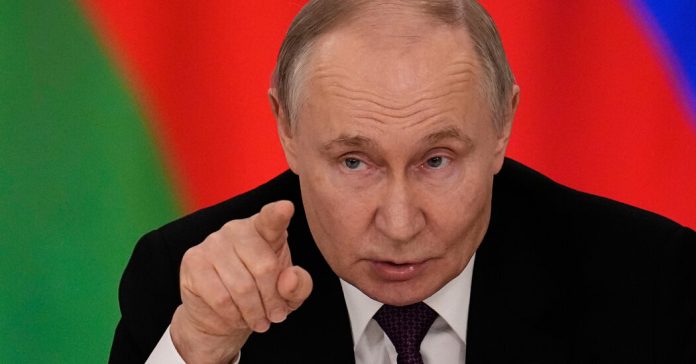
President Vladimir V. Putin of Russia on Friday insisted that Ukraine order some of its forces to surrender to Russia, a striking demand made hours after President Trump said the United States had “very good and productive” discussions with Mr. Putin about a potential cease-fire in Ukraine.

Mr. Putin’s televised comments came shortly after Mr. Trump, on social media, said he had urged the Russian leader to spare the lives of Ukrainian soldiers struggling to hold on to a patch of land in the Kursk region of Russia.

“I have strongly requested to President Putin that their lives be spared,” Mr. Trump wrote.

Both presidents claimed on Friday that Ukrainian forces were surrounded in Kursk, the area where Kyiv’s troops stunned Russia with a cross-border incursion last summer. Independent analysts have challenged those claims, and Ukraine’s military on Friday again rejected them.

Still, Russian forces have of late had the upper hand in the fighting in Kursk. And Mr. Putin said that for Mr. Trump’s call “to be effectively implemented,” the leaders of Ukraine needed to order “its military units to lay down their arms and surrender.” Neither man has raised the idea of Russian troops on Ukrainian land surrendering.

Battles have been raging in Kursk as Moscow’s forces push to drive Ukrainian troops from the land they seized over the summer. Russian troops have advanced in recent days, with Mr. Putin urging them to finish the job “in the shortest possible time.”

What happens next in Kursk has become a key point of contention ahead of a potential cease-fire. Mr. Putin had on Thursday suggested less explicitly that he wanted Ukraine to order its soldiers there to surrender as part of any deal to end the war, which has killed more than a million soldiers and countless civilians over three years of grinding fighting.

But his comments on Friday were far more direct, and came as both the Kremlin and White House signaled negotiations were moving forward despite the raft of concessions Moscow appears to be seeking.

After the Russian leader met with Steve Witkoff, the U.S. special envoy, in Moscow, late Thursday, top officials at both the White House and the Kremlin expressed “cautious optimism.”

“We had very good and productive discussions with President Vladimir Putin of Russia yesterday,” Mr. Trump wrote Friday morning on his Truth Social platform, in an apparent reference to the meeting with Mr. Witkoff. “There is a very good chance that this horrible, bloody war can finally come to an end.”

But President Volodymyr Zelensky of Ukraine questioned whether Russia was acting in good faith, pointing out that his country had already agreed to a 30-day truce after a meeting with U.S. officials in Saudi Arabia this week.

“The world sees how Russia is deliberately setting conditions that only complicate and drag out the process,” Mr. Zelensky said Friday on social media. “Russia is the only party that wants the war to continue and diplomacy to break down.”

It wasn’t immediately clear whether Mr. Putin and Mr. Trump had directly spoken to each other. The Kremlin said earlier Friday that Mr. Putin, in his meeting with Mr. Witkoff, “passed along information and additional signals for President Trump.” It also said that Mr. Putin expected to talk to Mr. Trump but that the call had yet to be scheduled.

In that Truth Social post, Mr. Trump also said thousands of Ukrainian troops were “completely surrounded by the Russian military” — an apparent reference to Russian claims that Ukrainian soldiers were surrounded in Kursk

“There is no threat of encirclement of our units,” the Ukrainian military’s general staff said in a statement soon after on Friday, calling such reports “false and fabricated by the Russians.”

A Ukrainian soldier fighting in Kursk who was reached by phone on Friday, speaking on condition of anonymity to discuss the current situation on the battlefield, said “the situation is bad, almost critical.” But it was not as bad as Mr. Trump described in his post, the soldier added.

The Ukrainian authorities on Friday ordered several villages in the Sumy region, across the border from Kursk, to evacuate amid increased attacks and fears that the fighting could spill over.

“Aerial attacks — such as glide bombs and drones — have intensified in the border areas,” Volodymyr Artiukhin, the Ukrainian head of the Sumy Regional Military Administration, said on Facebook. He announced the mandatory evacuation on Friday of eight villages, affecting 543 residents.

Driving Ukrainian troops out of Kursk would deny Mr. Zelensky a significant bargaining chip in any negotiations. And before the meeting with Mr. Witkoff, Mr. Putin showed on Thursday that he was in no hurry to accept the offer of a 30-day truce made by Ukraine and the United States this week — telling a news conference that he was open to the proposal, but adding that he would seek to negotiate over a slew of issues, such as Western weapons deliveries to Ukraine, that could delay or derail any deal.

Dmitri S. Peskov, Mr. Putin’s spokesman, suggested on Friday that the outcome of the diplomatic back-and-forth would only become clear after Mr. Witkoff had briefed Mr. Trump and after the Russian and American leaders had spoken by phone. The two leaders are last known to have spoken on Feb. 12.

Mr. Witkoff, who is officially the president’s Middle East envoy, has also taken on a key role as an interlocutor with Russia — spending three hours meeting with Mr. Putin last month as he finalized a prisoner exchange.

“After Mr. Witkoff passes along all of the information he received in Moscow to his head of state — we’ll determine the timing of the conversation after that,” Mr. Peskov said. “There’s an understanding on both sides that such a conversation is necessary.”

Mr. Peskov’s comments were the latest indication that Mr. Putin is likely trying to balance a desire to avoid upsetting Mr. Trump with his effort to force wide-ranging concessions from the West and from Ukraine. While Mr. Trump says he wants to end the war as quickly as possible, Mr. Putin appears confident that he has time on his side and that an unconditional cease-fire would benefit Ukraine.

Officials in Kyiv have argued that Mr. Putin is now simply trying to drag out negotiations while he continues fighting and has no plans to make concessions that could bring about a durable peace.

“Ukraine seeks an end to the war,” the country’s foreign minister, Andrii Sybiha, posted on X on Friday. “Putin seeks to continue the war. The rest of his words are just a smoke-screen.”

Marc Santora and contributed reporting from Dnipro, Ukraine.

Senate Democrats signal plans to advance GOP bill to avoid a government shutdown

0

The Senate will vote Friday on a GOP spending bill. Senate Minority Leader Chuck Schumer, D-N.Y., says he will vote to support the bill to avert a government shutdown. Hear the latest developments.

Duterte Appears in Court in The Hague via Video After Arrest

0

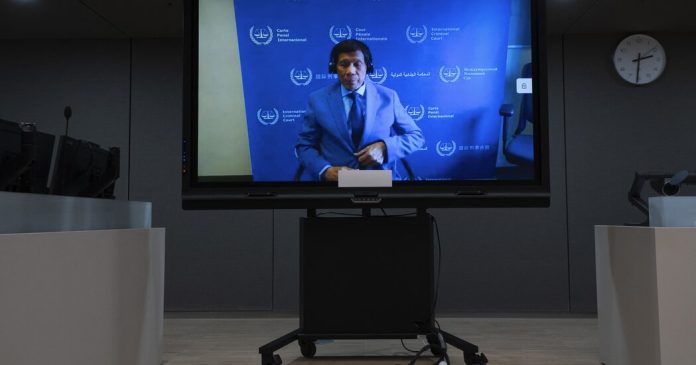
In a scenario once considered unthinkable for a head of state who presided over the public and brutal killings of thousands of civilians, Rodrigo Duterte, the former president of the Philippines, appeared at an International Criminal Court hearing via a video link on Friday.

Mr. Duterte’s arrest this week on charges of crimes against humanity, which came nearly three years after he left office, is a crucial step for Filipinos who have been seeking justice for their loved ones.

The 30-minute hearing in The Hague on Friday was procedural — a court officer informed Mr. Duterte of the charges, and Judge Iulia Motoc read him his rights and set a date for a hearing on Sept. 23 to determine whether the evidence presented by the prosecution was sufficient to take the case to trial.

But the breadth of the accusations against Mr. Duterte underscored the high stakes of the case in the country he once led.

During Mr. Duterte’s time as mayor of Davao City and as president, officers and vigilantes gunned down tens of thousands of people during what was portrayed as a war on drugs, rights groups said. Some of the victims were minors, and many were not involved in the drug trade, activists say.

Salvador Medialdea, Mr. Duterte’s lawyer, said in court on Friday that Mr. Duterte’s arrest amounted to a “pure and simple kidnapping” and called it “political score settling.”

Mr. Medialdea added that Mr. Duterte — who could be seen over the video link in a blue suit jacket, a blue tie and sitting at times with his eyes closed — was in bad health and that he was “hard of hearing and poor of sight.” Speaking in English, Mr. Duterte told the court his birthday and place of birth.

The lawyer said that Mr. Duterte would apply for temporary release for health reasons before the start of the trial, although they were not specified. Addressing Mr. Duterte, the judge said that she would not ask him to stand up, but added that later the court doctor had found him “fully mentally aware and fit” and that he could follow the proceedings by video link.

The Filipino authorities arrested Mr. Duterte, 79, on Tuesday at Manila’s main airport after he returned from a trip to Hong Kong, days after the I.C.C. issued an arrest warrant that led to his detention by the police in the Philippines.

He was arrested with the help of Interpol, acting on behalf of the I.C.C. because the Philippines is no longer a member of the court. Mr. Duterte was then flown on Wednesday to the Netherlands and was transported to The Hague.

When he ran for president before taking office in 2016, Mr. Duterte vowed to order the police and the military to find drug users and traffickers in order to kill them, promising immunity for those carrying out the orders.

Mr. Duterte had long benefited from a culture of impunity. Until Tuesday, he had seemed all but untouchable despite taking public credit for the widespread violence.

Mr. Duterte’s camp said his detention was illegal, arguing that the I.C.C. had no jurisdiction in the Philippines because the country had withdrawn from the court while he was president.

Judges ruled that the court had jurisdiction because it was investigating crimes that took place while the Philippines was still a member of the I.C.C.

The prosecution has charged Mr. Duterte with large-scale killings, torture and rape that it says occurred between Nov. 1, 2011, and March 16, 2019, when the Philippines officially withdrew from the court.

But Mr. Duterte may have been more likely to remain out of the court’s reach had it not been for a time of political upheaval in the Philippines.

When Mr. Duterte’s six-year term ended in 2022, he was succeeded by Ferdinand R. Marcos Jr., the son of a former dictator. Mr. Marcos ran together with Mr. Duterte’s daughter Sara Duterte, the country’s vice president.

That alliance has since fractured, and the two have had a spectacular falling out. Early in his administration, Mr. Marcos had indicated that he would not cooperate with the I.C.C., but in late 2023, his government allowed the court’s investigators to enter the country.

While supporters of Mr. Duterte gathered at his house in Davao City — some lighting candles and periodically chanting his name — dozens of family members of victims of his drug war joined watch parties of the hearing in the Philippines.

“Seeing Duterte face the I.C.C. gives hope for us victims,” said Marilyn Malimban, 51, at a coffee shop in Quezon City. She said her partner was shot by police officers masquerading as civilians in 2016.

“Duterte is feigning weakness,” she said, adding that he did not have the same power over the I.C.C. as he did in his home country. “He can act like a king only in the Philippines.”

The I.C.C. is facing various challenges in trying to convict Mr. Duterte. The court has tried — and several times failed — to convict leaders. The former president of Ivory Coast, Laurent Gbagbo, was acquitted in 2019 for his role in the country’s post-election violence.

To meet the standard of crimes against humanity — the charge that Mr. Duterte is facing — the prosecution must prove that the violent “war on drugs” campaign was part of a criminal plan led by Mr. Duterte and comprised “a widespread and systematic attack” against civilians in the Philippines.

Ms. Duterte, who was in court in The Hague on Friday, has called the arrest of her father political oppression, while Mr. Marcos has said he is simply following international convention in complying with the Interpol warrant.

Speaking outside the court, she said that Mr. Duterte and his supporters expressed their hope that “they will give us permission to visit the former president.”

In approving Mr. Duterte’s arrest, Mr. Marcos may be trying to eliminate the Dutertes as a political force without any major backlash. (Ms. Duterte is leading polls for the presidential election in 2028.)

Camille Elemia and Aie Balagtas See contributed reporting from the Philippines.

FTC asks to delay Amazon trial citing resources, then backtracks : NPR

0

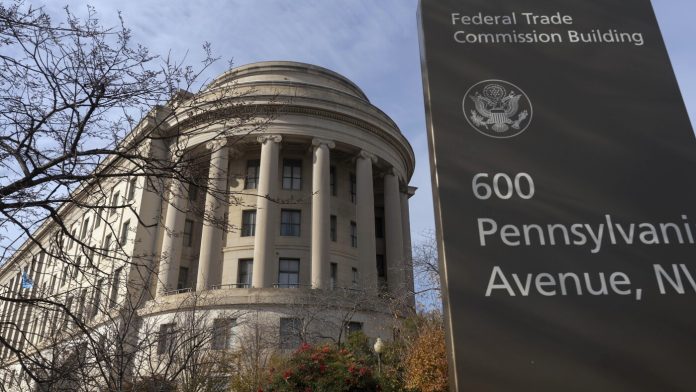
The Federal Trade Commission building is seen in Washington, D.C.

Jose Luis Magana/AP


hide caption

toggle caption

Jose Luis Magana/AP

On a a call about the government’s major lawsuit against Amazon, a federal lawyer began making startling disclosures.

The Federal Trade Commission is in a “dire resource situation,” FTC lawyer Jonathan Cohen said earlier this week, asking the federal judge to delay the trial.

Some people on the case team have resigned by accepting the DOGE team’s “Fork In the Road” offer, he said, and hiring is frozen. Agency staff have to vacate FTC offices because “something has happened” to the lease and they might move to the former USAID facilities. Their travel card limits were cut to $1. And they have to buy legal transcripts at the cheapest and slowest rate, which can mean weeks of waiting for documents to properly prepare for court deadlines.

“The agency is experiencing extremely severe resource shortfalls in terms of both money and personnel,” Cohen told U.S. District Judge John Chun in Seattle on Wednesday, according to a transcript of the call.

The case at stake is one of the FTC’s most high-profile lawsuits, against Amazon. The Biden administration had accused the retail giant of “tricking” people into paying for Prime memberships that were purposefully hard to cancel, which the company denies. The trial had been expected to start in September.

Amazon’s lawyer argued against rescheduling, saying he’d seen “no indication” of trouble at the FTC, and that lawyers change up on cases “DOGE or no DOGE.” Judge Chun asked the FTC to put the delay request in writing.

But within hours, federal lawyers reversed course.

“I was wrong,” Cohen wrote to the judge in a letter. “The Commission does not have resource constraints and we are fully prepared to litigate this case. Please be assured that the FTC will meet whatever schedule and deadlines the court sets.”

The FTC did not respond to NPR’s request for comment. But in a statement to the Associated Press, FTC Chair Andrew Ferguson also said Cohen was wrong, adding that the FTC “will commit the resources necessary for this case” and “will never back down from taking on Big Tech.”

Editor’s note: Amazon is among NPR’s recent financial supporters.

Trump Tariffs Leave No Country Room for Exemptions, U.S. Tells Canada

0

Top U.S. representatives told a Canadian delegation on Thursday that there was no way Canada, or any other country in President Trump’s cross hairs, could avoid a new round of sweeping tariffs on April 2, according to two people with direct knowledge of their conversation.

Any negotiations to remove some tariffs or even strike a more comprehensive trade deal would come after that date, American officials told their Canadian counterparts at a meeting in Washington, D.C. Mr. Trump, through an executive order, has ordered an in-depth examination of trade between the United States and several partners, including Canada, and the imposition of “reciprocal” tariffs beginning on April 2, to match surcharges other countries impose on U.S. goods.

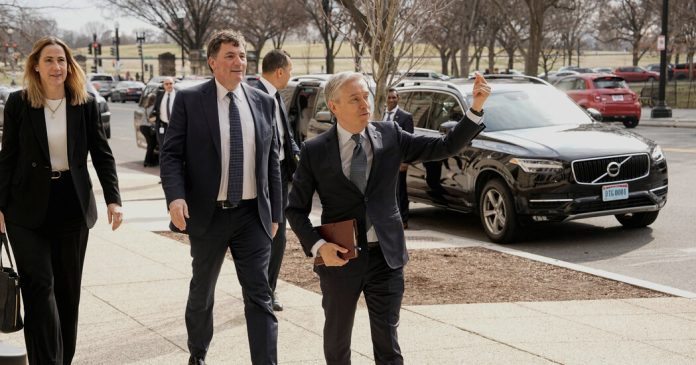
The United States was represented in the meeting by Commerce Secretary Howard Lutnick and U.S. Trade Representative Jamieson Greer. Canada was represented by Finance Minister Dominic LeBlanc, Industry Minister François-Philippe Champagne, Ontario Premier Doug Ford and Canada’s ambassador to the United States, Kirsten Hillman.

The Canadian officials left the meeting, which lasted more than an hour, with a clearer — but not necessarily more optimistic — sense of what lies ahead, according to two of them with direct knowledge of what transpired, who requested anonymity because they were not authorized to brief the press about it.

While the Trump officials made clear their pledge on reciprocal tariffs, Mr. Trump has shown a repeated penchant for vowing to press ahead with tariffs only to decide at the last minute to back down or grant a reprieve.

The meeting was an effort to inject a calmer approach to the relationship between the two countries, even as Mr. Trump on Thursday continued to level threats against Canada’s sovereignty.

The Canadian officials said that Mr. Lutnick and Mr. Greer conveyed to them that the Trump administration is very committed to tariffs as a trade policy, and to using tariffs to redefine the United States’ relationship to the world. April 2, they were told, will be a major step in establishing this new doctrine.

Mr. Trump last month directed his advisers to come up with new tariff levels that take into account a range of trade barriers and other economic approaches adopted by America’s trading partners. That includes not only the tariffs that other countries charge on U.S. products, but also the subsidies they give their industries, their exchange rates, and other measures that the president deems unfair.

Mr. Trump has said he needed to take action to even out America’s “unfair” relationships and stop other countries from taking advantage of the United States on trade. But he has made clear that his ultimate goal was to force companies to bring their manufacturing back to the United States.

The Canadian officials were left with the impression that there was a willingness by the United States to brush off the negative reaction that financial markets have already had to the president’s tariffs on Canada, Mexico and China.

The U.S. side explained that there was little Canada or any other nation could do to avert the coming tariffs on April 2. Instead, the administration was planning to go full steam ahead, and then, afterward, consider individual exemptions, changes or broader renegotiations on tariffs with specific countries, depending on market reactions.

After on-again-off-again threats of expansive tariffs, the United States now applies 25 percent surcharges on Canadian steel and aluminum as well as 25 percent on goods that do not comply with the existing trade agreement between the two nations. .

Economists believe the tariffs imposed so far, Canada’s retaliation against U.S. imports, and the overall atmosphere of volatility and uncertainty, could tip Canada into a recession this year.

A Trump administration official said that in the meeting on Thursday, Mr. Lutnick and Mr. Greer had highlighted the Trump Administration’s commitment to pursuing fair trade, and that both countries had recognized the strength and history of their relationship.

Mr. Lutnick has been meeting with numerous foreign officials to ensure that Mr. Trump’s message was heard and acted on accordingly, the U.S. official said. The Trump administration aimed to help U.S. companies prosper in the global marketplace by building balanced relationships, and eliminating trade deficits and foreign restrictions to trade, the official added.

Canadian officials are expected to return to Washington next week to talk with Mr. Greer, they said, and start focusing on more granular detail about addressing two key U.S. concerns raised in the Thursday meting: the digital services tax applied by Canada, and the question of quotas and surcharges on dairy products.

Canada imposes a 3 percent tax on revenues of online businesses, including social-media companies, online marketplaces and online advertising — industries that U.S. firms dominate. The tax has been a key complaint in the U.S.-Canada trade relationship since the Biden administration.

On dairy, Canada and the United States apply quotas and other measures limiting each other’s imports after a certain threshold of imports is reached. Mr. Trump has taken aim at this system, which he agreed to in 2018 as part of the renegotiation of the North American Free Trade Agreement into its successor trade deal, the U.S.-Mexico-Canada agreement.

The officials in the Thursday meeting also said that there was a broader feeling that the tone of the talks could improve with the departure of Canada’s prime minister, Justin Trudeau, who is being replaced on Friday by Mark Carney. Mr. Trump and Mr. Trudeau had fraught personal chemistry dating back to Mr. Trump’s first term.

“The temperature has come down,” Mr. Ford told the news media as he left the meeting on Thursday.

“We leave Washington I think better equipped in making sure we can defend Canadian interests,” Mr. Champagne, the industry minister, added.

Ana Swanson contributed reporting from Washington.

As stocks plummet, President Trump shifts his rhetoric

0

President Trump has repeatedly tied his political fortunes to the financial markets. But as his tariff policies impact investors, he’s shifting his rhetoric.