Thursday, November 12, 2026
Home Blog Page 126

Finland Finds Russian Mercenary Guilty of War Crimes in Ukraine

0

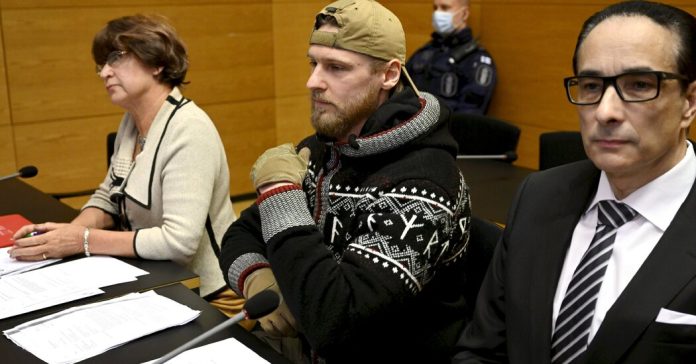
A court in Finland found a Russian paramilitary fighter guilty of war crimes committed during Russia’s first invasion of Ukraine, sentencing him to life in prison on Friday.

Voislav Torden, a Russian citizen who also goes by the name Yan Petrovskiy, was charged with committing war crimes for leading an ambush on Ukrainian soldiers in 2014, when Russian-backed forces first invaded Ukraine’s eastern front, according to the court ruling.

It was the first time a court in Finland presided over a case involving an alleged international war crime committed during the conflict in Ukraine, and a rare instance of a conviction for war crimes carried out when Russian forces first crossed into Ukraine more than a decade ago. In 2022, a United Nations-led commission of inquiry concluded that Russian forces had committed widespread atrocities in eastern Ukraine.

Mr. Torden had pleaded not guilty to five counts of committing war crimes, but a panel of three judges unanimously found him guilty of leading the ambush, murder, mutilation and distributing harmful images online. He was acquitted of a charge linked to planning the ambush because of insufficient evidence, the court said in its ruling.

Mr. Torden was a leader of Rusich, a neo-Nazi militia group that fought alongside Russia’s military and is associated with Wagner, the Russian private military company, according to the United States government. He and other members of the militia had been sanctioned by the United States, as well as the European Union and other allied countries.

Rusich mercenaries are known to have fought alongside Russian-backed proxy forces in the Donbas region in 2015 and to have appeared again on the battleground surrounding Ukraine’s northeastern city of Kharkiv in 2022, according to the U.S. Department of the Treasury.

Mr. Torden was arrested in Helsinki in July 2023, when he tried to enter Finland under a false identity. Mr. Torden was held under Finland’s terrorism laws and later charged with international war crimes. The trial was held in Finland after the country’s Supreme Court rejected an extradition request by Ukrainian prosecutors, citing concerns that he would not receive a fair trial in Ukraine.

During the trial, the court heard how Mr. Torden, as a deputy commander in Rusich, led an ambush at a checkpoint, killing 22 soldiers and wounding five others. The Rusich militia took over the checkpoint, flying a Ukrainian flag, according to the court ruling. After the firefight, Rusich soldiers searched through Ukraine’s injured, and fatally shot at least one of them.

Under Torden’s command, Rusich fighters mutilated the body of a Ukrainian soldier, carving the Rusich symbol into his face. They then photographed the mutilated soldier, and distributed the images on social media, with a message from Mr. Torden saying that Rusich fighters show no mercy.

During the trial, a Ukrainian soldier who was wounded in the attack testified that he saw Mr. Torden during the ambush, recognizing him by his tattoos of ancient Slavic symbols and his weapon of choice, a Russian-manufactured PKM machine gun, according to Finland’s public broadcaster, YLE.

In his defense testimony, Mr. Torden said that he was at the scene with a journalist and participated in filming propaganda videos for the Russian-backed separatist forces. He denied mutilating the wounded soldiers.

Mr. Torden plans to appeal the ruling and sentencing, said his lawyer, Heikki Lampela.

“My client was more than surprised, outright outraged, because there was no evidence that he had killed any wounded persons or given orders to kill wounded persons,” Mr. Lampela said in a telephone interview.

Nataliya Malgina, Mr. Torden’s other lawyer, told Russia’s state-run news agency RIA Novosti that the sentence was “politically motivated.”

Mr. Torden had been expelled from Norway in 2016 as a threat to national security, according to the treasury department. He took over the training of Rusich, replacing its previous leader, Alexey Yurevich Milchakov, who was wounded during fighting in 2022.

Iranian officials talk nuclear program with Chinese and Russian counterparts : NPR

0

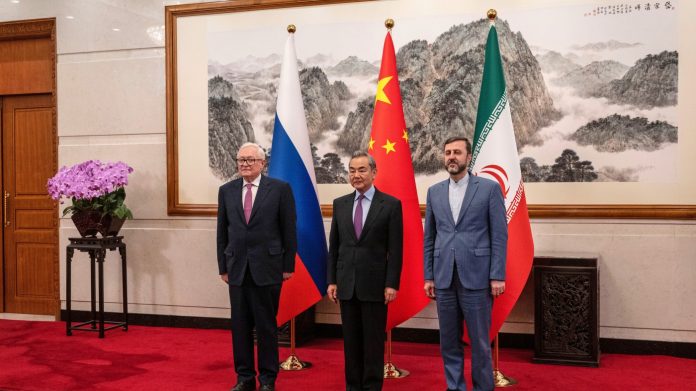
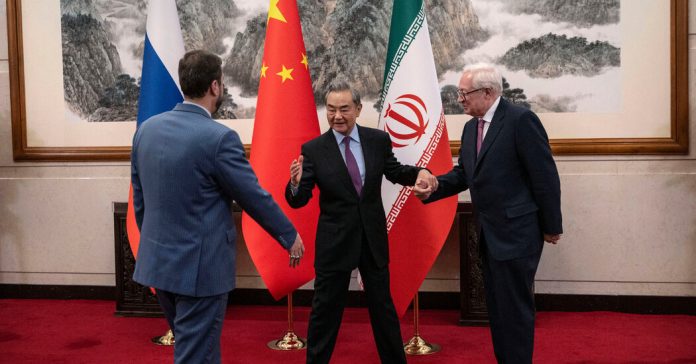
Chinese Foreign Minister Wag Yi, stands with Russian Deputy Foreign Minister Sergey Ryabkov, left, and Iranian Deputy Foreign Minister Kazeem Gharibabadi, right, before a meeting regarding the Iranian nuclear issue at Diaoyutai State Guest House on Thursday.

Getty Images/AP/Getty Images via AP


hide caption

toggle caption

Getty Images/AP/Getty Images via AP

BEIJING — Under pressure from the U.S. and a shifting international environment, China hosted Iranian and Russian officials to discuss Iran’s nuclear program, demonstrate solidarity and possibly align their positions in dealing with the West.

China’s Vice Foreign Minister Ma Zhaoxu, Russian Deputy Foreign Minister Ryabkov Sergey Alexeevich and Iranian Deputy Foreign Minister Kazem Gharibabadi issued a statement after their meeting, saying the countries discussed “the latest state of play with regard to [the] nuclear issue and sanctions lifting.”

“We reiterate that political and diplomatic dialogue based on mutual respect is the only effective and practical option,” Chinese Vice Foreign Minister Ma said according to state media. “We emphasize that relevant parties should work to eliminate the root causes of the current situation, abandon sanctions, pressure tactics, and threats of force.”

Iran’s Supreme Leader Ayatollah Ali Khamenei last week rejected President Trump’s call to either enter into nuclear negotiations or face possible military action.

During the meeting, the three nations also reaffirmed the importance of the 2015 Joint Comprehensive Program for Action (JCPOA). That 2015 deal requires Iran to curb its nuclear programs in exchange for sanctions relief.

Wu Bingbing, director of the Center for Middle Eastern Studies at Peking University, argues that the JCPOA reflects the interests of all sides in the nuclear issue, by allowing Iran to “peacefully develop nuclear energy,” and promote “the nuclear non-proliferation regime.”

The problem, he says, is that the U.S. pulled out of the JCPOA in 2018 during the first Trump administration. The U.S. reimposed sanctions, so that Iran never got the incentives to curb its nuclear programs that the JCPOA promises.

Wu says no parties want a war over the Iran nuclear issue, so “supporting negotiations and the spirit and principles of the JCPOA, and then reaching a new agreement would be the greatest limit to the risk of war.”

But Zhao Tong, a nuclear weapons expert at the Carnegie Endowment for International Peace, says that recent developments have heightened the sense of urgency over the Iran nuclear issue.

“One is the approaching deadline in October,” he says, “by which time the remaining members of the previous Iranian nuclear deal with the JCPOA would still have the right to trigger the snapback of comprehensive economic sanctions on Iran.”

The other is that the International Atomic Energy Agency earlier this year said that Iran accelerated its enrichment of uranium to near weapons-grade, beyond what’s required to produce nuclear energy.

Another factor, Zhao says, is that recent Israeli airstrikes have degraded Iranian air defense.

“That means the next few months is the important window of opportunity,” he says, “for Israel and the United States to use the military means to destroy Iranian nuclear facilities.”

Zhao argues that China, Iran and Russia are “like-minded” nations that share common interests and geostrategic objectives.

They also face a U.S. president who is trying to negotiate a deal with Russia over Ukraine, is locked in a trade war with China and has told Teheran to negotiate or face the possible use of U.S. force.

“Trump has been readjusting American strategic approach towards the major powers, making Russia and China also very uncertain about how they should readjust their relationship with each other,” Zhao argues.

“So they have a natural interest to coordinate positions among themselves first before engaging with Western countries.”

NPR’s Cao Aowen contributed to this report in Beijing.

Germans Reach Deal to Spend Big on Defense, Climate and More

0

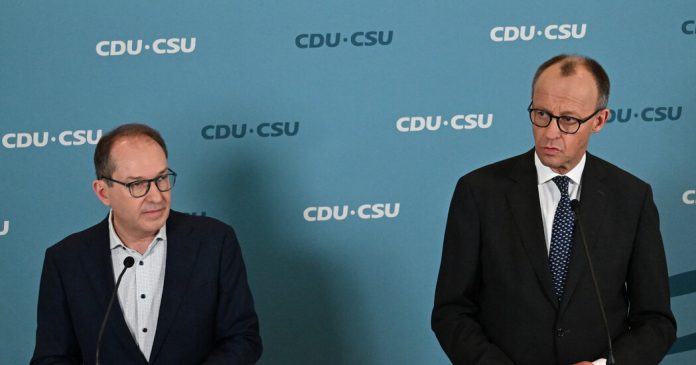
Friedrich Merz, the likely next chancellor of Germany, announced on Friday that he had cut a deal with the Green Party to allow extensive new government spending for defense, infrastructure and projects related to climate change, appearing to seal the votes for a stunning turnabout in German fiscal policy before he even takes office.

The deal, which Mr. Merz announced after days of negotiations, paves the way for a vote early next week to pass measures that are billed as a response to President Trump’s moves to pull back American security guarantees for Europe.

The measures would breach Germany’s hallowed limits on government borrowing, as they apply to military spending, and create new funds of borrowed money to improve dilapidated infrastructure and address climate change.

Mr. Merz called the agreement “a good result acceptable to all parties involved.”

Bernie Sanders adviser discusses whether Democrats should help pass GOP spending bill

0

Democrats face a dilemma. Should they help pass a GOP spending bill or allow the government to shut down? NPR speaks with Faiz Shakir, senior adviser to U.S. Sen. Bernie Sanders, I-Vermont.

The People Whose Children Were Killed in Duterte’s Drug War

0

Emily Soriano was doing laundry this week when a friend rushed into her house with news about their yearslong quest for justice.

In December 2016, gunmen stormed into a house in their poor neighborhood north of Manila and started shooting. They killed seven people, including three children and a pregnant woman. Ms. Soriano and her friend, Isabelita Espinosa, each lost a son, both teenagers.

To the victims’ families, the massacre seemed senseless, like thousands of other extrajudicial killings carried out during former President Rodrigo Duterte’s so-called war on drugs. Ms. Soriano and Ms. Espinosa have long held him responsible for the deaths of their sons —Angelito Soriano, 15, and Sonny Espinosa,16 — whom they say were innocent.

Mr. Duterte’s arrest on Tuesday, on accusations of crimes against humanity, was a major milestone toward accountability, the women said.

“What matters to me now is that justice is served,” Ms. Espinosa said. “And that we don’t allow these butchers and tyrants to remain in power. We must fight back.”

While he was in office, Mr. Duterte publicly encouraged the violence, which rights group say left tens of thousands dead. He promised immunity to the police officers who targeted people whom the authorities described as only “drug suspects.” Many were also killed by vigilantes.

Mr. Duterte rose to the presidency campaigning on his law-and-order credentials. He began his deadly antidrug campaign in the city of Davao, where he was the mayor for years and is accused of running a so-called death squad.

Between 2001 and 2007, Clarita Alia said four of her sons — all teenagers accused of petty crimes — were killed at Mr. Duterte’s behest. Over the past two decades, she became a symbol of protest against the killings in Davao, where speaking against Mr. Duterte was once unthinkable.

“I’m happy that he’s been jailed,” Ms. Alia said. “Now, he will feel what the people he hurt felt.”

Mr. Duterte was arrested in Manila on Tuesday after the International Criminal Court issued a warrant accusing him of crimes against humanity. Hours later, he was flown to The Hague, where both the I.C.C. and its detention facilities are based.

He is expected to make his first appearance in court on Friday, according to a court official. But his trial is not expected to start for months.

In the warrant, three judges of the court wrote that they had been presented with evidence that led them to believe Mr. Duterte was personally responsible for the killings and the attacks that were “both widespread and systematic.”

Mr. Duterte has argued the I.C.C. has no jurisdiction in the Philippines because he withdrew his country from the court while he was president. But in the warrant, the judges wrote that they were looking at extrajudicial killings while Manila was a member of the court. His supporters have denounced his arrest and handover to the I.C.C. as political persecution by the current president, Ferdinand R. Marcos Jr. Mr. Marcos has said he was complying with Interpol, which posted the I.C.C. warrant.

In Davao, Mr. Duterte’s stronghold, red ribbons with the words “Bring Duterte Home” were on display in many parts of the city. Some residents had stuck his photos on their vehicles in a show of support.

Ronald Camino said only criminals were angry with Mr. Duterte. “Those who do good are the ones being arrested,” he said.

In the Manila region, Ms. Espinosa got the news of Mr. Duterte’s arrest in a text message. Soon, she and Ms. Soriano were knocking on neighbors’ doors and gathering relatives of other drug war victims. Six other women joined them and hundreds of others that afternoon and lit candles to mark the arrest of Mr. Duterte.

During that rally, in nearby Quezon City, Ms. Espinosa wept for her son.

Ms. Soriano said she shares a birthday with Mr. Duterte, who will turn 80 on March 28. “I want to tell him: ‘I’m happy, this is a gift for me. But for you, it’s bad luck because you’ll be celebrating your birthday in jail.’”

But some Filipinos struggled to process their emotions.

Rodrigo Baylon’s son Lenin was killed by a stray bullet during a shootout in Caloocan in 2016, three days before he turned 10.

Celebrating Mr. Duterte’s arrest, Mr. Baylon said, also meant reliving that horrific event. At the time, Mr. Duterte’s chief of police, Ronald dela Rosa, who is now a senator, dismissed Lenin’s death as collateral damage in the drug war.

“Is this what they call justice?” Mr. Baylon said. “And will justice really come from the I.C.C.?”

He questioned why a foreign court, not the Philippine government, was holding Mr. Duterte accountable.

“Isn’t the government supposed to help people like us?” Mr. Baylon said.

Marlise Simons contributed reporting from Paris.

5 takeaways from what happened in Trump’s Washington this week : NPR

0

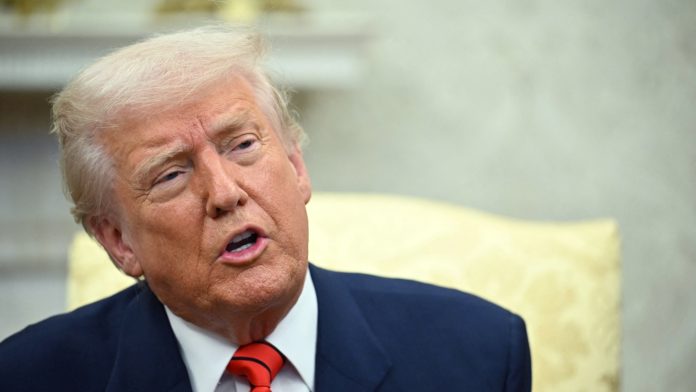
President Trump speaks to the press as he meets with NATO Secretary General Mark Rutte in the Oval Office of the White House in Washington, DC, on Thursday.

Mandel Ngan/AFP via Getty Images


hide caption

toggle caption

Mandel Ngan/AFP via Getty Images

We’ll be recapping what you need to know every Friday morning for the first 100 days of the Trump administration. Get more updates and analysis in the NPR Politics newsletter.

From economic and geopolitical volatility to a government shutdown standoff, the continued slashing of the government and mixed messaging on the measles, it was another consequential and news-packed week of this second Trump presidency.

Here are five takeaways from what happened this week that help you sift through what matters in our ongoing effort to chronicle the first 100 days of President Trump’s second turn in office:

1. Trump’s “period of transition”:

President Trump triggered concerns this week of a recession when he declined to rule the possibility of one out.

“There is a period of transition,” he said on Fox News, “because what we’re doing is very big.”

What the Trump administration is doing is implementing, pulling back and doubling down on tariffs. His trade war with Canada, Mexico, China and the European Union sent stocks tumbling and has caused general economic and geopolitical tumult.

Trump later defended his remarks when asked about his hesitancy to say there would not be a recession. “Of course I hesitated,” he said. “Who knows?” But by Tuesday, he’d walked that back entirely, saying, “I don’t see it at all.”

Trump’s “period of transition” remarks recalled the Biden administration saying inflation was “transitory.” (Biden himself said he believed price increases would be “temporary.”) Inflation did decline significantly eventually, but that was cold comfort for a lot of Americans, and Biden’s party lost the presidency.

Now, there’s a new administration, full of billionaires and multi-millionaire former corporate CEOs, pleading for patience on prices in hopes of bringing back manufacturing in the long term and telling Americans things like, “Access to cheap goods is not the essence of the American Dream,” as Treasury Secretary Scott Bessent did. Trump won’t be on the ballot again, but this week had to make a lot of Republicans who will be very nervous.

2. “The ball is now in Russia’s court”:

The Trump administration said Ukraine agreed to a 30-day ceasefire in its war with Russia. As a result, the U.S. will restart aid and intelligence sharing with Ukraine. “The ball is now in Russia’s court,” Secretary of State Marco Rubio said.

But Russia has not agreed to anything at this point despite Trump threatening sanctions. On Thursday, Russian President Vladimir Putin said he agreed “with the proposals to halt the fighting, but we proceed from the assumption that the ceasefire should lead to lasting peace and remove the root causes of the crisis.” And he questioned if 30 days would simply give the Ukrainian military time to regroup.

Earlier in the day, an aide to Putin reiterated that it wants Ukraine to: (1) concede that Crimea and four other regions are now part of Russia, (2) withdraw troops from lands claimed by Russia and (3) pledge never to join NATO.

The U.S. has already largely been negotiating on Russia’s terms — no NATO for Ukraine, no to getting all of Ukraine’s territory back. So how does Trump respond if Putin flouts his efforts?

3. Schumer blinks. Get ready for the blame and outrage:

Senate Minority Leader Chuck Schumer (D-N.Y.) leaves the Democratic caucus lunch at the U.S. Capitol on Thursday in Washington, DC.

Senate Minority Leader Chuck Schumer (D-N.Y.) leaves the Democratic caucus lunch at the U.S. Capitol on Thursday in Washington, DC.

Kayla Bartkowski/Getty Images


hide caption

toggle caption

Kayla Bartkowski/Getty Images

As if economic turmoil and a high-stakes gamble in trying to end a war weren’t enough, the federal government came pretty close to shutting down. But it looks like a shutdown, which would take place by the end of the day Friday, will be averted and the government will remain open for another six months. That’s because Senate Democratic leader Chuck Schumer said Thursday evening that he plans to vote for a GOP-written spending bill.

That’s despite saying a day earlier that Democrats would not help Republicans with this measure because Democrats were left out of negotiations. “Spending should be bipartisan, Republicans chose a partisan path,” Schumer had said. But he traded that line in for a warning about the hand a shutdown, he believes, would give Republicans.

“As bad as the CR is,” Schumer said of the continuing resolution, “allowing Donald Trump to take even more power via a government shutdown is a far worse option.” He contended that the GOP would weaponize a shutdown and reopen “only their favorite departments and agencies.”

Schumer’s move opens the pathway for more Democrats to vote in favor of it. Republicans could not pass the bill on their own, because they don’t have the 60 votes needed to overcome a filibuster.

This will also likely mean even more outrage from a frustrated Democratic base, which has been clamoring for Democratic leadership to do something to try to thwart Trump’s agenda.

NOTE: The government has shut down (either fully or partially) three times since 2013 – twice under Trump and once under President Barack Obama – and come close many other times. The 2019 shutdown, which lasted more than a month, came at a significant cost to the economy. It lowered “the projected level of real GDP in the first quarter of 2019 by $8 billion (in 2019 dollars), or 0.2 percent,” according to the Congressional Budget Office.

4. DOGE keeps on DOGE-ing – but what’s really going on?

The latest target in the Trump administration’s slashing of the federal workforce is the Department of Education. Trump pledged to eliminate the agency, and this week, he got about halfway there. Some 1,300 staffers were fired. Combined with those who have taken buyouts and probationary employees who were let go, the agency only has about half the staff it started with at the beginning of the Trump administration.

But that has led to questions about how efficient the agency will be in its ability to collect educational statistics, administer congressionally mandated funds for special education and low-income food programs and to allow people to apply for student loans. In fact, this week, a student aid website administered by the Education Department was down for several hours after the layoffs.

“I’m really anxious and quite honestly concerned to see whether or not the department is going to be able to follow through and be able to execute all of the programs, including federal student aid,” Beth Akers, a senior fellow at the right-leaning American Enterprise Institute, told NPR’s Morning Edition Thursday. And she is someone who is generally in favor of reducing the size of the agency.

The Trump administration, led by Elon Musk’s advisory Department of Government Efficiency, or DOGE, says the cuts are in an effort to cut the debt and deficit and make government more efficient. These cuts so far amount to very little in terms of the federal budget, but a lot in terms of people.

And that may be the point. Russ Vought, who is now Trump’s Office of Management and Budget Director, said in October, in a video unearthed by ProPublica before a pro-Trump think tank: “We want the bureaucrats to be traumatically affected. When they wake up in the morning, we want them to not want to go to work because they are increasingly viewed as the villains.”

By the way, that DOGE cuts are constituting a drop in the bucket (if that, considering their costs, too) is possibly one reason why Musk this week said his group will take aim at “waste, fraud and abuse” in entitlements, which he called “the big one to eliminate.” But there isn’t likely enough of that within Social Security, Medicare and Medicaid either to make much of a dent in the budget.

5. Kennedy’s mixed message on measles:

Before the measles, mumps and rubella vaccine was developed and then licensed in 1963, nearly everyone got measles by the time they were 15. One of the most infectious diseases known to man, it infected three to four million Americans every year with about 400 to 500 dying, 48,000 hospitalized and 1,000 suffering encephalitis, a swelling of the brain, according to the Centers for Disease Control and Prevention.

Almost 40 years after the vaccine — and its widespread and widely required use — measles was declared eliminated in the United States in 2000. Now, though, after the COVID pandemic saw an increase in vaccine hesitancy because of misinformation, one of the country’s most high-profile people, who has been questioning vaccines for years, is in charge of the Department of Health and Human Services. During his confirmation hearing, under pressure from people like Louisiana Republican Sen. Bill Cassidy, a doctor, Robert F. Kennedy Jr. downplayed his past statements on vaccines and his hesitancy about them.

One year-old River Jacobs is held by his mother, Caitlin Fuller, while he receives an MMR vaccine from Raynard Covarrubio, at a vaccine clinic put on by Lubbock Public Health Department on March 1, 2025 in Lubbock, Texas. Cases of Measles are on the rise in West Texas as over 150 confirmed case have been seen with one confirmed death.

One year-old River Jacobs is held by his mother, Caitlin Fuller, while he receives an MMR vaccine from Raynard Covarrubio, at a vaccine clinic put on by Lubbock Public Health Department on March 1, 2025 in Lubbock, Texas. Cases of Measles are on the rise in West Texas as over 150 confirmed case have been seen with one confirmed death.

Jan Sonnenmair/Getty Images


hide caption

toggle caption

Jan Sonnenmair/Getty Images

But since a measles outbreak in Texas, Kennedy has delivered very mixed messages. While he told Fox News’ Sean Hannity in an interview this week that he encourages people to get vaccinated, he also said getting measles gives you more immunity to measles than the vaccine and called himself a “freedom of choice person.” He said, “If people don’t want it, the government shouldn’t force them to do it.”

Despite serious side effects from vaccines being exceedingly rare, Kennedy played those up, something public-health experts called disinformation.

“The measles vaccine is incredibly safe,” Dr. Peter Hotez, co-director of the Texas Children’s Hospital Center for Vaccine Development and dean of the National School of Tropical Medicine at the Baylor College of Medicine, told CNN. “This is what anti-vaccine activists do is, they play up and try to scare you with the very, very rare side effects and forget to tell you about the horrific effects of the illness.”

Here’s an exhaustive day-by-day look at what happened this week related to Trump and his administration (since last Friday’s list):

Friday, March 7:

  • The jobs report shows the economy added 151,000 jobs. 
  • Trump administration brings back family detention of migrants. The Biden administration had ended family detention, opting to use detention facilities for adults only.
  • Pentagon flags 26,000 images to be removed because they were flagged as “DEI.” The vast majority of the purges were of women and minorities.
  • Trump canceling $400 million in funding to Columbia University. 
  • Trump says tariffs on Canada may be coming today. 
  • Trump says he’s “finding it frankly more difficult to deal with Ukraine. … It may be easier to deal with Russia.” But in response to Russia continuing to bomb Ukraine, he puts out a message on social media saying Russia “can’t do that” and threatens sanctions. 
  • Federal Reserve Chairman Jerome Powell says he’s awaiting “greater clarity” on Trump policies before signaling next move on interest rates.
  • Trump Treasury Secretary Scott Bessent, a billionaire, said during a speech defending Trump on tariffs, “Access to cheap goods is not the essence of the American Dream.”
  • Most of the 80,000 employees at HHS receive an email offering a buyout. 

Saturday

  • GOP unveils stopgap spending bill.
  • A future Trump presidential library has a “high likelihood” of landing in Florida, according to a state legislator. Florida Atlantic University and Florida International emerge are possibilities, he said. NBC News reports Eric Trump, Steve Witkoff and Florida Gov. Ron DeSantis have all scoped out potential sites. 
  • Elon Musk and Secretary of State Marco Rubio dine at Trump’s Mar-a-Lago Florida home after a tense Cabinet meeting exchange. 

Sunday

  • Trump negotiator Adam Boehler says he spoke directly with Hamas in an effort to free hostages. The move angered members of Israeli Prime Minister Benjamin Netanyahu’s administration.  
  • Trump does not rule out a recession this year in an interview on Fox News. He says there will be a “period of transition” and that the economy will be better off for it in the long run.
  • After Iran rebuffed a letter from Trump calling to negotiate over its nuclear program, Trump said in the same Fox News interview, ​​”There are two ways Iran can be handled, militarily or you make a deal.”
  • Commerce Secretary Howard Lutnick, though, says “absolutely not” when asked if Americans should be prepared for a recession on NBC. He says people shouldn’t doubt Trump, but in another interview, with CBS News, he says Trump’s tariff policies would be “worth it” even if they lead to a recession. 

Monday

  • The stock market plunges after Trump’s recession remarks and that there was “no room left” for negotiation in U.S. tariffs against Mexico and Canada
  • Head of the Department of Justice’s Office of Information Policy, the office that oversees the Freedom of Information Act, is fired as well as the Justice Department’s pardon attorney. The New York Times reports the pardon attorney was fired after refusing to recommend that Mel Gibson have his gun rights restored. 
  • X was down for several hours. Elon Musk says it was due to a “massive cyber attack” he says originated from the “Ukraine area.” Cyber security experts threw cold water on that.
  • A pro-Palestinian protestor who attended Columbia University was arrested by ICE. The man, Mahmoud Khalil, is a green card holder and married to an American citizen.
  • Mark Carney becomes incoming Canadian prime minister and he has tough words for Trump’s tariffs. He says Canada didn’t pick this fight, but is always ready when someone drops the gloves. 
  • Musk calls Sen. Mark Kelly, D-Ariz. a “traitor” after Kelly put a thread on X advocating for continuing to support Ukraine after a visit. Kelly is a combat veteran and astronaut.
  • Musk says entitlements make up a big portion of the federal budget and are the “big one to eliminate.” Musk claims there is $500 billion in “waste, fraud and abuse” in the programs, but previous inspectors general findings show that is highly unlikely. In Social Security, for example, from 2015 through 2022, its IG found almost $72 billion in improper payments, representing roughly 1% of benefits paid out in that stretch, the AP notes.
  • A federal judge barred the Trump administration from withholding congressionally appropriated foreign aid funds. 
  • Ontario Premier Doug Ford says the province will charge an additional 25% for Americans who use Canadian electricity. Trump then doubled down on tariffs and claimed of electricity tariffs “your (sic) not even allowed to do that.”
  • NBC reports that fewer people were deported in February under Trump than the same month a year ago under Biden. 

Tuesday

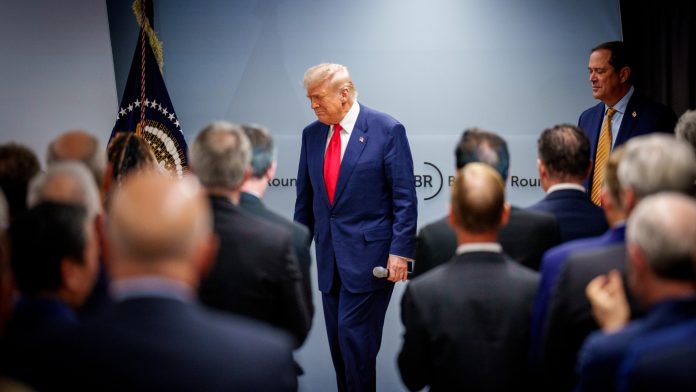
President Trump delivers remarks at the Business Roundtable's quarterly meeting at the Business Roundtable headquarters on Tuesday in Washington, DC. Trump addressed the group of CEO’s as his recent tariff implementations have sparked uncertainty that have helped fuel a market sell-off.

President Trump delivers remarks at the Business Roundtable’s quarterly meeting at the Business Roundtable headquarters on Tuesday in Washington, DC. Trump addressed the group of CEO’s as his recent tariff implementations have sparked uncertainty that have helped fuel a market sell-off.

Andrew Harnik/Getty Images


hide caption

toggle caption

Andrew Harnik/Getty Images

  • Trump posts that he’s adding another 25% to 50% in tariffs on steel and aluminum from Canada to go into effect Wednesday. Ford, the Ontario premier, says on CNN he “will respond appropriately on electricity. Stay tuned.” He calls on Trump to end the chaos and says the tariffs are leading to “Trump’s recession.” Trump’s post seemed to spook the markets again. Later in the day, after a meeting with Commerce Secretary Lutnick, Ontario said it was suspending its electricity surcharge. Trump says he will probably roll back steel and aluminum tariffs. 
  • The Federal Emergency Management Agency cancels National Fire Training Academy classes.
  • White House Press Secretary Karoline Leavitt echoes Trump saying the country is in a time of economic transition and blames former President Biden for leaving a “mess.”
  • Ukraine agrees to a ceasefire deal and the U.S. says it will resume aid. 
  • Leavitt says the Department of Homeland Security is actively seeking more campus protesters to detain following the arrest of Khalil. 
  • Layoff notices expected at the Education Department. 
  • The National Transportation Safety Board says there are urgent safety concerns in the airspace around Reagan National Airport outside Washington, D.C. 
  • Trump changes his tune on a potential recession, telling reporters, “I don’t see it at all.” He denies that the down slide of the stock market has anything to do with tariffs and instead blames Biden. “It’s all coming down,” Trump falsely says of prices and inflation. “It’s a beautiful thing.” Trump again says Canada should become the “cherished 51st state.” 
  • The New York Times reports that tuberculosis is spreading internationally as a result of Trump’s cuts to USAID.
  • Rep. Keith Self, R-Texas calls Rep. Sarah McBride of Delaware “Mr. McBride“. McBride is a transgender woman. After being pressed by Rep. Bill Keating, D-Mass. to properly address McBride, Self repeats it and then adjourns the hearing. 
  • Democrats overperform in a state House race in Iowa. The Democrat lost by about 4 points, but it’s a district Trump won in 2024 by almost 27 points.
  • RFK Jr. tells Fox News’ Sean Hannity that getting measles gives you more immunity than the vaccine. He noted that vaccines do stop the spread of the disease, are being sent to Texas, where there’s an outbreak, and, “Anybody who wants a vaccine will get one.” But, he also said, “I’m a freedom of choice person. … if people don’t want it, the government shouldn’t force them to do it.” He then cited exceedingly rare “adverse events from the vaccine” before saying “people ought to be able to make that choice for themselves.” 
  • Trump pardons a former Tennessee state senator, who had just begun serving a 21-month prison sentence for campaign fraud. “God used Donald Trump to save me from the weaponized Biden DOJ,” former state Sen. Brian Kelsey, 47, posted on X.

Wednesday

  • House Democrats begin their retreat, attempting to get on the same page. Of the uneven response to Trump’s address to a joint session of Congress that saw a member ejected for the first time, California Rep. Ami Bera told Politico, “I think it showed a party that wasn’t unified. I think we had clear direction from our leadership on how to conduct ourselves. So I would hope that we talk about that this week.”
  • During a meeting at the White House with the Irish prime minister, Trump accused Ireland of cheating to lure pharmaceutical companies with low taxes and took a swipe at comedian Rosie O’Donnell, who recently moved to Ireland.
  • Federal judge rules that Khalil cannot be deported “unless and until this court orders otherwise.” 
  • Democratic Senate leader Chuck Schumer of New York says Democrats aren’t going to help Republicans with their spending bill because “spending should be bipartisan. Republicans chose a partisan path.” Instead, he said his caucus supports a clean continuing resolution that would keep the government open until April 11. 
  • Trump says of Schumer: “Schumer is a Palestinian, as far as I’m concerned. He’s become a Palestinian. He used to be Jewish. He’s not Jewish anymore. He’s a Palestinian.”
  • Steel and aluminum tariffs take effect. 
  • Trump doubles down on reciprocal tariffs. Asked about the economy and the inconsistency of the administration’s messaging, Trump says, “I have the right to adjust. … I’m not like a block. It’s not inconsistency. It’s flexibility.”
  • Rubio speaks in Ireland. He defends Trump’s tariffs. Also says Khalil can be kicked out because a visa can be denied for any reason. “This is not about free speech,” he said, adding, “We have the right to deny you for virtually any reason.”
  • A CNN poll finds Trump with a 39% approval. 
  • The G7 Foreign Ministers meeting takes place in Canada. “Canada is not the one driving up the price of your groceries” gasoline and construction, Canadian Foreign Minister Melanie Joly says. 
  • Thousands are fired at the Department of Education across multiple states.
Demonstrators gather outside of the offices of the U.S. Department of Education in Washington, D.C. on March 13, 2025 to protest against mass layoffs and budget cuts at the agency, initiated by the Trump administration and DOGE. (Photo by Bryan Dozier / Middle East Images / Middle East Images via AFP) (Photo by BRYAN DOZIER/Middle East Images/AFP via Getty Images)

Demonstrators gather outside of the offices of the U.S. Department of Education in Washington, D.C. on Thursday to protest against mass layoffs and budget cuts at the agency, initiated by the Trump administration and DOGE.

Bryan Dozie/AFP via Getty Images


hide caption

toggle caption

Bryan Dozie/AFP via Getty Images

  • Greenland elects a Trump critic who says he hopes his election sends a clear message. 
  • The Environmental Protection Agency says it plans to roll back climate regulations, reconsidering rules for things like air pollution and wastewater from coal plants. The move comes on the heels of the government dropping a lawsuit against a petrochemical plant the Biden administration deemed a health threat to a community in Louisiana.
  • Federal student loan site was down after mass layoffs at the Department of Education.

Thursday

  • Canadian officials meet with Commerce Secretary Lutnick in Washington. Ontario’s premier Doug Ford called the two-hour meeting “productive,” “civil” and that the “temperature” had come down, but the tariffs remain in place. Before the meeting, Lutnick summed up the administration’s attitude on Fox News: “What are you doing for us? I know what we are doing for you, but what are you doing for us?”
  • Trump withdraws nominee to run the Centers for Disease Control and Prevention, Dr. Dave Weldon, a former Florida Republican congressman, on the day he was supposed to appear for his Senate confirmation hearing. Weldon, a friend of RFK Jr.’s who has questioned the effectiveness of vaccines, didn’t have the votes to be confirmed.
  • Trump threatens Europe with a 200% tariff on wine, champagne and other “alcoholic products” from France and other EU countries. He also said the EU “was formed for the sole purpose of taking advantage of the United States.”
  • Democratic attorneys general from 20 states sue over the Education Department cuts.
  • A federal judge in San Francisco rules that thousands of fired employees must be reinstated. 
  • Schumer says he will vote for the GOP spending bill. That opens the path for other Democrats to do so and avert a government shutdown. 

Friday

  • The government would shut down at the end of the day, if no deal is reached or enough Democrats vote for the spending measure. 
  • Dr. Mehmet Oz is slated for his confirmation hearing to head the Centers for Medicare and Medicaid Services.
  • Trump plans to visit the Justice Department.

China Backs Iran in Nuclear Talks, Slams ‘Threat of Force’ From the West

0

By working with Russia to hold talks with Iran, China is conveying a contrast with the United States in its approach to resolving the nuclear issue, said Shen Dingli, an international relations scholar in Shanghai. Beijing wants to show that “while the United States irresponsibly pulls out of the Iran Nuclear Agreement, China will also hold fast to this international commitment and assume the responsibility of leadership,” Mr. Shen said.

The message is also one of solidarity with Iran. “Even though the United States exerts extreme pressure, as long as Iran does not give up on its relevant commitments, it will still have friends,” Mr. Shen said. “Iran doesn’t need to worry. In the end, this is a strategic game between China and the United States.”

After Mr. Trump suggested that Iran negotiate over its nuclear program or face potential military action, Iran’s supreme leader decried “bullying governments” and seemed to push back on the idea of negotiating with the United States. China and Russia’s support could help Iran seem less isolated, but Tehran might have concerns, as well.

“The Iranians, for their part, are very wary of Chinese, but especially of Russian involvement in negotiations, as they fear they will be sold out by Moscow as part of a broader U.S.-Russia accord,” said Gregory Brew, a senior analyst at the Eurasia Group. “They will be looking for support from Russia while resisting any pressure to give in to U.S. demands.”

China has considerable leverage over Iran: Chinese companies purchased over 90 percent of Iran’s oil exports last year, often at deep discounts to world prices, according to Kpler, a Vienna-based company that specializes in tracking Iran’s oil shipments. Most other countries have refrained from buying oil from Iran so as to comply with Western-led sanctions aimed at persuading Iran to stop its development of nuclear weapons.

Sales by Iran’s state oil company to China represent about 6 percent of Iran’s entire economy, or half of government spending in Iran.

David Pierson contributed reporting from Beijing.

government shutdown; Trump at DOJ; federal layoffs : NPR

0

Good morning. You’re reading the Up First newsletter. Subscribe here to get it delivered to your inbox, and listen to the Up First podcast for all the news you need to start your day.

Today’s top stories

Senate Democrats must choose between a government shutdown and voting for a bill they hate, as they face a deadline today to pass a budget. Minority Leader Chuck Schumer said last night he would vote to keep the government open, signaling a path for the Senate to pass a six-month spending bill passed by the House that would fund the government through September. Rep. Alexandria Ocasio-Cortez called the announcement “a huge slap in the face,” and said there’s a “deep sense of outrage and betrayal” across the Democratic Party.

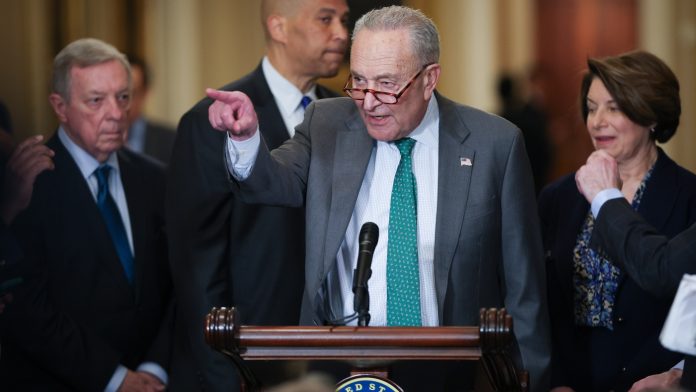
WASHINGTON, DC – MARCH 11: Senate Minority Leader Chuck Schumer (D-NY) speaks during a press conference following a policy luncheon at the U.S. Capitol on March 11, 2025 in Washington, DC. Schumer answered a range of questions during the press conference. (Photo by Win McNamee/Getty Images)

Win McNamee/Getty Images/Getty Images North America


hide caption

toggle caption

Win McNamee/Getty Images/Getty Images North America

  • 🎧 Democrats are not happy with this bill, which was written without their input, NPR’s congressional correspondent Dierdre Walsh tells Up First. But they say both of their options — avoid a shutdown or block the bill and trigger one — are terrible. The GOP has a 53-seat majority in the Senate but needs 60 votes to get around a filibuster. Schumer’s support could give undecided Democrats cover to vote yes on the bill, Walsh says.

President Trump is expected to visit the Justice Department today, where he will deliver a speech outlining his vision for the department. His visit comes as his administration has spent the last several weeks demoting attorneys who worked on cases related to Jan. 6 and firing officials who investigated the president.

  • 🎧 Historically, presidents have kept their distance from the DOJ, NPR’s justice correspondent Ryan Lucas says. That’s because for decades there’s been a norm, respected by both Republican and Democratic administrations, that the department is independent and free from political interference. During his speech, Trump is expected to address restoring law and order, removing violent criminals from communities, and ending what the White House says is the weaponization of justice against Americans for their political leanings.

Two federal judges yesterday ordered federal agencies to reinstate thousands of workers who were recently fired. In Maryland, U.S. District Judge James K. Bredar issued a 14-day stay in a case brought by 20 Democratic attorneys general. They argued that federal agencies falsely told probationary employees they were being fired because of their performance when, in fact, agencies didn’t evaluate them. Bredar ordered 18 federal agencies to reinstate probationary workers fired through what he called “illegal RIFs,” or reductions in force, by Monday at 1 p.m. EDT, for a period of 14 days. His ruling came hours after District Judge William Alsup ordered the Trump administration to reinstate workers fired from six federal agencies, calling the mass firings “a sham.” The administration has filed an appeal.

The NPR Politics team is recapping each Friday morning everything you need to know about the Trump administration’s first 100 days. From geopolitical volatility to a government shutdown standoff, the continued slashing of the government and mixed messaging on the measles, here are five takeaways from everything that has happened in the past week. Subscribe to the NPR Politics newsletter for more updates and analysis.

Picture show

Veterans and volunteers with Force Blue use an assembly line to transport stones to build a rubble wall in Ft. Walton Beach, Fla.

Veterans and volunteers with Force Blue use an assembly line to transport stones to build a rubble wall in Ft. Walton Beach, Fla.

Blake Jones for NPR


hide caption

toggle caption

Blake Jones for NPR

Veterans’ nonprofit Force Blue focuses on coral reef restoration and ocean conservation efforts across the U.S. Their projects also provide “mission therapy” to veterans who miss the camaraderie and sense of purpose they experienced during their service. The transition from military service has been identified as a critical time when suicide rates and mental health issues tend to increase. These volunteers are not the typical environmentalists, but “Gonzo” Gonzales says grizzled former Navy SEALS like him are “making conservation cool.” Check out these photos of a recent project.

Weekend picks

Cate Blanchett as Kathryn St. Jean and Michael Fassbender as George Woodhouse in Black Bag, director Steven Soderbergh's new spy thriller.

Cate Blanchett as Kathryn St. Jean and Michael Fassbender as George Woodhouse in Black Bag, director Steven Soderbergh’s new spy thriller.

Claudette Barius/Focus Features


hide caption

toggle caption

Claudette Barius/Focus Features

Check out what NPR is watching, reading and listening to this weekend:

🍿 Movies: A Steven Soderbergh spy thriller, a tween romance, a grisly comedy about a guy who feels no pain and more: Here are four of the buzziest movies coming out this weekend.

📺 TV: Have you ever stuck with a show until the very last episode, long after you realize it’s not good? Pop Culture Happy Hour hosts discuss their favorite terrible but bingeable shows.

📚 Books: With more daylight for reading, here are five books publishing this week. The offerings include a foodie memoir, an ecological catastrophe, a high-stakes mystery and more.

🎵 Music: The World Cafe’s “Spring Is Springing” playlist features tunes from Simon & Garfunkel, Sheryl Crow and Bill Withers that are perfect for springtime, which is almost here, and sunnier days.

❓Quiz: How confident are you in your international politics knowledge? You’ll need it for at least three questions in this week’s quiz.

3 things to know before you go

Kimberly Sullivan is taken into custody.

Kimberly Sullivan, who was taken into custody on Wednesday, faces charges including assault, kidnapping and unlawful restraint. She is accused of locking her stepson in his room for over 20 years.

AP/Waterbury Police Department


hide caption

toggle caption

AP/Waterbury Police Department

  1. A 32-year-old man, who has not been publicly named, is accusing his stepmom of keeping him locked inside a room in their Connecticut home since he was approximately 11 years old. He told authorities he set a fire in his upstairs bedroom to escape.
  2. Some acne treatments from brands including Walgreens, Proactiv and La Roche-Posay have been voluntarily recalled because they contain elevated levels of the carcinogen benzene.
  3. Italian designer Donatella Versace says she plans to step down as creative director of her eponymous luxury fashion powerhouse. The 69-year-old has held the position for nearly 30 years.

This newsletter was edited by Yvonne Dennis. Brittney Melton contributed.

Catholics Around the Globe Heed Francis’ Call to ‘Pray for Me’

0

When Pope Francis first appeared to the world on the balcony of St. Peter’s Basilica, he humbly requested that the faithful “pray for me.” Those simple words became the punctuation marks of his pontificate, as he ended practically all his speeches, greetings, weekly benedictions and casual conversations with the appeal.

Now, 12 years since his election on March 13, 2013, and a month to the day that he entered the hospital with life-threatening lung infections, the Roman Catholic world is heeding his call and praying for its pope.

Even as the Vatican says that the pope’s condition has seen a “slight improvement,” every evening, Vatican cardinals lead rosary prayers for Francis’ recovery. Parishes around the world, from his native Argentina to the far-flung nations he made it a priority to visit and worship with, are holding prayer sessions. Even Francis’ opponents in the church’s hierarchy, prelates he demoted and fired and who have waged war against the pope’s vision — often over how to pray and worship — are silently saying their prayers.

“At this moment, even people from different ideological or theological inclinations, prayer is bringing them together,” said Archbishop Fortunatus Nwachukwu, the secretary of the Vatican’s office for evangelization.

He said Francis’ constant appeal over the past dozen years for people to pray for him was an expression of his humility, that “like any other person, he needs prayer” and God’s help. It was also an expression of Francis’s trust that people, often from other faiths, had the same line of communication to God as he did.

“It is not a question of selfishness,” the archbishop said. “It is a question of human solidarity.”

Prayer has been the lifeblood of faith, the currency between the earthly and spiritual realms, since time immemorial. For Francis, the church’s first Jesuit pope, it has played a major role in a pastoral vision that draws people close to the church by emphasizing blessings and simple acts of devotion over church rules and traditions.

He has often taught that an openness to God’s will, a form of prayer, is central to his decision-making and has preached that a church that prays together stays together.

Now, with his breathing belabored and his body still weak, it is the pope’s own ailing health that has become an additional motivation for the prayer he believes the church needs to thrive.

“I thank you from the bottom of my heart for your prayers for my health from the square,” Francis said in a feeble voice last week, in his only public address since his Feb. 14 hospitalization. “I accompany you from here.” In recent days, he has observed and taken part by video link in spiritual exercises at the Vatican, where his tenuous condition looms over all conversations and rituals.

As Cardinal Mauro Gambetti, the archpriest of St. Peter’s Basilica, walked into the Vatican on Tuesday evening for one of those meditations and prayer services for Francis, he said that prayer was “the breath of the soul” and that he and other church leaders, in praying for the pope, prayed “for the breath we all need.”

Cardinal Francis Arinze, a former leader of the church’s worship office under Pope John Paul II and Pope Benedict XVI, said prayer was paramount. In the Bible, he said, followers who prayed to Jesus “got what they were asking.” It showed, he said, that “we need God; we are not almighty. It’s normal.”

Rank-and-file Catholics agreed. In the San Zaccaria church in Venice, an old woman held a rosary that she said Francis had given her. She said that she included him in her prayers. Her 90-year-old priest, the Rev. Carlo Seno, said that he prayed for Francis every day, but that if the pope did not end up recovering, it would not mean that prayer had failed.

“God can intervene in a way that is different from what we hope,” Father Seno said.

Carol Zaleski, an author, with her husband, Philip Zaleski, of “Prayer: A History,” said there were many different types and styles of prayer — petitions and adorations, unspoken and sung, linked to sacrifice or ritual. What was clear was that prayer had accompanied humanity since the beginning and that signs of it went back, at least, to cave drawings.

For the Catholic Church, she said, prayer, like doctrine, had evolved over the centuries. “Lex orandi, lex credendi,” she said, recalling an early Christian formulation that meant prayer and belief were one and the same.

In subsequent centuries, hermit monks in Egypt prayed fervently to survive hunger and the elements. The monasteries of the Middle Ages became what she called the “prayer laboratories” where “they’re doing every kind of prayer.” In the 12th century, St. Dominic of Guzmán, the founder of the Dominican order, reported that the Virgin Mary gave him rosary beads to keep count of Hail Mary recitations.

Prayer took different forms, but the petitions for help or miracles really went into overdrive, she said, “when the enemy is approaching and about to sack your city, or when the plague is killing everybody.” When disaster was averted, prayer got the credit.

After Pope Pius V led a league of Christian fighters in praying the rosary before triumphing over a larger Turkish invasion in the 1571 Battle of Lepanto, a turning point in the history of Europe, the church thanked the Virgin Mary by creating a feast day.

The church still turned to prayer in the face of the world’s greatest challenges.

In 2020, as deaths from Covid surged, Francis stood alone between a wooden cross used to ward off a 16th-century plague and the empty square of St. Peter’s Basilica to offer haunting prayers for the world’s healing. Remembering that occasion, Cardinal Matteo Zuppi told Italian bishops this week that it was now the world’s turn to be “united in prayer for him.”

The call came through to Vincenza De Simone, 69, from Naples, Italy, as she stood in St. Peter’s Square in Rome, reciting the Hail Mary prayer.

“This is an historic moment,” she said, adding that the pope’s sickness was an extra motivation for Catholics across the globe to pray for him.

Archbishop Nwachukwu said that togetherness was something Jesus, who expressly made prayer a pillar of the faith, wanted when he told his followers that God was present wherever two or three people gathered to pray.

On Tuesday evening, cardinals spilled out of the Vatican after a day of spiritual exercises and prayers for Francis that a friar leading meditations said should be hard work.

“After two hours,” said Cardinal Claudio Gugerotti, prefect of the church office for Eastern Churches, “we are exhausted.”

Among the prelates who have taken part in the prayer services for Francis in recent weeks have been some of his most prominent critics, traditionalists Francis clashed with for their championing of old rites and ways of praying that he worried put too much distance between the faithful and the church.

On the first night of the rosary prayer on the steps of St. Peter’s Basilica, Cardinal Raymond Burke of the United States, who has in the past suggested the pope was in danger of becoming a heretic, prayed quietly in the front row.

On Tuesday night, another prelate Francis exiled from power, Cardinal Robert Sarah of Guinea, a former head of the church’s office on worship, left the evening prayers for Francis. He worked his rosary beads as he crossed St. Peter’s Square.

“I’m praying right now,” he said.

Emma Bubola contributed reporting from Venice, and Elisabetta Povoledo from Rome.

American CEOs are worried about Trump’s chaotic new tariffs : NPR

0

President Trump arrives at the Business Roundtable’s quarterly meeting on March 11, to address a group of CEOs amid an ongoing market selloff sparked by his new tariffs.

Andrew Harnik/Getty Images/Getty Images North America


hide caption

toggle caption

Andrew Harnik/Getty Images/Getty Images North America

Wall Street is panic-selling over President Trump’s chaotic new tariffs. Business executives are reportedly making frantic calls to the White House. And on Tuesday, the country’s top CEOs crowded into a closed-door meeting with Trump — setting a record for attendance.

Yet in public, corporate America’s leaders are remaining calm — and even upbeat.

“The business community understands what the president is trying to do with tariffs,” Goldman Sachs CEO David Solomon told Fox News on Wednesday.

Solomon acknowledged that companies “always” want lower tariffs. But he was also careful to start his comments by praising Trump for being “engaged with the business community” — unlike, he added, the Biden administration.

The Goldman Sachs CEO was speaking a day after Trump met with him and other members of the Business Roundtable, an influential CEO group. The meeting followed two days of sharp losses in the U.S. stock market, in a $4 trillion (and ongoing) selloff, largely kindled by Trump’s words and actions: Since early March, Trump has implemented a flurry of steep new tariffs, reversed some of them, and shrugged off concerns over their economic impact.

When asked about the possibility of a recession, Trump demurred — in a reply that sparked this week’s market turmoil.

“There is a period of transition, because what we’re doing is very big. We’re bringing wealth back to America,” the president told Fox News in an interview that aired Sunday.

By mid-week, a handful of the most powerful CEOs had started to express concern — but even then, only in very mild terms.

“Uncertainty is not a good thing,” JPMorgan Chase CEO Jamie Dimon, who runs the country’s largest bank, said Wednesday at a conference hosted by the publication Semafor.

And Larry Fink, who runs investment giant BlackRock, told CNN that “the economy is weakening as we speak.”

Yet Fink was also quick to add that the Trump administration’s policies “can be very productive for the United States” in the long run.

A White House spokesperson on Thursday reiterated his statement to NPR from earlier this week.

“President Trump delivered historic job, wage, and investment growth in his first term, and is set to do so again in his second term,” White House spokesperson Kush Desai said by email.

Why America’s business leaders engage in delicate diplomacy

Corporate America’s careful rhetoric — even as many big companies brace for the impact of the market volatility and the tariffs — illustrates the delicate diplomacy that business leaders are trying to engage in. They largely welcome Trump’s other economic promises — including lower taxes and fewer regulations.

Business leaders also see limited benefits to criticizing the president in public, experts say. That’s a marked contrast from Trump’s first term, when some CEOs publicly resigned from White House advisory councils to protest the president’s handling of racist violence in Charlottesville, Va.

But eight years later, corporate America is much less willing to wade into public conversations about politics — or “social” issues that companies don’t see as directly related to their bottom lines.

Today, they’re more focused on the potential financial upsides of Trump’s new term. The president actively courted business interests during his campaign — and at first, corporate America seemed thrilled with the results of the election. CEO confidence soared to a three-year high last month, according to the Conference Board’s quarterly survey of the CEOs of the largest companies.

Now Trump’s stop-and-start tariff policies seem to be complicating many companies’ economic outlook. But business leaders are trying to avoid adding to investors’ financial panic, according to Anna Tavis, who chairs New York University’s department of human-capital management and talks to executives across corporate America.

She points out that part of a CEO’s job is to project confidence — in their own companies, in the markets and in the broader economy.

“They have no control over what the government is going to do, regardless of how they feel,” says Tavis.

And, she adds: “Obviously, they want to be on the winning side of whatever happens.”

80% of CEOs are “apologizing to our international partners”

Behind the scenes, the conversation is more candid. CEOs “are very discouraged,” says Jeffrey Sonnenfeld, an associate dean at the Yale School of Management, who hosted a gathering of CEOs on Tuesday.

80% of those CEOs say “that they find themselves apologizing to our international partners for Trump’s capriciousness,” Sonnenfeld told NPR’s Morning Edition on Thursday.

And, he added, “roughly 70% said the Trump administration is going to be bad for the economy.”

Those numbers are a sharp contrast to the Conference Board’s rosier findings last month. It regularly polls the heads of the largest U.S. companies, and it finished its latest survey on February 10 — after Trump had first announced, then first delayed, his new 25% tariffs against Mexico and Canada.

“I know people were surprised that we saw this increase in CEO confidence at the time that tariffs may [start to] have a negative impact on the economy,” Stephanie Guichard, senior economist at the Conference Board, told NPR last week.

Many of the CEOs surveyed in late January and early February did tell the Conference Board that they’re worried about tariffs, she added. But at the time, business leaders said they were more focused on Trump’s other, business-friendlier promises, including deregulation and lower taxes.

Still, Guichard is curious to see what CEOs tell the Conference Board in two months, when it next polls America’s business leaders.

“A lot can happen between now and May,” she says.