
Thursday, November 12, 2026
Home Blog Page 127

Challenged by Trump, Trudeau Rallies Canada as He Leaves Office

0

It was not even three months ago when it seemed like Canadians couldn’t wait for an end to Prime Minister Justin Trudeau’s nearly decade-long stint as their leader. On Jan. 6, he announced his intention to step down with polls showing most Canadians deeply unhappy with the state of their country.

But as Mr. Trudeau, 53, prepares to officially resign on Friday, his fortunes have taken a remarkable turn thanks to a prolonged campaign of aggression against Canada by President Trump.

Through tariffs that could lead to economic devastation and repeated verbal attacks on Canada’s sovereignty, Mr. Trump has ignited a wave of patriotism, and Mr. Trudeau’s defiance and oratorical skills have helped rally the nation.

“Canadians are reasonable and we are polite, but we will not back down from a fight, not when our country and the well-being of everyone in it is at stake,” he said after Mr. Trump briefly imposed 25 percent tariffs. “What he wants is to see a total collapse of the Canadian economy, because that’ll make it easier to annex us.”

Addressing the president informally as “Donald,” Mr. Trudeau continued: “Even though you’re a very smart guy, this is a very dumb thing to do.”

At such a fraught time, he will now hand the reins over to Mark Carney, a former leader of two major central banks, who was elected by members of Mr. Trudeau’s Liberal Party on Sunday to succeed the departing prime minister. Mr. Carney will be formally sworn in as Canada’s next leader on Friday.

Until Mr. Trump launched his broadsides against Canada, which have provoked intense feelings of betrayal, anger and resentment, there was a growing expectation that Mr. Trudeau might leave the Liberal Party the way he found it when be became its leader in 2013: a body possibly headed for extinction.

Polls had consistently showed the Liberals badly trailing the rival Conservative Party, with the gap reaching as high as double digits.

Mr. Trudeau’s decision to resign started to reverse the slide. But it was Mr. Trump’s on-again, off-again tariffs against Canadian exports, his claims that Canada would be better off if it became the 51st state, his belittling references to Mr. Trudeau as “governor,” that drastically changed the political landscape.

The Liberals have essentially erased the lead long enjoyed by Conservatives and surveys show that Canadians say they believe Mr. Carney would be better able to stand up to Mr. Trump than the Conservative leader, Pierre Poilievre. To capitalize on that momentum, Mr. Carney is expected to soon call a general election that now promises to be more contested.

As Canada has confronted a bellicose Mr. Trump, Mr. Trudeau has leaned on the speaking skills he used to reassure the country during the Covid pandemic and that helped bring him to power.

His strength during a crisis is that “he suddenly comes on strong, finds his feet and is able to articulate a largely emotional kind of response rather than a technocratic response,” said Michael Atkinson, a professor emeritus of political studies at the University of Saskatchewan.

Still, on the domestic front, Mr. Trudeau leaves a deeply troubled country, facing challenges that will be complicated and expensive to address, including soaring housing costs and the rising prices of groceries.

The picture for Mr. Trudeau was far rosier after he resurrected the Liberal Party and led it to a decisive victory in the October 2015 election. He made climate change, feminism, reconciliation with Indigenous people, immigration and child poverty top priorities. During the pandemic, he introduced programs for workers and businesses that lessened the damage to the economy.

But the mood toward Mr. Trudeau began shifting as he dealt with personal and political failings.

Revelations about his fondness for dressing up in blackface or brownface before entering politics undermined his support; he said he was “deeply sorry,” but many people scoffed at his claim that the practice had not been generally seen as racist 20 years earlier. Some of the more lavish vacations he took also drew criticism.

And Mr. Trudeau was widely seen as bullying a female member of his government, Jody Wilson-Raybould, an Indigenous lawyer who served as justice minister and attorney general. She refused to yield to Mr. Trudeau’s pressure to make a deal with a Montreal-based engineering company facing corruption charges; Mr. Trudeau said that he was acting to save jobs fearing for the company’s ability to bid on international contracts if it had a criminal conviction.

Ms. Wilson-Raybould resigned from the cabinet and then was expelled from the Liberal party.

But it was pocketbook issues that ultimately sent the popularity of Mr. Trudeau and the Liberals into a downward spiral, as his “sunny ways” approach to politics wore out its welcome.

Driven by the aftermath of the pandemic and Russia’s invasion of Ukraine, the cost of living soared in Canada. Inflation was a global problem — it climbed higher and remains higher in the United States and Europe — but Canadian voters, like those in other countries, have not been inclined to absolve their leaders of blame. In some major cities, a typical starter home now costs 1 million Canadian dollars, hindering economic mobility.

Mr. Poilievre seized on Mr. Trudeau’s vulnerability to pummel him relentlessly, often using simple, three-word slogans — like “ax the tax,” a reference to a carbon tax that Mr. Carney has vowed to end — that seemed a better fit with the national mood.

When Mr. Trudeau sought the party’s leadership 12 years ago, he told The New York Times that he initially was reluctant to pursue the post because of “the amount of garbage that would be thrown at me and my family.”

He alluded to some of the tough periods faced by his famous father, Pierre Elliott Trudeau, who was Canada’s prime minister for more than 15 years, before leaving politics in 1984.

“That’s the way politics is done these days, even worse than when I was a kid,” he said in The Times interview. “I remember watching my parents go through some very difficult times.”

Underscoring Mr. Trudeau’s fading appeal, the protest started by truckers that paralyzed downtown Ottawa for nearly a month in 2022 was for many of its participants as much about the prime minister as it was about pandemic restrictions.

The black flags that included a vulgarity before Mr. Trudeau’s name still fly, if often faded and tattered, in many rural areas.

Mr. Trudeau has not spoken about publicly about what he will do next. But those who know him suggest a priority will be his family, following his separation from his wife, Sophie Grégoire Trudeau, last year.

Marc Miller, the immigration minister who has been friends with Mr. Trudeau since he was 11 and the two were classmates in Montreal, predicted he would return to a private life centered on his three children.

“He probably wants to get some time to air his brain out,” Mr. Miller said. “That’s probably unsatisfying for anyone that is really eager to hear what his next steps are but that is where the current state of his thinking is.”

For the past few days, however, Mr. Trudeau has been very clear about what is on his mind.

In a farewell speech to Liberals on Sunday, he reminded Canada that fights are sometimes necessary. Then he uttered two words that hockey-loving Canadians instantly understood and that have become a battle cry: “Elbows up.’’
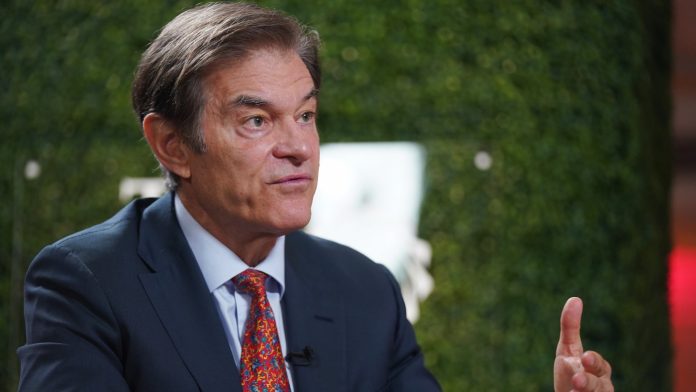

Dr. Mehmet Oz, Trump’s pick to lead Medicare and Medicaid, gets his Senate hearing : Shots

0

Dr. Mehmet Oz, a cardio-thoracic surgeon, has been a daytime TV talk show host and a candidate for Senate. He’s pictured in September 2024 in New York City.

Leigh Vogel/Concordia Summit/Getty Images


hide caption

toggle caption

Leigh Vogel/Concordia Summit/Getty Images

We’re following the confirmation hearings for the Trump administration. See our full politics coverage, and follow NPR’s Trump’s Terms podcast or sign up for our Politics newsletter to stay up to date.

Who: Dr. Mehmet Oz

Nominated for: Administrator of the Centers for Medicare and Medicaid Services

You might know him from: The long-running daytime TV talk show “The Dr. Oz Show.” He ran as the Republican candidate for U.S. Senate in Pennsylvania in 2022. (He lost that race to Sen. John Fetterman, the Democrat.)

  • He’s a cardiothoracic surgeon who first became famous as a regular guest on the Oprah Winfrey show.
  • He has faced lawsuits and a Congressional hearing for promoting unproven weight-loss treatments, like green coffee bean extract.
  • He favors Medicare Advantage, a privatized version of Medicare, and has made the case for a single-payer-like system he called “Medicare Advantage For All.”

Watch Oz’s Senate confirmation hearing, set to start at 10 a.m. ET:

What does this role do? The administrator oversees Medicare, Medicaid, and private insurance plans at Healthcare.gov. Combined, those programs provide health insurance to about half of all Americans. The agency also has a budget of $1.2 trillion annually, although a significant portion of that could be on the chopping block when Congressional Republicans try to cut spending to pay for President Trump’s tax cuts.

CMS is part of the Department of Health and Human Services, the agency led by Robert F. Kennedy Jr. Kennedy and Oz know each other well — Kennedy was a guest on Oz’s show, as was President Trump. During Trump’s first term, Oz served on the President’s Council on Sports, Fitness and Nutrition.

Like many of Trump’s health nominees, Oz was a critic of the COVID-19 public health response. He argued that the government had “patronized and misled” the public during the pandemic. “COVID-19 became an excuse for the government and elite thinkers who controlled the means of communication to suspend debate,” he said.

During his long television career, Oz’s promotion of dubious health products has gotten him into hot water. He has faced class action lawsuits and testified before the Senate after being accused of false advertising for supplements he promoted on his show. In 2015, 10 doctors wrote a letter urging Columbia University’s medical school to fire him, arguing that much of the advice on his TV show had been found to be unsupported or even contradicted by scientific evidence. Columbia did not fire him, citing academic freedom, and Oz responded to his critics both on his show and in a Facebook post.

“I bring the public information that will help them on their path to be their best selves,” Oz wrote in the post. “We provide multiple points of view, including mine which is offered without conflict of interest.”

Since he hasn’t done work in health policy previously, it’s hard to know how he will steer CMS and its trillion-dollar budget as Trump uses his second term to dramatically reshape the federal government.

CMS has already had layoffs, and its budget is a major target for cuts. The House GOP budget outline asks the committee overseeing CMS to find $880 million in cuts. That number has alarmed health policy experts. “Cuts of this magnitude will have devastating impacts on state budgets as well as the more than 70 million children, families, pregnant women, low-income adults, people with disabilities, and seniors who rely on Medicaid for their health insurance,” wrote Joan Alker of the Georgetown Center for Children and Families.

Senate Democrats on the Finance Committee have asked Oz for details of his position on privatizing Medicare by favoring the Medicare Advantage program and eliminating the traditional, government-run program. He co-authored an opinion piece in 2020 arguing that “Medicare Advantage for All” could provide universal coverage and “save our health-care system.”

Oz has an ally in Andy Slavitt, who served in the role of CMS administrator under President Barack Obama and helped with President Joe Biden’s COVID response. Slavitt says he didn’t know Oz until a few months ago, when Oz was nominated and they spoke on the phone for over an hour. “I found him to be very serious with a lot of humility, very smart, a good communicator and really excited to be in the role, and those are all good things,” he says, adding they now speak about once a week.

In an ethics filing released ahead of the hearing, Oz promised to sell his health care stock and leave his role as an adviser to iHerb, LLC, a nutritional supplement company that he has promoted on social media.

His financial disclosure showed that Oz owns between $5 million and $25 million in iHerb vested restricted stock units. His ethics agreement says he will divest those holdings within 90 days after confirmation, and that he “will not participate personally and substantially in any particular matter that to my knowledge has a direct and predictable effect on the financial interests of this entity until I have divested it, unless I first obtain a written waiver.”

However, the financial disclosure leaves open the possibility that Oz could hold onto some of his iHerb holdings until the company goes public or is bought, according to Richard Painter, a White House ethics lawyer under former President George W. Bush.

The iHerb language is “ambiguous,” Painter told NPR in February. “He will need to make it very clear that he’s going to be completely out of that company.” Sen. Elizabeth Warren, D-Mass., sent a letter to Oz just before the hearing asking him to go further in divesting from his financial interests in health care companies.

Sydney Lupkin contributed to this report.

A Mathematical ‘Fever Dream’ Hits the Road

0

Ingrid Daubechies, a mathematician at Duke University, is an expert on many matters, not least the baking of cookies in the shape of pi, the mathematical constant that equals the ratio of a circle’s circumference to its diameter, or roughly 3.14159. A sugar cookie recipe works fine, Dr. Daubechies says. But she prefers a savory version with cheese (Parmigiano-Reggiano) and herbs (thyme and marjoram).

In the summer of 2023, Dr. Daubechies made a pi-shaped cookie cutter that tiles the plane: In principle, when this shape cuts cookies from a large sheet of dough, it generates absolutely no wasteful scraps from one cookie to the next, row upon row upon row. (The reality of crumbs makes it hard to execute this ideal perfectly, Dr. Daubechies noted.)

Dr. Daubechies plans to bake pi cookies to celebrate Pi Day, which is this Friday, March 14 — 3/14. That day is also the International Day of Mathematics; the theme in 2025 is mathematics, art and creativity.

For the occasion, this year Dr. Daubechies is visiting the University of Quebec in Montreal, where she will offer special tours of “Mathemalchemy,” a traveling multimedia math-meets-art installation that has been her constant passion (some might say obsession) for the last five years. She will also give a public talk on “Mathematics to the Rescue of Art Curators.”

The exhibition — a 360-degree diorama of sorts, 20 feet long, 10 feet wide and nine and a half feet high — was created in collaboration with Dominique Ehrmann, a fiber sculptor from Quebec, and a team of 24 artistic mathematicians and mathematical artists. It debuted in 2022 at the National Academy of Sciences in Washington, D.C., and has made several stops since.

“Mathemalchemy” has been described as “a mathematics fever dream turned artistic playground for all math lovers (and haters, too).”

It is a fantasia fabricated in beadwork, ceramics, crochet, embroidery, knitting, leatherwork, needle felting, origami, painting, polymer clay, 3-D printing, quilting, sewing, stained glass, steel welding, light, temari, weaving, wire bending and woodworking. Last year it had an extended stay at the National Museum of Mathematics on Fifth Avenue in New York City, where one visitor on opening night felt a “Grimms’ fairy tale vibe.” The project’s official catchphrase is: “Mathemalchemy, where math is transforming.”

In 2023, while hosted by the Juniata College Museum of Art in Huntingdon, Pa., the project spawned a comic book that has been translated into several languages. In May the exhibition goes to the Navajo Nation Museum in Arizona. The “Mathemalchemy” group ran a fund-raiser to finance this installation, and met the goal of $25,000; donors receive their very own pi-cookie cutter as thanks.

At opening receptions, pi cookies are always served, often washed down with champagne.

Here’s a sampling of “Mathemalchemy” marvels, both on exhibit and in progress. A virtual tour with a detailed narrative is available at mathemalchemy.org.


A cat named Arnold, left, offers pi cookies hot from the oven.

The artwork is a nod to Vladimir Arnold, a mathematician known in part for a geometric operation called “Arnold’s cat map.” The map is a crude depiction of a cat’s head. Over numerous iterations, the image is stretched, sheared and scrambled; along the way, it becomes a seemingly random yet uniform mix of pixels, but eventually the original image reappears.

Used for image encryption and information security, Arnold’s map is an example of how simple systems can generate complex, chaotic dynamics. A “baker’s map,” another geometric operation, achieves a similar effect through repeated layering, cutting, stacking and compressing, in a process akin to a baker’s method for making puffed pastry.

Nearby, Tess the Tortoise strolls along Zeno’s Path with her Sierpinski kite, a tetrahedron with a triangular self-repeating fractal pattern.

“In order for Tess to reach the end of the path, she must make it halfway,” the exhibit text explains. “But then she has to make it to the halfway point of the remaining length, and to infinitely more halfway points after that. In theory, this will take forever!”

In “Mathemalchemy,” every road eventually leads to infinity.

Two infinite ball arches — one converging skyward, the other diverging and diving into a bay — transit through “Mathemalchemy.” Here’s the full whirl at the National Academy of Sciences in 2022.

The balls are crafted in the Japanese tradition of temari. Those decorated with embroidery represent twin prime numbers that are separated by the value of two: Balls 3 and 5, 5 and 7, 11 and 13 are the first three pairs of twin primes. Mathematicians have conjectured that the number of twin primes is infinite, but this has yet to be proved.

A mural depicts an octopus, named OctPi, who is a graffiti artist. With one tentacle, OctoPi paints the wave equation, a way to describe how waves — of water, light and the like — ripple and change. The exhibit display notes, “The ripples created by the green paint dripping from OctoPi’s bucket are described by this equation!”

As part of the “knotical” theme, a crocheted octopus — OctoPi’s daughter, Cayley — lounges in the bay, her tentacles sometimes arranging in elegant tangles.

Cattails are knottails.

Credit…Tasha Pruitt/Mathemalchemy

Helicoid beadwork evokes a strand of DNA and the primordial soup.

Beads also incarnate a galaxy of starfish, which belong to the only phylum of animals with fivefold radial symmetry, Echinodermata.

A reproduction of a remnant of the Antikythera mechanism, the oldest example of an analogue computer. Recovered from a shipwreck in 1901, the artifact dates to Greek antiquity; it was used for astronomical computation.

At one end of the exhibit, the Cryptography Quilt explores the history of cryptography — “secret writing.” The central padlock is surrounded by depictions of Morse code, blockchain, a carrier pigeon and letter locking, a fingerprint, the enigma machine, quipu and more.

Gilles Brassard, a Quebec computer scientist by training (he describes himself as a failed mathematician and an amateur physicist), first discovered “Mathemalchemy” in 2022, while at the National Academy of Sciences for an event. (He was inducted as an international member.) He made several visits over the course of a couple days and spent hours studying it up close. But, peering at the fabulous cryptographic quilt, he noticed that quantum cryptography was not represented.

Thus inspired, Dr. Daubechies and Ms. Ehrmann created a mini-quilt — the “Quantum Cryptography Quiltlet”— illustrating the first quantum cryptography protocol, a method of encryption using quantum mechanics. Dr. Brassard developed the protocol in 1984 with Charles H. Bennett, a physicist; it is called the quantum key establishment scheme Bennett-Brassard-84, or BB84.

The quiltlet illustrates how two parties could, rather fancifully, use natural components — fireflies, calcite crystals and frogs, optimally in a bath of ice cubes — to implement the BB84 scheme. This was Dr. Bennett’s notion, which he sketched out decades ago with markers.

“The Great Doodle Page,” on the flip side of the quilt, celebrates female mathematicians, using stitched reproductions of their drawings or doodles. One cluster is by Maryam Mirzakhani, who in 2014 became the first woman to win a Fields Medal, the most coveted prize in mathematics. Another is by the 19-century mathematician Ada Lovelace, who wrote the first algorithm for a computer.

A towering lighthouse anchors the other end of the exhibit. The beacon is housed within a stained-glass dodecahedron, a regular polyhedron with 12 faces, each a pentagon.

The mathematicians Jayadev Athreya, David Aulicino and Patrick Hooper recently proved that there are infinite straight paths on the dodecahedron that start at one vertex, proceed in a straight path around the polyhedron and return to the starting vertex without passing through any other vertexes.

Atop the lighthouse, a sphere with a carved-out pattern casts a stereographic projection on the ceiling — the projected pattern preserves angles but not lengths.

In November, at the opening in Montreal, Dr. Daubechies and Ms. Ehrmann addressed an audience of some 250 people and unpacked the intertwined contributions of two dozen “mathemalchemists.” “We consider it a curious collaboration,” Dr. Daubechies said.

In Japan, a Journalist Takes a Stand by Striking Out on His Own

0

Makoto Watanabe has never forgotten the day when his previous employer, one of Japan’s biggest newspapers, retreated from its biggest investigative scoop about the Fukushima nuclear disaster: that workers had fled the plant against orders from the plant’s manager.

It was 11 years ago, and the Asahi Shimbun had come under fire from other media and government supporters, who said the newspaper had misrepresented what were just garbled instructions. After proclaiming that it stood behind the story, the Asahi did an abrupt about-face at a news conference and retracted it.

The newspaper later gutted the investigative group he worked on that produced the article, telling reporters to be less contentious toward authorities. Mr. Watanabe quit his job at the leading newspaper, a rare move in Japan. But what he did next was more unusual: Mr. Watanabe started Japan’s first media nonprofit dedicated to investigative journalism.

“The newspaper was more interested in protecting its privileged access than informing its readers,” Mr. Watanabe, 50, recalled. “I wanted to make a new media that wouldn’t fold.”

Eight years later, his Tokyo Investigative Newsroom Tansa remains small. As the editor in chief, he supervises a staff of two full-time reporters, a volunteer and an intern. On a recent afternoon, they worked in a spartan room with two small tables and bookshelves on the second floor of a nondescript Tokyo office building.

But Tansa, which roughly translates as “in-depth investigation,” is finally making a mark. Last year, it published a series of articles that exposed decades of forced sterilizations of mentally disabled people, forcing the government to issue an apology and pass a law to pay compensation to the victims. Japan’s public broadcaster, NHK, signed a deal to use some of Tansa’s content.

The nonprofit, which had a 2024 budget of 60 million yen, or about $400,000, is funded entirely by donations and private grants, and it has seen a steady increase in the number of readers supporting it with monthly contributions. Mr. Watanabe plans to hire two new journalists this spring, including one from another big newspaper.

“People are starting to recognize that we stand for something different,” Mr. Watanabe said, sitting in his newsroom while a reporter nearby scanned an online archive for data on industrial pollutants.

Like Mr. Watanabe, the reporters were drawn by the chance to do more independent journalism and seek out voices ignored by Japan’s mainstream press. “Only at Tansa do we start stories by asking, ‘Who is hurt by this?’” said Mariko Tsuji, a reporter who left a prominent magazine to join the nonprofit.

It’s an approach that Mr. Watanabe said goes back to an experience in middle school, when he saw classmates picking on a girl with physical and mental disabilities. Outraged, he wrote a description of how the behavior was hurting her feelings and posted it on a school wall. To his own surprise, the bullying stopped.

“It taught me that I could bring change with words,” he said.

Decades later, Mr. Watanabe still has the cherubic features of a boy on a playground, with the energy and eagerness to match. But it was through trial and error that he found his passion for challenging official narratives, which remains rare in Japanese journalism.

He experienced the first thrill of journalism when he joined the Asahi in 2000, after working briefly at a television network. He exposed vote buying in rural areas and failures by air traffic controllers that resulted in near misses.

In recognition of his scoops, the Asahi accepted his request to join a new group that the newspaper created to undertake longer-term investigative projects. He loved the freedom to jump from topic to topic, but as he did so, he started running into resistance within his own newspaper.

He was stepping on the toes of reporters at the newspaper who were stationed in the so-called press clubs, which were offices inside the government agencies that they covered. These Asahi reporters complained internally about his group’s critical stories angering their sources, but Mr. Watanabe dismissed them as too dependent on authorities for information.

In May 2014, the group published the Fukushima scoop, which rival media and political supporters of then-Prime Minister Shinzo Abe faulted as overly sensational. The press club reporters inside Asahi, whose resentments had been building, used this to strike. Mr. Watanabe said they convinced the newspaper to disavow the article four months after it appeared and later to disband the investigative group.

In response to questions, the Asahi said that it had made a renewed push into investigative journalism led by a different section of the newspaper.

Mr. Watanabe joined another ex-Asahi reporter in launching the startup, which they at first named the Waseda Chronicle after a university that gave them early support. They made it a nonprofit to demonstrate their autonomy — from both corporate sponsors and the political establishment.

“We wanted to show that we stand next to our readers outside the circle of power,” Mr. Watanabe said.

To drive that point home, the nonprofit tackled media corruption in its first series of articles, which exposed payments made to major news companies by a big advertising firm in exchange for positive coverage of its clients.

Ever since, Mr. Watanabe has showcased deeply reported investigations not seen in most mainstream media. In a current series about chemical pollution by a major manufacturer, Tansa has published 75 articles. Another series, about a suicide brought about by bullying at a high school in Nagasaki, has reached 48 installments.

While the co-founder later left, Mr. Watanabe stuck with the tiny operation despite its reporting being ignored by establishment journalists. It has taken years, but Tansa is finally starting to stand out in a media landscape that has long been dominated by legacy newspapers and television networks.

Tansa is also winning recognition overseas, where it is the only investigative nonprofit from Japan in the Global Investigative Journalism Network, an international group with some 250 members.

“Japan is still controlled by established media that don’t give other narratives any space,” said William Horsley, the international director of the Centre for Freedom of the Media at the University of Sheffield. “Tansa is an exception that fills the gap.”

Mr. Watanabe hopes the reporters he is recruiting will allow him to do more cross-border collaborations. But he also sees storm clouds on the horizon at home. Like other parts of the world, right-wing populism and media-bashing politicians are rising in Japan, and last year police in the city of Kagoshima raided a small online media after it published stories criticizing an investigation.

In such an increasingly hostile environment, “the need will be stronger than ever for a media outlet that won’t surrender,” he said.

What's more "American" than the right to protest?

0

Last weekend, former Columbia University student Mahmoud Khalil was arrested by federal immigration authorities. The move was an escalation in the Trump administration’s crackdown on dissent, and it has people wondering: isn’t this against the constitution?

Brittany is joined by Chenjerai Kumanyika, a journalism professor at NYU, and Rick Perlstein, a historian of conservatism. Together, they talk about America’s love/hate relationship with the First Amendment, and what ICE’s arrest of a lawful permanent resident could mean for America’s culture of protest.

Support public media and receive ad-free listening & bonus content. Join NPR+ today.

Outrage in Australia After American Woman Grabs a Baby Wombat

0

In times of tumult and uncertainty, a society can come together over resounding, unequivocal disdain against a common villain.

This week, Australia, which is gearing up for a divisive election, found that antagonist in an American social media influencer. The woman — known as “Sam Jones” from Montana on Instagram — snatched a baby wombat from near its mother at night from the side of what appeared to be a remote road. Then she ran back to her vehicle and held the marsupial up for a camera, as it wriggled and squealed.

“Mama’s right there, and she’s pissed,” the woman said in a video posted online. She went on to release the joey on the roadside in the darkness, illuminated only by her car’s headlights.

Australia’s prime minister, Anthony Albanese, suggested that she try the same with a crocodile and see how that goes. “To take a baby wombat from its mother, and clearly causing distress from the mother is just an outrage,” Mr. Albanese said.

The indignation was bipartisan: Asked about the video by a reporter, the opposition leader, Peter Dutton, called it “a cruel act.”

The minister for home affairs, Tony Burke, said officials would review the woman’s visa to see if any immigration laws had been breached, and that any future applications from her would receive intense scrutiny. The government did not release her name but Australian news media identified her as Samantha Strable.

The drumbeat of criticism included calls to deport the woman. On Friday morning, ABC Australia, the national broadcaster, sent out a news alert saying she had left Australia.

The Wombat Protection Society of Australia denounced the video, explaining that human interaction could cause “severe stress” to wombats, and that it wasn’t clear from the short clip whether the animal had been reunited with its mother.

“A baby of this size is highly dependent on its mother, and prolonged separation could have fatal consequences,” the group said in a statement.

The influencer’s account, which describes her as an outdoor enthusiast and hunter, has been made private. An older video of her holding an echidna, another animal unique to Australia, drew further criticism.

An apology was posted in a newly created account on TikTok under a similar username.

“I’m really sorry about the wombat incident,” she wrote. “It was a mistake.”

In a subsequent post she said that she was getting hundreds of death threats for having picked up the animal. She did not respond to requests for comment.

In an email, Mark Heinz, a reporter for the Wyoming-based Cowboy State Daily, said he believed the woman in question was indeed Ms. Strable, whom he had interviewed in 2023 about her enthusiasm for hunting.

Ms. Strable responded to his attempt to reach her this week only by saying she would have an official statement forthcoming, Mr. Heinz said.

In the interview with Mr. Heinz, Ms. Strable, then a resident of Pinedale, Wyo., recounted her adventures of having hunted red stag in Chile with a bow and killed pigs and wallabies in New Zealand. She said that she was next attempting to trap a Wyoming black bear. She described herself as a wildlife biologist who works seasonally, and spends winter months in the southern hemisphere.

Detailing her pig hunting experience in New Zealand, in which dogs corner wild pigs allowing for the hunter to plunge a knife into the animal’s heart, she said it was “intense.”

“Honestly, I cried,” she said in the interview. “I don’t like killing. I like the hunting, I like the chase. It’s not fun to see anything die.”

Friday Briefing

0

Vladimir Putin’s conditions for a cease-fire.

Outrage in Australia After American Woman Grabs a Baby Wombat

0

In times of tumult and uncertainty, a society can come together over resounding, unequivocal disdain against a common villain.

This week, Australia, which is gearing up for a divisive election, found that antagonist in an American social media influencer. The woman — known as “Sam Jones” from Montana on Instagram — snatched a baby wombat from near its mother at night from the side of what appeared to be a remote road. Then she ran back to her vehicle and held the marsupial up for a camera, as it wriggled and squealed.

“Mama’s right there, and she’s pissed,” the woman said in a video posted online. She went on to release the joey on the roadside in the darkness, illuminated only by her car’s headlights.

Australia’s prime minister, Anthony Albanese, suggested that she try the same with a crocodile and see how that goes. “To take a baby wombat from its mother, and clearly causing distress from the mother is just an outrage,” Mr. Albanese said.

The indignation was bipartisan: Asked about the video by a reporter, the opposition leader, Peter Dutton, called it “a cruel act.”

The minister for home affairs, Tony Burke, said officials would review the woman’s visa to see if any immigration laws had been breached, and that any future applications from her would receive intense scrutiny. The government did not release her name but Australian news media identified her as Samantha Strable.

The drumbeat of criticism included calls to deport the woman. On Friday morning, ABC Australia, the national broadcaster, sent out a news alert saying she had left Australia.

The Wombat Protection Society of Australia denounced the video, explaining that human interaction could cause “severe stress” to wombats, and that it wasn’t clear from the short clip whether the animal had been reunited with its mother.

“A baby of this size is highly dependent on its mother, and prolonged separation could have fatal consequences,” the group said in a statement.

The influencer’s account, which describes her as an outdoor enthusiast and hunter, has been made private. An older video of her holding an echidna, another animal unique to Australia, drew further criticism.

An apology was posted in a newly created account on TikTok under a similar username.

“I’m really sorry about the wombat incident,” she wrote. “It was a mistake.”

In a subsequent post she said that she was getting hundreds of death threats for having picked up the animal. She did not respond to requests for comment.

In an email, Mark Heinz, a reporter for the Wyoming-based Cowboy State Daily, said he believed the woman in question was indeed Ms. Strable, whom he had interviewed in 2023 about her enthusiasm for hunting.

Ms. Strable responded to his attempt to reach her this week only by saying she would have an official statement forthcoming, Mr. Heinz said.

In the interview with Mr. Heinz, Ms. Strable, then a resident of Pinedale, Wyo., recounted her adventures of having hunted red stag in Chile with a bow and killed pigs and wallabies in New Zealand. She said that she was next attempting to trap a Wyoming black bear. She described herself as a wildlife biologist who works seasonally, and spends winter months in the southern hemisphere.

Detailing her pig hunting experience in New Zealand, in which dogs corner wild pigs allowing for the hunter to plunge a knife into the animal’s heart, she said it was “intense.”

“Honestly, I cried,” she said in the interview. “I don’t like killing. I like the hunting, I like the chase. It’s not fun to see anything die.”

2nd judge orders thousands of federal workers reinstated for now : NPR

0

People hold signs during a “Save the Civil Service” rally outside the U.S. Capitol on Feb. 11, 2025 in Washington, D.C.

Kent Nishimura/Getty Images North America


hide caption

toggle caption

Kent Nishimura/Getty Images North America

A federal judge in Maryland has ordered the Trump administration to temporarily reinstate thousands of federal employees terminated in recent weeks, after finding federal agencies acted unlawfully in carrying out the mass firings.

U.S. District Judge James K. Bredar, an Obama appointee, issued a 14-day stay in a case brought by 20 Democratic attorneys general representing the District of Columbia, Maryland, and 18 other states.

His ruling on Thursday came hours after another federal judge in San Francisco ordered the Trump administration to reinstate workers fired from six federal agencies. The Trump administration has already filed an appeal.

In a hearing in the states’ case on Wednesday, the attorneys general argued federal agencies falsely told probationary employees – typically those in their first year or two on the job – that they were being fired because of their performance, when in fact, agencies did not evaluate employees and instead were trying to shrink their headcount through a process called a reduction in force, or RIF.

The states charge that more than 20 agencies and their heads, who are named as defendants in the lawsuit, failed to follow proper procedures for carrying out mass layoffs, including providing states with 60 days’ notice.

Bredar found the states’ arguments compelling.

“Lacking the notice to which they were entitled, the States weren’t ready for the impact of so many unemployed people. They are still scrambling to catch up. They remain impaired in their capacities to meet their legal obligations to their citizens,” he wrote in his memorandum explaining his decision.

He ordered 18 federal agencies to reinstate probationary workers fired through what he called “illegal RIFs” by Monday at 1 p.m. Eastern daylight time, for a period of 14 days.

During that time, he said, the court would likely consider longer relief.

Bredar’s order covers probationary employees nationwide, not just those in states named as plaintiffs in the lawsuit.

The sweeping list of agencies include some not covered by other rulings, including the Departments of Health and Human Services, Education, Transportation, and Homeland Security, as well as the Environmental Protection Agency and the General Services Administration.

However, he said plaintiffs had failed to provide sufficient evidence of illegal firings at the Defense Department, the Office of Personnel Management and the National Archives and Records Administration, and excluded them from his order.

Under federal law, states are required to have rapid response teams to provide workers impacted by mass layoffs with support, including job transition services. The goal of these teams is to reduce fired employees’ reliance on public assistance.

“Economic dislocation of workers can easily create a cascade of instability throughout a regional economy,” the attorneys general wrote in their complaint.

In court, the states said that advance notice would have helped them quickly identify those in need of help before they were fired. Instead, they said, they’ve been forced to expend extra resources trying to track down those terminated, and meanwhile have seen unemployment claims soar.

The states also said the loss of tax revenue from people newly jobless was causing them harm.

In its defense, the government’s attorney argued that the states are not in fact experiencing injury, and that any effects of the layoffs on states would be downstream.

The government also argued that states lacked jurisdiction to bring their case to federal court, and that personnel matters involving federal employees must be channeled first through an administrative process within the federal government. It’s an argument that other courts have found compelling in cases brought by federal employee labor unions.

But in court on Wednesday, Bredar challenged that position, noting that unlike unions representing federal employees, the states have their own interests and their own harms when a large employer suddenly lays off thousands of employees.

There is a burden that falls on those state governments, he said.

Bredar noted it’s the government’s prerogative to shift thousands of people out of federal employment and do it quickly, but they can’t break the law while doing so.

“If the Government wishes to continue pursuing its RIF agenda, the Government must start from square one, acting in compliance with federal law,” he wrote in his memo.

The lawsuit in Maryland is one of several legal challenges seeking relief for tens of thousands of probationary workers fired over the last month.

Already, the Merit Systems Protection Board has ordered the U.S. Department of Agriculture to reinstate nearly 6,000 probationary employees it fired.

Earlier Thursday, the White House blasted the ruling issued from the bench by the federal judge in San Francisco, reinstating probationary employees at six agencies.

“A single judge is attempting to unconstitutionally seize the power of hiring and firing from the Executive Branch,” White House press secretary Karoline Leavitt said in a statement. “The President has the authority to exercise the power of the entire executive branch – singular district court judges cannot abuse the power of the entire judiciary to thwart the President’s agenda. If a federal district court judge would like executive powers, they can try and run for President themselves.”

Meanwhile, the Trump administration has begun to implement much deeper cuts across the federal workforce, including at the Department of Education, which announced Tuesday that it was terminating over 1,300 positions.

The Maryland attorney general’s office declined to comment on whether it had received advanced notice of any of the mass layoffs newly announced by the Trump administration.

Merz Challenges Germans to Make a Bold Strategic Shift. Will They Do It?

0

Germany’s centrist politicians are losing votes to the far right and the far left. They are losing faith in America, their longtime friend and protector.

And they are rapidly losing what could be their best chance to address both those problems at once.

The German government in waiting, led by the likely next chancellor, Friedrich Merz, introduced a raft of measures to a lame-duck session of Parliament on Thursday that it was billing as an urgent response to President Trump and his administration’s threats to withdraw American military support for Europe.

The package would rip away Germany’s signature limits on government spending and allow for hundreds of billions — or potentially trillions — of euros in new efforts to rebuild the country’s aging infrastructure and military.

But Mr. Merz and his center-right Christian Democrats, who narrowly won elections in February, do not yet have the votes to pass the proposed changes. Whether they can muster them over the next week will determine whether Germany is prepared to make a seminal strategic shift. It will also shape Europe’s fate as it confronts its most hostile security environment since World War II.

“Do you seriously believe that an American government will agree to continue NATO as before at the NATO summit in The Hague at the end of June if Germany and, together with Germany, the European NATO partners, are not prepared to take a new path?” Mr. Merz asked lawmakers in a fiery speech on Thursday.

The parliamentary cliffhanger in Berlin is playing out on a much more accelerated timeline than Germans are accustomed to. Typically after an election, the winner takes months to secure a governing agreement with one or more coalition partners.

But having struck an early deal with the center-left Social Democrats, Mr. Merz has taken the extraordinary step of trying to push his spending plan through the lame-duck Parliament, rather than wait for its replacement this month, when the legislative math for him will be worse.

Mr. Merz’s Christian Democrats won the election with a relatively low voter share, and his new two-party coalition with the Social Democrats will have only a narrow majority in the new Parliament. Because the spending plan must overcome constitutional limits, it requires even more than a simple majority.

In the new Parliament, Mr. Merz would need support from either the newly empowered Die Linke, the party of the far left, or the hard-right Alternative for Germany, or AfD, to pass the spending plan. The first is an unlikely ally, and the second is taboo because it is considered extremist.

Even in the outgoing Parliament, Mr. Merz’s challenge is difficult enough, requiring support from the center-left Green Party, his punching bag in the campaign.

The three parties have been negotiating for the last week. Their talks are expected to stretch through the coming weekend, ahead of a critical vote next week. Time is running out.

Speaking in Parliament on Thursday as the proposals were put forward, Mr. Merz promised 50 billion euros for a climate and energy transformation fund. He also agreed with widening the definition of spending exempt from borrowing limits — a request by the Greens — to also include intelligence, aid to Ukraine and response to natural disasters or other events threatening public peace.

“What more could you ask for?” Mr. Merz asked the Green Party lawmakers.

That is indeed the question.

Analysts, commentators and many political leaders have cast the next few days as a test for Germany’s mainstream parties, left and right. Can they muster a compromise? Or will domestic political squabbles block them from acting, as has been the case so often in Germany and other European democracies in recent years?

The urgency and boldness of Mr. Merz’s gambit has been spurred by Mr. Trump.

The would-be chancellor and his allies say publicly and privately that they have been jarred by Mr. Trump’s moves to undo a decades-long American security guarantee in Europe, and his sharp pivot on American support for Ukraine in its war against Russia.

Mr. Merz has publicly questioned the stability of Germany’s alliance with America and wondered whether the United States will remain a democracy. He has also dramatically increased his proposals for new military spending, while abandoning campaign promises to avoid heavy borrowing while strengthening defense.

The deal Mr. Merz reached with the Social Democrats, the diminished party of outgoing Chancellor Olaf Scholz, would allow effectively unlimited borrowing for any spending on defense that exceeds one percent of the nation’s annual economy, a level it already exceeds. As a sweetener for the Social Democrats, he also agreed to borrow 500 billion euros over a decade to upgrade Germany’s domestic infrastructure.

The size of the borrowing increases broke sharply from years of relatively austere German budgets. But Mr. Merz said last week that such moves could no longer be postponed “after the latest decisions by the American government.” He added: “In view of the threat to our freedom and to peace on our continent, the mantra for our defense has to be, ‘Whatever it takes.’”

His move to pass the changes to the Constitution while the old Parliament is still in power was seen by some experts as a cunning political move that would also ensure enough of a fiscal pillow to keep a centrist government stable.

The session on Thursday was only the second time in modern history that German lawmakers met after an election and before the swearing in of the new Parliament. The last was when the Bundestag decided to send German soldiers into Kosovo in 1998 — the first German military deployment outside of the country since World War II.

The current session convened in a cloud of uncertainty, because Mr. Merz made his plans without consulting with the Greens, who are not partners in the likely next coalition. They have had a contentious relationship with Mr. Merz’s party and its sister party in Bavaria, the Christian Social Union, for years, particularly in the recent campaign.

Mr. Merz attacked the Greens on the trail long after they ceased to be a threat to him. In one of the last speeches before the election, he berated “Greens and left-wing crackpots” and told the crowd that the Greens’ time had passed.

Markus Söder, the leader of the Christian Social Union, seemed to relish in celebrating the conservatives’ victory over the Greens, who were part of the outgoing coalition of Mr. Scholz. “Goodbye, have a nice trip, good riddance!” he said during a speech last week.

Nevertheless, Mr. Merz seemed to take the party’s support for his spending deal as a given. His charm offensive to Green leaders last weekend was limited to a voice message he left on one politician, offering to add the word “climate” in the official text justifying the new measures.

On Monday, the Green leaders announced they would not support Mr. Merz’s change to the Constitution in its presented form.

Many German analysts see the move as a negotiating tactic, because the Greens have long pushed for more borrowing to rebuild the country’s defense. The parties have talked all week.

While the Greens say they are prepared to help undo the debt limit for military spending both at home and in support of Ukraine, they insist that they will not support the infrastructure spending unless it is redefined.

“Pouring money into everything and doing so on credit, on a debt-financed basis for future generations. That is what we will not support,” Franziska Brantner, a Green party co-chairwoman, said in a public radio interview on Wednesday.

If the parties cannot agree to a deal soon, their task will grow more difficult: the far left and far right gained seats in the recent elections, and they could block any major borrowing reforms in the new Parliament.

Lars Klingbeil, one of the leaders of the Social Democrats, alluded to that challenges in a speech Thursday.

“When history comes knocking, you better open the door, because you never know if there might be a second chance,” he said.