Thursday, November 12, 2026
Home Blog Page 140

Who is Mark Carney, Canada’s new prime minister : NPR

0

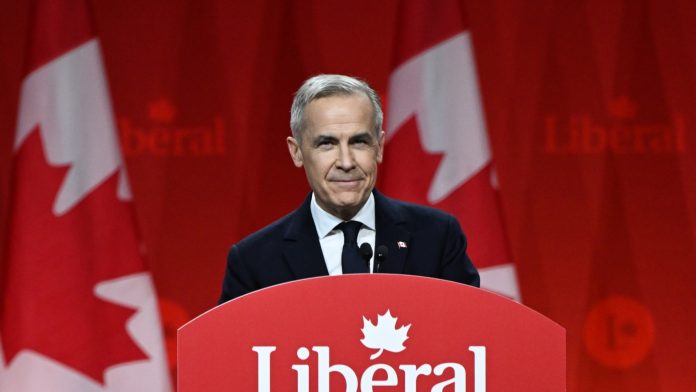
Mark Carney addresses supporters after winning the Liberal Party election on Sunday. He is expected to be sworn in this week.

Artur Widak/NurPhoto via GettyImages


hide caption

toggle caption

Artur Widak/NurPhoto via GettyImages

Mark Carney, a central banker-turned-centrist politician, will become the next prime minister of Canada after winning Sunday’s Liberal Party election with nearly 86% of the vote.

Carney replaces longtime Prime Minister Justin Trudeau, who announced his resignation in January after a decade in office and a sharp decline in approval ratings.

Since Trudeau announced his intention to step down, President Trump has come after Canada with steep tariffs and repeated talk of making it the 51st U.S. state, drawing reciprocal tariffs and angering many Canadians (some of whom have canceled visits stateside, eschewed American products and booed the U.S. national anthem at hockey games).

It’s also seen the Liberal Party surge rapidly in recent polls, either tying or surpassing the previously dominant Conservative Party, led by Pierre Poilievre.

“This has led to a resurgent nationalism, which is something that we haven’t seen the likes of in a long time in Canada, that has really benefited the Liberal Party,” Jamie Tronnes, executive director of the Center for North American Prosperity and Security, told NPR last week.

Experts say that’s largely because of rising anti-Trump sentiment and a lack of confidence that Poilievre — a populist whose rhetoric has drawn comparisons to Trump — will stand up to him.

Carney has been defiant against Trump, vowing in his acceptance speech on Sunday that “Canada never, ever, will be part of America in any way, shape or form.”

“We didn’t ask for this fight, but Canadians are always ready when someone else drops the gloves, so the Americans, they should make no mistake: In trade as in hockey, Canada will win,” said Carney, himself a former collegiate hockey player.

Carney is expected to be sworn in within days and will represent his party in the country’s general election this year, which must be held by Oct. 20.

But an election could be triggered much sooner than that. Opposition parties in Parliament could force an early election with a no-confidence vote when they return later this month, or Carney himself could call one.

Carney, 59, has not previously been elected to public office and doesn’t have a seat in parliament. While that’s not unprecedented, it does mean that he can’t participate in debates or votes — and suggests that he may call an election sooner rather than later, Canadian media report.

Here’s what else to know about him.

He led the banks of Canada and England

Carney began his career in the private sector, spending over a decade in the London, Tokyo, New York and Toronto offices of Goldman Sachs.

He returned to Canada and entered public service in the early aughts. He was appointed deputy governor of the Bank of Canada — which oversees the country’s monetary policy — in 2003, and the following year became a senior associate deputy minister of finance.

Carney served as the governor of the Bank of Canada from 2008 to 2013, a period that included the global financial crisis.

He then ran the Bank of England — becoming the first non-Briton appointed to do so — from 2013 to 2020. During that time, he warned Britons not to leave the European Union — unsuccessfully — and oversaw the bank’s response to the impacts of the Brexit referendum.

After leaving the bank, Carney began serving as the United Nations special envoy for climate action and finance.

He’s a graduate of Harvard and Oxford

Carney attended Harvard University, where he played goaltender on the ice hockey team.

According to a 2011 profile of Carney in Reader’s Digest Canada, he intended to study English literature and math but developed a keen interest in economics while attending lectures by Canadian-American economist John Kenneth Galbraith.

He graduated in 1988 with a bachelor’s degree in economics and earned both a master’s and doctorate in economics from Oxford University.

One of Carney’s Harvard roommates, fellow Canadian Peter Chiarelli, told the magazine that “even back in university, he wanted to make his mark in public service” and seemed to possess the qualities necessary to do so.

“When I met Mark, I remember saying to my friend, ‘That guy’s going to be the prime minister,’ ” Chiarelli said. “I bug Mark about it every year. And it may come true because he just cares so genuinely about what he’s doing.”

He is a father of four

Carney is married to Diana Fox Carney, a British economist with a focus on developing countries.

The two — who met at Oxford — have four daughters: Cleo, Tess, Amelia and Sasha. Carney thanked them all in his speech on Sunday.

“Without your support, I wouldn’t be standing here,” he said. “Without your examples, I wouldn’t have a purpose. Without your love, I wouldn’t have the strength that I need for what lies ahead.”

While Carney’s children have largely stayed out of the public eye, his daughter Cleo, a first-year at Harvard College, introduced him onstage after Sunday’s victory.

“I want Canadians to understand what kind of a man he is,” Cleo Carney said, according to the Harvard Crimson. “He is unwaveringly supportive of the things he cares about. My dad invests in what matters. He expects nothing to come without hard work, and he is always ready to work hard.”

He has triple citizenship — at least for now 

Carney was born in Canada — in Fort Smith, a town in the Northwest Territories — but also holds British and Irish citizenship.

Carney’s grandparents moved to Canada from Ireland, and he has called that Irish heritage “a big part of who I am,” according to the Irish Times. He obtained Irish citizenship in the 1980s and became a British citizen in 2018 while running the country’s central bank.

As a candidate for prime minister, however, he said he intended to renounce his British and Irish citizenship. Carney told reporters earlier this month that he had written to those governments to begin the process.

He said that while some Canadian politicians hold multiple passports, he believes the prime minister should not.

“I’m not judging those other people,” Carney said. “I’m saying, as prime minister, I should only hold one citizenship.”

He has been critical of Trump

Carney has been vocal in his disagreement with Trump throughout his campaign.

Last month, he compared the president to the villain from the Harry Potter franchise while speaking to supporters in Winnipeg, saying he didn’t want to dignify Trump’s talk of annexation.

“When you think about what’s at stake in these ridiculous, insulting comments of the president, of what we could be, I view this as the sort of Voldemort of comments,” Carney said. “Like I will not even repeat it, but you know what I’m talking about.”

He had even sharper words during his victory speech on Sunday, accusing Trump of attacking Canadian workers, families and businesses by putting “unjustified tariffs on what we build, on what we sell, on how we earn a living.”

Carney pledged that his government would maintain tariffs “until the Americans show us respect … and make credible, reliable commitments to free and fair trade.”

Colin Robertson, a former Canadian diplomat now with the Canadian Global Affairs Institute, told NPR’s Morning Edition on Monday that he believes Carney will both challenge and listen to Trump, saying he “will make the case for Canada and why this makes no sense, and hope Mr. Trump pays attention.”

Robertson, who first met Carney in the 1990s, said the incoming prime minister has a deep sense of public service and a big network from his years in finance.

“Safe hands,” he added. “He wouldn’t be accused of being particularly charismatic, but he wants to put the emphasis on growth — which is what Canada needs today if we’re going to pay for all the things we need, like public services and defense.”

Oil Tanker and Container Ship Collide in the North Sea

0

Information from Marine Traffic, a website that tracks vessels, appeared to show the Stena Immaculate, an oil tanker, and the Solong, a container ship, on an intersecting route surrounded by emergency response vessels just off the coast of the mouth of the River Humber, near Hull.

According to the tracker, the Stena Immaculate, a U.S.-flagged vessel, was anchored at the time of the crash, raising questions about how the two vessels had managed to collide during the daylight hours. The Solong, sailing under the Portuguese flag, was headed to Rotterdam in the Netherlands after leaving a port in Scotland on Sunday, according to the vessel tracker.

Erik Hanell, the chief executive of Stena Bulk, which co-owns the Stena Immaculate, told the BBC that all of the crew of that tanker were accounted for and safe.

Martyn Boyers, the chief executive of the port of Grimsby East, spoke to Sky News, a British news channel, and said that the area had been foggy on Monday morning, which may have contributed to visibility issues. He said that at least 32 people had been brought into the port of Grimsby and that some of them had been taken by ambulance to local hospitals. It remains unclear how many of those people were injured.

“Altogether, 32 casualties were brought through the port, and there was a line of ambulances waiting to take them to Princess Diana Hospital, which is what they’re still doing now,” he told Sky News. He added, “This morning, it’s been very foggy, and the fog has never lifted. So I would imagine that at that time, when the accident took place, that there would have been fog.”

Trump’s Attacks Give Zelensky a Popularity Boost in Ukraine

0

President Volodymyr Zelensky of Ukraine was losing popularity at home for months, seen by many as a thin-skinned leader who had concentrated power around him. Political opponents saw an opening to win a future election against him. His former top general in the war against Russia had a higher approval rating.

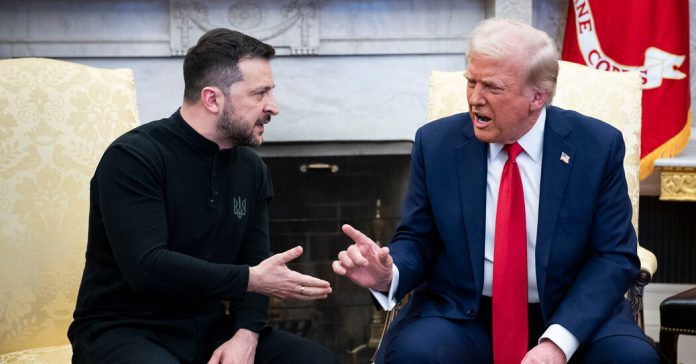
Enter President Trump. In recent weeks, he has echoed Moscow’s talking points on the war and called Mr. Zelensky a “dictator without elections” who “has done a terrible job.” Mr. Trump and his allies have demanded new presidential elections in Ukraine, despite the war, and humiliated Mr. Zelensky at a disastrous meeting in the White House.

But Mr. Trump’s actions appear to have helped the Ukrainian leader at home.

Mr. Zelensky’s approval ratings have risen, according to two recent polls, and his political opponents have said publicly that now is not the time for elections. Suggestions by political opponents and some analysts that Mr. Zelensky should share power and form a coalition government — a Ukrainian team of rivals — have not gained traction. And even if critics haven’t exactly rallied around the president, they haven’t outright attacked him.

“Some people expected me to criticize Zelensky,” Petro Poroshenko, Mr. Zelensky’s predecessor as Ukraine’s president and a frequent needler-in-chief, said after the explosive meeting between Mr. Zelensky and Mr. Trump. “But no, there will be no criticism, because that’s not what the country needs right now.”

Mr. Zelensky is still in a precarious position. He needs to somehow chart a path forward with a U.S. president who clearly wants to deal with a different Ukrainian leader.

Mr. Zelensky has offered to step down in exchange for peace or Ukraine’s membership in NATO. Political opponents have agreed that elections cannot be held while the country is at war, because frontline troops and Ukrainians outside the country cannot vote. But given that Ukraine was to hold an election in spring 2024, they will probably push for one if a cease-fire is reached — likely long before a final peace deal is inked. And opposition politicians seem to be biding their time, despite public calls for unity.

Mr. Trump has ratcheted up pressure on Mr. Zelensky ahead of a meeting planned for Tuesday in Saudi Arabia in which U.S. and Ukrainian officials are supposed to discuss steps that could lead to a peace deal with Russia. After a planned deal to share profits from Ukraine’s natural resources wasn’t signed amid the acrimony at the White House meeting on Feb. 28, Mr. Trump paused both U.S. military aid and intelligence sharing with Ukraine last week.

On Sunday, posts on X by Elon Musk, the billionaire ally of Mr. Trump, renewed fears in Ukraine that Musk might cut off his Starlink internet system, which he called the “backbone of the Ukrainian army.” He added: “Their entire front line would collapse if I turned it off.” However, he later said “no matter how much I disagree with the Ukraine policy, Starlink will never turn off its terminals.”

Analysts said the White House meeting was probably the biggest crisis that Mr. Zelensky had faced since Russia’s full-scale invasion in February 2022. Several said there was probably nothing Mr. Zelensky could do because Mr. Trump had chosen to side with Russia. But others suggested several paths for Mr. Zelensky: appointing an official negotiator to deal with Mr. Trump, setting up a more inclusive coalition government or even using a translator.

Yevhen Mahda, a political scientist in Kyiv, said that if Mr. Zelensky built a “coalition of victory from separate parties that unite,” with professional appointees instead of political allies, it would show the world and the United States that Mr. Zelensky could adapt.

Dmytro Razumkov, a politician who left Mr. Zelensky’s party in 2021 and now leads an opposition group in Parliament, said such a coalition should have been formed when the war started, but the president didn’t want to work with his opponents.

“He is not listening to other points of view,” said Mr. Razumkov, who has announced plans to run for president but also opposed holding elections until a peace deal is reached. “He cannot hear them. He cannot work with other parties and other ideas.”

But members of Mr. Zelensky’s party and some analysts dismissed the idea of a coalition.

“Those opposition parties will not focus on Ukraine or on how to help the country,” said Volodymyr Fesenko, a leading political analyst here. “They will focus on future elections. And all those opposition politicians have a very big level of national distrust.”

There are signs that Mr. Zelensky is trying to allow different voices to be heard. For instance, Gen. Valery Zaluzhny, Ukraine’s top military commander for the first two years of the war, would probably be Mr. Zelensky’s strongest possible opponent in an election. He has rarely spoken publicly since being named ambassador to the United Kingdom last March, effectively sidelining him, even as polls have shown that he’s more popular than Mr. Zelensky.

But on Thursday, Mr. Zaluzhny delivered a speech in London in which he blamed the United States for destroying the world order. Political analysts said Mr. Zaluzhny never would have given that speech if Mr. Zelensky had not agreed to it.

While some politicians and analysts described Mr. Trump and Vice President JD Vance as bullies at the White House meeting, some focused on Mr. Zelensky, suggesting that the Ukrainian president would have benefited from using an interpreter.

While he speaks English at a conversational level, an interpreter would have given him additional time to weigh his responses, Mr. Mahda said.

Mr. Razumkov, the politician who left Mr. Zelensky’s party, said he thought there might have been language misunderstandings between the two sides. “This whole conversation went wrong from the very beginning,” he said.

A date for a presidential election seems to be a moving target. If a cease-fire deal is reached, Mr. Trump will likely push for new elections even before hammering out a peace deal.

Were an election held today, Mr. Zaluzhny and Mr. Zelensky would likely be top contenders.

On Friday, the Kyiv International Institute for Sociology released a poll showing that between Feb. 14 and March 4 — when relations between Ukraine and the United States soured — the level of trust in Mr. Zelensky increased to 67 percent, from 57 percent in the first half of February. Another poll showed a similar jump, while two other recent polls showed similar approval ratings for Mr. Zelensky. (While approval and trust ratings aren’t the same as electoral ratings, they show how popular the country’s different leaders are.)

Mr. Zelensky’s ratings could have jumped because Ukrainians are rallying around the flag, and not because of the president himself. Mr. Zelensky also saw a huge bump in his approval rating after Russian’s full-scale invasion.

Both Mr. Poroshenko, who lost to Mr. Zelensky in 2019, and Yulia Tymoshenko, a former prime minister, have indicated they would run in a future election. Both have met with Mr. Trump’s team. Ms. Tymoshenko traveled to Washington around the time of Mr. Trump’s January swearing-in, and attended some inaugural events. Mr. Zelensky did not attend the inauguration, but reportedly sent a close ally.

After Politico reported last week on meetings between Mr. Trump’s allies and the Ukrainian politicians or their representatives, Ms. Tymoshenko and Mr. Poroshenko denied they were trying to oust the president, and said they opposed elections while fighting continues. Ms. Tymoshenko said her team was “talking with all our allies who can help in securing a just peace as soon as possible.” Mr. Poroshenko said his team had talked with U.S. officials but opposed Mr. Trump’s demands for wartime elections.

The United States and Ukraine continue to negotiate, on both a possible natural resources deal and any peace pact. On Friday, Mr. Zelensky said “the most intensive work to date has been ongoing with President Trump’s team at various levels — with many phone calls.”

In at least one way, Mr. Zelensky is choosing to navigate the path ahead delicately. On Tuesday, senior members of his team are to have their first in-person meeting with U.S. officials since the White House meeting. They will meet in Saudi Arabia to discuss laying the groundwork for any peace deal.

Mr. Zelensky will travel to Saudi Arabia but is not expected to play any formal role in the talks with the Americans.

Oleksandra Mykolyshyn contributed reporting from Kyiv, and Kenneth P. Vogel from Washington.

Everyone Has a Plan For Gaza. None of Them Add Up.

0

Under President Trump’s plan, the United States would govern Gaza and expel its residents. Under the Arab plan, Gaza would be run by Palestinian technocrats within a wider Palestinian state. By one Israeli proposal, Israel would cede some control to Palestinians but block Palestinian statehood. By another, Israel would occupy the entire territory.

Since the opening weeks of the war in Gaza, politicians, diplomats and analysts have made scores of proposals for how it might end, and who should subsequently govern the territory. Those proposals grew in number and relevance after the sealing of a cease-fire in January, increasing the need for clear postwar plans. And when Mr. Trump proposed to forcibly transfer the population later that month, it fueled a push across the Middle East to find an alternative.

The problem? Each plan contains something unacceptable to either Israel or Hamas, or to the Arab countries like Egypt and Saudi Arabia who some hope will fund and partially oversee Gaza’s future.

“The devil is in the details, and none of the details in these plans make any sense,” said Thomas R. Nides, a former United States ambassador to Israel. “Israel and Hamas have fundamentally opposed positions, while parts of the Arab plan are unacceptable to Israel, and vice versa. I’m all for people suggesting new ideas, but it is very hard for anyone to find common ground unless the dynamics change significantly.”

The central challenge is that Israel wants a Hamas-free Gaza whereas the group still seeks to retain its military wing, which led the October 2023 attack on Israel that ignited the war.

Mr. Trump’s plan would satisfy many Israelis, but it is unacceptable both to Hamas and to the Arab partners of the United States, who want to avoid a process that international lawyers say would amount to a war crime.

The Arab alternative — which was announced last week in Egypt — would allow Palestinians to stay in Gaza, while transferring power to a technocratic Palestinian government. But it was hazy about how exactly Hamas would be removed from power, and it was conditional on the creation of a Palestinian state, which a majority of Israelis oppose.

The upshot is that, despite the flurry of proposals since January, Israelis and Palestinians are no closer to an agreement about Gaza’s future than they were at the start of the year.

In turn, that raises the risks of renewed war.

The cease-fire agreed to in January was technically meant to last just six weeks, a period that elapsed at the start of March. For now, both sides are maintaining an informal truce while they continue negotiations — mediated by Egypt, Qatar and the United States — for a formal extension.

But that goal seems distant because Hamas wants Israel to accept a postwar plan before releasing more hostages, whereas Israel wants more hostages released without an agreement over Gaza’s future. While some Israelis could accept any deal that secures the return of 59 hostages still held in Gaza, of which 24 are said to be alive, key members of Prime Minister Benjamin Netanyahu’s coalition government would not.

For now, all sides are projecting a sense of momentum.

A Hamas delegation visited Egypt over the weekend to discuss Gaza’s future. An Israeli delegation was set to arrive in Qatar on Monday for further mediation. And on Sunday night, Israeli networks broadcast interviews with Adam Boehler, an American envoy, in which he reported “some progress” from a “baby-steps perspective.”

Mr. Boehler, who has broken with years of U.S. policy to negotiate directly with Hamas, said some of the group’s demands were “relatively reasonable” and that he had “some hope about where this could go.” Mr. Boehler also conceded that any breakthrough was still weeks away.

A senior Hamas official, Mousa Abu Marzouq, said in a recent interview with The New York Times that he was personally open to negotiations about Hamas’s disarmament, a move that would increase the chances of a compromise. But the Hamas movement quickly distanced itself from his remarks and said they had been taken out of context.

The longer the impasse lasts without any hostages being released, the likelier it is that Israel will return to battle, according to Israeli analysts.

Absent a breakthrough, Israel would either have to accept Hamas’s long-term presence — an outcome that is unacceptable to many ministers in the Israeli government — or return to war to force Hamas’s hand, said Ofer Shelah, a former lawmaker and a researcher at the Institute for National Security Studies, a research group in Tel Aviv.

“Given the current situation, we are on a path leading to an Israeli occupation of Gaza, making Israel responsible for the fate of two million people,” Mr. Shelah said. That would have lasting consequences not only for the Palestinians in Gaza, he said, but also for Israel itself, which would probably get bogged down in a costly war of attrition in order to maintain its control of the territory.

Lia Lapidot contributed reporting from Tel Aviv.

Iran Signals Openness to Limited Nuclear Talks With U.S.

0

Iran has signaled that it is open to talks about its nuclear program with the United States if they are restricted to military concerns, a day after the country’s supreme leader had appeared to reject an overture from President Trump to hold discussions.

“If the objective of negotiations is to address concerns vis-à-vis any potential militarization of Iran’s nuclear program, such discussions may be subject to consideration,” Iran’s mission to the United Nations said in a social media post on Sunday.

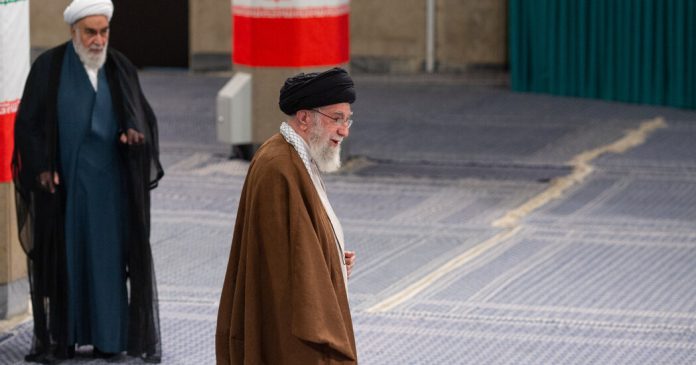
It was unclear if the comments represented a shift in policy after Ayatollah Ali Khamenei, Iran’s supreme leader who has ultimate authority in such matters, issued an angry statement following Mr. Trump’s offer last week to restart talks.

In a social media post on Saturday, Mr. Khamenei decried “bullying governments” that seek to impose restrictions on Iran. The remarks did not refer directly to Mr. Trump or his offer. The president had warned that Tehran would have to choose between curbing its nuclear program or risk losing it in a military attack

Experts say Iran is at the threshold of being able to enrich enough uranium to produce a nuclear weapon. The Islamic republic says its nuclear program is for peaceful purposes.

Iran’s U.N. mission said that “negotiations will never take place” if their aim is to dismantle Tehran’s “peaceful nuclear program.”

The apparently conflicting remarks may reflect a split among Iranian officials about whether to re-enter talks after Mr. Trump, during his first term as president, withdrew the United States from the nuclear deal struck with Tehran by his predecessor, Barack Obama.

Some moderate and reformist Iranian leaders, including President Masoud Pezeshkian, who took office last year, have said they want to begin discussions. Mr. Khamenei, however, has the final say and has said that Iran cannot trust the United States.

Mr. Trump’s offer comes as the strategic environment for Iran has deteriorated substantially.

Israel has severely weakened Tehran’s regional proxies, Hezbollah and Hamas, and destroyed almost all the air defenses protecting Iran’s nuclear facilities. In December, a rebel coalition toppled Syria’s former authoritarian ruler, Bashar al-Assad, an ally of Tehran.

Some senior Israeli officials have argued that there will never be a better moment to strike at Iran’s major nuclear facilities.

U.S.-funded international networks fear fate under Kari Lake : NPR

0

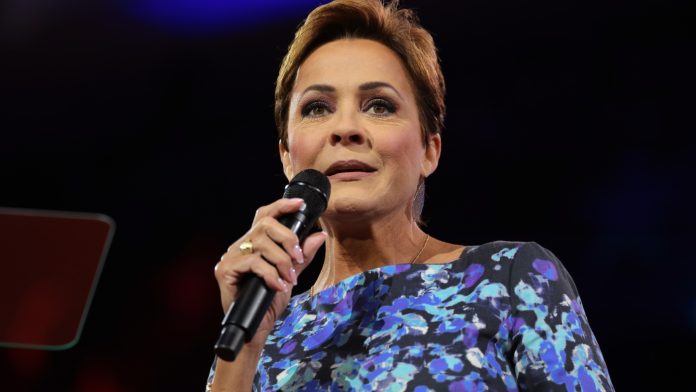
Kari Lake, U.S. President Donald Trump’s choice to lead Voice of America, is shown speaking at the Conservative Political Action Conference (CPAC) at the Gaylord National Resort Hotel And Convention Center on Feb. 21, 2025 in Oxon Hill, Maryland.

Alexander Nemenov/AFP via Getty Images


hide caption

toggle caption

Alexander Nemenov/AFP via Getty Images

A month ago, Elon Musk called for Voice of America and Radio Free Europe/Radio Liberty to be shut down, tweeting: “It’s just radical left crazy people talking to themselves while torching $1B/year of US taxpayer money.”

It’s in keeping with Musk’s DOGE initiative, prompting the administration to slash jobs, cut programs and even seek to sever funds for contracts already in progress throughout the federal government.

In the weeks since, Trump administration officials have asserted greater control over the Voice of America’s parent, the U.S. Agency for Global Media. Several DOGE aides have been sent to the agency, which has commenced an initial batch of firings of probationary employees at Voice of America. And leaders at other U.S.-funded networks that broadcast overseas fear Musk’s grander wish — for a full shutdown — may be coming true.

Those outlets include such storied networks as Radio Free Europe/Radio Liberty and Radio Free Asia, started up to counter Communist propaganda during the Cold War.

These institutions, unlike the government-owned Voice of America, are separate not-for-profit entities. Yet they are fully funded by the U.S. government through the same federal parent agency.

Were the government to withhold money for any appreciable length of time, “We would bleed out,” an official at one of the international broadcast networks said. The official spoke on condition of anonymity, citing fear of reprisal.

(NPR has no affiliation with the U.S. Agency for Global Media and typically receives about 1 percent of its annual budget from the Corporation for Public Broadcasting.)

This account is based on interviews with 12 people with knowledge of developments at the U.S. Agency for Global Media, which is the federal agency that oversees all these international broadcasters and distributes money to them. All spoke on condition they not be named for fear of recrimination, given the backdrop of government firings and budget cuts. The agency did not reply to two requests for comment for this story.

Soft diplomacy versus hardline regimes

The networks’ mission is to deliver news coverage and cultural programming to places where a free press is threatened or doesn’t exist. They are also designed as a form of soft diplomacy, by modeling independent journalism that incorporates dissent from government policy. Together, according to the agency, the networks reach 420 million people in 63 languages and more than 100 countries each week.

That comes with diplomatic complications. The reporting of Radio Free Europe/Radio Liberty has vexed autocratic-minded leaders in Russia and Hungary as well as their allies. The networks’ journalists have been imprisoned or detained in Russian-controlled Crimea, Belarus, Azerbaijan and Russia itself.

The network’s Farda news service reports intensely on life in Iran and is a thorn in the side of the regime there. The Iranian government, a sworn enemy of the U.S. and frequent irritant to President Trump, is allied with Russian President Vladimir Putin. In December, the regime sentenced former Radio Farda reporter Reza Valizadeh to 10 years in prison for “cooperating with a hostile government.”

“Clearly, this regime feels threatened by the forces of freedom, including independent journalism,” Radio Free Europe/Radio Liberty chief Steve Capus said at the time. “It’s why Radio Farda’s mission of providing uncensored news and other programming to the Iranian people is more important than ever. Journalism is not a crime.”

Similarly, Radio Free Asia’s reports on the oppression of Uighur Muslims by Chinese authorities helped to bring their plight to international attention. In 2020, North Korean officials executed the owner of a fishing fleet for secretly listening to broadcasts by Radio Free Asia while at sea, the network reported. Authorities brought in 100 of his peers to watch the execution as a warning of the dangers of tuning in.

Networks monitoring aid programs

According to six people with knowledge, officials at the international broadcasters are closely monitoring deep cuts at the U.S. State Department to international relief efforts for which money has already been contracted. (Radio Free Asia and Radio Free Europe/Radio Liberty did not respond to NPR’s requests for comment.)

They also see parallels to the financial crisis at the National Endowment for Democracy, a nonprofit organization that awards grants to strengthen democracy in 100 countries. Like the networks, it receives a direct appropriation annually from Congress.

The endowment is suing the Trump administration, saying the White House has unlawfully withheld nearly $240 million in congressionally approved funding, the bulk of it already obligated.

No concrete proof of such broad intentions at USAGM has publicly surfaced. The question of whether the agency could cut off funding for the networks is further complicated by two countervailing facts: Congress directly appropriates money for them, granting the agency only a small degree of latitude to redirect funds; on the other hand, Congress has not passed a budget for the current year in progress, and the current stop-gap measure is set to run out on Friday.

Trump officials push to overhaul agency

Trump has announced he wants Kari Lake, a former Phoenix local TV news anchor turned two-time unsuccessful MAGA political candidate, to be the next director of Voice of America; hers, by law, is not a presidential appointment. She legally must await the Senate confirmation of Trump’s pick to lead USAGM — the conservative media critic Brent Bozell III. The Senate Foreign Relations Committee has not yet set a date for a confirmation hearing. Then Lake has to be approved by a bipartisan board overseeing the network; the White House fired its members upon Trump taking office.

In the meantime, Lake is helping to lead the agency as a senior adviser to Trump. She has made conciliatory remarks to the journalists and networks in her official communications, while signaling changes and cuts may be in store.

“I understand the challenges faced by those who cover news both in front of and behind the camera, and I have immense respect for the men and women who do the job with honesty and integrity,” Lake wrote in a memo to staff obtained by NPR.

“Sadly, journalism is experiencing dark days right now,” she continued. “The public has lost almost all trust in the media. For those reading this — it is critical we recognize our agency is funded by hardworking American taxpayers, many of whom are struggling to make ends meet.”

“I am committed to quickly reforming and modernizing the agency into something the American people are willing to support,” she wrote.

In outside statements, Lake has been blunter. “We won’t become Trump TV,” she said at the Conservative Political Action Conference last month, “but it sure as hell will not be ‘TDS TV.’ You can find all the Trump Derangement Syndrome that you want over on CNN, MSNBC, PBS, 60 Minutes, The Washington Post and The New York Times.”

That said, journalists throughout the agency’s networks say she has not met to talk substance or her plans with their newsrooms or senior executives. (They spoke on condition of anonymity given a climate of fear.)

Following the DOGE game plan

Following the DOGE playbook, the U.S. Agency for Global Media has fired nine journalists at Voice of America who held probationary status. The agency also fired two journalists from the Office of Cuba Broadcasting, which is similarly fully owned by the U.S. government and runs Radio and TV Martí. The agency did so over the objections of Voice of America’s senior management, according to three people with knowledge of events, speaking on condition they not be named for fear of reprisal. Voice of America did not reply to requests for comment.

Ostap Yarysh, a host and correspondent for the Ukrainian language service of the Voice of America, was among those fired. He tells NPR that he was pulled in a few hours before his show last Thursday and told not to do any more work. Yarish says the network hired him as a contractor in 2019, but promoted him in 2023 to a full-time employee. He says he was still in the last legs of a two-year probationary period, and hence vulnerable.

“I was given no notice, basically,” Yarysh says. “There’s speculation this was political retribution. I don’t think that was the case. It was just a probationary employee directive and they got everyone.”

He said the U.S. Agency for Global Media first tried to fire him two weeks earlier but Voice of America leaders objected, designating him as an employee critical to its mission. This time, Yarysh says, he received a termination notice saying he had not been designated as mission-critical – despite what news executives at Voice of America said.

Return of a Project 2025 author 

During the final year of Trump’s first presidential term, his appointee as chief executive of the U.S. Agency for Global Media similarly tried to upend it and its networks. Many of the efforts of then-CEO Michael Pack were overturned in court and found to have broken laws.

Pack’s acting vice president of legal, compliance and risk was cited by a 2023 federal investigative report as having failed to observe federal law in several instances. That executive, Mora Namdar, wrote the chapter on USAGM and international broadcasting in Project 2025, The Heritage Foundation’s suggested blueprint for Trump’s second term. Though Trump disavowed it during the campaign, many of his administration’s actions have closely hewed to its suggestions.

In her chapter for Project 2025, Namdar called for consolidation of many of the foreign language services, stricter scrutiny of visas for journalists who are citizens of other countries, and the scrapping of many “firewall” provisions intended to protect the journalists who work for the networks from political meddling.

In fall 2020, Pack assigned two political appointees at the agency to investigate senior White House correspondent Steve Herman; it was decried as a witch hunt and found by a federal judge to be unconstitutional breach of the firewall’s free speech protections. Similarly, in early 2021, veteran reporter Patsy Widakuswara had been shifted from her assignment after pressing then Secretary of State Mike Pompeo over the January 6th siege of the U.S. Capitol.

Two weeks ago, Herman, was suspended and is being once more investigated over his social media posts of articles critical of the Trump administration. The network also reassigned Widakuswara from her beat covering the White House.

Both moves were said to have been done by the network’s news leaders, not political appointees at the agency; VOA’s director, Michael Abramowitz is a veteran editor at the Washington Post and former head of Freedom House, the free speech and journalism advocacy organization.

As of this month, Namdar appears to be back on board, spotted last week at USAGM, according to four people with knowledge who spoke on condition they not be named, citing fear of retribution. Namdar is said to be advising Lake.

USAGM did not respond to NPR’s questions about Namdar’s role at the agency.

Zelensky Is Set to Meet With Saudi Crown Prince Before U.S.-Ukraine Talks

0

President Volodymyr Zelensky of Ukraine, working to repair his strained relationship with the United States and secure a favorable deal to end his country’s war with Russia, was scheduled to meet on Monday with Crown Prince Mohammed bin Salman in Saudi Arabia.

The meeting between Mr. Zelensky and Prince Mohammed, the de facto Saudi leader, who has sought to take a central role on the world’s diplomatic stage, comes ahead of talks planned for Tuesday between Ukrainian and U.S. officials in the oil-rich Gulf state.

The crown prince, once shunned internationally because of accusations of human rights abuses that he has denied, has positioned his country as a middleman in efforts to end the Russia-Ukraine war. Last year, Saudi Arabia played a pivotal role in a complex U.S.-Russia prisoner swap, and President Trump has suggested it could be the site of a possible meeting between him and President Vladimir V. Putin of Russia.

Last month, Mr. Zelensky postponed a trip to Saudi Arabia after it hosted an extraordinary meeting of the U.S. secretary of state, Marco Rubio, and his Russian counterpart, Sergey V. Lavrov, in which the two sides sought to reset their relationship and discussed the war in Ukraine, without Mr. Zelensky.

But on Saturday, Mr. Zelensky said on social media that he would visit Saudi Arabia, declaring that he was “determined to do everything to end this war with a just and lasting peace.”

“Ukraine has been seeking peace from the very first second of this war,” he wrote of the full-scale conflict, which began with Russia’s invasion three years ago. “Realistic proposals are on the table. The key is to move quickly and effectively.”

Mr. Zelensky added that he would not attend the talks with U.S. officials, but the Ukrainian delegation would include the country’s foreign and defense ministers, a top military official and the president’s chief of staff.

Mr. Zelensky is under intense pressure from the Trump administration to agree to a peace deal, and he has appeared to recalibrate his message after Mr. Trump and Vice President JD Vance angrily assailed him 10 days ago in the Oval Office over what they described as a lack of gratitude for U.S. support.

Mr. Trump has repeatedly said that Mr. Zelensky does not “have the cards” given Russia’s military strength, and has all but demanded that Ukraine accept diplomatic terms set by the United States for a resolution of the war. Still, there are signs that Ukraine’s position on the battlefield is improving: Ukrainian troops have in recent months stalled a Russian offensive and in some places won back small patches of land.

Steve Witkoff, the Trump administration’s special envoy to the Middle East, has said that Mr. Zelensky’s deferential posture after the blowup in the White House has improved Ukraine’s standing with American officials. Nonetheless, the U.S. has paused military support for Ukraine.

Mr. Zelensky wrote on Saturday that he was “fully committed to constructive dialogue” and that he hoped to “discuss and agree on the necessary decisions and steps” during his visit to Saudi Arabia. Mr. Rubio will be in the seaside Saudi city of Jeddah for talks with Ukrainian officials from Monday through Wednesday, according to the U.S. State Department, and was expected to meet with Prince Mohammed after arriving on Monday evening.

Mr. Trump’s position on Russia and Ukraine has sometimes been hard to pin down. On Friday, he said on social media that he was considering significant sanctions on Russia to help force a peace deal on Ukraine. He demanded that the two countries “get to the table right now, before it is too late.”

Hours later, he told reporters at the White House that he felt talks with Russia were going well and that he was “finding it more difficult, frankly, to deal with Ukraine.”

Trump officials use the census to justify a USPS takeover : NPR

0

A U.S. Postal Service employee unloads mail at a facility in 2022 in Houston.

Brandon Bell/Getty Images


hide caption

toggle caption

Brandon Bell/Getty Images

The Trump administration’s talk of transforming the U.S. Postal Service has ensnared another one of the country’s oldest institutions — the census.

During a recent interview, Fox News anchor Bret Baier asked Commerce Secretary Howard Lutnick about a potential push for his department to take control of the USPS — even though Congress set up the Postal Service to be independent of the White House and generally self-funded through stamp sales and other service fees.

President Trump gave Lutnick “a whole 24 hours,” the commerce secretary said, to figure out how to solve the mail service’s longstanding financial problems. To “save us money,” the solution Lutnick pitched was to rely on mail carriers instead of hiring temporary census workers to help conduct the constitutionally required head count of the country’s residents once every 10 years.

“Can you imagine saying to your postman, ‘Can you count the people in the house?’ ” said Lutnick, who heads the Census Bureau’s parent agency.

It’s a question some members of Congress, mainly Republicans, have floated for decades, prompting studies by the bureau and the Government Accountability Office that ultimately concluded that adding this census work to the Postal Service’s responsibilities would not be cost-effective or as easy as it may seem.

The idea’s recent resurfacing — as Trump suggests a “form of a merger” between the USPS and the Commerce Department — is now raising concerns about disruptions to the country’s mail service and to plans for the 2030 census, which is set to be used to redistribute political representation and federal funding to communities in the coming decade.

Lutnick’s proposal faces major legal and logistical hurdles, experts say

Mail carriers have played a key role in the national tally going back to 1960, when the Census Bureau first used the mail extensively to deliver questionnaires for households to fill out.

But until now, public calls to increase collaboration between the two agencies had not come with the idea of folding the USPS into the Commerce Department. Such a unilateral move by the president would violate the Postal Reorganization Act of 1970, says Rena Steinzor, an administrative law expert who retired last year as a professor at the University of Maryland’s law school.

“The law is crystal clear on this point,” Steinzor says. “Trying to take it over, to pull it into the Commerce Department and get rid, in essence, of its independent structure would not be legal without the consent of Congress.”

Still, Trump has been attempting to expand his power over other independent agencies, and it’s unclear what exactly Lutnick envisions for his proposal to expand the Postal Service’s census role. The Commerce Department’s public affairs office has not responded to NPR’s interview request. The USPS also didn’t reply to a request for comment.

Based on Lutnick’s public comments so far, Terri Ann Lowenthal, a census consultant who once served as staff director of the former House oversight subcommittee on the census and the Postal Service, is skeptical.

“I think that looking to the Postal Service as a replacement for the Census Bureau and census takers is an effort to find a silver bullet that just doesn’t exist,” Lowenthal says. “The cost savings that Secretary Lutnick believes might be there for the taking simply are based on wildly inaccurate numbers and assumptions.”

For example, the 2020 census cost $13.7 billion, about a third of the $40 billion Lutnick cited in the interview as the cost he claimed the federal government could save.

In 2011, the GAO concluded that using mail carriers to interview households for the census “would not be cost-effective.” The watchdog agency’s report pointed to higher average wage rates for mail carriers compared to those for temporary census workers, as well as the large number of hours needed to follow up with households that don’t respond to the census on their own.

There are also logistical mismatches. With the cluster mailboxes often found in apartment buildings becoming more common in new subdivisions, many carriers’ mail routes don’t include door-to-door stops, says Chris Mihm, a retired managing director for strategic issues at the GAO, who tracked the census for decades.

“Mail is obviously, in most cases, delivered during the day, in the middle of the day. That’s not the peak time for doing follow-up on census forms that are not returned,” adds Mihm, noting that the bureau trains its door knockers to visit households when they’re more likely to be home, such as in the early evening or during weekend afternoons.

In rural areas, where homes can be spread far apart, trying to squeeze census interviews into a regular day for mail carriers could be a “pretty large ask,” warns Don Maston, president of the National Rural Letter Carriers’ Association, one of the two mail carrier unions.

“Certainly the rural carrier is not going to be able to deliver their assigned duties for the day and also accomplish a second job because they just simply don’t have the time,” Maston says. “They’re under the gun to get back to the post office at a reasonable time.”

Many postal watchers fear the census proposal is covering up privatization plans

For Mihm, the retired GAO official, any talk about more census work for mail carriers doesn’t address the “real” problem facing the Postal Service — its outdated business model for funding a universal service obligation of delivering mail to almost every address in the country six days a week.

Since 2009, its troubled finances have kept the USPS on the GAO’s “high risk list” of parts of the federal government that are seriously vulnerable to waste, fraud, abuse or mismanagement. The agency’s latest warning, out last month, says the Postal Service is likely to face more declines in its most profitable kind of mail (first-class) and more competition from private package delivery companies while also dealing with rising expenses and unfunded liabilities driven by health and pension benefits for its retired workers.

Still, the USPS ended this fiscal year’s first quarter with a $144 million surplus, compared to the $2.1 billion net loss for the same period last year. The USPS says the turnaround is in large part the result of a controversial 10-year reorganization plan Postmaster General Louis DeJoy rolled out in 2021.

The heads of the three USPS employee unions that NPR spoke with say they’re open to ideas for rethinking the services the agency can provide, including interviewing households for the census.

“If the Commerce Department wants us to get more involved with some of their work, bring it on,” says Mark Dimondstein, president of the American Postal Workers Union. “But the people of this country should not be fooled by nice-sounding ideas of doing a census, as if somehow that’s a basis or legitimate reason to do a hostile takeover” by the Trump administration.

While Brian Renfroe — president of the National Association of Letter Carriers, which represents carriers in cities — showed support in an X post for Lutnick’s suggestion to add more census work to letter carriers’ responsibilities, he tells NPR that he is still concerned that neither the commerce secretary nor Trump has publicly denied that the administration is considering an attempt to change the independent status of the USPS.

“It remains a threat as long as it’s under consideration,” Renfroe says.

The unions fear that a Trump administration takeover could result in privatizing at least some part of the USPS, a direction that Trump said at a December press conference was “not the worst idea” he’s ever heard.

That kind of transformation would likely lead to reduced mail service to rural areas and higher shipping costs for the public, says Chris Wetherbee, a transportation analyst with Wells Fargo, who recently co-authored a report exploring the implications of splitting off and selling the package side of the Postal Service from its mail business.

“Just going in there and being able to reduce service levels pretty meaningfully or change materially how mail is delivered in this country is not a particularly easy thing. And I’m not sure it’s something that people have a ton of appetite for in Washington,” adds Wetherbee.

And it may be difficult even for Trump to rally support among Republicans on Capitol Hill. Six voting House Republicans have signed on as co-sponsors of a resolution that Congress “should take all appropriate measures” to make sure the USPS remains an independent government agency and “not subject to privatization.”

Maston, president of the National Rural Letter Carriers’ Association, sees a “less disruptive” path Trump could take to influence the Postal Service, whose politically appointed governing board currently has four Biden nominees, two Trump nominees and three open seats.

“There is opportunity for the current administration to put some people on the Board of Governors and have some oversight from that level and without completely flipping the applecart upside down, so to speak,” Maston says.

The postal governors are set to pick a replacement for DeJoy, who recently announced plans to step down. The White House’s press office has not responded to a request for comment on whether Trump is considering making any nominations for governors.

Edited by Benjamin Swasey

Covid-19: Enduring Images of a Global Crisis, 5 Years On

0

We asked 19 photographers to revisit their most enduring images of the coronavirus pandemic, five years after the virus became a global threat. Their photographs transport us to that bewildering period in an uncanny sort of time travel.

The journalists who captured these scenes were not just covering the Covid-19 story but living through it. To bear witness at a time of lockdowns and isolation, they had to be in the world, navigating fear and uncertainty.

The images evoke how we felt and what we lost, as well as human resilience and connection at a time of crisis.

— Meaghan Looram

One night in January 2020, the Food and Health Bureau of Hong Kong announced that a male traveler from Wuhan, China, had a fever and was suspected of being infected with the novel coronavirus.

I rushed by high-speed rail to the hospital where the patient was. It was crowded with journalists. By a back door, paramedics were in full protective gear. Eventually, he was wheeled out on a stretcher. We were so close that I could see his sweat. He was transferred to an isolation hospital, where he later tested positive.

— Lam Yik Fei

São Paulo, Brazil. March 2020

I had returned on the fourth lockdown day to Brazil from Argentina, where I had been working on a story about jaguars, barely making it before the airport closed. After a day in search of images, I visited my old neighborhood to photograph an empty barbershop. A friend tipped me off to an apartment with a privileged view of the emblematic Copan building, where thousands live in São Paulo.

I arrived on the terrace late that afternoon. I waited for nightfall and the lights in the dozens of studios gradually came on. Everyone was in their cubicles, living through the pandemic alone, like me.

— Victor Moriyama

Officially, Beijing had recorded a few hundred Covid cases and less than a handful of deaths in mid-February. But what did we know? A month earlier, health authorities had insisted there was no proven human-to-human transmission, only to reverse themselves.

The city felt empty. A robotic voice playing on a loop on loudspeakers recommended to wash hands and avoid crowds.

I headed to Houhai, a neighborhood popular with locals and tourists. That evening, the place was dark and deserted except for one bar, where under a spotlight, a man sat surrounded by empty velvety couches, eating dinner out of plastic boxes. I placed my lens against the window.

— Gilles Sabrié

Cenate Sotto, Italy. March 2020

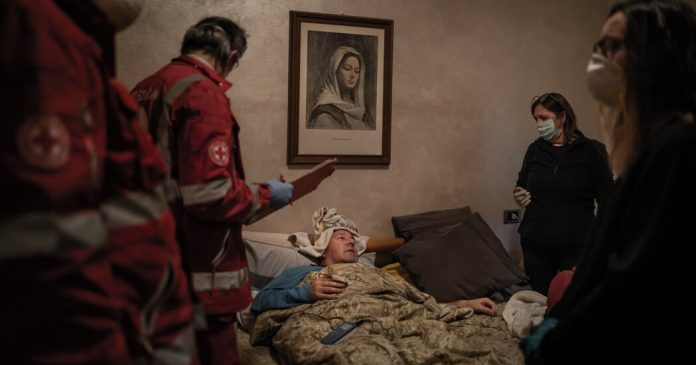
Italy was the first Western country to see its squares empty, its shops close and fear creep in. While taking precautions and following protocols, I followed the Red Cross, entering hospitals and going into private homes and even funerals. I saw fear in the eyes of victims, despair in those left behind and immense exhaustion in doctors and nurses.

The photo of Claudio Travelli is a real-life tableau of pain but also the fight for survival and the resilience of the families involved. Mr. Travelli survived, though he has not shaken off the specter of the virus, as he confided a year later when I returned to Cenate Sotto, a town in the province of Bergamo.

“Since I got sick,” he said, “I’ve never been the same. It feels like I’ve lost 10 years of my life.”

— Fabio Bucciarelli

Paris. March 2020

This was Place de la Concorde, at 8 a.m. on Tuesday, March 17, 2020. Normally, that would have been rush hour for one of the busiest roads in Paris, but the lockdown announcement the day before changed everything. The taxi dropped me off at Place de la Madeleine, a short walk away.

The city was immersed in an eerie silence, like that of a lunar atmosphere. As a child, I would often come here with my father for walks, and he would tell me it was one of the liveliest places in the world. This photograph was born from a silent shock, having my breath taken away.

— Andrea Mantovani

Tampa, Fla. October 2020

My family and I had just relocated to Central Florida about eight months after leaving New York City when I found this picture in October 2020. At a drive-through Covid testing site in Tampa, Fla., a woman’s face mirrored the anxiety of those days when people feared that an encounter with another person could potentially be lethal.

It may have been the anticipation of the test itself or the results that terrified her, but the look on her face reminded me of the height of the AIDS epidemic when simply taking a test was an acknowledgment of our own mortality.

— Damon Winter

Paterson, N.J. March 2020

Firefighters and emergency medical technicians steeled themselves to overcome their fear and help those who needed it the most as they made home visits at the outset of the pandemic in Paterson, N.J.

It was the moment of holding a hand through the darkness.

— Chang W. Lee

Houston, Texas. July 2020

I spent about three weeks with colleagues at Houston Methodist Hospital in Texas in the summer of 2020. The hospital was opening one intensive-care unit after another to tend to the most critically ill, and we were given permission by patients and their families to follow their care.

I was sweating through plastic face shields while wearing gowns, gloves, bootees and head coverings, and cleaning my cameras with wipes used to sanitize medical equipment. This photo froze a moment when doctors and nurses came together to turn Edwin Garcia, 31, on his back. He was on a ventilator.

Until then, I did not know how much effort it took to keep a hospital running.

Mr. Garcia would suffer physical and neurological impairments after his time in the hospital — including losing the use of his left arm and hand, and requiring a cane to walk — that continue to affect him nearly five years later.

— Erin Schaff

Los Angeles. March 2021

Dianne Gutierrez held up a family photo through glass for her father, Dr. David Gutierrez, who was in intensive care for six months. She was trying to prompt him to say the names of those in the photograph.

“Who is this?” she asked, after she peeled one photo after another from a stack and held each up to the window.

He stared with eyes wide open and said nothing.

He was a family medicine doctor serving patients in California in December 2020 when he started to develop Covid symptoms, which quickly escalated. He was transferred to Providence Saint John’s Health Center in Santa Monica, Calif., and placed on extracorporeal membrane oxygenation as a last-resort therapy.

Dr. Gutierrez was struggling to speak after months of intubation. But during this visit, with the help of a speech therapist, he uttered “I love you” to both his wife and daughter.

I held onto Dr. Gutierrez’s story as a symbol of hope. He was one of the few patients I shadowed in intensive care who survived in 2021.

— Isadora Kosofsky

Manacapuru, Brazil. June 2020

On March 13, 2020, a 39-year-old woman returned to Brazil from England and became the first confirmed case of Covid in the state of Amazonas. Mostly a tropical jungle, the region turned into the scene of one of the world’s worst-hit and fastest-growing epidemics, leaving its hospitals unprepared and cemeteries overwhelmed.

I visited the remote settlements on the Amazon River to document how the virus had spread through people traveling on boats from the state capital, Manaus, to these distant communities, many of which had no hospitals, doctors or even phone service.

While waiting at a small river landing in Manacapuru, a boat used as an ambulance arrived with the sick from Codajás, a community 100 miles farther upriver. After their long journey, now nearly dark and with little sound, they drifted into the glow of the headlights of a vehicle, waiting to transport patients to a hospital.

— Tyler Hicks

Los Angeles. February 2021

When this photo was taken, sunlight was entering the chapel lobby of the Continental Funeral Home in East Los Angeles through a skylight and illuminating Brianna Hernandez, an apprentice embalmer. She was working alongside other funeral home employees as they attempted to absorb the staggering influx of bodies at the height of the pandemic in Southern California.

I watched as the funeral home director and her staff adapted to the unimaginable. Church pews were replaced by rows of coffins; the cafeteria was converted into a makeshift morgue; and back-to-back funerals were held daily in the parking lot.

As I photographed Ms. Hernandez and the other workers carefully moving bodies draped in white sheets onto industrial shelving racks, I was confronted with the sobering reality of the pandemic’s devastating toll.

— Alex Welsh

I was in New Delhi during a second Covid wave when I heard that hospitals were experiencing a colossal oxygen supply crisis. I was going everywhere, to hospitals and makeshift hospitals. I was seeing people in line, seeking oxygen cylinders, and patients in ambulances waiting to be admitted at government hospitals. Some were gasping for air. I saw people die for lack of oxygen when I was in the outskirts of Delhi.

This made me wonder what it was like in the cremation grounds. I went to one in the outskirts of Delhi where even the parking lot had been converted to accommodate the many bodies brought there. It was all overwhelming but I felt I needed to convey the truth to the world through my images of the Hindu rituals, which are seen as a way to free the soul from the body.

I got myself to high ground and saw ambulances lined up. I waited for the light to fade. I photographed the flames emitting light, as if the funeral pyres were revealing the truth of what was happening in India.

— Atul Loke

Los Angeles, February 2021

I met María Salinas Cruz on Jan. 28, 2021, minutes before a respiratory therapist disconnected the ventilator that kept her husband alive at a Los Angeles County hospital.

“Don’t be afraid, Felipe,” his wife wailed in Spanish through the thick glass door that separated them. “Be brave, my love, brave until the last moment.”

Three weeks later, the Cruz family invited me to their home. I learned that Mr. Cruz cleaned and repaired heating, ventilation and air-conditioning systems. His family is convinced he became infected with Covid while at work. It became so difficult for him to breathe that they took him to the emergency room on Jan. 1, 2021, which was his birthday.

My visit to their home lasted five hours. We listened to his favorite music, ate his favorite dinner, looked at lots of photos and they told many stories. The last thing we did was gather around the kitchen table to drink a special hot chocolate from his hometown, Oaxaca, Mexico.

After finishing her last sip, Ms. Cruz broke down weeping. Her daughter Maritza embraced her, and I took just one photo, this photo, and then hugged them, too.

— Meridith Kohut

Wait times for crematories stretched for days and were only getting worse in Iztapalapa, the most densely populated borough of Mexico City, in the late spring of 2020.

At the San Lorenzo Tezonco cemetery, gravediggers stood by on May 14, waiting for the hearses and grieving families to arrive. At the height of the crisis, many risked illness or even death because they could not afford to stay home.

We tried speaking with the family at this burial but they declined. At that time, gatherings were not allowed, and there was still a sense of shame around the virus.

— Daniel Berehulak

Moscow. December 2020

In December 2020, Russia was the first country to approve a coronavirus vaccine, an achievement that was promoted with pride on state television. Outside the hospital walls, skepticism ran deep, with surveys finding that 59 percent of Russians refused to take it.

Lyudmila Soboleva, a 38-year-old medic, knew firsthand from working in a hospital that Covid left patients struggling to breathe. A warm, late-afternoon light cut through the room, casting long shadows on the tiled walls when she exposed her arm to take the shot.

The government launched a mass vaccination effort, setting up mobile clinics in shopping malls, sports halls and even in the heart of Moscow, at Red Square. Some lined up for their jabs seeking protection or to regain a feeling of normal life. Others refused, as their distrust of the government was stronger than fear of the virus.

— Sergey Ponomarev

Stuttgart, Germany. May 2020

When I arrived in Stuttgart, Germany, in the spring of 2020, it was a warm, sunny day in which many people would normally have been outside. Yet, it all felt surprisingly empty. I drove up a hill covered with vineyards to reach a location where two orchestras had created a unique way for people to reconnect with live music through intimate, one-on-one outdoor concerts.

In those sessions, a single musician played for one listener, often sparking deep emotions after months of isolation. Without words, tickets or applause, the concerts aimed to restore human connection at unexpected places.

— Laetitia Vancon

Queens, New York. July 2020

The New York Mets held their season opener against the Atlanta Braves in July 2020 in a Citi Field devoid of fans. Cutouts of people were placed on the empty seats, creating a surreal backdrop for the game. Few photographers were allowed to cover the game and we couldn’t wander far from our cordoned-off sections.

I recall feeling a flood of emotion at one point, but I can’t quite pinpoint why. Perhaps it was taking stock of all I had seen during the pandemic. Like most journalists, I was living the story we were covering, juggling the incongruities of being a parent while witnessing the devastating effects the virus had on our city.

There was a glimpse of optimism, but the reopening seemed distorted, like a new version of a recent past.

— Todd Heisler

Children wearing face coverings were meditating at a morning assembly on their first day at school after Bangkok ended a second lockdown caused by a spike in Covid infections in early 2021.

I lived in Thailand through the pandemic. There were very few cases early on and the government quickly closed the borders and put in place strict social-distancing and mask-wearing rules. I remember feeling guilty, fearful and helpless as I watched the devastation that the pandemic caused for my friends and family in England and the United States while I was leading a relatively normal life.

Looking back, I can’t help wondering how these children remember this strange time and how the lockdowns and isolation affected them.

— Adam Dean

old bridge, n.j. March 2021

Dan Fabrizio had not seen his 95-year-old mother, Marie Fabrizio, in person for more than a year when they had this encounter in March 2021. She was staying in an assisted-living home in suburban New Jersey, and at that time, many retirement homes were experiencing deaths from the disease at a horrifying rate. Some lost dozens of residents from the virus in a few weeks.

I’ll never forget how happy she was to see her son and how relieved he was just to hug her. As soon as Mr. Fabrizio walked into the room, he completely broke down.

“Hearing my mom’s voice in person — it just felt like, it wasn’t a recording,” he said. “It wasn’t the telephone. It wasn’t a Zoom. It was live. She got through this. I sat in my car and I cried.”

—Bryan Anselm

How COVID changed America : NPR

0

Faced with isolation during the early weeks of the COVID-19 pandemic, James Yu of San Diego, Calif., embraced new priorities — like starting a family. Here, Yu is seen with his wife, Barbara, daughter Madeleine and their dog Quilo.

James Yu


hide caption

toggle caption

James Yu

Five years ago, James Yu’s life in San Diego was a seamless blend of work and social outings with his colleagues.

“We worked out together, grabbed dinner together, met up after work [for] craft beers together,” he says.

All of that was upended by the COVID-19 pandemic, as people across the U.S. were plunged into unprecedented lockdown conditions.

“I was living alone at the time with no pets. It felt like solitary confinement,” Yu, who’s now 40, says.

Yu, a scientist working in the biotech industry, recalls reading Facebook posts from friends who complained about being stuck at home with their kids and spouse all day. He had the opposite problem, his days full of silence and pacing in his apartment. Yu says he was relieved when his company was deemed an essential industry.

“It was so good to be able to go into work and actually talk to someone in person,” he says. “And after most of the shutdown ended, that isolating experience was also a strong impetus to find a partner who is my now wife.”

Yu’s story is emblematic of how COVID united Americans — to an extent. Faced with a new lethal coronavirus, we shared information and commiserated over lost loved ones and our altered lives. But COVID also divided us. The disease wrought wildly different effects, from mild symptoms to long COVID or death. Deep fractures ruptured along political, cultural and geographic lines, as Americans embraced divergent ideas about how to cope with the pandemic.

“People from California were lobbing insults at the ‘idiots in Florida’ for remaining open,” Yu recalls, citing arguments on social media. “And people from Florida were lobbing insults at the ‘sheep in California’ for willingly following the masking mandates.”

March 20, 2020: A woman wears a mask walking over the Brooklyn Bridge as a COVID-19 outbreak rocks New York City.

March 20, 2020: A woman wears a mask walking over the Brooklyn Bridge as a COVID-19 outbreak rocks New York City.

Victor J. Blue/Getty Images


hide caption

toggle caption

Victor J. Blue/Getty Images

Is the pandemic really “over”?

COVID-19 has killed more than 1.2 million people in the U.S., according to the Centers for Disease Control and Prevention. The death toll began slowing after vaccines emerged in late 2020 — and it has mostly remained at lower rates since early 2022. In recent weeks, the coronavirus was still causing more than 1% of American deaths, the CDC says.

In April 2023, then-President Joe Biden signed a resolution ending the national state of emergency over COVID-19; the World Health Organization declared an end to the global health emergency for COVID weeks later, in May 2023.

“I think we are still recovering from the shock of the pandemic,” Melodye Watson, a clinical social worker in Bowie, Md., tells NPR. There’s a lingering trauma, she says, from people absorbing daily death tolls along with new levels of isolation and enmity over safety precautions.

Among the U.S. public, many still disagree over whether the pandemic is over. A new Gallup poll found that while 59% of Americans believe we’re past the pandemic, 41% do not. Those are the same numbers found in a similar poll last year.

It’s a reminder that as a country, we experienced COVID-19 in a multitude of ways. In response to an NPR request, Yu, Watson and hundreds of other Americans shared their stories about reassessing priorities and finding new pursuits. They also described how the pandemic isolated them, how they found moments of joy — and, in some cases, how long COVID left them debilitated.

We adjusted, uneasily, to shifts in what’s normal

May 1, 2020: Activists hold signs and protest the California lockdown due to the COVID-19 pandemic in San Diego.

May 1, 2020: Activists hold signs and protest the California lockdown due to the COVID-19 pandemic in San Diego.

Sean M. Haffey/Getty Images


hide caption

toggle caption

Sean M. Haffey/Getty Images

Julie Foote, 38, was teaching overseas with her husband when the pandemic struck. They opted to stay in in Yangon, Myanmar, forming a social bubble with colleagues — and becoming devotees of Dungeons & Dragons, a game she had long been skeptical of. The couple now work in Hanoi, Vietnam, and at each school where they’ve taught, they’ve invited students to play the game along with them.

“It gives students endless opportunities for problem-solving, improv comedy, and art integration,” Foote says.

In Southern California, Mara Rosza, 49, says she found moments of joy at the height of the pandemic — but she also couldn’t relate with “the bread bakers of COVID.”

Rosza was working in a garden center, where she found camaraderie with her coworkers and joy in teaching people how to plant seeds and grow their own vegetables. She says she felt a disconnect between the exhausting work she was doing and stories from friends who were getting unemployment benefits and relatives who were stuck at home.

“My coworkers and I felt unprotected and scared, but we had each other. This was comforting,” she says.

But in contrast, their white-collar customers “seemed to take for granted that we would show up to work while they did not think it was safe for them.”

Others felt similar disconnects and frustration. In Seattle, 31-year-old Pauline M. (who asked that her last name not be used because she’s worried her skepticism about COVID restrictions might lead to retaliation from her employer), says depression and anger outweighed any joy brought by pandemic-safe hobbies. A self-described liberal, she says her skepticism about some pandemic measures sometimes put her at odds with others.

“I left social media, because the snarky-yet-saccharine, holier-than-thou, and rude posts by my supposed political allies on the left jaded me and left me enraged,” she says.

The pandemic brought life changes to Chelsea Lloyd, a microbiology professor at Parkland College, a community college in Champaign, Ill. She got married at home, in a small ceremony. She says the pandemic also changed life on her school’s campus, making it harder to form a sense of community, and to socialize with people informally.

Lloyd says she’s noticed more burnout among her colleagues. She says fewer students are entering health professions, adding that those careers “got hammered so hard during the pandemic.”

Americans’ views on the pandemic became increasingly linked to politics

Lloyd says that in general, “I feel there is more mistrust of science now and more political division. Science and expertise have become politicized.”

A recent Pew study agrees.

Large partisan divides on views of COVID-19’s severity.

For the first weeks after the WHO declared COVID-19 a global pandemic, most Americans shared a widespread sense that public health officials were doing “an excellent or good job,” despite some confusion about the coronavirus, according to Alec Tyson, associate director of research at the Pew Research Center, as he describes the Pew findings on NPR’s Here & Now.

But a stark divide began to emerge between Republicans and Democrats, Tyson says. Five years later, the rift remains prevalent.

“In some ways the national reaction has really been made up of two competing viewpoints: one more commonly held by Democrats that the health threat is high, it’s severe, and generally supportive of restrictions and actions,” Tyson says, “and another viewpoint more commonly held by Republicans that, well, there is a health threat, it may not be the most intense threat and there are mixed views or less support for some of the restrictions.”

He notes that Americans still don’t agree on pandemic measures such as lockdowns and requirements for masks and vaccines.

“Fewer than half say [the restrictions] were about right — 44%,” Tyson says. “From there, 38% say they should have been fewer, while 18% say there should have been more.”

The U.S. political landscape was marked by polarization and fragmented viewpoints before COVID. But the pandemic thrust many of those differences into the public sphere.

Foote, who has been teaching overseas, says that when she comes home now, she finds a changed America.

“The biggest difference,” she says, “is how confrontational Americans have become. I have never been anywhere else in the world where people feel entitled to be verbally abusive or physically aggressive towards complete strangers. I lived in the U.S. for 33 years without ever experiencing unprovoked aggression, but I’ve been on the receiving end of it twice in my visits post-COVID. It’s really alarming.”