Thursday, November 12, 2026
Home Blog Page 139

Tuesday Briefing: U.S. Recession Fear Rattles Markets

0

Stock markets around the world fell yesterday, a day after President Trump refused to rule out the possibility that his trade policies may cause a recession this year. The S&P 500 was down by nearly 3 percent, the sharpest drop in months. Several retaliatory tariffs against the U.S. also went into effect. Here’s what to know:

Stocks tumbled

Many stocks dropped yesterday as nervous investors reacted to a Trump interview that aired on Sunday in which he described “a period of transition” for the U.S. economy, and suggested more tariffs could come. Prices also plunged for several large tech companies, whose stocks have an outsize influence. Markets in Europe and Asia were under pressure, too, but the declines paled in comparison with losses on Wall Street.

Global effects

In a report, analysts at JPMorgan Chase warned that the possibility of a U.S. slowdown had resulted in a “materially higher risk of a global recession this year because of extreme U.S. policies.” They put the probability of a downturn at 40 percent.

Several countries issued their own tariffs

The Canadian province of Ontario imposed a 25 percent tariff on energy exports to Michigan, Minnesota and New York. The move will cost businesses and residents in each state up to $400,000 per day, Ontario’s top official said.

Beijing imposed tariffs on many farm products from the U.S. Japanese officials are expected to visit Washington this week for talks before tariffs hit exports from Japan. Trump is set to issue tomorrow a 25 percent tariff on all steel and aluminum imports, but some metals businesses said that was good news.

Mark Carney, a former central banker, was swept into the leadership of Canada’s Liberal Party on Sunday night and is expected to be sworn in as prime minister this week. He will soon have to call a general election, in which the Liberals will face the Conservative Party, led by Pierre Poilievre.

Days ahead: Carney, who is seen as a centrist technocrat, revisited some of his main campaign promises in a speech, including immediately eliminating a widely criticized carbon tax. His campaign focused mainly on reorienting Canada’s struggling economy.

Outside threats: Adding to the country’s economic woes are Trump’s on-again-off-again tariffs, which are already taking their toll. His frequent statements about making Canada the 51st state have angered most of the public.

General election: In his victory speech, Carney referred to Poilievre as a leader that would leave Canada divided and “kneel” before Trump rather than stand up to him. Anger at the U.S. president has grown so much that Poilievre, seen as ideologically similar to Trump, has started to try to create some distance between them.


The Kurdish-led militia that controls northeast Syria agreed yesterday to merge with the country’s new government. It was a major breakthrough for Damascus in its efforts to unify a country wrestling with violent turmoil.

The agreement stipulated that the U.S.-backed Syrian Democratic Forces would integrate “all civil and military institutions,” as well as its prized oil and gas fields, into the new Syrian state by the end of the year.

The decision by South Korea’s president, Yoon Suk Yeol, to impose martial law on Dec. 3 was not made in a vacuum, but almost nobody saw it coming. Yoon came close to achieving the unthinkable: a military takeover.

A Times investigation uncovered Yoon’s many missteps. The first was overestimating his allies.

Lives lived: Athol Fugard, a South African playwright whose works exposed the realities of racial separatism in his homeland, died at 92.

At an undisclosed farm in rural America, miniature pigs are given toys and kept warm under lights. The pampering is by design — they are clones, genetically engineered to have organs more compatible with humans. And their weak bodies need protection from the environment.

In 2022, researchers received permission to transplant pig organs into a few critically ill patients, and last year into healthier people. There are still unaddressed issues: Pigs carry pathogens that can jump to humans, for example. But as the first formal clinical trial begins, some scientists argue that there is a moral imperative to move forward.
Syrian Government Signs Breakthrough Deal with Kurdish-Led Forces

0

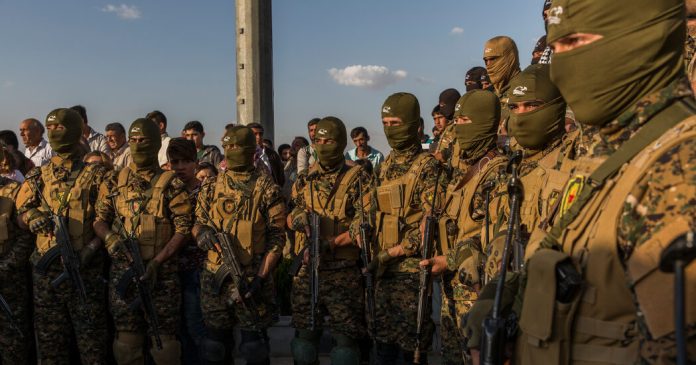
The Kurdish-led militia that controls northeast Syria agreed on Monday to merge with the country’s new government, marking a major breakthrough for Damascus in its efforts to unify a country wrestling with violent turmoil.

The agreement, announced by the office of Syria’s presidency and signed by both parties, stipulated that the U.S.-backed Syrian Democratic Forces would integrate “all civil and military institutions” into the new Syrian state by the end of the year, including its prized oil and gas fields.

The deal also outlined “the rights of all Syrians to representation and participation in the political process,” amid repeated pledges by Syria’s new leadership to form an inclusive government after years of sectarian strife.

The timing of the agreement, which came amid violent clashes in Syria’s coastal region that have left more than 1,300 people dead, signaled a moment of reprieve for Syria’s new interim president, Ahmed al-Shara.

Since the rebel coalition headed by Mr. al-Shara toppled the dictator Bashar al-Assad in December, the new government has sought to unify the complex web of rebel groups operating across Syria — the most powerful of them being the Kurdish-led forces in the northeast. However, the security situation has remained unstable, and the Kurdish militia has been among the most challenging groups to bring under the new government’s fold.

Syria’s new government has ordered all armed groups in the country to dissolve, and in recent weeks, several prominent militias have agreed to work with the new authorities, despite their skepticism about sweeping promises to create an inclusive government. As a rebel leader, Mr. al-Shara commanded an armed group once allied with Al Qaeda, and skeptics question whether he has given up its former hard-line jihadist views.

It remains unclear whether those militias have dissolved as directed and fully integrated into a single national army under Mr. al-Shara’s authority, or if they have simply agreed to cooperate with Mr. al-Shara’s government but remain as semi-independent forces in regions they effectively control.

For years, the Kurdish-led militia has been the main U.S. partner in the fight in Syria against the Islamic State, and made hard-fought territorial gains amid the country’s civil war, to the extent that it now administers a de facto state in Syria’s northeast. The group has long sought to position itself as the protectors of Syrian Kurds, who make up about 10 percent of the country’s population.

Despite the breakthrough on Monday, there were some questions that were left unanswered.

For one, it remained unclear whether the S.D.F. would be allowed to operate as a distinct military bloc within Syria’s armed forces, a key demand in recent months by the Kurdish-led administration. It was also unclear how exactly the call for “a cease-fire on all Syrian territories” would be carried out as stipulated in the agreement.

Even on Monday, fighting continued to rage in the northeast between Kurdish-led forces and armed groups backed by Turkey, a close ally and backer of the new government in Damascus.

Turkey has long viewed the S.D.F. as an extension of Kurdish separatist insurgents who have fought the Turkish state for four decades. Amid dramatic changes in Syria’s political landscape, many Kurds have grown unnerved at the prospect of ending up worse off under a government supported by their longtime foe, Turkey.

Top ‘Washington Post’ columnist resigns, accusing publisher of killing piece : NPR

0

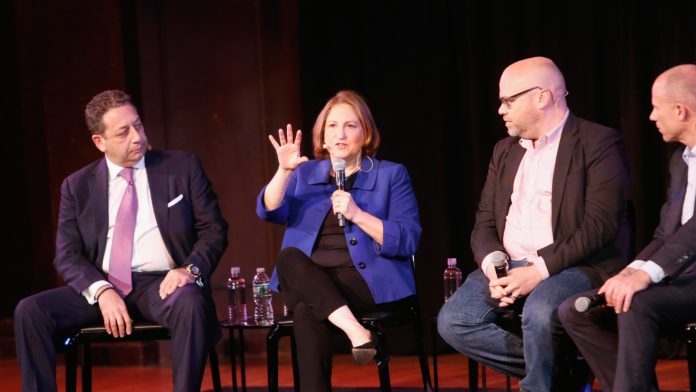
Washington Post columnist Ruth Marcus (in a blue jacket) speaks on stage during a panel at the New Yorker Festival in 2018.

Thos Robinson/Getty Images for The New Yorker/Getty Images North America


hide caption

toggle caption

Thos Robinson/Getty Images for The New Yorker/Getty Images North America

A top political columnist for The Washington Post resigned today, accusing Post chief executive and publisher Will Lewis of killing her column that criticized owner Jeff Bezos’s drive to overhaul the opinion pages to focus on his libertarian priorities.

Post columnist and Associate Editor Ruth Marcus, who has worked at the paper for four decades, says she can no longer stay there.

“Jeff’s announcement that the opinion section will henceforth not publish views that deviate from the pillars of individual liberties and free markets threatens to break the trust of readers that columnists are writing what they believe, not what the owner has deemed acceptable,” Marcus wrote in a resignation letter obtained by NPR.

More than 75,000 digital subscribers canceled in the 48 hours after Bezos revealed his intentions late last month, which included an edict that the paper would not print opposing views; then Opinions Editor David Shipley stepped down after vainly trying to dissuade Bezos from his course.

Marcus confirmed to NPR she had resigned and the authenticity of the letter but declined further comment.

“Will’s decision to not …run the column that I wrote respectfully dissenting from Jeff’s edict – something that I have not experienced in almost two decades of column-writing – underscores that the traditional freedom of columnists to select the topics they wish to address and say what they think has been dangerously eroded,” she wrote.

“We’re grateful for Ruth’s significant contributions to The Washington Post over the past 40 years,” a spokesperson for the paper said in a statement shared with NPR. “We respect her decision to leave and wish her the best.” The Post did not address her allegations against Lewis.

A killed endorsement to avoid ‘perception of bias’

In late October, Bezos killed a planned endorsement of Democratic presidential nominee Kamala Harris. That sparked 300,000 digital subscribers to cancel in the days that ensued.

And it raised questions about Bezos’s motivations to his critics, who note that he is the executive chairman of Amazon and founder of Blue Origin, which together have billions of dollars of business with the federal government.

“What presidential endorsements actually do is create a perception of bias,” Bezos wrote in a opinion piece explaining his decision. “A perception of non-independence. Ending them is a principled decision, and it’s the right one.”

Bezos has also moved closer to President Trump since the election, traveling with his fiancée to Mar-A-Lago to dine with the Trumps, paying $1 million toward his inauguration fund, sitting on the inauguration platform with other tech titans during the swearing in ceremony, and dining with Trump again late last month in Washington.

Amazon studios have approved two deals for documentaries involving the Trumps, one of which includes a $40 million payout to Melania Trump, according to Puck News.

‘Post’ blocks coverage of fallout at the paper

All this led to critical columns about the endorsement decision in the Post‘s own pages and multiple resignations by editorial board members and by contributors to the wider opinions section. Shipley, while still editor, killed a cartoon late last year by Pulitzer Prize-winner Ann Telnaes showing Bezos among the media and tech figures abasing themselves before Trump; she resigned. A deluge of veterans have taken jobs at competing news outlets.

The Post’s top news editor, Matt Murray, blocked reporters from covering the fallout at the newspaper, as NPR has reported.

Bezos’ decisions about the opinion pages led veteran journalists who have been a part of the Post for decades to cut ties, including Associate Editor David Maraniss and former Senior Managing Editor Cameron Barr.

In her resignation Monday, Marcus said she had served at the Post as a reporter, deputy national editor, editorial writer, deputy editorial page editor before becoming a columnist and associate editor.

“I love the Post,” Marcus wrote at the end of her resignation letter. “It breaks my heart to conclude that I must leave. I have the deepest affection and admiration for my colleagues and will miss them every day. And I wish you both the best as you steer this storied and critical institution through troubled times.”

U.S. Energy Secretary Pledges to Reverse Focus on Climate Change

0

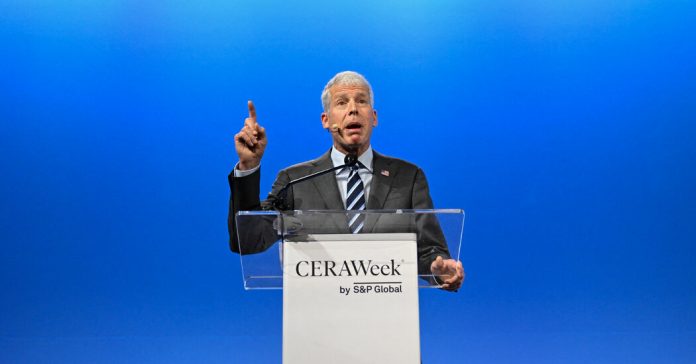
Before a packed crowd of oil and gas executives on Monday, Chris Wright, the new U.S. energy secretary, delivered a scathing critique of the Biden administration’s energy policies and efforts to fight climate change and promised a “180 degree pivot.”

Mr. Wright, a former fracking executive, has emerged as the most forceful promoter of President Trump’s plans to expand American oil and gas production and dismantle virtually every federal policy aimed at curbing global warming.

“I wanted to play a role in reversing what I believe has been a very poor direction in energy policy,” Mr. Wright said as he kicked off the CERAWeek by S&P Global conference in Houston, the nation’s biggest annual gathering of the energy industry. “The previous administration’s policy was focused myopically on climate change, with people as simply collateral damage.”

Mr. Wright’s speech was greeted with enthusiastic applause.

It was quite different from a year ago, when Jennifer Granholm, the energy secretary during the Biden administration, told the same gathering that the transition to lower-carbon forms of energy like wind, solar and batteries was unstoppable. “Even as we are the largest producer of oil and gas in the world,” Ms. Granholm said, “the expansion of America’s energy dominance to clean energy is striking.”

Mr. Wright, however, was dismissive of renewable power, which he said played only a small role in the world’s energy mix. Natural gas currently supplies 25 percent of raw energy globally, before it is converted into electricity or some other use. Wind and solar only supply about 3 percent, he said. He noted that gas also had a variety of other uses — it could be burned in furnaces to heat homes or used to make fertilizer or other chemicals — that were hard to replicate with other energy sources.

“Beyond the obvious scale and cost problems, there is simply no physical way wind, solar and batteries could replace the myriad uses of natural gas,” Mr. Wright said.

Mr. Wright has argued that there is a moral case for fossil fuels, saying they are crucial for alleviating global poverty and that moving too quickly to cut emissions risks driving up energy prices around the world. He has denounced efforts by countries to stop adding greenhouse gas to the atmosphere by 2050, calling that a “sinister goal.”

At a conference in Washington last week, Mr. Wright said that African countries needed more energy of all kinds to lift themselves out of poverty, including coal, the most polluting fossil fuel. “We’ve had years of Western countries shamelessly saying don’t develop coal, coal is bad,” he said. “That’s just nonsense.”

In Houston on Monday, other oil and gas executives echoed Mr. Wright’s remarks, pitching oil and gas as the best solution to energy poverty around the world.

“There are billions of people on this planet that still live sad, short, difficult lives because they live in energy poverty, and that’s a shame,” said Michael Wirth, chief executive of Chevron. “It should be unacceptable but affordability had left the conversation, at least in the West.”

In recent years, much of the world has been investing heavily in renewable energy. Last year, nations invested roughly $1.2 trillion in wind, solar, batteries and electric grids, slightly more than the $1.1 trillion they spent on oil, gas and coal infrastructure, according to the International Energy Agency.

But Mr. Wright warned against a shift to renewable energy that he said was likely to prove costly. “Everywhere wind and solar penetration have increased significantly, prices went up,” he said.

That is not always true. Texas has seen its electricity prices decline slightly over the past decade as wind and solar have grown rapidly and now supply more than one-quarter of the state’s power. The costs of wind turbines and solar panels have dropped precipitously in the last decade. But some places, like California and Germany, have seen electricity prices rise significantly at the same time they ramped up their use of renewable energy.

Some energy executives at the conference were more optimistic about renewable energy. John Ketchum, the chief executive of NextEra Energy, the largest producer of wind and solar power in the United States, said that renewables were essential for meeting growing demand for electricity in the United States over the next few years — especially since there was a large backlog for new turbines that burn natural gas.

Renewable energy “is cheaper and it’s available right now,” Mr. Ketchum said. “When you look at gas as a solution, as an example, to get your hands on a gas turbine and to actually get it built throughout the market, you’re really looking at 2030, or later.”

In his speech, Mr. Wright sharply criticized the Biden administration for slowing the growth of natural gas exports. Last year, the Energy Department paused approvals of new terminals that export liquefied natural gas, saying that it was concerned about the environmental and price impacts of shipping more gas overseas. Despite the pause, the United States was still the world’s largest exporter of natural gas in 2024.

On Monday, Mr. Wright signed the fourth export approval since Mr. Trump took office, extending an approval for the Delfin terminal off the coast of Louisiana. He said the Biden administration’s review of gas exports had found only modest impacts on global emissions and domestic U.S. prices.

On the topic of climate change, Mr. Wright said he didn’t deny that the planet was warming, calling himself a “climate realist.”

But he added that rising greenhouse gas emissions from burning fossil fuels — which have increased global average temperatures to their highest levels in at least 100,000 years — were a “side effect of building the modern world.”

“We have indeed raised global atmospheric CO2 concentration by 50 percent in the process of more than doubling human life expectancy, lifting millions of the world’s lifting almost all of the world’s citizens out of grinding poverty, launching modern medicine,” he said. “Everything in life involves trade-offs.”

Mr. Wright did not dwell on the downsides of climate change, which include the growing risks of heat waves, drought, floods and species extinction. He also did not address the costs of adapting to a hotter planet, which experts estimate could reach trillions of dollars for developing countries alone this decade.

Instead, Mr. Wright rebuked Britain for slashing its greenhouse gas emissions faster than any other wealthy country, saying that doing so had driven key industries overseas.

“I find it sad and a bit ironic that once mighty steel and petrochemical industries of the United Kingdom have been displaced to Asia where the same products will be produced with higher greenhouse gas emissions, then loaded on a diesel powered ship back to the United Kingdom,” Mr. Wright said. “The net result is higher prices and fewer jobs for U.K. citizens, higher global greenhouse gas emissions, and all of this is termed a climate policy.”

Mr. Wright said he was not against low-carbon energy and supports advanced forms of nuclear power and geothermal power, which multiple startups in the United States are pursuing.

But he said that the administration’s “all-of-the-above” approach to energy likely would not extend to wind farms, citing opposition in some communities. President Trump has railed against wind farms, saying falsely they cause cancer. The administration has stopped approvals for wind farms on public land and in federal waters and has threatened to block projects on private land.

“Wind has been singled out because it’s had a singularly poor record of driving up prices and getting increasing citizen outrage, whether you’re a farm or you’re in a coastal community,” Mr. Wright said. “So wind is a little bit of a different case.”

The Trump administration’s policies are not uniformly popular among oil and gas producers. Many companies have warned that Mr. Trump’s tariffs on steel and aluminum could raise prices for essential materials like pipes used to line new wells, while the constant threat of tariffs on Canadian oil could raise prices for refineries in the Midwest.

Mr. Wright mostly sidestepped questions on the tariffs, saying that “it’s very early on” and pointing out that inflation was low during Mr. Trump’s first term.

Ivan Penn contributed reporting

Stocks slump again on fears about tariffs — and a recession : NPR

0

A trader works on the floor of the New York Stock Exchange (NYSE) at the opening bell in New York City on March 10, 2025.

CHARLY TRIBALLEAU/AFP via Getty Images/AFP


hide caption

toggle caption

CHARLY TRIBALLEAU/AFP via Getty Images/AFP

U.S. stock markets fell again on Monday as investors grew increasingly fearful about tariffs — and a potential recession.

Wall Street was already coming off a volatile, negative week digesting the potential impact of new U.S. tariffs — and mounting whiplash from how President Trump has implemented, and then delayed, some of them.

By the end of last week, the major U.S. indices had each dropped by more than 2% for the week. The S&P 500 fell 3.1% — its largest decline since September.

Then, in a weekend interview with Fox News, Trump didn’t rule out the possibility of a recession.

“I hate to predict things like that,” Trump told Fox News. “There is a period of transition, because what we’re doing is very big. We’re bringing wealth back to America.”

In contrast, Trump’s Commerce Secretary, Howard Lutnick, told NBC’s Meet the Press that there was “no chance” of a recession.

But by midday Monday, U.S. investors appeared more worried than reassured.

The Dow was down about 500 points, or 1.2%, in midday Monday trading. The S&P 500 fell by another 2.2%, and the tech-heavy Nasdaq slumped more than 3.3%.

A Young Prince of Luxembourg Dies of a Rare Genetic Disease

0

A prince of Luxembourg has died at 22 of a genetic disease for which he spent his brief life raising awareness.

Prince Frederik, the second cousin of the heir to the Luxembourg throne, discovered at age 14 that he had a mutation in his POLG gene, which is involved in the replication and repair of DNA. He died on March 1 in Paris, his father, Prince Robert, said in a statement through the POLG Foundation.

Estimates vary, but roughly one in 10,000 people are thought to have POLG, or polymerase gamma, disease, according to the United Mitochondrial Disease Foundation. It is a mitochondrial disorder, a group of conditions that affect how mitochondria in cells produce energy. POLG disease affects multiple organs and can lead to seizures and poor coordination, among other symptoms.

“One might compare it to having a faulty battery that never fully recharges, is in a constant state of depletion and eventually loses power,” Prince Robert said.

POLG deficiency is a particularly brutal type of mitochondrial disease, according to Sir Doug Turnbull, an emeritus professor of neurology at Newcastle University and a member of the POLG Foundation’s scientific advisory board. “It is so relentlessly progressive,” he said, “attacking so many different systems with sadly the same conclusion.”

Prince Frederik was a founder and the creative director of the POLG Foundation. The organization used his DNA for research, initiated studies and made a short film about the disease. Frederick also designed a clothing line to raise money for research.

Frederik was born in Aix-en-Provence, France, and grew up in Switzerland. He was a fan of the American television show “The Office,” his father said, and had seen the full series 10 times.

In his last days, Frederik was in the hospital with pneumonia and another serious infection that left him unable to move, but he could still look out the window, Prince Robert said.

“Through the small, mesh-covered window, he saw the Eiffel Tower glistening with its hourly dance of lights,” his father said. Frederik asked his brother, Alexander, to take a photograph of the setting sun.

Frederik was a second cousin of Prince Guillaume, who will be taking over the throne of Luxembourg when his father, Grand Duke Henri, retires in October. Frederik and Guillaume share great-grandparents: Charlotte, Grand Duchess of Luxembourg, who reigned from 1919 to 1964, and her husband, Prince Félix.

“When you’re a kid, you have all these dreams, all these aspirations,” Frederik said in the film produced by his foundation. “I’m not sure I understood all the consequences of POLG when I first got diagnosed. It’s more subtle, where slowly the world is getting smaller and smaller.”

ICE arrests, seeks to deport Palestinian protester in New York : NPR

0

Palestinian supporters, including Mahmoud Khalil, second from left, demonstrate during a protest at Columbia University in October 2023 in New York.

Yuki Iwamura/AP


hide caption

toggle caption

Yuki Iwamura/AP

Mahmoud Khalil, a recent Palestinian graduate student at Columbia University and green-card holder, was arrested by Immigration and Customs Enforcement officers over the weekend in what is likely one of the first high-profile detentions of a student who participated in the protests against the Israel-Hamas war.

The arrest follows through on one of President Trump’s executive actions, which directed the government to use all of its tools to punish those who have engaged in “antisemitic harassment and violence.” The executive action cites the federal law that authorizes deporting a foreign national who “endorses or espouses terrorist activity.”

The move is an escalation in Trump’s effort to increase deportations from the U.S. and strip protections from those who violate the new administration’s priorities.

Michael Thaddeus, a mathematics professor at Columbia University, said the move seeking to strip Khalil’s green card and deport him violates the broader trust from foreign students who come to study in the U.S.

“They come because of their trust and belief that they could speak out freely while they’re here and not be imprisoned or harassed because [of] their political speech or activism or advocacy,” Thaddeus said.

Khalil was one of the Palestinian students who negotiated on behalf of the campus protesters who pressed Columbia to divest from Israel over its war with Hamas in Gaza.

Amy Greer, Khalil’s attorney, told NPR that ICE officers arrested Khalil in the lobby of his university-owned apartment.

First, they told Khalil his student visa had been canceled. But he’s not on a visa; he’s a legal permanent resident. His wife went to get his green card from their apartment, but officers said his lawful permanent residency had been revoked.

“I demanded to see a warrant or have a warrant shown to me or Mr. Khalil before they removed him, and the agent hung up the phone on me,” Greer said. “Mr. Khalil was under the impression that as a lawful permanent resident, that he had some modicum of protection that may not exist for people who do have student visas or who are undocumented.”

His wife, a U.S. citizen, later discovered he had been transferred to a detention facility in Louisiana, Greer said.

Government has burden to prove deportation

Green cards, also known as lawful permanent residency, allow people to live, work and travel as a U.S. citizen would. They can be revoked by an immigration judge for various reasons, including fraud in the application process or for criminal activity.

“If I have a permanent resident in removal proceedings, most of the time it’s because of a criminal activity,” said Kelli Stump, president of the American Immigration Lawyers Association, adding that once placed in immigration proceedings only an immigration judge can revoke the green card.

“The government bears the burden of proving the reason that this person is deportable from the United States. And then just depending on what ground we’re looking at, that’s where the fight ensues.”

DHS spokeswoman Tricia McLaughlin said Khalil had been arrested in support of Trump’s executive order on antisemitism, and that Khalil had “led activities aligned to Hamas, a designated terrorist organization.”

Separately, in a post on X, Secretary of State Marco Rubio linked to a story about Khalil’s arrest and wrote the administration would be revoking the visas or green cards of Hamas supporters so that they can be deported.

“We will vigorously be pursuing Mahmoud’s rights in court, and will continue our efforts to right this terrible and inexcusable – and calculated – wrong committed against him,” Greer said in a later statement.

Several groups planned rallies and gatherings around Manhattan on Monday in protest of Khalil’s arrest. Thaddeus, the professor, said the campus community was surprised ICE’s first target was someone with a green card, rather than someone without legal status, calling it “horrifying and a little bit unexpected.”

“It means that the strategy of the immigration police has gone in an unexpected direction,” he said.

Columbia University did not respond to an immediate request for comment.

Trump builds on first term efforts to strip status

During Trump’s first term, he took steps towards limiting visas for foreign nationals and revoking people’s immigration status, including denaturalization, or cancelling someone’s status as a naturalized U.S. citizen.

Towards the end of his last term, Trump’s Justice Department created a section within the immigration office to focus on denaturalization. The New York Times reported at the time that about 40% of the 228 denaturalization cases the DOJ had ever filed were brought during Trump’s four years in office.

USCIS also launched a task force to review whether people may have lied during their immigration application proceedings in order to get citizenship.

But immigration law experts have said that the number of people who might lie on forms is very small compared to the millions of people who are naturalized or receive green cards each year.

Skirmish in Syrian Capital Raises Fears of Expanding Violence

0

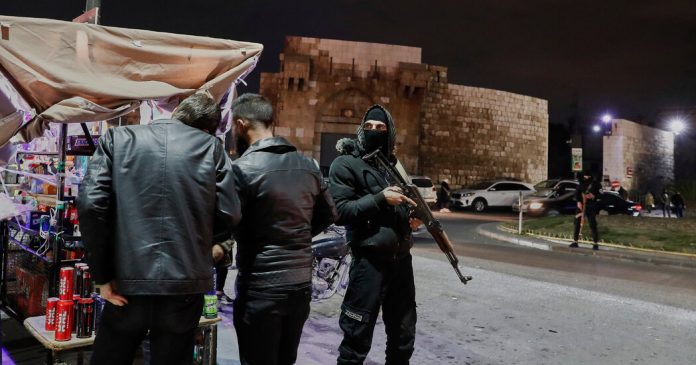
Gunmen attacked a position held by Syrian security forces in Damascus overnight, a war monitor said Monday, raising fears that the deadly violence sweeping Syria’s coastal region could spread to other parts of the country.

The Britain-based Syrian Observatory for Human Rights, which has monitored the Syrian conflict since 2011, said that unidentified gunmen threw grenades and opened fire overnight on a building housing government security forces in the highly fortified Mezzeh district of the capital, Damascus. Clashes with government security forces ensued, and it was unclear if anyone was injured, the observatory said. It added that an unspecified number of arrests had been made.

There was no immediate comment from Syria’s new government or on state news media, and the information could not be independently verified.

The attack came as the country was reeling from a spate of violence that erupted last week between fighters affiliated with Syria’s new government, headed by Ahmed al-Shara, and those loyal to the ousted dictator Bashar al-Assad.

More than 1,300 people have been killed since the fighting began, largely in the coastal Latakia and Tartus Provinces, the heartland of Syria’s Alawite minority, according to the observatory. It said on Monday that about 1000 civilians were included in that figure, most of whom were killed by armed forces affiliated with or loyal to the new government. The information could not be independently verified.

The violence has stoked fears of a renewed sectarian conflict and presented what appeared to be the most serious challenge yet to Syria’s new leaders as they attempt to unite the country after more than a decade of war. The Assad family is Alawite and the sect dominated the country’s upper class and highest ranks of the former regime’s military.

While state news media quoted a spokesman for the defense ministry, Col. Hassan Abdul Ghani, as saying on Monday that the “military operation” was over, the violence reportedly continued, as fighters affiliated with the government stormed a town near the coastal port city of Baniyas and set fire to homes, according to the observatory. .

Syria’s interim president, Mr. al-Shara, said on Sunday that the government was forming a fact-finding committee to investigate the violence in the coastal regions and to bring the perpetrators to justice. But it wasn’t clear if he was acknowledging possible killings at the hands of his forces or laying the blame on former regime elements.

In an apparent bid to reassure the nation, he appealed for calm on Sunday and repeated calls for Assad loyalists to lay down their arms.

“We must preserve national unity and civil peace,” Mr. al-Shara said at a mosque in Damascus, according to video that circulated online.

Renewed effort to put Harriet Tubman on $20 bill unveiled : NPR

0

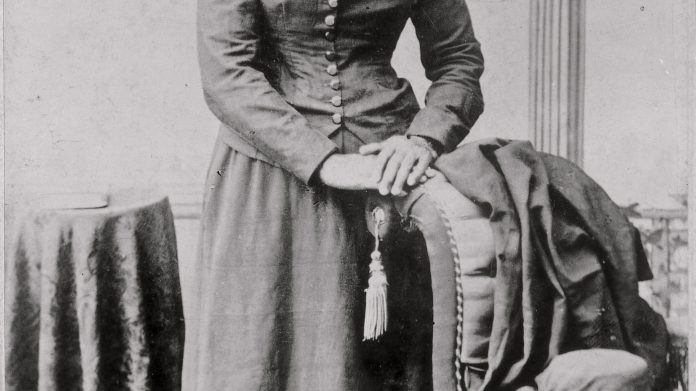
Harriet Tubman, in a photograph dating from 1860-1875.

Harvey B. Lindsley/Library of Congress via AP


hide caption

toggle caption

Harvey B. Lindsley/Library of Congress via AP

A measure to replace President Andrew Jackson with abolitionist Harriet Tubman on the $20 bill is being taken up again in Congress.

Monday’s announcement is the latest push to honor Tubman on the currency and remove Jackson, the country’s seventh president and a slaveholder. It follows a decade-long effort of previous attempts, including through legislation that has stalled in Congress. The announcement also coincides with Harriet Tubman Day, a holiday honoring the activist who led enslaved people to freedom on the Underground Railroad.

The new bill, called the “Harriet Tubman Tribute Act of 2025,” calls for the Treasury secretary to include the abolitionist’s face on all $20 bills printed after Dec. 31, 2030, according to a draft of the bill obtained by NPR.

The proposed legislation also stipulates that the production of these bills cannot be delayed more than two years unless it is determined that issuing the bills after the designated date “would create an unacceptable risk of counterfeiting or to the safe, secure, and speedy functioning of the United States economy.”

New Hampshire Sen. Jeanne Shaheen, a Democrat who will introduce the bill, says images on U.S. paper currency reflect America’s values and history and tell the country’s story.

“An abolitionist and true patriot who sacrificed so much for the betterment of our nation, Harriet Tubman is nothing short of an American icon,” Shaheen tells NPR. “Women and girls, especially communities of color, deserve to see themselves represented and celebrated in meaningful ways — and they deserve to know that their contributions are honored and recognized.”

Ernestine “Tina” Martin Wyatt, Tubman’s great-great-great-grandniece, tells NPR that honoring her aunt on the $20 bill would mean “freedom.”

“That’s what was on her mind all the time. Freedom, inclusiveness, justice and equality. That’s what democracy is,” Wyatt says. “How are we going to make a better country without including people, without justice, without equality, without freedom, most of all and freedom?”

Following her North Star to freedom

Ernestine "Tina" Martin Wyatt, Harriet Tubman's great-great-great grandniece, attends the Washington, D.C., premiere of the biopic "Harriet " at the Smithsonian National Museum Of African American History on Oct. 22, 2019.

Ernestine “Tina” Martin Wyatt, Harriet Tubman’s great-great-great grandniece, attends the Washington, D.C., premiere of the biopic Harriet at the Smithsonian National Museum Of African American History on Oct. 22, 2019.

Shannon Finney/Getty Images


hide caption

toggle caption

Shannon Finney/Getty Images

Born into slavery in Dorchester County, Maryland, around 1822 as Araminta “Minty” Ross, Tubman — she married John Tubman, a free Black man, in 1844 — escaped to Philadelphia on Sep. 17, 1849.

But her journey to freedom did not stop there. She risked her life to free her family and other enslaved persons repeatedly as a conductor of the Underground Railroad, traveling by night using the North Star as a guide to the South and back to the North.

She was also a nurse and Union spy during the Civil War — becoming the first woman to lead a major military operation when she guided 150 Black Union soldiers in the Combahee Ferry Raid. During the operation in June 1863, more than 700 enslaved persons were rescued.

Known as “Moses,” Tubman helped 70 enslaved persons escape to freedom during her time as a conductor on the Underground Railroad. During a women’s suffrage convention in 1896, she spoke of her time as conductor, famously saying, “I never ran my train off the track and I never lost a passenger.”

‘Honor what was started’

While Wyatt appreciates the renewed effort, she says she is not confident it will occur under the Trump administration, given its rollback of diversity, equity and inclusion efforts. And not only has the endeavor been held up in Congress, it has also faced delays with the White House and Treasury Department.

In April 2016, Treasury Secretary Jacob Lew announced that Tubman’s portrait would be on a redesigned $20 note, to be unveiled in 2020. The image of Jackson was slated to be moved to the bill’s reverse side — an action that Wyatt says the family objected to because her aunt and the seventh president of the U.S. are “antithesis of each other.”

A woman holds a sign supporting Harriet Tubman for the $20 bill during a town hall meeting at the Women's Rights National Historical Park in Seneca Falls, N.Y., on Aug. 31, 2015.

A woman holds a sign supporting Harriet Tubman for the $20 bill during a town hall meeting at the Women’s Rights National Historical Park in Seneca Falls, N.Y., on Aug. 31, 2015.

Carolyn Thompson/AP


hide caption

toggle caption

Carolyn Thompson/AP

“He held slaves. She freed slaves. They’re just so opposing,” she says.

During the first Trump administration, then-Treasury Secretary Steven Mnuchin said in 2019 that a new design for the $20 bill would not occur until 2028; he reiterated that to reporters the following year.

In January 2021 during the Biden administration, then-White House Press Secretary Jen Psaki said during a news briefing that the Treasury Department was “taking steps to resume efforts” to place Tubman on the bills.

President Trump, who praised Tubman as one of several American heroes who “represent what is best in America and her citizens” in January, said in 2016 that the change in currency was “pure political correctness.” He also said he would rather leave Jackson on the $20 bill and that it would be “more appropriate” for Tubman to be placed on another form of currency such as the $2 bill.

NPR reached out to the White House, the Bureau of Engraving and Printing, and the Treasury Department for comment on Monday but have not received a response.

The new redesign of the $20 is scheduled for issuance in 2030 on a timeline with other bills to address “risk mitigation and counterfeiting concerns,” according to the Bureau of Engraving and Printing.

Shaheen says she will pursue “all avenues” to ensure Tubman will be recognized on the currency.

“I’ve advocated for making this move under four different administrations now,” she says. “While some officials have been supportive, it hasn’t yet been done — which illustrates why it’s so important that Congress step up, especially now as this administration attacks efforts to embrace our nation’s diverse culture and history.”

But Wyatt, Tubman’s relative, says that no matter what political party is in control, she doesn’t want the issue to be delayed any further and has a message for Congress and the White House: “Honor what was started and give her the recognition that she needs to have.”

“You don’t have to like us. You don’t have to even want to support us or anything like that. But just do the right thing,” she said. “You go to other countries … and you’ll see other women, White and Black, that are on money already. … Not coins, but paper currency.”

NPR’s Laurel Wamsley contributed to this report.

Trump Looms Over Greenland’s Election, but Voters Have Other Concerns

0

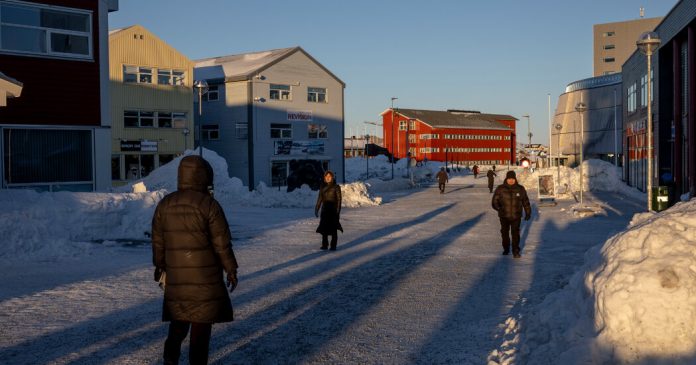
The air inside the community hall in Greenland’s capital was thick with warmth, a welcome contrast to the icy streets outside. As voters brushed snow from their coats, candidates from most of Greenland’s major parties sat down in the front of the room, ready for questions.

Every seat was filled, two dozen international journalists lined the walls and a man in a black and gray sweater stepped forward to the mic.

“Why is running a small business still so difficult?” he asked, his voice steady but impatient.

Cameras clicked and so did the strap-on spikes that several journalists wore on their boots to keep from slipping on the ice.

“You need to take those off,” the moderator said. “They’re ruining the floor.”

With some grumbles, the spikes came off.

On Tuesday, Greenlanders will cast their votes in what has to be the most closely watched election this island has ever held, as President Trump asserts again and again that he wants the United States to take over Greenland. He has refused to rule out force, and in his recent speech to Congress, he made a direct plea to the Greenlanders themselves, promising, “We will make you rich.” All the attention he has paid has drawn a wave of journalists, diplomats, social media influencers and investors to the Arctic.

Greenland’s leading political parties are presenting different visions for the future and some are pushing for a new relationship with the United States and quick independence from Denmark, which colonized Greenland hundreds of years ago and still controls some of its affairs.

But for many of Greenland’s 56,000 residents — a tiny population on the world’s biggest island — geopolitics is not a priority. At the recent town hall debate and in interviews with voters, Greenlanders expressed much more prosaic worries, often about living costs, unemployment, schools and health care.

“The election is shaped by what I would call a ‘cross-pressure’ — two competing narratives pulling in different directions,” said Rasmus Leander Nielsen, a political scientist at Ilisimatusarfik University in the capital, Nuuk. “The geopolitical debates might dominate headlines, but for the average voter, daily life matters more.”

President Trump floated the idea of the United States buying Greenland from Denmark during his first term. After Denmark said no, the idea seemed to die.

But this time around, Mr. Trump seems determined to “get” Greenland, as he puts it. His refusal to rule out force has sent jitters across Europe, where relations with his administration are already hitting new lows over a number of issues, including tariffs and Mr. Trump’s stunning pivot toward Russia.

European diplomats and American investors have been streaming into snowbound Nuuk, drawn by the island’s resources and its strategic location. Greenland’s position along Arctic sea lanes, which are opening up as the planet warms, have attracted the attention of the United States, Russia, China and European powers. The island also possesses vast mineral deposits, though many are hard to access.

In contrast to those sweeping ambitions, people on the island say they’re worried about higher housing costs and economic uncertainty.

“This election is a test of where Greenlanders see their future — both in their everyday lives and on the global stage,” Mr. Leander Nielsen said. “The question is whether voters will prioritize immediate economic concerns or the bigger geopolitical picture. It’s a tough call.”

At the heart of the election is the question of control.

For more than 200 years, Greenland was ruled as a distant colony of Denmark, its Inuit population largely sidelined as Danish officials controlled its land and resources. Over time, pressure for self-rule grew, leading to greater autonomy and eventually a government of its own. Today, Greenland controls most domestic affairs, while Denmark still oversees defense, foreign policy and monetary matters.

But full independence remains a challenge. Denmark’s financial support covers more than half of Greenland’s budget, making economic stability a key hurdle to sovereignty.

The coming election will decide the makeup of the Inatsisartut, the island’s 31-seat parliament. Nearly all major parties agree that Greenland should become independent — it’s just a question of when and how. They also differ on what the island’s ultimate relationship should be with the United States and Denmark.

No major politicians have expressed a desire to become an American state, and polls show that 85 percent of Greenlanders don’t want that. But some candidates, like Kuno Fencker, a member of the Naleraq party, believe that Greenland should establish close ties with the United States.

He says Washington could best protect Greenland and such an alliance would deliver more investment and development. Mr. Fencker is part of a small pro-Trump camp in Greenland and went to Washington for Mr. Trump’s inauguration. He says the first step is breaking off from Denmark.

“It’s about us gaining full authority over our land,” he said. “From there, we will cooperate with international organizations and other countries.”

The United States has maintained a military presence on Greenland since World War II, with a small missile defense base at the top of the island.

“The U.S. is here to stay,” Mr. Fencker said. “They will always be part of the negotiating equation.”

Other parties, including the Demokraatit, are more cautious about sovereignty and relations with Washington.

“We must be smart and not push for independence at the expense of our people,” said Bo Martinsen, a Demokraatit candidate. “Right now, immediate independence is not feasible.”

Mr. Trump’s attention has intensified the conversation about independence and what Greenland should do if it breaks off from Denmark.

“The most important thing for me in this election is that there’s so much talk about independence, but I really want to know: How?” said Runa Sværd, a municipal planning chief in Nuuk. “I need a road map.”

On an island where harsh weather can shut down entire towns and 80 percent of the land mass is covered by a glacier ice cap, ensuring a smooth election isn’t so simple.

Ballots are flown by helicopter, ferried by boats through Arctic waters and sped to remote settlements by snowmobile. Once cast, each vote is counted by hand, with results relayed by email or, in the most isolated regions, by satellite phone. The results are expected to be announced late Tuesday, weather permitting.

“If a storm comes in and delays transport, we have to improvise,” said Klaus Georg Hansen, a former election official.

But storms aren’t the only threat. Danish intelligence officials have warned of foreign interference, with fake social media profiles posing as Greenlandic politicians and statements twisted to sow division.

With each passing day, the election buzz grows louder in Nuuk. As travelers drive away from the new international airport, two massive banners, one for Naleraq and another for Inuit Ataqatigiit, the governing party, hang on opposite sides of a rock-cut mountainside.

Further along, campaign posters sway from lampposts. On Thursday, as John Nathansen, a 66-year-old pensioner, made his way to a supermarket, the election was on his mind.

“The conditions we live under don’t get enough attention. Instead, it’s all about that orange guy — Trump,” he said. “In my view, independence should be at the back of the line.”