Thursday, November 12, 2026
Home Blog Page 142

Monday Briefing: Violence Continues in Syria

0

Syria’s interim president, Ahmed al-Shara, appealed yesterday for calm and unity after violence erupted last week between fighters affiliated with his government and those loyal to the ousted dictator Bashar al-Assad.

More than 1,000 people have been killed, including about 700 civilians, mostly by government forces, according to the Syrian Observatory for Human Rights. The information could not be independently verified.

“We call on Syrians to be reassured because the country has the fundamentals for survival,” al-Shara said. His remarks came as new fighting was reported in the Latakia and Tartus Provinces. Later in the day, he said a fact-finding committee had been formed to investigate the violence and bring those responsible to justice. It was unclear whether al-Shara was acknowledging possible killings at the hands of his forces or laying the blame entirely on al-Assad loyalists.

Context: The fighting broke out on Thursday when armed men loyal to al-Assad ambushed government security forces in Latakia Province, setting off days of clashes. The violence has been the worst since the Assad government was ousted in early December.

Reaction: Thousands protested in the streets in the first wide-scale demonstrations against the new government. Residents were ordered to stay indoors as security forces scrambled to contain the turmoil. Here’s what else we know.

Elsewhere in the region: Israel’s energy minister said that he was immediately cutting off electricity to the Gaza Strip.


Canadian elections were taking place yesterday, with two centrist policymakers vying to succeed Prime Minister Justin Trudeau as leader of both the Liberal Party and the country. The winner will have to call a general election, which must be held by October, but could take place sooner. Results were expected around 6:30 p.m. Eastern time.

The race is effectively between Mark Carney, the former governor of the Bank of Canada and the Bank of England, and Chrystia Freeland, the former finance minister. Surveys have shown Carney as the front-runner.

Our Canada bureau chief, Matina Stevis-Gridneff, told me that the U.S. is front-and-center at the ballot box.

“Voters are looking for someone to handle negotiations with President Trump, whom they view as the biggest threat to Canada’s economy and sovereignty,” Matina said. She added that polling suggested voters prefer Carney and Freeland to negotiate with Trump over the Conservative leader, Pierre Poilievre.

“Trump’s persistent threats to Canada have worked against Poilievre who, despite being a mainstream Conservative politician, is seen as too ideologically close to Trump for comfort,” Matina said.

Get to know the candidates: Carney has pitched himself as the fix-it man who can set Canada back on track. Freeland’s chances could hinge on whether voters consider Trump’s dislike of her an asset.

China announced this weekend tariffs of up to 100 percent on canola, pork and other foods from Canada. The move was retaliation for Canada’s decision last August to collect steep taxes on imports of Chinese electric vehicles, steel and aluminum.

The tariffs, which take effect on March 20, were also a clear warning to Canada — and, indirectly, Mexico — not to cooperate with the U.S. on trade.


The price of a beef Bourguignon, the signature dish at Le Bouillon Chartier in Paris, has remained low at this working-class eatery — someone on a living wage can enjoy the meal for less than what they earn in an hour.

As inflation has hammered Europe, the restaurant’s owner has cut into margins to keep the menu affordable, but making beef Bourguignon now costs nearly double what it used to. Businesses across the continent are feeling a similar squeeze.

Lives lived: Uri Shulevitz, a children’s book author who turned childhood memories of fleeing the Nazis in Poland into magical stories, died at 89.

Literature events in India are blooming, driven by young people who are reading books in the country’s dozens of native tongues. The gatherings give attendees the chance to explore new topics, meet favorite authors or simply check out the scene.

Readers and writers gather in rural towns or inside storied palaces for an intimate affair or, in the case of an event in Jaipur, they mingle among tens of thousands of people. A sense of intellectual “cred” has helped the festivals give Bollywood and cricket a run for their money.

For these readers, books open worlds that India’s higher education system, with its focus on make-or-break examinations, often does not. Read about the festivals here.
Trump rebuffed by Iran’s leader after sending letter calling for nuclear negotiation : NPR

0

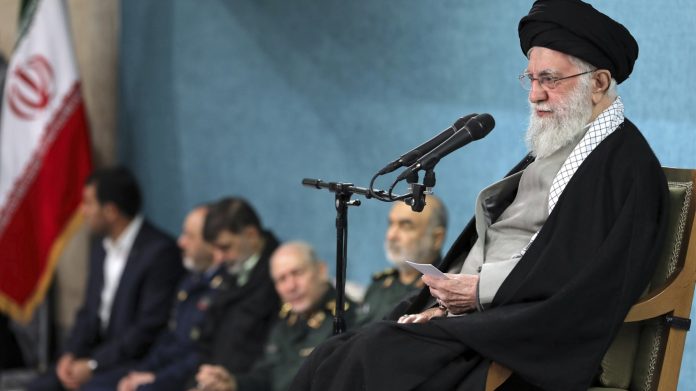
In this photo released by an official website of the office of the Iranian supreme leader, Supreme Leader Ayatollah Ali Khamenei speaks in a ceremony meeting a group of officials, in Tehran, Iran, Saturday, March 8, 2025. (Office of the Iranian Supreme Leader via AP)

AP/Office of the Iranian Supreme Leader


hide caption

toggle caption

AP/Office of the Iranian Supreme Leader

President Trump said he sent a letter to Iran’s Supreme Leader Ayatollah Ali Khamenei last week asking that the two leaders “negotiate” over the Islamic republic’s nuclear program. On Saturday, the Iranian leader condemned the effort by unnamed “bullying governments” to make a deal over the program.

Trump said the alternative to talks is force during an interview with Fox News’ Sunday Morning Futures.

“There are two ways Iran can be handled, militarily or you make a deal,” Trump said. “I would prefer to make a deal, because I’m not looking to hurt Iran. They’re great people. I know so many Iranians from this country.”

The president went on to criticize Iran’s leadership, but said he’s written Iran’s supreme leader personally asking to talk. Khamenei rebuffed the outreach Saturday during a meeting with government and military officials.

“The insistence of some bullying governments to negotiate is not to solve problems, but to impose their own expectations,” Khamenei said, according to state media. “The Islamic Republic of Iran will definitely not accept their expectations.”

Iran’s nuclear program has been the subject of Western scrutiny for nearly two decades. Iran maintains that its nuclear program is for energy use only, but the U.S. and its allies say Iran’s program is a front for a nuclear weapons bomb.

On Sunday, Iran seemed to open the door to limited negotiations. Its UN mission posted on X that Iran would discuss the “militarization” of its nuclear program, but the “dismantlement” of its program is a non-starter.

“Should the aim be the dismantlement of Iran’s peaceful nuclear program to claim that what Obama failed to achieve has now been accomplished, such negotiations will never take place,” Iran’s UN Mission said.

While Iran says its program is for peaceful purposes, its officials have recently threatened to create a bomb in the wake of the Israel-Hamas war, according to a recent House resolution by Rep. Jared Moskowitz, D-Fla. And weapons-grade uranium production has increased, according to the Associated Press.

Sen. Lindsey Graham, R-S.C., told Fox News the deal he wants to reach with Iran.

“Here’s what a good deal looks like to me,” Graham, an influential foreign policy voice in the Senate, said. “No more enrichment for Iran. Take all the highly enriched uranium out of Iran — I’m willing to buy it from them and allow them to have nuclear power where fuel rods are provided by Russia or China or some international group.”

In short, Graham said he wants to eliminate Iran’s “nuclear capability to make a bomb.”

Trump summarized his message to Iran’s leader.

“I said, ‘I hope you’re going to negotiate, because it’s going to be a lot better for Iran,'” Trump recounted to Fox News’ Maria Bartiromo. “And I think they want to get that letter. The other alternative is, we have to do something, because you can’t let them have a nuclear weapon.”

Trump dismisses concerns over back-and-forth levies, says ‘tariffs could go up’ : NPR

0

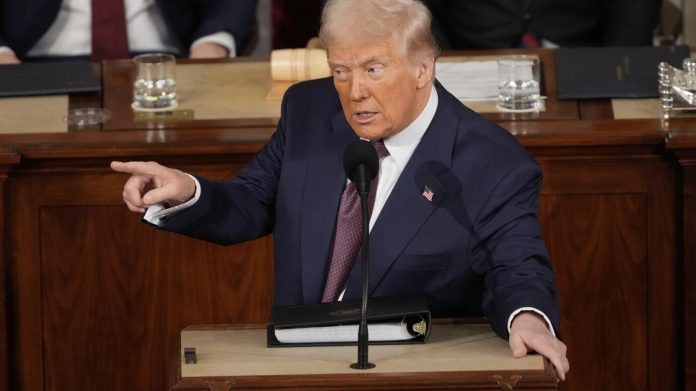
President Donald Trump addresses a joint session of Congress at the Capitol in Washington, Tuesday, March 4, 2025. (AP Photo/Ben Curtis)

Ben Curtis/AP/AP


hide caption

toggle caption

Ben Curtis/AP/AP

President Trump defended his administration’s economic policy after he imposed tariffs on Mexico and Canada last week and then rolled some of those levies back, causing what critics say is uncertainty for businesses and the broader economy.

During an interview with Fox News Channel’s Sunday Morning Futures, Trump dismissed concerns over his back-and-forth tariffs and said they “could go up.”

Fox News’ Maria Bartiromo asked Trump whether he expects a recession during his first year in office. The president couldn’t say.

“I hate to predict things like that,” Trump said. “There is a period of transition, because what we’re doing is very big. We’re bringing wealth back to America. That’s a big thing. And there are always periods of it takes a little time.”

There are some signs that the economy may be headed toward a recession, but Howard Lutnick, the Commerce secretary, told NBC’s Meet the Press there was “no chance” of one.

Last week, the Trump administration said it would place a 25% tariff on cars and auto parts from Mexico and Canada. Soon after, the White House announced a one-month delay on the measure after carmakers Ford, Stellantis and General Motors called the president. During his interview with Bartiromo, Trump explained the move.

“This is short term and I felt for the good of the American carmakers,” Trump said. “I thought it would be a fair thing to do. And so I gave them a little bit of a break for this short period of time.”

Criticism from automakers notwithstanding, Sean Fain, the head of the United Auto Workers, called the tariffs an “attempt to stop the bleeding” in the American economy.

Tariffs “aren’t the end solution,” he told ABC’s This Week, “but they are a huge factor in fixing this problem.”

Meanwhile, the stock market had it’s worst week in 6 months with the S&P 500 dropping 3.1% and Nasdaq down 3.45%. Fox News’ Bartiromo asked the president whether the uncertainty over tariffs — which many economist say is causing stocks to slump — will continue or if there will be clarity for businesses.

“Well I think so,” Trump said. “But you know the tariffs could go up as time goes by and they may go up.”

Trump also said he still plans to put in place next month “reciprocal” tariffs against all trading partners that have tariffs on U.S. goods.

“April 2nd, it becomes all reciprocal,” he said. “What they charge us, we charge them.”

Echoing a Roman Emperor, Croatia Tries to Cap Soaring Prices

0

In 301 AD, the Emperor Diocletian made a bold but ultimately unsuccessful bid to address the inflation that was rampaging across the eastern half of the divided Roman Empire.

Prices of everything from purple thread and feathers to slaves and cattle were dictated by his Edict on Maximum Prices. Violators faced the death penalty. Diocletian gave up power about four years after issuing his edict, watching his measure fail from his sprawling retirement palace in the heart of what became the city of Split in Croatia.

Now Croatia’s government is trying a similar tactic to rein in prices that have soared in recent years and sparked protests and retail boycotts by the country’s beleaguered consumers.

On Feb. 7, the government introduced price controls for retailers, targeting supermarket items such as bread, pork and shampoo. The penalties are less drastic than those decreed by Diocletian, mandating a fine of up to 30,000 euros, or $31,400, for retailers breaking the rules.

It is unclear whether the new edict will be any more successful than Diocletian’s, which economists say ended up being counterproductive by causing shortages, fueling a black market and enabling profiteers.

For the moment, consumers are still figuring out how to navigate the new system, which caps the price of 70 common grocery store products.

In Split, whose tight limestone streets and alleyways attract tourists from around the world, Anita Kargotic, 62, went shopping recently at a Spar supermarket, where two signs were posted outside listing the maximum prices allowed for a range of goods.

She tied her dog, an American Akita named Maja, to a post outside, and later emerged from the supermarket, with a haul of Kaiser rolls, popcorn kernels, soy flakes and crackers. Most were store-brand generics, already less expensive than more recognizable labels.

Ms. Kargotic said her money did not go as far as it once did, and caring for herself and Maja has become a vexing exercise in prioritization.

Flea collars and dry dog food? Those are necessities. Grapes? No, too expensive.

Staples like rice and pasta? Pass. “Those prices have become completely unreasonable,” she said, adding that she doesn’t think the new price controls will make much difference to her since she mainly buys whatever is cheapest.

“I’m always looking at lower prices, paying attention to sales,” she said.

Croatia, which joined the European Union in 2013, should be basking in a successful post-pandemic recovery. The economy has been growing at an average of 6.6 percent over the past four years, tourism has been booming and wages have been steadily rising. But that has also helped drive a surge in prices, with inflation hitting 5 percent in January after remaining stubbornly above 3 percent throughout 2024.

The rules that came into effect this month are the Croatian government’s third attempt at controlling prices by fiat since Sept. 2022. The first two efforts were largely ineffective, with retailers simply refusing to stock most price-controlled goods.

The government says it is serious this time, with the law requiring that price-controlled products be available and it has promised regular inspections and fines for violators.

Under the new rules brought in by Prime Minister Andrej Plenkovic, shop entrances must display a list of all 70 items that fall under the government’s pricing regime.

Centuries ago, Diocletian’s edict accused some citizens of price gouging, and said their greed needed to be reined in.

In January, Mr. Plenkovic struck a similar tone when introducing his government’s measures.

“We support companies that work well and make a profit, but within realistic frames. That can’t be at the expense of the little guy,” he said at a stormy meeting with retailers in January.

Rudolf Nardelli, 80, another recent shopper at the Spar in Split, said he moved to Haarlem, in the Netherlands, five decades ago and recalls often leaving Split with his car’s trunk full of provisions.

“Now the prices in Holland are lower,” said Mr. Nardelli, who still divides his time between Haarlem and Split, as he strapped groceries to his bike. “Retailers here are inflating prices for no reason.”

Economists blame the increases on a three-headed hydra of pandemic-era economic rescue packages that flooded the country with cash, increases in public sector wages and retailers rounding up prices after Croatia adopted the euro in 2023.

Those with tighter budgets are facing unexpected sacrifices.

Leonardo Inacio, 28, was shopping at the Spar for protein, mostly chicken, to aid in his physical recovery from the demands of his job as a ballet dancer.

He said a monthly grocery budget of €350 used to be enough when he moved to Split from Brazil two years ago. That figure has jumped to €450, he said.

“I’m passing up on supplements,” Mr. Inacio said of the sacrifices he was making to make ends meet. “I’d much rather spend that money on something that helps me professionally, but I can’t.”

He said he had participated in the boycotts against retailers, but knew nothing about the government’s price regulations. He glanced curiously at the list of discounted items outside the supermarket.

“This could actually be useful,” he said, snapping a photo of the list with his phone.

But many people say price controls are not the answer.

John H. Cochrane, an economist and fellow at the Hoover Institute, a research center, pointed to the role Diocletian’s edict played in causing shortages and fueling a black market.

“It’s like trying to stem the symptoms rather than treating the underlying disease,” Mr. Cochrane said of price controls. “It offers people the appearance of help for a while, and then it takes a few weeks or, a month or two, for all the problems to break out.”

Politics chat: House Republicans aim to pass another stopgap measure to avoid shutdown

0

House Republicans release another stopgap measure to keep the federal government funded just as the last extension is set to expire. It’s unclear if the thin GOP majority can get it passed.

Syria’s Interim President Calls for Unity Amid Fresh Fighting

0

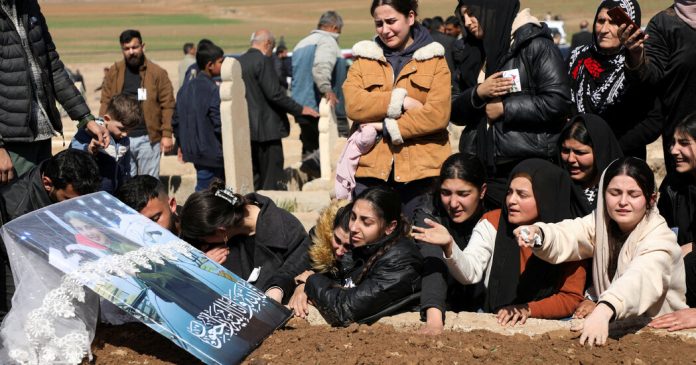
Syria’s interim president, Ahmed al-Shara, appealed on Sunday for calm and for unity as he moved to reassure the nation after days of clashes that a monitoring group said had killed hundreds of people.

“We must preserve national unity and civil peace,” he said from a mosque in Damascus, according to video that circulated online. “We call on Syrians to be reassured because the country has the fundamentals for survival.”

The violence erupted last week between fighters affiliated with Syria’s new government, headed by Mr. al-Shara, and those loyal to the ousted dictator Bashar al-Assad. Scores of civilians have been killed, according to two war monitoring groups, along with combatants on both sides of the conflict.

Mr. al-Shara’s remarks on Sunday came as fresh fighting was reported in the countryside of the coastal Latakia and Tartus provinces. A spokesman for the Defense Ministry, Col. Hassan Abdul Ghani, told state media that government forces were combing the countryside for armed fighters loyal to the deposed Assad regime.

The Britain-based Syrian Observatory for Human Rights, which has monitored the Syrian conflict since 2011, said that government forces were attacking with drones, tanks and artillery on Sunday. In other areas, it said, government forces were searching for armed groups affiliated with the deposed regime’s military.

The clashes have centered in the coastal provinces, where much of the country’s Alawite religious minority — which dominated the ruling class and upper ranks of the military under the Assad government, and included the Assad family itself — live. That has raised fears of a renewed sectarian conflict in the country.

More than 1,000 people have been killed in Tartus and Latakia provinces since the fighting erupted last week, the observatory said early on Sunday. About 700 civilians were included in that figure, most killed by government forces, it said. The information could not be independently verified.

Another monitoring group, the Syrian Network for Human Rights, reported earlier that government security forces had killed some 125 civilians. The group had not yet updated its casualty figures on Sunday. It said that men of all ages were among the casualties and that the forces did not distinguish between civilians and combatants.

The violence has been the worst since the Assad government was ousted in early December by rebels who became the country’s new leaders. It presents a major test of the new government’s authority and ability to unify the country, which has deep sectarian divisions after more than 13 years of civil war.

U.S. Secret Service says it shot a man near the White House after a confrontation : NPR

0

The White House in Washington, Nov. 18, 2008.

Ron Edmonds/AP


hide caption

toggle caption

Ron Edmonds/AP

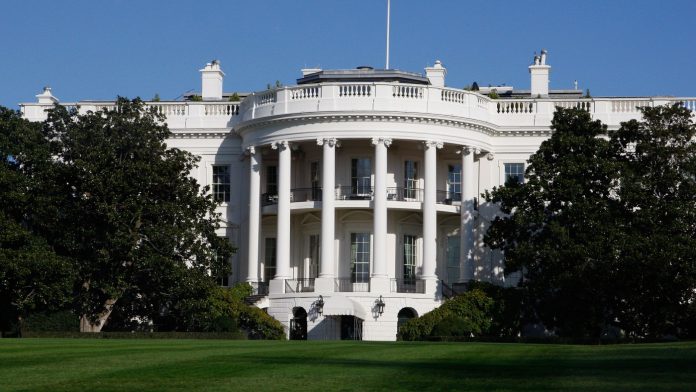
A man who was brandishing a firearm in Washington, D.C., was shot by Secret Service officers near the White House on Sunday morning, the Secret Service said.

The man, who is thought to have been traveling from Indiana, had been flagged to the Secret Service by local police as a potential suicide risk, according to the agency. Officials came across the man’s car, and found him nearby with a firearm, when an armed confrontation ensued, the Secret Service said.

The man was transported to a nearby hospital, and his condition is so far unknown. No Secret Service personnel are thought to have been harmed.

President Donald Trump was at his home in Mar-a-Lago, Florida, at the time of the shooting, which occurred just one block away from the White House.

The full statement by the Secret Service is below:

“On Sunday March 9th, an adult male was shot by U.S. Secret Service personnel following an armed confrontation with law enforcement in Washington DC.

Earlier on Saturday, local police shared information about a suicidal individual who may be traveling to Washington DC from Indiana. Around midnight, members of the Secret Service encountered the individual’s parked vehicle near 17th and F Streets, NW. They also saw an individual on foot matching the description nearby.

As officers approached, the individual brandished a firearm and an armed confrontation ensued, during which shots were fired by our personnel.

The suspect was transported to an area hospital and his condition is unknown. There were no reported injuries to Secret Service personnel.

The incident is under investigation by the Metropolitan Police Department Internal Affairs Division’s Force Investigations Team, which investigates all law enforcement officer involved shootings in the District of Columbia.”

Hamburg Airport Halts All Flights as Ground Staff Strike

0

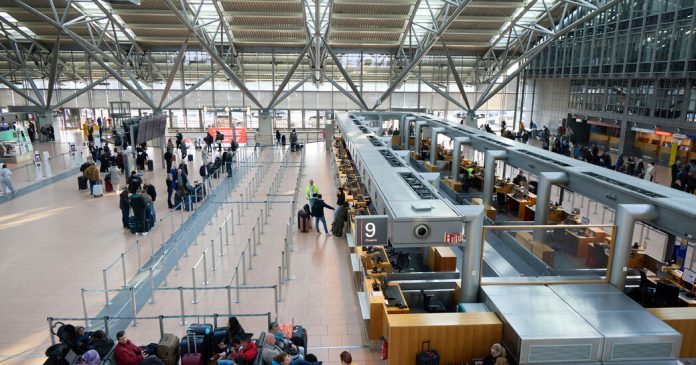
The airport in Hamburg, Germany’s second largest city, said it had canceled all flights on Sunday because of a one-day strike over pay by ground staff called by a labor union that started its action earlier than expected without little warning.

The airport had been expected to carry more than 40,000 passengers on Sunday, with 144 arrival flights and 139 departures, but only 10 flights took place before the strike took hold at 6.30 a.m. local time, Hamburg Airport said in a statement, which directed stranded passengers to contact their airlines. The airport said the strike, called by the labor union Verdi, had begun “without any notice” during a busy holiday.

“The union is paralyzing the airport and without notice right at the beginning of Hamburg’s spring break,” Katja Bromm, head of communications at the airport, said in a statement. The airport mainly serves European destinations.

The union, which represents public-sector service workers, said it had brought the strike forward by a day and minimized warning of the start time to maximize the pressure on the employer and to prevent the airport from bringing in nonunion workers.

“We are very much aware that this strike may have hit families who have saved money to go on holiday, but the employer has left us no other choice,” said Lars Stubbe, the Hamburg representative of Verdi.

The strike at Hamburg is the first of more than a dozen planned actions at airports across Germany on Monday, including at the country’s busiest airports, Frankfurt, Munich and Berlin Brandenburg, Mr. Stubbe said.

Around 510,000 people will be affected by the strike on Monday, with more than 3,400 flights canceled, according to A.D.V., the association of Germany’s airport operators, German news media reported. The latest strike represents an escalation after Verdi, the full name of which is the Unified Services Union, staged walkouts in February.

Mr. Stubbe said that its strikes aimed to increase pressure on employers over stalled collective bargaining talks to improve conditions for more than 25,000 employees in the aviation security sector. Among the union’s demands are 30 days of vacation, additional vacation for shift work and an increase in the annual bonus. The next round of talks is scheduled for later this month.

The strikes come amid what is effectively an economic crisis in Germany, traditionally Europe’s powerhouse. The country’s economy shrank slightly last year and it has recovered less well from the pandemic than most of its European peers and the United States.

The centrist conservative party, the Christian Democrats, secured the most votes in a parliamentary election last month in a rebuke to the country’s left-leaning government for its handling of the economy and immigration.

Plan to Return Russian Diplomats to U.S. Poses Espionage Risk

0

As it moves to transform U.S. relations with Russia, the Trump administration is talking with Moscow about readmitting potentially scores of Russian diplomats into the United States after years of expulsions.

But the good-will gesture, which would be reciprocated by Moscow, could be a kind of Trojan horse, experts and diplomats warn, as the Kremlin is likely to dispatch spies posing as diplomats to restore its diminished espionage capabilities within the United States.

U.S. and Russian officials met in Istanbul last month to discuss returning more diplomats to each other’s countries after years of tit-for-tat expulsions and the shuttering of diplomatic facilities. The midlevel talks, part of a rapid rapprochement between the Kremlin and the White House under President Trump, took place at the U.S. consul’s residence.

Days earlier in Riyadh, a U.S. delegation headed by Secretary of State Marco Rubio and top Russian officials agreed “to ensure that our diplomatic missions can function,” as Mr. Rubio told reporters.

Both sides say the move could pave the way for a broader peace agreement to end the war in Ukraine.

An agreement to normalize diplomatic operations might also enable the United States to conduct espionage activities of its own: Washington has long placed spies in U.S. embassies and consulates in Russia. But experts say that even if a deal expands both diplomatic contingents in comparable numbers, any Russian spies would enjoy an advantage, working in a more open society in the United States.

The renewed access, combined with Mr. Trump’s courtship of President Vladimir V. Putin of Russia, could spell opportunity for the Kremlin’s espionage apparatus at a time when Moscow’s operations against the West have grown more brazen, according to intelligence experts and former officials.

The Trump administration has installed several officials sympathetic to Moscow’s worldview, raising questions about whether it will continue to prioritize counterintelligence operations against Russia. And the appointment of the political operative Kash Patel and the conservative media personality Dan Bongino atop the F.B.I. promises upheaval in the force whose counterintelligence division tracks Russian spies.

“If I were sitting in Yasenevo or Lubyanka and targeting Americans, I would be rubbing my hands with glee,” said Paul Kolbe, a senior fellow at the Belfer Center for Science and International Affairs at Harvard, referring to the headquarters of Russia’s foreign and domestic intelligence services.

The potential expansion of the Russian diplomatic footprint in the United States comes as Russia’s intelligence services have grown more brazen in their operations against the West.

Last year, Russia plotted to place incendiary devices on cargo planes in Europe, and to assassinate the chief executive of a German arms maker supplying weapons to Ukraine. Russian intelligence officers have also been accused of carrying out a sabotage campaign aimed at raising the costs for Europe to support Ukraine.

Experts say the Kremlin would be eager to reverse a decade of U.S. action against its intelligence operatives working under diplomatic cover.

As hostility grew between Washington and Moscow in recent years, three U.S. presidents expelled more than 100 Russian diplomats accused of spying and shut down a half-dozen Russian diplomatic facilities, several of which officials said were used for espionage activities.

Russia responded with largely equivalent actions, and each side now caps the number of diplomats it will host from the other.

Today, only skeleton crews remain on each side, including many fewer intelligence officers.

The U.S. presence in Russia has plunged by about 90 percent, from more than 1,200 U.S. diplomats and local support workers spread across five facilities to about 120 Americans at the U.S. Embassy in Moscow, according to former U.S. officials. (The State Department says it will not discuss diplomatic staffing details for security reasons.)

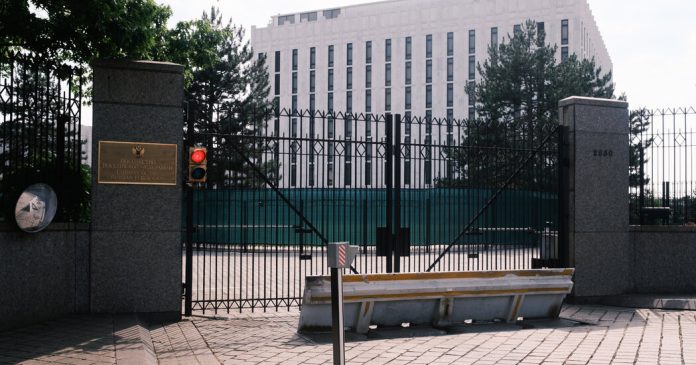
Around 220 Russian diplomats remain in the United States, according to one of the former U.S. officials. Most work at Russia’s Embassy in Washington, but dozens are also based at Russia’s United Nations mission in New York as well as a consulate in Houston.

Both governments complain that even routine diplomatic work like processing visas and assisting traveling citizens has become nearly impossible. Mr. Rubio said last month that he hoped to “work very quickly to reestablish the functionality of our respective missions.”

The two sides “identified concrete initial steps” toward that goal in Istanbul and will meet again soon, the State Department said in a statement.

The Russian delegation was led by Alexander Darchiev, a longtime diplomat who has been named Moscow’s new ambassador to Washington. The Americans were led by Sonata Coulter, a career State Department official who has served in Russia.

If expanded diplomatic ranks are tapped for espionage on both sides, Russia is expected to have an inherent advantage. Moscow is very aggressive about placing intelligence operatives under diplomatic cover abroad, said a former senior U.S. diplomat with Russia expertise.

It is also easier for Russian agents to operate in the United States than it is for U.S. officials to function in an authoritarian, wartime Russia, said Mr. Kolbe, who served for 25 years in the C.I.A.’s operations division.

“The Russian diplomatic presence will be heavily loaded with intelligence offers aiming to penetrate the American government and businesses,” he said. “They will have far more access and freedom of action than American diplomats in Moscow, who will contend with 24/7 physical and technical surveillance and harassment.”

Mr. Trump’s disruption of the federal work force could also benefit the Kremlin, Mr. Kolbe added.

“All the factors that create potentials for walk-ins or recruitment,” including political disaffection, ideological sympathy, money problems or being angry at bosses seem to be in play now, he said.

By contrast, said Andrei Soldatov, a London-based expert on Russian intelligence, merely speaking with an American now poses a serious risk for Russian officials.

“Even that could constitute a crime,” he said. “You could be branded a foreign agent. You could be accused of high treason.”

(One potential benefit to the United States of expanded diplomatic ranks would be that Russian diplomats who are spies are at least known threats; U.S. officials say that Russia has made up for its losses by inserting more agents into America under nonofficial cover.)

The U.S.-Russia relationship deteriorated sharply after the Kremlin interfered in the 2016 presidential election.

President Barack Obama responded by ordering 35 Russian “intelligence operatives” to leave the country and required Russia to vacate two luxurious waterfront diplomatic compounds in New York and Maryland. President Trump expelled another 60 Russian diplomats and closed down Russia’s consulate in Seattle in 2018 after Russian agents poisoned a former Russian spy on British soil. (Mr. Trump acted amid pressure from European leaders and Russia hawks in Congress and on his national security team.)

President Joseph R. Biden Jr. ejected 10 more Russian diplomats and a dozen accused spies from Moscow’s United Nations mission after Russian cyberattacks and the 2022 invasion of Ukraine.

In nearly every case, the Kremlin retaliated by expelling equivalent numbers of American diplomats. Russia also ordered the closure of the U.S. consulate in St. Petersburg, and staff shortages forced the State Department to close two others.

The Kremlin barred the U.S. Embassy in Moscow from employing locals who often performed maintenance and support work, forcing American diplomats to assume responsibilities such as cleaning floors and shoveling snow. The United States could not respond in kind because Russia, as a matter of policy, does not employ Americans at its U.S. facilities.

Mr. Obama closed Russia’s waterfront properties in New York and Maryland because the Russians used them to evade American surveillance by having conversations on the beach, U.S. officials said.

Two consulates closed in Mr. Trump’s first term were also seen as intelligence threats. One, in San Francisco, provided access to Silicon Valley’s technology secrets. The other, in Seattle, was near a nuclear submarine base and the headquarters of the defense contractor Boeing.

If the talks advance, Mr. Kolbe said, the United States should move deliberately and in stages, observe strict reciprocity and not reward Russia immediately with full diplomatic staffing.

But Mr. Soldatov warned that the United States must remain vigilant.

“The Russians, they will try to exploit this new opportunity, which is given to them, like a gift,” he said.

He added, “I think it’s quite a significant risk.”

Adam Goldman contributed reporting.

DOJ limits enforcement of FACE Act, fueling concerns among abortion providers : NPR

0

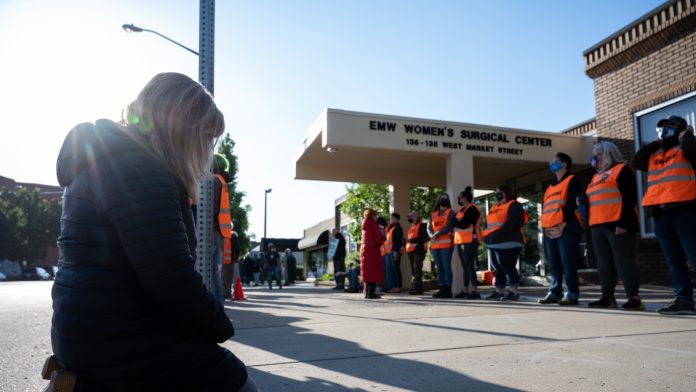
Abortion-rights advocates think the Trump administration’s limits on enforcing the FACE Act give a green light to anyone who wants to disrupt abortion centers in the future. Here, an anti-abortion demonstrator is shown before a line of volunteer clinic escorts in front of the EMW Women’s Surgical Center, an abortion clinic, in 2021 in Louisville, Kentucky.

Jon Cherry/Getty Images


hide caption

toggle caption

Jon Cherry/Getty Images

One morning in late August 2021, Phebe Brandt was attending to patients at a Planned Parenthood facility in Philadelphia, where she works as a nurse practitioner, when someone at the front desk told her a man had barricaded himself in one of the bathrooms.

Just a few minutes later, everyone was ordered to evacuate the building.

“At that very moment, we really didn’t know what was going on,” Brandt said. “We didn’t know if he was armed. We didn’t know if he had a bomb on him. It was very scary just because we didn’t know what was happening.”

The man holed up in the bathroom was Matthew Connolly, an anti-abortion rights activist from Minnesota. He wasn’t armed, but court papers say he refused to leave even after the police arrived. Eventually, a SWAT team broke down the door and removed him from the premises.

Connolly’s actions forced the clinic to shut down for the day. Patients who were mid-visit were sent home; those with appointments later in the day were told not to come in.

Federal prosecutors filed a lawsuit against Connolly under the FACE Act, or the Freedom of Access to Clinic Entrances Act. The law prohibits threat of force, obstruction and property damage meant to interfere with reproductive health care services, including abortion. The federal government’s civil case sought to impose financial penalties on Connolly and deter future disruptive actions by him at abortion clinics.

The lawsuit was one of several the Justice Department brought during the Biden administration as it sought to protect access to reproductive health care.

In the past six weeks, the Trump administration has moved to undo all of that.

The Justice Department’s new leaders say past enforcement of the FACE Act is “the prototypical example” of what they say is the weaponization of law enforcement against conservatives.

Instead, the Justice Department now says it will no longer enforce violations of the statute, except in extraordinary circumstances — such as cases involving death or serious property damage.

The department also has dropped three pending FACE Act cases, including the one against Connolly. President Trump, meanwhile, pardoned 23 people convicted under the FACE Act.

Fear of more disruptions

Abortion-rights advocates and providers, including Brandt, think these moves give a green light to anyone who wants to disrupt abortion centers in the future.

“It basically tells them that there will be no consequences for them to come into our centers, disrupt things, and potentially even be violent,” she said. “I absolutely think we’re going to see more of that going forward. I think this is going to put our safety at risk.”

The FACE Act dates back to the early 1990s. Its supporters said the statute was necessary to prevent rising violence at the time targeting abortion clinics and providers, including the 1993 murder of Dr. David Gunn outside a clinic in Florida.

The law’s opponents, however, viewed it as an infringement on the free speech rights of abortion opponents.

Ultimately, the bill passed with bipartisan support and President Bill Clinton signed it into law in 1994.

By most accounts, the law has worked as designed.

“The FACE Act has been incredibly effective at curbing some of the major types of violence and obstruction that we saw really escalating in the early nineties,” said Melissa Fowler, the chief program officer at the National Abortion Federation.

Enforcement of the law has varied over the years, with Democratic administrations often being more active enforcing it than Republican ones, she said, “but what we’ve seen this time is really unprecedented.”

“It really shouldn’t take an abortion provider being murdered for the federal government to enforce a law that has been effective at keeping providers safe and helping people access care,” Fowler added.

Opponents say law was unfair

For opponents of abortion rights, however, the department’s change in charging policy is a source of optimism.

“That decision is very much welcomed,” said Monica Miller, the director of Citizens for a Pro-Life Society, an activist organization. “I’ve always felt very deeply that this was a flawed law. It was unfair. It went after a particular social justice group for higher penalties.”

Miller, who has been involved in anti-abortion activism since the 1970s, was a defendant in one of the FACE Act lawsuits recently dropped by the Justice Department. She helped start what’s known as “Red Rose Rescues,” in which activists enter clinics to try to talk women out of getting an abortion and then remain in the facility until physically removed by police.

In court papers, prosecutors have said those actions are designed to temporarily shut down clinic services. Providers say the group’s activities are traumatic for staff and patients, and disruptive.

Miller said the group’s actions are peaceful.

“Let’s put this in context. What is it that is being, quote unquote, disrupted?” she said. “What has been disrupted is the killing of innocent human persons in an act that is barbaric and violent and often hurtful to the women. And that’s why there’s a contingent within the pro-life movement that feels very strongly that that these nonviolent acts of dissent need to be conducted.”

Some abortion opponents have called for a renewed push to disrupt abortion clinics in light of the department’s new policy toward the FACE Act.

For her part, Miller said the change will make it easier to conduct disruptive actions at abortion clinics, but she said it’s “not a get out of jail free card” because activists could still face legal consequences under state law.

Another anti-abortion activist, Jonathan Darnel, agreed.

“Some supporters of abortion are convinced that there will now be frequent rescues at abortion mills. I wish!” Darnel, who was recently pardoned by Trump, wrote in an email. Darnel was convicted in connection with the blockade of a reproductive health clinic in Washington, D.C. in 2020.

“Unfortunately, most pro-lifers are still afraid. After all, states can and will punish civil disobedience. But maybe Trump’s decision is important for the message it sends: laws that protect murder should not be enforced, and in fact should be defied.”