Thursday, November 12, 2026
Home Blog Page 143

Canada’s Liberal Party To Elect New Leader and Prime Minister to Replace Trudeau: What to Know

0

Two friends from Alberta, both with strong careers overseas and similar backgrounds — Harvard and Oxford graduates, members of the liberal global elite — are vying to replace Justin Trudeau as leader of the Liberal Party and of the country just as Canada faces a generational crisis because of the Trump administration’s tariffs and sovereignty threats.

Some 400,000 Liberal Party members have been casting ballots in their party’s important leadership race to decide who will succeed Mr. Trudeau and mark a new era in Canadian politics. Whoever wins will have to call a general election, which must be held by October, but could take place sooner.

The results of the election will be announced at a special event in Ottawa, the capital, at around 6:30 p.m. on Sunday.

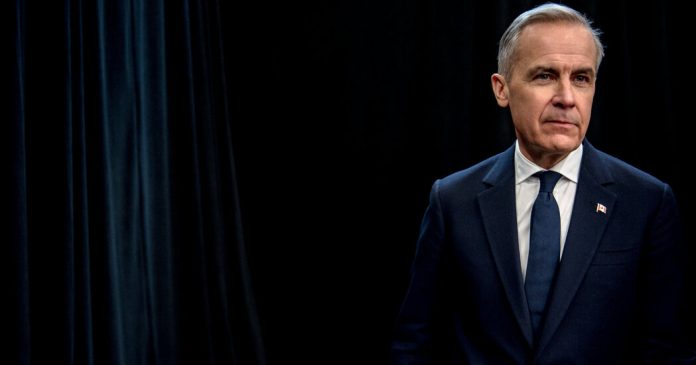
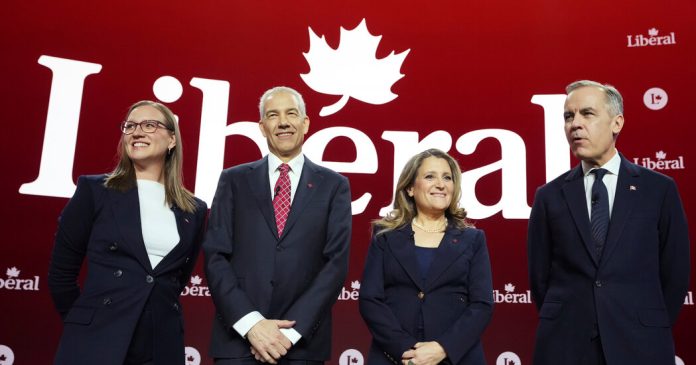
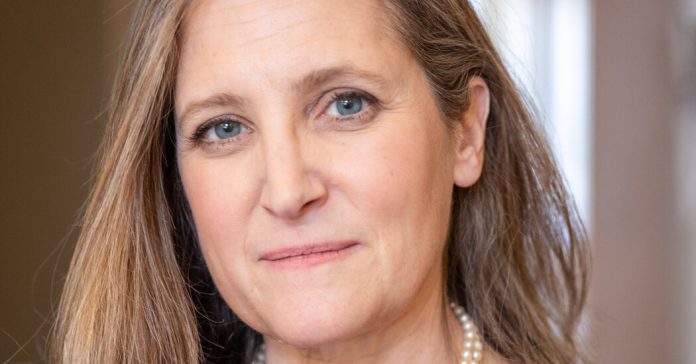
The race is between Mark Carney, 59, the former governor of the Bank of Canada and the Bank of England and a prominent green investor, and former finance minister Chrystia Freeland, 56, whose resignation triggered Mr. Trudeau’s decision to step down. Surveys have shown Mr. Carney is the front-runner.

A third candidate, Karina Gould, 37, has been trying to make her mark as a future leader of the party, differentiating herself from the two others as more plainly spoken and more left-leaning. Frank Baylis, 62, a businessman and former member of Parliament, is also running.

Ms. Freeland and Mr. Carney share similar backgrounds and are both considered technically competent centrists with a preference for fiscal discipline.

Ms. Freeland had a successful career in international journalism but has been a prominent politician in Canada for the past 10 years. Her record as finance minister and, previously, foreign minister, is being closely scrutinized. Her detractors hold her accountable for not standing up to Mr. Trudeau, under whom she served, when his policies became increasingly unpopular.

She has tried to reintroduce herself to the Canadian public as a more grass roots candidate who has listened to critiques and will abandon unpopular policies such as Mr. Trudeau’s tax on carbon emissions.

And she’s pitched herself as the best person to stand up to President Trump as he launches tariffs against Canada, as well as threats against the country’s sovereignty. Mr. Trump harbors a strong dislike for her — having called her “toxic,” “a whack” and “incompetent” in recent months.

Ms. Freeland successfully renegotiated the North Atlantic Free Trade Agreement on behalf of Canada during Mr. Trump’s first term. The treaty binds Canada, the United States and Canada.

Mr. Carney, while being in the public eye for much of his career, has not been a traditional politician before making his bid for party leadership.

He joined the public sector as a senior official in the finance ministry in 2004, serving under successive Liberal and Conservative governments, and was later tapped to lead central banks in Canada and Britain.

He was praised for his performance in both posts, helping Canada weather the 2008 financial crisis and steering Britain through Brexit, though critics accused him of inciting fear by suggesting that Brexit would hurt the country’s economy.

Mr. Carney’s plan is centered on boosting Canada’s economy, which has been hobbled by inflation and low productivity. The high costs of housing has become a central issue in Canada and Mr. Carney has pledged to build four million homes over several years.

Like Ms. Freeland, Mr. Carney also plans to jettison Mr. Trudeau’s carbon tax and replace it with a pricing system that would require industrial polluters to pay consumers to reduce their carbon footprints.

Ms. Freeland’s platform focuses on policy areas that have become liabilities for the Liberal Party, including an emphasis on tackling Canada’s physician shortage, increasing military spending and countering foreign interference in politics.

Liberal Party members have been able to vote online after registering with the party and confirming their identity. Voting began on Feb. 26. Results will be tracked on the Liberal Party’s website and are expected around 6:30 p.m. Supporters will gather at the Rogers Center in Ottawa, a convention hall not far from Parliament Hill, for the announcement of the results.

Mr. Trudeau, who will be capping nearly a decade as prime minister and 13 years as leader of the Liberals, is expected to attend.

The new leader will likely be sworn in as prime minister during the coming week. The proceedings are in accordance with the Westminster parliamentary system, which is followed in Britain and elsewhere.

What happens next is not fully mapped out and will partly depend on who the new leader is.

Mr. Carney is unelected and does not hold a seat in Parliament. His campaign has indicated he would call federal elections soon after being named prime minister.

Ms. Freeland, who holds a parliamentary seat, told The New York Times in an interview that she’d consider whether a quick election was a good idea given the continuing threat of tariffs and their impact on Canada’s economy.

Federal elections must be held by October in line with Canada’s rules. The Conservative Party, led by Pierre Poilievre, had long maintained a 20-plus point lead over the Liberals in polls, but the gap has been closing since Mr. Trudeau announced his resignation and Mr. Trump started making moves against Canada.

The latest polling suggests that most respondents would choose Mr. Carney over Mr. Poilievre if he led the Liberal Party into the elections. Voters would also choose Ms. Freeland over Mr. Poilievre, though by a narrower margin, the polls show.

Polling also shows that Canadians prefer Mr. Carney and Ms. Freeland to negotiate with Mr. Trump over Mr. Poilievre.
Violence Sweeps Coastal Syria, Sowing Chaos: ‘We Have to Get Out of Here’

0

The gunfire began at dawn on Friday in the town of al-Haffa on Syria’s Mediterranean coast.

At first, Wala, a 29-year-old resident of the town, leaped off her bed to the corner of the room in her first-floor apartment, flattening herself as the rat-a-tat of gunshots sounded outside her bedroom window.

When the commotion grew louder, she said, she crept to the window and peeled back the curtain. Outside, dozens of people were fleeing down the road, many in their pajamas, as four men in forest green uniforms chased them. Then, the uniformed men opened fire. Within seconds, four of the fleeing people crumpled to the ground.

“I couldn’t believe what I was seeing. I was terrified, terrified,” said Wala, who asked to be identified only by her first name for fear of retribution.

The attack in her town was part of the unrest that has shaken Syria’s coast over the last four days and has killed more than 1,000 people, the war monitoring group Syrian Observatory for Human Rights said early Sunday. It was the bloodiest outbreak of violence since rebels ousted the longtime dictator, Bashar al-Assad, in early December, then sought to assert their rule over a country fractured by nearly 14 years of civil war.

The violence broke out on Thursday when armed men loyal to Mr. al-Assad ambushed government security forces in Latakia Province, where al-Haffa is located. The ambush set off days of clashes between Assad loyalists and government forces.

The Observatory, which is based in Britain and has monitored the Syrian conflict since 2011, said early Sunday that about 700 civilians were among the more than 1,000 dead, most of them killed by government forces.

At least 65 civilians were killed in al-Haffa, according to the Observatory.

Another war monitoring group, the Syrian Network for Human Rights, reported on Saturday that government security forces had killed an estimated 125 civilians. Those claims could not be independently verified.

Officials with the new government rejected accusations that its security forces had committed atrocities. But they said they were committed to investigating accusations and holding anyone who had harmed civilians accountable.

The violence has raised the specter of a larger sectarian conflict in Syria and stoked panic in the coastal provinces of Latakia and Tartus. The region is the heartland of Syria’s Alawite minority, which dominated the ruling class and upper ranks of the military under the Assad government, and included the Assad family itself. The new government was formed from a coalition of rebels led by an Islamist Sunni Muslim group.

The Observatory said most of the civilians killed in recent days were Alawites.

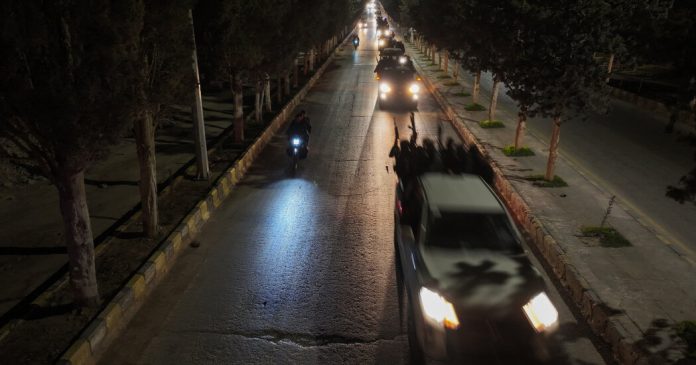
On Saturday, the highway leading from the capital, Damascus, into Tartus was nearly empty as the authorities tried to seal off all traffic into the coastal region. Government security forces set up checkpoints along the main roads into and throughout Tartus city, the provincial capital, where most shops were closed and many residents were hunkering down in their homes.

Shadi Ahmed Khodar, 47, sat by the highway leading from Tartus north to Latakia, watching as the occasional ambulance or government vehicle sped by. The streets of his neighborhood had emptied as violence raged in recent days, turning Tartus into a ghost town, he said. He is an Alawaite but like many in the city, he said he does not support the Assad loyalists who have taken up arms against Syria’s new authorities.

But he was also terrified that security forces with the new government would no longer distinguish between armed Assad loyalists and people like him — a crane operator who had worked for the Assad government.

“Maybe they will just come here and say we are against them and kill us,” he said.

The country, he feared, was barreling toward more conflict. The violence had yet to subside by late Saturday afternoon and, down the road from where he stood, government forces at a checkpoint were warning drivers that gunmen were ambushing cars driving up the coast toward Latakia.

“We’re just in the shallow water,” Mr. Khodar said. “We haven’t reached the depths yet.”

In the nearby countryside of Latakia Province, armed Assad loyalists were holding dozens of government security personnel hostage after seizing control a day earlier, residents said. In other areas, local residents had taken up arms and stationed themselves outside their homes to protect their families, after hearing reports about government forces killing civilians.

In Baniyas, a town on the northern tip of Tartus Province, armed men who appeared to be with the government had stormed into the town’s predominately Alawite neighborhoods late Thursday night, according to four residents.

Ghaith Moustafa, a resident of Baniyas, said he had spent most of Friday and Saturday huddling with his wife, Hala Hamed, and their 2-month-old son behind their front door — the only place in their small apartment that was not near any windows.

Early Friday morning, he said he heard the patter of shooting grow louder as armed men reached his building. Then he heard men shouting, gunfire and screams coming from the apartment below his. He later learned that his downstairs neighbors had been killed.

“I was so scared for my baby, for my wife,” Mr. Moustafa, 30, said in a telephone interview. “She was so afraid. I didn’t know how to not show her that I was also afraid for us.”

When the gunfire subsided around 2 p.m. on Saturday, Mr. Moustafa said he and his family fled their apartment and sought shelter at a friend’s house in a nearby neighborhood that had been spared much of the violence. Driving away from home, he was horrified.

Every two or three meters, a body lay on the ground, he said. Blood stains were smeared across the pavement. Storefronts windows were shattered and many shops appeared to have been looted, he said.

The Syrian Observatory said on Saturday that at least 60 civilians, including five children, were killed in the violence in Baniyas.

“I’m shocked, I’m just shocked,” said Mr. Moustafa, a pharmacist. By Saturday evening, all he could think about was leaving. “We have to get out of here as soon as possible,” he added. “It’s not safe, not at all safe.”

Mr. Moustafa was among hundreds of people who fled Baniyas on Saturday, according to residents. Many sought shelter with friends who were not Alawite in the hope that their neighborhoods would avoid the brunt of any more violence.

Wala, the al-Haffa resident who said she saw men in uniforms shooting at people as the fled, was taking cover with friends and family in her apartment when security personnel knocked down the front door, about an hour after government forces had entered her town. A friend visiting from the northwestern region of Idlib, where the rebels who overthrew Mr. al-Assad came from, pleaded with them not to shoot.

“She said, ‘I am from Idlib. All my family is from Idlib. Please don’t do anything to these people. They are peaceful family,’” Wala recounted in a phone interview.

The men demanded that the friend hand over her phone and yelled at Wala to open her safe, which she did. They demanded that Wala’s mother give them her gold necklace and earrings, Wala said.

Before they left, the men issued a stern warning: Don’t leave the house. She and her relatives rushed back to her bedroom, terrified.

But bout an hour later, as the gunfire subsided, they defied that order to try to help someone they could hear pleading from the street.

Outside, Wala said she found two men who had been shot. One was covered in blood and asked her in a weak voice to lift his head a bit from the ground. The other, shot in the thigh, begged for water.

Before long gunfire rang out again and Wala ran back inside. By Saturday evening, she said, she did not know whether either man had survived.

Chrystia Freeland Eyes Justin Trudeau’s Job as Canada’s Liberal Party Leader

0

The protester leaped on to the stage, lunged at Chrystia Freeland and screamed within inches of her face.

She didn’t flinch.

Her January campaign launch for leadership of the Liberal Party, and by extension Canada, was disrupted, but the encounter made a point no stump speech could have landed as effectively: She’s unflappable.

Ms. Freeland, a career journalist from Alberta who rose through elite institutions to become a top politician, is now running to replace the man who brought her into politics, Justin Trudeau.

On Sunday, Canada’s Liberal Party will announce the results of its election for a new leader, chosen by 400,000 members. The winner will also become Canada’s prime minister, though not for long: The party does not command a majority in Parliament, so has a weak grip on power. Federal elections must take place before October.

Ms. Freeland’s dramatic December resignation as finance minister, deputy prime minister, and all-around right-hand woman to Mr. Trudeau triggered his own decision to step down, plunging Canada into political turmoil.

This has come as Canada is thrust in crisis. This week President Trump made good on his threat to impose sweeping tariffs on Canadian goods and, while he eased some of those measures Thursday, he made plain he would continue to hit Canada’s economy with surcharges.

Canada retaliated, entering an uneven trade war with its closest economic partner. Mr. Trump has also menaced Canada in a more existential way, insisting he wants to make it the 51st state.

Canadians are evaluating their political leaders on the basis of who is best to fight for Canada against Mr. Trump, polling shows. Ms. Freeland, 56, is the underdog. She is running against a friend, the former central banker Mark Carney, who is the front-runner.

Mr. Trump has repeatedly expressed his dislike of Ms. Freeland.

During his first presidency, she led the Canadian side on the renegotiation of the North Atlantic Free Trade Agreement. By all accounts, she drove a tough bargain and won concessions for Canada.

When she announced she was stepping down in December, Mr. Trump posted, “Her behavior was totally toxic.”

And last week, in an interview with the British outlet The Spectator, he doubled down: “She’s a whack,” he said. “She’s absolutely terrible for the country.”

But Ms. Freeland seems to be relishing the fight.

“Donald Trump doesn’t like me very much,” she says with a smile on one of her ads. On her Instagram, she posted a New York Times article about Mr. Trump disparaging her, adding a dismissive caption: a manicure emoji.

“I have a strategy when it comes to the single biggest challenge Canada is facing: fighting for Canada, standing up to Trump,” she said in an interview with The Times at her Toronto home last month.

And despite the antipathy, she had praise for him. “I have a lot of respect for President Trump,” she said. “He is not afraid of being a disrupter, he glories in it, and he knows how to use that to his own benefit, and in many situations, it works,” she added.

Less ardent critics see Ms. Freeland’s effort to differentiate herself from Mr. Trudeau as too little too late, and hold her accountable for her central role in his now unpopular government.

Ms. Freeland’s had a modest childhood, raised by divorced parents and spending long stretches working on the family farm in Peace River, Alberta, and in Edmonton, where her mother, a Ukrainian immigrant, worked as a lawyer.

Ms. Freeland left Alberta on a scholarship at 16 to finish high school at a selective international school in Italy. She later studied at Harvard and was a Rhodes scholar at Oxford.

While at Harvard she spent time in Ukraine as an exchange student, and became involved in Ukraine’s then nascent independence movement. Her activism reportedly caught the eye of the K.G.B., which code-named her “Frida.”

Declassified K.G.B. documents showed the Soviet intelligence service loathed and admired her, calling her “a remarkable individual,” according to a report in the Globe and Mail.

She rose within the ranks of some of international journalism’s most venerable institutions, serving as a senior editor at The Financial Times and Reuters, with a brief stint at Canada’s Globe and Mail.

Ms. Freeland is married to Graham Bowley, a reporter on the Culture desk of The New York Times; they have three children.

Former co-workers and friends describe her as preternaturally active and decidedly no-frills: much of the furniture in her home is second hand. Most surfaces in her living room are covered in books and Ukrainian art hangs on the walls. She is known to bicycle everywhere, no matter the weather. She forgoes security.

In 2013, she moved her family from New York to Toronto, after Mr. Trudeau convinced her to run as a Liberal Party candidate.

He had just been elected as leader, and the party was in tatters, stuck in third place. Ms. Freeland takes pride in making what she calls “iconoclastic, high-risk decisions” and leaving journalism to join a party in bad shape was one of them.

“I called up lots of people, my friends, lifetime mentors, and everyone’s advice was: ‘Do not do it,’” she said.

Ms. Freeland won her seat and, within two years, Mr. Trudeau had brought the party back from the dead. At his swearing in as prime minister in 2015, she was by his side.

She served in key jobs, including foreign and finance minister. The joke in Ottawa was that she was his “minister of everything.” Her relentless energy and grasp of technical issues distinguished her, but her detractors said she came across as condescending or stiff in public.

She was heavily criticized for suggesting people cancel their Disney+ subscriptions as a response to an affordability crisis. Despite her own professed dedication to fiscal discipline, Ms. Freeland oversaw significant spending.

She remained loyal to Mr. Trudeau, even as Canadians started turning on him, and her leading role in his government has become a burden as she’s tried to separate herself from his legacy.

“People know there’s a difference between playing on a team and leading a team,” she said, adding that she was proud of the work she had done in government.

The end of her collaboration with Mr. Trudeau remains something of a mystery.

Mr. Trudeau, on a December Zoom call, told Ms. Freeland he would demote her to U.S.-Canada envoy and give her finance minister job to Mr. Carney, who is unelected.

Ms. Freeland and Mr. Trudeau had been in conflict over spending, believing some of his moves to ease financial burdens on Canadians were frivolous and politically motivated. She wanted to save money to deal with Mr. Trump’s tariffs, which she saw as inevitable.

She resigned soon after the Zoom call.

It was the final blow to Mr. Trudeau who, despite his unpopularity, had intended to remain Liberal leader and take the party to the next federal election.

Ms. Freeland said she did not anticipate her resignation would lead to Mr. Trudeau’s.

“On the morning of Dec. 16, when I resigned, my assumption was that the next day, Mark would become finance minister,” she said in her interview with The Times. “And I think the prime minister thought that, too.”

Mr. Trudeau has not commented on the events, nor has Mr. Carney, who did not agree to an interview.

Ms. Freeland’s campaign has been reshaping a new image outside Mr. Trudeau’s shadow. She has been churning out policy plans and broke with Mr. Trudeau on a controversial carbon tax that he had championed.

And she has tried to present herself as the grass roots, not the elite candidate, as most of Mr. Trudeau’s cabinet has endorsed Mr. Carney.

“A failing of the center left is that it can be a little too technocratic, and to act like the technocrats have all the answers,” she said.

One of the first decisions she’ll make if she wins, is decide when to hold a federal election. She’s not in a hurry.

“It may well be that when we look at the situation in March and further challenges ahead in April, I may decide as prime minister, we may decide as Liberals, and frankly it may be the view of Canadians, that Canada would be better off having a stable government for a few months,” she said.

As for Mr. Carney who is, among other things, her youngest child’s godfather, she has been careful not to attack him.

“I have a lot of respect for Mark,” she said. “I would be really happy if he were to serve as finance minister in my government.”

Echoing a Roman Emperor, Croatia Tries to Cap Soaring Prices

0

In 301 AD, the Emperor Diocletian made a bold but ultimately unsuccessful bid to address the inflation that was rampaging across the eastern half of the divided Roman Empire.

Prices of everything from purple thread and feathers to slaves and cattle were dictated by his Edict on Maximum Prices. Violators faced the death penalty. Diocletian gave up power about four years after issuing his edict, watching his measure fail from his sprawling retirement palace in the heart of what became the city of Split in Croatia.

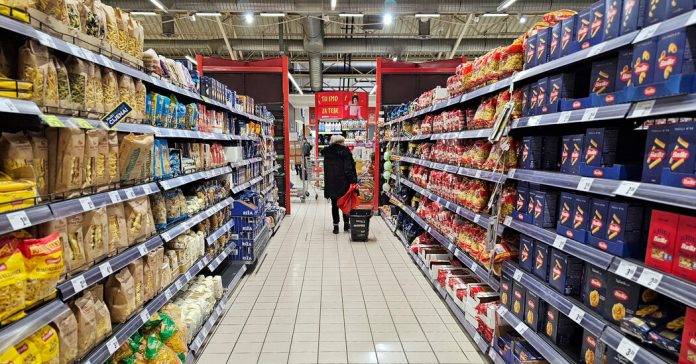
Now Croatia’s government is trying a similar tactic to rein in prices that have soared in recent years and sparked protests and retail boycotts by the country’s beleaguered consumers.

On Feb. 7, the government introduced price controls for retailers, targeting supermarket items such as bread, pork and shampoo. The penalties are less drastic than those decreed by Diocletian, mandating a fine of up to 30,000 euros, or $31,400, for retailers breaking the rules.

It is unclear whether the new edict will be any more successful than Diocletian’s, which economists say ended up being counterproductive by causing shortages, fueling a black market and enabling profiteers.

For the moment, consumers are still figuring out how to navigate the new system, which caps the price of 70 common grocery store products.

In Split, whose tight limestone streets and alleyways attract tourists from around the world, Anita Kargotic, 62, went shopping recently at a Spar supermarket, where two signs were posted outside listing the maximum prices allowed for a range of goods.

She tied her dog, an American Akita named Maja, to a post outside, and later emerged from the supermarket, with a haul of Kaiser rolls, popcorn kernels, soy flakes and crackers. Most were store-brand generics, already less expensive than more recognizable labels.

Ms. Kargotic said her money did not go as far as it once did, and caring for herself and Maja has become a vexing exercise in prioritization.

Flea collars and dry dog food? Those are necessities. Grapes? No, too expensive.

Staples like rice and pasta? Pass. “Those prices have become completely unreasonable,” she said, adding that she doesn’t think the new price controls will make much difference to her since she mainly buys whatever is cheapest.

“I’m always looking at lower prices, paying attention to sales,” she said.

Croatia, which joined the European Union in 2013, should be basking in a successful post-pandemic recovery. The economy has been growing at an average of 6.6 percent over the past four years, tourism has been booming and wages have been steadily rising. But that has also helped drive a surge in prices, with inflation hitting 5 percent in January after remaining stubbornly above 3 percent throughout 2024.

The rules that came into effect this month are the Croatian government’s third attempt at controlling prices by fiat since Sept. 2022. The first two efforts were largely ineffective, with retailers simply refusing to stock most price-controlled goods.

The government says it is serious this time, with the law requiring that price-controlled products be available and it has promised regular inspections and fines for violators.

Under the new rules brought in by Prime Minister Andrej Plenkovic, shop entrances must display a list of all 70 items that fall under the government’s pricing regime.

Centuries ago, Diocletian’s edict accused some citizens of price gouging, and said their greed needed to be reined in.

In January, Mr. Plenkovic struck a similar tone when introducing his government’s measures.

“We support companies that work well and make a profit, but within realistic frames. That can’t be at the expense of the little guy,” he said at a stormy meeting with retailers in January.

Rudolf Nardelli, 80, another recent shopper at the Spar in Split, said he moved to Haarlem, in the Netherlands, five decades ago and recalls often leaving Split with his car’s trunk full of provisions.

“Now the prices in Holland are lower,” said Mr. Nardelli, who still divides his time between Haarlem and Split, as he strapped groceries to his bike. “Retailers here are inflating prices for no reason.”

Economists blame the increases on a three-headed hydra of pandemic-era economic rescue packages that flooded the country with cash, increases in public sector wages and retailers rounding up prices after Croatia adopted the euro in 2023.

Those with tighter budgets are facing unexpected sacrifices.

Leonardo Inacio, 28, was shopping at the Spar for protein, mostly chicken, to aid in his physical recovery from the demands of his job as a ballet dancer.

He said a monthly grocery budget of €350 used to be enough when he moved to Split from Brazil two years ago. That figure has jumped to €450, he said.

“I’m passing up on supplements,” Mr. Inacio said of the sacrifices he was making to make ends meet. “I’d much rather spend that money on something that helps me professionally, but I can’t.”

He said he had participated in the boycotts against retailers, but knew nothing about the government’s price regulations. He glanced curiously at the list of discounted items outside the supermarket.

“This could actually be useful,” he said, snapping a photo of the list with his phone.

But many people say price controls are not the answer.

John H. Cochrane, an economist and fellow at the Hoover Institute, a research center, pointed to the role Diocletian’s edict played in causing shortages and fueling a black market.

“It’s like trying to stem the symptoms rather than treating the underlying disease,” Mr. Cochrane said of price controls. “It offers people the appearance of help for a while, and then it takes a few weeks or, a month or two, for all the problems to break out.”

He Was Once a Covert Taliban Operative. Now He’s the Friendly Taxman.

0

He is the Taxman of Kabul, a bearded, black-turbaned Talib with a genial manner and the calculating mind of a computer-savvy accountant.

As director of the Taliban’s Taxpayers Services Directorate, Abdul Qahar Ghorbandi has the unenviable task of raising revenue for the government of a wretchedly poor, isolated nation.

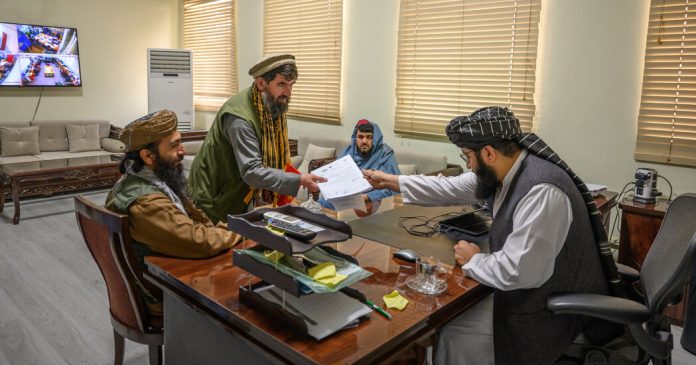
From his perch behind an enormous desk next to a black and white Taliban flag, Mr. Ghorbandi rides herd on hundreds of Afghan taxpayers each weekday. He makes sure they arrive with income documentation and leave with a fistful of tax forms to fill out.

Teachers, money changers, truckers, wedding planners, grocers and others trudge the worn hallways of the imposing tax building, discussing their taxes with Talibs pecking away at computer terminals.

The Taliban have sought to ramp up tax collection after a severe economic contraction that followed their takeover in 2021. The authoritarian regime has been crippled by sanctions, in part over its harsh restrictions on women and girls.

U.S. aid, drastically reduced since 2021, could be eliminated entirely under President Trump’s budget cuts. That aid has gone to the United Nations and nongovernmental organizations working in Afghanistan, not directly to the Taliban government.

With the Taliban now in power, former guerrilla fighters must function as bureaucrats. In the 280-person tax department, they work alongside employees inherited from the U.S.-backed government that the Taliban overthrew.

“At the same table we have people with turbans, with beards, next to people with suits,” said Mohammad Walid Haqmal, spokesman for the Ministry of Finance.

The Taxman himself, Mr. Ghorbandi, was an undercover operative for the Taliban in Kabul before becoming a civil servant, he said.

Mr. Ghorbandi, who said he had a master’s degree in computer science, presides over a tax administration computer system converted from English into Pashto and Dari. He has hired IT experts to modernize the department.

He has also tried to instill a culture of transparency, he said as he took a break for a lunch of beef kebabs and rice. His employees are not permitted to handle cash. Taxpayers take their forms to a government-run bank and pay taxes there.

When he is not at his desk signing reams of documents delivered by aides hustling in and out, he said, he visits different sections of his department, asking taxpayers how he could make the process faster.

International observers say the Taliban have reduced the tax corruption and cronyism that Afghans say were rampant under the U.S.-aligned government, while streamlining the process of collecting taxes.

Although many well-connected Afghans once avoided paying taxes, Mr. Ghorbandi stressed that even as the government Taxman, he was not exempt. He said he paid 30,000 afghanis a month, or a little over $400.

However open and efficient, it is still a tax office, though, and not every taxpayer leaves satisfied.

Shamsurahman Shams, who showed up one day late last year, had a beef with the Taxman. He said the two private schools he helped run had not turned a profit the past three years — and he carried a plastic folder stuffed with documents to prove it. Yet he had been assessed 500,000 afghanis, or about $7,350, in taxes.

He engaged in a spirited but civil discussion with a department employee, showing the man his documents. There was no resolution. He was told to return later to resume negotiations.

Although it was not the outcome he had hoped for, Mr. Shams conceded that the new process was more transparent than the previous system. “At least they listened to me,” he said.

During the war, the Taliban ran a lucrative tax system that levied customs duties, trucking fees and local taxes in areas they controlled. They also earned millions by imposing 10 percent taxes — “ushar” in Islam — on poppy farmers, though they have since banned poppy production.

In 2023, the Taliban government collected about $3 billion in taxes, customs and fees, or 15.5 percent of gross domestic product. (The comparable rate in the United States was 25.2 percent). The biggest source for the Taliban was so-called nontax revenue — customs duties, mining revenues, telecom licenses, airport charges, and fees for national ID cards, passports and visas, the World Bank reported. That revenue, for the first half of last year, increased 27 percent compared with the same period the previous year.

Half of government revenues were spent on security and the military last year, and just 26 percent on social programs — most of that on education for boys, according to international observers.

Mr. Ghorbandi said the tax system was not designed to be punitive. Generous exemptions mean that most ordinary Afghans do not pay income taxes. Shopkeepers with annual sales below two million afghanis, or about $29,500, also are exempt.

Merchants with earnings over that amount are taxed at just 0.3 percent — a rate that American conservatives would surely appreciate.

There are no cash penalties or interest fees for taxpayers who do not pony up on time. But scofflaws can lose their business licenses and access to the banking system.

“We are human,” Mr. Ghorbandi said. “We don’t want to put burdens on our people.”

He and Mr. Haqmal, the Finance Ministry spokesman, said the ultimate goal was to eliminate all income taxes.

“It is a direct order from our supreme leader,” Mr. Haqmal said. “He said: ‘I need a tax-free Afghanistan.’” Mr. Haqmal was referring to Sheikh Haibatullah Akhundzada, the Taliban’s emir and head of state.

Another direct order from Sheikh Haibatullah has been the shredding of women’s rights and broader restrictions on civil liberties for all Afghans. Women are prohibited from traveling any significant distance without a male relative and are obligated to cover their entire bodies and faces in public. The sound of a woman’s voice outside her home is banned.

A striking feature of the tax department’s 15 sections in Kabul is the sight of female taxpayers in rooms crammed with men.

Lida Ismaeli, who operates a private school, sat next to a bearded Talib as he reviewed her tax status on a computer. She said no one had complained that she spoke with a male employee about her taxes with no male relative present.

Under the previous government, Ms. Ismaeli said, she never knew whether her taxes went to the government or into the pockets of the employee she paid.

“The system is better now — it’s more fair,” she said.

Down a darkened hallway, Mohammad Taqi Irfani, a money changer, huddled over a computer screen with a tax employee. Mr. Irfani seemed resigned to his assessed tax payment of 73,500 afghanis, or about $1,080, on his annual earnings.

He said he did not enjoy paying taxes — who does? — but his tax burden was clearly explained to him, and his business accounts were not questioned. Under the American-backed government, he said, tax collectors came to his office and demanded bribes to lower his tax assessment.

“They were in it just to make money for themselves,” he said. “So far under this government, no one has ever asked me for a bribe.”

Safiullah Padshah and Yaqoob Akbary contributed reporting.

How Would Peacekeeping Work in Ukraine? These Experts Gamed It Out.

0

When military and civilian experts on peacekeeping started meeting in Geneva in the spring of 2022, they insisted on discretion. Their topic was sensitive: how to implement a future cease-fire in Ukraine.

Last week, that group of experts went public for the first time, publishing a 31-page paper that delves into the technical details of how a cease-fire along a more than 700-mile front line could be monitored and enforced. The paper was shared last month via another confidential channel: a recurring meeting in Geneva between American, Russian and Ukrainian foreign-policy experts who are close to their governments.

The paper, one of the most detailed templates for a Ukraine cease-fire to have been published, is a sign of how quickly the topic of planning for a cease-fire has gone from a controversial and theoretical exercise to an urgent and practical issue.

France and Britain have raised the prospect of sending thousands of their own troops to Ukraine after the fighting stops, though there is little clarity about what that force’s responsibility would be. Russia has shown no sign of agreeing to such a force, while President Trump has offered few assurances of any American backup to it.

“One of the biggest cease-fire monitoring operations ever will be coming at us very quickly, with no planning thus far of what that would look like,” said Walter Kemp, a specialist on European security who drafted the Geneva group’s document.

Mr. Trump has said he wants a quick settlement and in the last week has taken steps aimed at forcing Ukraine to the negotiating table: Suspending military aid and the sharing of intelligence to Ukraine, while repeatedly saying, with no evidence, that he thinks President Vladimir V. Putin of Russia wants to make a deal.

For most of Russia’s three-year invasion of Ukraine, the possibility of a cease-fire seemed far-off and, some analysts say, a taboo topic. Kyiv and Western leaders sought to keep the focus on the battlefield rather than the complications of an eventual compromise, and were reluctant to speak publicly about the possibility that Ukraine would fall short of victory.

But Mr. Trump’s desire to end the fighting quickly has cast a spotlight on what will happen on the ground if the fighting does end. The previous cease-fire in Ukraine, negotiated in Minsk, Belarus, in 2015, was plagued by spotty monitoring and the absence of a way to punish violations of the deal’s terms.

Last week’s paper, produced by a Swiss government-financed think tank called the Geneva Center for Security Policy, laid out some specific numbers. It proposed a buffer zone at least six miles wide to separate the two armies, and a plan for 5,000 civilians and police officers to patrol it. The paper argued that about 10,000 foreign troops may be needed to provide security for those monitors.

The monitors would report on cease-fire compliance and whether heavy weaponry had been withdrawn an agreed-upon distance from the buffer zone. The mission would operate under a mandate from the United Nations or another international body.

Such a force could help prevent tensions and misunderstandings from spiraling into renewed fighting, but it would be separate from any “tripwire” force meant to provide a security guarantee for Ukraine in the event of another Russian invasion.

Thomas Greminger, the Geneva center’s director, oversaw cease-fire monitoring in Ukraine from 2017 to 2020 as the secretary general of the Vienna-based group doing the monitoring, the Organization for Security and Cooperation in Europe.

He said he pulled together a group of cease-fire experts soon after the 2022 invasion began, to come up with options for how to make a future armistice in Ukraine more durable than the last one.

The experts included officials at international organizations and former military commanders with peacekeeping experience, he said. They requested not to be publicly identified because of the sensitivity of the topic for their institutions.

“We had to be quite discreet,” he said.

Separately, Mr. Greminger hosted confidential discussions between foreign-policy experts from Ukraine, Russia, the United States and Europe.

The participants in those meetings — whose identities Mr. Greminger would not disclose — acted in their personal capacity, he said, though they were expected to be briefed by their governments beforehand and to debrief them afterward. He said the initial purpose of the meetings, which started in 2022, was “to establish a channel of communication” with Moscow, and that scenarios for a cease-fire or settlement were also discussed.

It’s not clear what impact, if any, the cease-fire proposal will have on the negotiations themselves, especially given the personal approach taken by Mr. Trump and Mr. Putin. But the Geneva center’s efforts also shed light on the behind-the-scenes diplomacy that has been a hallmark of a war in which the West and Ukraine have sought to isolate Russia on the world stage while engaging with Moscow on some matters privately.

Back-channel negotiations with Russia, for example, have resulted in a series of prisoner-of-war exchanges and the deal that allowed Ukraine to export its grain through the Black Sea (until Russia pulled out of it in 2023). Throughout the war, the Geneva center’s paper says, Russia and Ukraine “have found ways to cooperate on issues of mutual interest.”

The paper proposes that the international monitors would work with a joint commission made up of both Russian and Ukrainian military officials. Through the commission, both sides could hold each other accountable and negotiate things like the release of detainees, mine clearance and civilian corridors through the buffer zone.

“This is going to be an unprecedented, difficult problem,” said Samuel Charap, a Russia analyst at the RAND Corporation, referring to the implementation of a cease-fire in Ukraine.

One reason is the length of the boundary between Ukrainian and Russian-occupied territory — some five times as long as the Demilitarized Zone between North and South Korea. Another, he said, is the sophistication and range of weaponry available to both Russia and Ukraine.

Mr. Charap said he was not involved with the Geneva center’s project but was familiar with it, and that he was working on his own proposals for how sensors mounted on drones, aerostats, buoys and boats could be used to monitor a cease-fire.

He said that accurate monitoring would be a key factor in whether a future armistice in Ukraine would stick. Increasing the likelihood that a violation would be documented, he said, would reduce the incentives for either side to test the stability of the armistice. It could also lessen the chances that unintentional or rogue actions could trigger renewed fighting.

“I don’t think there is a blueprint that can be easily consulted that is on the shelf” for how to implement a Ukraine cease-fire, said Mr. Charap, who has long called for the West to explore a negotiated settlement. “In part because it was such a taboo issue for so long.”

Skepticism over Mr. Putin’s willingness to agree to a cease-fire, let alone stick to its terms, remains widespread, however; Russian officials pledged almost up until the start of the war that he had no intention of invading Ukraine. And no monitoring mission would be able to deter the Russian president if he decided to launch a new invasion of Ukraine.

Janis Kluge, a Russia expert at the German Institute for International and Security Affairs, a research organization in Berlin, said it was “dangerous to occupy your mind with this illusion” of a potentially imminent cease-fire.

“I don’t think it’s realistic that Russia will agree to something where Ukraine remains independent and sovereign, even in the territory it controls,” Mr. Kluge said.

Will Canadians Warm Up to Mark Carney, the Liberal Party Front-Runner Eyeing Trudeau’s Job?

0

It was the summer of 2007. Deep inside Canada’s finance ministry, high-ranking officials were staring down the barrel of a global financial meltdown.

They weren’t sure exactly when, or how, the market would crash, but as Mark Carney tells it, “We knew that the thing was going to fall apart.”

It was a turning point for Mr. Carney, then a senior public servant, and began the next chapter of his career managing economic crises as the governor of national banks in Canada and Britain.

It was also a transformative moment in Mr. Carney’s political evolution: He saw the financial crisis as the catalyst for a yearslong and steep decline in public trust of Western institutions.

“People were betrayed by the system,” Mr. Carney, 59, said at a meeting of a research group in Ottawa, the Canadian capital, in November. “How do you rebuild that trust?”

Canada’s Liberal Party, with lagging voter support after almost 10 years in power, is now looking in the mirror and asking itself the same question.

Mr. Carney has presented himself as the answer as he makes his pitch to win the Liberal Party leadership on Sunday and become prime minister, succeeding Prime Minister Justin Trudeau in both roles.

The Liberal Party establishment has rallied around Mr. Carney, an economist from Alberta who became a prominent leader of global monetary policy and later green investing. Polls show he is the leading candidate, with his lifelong friend Chrystia Freeland trailing behind him.

Much has changed in the two months since Mr. Trudeau announced his resignation. The domestic issues that contributed to his downfall, from immigration to inflation, have been overshadowed by President Trump’s tariff threats, which became a reality on Tuesday. By Thursday afternoon, Mr. Trump had temporarily reversed some of them. But he made it clear that he intended to continue his surcharge policies against Canada.

To many voters, Mr. Carney’s economic qualifications and measured temperament make him well-suited to take on Mr. Trump, though it is unclear how long Mr. Carney would be prime minister. The Liberal Party does not have a majority in the Parliament and Mr. Carney would have to call elections, which must be held by October but could come sooner. As he is not currently a member of Parliament, his campaign has indicated he would move to a swift federal election.

When it comes to Mr. Trump, Mr. Carney has been largely circumspect, providing no sense of his strategy for dealing with the American president, who beyond wielding tariffs has also spoken about annexing Canada.

In a recent interview with the Canadian Broadcasting Corporation, Mr. Carney insisted that discussing his views of Mr. Trump would be bad form and give “conflicting signals” during Mr. Trudeau’s negotiations with Washington. By contrast, Ms. Freeland has said she would exact a dollar-for-dollar tariff retaliation.

Mr. Carney has also faced criticisms that he is too privileged and out of touch with the lives of many Canadians.

He has also been more guarded on the campaign trail compared with his opponents, often withholding basic details of events, like their locations, and rarely giving interviews. His representatives did not respond to multiple requests from The New York Times for an interview.

Mr. Carney’s education at Harvard and Oxford universities and his expansive résumé, which includes rising to managing director at Goldman Sachs and sitting on the board of the World Economic Forum foundation, have added to the perception that he is part of the global elite.

But he has pitched his background in the banking sector as an asset for attracting private investment to Canada and addressing its longstanding productivity issues.

“I’m not a politician,” Mr. Carney said in a recent campaign ad, pointing to his work as a senior official in the finance ministry of a Liberal government in 2004, and that continued when a Conservative government was elected in 2006.

Mr. Carney was then tapped to lead the Bank of Canada in 2008. One month into his tenure, he slashed interest rates as part of a response to the global financial crisis. For his quick action, Canada’s financial papers labeled him “one of the shrewdest central bankers in the world.”

Maclean’s, a Canadian magazine, gave Mr. Carney a front-page spread calling him “the Canadian hired to save the world.”

Mr. Carney was born in Fort Smith, a small river town on the northern border of Alberta, and home to Canada’s largest national park. He was raised in Edmonton, Alberta, where his parents were both teachers.

His father was heavily involved in the province’s Catholic community and Mr. Carney has said that he regularly attends church and has served on a committee at the Council for Inclusive Capitalism with the Vatican. He is married to Diana Carney, an economist, and they have four daughters.

In 2013, Mr. Carney became the first person who was not British to be hired as governor of the Bank of England, which he ran until 2020. He became a household name in Britain as he tried to steer the country through Brexit. The consensus is that he was able to competently tackle the crisis, but critics found him to be too political for a central-bank governor, and Brexit supporters loathed him. They said his warnings that Brexit could hurt the economy unnecessarily incited fear.

Jim Flaherty, a former Canadian finance minister, said Mr. Carney’s overseas appointment sent an important signal to the world that Canada managed its economic affairs with a steady hand.

But Mr. Carney’s opponents have accused him of overstating his influence in helping Canada to weather the 2008 financial crisis.

“I have listened, with increasing disbelief, to Mark Carney’s attempts to take credit for things he had little or nothing to do with back then,” Stephen Harper, the Conservative prime minister who preceded Mr. Trudeau, wrote in a letter to Conservative donors this week.

The Conservatives have also called on Mr. Carney to disclose his financial assets and any conflicts of interest. Mr. Carney’s campaign said on Thursday that if he won, his assets would “immediately” be placed into a blind trust — meaning he would not have control over them — to avoid possible conflicts of interest.

With a chorus of support from sitting Liberal members of Parliament, Mr. Carney has to perform a delicate dance to convince voters that he is forging a different path from the Trudeau government.

He has also had to distance himself personally from Mr. Trudeau, who tapped him in 2020 to be a special economic adviser.

But supporters say it was a limited role.

“That, I think, was of more cosmetic value to Trudeau than substantial value,” said Evan Siddall, a Canadian business leader who has worked with Mr. Carney and raised funds for his campaign.

Mr. Carney’s platform, in a big divergence from Mr. Trudeau, includes cutting the prime minister’s deeply unpopular carbon tax and replacing it with an industrial pricing system for big polluters that would involve paying consumers to shrink their carbon footprint. His climate plan includes incentives for a green energy transition, while trying to avoid any backlash in Alberta, the heart of Canada’s oil and gas industry.

Mr. Carney said he would also undo the Trudeau government’s capital gains tax increase and limit the size of the government work force.

Though he put forward a softer, more affable version of himself on the campaign trail, Mr. Carney is a no-nonsense technocrat, known at times to have a prickly and curt manner.

“I will say this,” Mr. Siddall said, “he doesn’t suffer fools.”

Trump’s Tariffs Could Help Tesla, by Hurting Its Rivals More

0

As President Trump puts new tariffs on goods from China and threatens a trade war with allies like Mexico and Canada, one global company is likely to suffer less than most of its competitors: Tesla.

But the electric car maker led by Elon Musk, which accounts for a third of the billionaire’s wealth, is also vulnerable if relations with China worsen. That country is the company’s second-largest market after the United States and it produces more cars there than anywhere else.

Tesla has built largely self-sufficient supply chains in the United States and China, a rarity in a world of interconnected trade. As a result, the tariffs imposed by the Trump administration on Chinese goods, and the continuing threat to put them on Mexican and Canadian products, might help Tesla by hurting its competitors more.

Although there is no evidence that Mr. Musk is shaping trade policies, the tariffs are one of several measures adopted by the Trump administration that may benefit Tesla at the expense of its rivals. On Wednesday, Mr. Trump paused 25 percent tariffs on most autos and parts made in Canada and Mexico, but the reprieve expires in a month, leaving automakers in the United States that depend on foreign supply chains in a state of uncertainty.

The administration is also trying to eliminate financial support for the construction of fast-charging stations for electric vehicles, a move that could handicap companies seeking to compete with Tesla’s extensive network. And it is attempting to cut or eliminate loans and subsidies that competitors like Ford Motor and Rivian are using to finance electric vehicle and battery factories.

Mr. Musk has said next to nothing about trade or the administration’s crusade to promote fossil fuels and impede sales of electric vehicles, which could also hurt Tesla. And his support of Mr. Trump has inspired protests at Tesla dealerships and weighed on Tesla’s share price. But his position as a de facto member of Mr. Trump’s cabinet gives him influence that far exceeds any other auto executive.

“Conflict of interest is putting it very mildly here,” said John Helveston, an assistant professor at George Washington University who teaches engineering management.

Tesla did not respond to a request for comment. A White House official said that its policies predated Mr. Musk’s support for Mr. Trump.

“President Trump consistently slammed Biden’s job-killing electric vehicle policies on the campaign trail since summer 2023 — more than a year before Elon Musk even endorsed President Trump — and he has consistently pressed companies to have their products be made in America since he first ran for president in 2015,” Kush Desai, a White House spokesman, said in an email.

The trade war and other Trump policies also hold risks for Tesla when the company is already in crisis, with sales plummeting in China and Europe even as the overall market for electric vehicles is surging.

Mr. Musk’s extensive investments in China leave him vulnerable as trade tensions between the Chinese government and the Trump administration rise.

“He could become a pawn in all of this,” said Lei Xing, an independent auto analyst based in Massachusetts who is focused on China.

Tesla is already struggling in Europe and China because of competition from Chinese electric carmakers and a dearth of new models. Anger over Mr. Musk’s political activities, including promotion of far-right parties, has also hurt demand in Germany, the United States and other markets. Mr. Musk’s personal wealth is tied up in Tesla stock, which has been on a steep decline.

When Tesla began mass-producing electric cars at a factory in Fremont, Calif., in 2012, it designed a supply chain that was less dependent on imports than virtually all of its competitors. Electric vehicles were a new technology then, forcing Tesla to largely develop its own sources of batteries, motors and other components.

Tesla built a battery factory in Nevada in partnership with Panasonic of Japan, and it remains one of just a few car companies to mass-produce batteries in the United States.

When, in 2014, Mr. Musk began talking about building a factory in China, he received a warm welcome from government officials. Tesla opened a factory in Shanghai six years later under unusually favorable conditions. Beijing changed ownership rules so that the company could set up without a local partner, a first for a foreign automaker in China. The Chinese government also ensured low-interest loans, access to top leaders and even changes that Tesla had sought on emissions regulations.

But Mr. Musk kept supply chains for the Chinese and U.S. factories relatively separate, unlike other auto companies that depend heavily on imported parts.

“He set himself up nicely in the event that trade goes sideways and tariffs go higher,” said Michael Dunne, a longtime China automotive consultant. “And that serves him well today.”

Today, the cars made in Shanghai are sold in Europe, Southeast Asia or in the domestic Chinese market — but not in the United States.

The cars Tesla sells in the United States are made at factories in Fremont and Austin, Texas. Tesla also produces charging equipment for its proprietary charging network — the nation’s largest — in Buffalo, N.Y. Tesla regularly tops an annual ranking by Cars.com, an online shopping site, of how much of a vehicle is American-made.

“Tesla is in a good position” to withstand tariffs, said Patrick Masterson, who oversees compilation of the data that goes into the Cars.com ranking. “Their domestic production is robust.”

Tesla is still vulnerable to tariffs on goods from China and Mexico because a quarterof the components and materials in the car, measured by value, is imported, according to data compiled by the National Highway Traffic Safety Administration. But electric vehicles made by Tesla’s competitors are much more vulnerable to tariffs.

General Motors’ Chevrolet Equinox sport utility vehicle, for example, is made in Mexico. With a starting price of $34,000, the battery-powered Equinox is a threat to the Tesla Model Y, which starts at $45,000 before government incentives. The Trump administration’s 25 percent tariff will erase most of that advantage, assuming it stands.

The risk to Tesla in China is harder to gauge. So far, Chinese leaders appear to see Mr. Musk’s role in the Trump administration as a plus, viewing him as a potential point of contact. In January, when Han Zheng, China’s vice president flew to Washington to attend Mr. Trump’s inauguration, he met with Mr. Musk.

“U.S.-China policy often has operated through specific personal relationships,” said Ilaria Mazzocco, a senior fellow in Chinese business and economics at the Center for Strategic and International Studies, a Washington think tank. “There is hope in China that he could play a constructive role.”

But Mr. Musk has also lost some bargaining power in China.

When Chinese leaders greenlighted the Shanghai factory, Tesla was seen as a technology leader that would spur development of the E.V. industry. With sales plummeting in Europe and weakening in China, however, Tesla production in Shanghai fell 50 percent in February from a year earlier. Chinese automakers like BYD and Xiaomi are introducing new models that rival Tesla in features like autonomous driving.

Tesla’s prestige and leverage in China may be diminished as a result.

“Tesla can no longer control China,” said Jia Xinguang, an independent automotive analyst in Australia. “But China, by contrast, can control Tesla.”

Still, China would likely think twice before targeting Tesla and Mr. Musk because doing so could make it more difficult to attract foreign investment, said Wang Yanhang, a fellow at the Chongyang Institute for Financial Studies at Renmin University in Beijing who tracks trade issues. “China will not shoot itself in the foot,” he said. “It is the last option.”

China has so far steered clear of autos when retaliating against the Trump administration’s tariffs on Chinese goods, instead raising duties on U.S. agricultural products like chicken and wheat.

Tesla has quietly fought at least one potential tariff on Chinese materials that would have a direct impact on its competitiveness.

China is the main source of high-purity graphite, an essential material for batteries. In December, a group of companies that are trying to produce battery-grade graphite in the United States accused China of dumping and asked the U.S. International Trade Commission to impose punitive duties that could be more than 800 percent.

At a hearing on the issue in January, Tesla hired a prominent Washington law firm to argue its case, and four Tesla executives spoke, according to public documents. Tesla is “pushing back because they don’t see an alternative to the Chinese graphite,” said Iola Hughes, head of research at Rho Motion, which tracks the battery industry.

Last month, the trade agency said there was a “reasonable indication” that Chinese exports of graphite were harming U.S. producers. The agency has not issued a final decision. Mr. Trump’s rhetoric on trade has not included any mention of graphite.

Joy Dong contributed reporting.

What it’s like to cover Elon Musk : NPR

0


From tweets to 2AM emails: What it’s like to cover Elon Musk.

  • Download

The Hot Place to Be Seen for Young Indians: Book Festivals

0

Mizoram, a state in India’s remote northeast that shares boundaries with Bangladesh and Myanmar, has one. Surat, a city best known for its diamonds and textiles, has one. Bengaluru, the country’s tech hub with a touch of hipness, has one. Kolkata, whose residents take their reputation for erudition seriously, has at least three.

And then there’s the big one: the Jaipur Literature Festival, which calls itself the “greatest literary show on Earth” and recently celebrated its 18th year.

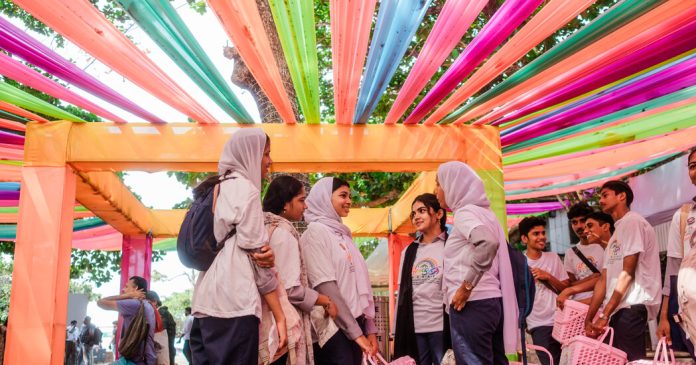
While India may appear consumed by Bollywood, cricket and phone screens, literature festivals are blooming, bringing readers and writers together in hilltop towns and rural communities, under the cover of beachside tents or inside storied palaces.

Some of the festivals, like the one in Jaipur, attract tens of thousands of people. The Mizoram festival, held for the first time in October in Aizawl, the state capital, was a more intimate affair with around 150 guests.

The boom has been driven by young people who, in a country of dozens of languages, are increasingly reading literature in their native tongues alongside books written in English. For these readers, books open worlds that India’s higher education system, with its focus on time-consuming preparation for make-or-break examinations, often does not.

The events’ appeal has widened as organizers have begun promoting Indian writing in languages other than English. The five-day Jaipur festival, which early on focused almost entirely on English-language writing, has in recent years invited more authors who write in languages like Telugu and Malayalam, two south Indian tongues.

To Namita Gokhale, an author and a co-founder of the Jaipur fair, the surge in book-focused festivals — by some estimates there are now as many as 150 — signals a more confident nation.

“There’s a new generation, people who are more naturally bilingual,” Ms. Gokhale said. “A love and respect for the mother tongue is returning.”

The festival season typically runs from October to March, when the weather is pleasant in much of the country. Most are free to attend. For college students, they are venues to explore new topics, meet a favorite author or simply check out the scene.

From self-improvement books like James Clear’s “Atomic Habits” to the best-selling debut novel by Ravi Mantri, who writes in Telugu, young people are reading. And they are eager to expand — and advertise — their literary experiences, meandering through festival book stalls, attending panel discussions and often posting their intellectual “cred” on social media.

“It’s a badge of status for many,” said Harish Bhat, an author and formerly a top marketing executive at Tata Sons, an Indian conglomerate, who has attended at least 15 literature festivals in the past decade.

Readers like Neelam Shravani, a 23-year-old management student, are at the core of the events. In January, Ms. Shravani attended all four days of the Kerala Literature Festival, held in the beach town of Kozhikode, “purely for the love of books.”

She did, however, come with a plan, picking panel discussions based on the authors she most wanted to hear and researching her picks carefully to make her questions “more in-depth.” Listening to Nobel laureates, of whom there were two at the Kerala festival, was of particular interest.

The festival started in 2016, when its founder, Ravi Deecee, the managing partner of DC Books, which publishes literary works in Malayalam, assembled a small army of volunteers to clean up stretches of the beach where trash had been dumped to host a gathering of readers and writers.

The bulk of festival attendees are young people. “It’s a promising thing,” Mr. Deecee said.

This year, half of the festival’s 354 sessions were conducted in Malayalam, and the rest in English and other languages, including French.

Literary classics in regional languages aren’t the only ones selling; new writing is also having a moment.

In 2023, Mr. Mantri, the author who writes in Telugu, released his first book, a love story called “A Few Pages From Mother’s Diary,” expecting to sell a few hundred copies. His publisher, Swetha Yerram of Aju Publications, says it has sold more than 185,000 copies, after young readers created memes about how moved they were by the book. Based on her sales analyses, a majority of its readers are between 25 and 35 years old. It will be translated into English and other Indian languages this year.

Mr. Mantri, who quit his job as a business analyst in Dublin to pursue a literary career, embodies an aspirational Indian for the country’s growing middle class — a successful professional who is both at home in the world and proud of his roots.

“No matter how far you travel, your mother tongue keeps you rooted,” he said. “That is the only language you can speak with your mom, that brings you back to your home.”

Mr. Mantri said he had received daily emails from first-time readers saying they had touched little other than academic texts before picking up his novel. His book, he said, has acted as a gateway to Telugu literature — and literature more broadly.

“Reading is an addiction,” he said. “If you start reading, you cannot stop at one.”

Prarthana Manoj, a 24-year-old who has moderated panels and volunteered at literature festivals, said that young attendees were more curious about topics like class, caste and gender.

“Even if they haven’t read a lot, they are trying to be more inclusive,” Ms. Manoj said. “They have these genuine questions, and you’re like, OK, this is a beautiful crowd.”

Many organizers have borrowed the Jaipur festival’s playbook, which includes panel discussions, book signings, a festival bookstore and other cultural events, but put their own spin on it.

The four-year-old Shillong Literary Festival, in the scenic northeastern state of Meghalaya, celebrates local poetry and traditional storytelling by Indigenous communities, with a backdrop of cherry blossoms. Wayanad, a district in the south Indian state of Kerala, distinguishes itself by hosting India’s “largest rurally held festival.” The Vidarbha Literary Festival in the city of Nagpur in the western state of Maharashtra says it is “dedicated exclusively to nonfiction writing in English in India.”

Srikrishna Ramamoorthy, a venture capitalist and co-founder of the Bangalore Literature Festival, said the fairs had taken off after governments and cultural organizations embraced them as a way to showcase regional writing and culture. “People saw merit to the model,” he said.

For the festival in Mizoram, in the hilly and forested northeast, the intention was to keep it small and invite people to explore the history and culture of the state, which has the second-highest literacy rate in India.

The event connected well-known literary figures among the Mizo ethnic group with the largely Mizo audience, and introduced others to the language and complexities of the region, said Sanjoy Hazarika, a journalist and author who helped put the festival together.

It was “both looking inward and reaching out,” Mr. Hazarika said.

For authors, book festivals are a gift. They have a chance to talk about their work onstage, meet admirers and fellow writers, and sign books.

At the Jaipur festival, fans of the author Sudha Murty stood in line for more than an hour to have her sign copies of her new book. Ms. Murty is the wife of N.R. Narayana Murthy, the billionaire co-founder of Infosys, and the mother-in-law of Rishi Sunak, the former British prime minister, both of whom were in the audience.

Many authors, especially those with new books out, end up hopping from festival to festival. Mr. Bhat, the former Tata Sons executive, said that in the past six months, he had attended the festivals in Bengaluru, Kozhikode and Jaipur to promote his book “Jamsetji Tata: Powerful Learnings for Corporate Success,” which he co-wrote.

“I feel a little bit like a nomad, but a happy nomad, going from one festival to another,” Mr. Bhat said.