Friday, November 13, 2026
Home Blog Page 168

Looking back at Trump’s last State of the Union : NPR

0

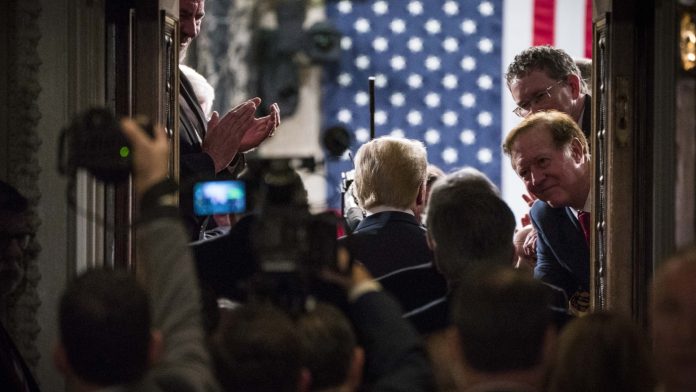
President Trump arrives to deliver the State of the Union address in the chamber of the U.S. House of Representatives on Feb. 4, 2020.

Sarah Silbiger/Getty Images


hide caption

toggle caption

Sarah Silbiger/Getty Images

President Trump returns to the House chamber on Tuesday for his first address to a joint session of Congress since retaking the White House, a moment where he is expected to revel in his shake-up of Washington and lay out some plans for the year ahead.

If past is prologue, some clues about how Trump might approach this routine task of the presidency may be found in Trump’s State of the Union address from 2020.

Delivered the day before the Senate voted to acquit him in his first impeachment case, and as COVID began to spread in the United States, Trump’s 2020 address was part reality TV, part gameshow and part WWE smackdown.

“It was drama-filled … you never knew what was going to come out of the president’s mouth,” said Cheri Bustos, a former Democratic congresswoman from Illinois, who was in the chamber that night. “I mean, it was a State of the Union like none other.”

House Speaker Nancy Pelosi, a Democrat from California, right, rips up papers after President Trump, bottom left, delivers a State of the Union address to a joint session of Congress at the U.S. Capitol on Feb. 4.

House Speaker Nancy Pelosi rips up a copy of President Trump’s State of the Union address on Feb. 4, 2020.

Andrew Harrer/Bloomberg via Getty Images


hide caption

toggle caption

Andrew Harrer/Bloomberg via Getty Images

In normal times, a president’s annual speech to Congress is a recitation of accomplishments, an update on the economy and foreign affairs, with a few new proposals thrown in for good measure.

Compared to past presidents, Trump claims more credit and asks less of lawmakers – and his guests have been chosen to drive a more partisan message, said Donna Hoffman, a political scientist at the University of Northern Iowa whose specialty is the State of the Union.

Hoffman said she thinks these speeches should be a little bit boring. She described Trump’s approach as performative. “It really is very much like a wild card. It has got the flavor of a State of the Union address but then there is that added extra thing there of really kind of inserting that reality television aspect to it.”

In 2020, there was drama before Trump said a word

Even before Trump spoke a word of his last State of the Union address, it was off to a contentious start. Then-House Speaker Nancy Pelosi reached out for a handshake, but Trump left her hanging.

Soon, congressional Republicans in the chamber were chanting “four more years.” It was an election year, and Trump was both embattled and riding high.

Trump didn’t mention the impeachment that had been consuming Washington for weeks, but it hung over the chamber.

“There was no way to divorce the political realities of what President Trump was going through during that very time, from the State of the Union speech,” said Steven Groves, who was a deputy press secretary in the White House at the time.

There were guests — with surprise twists

The White House invited guests in the first lady’s box, as has become the tradition. But Trump added the element of surprise.

For Janiyah Davis, a 4th-grader from Philadelphia, Trump announced he was giving her a scholarship to attend a private school.

Janiyah Davis, a 4th grade scholarship student from Philadelphia, and her mother, Stephanie, are recognized during President Donald Trump's 2020 State of the Union.

Janiyah Davis, a 4th-grade student from Philadelphia, and her mother, Stephanie, are recognized during President Trump’s 2020 State of the Union address.

Tom Williams/CQ-Roll Call, Inc. via Getty Images


hide caption

toggle caption

Tom Williams/CQ-Roll Call, Inc. via Getty Images

And then there was an emotional tribute to conservative talk radio personality Rush Limbaugh, who had recently been diagnosed with Stage 4 lung cancer.

“The unspoken thing was this was likely to be the last State of the Union that Rush was going to be around for — he was that sick,” recalled Groves.

But no one expected what came next. Trump awarded Limbaugh the Presidential Medal of Freedom, right then and there, asking first lady Melania Trump to put the medal around his neck.

Radio personality Rush Limbaugh pumps his thumb after being awarded the Medal of Freedom by first lady Melania Trump. Limbaugh was also acknowledged by President Donald Trump as he delivered the State of the Union address on Feb. 4, 2020.

Radio personality Rush Limbaugh gives a thumbs-up after being awarded the Medal of Freedom during President Trump’s 2020 State of the Union address.

Mandel Ngan/AFP


hide caption

toggle caption

Mandel Ngan/AFP

Republicans loved it. Democrats were shocked. Typically guests who get mentioned in the State of the Union have a story that will bring the country together. Limbaugh was a partisan warrior, beloved on the political right and reviled by the left.

“I just remember on the Democratic side, there were just a lot of eye-rolls around that,” said Bustos.

A series of made-for-TV moments

Trump’s next surprise was one everyone in the chamber would rise to applaud. He introduced Amy Williams of Fort Bragg, N.C., a military spouse with two young children who Trump said had not “seen their father’s face in many months.”

He thanked Williams for her family’s sacrifice — and then came the reveal.

Sgt. Townsend Williams (at right) waves next to his children after returning from deployment in Afghanistan as his wife Amy (second from left) looks on during the 2020 State of the Union address at the U.S. Capitol.

Sgt. Townsend Williams (at right) waves after returning from deployment in Afghanistan, surprising his wife Amy during the 2020 State of the Union address.

Mandel Ngan/AFP


hide caption

toggle caption

Mandel Ngan/AFP

“Amy, there is one more thing,” Trump said, relishing the moment. “I am thrilled to inform you that your husband is back from deployment, he is here with us tonight and we couldn’t keep him waiting any longer.”

The family embraced, reunited as millions of people watched on television.

‘Get on board — or get out of the way’

It wasn’t just the president bringing the made-for-TV moments in 2020. As Trump concluded his address, Pelosi, who had been seated behind him, picked up her printed copy of his remarks, and theatrically ripped them in half.

It was a move that immediately became iconic, with Democrats cheering and Republicans like Groves calling it disgusting.

But the political dynamics this time are remarkably different from 2020, Groves said. For starters, there will be a Republican speaker seated behind Trump.

“He is coming in in 2025, riding the wave of winning the popular vote and both the House and the Senate being in Republican hands,” Groves said.

He said he thinks Trump’s message will not be any more conciliatory than it was in 2020, predicting a “Get on board — or get out of the way” ethos.

Bustos said she expects the unexpected: more breaking of norms, more playing to the cameras.

“Who knows what we’ll see this time? I’ll give President Trump credit: he is not boring,” Bustos said.
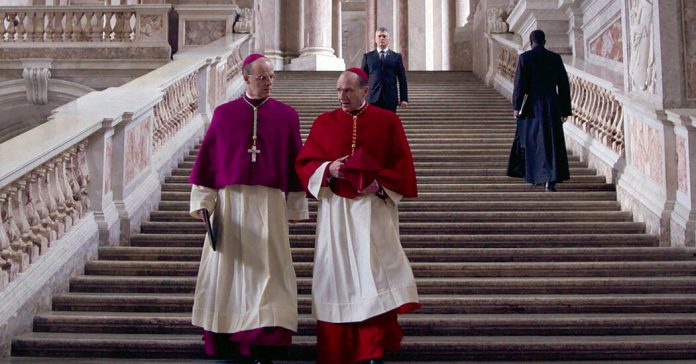

A Papal Primer That’s Fiction, but Also Rings True

0

After back-to-back wins for best picture at the Screen Actors Guild Awards and at Britain’s equivalent of the Oscars, the papal thriller “Conclave” has a chance at a hat-trick on Sunday at the Academy Awards.

The shot at cinematic glory comes at an awkward time: Cardinals and the faithful in Rome have been fervently praying in St. Peter’s Square each evening that life will not imitate art. Millions more are doing so around the world.

Pope Francis, 88, is more than two weeks into a stay at Policlinico Agostino Gemelli, a Rome hospital, for pneumonia in both lungs, along with other infections.

The Vatican said on Sunday morning — two days after a bronchial spasm that required him to undergo noninvasive mechanical ventilation — that the pope was resting after a peaceful night.

On Saturday, the Holy See had reported that Francis was stable and that he was alternating that mechanical ventilation with long periods of high-flow oxygen therapy.

But the crisis on Friday again renewed concerns about the prognosis for the leader of the Roman Catholic Church, and its own future.

The film “Conclave” has become a primer of sorts, giving millions a glimpse into the traditional — and secretive — rituals that regulate the election of a new pope.

The word conclave — from the Latin “with key” — refers to the isolation imposed on the cardinals who are locked inside the Sistine Chapel until a new pope is chosen, which is meant to keep the electoral process from dragging on. The cardinals take a vow of silence that can be broken only with papal permission (though leaks are plentiful).

The film stars Ralph Fiennes as Lawrence, the dean of the College of Cardinals, who in the movie is responsible for leading the papal election, and Stanley Tucci, John Lithgow, Lucian Msamati and Sergio Castellitto as papal contenders.

Their characters are not based on real people, but are instead amalgams of contrasting blocs, traditionalist and progressive, that loosely correlate with existing currents in the church.

Francis has tried to position the church to be more inclusive, giving rise to concern from critics who worry that he is sacrificing its traditions in the process.

He has allowed debates on previously taboo topics — like priestly celibacy, married priests and the extension of sacraments to the divorced. In doing so, he has set in motion subtle shifts toward liberalizing changes that have enraged conservatives for going too far and frustrated progressives for not going far enough.

A conclave will ultimately decide whether the church will pursue Francis’ vision, or shift in another direction.

Alberto Melloni, a church historian who is writing a book about the history of conclaves, said the film drew very precise fault lines, but in real life, cardinals would “not be so open about their antagonisms.”

“But to make a film,” he added, “you have to make explicit what in the real world is implicit.”

“Conclave” is hardly the first film to chronicle a papal election, but it may be the first where so much care has been taken to get the liturgical details right.

Robert Harris, who wrote the novel the film was based on, and the scriptwriter Peter Straughan were able to reflect the precise rules that Pope John Paul II established in 1996 for electing a pope.

Scenes show the Sistine Chapel being swept for electronic listening devices; the Latin oaths the cardinals swear before and during voting; and the tradition of threading the paper ballots after they have been counted so they can be preserved.

For his novel, Mr. Harris said in an interview last year, he turned to the former archbishop of Westminster, Cardinal Cormac Murphy-O’Connor, as a consultant.

When the book was published, Mr. Harris recalled, the cleric wrote him “a very nice letter saying it was just like a conclave and that the research was very good.” (The cardinal died in 2017.)

As for the plot and its surprise ending, the cardinal noted, “it was only a novel,” Mr. Harris said.

The film’s production team also took painstaking care when it came to recreating the Sistine Chapel and the more mundane Domus Sanctae Marthae, the Vatican guesthouse built to house cardinals during conclaves that is currently also Pope Francis’ home.

The production designer, Suzie Davies, who is up for an Oscar along with the set decorator, Cynthia Sleiter, said she had approached the film “more like a ’70s thriller than a religious film,” blending tradition, history and real-life mundanity like “cardinals on cellphones or vaping or going through security machines,” often set against the architecture of 20th-century Rome.

And the cast and crew had some insider training. The Rev. Elio Lops, the parish priest of San Vitale al Quirinale, one of Rome’s oldest churches, first gave the actors a grounding in Catholicism.

“They got a two-month crash course,” he said, including how to make the sign of the cross and to pronounce Latin prayers correctly.

Mr. Fiennes, who is up for best actor, was taught how a cardinal might behave in a particular situation. “It made them all very realistic,” said Father Lops, who also advised on Paolo Sorrentino’s television series “The Young Pope,” and on Fernando Meirelles’ 2019 film, “The Two Popes.”

The Vatican has only made passing mention of the film up to now. A short review in the Vatican newspaper “L’Osservatore Romano” gushed over Isabella Rossellini’s turn as Sister Agnes, and acknowledged the “spectacular” nature of a conclave with its “rituals and myths.”

Cardinal Anders Arborelius, the bishop of Stockholm, said in an interview that he had watched “Conclave” on a plane to Singapore. “It was a bit exaggerated in some sense, but they were good actors,” he said. “It was interesting to see.”

Emma Bubola contributed reporting.

Trump Threats and Mexico’s Crackdown Hit Mexican Cartel

0

One cartel leader says he’s trying to figure out how to protect his family in case the American military strikes inside Mexico. Another says he’s already gone into hiding, rarely leaving his home. Two young men who produce fentanyl for the cartel say they have shut down all their drug labs.

A barrage of arrests, drug seizures and lab busts by the Mexican authorities in recent months has struck the behemoth Sinaloa Cartel, according to Mexican officials and interviews with six cartel operatives, forcing at least some of its leaders to scale back on fentanyl production in Sinaloa state, their stronghold.

The cartels have sown terror across Mexico and caused untold damage in the United States. But here in Culiacán, the state capital, the dynamic seems to be shifting, at least for now. Cartel operatives say they’ve had to move labs to other areas of the country or temporarily shut down production.

“You can’t be calm, you can’t even sleep, because you don’t know when they’ll catch you,” said one high-ranking member of the Sinaloa Cartel who, like other cartel operatives, spoke on condition of anonymity for fear of capture.

“The most important thing now is to survive,” he added, his hands trembling.

The government crackdown on organized crime intensified after the Trump administration threatened retribution unless Mexico halted the supply of fentanyl into the United States, vowing high tariffs if the flow of migrants and drugs continued.

President Trump began floating the possibility of tariffs soon after his election in November, and soon after taking office announced 25 percent levies on Mexican goods if the country didn’t act on border security and drug trafficking. The president gave Mexico a month to deliver results, threatening to enact the tariffs on March 4 if he wasn’t satisfied.

Facing economic chaos, the Mexican government went on the offensive. President Claudia Sheinbaum dispatched 10,000 national guard troops to the border and hundreds more soldiers to Sinaloa state, a major hub of fentanyl trafficking where a cartel war has caused turmoil for months.

“Every day there have been arrests and seizures,” Omar Harfuch, the Mexican security minister, said at a recent news conference after returning from several days in Sinaloa. The detentions have led to “a constant weakening” of the cartel, he said.

The country’s law enforcement seized nearly as much fentanyl in the last five months as it did in the previous year. Ms. Sheinbaum’s administration says it has made nearly 900 arrests in Sinaloa alone since October.

Then, last week, the Mexican government said it had begun sending to the United States more than two dozen cartel operatives wanted by the American authorities. It was a clear signal to the Trump administration that Mexico was eager to fight the cartels, though Mr. Trump said on the same day that he was still not satisfied with the government’s efforts and that tariffs would go into effect on March 4.

“Criminal groups have not felt this level of pressure in such a long time,” said Jaime López, a security analyst based in Mexico City.

In interviews, cartel operatives agreed. Some said they were selling off property and firing unessential personnel to make up for lost income from the dent in the fentanyl trade. Others said they were investing money in advanced equipment to detect American government drones, which the United States flew into Mexico during the Biden and Obama administrations as well.

Criminal organizations in Mexico have a long history of surviving efforts to dismantle them, or simply splintering off into new groups. But several operatives said that for the first time in years, they genuinely feared arrest or death at the hands of the authorities.

Experts noted that a decline in production in Culiacán wouldn’t necessarily affect the flow of fentanyl north, since the drug is easy to make and the cartel can move its labs elsewhere. And it isn’t clear how long any disruption in Culiacán would last. Cooks and experts said they expected the cartel would restart labs in the city if the pressure subsided or the group needed an influx of cash.

But the crackdown has had an immediate impact, they said, and some cited the newfound pressure by Mr. Trump.

“Trump established a deadline, and we are seeing the results of everything we could have seen in years being done in a month,” Mr. López said. “The government is sending a message that when it really wants to, it can exert that kind of pressure.”

But even before tariff threats intensified, Ms. Sheinbaum had showed her willingness to take on the cartels as soon as she took office on October 1.

Her predecessor and political ally, former president Andrés Manuel López Obrador, had pursued a strategy he called “hugs not bullets,” focusing on the root causes of crime and generally avoiding violent confrontations with criminals.

While she pledged allegiance to her mentor’s vision, Ms. Sheinbaum made headlines with a rash of battles between soldiers and cartel gunmen that left dozens dead earlier in her presidency.

Cartel members said they were making their own preparations for the heightened pressure under Mr. Trump. American officials say the United States has recently begun expanding drone flights into Mexico to detect drug labs, and last week the administration designated several cartels as terrorist organizations.

In interviews, cartel operatives said they were importing scanners to detect drones and hiring more people with experience operating and tracking such aircraft. They also said they had increased arms shipments from the United States, the source of most of the illegal weapons used by criminals in Mexico.

Inside the Trump administration, there is still some division over whether the United States should take unilateral military action inside Mexico against the cartels, or whether it should work more closely with the Mexican government in combating the drug trade.

Mexico’s cartels are known for amassing military-grade weapons, including I.E.D.s and land mines, yet the operatives acknowledged in interviews that they could scarcely compete with the American military’s arsenal. Even so, one high-level operative said the cartel would be prepared to respond if raids or strikes were carried out.

“If a helicopter comes here and soldiers drop out, 20 or 30 of them,” the operative said, “there’s no way we’d just sit here with our arms crossed.”

One cartel fentanyl cook, speaking from jail, said he was actually in favor of stepped up enforcement by the Mexican government, because he believed that curbing cartel violence could prevent the “deaths of innocents.”

Last week, Mexican forces arrested two big players within the Sinaloa Cartel who were close associates of Iván Archivaldo Guzmán Salazar, the most powerful son of the drug lord known as El Chapo. After news of the captures spread, the Mexican military deployed a surge of soldiers throughout the city, setting up checkpoints and blocking off entire blocks.

Despite the arrests, the violence in Culiacán keeps claiming lives. On a recent Wednesday morning, the body of a man appeared face down in the middle of a street at a busy intersection, his hands tied and blood pouring from his head.

The next day, a different man’s body was found in a residential neighborhood nearby, with his feet bound and a plastic bag over his head. Officials at the scene said it appeared the victim had been shot dead on the spot.

Ms. Sheinbaum has defended her record on fighting the cartels and hit back hard against the Trump White House’s accusation that the Mexican government has “an intolerable alliance” with drug traffickers.

“We are combating organized crime groups, there can be no doubt about this,” she said at a news conference last month, adding: “We are going after organized crime.”

But few dispute that corruption is rampant in Mexico. The last major crackdown on organized crime was led by a security chief who was later convicted in U.S. federal court of taking bribes from the Sinaloa Cartel.

Cartel members said the only reason the government hadn’t really fought them up until recently was because they’d bought off enough officials. One cartel cell leader said he doubted that this new effort would seriously damage the cartel because the group could ensure its survival by bribing key officials.

“There are always weak points,” he said, “there are always loose ends we can get to.”

When asked how it feels to be labeled terrorists, the cartel operatives responses ranged from apathetic to indignant.

The fentanyl cook in jail argued that the real terrorists were the users in the United States whose insatiable appetite for the drug fuels the trade. The two other young cooks agreed that the worst actors were north of the border: the arms dealers who turn a huge profit smuggling weapons into Mexico that kill so many people.

The high-level operative said he considered himself a businessman, not a terrorist.

“We talk about supply and demand,” he said, “not AK-47s, much less bombing Times Square.”

Even if the government bombs every drug lab in Mexico, he said, it won’t make Americans less dependent on the drug, which is one of the most addictive synthetic opioids available. He said that, with the right ingredients, fentanyl can be synthesized almost anywhere — in tiny kitchens or rudimentary mountain labs — and that as long as Americans want fentanyl, it will get made.

“Demand will never end, the product is still being consumed.” the operative said. “Addiction means demand never ends.”

Judge rules head of watchdog agency must keep his job, says his firing was unlawful : NPR

0

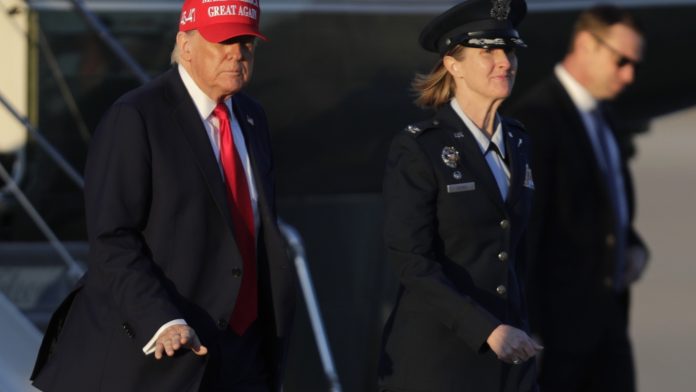
President Donald Trump, left, gestures as is escorted by Air Force Col. Angela Ochoa, commander of the 89th Airlift Wing, center, as he walks from Marine One before boarding Air Force One, Friday, Feb. 28, 2025, at Joint Base Andrews, Md.

Luis M. Alvarez/AP


hide caption

toggle caption

Luis M. Alvarez/AP

WASHINGTON — The head of a federal watchdog agency must remain in his job, a judge in Washington ruled on Saturday, saying President Donald Trump’s bid to remove the special counsel was unlawful.

U.S. District Judge Amy Berman Jackson sided with Hampton Dellinger, who leads the Office of Special Counsel, in a legal battle over the president’s authority to oust the head of the independent agency that’s likely headed back to the U.S. Supreme Court.

Dellinger sued Trump last month after he was fired, even though the law says special counsels can be removed by the president “only for inefficiency, neglect of duty, or malfeasance in office.” Jackson, who was nominated to the bench by Democratic president Barack Obama, quickly reinstated Dellinger in the job while he pursued his case.

Jackson rejected the Trump administration’s claims that the special counsel’s removal protections are unconstitutional because they prevent the president from rightfully installing his preferred agency head.

The judge said allowing the president to remove the special counsel at will would have a chilling effect on his crucial duties, which include guarding the federal workforce from illegal personnel actions, such as retaliation for whistleblowing.

“The Special Counsel is supposed to withstand the winds of political change and help ensure that no government servant of either party becomes the subject of prohibited employment practices or faces reprisals for calling out wrongdoing — by holdovers from a previous administration or by officials of the new one,” Jackson wrote in her decision.

The Justice Department quickly filed court papers indicating it will challenge the ruling to Washington’s federal appeals court. The case has already gone up once to the Supreme Court, which previously temporarily allowed Dellinger to remain in his job.

The ruling comes as Dellinger is challenging the removal of probationary workers who were fired as part of the Trump administration’s massive overhaul of the government. A federal board on Tuesday halted the terminations of several probationary workers after Dellinger said their firings may have been unlawful.

“I’m glad and grateful to see the court confirm the importance and legality of the job protections Congress afforded my position,” Dellinger said in a statement on Saturday. “My efforts to protect federal employees generally, and whistleblowers in particular, from unlawful treatment will continue.”

The judge said the special counsel has a “unique status and mission,” which requires independence from the president to ensure he can carry out his responsibilities. The office investigates whistleblower claims of reprisal, can pursue disciplinary action against employees who punish whistleblowers and provides a channel for employees to disclose government wrongdoing.

“If I don’t have independence, if I can be removed for no good reason, federal employees are going to have no good reason to come to me,” Dellinger told reporters outside Washington’s federal courthouse after a recent hearing.

The Office of Special Counsel is also responsible for enforcing the Hatch Act, which restricts the partisan political activities of government workers. Dellinger’s firing came as Trump administration employees have touted their support on social media for his policies even though the Hatch Act is meant to restrict political advocacy while on duty.

The Justice Department employed sweeping language in urging the Supreme Court last month to allow the termination of the head of an obscure federal agency with limited power. Acting Solicitor General Sarah Harris wrote in court papers that the lower court had crossed “a constitutional red line” by blocking Dellinger’s firing and stopping Trump “from shaping the agenda of an executive-branch agency in the new administration’s critical first days.”

Dellinger was appointed by Democratic President Joe Biden and confirmed by the Senate to a five-year term in 2024.

Europe Is Left with Hard Choices as Trump Sours on Ukraine

0

European leaders have dealt with President Trump’s return to office by trying to keep him cooperating on Ukraine while pushing to ramp up their own defense spending so they are less reliant on an increasingly fickle America.

But Friday’s meeting in the Oval Office, in which Mr. Trump berated President Volodymyr Zelensky of Ukraine, underscored for European leaders that they might need to come up with more concrete plans — and fast.

Following the heated exchange, a visibly annoyed Mr. Trump canceled a news conference with the Ukrainian leader and posted on social media that Mr. Zelensky was “not ready for peace” so long as he has American backing.

His anger — and his threat that the United States could stop supporting Ukraine if it did not accept any U.S.-brokered peace deal — was just the latest sign that Mr. Trump was pivoting American foreign policy away from traditional allies in Europe and toward Russia.

“The scene at the White House yesterday took my breath away,” Germany’s president, Frank-Walter Steinmeier, told D.P.A., a German news agency, on Saturday. “I would never have believed that we would ever have to defend Ukraine from the United States.”

The stark shift in American strategy has left the continent’s leaders reeling. Many worry that if the war ends with a weak deal for Ukraine, it would embolden Russia, making it a greater threat to the rest of Europe. And the change in tone makes achieving greater self-reliance more urgent than ever, even if the European leaders face the same daunting challenges as before.

It would take years to build the weapons systems and capabilities that Europe would need to be truly independent militarily. And supporting Ukraine while building homegrown defenses could take the type of rapid action and united political will that the European Union often struggles to achieve.

“Everything relies on Europe today: The question is, how do they step up?” said Alexandra de Hoop Scheffer, acting president of the German Marshall Fund. “They have no alternative.”

European leaders had already been debating how they could help guarantee security in Ukraine if a peace deal were struck, what terms they would find acceptable, and what they might give Ukraine in their next aid package.

In fact, top officials are poised to meet this week to discuss defense, first in London on Sunday at a gathering organized by Keir Starmer, the British prime minister, then in Brussels on Thursday at a special summit of the European Council, which brings together E.U. heads of state.

Representatives from the bloc’s 27 member countries met on Friday afternoon to come up with a draft of ideas for the meeting in Brussels. The plan included calls to beef up E.U. defenses faster than previously expected, and to more clearly define possible security guarantees for Ukraine, according to an E.U. official briefed on the matter.

And that was before Friday’s exchange between Mr. Trump and Mr. Zelensky.

The flare-up spurred an immediate outpouring of public support for Ukraine from many European officials.

“You will never be alone, dear President,” Ursula von der Leyen, the president of E.U.’s executive arm, wrote in Ukrainian on X on Friday night, in a joint post with other European leaders.

It also prompted calls for fast action, with some European diplomats and leaders hoping that even countries that have been reluctant to increase spending on defense and support for Ukraine will now get on board with a more ambitious approach.

“A powerful Europe, we need it more than ever,” President Emmanuel Macron of France posted on social media. “The surge is now.”

Kaja Kallas, the E.U.’s top diplomat, was even more emphatic.

“We will step up our support to Ukraine,” she wrote on social media on Friday night. “Today, it became clear that the free world needs a new leader. It’s up to us, Europeans, to take this challenge.”

Yet for all of the bracing pronouncements, speeding up Europe’s transition to greater autonomy on defense will be no easy task.

For starters, shouldering a greater part of the financial burden for aiding Ukraine is likely to be expensive. The United States alone has spent about $114 billion on military, financial and humanitarian aid for Ukraine over the past three years, according to one frequently used tracker, compared to Europe’s $132 billion.

Plus, when it comes to European defense more broadly, America provides critical weapons systems and other military equipment that would be near impossible to replace quickly.

“We still do need the U.S.,” said Jeromin Zettelmeyer, director of the Brussels-based research group Bruegel.

E.U. nations have been increasing their military spending in recent years — spending 30 percent more last year than in 2021. But some NATO countries are still short of the goal of members’ spending 2 percent or more of their gross domestic product on defense.

Part of the problem is that spending more on defense typically means spending less on other priorities, like health care and social services. And given economic challenges and budgetary limitations in Germany, France and smaller economies like Belgium, finding the political will to ramp up outlays has been a challenge.

Still, European leaders are trying to find ways to make bloc-wide deficit rules more flexible to enable more military investments.

When it comes to finding more money to support Ukraine, Europeans are not speaking with one voice.

European officials had already been discussing a future aid package for Ukraine, one that could total tens of billions of euros. By Friday night, countries that have been pushing for more ambitious sums were hoping that Mr. Trump’s tone during the Zelensky meeting would help to prod European laggards to open their pocketbooks, according to one diplomat familiar with discussions.

But Hungary is expected to oppose the new aid package for Ukraine, which could force the E.U. into a time-consuming effort of cobbling together contributions from member states, rather than passing a package at the level of the bloc, since the latter would require unanimity.

In a clear sign of the disunity, Viktor Orban, Hungary’s prime minister, stood apart from many other European leaders, thanking Mr. Trump for his exchange with Mr. Zelensky. He wrote on social media that the American leader “stood bravely for peace” even if “it was difficult for many to digest.”

European officials have also been considering whether, when and how to put European peacekeeping forces on the ground in Ukraine if a deal is reached to stop the war. Britain has expressed a willingness to send troops to Ukraine, as has France. Discussions on that are expected to continue this week.

But in light of Friday’s exchange, some say the time for slow-moving deliberation may be over. While officials had just begun to talk about what security guarantees for Ukraine might look like, they may need to begin to quickly think about how to implement them, said Ms. de Hoop Scheffer at the German Marshall Fund.

“This is a time for Europe to very, very seriously step up,” she said.

She added that the Oval Office blowup had underscored that European officials will need to put forward their best mediators to try to keep the United States on board, to the extent possible.

Giorgia Meloni, the Italian prime minister, is seen as one of the closest leaders to Mr. Trump in Europe. She said in a statement on Friday night that she would try to push for a meeting among all of the allies.

“It is necessary to have an immediate summit between the United States, European states and allies to talk frankly about how we intend to face today’s great challenges,” she said. “Starting with Ukraine.”

And earlier last week, both Mr. Starmer and Mr. Macron traveled to Washington to meet with Mr. Trump, gatherings that seemed to go considerably better than the meeting with Mr. Zelensky — even if they failed to achieve major goals like getting a U.S. security “backstop” for peacekeeping troops.

In fact, Mr. Starmer’s plans to debrief European leaders on his trip during the Sunday summit highlights one side effect of the shift in America’s tone: European Union countries and Britain are coming closer together as they draw up defense plans.

That puts Mr. Starmer in a position to play more of a leadership role in dealings with the United States, as Germany works to put together a new government and the French struggle with domestic political challenges.

But as Europe increasingly recognizes that the United States is “super unreliable,” as Mr. Zettelmeyer at Bruegel put it, the time for placating Mr. Trump and hoping for continuity in relations may be past.

“We’ve had several of these shocking moments — every time there’s a shocking moment, there’s a lot of hand wringing,” he said. “The really interesting question is: Is this time going to be different?”

Emma Bubola contributed reporting.

Israel Proposes Temporary Cease-Fire Through Ramadan and Passover

0

Israel proposed a temporary cease-fire extension in Gaza for the Ramadan and Passover holidays, the prime minister’s office announced around midnight on Saturday as the initial phase of the truce was expiring.

It appeared to be the Israeli government’s effort to make its opening negotiating position clear, as it and Hamas struggle to move from the first phase of the cease-fire into a second, more comprehensive phase as the deal initially called for.

The Israeli announcement came after a cabinet meeting led by Prime Minister Benjamin Netanyahu and attended by Israel’s minister of defense, senior defense officials and a negotiating team, according to the prime minister’s office.

But there is still much uncertainty about what will happen next in Gaza. Earlier Saturday, a Hamas spokesman told Al-Araby TV that the militant group had rejected Israel’s framework for an extension, Reuters reported.

Both Israel and Hamas have reasons to avoid another round of fighting, at least for now. Hamas wants to give its forces a chance to recuperate, while Israel wants to bring home the remaining hostages. But the prospect of a comprehensive agreement seems remote.

And Hamas is unlikely to accept Israel’s offer without further negotiations, according to Aaron David Miller, a former State Department Middle East analyst and negotiator who is now a senior fellow at the Carnegie Endowment for International Peace. The proposal, he said, “allows Israelis to get hostages back without making reciprocal commitments.”

Under Israel’s proposal, which it attributed to the U.S. envoy to the region, Steve Witkoff, half of the remaining hostages held in Gaza would be released to Israel on the first day of the agreement.

If, at the end of the temporary extension a permanent truce had been reached, the rest of the hostages would then be returned.

Ramadan concludes at the end of March, while Passover runs until April 20, which under this proposal would give Israel and Hamas about seven weeks to reach a comprehensive agreement.

“Hamas is not going to return all of the hostages until it has ironclad guarantees that the Israelis will withdraw their forces and formally declare and abide by an end of the war,” Mr. Miller said. “No one is going to give Hamas that guarantee,” he added.

Israel and Hamas have accused each other of violating the agreed-upon deal, which was set forth in the final days of the Biden administration. Phase 1 of that deal, which ended March 1, allowed for a six-week truce to negotiate the terms for an end to the war.

The terms of the agreement included the exchange of Israeli hostages for Palestinian prisoners. Israel over the last weekend delayed the release of hundreds of prisoners in protest of Hamas’s having paraded Israeli hostages in public spectacles before handing them over.

The negotiations between Hamas and Israel that were supposed have been completed by this weekend still have not begun in earnest, though officials from each party did visit Cairo, the Egyptian capital, to discuss the next steps. Mr. Netanyahu has stated that Israel was ready to resume fighting if Hamas did not disarm voluntarily.

Hamas has avoided outright calls for a resumption in hostilities, though the group has refused to surrender.

As Ramadan Nears, Syrians Feel the Pinch of a Cash Shortage

0

Days before the start of Ramadan, lines of people snaked down the stairs outside a bank in Syria’s capital, Damascus, waiting for hours to withdraw the equivalent of about $15 for the requisite holiday shopping.

The new government has imposed severe daily withdrawal limits of about that amount at Syrian banks, dampening what would usually be a festive time as many struggle to buy even the basics for the holy fasting month.

“That can buy maybe a kilo and a half of meat,” said Sleiman Dawoud, a 56-year-old civil engineer among those waiting in the A.T.M. line to withdraw that $15 — 200,000 in Syrian pounds. “But what about the bread, and vegetables and fruits? Ramadan is coming, and we need to spend.”

Ra’if Ghnaim, 75, a retired civil servant, fretted about how he would afford the tradition of giving children small amounts of money at the end of Ramadan as he waited to take out some cash.

“How are we going to celebrate and give gifts to the children?” he asked.

This year, Ramadan falls three months after the ouster of the Assad dictatorship that ruled Syria with an iron first for more than five decades. The rebel coalition that has taken over the government in Damascus has instituted several economic changes.

It opened the market to imported products. It eliminated bread subsidies — making the staple food 10 times more expensive. It laid off thousands of public-sector employees. And it capped cash withdrawals at A.T.M.s.

The prices of many goods other than bread have fallen since the new government took over, but many Syrians still can’t buy them because of the withdrawal limits in a cash-based economy where the widespread use of credit cards and e-payments has never taken hold.

Getting cash out has become a part-time job of sorts as Syrians spend hours or even days trying to withdraw enough cash to live, much less splurge during a time of large family gatherings and feasts.

As Syrian pounds have dried up and the government has started shifting economic policy, the currency has begun to strengthen after more than a decade of weakening.

Before the Syrian civil war began in 2011, the exchange rate was about 50 Syrian pounds to the U.S. dollar. When the government was overthrown in December, it was about 15,000, but has since fallen.

The Syrian Central Bank, Economy Ministry and Interior Ministry did not respond to questions.

The Central Bank alluded to the withdrawal limits in a December statement, saying the measures would be temporary. But they have now lasted for months.

This month, a planeload of newly minted Syrian pounds arrived from Russia, where they are printed, according to the state news media. The amount was not made public.

“They indeed do not have enough bank notes. They have a liquidity crisis,” said Karam Shaar, a political economist and senior fellow at the New Lines Institute, a Washington-based think tank, who has been meeting with Syrian officials.

“The current monetary policy that the Central Bank is considering is not finalized, and it doesn’t seem to be coherent” he added.

More than 90 percent of Syrians live in poverty, and one in four is unemployed, according to the United Nations. And on the ground, and in long bank lines across the country, many are suffering.

“We’ll have to cancel the suhoor,” Mahmoud Embarak, a 60-year-old retired military officer, said of the pre-dawn meal that Muslims eat before the start of the daily fast.

He said that the new government had recently cut his pension and that his family was now living off his wife’s nursing pension.

“It won’t be as happy of a time as it has been in the past,” Mr. Embarak added.

Ahlam Kasem, 45, cringed at the mention of Ramadan.

She was waiting in the bank line to withdraw 200,000 Syrian pounds (about $15) from her monthly salary of 380,000 (about $28) as a civil engineer with the agriculture ministry.

“They told us the government doesn’t have any money, the Central Bank doesn’t have, the banks don’t have,” she said. “We have so many questions and there are no answers.”

So, along with her husband, she took a minibus from their town of Saboora, about 10 miles away, and paid 10,000 Syrian pounds each to get to an A.T.M. at the Damascus bank.

She will have to make another trip on another day to withdraw the rest of her salary.

That still won’t buy much for her family of five — much less for the large gatherings to break the fast characteristic of Ramadan.

“There won’t be dinner parties or anything” said Ms. Kasem, who is among the many civil servants who have been laid off with a severance of three months’ salary.

As she spoke, a man rapped on the bank’s metal door, trying to get the attention of an employee inside. No one came.

“We have now gotten to point in Syria where even a cup of coffee may be too much of a hardship for someone to offer you,” she said. “We’re a very social people, but we’ve gotten to the point where we don’t want to visit anyone so as not to put any pressure on them for even a cup of coffee, much less lunch or dinner.”

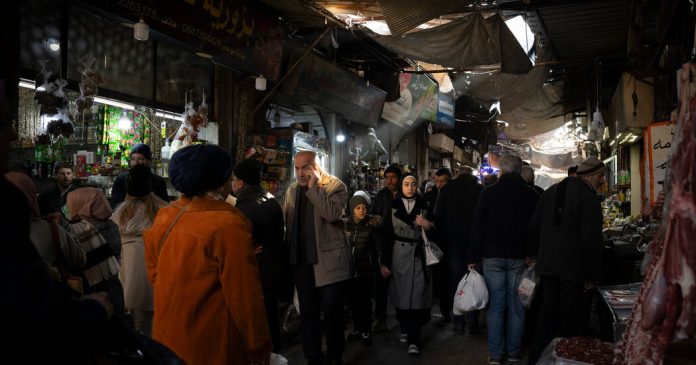
Those concerns were top of mind at the Bab Sraijeh market, a bustling cluster of shops and street vendors along a cobblestone street in the old city of Damascus. The sound of motorcycles driving through occasionally drowned out the competing offers that sellers were yelling out.

“Ten, ten, practically free,” a young man hollered repeatedly, offering a kilogram of olives for 10,000 pounds, less than one dollar.

At a small shop selling Ramadan decorations — wooden crescent moons, colorful lanterns and string lights — it was mostly quiet. Occasionally, someone would inquire about the price of an ornament and then walk off without buying anything.

“People don’t have money,” said Nour al-Hamwi, 37, who was helping her husband at the shop. “The banks don’t have money, Syria doesn’t have money.”

Last year, the items were flying off the shelves, her husband said. Now, people are buying only necessities.

“The Ramadan atmosphere will be weaker this year,” Anwar Hamid said.

Fatima Hussain Ali, 56, and her husband, Ha’il Ali Jasser, 59, were each carrying several stuffed grocery bags of spices, cheese and flour as they made their way through the market.

The staples of Ramadan — olive leaves, oil, rice, bulgur wheat — are cheaper than before the ouster of President Bashar al-Assad. But the couple, who have eight children, were still buying much less than in previous Ramadans.

“Prices are cheaper, but there isn’t money,” she said.

Except for bread, which has gone from 400 pounds to 4,000 pounds.

She doubted they would host any dinner parties this year. If they did, she joked, they might have to ask their guests to B.Y.O.B.: bring your own bread.

Argentina’s Crypto Scandal Swindled Thousands. What Did Javier Milei Know?

0

The scandal began with a tweet.

“The world wants to invest in Argentina,” Javier Milei, Argentina’s president, posted at 7:01 p.m. on Valentine’s Day, offering a code to buy a new cryptocurrency.

The digital coin was called $Libra, and it had been created 23 minutes earlier.

Over the next few hours, thousands of people invested. $Libra’s value skyrocketed.

Then it swiftly collapsed. The largest stakeholders had sold their coins, leaving almost everyone else with a collective $250 million in losses.

To cryptocurrency veterans, it was a classic “rug-pull.” A celebrity touts a new digital coin, prices soar and then insiders who own most of the coins pull the rug: They sell their stakes for a big profit at the expense of amateur investors who got in later.

To Argentina, it was a national scandal. The president, critics said, had just scammed his constituents. The opposition called for impeachment. Argentine citizens filed a dozen criminal complaints. A federal prosecutor opened an investigation, with Mr. Milei as a target.

Then Mr. Milei left for Washington. At the Conservative Political Action Conference on Saturday, he gave a combative speech ahead of President Trump, the other president who promoted a new cryptocurrency this year that soared and then crashed. That coin, $Trump, generated enormous profits for insiders and a cumulative $2 billion in losses for more than 800,000 other investors.

Mr. Trump has claimed ignorance. “I don’t know if it benefited” me, he said. “I don’t know much about it.” (The Trump family and its business partners earned nearly $100 million in trading fees alone on the coin.)

Following the ballooning $Libra scandal in Argentina, Mr. Milei took a similar approach. He did not earn a cent, he said. Instead, he blamed a small start-up in Singapore, KIP Protocol, that few in the crypto industry had heard of.

“You’ll notice that the company that organized the launch, KIP, explicitly stated that I had nothing to do with it,” he said in a prime time interview last week.

But Mr. Milei’s story has begun to unravel, showing how crypto and politics have increasingly blended to enrich the powerful and take from most everyone else.

The origins of the $Libra scandal trace back to a conference in Argentina last year, where an American crypto consultant and an Argentine business partner of Mr. Milei tried to sell access to the president, according to interviews and documents reviewed by The New York Times. It eventually led to meetings in the presidential offices and a planned partnership with Dave Portnoy, the founder of Barstool Sports.

Since the crash, evidence has emerged contradicting the president’s claims; critics in Argentina have accused his inner circle of taking bribes; and the American consultant, whom Mr. Milei last month referred to as an adviser, has admitted to amassing $100 million from the scheme.

“This is an insider’s game,” the American consultant, Hayden Davis, said about crypto coins in a video last week. “This is like an unregulated casino.”

The crypto world was excited about Mr. Milei.

A libertarian economist, he had said he wanted to open his financially scarred nation to new currencies. So when it was announced that he would speak at a crypto conference in Buenos Aires in October, industry leaders descended.

The conference was organized by Mauricio Novelli, a polished 29-year-old stock trader with yearslong connections to Mr. Milei.

In 2020, Mr. Milei began teaching at Mr. Novelli’s small investing academy and became the school’s pitchman, posting repeatedly about it online, up until he was president. In 2022, he posted about a new crypto project from Mr. Novelli, calling it “an economic model that’s sustainable over time.” Not long after, it collapsed.

At the conference, Mr. Novelli was charging sponsors $50,000 for a speaking slot and a meet-and-greet with Mr. Milei, according to four attendees who paid the fee.

Yet those people said the meeting with the president turned out to be a quick group photo. To get more time, two of them said, conference organizers told them it would cost more.

“They’d say, ‘Hey, you know, give us a little something-something and we can get you a meeting,” said Charles Hoskinson, a cryptocurrency billionaire who founded one of the industry’s largest platforms, Cardano.

Another attendee said Mr. Novelli offered a meeting with the president if the person signed a $500,000 contract for vague “consulting services,” according to a copy of the document viewed by The Times.

But Mr. Novelli was not the only one selling access to Mr. Milei.

Mr. Davis — a 28-year-old with curly blonde hair and garish gold glasses whom Mr. Novelli had met at a crypto event in Denver — was also telling conference attendees that he had “control” over Mr. Milei and could broker deals, according to messages viewed by The Times.

“Everything from Milei tweeting” to “all the front-facing Milei stuff basically, showing up at things, et cetera — I have control over a lot of those levers,” Mr. Davis said in an audio message to an entrepreneur, obtained by The Times.

“But,” he added, “there’s a cost.” He insinuated that cost could be in the millions of dollars. “I’m not trying to screw anyone over,” he said, using an expletive.

Another entrepreneur said Mr. Davis made an even more brazen offer in writing: He would deliver a meeting with Mr. Milei and a partnership with the Argentine government in exchange for roughly $90 million in cryptocurrencies over 27 months, according to a copy of the proposal viewed by The Times.

There is no evidence that Mr. Milei was aware of the proposals. Mr. Davis and Mr. Novelli, through spokesmen, declined to comment.

Three months before the conference, in July, Mr. Novelli and Mr. Davis visited Argentina’s presidential offices, according to government records obtained by the Argentine newspaper La Nación. The records show their host was the president’s sister and chief of staff, Karina Milei.

In November, they visited the presidential offices again. Afterward, Mr. Novelli and Mr. Davis toasted with champagne at the Four Seasons in Buenos Aires, telling others they had just signed a deal with the president, according to La Nación.

Then, on Jan. 30, Mr. Milei posted a photo of himself and Mr. Davis, saying the American “was advising me on the impact and applications of” crypto-related technology.

Two weeks after that post, a tech entrepreneur in Singapore got an unexpected call from Mr. Novelli.

The entrepreneur, Julian Peh, founder of a start-up called KIP Protocol, said he had met Mr. Novelli at the October conference. Mr. Peh was one of the few attendees who actually got a sit-down meeting with Mr. Milei. (He said he paid only to sponsor the event.)

But over the next few months, Mr. Peh said, he had no contact with the Argentine president or his office. Then Mr. Novelli called him on Feb. 13 to pitch him on a new project, he said: the launch of a cryptocurrency called $Libra that would ultimately finance small businesses in Argentina.

Mr. Novelli described a plan that involved Mr. Davis launching $Libra and Mr. Peh’s company, KIP, distributing funds to businesses, Mr. Peh said.

It was not his company’s forte — KIP built technology related to artificial intelligence. But Mr. Peh said he agreed anyway.

A day later, $Libra launched with Mr. Milei’s tweet. The president linked to a website describing the $Libra project as having “a clear mission: to boost the Argentine economy.” At the bottom was a single disclaimer: “Private Initiative project Developed by KIP Network Inc © 2025.”

It was before dawn in Singapore. Mr. Peh said he awoke to confused messages from colleagues: What was $Libra?

With the price crashing after the initial boom, Mr. Peh said Mr. Novelli then directed him to post a message on X supporting the coin. Mr. Novelli provided the exact text in English and Spanish, he said.

Mr. Peh said he followed the instructions. “The $LIBRA currency has been a success. We want to thank everyone for their trust and support,” KIP’s account posted. “We would like to clarify that this is a private enterprise project, President Milei was not and is not involved in the development of this project, as he has mentioned himself. This is an entirely private enterprise.”

Two minutes later, Mr. Milei’s account disowned $Libra. “I obviously have no connection whatsoever,” his account posted on X. “I was not aware of the project’s details.” He deleted his initial post promoting $Libra.

Ten hours after that, Mr. Milei’s office released a statement blaming Mr. Peh and calling $Libra the “KIP Protocol project.” The statement said Mr. Peh had pitched the project to Mr. Milei — and that Mr. Peh had introduced the president to Mr. Davis as a KIP representative.

“Mr. Davis had no and does not have any connection with the Argentine government and was presented by the KIP Protocol representatives as one of their partners,” the president’s office said.

That appeared to contradict Mr. Davis’s earlier visits to the presidential offices, including before Mr. Milei and Mr. Peh met.

Mr. Novelli’s company also released a statement blaming Mr. Peh and Mr. Davis for $Libra. It said he had earned nothing.

Mr. Peh said he realized that he had become the fall guy. KIP “became a convenient party to provide cover for other parties,” the company said in a statement.

Part of crypto’s appeal is that transactions are publicly trackable. So experts dug into $Libra — and found a mess.

More than 10,000 crypto accounts, representing 86 percent of investors, lost a combined $251 million, according to Nansen, a crypto data firm.

At the same time, the data showed that accounts connected to $Libra’s launch reaped enormous sums.

Typically, creators of a new cryptocurrency control a large percentage of the supply. But rules programmed into the currency often block those shares from being sold for a set period of time, preventing insiders from taking profits and crashing the price.

However, the crypto accounts that created $Libra could sell immediately. Within hours, those accounts — which controlled 80 percent of the coins — had cashed out nearly $90 million, according to Bubblemaps, a crypto analysis firm.

Another $33 million in profits went to accounts that were created just hours before the launch — and that then quickly bought and sold $Libra after its release — suggesting that whoever controlled them may have known the coin was coming.

Investors were furious. “It was not only about the losses — it was about the insider activity,” said Nicolas Vaiman, chief executive of Bubblemaps. “It shows how deeply rigged the game was.”

A crypto rug-pull is usually mysterious: The money disappears, and no one knows who took it.

Yet a day after $Libra crashed, Mr. Davis came forward. “I’m here to set the record straight,” he said in a video posted on X. “I am indeed Javier Milei’s adviser.”

Then he criticized Mr. Milei. In a statement, Mr. Davis said Mr. Peh was “completely innocent” and that “I can only assume that Milei’s associates attempted to shift blame onto Julian to shield themselves.”

After that, he gave two interviews on YouTube, including to Dave Portnoy, the Barstool Sports founder. Mr. Portnoy said he had a deal with Mr. Davis to promote $Libra, but pulled out at the last minute. “Thank Christ,” he said, adding an expletive.

In the interviews, Mr. Davis said he had controlled enormous amounts of $Libra and sold those stakes when prices were high. He also said the team that created Libra had quickly bought the coin right after it hit the market — a practice called “sniping” widely viewed as deceptive in crypto circles.

Now he had control of $100 million, he said, and wanted to make things right.

“Whose money is it?” Mr. Portnoy asked.

“I mean, it’s, I mean, it’s, it’s, it’s the, I mean, it’s the,” Mr. Davis replied, stammering. “I don’t know. I mean, it’s definitely not mine. It’s, it’s Argentina’s.”

There is no sign that Mr. Davis has returned any money — other than to Mr. Portnoy, who said he lost $5 million on $Libra.

In the interviews, Mr. Davis said so-called memecoins like $Libra and $Trump — crude, speculative cryptocurrencies tied to celebrities or online memes — were essentially rigged.

Data shows that some recent memecoins may have been backed by the same people.

A Bubblemaps analysis showed the crypto account that created $Libra was closely linked to the account that created $Melania, a memecoin promoted by Melania Trump that also collapsed. The two accounts were key cogs in a web of crypto wallets that transferred funds among one another, the analysis showed.

On YouTube, Mr. Davis said he was involved in $Melania but did not elaborate on his exact role.

Ms. Trump’s office declined to comment.

While the cryptoverse was erupting in outrage, Mr. Milei was buffeted by crisis in Argentina.

The stock market dipped. A key political ally, former president Mauricio Macri, called him “careless.” The press labeled the scandal “Cryptogate.”

A federal prosecutor has opened an investigation, including into Mr. Milei’s conduct, and Mr. Milei ordered Argentina’s anti-corruption office to investigate.

Then a more damning accusation arrived: La Nación and the crypto news site CoinDesk published text messages they said showed Mr. Davis telling someone he “owned” Mr. Milei because “I send $$ to his sister.”

Mr. Milei’s sister has long acted as the president’s gatekeeper, and he regularly refers to her as “the boss.”

Mr. Milei’s spokesman, Manuel Adorni, said bribery accusations were “insulting.” Mr. Milei and Ms. Milei did not respond to questions from The Times. Mr. Davis has since denied paying either of them.

When asked on television if any deputy earned money on $Libra, Mr. Milei answered: “That’s not for me to say. I have full confidence in all my officials.” He backed Mr. Novelli and again blamed Mr. Peh.

Yet he added that, regardless, he had little sympathy for the scam’s victims. “If you go to a casino and lose money, what’s your complaint?” he said. “They knew very well the risks.”

Three days later, another cryptocurrency billionaire posted that he wanted to bring a new crypto conference to Argentina.

“THANK YOU VERY MUCH,” Mr. Milei replied. “It would be a great opportunity for our country.”

David Feliba, Daniel Politi and Lucía Cholakian Herrera contributed reporting from Buenos Aires and Natalie Alcoba from Toronto. Kitty Bennett contributed research.

A New Age of Iranian Cinema Is on Display at the Oscars

0

A wife, wearing a nightgown and her hair uncovered, lies down next to her husband in bed. An older man and woman, drunk on red wine, dance wildly and discuss the complexities of sex and nudity at their age. A distressed young woman navigates the sexual advances of a male employer in a job interview.

These scenes may seem to be simply ordinary life snippets on the big screen. But their existence — in three Iranian films released over the last few years — is nothing short of extraordinary, representing a new era of filmmaking in Iran’s storied cinema.

These movies, and the trend they represent, have gained recognition and accolades internationally. One of them, “The Seed of the Sacred Fig,” written and directed by Mohammad Rasoulof, will compete for best international feature film at the Academy Awards on Sunday.

Mr. Rasoulof, 52, is among a number of prominent Iranian directors and artists who are flouting government censorship rules enforced for nearly five decades since the 1979 Islamic revolution. These rules ban depictions of women without a hijab, the consumption of alcohol, and men and women touching and dancing; they also prevent films from tackling taboo subjects like sex.

In a collective act of civil disobedience and inspired by the 2022 women-led uprising in Iran and many women’s continued defiance of restrictive social laws, Iranian filmmakers say they have decided to finally make art that imitates real life in their country.

“The Women-Life-Freedom movement was a pivotal point in Iranian cinema,” Mr. Rasoulof said, referring to the protests that swept across the country in 2022 after a young woman died in police custody while she was detained for violating mandatory hijab rules.

“Many people, including filmmakers and artists in the cinema industry, wanted to break the chains of censorship and practice artistic freedom,” Mr. Rasoulof said in a telephone interview from Berlin, where he now lives in exile.

Mr. Rasoulof’s thriller drama follows a fictional judge for Iran’s Islamic Revolutionary Court confronting the rebellion of his teenage daughters who turn against him as those protests erupt.

The judge’s family drama serves as a metaphor for the larger struggle that is still continuing in Iran, years after the government brutally quashed the protests. Many women still defy the hijab rule, appearing in public without covering their hair and bodies, and young people make clear — by dancing in public spaces, or through their choice of music and clothes — that their lifestyles vastly differ from those of their religiously conservative rulers.

Mr. Rasoulof made the movie without the required governmental approval and licensing, and filmed it in secret. Like all of the daring Iranian films made underground in the last few years, “The Seed of the Sacred Fig” could not be released in Iran and instead was distributed internationally. It is competing in the Oscars as the nominee from Germany, which co-produced it.

Mr. Rasoulof fled Iran in May, just days before the film’s premier at the Cannes Film Festival, and after he was sentenced to eight years in prison and flogging for charges related to his political activism and art. He was previously jailed for eight months in 2022.

Iran’s Revolutionary Court has opened a new criminal case against Mr. Rasoulof, his cast and some members of his crew, charging that the film threatens Iran’s national security and spreads indecency. But he said everyone involved agreed that the risk was worthwhile.

Most of the film’s main cast members have now left Iran, except the leading actress, Soheila Golestani, who is the only one still in the country facing trial in person.

“For me it was more than acting in a movie,” Ms. Golestani, 44, said in an interview from Tehran. “Something like a social responsibility. And of course, presenting a true picture of a woman’s character which never had the opportunity to appear onscreen.”

For actresses, the risks are magnified. Simply letting their hair show in public or in front of the camera amounts to breaking the law. But a number of famous actresses have announced that they will no longer wear hijabs in films, a stand that risks limiting their casting options and incurring the wrath of the government. It has forced some into exile.

Vishka Asayesh, a 52-year-old beloved movie star, left Iran in the summer of 2023 after a run-in with intelligence agents over her support of the protests.

“Enough was enough, abiding by the rules felt like a betrayal of my fans and all the young people courageously protesting,” said Ms. Asayesh, who now resides in New York City. “This was my way of participating in the movement for change.”

The struggle between artistic expression and government control is continuing. A new hit Iranian television series, “Tasian,” set in early 1970s during the rule of the Shah, was abruptly canceled this past week and banned from streaming platforms because its female characters showed their hair (the actresses wore wigs) and danced and drank at nightclubs. The show’s director, Tina Pakravan, defied the authorities by making the entire series available on YouTube for free on Friday. She lives in Iran.

“Why should an artist who should be a mirror of his society be forced to emigrate only because he reflects the desired images of his people?” Ms. Pakravan said in a phone interview from Tehran.

The International Coalition for Filmmakers at Risk, which defends artistic freedom and safety, organized a petition recently signed by more than 100 prominent figures in the global film industry for two Iranian filmmakers, a married couple, Maryam Moghadam and Behtash Sanaeeha, who are facing prosecution related to their critically acclaimed movie, “My Favorite Cake.”

“My Favorite Cake” explores a theme in a daring way not seen in Iranian cinema since the revolution. A man and woman, in their 70s and burdened with loneliness, spend one impromptu romantic night together. They drink wine, dance and discuss sex and their insecurities about stripping bare. In one scene the lead actress, Lili Farhadpour, sprays perfume under her skirt, anticipating sexual intimacy.

“It was time to show the real life of a large portion of Iranian society — the way they go about their days, they way they love and act,” said Ms. Moghadam, 52, in a telephone interview from Tehran.

She and her husband wrote the screenplay two years before the women-led protests that catalyzed so many other directors. Their film has since been screened around the world and has won 17 international prizes, including the jury prize at Berlin International Film Festival and the new director competition at the Chicago International Film Festival.

Like Mr. Rasoulof, they, too, face charges related to national security and spreading indecency in Revolutionary Court that could result to years in prison, and have been barred from leaving the country, working or teaching, they said. Their first trial date is on Saturday.

Mr. Sanaeeha said he hoped that the attention at the Academy Awards on Mr. Rasoulof’s film would result in more support for independent Iranian filmmakers, and that the Academy would change its rules that require international films to be nominated by the government of the country in which they were produced. The rule, he said, effectively shuts out the new wave of groundbreaking Iranian movies.

“Every filmmaker dreams of making movies in their own country,” Mr. Sanaeeha said. “We have never seen our movie on a big screen in the theater or with an audience.”

Leily Nikounazar contributed reporting.

Trump executive order makes English the official language of the U.S. : NPR

0

President Trump speaks to members of the media before boarding Marine One on the South Lawn of the White House on Feb. 28.

Andrew Harnik/Getty Images


hide caption

toggle caption

Andrew Harnik/Getty Images

President Trump has signed an executive order designating English as the official language of the U.S., the first such designation in the country’s history.

The order, which Trump signed on Saturday, rescinds a policy issued by former President Bill Clinton requiring agencies to provide assistance programs for people with limited English proficiency, according to a White House fact sheet. The order allows agencies to voluntarily keep those support systems in place.

“A nationally designated language is at the core of a unified and cohesive society, and the United States is strengthened by a citizenry that can freely exchange ideas in one shared language,” the order said.

English is already the official language in more than 30 states, but Trump’s executive order comes at a time when the number of people in the United States who speak languages other than English continues to grow. Roughly one in 10 people now speak a language other than English, more than triple the amount compared to 1980, according to 2022 data from the U.S. Census.

Trump’s order echoes a longtime campaign pledge and is a move the White House said will “promotes unity, cultivate a shared American culture for all citizens, ensure consistency in government operations, and create a pathway to civic engagement.”

At the same time, some advocacy organizations say the order will hurt immigrant communities and those looking for assistance learning English.

Roman Palomares, who heads the League of United Latin American Citizens, criticized the Trump administration’s move in a statement issued ahead of the order’s official signing.

“Our Founding Fathers enshrined freedom of speech in the First Amendment without limiting it to one language. They envisioned a nation where diversity of thought, culture, and expression would be its greatest strength,” said Palomares.

“Declaring English as the only official language directly contradicts that vision,” he added. “America thrives when we embrace inclusivity, not when we silence the voices of millions who contribute to its success.”