Friday, November 13, 2026
Home Blog Page 169

Gazans Mark a Somber Ramadan Amid the Rubble

0

Bags of fragrant spices, crates of dates, frozen chicken and fresh produce. Food and other goods that were scarce during the war have returned to the shops and street markets of Gaza in time for the holy fasting month of Ramadan. And the Israeli bombs have fallen silent.

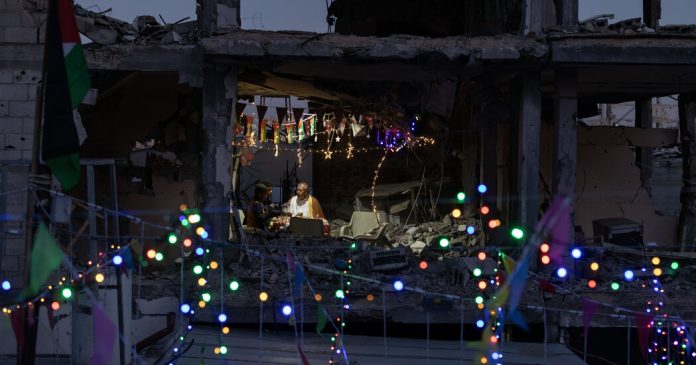
But the shadow of the war hangs heavy over what was once one of the most joyous seasons in the territory, and life in Gaza has not even begun to return to normal. Street vendors have refrained from playing the special songs they normally would during Ramadan and even if there is more food in the shops, many struggle to afford it.

The first phase of a cease-fire between Israel and Hamas has lasted a month and a half, but it was set to elapse on Saturday, which coincides with the first day of Ramadan fasting from dawn to dusk. It could be extended but so far, there has been little progress toward doing so.

Maisa Arafa, 29, who said that her brother had been killed during the war, has been living in a tent with other relatives as they clear away rubble from their devastated home in northern Gaza in hopes of moving into one room that is still intact.

“More than anything, I wish my brother could come back. That would be the only thing to make Ramadan feel like it used to,” Ms. Arafa said as she shopped in downtown Gaza City. “This is not the Ramadan we knew, or even the life we knew.”

Before the war, Ramadan was one of the most joyful festivals in Gaza. Crowds flocked to the mosques, and streets were festooned with colorful lanterns typical of the Ramadan period.

But an enormous gap stretches between the happy holiday memories of a seemingly irrecoverable past and the desolation and grief left by the 15-month war in Gaza. Many Palestinians in the territory see little to celebrate.

Since the Israel-Hamas cease-fire went into effect in mid-January, hundreds of truckloads per day of food and other supplies have been entering Gaza, offering a degree of relief from the intense hunger many suffered during the war. The constant bombardment that haunted civilians’ lives every day for more than a year has ceased.

Farah Irshi, 21, described how the previous Ramadan felt during the fighting between Israel and Hamas. There was little food and about 25 displaced people crowded into their home amid constant bombardment, she said.

“Now there’s more food in the local market as more aid seems to be entering Gaza, but people, including us, have no money at all,” she lamented. “So it’s as if there isn’t anything in the markets, anyway.”

Abdelhalim Awad, who oversees a bakery and supermarket in central Gaza, said that prices had dropped since the worst days of the war, when a 55-pound sack of flour could cost hundreds of dollars.

Many goods — like frozen chicken and cooking gas — are now in shops and street markets, although others, like chocolate, are still scarce, he said. But they are still expensive and many people already burned through their savings during the war to buy hard-to-find, overpriced food.

“The goods are now available, but people are still only able to buy what they really need,” Mr. Awad said as he watched holiday shoppers come and go, buying what they could for communal meals to break the fast at night.

The war began after the Hamas-led assault on southern Israel on Oct. 7, 2023, killed about 1,200 people and saw some 250 others taken back to Gaza as hostages. The subsequent Israeli military campaign laid waste to large swaths of the Gaza Strip.

Many residents are still displaced or have returned to their homes only to find them ruined by the fighting. Some have returned to the camps for the displaced where they spent much of the last year, while others have pitched tents on the rubble where their houses once stood.

The Israeli campaign killed more than 48,000 Palestinians, including thousands of children, according to local health officials who do not distinguish between civilians and combatants. The Israeli military said it had “eliminated” nearly 20,000 Hamas operatives, without providing detailed evidence to back up that claim.

This week, Gazans walked through local markets in central and northern Gaza, looking for whatever they could afford. One vendor showcased heaps of green and black olives, piles of dates and other goods.

Muhanned Hamad, an accountant from Gaza City, stood in front of a toy vendor’s stall in what was historically a major downtown market. He said he was looking for a holiday lantern to give to his neighbors, a mother and son who had lost their immediate family during the war.

“This Ramadan is nothing like the ones before,” said Mr. Hamad, 39. “The war has drained it of meaning,” he added. “Even with the cease-fire, nothing here feels worthy of celebration.”

Ameera Haroudacontributed reporting.

How is DOGE funded?

0

DOGE has a mandate from both President Trump and Elon Musk to make federal agencies more efficient and transparent. But who is making sure DOGE is efficient and transparent?

Lawsuit Against Panama Challenges Detention of Trump Deportees

0

A group of high-profile lawyers on Saturday filed a suit against Panama over its detention of migrants deported from the United States, threatening to disrupt President Trump’s new policy of exporting migrants from around the world to Central American countries.

The lawsuit, filed against the government of Panama before the Inter-American Commision on Human Rights, names 10 Iranian Christian converts and 102 migrants detained at a camp near a jungle in Panama as plaintiffs, according to a copy seen by The New York Times.

The suit argues that the United States violated the Iranian group’s right to asylum on account of religious persecution and that Panama has violated domestic and international laws, such as the American Convention on Human Rights, in its detention of the migrants.

The lawsuit was filed only against Panama, although one of the lawyers involved said he planned to file a separate complaint against the U.S. Department of Homeland Security this coming week.

Responding to a request for a comment on the lawsuit, a spokeswoman for President Raúl Mulino of Panama, Astrid Salazar, said that the migrants “are not detained” by the Panamanian government. “They are not in our command but rather that of IOM and UNHCR.”

The migrants are being held at a fenced camp guarded by armed Panamanian police officers, and Panama’s security ministry controls all access to the facility. The International Organization for Migration and the U.N. Refugee Agency do not have regular presence at the camp, and have said that they are not in charge of the migrants, but rather are offering some humanitarian support, like providing funds for food.

The suit filed on Saturday requests that the commission issue emergency orders saying that none of the detained migrants at the jungle camp should be deported to their countries of origin.

“Panama’s government has no domestic or international authority to detain people under these circumstances,” said Ian Kysel, associate clinical professor of law at Cornell Law School and the plaintiffs’ lead counsel.

In mid-February the Trump administration opened a new front in its efforts to deport millions of people by sending recently arrived migrants from around the world to Central America. About 300 people were flown to Panama and held at a hotel in Panama City, including the 10 Iranian converts, several children among them.

More than 100 people who did not agree to return to their countries of origin were later transferred to a detention camp near the Darién jungle, where they remain.

The Trump administration has since thanked Panama for its assistance in tackling migration challenges. But the arrival of the deportees and their detentions have created problems for the government of Mr. Mulino, which agreed to take the migrants but has received criticism from the United Nations, human rights activists and lawyers for holding them without criminal charges.

The human rights commission is a seven-member body whose decisions apply to members, including Panama. It is meant to be used when individuals feel their domestic legal options have been exhausted or in cases where irreparable harm is imminent and plaintiffs say they need rapid legal protections.

The commission cannot impose sanctions, but ignoring its decisions could come with political risks.

José Miguel Vivanco, an expert on human rights issues in Latin America, said that if the commission ruled in the plaintiffs’ favor, he thought Panama would comply.

Were the commission to rule in favor of the plaintiffs, halting their deportations, it could make it more difficult for Mr. Trump to convince leaders in Panama and elsewhere to take in migrants the United States does not want to deal with.

After sending the migrants to Panama, the Trump administration sent 200 migrants from Central Asia, the Middle East and Eastern Europe to Costa Rica, including dozens of children. As in Panama, the migrants are being held at a remote facility several hours’ drive from the capital.

Mr. Kysel said similar legal actions are expected against other countries in Latin America, including Costa Rica, that are cooperating with Mr. Trump and accepting deportees.

In both cases, the Central American governments said they planned to deport people quickly to their home countries. In the lawsuit, lawyers argue that for the Iranian Christians deportation would carry “irrefutable harm,” because Iran’s law stipulates that converting from Islam is a crime punishable by death.

“I am afraid of what will happen to me at the hands of the government of Panama,” one of the Iranians, Artemis Ghasemzadeh, said in a sworn declaration filed in the lawsuit. “I still want to seek asylum in the United States and pursue a free life as a Christian there.”

Ms. Ghasemzadeh, 27, who fled Iran in December and made her way from Mexico across the southern U.S. border, has been publicizing their ordeal in media interviews. She first attracted global attention when a video in which she recounted being shackled and deported to Panama spread widely online.

The commission typically issues decisions in such cases within days, said Mr. Vivanco.

The bar for the commission to issue protections to plaintiffs is very high, he said. But given Iran’s policy toward converted Christians, he thought the case had a chance. “I think this is going to get the attention of everyone involved,” he said.

Mr. Kysel said he hoped the lawsuit deterred other countries from participating in Mr. Trump’s deportation plans.

“Panama and any other country in the region face legal liability if they receive, detain and deport asylum-seekers summarily expelled from the United States,” said Mr. Kysel.

The lawsuit is a result of collaboration among lawyers and legal groups in multiple countries.

One of the lawyers, Ali Herischi, who is representing the Iranians pro bono, said he plans on filing a separate lawsuit this week against the Department of Homeland Security. The lawsuit would be on behalf of Ms. Ghasemzadeh and the nine Iranian Christian converts, three of them children, in Panama and three Iranians deported to Costa Rica.

A spokesman for the Department of Homeland Security has previously said that none of the migrants had “asserted fear of returning to their home country at any point during processing or custody.”

Ms. Ghasemzadeh contends she repeatedly asked to fill out paper work for asylum but immigration officials at the camp in California where she was held kept telling her this was not the time.

Mr. Herischi said the motion would challenge the legality of their deportation and requests as a remedy that the group be allowed to apply for asylum in the United States.

Why Canada Is Trying to Secure the Border

0

Since President Trump’s election, Canada has intensified its efforts to curb illegal immigration into the U.S. However, with mass deportations underway in the U.S., a new dynamic is emerging at the border. Matina Stevis-Gridneff, The New York Times’s Canada bureau chief, reports from the border.

How Johnson, Who Put His Job at Risk to Save Ukraine Aid, Flipped for Trump

0

The night before Speaker Mike Johnson defied the hard-right wing of his party and brought up a bill to send more than $60 billion in aid to Ukraine, he spent a mostly sleepless night in a luxury hotel suite overlooking the Potomac River, bracing for a mutiny that would end his speakership.

“He was in turmoil,” his wife, Kelly Johnson, recalled of that night last spring, in an interview conducted last fall. “We assumed we were done. I was saying, ‘Well, it’s been great. It’s been a nice, but short little ride.’ We thought we were going home.”

Mr. Johnson spent the night praying in the living room of their suite at the Pendry. In the morning, he told his wife he was going to do what he thought was right, regardless of the personal political cost. He would move ahead with legislation to continue funding Kyiv’s fight against Russian aggression, telling colleagues that he wanted to be on the right side of history.

Less that one year later, Mr. Johnson still has his job and has made a 180-degree conversion on Ukraine. His reversal reflects a broader Republican capitulation to the president even from some of Congress’s most vocal Russia hawks as Mr. Trump pursues warmer relations with President Vladimir V. Putin, blames Ukraine for the conflict and labels its president — but not Mr. Putin — “a dictator.”

The new alignment was on display during an explosive meeting in the Oval Office on Friday in which Mr. Trump berated President Volodymyr Zelensky of Ukraine, ultimately kicking him out of the White House in a dramatic rupture in relations. Mr. Johnson responded hours after the meeting concluded by cheering on Mr. Trump.

“Thanks to President Trump — the days of America being taken advantage of and disrespected are OVER,” he wrote on social media, adding, “What we witnessed in the Oval Office today was an American President putting America first.”

It is a particularly striking turn for the speaker, who less than a year ago was so sold on the worthiness of Ukraine’s struggle against Russian aggression that he was willing to lose his job to ensure continued financial support for it, in what the president now says was a terrible deal for the United States.

Back then, Mr. Johnson engaged in highly secretive talks with top Biden administration officials to figure out how to salvage the aid, going to previously unreported lengths to keep those negotiations under wraps. Now, he is siding with Mr. Trump as he blames those same officials for causing the war and botching the American response.

The Republican speaker doggedly took on naysayers in his own ranks last year, privately making the very arguments in favor of Kyiv that Mr. Trump is now rejecting as he resets American policy toward Russia and Ukraine.

This account of those secret talks and internal conversations is drawn from interviews conducted last fall with people familiar with them, most of whom recounted them on the condition of anonymity for a forthcoming book, “Mad House: How Donald Trump, MAGA Mean Girls, a Former Used Car Salesman, a Florida Nepo Baby, and a Man With Rats in His Walls Broke Congress.”

Mr. Johnson argues that his position has not changed a bit since last year, claiming that he was moving to shore up Ukraine’s standing so Mr. Trump could come in and end the war. But behind the scenes, he was making a much more sweeping case about the need for strong U.S. backing to thwart Mr. Putin’s march and keep peace in Europe.

In the days leading up to last year’s vote, he engaged in tense talks with Representative Marjorie Taylor Greene, Republican of Georgia, who was threatening to oust him from his job if he allowed the Ukraine aid bill to come up.

In one such meeting, Ms. Greene warned Mr. Johnson that the classified intelligence he was relying on to justify sending the funds was exactly the kind of information that had led the United States to search for weapons of mass destruction in Iraq that turned out not to have existed. She warned him to be skeptical of the material he was being “fed” from the intelligence community, because, she said, “they have goals.”

The level of distrust tested Mr. Johnson’s patience.

“What about Trump guys who say if we don’t do this, we’re going to start World War III?” Mr. Johnson asked her — referring to people like John Ratcliffe, Robert O’Brien, Mike Pompeo and Devin Nunes.

“They’re deep state, too,” Ms. Greene shot back. “Once you go to the intel space, you just sell your soul.”.

Wasn’t there anyone at all at the Pentagon whose word she trusted, Mr. Johnson asked. There was not, Ms. Greene responded, saying they all deserved the “deep state” moniker.

Mr. Johnson seethed and forced himself to remember the biblical admonition to be forgiving, even to one’s persecutors.

He asked Ms. Greene whether she had ever served in the military, or visited Europe. She responded that she had not. But she still wanted him to take her gut feeling over all of the intelligence he was being shown? Mr. Johnson was incredulous.

“The American people know,” she shot back. “And you ought to know, if you weren’t such a coward.”

The meeting lasted 90 minutes, an investment of time that Mr. Johnson made because he had to.

At the time, any single member of the House had the power to bring up a motion to oust him from his job, and he knew that Ms. Greene was serious about her threat. Everyone from Mr. Trump on down was pleading with Ms. Greene not to do it, but there was no political downside to her forging ahead.

So Mr. Johnson needed to make Ms. Greene feel heard. He would vent to donors and colleagues that he spent half his days as speaker and the other half as a mental health counselor. Because of his tiny majority, he explained, he could not afford to be at odds with anyone. So he spent countless hours “on the couch” with restive Republicans, listening and gently encouraging them to get back on the team.

Mr. Johnson viewed Ms. Greene, in particular, as more sympathetic to Mr. Putin than anyone he knew. He felt strongly that what he was trying to do was right and some days, he would come home and joke with his wife: “Sure, you’re supposed to bless those who persecute you, but every hour of every day?”

Mr. Johnson wanted to convince Ms. Greene and other Republican holdouts that the briefings he sat through were accurate. Mr. Putin was a threat who could potentially steamroll across Europe after taking Ukraine and threaten one of America’s NATO allies. To those who did not agree, he offered briefings on the intelligence that had persuaded him that Ukraine needed American help. No one ever showed up to receive them.

Mr. Johnson ultimately moved the bill and survived politically, thanks to Democrats’ blocking of Ms. Greene’s motion to oust him. He was elected again as speaker in January, with a hefty assist from Mr. Trump.

Mr. Johnson’s current stance is the one that many people expected of him when the little-known Louisiana lawmaker was elected speaker last year.

Senator Mitch McConnell of Kentucky, then the minority leader, was concerned when Mr. Johnson, a third-term congressman he had never heard of, was chosen to lead the House. Mr. McConnell was staking his legacy on backing Ukraine’s fight against Russia and he was urging the inexperienced speaker to simply put a bill on the floor and see if it had the votes to pass.

“It’s going to take quite a bit of time,” Mr. Johnson told Mr. McConnell. “You’re going to have to trust me on this.”

The problem was Mr. McConnell didn’t, really. He assumed Mr. Johnson, a red-state lawmaker who in the past had voted against aid to Ukraine, would buckle under pressure from the far right.

What he did not know at the time was that Mr. Johnson was deep into talks with top Biden administration national security officials about how to make it work. He held secret conversations with Jake Sullivan, the national security adviser; Antony J. Blinken, the secretary of state; and Steve Ricchetti, President Joseph R. Biden Jr.’s main conduit to Capitol Hill.

Paranoid that the hard right would discover their talks and tank them, Mr. Johnson’s staff tried to put nothing in writing and avoided meeting during work hours. His chief of staff, Hayden Haynes, would sometimes meet Shuwanza Goff, the Biden White House’s director of legislative affairs, at a dog park in their neighborhood at night to trade folders of proposals, as if they were characters in the TV spy show “The Americans.”

It took Mr. Johnson almost two months to get there, but he eventually did.

Last year, Mr. Zelensky singled out Mr. Johnson for praise, saying that his decision to move forward with Ukraine aid was “a show of leadership and strength of the United States.”

These days, Mr. Johnson has been echoing a Kremlin talking point embraced by Mr. Trump, raising concerns about the fact that Mr. Zelensky has not held an election during the war.

“We want to get back to free and fair elections there,” he said. Mr. Putin has been using the absence of an election during the conflict to cast doubt on Mr. Zelensky’s legitimacy.

Mr. Johnson argues that he never changed his stance on Ukraine, defending his decision to send aid to Kyiv as a move aimed at setting up Mr. Trump for success so he could forge a peace deal to end the conflict.

“It put Ukraine in the position where they are right now, to be in a posture where a peace negotiation can take place,” Mr. Johnson said recently. “I knew when President Trump was elected, he would be the changing agent, he would be the force who would come in and move both of those parties to the table.”

And recently it has been Ms. Greene who has taken a victory lap.

On social media this week, she posted a New York Post front page from last year that referred to her as “Moscow Marjorie” and pictured her wearing a fur hat with a communist seal.

“Badge of honor!” she commented.

Illegal Migration to the U.S. Now People Are Heading to Canada.

0

The pre-dawn call by U.S. border agents to their Canadian counterparts was shocking: A group of nine people, most of them children, were about to enter Canada on foot.

On Feb. 3 at 6:16 a.m., when the group was spotted, the border between Alberta and Montana was brutally uninviting, covered in snow, dark with a temperature of minus 17 degrees Fahrenheit.

Grainy night-vision images captured by Canadian border cameras showed two little girls in pink winter wear holding a woman’s hand as they trudged through the snow. More children followed in a line. Another adult dragged two suitcases.

The group of nine people, including children, who crossed the border into Alberta last month, as seen in a video image released by the Royal Canadian Mounted Police.Credit…Royal Canadian Mounted Police

The quick intervention by the Royal Canadian Mounted Police crew that found the group was the result of a newly beefed-up border presence across the vast frontier between the United States and Canada. At 5,525 miles, the border is the world’s longest.

Until recently, the border had been described by both nations as “unguarded,” a testament to their close friendship.

But with the return of President Trump to the White House, it has become a flashpoint in the relationship between the two neighbors.

Even before his inauguration, Mr. Trump accused Canada of allowing large numbers of unauthorized migrants to enter the United States. He has made stopping that movement a key demand as he threatens to impose crippling tariffs on Canadian exports to the United States.

After a one-month reprieve, Mr. Trump says those tariffs will now go into effect on Tuesday.

Canada has mobilized. It has deployed more staff and equipment along the border and tightened visa rules that critics say made Canada a steppingstone to enter the United States illegally.

The number of illegal crossings into the United States from Canada was relatively low to begin with, and has now plummeted, indicating that Canada’s response to Mr. Trump’s pressure is working.

But now a new dynamic is emerging at the border: Asylum seekers are fleeing north to Canada as Mr. Trump has embarked on his plan for sweeping deportations.

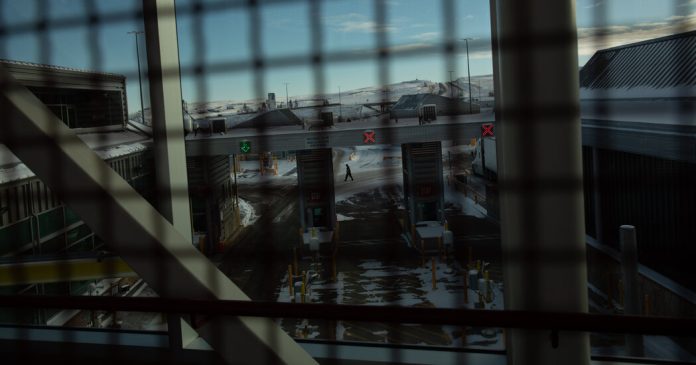
On any given day, the Coutts-Sweetgrass border crossing in Alberta is an orderly hum of trucks, trains and civilian vehicles.

The communities on either side are close in every sense. Hit a ball hard enough on one of the two baseball diamonds in Coutts, Alberta, and chances are it will land in Sweetgrass, Montana.

The two countries’ border authorities even share a building.

“There is close day-to-day communication,” Ryan Harrison, an R.C.M.P. staff sergeant, who heads an integrated border enforcement team, said on a bitterly cold February morning as he drove along Border Road, a gravel lane snaking through plains that marks the border for several miles. “These are people we go for dinner with and attend their retirement parties.”

But Mr. Trump’s criticisms have upended the business-as-usual atmosphere at the border.

Mr. Trump has been particularly alarmed by a jump in the number of unauthorized migrants entering the United States over the past three years.

The number of people apprehended last year crossing from Canada into the United States illegally was nearly 200,000. (That still pales in comparison to crossings from Mexico: Last year, more than two million people were apprehended at the U.S. southern border, U.S. government data shows.)

Canada has directed 1.3 billion Canadian dollars ($900 million) to enhance border security, adding two Black Hawk helicopters and 60 drones equipped with thermal cameras.

It also tightened requirements for temporary visas that some visitors used to arrive in Canada legally but then enter the United States illegally.

The Canadian government says its recent measures have drastically driven down the number of unauthorized crossing into the United States: About 5,000 migrants were intercepted at the border in January, a third of the figure in January 2024, according to U.S. data.

“Whether or not some of the allegations about what is going on at the border are accurate or not, or credible or not, I don’t have the luxury not to take it seriously,” Marc Miller, Canada’s immigration minister, said in an interview on Thursday.

He was in Washington, along with other senior Canadian ministers planning to meet with Trump administration officials in a last-ditch push to avert tariffs.

Mr. Miller said he would explain the measures Canada had taken and how they were working. But he also wanted to talk to U.S. officials about the recent uptick of people arriving in Canada from the United States.

Canada’s focus on the border, against the backdrop of Mr. Trump’s domestic crackdown on migrants, is why the nine people walking into Alberta on Feb. 3 raised alarms: It was unusual to see a group this large crossing on foot in the heart of winter. The presence of young children made it all the more troubling.

The Canadian authorities say they have been intercepting more people arriving from the United States, but because of the schedule Canada follows in releasing data, no numbers are yet available for the weeks since Mr. Trump’s inauguration in January. But government news releases suggest the numbers are rising.

In Alberta, preliminary calculations show that up to 20 people have been apprehended crossing illegally so far this year, including children as young as 2.

By contrast, only seven people were apprehended crossing the border illegally in Alberta in all of 2024.

Of the nine migrants found in Alberta on Feb. 3, seven, including three children ages 13, 10 and 7, were Venezuelans, the R.C.M.P. told The New York Times. The two others were children, 7 and 5 years old, from Colombia.

Staff Sergeant Harrison, who has worked at the border for two years, said,“It’s the first time I’ve seen Venezuelans here.”

Venezuelans fleeing the oppressive government of President Nicolás Maduro have been offered protection across the world. Nearly eight million have fled in the past decade, according to the United Nations, an extraordinary number for a nation not at war.

Under the Biden administration, 600,000 Venezuelans already living in the United States were granted temporary protection and allowed to live and work in the country. More were able to stay under smaller programs.

The Trump administration has ended all protections for Venezuelans, and most programs will expire in the coming months.

The removal of Venezuelans has emerged as a priority in Mr. Trump’s deportation push. Venezuelans described as criminals have been sent to the U.S. facility at Guantánamo Bay, Cuba, while others been deported back to Venezuela.

The Venezuelan government has recently begun arresting not just political activists, but also bystanders at protests, and it’s unclear how it will treat returned migrants.

As a result, Canada has a policy of not deporting Venezuelans.

Canadian border officials declined to discuss what they did with the group of nine migrants detained in Alberta, saying they were protecting their privacy.

But a spokesman for U.S. Customs and Border Protection confirmed that the Canadian authorities had returned them to the United States, and they had been transferred to the custody of Immigration and Customs Enforcement. Their status is unknown.

Canada and the United States regularly return asylum seekers crossing into each other’s territory, on the premise that both countries are equally safe for asylum seekers to lodge their claims, and that they should do so in the first of the two countries in which they arrive. The policy is formally known as the Safe Third Country Agreement.

But the Trump administration’s deportation drive and changes to asylum policies call into question whether the United States is still a safe country for asylum seekers, experts and advocates say, and if Canada should continue sending people back over the border.

“This is the latest sign that Canada is sending people and families with children back to the U.S. with the full knowledge that they are at great risk of being detained and then returned to danger,” said Ketty Nivyabandi, a leader of Amnesty International’s Canada chapter, referring to the nine migrants Canada returned to the United States.

“The Canadian government must not wait a minute longer to withdraw from the Safe Third Country Agreement,” she added.

But such a move would likely encourage more people to seek refuge in Canada, creating new pressures on the country’s already strained immigration system.

“It would almost certainly lead to a surge in unauthorized border crossings,” said Phil Triadafilopoulos, a political science professor at the University of Toronto.

Still, he added, by continuing to return asylum seekers to the United States, Canada is signaling that “it isn’t going to receive people who have lost their temporary protected status in the U.S. as hospitably as it did in the past.”

And as illustrated by the migrants who crossed in Alberta, those groups, he said, can “include small children in really dire conditions, with the full knowledge that the fate of those children and their families is highly uncertain.”

Mr. Miller, the immigration minister, insisted that Canada believes that the United States remains a safe country for asylum seekers.

“We need to have a proper, managed system at the border,” he said. “But it doesn’t mean that we’re naïve, or we’re not watching events that are currently happening in the U.S.”

Hamed Aleaziz contributed reporting from Washington, and Julie Turkewitz from Metetí, Panama.

Welcome to the Zero Sum Era. Now How Do We Get Out?

0

My grandfather’s idea of an Easter egg hunt involved hiding money in colorful plastic eggs sprinkled around his house in Long Island. Most held coins, but there was always one with a crisp, new $100 bill.

My cousin, Billy-O, and I were the only players. We were usually playful partners in mayhem but as competitors, we took on every hunt with gusto, flipping over cushions, throwing open cabinets, knocking each other aside until, without fail, Billy-O found the $100.

The first time he won, I fought back tears. But after a few years of losses, I exploded.

“It’s just not fair,” I yelled.

“Life’s unfair,” my grandfather told us. “You win or you lose.”

This is what’s called zero-sum thinking — the belief that life is a battle over finite rewards where gains for one mean losses for another. And these days, that notion seems to be everywhere. It’s how we view college admissions, as a cutthroat contest for groups defined by race or privilege. It’s there in our love for “Squid Game.” It’s Silicon Valley’s winner-take-all ethos, and it’s at the core of many popular opinions: that immigrants steal jobs from Americans; that the wealthy get rich at others’ expense; that men lose power and status when women gain.

But nowhere is the rise of our zero-sum era more pronounced than on the world stage, where President Trump has been demolishing decades of collaborative foreign policy with threats of protectionist tariffs and demands for Greenland, Gaza, the Panama Canal and mineral rights in Ukraine. Since taking office, he has often channeled the age he most admires — the imperial 19th century.

And in his own past, zero-sum thinking was deeply ingrained. His biographers tell us he learned from his father that you were either a winner or loser in life, and that there was nothing worse than being a sucker. In Trumpworld, it’s kill or be killed; he who is not a hammer must be an anvil.

Mr. Trump may not be alone in this. Vladimir Putin of Russia and Xi Jinping of China have also displayed a zero-sum view of a world in which bigger powers get to do what they want while weaker ones suffer. All three leaders, no matter what they say, often behave as if power and prosperity were in short supply, leading inexorably to competition and confrontation..

Until recently, the international order largely was built on a different idea — that interdependence and rules boost opportunities for all. It was aspirational, producing fourfold economic growth since the 1980s, and even nuclear disarmament treaties from superpowers. It was also filled with gassy promises — from places like Davos or the G20 — that rarely improved day-to-day lives.

“The reversion to zero-sum thinking now is in some ways a backlash against the positive-sum thinking of the post-Cold War era — the idea that globalization could lift all boats, that the U.S. could draft an international order in which nearly everyone could participate and become a responsible stakeholder,” said Hal Brands, a global affairs professor at Johns Hopkins University and senior fellow at the American Enterprise Institute. “The original Trump insight from 2016-17 was that this wasn’t happening.”

What we are now experiencing, especially in the United States, is effectively a rejection of the belief in abundance and cooperation. It is an uprising against the premise that many groups can gain at once — a cynical, contagious us-or-them attitude, spreading across countries, communities and families.

With kids’ games, maybe zero-summing feels like tough love. But on a national and global scale, it’s increasingly hard not to ask: What are we losing with a win-or-lose approach?

Zero-sum thinking probably seemed to make a lot of sense for our evolutionary ancestors, who were forced to compete for food to survive. But the mind-set has lingered and researchers have become more interested in mapping its impact.

The most recent work in the social sciences builds on the findings of George M. Foster, an anthropologist from the University of California, Berkeley. He did his field work in Mexico’s rural communities where he was the first researcher to show that some societies hold “an image of limited good.”

In 1965, he wrote that the people he studied in the hills of Michoacán view their entire universe “as one in which all of the desired things in life such as land, wealth, health, friendship and love, manliness and honor, respect and status, power and influence, security and safety, exist in finite quantity and are always in short supply.”

Psychologists later confirmed that a sense of scarcity and feeling threatened are fundamental components of zero-sum thinking in individuals and cultures. A 2018 analysis of 43 nations, for example, found that zero-sum beliefs tend to emerge more “in hierarchical societies with an economic disparity of scarce resources.”

But zero-sum thinking is a perception, not an objective assessment. Sometimes people will see zero-sum games all around them, even though for most of us, “purely zero-sum situations are exceedingly rare,” as a paper in the Journal of Personality and Social Psychology recently noted.

Think about two co-workers vying for the same promotion: Yes, one might get it and the other not, but over the long term, their fortunes will also rise or fall together based on how their team or company performs. Even in sports — the prototypical zero-sum contest — losing to a stronger competitor can accelerate the development of important skills — as I keep telling my son when his soccer team struggles to score in a tough, local league.

Essentially, many people slip into what Daniel V. Meegan, a psychologist at the University of Guelph in Ontario, Canada, has identified as a “a zero-sum bias.” They believe they are in scenarios of cutthroat competition even when they are not.

Many zero-summers like to picture themselves as tough, hardheaded realists — and sometimes a winner-take-all approach can lead to gains or victory, at least temporarily. But the science says zero-sum thinking is rooted in fear. It mistakes Foster’s “image of limited good” for wisdom and treats potential partners as threats, creating blind spots to the potential for mutual benefit.

That’s why zero-sum thinking can be so problematic: It pinches perspective,sharpens antagonism and distracts our minds from what we can do with cooperation and creativity. People with a zero-sum mentality can easily miss a win-win.

But the far greater danger for zero-sum thinking is the lose-lose.

The last time zero-sum thinking guided the world, Europe’s colonial powers of the 16th to 19th centuries saw wealth as finite, measured in gold, silver and land. Gains for one translated to losses for another and empires levied high tariffs to protect themselves from competitors.

Mr. Trump has romanticized the era’s tail end. “We were at our richest from 1870 to 1913,” he told reporters last month. “That’s when we were a tariff country.”

In fact, the United States is far richer now in household income and economic output. But of greater concern may be Mr. Trump’s refusal to acknowledge the historical context. Economists say the mercantilism and great-power rivalries of that imperial age hindered wealth creation, advanced inequality and often led to the most complete zero-sum game of all: war.

The 80 Years War. The 30 Years War. The Nine Years War. Trade monopolies and empire building produced decades of lose-losing that cost huge sums and caused millions of casualties.

What actually made the United States distinct, according to historians, was a greater adherence to the exuberant capitalism laid out by Adam Smith’s “Wealth of Nations.”

Published in 1776, the book pivoted away from the scarcity assumptions of mercantilism. Smith showed that wealth could be more than metal. It could be everything an economy does, otherwise known as gross domestic product. New riches could be created through productivity, innovation and free markets that let each country prioritize what it does best.

Nonzero-sum capitalism was pretty compelling for a young nation of striving immigrants. (The foreign-born share of the U.S. population peaked at nearly 15 percent around 1890, a fact Mr. Trump also seems to ignore.) And in a lot of ways, free markets and sharing were harder for Europe’s leaders to embrace. World War I and II were both spurred on by zero-sum approaches to international relations.

That line I included high up in this article — “he who is not a hammer must be an anvil”? It comes from a speech that Adolf Hitler gave about the Treaty of Versailles, which forced Germany to pay reparations, disarm and lose territory after World War I.

“If it’s the 1930s, you correctly understand that if countries are not firmly in your bloc, they might be completely mobilized against you,” said Daniel Immerwahr, a historian of U.S. foreign policy at Northwestern University. Only after the war ended, he added, was there an attempt to “change the rules of the game” — to make the world less zero-sum, by assuring countries that they could get rich through trade rather than by seizing land or starting wars.

The United States built and oversaw that system, mainly through organizations like the International Monetary Fund. Which is not to say that Washington’s outlook was never zero sum, or that the United States never got stuck in a lose-lose of its own.

I covered the Iraq war, after President George W. Bush told other countries they had a zero-sum choice: “Either you are with us or you are with the terrorists.”

A few months ago, I opened a new bureau for The New York Times in Vietnam. I now live with my family in a country still dealing with the fallout of a zero-sum civil war that the United States joined because of its own zero-sum belief that any country the Communists won amounted to a major loss for America’s way of life.

The consequences were severe: a toll of three million Vietnamese lives and more than 58,000 American soldiers, plus a legacy of psychological trauma.

Maybe the world can avoid repeating such a catastrophic spiral. The global economy is more interconnected now, a potent disincentive to aggression. Many countries that have also benefited from the postwar system — especially in Europe and Asia — are seeking to protect its principle of peace through cooperative deterrence.

Maybe zero-sum thinking can even encourage restraint. In the same paper declaring that purely zero-sum situations are “exceedingly rare,” two psychology professors, Patricia Andrews Fearon, and Friedrich M. Gotz, found that “the zero sum mind-set predicts both hyper-competitiveness and anxious avoidance of competitions.”

Some zero-summers may not compete, they concluded, because they do not want to cause the pain or face the costs that they think are necessary for success. They also may avoid contests that they do not think they can win.

Mr. Trump may end up fighting and fleeing, depending on the circumstances. He views other nations in only two ways, Mr. Immerwahr said: “Either they are completely in your thrall or they are threats.”

Simplistic, yes, but many Americans also see foreign affairs in blunt, personal terms. After I wrote recently about the painful impact of U.S.A.I.D.’s demise on Vietnam’s Agent Orange victims, one reader emailed a short, telling critique: “Get real. That’s MY money.”

What causes this kind of zero-sum thinking?

Economic inequality fosters such a belief about success. But zero-sum Americans may not really be squabbling over taxes, college, jobs or wealth.

Jer Clifton, a psychologist at the University of Pennsylvania who oversees extensive surveys of primal world beliefs, told me the current backlash may be rooted in a zero-sum conviction about something deeper: importance.

Many Americans seem to fear that if some other group matters more, they matter less. “In 21st-century America, the more common, driving fear is not food or resource scarcity, but not enough meaning,” Dr. Clifton said. “We are a people desperate to matter.”

Under the old order, Americans found meaning in a belief that the United States was special. Our nation was built not on blood or soil but ideas — democracy, freedom, a chance to rise from rags to riches — and we were confident we could inspire and improve other countries.

Today, fewer Americans than ever want the United States to play a major or leading role in international affairs, according to Gallup surveys reaching back to the ’60s. They’re dissatisfied with themselves and the world, and they are wobbly on how to move forward.

Any desired revival of meaning may not come easily. Zero-sum culture breeds hostility and distrust by insisting on domination. You can hear a common response in Friedrich Merz, who is likely to be Germany’s new leader, calling for “independence” from the United States.

“One thing I’ve seen people do if they know they’re being forced into a zero-sum game is minimize investment and hold back resources,” said Michael Smithson, an emeritus professor of psychology at the Australian National University who has studied zero-sum thinking for more than a decade.

Essentially, those who resist the game shun the zero-sum player, who tends to be less happy and hard to be around. Fewer players (and resources) make the game less lucrative — but safer. With time, the “win-winners” add partners and agree to new rules. In the vein of Daniel Kahneman’s book “Thinking, Fast and Slow,” studies have found that people can be taught to see situations as nonzero sum with deliberation and guidance.

Mr. Smithson said he often told students in his classes to see him as their opponent so they would collaborate with one another, not compete.

My grandfather’s Easter egg hunt could have used a similar tilt. With a time limit, Billy-O and I would have had an incentive to cooperate, to make sure we found the $100 egg before the deadline. Instead of win or lose, it could have been “share the work, and the winnings.”

Honduras Moves to Extradite Man Accused of Killing Iowa Woman

0

The government of Honduras said it had begun the process of extraditing to the United States an undocumented immigrant who was accused of killing a young Iowa woman in 2016, a case that President Trump made a focal point in his first presidential campaign.

The move to fulfill a U.S. request to extradite Eswin Mejia comes as Honduras and other Latin American countries have sought to demonstrate their willingness to cooperate with the Trump administration.

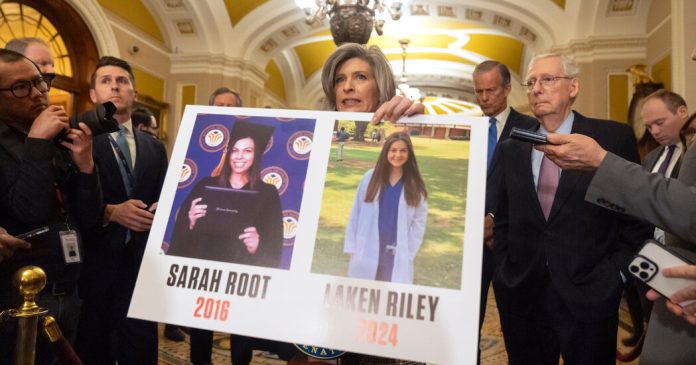
Mr. Mejia was allegedly driving drunk when he crashed into Sarah Root’s vehicle at a stoplight in Omaha in January 2016. He was detained and charged, but fled the country after being released on bond.

He was arrested on Thursday in a town about 125 miles northwest of the Honduran capital of Tegucigalpa, where he was taken and appeared before a Supreme Court judge on Friday, according to Honduran officials.

Enrique Reina, Honduras’s foreign minister, said in an interview that the Supreme Court had ordered Mr. Mejia’s arrest and that a judge would determine whether to grant an extradition request by the United States.

“This has to go through a process,” Mr. Reina said, adding that the Honduran government had received more than 50 extradition requests from the United States since President Xiomara Castro took office in 2022.

The White House did not respond to requests for comment. The State Department referred a request for comment to the Justice Department, which did not respond.

The Trump administration has pressured nations in the region to send individuals wanted by American authorities back to the United States, seeking early wins on the issues of illegal immigration and crime that are central to Mr. Trump’s political brand.

On the same day of Mr. Mejia’s arrest, Mexico sent 29 top cartel operatives wanted by the American authorities. The group includes Rafael Caro Quintero, a founding member of the Sinaloa drug cartel, who was convicted in Mexico of masterminding the 1985 murder of Enrique Camarena, an agent with the Drug Enforcement Administration. This week, the Trump administration also met with a high-level Mexican delegation to try to hammer out a new security agreement.

Ricardo Zúniga, a retired State Department who served as its special envoy for Honduras, Guatemala and El Salvador, said the concessions were part of a broader effort by Latin American countries to showcase their efforts to target criminal groups and illegal immigration as Mr. Trump threatens to impose new tariffs.

“For many governments in the region, having a deal where they give Trump what he wants and in exchange they’re left alone and no one will get in their business, they’re quite comfortable with that deal,” Mr. Zúniga said. “On the other hand, they are quite worried about tariffs.”

The case of Sarah Root, who was 21 when she was killed, became a focus for Mr. Trump during his first campaign in 2016. In that race, he repeatedly emphasized his plans to crack down on illegal immigration and sought to spotlight cases in which undocumented immigrants were accused of crimes.

Unlike Mexico, Honduras does not face imminent tariffs. But the country’s government has been eager to show it is open to working with the Trump administration.

Honduras was left off Secretary of State Marco Rubio’s itinerary through Central America last month, on his first official trip, sending what experts said was a clear message to President Castro.

Last year, Ms. Castro moved to end a longstanding extradition treaty with the United States, and on New Year’s Day, she threatened to expel the U.S. military from an important air base if Mr. Trump carried out mass deportations.

Recently, the Honduran government has reversed course.

Last week, the country agreed to allow its Soto Cano air base to serve as a transfer point for deportation flights from Guantánamo. Venezuelan deportees were flown by American authorities from the naval base to Honduras, where they were transferred to a flight sent by the Venezuelan government.

Mr. Reina, the foreign minister, said then that it was a sign of Honduras’s strengthening ties with the United States.

Honduras has also agreed last month to continue the extradition treaty with the United States that Ms. Castro previously moved to end. Tony García, the deputy foreign minister, said in an interview at the time that Honduras hoped that doing so would lead to “warmer and more fluid relations” with the United States, “because that’s been a thorny topic.”

On Thursday, the Honduran government announced Mr. Mejia’s capture in a social media post and said that the “historic arrest was made possible thanks to the cooperation between the government of President @XiomaraCastroZ and the administration of President @realDonaldTrump.”

Honduras had been aware that Mr. Mejia was in the country for some time, according to a person familiar with the situation, who was not authorized to comment publicly and spoke on the condition of anonymity. The Castro government moved to arrest him quickly after an extradition request from the United States came, the person said.

The Honduran government could still face domestic legal challenges in sending Mr. Mejia back to the United States, the person said. Honduran law makes it difficult to extradite individuals accused of murder.

Mr. Mejia will remain in custody in Honduras until his next hearing in March, authorities said Friday.

His arrest comes as Mr. Trump has continued to link crime to illegal immigration, a centerpiece of his strategy to build support for his anti-immigration agenda. He has had some success. Polling during the most recent campaign showed that Americans supported Republicans more than Democrats on immigration.

One of his first victories of his second term was legislation named for a 22-year-old Georgia nursing student killed last year by a migrant from Venezuela who had crossed into the United States illegally. The bill requires the detention of migrants who enter the country without authorization and are arrested or charged with certain crimes.

While crimes committed by immigrants have received national attention, Mr. Trump also has a long history of inflating their criminality. For the past 150 years, immigrants overall have been less likely to commit crimes than people born in the United States, a 2023 study concluded.

Canada-U.S. Relations Continue to Reach Lows Over Tariffs and Annexation Threats

0

But when Prime Minister Justin Trudeau steps down in a few days, his successor will face the worst relations between the U.S. and Canada since the trade war of the Great Depression. Arguably they are nearing a nadir not seen since the 19th century.

After a week of confusing signals from the White House, Mr. Trump said he was committed to imposing potentially devastating 25 percent tariffs on most exports from Canada except oil and gas, which face a 10 percent tax.

[Read: Trump Says Canada and Mexico Tariffs Will Go Into Effect Next Week]

If we recall when Mr. Trump first started proposing tariffs on Canada and Mexico, which now seems a very long time ago, he had two justifications. He insisted that the U.S. was being overrun by migrants and poisoned with fentanyl coming across the borders with the country’s two major trading partners.

Mr. Trudeau’s government responded with a 1.3 billion Canadian dollar package of measures to fortify the border. He named a “fentanyl czar,” gave the Mounties two Black Hawk helicopters to fly along the border, assigned a large number of their officers to border patrol and bought a variety of surveillance devices, including drones.

Matina Stevis-Gridneff, our Canada bureau chief, went to Coutts, Alberta, to see the project in action. What she found is that instead of stopping migrants coming out of Canada, the new patrols are picking up people fleeing from the U.S.

[Read: Canada Curbed Illegal Migration to the U.S. Now People Are Heading to Canada.]

Mr. Trump’s arguments for tariffs are sometimes based around the view that the U.S. is, as he puts it, subsidizing Canada. The idea is part of a general argument by the president that trade is being used by the rest of the world to “rip off” the U.S. and undermine its industries.

In Canada’s case, his subsidy claim appears related to its trade surplus with the U.S. That surplus is largely a result of oil and gas exports to the U.S. Because Americans receive goods and services from Canada for their money, the trade surplus in no way fits the definition of a subsidy.

My colleagues Ana Swanson, Andrew Duehren and Colby Smith write that “Mr. Trump maintains that tariffs will impose few, if any, costs on the United States and rake in huge sums of revenue that the government can use to pay for tax cuts and spending and even to balance the federal budget.”

But in their analysis of Mr. Trump’s trade pronouncements, they found that “tariffs cannot simultaneously achieve all of the goals that Mr. Trump has expressed. In fact, many of his aims contradict and undermine one another.”

[Read: When It Comes to Tariffs, Trump Can’t Have It All]

If a last-minute reprieve doesn’t come and tariffs are in effect just after midnight on Tuesday, Mr. Trudeau has made clear that Canada will retaliate with taxes of its own.

But they are not likely to make Mr. Trump immediately backtrack, nor will they reverse the plant closings or inflation that most experts and many industry leaders anticipate.

A petition is circulating that calls on the government to revoke the Canadian citizenship of Elon Musk, the multibillionaire whose work for Mr. Trump makes him, it says, “a member of a foreign government that is attempting to erase Canadian sovereignty.”

  • Norimitsu Onishi has written a sensitive and revealing profile of Sandra Demontigny, a 45-year-old mother of three from Lévis, Quebec, who, after being diagnosed with early-onset Alzheimer’s, pushed the province to become one of the few places in the world to allow people to choose a medically assisted death years in advance.

  • Ian Willms, a photographer in Toronto and a regular contributor to The Times, has a powerful visual story of the safe injection site at the city’s Moss Park. Since 2018, it has reversed 3,040 overdoses, Now, a developer is planning to build a condo there. Ontario’s government has said it will stop new safe injection sites from opening, which means this site won’t be allowed a new license to reopen once it’s evicted.

  • A search of the Prairie Green Landfill near Winnipeg has “identified potential human remains.” Matina Stevis-Gridneff and Kim Wheeler report that they “could be the remains of two Indigenous women murdered by a serial killer, a possible breakthrough in a case that has devastated local communities and brought to the fore the issue of violence against Indigenous women in Canada.”

  • In Books, Leah Greenblatt reviews two “highly personal tributes” to Joni Mitchell.

  • Drake has canceled four tour dates in Australia and New Zealand because of what his representatives described as a “scheduling conflict.”

  • Josh Ocampo of Times Insider chatted with me about my job.


Ian Austen reports on Canada for The Times and is based in Ottawa. Originally from Windsor, Ontario, he covers politics, culture and the people of Canada and has reported on the country for two decades. He can be reached at [email protected]. More about Ian Austen


How are we doing?
We’re eager to have your thoughts about this newsletter and events in Canada in general. Please send them to [email protected].

Like this email?
Forward it to your friends, and let them know they can sign up here.

Shocked by Trump Meeting, Zelensky and Ukraine Try to Forge a Path Forward

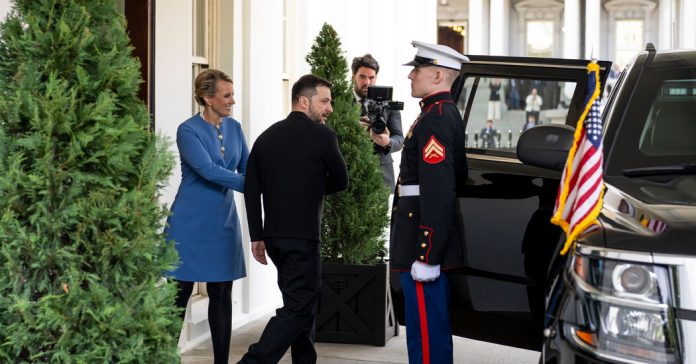
0

For months leading into the American elections last fall, the prospect of a second Trump presidency deepened uncertainty among Ukrainians over how enduring American support would prove in a war threatening their national survival.

After President Volodymyr Zelensky’s disastrous meeting with President Trump in the White House on Friday, many Ukrainians were moving toward a conclusion that seemed perfectly clear: Mr. Trump has chosen a side, and it is not Ukraine’s.

In one jaw-dropping meeting, the once unthinkable fear that Ukraine would be forced to engage in a long war against a stronger opponent without U.S. support appeared to move exponentially closer to reality.

“For Ukraine, it is clarifying, though not in a great way,” Phillips O’Brien, an international relations professor at the University of St. Andrews in Scotland, said in an interview. “Ukraine can now only count on European states for the support it needs to fight.”

An immediate result was that Ukrainians, including opposition politicians, were generally supportive of Mr. Zelensky on Saturday for not bending to Mr. Trump despite tremendous pressure.

Maryna Schomak, a civilian whose son’s cancer diagnosis has been complicated by the destruction of Ukraine’s largest children’s cancer hospital by a Russian missile strike, said that Mr. Zelensky had conducted himself with dignity.

“They gathered with one goal — to pressure us and undermine our authority on the global political stage,” she said of Mr. Trump and his team.

Mr. Zelensky signaled on Saturday that he had not completely given up hope of repairing the relationship with Mr. Trump. Posting on social media, he went out of his way to thank the United States, perhaps trying to address Mr. Trump’s complaint on Friday that he was ungrateful.

“I’m thankful to President Trump, Congress for their bipartisan support, and American people,” he wrote. “Ukrainians have always appreciated this support, especially during these three years of full-scale invasion.”

At the same time, Mr. Zelensky began laying the groundwork for moving ahead with the European countries that have stood by Kyiv’s side. Ukraine announced plans on Saturday for a joint weapons venture with France that would be financed by frozen Russian assets.

Later in the day, Mr. Zelensky was scheduled to meet with Prime Minister Keir Starmer of Britain, who has been a supporter of the Ukrainian president in the face of Mr. Trump’s harsh rebukes. On Sunday, Mr. Zelensky will attend a summit of European leaders hosted by Mr. Starmer.

While much of the focus was on the shocking tone and theatrics of the dressing-down delivered by the American president to a putative ally, Professor O’Brien, the St. Andrew’s scholar, said that Mr. Trump’s comments suggested that the root of the public rupture ran deeper.

“He was trying to pressure Zelensky into agreeing to a cease-fire along Putin’s lines, and Zelensky refused,” Professor O’Brien said, referring to President Vladimir V. Putin of Russia. “Trump comes out and says that explicitly at the end.”

Mr. Trump had shouted at the Ukrainian leader, “You’re buried there,” and said, “Your people are dying. You’re running low on soldiers.”

As Mr. Zelensky tried to defend himself, Mr. Trump talked over him.

“No, listen,” he continued. “And then you tell us, ‘I don’t want a cease-fire. I don’t want a cease-fire.’”

The exchange, Professor O’Brien said, reflects Mr. Trump’s belief that “Ukraine should shut up and take Trump’s and Putin’s terms.”

The real affront that prompted the spectacle, many Ukrainians and analysts believe, is that Mr. Zelensky pushed back against some of Mr. Trump’s terms.

Along the front lines, some soldiers said that the realization was sinking in that Mr. Trump would probably not help Ukraine. “Trump chose his side in this war,” said Pvt. Serhiy Hnezdilov in a telephone interview from the front on Saturday.

Private Hnezdilov said that he supported Mr. Zelensky’s stance, adding that he thought the attempt to humiliate the Ukrainian leader was probably the goal of the invitation to the White House.

“The scandal we witnessed was essentially the only purpose of that meeting,” the private said. “It looked utterly absurd, considering that we, Ukrainians, have always regarded America as an example of democracy and, most importantly, of values.”

Ukrainians may have been naïve, he added.

Still, many Ukrainians were shaken by the public falling-out in Washington, and Mr. Zelensky sought to reassure his war-weary nation on Saturday.

“People in Ukraine need to know they are not alone, that their interests are represented in every country and every corner of the world,” he said in a statement.

Leaders across Europe took to social media to voice support of Ukraine, and Mr. Zelensky offered his personal thanks for every statement while reposting them.

But Mr. Zelensky did acknowledge that losing U.S. military support would be a devastating blow.

“It will be difficult for us,” he told Fox News after the White House meeting. “That’s why I’m here.”

Mr. Zelensky’s domestic standing appeared to be holding steady in the immediate aftermath of the meeting, despite a statement by Senator Lindsey Graham, Republican of South Carolina, calling for Mr. Zelensky to resign or be dismissed. “I don’t know if we can ever do business” Mr. Graham said, only days after praising the Ukrainian leader as an ideal ally.

Mr. Zelensky received a public signal of support from the speaker of the Ukrainian Parliament, Ruslan Stefanchuk, who would assume the presidency if Mr. Zelensky resigned. “Full support for the President of Ukraine!” Mr. Stefanchuk wrote in a social media post.

Opposition figures also backed Mr. Zelensky.

“Though I do not fully agree with President Zelensky’s policies, I must say that I am genuinely grateful to him for withstanding this pressure,” Natalia Pipa, a member of Parliament for the Holos party, said in an interview.

“Trump behaved disgustingly and condescendingly,” she added.

The path ahead for Ukraine, politicians and analysts said, was to try to repair relations with the United States, where defense contractors are one constituency with an interest in continuing American support, while trying to shore up European backing. Mr. Zelensky will also be trying to get a role in the negotiations for a peace settlement, though Mr. Trump seems intent on dealing directly with Mr. Putin.

But the anger directed at Mr. Zelensky in the Oval Office came against a tense backdrop in which Mr. Trump has increasingly aligned himself with the Kremlin in both words and actions.

Since Mr. Trump picked up the phone on Feb. 12 for a 90-minute chat with Mr. Putin, he has called Mr. Zelensky “a dictator”; falsely accused Ukraine of starting the war; and pressed the Ukrainian leader to accede to his administration’s demands, posting that he “better move fast or he is not going to have a Country left.”

Last week, the State Department terminated an initiative that has invested hundreds of millions of dollars to help restore Ukraine’s energy grid after attacks by the Russian military.

While pressuring Kyiv, Mr. Trump has said that he would “love” to see Russia back in the Group of 7 — a gathering of the world’s wealthiest large democracies — and that “it was a mistake to throw them out.”

He offered Mr. Putin generous concessions on NATO and Ukrainian territory even before the talks started, and repeated the Kremlin’s calls for elections in Ukraine.

The White House has also cut funding for pro-democracy programs as part of its efforts to dismantle U.S.A.I.D., a move celebrated by the Kremlin.

The Trump administration has also offered public support for far-right parties in Europe known for their support of Moscow, including the AfD in Germany.

The U.S. attorney general, Pam Bondi, has also disbanded an F.B.I. task force focused on investigating foreign influence operations, and the secretary of defense, Pete Hegseth, has ordered that Russia be removed as a target of U.S. cybersecurity planning.

Washington also sided with Moscow in a vote at the United Nations that would have condemned Russian aggression on the third anniversary of the Ukraine invasion — breaking with allies to join a small group of nations including North Korea and Belarus.

Having endured years of loss and suffering, Ukrainians would like nothing more than to see an end to the war, but not if the price is their freedom, Mr. Zelensky has been insisting.

Natalka Sosnytska, program coordinator at a Ukrainian organization that helps children with war trauma, echoed that sentiment. “Of course, we want peace, but only after our victory,” she said. “By standing his ground, Zelensky preserved our dignity as a nation.”

Liubov Sholudko and Yurii Shyvala contributed reporting.