Friday, November 13, 2026
Home Blog Page 170

Alaska National Park workers say their firings were illegal : NPR

0

Eileen and James Kramer in Alaska’s Lake Clark National Park where they’ve worked for about the past decade. After getting promotions, they were both suddenly fired by the Trump administration earlier this month.

Eileen and James Kramer


hide caption

toggle caption

Eileen and James Kramer

Two weeks ago, Eileen Kramer and her husband James each received termination letters in their email inboxes.

“They were saying we were underperforming, which isn’t true,” Eileen said.

The couple, who live and work in the sprawling 4-million-acre Lake Clark National Park in Alaska, may soon have to vacate the house they’re living in because it is owned by the Park Service.

“It’s more than just losing our job,” James said. “We’re losing our life.”

“We’ve given so much to this place and we’ve created a life here,” explained Eileen, “and that’s being taken away dishonestly.”

The couple has worked in Lake Clark for about 10 years. She’s in logistics, he’s a biological science technician. They were both recently promoted. Those promotions put them into probationary status in their new positions.

The Trump administration has fired tens of thousands of federal workers with “probationary” status, which usually means newer workers, and makes them easier to let go. But those workers still have some rights and protections, and many say the administration has used false pretenses to fire them.

On Thursday, a federal judge in San Francisco sided with the workers in a lawsuit brought by unions and civic organizations. The judge ruled specifically that the Trump administration’s Office of Personnel Management (OPM) exceeded its authority by directing federal agencies to carry out these mass firings. The government had argued it didn’t because each agency made its own decisions. But U.S. District Judge William Alsup, an appointee of former President Bill Clinton, said he didn’t believe that.

“Plaintiffs … have mustered a mountain of evidence that points in the other direction, from a broad range of federal agencies,” the judge wrote in his order.

It’s not yet clear exactly how the ruling is going to affect the thousands of workers who were already let go.

“ I got an award in efficiency last year”

A federal agency is allowed to fire a probationary worker for bad performance or conduct.

The OPM sent letter templates to agency officials in its guidance about firing probationary workers, and the administration fired many for poor performance — even though workers like James and Eileen Kramer say that’s a lie.

“They obviously didn’t look at our personnel file because we have evidence showing that we’re great performers and we’ve exceeded expectations and we’ve received performance awards,” James said.

“ I got a regional award specifically in efficiency last year,” Eileen said. “So it’s a little bit ironic to me that I’m being terminated as part of this government efficiency initiative,” referring to the Elon Musk-aligned Department of Government Efficiency.

The Trump administration has maintained that it is simply trying to root out waste, fraud and inefficiency among the federal workforce of 2.3 million people.

But the lawsuit filed in federal court in San Francisco on behalf of thousands of federal workers claimed that the only fraud here is being committed by the administration.

“[The Trump administration] in one fell swoop has perpetrated one of the most massive employment frauds in the history of this country, telling tens of thousands of workers that they are being fired for performance reasons, when they most certainly were not,” the lawsuit stated.

The White House hasn’t responded to that specific accusation of fraud, but the government had said in a court filing that the “probationary period is part of the hiring process; agencies are not required to hire every employee whose performance is ‘satisfactory.’ “

In his order, Judge Alsup agreed that the firings were not in fact based on performance: “It is unlikely, if not impossible, that the agencies themselves had the time to conduct actual performance reviews of the thousands terminated in such a short span of time. … It is even less plausible that OPM alone managed to do so.”

Michelle Bercovici is a lawyer working on another legal effort to help probationary federal workers who were let go.

 ”They had good performance, a good relationship with their supervisor, and were terminated using the same letter,” Bercovici said. “This is an attempt to circumvent various procedures, policies or requirements designed to protect employees.”

Bercovici has petitioned a federal watchdog entity, the Office of Special Counsel, and managed to secure a stay forcing the rehiring of a small initial group of six federal workers. Working with the nonprofit Democracy Forward, she is hoping to expand the stay to reach thousands of other federal workers.

“We are trying to advocate for as broad a stay as possible,” Bercovici said.

Bercovici says if a government agency wants to do a mass layoff, that’s known as a “reduction in force” and there are rules that need to be followed.

“ It’s a fair, clearly laid-out process,” she said. “It requires a lot of planning.”

Eileen and James Kramer in 2019 by a National Park Service airplane after an aerial telemetry mission tracking radio collared caribou to estimate population.

Eileen and James Kramer in 2019 by a National Park Service airplane after an aerial telemetry mission tracking radio collared caribou to estimate population.

Eileen and James Kramer


hide caption

toggle caption

Eileen and James Kramer

At the National Park in Alaska, Eileen and James Kramer said there was no apparent planning behind the layoffs there. They said half the staff who live onsite at the park were fired, including a 20-year veteran employee at the park who they say was the one person who knew how to keep all the boats, heaters, trucks, snowmobiles and all sorts of other equipment running.

Since he recently became a supervisor they say he was in probationary status too.

“He’s also emergency response, he’s a boat captain,  he’s the one that’s gonna come rescue you if you get in trouble in the backcountry,” Eileen said.

James added: “The superintendent even said, ‘You can fire me, the park will still run without me, but without Warren, we can’t do anything.’ “

The couple said none of these firings appeared to have anything to do with waste or inefficiency.

They say their former supervisors haven’t yet been told by the National Park Service if the ruling in federal court will result in them being reinstated to their old jobs.

“But we are heading into the weekend with somewhat lighter hearts,” Eileen said.

Have information you want to share about ongoing changes across the federal government? NPR’s Chris Arnold can be reached at [email protected] or contacted through encrypted communications on Signal at ChrisArnold.07.

Trump’s Dressing Down of Zelensky Plays Into Putin’s War Aims

0

President Trump says he wants a quick cease-fire in Ukraine. But President Vladimir V. Putin of Russia appears to be in no rush, and the blowup on Friday between Mr. Trump and Ukraine’s president may give Russia’s leader the kind of ammunition he needs to prolong the fight.

With the American alliance with Ukraine suffering a dramatic, public rupture, Mr. Putin now seems even more likely to hold out for a deal on his terms — and he could even be tempted to expand his push on the battlefield.

The extraordinary scene in Washington — in which Mr. Trump lambasted President Volodymyr Zelensky of Ukraine — was broadcast as the top story on state television in Russia on Saturday morning. It played into three years of Kremlin propaganda casting Mr. Zelensky as a foolhardy ruler who would sooner or later exhaust the patience of his Western backers.

For the Kremlin, perhaps the most important message came in later remarks by Mr. Trump, who suggested that if Ukraine didn’t agree to a “cease-fire now,” the war-torn country would have to “fight it out” without American help.

That could set up an outcome that Mr. Putin has long sought, at the cost of tens of thousands of Russian lives: a dominant position over Ukraine and wide-ranging concessions from the West.

In fact, Mr. Trump’s professed attempts to end the war quickly could intensify and prolong it, experts warned. If the United States is really ready to abandon Ukraine, Mr. Putin could try to seize more Ukrainian territory and end up with more leverage if and when peace talks ultimately take place.

“Russia will be willing to keep fighting for longer, and more bitterly,” said Konstantin Remchukov, a Moscow newspaper editor with Kremlin ties, describing the consequences of Mr. Trump’s public break with Mr. Zelensky. “If Zelensky says the Ukrainian people are ready to keep on fighting, Moscow will say: ‘Sure, let’s keep fighting.’”

If Friday’s angry encounter in Washington leads to a further drop in U.S. military support for Ukraine, Mr. Remchukov said in a phone interview, the consequences could be profound, possibly even encouraging Mr. Putin to return to the broader territorial aims he pursued when he began his invasion in 2022.

“I wouldn’t be surprised if Moscow decided to go further, to Odesa or Mykolaiv,” Mr. Remchukov said, referring to key Black Sea ports that remain under Ukrainian control. “It could change the strategic direction of the offensive.”

Despite the striking alignment that has emerged between Mr. Trump and Mr. Putin in recent weeks, many analysts have spotted a key difference in their views. While the American president says he wants to “stop the death” in Ukraine as soon as possible, the Russian leader says he wants to resolve the “root causes” of the war first.

For Mr. Putin, that terminology is code for his desire for a wider deal that would prevent Ukraine from joining NATO, limiting the size of its military and granting Russian influence over its domestic politics — along with a broader pullback of the NATO alliance across Eastern and Central Europe.

Such a deal, of course, would take months to negotiate, which is why Mr. Putin has appeared resistant to the idea of a quick cease-fire. The spat in the White House on Friday appeared to play into the Kremlin’s hands, because it may convince Mr. Trump that Mr. Zelensky, rather than Mr. Putin, is the more recalcitrant of the two leaders.

“You tell us, ‘I don’t want a cease-fire,’” Mr. Trump told Mr. Zelensky in the Oval Office. “I want a cease-fire, because you’ll get a cease-fire faster than an agreement.”

Mr. Zelensky on Saturday reiterated his opposition to a quick cease-fire with Mr. Putin, saying that the Russian leader could not be trusted to uphold one. Instead, he said, Ukraine needed security guarantees from the West to deter future Russian attacks.

But Mr. Zelensky also signaled that he had not completely given up hope on repairing the relationship with Mr. Trump. And since the Friday meeting, he has publicly expressed thanks for American support, after Vice President JD Vance accused him of not being grateful enough.

A Moscow foreign-policy analyst who is close to the Kremlin said on Saturday that any delay to peace talks was likely to benefit Russia, because there was no deal in sight at present that would satisfy Mr. Putin. The analyst insisted on anonymity because of the sensitivities in Moscow of speaking to Western journalists.

Dmitry Suslov, an international relations specialist at the Higher School of Economics in Moscow, said in comments published by the Kommersant newspaper that Mr. Trump would become “even more favorable to Russia’s position on a settlement” after “the fiasco of Zelensky’s negotiations with Trump.”

Mr. Suslov also raised the possibility of Russia’s being able to grab far more than the roughly 20 percent of Ukrainian territory in the country’s south and east that Moscow now holds.

If the United States stops providing weapons and intelligence to the Ukrainian military, Mr. Suslov wrote, “the pace of Kyiv’s defeat on the battlefield will accelerate, with the prospect of a complete collapse of the front within months.”

Friday’s scene was a boon for Moscow in other ways, too. It may have helped advance, in just a matter of minutes, one of Mr. Putin’s longtime goals: the removal of Mr. Zelensky from power in Ukraine.

Immediately after the White House meeting, Sen. Lindsey Graham, the South Carolina Republican who has been one of his party’s staunchest backers of Ukraine, said, “I don’t know if we can ever do business with Zelensky again.” He called the Ukrainian leader’s behavior in the Oval Office “disrespectful.”

The public dressing-down of Mr. Zelensky also accomplished another longtime goal of Mr. Putin’s: cleaving the Western military alliance led by Washington that united behind Ukraine after Russia’s 2022 invasion. European leaders immediately came out in support of Ukraine after the meeting, setting up a possible split with the United States, their longtime security backer.

Russian officials could hardly control their glee.

Dmitri A. Medvedev, the former Russian president who is deputy chairman of the country’s security council, cheered Mr. Trump on with a post on X, piling on to denounce Mr. Zelensky as an “insolent pig.”

And Konstantin Kosachev, a senior Russian lawmaker, wrote on the Telegram social network, “Zelensky lost this round in a resounding crash,” adding, “He will have to crawl on his knees to the next one.”

Pro-Kremlin commentators who for years have been hurling invective against the United States could barely believe their change in fortune.

Igor Korotchenko, a military analyst who is a regular on Russian talk shows, wrote that he never thought he would be applauding the president of the United States.

“But tonight I applaud the 47th President of the United States Donald Trump — Zelensky was thrown out of the White House like a garbage alley cat,” Mr. Korotchenko wrote in a post on X.

Yet for all the schadenfreude in Russia, Friday’s bitter meeting in Washington did little to illuminate a pathway toward a settlement. And while Mr. Putin may want to extend the war, he could also suffer if it goes on much longer, given the country’s economic problems and steep battlefield casualties.

“The Russian leadership would like to end the war on its own terms, not just restore ties with the U.S.,” Grigorii Golosov, a professor of political science at the European University in St. Petersburg, said in a phone interview. “The prospects for that are not clearer at all despite what happened yesterday.”

Trump is a professional wrestling fan. Here’s how his politics echo the sport : NPR

0

It’s well known that President Trump is a devotee of professional wrestling. Pundits often  describe his moves in the White House in wrestling terms: smackdowns, cage fights and so on. We ask how the wrestling world may be informing his second term.

In U.S., Tate Brothers Are Met With a Mixed Reception

0

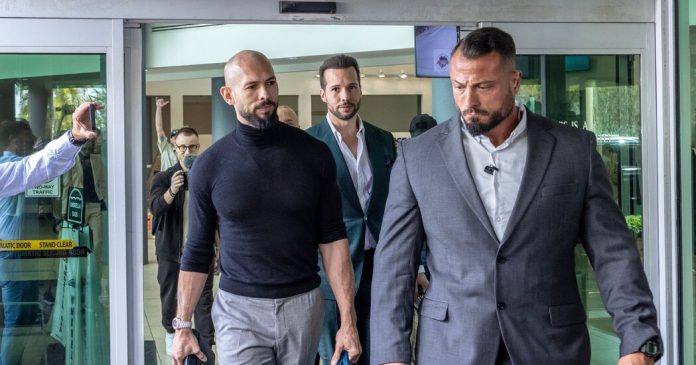
Andrew Tate rose to fame on a message of forceful masculinity that positioned men as rightful dominators over women. From his base in Romania, he promised to help guide men through “the Matrix,” his conspiratorial term for a world that he says unfairly demonizes men, and called the criminal accusations against him evidence of persecution.

Now, the sudden arrival of Mr. Tate and his brother Tristan Tate in Florida has alarmed women’s rights groups and women who say they have been victimized by the brothers.

Questions over whether U.S. officials intervened to help the Tates have only added to concerns that their ideology will thrive, even as they face separate investigations in Romania and Britain.

Here is what to know about the response to their arrival in the country.

“It felt like their power knows no bounds,” said Dani Pinter, a lawyer representing an American woman who has accused the Tate brothers of luring her to Romania to exploit her.

The client, who has sued the brothers in a Florida court, was “terrified and shocked” that they had come to the state, said Ms. Pinter, a senior vice president at the National Center on Sexual Exploitation.

After their arrival, Ms. Pinter called it “a slap in the face to all the victims of the Tate brothers, especially the U.S. victim who is not being protected by her country.”

The brothers had been held in Romania since 2022, first over accusations that they romanced women with the intention of forming a criminal group to exploit them for financial gain, and then over sex crime charges from the British authorities.

They have denied any wrongdoing and sued one of Ms. Pinter’s client for defamation. “We’ve yet to be convicted of any crime in our lives, ever,” Mr. Andrew Tate said after landing in Florida on Thursday.

Four British women who sued Andrew Tate in Britain over claims that he had raped and abused them urged the British government on Friday to immediately request the brothers’ extradition from the United States. The British authorities have sought their arrest over separate criminal accusations of rape and human trafficking.

If the government does not request the extradition, “it won’t just be us it will be failing, but all British victims of alleged sexual violence,” the women said in a statement. A spokeswoman for the British Home Office, which oversees policing and crime policy, declined to say whether any extradition request had been made or received.

“I am really concerned that we are going to see their following grow and more of their followers feel like they’re going to be invincible,” said Christian F. Nunes, the president of the National Organization for Women. Officials and others need to respond by being “vocal defenders” of women and girls, she said.

The brothers, who have zealously supported President Trump, have previously found support from his associates, including the president’s eldest son, Donald Trump Jr. The Tampa Bay Young Republicans called the brothers “free speech absolutionists” and welcomed them to the state.

But Gov. Ron DeSantis, a Republican, said the Tates were not welcome in Florida, and the state’s attorney general, James Uthmeier, also a Republican, said that his office would conduct a “preliminary inquiry” into the brothers. “Florida has zero tolerance for human trafficking and violence against women,” Mr. Uthmeier said on Thursday.

A lawyer for the influencers said on Thursday that he had lobbied American lawmakers on the brothers’ behalf, but declined to comment on whether that effort had been successful. Romanian officials have denied any intervention from U.S. officials in the case.

Still, the ties to the administration left women’s rights groups worried that the brothers and their views would be bolstered in an environment where the administration has targeted diversity, equity and inclusion programs and protections against gender discrimination.

The Tate brothers, much like Mr. Trump, have tapped into the genuine suffering that men and boys experience as they struggle with loneliness, suicide, drugs and the feeling that their identities as men have been demonized, said Cynthia Miller-Idriss, the founding director of the Polarization and Extremism Research and Innovation Lab at American University in Washington.

The brothers have sold access to an online community and courses that promised to teach men how to use women to build wealth.

They offer the narrative, Dr. Miller-Idriss said, that “you can be back on top — all you have to do is dominate women.”

“To some extent, a lot of boys and men feel like he’s saying the things nobody else will say,” she said, “and the MAGA campaign and the Trump campaign has done the same thing.”

What happens now that the brothers are in the United States remains unclear. Joseph McBride, a lawyer for the brothers, did not respond to a request for comment on Friday.

Romanian prosecutors did not name the brothers, but said that two British American citizens who had been allowed to leave Romania would still need to appear before a court there when summoned. Although an indictment against them in Romania was withdrawn, investigations over sex trafficking accusations are still active.

Without an active indictment, the lifting of a travel ban against the Tate brothers was legal, said Silvia Tabusca, a law lecturer at the Romanian-American University in Bucharest.

“If they are not coming back, they will face an international warrant and international action,” she said.

But it is possible, she said, that the United States could decide to protect them by arguing that Romania’s judicial system is not fair.

Vice President JD Vance criticized Romania’s democracy in a speech last month in Germany after Romania annulled its presidential election results after finding signs of Russian interference.

Ms. Tabusca nonetheless said that because the potential charges the brothers face carry long prison sentences, the investigation in Romania is likely to continue even if they are absent. “They are not escaping these charges,” she said.

It remains to be seen, she said, whether the brothers will return to Romania for a court hearing scheduled for later this month.

Week in politics: Contentious Trump-Zelenskyy press conference, federal agency cuts

0

We look at Friday’s contentious press conference at the Oval Office, as well as updates on the Trump administration’s cuts at federal agencies. The U.S. Supreme Court is set to weigh in on the matter.

Kurdish Insurgent Group Declares Cease-Fire in Conflict With Turkey

0

The Kurdish guerrilla group that has been fighting a long-running insurgency against Turkey declared a cease-fire on Saturday, days after a call from its jailed leader to disarm and disband the organization raised hopes of ending a conflict that has killed tens of thousands of people over four decades.

The Kurdistan Workers’ Party, or P.K.K., said the cease-fire would begin immediately. But it also called for Abdullah Ocalan, the P.K.K.’s founder and leader who has been in a Turkish prison for a quarter-century, to be freed so he can oversee the group’s dissolution.

If the P.K.K. does disband, it would resolve a major domestic security threat and mark a political victory for Turkey’s president, Recep Tayyip Erdogan. If negotiations proceed with Mr. Ocalan, it could usher in a new era of peace across the region where Kurds have pursued an armed struggle in a mountainous area that intersects parts of Iraq, Syria and Turkey.

But there are still many unanswered questions.

“This is just the first sentence,” Asli Aydintasbas, a senior fellow at the Brookings Institution, said of Mr. Ocalan’s call to all groups to disarm.

It is not clear whether Turkey will cease armed operations against the P.K.K., who would monitor any truce or what would happen to fighters who do lay down their arms. There is also the question of whether the government has offered the Kurdish fighters anything in return.

But a cease-fire would allow Kurds to start internal consultations and hold local congresses to forge a democratic way forward, something Kurds in Turkey and Syria have said they want to do.

The P.K.K. announcement came two days after Mr. Ocalan said that the group had outlived its life-span and should dissolve itself, a rare message from a leader with broad influence over Kurdish fighters in Turkey, but also around the region, including in Syria and Iraq.

The P.K.K. statement, carried by Firat News Agency, a P.K.K.-linked news site, said “none of our forces will take armed action unless attacked.”

In recent years, Turkey’s military has degraded the P.K.K.’s fighting abilities, which analysts say may have contributed to its willingness to discuss an end to its fight.

Fighters of the P.K.K. revere their leader, Mr. Ocalan, and are expected to heed his call, but the group’s conditional statement suggests it will continue to use its leverage in the bargaining process.

“For these types of organizations, cease-fires are a means to buy time, overcome military setbacks and smooth over cracks among members,” said Oytun Orhan, an analyst at the Center for Middle Eastern Studies based in the Turkish capital, Ankara.

The Turkish government did not immediately comment on the P.K.K. statement or on the group’s call for Mr. Ocalan to be released.

But on Friday, Mr. Erdogan welcomed the appeal by Mr. Ocalan, which came after a series of talks that included Turkish officials; Mr. Ocalan himself; and members of Turkey’s main pro-Kurdish party, the People’s Equality and Democracy Party, or D.E.M.

“We have a historic opportunity to take a step toward demolishing the wall of terror” between Turks and Kurds, he said. He added that Turkish officials would follow up on working to end the conflict, without elaborating on what that would entail.

Mr. Erdogan said in January that the government had offered the P.K.K. no concessions.

The P.K.K. began as a secessionist group that sought to create an independent state for Turkey’s Kurdish minority, but more recently it has said it was seeking greater rights for Kurds inside Turkey.

Turkey, the United States and other countries classify Mr. Ocalan as a terrorist and the P.K.K. as terror group for its attacks that have killed Turkish security forces and civilians. Many Turks see Mr. Ocalan, who was convicted in 1999 of leading an armed terrorist group, as one of the country’s biggest enemies.

Turkey and the P.K.K. have tried over the years to resolve the conflict, most recently through peace talks that started in 2011. Negotiations broke down in 2015, ushering in a deadly new phase.

But last October, a powerful political ally of Mr. Erdogan made a surprising public call to Mr. Ocalan, asking him to tell his fighters to lay down their arms and end the conflict. Doing so, the politician said, could open a pathway for his life sentence to be ended.

Oval Office Showdown – The New York Times

0

After five weeks in which President Trump made clear his determination to scrap America’s traditional sources of power — its alliances among like-minded democracies — and return the country to an era of great-power negotiations, he left one question hanging: How far would he go in sacrificing Ukraine to his vision?

The remarkable Oval Office shouting match yesterday provided the answer.

As Trump admonished President Volodymyr Zelensky and warned him that “you don’t have the cards” to deal with Vladimir Putin, and as Vice President JD Vance called the Ukrainian leader “disrespectful” and ungrateful, it was clear that the three-year wartime partnership between Washington and Kyiv was shattered.

Maybe it can be repaired, but it’s hard to imagine how. Still, the venomous exchanges made evident that Trump regards Ukraine as an obstacle to a far more vital project.

What Trump really wants, one European official told me as the administration had its first, ugly encounters with America’s allies this month, is to normalize the relationship with Russia. If that means rewriting the history of Moscow’s illegal invasion, if it means dropping investigations of Russian war crimes or refusing to offer security guarantees that would keep Putin from finishing the job in Ukraine later, then Trump, in this assessment of his intentions, is willing to make that deal.

Trump believes that the post-World War II system, created by Washington, ate away at American power. That system prized relationships with allies committed to democratic capitalism, even when those alliances came with a cost to American consumers. It sought to avoid power grabs by making the observance of international law, and a respect for established international boundaries, a goal unto itself.

To Trump, that system gave smaller and less powerful countries leverage over the United States, leaving Americans to pick up the tab for defending allies and promoting their prosperity.

While his predecessors — Democrats and Republicans — insisted that alliances kept the peace and allowed trade to flourish, Trump viewed them as a bleeding wound. In the 2016 presidential campaign, he repeatedly asked why America should defend countries that are running trade surpluses with the U.S.

But only in the past five weeks has Trump begun exercising a plan to destroy that system. It explains his demand that Denmark cede Greenland to the United States and that Panama return a canal Americans built. When asked how he could seize Gaza for redevelopment as a “Riviera of the Middle East,” when it was sovereign territory, he shot back: “Under the U.S. authority.”

Ukraine was always a more complicated case. Only 26 months ago Zelensky was feted in Washington as a warrior for democracy, invited to address a joint session of Congress, and applauded by Democrats and Republicans.

Trump and Vance had signaled for months that in their minds the American commitment to Ukraine’s independence was over. Three weeks ago Trump told an interviewer that Ukraine “may be Russian someday.”

Zelensky knew this but did not read the room. While the leaders of France and Britain preceded him to the Oval Office with plans to placate Trump, and explain how Europe was stepping up its defense spending, Zelensky became combative.

He reminded Trump that the oceans between America and Russia won’t protect it forever. Trump raised his voice and told the Ukrainian he would be lucky to just get a cease-fire, suggesting that any terms would be better than defeat. “I want to see guarantees,” Zelensky retorted. Minutes later, he stormed out of the White House, leaving the luncheon of rosemary roasted chicken and crème brûlée uneaten, a minerals deal unsigned and his country’s future ability to defend itself in doubt.

The Russians celebrated their good luck. Former President Dmitri Medvedev thanked Trump for “telling the truth” to Zelensky’s face. He urged him to suspend remaining American aid.

Of course, it is easier to blow up an existing world order than to create a new one. For all its faults, the post-World War II system avoided great-power war and encouraged economic interdependence. Trump, instead, would use American power to strike deals — essentially an argument that peace is as simple as weaving together minerals agreements and trade pacts.

There is little precedent to suggest that approach alone works, especially with authoritarian leaders like Putin and President Xi Jinping of China. But judging by yesterday’s display in the Oval Office, Trump seems convinced that as long as he is at the helm, the world will order itself as he commands.

More on Trump

International

  • A Missouri woman agreed to plead guilty in a scheme to defraud Elvis Presley’s heirs and sell Graceland.

  • Roberta Flack, who died this week at 88, had a voice that could be cool, luxurious or powerful, Ben Sisario writes.

More Culture

📺 “Doctor Odyssey” (Thursday) When the waters of life grow choppy, you could do worse than being put to sea with “Doctor Odyssey.” The new Hulu series, from the prolific producer Ryan Murphy, is cousin to the outrageous disaster show “9-1-1.” Here the setting is a luxury liner, and the main characters are a doctor and two nurses (and Don Johnson, playing a captain, but also somehow himself) solving medical mysteries — beyond norovirus! — while looking extremely attractive in uniform. The series begins with an episode subtly titled “Shark Attack!”

Kay Chun’s pork and ricotta meatballs call for just five ingredients (not counting the salt and pepper). Yet somehow they come together into a savory dish that’s both brawny and delicate, with an airy texture from the ricotta. You can serve them simply by themselves, with some lemon wedges and crusty bread on the side, or simmer them in a pan of marinara sauce and spoon them over spaghetti. And feel free to substitute turkey or chicken for the pork. With a recipe this flexible, you can’t go wrong.

Quiz: The way you smell can say a lot about you. Find your signature scent.

Need a date? In Los Angeles, a barbershop owner has added matchmaker to his list of services.

Travel: Rewards programs are shifting to spending rather than miles flown. Here’s how to maximize your awards.

If you’re starting to turn over your seasonal wardrobe and find yourself staring at a disorganized mess, there are a few simple ways to restore order to your closet. Start by reorganizing the way you hang your clothes: Do it by length. Instead of having your things randomly slotted in, group the long-hanging and short-hanging clothing together. Not only does this reduce visual clutter, but it frees up a chunk of floor below the shorter pieces to use as storage space. As far as the hangers themselves, our experts recommend upgrading to good quality slim ones — they’re the most efficient way to maximize space. — Brittney Ho

No. 4 U.S.C. vs. No. 2 U.C.L.A., women’s college basketball: There are three serious contenders for N.C.A.A. player of the year, according to The Athletic, and two of them are in this game: Lauren Betts, U.C.L.A.’s dominant center, and JuJu Watkins, U.S.C.’s sophomore phenom. Betts is one of the nation’s top shot-blockers and Watkins one of its top scorers, but neither is a specialist — they both excel at all things basketball. This game should be great; it’ll be even better if these teams meet again next month in the Final Four. Tonight at 9 p.m. Eastern on Fox

Illegal Migration to the U.S. Now People Are Heading to Canada.

0

The pre-dawn call by U.S. border agents to their Canadian counterparts was shocking: A group of nine people, most of them children, were about to enter Canada on foot.

On Feb. 3 at 6:16 a.m., when the group was spotted, the border between Alberta and Montana was brutally uninviting, covered in snow, dark with a temperature of minus 17 degrees Fahrenheit.

Grainy night-vision images captured by Canadian border cameras showed two little girls in pink winter wear holding a woman’s hand as they trudged through the snow. More children followed in a line. Another adult dragged two suitcases.

The group of nine people, including children, who crossed the border into Alberta last month, as seen in a video image released by the Royal Canadian Mounted Police.Credit…Royal Canadian Mounted Police

The quick intervention by the Royal Canadian Mounted Police crew that found the group was the result of a newly beefed-up border presence across the vast frontier between the United States and Canada. At 5,525 miles, the border is the world’s longest.

Until recently, the border had been described by both nations as “unguarded,” a testament to their close friendship.

But with the return of President Trump to the White House, it has become a flashpoint in the relationship between the two neighbors.

Even before his inauguration, Mr. Trump accused Canada of allowing large numbers of unauthorized migrants to enter the United States. He has made stopping that movement a key demand as he threatens to impose crippling tariffs on Canadian exports to the United States.

After a one-month reprieve, Mr. Trump says those tariffs will now go into effect on Tuesday.

Canada has mobilized. It has deployed more staff and equipment along the border and tightened visa rules that critics say made Canada a steppingstone to enter the United States illegally.

The number of illegal crossings into the United States from Canada was relatively low to begin with, and has now plummeted, indicating that Canada’s response to Mr. Trump’s pressure is working.

But now a new dynamic is emerging at the border: Asylum seekers are fleeing north to Canada as Mr. Trump has embarked on his plan for sweeping deportations.

On any given day, the Coutts-Sweetgrass border crossing in Alberta is an orderly hum of trucks, trains and civilian vehicles.

The communities on either side are close in every sense. Hit a ball hard enough on one of the two baseball diamonds in Coutts, Alberta, and chances are it will land in Sweetgrass, Montana.

The two countries’ border authorities even share a building.

“There is close day-to-day communication,” Ryan Harrison, an R.C.M.P. staff sergeant, who heads an integrated border enforcement team, said on a bitterly cold February morning as he drove along Border Road, a gravel lane snaking through plains that marks the border for several miles. “These are people we go for dinner with and attend their retirement parties.”

But Mr. Trump’s criticisms have upended the business-as-usual atmosphere at the border.

Mr. Trump has been particularly alarmed by a jump in the number of unauthorized migrants entering the United States over the past three years.

The number of people apprehended last year crossing from Canada into the United States illegally was nearly 200,000. (That still pales in comparison to crossings from Mexico: Last year, more than two million people were apprehended at the U.S. southern border, U.S. government data shows.)

Canada has directed 1.3 billion Canadian dollars ($900 million) to enhance border security, adding two Black Hawk helicopters and 60 drones equipped with thermal cameras.

It also tightened requirements for temporary visas that some visitors used to arrive in Canada legally but then enter the United States illegally.

The Canadian government says its recent measures have drastically driven down the number of unauthorized crossing into the United States: About 5,000 migrants were intercepted at the border in January, a third of the figure in January 2024, according to U.S. data.

“Whether or not some of the allegations about what is going on at the border are accurate or not, or credible or not, I don’t have the luxury not to take it seriously,” Marc Miller, Canada’s immigration minister, said in an interview on Thursday.

He was in Washington, along with other senior Canadian ministers planning to meet with Trump administration officials in a last-ditch push to avert tariffs.

Mr. Miller said he would explain the measures Canada had taken and how they were working. But he also wanted to talk to U.S. officials about the recent uptick of people arriving in Canada from the United States.

Canada’s focus on the border, against the backdrop of Mr. Trump’s domestic crackdown on migrants, is why the nine people walking into Alberta on Feb. 3 raised alarms: It was unusual to see a group this large crossing on foot in the heart of winter. The presence of young children made it all the more troubling.

The Canadian authorities say they have been intercepting more people arriving from the United States, but because of the schedule Canada follows in releasing data, no numbers are yet available for the weeks since Mr. Trump’s inauguration in January. But government news releases suggest the numbers are rising.

In Alberta, preliminary calculations show that up to 20 people have been apprehended crossing illegally so far this year, including children as young as 2.

By contrast, only seven people were apprehended crossing the border illegally in Alberta in all of 2024.

Of the nine migrants found in Alberta on Feb. 3, seven, including three children ages 13, 10 and 7, were Venezuelans, the R.C.M.P. told The New York Times. The two others were children, 7 and 5 years old, from Colombia.

Staff Sergeant Harrison, who has worked at the border for two years, said,“It’s the first time I’ve seen Venezuelans here.”

Venezuelans fleeing the oppressive government of President Nicolás Maduro have been offered protection across the world. Nearly eight million have fled in the past decade, according to the United Nations, an extraordinary number for a nation not at war.

Under the Biden administration, 600,000 Venezuelans already living in the United States were granted temporary protection and allowed to live and work in the country. More were able to stay under smaller programs.

The Trump administration has ended all protections for Venezuelans, and most programs will expire in the coming months.

The removal of Venezuelans has emerged as a priority in Mr. Trump’s deportation push. Venezuelans described as criminals have been sent to the U.S. facility at Guantánamo Bay, Cuba, while others been deported back to Venezuela.

The Venezuelan government has recently began arresting not just political activists, but also bystanders at protests, and it’s unclear how it will treat returned migrants.

As a result, Canada has a policy of not deporting Venezuelans.

Canadian border officials declined to discuss what they did with the group of nine migrants detained in Alberta, saying they were protecting their privacy.

But a spokesman for U.S. Customs and Border Protection confirmed that the Canadian authorities had returned them to the United States, and they had been transferred to the custody of Immigration and Customs Enforcement. Their status is unknown.

Canada and the United States regularly return asylum seekers crossing into each other’s territory, on the premise that both countries are equally safe for asylum seekers to lodge their claims, and that they should do so in the first of the two countries in which they arrive. The policy is formally known as the Safe Third Country Agreement.

But the Trump administration’s deportation drive and changes to asylum policies call into question whether the United States is still a safe country for asylum seekers, experts and advocates say, and if Canada should continue sending people back over the border.

“This is the latest sign that Canada is sending people and families with children back to the U.S. with the full knowledge that they are at great risk of being detained and then returned to danger,” said Ketty Nivyabandi, a leader of Amnesty International’s Canada chapter, referring to the nine migrants Canada returned to the United States.

“The Canadian government must not wait a minute longer to withdraw from the Safe Third Country Agreement,” she added.

But such a move would likely encourage more people to seek refuge in Canada, creating new pressures on the country’s already strained immigration system.

“It would almost certainly lead to a surge in unauthorized border crossings,” said Phil Triadafilopoulos, a political science professor at the University of Toronto.

Still, he added, by continuing to return asylum seekers to the United States, Canada is signaling that “it isn’t going to receive people who have lost their temporary protected status in the U.S. as hospitably as it did in the past.”

And as illustrated by the migrants who crossed in Alberta, those groups, he said, can “include small children in really dire conditions, with the full knowledge that the fate of those children and their families is highly uncertain.”

Mr. Miller, the immigration minister, insisted that Canada believes that the United States remains a safe country for asylum seekers.

“We need to have a proper, managed system at the border,” he said. “But it doesn’t mean that we’re naïve, or we’re not watching events that are currently happening in the U.S.”

Hamed Aleaziz contributed reporting from Washington, and Julie Turkewitz from Metetí, Panama.

DOGE’s savings page fixed old mistakes — and added new ones : NPR

0

Billionaire and presidential adviser Elon Musk speaking during a cabinet meeting at the White House in Washington, DC, on Feb. 26, 2025.

Jim Watson/AFP via Getty Images


hide caption

toggle caption

Jim Watson/AFP via Getty Images

Elon Musk’s Department of Government Efficiency has made more inflated savings claims on its digital “wall of receipts.”

Tuesday’s update to the federal website included inaccurate data, according to an NPR review, even as the group corrected prior errors.

A day later, while speaking at President Trump’s first Cabinet meeting, Musk spoke about the effort to reshape the federal government. He said anyone who questions DOGE’s savings can look at the digital receipts for themselves.

“We won’t be perfect,” he said, “but when we make mistakes, we’ll fix it very quickly.”

The latest inaccurate data identified by NPR remained on the DOGE site, as of Friday morning.

The White House has not responded to multiple requests over the last two weeks to explain the DOGE savings process, why changes have been made to the data, or if they are concerned about an official government data source sharing inaccurate information.

The new numbers

DOGE’s savings page launched with a topline claim of $55 billion saved, with “receipts” that accounted for about $16.5 billion in contract cancellations. But an NPR review found the documented savings were grossly overstated, including with an apparent $8 billion typo, the misleading inclusion of procurement methods that act as lines of credit and billions of dollars in contracts that were not actually terminated. By matching DOGE’s claims with federal contract data, that NPR analysis found estimated savings of only about $2 billion — a fraction of what the receipts claimed or the higher, unverifiable claim of $55 billion overall.

In Tuesday’s update, DOGE’s new grand total is $65 billion saved. It’s unclear how that tally was achieved. The site added almost 1,200 new “receipts” that claim to show another $4 billion in savings. But when NPR matched the claims to federal contracting data, the savings were essentially unchanged from the initial analysis, now about $2.3 billion.

DOGE deletes past mistakes

Since last week’s launch, DOGE deleted more than $2.5 billion from its initial batch of savings claims. This includes an adjustment to a triple-counted U.S. Agency for International Development (USAID) project worth up to $655 million, as highlighted by multiple media outlets. Savings from that USAID project are now listed as an estimated $18 million — less than 1% of the nearly $2 billion claimed at the tracker’s launch.

Claims of a quarter billion saved from a Social Security contract that wasn’t actually terminated are now updated to reflect a more modest $560,000 from ending the “Gender X” marker initiative, as noted by The Intercept.

Even the $8 billion typo in an Immigrations and Customs Enforcement contract worth $8 million was changed — again — to bring the savings down to zero.

Christopher Byrne, a retired senior government contracting officer who reviewed NPR’s findings, said that data entry errors are inevitable, but DOGE’s quiet changes reflect a “failure of due diligence” that likely comes from focusing on speed and volume over accuracy — and in turn misleading the public.

“I think it’s worse that they’re quietly revising after the fact and not telling people,” he said. “Elon Musk has said, ‘We’re going to make errors, and we correct them,’ but the soundbites are already out there, and people are buying into them, hook, line and sinker, without really understanding.”

In all, the DOGE tracker now claims to have proof for $9.6 billion in savings garnered from terminating contracts. But for the second time in as many weeks, that math doesn’t add up.

New data added, similar misleading math

This week, half of the $9.6 billion in alleged savings comes from contracts that did not appear to be canceled as of Tuesday — including $4 billion previously listed in the initial batch.

The largest new source of savings is related to a multi-year agreement worth up to $1.9 billion to update things like cybersecurity and project management for an Internal Revenue Service contract.

That proposal, which was officially canceled last week, is part of $2.5 billion in “savings” listed that comes from the counting — sometimes multiple times — of things like blanket purchase agreements and “indefinite delivery” contracts. Federal contracting experts say these types of contracts are misleading to include in a tally of savings because these methods act more as a line of credit for agencies to make purchases, instead of a maximum value that can be saved.

Those experts also say the projected savings will continue to decrease as the contracts are fully closed out because there are costs associated with terminating contracts early. Indeed, some of the verified savings from last week are lower now, as contracts are ended, the data shows.

That leaves a total of just over $2.3 billion in maximum estimated savings from cancellations in recent weeks that NPR verified by checking the Federal Procurement Data System, though even that number is likely an overstatement due to other errors in the DOGE data.

DOGE data woes

Several of the updated receipts link to the wrong contract data, like a Small Business Administration listing for a “Contract for expired Shuttered Venue Program” that instead linked to a BPA for research support. Neither one of those have been canceled.

A DOGE listing notes a National Institutes of Health cancellation for “human capital management and development support” worth $99 million in savings, but erroneously ties it to a still-ongoing $99 million contract for “bioinformatics and computational biology.” A review of the federal contract database finds the actual NIH agreement that was canceled is $9.9 million, with less than a million dollars in estimated savings.

A Department of Health and Human Services contract for administrative assistants that was incorrectly listed in the first tranche of data was changed in this week’s update to a different, incorrect amount. It now promotes a hypothetical savings of $150 million while incorrectly linked to a still active contract for $119,000 in refrigerated liquid gases instead of the actual agreement with a $1.4 million ceiling.

“If DOGE is to have any credibility, especially within the government community, they have to be accurate and understand what they’re reporting,” Byrne, the former contracting officer said. “They can’t be flying by the seat of their pants.”

Savings are dwarfed by what Congress is considering 

Even if taken at face value, DOGE’s claims of savings amount to less than 1% of what the federal government spent in the last fiscal year, and dwarfs the proposed $2 trillion in spending cuts in the GOP-led House framework approved Tuesday night — or the proposed $4 trillion increase to the nation’s debt limit.

Aside from the contract cancellations, the DOGE website has begun to list “receipts” of terminated federal government leases, and ascribes its larger savings numbers to other efforts to trim the government, like mass firings of probationary employees. The administration is planning a much broader reduction of its workforce.

Several of DOGE’s moves to reshape the federal government, such as the terminations of probationary workers, are before the courts, as questions about the power and role of DOGE and Musk continue beyond the first month of the new Trump administration.

Have information you want to share about contracting, spending, DOGE or other restructuring changes across the federal government? Reach out to this author. Stephen Fowler is available through encrypted communications on Signal at stphnfwlr.25.

Trump’s Cuts Come With Risks. Including From Volcanoes.

0

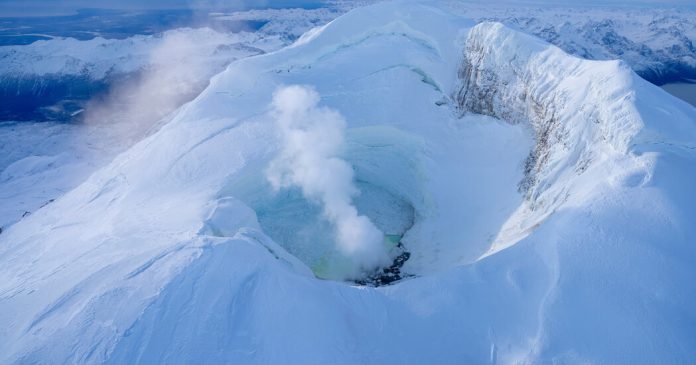
When the fuming and rumbling at Mount Spurr, a giant volcano northwest of Anchorage, started picking up in October, Alaska’s volcano monitoring agency raised its alert level to ensure that nearby communities and passing airplanes would have ample warning of any eruption.

The Trump administration’s cost-cutting campaign has put this work in jeopardy.

The credit cards that employees at the United States Geological Survey’s volcano observatory in Alaska use to pay for travel and other expenses have been frozen, according to two people who requested anonymity because they weren’t authorized to speak with the news media.

Crucially, those expenses include the telecommunications services that the observatory relies on to transmit data from its monitoring systems on the volcanoes, the people said. If spending continues to be restricted, these services could be shut off. That might mean a loss of real-time information about volcanic activity, the people said.

And, if employees can’t pay for travel, then they won’t be able to go into the field by helicopter and boat to repair and maintain their monitoring equipment. Much of this gear sits in remote, rugged environments, where it is vulnerable to damage from storms and extreme winter conditions.

Losing volcano monitoring data from the region would be a “complete disaster,” said Jeff Freymueller, a professor of geophysics at Michigan State University who previously worked as the Alaska Volcano Observatory’s coordinating scientist. Thousands of people and vast amounts of cargo travel every day over the Aleutian Islands, which hold most of Alaska’s volcanoes, while crossing the Pacific.

“We know what happens when a plane flies through an ash cloud,” Dr. Freymueller said. “It’s a disaster. And it cannot happen again.”

Representatives for the U.S. Geological Survey, which is part of the Interior Department, didn’t immediately respond to a request for comment.

In recent weeks, the Trump administration has moved swiftly to enact cost cuts and layoffs across federal agencies. An executive order signed by President Trump on Wednesday further empowered the Department of Government Efficiency, led by Elon Musk, to scrutinize federal employees’ spending. The order appeared to implement a 30-day freeze on government-issued credit cards while making exceptions for disaster relief and “other critical services.”

So far, though, the credit cards issued to workers at the Alaska Volcano Observatory don’t appear to have been exempted. According to the people familiar with the situation, it’s unclear how soon telecom services might be cut off if payments can’t be made.

The volcano observatory is run jointly by the U.S. Geological Survey, the University of Alaska Fairbanks and the Alaska Division of Geological and Geophysical Surveys.

For now, the observatory is still monitoring Mount Spurr for signs that it is moving closer to erupting. Small, shallow earthquakes have been detected. Steam has been seen wafting about its peak.

Another Alaska volcano is on an even higher alert status. At Great Sitkin Volcano, which sits on an island in the Aleutian chain, lava has been slowly erupting from the summit crater since 2021.