Friday, November 13, 2026
Home Blog Page 178

Why the job cuts at bank regulator FDIC are raising alarms : NPR

0
In this photo, a man walks past a branch of Signature Bank in New York City on March 13, 2023. The bank has double glass doors, and the name "SIGNATURE BANK" appears in capital letters above the doors.

A man walks past a branch of Signature Bank in New York City on March 13, 2023. After Signature Bank collapsed during the 2023 regional banking crisis, the Federal Deposit Insurance Corp. said it didn’t have enough qualified examiners to catch the problems that had led to the bank’s failure.

Ed Jones/AFP via Getty Images


hide caption

toggle caption

Ed Jones/AFP via Getty Images

President Trump’s sweeping cuts to the U.S. government are hitting a crucial part of the financial system: the independent agency responsible for preventing future banking crises.

The Federal Deposit Insurance Corp. (FDIC) is responsible for insuring consumer deposits against bank failures — and for preventing those failures in the first place.

Since its creation 92 years ago, during a national panic that closed thousands of banks, the FDIC has performed some of the unglamorous but crucial work of ensuring financial stability. Its very existence reassures consumers and businesses that their money is safe, by insuring deposits of up to $250,000.

And its employees closely monitor most of the United States’ smaller banks — warning lenders if, for example, their debt levels are edging too high or if they’re taking on too much risky business.

The end goal of these examinations is to catch any problems before they snowball into a bank failure — or a wider banking crisis. In those worst-case scenarios, the FDIC is also responsible for taking over failed banks.

But the agency has been struggling with several internal problems, including staffing shortages and widespread employee complaints about a toxic culture. The FDIC says that its staffing problems have already made it harder to adequately supervise banks and reduce the risk of bank failures.

Now, those problems are getting much worse. Trump and his billionaire adviser, Elon Musk, are firing workers across agencies as they slash the size of the federal government — and hundreds of FDIC employees have already been affected.

About 170 probationary employees of the FDIC were fired this month after about 500 workers had already accepted the Trump administration’s deferred resignation offer, Bloomberg reported this month. The reported cuts amount to more than 10% of the agency’s workforce.

The FDIC has also rescinded more than 200 job offers to new examiners, the front-line employees who monitor banks for early signs of problems, The Washington Post reported in January.

A spokesperson for the FDIC confirmed that about 500 employees had accepted the deferred resignation offer, but otherwise declined to comment.

Alarm bells are ringing

The FDIC’s role as the backstop of the banking system made headlines during the 2008 financial crash and the 2023 regional banking crisis. During that more recent scare, the agency took extra steps to restore public confidence in the financial system by promising to insure every affected bank account — even those above its $250,000 limit.

But the Trump administration’s new cuts further weaken a banking watchdog that has been sounding the alarm for years about its decreasing ability to prevent future banking crises.

After New York-based Signature Bank collapsed during the 2023 crisis, the FDIC said it didn’t have enough qualified examiners to catch the problems that had led to the bank’s failure.

Yet instead of gaining more resources, the FDIC is losing them. It’s hardly alone among financial regulators: The FDIC’s cuts have paled in comparison with the administration’s efforts to essentially shut down the Consumer Financial Protection Bureau, which is widely hated by Republicans and many in the financial industry.

Now, regulatory experts are warning about the potential long-term consequences of further weakening the FDIC.

“This administration is really sowing the seeds for the next financial crisis,” says Mayra Rodríguez Valladares, a financial risk consultant who works with banks and regulators.

“The cuts [at the FDIC] are incredibly unfortunate,” she adds. “And they are potentially quite dangerous for America’s financial stability — which, of course, means for all of us as ordinary American consumers.”

The FDIC has faced wider problems

Trump and Musk say they want to reduce government spending. But their cuts to the FDIC won’t save taxpayers any money — because the FDIC doesn’t cost taxpayers anything in the first place. Instead, it’s funded by banks, which pay the FDIC quarterly dues based in part on the deposits they hold.

The agency has historically operated independently of the White House. It regulates about 4,500 banks; most of those are smaller institutions, while the Office of the Comptroller of the Currency and the Federal Reserve supervise the larger, systemic banks.

The FDIC said in its annual report issued last year that it has a staff of about 6,000 and that it was seeking to hire an additional 800 people. But it has been struggling to do so, for a variety of reasons: An outside review last year found a toxic workplace where hundreds of employees complained of sexual harassment, discrimination and other misconduct. The investigation was commissioned after a 2023 report by The Wall Street Journal, which documented strip club visits, lewd messages, heavy drinking and bullying at the government agency.

Trump has since replaced the then-chair of the FDIC, Martin Gruenberg, by promoting Vice Chair Travis Hill to head the agency on an acting basis. Hill said in January that he wanted to “conduct a wholesale review of regulations” and “withdraw problematic proposals” of the Biden administration. He has also signaled that he wants to make it easier for nonbank financial interests, including cryptocurrency, to become part of the mainstream financial system.

Weakening the FDIC in general appears to be a goal of Trump and Musk’s Department of Government Efficiency. Musk has said on his X social network, “There are too many duplicative regulatory agencies.”

Last week, Trump signed an executive order that would give him greater power over independent regulatory agencies, including the FDIC. And some of Trump’s advisers have expressed interest in abolishing the FDIC, The Wall Street Journal reported in December.

In an emailed response to NPR, a White House deputy press secretary said, “The personal financial situation of every American is top of mind for the President, which is why he’s working to cut regulations, reshore jobs, lower taxes, and make government more efficient.”

Influenced by Project 2025

The administration’s approach to the FDIC appears similar to the agenda laid out in Project 2025, the conservative policy blueprint that Trump distanced himself from while campaigning but that has appeared to shape many of the actions he has taken as president so far.

That 900-plus-page document proposes restructuring “the outdated and cumbersome financial regulatory system,” in part by merging the FDIC and other banking regulators.

Some Democrats are publicly warning about the impact of Trump’s cuts to the agency.

“These cuts threaten the reliability and integrity of federal deposit insurance and inhibit the FDIC’s capacity to ensure the stability and confidence that underpin our nation’s banking system,” Sen. Elizabeth Warren, D-Mass., who is the ranking member of the Senate Banking Committee, said in a statement last week.

Rodríguez Valladares, the financial consultant, acknowledges that regulatory bureaucracy can make it more difficult to do business and drive up costs, as bankers have long complained.

But she worries that the approach Trump and Musk have taken to slashing the agencies without much process, and to firing people without first studying what their roles and responsibilities entail, could create long-term chaos for the U.S. economy.

“That is just literally one of the most dangerous, one of the most insane things I’ve ever seen, and I’ve been working in markets for over three decades,” she says.

Al-Assad Becomes a Punchline in Syria’s Comedy Scene

0

Sharief al-Homsi shivered, clutched his arms and pretended to go through Syrian regime withdrawal.

Standing before an audience in Damascus, he was telling a joke that would have been unthinkable until just a few weeks before, when President Bashar al-Assad was suddenly ousted after more than five decades of his family’s oppressive rule.

“We need rehab centers. You can’t just take this guy away from our life like that — it has to be gradual,” the 33-year-old comedian and screenwriter said, describing the omnipresent posters and magazine spreads depicting the al-Assad dynasty, to laughter from the crowd. He continued to shake. “They’ll ask us what drug were you addicted to; we’ll say, ‘Bashar al-Assad.’”

It was a night of stand-up in late December at the Zawaya Art Gallery in the heart of the Syrian capital. Half of the comedians performing that night have been living abroad after fleeing the country during the 13-year civil war that ended with Mr. al-Assad’s ouster.

Their routines included standard comedy fare — religion, sex and the pressure to get married — but the biggest punchline of the night was Mr. al-Assad. One comedian referred to him throughout his routine as “that whore.”

The comedians were relishing the chance to say things that for decades Syrians would be too scared to utter even in private company. Fear of the notorious mukhabarat, the secret intelligence service, was ingrained so deeply that Syrians lived with the cautionary warning that “the walls have ears.”

But even as they embraced the liberty to make new jokes, the comedians, like many everyday Syrians, were worried that this new freedom of expression could be fleeting. Ahmed al-Shara, the country’s interim president who leads Hayat Tahrir al-Sham, the Islamist rebel group that ousted Mr. Assad, has promised unity that reflects Syria’s diverse population, but there are deep concerns about how democratic and inclusive the government will be.

Under the Assad government, Roula Sulaiman, the owner of the Zawaya gallery, said she faced restrictions and accusations of organizing political opposition events when she tried to hold comedy and cultural events. Now, she is still concerned.

“We haven’t tested the new regime yet,” Ms. Sulaiman said. “Based on what we are seeing, I think we are moving toward more restrictions.”

Officials with the new government had come by her gallery and told her that nudity in art would no longer be allowed, she added. Asked for comment, the government’s information ministry said it was not familiar with the episode but did not have any rules to that effect.

So as the comedians wait to see what the new red lines may be, they are taking advantage of the opportunity for as long as it lasts.

“We’re in an interim phase where we can talk about the past and present freely, but we all face an unknown future,” said Mary Obaid, one of the founding members, along with Mr. al-Homsi, of Styria — a portmanteau of Syria and hysteria — that bills itself at the first stand-up comedy platform in the country.

Styria formed two years ago with the goal of spreading stand-up comedy in Syria and establishing the first comedy club in the country, a goal it has yet to achieve.

“We’re all afraid but we’re hopeful that the freedom of expression will remain,” said Ms. Obaid, a 23-year-old dentist.

Even under the Assad government’s repression and through a destructive civil war, Syrians relied on humor — usually dark — as a coping mechanism.

Early in the war, ordinary Syrians began forming rebel groups to fight the government, but often struggled to acquire arms. One small band of men recorded a satirical video echoing others announcing new groups, but rather than holding Kalashnikovs, each held a piece of fruit to poke fun at their group’s struggle to get weapons.

In Aleppo, as government forces began to encircle opposition-held areas of the city in 2014, rebels shared their dinner with stray cats. The rebels joked that they were trying to fatten the cats in case they needed to eat them.

Given their tradition of gallows humor, Syrians might be uniquely equipped to mine laughs from both the current moment and the decades living under the Assad dynasty.

That includes combining the personal and political. After Mr. al-Assad’s presidential palace was looted in the wake of his fall, a photograph of him circulated online, showing him dressed in ill-fitting white underwear and a tank top.

Ms. Obaid found an overlap with her own life. “I wasn’t shocked by anything from the fall of the president except for one thing,” she began during her routine, “My underwear before I had stomach reduction surgery. Why were they in the president’s palace?”

Thirty minutes before the show at Zawaya, Mr. al-Homsi sat in what was serving as a green room, trying out on his fellow comedians lines that could become new material. Paintings covered the walls around him as techno played loudly in the main hall.

He joked about a recent visit from Hayat Tahrir al-Sham security officers and how he tried to hide the tattoos covering his arms, given most conservative Muslims’ disapproval of body art.

Before the regime’s fall, Mr. al-Homsi would inevitably come up with jokes involving Mr. al-Assad, his wife or the government. He would write them down and file them away in a document that he labeled, “for Lebanon.”

At this point, he is work-shopping the Assad withdrawal symptoms joke, aiming to expand it into a proposed 12-step program to wean Syrians off an addiction to the regime.

“These were jokes that I couldn’t tell here,” he said. “Now I can.”

Zeina Shahla contributed reporting.

Trump sows further confusion on tariffs on Canada and Mexico : NPR

0

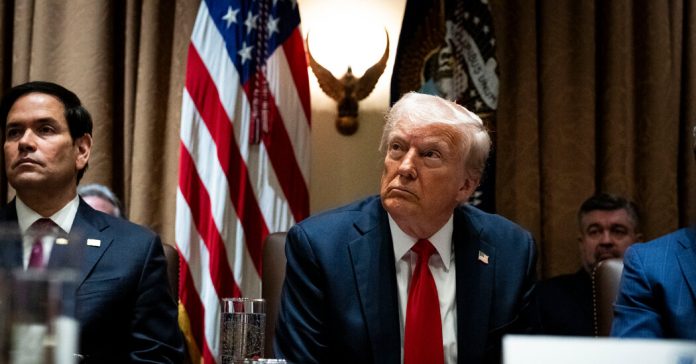
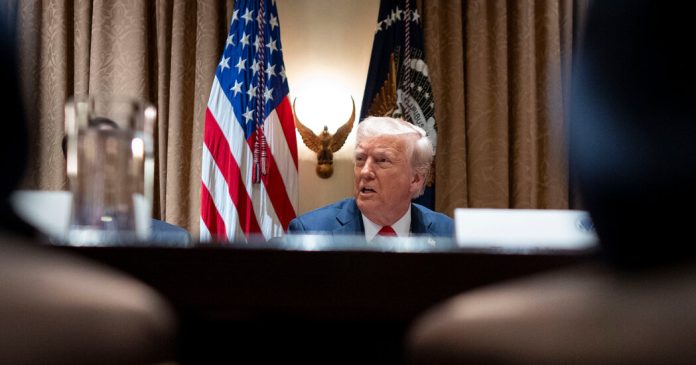
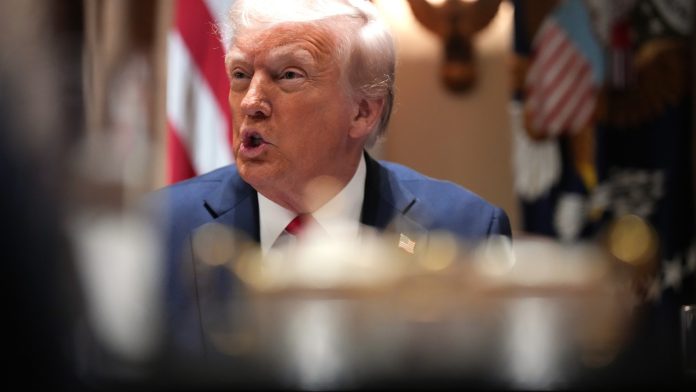
President Trump delivers remarks during a Cabinet meeting at the White House on Wednesday. During the meeting, Trump said he was looking at implementing tariffs against Canada and Mexico starting in April.

Andrew Harnik/Getty Images


hide caption

toggle caption

Andrew Harnik/Getty Images

President Trump has suggested that there could be another delay for his proposal to apply 25% tariffs on Mexican and Canadian goods.

The tariffs were initially scheduled for Feb. 1. However, at the last minute, Trump gave the allies a reprieve, after Canadian Prime Minister Justin Trudeau and Mexican President Claudia Sheinbaum assured Trump that they were taking action to stop the flow of fentanyl and immigrants into the United States. Trump then delayed the tariffs to early March.

The delays are part of a pattern of vague and changeable tariff pronouncements, leading many to be unsure of how seriously to take the threats.

This week has added more confusion. On Monday, Trump said the tariffs on Canada and Mexico would go ahead next week. But at his Cabinet meeting on Wednesday, Trump said he was looking at April.

“April 2 — I was going to do April 1, but I’m a little bit superstitious, so I made it April 2 — the tariffs go on,” he said when asked about the taxes. “Not all of them, but a lot of them.”

But it was also uncertain how hard and fast that new deadline would be. During Trump’s wide-ranging, hourlong exchange with reporters during the Cabinet meeting, Commerce Secretary Howard Lutnick suggested that the delay was contingent on Canada and Mexico showing they had made progress on slowing the flow of fentanyl.

Nothing about how Trump talks about tariffs is normal — not only because Trump is threatening tariffs on a weekly, even daily, basis, but also because it’s often unclear if or when many of those tariffs will happen, not to mention how big they’ll be. That uncertainty itself can hurt the economy.

Here are some of the tariffs Trump has proposed

Trump ran for president promising big tariffs, telling crowds that “tariff” was “the most beautiful word in the dictionary.” Tariffs are taxes that American businesses pay to import goods from overseas.

Thus far, one tariff has gone into effect this term: a 10% tariff on Chinese goods.

But Trump has proposed many more. He signed an executive order expanding steel and aluminum tariffs, to go into effect on March 12, though questions remain as to how broadly they’ll be applied.

Trump has also signed an order aimed at imposing “reciprocal tariffs,” potentially on all kinds of products from all trading partners. That order doesn’t itself impose tariffs. Instead, it sets in motion a research process. Lutnick has said the administration could start imposing tariffs in early April.

Trump has also talked about cars and lumber. And this week, he announced an investigation that could lead to new tariffs on copper.

Echoes of “infrastructure week”

President Trump, joined by Health and Human Services Secretary Robert F. Kennedy Jr. (left) and Commerce Secretary Howard Lutnick, signs an executive order in the Oval Office on Tuesday.

President Trump, joined by Health and Human Services Secretary Robert F. Kennedy Jr. (left) and Commerce Secretary Howard Lutnick, signs an executive order in the Oval Office on Tuesday. In the order, Trump directed the Commerce Department to open an investigation into potential tariffs for copper imports.

Alex Wong/Getty Images


hide caption

toggle caption

Alex Wong/Getty Images

There’s an echo here of “infrastructure week” — a phrase that became a joke during Trump’s first term, referring to big repeated policy declarations with little follow-through.

Scott Lincicome, a trade expert at the libertarian Cato Institute, thinks the analogy broadly applies — with one big caveat.

“We shouldn’t dismiss the real costs that this is inflicting on various companies in the economy more broadly,” he said.

Tariffs can hurt consumers by raising prices. But even when tariffs are merely threatened, the resulting uncertainty can drag on business investment. A manufacturer might hold off on buying steel and aluminum until it knows what the tariff policy will be.

Indeed, in a 2020 study, economists at the Federal Reserve found that trade policy uncertainty during Trump’s first term significantly cut investment.

Trump’s executive orders make the threats more formal

But there are differences between now and eight years ago, Lincicome said — most notably, that Trump appears more willing to act on his tariff threats.

“In Trump 1.0, you just got a tweet that said, ‘Oh, I’m gonna slap tariffs on stuff.’ We didn’t actually get a signed executive order with a deadline,” he said. “This is much more formal, and I think that has significant economic implications.”

But it’s still not clear when Trump is or isn’t willing to back down. He has, for example, signed an order to expand steel and aluminum tariffs. Trump initially said there would be no exemptions for any country. However, countries are still pushing for exemptions, and this week, Trump officials and Australian officials met as Australia seeks its own exemption.

Conflicting goals add to the uncertainty

There’s another thing adding to the uncertainty: With some tariffs, it’s unclear what Trump’s goals are.

Chad Bown, a trade expert at the Peterson Institute for International Economics and an economist in the Biden administration, points to Trump’s reciprocal tariff idea. Trump has said those tariffs are about fairness, but Bown sees that rationale as confusing.

“This is one argument that he’s put forward, but it’s one of many arguments that President Trump has put forward on the reasons why he might be using tariffs, and many of them are inconsistent with each other,” Bown said.

This means that it can be hard to game out what might cause Trump to go through with — or back down from — some of his threats.

It’s not just economists taking Trump’s tariff threats with several grains of salt. Markets are also assuming policy won’t match Trump’s grandest pronouncements.

“We think that the market’s certainly looking at it probabilistically,” said Mike Reynolds, vice president of investment strategy at wealth management firm Glenmede. “We think that sort of the median likelihood, straight down the middle, is that [tariffs] will end up somewhere that’s in between current policy and proposed policy.”

The effects of tariff threats go beyond businesses and investors. This month, consumer confidence suffered its largest drop since 2021, fueled in part by fears that tariffs will stoke inflation.

North Korea Is Sending More Troops to Russia, South Korea’s Spy Agency Says

0

Despite the heavy casualties it has suffered in the war between Russia and Ukraine, North Korea appears to have sent more troops to Russia as its soldiers re-entered frontline combat, South Korea’s spy agency said on Thursday.

The National Intelligence Service, South Korea’s main spy agency, said it was still trying to assess the size of the new deployment. But its brief statement on Thursday followed a report in a South Korean newspaper, JoongAng, citing anonymous sources, that North Korea has sent up to 3,000 additional troops since January by ship and military cargo planes.

North Korea sent an estimated 11,000 troops to Russia late last year, and has supplied large shipments of artillery shells, missiles and other conventional weapons. The troops were sent to the Kursk region, where they fought alongside Russian forces to help them regain territory lost to Ukraine.

But the North Korean soldiers pulled back from the front lines in January after suffering heavy casualties, according to Ukrainian and U.S. officials. They hailed from North Korea’s highly disciplined special warfare units, but were badly prepared for drone attacks on the mostly open and flat battlefields in eastern Europe. Thousands have been killed or wounded, according to South Korean officials.

Earlier this month, Ukrainian President Volodymyr Zelensky said that North Korean troops were back on the front lines, a view echoed by the South Korean spy agency on Thursday.

“Following a monthlong lull, North Korean troops were placed back in the frontline region of Kursk starting in the first week of February,” it said.

The Russian war against Ukraine is the first major overseas armed conflict in decades to which North Korea has sent its soldiers, helping its military gain valuable lessons in real-life, modern warfare despite the heavy casualties, military analysts said.

South Korean officials have also expressed concerns that North Korea was receiving food, oil and advanced weapons technologies from Russia in return for its troops and artillery.

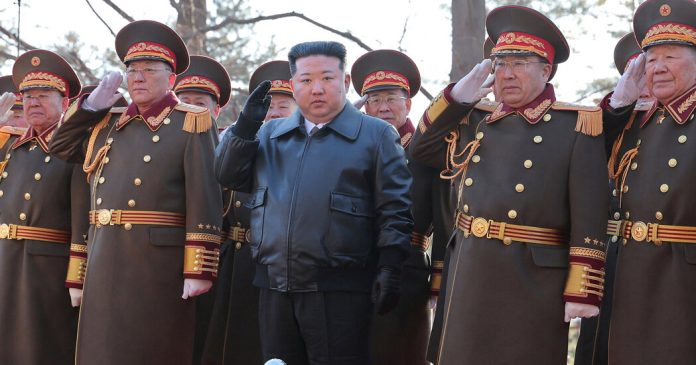
North Korea’s leader, Kim Jong-un, has sought to upgrade his nuclear and other weapons programs and find new diplomatic partners for his pariah government since his diplomacy with President Donald J. Trump collapsed in 2019.

Mr. Kim made Russian President Vladimir V. Putin a new ally by supplying Moscow with badly needed ammunition and troops. When Mr. Putin met with Mr. Kim in Pyongyang in June last year, they revived a Cold War-era mutual defense treaty.

Since Mr. Trump returned to the White House in January, he has vowed to end the war. He has also hinted that he was interested in reviving diplomacy with the North Korean leader. But Mr. Kim has not publicly responded.

Can the president override Congress on spending? It depends on 'impoundment'

0

Can the president spend less money than congress directed be spent? It comes down to a legal question around what’s known as impoundment.

Thailand Deports Dozens of Uyghurs to China, Activists Say

0

Thailand on Thursday sent back 40 “illegal immigrants” to China, Chinese state media reported, hours after rights groups warned that Thailand was on the verge of repatriating dozens of Uyghur men who had fled persecution in China.

The Uyghurs, a Muslim minority in China, face possible torture and long-term imprisonment upon return to that country, rights groups have said. They were part of a wave of more than 300 Uyghur asylum seekers who fled China in 2014.

They had hoped to use Thailand as a transit point to get to Turkey, which is home to a sizable Uyghur community. But more than 40 of them ended up being detained in Bangkok for more than a decade. Last month, some of the men went on a hunger strike amid fears of being returned to China.

A photograph provided on condition of anonymity, showed Uyghur detainees sitting in an immigration detention center in Bangkok, in February.Credit…Associated Press

At around 2 a.m. on Thursday, a reporter witnessed six trucks that had their windows covered with black cloth leaving an immigrant detention center in downtown Bangkok where the detained Uyghurs had been held. Several police cars accompanied the trucks, cordoning off traffic around them.

At around 5 a.m., an unscheduled China Southern Airlines flight took off from Bangkok to Kashgar in Xinjiang, the native homeland of Uyghurs, according to FlightRadar24, which tracks flights around the world. It landed just after 12 p.m. local time.

“All signs point to at least 40 of the men having been deported,” said Julie Millsap of No Business With Genocide, a Washington-based group that has been lobbying governments to free the Uyghurs.

In a statement, Human Rights Watch criticized the Thai authorities for having deported the men despite making public assurances earlier that they would not do so.

“Thailand’s transfer of Uyghur detainees to China constitutes a blatant violation of Thailand’s obligations under domestic and international laws,” said Elaine Pearson, Asia director at Human Rights Watch. “The men now face a high risk of torture, enforced disappearance, and long-term imprisonment in China.”

The Thai police and foreign ministry did not respond to repeated requests for comment.

The Chinese report, published by the official Xinhua news agency, appeared to be deliberately vague about the deportees, providing no details about their identities or where in China they were from. It said “the repatriation was carried out in accordance with the laws of China and Thailand, international law and international practice.”

.

Pirada Anuwech contributed reporting from Bangkok.

Some European Allies Fear Trump Is Out to Destroy Them

0

During his first term in office, President Trump described the European Union “as a foe,” established “to hurt the United States on trade.”

He repeated the charge at a cabinet meeting on Wednesday, but in more vulgar terms: “The European Union was formed in order to screw the United States. That’s the purpose of it, and they’ve done a good job of it.”

Then he said he was preparing to hit Europe with 25 percent tariffs on cars and other goods.

After Mr. Trump’s embrace of Russia and his warnings that Europe had better fend for itself, the president’s latest attack added to the increasing view of European leaders and analysts that he and his team of loyalists consider America’s traditional allies in Europe as adversaries not just on trade, but on nearly everything.

Some officials and analysts see the Trump administration as merely indifferent to Europe; others see open hostility. But there is a common view that the fundamental relationship has changed and that America is a less reliable and predictable ally.

Mr. Trump has rebuffed NATO and aligned himself with the longstanding, principal threat to the alliance: Russia. Vice President JD Vance has attacked European democracy while calling for the door to be opened to far-right parties. Elon Musk, the billionaire Trump aide, has heaped contempt on European leaders and openly endorsed an extremist party in Germany.

Equally shocking to European leaders, the United States this week refused to condemn Russia’s invasion of Ukraine at the United Nations. It instead broke from its allies and voted with Russia, Belarus and North Korea, all authoritarian governments.

European leaders are scrambling to assess and mitigate the damage. The prime minister of Britain, Keir Starmer, arrives at the White House on Thursday — the second such visit this week, after President Emmanuel Macron of France — still hoping to persuade Mr. Trump not to abandon Ukraine and to remain engaged in Europe. But Mr. Trump describes himself as a disrupter, and Mr. Macron got little for his attempt at seduction.

Friedrich Merz, 69, the conservative politician likely to be Germany’s next chancellor, has expressed strong doubts about the trans-Atlantic relationship he and his country have been committed to for decades.

On Sunday evening, after his party won the most votes in the German election, Mr. Merz said that after listening to Mr. Trump, “it is clear that the Americans, at least this part of the Americans, this administration, are largely indifferent to the fate of Europe.”

He wondered whether the American nuclear umbrella over NATO would remain — and even whether the alliance itself would continue to exist.

“My absolute priority will be to strengthen Europe as quickly as possible so that, step by step, we can really achieve independence from the USA,” he said.

His comments were a remarkable measure of the dismay felt by European leaders over the American reversal of policy on Ukraine and, perhaps more so, for its outright backing of far-right parties that despise European governments and support Russia.

Mr. Merz’s remarks were reminiscent of a 2017 statement by Angela Merkel, then the German chancellor, after contentious alliance meetings with Mr. Trump. “The times in which we could rely fully on others — they are somewhat over,” she said. She encouraged Europeans to “take our fate into our own hands.”

Her comments were considered a potentially seismic shift, but a real reorientation of European security policy never materialized. Matters are more serious now, said Claudia Major, who directs security policy at the German Institute for International and Security Affairs.

“In Munich, Vance declared a culture war and said: ‘Join us or not. We have the right values and you have it wrong,’” she said. His speech, she added, made it clear that “the country that brought us back our freedom and our democracy is turning against us.”

She is not alone in the assessment. Several analysts said the Trump administration’s actions showed that it was not merely indifferent to Europe, but was out to undo it. The distinction holds real consequences for how Europe can respond.

“There is no question the intention is there to destroy Europe, starting with Ukraine,” said Nathalie Tocci, director of Italy’s Institute of International Affairs. “The empowering of the far right is instrumental to the goal of destroying the European Union.”

The reason, she said, is that the Trump administration sees Europe not merely as a competitor, but also as an economic and even ideological threat. It wants to undermine the power of the European Union to regulate trade, competition and hate speech. The latter is a major topic for Mr. Vance, as he criticized what he called news media censorship and political correctness.

The European Union is the largest trading bloc in the world, capable of striking back against Washington economically and in tariff terms, representing the “economic foe” Mr. Trump railed against in his first term.

That power is being used against high-tech and social media companies whose leaders surround and subsidize Mr. Trump, like Mr. Musk, who owns the social media platform X. They, too, have an interest in weakening “the Brussels Effect,” as Anu Bradford of Columbia University Law School called it.

The Brussels Effect is the power of the European Union to establish global rules and norms, and it is particularly important in the realms of climate regulations, digital competition, platform accountability and artificial intelligence.

But if the Trump administration feels it necessary to destroy that threat, then there is little European nations can do to appease the White House, some warned.

If Mr. Trump and his team “are out to push the far right and destroy European democracy, then no amount of European purchasing of American LNG or weapons will matter,” said Ms. Tocci, of Italy’s Institute of International Affairs. By increasing dependency, she added, “it could be a kind of double suicide.”

U.S.-European relations tend to go in cycles, with important strategic debates in the past over Iraq or Afghanistan or even Vietnam. But now the clashes are simultaneously ideological, strategic and economic, said Camille Grand, a former NATO and French official with the European Council on Foreign Relations.

“Facing hostility on all three fronts at once is quite a shock to Europeans,” said Mr. Grand. “Adding all three together you can wonder whether you are no longer a partner but a rival and, perhaps, even an adversary.”

Every country in Europe is doing a reassessment of where it is vis-à-vis Washington, he said. What isn’t clear is whether, as in Mr. Trump’s first term, “you have an unpleasant roller-coaster ride that leaves you sick but you end up where you started, or whether the whole relationship now derails.”

Linas Kojala, director of the Geopolitics and Security Studies Center in Vilnius, Lithuania, urges calm, because “there is no real alternative to the U.S. security guarantee” for a long time to come. “Declaring the trans-Atlantic relationship has collapsed would be like stepping off a ship in the middle of the ocean with no other vessel in sight.”

So for now, he said, “Europe must swallow” the Trump criticism and “do everything possible to keep the relationship intact.”

But it is unlikely to return to where it was, Alex Younger, a former chief of Britain’s foreign intelligence service, MI6, told the BBC last week. “We are in a new era where, by and large, international relations aren’t going to be determined by rules and multilateral institutions,” he said, but “by strongmen and deals.”

Matthew Kroenig, a former defense department official who is now at the Atlantic Council in Washington, calls himself a “normal Republican” and says that “there has been a bit too much hysteria over the past couple of weeks.”

After all, Mr. Kroenig said, the first Trump term was also marked by “a lot of tough rhetoric against allies and a lot of deferential language toward Putin, but in the end, NATO was strengthened.”

Others are less sure.

Mr. Trump has been engaged in “a policy of rapid, unilateral concession of long-held positions on fundamental interests to persuade the aggressor to stop fighting,” said Nigel Gould-Davies of the International Institute for Strategic Studies, speaking of Russia in Ukraine.

“The established name for such a policy,” he said, “is ‘strategic surrender.’”

Whether it will produce the outcome Mr. Trump desires is not clear, he said. What is clear is that it is undermining allied trust in the credibility and common sense of the United States.

It is imperiling old allies in Europe.

And it is “making Russia a more powerful, assertive and attractive ally to America’s adversaries around the world,” he said.

Thursday Briefing

0

President Trump’s relationship with Europe.

Why Scam Centers in Southeast Asia Keep Flourishing

0

There are usually no international flights out of the airport in Mae Sot, a town on Thailand’s border with Myanmar. But in recent days, hundreds of people here boarded direct flights back home to China. They had been rescued from Myanmar, where they were ensnared in a 21st-century scourge — online scam mills that have used forced labor to bilk tens of billions of dollars out of victims worldwide.

The chartered flights were part of a multinational effort that followed the trafficking last month of a Chinese actor to work in a fraud center, which scared off Chinese tourists from visiting Thailand. The rescue missions, coordinated by officials in Thailand, Myanmar and China, were pitched as a body blow to this industry of grift.

But even as the planes headed north, construction workers in these scam centers — modern tower blocks within sight of the Thai side of the frontier — continued to weld and hammer into the night, brazenly building new warehouses dedicated to crime. Fraudsters confined to rooms with barred windows kept cajoling money out of lonely hearts and eager investors in the United States, China and beyond.

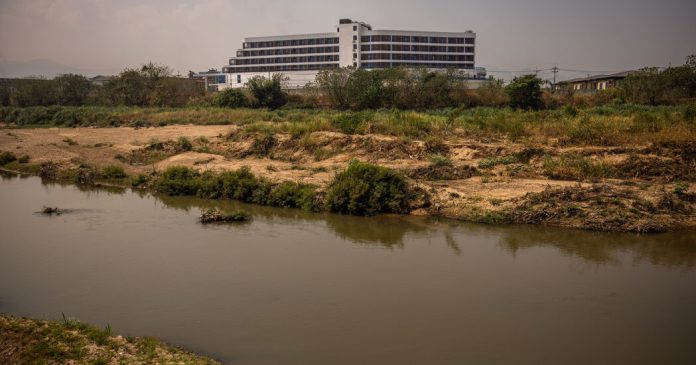
Following a military coup in Myanmar in 2021 and an ensuing civil war, the country’s border with Thailand has exploded into one of the most lawless and lucrative places on earth. Chinese criminal syndicates have moved in, making deals with rival factions to turn rainforests into high-rise settlements dedicated to online fraud.

With the Thai government failing to intervene forcefully, Chinese gangsters and militia commanders from Myanmar have smuggled tens of thousands of people across the riverine frontier to labor in these hubs of criminality, according to the United Nations. Thailand has also supplied the electricity and internet for the fraud centers, and served as a conduit for construction materials, instruments of torture and even the odd Lamborghini.

The raids this month were the latest offensive against the scam centers and freed thousands of people who were scammed into becoming scammers themselves. Often lured by false promises of good-paying jobs in I.T., engineering or customer service, citizens of at least 40 nations have been forced by Chinese criminals to engage in crypto-fraud, online dating deception, TikTok shopping swindles, WhatsApp real estate dodges, Instagram deep fakes and Facebook trickery.

Confined to these compounds, the scammers, many of whom are Chinese, have been beaten, subjected to electric shock and tied up for hours in a pose that mimics crucifixion, people who were witnesses to or victims of the abuse said. Another form of torture involves crawling on gravel, until knees and hands bleed.

Marking the successful rescue operations last week, Chinese, Thai and Myanmar officials held hands and celebrated what they called a unified vanquishing of transnational crime. A raid in Cambodia, another hotbed of cybercrime, freed others, too.

“Several scam sites have been eradicated and a large group of suspects arrested,” Guo Jiakun, a spokesman for the Chinese foreign ministry, said on Friday, noting the “strong steps taken by Thailand and Myanmar to dismantle the scam gangs and protect the life and property of citizens from China and other countries.”

But such self-congratulation is premature, according to interviews with about two dozen people, some who have worked or are currently working in the scam centers and others who serve in national and militia bureaucracies that aid or profit from the cyberfraud industry.

Thousands of individuals who were supposedly rescued from the scam warehouses this month are still stranded between the hell of forced labor in Myanmar and the promise of freedom in Thailand. Tens of thousands more remain imprisoned in the fraud factories.

“Business is normal,” said Ma Mi, a Myanmar national who toils in one of the online crime hubs. She spoke by phone and said that, like many Myanmar citizens there, she was working voluntarily.

And none of the major players orchestrating this international criminal network, which spans dozens of countries and operates with a Chinese nerve center, have been taken down in the current campaign. The arrest in 2022 of a Chinese-born kingpin, who is now in a Thai prison fighting extradition to China, did not slow construction in the scam towns he is accused of having run.

“Addressing human trafficking and online scam operations requires more than reactive law enforcement measures,” wrote Saw Kapi, the founding director of the Salween Institute for Public Policy, which focuses on the region where the scam centers are proliferating, on Feb. 21. “It necessitates confronting the root causes — failure in governance, corruption, and the entanglement of organized crime with political and economic interests.”

On Saturday evening, as Thai police set up checkpoints near the border with Myanmar, one trafficker said that a group of Chinese scammers was moved from one large cybercrime compound to a smaller one, via Thailand, because roads in Myanmar do not yet connect the crime settlements. The scammers, the trafficker said, splashed across the river, which is low because it is the dry season.

Naw Pann, who has facilitated other nighttime border crossings and who is being identified by only part of her name for her safety, said that human trafficking from Thailand to Myanmar is continuing, despite the supposed crackdown. Because she does not speak Mandarin or other foreign languages, she said, she motions to the victims to keep quiet, raising her index finger to her mouth. Some of the people who have crossed in recent days, she said, have had wounds on their faces and bandages on their legs.

“I feel pity for them,” she said. “But I can’t do anything to help them.”

Ko Min, a member of an armed group in Myanmar that has a stake in one of the largest crime cities, said he witnessed four or five Chinese men beating and shocking with an electric prod another Chinese man curled into the fetal position on the floor. The room was filled with rows of workers sitting in front of desktop computers, he said. They knew not to look at him or at the abusers, he said.

“I’ll never forget the terror of the people in the room,” he said. “It was like watching an animal being tortured.”

In January, the open secret of scam centers on this stretch of border — highly visible, highly electrified — jolted the public consciousness with the disappearance of Wang Xing, the Chinese actor. Although he was quickly freed from a scam park in Myanmar, public outrage percolated in China, and Chinese tourists canceled holidays in Thailand.

Early this month, Prime Minister Paetongtarn Shinawatra of Thailand visited Beijing, where she promised China’s leader, Xi Jinping, that her government was cracking down. Before her trip, Thailand announced that it had shut off electricity to the other side of the border, something it had done briefly in 2023 as well. China’s vice minister of public security came to inspect the border zone.

Leaders of ethnic minority militias in Myanmar that control areas near the Thai border and lease land to Chinese companies sought to deny culpability. These armed groups, some aligned with the junta and some fighting it, help provide the muscle that keeps fear thrumming in the fraud hubs, witnesses and trafficked employees said. The militias have also been implicated in other illicit trades, from drugs and gems to wildlife and timber.

Gen. Saw San Aung, the chief of staff of the Democratic Karen Benevolent Army, a rebel group, said that he only became aware of the scam centers operating in his territory after some troubling photographs circulated online this year. But he cautioned against believing all images of scam center workers who exhibit signs of physical abuse.

“They harmed themselves and accused their employers of torture,” General Saw San Aung said. “If the employers had tortured them, it’s unclear how they managed to take and share photos of their injuries.”

Even if the militias knew that something nefarious was going on, said a spokesman for another militia, they were coerced into staying silent by larger powers that profited from the criminal activity.

“We didn’t conduct these raids because of pressure from China,” said Lt. Col. Naing Maung Zaw of the Karen Border Guard Force, which holds more turf along the border. “We acted because reports mentioned that foreigners were being held against their will and abused.”

Since Feb. 20, hundreds of Chinese released from the scam centers have been airlifted home; Chinese state media labeled the first batch criminal suspects. Another 260 people, many African, made it to Thailand in mid-February and are awaiting repatriation. But just across the border in Myanmar, about 7,000 people who were taken from the crime compounds are now stuck in a purgatory, sheltering in hangars in militia territory and awaiting permission to enter Thailand, aid groups say.

“We’re looking at a humanitarian crisis, with people running out of food, diseases breaking out,” said Amy Miller, the Southeast Asia director of Acts of Mercy International, which helps trafficked individuals who were forced to work in the scam centers. “In one place, there are two toilets for 400 people.”

The Thai authorities have said that foreign embassies need to help with repatriation efforts. While most of the people stranded in Myanmar are Chinese, there are victims from 27 other countries, including Zimbabwe, Liberia and Malawi, Ms. Miller said. Many African nations do not have embassies in Thailand.

Fisher, a 27-year-old Ethiopian who is being identified by a nickname, was trafficked to a scam center in Myanmar’s borderlands. In a torture chamber, he was bound and beaten. Electric shocks made his body convulse.

In mid-February, Mr. Fisher was rescued and moved to Thailand.

“It was like a nightmare,” he said of his eight-month ordeal. “But I woke up, and it was real.”

Selam Gebrekidan contributed reporting from Hong Kong, and Li You contributed research from Beijing.

Frankétienne, Father of Haitian Letters, Is Dead at 88

0

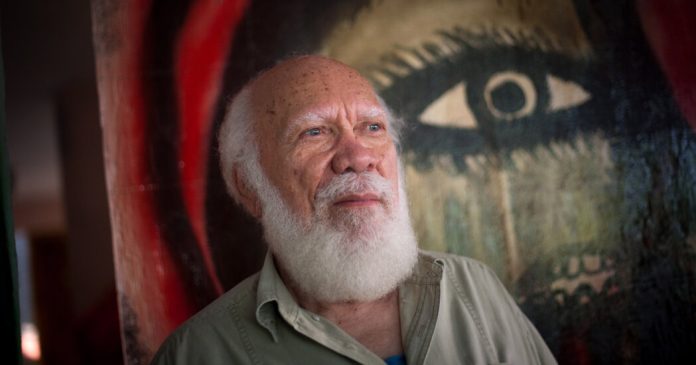
The Haitian artist and writer known as Frankétienne, who published the first novel written entirely in Haitian Creole and who, as the nation’s foremost literary lion, refracted its chaos and disorder through art, died on Thursday at his home in Port-au-Prince, the nation’s capital. He was 88.

The Haitian Culture Ministry announced the death. The cause was not specified.

“Through his writings, he illuminated the world, carried the soul of Haiti and defied silence,” Prime Minister Alix Didier Fils-Aimé said in a statement.

Frankétienne was a prolific novelist, poet and painter — often all three in a single work — whose art embraced and interpreted the chaos of the small, tumultuous country he came from.

“I am not afraid of chaos because chaos is the womb of light and life,” he said in a 2011 interview with The New York Times at his rambling gallery and home, in a working-class district of Port-au-Prince. “What I don’t like is nonmanagement of chaos. The reason Haiti looks more chaotic is because of nonmanagement.”

While not well known in the English-speaking world, Frankétienne was a larger-than-life figure in Haiti and was celebrated in French and Creole-speaking literary and diaspora circles around the world. He garnered an Order of Arts and Letters award in France, and his lively, unpredictable appearances drew crowds.

His output was varied and extensive, including some 50 written works in French and Haitian Creole and thousands of paintings and sketches, characterized by spirals of blacks, blues and reds, often with poems layered in.

Frankétienne’s “Dézafi,” published in 1975, was the first novel written in Haitian Creole. A looping, experimental work, it is seen as an allegory for slavery and political oppression.Credit…Uva Press

Writing the novel “Dézafi” — published in 1975 and translated as “Cockfight” — in Haitian Creole was an important milestone for the language, derived from French colonizers and enslaved Africans, with a strong oral storytelling tradition. It is a looping, experimental work laced with poetry and elements of magical realism. The plot, involving Voodoo priests set upon by people they have put in a deathlike state, has come to be seen as an allegory of slavery and political oppression.

The novel was also a classic example of Spiralism, a Haitian literary movement, which he founded in the 1960s with the writers René Philoctète and Jean-Claude Fignolé, characterized by the idea of self-perpetuating chaos and creativity.

His play “Pelin Tet” also took a biting look at Jean-Claude Duvalier, the dictator known as Baby Doc who ruled Haiti in the 1970s and ’80s, told through the lives of Haitian immigrants in New York recalling their time back home.

Yet even during the tumultuous years of dictatorships and the 2010 earthquake that devastated the country, Frankétienne stayed. He said he believed that his works were too baroque to attract interest from Haiti’s succession of autocratic governments, and that disaster was merely a part of life.

Besides, he said, Haiti was his muse.

“Through the enigmatic, chaotic and mysterious massif of Haiti, the Divine Intelligence of universal energy has given me everything,” Frankétienne, speaking in his usual enigmatic style, told UNESCO in 2023 when the organization designated him an Artist for Peace.

Indeed, a conversation with Frankétienne could take on flights of fancy.

Kaiama L. Glover, an African American studies professor at Yale who has translated his works, recalled moderating a discussion with him in 2009 during which he leaped to his feet, ripped open his shirt to reveal prayer beads and began singing Voodoo prayers to make a point.

“He was just bellowing and calling on the spirits to express an answer on what it means to write in French and Creole,” Professor Glover said in an interview.

He and his studio became a magnet for aspiring writers and artists of all kinds. He lived there with his wife, Marie-Andrée Étienne, a son, Rudolphe, and a daughter, Stéphane, all of whom survive him. His survivors also include a number of grandchildren.

The Haitian American writer Edwidge Danticat, who appeared with Frankétienne at conferences in Haiti and Miami and whose parents brought her to see his plays when they were performed in Brooklyn, said his death leaves a big gap.

“But as I’m sure he would say, the spiral continues in the generation that, in part, he helped nurture and which continues in his wake,” she said in an interview.

“His novels and plays extended our vocabulary, expanding how we express love, passion, humor and rage,” she said. “His love for Haiti was so deep that sometimes he had to invent words to express it.”

Frankétienne did get wider notice after the 2010 earthquake. Two months before it struck, he had written a play, “The Trap,” depicting two men in a postapocalyptic landscape, and its themes and setting resonated with audiences far beyond Haiti. After it was first presented, at a UNESCO conference in Paris, demand for his written work and paintings soared, and his art was featured in exhibitions in New York.

Frankétienne was born Jean-Pierre Basilic Dantor Franck Étienne d’Argent on April 12, 1936, in Ravine-Sèche, an impoverished rural village in northwest Haiti. He was born to a Black mother, Annette Étienne, who worked as a street vendor selling cigarettes, charcoal, candy and moonshine, while raising eight children, and a white father, Benjamin Lyles, an American businessman who abandoned the family.

“My mother was an illiterate peasant and she had me when she was 16,” Frankétienne said in 2011. “She was taken in by an American, a very rich American. The American was 63.”

He was raised in the Bel-Air neighborhood of Port-au-Prince, where his fair skin and blue eyes often drew stares. He was the oldest child, and his mother struggled to finance his schooling.

The school he attended was French, and he was teased because he didn’t speak French. Angry, he set about mastering the language and developed an affinity for words and artistic expression.

He later combined two of his names as he embarked on an artistic and literary career. He began writing poetry in the early 1960s as a student at the École Nationale des Hautes Études Internationales in Paris and in 1968 published his first novel, “Mûr à Crever” (“Ready to Burst”).

He started writing plays, he said, because in Haiti, where nearly half the population is illiterate, so few could read his novels.

He had a penchant for prophecies, including, years before the coronavirus pandemic, predicting that he would die in 2020. Friends and scholars then nervously watched the pandemic unfold, wondering if Frankétienne had been on to something.

“His prediction was five years too early,” Professor Glover said, “and so we got more time.”

Steven Moity contributed reporting.