Friday, November 13, 2026
Home Blog Page 180

Pope’s Illness Is Surrounded by Intrigue Over Possible Resignation

0

Earlier this week, two top Vatican officials made a secret visit to see Pope Francis in the hospital. At first, the Vatican said it had no information about the meeting but then confirmed it, explaining the two prelates had come to secure the pope’s signature to move forward on assembling cardinals to approve new saints.

Veterans of decades of Vatican intrigues weren’t buying it.

“Very, very strange,” said Andreas Englisch, a German journalist and author who has covered the Vatican for nearly 40 years, and who said the meeting immediately set off alarm bells because neither of the two officials worked on canonization issues. Stranger still, he said, was that Francis’ predecessor, Pope Benedict XVI, announced his resignation at the same meeting of cardinals, called a consistory, that was also discussing the canonization of saints a dozen years ago.

“It’s the wrong guys for the wrong thing,” he said. “It was obvious that something was not as it seemed.”

The visit, the tantalizing echo of the forum of Benedict’s resignation and what some church watchers consider a clunky cover story about what Francis and his aides really discussed, has only fueled speculation that Francis, who has been out of the public eye for nearly two weeks amid terse medical reports about his health crisis, may be weighing resignation.

His supporters shrug it off as idle chatter. The important thing, they say, is to focus on the pope’s health, which the Vatican said on Wednesday evening has shown “a slight further improvement over the past 24 hours.” Francis’s blood tests confirmed an improvement and that a mild kidney insufficiency had subsided. A CT scan of the pope’s chest carried out Tuesday to monitor his pneumonia in both lungs showed a normal progression of the lung inflammation.

“Despite the slight improvement, his prognosis remains guarded,” the Vatican said.

The possibility of resignation is not an option many would have even considered before 2013, when Benedict became the first pontiff to retire in nearly 600 years, changing the perception of the papacy from a lifetime mission to a more earthly calling, subject to political pressures and health assessments when modern medicine can keep patients alive much longer. If Francis were also to resign, he would help normalize what Dante once called “the great refusal,” and divide the church into pre-Benedict and post-Benedict eras.

Whether there is any fire behind this week’s apparent smoke screen of a meeting, or if Francis is even thinking about resigning is unknown to perhaps but a few of his closest allies, and probably not even them. Once again close watchers of the church are left studying shadows on the Vatican walls and Francis’s biography for hints of what he might do.

“As I know him, he wouldn’t want a major degenerative condition to be a distraction from the papacy so it then becomes the focus of everything,” said Austen Ivereigh, the pope’s biographer, who stressed he had no idea of Francis’ plans. “For Francis what is absolutely essential is that he has freedom.”

To that end, planning an upcoming, though notably undated, meeting with Rome’s cardinals about canonizations keeps an open-ended option for Francis, church watchers say, should he decide that his prognosis going forward does not allow him to fulfill his duties as he sees fit. Overcoming his crisis and exiting the phase of fighting for his life could allow the pope to focus more on what he thinks is best for the church.

In the past, Vatican watchers have seen retirement plans in an unexpected move to make new cardinals, or in a visit, like Benedict before him, to an Italian town with a connection to a Medieval pope who called it quits. Last week, one Italian paper reported on what it dubbed an “‘Operation Biden’” to Convince the Pope to Quit ‘For the Good of the Church.’”

Many church observers who have spent years watching Francis doubt that he would quit, especially from the hospital, which would generate all kinds of conspiracies — in a gossipy world highly prone to conspiracies — about whether he was coerced. Mr. Englisch, for example, didn’t necessarily subscribe to the idea that Francis would quit in the same way as Benedict, in a consistory of cardinals about new saints.

“It’s too perfect to be true,” he said. What seemed more likely to him was that even from his hospital bed Francis continued to use unpredictability as a governing style to keep a Vatican bureaucracy he doesn’t trust off balance. “He wants to send a signal,” Mr. Englisch said.

What that signal meant was an open question.

“Did the Pope call a consistory to resume work or to resign?” read a headline on the Catholic news website Aleteia.

Whatever the answer, clerics who want Francis to stay or go have been sending their own signals since the pope entered the hospital 12 days ago.

The talk of resignation was “useless speculation,” Cardinal Pietro Parolin, the Vatican’s secretary of state and the pope’s second-in-command, and one of the officials who visited him apparently to talk about new saints, said in an interview last week with the Corriere della Sera, Italy’s leading daily. “Now we are thinking about the Holy Father’s health, his recovery, his return to the Vatican: these are the only things that matter.”

The Vatican republished those remarks, as well as those by another close adviser to Francis, the Argentine cardinal Víctor Manuel Fernández. “It doesn’t make sense that some groups put pressure on the pope to resign,” he told La Nación. “They have done it various times in recent years.”

The resignation parlor game is not a new one at the Vatican, and Francis himself has often taken part.

In 2022, he revealed that, like popes before him, he had written a letter offering his resignation were he to become incapacitated. But it remains unknown what criteria Francis set.

He subsequently told Jesuits in Congo that he didn’t think “resigning popes should become, let’s say, a ‘fashion,’ a normal thing” and added that he believed “the pope’s ministry is ‘ad vitam,’” or for life. “I see no reason why it should not be so.” He later added that the idea of resignation “never entered my mind. For the moment, no.”

But now we are in a different moment. And there are gray areas of church law about who runs the church if a pontiff slips into a coma, or otherwise loses consciousness for a long period. The bar for resignation is that it be tendered “freely and properly manifested,” but it’s not clear when a pope loses that freedom, or whether Francis’s letter would even be valid if he could not freely and properly manifest his resignation.

Cardinal Gianfranco Ravasi said last week that “there is no question” that Francis could resign if he lost the ability to have “direct contact, as he loves doing, or to communicate in an immediate, direct, incisive and decisive way.”

Another prelate, Cardinal Jean-Marc Aveline, the archbishop of Marseille, who often appears on lists of potential popes, allowed last week that when it came to retirement, “everything is possible.”
Consider This from NPR : NPR

0

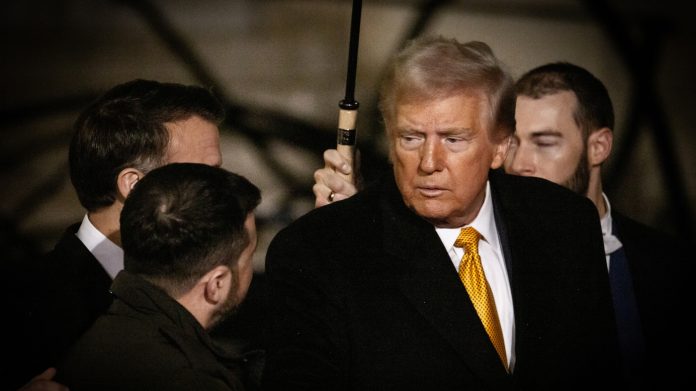
France s President Emmanuel Macron, US president-elect Donald Trump and Ukraine s President Volodymyr Zelensky after a meeting at The Elysee Palace in Paris in December of last year.

MATHILDE KACZKOWSKI/Hans Lucas/AFP via Getty Images


hide caption

toggle caption

MATHILDE KACZKOWSKI/Hans Lucas/AFP via Getty Images


France s President Emmanuel Macron, US president-elect Donald Trump and Ukraine s President Volodymyr Zelensky after a meeting at The Elysee Palace in Paris in December of last year.

MATHILDE KACZKOWSKI/Hans Lucas/AFP via Getty Images

On Friday, Ukrainian President Volodymyr Zelenskyy is scheduled to meet President Donald Trump at the White House.

On the agenda — a deal for Ukraine to share it’s rich natural resources. The Trump administration wants hundreds of billions of dollars of rare earth metals and other critical minerals. Details are thin on what exactly Ukraine would get in exchange.

The meeting comes as the world marks three years since Russia’s full-scale invasion of Ukraine, and as Trump promises to bring an end to the war.

But bringing an end to the war may not be so simple argues Alexander Vindman.

The Ukrainian-born Vindman was the White House staffer and active duty Army officer, who testified against Trump during his first impeachment trial in 2019.

Trump fired Vindman not long after.

For sponsor-free episodes of Consider This, sign up for Consider This+ via Apple Podcasts or at plus.npr.org.

Email us at [email protected].

This episode was produced by Marc Rivers and Alejandra Marquez Janse.

It was edited by Courtney Dorning and Nadia Lancy

Our executive producer is Sami Yenigun.

‘Fantasy’ AI Video, Shared by Trump, of Gaza as Luxury Resort Draws Scorn

0

President Trump on Tuesday night shared an AI-generated video depicting the devastated Gaza Strip as an opulent resort emblazoned with his name, less than a week after he appeared to back off his proposal to displace Palestinians en masse from the territory and assert U.S. control over it.

It was not immediately clear where the video originated or who made it, and Mr. Trump did not add any comment to the social media post that shared it. Versions of the video had appeared on social media sites including LinkedIn, X and Instagram in recent weeks. The video shared on Mr. Trump’s account appeared to have been downloaded from Rumble, a Florida-based video platform popular on the right.

The video was immediately scorned by many Palestinians, much as Arab nations rejected Mr. Trump’s plan when he announced it early this month.

“It’s a fantasy,” said Ahmed al-Soufi, the mayor of Rafah, a city in southern Gaza where huge numbers of displaced people live in tents amid rubble. “If Mr. Trump wants to give Palestinians a place to live in dignity and a future, he must give them a state alongside Israel.”

The video begins with scenes of people, including gunmen, walking through the ruins of heavily damaged streets, then quickly transitions to images of development and then beachside luxury. Scenes variously show a child holding a balloon shaped like Mr. Trump’s head; a large golden statue of the president; and a man throwing money in the air on a beach.

Some signs of AI-generated imagery are more subtle than others. One scene shows a man who resembles the billionaire Elon Musk, a close adviser to the president, eating bread with six fingers on one hand. Other scenes show belly dancers with beards and green head scarves on a beach; Mr. Trump dancing with a woman at a nightclub; and Mr. Trump and Prime Minister Benjamin Netanyahu of Israel sitting shirtless at a pool with drinks.

Mr. Trump proposed in early February that the United States take control over Gaza and permanently remove the entire Palestinian population of about two million people to countries like Egypt and Jordan. The leaders of those nations and others swiftly rejected the plan, and experts said the forced deportation or transfer of a civilian population is a violation of international humanitarian law, a war crime and a crime against humanity.

Last week, Mr. Trump seemed to concede that his efforts to persuade Egypt and Jordan had failed, telling Fox News in an interview that he was “a little surprised” by those countries’ response.

“I’ll tell you, the way to do it is my plan,” he told the Fox News host Brian Kilmeade. “I think that’s the plan that really works. But I’m not forcing it. I’m just going to sit back and recommend it.”

He also spoke of his proposal in the past tense, saying, “I liked my plan. I thought my plan was good.”

The White House did not immediately respond to a request for comment on the video.

The militant group Hamas, which has tried to demonstrate its continued control of Gaza over the course of a cease-fire with Israel in recent weeks, rejected the vision presented in the video on Wednesday.

“We strongly condemn, in the harshest terms, the disgraceful video published by U.S. President Donald Trump, which contains unethical scenes that violate the customs, morals and traditions of our Palestinian people,” said Ismail al-Thawabta, the director of the Hamas-run government media office in Gaza.

During his first term, Mr. Trump outlined a Middle East peace plan that strongly favored Israel while offering the Palestinians the possibility of a fragmented state with limited sovereignty. This month, the president remained ambiguous about whether he supported a two-state solution.

“It doesn’t mean anything about a two-state or a one-state or any other state,” he said at a White House news conference.

Aaron Boxerman contributed reporting.

Jeff Bezos revamps Washington Post opinion section, leading editor to quit : NPR

0

The Washington Post owner Jeff Bezos attends a luncheon following the inauguration of President Trump in January. Bezos says the newspaper’s editorial section will publish only “in support and defense of two pillars: personal liberties and free markets.”

Kevin Dietsch/Getty Images/Getty Images North America


hide caption

toggle caption

Kevin Dietsch/Getty Images/Getty Images North America

The Washington Post‘s billionaire owner, Jeff Bezos, announced a sweeping new libertarian vision for the paper’s opinion sections on Wednesday, just four months after his decision to kill a presidential endorsement of Kamala Harris triggered hundreds of thousands of subscribers to cancel.

Post Opinions Editor David Shipley, whom Bezos recruited from Bloomberg Opinions in 2022, chose to resign rather than stay to oversee the paper’s revamped sections.

“We are going to be writing every day in support and defense of two pillars: personal liberties and free markets,” Bezos wrote in a memo to staffers announcing the changes. “We’ll cover other topics too of course, but viewpoints opposing those pillars will be left to be published by others.”

Newspaper op-ed sections have incorporated opposing views for years. The term “op-ed” is literally an abbreviation for pieces running “opposite the editorial pages” that often conflicted with a publisher’s editorial line. But Bezos characterized that practice as outdated.

“There was a time when a newspaper, especially one that was a local monopoly, might have seen it as a service to bring to the reader’s doorstep every morning a broad-based opinion section that sought to cover all views,” Bezos said. “Today, the internet does that job.”

Shock inside the newsroom

At an hour-long meeting with opinion writers, Shipley said he did not know what lay ahead, according to an attendee who spoke on condition of anonymity because they did not have permission to speak publicly.

Shipley said he had wanted a “broader, pluralistic place,” but that Bezos sought “a focused [opinion] report.”

Bezos justified his decision in the memo to staffers. “I am of America and for America, and proud to be so,” he wrote. “And a big part of America’s success has been freedom in the economic realm and everywhere else.”

The decision sparked fresh shock and dismay at the paper. After senior news editors raised concerns at a meeting Wednesday, Executive Editor Matt Murray reassured them that Bezos had given no indication that he wanted to interfere with news coverage, according to two people with direct knowledge. A spokesperson for the Post confirmed his remarks.

Later in the day, Murray sent a memo to the newsroom to underscore the point: “The independent and unbiased work of The Post’s newsroom remains unchanged, and we will continue to pursue engaging impactful journalism without fear or favor.” (Murray and Bezos did not reply to requests for comment.)

Post Associate Editor David Maraniss, a legendary journalist whose association with the newspaper stretches back more than four decades, wrote on Bluesky that he would never write for it again as long as Bezos owns it.

“One pernicious step after another, Bezos encroached on the Post editorial policy,” Maraniss wrote. “Today he seized it fully. The old Washington Post is gone.”

One writer for the opinions section told NPR he was “heartsick,” adding, “leadership matters.”

NPR spoke to six people with direct knowledge of events for this article. They were given the ability to speak anonymously because they were not authorized to speak about internal matters at the paper.

Shipley did not respond to requests for comment. According to a person with direct knowledge, Shipley told Bezos that the new approach would violate the Post‘s promise of holding power to account.

Bezos new approach differs dramatically from first Trump term

Bezos stood by the newspaper’s dogged reporting on the first Trump administration. In that period, the Post adopted the motto “Democracy Dies in Darkness.” It won Pulitzer Prizes for coverage of the Jan. 6 attack on the U.S. Capitol and, earlier, of Russian interference in the 2016 presidential election.

More recently, Bezos’ decision in October to kill the Harris editorial sparked a furor inside and outside the paper, leading editorial writers to resign and more than 300,000 people to cancel their digital subscriptions in a matter of days. (The Post says it has been able to win some subscribers back and garner some new subscribers in the opening weeks of Trump’s second term.)

David Shipley resigned as opinions editor of The Washington Post after owner Jeff Bezos declared he wanted the section to focus only on supporting "personal liberties and free markets." In this 2024 photo, Shipley and the newsroom celebrate winning three Pulitzer Prizes.

David Shipley resigned as opinions editor of The Washington Post after owner Jeff Bezos declared he wanted the section to focus only on supporting “personal liberties and free markets.” In this 2024 photo, Shipley and the newsroom celebrate winning three Pulitzer Prizes.

The Washington Post/The Washington Post via Getty Im/The Washington Post


hide caption

toggle caption

The Washington Post/The Washington Post via Getty Im/The Washington Post

As a practical matter, Shipley argued to Bezos, the Wall Street Journal‘s highly pro-markets pages have had a similar policy for decades. As with the decision not to publish the endorsement of Harris, Shipley’s arguments fell on deaf ears.

In his memo to staff, Bezos praised Shipley and wrote that he offered the editor the chance to lead the reformed sections. “I suggested to him if the answer wasn’t ‘hell yes,’ then it had to be ‘no,'” Bezos wrote.

The Post has aggressively covered the new administration. But Bezos appears to have embraced the president’s return to power. Bezos personally paid $1 million toward Trump’s inaugural fund. He and his fiancée Lauren Sánchez traveled to Trump’s Florida estate, Mar-a-Lago, to socialize with the Trumps. And, along with other digital chieftains, Bezos sat behind the president as he was sworn in for a second term.

Opinions editor repeatedly in tough spot

Shipley’s two-and-a-half years have brought acclaim for the section, with two Pulitzer Prizes and two Loeb Awards. But his standing was deeply undercut by Bezos’s recent decisions, especially over the Harris endorsement.

When Shipley decided to withhold a cartoon from the Pulitzer-winning staffer Ann Telnaes about Bezos from publication, he told colleagues he believed he was making a decision on the merits, not pulling his punches. The cartoon depicted Bezos abasing himself along with other tech titans before Trump.

“Not every editorial judgment is a reflection of a malign force,” Shipley said in a statement shared at the time with NPR. “My decision was guided by the fact that we had just published a column on the same topic as the cartoon and had already scheduled another column — this one a satire — for publication. The only bias was against repetition.”

Shipley told colleagues privately that he understood, given the moment, it might be hard to credit his actual motivations.

The paper has bled veteran talent from both the opinion and news sides since the news broke about the killed editorial. Post journalists left for the Atlantic, the New York Times, the Wall Street Journal, and CNN among other outlets.

But Post Publisher and Chief Executive Will Lewis celebrated the change in direction on Wednesday. Lewis previously served for six years in the same role at the Journal, which is owned by Trump ally and conservative media magnate Rupert Murdoch. He has advocated for a similar approach at the Post.

Bezos hired Lewis, in significant part, due to his belief the British journalist could build better bridges to Trump and to conservatives. As well as serving Murdoch as an executive for a decade, Lewis was previously editor of the conservative Telegraph in the U.K. and later served as a consultant for Tory Prime Minister Boris Johnson.

“I am very excited about this new clarity and transparency, and cannot wait to see it brought to life in our opinion section. Every Day,” Lewis said in a note to staff. “This is not about siding with any political party. This is about being crystal clear about what we stand for as a newspaper. Doing this is a critical part of serving as a premier news publication across America and for all Americans.”

A Woman Died Midflight. Her Body Was Seated Next to Them.

0

An Australian couple’s dream trip to Venice turned into a nightmare when flight attendants asked them to stay seated next to the body of a passenger who had died midflight for the final four hours of a 14-hour trip from Melbourne, Australia, to Doha, Qatar.

When a passenger collapsed during the flight, flight attendants tried to save her but were unsuccessful, Mitchell Ring, another passenger on the flight, said in an interview with an Australian news program, “A Current Affair,” on Channel 9. “They did everything they could, but unfortunately the lady couldn’t be saved, which was pretty heartbreaking to watch,” he said.

The crew tried to move the body to business class using a wheelchair, but it was too large to be moved through the aisle, Mr. Ring said in the interview. The flight attendants then saw that there were two open seats in the row of four seats where Mr. Ring and his wife, Jennifer Colin, were seated. They asked Mr. Ring to move over one seat, and placed the body in the seat where he had been sitting. Ms. Colin moved to a different row of seats.

Through tears, Ms. Colin, described the experience as shocking. “I’m not a great flyer at the best of times,” she said in the interview.

Upon landing, Mr. Ring said, he was told to stay seated as paramedics removed blankets from the body. The couple said in the interview that the airline had not offered them support.

Qatar Airways said in a statement on Wednesday that airline officials had spoken with the passengers seated next to the body to address their concerns.

“The safety and comfort of all our passengers is of paramount importance to us,” the statement said. “Our thoughts are with the family members of the passenger who sadly passed away.”

A spokesman did not respond to questions about whether the airline had offered compensation.

While distressing, moving the body of someone who has died to a seat is normal protocol, according to guidelines set by the International Air Transport Association, an airline trade group. Here is the standard procedure for flight attendants:

  • Alert the captain. The captain will advise the authorities at the destination airport so that officials can be ready to meet the flight when it lands, according to the association.

  • Move the deceased to a seat with few passengers around. If the flight is full, the body should be returned to its original seat or one that doesn’t obstruct an aisle or exit. “Be aware of the difficulty of the situation for companions and onlookers,” the guidelines say.

  • Put the body in a body bag. Zip it up to the body’s neck, and secure the body in place with a seatbelt. If no body bag is available, cover the corpse with a blanket.

  • Close the eyes.

  • Disembark passengers first. Family members should stay with the body.

When dealing with a dead body on a flight, “you cannot leave it on the floor,” said José Alvarado, a pilot with the Icelandic airline Play, explaining that it could hit a nearby passenger if there were turbulence.

In the event of a medical emergency, the pilots will stay the course or divert the flight depending on the situation. There are doctors available via satellite communication to advise on how best to treat and monitor a patient, he said.

If all efforts fail and a passenger dies, pilots will often continue to the planned destination, Mr. Alvarado said. In his decades as a pilot, a passenger has died midflight only once while he was at the controls. It was 1999, and a passenger had a stroke on a flight from Havana to Madrid, he recalled. He continued flying to Madrid, where paramedics took the body and assisted the man’s daughter, he said.

“You have very little options at 39,000 feet,” Mr. Alvarado said.

In-flight deaths are rare. There is one medical emergency for every 604 flights, according to a study published in 2013 that reviewed medical emergencies on flights between 2008 and 2010. Of the more than 10,000 patients for whom data was available, just over a quarter were taken to hospitals and just 0.3 percent, or about 30, died. The most common issues were possible strokes or respiratory symptoms.

DOGE expects to send another round of emails to federal workers : NPR

0

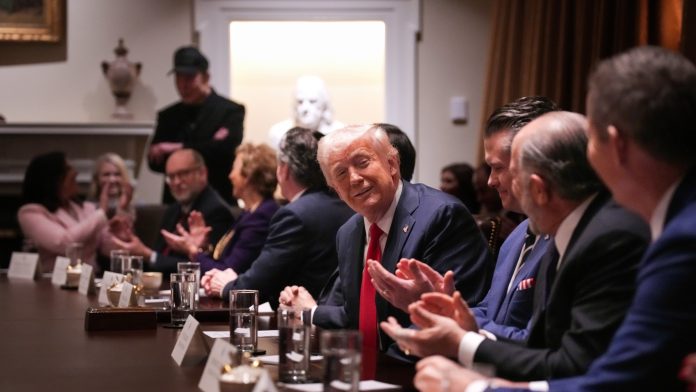
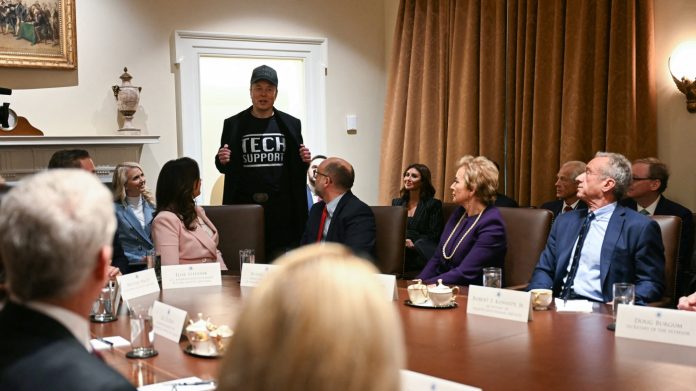
President Trump delivers remarks during his first Cabinet meeting of his second term at the White House on Feb. 26, in Washington, D.C. The meeting includes Tesla and SpaceX CEO Elon Musk, head of a Trump administration team called the Department of Government Efficiency.

Andrew Harnik/Getty Images


hide caption

toggle caption

Andrew Harnik/Getty Images

President Trump on Wednesday warned that the roughly 1 million federal workers who did not respond to recent emails asking them to describe “five things” they accomplished are “on the bubble” suggesting they are at risk of losing their jobs.

At the first meeting with the Cabinet, Trump welcomed tech billionaire Elon Musk, head of the administration’s cost-cutting team called the Department of Government Efficiency (DOGE), who said federal workers should expect another email in an effort to figure out if workers exist.

“We’re going to send another email,” Musk said.

Trump called Musk’s push “a good idea because, you know, those people, as I said before, they’re on the bubble,” he said. About half the federal workforce did not reply to initial emails sent over the weekend, according to the White House.

Musk also spoke at the meeting, describing the emails that asked “What did you do last week?” as a “pulse check” that anyone could do and argued, without presenting evidence, that the government is paying salaries to workers who don’t exist.

Leader of the Trump administration team called the Department of Government Efficiency, Elon Musk, wears a shirt that says "Tech Support" as he speaks during a Cabinet meeting with President Trump at the White House on Feb. 26.

Leader of the Trump administration team called the Department of Government Efficiency, Elon Musk, wears a shirt that says “Tech Support” as he speaks during a Cabinet meeting with President Trump at the White House on Feb. 26.

Jim Watson/AFP via Getty Images


hide caption

toggle caption

Jim Watson/AFP via Getty Images

“What we are trying to get to the bottom of is, we think there are a number of people on the payroll who are dead, which is probably why they can’t respond — and some people who are not real people … fictional individuals that are collecting paychecks,” Musk said.

The emails sparked confusion among federal workers and apparent tension among members of Trump’s Cabinet, some of whom told their workers not to immediately respond to it. At the Cabinet meeting, Trump told reporters that “everyone at this table is very much behind it.”

Trump invited Cabinet members to speak up to express any dissatisfaction with Musk but quickly added “we’ll throw them out” if they actually spoke up, eliciting laughter in the room.

“And some disagree a little bit, but I will tell you, for the most part, I think everyone’s not only happy, they’re thrilled,” Trump said.

Musk, wearing a “tech support” shirt under a suit jacket while standing behind Cabinet members seated at a long table, called DOGE a “support function” for the administration. His goal, he said, was to cut $1 trillion out of the nearly $7 trillion budget this year in an effort to balance it.

Musk also acknowledged that his team had made errors, such as canceling Ebola prevention efforts while making cuts to USAID. “I think we all want Ebola prevention. So we restored the Ebola prevention immediately, and there was no interruption. But we do need to move quickly,” he said.

Trump’s New Crackdown on China Is Just Beginning

0

President Trump’s tough talk on China typically centers on tariffs. But a closer look at the decisions he has made since taking office shows that the president is considering a far wider set of economic restrictions on Beijing, ones that could hasten America’s split from a critical trading partner.

The Trump administration has so far proposed expanding restrictions on investments flowing between the United States and China. It has appointed officials who, because of national security concerns, are likely to push for more curbs on Chinese investments and technology sales to China. And Mr. Trump has ushered in a 10 percent tariff on Chinese imports, a move that he called an “opening salvo.”

After years in which officials from both parties gradually pared back America’s economic relationship with China, Mr. Trump’s moves suggest that he is prepared to sever ties more aggressively.

Samm Sacks, a senior fellow at Yale Law School’s Paul Tsai China Center, said the investment memorandum that the administration issued on Friday read like “a call to finish the unfinished task of fully unwinding commercial ties with China.”

“So far, pragmatists have prevailed in getting a more narrow version of decoupling,” Ms. Sacks said.

The pronouncements could be “a bargaining tool” for Mr. Trump to kick off negotiations with the Chinese leader, Xi Jinping, Ms. Sacks said. “But should that fall apart or not work out — which is probably most likely — I see this as the blueprint to finish the job of decoupling.”

The main wild card in how far the United States will go appears to be Mr. Trump himself. The president is interested in potentially striking a deal with Mr. Xi, in part because of China’s failure to live up to the terms of an agreement the two leaders signed in early 2020. Current and former advisers say Mr. Trump takes a more transactional view to issues like Chinese investment than many of his more hawkish advisers, a position that could result in continuing economic ties in exchange for a deal that he feels benefits the United States.

Speaking from the Oval Office on Wednesday, Mr. Trump said he had a “great relationship” with Mr. Xi and expressed support for Chinese investment in the United States.

“We want them to come in and invest. I see so many things saying that we don’t want China in this country this time, right? We want them to invest in the United States. That’s good. That’s a lot of money coming in, and we’ll invest in China. We’ll do things with China.”

“We’re going to have a good relationship with China, but they won’t be able to take advantage of us,” he added.

Mr. Trump has expressed support for foreign investments in the United States that other Republicans consider national security issues, like a proposal by Japan’s Nippon Steel to invest in U.S. Steel, or a rescue of TikTok. And while campaigning, Mr. Trump said he would welcome Chinese companies to build auto plants in the United States as long as they hired locally.

“I’ll tell them if they want to build a plant in Michigan, in Ohio, in South Carolina, they can — using American workers, they can,” the president said at a rally in Dayton, Ohio, last March.

During his first term, Mr. Trump backed off a plan that would have crippled ZTE, a Chinese electronics maker, after Mr. Xi helped secure a meeting between Mr. Trump and President Kim Jong-un of North Korea.

Mr. Trump’s advisers say the president could continue to ratchet up pressure on Beijing, since he may see that as way to force Chinese officials to make concessions. As a result, trade tensions could rise in the months to come.

Mr. Trump, who hit China with tariffs during his first term, imposed an additional 10 percent levy on all Chinese imports this month. The reason, he said, was that Beijing was not doing enough to limit the flow of drugs into the United States. China answered with its own tariffs on American imports. It also restricted the export of certain critical minerals and initiated an antimonopoly investigation into Google.

A trade memorandum signed by the president on his first day in office directed his advisers to study other significant measures against China, such as revoking the permanent normal trade relations that the United States extended to China before it joined the World Trade Organization. And on Friday, the Office of the United States Trade Representative said it was moving forward with a trade case aimed at protecting the U.S. shipbuilding industry against Chinese competition.

Mr. Trump’s team is also discussing ways to tighten U.S. export controls, including by patching perceived loopholes in regulations on chips and chip-making equipment. Trump officials recently met with their counterparts in Japan and the Netherlands to discuss cooperation to keep technology out of China, continuing regular meetings from the Biden administration, people familiar with the incident said.

Personnel appointments also point to a stricter stance on Chinese investment and technology sales. Within the Commerce Department, which leads the efforts to limit technology sales to China, the Trump administration recently ousted several longtime employees, including Matthew S. Borman, a former deputy assistant secretary for export administration, in favor of new appointments. A nominee for assistant secretary of commerce, Landon Heid, advocated tighter restrictions on sales to Chinese technology companies while at the State Department.

On investment, Mr. Trump’s directive was a presidential memorandum rather than an executive order, meaning it did not immediately affect any policy. But it told the Treasury Department and other agencies in general terms to establish new rules to stop U.S. companies and investors from making investments that would aid China’s military advances, and stop people affiliated with China “from buying up critical American businesses and assets.”

The memorandum said that the Trump administration would create a “fast track process” for investment from U.S. allies, and that the United States would welcome all “passive” investments from foreigners, meaning investments in which they have no controlling stakes or managerial influence.

But it proposed harsher restrictions on certain foreign adversaries, like China, that it said were systematically investing in the United States to obtain technology, intellectual property and leverage in strategic industries like agriculture, minerals and shipping.

The memo said the Trump administration would expand the authorities of the Committee on Foreign Investment in the United States, or CFIUS, a body that reviews incoming investments for national security threats, to include “greenfield investment” — new facilities built from the ground up. It also ordered CFIUS to stop using “mitigation” agreements, in which companies make changes in ownership or technology to try to lessen national security concerns and allow acquisitions to go through.

Mr. Trump directed his advisers to consider expanded restrictions on emerging technologies, as well as whether to apply limits to more types of investments, such as pension funds and university endowments. He also ordered them to review the special structure that Chinese companies typically use to list on U.S. stock exchanges, which critics say limits ownership rights and protections for U.S. investors.

Critics say investment flows between the countries have aided the Chinese government and military, including by funding activities contrary to U.S. national security and helping U.S. technology flow to China.

The Coalition for a Prosperous America, a trade group that supports protectionist measures, praised the presidential memo. In a statement, it said money from U.S. investors had allowed China “to fund its state-sponsored genocide, military aggression, surveillance state apparatus and other malign activities.”

Roger Robinson Jr., a senior adviser to the group, called it “a history-making breakthrough.”

“Hopefully, the Congress will do its part in making illegal a number of Wall Street’s reckless and indefensible investment practices benefiting Chinese state-controlled corporate bad actors to our detriment,” Mr. Robinson said.

But some analysts said that the economic impact could be limited and that the order could be subject to legal challenges.

Ling Chen, a professor at the Johns Hopkins University School of Advanced International Studies in Washington, said Chinese investment in the United States had already fallen sharply since 2017. As a result, she said, she doesn’t expect much fluctuation, or much influence on China.

“I do not expect to see any surprising changes in the overall trend,” she said.

Jim Secreto, a former counselor for investment security at the Treasury Department, said some of the ideas in the memo, like reviews of greenfield projects, “overstep CFIUS’s existing authorities and could be challenged in court.”

“The Trump administration would be wise to proceed carefully to avoid implementation challenges that could end up harming national security,” Mr. Secreto said.

Alan Rappeport contributed reporting.

A pattern emerges in Elon Musk’s federal government shakeup : NPR

0

Elon Musk, who oversees the Trump administration’s Department of Government Efficiency, wears a shirt that says “Tech Support” as he speaks during President Trump’s Cabinet meeting Wednesday at the White House.

Jim Watson/AFP via Getty Images


hide caption

toggle caption

Jim Watson/AFP via Getty Images

Stability used to be a hallmark of working for the federal government. Since Jan. 20, it’s been quite the opposite.

As President Trump acts on his campaign promise to dismantle government bureaucracy and root out waste and fraud, federal workers have complained of mass chaos and confusion while lawsuits challenging the Trump administration’s moves pile up.

Five weeks in, there’s an emerging pattern in how the administration moves to target federal employees, and it looks something like this:

  1. Elon Musk, the billionaire adviser to Trump, brings in tactics he’s employed at his private-sector businesses.
  2. A directive is sent out through the Office of Personnel Management (OPM) that immediately raises the question: Can they do that?
  3. Federal agencies scramble to provide guidance to employees, resulting in multiple emails often in conflict with one another.
  4. Facing pushback, OPM then issues further guidance, telling agencies to carry out the directive themselves.

This process occurred with both the “Fork in the Road” resignation offer, which mirrored an offer Musk made to employees at Twitter in 2022, and the “What did you do last week?” email, a question Musk also put to then-Twitter’s CEO before buying the company in 2022.

“It’s been very eerie watching what’s been happening … where he rolls out the same Twitter playbook now with the federal government,” Shannon Liss-Riordan, an attorney who has sued Musk on behalf of Twitter employees, told NPR after the “Fork” offer went out.

Both directives were sent from the email address [email protected], which didn’t exist before Jan. 20. Lawsuits are challenging whether OPM even has the authority to send such communications.

Meanwhile, Trump has cheered Musk’s work and encouraged him to go further.

“Elon is doing a great job, but I would like to see him get more aggressive,” Trump wrote on his social media site Truth Social.

The president’s words ignore the fact that Musk himself has no authority to tell federal agencies what to do.

In a court filing earlier this month, the White House stated that Musk is a “Senior Advisor to the President,” and like other senior advisers, “has no actual or formal authority to make government decisions himself.”

Still, that doesn’t mean Musk — with the ear of the president and a giant megaphone — lacks power.

When Musk posted on his social media site X that federal employees could lose their jobs if they didn’t respond to the “What did you do last week?” email, that threat became part of the narrative, even though the actual email that went to federal employees made no mention of it, and prior OPM guidance stated that responses to mass emails were voluntary.

While some agency leaders swiftly issued guidance telling their employees not to respond, others including at the Treasury Department and the Environmental Protection Agency expressly instructed their employees to respond before the deadline, reinforcing Musk’s stance that a response was required.

Then late Monday, OPM issued new guidance formalizing the transfer of responsibility for the “What did you do last week?” request from OPM and Musk to the agencies, telling agency leaders to collect responses to the email and decide what to do with employees who didn’t respond.

“It is agency leadership’s decision as to what actions are taken,” the memo stated.

Where this playbook — agencies carrying out directives coming from OPM and championed by Musk — might hit a roadblock is in federal court.

Last week, in response to the Trump administration’s mass firings of probationary employees, labor unions sued the Trump administration, claiming that federal agencies themselves had no plans to fire employees but did so only at the direction of OPM.

Their complaint points to a federal statute that states that the head of each executive department “may prescribe regulations for the government of his department, the conduct of its employees, the distribution and performance of its business.”

In other words, the unions argue, OPM has no business telling other agencies how to manage their employees.

“OPM has, in my mind, vastly exceeded not only its authority, but any past precedent for exercising its authority,” says Michelle Bercovici, a partner with the Alden Law Group who filed a different complaint over Trump’s firing of probationary employees. “It’s definitely break first, ask questions later.”

In its opposition brief, the Trump administration denied that it had created a “mass termination program,” only noting that OPM had asked agencies to review probationers based on how their performance was advancing the agencies’ mission. The administration insists that agencies made their own decisions about which employees to terminate and which to keep.

U.S. District Judge William Alsup of the Northern District of California will hear arguments in the unions’ case on Thursday.

Now, unions and attorneys are bracing for far deeper cuts, as Trump moves to the next phase of the dismantling.

Trump’s Feb. 11 executive order directs agencies to prioritize cutting “all offices that perform functions not mandated by statute or other law” through a process called a reduction in force.

That process moved forward a step Wednesday, with OPM and the Office of Management and Budget sending out official guidance to agencies, saying they have until March 13 to develop “Agency Reorganization Plans.”

Those plans could mean tens of thousands or even hundreds of thousands of federal employees lose their jobs.

Have information you want to share about ongoing changes across the federal government? NPR’s Andrea Hsu can be contacted through encrypted communications on Signal at andreahsu.08.

Rare Protest at U.S. Embassy in Ukraine Reflects Fears Over Trump

0

Maryna Tymchenko walked to the U.S. embassy on Wednesday morning and held up a homemade cardboard sign over her head: “Reagan would have hated it,” the sign read, alluding to the former president who famously called the Soviet Union “an evil empire.”

She said she felt whiplash from the past two weeks as the United States, once Ukraine’s top ally, and the Republican Party, the party of Ronald Reagan, appeared to back Russia in its war against Ukraine.

But Ms. Tymchenko, who skipped lunch for the small protest, was nuanced in her views: She was angry with President Trump, who appeared to blame Ukraine’s leaders for Russia’s invasion of her country. But she was grateful for America’s past support of Ukraine’s war effort.

She was confused: Why had the United States aligned with Russia? Why had initial talks to end the war taken place between the United States and Russia while leaving out Ukraine? Why was the Trump administration pushing Ukraine to sign a deal — which appeared to be in its final stages on Wednesday — that would grant the United States at least some future profits from the mining of critical minerals in Ukraine?

“It feels like a knife in the back from your dear friend,” said Ms. Tymchenko, 27, who works for an information technology company in Kyiv. “That’s why I’m here. It’s so weird. That’s not what the U.S. is supposed to do. You’re the leader. You’re strong. Why don’t you support us?”

As anti-American protests go, this was more of a plea for help than a shout of anger. There were no chants of “Death to America,” as happens at even the most benign protests in Pakistan or Iran. The woman who organized the protest was gentle in her admonitions.

“Trump is making America very small,” the organizer, Anabella Morina, said several times, while holding a banner that said “God, save America” and depicted the Statue of Liberty, Mr. Trump and President Vladimir V. Putin of Russia in a strange embrace.

There were more police officers and journalists at the embassy’s front gates than the handful of protesters. The protest, announced on Facebook on Monday, was held in the middle of a workday, and most attendees were retirees or activists.

Still, the demonstration was emblematic of what could become a shift in Ukrainian opinion on America, with President Volodymyr Zelensky taking a more barbed tone toward its longtime ally in the war.

“Our people are used to criticizing their own president — that’s our prerogative,” Ms. Morina said. “Trump has no right to interfere. I apologize in advance for criticizing your president, but he is interfering in our affairs. This is my opinion, but I also know many who share my view — his current policies are aimed at Ukraine’s defeat.”

A poll by a Ukrainian company called Rating Group that was conducted after Mr. Trump called Mr. Zelensky a dictator found that Mr. Zelensky’s approval rating had gone up, to 65 percent from 57 percent in January.

“I was against Zelensky myself, I never voted for him,” said Alla Iskra, 61, a former economist and casino manager who came to the protest on Wednesday. But, she added, “When Trump went against Zelensky, we all united.”

Under President Biden, the United States was Ukraine’s biggest supporter, leading an international coalition against Russia and its invasion.

But now, Ukrainian online memes feature photos of Mr. Trump alone, juxtaposed with photos of Mr. Zelensky surrounded by Western leaders, as he was in Kyiv on Monday, the third anniversary of Russia’s full-scale invasion.

A frequently shared meme features a cartoon rendition of a well-known photograph from the Kyiv suburb of Bucha in the early days of the invasion: a broken bicycle and a young man’s body. Only this rendition included Mr. Trump looking down at the body and saying, “You started it!”

Ukrainians typically love a good protest. In fact, past ones have led to revolutions: the Revolution on Granite in 1990, the Orange Revolution in 2004 and the Revolution of Dignity in 2013 and 2014. Throughout the war, demonstrators have gathered on a weekly basis to protest the plight of Ukrainian prisoners of war.

But protests at the U.S. embassy in Kyiv have, until now, been rare.

Several Ukrainians at Wednesday’s protest assailed Kyiv’s deal this week in which it agreed to turn over the revenue from some of its mineral resources to the United States.

Pavlo Derhachov, 35, called it “a new form of colonialism, hybrid colonialism.”

And signs at the protest proclaimed “no blackmail” and “no to looting Ukraine.”

Ms. Iskra, the former economist who was among the protesters, said she feared Mr. Trump’s insistence on gaining access to Ukraine’s critical minerals.

“When Trump started talking about mineral resources, I thought he meant something good, something about helping and protecting Ukraine,” she said. “But then I realized this is just business — he is making money off Ukraine.”

Oleksandra Mykolyshyn contributed reporting from Kyiv.

Former Trump adviser defends alienation of U.S. allies : NPR

0

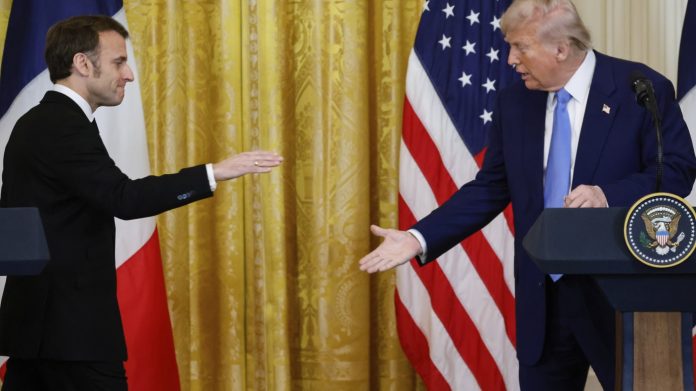
President Donald Trump, right, and France’s President Emmanuel Macron reach to shake hands during a joint press conference in the East Room of the White House in Washington, Monday, Feb. 24, 2025.

Ludovic Marin/Pool via AP


hide caption

toggle caption

Ludovic Marin/Pool via AP

In recent days, President Trump has publicly criticized and made demands of Ukraine’s President Volodymyr Zelenskyy while declining to call longtime U.S. antagonist Russian President Vladimir Putin a dictator.

Vice President Vance told European leaders at the Munich Security Conference last week that the real threat is not coming from Russia but from within their own countries.

Foreign policy experts have told NPR that Trump’s alienation of U.S. allies in Europe is radical and that in the long run, the move won’t benefit the U.S.

But what the president and his administration are actually doing is recognizing that post-World War II alliances, including NATO, are outdated, said Victoria Coates, a deputy national security adviser in the first Trump administration.

“A war between Germany and France is not our number one national security problem,” Coates said. “[Trump] is looking at the world and saying, OK, there is a war in Europe, but this is the Ukraine-Russia war. It’s been going on for three years. There’s been no diplomacy to proceed to a conclusion of the war.”

In an interview with Morning Edition‘s Steve Inskeep, she said she wonders if it isn’t NATO allies falling short of expectations with the U.S. instead of the other way around.

This interview has been edited for length and clarity. 

Steve Inskeep: There has been this world order, particularly in Europe, ever since World War II. The U.S. leads its European allies when necessary against Russia. That was the form in the early years of the war in Ukraine. Do you believe President Trump has upended the world order or switched sides?

Victoria Coates: No, I don’t think so. What President Trump is doing is acknowledging that 80 years on the reason that some of the structures were put in place after World War II, which was actually largely to prevent another inter-Europe war, are no longer in place. A war between Germany and France is not our number one national security problem. He is looking at the world and saying, OK, there is a war in Europe, but this is the Ukraine-Russia war. It’s been going on for three years. There’s been no diplomacy to proceed to a conclusion of the war. We’ve had a lot of maximalist rhetoric. We’ve had a lot of sort of displays of support for Ukraine and declarations that Ukraine is a democracy and this is an existential threat to the West. But we’ve also had hundreds of thousands dead and a lot of destruction. He is trying to change that paradigm also.

Inskeep: You mentioned that a lot of the structures were put together to avoid an inter-European war. I think that’s correct. But NATO specifically was an alliance against the expansion of what was then the Soviet Union, what is now Russia, which does seem to literally be the problem right now. It’s not just a war between Ukraine and Russia. Russia invaded Ukraine.

Coates: Well, it is. We’ll be welcoming the prime minister, Prime Minister Keir Starmer to Washington this week. We’ve already had President Emmanuel Macron. We will have President Volodymyr Zelenskyy. So that hardly looks to me like a Washington that is rejecting Europe.

At the NATO summit last year here in Washington, the NATO countries collectively agreed on a series of war plans that we would execute in the event of an additional kinetic action by an enemy. And those war plans require NATO to be investing collectively at 3.5%, which is where the United States is. The UK announced this week with great fanfare they were going to try to get to 2.5%. That math just doesn’t add up. If three years into a war in Europe, you don’t have the major European economies getting to the level of defense expenditure they need to get to in order to sustain what NATO has agreed to, then I have to wonder if it’s not the United States that’s turning its back on NATO, it’s these other NATO members who aren’t investing.

Inskeep: I want to ask about the concessions that the United States has offered to Russia’s Vladimir Putin as the president tries to end this war. Michael McFaul, a critic of Trump and former U.S. ambassador there, notes that the U.S. has already publicly said that Ukraine has to give up territory to Russia, that Ukraine can’t join NATO, that the U.S. won’t send peacekeeping troops, that the U.S. will reduce the number of soldiers in Europe, and that Zelensky, the Ukrainian president, has to hold elections before there are peace negotiations and other concessions. And in McFaul’s view, the United States hasn’t demanded anything of Russia. Is that how you see it?

Coates: Not at all. I mean, I think what has been offered to Russia has largely been rhetorical. None of this has cost the president anything. I would add the United Nations General Assembly resolution to that list, because off the top of my head, I can’t think of anything more useless than one of those resolutions.

Inskeep: You think you think it doesn’t matter that this resolution with the wording that few people other than the United States agreed with passed. Go on.

Coates: Yeah, this has largely been rhetorical and what we’ve offered Ukraine, on the other hand, which will be signed at the White House on Friday, is a material economic deal that will invest the United States in Ukraine and Ukraine’s security. So I would see that as a much more serious offer than, you know, rhetoric.

Inskeep: Do you think that deal would commit the United States to defend Ukraine against Russia?

Coates: I think it gives the United States a vested interest in Ukraine, which is something we have not had before. So we will see what that results.