Friday, November 13, 2026
Home Blog Page 181

At Funeral for Shiri Bibas and Children, an Israeli Outpouring of Grief

0

The people of Israel embraced them on their final journey, turning out in multitudes along the funeral route for a family that had become emblematic of the country’s trauma after the Oct. 7, 2023, attack.

Shiri Bibas and her two young sons, Ariel and Kfir, were kidnapped during the Hamas-led attack on southern Israel, taken to Gaza, and killed in captivity, according to the Israeli authorities. On Wednesday, amid a national outpouring of solidarity and grief, they were buried under a blue sky, not far from the border community where they had lived and from which they were seized.

Through 16 months of fear and uncertainty over their fates, the Bibases had become a symbol for many Israelis, both of the tragedy that befell their country that October day, when about 1,200 people were killed and about 250 abducted to Gaza, but also of a widespread sense of abandonment. The military had failed to come to their rescue and the government failed to bring them, and many other hostages, home in time.

Ms. Bibas was 32 when she was abducted. Ariel was 4, and Kfir, the youngest hostage, was not even nine months old. Yarden Bibas, Shiri’s husband and the father of the two redheaded boys, was abducted separately during the attack, which set off Israel’s 15-month war in Gaza that killed tens of thousands of Palestinians and left much of the enclave in ruins.

Mr. Bibas was returned to Israel alive early this month as part of a cease-fire deal for Gaza. The remains of Ms. Bibas and the children were returned to Israel last week. After forensic testing, Israel’s chief pathologist dismissed Hamas’s claims that they had been killed in an Israeli airstrike, though no evidence has been made public, in line with the family’s request for privacy.

Eulogizing his family, Mr. Bibas apologized for not managing to protect them. “Ariel, I hope you’re not angry with me for failing to protect you properly and for not being there for you,” he said, adding, “Kfir, I’m sorry I didn’t protect you better.”

“Shiri, everyone knows and love us — you can’t imagine how surreal all this madness is,” he said. He added, “This is the closest I’ve been to you since Oct. 7, and I can’t kiss or hug you.”

Ofri Bibas, Yarden Bibas’s sister, touched on the popular anger and demand for the government to allow an independent investigation into the Oct. 7 failures and accept responsibility.

“There is no meaning to forgiveness before the failures are investigated and all officials take responsibility,” she said in her eulogy. “Our disaster as a nation and as a family should not have happened and must never happen again.”

Government officials were asked to stay away from the private burial. A few days ago, Ofri Bibas criticized the Israeli prime minister, Benjamin Netanyahu, for not apologizing to the family.

Crowds also gathered at a central plaza in Tel Aviv now known as Hostage Square to watch a livestream of the eulogies on a large screen. Some people were wrapped in Israeli flags. Some wore orange to remember the redheaded children. Others held orange balloons aloft then released them into the sky.

Maia Szryftman, 53, had come from Nahariya, on Israel’s northern border, to express support for the family and be part of the public outpouring. “The heart aches for the two children, for the whole family,” she said.

Yael Koren, 44, said she had come to the square “to be human.”

“I believe that being together makes us stronger,” she said.

She showed an image on her cellphone of a picture that her son, nearly 7, had drawn of a boy who had been kidnapped. She said her children’s school had sent memos home about how to answer their questions about the Bibas children.

“But you can’t explain it,” she said.

National Park Service layoffs, hiring delays impact visitors : NPR

0

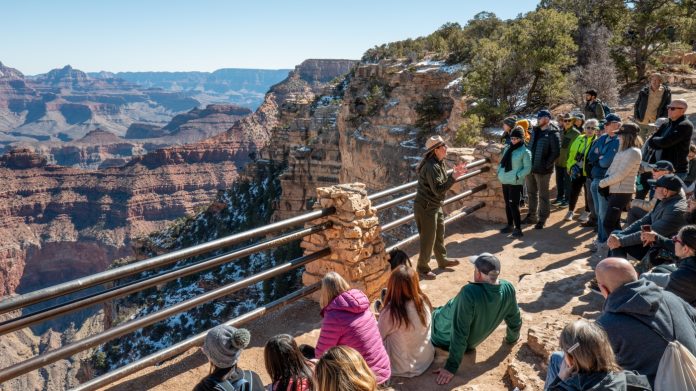
A ranger gives a tour to visitors at Grand Canyon National Park on Saturday. The National Park Service is dealing with the effects of layoffs and the federal hiring freeze.

Brandon Bell/Getty Images


hide caption

toggle caption

Brandon Bell/Getty Images

National parks across the U.S. are bearing down on an uncertain season, as federal layoffs and staffing shortages threaten many of the services they provide for their millions of annual visitors, from reservations to cleanup to education.

The National Park Service (NPS) laid off some 1,000 employees on Feb. 14, just weeks before the start of the busy season in many of the country’s 63 national parks.

The layoffs, which targeted probationary workers, are part of a broader effort by President Trump and adviser Elon Musk to downsize the federal workforce. NPS officials have testified that the agency was already understaffed — the number of full-time employees dropped by about 15% between 2011 and 2022, forcing some visitor facilities to close or limit their hours.

A bit of welcome news came later that week when the Trump administration gave the NPS permission to fill temporary seasonal positions that had been paused due to the federal hiring freeze. The agency is allowed to fill a total of 7,700 positions — higher than the three-year average of 6,350 — according to a memo obtained by NPR.

“Now that’s really good news,” said Bill Wade, the executive director of the Association of National Park Rangers and a retired superintendent of Shenandoah National Park.

“However, it’s not without problems, because at this sort of late date and the hiring timetable, I think there’s going to be some difficulty getting some of those positions on board in the parks before the summer season hits.”

Between the paperwork, background checks, training regimens and housing searches, experts worry many seasonal positions won’t get filled — in general, let alone by summertime. Busy season varies between parks, though generally runs May through September in colder areas and can start as soon as March in warmer parts of the country.

The influx of seasonal workers can more than double the number of park staff in a typical year, Wade said. And their absence will surely be felt by visitors, since they perform such critical functions.

“They’re typically the ones that do the fee collection at the entrance stations during that period of time,” he added. “They work in the visitor centers and keep them open and staffed and give the ranger-led programs. They are often the custodians that keep the campgrounds clean and the restrooms clean and pick up the trash.”

Kristen Brengel, the senior vice president of government affairs at the National Parks Conservation Association — a nonprofit that advocates for the NPS — says these workers take care of visitors in subtle but critical ways, from asking hikers how much water they have to gently making sure people keep a safe distance from wildlife.

They also perform more overt acts of heroism, like performing CPR and rescuing overtaxed hikers from trails, an increasing concern after multiple summers of heat-related deaths in national parks. One study found that the risk of heat-related illness at Grand Canyon National Park — and public lands in general — will only increase as climate change worsens.

“This is just such a sad situation,” Brengel said. “We hope the dedication that people have to working in the parks comes through and we can see parks staffed well this summer. But with all the chaos going on, it’s just concerning.”

With layoffs underway and seasonal workers delayed, some parks are already cutting back on services for now — and worrying about what will happen later.

A sign for an emergency phone in California's Joshua Tree National Park.

A sign for an emergency phone in California’s Joshua Tree National Park. Job cuts are prompting safety concerns, especially given the number of heat-related deaths in national parks in recent summers.

Mario Tama/Getty Images


hide caption

toggle caption

Mario Tama/Getty Images

Job cuts impact the visitor experience 

The NPS has not publicly confirmed the number or types of jobs lost at specific national parks, nor responded to NPR’s requests for comment.

But individuals and organizations affiliated with some parks have spoken out in recent days, beginning to paint a picture of the losses.

Ann Simonelli, a spokesperson for the Appalachian Trail Conservancy (ATC), told NPR over email that two out of 10 Appalachian Trail full-time staff members were impacted by the layoffs.

She said ATC is pausing all seasonal hiring, including trail crews — who have been repairing the nearly 500 miles of the trail damaged by Hurricane Helene — “until we see what happens with the federal budget.”

Congress has to pass a funding bill by March 14 to avert a government shutdown.

Farther north, Friends of Acadia — the philanthropic partner of Acadia National Park in Maine — says job cuts and hiring delays have added new layers of uncertainty to the park’s summer plans.

Eric Stiles, the organization’s president and CEO, told NPR that eight probationary park staffers were laid off: four fee collectors, two who worked on trails, an administrator who coordinated land management and a visual information specialist.

On top of that, he said fears of future rounds of layoffs, as well as the delay in seasonal staff, are cutting into the park’s ability to prepare for its busy season since it doesn’t know what its workforce will look like.

“I can’t tell you what summer visitors at Acadia — what that experience is going to be like,” he said. “I can’t tell you if the campgrounds are going to be open. I can’t tell you if the reservation system for Cadillac [Mountain] is going to be up and running. I can’t tell you if trails are going to be closed, because if there’s a dead tree overhanging a trail, you need highly skilled, certified folks that might be able to climb and drop a tree with a chainsaw.”

Across the country, some fired parks staff members have weighed in on the consequences for park visitors, from loss of wildlife protection to unclean bathrooms to a lack of rangers who can keep hikers safe.

Nate Vince, who said he was Yosemite’s only locksmith, wrote in a now-viral Instagram post that he was terminated on Valentine’s Day — losing his housing along with his job — with what he said are potentially dangerous repercussions.

“Yosemite National Park [is] the size of Rhode Island and has more locks than a small city, and without a locksmith I’m deeply concerned for the safety and security of the park and people in it,” Vince wrote. “This is not right!”

Vehicles wait in line at an entrance to the Grand Canyon National Park.

Vehicles wait in line at an entrance to the Grand Canyon National Park on Sunday. It’s not clear how many park staff lost their jobs, but Arizona’s governor has expressed concern about the economic impact of the layoffs.

Brandon Bell/Getty Images


hide caption

toggle caption

Brandon Bell/Getty Images

Some parks are already making adjustments 

Disruptions are already being felt at some park sites.

Florissant Fossil Beds National Monument in Colorado posted on Facebook that as of this week, it is closed on Mondays and Tuesdays, “due to a lack of staffing.”

Saguaro National Park in Arizona says its visitor centers will be closed on Mondays until further notice. Yosemite National Park announced it is delaying reservation bookings at five of its popular campgrounds, affecting reservations in June and July.

Responding to reports of staffing shortages causing wait times twice as long as usual at the Grand Canyon last weekend, Arizona Gov. Katie Hobbs called it “a slap in the face for Arizonans and all who love to come here.” (The Grand Canyon National Park referred comment to the NPS.)

“The Trump administration’s removal of essential workers undermines our economy and ability to showcase one of the greatest natural wonders of the world,” Hobbs tweeted.

National parks play a vital economic role throughout the country. Some 325 million visitors spent an estimated $26.4 billion in local “gateway regions” in 2023 alone, according to NPS. Those expenditures supported 415,000 jobs and created $55.6 billion in economic output in the national economy, it adds.

When asked about safety and economic concerns, J. Elizabeth Peace, a spokesperson for the Department of the Interior, told NPR that the NPS — which it houses — is hiring seasonal workers “to continue enhancing the visitor experience as we embrace new opportunities for optimization and innovation in workforce management.”

“We are focused on ensuring that every visitor has the chance to explore and connect with the incredible, iconic spaces of our national parks,” she added. “As always, NPS will continue to provide critical services and deliver excellent customer service.”

Visitors admire the "firefall effect" on El Capitan during sunset.

Visitors admire the “firefall effect” on El Capitan during sunset at Horsetail Fall in Yosemite National Park, California, last week. Busy season starts in May for Yosemite and many other parks.

Tayfun Cokun/Anadolu via Getty Images


hide caption

toggle caption

Tayfun Cokun/Anadolu via Getty Images

What park-lovers — and potential visitors — can do

The experts NPR spoke with all encouraged potential visitors not to cancel their park vacation plans just yet, but urged caution and flexibility given all of the uncertainties.

Brengel, with the National Parks Conservation Association, said people should try to take fewer risks as they venture outside.

“If you don’t think you can do the hike, don’t do it this year,” she said. “Stay out of the direct sunlight, bring lots of water, make sure your footwear is good … Just really do your homework before you come in because there may be fewer people to help you once you get there.”

Wade, the retired NPS superintendent now with the Association of National Park Rangers, recommends visitors keep checking on their reservations as their trip gets closer since services like guided tours could be suspended.

“They need to check ahead of time and they need to probably be a little bit patient with some of the impacts that they might see, like maybe restrooms not cleaned as as frequently, visitor center hours, trash pick-up, some of those things that they might see now or in the early part of the summer that they wouldn’t normally see,” he added.

The hope, he said, is that things will run more smoothly as more seasonal positions get filled in the weeks and months ahead. The big question, Wade added, is what happens at the end of the summer when those positions are terminated.

“We don’t know what the ultimate outcome of staffing is going to be after the summer season or after those seasonals leave,” Wade said. “There are rumors that downsizing is not over yet … And so it’s a very unsettling time for people in the parks right now.”

Wade said the most helpful thing concerned visitors can do is lobby their elected representatives to reverse the layoffs — which some Virginia lawmakers have already asked the Trump administration to do.

A 2024 Pew Research Center poll showed that the park service had the most favorable rating of any government agency at 76%, with strong support from a majority of both Democrats and Republicans.

“This is not a partisan matter. This is not a political matter,” said Stiles, with Friends of Acadia. “This is really about the foundational experience of participating, learning from, recreating in the best America has to offer by way of our natural treasures and cultural treasures.”

Stiles believes most Americans value and cherish the national parks system, which was the first in the world when it started in 1872 and has been crowned “America’s best idea.” And he said that while there is a conversation to be had about how to make it more efficient, that’s not what is happening now.

“You don’t treat America’s best idea with a sledgehammer,” he said.

UK’s Starmer to Meet Trump With a Boost on Defense and Pleas for Ukraine

0

Follow live updates on the Trump administration.

Now it’s Keir Starmer’s turn.

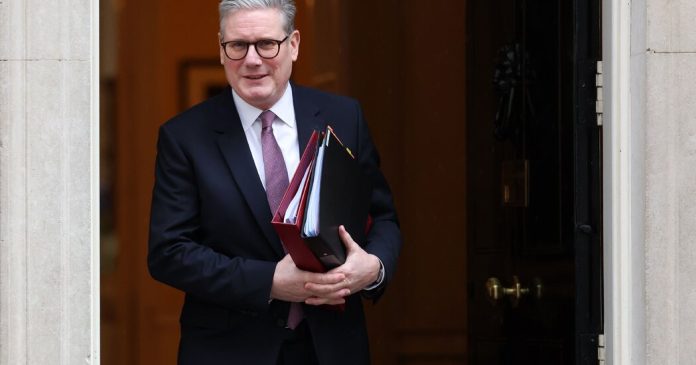
After President Emmanuel Macron of France navigated his meeting with President Trump on Monday, skirting the rockiest shoals but making little headway, Mr. Starmer, the British prime minister, will meet Mr. Trump on Thursday to plead for the United States not to abandon Ukraine.

Mr. Starmer will face the same balancing act as Mr. Macron did, without the benefit of years of interactions dating to 2017, when Mr. Trump greeted the newly elected French president with a white-knuckle handshake that was the first of several memorable grip-and-grin moments.

Unlike Mr. Macron, Mr. Starmer will arrive in the Oval Office armed with a pledge to increase his country’s military spending to 2.5 percent of gross domestic product by 2027, and to 3 percent within a decade. That addresses one of Mr. Trump’s core grievances: his contention that Europeans are free riders, sheltering under an American security umbrella.

To finance the rearming, Mr. Starmer will pare back Britain’s overseas development aid, a move that echoes, on a more modest scale, Mr. Trump’s dismantling of the United States Agency for International Development. Mr. Starmer’s motive is budgetary not ideological — he says the cuts are regrettable — but Mr. Trump might approve.

British officials said Mr. Starmer would combine his confidence-building gestures on defense with a strong show of support for President Volodymyr Zelensky of Ukraine and a warning not to rush into a peace deal with President Vladimir V. Putin of Russia that fails to establish security guarantees for Ukraine.

“The key thing is, we don’t want to repeat the previous mistakes in dealing with Putin, in going for a truce or cease-fire that doesn’t convert into a durable peace,” said Peter Mandelson, who became Britain’s ambassador to Washington three weeks ago and has helped arrange the visit.

Mr. Mandelson said Mr. Starmer had a different style from Mr. Macron, who called Mr. Trump “Dear Donald” and tapped him on the knee, even as he corrected him on his claim that Ukraine would pay back Europe’s aid. But Mr. Mandelson said his boss’s less demonstrative approach would also be effective.

“The prime minister has his own personal relationship with President Trump that’s been established over a series of phone calls and meetings,” Mr. Mandelson said in an interview. “Keir Starmer is a plainly spoken, straightforward guy who is perfectly capable of speaking truth unto power, and doing so respectfully, in a way that will enable the president to see what he and the U.S. gets out of any situation.”

Mr. Mandelson took note of Defense Secretary Pete Hegseth’s words of praise after Mr. Starmer announced the increased military spending. Mr. Hegseth called it a “strong step from an enduring partner.”

Whether that will make Mr. Trump any more favorably disposed toward Mr. Starmer’s arguments on Ukraine and Russia is another matter, though the president will also be basking in another piece of news: that President Volodymyr Zelensky of Ukraine has yielded to American pressure and agreed to a deal turning over revenue from some mineral resources.

Mr. Trump told reporters that Mr. Zelensky was pressing for his own Oval Office meeting on Friday, at which he and the president could sign the deal. If that meeting is confirmed, it would make Mr. Starmer the interlude between two high-profile encounters — with Mr. Macron and Mr. Zelensky.

But Mr. Starmer’s hastily assembled commitment on defense could give him credibility with Mr. Trump, unmatched by other European leaders, because it is a reminder that his Labour Party won a landslide majority in Parliament last July.

Analysts said it was hard to imagine France or Germany moving as quickly, given the political uncertainty in both countries. Mr. Macron’s control over France’s Parliament has eroded since elections last summer. Friedrich Merz, the chancellor-designate in Germany, is cobbling together a coalition after his victory last Sunday.

“Now the focus will rightly turn to France and Germany to see if they can also step up to the plate,” said Malcolm Chalmers, deputy director general of the Royal United Services Institute, a research group in London. “Europeans are going to have to take the lead responsibility for their own defense very soon.”

Mr. Starmer has also drawn a line between himself and Mr. Merz on the future of the trans-Atlantic alliance. Speaking after his victory, Mr. Merz said the Trump administration “does not care much about the fate of Europe.” He said his priority would be to build an “independent European defense capability.”

Mr. Starmer, by contrast, reaffirmed Britain’s ties with the United States. “We must reject any false choice between our allies, between one side of the Atlantic or the other,” he said in Parliament on Tuesday, adding, “It is a special relationship. It is a strong relationship. I want it to go from strength to strength.”

British officials said the prime minister also hoped to announce cooperation on advanced technology, including artificial intelligence, with Mr. Trump. They said his focus would be on the future, not on re-litigating issues like the president’s labeling of Mr. Zelensky as a dictator or his assertion that Ukraine started the war with Russia.

“It’s not Starmer’s style to have exchanges on words or semantics,” Mr. Mandelson said. “He just wants to get stuff done — to make sure that as each other’s closest allies, we know what the other side is going to do.”

Trump’s AI-generated Gaza video has glitz, gold and ‘TRUMP GAZA’ resort : NPR

0

A composite made from an AI-generated video President Trump posted to social media on Tuesday night.

Screenshots via Instagram. Annotation by NPR


hide caption

toggle caption

Screenshots via Instagram. Annotation by NPR

Arabs and Muslims in the United States and abroad are criticizing a controversial video posted by President Trump on social media.

The apparently AI-generated video includes depictions of Trump and Israeli Prime Minister Benjamin Netanyahu sunbathing in Gaza, and imagines scenes of destruction in Gaza transformed into a glitzy Riviera-style resort called “TRUMP GAZA.”

The video also shows children running out of the rubble into a world of palm trees and luxury buildings, and a towering golden statue of Trump. It depicts men in apparent drag dancing in bikinis on the beach, Trump enjoying a belly dancer and a man resembling Elon Musk being showered with cash.

The post comes weeks after Trump suggested the U.S. should take over the Gaza strip and relocate Palestinians.

In Gaza, many residents have little to no internet service, but some who viewed the video expressed anger to NPR Gaza producer Anas Baba. Baba showed the video to 20-year-old Mohamed Abdelrahman who rejected the idea.

“We won’t be lured by a few statues and money, leave us alone and let us rebuild our homes by ourselves,” he told Baba.

Faye Nemer, CEO and Founder of the MENA American Chamber of Commerce in Dearborn, Michigan, called the video “offensive and counterproductive to peace talks” in a statement to NPR.

Nemer, who says she voted for Trump in November, is calling on him to remove the video and issue a “reconciliatory statement.”

What We Know About the U.S.-Ukraine Minerals Deal

0

Officials in Ukraine and the Trump administration said they have reached a deal that would give the United States revenues from Ukraine’s minerals and other natural resources, after an intense pressure campaign by the American president.

It is not clear if the two sides have reached final agreement on the terms of the deal.

A draft seen by The New York Times dated Feb. 25 described the creation of a U.S.-controlled fund that would receive revenue from Ukraine’s natural resources.

Missing from the draft was Mr. Trump’s initial demand that Ukraine contribute $500 billion to a fund owned by the United States and pay back twice the amount of any future American aid.

  • Under the draft agreement, Ukraine would contribute into the fund half of its revenues from the future monetization of natural resources, including critical minerals, oil and gas.

  • The fund would not draw on revenue from existing mines, oil wells and other natural resources businesses.

  • The United States would own the maximum financial interest in the fund allowed under American law, though not necessarily all. It is unclear how that would be interpreted.

  • The fund would be designed to reinvest some revenues into Ukraine.

The draft vaguely referenced security guarantees, but did not signal any specific U.S. commitment to safeguarding Ukraine’s security — a provision Kyiv has vigorously pressed to include as its war against Russia enters its fourth year.

A copy of the agreement obtained Wednesday by The New York Times included a sentence stating that the United States “supports Ukraine’s effort to obtain security guarantees needed to establish lasting peace.” Previous drafts did not have the phrase.

President Volodymyr Zelensky of Ukraine is expected to travel to Washington on Friday to sign the agreement with President Trump. The draft obtained by The Times showed Scott Bessent, the U.S. Treasury secretary, and Yulia Svyrydenko, Ukraine’s economy minister, as the initial signatories.

It was not clear whether the draft, dated Tuesday, was a final version.

Ukraine controls more than 100 major deposits of critical minerals, according to a study by the Kyiv School of Economics, along with modest oil and natural gas reserves.

Ukraine also has deposits of 20 of the 50 minerals the U.S. Geological Survey lists as critical for America’s economic development and defense, including:

  • Titanium, used in construction, airplanes, orthopedic implants and as an additive in paint and cosmetics, including sunscreen, among many other things. Titanium mines in central Ukraine account for about 6 percent of global production, according to Ukrainian media.

  • Lithium, a crucial element in batteries, including those in electric vehicles, and in other industrial products, including some medications. Ukraine has a third of Europe’s total reserves, although some sites are in war-contested areas. Before the war with Russia, Ukrainian officials suggested to Elon Musk that he invest in Ukrainian lithium mines.

  • Rare earths, a group of more than a dozen metals, much less abundant than titanium or lithium, that are used in many high-tech sectors, including green energy, electronics and aerospace. Ukraine has substantial reserves that are mostly untapped, and it is unclear how expensive they would be to extract.

  • Manganese, used for steel smelting.

  • Zirconium, used in the ceramics industry, nuclear fuel rods and artificial diamonds.

  • Graphite, used in steel manufacturing and electric motors. Ukraine is one of the world’s leading producers.

Ukraine also has Europe’s largest reserves of uranium, used in nuclear power plants and nuclear weapons. Oil and natural gas fields dot several regions of Ukraine, and surveys conducted before the war found offshore natural gas reserves.

Mr. Trump has said he wants revenue from the minerals as repayment for military aid that the United States has provided to Ukraine.

He also could be seeking access to gain a geopolitical advantage over Beijing: Ukraine could help break a Chinese near-monopoly on some rare earth metals needed for mobile phones, other electronics and possibly future technologies.

“It’s clear that Europe, Japan, and the United States are all dependent on China for rare earth elements,” Serhiy Vyzhva, director of the Institute of Geology at Taras Shevchenko National University of Kyiv, said in an interview.

Other ores, minerals and energy are less strategic but still valuable. Ukrainian oil and natural gas reserves could be a source of revenue for the U.S.-controlled fund envisioned in the agreement.

How the minerals would actually be extracted has not been extensively discussed with the Trump administration, but developing those resources has been long-term goal for Ukraine.

“Our geological base is similar to that of Canada and South Africa, both of which have extensive mineral resources,” said Mr. Vyzhva, the Ukrainian geologist.

The country’s most productive mines produce iron, titanium, manganese and zirconium, he said, adding that Ukraine was “highly interested” in investment, but its “main focus remains on ending the war.”

When Mr. Zelensky last fall introduced the idea of trading natural resources for military support, he told the Ukrainian Parliament the country’s mineral wealth was worth “trillions” of dollars. That bonanza would be available to “either Russia and its allies or Ukraine and the democratic world” depending on who won the war, he said.

The resources are valuable but experts say that Mr. Zelensky’s estimate is exaggerated. Much exploration remains to be done to assess the true value of the country’s critical minerals, they say, and cumbersome bureaucracy and corruption has limited investment. Under a Soviet-era policy, for example, information about some reserves are classified as state secrets, preventing foreigners from even studying them, a Ukrainian business newspaper reported.

The Ukrainian government’s revenues last year from natural resources royalties were $1.1 billion, far less than the hundreds of billions of dollars Mr. Trump has said he is seeking from the agreement.

The International Energy Agency reported in 2023 that lithium is now mined in sufficient quantities around the world to meet global demand.

One lithium deposit and several rare earth deposits are in Ukrainian territory currently occupied by Russia. Some offshore natural gas deposits in the Black Sea are also inaccessible while fighting continues; some drilling platforms have become contested sea bases for both Russian and Ukrainian marines.

American and other international oil companies have also previously tried to do business in Ukraine.

Before Russia’s military incursion in eastern Ukraine in 2014, Ukraine cut deals with Chevron and Shell to explore for shale gas, which the country possesses in abundance — though it has not been economically viable to extract. Shell’s project ended with the Russian incursion, which occupied areas near the site of its project in the Donetsk region. Chevron’s project was canceled because of geological challenges.

Andrew E. Kramer and Alan Rappeport contributed reporting.

U.S.-Ukraine Minerals Deal Draft Features Vague Reference to Security Guarantees

0

A draft of an agreement calling for Ukraine to hand over to the United States revenue from natural resources includes new language referring to security guarantees, a provision Kyiv had pressed for vigorously in negotiations.

But the reference is vague and does not signal any specific American commitment to safeguarding Ukraine’s security.

A copy of the agreement obtained Wednesday by The New York Times included a sentence stating that the United States “supports Ukraine’s effort to obtain security guarantees needed to establish lasting peace.” Previous drafts did not have the phrase on security guarantees.

It was not clear whether the draft, dated Tuesday, was a final version.

A Ukrainian official briefed on the draft, and several people in Ukraine with knowledge of the talks, confirmed that wording on security had been included in the document. They spoke on the condition of anonymity to discuss private negotiations.

The agreement is seen as opening the door to possible continued backing from the United States under the Trump administration, either as aid for the war effort or as enforcement of any cease-fire. Officials in the United States and Ukraine said on Tuesday that a version had been accepted by both sides.

President Volodymyr Zelensky of Ukraine is expected to travel to Washington on Friday to sign the agreement with President Trump. The draft obtained by The Times showed Scott Bessent, the U.S. Treasury Secretary, and Yulia Svyrydenko, Ukraine’s economy minister, as the initial signatories.

Mr. Zelensky had proposed a deal granting the United States access to mineral wealth last fall as a contingency in case Mr. Trump won the American election. But the Ukrainian leader balked at the terms presented earlier this month after Mr. Trump took office.

Mr. Zelensky had pushed hard that a commitment to Ukraine’s security be detailed in the document. In exchange, Ukraine would contribute half of future natural resource earnings to an American-controlled fund.

The Trump administration resisted that request. Officials in Washington argued that security guarantees were implied in Washington’s holding a financial interest in Ukrainian metal ores, minerals, oil and natural gas, and that such an agreement would provide an incentive to prevent Russian occupation of the resources.

The American national security adviser, Mike Waltz, told Fox News this past week that, for Ukrainians, U.S. involvement in natural resources was “the best security guarantee they could ever hope for, much more than another pallet of ammunition.”

The draft from Tuesday included earlier phrasing that the United States would take “steps to protect mutual investments,” implying an American commitment to safeguard the sites of resource deposits, some of which are close to front lines.

Mr. Trump has called the deal payback for earlier American aid and had asked for $500 billion. That figure, included in earlier drafts, alarmed officials in Kyiv and was dropped from later versions.

The Trump administration negotiators, the Ukrainian official briefed on the draft said, had strenuously tried to exclude the phrase on security guarantees from earlier versions, arguing that the language was beyond the scope of a negotiation over mineral rights. It was added only in drafts late in the negotiations, the official said.

Ukraine’s prime minister, Denys Shmyhal, spoke on Wednesday about the new phrasing about security guarantees in terms suggesting that the United States had not acceded to the request for its inclusion. Mr. Shmyhal said that neither Mr. Zelensky nor other officials in the Ukrainian government would sign the deal if the phrase were omitted, calling it an “integral element” to the agreement on minerals.

It was unclear if the new phrasing suggested support for American security guarantees or support for Ukraine’s ongoing diplomatic effort to shore up backing for a European peacekeeping mission and other assurances to safeguard a possible cease-fire.

The British prime minister, Keir Starmer, is scheduled to travel to Washington on Wednesday to present to Mr. Trump a European initiative to field a 30,000-strong peacekeeping force. European leaders have said such a force would nonetheless require an American “backstop” of military assistance, such as American satellite surveillance, air defense or air force support.

Other terms in the draft beyond security remained mostly unaltered from a previous draft on Monday. The Ukrainian government agreed to relinquish half of its revenues from the future monetization of natural resources including minerals, oil and gas, as well as earnings from associated infrastructure such as liquefied natural gas terminals and port infrastructure. The fund would not draw on revenue from already existing natural resource business such as mines and oil wells.

Those revenues would fill a fund where the United States would hold a percentage of ownership and degree of control “to the maximum” extent allowed under American law. It is unclear how that would be interpreted.

Talks on Syria’s Future Fall Short of Promises, Participants Say

0

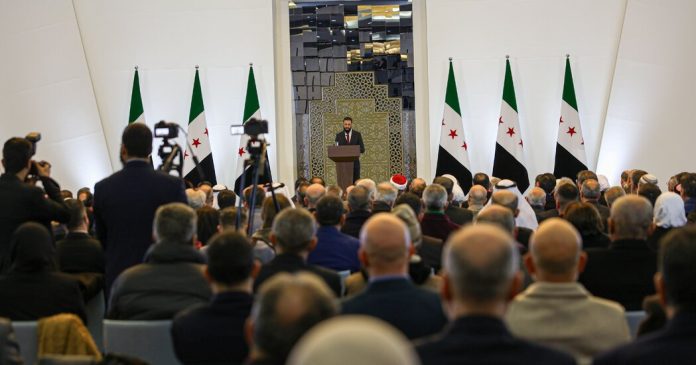
It was billed as the first step in establishing a representative government as Syria emerged from decades of a brutal, one-family dictatorship.

But for some in Syria, the highly anticipated “national dialogue” that ended on Tuesday night fell far short of those promises. Instead, the two-day conference only added to concerns about the openness of the country’s new Islamist rulers to setting up a genuinely inclusive political process.

“We have a lot of objections to how this happened,” said Ibrahim Draji, a law professor at Damascus University who was among the hundreds of attendees at the conference. “There’s no transparency. There is no clear criteria for who gets invited,” he added.

“I’ve been a professor of law for the past 22 years, and I can tell you that this is not an actual national dialogue,” he said.

As the conference opened on Monday, the participants who gathered at the presidential palace in the capital, Damascus, had high hopes that they were about to be part of a historical event and have a hand in shaping the new political chapter in Syria.

Months earlier, the rebel coalition that seized power after ousting the longtime autocratic ruler Bashar al-Assad had pledged to establish a representative government. The first step, they said, would be a landmark meeting where leadership figures from across the country would, together with the victorious rebels, chart a different course for their fractured nation.

Despite those lofty goals, the conference was hastily organized, with invitations sent out only a day or two before it began. While community leaders, academics and religious figures attended, key groups such as the U.S.-backed Kurdish-led militia that controls much of northeastern Syria were not invited.

And rebel leaders said the recommendations that the conference issued on Tuesday night — including respecting personal freedoms and women’s rights — were not binding. It was unclear what bearing, if any, they would have on the nascent government.

Syria is navigating a once unimaginable period of transition after being ruled by the Assad family for more than 50 years. At the helm of that transition is the interim president, Ahmed al-Shara, whose rebel group, Hayat Tahrir al-Sham, led the offensive that toppled Mr. al-Assad in early December.

Mr. al-Shara is facing a dizzying array of challenges as he marshals a country whose delicate social fabric and economy were both shredded during nearly 14 years of civil war.

In many ways, the hastily organized conference on Tuesday reflects the competing priorities Mr. al-Shara is juggling as he scrambles to set up a functioning government.

He is under pressure to establish an internationally recognized government quickly to bolster his efforts in negotiating for badly needed financial aid from the international community. Many Arab and Western leaders have conditioned full ties with Syria’s new government — including relief from Western sanctions that have left the economy in tatters — on the creation of an inclusive political process that reflects Syria’s ethnic and religious diversity.

The European Union, which lifted some sanctions on Syria after the rebels seized power, announced on Monday that it was suspending additional restrictions on the country’s banks and on its energy and transport sectors. But European officials have said that relief will be reversed if the rebels form a government that is not consistent with E.U. values.

The urgency to create a new government has produced slapdash efforts, like this week’s conference, that have undercut the legitimacy of the political process in the eyes of some Syrians both at home and abroad.

Many in Syria greeted the fall of the Assad dynasty with elation, hoping it would usher in a more democratic era. While voicing political dissent — an act that was once effectively a death sentence — is now possible, many Syrians’ expectations for radical change have been tempered in recent weeks as Mr. al-Shara has consolidated most government control in his own hands or those of close allies.

“It feels like there’s been a downgrading of their initial promises, of what the new political process is and what the national dialogue would lead to,” said Ibrahim al-Assil, a Syrian adjunct professor of political science at George Washington University.

“Our expectations weren’t very high, but what happened was even more underwhelming than the moderate expectations,” added Dr. al-Assil, who was not involved in the dialogue.

Still, some Syrians, exhausted from more than a decade of civil war and widespread destruction, say that any political involvement, however small, is a welcome change.

“We haven’t been involved in political life or affairs for over 50 years,” said Dana Shubat, 30, an ophthalmologist in Damascus.

“I’m not sure what I was expecting,” she added, “but at least the people have the opportunity — even if it’s small — to voice our opinions on the government.”

Responding to criticism of the conference, Hassan al-Daghim, a spokesman for the event’s preparatory committee, said in an interview that Tuesday’s sessions were just the beginning of what would be an ongoing and inclusive political process that would “involve a wide array of experts.”

So far, neither the preparatory committee nor Mr. al-Shara has offered a detailed plan for continuing the dialogue, for drawing up a new constitution or for creating a system of transitional justice demanded by a public seeking accountability for the crimes of the dictatorship.

Leaders “should not import systems that do not align with the country’s situation” or “implement political dreams that are unsuitable,” Mr. al-Shara said.

“Just as you accept this victory from us, I kindly ask that you also accept the methods used to achieve it,” he added, referring to the rebels’ approach to establishing a government since seizing power.

To many, those comments were seen as a clear message: Even if the next chapter in Syria is inclusive, it will be a far cry from the democratic reform many had long dreamed of.

Conference participants also condemned the Israeli military’s recent incursion into southern Syria. Israel launched new airstrikes on military targets south of Damascus late Tuesday night, according to Israeli officials.

Prime Minister Benjamin Netanyahu of Israel has said in recent days that his country will not allow the presence of Syrian forces in the south of Syria, though it remains unclear how the leadership in Damascus will respond to that demand.

The next major litmus test for the new Syrian authorities will be in the coming days when Mr. al-Shara is expected to form a caretaker government. That government will administer the country in the coming years until Syria can hold elections.

Its makeup — and whether it includes representatives beyond Mr. al-Shara’s loyalists — will offer the next major clues as to how he plans to govern.

The structure of the caretaker government “will send a crucial message,” said Haneen Ahmad, a political and human rights activist in Damascus. “It will reflect the current regime’s willingness to be open and work with all Syrians.”

Rep. Tim Burchett, R-Tenn., discusses the budget framework passed on Tuesday

0

NPR’s Leila Fadel speaks with Republican Rep. Tim Burchett of Tennessee about the budget framework that passed in the House and how it may impact Americans across the country.

Israel and Hamas Agree Another Hostage Release and Prisoner Exchange

0

Hamas has agreed to release the remains of four Israeli hostages in exchange for hundreds of Palestinian prisoners, Israeli officials and the group said, resolving a dayslong impasse between the two sides.

The agreement comes as the first phase of a fragile cease-fire deal draws to a close. Negotiators have yet to reach terms to extend the deal into a more comprehensive truce, raising concerns that the fighting in Gaza could resume.

During the first phase, Hamas had agreed to free 25 Israeli hostages and hand over the bodies of eight more in exchange for more than 1,500 Palestinians jailed by Israel. On Saturday, Hamas released the last living captives set to be freed in the first phase, and Israel was supposed to release 620 Palestinian prisoners in return.

But Israel delayed the release of the prisoners, saying they would not be freed until Hamas committed not to subject hostages to “humiliating ceremonies” during future exchanges. That raised more questions about any next steps for the cease-fire.

Late on Tuesday night, Hamas announced that a deal had been reached for the simultaneous release of Palestinian prisoners in exchange for the remains of the four hostages. Omer Dostri, the spokesman for Israel’s prime minister, confirmed that an agreement had been reached, saying in a text message that the swap would take place on Wednesday night or Thursday.

Some of the Palestinian prisoners slated for release were convicted of deadly attacks against Israelis, while others — including minors — were held without charge.

The impending exchange could be the last in the first phase of cease-fire, leaving both Israelis and Palestinians in limbo. Around 27 hostages and the remains of more than 30 others are still in Gaza, according to the Israeli government.

It is unclear whether serious negotiations on the second phase of the agreement have even begun, let alone borne fruit.

Mediators have pressed both sides to agree to a second stage. Steve Witkoff, President Trump’s Middle East envoy, was expected to visit the Middle East on Wednesday in an attempt to move the talks forward. But Mr. Witkoff’s travel to the region has now been delayed, according to a U.S. official, who spoke on condition of anonymity to discuss his schedule.

President Trump to hold his first meeting with Cabinet secretaries Wednesday

0

As President Trump holds his first meeting with Cabinet secretaries Wednesday and Elon Musk expected to attend, there’s conflicting messaging over who’s in charge of some government decision-making.