Friday, November 13, 2026
Home Blog Page 182

Wildfire Burning on Table Mountain Moves Toward Cape Town

0

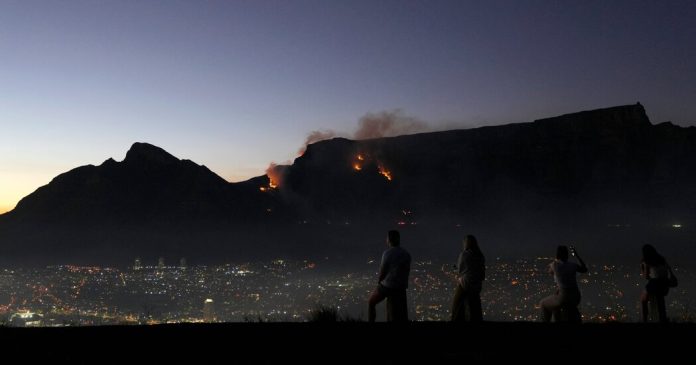
Firefighters in Cape Town on Wednesday were battling a wildfire that broke out in Table Mountain National Park and spread overnight toward the city, local authorities said.

The wildfire has burned for several days in the Newlands area, high in the mountainous slopes of the park, but strong gusting winds pushed it toward Cape Town’s central business district overnight, fire and park officials said.

The size of the fire and the extent of any potential property damage was still being determined, said Edward Bosch, a spokesman for the Cape Town Fire and Rescue Service. But he described the blaze as “extensive.” He said there was no threat to the downtown area as of Wednesday morning, but noted that could change depending on the wind and other factors throughout the day.

Trails in Table Mountain National Park, a popular hiking spot for residents and tourists, were closed after the fire began earlier this week. As of Monday, the fire had burned through at least 148 acres of land, according to a body responsible for managing the national park, which said on Monday that it was concerned about “the continued presence of hikers in areas that have been closed off.”

A second fire, in the Red Hill region of the park, was also burning on Wednesday morning.

No evacuations had been ordered, Mr. Bosch said. Two helicopters had been water-bombing the fire since sunrise on Wednesday, he said, and a third helicopter was on its way from the nearby town of Stellenbosch.

“If the conditions are favorable today, then it should be under control by today,” he said.

Park officials said that more than 80 firefighters from various agencies had been dispatched to combat the fire. Operators of a cable car running from Table Mountain to the central district said in a social media post on Wednesday that it would close until further notice because of smoke from the wildfires.

Several major mountain fires have burned in the Western Cape province in recent years. Residents of Cape Town, who live close to the mountain’s foothills, are especially concerned. Ecologists have urged national park officials to conduct more prescribed burnings of vegetation to stop uncontrollable wildfires.

Trump White House tightens grip on press access : NPR

0

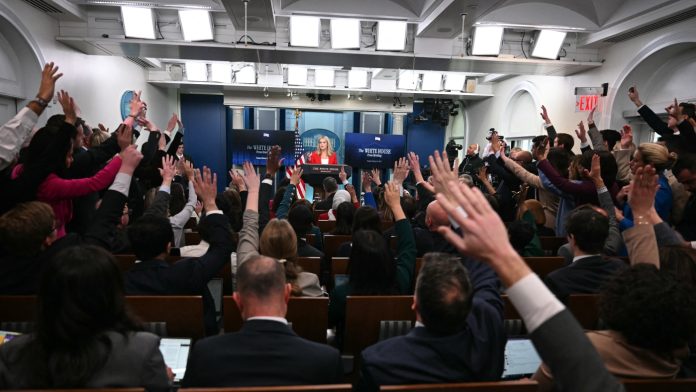
White House press secretary Karoline Leavitt takes questions during the daily briefing in the Brady Briefing Room of the White House on Feb. 25, 2025.

Jim Watson/AFP via Getty Images


hide caption

toggle caption

Jim Watson/AFP via Getty Images

In the White House briefing room Tuesday, the Trump administration announced its latest steps to tighten its grip on the message it sends out and the news coverage it receives.

No longer would the White House Correspondents’ Association, made up of news outlets that cover the White House, determine how they will share coverage of President Trump at major events where space is limited.

Press secretary Karoline Leavitt told the assembled reporters the White House would make that determination instead. Leavitt said the media association previously had “dictated” who was able to report directly on Trump and with this move, she was returning “power to the people.”

“Legacy outlets who have participated in the press pool for decades will still be allowed to join – fear not,” Leavitt said from the White House lectern. “We will also be offering the privilege to well-deserving outlets who have never been allowed to share in this awesome responsibility.” The television pool will not be affected, despite the president’s differences with many major networks; before entering electoral politics, Trump was a frequent subject of tabloid and television attention and then a reality TV star.

Press outlets “pool” their resources when coverage by all would be impractical; a selection of print, video, radio, online and photo news organizations alternate in doing the reporting. The Trump administration already has barred The Associated Press, a mainstay of those pools, from covering major events because it has not changed its guidance for calling the body of water between Mexico and Florida the Gulf of America, rather than the Gulf of Mexico.

“In free countries, like the United States is, leaders don’t get to pick who covers them day in and day out,” Politico reporter Eugene Daniels, the head of the White House Correspondents Association, told NPR’s Ari Shapiro Tuesday evening on All Things Considered. 

Leavitt already has invited once-fringe figures from far-right outlets into the press room to ask questions. They include reporters for the conspiracy-minded Gateway Pundit, Steve Bannon’s podcast and Lindell TV, started by the MyPillow magnate Mike Lindell. While ideological journalists have attended White House briefings for decades, she has amplified their role.

“It’s surreal to watch these so-called new media people asking softball, ludicrous questions to Trump and Leavitt,” another White House reporter said, speaking on condition of anonymity for fear of repercussions from a boss or the administration. “I never thought I’d see plants in press briefings of the highest seat of American power.”

Declaring “VICTORY”

The AP filed a lawsuit over the ban, saying the White House violated its First Amendment free speech rights and its Fifth Amendment procedural rights, as it had no opportunity to appeal the decision internally. At a hearing on Monday, U.S. District Court Judge Trevor McFadden, a Trump appointee, pushed Justice Department lawyers to reconsider the administration’s stance toward the AP. Yet the judge also questioned why the correspondents’ association had such discretion over who participated.

The White House appears to have either taken inspiration or refuge from the judge’s words – with Leavitt’s buoyant announcement the very next day. She was flanked by television screens showing a map of the Southeastern U.S., each stamped with the word “VICTORY” in all capital letters. It showed the Gulf of Mexico marked as the Gulf of America, Trump’s preferred term.

White House Press Secretary Karoline Leavitt speaks in front of a map of the Southeastern U.S. labeled "VICTORY" after the Associated Press unsuccessfully petitioned a court to restore its access to presidential events.

White House Press Secretary Karoline Leavitt speaks in front of a map of the Southeastern U.S. labeled “VICTORY” after the Associated Press unsuccessfully petitioned a court to restore its access to presidential events.

JIM WATSON/AFP via Getty Images/AFP


hide caption

toggle caption

JIM WATSON/AFP via Getty Images/AFP

The AP’s refusal to change its Stylebook to reflect the president’s preference, expressed in an executive order on his first day in office, led to the ban, Trump and Leavitt have said. Judge McFadden suggested that sounded like viewpoint discrimination, something the courts have found violates the First Amendment. Yet he declined the news agency’s request for an emergency decree to force the administration to back off the ban. Instead, he set a hearing for March 20.

Meanwhile, the president’s chief regulator of broadcast media has instigated investigations of each of the major broadcast outlets – ABC, CBS, NBC, NPR and PBS – save Rupert Murdoch’s Fox, which is a corporate sister of the pro-Trump Fox News Channel. In 2016, Murdoch struck an alliance of convenience with Trump. It briefly flagged, until last year when Trump once more dominated the Republican primaries.

The president, in his private capacity, has filed many lawsuits against media and social media companies. The owners of ABC, Facebook, and X have each paid millions of dollars to settle lawsuits he filed against them. Paramount, CBS’s corporate parent, which is seeking government approval of a sale, is weighing whether to follow their example in Trump’s $20 billion suit over its interview with Kamala Harris last year. Legal observers almost uniformly say the president has no merit to his case.

A pincer movement

The administration is operating something of a pincer movement, applying pressure to all possible vulnerabilities.

“Having served as a Moscow correspondent in the early days of Putin’s reign, this reminds me of how the Kremlin took over its own press pool and made sure that only compliant journalists were given access,” Peter Baker, the chief White House correspondent for the New York Times, tweeted Tuesday afternoon.

“The message is clear,” Baker continued. “Given that the White House has already kicked one news organization out of the pool because of coverage it does not like, it is making certain everyone else knows that the rest of us can be barred too if the president does not like our questions or stories.”

Other veteran reporters also reacted with alarm.

“This move does not give the power back to the people – it gives power to the White House,” Jacqui Heinrich, who covers Trump for Fox News, tweeted after Leavitt announced the White House would pick which reporters could serve in press pools. “Our job is to advocate for the MOST access possible.”

The pressure on the press dovetails with Trump’s efforts to clamp down on independent checks on his power within the executive branch. Among the myriad government officials he has dismissed are agency inspectors general and Special Counsel Hampton Dellinger, who investigates federal employees’ complaints against the government. He’s fired senior military lawyers, whom Defense Secretary Pete Hegseth – a former Fox star – said could be “roadblocks” to the White House’s agenda.

Under Hegseth, the Defense Department has dislodged eight news organizations from permanent work stations at the Pentagon, including NPR, and invited in seven conservative and right-wing news outlets to replace them (along with one liberal outfit, HuffPost).

A Reuters defense correspondent tweeted that Hegseth was traveling to visit Guantanamo Bay to visit the new U.S.-run detention center for immigrants without a single reporter who routinely covers the military. Pentagon social media accounts painstakingly documented his comings and goings. The “DOD rapid response” social media account taunted CNN after it departed its small work space and mocked the news media last night: “Since real journalism is dead, we’ll do it for you.”

Trump’s picks visit Voice of America

Some journalists who cover the administration say they believe that veers into propaganda. And that’s what is feared by many journalists over at the government-owned Voice of America, who were pressured intensely during Trump’s first term. His choice to lead it, Kari Lake, appeared for the first time at the international network yesterday, according to five people there. That said, it was hardly a secret: She tweeted out a picture of the network’s nameplate at the entry of its Washington, D.C. headquarters. “Let’s Get To Work,” she wrote.

Lake is a former local news anchor in Phoenix who ran, unsuccessfully, for governor and then U.S. Senate from Arizona. She has denied election losses (both hers and Trump’s) and become a frequent critic of the mainstream media.

Voice of America (VOA), which is funded by Congress, operates in nearly 50 languages and reaches an estimated 354 million people weekly across the globe. It is a form of soft power in that it delivers news to places where the press cannot operate freely or is not financially robust, and it models how a free press operates, incorporating criticism as well as praise for each U.S. administration.

Trump announced Lake’s selection as though the position involves a presidential appointment. It does not; the appointment is done by the head of VOA’s parent agency, the U.S. Agency for Global Media, and approved by a bipartisan board. Confirmation hearings have not yet been scheduled for Trump’s pick to lead the USAGM, the right-wing media critic Brent Bozell.

At the time of her selection, Lake wrote, “Under my leadership, the VOA will excel in its mission: chronicling America’s achievements worldwide.” That’s not precisely the network’s stated mission. On its website, Voice of America says it’s committed to “providing comprehensive coverage of the news and telling audiences the truth.”

As she awaits her appointment at Voice of America, Lake has taken a role as an adviser to the U.S. Agency for Global Media. In recent days, she has defended the Voice of America’s existence from calls for its elimination by presidential adviser Elon Musk. She took to Musk’s social media platform X to do so.

“I think it’s worth getting in, digging around, fixing what’s wrong, bolstering what’s good, & putting out an incredible product that fulfills its mission, broadcasting the American story across the globe, & spreading the ideals of freedom & liberty,” she wrote, linking an interview she sat for with the pro-Trump outlet Epoch Times.

Another new adviser to VOA’s parent agency is Mora Namdar, who worked for USAGM in the first Trump administration. She also wrote the section on the agency for Project 2025, the blueprint for governing developed by the Heritage Foundation. Trump disavowed Project 2025 on the campaign trail, but now in office, he has enacted several of its proposals.

In her section on the agency, Namdar wrote that Voice of America and other U.S. owned international outlets often “parrot America’s adversaries’ propaganda and talking points.”

She was part of an effort by Trump appointee Michael Pack, USAGM’s chief executive for seven months in 2020, to root out perceived ideological bias throughout the network. A federal judge found that Pack violated constitutional protections. A formal investigation determined that Pack had repeatedly abused the powers of his office, broke laws and regulations, and engaged in gross mismanagement.

Ultimately, interviews with more than two dozen people showed that Trump’s aides at the White House and USAGM wanted the network to reflect Trump’s successes and to tamp down on criticisms of him – a consistent thread of recent developments.


Rejecting Trump’s Call to Annex Their Nation, Canadians Rally Around the Flag

0

On a good day in February, Debbie Hartlen might sell one Canadian flag at her workshop in Dartmouth, Nova Scotia, where she sells flags. Now, daily sales have hit roughly 300 flags, and that’s not counting her larger online business.

President Trump’s plan to impose crippling tariffs on Canadian exports are seen as a devastating threat to many Canadian businesses and workers. His warning on trade — combined with his repeated calls for the United States to annex Canada — have the country’s flag makers struggling to keep up with suddenly soaring demand.

“Isn’t it wonderful?,” said Ms. Hartlen, who owns The Flag Shop Nova Scotia. “Thank you, Trump. Who would have thought we’d be saying that?”

The renewed interest in Canada’s maple leaf flag, fueled by intense opposition to Mr. Trump’s idea of making Canada the 51st state and his economic threats, comes as the red and white Canadian banner marks its 60th anniversary.

And for a nation where flag waving is less a part of life than in the United States and flags are generally less conspicuous, the Trump-fueled resurgence of Canadian patriotism has also revived the Canadian flag’s image.

The maple leaf flag, often flown upside down or from hockey sticks, became the defining symbol used by protesters who occupied and paralyzed Ottawa, Canada’s capital, for nearly a month in 2022 in response to Covid restrictions.

As a result, many Canadians have shied away from displaying their national flag out of concern that they would be seen as endorsing the protests.

But things started to change as Flag Day in Canada, which is celebrated on Feb. 15, approached. Usually, the day passes by largely unnoticed. This time, against the backdrop of tariff threats and Mr. Trump’s criticisms of Canada, including referring to Prime Minister Justin Trudeau as Governor Trudeau, five former prime minsters have called on Canadians “to show the flag as never before.”

The government held 60th birthday celebrations, which included skaters holding aloft a giant flag down a 19th century canal in Ottawa that doubles as a giant ice skating rink during the winter. And throughout the country, Canadians are doing something many rarely do: flying flags outside their homes.

L’étendard Flags and Banners, a company based in Quebec City, makes about 25,000 Canadian flags for the federal government and 10,000 more for other customers and uses what is typically the slow winter season to build up inventory leading up to Canada Day on July 1.

This year demand for flags is so high that the company may need to hire extra workers to cope with the surge, said Mario Trahan, one of the company’s owners.

“There’s a peak just before the July 1 but it’s always the same pattern every year,” said Mr. Trahan, whose company has been in the flag business for 30 years. “But we haven’t seen a rush like this.”

Before the current version of the flag was adopted, Canada had spent nearly a century trying to create and agree on a national flag that was not simply carried over from its past as a British colony.

“English Canadians in particular were divided about their identity,” said Forrest Pass, a vexillologist, or flag scholar, at Library and Archives Canada, the national archive. “British imperial identity still loomed large.”

The result, he said, was that Canada first used Britain’s Union Jack, which is officially known as the royal union flag, as its national flag. In 1892, the British Admiralty officially allowed Canadian commercial ships to fly a red flag that was known as the Canadian Red Ensign, with the Union Jack in one corner and a smaller shield of Canada that underwent many design changes.

Soon, the Canadian Red Ensign was being used on land, particularly by the military during World War I, before gaining official status in 1946.

Many Canadians regarded the red ensign as mostly a “place holder,” said Dr. Pass, whose dissertation was on flags.

Various committees at various times considered thousands of proposed Canadian flags, including one, Dr. Pass said, that featured a woman in a bikini.

“It was something of a cottage industry, the production of new flag designs,” he said.

But it was Lester B. Pearson, the Nobel Peace Prize laureate for his work resolving the Suez crisis and past Liberal prime minister, who ultimately selected the single Maple Leaf design.

But it was a hard sell at first. The debate in Parliament to adopt it was described by one historian as “among the ugliest in the House of Commons history” because of the strong opposition from members of Parliament to diluting British heritage.

But once the debate was settled and the design approved, Canadians quickly warmed to their new flag, Dr. Pass said.

During the Vietnam War, anecdotal stories about American travelers sewing maple leaf patches onto their backpacks before heading abroad became a source of cross-border resentment, particularly given Canada’s strong opposition to the war.

But the protests in Ottawa, which became known as the trucker convoy — and that polls showed most Canadians strongly opposed — hurt the country’s romance with its flag.

“The co-option of the flag by a small segment of the population created a lot of discomfort for Canadians,” said Heather Nicol, the director of the Canadian studies school at Trent University in Peterborough, Ontario. “A lot of people felt like: ‘Well I don’t know if we want to look at that flag or fly that flag again.’”

Still, in one downtown Ottawa neighborhood that endured the ear splitting, late night air horn honking by protesting truckers, Sam Hudson never took down the four Canadian flags that largely cover the window of the tailor shop he opened 15 years ago after emigrating from Jordan. (There is also a Scottish flag in the window in honor of his first customer.)

“I kept them because they are the symbol for our country,” Mr. Jordan said. “It’s not a symbol for certain people. I respect this flag. It’s a symbol for 40 million people who live in this land.”

Now with Mr. Trump’s denigration of Canada, Mr. Jordan said he wants more Canadians to follow his example and start displaying the flag.

“Everywhere, any time, all the year,” Mr. Hudson said before hemming some trousers. “This is our I.D.”

Some Trump voters want him to curb health care costs and medical debt : Shots

0

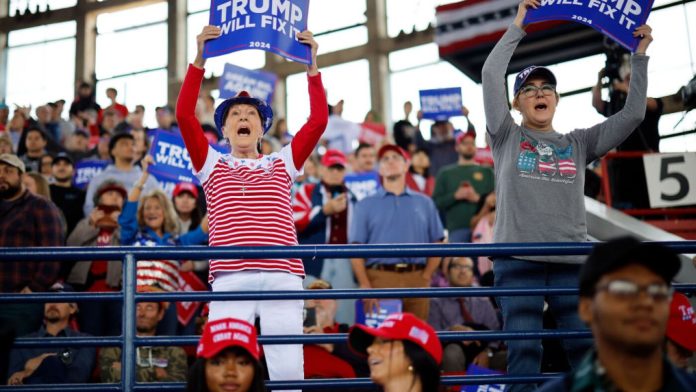
People hold up signs before Republican presidential nominee, former U.S. President Donald Trump holds a campaign rally Nov. 4, 2024 in Raleigh, North Carolina.

Chip Somodevilla/Getty Images


hide caption

toggle caption

Chip Somodevilla/Getty Images

Like many Americans who voted for Donald Trump, Jason Rouse hopes the president’s return will mean lower prices for gas, groceries and other essentials.

But Rouse is looking to the federal government for relief from one particular pain point: high health care costs.

“The prices are just ridiculous,” said Rouse, 53, a retired Michigan firefighter and paramedic who has voted for Trump three times. “I’d like to see a lower cap on what I have to pay out-of-pocket.”

Government regulation of health care prices used to be heresy for most Republicans. GOP leaders fiercely opposed the 2010 Affordable Care Act, which included government limits on patients’ costs. More recently, the party fought legislation signed by former President Joe Biden to cap prescription drug prices.

But as Trump begins his second term, many of the voters who sent him back to the White House welcome more robust government action to rein in a health care system many Americans perceive as out of control, polls show.

“That idea that government should just keep its hands off, even when things are tough for people, has kind of lost its sheen,” said Andrew Seligsohn, president of Public Agenda, a nonprofit that has studied public attitudes about government and health care.

“We’re wandering around the country with a set of old, outdated frameworks about what ordinary Democrats and ordinary Republicans like,” he said.

Jason Rouse of Alpena, Michigan, Sarah Bognaski of Clayton, New York, and Charles Milliken of New Martinsville, West Virginia, all voted for President Donald Trump in November. They’d like to see the new administration put limits on what health care providers can charge patients.

Jason Rouse of Alpena, Michigan, Sarah Bognaski of Clayton, New York, and Charles Milliken of New Martinsville, West Virginia, all voted for President Donald Trump in November. They’d like to see the new administration put limits on what health care providers can charge patients.

Jason Rouse; Sarah Bognaski; Charles Milliken


hide caption

toggle caption

Jason Rouse; Sarah Bognaski; Charles Milliken

Republican voters strongly back federal limits on the prices charged by drug companies and hospitals, caps on patients’ medical bills, and restrictions on how health care providers can pursue people over medical debt, recent polling finds.

Even Medicaid, the state-federal insurance program that Republican congressional leaders are eyeing to dramatically cut, is viewed favorably by many GOP voters, like Ashley Williamson.

Williamson, 37, a mother of five in eastern Tennessee who voted for Trump, said Medicaid provided critical assistance when her mother-in-law needed nursing home care.

“We could not take care of her,” Williamson said. “It stepped in. It made sure she was taken care of.”

Williamson, whose own family gets coverage through her husband’s employer, said she would be very concerned by large cuts in Medicaid funding that could jeopardize coverage for needy Americans.

For years, Republican ideas about health care reflected a broad skepticism about government and fears that regulation would threaten patients’ access to physicians or lifesaving medicines.

“The discussions 10 to 15 years ago were all around choice,” said Christine Matthews, a Republican pollster who has worked for numerous GOP politicians, including former Maryland governor Larry Hogan. “Free market, not having the government limit or take over your health care.”

Matthews and fellow pollster Mike Perry recently convened and paid for several focus groups with Trump voters, including Rouse and Williamson, which KFF Health News observed.

Skepticism about government lingers among rank-and-file Republicans. And ideas such as shifting all Americans into a single government health plan, akin to “Medicare for All,” are still nonstarters for many GOP voters.

But as tens of millions of Americans are driven into debt by medical bills they don’t understand or can’t afford, many are reassessing their inclination to look to free markets rather than the government, said Bob Ward, whose firm, Fabrizio Ward, polled for Trump’s 2024 campaign.

“I think most people look at this and say the market is broken, and that’s why they’re willing for someone, anyone, to step in,” he said. “The deck is stacked against folks.”

In a recent national survey, Fabrizio Ward and Hart Research, which for decades has polled for Democratic candidates, found that Trump voters were more likely to blame health insurers, drug companies, and hospital systems than the government for high health care costs.

Sarah Bognaski, 31, an administrative assistant in upstate New York, is among the many Trump voters who say they resent profiteering by the health care industry.

“I don’t think there is any reason a lot of the costs should be as high as they are,” Bognaski said. “I think it’s just out of pure greed.”

High health care costs have had a direct impact on Bognaski, who was diagnosed four years ago with Type 1 diabetes, a condition that makes her dependent on insulin. She said she’s ready to have the government step in and cap what patients pay for pharmaceuticals. “I’d like to see more regulation,” she said.

Charles Milliken, a retired auto mechanic in West Virginia, who said he backed Trump because the country “needs a businessman, not a politician,” expects the new president to go even further.

“I think he’s going to put a cap on what insurance companies can charge, what doctors can charge, what hospitals can charge,” said Milliken, 51, who recently had a heart attack that left him with more than $6,000 in medical debt.

Three-quarters of Trump voters back government limits on what hospitals can charge, Ward’s polling found.

And about half of Trump voters in a recent KFF poll said the new administration should prioritize expanding the number of drugs whose price is set through negotiation between the federal Medicare program and drug companies, a program started under the Biden administration.

Perry, who’s convened dozens of focus groups with voters about health care in recent years, said the support for government price caps is all the more remarkable since regulating medical prices isn’t at the top of most politicians’ agenda.

“It seems to be like a groundswell,” he said. “They’ve come to this decision on their own, rather than any policymakers leading them there, that something needs to be done.”

Other forms of government regulation, such as limits on medical debt collections, are even more popular.

About 8 in 10 Republicans backed a $2,300 cap on how much patients could be required to pay annually for medical debt, according to a 2023 survey by Perry’s polling firm, PerryUndem. And 9 in 10 favored a cap on interest rates charged on medical debt.

“These are what I would consider no-brainers, from a political perspective,” Ward said.

But GOP political leaders in Washington have historically shown little interest in government limits on what patients pay for medical care. And as Trump and his allies in Congress begin shaping their health care agenda, many Republican leaders have expressed more interest in cutting government than in expanding its protections.

“There is oftentimes a massive disconnect,” Ward said, “between what happens in the caucuses on Capitol Hill and what’s happening at family tables across America.”

KFF Health News is a national newsroom that produces in-depth journalism about health issues and is one of the core operating programs at KFF.

Power Outage Hits Chile

0

The sweeping blackout caused headaches across the country as eight million households were affected and a state of emergency was instituted.

Unknown Deadly Illness Strikes Western Congo

0

An unidentified illness has killed scores of people and infected hundreds in the Democratic Republic of Congo, the World Health Organization has reported, with preliminary investigations tracing the outbreak to three children who in January ate a bat and died.

Fifty-three people in the country’s northwest had died from the disease, out of 431 reported cases as of Feb. 15, and “with nearly half of the deaths occurring within 48 hours of symptom onset” in one of two identified clusters, according to a weekly bulletin published by the W.H.O.’s Africa office.

“The outbreak, which has seen cases rise rapidly within days, poses a significant public health threat,” the report said, and “the exact cause remains unknown.”

Victims’ symptoms have included fever, vomiting, diarrhea, and body aches, among others. The children who perished from the illness also had bled from the nose and vomited blood.

The link to a bat may be significant, because viruses in bats are known to cause a number of other diseases in humans. Bats are thought to be natural reservoirs for Marburg and Ebola viruses, two hemorrhagic fevers that are the source of ongoing outbreaks in the region, and a bat virus appears to have been a precursor to the Covid-19 virus.

The disease, which has infected people in Congo’s Équateur Province, has been fatal in over 12 percent of cases. Investigators identified an initial outbreak in Boloko Village that spread to nearby Danda Village, the W.H.O. said. A second, larger outbreak occurred in Bomate Village and has infected over 400 people.

The investigators sent 18 samples to Congo’s capital, Kinshasa, for testing, ruling out Ebola and Marburg viruses.

Last year, an unknown flulike illness infected hundreds of people in the southwestern part of the country. It was later found to likely be respiratory infections complicated by malaria.

The unknown outbreak in northwestern Équateur Province is several hundred miles removed from the war and deepening humanitarian crisis tearing apart eastern Congo. M23 rebels backed by Rwanda have been fighting the Congolese Army there and gaining ground.

Équateur covers an area the size of Kentucky straddling the Congo River, much of it sparsely populated farmland and rainforest.

Marian Turski, Who Refused to Forget the Holocaust, Dies at 98

0

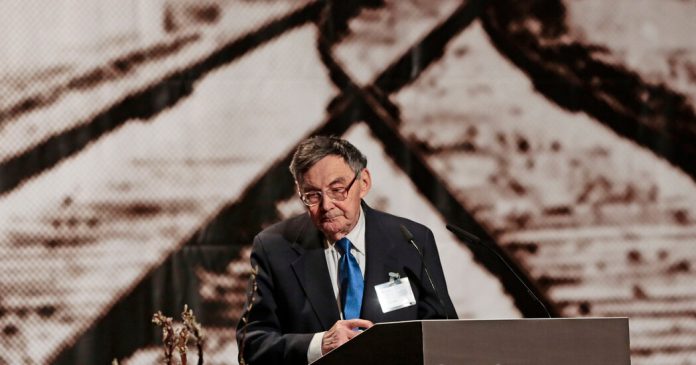
Marian Turski, a Holocaust survivor who returned to his native Poland after World War II to give voice to fellow victims of the Nazis and their collaborators, warning the world in writings and speeches about the dangers of indifference to racial and ethnic injustice, died on Feb. 18 at his home in Warsaw. He was 98.

His death was announced by the Polin Museum of the History of Polish Jews, which he had helped to establish and whose board he had chaired since 2009.

Speaking in 2020 at the 75th anniversary of the liberation of the Auschwitz-Birkenau concentration camp in German-occupied Poland, where he was shipped from the Lodz ghetto when he was a teenager, Mr. Turski sounded an alarm about what he called “a huge rise in antisemitism.”

“Auschwitz did not fall from the sky,” he said in a Polityka magazine podcast. “It began with small forms of persecution of Jews. It happened; it means it can happen anywhere. That is why human rights and democratic constitutions must be defended.”

“The 11th Commandment is important: Don’t be indifferent,” he asserted. “Do not be indifferent when you see historical lies. Do not be indifferent when any minority is discriminated. Do not be indifferent when power violates a social contract.”

He added: “If you are indifferent, before you know it another Auschwitz will come out of the blue for you or your descendants.”

His father and younger brother were killed at Auschwitz, and he lost 37 other relatives in the Holocaust.

Menachem Z. Rosensaft, an adjunct law professor at Cornell University, a son of Holocaust survivors and the author of “Burning Psalms: Confronting Adonai After Auschwitz” (2025), said Mr. Turski had exemplified “those members of the survivor generation who, instead of turning inward and wallowing as they might easily have done in their suffering, devoted himself to the future, to making sure that nothing like the horrors he and European Jewry experienced in the Holocaust would happen again to anyone else.”

Only weeks before his death, Mr. Turski returned to the camp where he had been a slave laborer to attend a ceremony commemorating the 80th anniversary of its liberation, in January 1945, by the Soviet army.

“We have always been a tiny minority,” he said, referring to himself and his fellow survivors. “And now only a handful remain.”

For decades, Mr. Turski was a dominant sermonizer among them. He served as a firsthand witness to wartime atrocities as a columnist for the weekly Polityka magazine, which he went to work for in 1958; as chairman of the Association of the Jewish Historical Institute of Poland from 1999 to 2011; and as the editor of three volumes of eyewitness accounts, titled “Jewish Fates: A Testimony of the Living” (1996-2001).

“Marian dedicated his life to ensuring that the world never forgets the horrors of the past,” Ronald S. Lauder, the cosmetics heir and president of the World Jewish Congress, said in a statement this week. He described Mr. Turski as “a man who led by example, choosing good over evil, dialogue over conflict and understanding over hostility.”

Mr. Turski was born Mosze Turbowicz on June 26, 1926, in Druskininkai, a city that was part of Poland then and is now in Lithuania.

His father, Eliasz Turbowicz, a coal trader who came from a family of rabbis, had planned to emigrate to Palestine but remained in Europe because of a recurring lung ailment, a result of a wound sustained while serving in the Russian army during World War I. Mr. Turski’s mother, Estera (Worobiejczyk) Turbowicz, was a clerk.

Mosze attended Jewish primary and secondary schools in Lodz, but once the Germans invaded in 1939, Jews were confined to the Lodz ghetto. He helped support his family by tutoring in Hebrew, Latin and Polish and working in a smokehouse, where he butchered horse meat. He also joined the Communist resistance.

Two weeks after his parents and younger brother were deported, in August 1944, he was shipped out on one of the last transports from Lodz. He figured his chances of surviving were better at Auschwitz-Birkenau than in the ghetto, which the Nazis were obliterating.

His mother was sent to Bergen-Belsen, a concentration camp in northern Germany; she survived the war and died in 1988.

Mosze’s experience, too, was one of harrowing survival: deployed from the Auschwitz-Birkenau camp to do roadwork; forced to join a death march to the Buchenwald concentration camp ahead of the Soviet advance; and sent to a camp at Theresienstadt, in occupied Czechoslovakia, where he caught typhus and shriveled to 70 pounds before the camp was liberated by the Red Army in May 1945.

After the war, he returned to Poland as a committed Socialist. Given the antisemitism in the country, a Communist official suggested that he adopt a non-Jewish name; he chose Marian Turski. He earned a degree in history from the University of Wroclaw.

Joining the Polish Workers’ Party, Mr. Turski became a committed Communist official, enforcing censorship, imposing crop quotas on farmers and presiding over a fraudulent referendum that consolidated Polish territory recovered from the German occupation — all, he would later say, in the interests of promoting Polish nationalism and socialism.

In 1965, while studying and lecturing in the United States on an eight-month State Department scholarship, he participated in a civil rights march from Selma to Montgomery, Ala., led by the Rev. Dr. Martin Luther King Jr.

Years later, when President Barack Obama, at a ceremony in Warsaw, asked Mr. Turski what had motivated him to march, he replied, “Simply out of solidarity with all those who fought for their civil rights and against racial divisions.”

In the late 1960s, he soured on Soviet communism because of the government’s official policy of antisemitism and Moscow’s opposition to political liberalization in Czechoslovakia. That “accelerated my transition from being a Pole with Jewish origins to an awareness of being a Pole and a Jew simultaneously,” he said.

While he suppressed his wartime memories for years, Mr. Turski returned to Auschwitz in the 1970s, a trip he would make more than once. In 2020, he urged Mark Zuckerberg, the chief executive of Facebook, to ban Holocaust deniers from that social media platform. Mr. Zuckerberg eventually did so that year.

Mr. Turski’s wife, Halina (Paszkowska) Turski, a fellow Holocaust survivor, had escaped the Warsaw ghetto, served as a messenger for the resistance and later worked as a sound engineer for filmmakers. She died in 2017. He is survived by their daughter, Joanna Turski, a flutist; two grandchildren; and two great-grandchildren.

“Soft-spoken, an intellectual giant, he remained in Poland so that his voice resonated as closely as possibly to the abyss,” Professor Rosensaft, of Cornell, said.

“He could tell people, ‘I have seen this,’” he added. “It is now going to be our task — the following generations — to make sure the authentic memory of the survivors becomes ingrained in our consciousness. We cannot replicate the voice of the survivors, but we can make sure that the questions they asked, the warnings they raised, remain ingrained in our consciousness.”

Wednesday Briefing – The New York Times

0

Ukraine has agreed to turn over the revenue from some of its mineral resources to the U.S., an American and a Ukrainian official said yesterday, in a deal that followed an intense pressure campaign from President Trump.

It was not immediately clear what, if anything, Ukraine would receive from the U.S. President Volodymyr Zelensky of Ukraine previously rejected at least one other draft agreement because it lacked specific U.S. security guarantees and because Trump was requesting mineral rights worth $500 billion. Some of the more onerous conditions have since been removed. Here’s what’s at stake.

A U.S. official said a final translated draft of the agreement was sent to Ukraine yesterday; this would first be signed by the U.S. Treasury secretary and his Ukrainian counterpart, before being signed by Trump and Zelensky in Washington.

Details: The draft agreement said Ukraine would contribute half of its revenues from the future monetization of natural resources to a fund. The U.S. would own the maximum financial interest in the fund allowed under American law. The fund would also be designed to reinvest some revenues into Ukraine. Here’s what we know.

Changing alliances: When it comes to the war in Ukraine, Trump has courted outlier states like Belarus, North Korea and Russia, while standing against traditional U.S. allies.


Ahmed al-Shara, Syria’s interim president, called for unity yesterday at a two-day conference aimed at charting the country’s future after decades of dictatorship. The gathering, in Damascus, brought together hundreds of people from Syria’s many religious sects and ethnic groups, as well as journalists, community leaders and activists.

But one major player was absent: The Kurdish-led Syrian Democratic Forces, the U.S.-backed militia that controls much of Syria’s northeast. The current government told the group that it would have to disarm and join a unified national military if it wanted to attend the dialogue.

Keir Starmer, the British prime minister, said yesterday that Britain would significantly raise its military spending by 2027. The announcement was meant to send a signal about burden-sharing to President Trump before the leaders’ meeting at the White House tomorrow.

The change would amount to an increase of 13.4 billion pounds ($17 billion) in military spending per year. It would be paid for by scaling back on overseas development aid. Starmer said he regretted the cuts, but he presented them as a temporary measure in a challenging new security environment.

Context: Recent statements from Trump about Ukraine have reinforced fears that the U.S. is retreating from its decades-long commitment to Europe’s defense. And NATO’s secretary general recently called on members to spend “considerably more” than 3 percent of economic output on defense.

Most of the books nominated for this year’s International Booker Prize are under 200 pages long. This isn’t because of some “much-prophesied loss of attention span,” according to the chair of the judging panel — instead, the 13 nominees simply “don’t have a wasted word.” Check out the full list.

Lives lived: Marian Turski, a Polish Holocaust survivor who dedicated his life to warning the world about the dangers of indifference to racial and ethnic injustice, died last week at 98.

A century ago this week, the musician Art Gillham entered a studio in New York to test a soon-to-be-transformative tool: the microphone. In that moment, the record industry left the acoustic era and went electric.

The effects were felt across genres and styles. Instruments could be reproduced more faithfully. Stand-up basses were no longer outperformed by blaring horns. But the biggest beneficiaries were pop singers — microphones gave them personality, like Hollywood stars.

Read more about the device that changed music.

Facing Trump’s Hostility, Ukraine Weighs Its Options. But They Are Few.

0

The antagonistic messaging President Trump has delivered to Ukraine since taking office has presented leaders in Kyiv with a brutal reckoning: that the United States can no longer be counted on as a supporter, and may even be an adversary, in the effort to end the war with Russia.

In the past two weeks, Mr. Trump has initiated direct peace talks with Russia and dismissed Ukraine’s protests that it should have a seat at the negotiating table. He has called Ukraine’s president, Volodymyr Zelensky, a “dictator” and falsely claimed that Ukraine was responsible for the war that Russia started with its 2022 invasion.

As the war enters its fourth year, that enmity has prompted Kyiv to reassess what leverage, if any, it still holds over America’s policy in Ukraine and to explore alternative options to safeguard its interests.

There are few of them, and none are ideal, analysts and Ukrainian officials say. Ukraine can curry favor with Mr. Trump by dangling lucrative economic deals, such as a minerals deal, which both sides finally struck after days of difficult negotiations, officials said on Tuesday.

If American support dries up, Kyiv could hold out on the battlefield as long as it can — which could be only a few months — hoping Mr. Trump acknowledges that peace talks cannot proceed without its involvement.

In the meantime, Ukraine has made an emphatic pivot toward Europe as its new closest partner and potential security guarantor. In the past few days, Mr. Zelensky has engaged in numerous calls and meetings with his European counterparts to discuss increased military support, including peacekeeping troops on the ground. On Monday, President Emmanuel Macron of France pleaded Ukraine’s case at the White House.

Either way, “Ukraine should not count on U.S. support in negotiations,” Volodymyr Fesenko, a Ukrainian political analyst, wrote on Facebook last week — an approach that not long ago would have seemed unimaginable.

For Ukrainians, it is difficult to adapt to this new situation, said Alyona Getmanchuk, the head of New Europe Center, a Kyiv-based think tank, and Mr. Zelensky’s pick to be Ukraine’s next NATO ambassador. “We’ve long been used to having the U.S. on our side, and we still need them fully on our side,” she said in a phone interview.

After Mr. Trump returned to office in January, Ukraine hoped to appeal to his business-oriented mind-set as leverage. It offered a deal on access to critical minerals, which are key to modern technology manufacturing, in exchange for continued American support.

But Mr. Trump flipped the concept on its head, demanding a deal worth $500 billion in Ukraine’s natural resources, including minerals, oil, and gas, without offering anything in return. Mr. Trump has framed access to Ukraine’s resources as “payback” for Washington’s past aid to Kyiv. The real value of American assistance to Ukraine so far is about $120 billion.

Kyiv has rejected several versions of a deal that it deems too onerous. On Tuesday, officials said the two sides had come to terms, though it was not immediately clear what, if anything, Ukraine would receive in the end.

It remains to be seen whether the deal helps Ukraine in its relationship with the Trump administration. On the one hand, it will allow Mr. Trump to declare that he secured a big financial boon. But ceding revenue from natural resources to the United States could divert money now being used for the war effort, and saddle Ukraine with future debt.

Another factor might work in Ukraine’s favor, experts say: Mr. Trump’s vanity. The American president has boasted that he can quickly end the war, but he cannot do so without Ukraine’s consent. That gives Kyiv at least some leverage.

“Without Ukraine’s approval of a potential deal, Trump won’t be able to be the great peacemaker he claims to be,” Ms. Getmanchuk said. “He would appear as a president unable to deliver on his promise. He needs Zelensky to accomplish this peacekeeping mission.”

Ultimately, experts say it is up to Ukraine to decide whether to continue the fight. The key now is whether it can hold out long enough on the battlefield, potentially cut off from U.S. support, to avoid having to accept a deal with onerous terms.

The Ukrainian government has said that it has enough funds, weapons and ammunition to sustain its fight against Russia through the first half of this year. But structural issues in its army have weakened its defense, including a shortage of soldiers for the front lines, exhaustion after three years of war that has led some to desert, and coordination gaps between brigades that Russian forces routinely exploit.

Still, military analysts say that Ukraine has some elements working in its favor. It has significantly ramped up its domestic weapons production, producing nearly all of the attack drones it deploys on the battlefield — the primary means of targeting Russian troops today.

Ukraine’s defense industry now covers about 40 percent of the country’s need in weapons, according to Solomiia Bobrovska, a member of the Ukrainian Parliament’s defense and intelligence committee.

Nico Lange, a former German Defense Ministry official who is now a senior fellow at the Munich Security Conference, said, “Holding the line and saying, ‘Look, we will continue to defend ourselves,’ is I think what strengthens Ukraine’s position in this unfortunate situation.”

Perhaps the most promising option is Ukraine’s turn to Europe.

Mr. Zelensky said last week that he had started talks with his European counterparts to have them fund Ukraine’s war effort “if the United States decides not to.” Just in the past few days, he has spoken to dozens of European leaders by phone or in person during a large summit held in Kyiv on Monday.

France and Britain have also taken the lead in discussions about deploying European peacekeeping troops to Ukraine as part of a postwar settlement to deter further Russian aggression. Following Mr. Macron’s discussion of the idea with Mr. Trump on Monday, Prime Minister Keir Starmer of Britain is expected to push the proposal during his visit to Washington this week.

Still, Mr. Starmer has acknowledged that deploying European troops would not be viable without what he called a “U.S. backstop” to deter Russia, potentially in the form of American air cover. Many in Ukraine also recall that Europe failed to meet its promise to deliver one million artillery shells by March of last year.

At a security forum in Kyiv last Friday, top representatives from the European Union, NATO and Canada, as well as David H. Petraeus, the retired U.S. general and former C.I.A. director, agreed that Ukraine’s path forward must be multipronged: deepening ties with Europe, increasing domestic weapons production and, in the immediate term, repairing relations with Mr. Trump.

But officials in Kyiv also do not rule out the possibility that the famously mercurial Mr. Trump could suddenly shift and back Ukraine, especially if negotiations with Russia stall.

His flurry of statements in recent days, often delivered late in the day in Ukraine because of the time difference, has been such that Ms. Bobrovska said a new joke was now circulating in Kyiv’s political circles: “Better to fall asleep early than to listen to Trump on Ukraine.”

Chile Declares Curfew as Power Outage Sweeps Across Country

0

Chile’s government imposed a curfew and declared a state of emergency in response to a sweeping blackout that cut electricity to most of the country including the capital, Santiago, on Tuesday.

The massive outage, which began in the afternoon, affected eight million households across the country, from the northern port city of Arica to Los Lagos in the country’s south, officials said. In Santiago, it knocked out traffic lights, stranded people in elevators and shut down the subway network.

Hours later, the government announced a curfew from 10 p.m. to 6 a.m. in the regions affected by the outage. Schools in those regions will be closed on Wednesday, with about 300,000 students affected, officials said.

“Today has been a difficult day for millions of countrymen,” Gabriel Boric, the president, said at a news conference on Tuesday night.

By late Tuesday, power had been restored to about four million households, Mr. Boric said. But he warned that the recovery was slow and unstable, and the situation remained precarious.

He blamed the country’s power companies for allowing the outage to occur and for not restoring power earlier, adding, “This is outrageous.” The outage was caused by failure of a transmission system, officials said.

Soldiers and national police officers were sent to affected regions, officials said, and in Santiago, helicopters circled above the city.

Emergency services, hospitals, prisons and airports across the country were operating on backup electricity systems and generators, the national disaster agency said.

John Bartlett contributed reporting.