Friday, November 13, 2026
Home Blog Page 183

Trump wants to sell $5 million ‘gold cards’ to rich immigrants : NPR

0

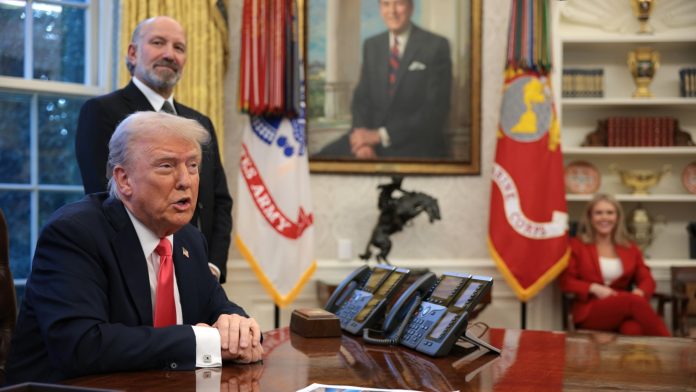
President Trump speaks to reporters as Commerce Secretary Howard Lutnick looks on in the Oval Office on Feb. 25, 2025.

Alex Wong/Getty Images North America


hide caption

toggle caption

Alex Wong/Getty Images North America

President Trump said he is planning to introduce a new visa to attract rich foreigners to America — something he is calling a “gold card.”

For $5 million, people will be able to become lawful permanent residents. Trump said the program would be rolled out in two weeks, would bring in “very high-level people,” and said the proceeds from the program could help pay down the deficit.

“It’s going to be a route to citizenship, and wealthy people will be coming into our country by buying this card. They’ll be wealthy, and they’ll be successful, and they’ll be spending a lot of money and paying a lot of taxes,” Trump told reporters at an unrelated event in the Oval Office on Tuesday.

Trump’s Commerce Secretary Howard Lutnick called it the “Trump Gold Card” and said it would effectively replace the current EB-5 immigrant investor visa. That program gives residency to foreigners who invest at least $1.05 million in a new business that creates jobs — or $800,000 if the business is in a rural area, high unemployment area or an infrastructure project.

Lutnick told reporters the EB-5 program was “full of nonsense, make-believe and fraud.” He emphasized that applicants for the “gold card” would be vetted.

Asked by a reporter whether Russian oligarchs could apply to buy “gold cards,” Trump said — seemingly tongue-in-cheek — “Yeah, possibly. Hey, I know some Russian oligarchs that are very nice people.”

Israel Strikes Syria Hours After Country’s Leader Demands Withdrawal

0

The Israeli military said it had struck sites in southern Syria on Tuesday, just hours after the new Syrian leadership demanded that Israel withdraw from territory it has seized since the fall of the Assad regime.

The attacks were aimed at “military targets in southern Syria, including headquarters and sites containing weapons,” the Israeli military said in a statement. It added, “The presence of military assets and forces in the southern part of Syria constitutes a threat” to Israeli citizens.

Israel Katz, the Israeli defense minister, said in a statement late on Tuesday that the attacks were part of a “new policy” of ensuring a “demilitarized southern Syria.” He added that “any attempt” by either Syrian forces or militant groups to establish a presence in what Israel has deemed its “security zone” in the region “will be met with fire.”

That policy was announced by Israel’s prime minister, Benjamin Netanyahu, on Sunday in a speech demanding “the complete demilitarization” of southern Syria. The speech and Israel’s actions drew the condemnation of Syria’s new government on Tuesday.

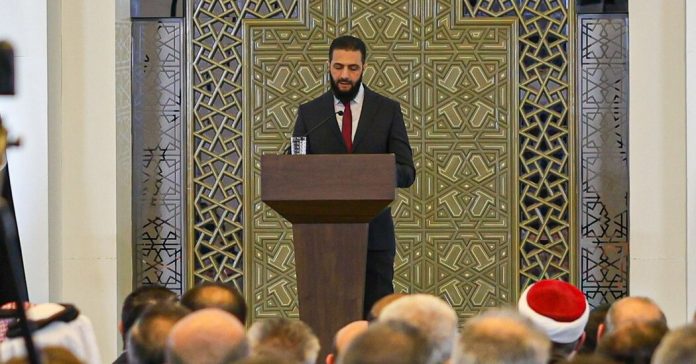
The country’s interim president, Ahmed al-Shara, presided over a national unity conference on Tuesday that was intended to build consensus around the nation’s political and economic future. It concluded with a statement decrying Israeli incursions in Syria and rejecting “the provocative statements of the Israeli prime minister.”

Syria’s new government said Israel was violating Syria’s sovereignty and a longstanding agreement, and called on the international community to pressure Israel “to stop the aggression.”

Israel has been striking in Syria since before the fall of the country’s longtime dictator, Bashar al-Assad, saying it aimed to curb the flow of arms and money from Iran to the militant group Hezbollah in Lebanon. Since the rebel alliance led by Mr. al-Shara ousted Mr. al-Assad, and Mr. al-Shara became Syria’s leader, Israel has seized territory near their shared border and has been attacking military assets.

The Syrian Observatory for Human Rights, a war monitoring group based in Britain, said on Tuesday that Israeli forces have struck in Syria 16 times this year. Most of the attacks were conducted by the air force and two were ground strikes, the observatory said.

While Israeli leaders have for months made it clear they intend for their troops to remain in the border regions within what is supposed to be a buffer zone overseen by international peacekeepers, their declarations about a demilitarized southern Syria represent an escalation that has heightened tensions within Syria.

Mr. Netanyahu in his speech singled out three southern provinces in Syria, saying Israel would not tolerate Syrian forces in Quneitra, Dara’a and Sweida. On Tuesday, Syria’s state news agency reported demonstrations in Sweida in response to those statements and Israeli actions. Syrian news media and the Syrian Observatory for Human Rights also reported demonstrations against Israeli actions in the other two provinces on Monday and Tuesday.

Israel invaded border villages in Syria after the Assad regime was toppled in what it described as temporary measures to protect its own security. But the Israeli raids continued throughout January and into February, raising fears among Syrians that the incursions could become a prolonged military occupation.

Mr. al-Shara’s government is seeking to create a national army to absorb Syria’s many militias, but some are resistant to joining and control significant territory and resources like farmland and oil. The Israeli actions and statements have been viewed by some Syrians as an attempt to sow further divisions and prevent national unity.

The United Nations and some member states have said that Israel is violating a decades-long cease-fire between Syria and Israel by sending its troops within and beyond the buffer zone, which was established in a 1974 Security Council resolution in the wake of a war between the two nations.

On Tuesday, the Israeli military also said it had struck in Lebanon, attacking people it identified as militants who it said were operating in a Hezbollah weapons production and storage facility. Lebanon’s health ministry, which does not distinguish between civilians and combatants, said two people were killed and three were injured.

Israel has been fighting on multiple fronts since the Oct. 7, 2023, Hamas-led attack ignited a war in Gaza and prompted Hezbollah to fire rockets and drones into northern Israel in solidarity with Hamas. Israel and Lebanon entered a cease-fire agreement in late November, but Israel has continued to attack what it says are Hezbollah targets and militants since then.

Israel and Gaza are near the end of the first phase of a cease-fire. As part of that deal, hostages taken by Hamas in the initial attack have been exchanged for Palestinians jailed in Israel. Late on Tuesday, Hamas said that mediators had reached an agreement on the release of Palestinian prisoners who were supposed to be freed on Saturday.

Israel had delayed the release abruptly after six Israeli hostages were freed, saying it would wait until Hamas committed to releasing them without “humiliating ceremonies.” Israeli news media reported shortly after midnight Tuesday local time that the release would take place within 24 hours, with Hamas at the same time transferring the bodies of four deceased hostages to Egypt.

Raja Abdulrahim and Johnatan Reiss contributed reporting.

Six federal workers fired by Trump must get their jobs back : NPR

0

The Merit Systems Protection Board is the independent, quasi-judicial agency that hears appeals in labor disputes brought by federal employees.

Krisanapong Detraphiphat


hide caption

toggle caption

Krisanapong Detraphiphat

Six fired federal employees must get their jobs back, at least through April 10, according to the Merit Systems Protection Board (MSPB), the independent federal agency that hears employee complaints against the government.

The MSPB issued a 45-day stay of the terminations Tuesday evening in response to a request from the U.S. Office of Special Counsel, which had begun investigating the firings.

“I find that there are reasonable grounds to believe that each of the six agencies engaged in a prohibited personnel practice,” stated the order from board member Raymond A. Limon.

The decision comes four days after U.S. Special Counsel Hampton Dellinger argued that he had “reasonable grounds” to believe that federal agencies had violated federal statute in terminating six employees who were still on probationary status. The 45-day stay will allow the Office of Special Counsel’s investigation to continue.

The six agencies named in the complaint — the departments of Education, Energy, Housing and Urban Development, Agriculture, and Veterans Affairs, and the Office of Personnel Management — have five working days to provide evidence that they are complying with the order.

While probationary employees lack some of the job protections afforded to career civil servants, they cannot be terminated “at will,” Dellinger wrote in his filing with the MSPB. Moreover, agencies must inform employees why they are being fired.

None of the six had performance issues, according to Dellinger’s investigation. Instead, he wrote, the evidence indicates that agencies improperly used the employees’ probationary status to accomplish a downsizing of the workforce, without following the proper procedures for doing so.

The fired included disabled veterans working for the Departments of Education and Veterans Affairs who would receive preference in a mass layoff done legally.

Dellinger took up the case of the six fired employees after receiving a complaint, brought on their behalf by the legal advocacy group Democracy Forward and the Alden Law Group. The lawyers said in a press release that they are urging Dellinger to “seek relief on behalf of all similarly situated probationary employees.” He is considering ways to do so, according to his office.

Dellinger himself was fired abruptly by the Trump administration. He sued, noting that under the law, the special counsel may be removed by the president “only for inefficiency, neglect of duty, or malfeasance in office.” A judge temporarily reinstated him while his case winds through judicial system.

Under Trump, America’s New Friends: Russia, North Korea and Belarus

0

If the old saying is true, that you are known by who your friends are, then President Trump may be telling the world something about who he plans to be in this second term.

In a move that redrew the international order, Mr. Trump this week had the United States vote against a U.N. General Assembly resolution condemning Russia’s invasion of Ukraine on the third anniversary of the war.

Among the countries that Mr. Trump joined in siding with Russia? North Korea, Belarus and Sudan.

Those he stood against? Britain, France, Germany, Canada, Italy, Japan and most of the rest of the world.

It would be hard to think of a starker demonstration of how radically Mr. Trump is recalibrating America’s place in the world after barely a month back in office. He is positioning the United States in the camp of the globe’s chief rogue states in opposition to the countries that have been America’s best friends since World War II or before.

The fracturing of the U.S. bond with its traditional allies carries profound implications for the future of American foreign policy. Even as leaders from Poland, France and Britain are heading to Washington this week to try to lure Mr. Trump back into the fold, they and their compatriots face the reality that he does not share their values or see their priorities being in concert with American interests.

If the United States is going to align itself with international outcasts like Russia and the others, it could force Europe, Canada and Asian allies like Japan and South Korea to go their own way and look elsewhere for alliances. At the same time, Mr. Trump’s deference to Moscow has allowed Russia out of the diplomatic isolation chamber that Washington and the West sought to construct in the three years since its full-fledged invasion of Ukraine.

“Trump is transparently and unabashedly doing Russia’s bidding in this and many other ways, aligning the U.S. with our adversaries and against our treaty allies,” said Susan E. Rice, who served as President Barack Obama’s ambassador to the United Nations and later his national security adviser. “We all have to ask ourselves why?”

European leaders were stunned and flummoxed by the U.S. vote at the U.N. General Assembly on Monday as well as the American push for an alternate resolution through the Security Council that did not blame Russia for the invasion. On that measure, the United States, China and Russia voted together while Britain, France and other European nations abstained.

“I was deeply troubled by the vote at the U.N. today which put us on the same side as Russia and North Korea,” Senator John Curtis, Republican of Utah, wrote on social media. “These are not our friends. This posture is a dramatic shift from American ideals of freedom and democracy. We all want an end to the war, but it must be achieved on terms that ensure Ukraine’s sovereignty and security and that deter Putin from pursuing further territorial ambitions.”

Representative Don Bacon, Republican of Nebraska, expressed consternation that the president would take the side of the invader. “The Trump Administration royally screwed up today on Ukraine,” he said online. “The vast majority of Americans stand up for independence, freedom and free markets, and against the bully and invader.”

Mr. Trump’s advisers argue that he is initiating a complicated, sensitive negotiation to end the war and that those criticizing him for adopting Russia’s talking points must oppose an end to the violence in Ukraine. The last president, Joseph R. Biden Jr., did not make peace, therefore Mr. Trump’s approach must be better, or so the reasoning goes.

“The president knows how to make a deal better than anyone who has ever assumed the office of the American presidency, and in order to make a deal, you have to bring both sides to the table,” Karoline Leavitt, the White House press secretary, said at her briefing on Tuesday. “And typically when you make a good deal, both sides leave that table a little bit unhappy.”

But if the goal was not to alienate President Vladimir V. Putin of Russia as Mr. Trump seeks an agreement, he has demonstrated no reticence about alienating the person on the other side of the war, President Volodymyr Zelensky of Ukraine. While declining to criticize Mr. Putin or Russia, Mr. Trump has falsely claimed that Ukraine “started” the war and called the popularly elected Mr. Zelensky a “dictator without elections.”

The United States has rarely found common cause with the likes of North Korea and Belarus on questions of major importance while stiff-arming Britain and France. A State Department report in 2023 found that among the countries that the United States voted with most often at the United Nations that year were Canada, Britain, Australia and France. The countries that United States was most at odds with on contested U.N. votes included Syria, Nicaragua, Iran, North Korea, China, Cuba, Belarus and Russia.

The main area where the United States typically finds itself at odds with its major allies is the Israeli-Palestinian conflict, where America mostly has stood against U.N. resolutions criticizing Israel even as European nations more often vote for them. Past diplomats at the U.N. said they could not recall a time when the United States had joined Russia and other outlier states on a question of such importance.

“When I was U.N. ambassador, had I received instructions from the State Department and White House to hang our European allies out to dry and vote with the axis of autocrats, including Russia, North Korea and Belarus, I would have concluded that the Russians had hacked and corrupted our communications systems,” Ms. Rice said.

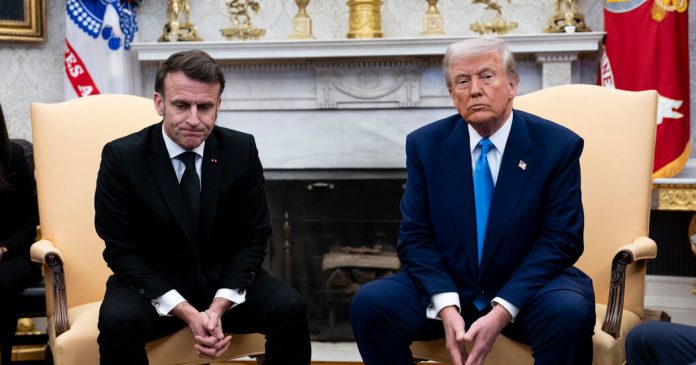
Mr. Trump evinces no concern about being left outside the global consensus. He hosted President Emmanuel Macron of France this week without evident rancor even as the visiting leader tried to gently coax him into being more wary of Russia and more willing to defend Ukrainian security. Mr. Trump smiled and shook hands and seemed thoroughly unmoved.

He will host Prime Minister Keir Starmer of Britain on Thursday at the White House for another session that will further test the new reality of the Atlantic alliance as the British leader seeks to convey the importance Europe attaches to standing together with the United States. But European officials are not holding out great hope for success.

The reality is that Mr. Trump is not offended by leaders like Mr. Putin and Kim Jong-un of North Korea. He has always expressed admiration for autocrats. On the wall of his office at Mar-a-Lago after he left the White House in 2021, he happily hung a picture of himself with Mr. Kim, a ruthless dictator whose government is accused by the State Department of extrajudicial killings, arbitrary arrest, torture, repression, coerced abortion and forced sterilization, among other human rights abuses.

Other presidents have made common cause with unsavory characters and countries in realpolitik concessions to national interests, but generally without much enthusiasm and not usually at the expense of close allies. And Mr. Trump is willing to go further than most of his predecessors.

During a news conference with Mr. Macron, the president brought up Crown Prince Mohammed bin Salman of Saudi Arabia. The C.I.A. has called the prince a killer, reporting that he ordered the brutal murder and dismemberment of Jamal Khashoggi, a Washington Post columnist. Mr. Trump called the prince “a fantastic young guy” who is “tremendously respected all over the world.”

Mr. Trump has had no such laudatory words lately for Mr. Zelensky, the embattled leader of a democracy invaded by a dictatorship. Ukraine is not part of the U.S. alignment, as Mr. Trump envisions it. While the United States was the only Group of 7 country to vote against the U.N. resolution, Mr. Trump is effectively assembling a new club, one with chapters in Moscow, Minsk and Pyongyang instead of London, Paris and Berlin.

Catholics Pray for Pope Francis as He Battles Pneumonia

0

new video loaded: Catholics Pray for Pope Francis as He Battles Pneumonia

transcript

transcript

Catholics Pray for Pope Francis as He Battles Pneumonia

On Tuesday night, the Vatican said the pope was in “critical but stable” condition.

“I think it’s a public manifestation of the love that we have for the Holy Father, the respect that we have for what he does for us and that the whole body of the church, wherever they are.” “Espirito Santo.” “Amen.” “We are pilgrims to Rome, and we heard that he’s in the hospital right now, and we are very worried about his health. So I come here to today to pray for him because he is the leader of the Catholic Church all over the world. He is our father and our responsibility to pray for him.”

Recent episodes in Pope Francis

What We Know About the U.S.-Ukraine Minerals Deal

0

Ukraine has agreed to a deal to turn over the revenue from some of its mineral resources to the United States, an American and a Ukrainian official said on Tuesday, after an intense pressure campaign from President Trump.

The final details of the agreement, including the amount of money that Ukraine will pay the United States, are not yet known.

But a draft agreement discussed on Tuesday no longer included the demand that Ukraine contribute $500 billion to a fund owned by the United States. It also did not include a clause requiring Ukraine to pay back the United States twice the amount of any future American aid.

The Ukrainians became more comfortable with the deal in the past few days after the Americans removed some of the more onerous conditions.

The draft agreement said Ukraine would contribute to a fund half of its revenues from the future monetization of natural resources, including critical minerals, oil and gas. The United States would own the maximum financial interest in the fund allowed under American law, though not necessarily all. And the fund would be designed to reinvest some revenues into Ukraine.

Mr. Zelensky had repeatedly pressed for security guarantees for his country in exchange for mineral rights, as Russia’s war has entered its fourth year. But draft agreements reviewed by The New York Times included no such security commitment.

A final translated draft of the agreement was sent to Ukraine on Tuesday, according to the American official.

Treasury Secretary Scott Bessent and his Ukrainian counterpart, the American official said, are expected to sign the agreement first and then Mr. Zelensky is expected to go to Washington for a signing with Mr. Trump.

Ukraine controls more than 100 major deposits of critical minerals, according to a study by the Kyiv School of Economics, along with modest oil and natural gas reserves.

Titanium is used in construction, airplanes, orthopedic implants and as an additive in paint and cosmetics, including sunscreen, among many other things. Titanium mines in central Ukraine account for about 6 percent of global production, according to Ukrainian media.

Lithium is a crucial element in batteries, including those in electric vehicles, and in other industrial products, including some medications. Ukraine has a third of Europe’s total reserves, although some sites are in war-contested areas. Before the war with Russia, Ukrainian officials suggested to Elon Musk that he invest in Ukrainian lithium mines.

Uranium is used in nuclear power plants and nuclear weapons. Ukraine has the largest uranium reserves in Europe.

Rare earths are a group of more than a dozen metals, much less abundant than titanium or lithium, that are used in many high-tech sectors, including green energy, electronics and aerospace. Ukraine has substantial reserves that are mostly untapped, and it is unclear how expensive they would be to extract.

Reporting by Constant Méheut, Andrew E. Kramer, Maria Varenikova and Alan Rappeport.

White House says it's changing the pool of journalists who travel with the president

0

On Tuesday, the White House press briefing room announced new rules. White House Correspondents Association head and Politico reporter Eugene Daniels speaks with NPR’s Ari Shapiro about this.

What’s at Stake in the Ukraine-Trump Minerals Deal?

0

Officials in Ukraine and the Trump administration say they are close to a deal that would give the United States revenues from Ukraine’s minerals and other natural resources, including titanium, lithium, oil, natural gas and rare earth elements.

A draft agreement seen by The New York Times described the creation of a U.S.-controlled fund that receives revenue from Ukraine’s natural resources. It did not offer any security guarantees.

Ukraine, the largest country wholly within Europe, controls more than 100 major deposits of critical minerals, according to a study by the Kyiv School of Economics, along with modest oil and natural gas reserves.

Ukraine has deposits of 20 of the 50 minerals the U.S. Geological Survey lists as critical for America’s economic development and defense, including:

  • Titanium is used in construction, airplanes, orthopedic implants and as an additive in paint and cosmetics, including sunscreen, among many other things. Titanium mines in central Ukraine account for about 6 percent of global production, according to Ukrainian media.

  • Lithium is a crucial element in batteries, including those in electric vehicles, and in other industrial products, including some medications. Ukraine has a third of Europe’s total reserves, although some sites are in war-contested areas. Before the war with Russia, Ukrainian officials suggested to Elon Musk that he invest in Ukrainian lithium mines.

  • Uranium is used in nuclear power plants and nuclear weapons. Ukraine has the largest uranium reserves in Europe.

  • Rare earths are a group of more than a dozen metals, much less abundant than Titanium or Lithium, that are used in many high-tech sectors, including green energy, electronics and aerospace. Ukraine has substantial reserves that are mostly untapped, and it is unclear how expensive they would be to extract.

Mr. Trump says he wants revenue from the minerals as repayment for military aid that the United States has provided to Ukraine.

Ukraine could help break a Chinese near-monopoly on some rare earth metals needed for mobile phones, other electronics and possibly future technologies.

“It’s clear that Europe, Japan, and the United States are all dependent on China for rare earth elements,” Serhiy Vyzhva, director of the Institute of Geology at Taras Shevchenko National University of Kyiv, said in an interview.

Other ores, minerals and energy are less strategic but still valuable. Ukrainian oil and natural gas reserves could be a source of revenue for the U.S.-controlled fund envisioned in the agreement.

Ukraine wants Mr. Trump’s backing in the war, and in setting the terms of an eventual peace with Russia. How the minerals would actually be extracted has not been extensively discussed with the Trump administration, but developing those resources has been long-term goal for Ukraine.

“Our geological base is similar to that of Canada and South Africa, both of which have extensive mineral resources,” said Mr. Vyzhva, the Ukrainian geologist.

The country’s most productive mines produce iron, titanium, manganese and zirconium, he said, adding that Ukraine is “highly interested” in investment, but its “main focus remains on ending the war.”

When Mr. Zelensky last fall introduced the idea of trading natural resources for military support, he told the Ukrainian Parliament the country’s mineral wealth was worth “trillions” of dollars. That bonanza would be available to “either Russia and its allies or Ukraine and the democratic world” depending on who won the war, he said.

The resources are valuable but experts say that Mr. Zelensky’s estimate is exaggerated. Cumbersome bureaucracy and corruption has limited investment. Under a Soviet-era policy, for example, information about some reserves are classified as state secrets, preventing foreigners from even studying them, a Ukrainian business newspaper reported.

The Ukrainian government’s revenues last year from natural resources royalties were $1.1 billion, far less than the hundreds of billions of dollars Mr. Trump has said he is seeking from the agreement.

The International Energy Agency reported in 2023 that lithium is now mined in sufficient quantities around the world to meet global demand.

One lithium deposit and several rare earth deposits are in Ukrainian territory currently occupied by Russia. Some offshore natural gas deposits in the Black Sea are also inaccessible while fighting continues; some drilling platforms have become contested sea bases for both Russian and Ukrainian marines.

American and other international oil companies have also tried to do business in Ukraine before.

Before Russia’s military incursion in eastern Ukraine in 2014, Ukraine cut deals with Chevron and Shell to explore for shale gas, which the country possesses in abundance — though it has not been economically viable to extract. Shell’s project ended with the Russian incursion, which occupied areas near the site of its project in the Donetsk region. Chevron’s project was canceled because of geological challenges.

House budget vote marks a key test Trump agenda, with GOP support still unclear : NPR

0

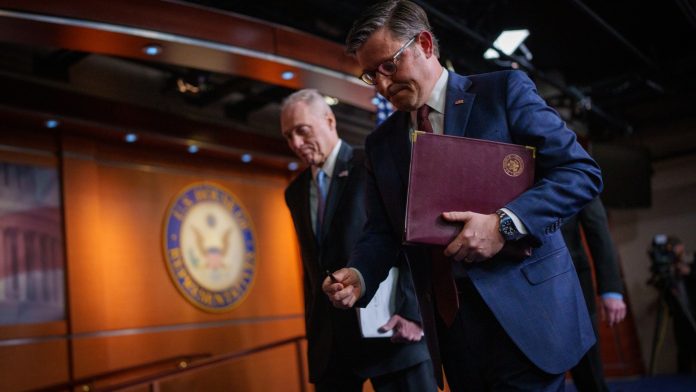
Speaker of the House Mike Johnson, R-La., (right) departs a news conference alongside House Majority Leader Steve Scalise, R-La., at the U.S. Capitol on Tuesday. House Republicans are working to pass a budget bill this week that includes up to $4.5 trillion in tax cuts and an increase in the debt limit.

Andrew Harnik/Getty Images North America


hide caption

toggle caption

Andrew Harnik/Getty Images North America

The future of President Trump’s domestic agenda faces a decisive test in the House on Tuesday, as Republicans look to overcome internal divides over spending and pass a framework for a sweeping multitrillion dollar plan to address defense, energy, immigration and tax policy.

Tuesday’s vote is critical for House Republicans, as passage would allow them to unlock a complicated legislative tool known as reconciliation. It’s a process that Republicans can use to avoid a filibuster from Democrats in the Senate, but in order to use it they have to first agree on a budget blueprint.

“We’re making great progress,” House Speaker Mike Johnson, R-La., told reporters. “It’s a very complicated negotiation, a lot of numbers, a lot of factors, a lot of different opinions. But we will get there as we always do.”

House Republicans are working with a razor-thin majority, and will need virtually the entire conference to vote yes. But even if they can cross that hurdle, it would still amount to just a first step on what promises to be a lengthy and difficult path in passing the party’s policy priorities.

Their budget blueprint passed an important test vote earlier Tuesday, but it remained unclear whether enough members would support a final vote expected later this evening.

With the final vote fast approaching, GOP leaders were still working to wrangle support. Johnson and his deputies have spent weeks in painstaking negotiations, but have struggled to balance competing demands from within a fractious GOP caucus.

While fiscal hawks are demanding steep spending cuts, other members have voiced concern about those cuts having to come from Medicaid, the government insurance program that provides health coverage for millions of low-income and disabled Americans.

The Republican-led Senate, impatient with delays on the House side, has already moved their own budget reconciliation plan forward. However, President Trump, after weeks of talks with members, has made clear he’d like to see the House version get to his desk.

The House plan calls for an increase in funding to secure the southern border, a boost for military spending and raising the nation’s debt limit by $4 trillion.

The plan also calls for $4.5 trillion in tax cuts over the next decade. Those cuts include renewing the 2017 Trump tax cuts, which are set to expire at the end of the year, as well as other proposals that the president campaigned on, like no taxes on tips, overtime or Social Security.

In order to get the budget plan just to this stage, Johnson was forced to concede to a demand from some conservative holdouts for $2 trillion in spending cuts. Under the budget framework, the exact details of those cuts will be sorted out later, by individual committees in the House.

The House Energy and Commerce Committee, for example, would be responsible for coming up with $880 billion in savings. But because the committee has say over spending for programs like Medicare and Medicaid, more moderate Republicans are worried about cuts coming from the social safety net.

Given Republicans’ thin majority in the House, they can only afford to lose one vote, but entering Tuesday, several members were signaling opposition.

Among the potential holdouts was Rep. Thomas Massie, R-Ky., who in a post on social media Monday wrote, “If the Republican budget passes, the deficit gets worse, not better.” Elon Musk responded to the post by saying, “That sounds bad.”

Rep. Victoria Spartz, R-Ind., said that before she could agree to support the bill, she was hoping for deeper spending cuts to help guard against rising prices.

“I think my party needs to go a little bit on [the] offensive,” she said. “If we care about the people.”

Another potential holdout, Tennessee Republican Tim Burchett, wasn’t sure how he would vote. Burchett, who spoke to Trump by phone earlier Tuesday, declined to share details from the call or give any clues on what he would do.

“I don’t know,” he told NPR.

If the House cannot pass its budget plan, the Senate bill may end up as Plan B. President Trump has expressed a desire for one “big, beautiful bill,” but the Senate plan would seek to pass his main agenda through two bills: one that tackles the border, military spending and energy policy first, followed by a second bill on tax cuts.

Elena Moore contributed reporting.

Ukraine Agrees to U.S. Deal for Mineral Rights

0

Ukraine has agreed to a deal to turn over the revenue from some of its mineral resources to the United States, a Ukrainian official said on Tuesday, after an intense pressure campaign from President Trump that included insults and threats.

The White House did not confirm that an agreement had been struck.

The final terms of the deal were unknown, and it was not immediately clear what, if anything, Ukraine would receive in return. President Volodymyr Zelensky of Ukraine had repeatedly pressed for security guarantees for his country in exchange for mineral rights, as Russia’s war entered its fourth year.

Previous draft agreements reviewed by The New York Times included no such commitment, and the Trump administration has characterized the deal as repayment for past military aid.

Three Ukrainian current and former officials with knowledge of the negotiations said that Kyiv was ready to sign the agreement.

Mr. Trump had insisted he wanted “payback” for past U.S. aid to Kyiv, shifting America’s alliance with Ukraine to a nakedly mercantile footing.

On Tuesday afternoon, Mr. Trump indicated that Mr. Zelensky was coming to Washington later in the week. “I hear that he’s coming on Friday,” he said. “ Certainly, it’s OK with me if he’d like to.”

Mr. Zelensky has been pressing for days to finalize any agreement with Mr. Trump in person.

The discussions about mineral rights have occurred as Russia has seized the advantage on the battlefield. Mr. Trump has aligned himself with President Vladimir V. Putin while excoriating Mr. Zelensky.

Mr. Trump has called the Ukrainian president a “dictator” and falsely said that Ukraine had started the war, though the conflict began with Russia’s full-scale invasion in February 2022.

He has prodded Mr. Zelensky to sign a deal, saying he “better move fast or he is not going to have a country left.” In response, Mr. Zelensky said that Mr. Trump was trapped in a Russian “disinformation bubble.”

Mr. Zelensky had floated the idea of a resources deal last fall to provide an incentive for more U.S. military support. But he balked at the terms presented by the Trump administration when Treasury Secretary Scott Bessent visited Kyiv on Feb. 12.

At least one other draft of an agreement was also rejected by Mr. Zelensky because it lacked specific U.S. security guarantees and because Mr. Trump was requesting mineral rights worth $500 billion.

The Ukrainians became more comfortable with the deal in the past few days after the Americans removed some of the more onerous conditions.

“I am not signing something that 10 generations of Ukrainians will have to repay,” Mr. Zelensky previously told a news conference.

Still, Mr. Zelensky acknowledged that he might ultimately have little choice. “If we are forced and we cannot do without it, then we should probably go for it,” he said, amid intensifying pressure.