Friday, November 13, 2026
Home Blog Page 184

‘We don’t want to be Americans’ : Consider This from NPR : NPR

0

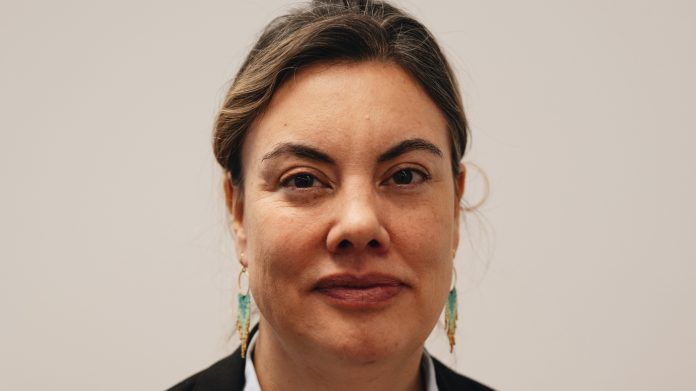
Naaja Nathanielsen poses for a portrait in her office in Nuuk, Greenland on Feb. 20, 2025.

Grace Widyatmadja/NPR


hide caption

toggle caption

Grace Widyatmadja/NPR

President Trump’s calls for the U.S. to take over Greenland have sparked alarm and outrage.

Denmark, which is responsible for Greenland’s security, recently announced that it would further boost its defense spending.

And a recent poll found 85 percent of Greenlanders are opposed to being part of the United States.

Parliamentary candidate Naaja Nathanielsen is one of them.

It isn’t clear whether Trump’s ambitions for Greenland will take. But some politicians in the territory are taking his calls for acquisition more seriously than ever before.

For sponsor-free episodes of Consider This, sign up for Consider This+ via Apple Podcasts or at plus.npr.org.

Email us at [email protected].

This episode was produced by Mat Ozug, Vincent Acovino and Elena Burnett and was edited by Ashley Brown, Courtney Dorning and Nadia Lancy.

Our executive producer is Sami Yenigun.

Facing Early-Onset Alzheimer’s, She Fought to Expand Assisted Suicide in Quebec

0

One recent evening, Sandra Demontigny tried to write down when she would die.

“I sat down in a corner with a candle next to me, just to create my own bubble, to think and to cry a little,” she said.

She had reflected on this moment for years, desperately hoped for it, fought tirelessly for it. But the words refused to come out. The form before her remained blank. How, exactly, does one decide when to end one’s life?

Canada’s French-speaking province of Quebec last fall became one of the few places in the world to allow a person with a serious and incurable illness to choose medically assisted death in advance — perhaps years before the act, when the person still has the mental capacity to make such a momentous decision.

And Ms. Demontigny — a 45-year-old mother of three, diagnosed in the prime of her life with a rare form of early-onset Alzheimer’s — played a pivotal role in lobbying for the change.

Some facing such a grave health challenge might have withdrawn. But even as Ms. Demontigny (deux-mon-tee-gnee) began losing her memory, she became the face of the campaign to expand the right to die in Quebec.

In front of health ministers and lawmakers, on talk shows, in countless interviews, she spoke of how she had inherited the Alzheimer’s gene carried by her family. She recalled how her middle-aged father, in the last years of his life, became unrecognizable and aggressive. She wanted to die with dignity.

Still, four months after Quebec expanded the right to die, she had yet to fill out the advanced request forms. Choosing death was agonizing enough, but Ms. Demontigny had to declare, in precise details, the circumstances under which the lethal dose would be administered. Should it be carried out when she needs care round the clock? When she no longer recognizes her own children?

“Even though it’s a subject that’s preoccupied me for years, it’s different now because I have to make an official request,” Ms. Demontigny said. “But I’m not changing my mind — that’s for sure.”

Under the new law, an advanced request for assisted death must meet a set of criteria and be approved by two physicians or specialized nurses.

Across the world, only a few countries — including the Netherlands, Belgium, Luxembourg, Spain and Colombia — recognize advance requests for assisted deaths, though, in some cases, not for people suffering from Alzheimer’s or other forms of dementia.

At her one-bedroom apartment, Ms. Demontigny spoke during a two-hour interview often punctuated by the cries of a very voluble siamese cat named Litchi. Her partner, André Secours, was visiting — helping her recall a detail, reminding her of a scheduled phone call in the afternoon or an appointment the following day.

Though only in her mid-40s, Ms. Demontigny moved into the apartment — inside a residence for older people in Lévis, a suburb south of Quebec City — as she needed more help a year ago. She chose to live alone, not wanting to burden her family. Her two older children were already adults, and her youngest went to live with Ms. Demontigny’s former husband.

Her front door was covered with reminder notes. A timer on top of the stovetop range cuts off power automatically. The dresses in her closet were methodically arranged and archived with photos on her smartphone. No system was foolproof, though.

“I’m doing something,” she said, “and Litchi walks past by me, and I follow Litchi and I forget what I was doing.”

Bright sofa covers — brought back from Bolivia, the Democratic Republic of Congo and other places where she had worked as a midwife — hinted at her life before her Alzheimer’s diagnosis at age 39.

Ms. Demontigny decided to become a midwife after the difficult birth of her first child. The obstetrician, she said, performed a procedure without warning her.

“It’s my body — can you at least tell me?” Ms. Demontigny said.

As a midwife, she wanted women to be able to give birth in a respectful and natural environment.

For Ms. Demontigny, there was a direct link between a proper birth and a proper death.

“Life and death resemble each other,” she said.

When Ms. Demontigny learned that she had Alzheimer’s, she slipped into depression but was not surprised. Several older relatives had begun experiencing symptoms of Alzheimer’s at a young age, though they kept the illness hidden as long as they could, out of shame.

Her father started losing his memory in his mid-40s and stopped working at 47. At home, he spent his days wandering, bumping into walls and collapsing from exhaustion. In his final years at a health facility, he licked the floor and acted menacingly, even threatening to kill his son, Ms. Demontigny’s brother.

Like many Québécois families, Ms. Demontigny’s parents had drifted away from the Roman Catholic Church, and Ms. Demontigny considered herself an atheist. And yet, when her father died after years of anguish, she said she felt his soul depart.

“I hadn’t seen him like that, at peace, in at least 10 years,” she said.

While her parents’ generation kept silent about Alzheimer’s, Ms. Demontigny set up a Facebook page in 2019 to describe living with the illness. The social media posts from a mother of three, not yet 40, who had to give up her career as a midwife because of a rare form of Alzheimer’s, resonated in Quebec. She became the spokeswoman for the Federation of Quebec Alzheimer Societies and wrote a book about her experience, “The Urgency to Live.”

Quebec legalized assisted death a decade ago, before the rest of Canada. Under the law, a person had to be in an “advanced state of irreversible decline in capability” and “must expressly confirm their consent immediately” before the assisted death. But the requirements presented a problem for those suffering from an incurable and serious disease like Alzheimer’s, who were likely to lose their capacity to consent.

Dr. Georges L’Espérance, a neurosurgeon and president of the Quebec Association for the Right to Die with Dignity, said Ms. Demontigny helped press to allow for advance requests after becoming the group’s spokeswoman in 2022.

“She played a primordial role,” Dr. L’Espérance said. “It’s fine to discuss these concepts in the abstract. But it’s different when you can link an illness to someone that people can identify with. And Sandra’s an open book and very credible.”

Mr. Secours, Ms. Demontigny’s partner, said fighting for the change had helped fill the void created by her diagnosis.

“She had never expected to commit herself to a cause,” Mr. Secours said. “But that saved her, that gave meaning to her life.”

In the half-decade since her diagnosis, Ms. Demontigny had led a busy life — speaking out, writing a book, becoming a grandmother. She had embarked on a romantic relationship with Mr. Secours, 72, who lived across the street from her old place.

“André talks to everybody, says hello to everybody, he’s very cheerful,” Ms. Demontigny said.

“We were friends, neighbors, in the beginning, then our affection developed,” Mr. Secours said.

Some people, though, asked him why he had chosen to get involved with someone with an incurable illness.

“Even my mother, who just turned 100 and sees very well, told me, ‘André, you’re really not making your life easier.’”

“She doesn’t say that anymore,” Ms. Demontigny interjected.

The couple vacationed in Costa Rica last year and were hoping to go on a safari in South Africa, they said, as Litchi now lay sleeping before the television.

Perhaps it was this, the life she was still able to lead and enjoy, that made it difficult for Ms. Demontigny to put down in writing, as required by law, the “clinical manifestations” that will lead to assisted death.

Because Ms. Demontigny is likely to become incapable of consenting as her illness progresses, the manifestations she describes will “constitute the expression” of her consent in the future.

In fact, she had written in her book that she wanted assisted death to be carried out when certain conditions were met, including being unable to recognize even one of her children and behaving aggressively toward her loved ones. But though she knew exactly what she was going to say as she sat over the documents on that recent evening, she could not bring herself to write it down, not yet.

“I’m not going to change my mind because for me, in my situation, that’s the best possible end,” she said. “But I don’t want to die. I’m not ready. That’s not what I want.”

21 DOGE staffers resign, saying they won’t help ‘dismantle’ public services : NPR

0

Elon Musk, who oversees the Department of Government Efficiency, or DOGE, holds a chainsaw as he arrives to speak at the Conservative Political Action Conference Thursday in Oxon Hill, Md.

Jose Luis Magana/AP


hide caption

toggle caption

Jose Luis Magana/AP

Twenty-one members of the United States DOGE Service (formerly the U.S. Digital Service) have resigned, citing DOGE’s ongoing work dramatically reshaping the federal government.

“We will not use our skills as technologists to compromise core government systems, jeopardize Americans’ sensitive data, or dismantle critical public services. We will not lend our expertise to carry out or legitimize DOGE’s actions,” the anonymous staffers write in a letter obtained by NPR, and first reported by The Associated Press.

The staffers who resigned appear to have started with USDS before the Trump administration.

“As civil servants, we remained committed throughout the Presidential Transition to delivering better government services through technology and stood ready to partner with incoming officials,” they write. “Each of us left senior private sector technology positions to pursue nonpartisan public service. We swore to serve the American people and uphold our oath to the Constitution across presidential administrations. However, it has become clear that we can no longer honor those commitments at the United States DOGE Service.”

According to the letter, which is dated Tuesday and addressed to White House Chief of Staff Susie Wiles, the resignations follow numbers of people being let go from USDS earlier this month.

The DOGE effort is overseen by billionaire White House adviser Elon Musk.

This is a developing story and will be updated.

German Central Bank Loss Points to More Economic Woes for Germany

0

The president of Germany’s central bank, which on Tuesday reported an annual loss for the first time in more than 40 years, said Germany faced another year of economic stagnation, more gloomy news for a country that is struggling to grow.

“It is not possible to rule out a third consecutive calendar year with no growth,” Joachim Nagel, the head of the Bundesbank, told reporters in Frankfurt.

The comments highlighted the economic challenges facing Germany’s next government. Voters on Sunday gave Friedrich Merz of the conservative Christian Democrats a mandate to form a new government, which he is hoping to do in coalition with the center-left Social Democrats.

The new government will inherit a 2025 budget with a 13-billion-euro ($13.6 billion) hole and an economy riddled with structural problems, including high energy costs, a cumbersome bureaucracy, and an export industry under pressure from rivals in China and the threat of tariffs by the United States.

The government, which will find it hard to borrow more because of strict rules on debt and deficits, cannot rely on any transfers from the Bundesbank, which sends its profits to the state.

Mr. Nagel was speaking after the release of the central bank’s annual report, which showed a loss of €19.2 billion last year, the bank’s first loss since 1979.

Since interest rates have risen, central banks around the world have faced losses stemming from the high interest they pay on deposits versus the low returns they receive from low-rate bonds bought during past crises. The Bundesbank stopped transferring money to the government in 2020, building reserves to offset losses.

Sabine Mauderer, the first deputy governor of the central bank, said that losses would continue, making the bank “unable to distribute any profit for an extended period of time.”

The Bundesbank stressed that it maintained a “sound” balance sheet, buttressed by some €260 billion worth of gold, which has recently soared in value. And despite the economy’s “stubborn stagnation,” Mr. Nagel pointed to Germany’s stable institutions, “adaptable” companies and skilled work force as strengths that would help the country return to growth.

But the past three years have been marked by political instability — or a “lack of political reliability,” as Mr. Nagel put it — that has rattled consumers and investors.

“Germany needs an effective government as soon as possible,” the central bank chief said, calling for “smart economic policy to enable the economy to get back on track.”

Teachers worry about rollback of DEI effects on Black History Month : NPR

0

Gwen Partridge, known to her students as “Mrs. Gwen,” stands in front of an exhibit she created for Black History Month on Feb. 13. She’s uncertain others will be able to continue teaching Black history once she retires given the Trump administration’s orders that schools eliminate diversity initiatives or risk losing federal funding.

Kassidy Arena/Nebraska Public Media


hide caption

toggle caption

Kassidy Arena/Nebraska Public Media

Gwen Partridge, or Mrs. Gwen to her pre-K students, walked around her homemade Black History Museum at the YMCA Immanuel Early Learning Center in Omaha, Neb., on an icy Thursday. She and her co-workers researched and created each exhibit.

“What’s great is when they learn something about Black history and then the parents come back and say ‘Thank you,'” Partridge said.

Partridge has been a pre-K teacher for 20 years, and the Black history museum she spearheaded for the school has interactive exhibits for the students. There’s a music section with a piano, a makeshift hair salon, and plenty of books about influential Black history-makers.

The students in her mostly white class ask her why she has brown skin and they don’t. She uses that question to teach about the first Black student to attend an all-white school, about 65 years ago: Ruby Bridges.

“And I’m like, ‘She was little, just like you guys. And just imagine how scared she was walking into a classroom with nobody else the same color as her skin,'” Partridge said.

Tense time for educators who teach Black history

The U.S. Department of Education recently told public schools and universities to eliminate diversity initiatives within 14 days, or lose public funding.

Officials and teachers with three large districts in Nebraska declined to speak about Black history education this year, claiming it was either a sticky subject or citing the “evolving national dialogue around educational observances,” according to one school district.

Tim Royers, president of the Nebraska State Education Association, recently attended a national meeting with other teachers union leaders.

“There’s such a profound chilling effect that’s happened right now because of the orders coming out of Washington,” he said. “I don’t think any school or district wants to talk about it for fear that that’s going to get weaponized and used against them to potentially take away federal funding.”

Royers, a former history teacher, said educators at the forefront of these discussions are exhausted, and these pressures contribute to low teacher retention.

Studies show rural districts — the majority of school districts in Nebraska — have some of the highest rates of teacher turnover.

“[Teachers are] not necessarily shying away from doing the work to educate on Black History Month, but, I mean literally, we’re hearing stories about if a program mentions the word equity, they’re getting contacted demanding that they either shut the program down or they’re going to lose funding,” Royers said.

Standing up for Black History Month

But not all teachers are experiencing these same tensions. Dan Wade III is a social science teacher in Oxnard, a city in Southern California. He co-wrote an African American studies course for his high school, which launched last year. He said his school district has been supportive.

His class has been near capacity.

“Ninety-five percent of the students are not African American that are taking the class,” he said.

Wade said it’s often the students who lead the class discussions based on current events.

“Me teaching this class, it almost feels like a way of standing up for Black history,” he said. “I think essentially what I’m saying is, it’s caused me to kind of step up in a way that before I would have avoided.”

But Wade said he isn’t sure about the future of his class as the debate continues about how schools should teach Black history.

“Black histories are not ones that are typically taught in their traditional curriculum, and we’re including different groups of people. So, you know, essentially, it feels as though an attack on DEI can also be an attack on Black histories, or Asian American histories, Mexican-Chicano histories and so forth,” he said.

Black History Month is about accomplishments and history

The “Dear Colleague” letter sent to schools earlier this month from the U.S. Department of Education Office for Civil Rights accused schools and universities of “repugnant race-based preferences and other forms of racial discrimination.”

“American educational institutions have discriminated against students on the basis of race, including white and Asian students,” the letter said.

LaGarrett King, professor of social studies education at the State University of New York at Buffalo, serves as the director for the Center for K-12 Black History and Racial Literacy Education.

“Lately it’s, you know, ‘No one should be taught that any race is superior.’ That’s not being taught in Black history. No one’s teaching that Black people are superior to white people,” he said.

Royers added that history education is about sharing the whole truth, even if it can be ugly.

“Black History Month is about two different things: elevating Black accomplishments and contributions to American history that might have otherwise been not told or under-told, but also acknowledging the history of systemic oppression that was used to diminish Black voices and Black participation in society,” he said.

King said Black educators often lead the charge to teach more about Black history, but Black teachers are significantly underrepresented in American schools. According to data published in 2020 by the National Center for Education Statistics, about 80% of teachers in U.S. public schools identified as white, non-Hispanic.

King said there is hesitation to teach Black history for a couple reasons: many educators and curriculum writers lack formal Black history education from schools and many Black educators do a better job teaching Black history because of the unofficial spaces where they learn Black history like at home and in churches and community centers.

“It’s through their perspectives. It’s about their voices, it’s about their experiences, right? So when you frame Black history in that manner, other than Black history that’s taught from a white person’s lens, that could be a little intimidating for people to even kind of approach that,” he said.

Mrs. Gwen’s pre-K lesson plan on this day included learning about the stoplight, invented by Black businessman Garrett Morgan.

“Black history, you know, that’s something that we all should learn about. It’s part of our history. Because now I’m not for sure, I’m reading different things that they might be taking out Black history and Black studies out of schools. So if they don’t get it here, they might not get it,” Partridge said.

She plans to retire in June, but she intends to “pass the torch,” to make sure the pre-K Black History Museum opens its doors every February.


Their Album is Wordless. Will Their Protest Against A.I. Resound?

0

Sometimes, silence speaks louder than song.

That’s the hope, at least, for more than 1,000 musicians who released a lyric-less album on Tuesday to protest the British government’s proposal to expand the ways that developers can use copyright-protected works to train artificial intelligence models.

The album, which was created by artists including Annie Lennox, Billy Ocean, Hans Zimmer and Kate Bush, is not exactly silent: It features recordings of empty studios, which the artists say represent “the impact we expect the government’s proposals would have on musicians’ livelihoods.”

There are footsteps and rustles — is that a door closing? a page turning? a fly? — but only the most out-there contemporary composers would refer to the sounds as songs.

“Doesn’t that silence say it all?” Kate Bush, who contributed to the album, said in a statement, adding, “If these changes go ahead, the life’s work of all the country’s musicians will be handed over to A.I. companies for free.”

Under the government’s proposals, artists would have to opt out, or “reserve their rights,” to keep their works from being used to train A.I. The window for public comments on the proposal, which is part of a broader government consultation on copyright and artificial intelligence, was set to close Tuesday night.

“Opt-out shifts the burden of controlling your works onto the rights holder,” said Ed Newton-Rex, who organized the album and is the chief executive of Fairly Trained, a nonprofit that certifies generative A.I. companies for the training data they use.

“Basically,” he said, of the current government proposal, “it flips copyright on its head.”

Even as some artists experiment with artificial intelligence, many fear that developers are inappropriately using their work without compensating them. (Publishers and journalists are also concerned: The New York Times has sued OpenAI and Microsoft for copyright infringement of news content related to A.I. systems. OpenAI and Microsoft have denied those claims.)

The album — titled “Is This What We Want?” — has 12 songs, each of which has a one-word title that together spell out the sentence: “The British government must not legalize music theft to benefit A.I. companies.”

Only some of the artists who were part of the album project directly contributed to the audio, Mr. Newton-Rex said, although he said that all shared in the credits.

Mr. Newton-Rex and other critics fear that artists may not even know if their work is being used to train the A.I. models. He said that he had previously run opt-out schemes at generative A.I. companies, which he called an “illusion,” in part because copyrighted work can spread so quickly online that creators can lose control of it.

Powerful A.I. developers have repeatedly shown that they are willing to skirt copyright law to train systems. And Britain, desperate to revive its sluggish economy, is aggressively trying to court A.I. developers. Prime Minister Keir Starmer recently said he plans to push Britain to be “the world leader.”

The country has already signaled its willingness to break with the European Union and some of its other allies, like Australia and Canada, in its attitude to the technology. At a recent A.I. summit in Paris, Britain sided with the United States in declining to sign a communiqué calling for A.I. to be “inclusive and sustainable.”

Now, Britain is arguing that a “competitive copyright regime” is part of what is needed to “build cutting-edge, secure and sustainable A.I. infrastructure.” The proposals, which were announced late last year, call the current system unclear and say that it is hampering innovation for both A.I. developers and artists. Britain argues that the proposed changes are meant to give artists more control over the way their work is used and more opportunities for payment.

In response to a request for comment, the Department for Science, Innovation and Technology said that Britain’s current copyright structure is holding both artists and A.I. companies back from full innovation. But it also noted that no decisions had been finalized and that it would consider the responses it received before setting out next steps.

Britain’s consultation process, in which the government asks for public input at the early stages of policy proposals, is designed to take in feedback and often leads to revisions.

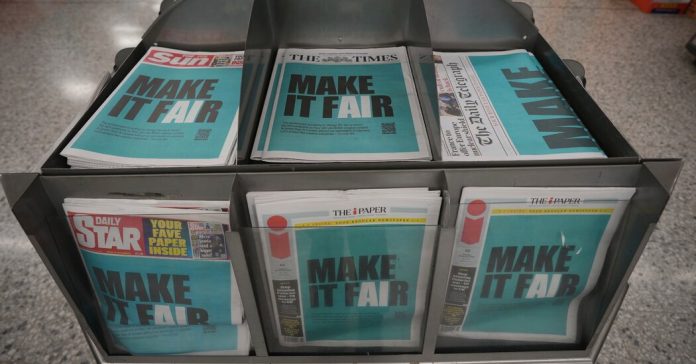
As the consultation period ended on Tuesday, British artists and publishers released a series of protests. Several newspapers featured identical campaign images across their front pages that read: “Make it fair: The government wants to change the U.K.’s laws to favor big tech platforms so they can use British creative content.”

The musicians Paul McCartney, Elton John and Dua Lipa, the novelist Kazuo Ishiguro and the actor Stephen Fry were among the artists who signed a letter in protest that was published in The Times of London.

“There is no moral or economic argument for stealing our copyright,” the artists wrote. “Taking it away will devastate the industry and steal the future of the next generation.”

Keir Starmer Announces Defense Spending Increase

0

new video loaded: Keir Starmer Announces Defense Spending Increase

transcript

transcript

Keir Starmer Announces Defense Spending Increase

Prime Minister Keir Starmer of Britain said the move would amount to an increase in expenditure of 13.4 billion pounds, or $17 billion, a year on defense between now and 2027.

“Starting today, I can announce this government will begin the biggest sustained increase in defense spending since the end of the Cold War.” “Hear, hear.” “We will deliver our commitment to spend 2.5 percent of G.D.P. on defense, but we will bring it forward so that we reach that level in 2027.” “Hear, hear.” “And we will maintain that for the rest of this Parliament. And let me spell that out, Mr. Speaker: That means spending 13.4 pounds billion more on defense every year from 2027. I have long argued that in the face of ongoing generational challenges, all European allies must step up and do more for our own defense. So, subject to economic and fiscal conditions, and aligned with our strategic and operational needs, we will also set a clear ambition for defense spending to rise to 3 percent of G.D.P. in the next Parliament.”

Recent episodes in International

International video coverage from The New York Times.

International video coverage from The New York Times.

Supreme Court throws out death sentence, murder conviction of Okla. death row inmate : NPR

0

Anti-death penalty activists rally outside the U.S. Supreme Court on Sept. 29 in an attempt to prevent the execution of Oklahoma inmate Richard Glossip.

Larry French/Getty Images


hide caption

toggle caption

Larry French/Getty Images

The Supreme Court on Tuesday threw out the murder conviction and death penalty for Richard Glossip, an Oklahoma man who has been on death row for more than 25 years.

The court found that Glossip’s trial violated his constitutional rights. It reversed the Oklahoma state court’s judgement and sent the case back for a new trial.

The majority opinion was written by Justice Sonia Sotomayor, who was joined by Chief Justice John Roberts, and Justices Elena Kagan, Brett Kavanaugh and Ketanji Brown Jackson. Justice Amy Coney Barrett joined the opinion in part. Justices Clarence Thomas dissented and was joined by Justices Samuel Alito and Barrett in part. Justice Neil Gorsuch did not participate in this case.

At issue was a remarkable true-crime drama that pit Oklahoma’s attorney general against the state’s highest court for criminal appeals. The question before the court was whether the state court wrongly refused to accept the attorney general’s findings that Glossip was entitled to a new trial.

Glossip has been on death row for more than 25 years. In that time, he has been tried and convicted twice and has lost multiple appeals, including one at the Supreme Court.

This is a developing story and will be updated

Johnson Grasps for Republican Votes to Pass Budget Plan

0

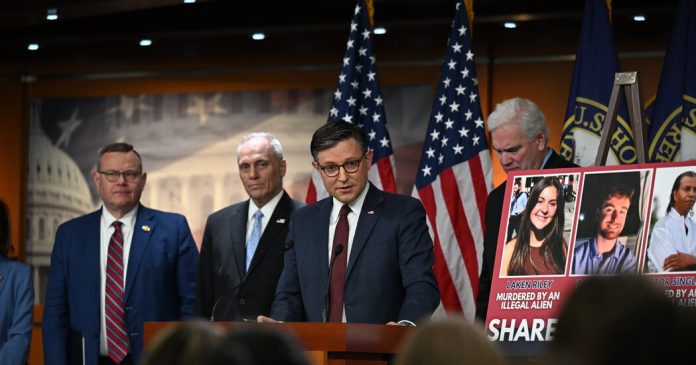
Speaker Mike Johnson toiled on Tuesday to find the votes to squeeze the G.O.P. budget resolution through the House, facing potential defections from centrist Republicans fearing the plan would tee up deep Medicaid cuts and conservatives who want to slash federal spending even more deeply.

Mr. Johnson announced an evening vote on the budget outline, whose approval would clear the way to enact the major elements of President Trump’s domestic agenda, but it was not clear whether he would be able to muster the votes to adopt it.

At a news conference at the Capitol on Tuesday, Mr. Johnson said Republican leaders were “very close” to winning the votes they needed to do so, but signaled the vote could slip to later in the week.

“There may be a vote tonight,” he said. “There might not be.”

It was a familiar conundrum for the speaker, who is working to quell discontent from both flanks of his fractious conference, all while dealing with a razor-thin majority that will accommodate almost no defections. If all members were present and voting, Mr. Johnson could afford to lose no more than a single Republican, and a handful have already said they are against the measure.

Approval of the budget plan is a crucial first step for Republicans to smooth the way through Congress for a massive fiscal package using a process called reconciliation, which allows such bills to steer clear of a filibuster and pass the Senate on a simple majority vote.

The House blueprint calls for legislation that would add roughly $3 trillion to the deficit over a decade, while teeing up deep cuts in spending on health care and food programs for low-income people. That would help pay for $4.5 trillion in tax cuts. It also calls for raising the debt limit by $4 trillion.

At least five conservatives on Tuesday morning said they planned to vote against it.

“It’s insane,” said Representative Thomas Massie of Kentucky. “We’re going to increase the deficit with this. Why would I vote for that? You can’t cut taxes without cutting spending, and they’re not really cutting spending.”

At the same time, Republicans in swing-seat districts have said they are uncomfortable approving a plan that could lead to major cuts to Medicaid and food stamps. The budget does not specify precise cuts, but it lays out broad spending targets by committee that dictate where Republicans must find the money to finance their tax cuts.

For example, the plan instructs the Energy and Commerce Committee, which oversees Medicaid and Medicare, to come up with at least $880 billion in cuts. It would not be possible to find anywhere approaching that amount of money without slicing deeply into at least one of those programs.

“I’m still making my point all the way to the end about the need to protect the services that are important to my district,” Representative Juan Ciscomani of Arizona, said as he left a closed-door meeting of Republicans on Tuesday morning to discuss the plan. “Obviously, this is only the beginning. This is where the real fight actually begins to protect the services that I’ve been fighting for, while also delivering on the promise of slashing down the size of government.”

Republican leaders in recent days have huddled with those skeptical lawmakers and tried to assure them that they will not ultimately be asked to approve deep cuts to those programs. They have argued the House urgently needs to approve the blueprint — which does not carry the force of law — in order to move the reconciliation process forward.

“The question before us now is, what will move us in the right direction: failure, or a partial success?” said Representative Dusty Johnson, a South Dakota Republican who leads the centrist Main Street Caucus. “I think we’re going to come together around the idea that failure is the wrong option, and a partial success is far preferable.”

Maya C. Miller contributed reporting.

Rounding up the Trump administration’s econ-related actions : NPR

0

President Trump.

Chip Somodevilla/Getty Images


hide caption

toggle caption

Chip Somodevilla/Getty Images

This first appeared in the Planet Money newsletter. You can sign up here.

Since taking office in late January, the Trump administration has been working at a galloping pace to reshape the government and economy. We at Planet Money, The Indicator and the Planet Money newsletter have been doing our best to keep up and keep you informed.

Here’s a roundup of some of our recent coverage of the Trump administration’s econ-related actions.

Downsizing Of The Federal Workforce

The Trump administration and DOGE have been seeking to downsize the federal workforce, and our short daily show The Indicator has been covering the story. In “A ‘Fork in the Road’ for federal employees,” The Indicator takes a look at what’s happening to government workers over the last few weeks. The administration sent a memo to nearly 2 million workers that offered them a deal: resign and you will get paid until September. However, can the administration just do this? They didn’t go to Congress to get them to fund these severance packages. The Indicator talks to an employment lawyer, Ricardo Pitts-Wiley, who says that, under existing law, federal employees usually can get only ten days of administrative leave, not many months. “There’s concern that paying individuals to be in a paid administrative leave status beyond 10 days is unauthorized and illegal,” Pitts-Wiley says. These are just some of the issues that The Indicator reveals in its reporting on federal workforce downsizing.

The Dismantling Of USAID

The Indicator has been covering the Trump administration’s actions to try and dismantle USAID. In their first episode on this issue, “The gutting of USAID,” the show looks at the history of the agency and the fallout from it’s recent disruption. The Indicator reports that the US has actually spent less than many other rich countries on foreign aid as a percentage of its economy. But the US economy is so big that the US is still the biggest foreign aid donor in absolute spending terms. Shuttering USAID and slashing foreign aid spending could have huge effects on poor nations.

“We are talking tens of millions of people who are alive because of USAID, rather than dead. And we do it for this teeny amount of money,” Charles Kenny, a senior fellow at the Center for Global Development, told The Indicator. The agency also may have helped U.S. national security and diplomatic interests. Some worry that, if U.S. foreign aid is slashed, China will fill the vacuum.

Want us to cover something? Reach out! Email us at [email protected].

But, at the same time, The Indicator reports, USAID has also faced criticisms in the past about wasteful spending and questions whether its work — and, more broadly, foreign aid — really helps economic growth in poor countries.

In another episode focused on the Trump’s Administration’s USAID cuts, The Indicator looks at another historic beneficiary of US foreign aid: American farmers (the episode is titled “How USAID cuts hurt American farmers“). The abrupt cuts to USAID has affected almost $500 million worth of American wheat, soybeans, and other commodities grown in the US that were set to be distributed as aid overseas. The Indicator reports that foreign aid, and specifically a program called “Food for Peace ,” has been a small but significant source of revenue for farmers in the US. USAID had been this program’s administrator. But, now that the agency’s future is in question, some U.S. Senators are now working to try and transfer “Food For Peace” to the US Department of Agriculture.

Spending freezes and cuts

Housed in the U.S. Department of the Treasury, there’s a gigantic money pipe through which hundreds of millions of dollars flow everyday. It’s known as “the Secure Payment System,” and it’s how the federal government pays for most things. Recently, the Trump administration partially froze funds that flow through this pipe. The courts blocked the freeze, but, as Planet Money‘s reporting suggests in our recent episode ” The Big Government Money Pipe Freeze,” certain parts of the government may not be seeing this pipe flow dollars to them anymore.

Tariffs

President Trump has been raising tariffs, threatening to raise more tariffs, and in the process sparking what could prove to be a trade war bigger than his first term. The Indicator has been on the story.

Trump’s tariff role model — President Trump speaks fondly of William McKinley, the 25th U.S. president who was a strong advocate for tariffs. He’s credited with helping to protect the fledgling tinplate industry in the late 19th century. But did the tariff work? The Indicator takes a closer look at McKinley’s tinplate tariff and if it was worth the cost.

The U.K.’s tariff balancing act — President Donald Trump has already made noise with tariff threats against the United States’ North American trading partners. And soon, the United Kingdom could become another target which has a chance to drive a wedge between the U.K’s trade relationship with the EU. The Indicator explores what the U.K. could possibly offer the United States to ease trade tensions.

Canada’s key resource against Trump’s potential trade war — The Indicator talks to a business journalist with the Canadian Broadcasting Corporation on why oil would be the “biggest arrow in the quiver” should Canada and the U.S. descend into a trade war.

Immigration

After the incoming Trump administration announced that Chicago would be one of the first places targeted by raids by U.S. Immigration and Customs Enforcement, Planet Money traveled there to get a sense of what it looked like on the ground. And they dived into an economic study that looked at the effect of mass deportations. “We find that mass deportations do not have a positive impact for the U.S. labor market as a whole or for U.S.-born workers,” says Chloe East, who conducted the study. The episode is called “The ‘chilling effect’ of deportations.”

Impoundment

Last week, the Planet Money newsletter covered the constitutional conflict over “impoundment.” That’s when the president refuses to spend money appropriated by Congress. Well, we also recently released an episode that dives into all this. The episode is called, “Can the president override Congress on spending?” Check it out here

We’ll keep covering the economic policies of the Trump administration. And we’d love to get your thoughts. Is there stuff that’s confusing? Is there stuff you want clarified? Send us your questions and ideas: [email protected].