Friday, November 13, 2026
Home Blog Page 185

How Can Europe Talk to Trump? Macron Tries Flattery, and Gentle Resistance.

0

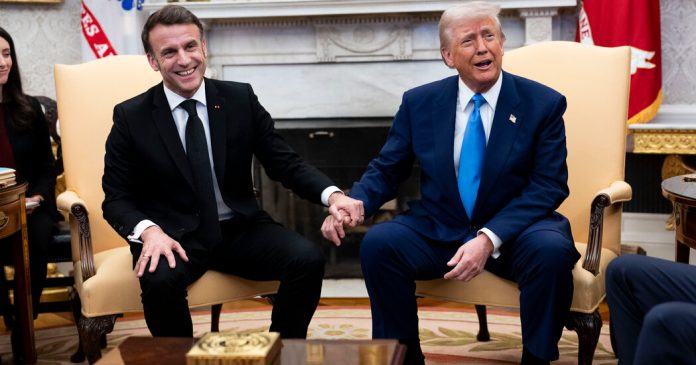
President Emmanuel Macron of France struck a chummy tone with President Trump even as he corrected him with a smile in Washington on Monday. That one-two punch of flattery and gentle resistance is an example of how some European leaders are trying to approach America at a fraught moment.

The question is whether it will work.

Mr. Macron called Mr. Trump “Dear Donald” four times during a joint news conference on Monday, while emphasizing the shared history between France and the United States — and underscoring that the two leaders had made progress in discussing a sustainable and strong peace agreement for Ukraine.

But even as he stuck to the script and emphasized shared goals and values, Mr. Macron showed himself willing to push back.

When Mr. Trump claimed in the Oval Office that Europe would “get their money back” because of the way they have funded support for Ukraine, Mr. Macron interjected, in a friendly tone, saying, “We provided real money.” Unlike Mr. Trump, Mr. Macron clearly labeled Russia as Ukraine’s aggressor. And later, in an interview with Fox News’s “Special Report” before returning to France, Mr. Macron mildly criticized threats to slap tariffs on European consumer goods as counterproductive. “How do you want us to increase security and defense expenditures if we are in a trade war?” he asked.

Europe faces a towering challenge as the full-scale war in Ukraine enters its fourth year and American support for the conflict — and for the continent as a whole — wavers.

Mr. Macron’s trip was part of a flurry of European diplomacy this week in Washington, with Prime Minister Keir Starmer of Britain expected to meet Mr. Trump on Thursday, and the European Union’s top diplomat, Kaja Kallas, making the rounds with administration officials.

Mr. Macron is poised to debrief European heads of state on Wednesday about his visit with Mr. Trump. Mr. Starmer will meet with a group of leaders in London on Sunday, Donald Tusk, the Polish prime minister, said on Tuesday.

That same day, Britain announced an increase in military spending; British and European leaders are increasingly talking about defense jointly, as both groups recognize that they may need to step into whatever void America leaves.

E.U. leaders will have a special summit on March 6 about supporting Ukraine and strengthening Europe’s defense, one which leaders have promised will center on more detailed plans.

Even as they chart their own path ahead, European officials are desperate to keep the United States engaged and active. American military capabilities and funding have been critical to supporting Ukraine’s resistance, and the United States is a key trading partner for the 27-member European Union. A deterioration in the trans-Atlantic relationship is in neither’s interest, E.U. leaders often emphasize.

America’s tonal shift has been so sudden and stark that it has left Europe on the defensive. Mr. Trump has spent recent days and weeks sharply criticizing European allies while making increasingly friendly overtures toward Russia. Among his complaints, Mr. Trump has long insisted that European nations spend more on their own security — a message that Mr. Macron is particularly comfortable delivering.

The French president has for years called for Europe to have more “strategic autonomy” and less military dependence on the United States — often to skepticism from some of France’s neighbors. He underscored it again with Mr. Trump.

“Everyone in Europe is now clear that it is our duty as Europeans” to shoulder more of the continent’s security burden, Mr. Macron said in Washington. “Europeans are now ready to do a lot more.”

Mr. Macron said that Europeans could send troops as part of a future peace deal in Ukraine — not on the front lines of a conflict, but as a peacekeeping force — and that the United States would act in “solidarity” to support that approach.

There were few details about how the United States would do so. And if it became necessary, it would take lots of troops, money and time for Europe to develop the capabilities needed to support Ukraine and defend itself independently. That helps to explain why officials are softly urging the United States to remain engaged, and why they are reminding American officials that doing so is in Washington’s own interest.

“Autocrats around the world are watching very closely whether there is any impunity if you invade your neighbor and violate international borders,” Ursula von der Leyen, president of the European Commission, said in Kyiv, the Ukrainian capital, on Monday.

“This is not only paramount for Europe,” she added. “It is also important for Asia, for Africa, and both sides of the Atlantic.”

It is also not clear whether Mr. Macron and other European leaders can influence Mr. Trump on Ukraine as the American leader embraces President Vladimir V. Putin of Russia and redefines that relationship. The statements and actions emerging from Washington have left European officials concerned that Mr. Trump will negotiate a rapid peace agreement with Russia without including Ukrainian and other European leaders, laying the groundwork for a truce that leaves Kyiv vulnerable and emboldens Mr. Putin. That in turn, the Europeans fear, would leave other nations on the continent at risk of future invasion.

On the surface, Mr. Trump and Mr. Macron were all broad smiles and firm handshakes during the French president’s visit. They addressed each other as close friends, reminisced about past meetings — including a Bastille Day gathering in 2017 and Notre-Dame Cathedral’s reopening last year — and played up a centuries-old Franco-American alliance.

“The United States and France always stand on the same side, the right side, I would say, of history,” Mr. Macron said. “This is what is at stake today.”

He was careful not to antagonize Mr. Trump directly and repeatedly put a positive spin on the American leader’s latest overtures to Russia.

Mr. Macron — criticized himself in the early stages of the war for outreach to Mr. Putin, before taking a harder line — called discussions with Russia “useful.” He even framed U.S.-Ukraine discussions over a mineral deal as a great sign, telling Fox News in an interview that it was “one of the best ways” to ensure the United States was committed to “Ukrainian sovereignty.”

Behind the united calls for peace, though, were starkly divergent views on how to obtain it. Mr. Trump suggested, “We could end it within weeks, if we’re smart.” Mr. Macron repeatedly hammered his own message: Don’t rush.

Peace cannot mean Ukraine’s “capitulation,” Mr. Macron said, adding that Ukraine should not be pushed into a lopsided cease-fire without security guarantees to deter future Russian aggression.

As a cautionary tale, Mr. Macron repeatedly mentioned the 2014 and 2015 cease-fire agreements, known as the Minsk Accords, that were forged after Russian-backed separatists attacked and grabbed territory in eastern Ukraine. Those deals failed to prevent Russia’s 2022 invasion of Ukraine.

“It was violated every time by Russia, and we didn’t react, all of us,” Mr. Macron said.

In France, the camaraderie between the two men was seen as a surface-level display that did little to paper over the growing rift in the trans-Atlantic alliance.

Libération, a left-leaning daily, said that “behind the outward smiles” of the leaders, “a wall is rising” between Europe and the United States. Le Figaro, a conservative daily, noted that Mr. Macron had not received any “firm assurances” from Mr. Trump of continued American support.

Le Monde, one of France’s leading newspapers, declared in an editorial that when it comes to reasoning with Mr. Trump, “hope is slim,” and that Europe may need to “get battle ready.”
In Former East Germany, the Hard-Right AfD Party Finds Most of Its Support

0

Three and a half decades after reunification, a line runs through Germany where the Iron Curtain once stood. Instead of barbed wires and dogs, that line now divides Germans by measures like income and unemployment — and increasingly by the willingness to vote for extremist parties.

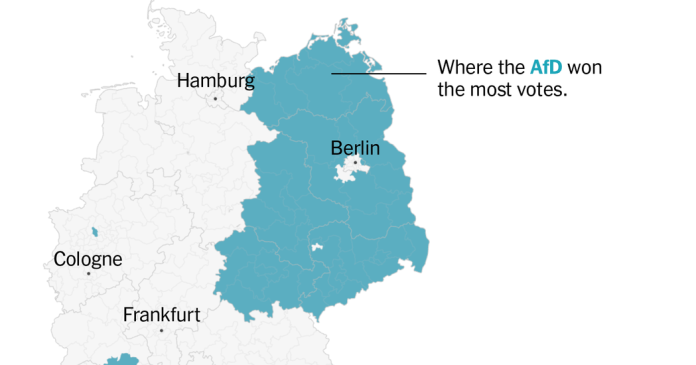
If East Germany were still its own country, the hard-right Alternative for Germany, or AfD, which has been linked to neo-Nazis and is being monitored by domestic intelligence, would have scored a convincing win in the elections on Sunday, with nearly one in three voters there casting ballots for it.

Only two of 48 voting districts outside of Berlin in the former East Germany were not won by the AfD. In a handful of districts in the east, the AfD got nearly 50 percent of the vote.

That division — and the sense that Germans still to some degree inhabit two separate worlds, east and west — has become a persistent feature of Germans’ voting habits. It is one that was manifest not only on Sunday but also when Germans voted in elections for the European Parliament last June.

The divide, analysts say, reflects not only a failure to fully integrate the east, but also its unique problems and culture, shaped by decades of Communist rule during the Cold War and close alignment with Moscow and the former Soviet bloc.

“One important aspect of this is that many East Germans have never really connected emotionally or mentally with West German democracy,” said Benjamin Höhne, a political scientist who studies eastern Germany.

On top of that, many of the metrics where eastern Germany still lags behind the western part are the very factors that make voters more likely to vote for the far right, Mr. Höhne said. The AfD also has close links to Moscow.

On Sunday, only 42 percent of Germans in the east voted for traditional West German parties, including the Social Democrats and Christian Democrats, which look likely to form a governing coalition.

The rest voted either for the AfD, Die Linke, which itself is a successor of the old Socialist Party that ran the East for nearly four decades, and a small splinter party run by a former Communist.

“The old western parties were never that well established in East Germany,” said Matthias Quent, a sociologist professor who has spent years studying the extreme right.

In the former East, the AfD is increasingly visible. Many members are active in civil society — including several mayors — which means even people who do not vote for the party come in regular contact with it, Professor Quent said.

“East Germany simply works differently and has not become more like the rest of the country either,” he said.

Given that East Germans were not allowed to vote freely for four decades before 1990, it is perhaps unsurprising that they do not feel the same attachment to western parties, experts say.

On top of that, parties called the Christian Democrats, Social Democrats or Liberal Democrats — like those in the West — existed in the old East Germany, but were not actual opposition parties because they were controlled by the communist regime.

It’s a narrative that allows the AfD to claim that it is the only real alternative to mainstream politics.

The result on Sunday was not a surprise. The vote tally in the east mirrored state elections in three eastern races in September.

In Thuringia, where Björn Höcke, who has been fined by a court for recycling Nazi language, runs the party, 33 percent voted for the AfD in September. The mainstream Christian Democrats came in a distant second place with about 24 percent of the vote.

However, when compared to neighboring countries, the more unusual part of the country is maybe the west, not the east.

“By European standards, the party landscape in eastern Germany is more the norm, while western Germany, with its still relatively stable mainstream parties, is actually the exception,” Professor Höhne said.

It is a problem not lost on mainstream politicians in Berlin, who see their support eroding in the east and worry that it could be a harbinger of what’s to come for the whole of Germany.

Friedrich Merz, the presumptive future chancellor of a center-right government, acknowledged the severity of the lopsidedness of German voting habits when he spoke to reporters a day after winning the national vote.

“We are extremely concerned about what is happening in the east,” Mr. Merz said.

To bolster the fortunes of mainstream parties, Mr. Merz plans to address problems both with irregular migration, which has been the AfD’s favorite issue, and with economics, as Germany struggles to improve competitiveness.

“We have to work together to solve the problems in Germany to gradually deprive this party of its fertile ground,” he said of the AfD.

Mr. Merz would be the first Christian Democratic chancellor since Angela Merkel, who was the first and so far only chancellor raised in East Germany.

And while the two parts of the country have become more integrated, high-level politics have not. Of the 17 government ministers in the departing cabinet of Chancellor Olaf Scholz, two were born in East Germany — and there might be even fewer in Mr. Merz’s.

From deportations to health care, state lawmakers are key for much of Trump’s domestic agenda : NPR

0

President Trump speaks with governors in the White House last week. He challenged Maine Gov. Janet Mills about her state’s policy on transgender student athletes, prompting her to answer, “See you in court.”

Pool/AP


hide caption

toggle caption

Pool/AP

Many of President Trump’s plans aren’t possible without help from state leaders — who have the power to enable or block White House goals.

Take Trump’s deportation plan, what Florida Gov. Ron DeSantis says would be the “largest mass deportation program in American history.”

“That is not possible to be achieved unless states like Florida actively work to facilitate the federal operation,” the Republican governor said recently when announcing an agreement with federal officials for the Florida Highway Patrol to carry out immigration enforcement.

Not just a matter of manpower, it’s also a question of authority. The federal government is powerful but states have jurisdiction over cities and counties, police, schools and health departments. Think back a few years ago when governors took their states in different directions on Covid shutdowns and vaccine requirements.

In contrast to DeSantis’ support, last week Trump had a public dispute with Maine’s Democratic Gov. Janet Mills over whether her state will adopt Trump’s policy on transgender students in sports. “See you court,” the governor told the president during a White House meeting with governors.

The U.S. was created with the idea that states have power except in areas spelled out by the U.S. Constitution. Local officials, like police and sheriffs, are largely governed by local and state laws, not federal mandates.

And then there’s the politics. For now, Trump and his supporters have political momentum, saying the election win endorsed their agenda. Democratic-led states have challenged some of the policies in court. But much of it will rise or fall on what governors and state legislatures do. Here is a look at some of the issues in play.

States can order police to support deportations in ways federal officials can’t

The federal government has the responsibility for protecting U.S. borders but that doesn’t mean it can force local law enforcement to join in.

“The federal government actually is very limited in forcing states and localities to do anything,” says Rick Su, a law professor at the University of North Carolina. But state lawmakers do have the authority to make police and sheriffs participate in immigration enforcement — such as detaining people for immigration violations.

To enable that, Florida, like several states already, just made it a state crime for someone to be in Florida without legal status in the United States. It means local police can charge people with a misdemeanor on the first offense and a felony after that.

State Troopers remove a protestor during a special session of the Tennessee Legislature last month as it advanced a sweeping immigration bill.

State Troopers remove a protestor during a special session of the Tennessee Legislature last month as it advanced a sweeping immigration bill.

George Walker IV/AP


hide caption

toggle caption

George Walker IV/AP

Tennessee lawmakers, urged on by Republican Gov. Bill Lee, last month made it a felony for local elected officials to vote for sanctuary policies, which are banned in the state. In Alabama, one proposal would make it a crime to shield or harbor someone without legal immigration status.

And Democratic-led states have used their power to oppose deportations going back to the first Trump administration. Cities have adopted sanctuary policies and state lawmakers can prohibit police from detaining people on federal immigration charges.

But they can’t interfere with the U.S. Immigration and Custom Enforcement, or ICE, carrying out its federal duties. And the politics here can be hard for Democrats right now. National polls show much of the public supports the idea of deportations and “sanctuary” policies tend to be unpopular.

Trump wants to overhaul American schools but that’s largely in local hands

Trump signed an order encouraging the use of tax money to pay tuition for children attending private schools -– the idea broadly called school vouchers or, by supporters, school choice.

“What the administration is signaling is that they want to bring education, freedom and choice and these dollars closer to each student,” says Lee Schalk, senior vice president of policy at the American Legislative Exchange Council, which advises legislators on laws to limit government and promote “education freedom.”

But much of Trump’s plan relies on states. Lawmakers, mostly in Republican-led legislatures, have already brought some form of vouchers or school choice to many states. Texas Gov. Greg Abbott is pushing lawmakers to start a voucher program that could send $1 billion a year to private schools.

Many Democratic-led states have blocked voucher programs and the idea has usually lost when put to voters directly, amid concerns by both Democrats and Republicans that it’ll drain money from public schools.

One thing Trump could do is persuade Congress to pass tax breaks for groups that can then subsidize tuition. A plan from his last administration would have cost about $5 billion in tax revenue but would have provided tuition for hundreds of thousands of students (about a million of the country’s 50 million schoolchildren get vouchers currently).

Trump also threatened funding cuts to “end radical indoctrination” in schools. But state and local governments control school curricula and they raise more than 80% of their own money.

Meanwhile, some Trump allies call for closing the U.S. Department of Education. That would likely lead to less oversight on the few areas where the federal government does have power –- especially preventing discrimination — and give state leaders yet more control over schools.

Trump won support over concerns about crime but law enforcement is largely local

Crime rose during the Covid pandemic and most crime has dropped in many areas since. But it was a recurrent theme throughout the Trump campaign, which criticized the Biden White House and local officials for criminal justice policies it said were too soft.

“Now the pendulum’s swinging back to normal. Thank God. Because people, especially in blue cities, have realized, look, this is not what we voted for,” says Charles “Cully” Stimson, senior legal fellow at the Heritage Foundation, the research group that compiled the Project 2025 plan for government overhaul written in part by people who subsequently joined the Trump administration.

But, as Stimson notes, the vast majority of crimes are prosecuted at the local level by prosecutors in counties and courts across 50 states. And state lawmakers set the rules for them.

States led by both parties — and their voters in referendums — have already been toughening crime laws. California toughened penalties for drug crimes and shoplifting. Republican-led states have been looking at ways to carry out more executions. While some states and localities eliminated cash bail requirements on some crimes, legislatures in other states have looked at ways to toughen bail requirements.

Abortion rights, vaccines, fluoride are decided at the state and city level

President Trump has taken credit for the U.S. Supreme Court decision to end the federal right to abortion in 2022 because of his choice of justices in his first term. Reproductive rights are a stark example of an issue that’s up to state lawmakers, as evidenced by the constantly shifting patchwork of abortion laws across the country.

Going further, states are now re-interpreting their powers over other medical treatments, from whether they can ban medications used for abortions to transgender care. Nicole Huberfeld, professor of law at Boston University’s law school and co-director of the school’s Program on Reproductive Justice, says she’s tracking court cases “where states are claiming that they have power to decide which kinds of medical care should be lawful and the federal government does not.”

After Trump signed an executive order threatening to cut federal funds from hospitals that provide transgender care, Democratic state attorney generals in New York and California told hospitals they were still obligated by state law to continue the treatment.

Meanwhile public health matters like vaccine requirements for public school children and workplaces are at play in legislatures around the country.

The common practice of putting fluoride in water to improve dental health — something criticized by new Secretary of Health and Human Services Robert F. Kennedy Jr. — is controlled by states and cities. Several state legislatures are considering bills to prohibit its use.

U.K. to Raise Defense Spending to 2.5% of G.D.P. by 2027, Starmer Says

0

Britain on Tuesday announced a landmark increase in military spending, seeking to send a powerful signal about burden sharing to President Trump before Prime Minister Keir Starmer meets him at the White House on Thursday.

Speaking to Parliament, Mr. Starmer said Britain would raise its military spending to 2.5 percent of gross domestic value by 2027, and to 3 percent by the end of the next government’s term, which would mean by 2034 at the latest. Britain, he said, would finance the massive new expenditure by scaling back spending on development.

The Labour government had previously promised to raise expenditure to 2.5 percent of economic output, from a current level of 2.3 percent, but had not given a date by which it would do so. The move would amount to an increase in expenditure of 13.4 billion pounds ($17 billion) a year on defense between now and 2027.

“We must change our national security posture because a generational challenge demands a generational response,” Mr. Starmer said.

Mr. Starmer said the change would be funded by cutting overseas development aid from 0.5 percent of gross domestic product to 0.3 percent, adding that he regretted the reduction. “At times like this, the defense and security of the British people must always come first,” he said.

Mr. Trump has long demanded that European allies contribute more to Europe’s defense. NATO’s secretary general, Mark Rutte, recently called on NATO members to spend “considerably more” than 3 percent of economic output on defense.

Mr. Starmer reiterated the centrality of NATO and the trans-Atlantic alliance to Europe’s security. That drew a distinction with the likely new chancellor of Germany, Friedrich Merz, who said after his party’s election victory on Sunday that Europe would have to stake out a security strategy independent of the United States.

This is a developing story. Please check back for updates.

Anxious Prayers as Pope Francis Lingers in Critical Condition

0

Vatican City is an anxious place. Clergy keep their phones by their pillows. Reporters, crammed in the Holy See press office, open emails with trepidation. Faithful have begun to gather expectantly in St. Peter’s Square.

All await terse bulletins from the Vatican on the condition of Pope Francis, who remains critical after being taken to a hospital 11 days ago with bronchitis that developed into pneumonia in both lungs. On Monday afternoon, hours before the Vatican reported a “slight improvement,” the phones of Vatican officials buzzed with texts falsely reporting Francis’ death.

Francis, who now has the beginnings of kidney failure and infections, may yet recover, though the prognosis is not promising, doctors say. For veterans of papal transitions, the daily health bulletins, the influx of global media, the rampant speculation and the special prayer services have a familiar and ominous feel.

“These are delicate moments,” said Duban Corredor, a 27-year-old seminarian from Colombia, who came to St. Peter’s Square on Monday night to pray the rosary for Francis, who he noted had always concluded his conversations and remarks with an appeal to “pray for me.”

The seminarian said he had assisted Francis during a Christmas Eve prayer service and saw him deeply tired, but also at peace. “I don’t think it will be long — I think he’s preparing for a moment of tranquillity, knowing that this is the end of his life.”

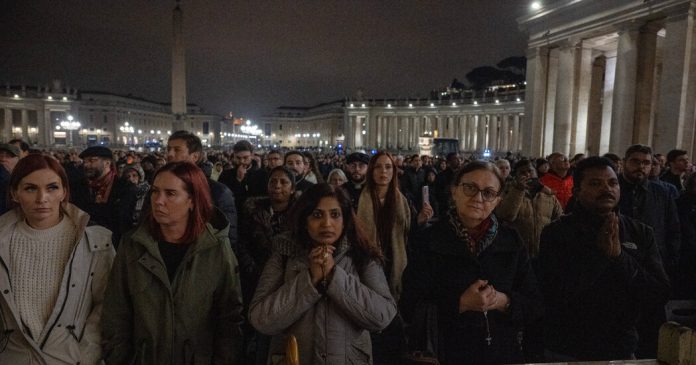
On a damp Monday evening, Cardinal Pietro Parolin, the Vatican’s second-in-command, who is a fixture in the increasing speculation about who might replace Francis, led cardinals, bishops and a few thousand faithful in front of St. Peter’s Basilica in a rosary prayer for the pope’s health.

Under an intermittent drizzle, the cardinal knelt before a portrait of the Madonna and child and addressed the crowd, made up largely of priests, nuns and pilgrims.

“For 2,000 years the Christian people have prayed for the pope when he was in danger or sick,” said Cardinal Parolin, adding that now the time had come to pray for Francis “in this moment of illness and trial.”

Francis is the 266th pope to lead the Roman Catholic Church, and for much of the church’s history, especially when the papacy acted as a monarchy directly and indirectly governing large swaths of land, the death of a pope could transform the fortunes of powerful aristocrats, change the direction of a powerful state, or even determine where the church had its headquarters.

“The upheaval that follows the death of the pope today is incomparably different from what might have happened” centuries ago, said Agostino Paravicini Bagliani, a church historian. He said that in some cases a pope’s death would be kept a secret, for fear that a papal entourage, or at times even the population of Rome, might ransack the Apostolic Palace. “A papal death provoked all sorts of problems.”

In the modern era, long after the pope lost his temporal powers, transitions have run more smoothly. Now a change at the top, while having great consequence for the priorities, vision and ideological complexion of the church, is unlikely to have much geopolitical impact. Still, the last days of a pope attract pilgrims, and news media, from all over the world to Rome, and they focus the faithful’s attention on their spiritual leader.

Cardinals said the rosary before the passing of Pope John XXIII in 1963. It was during a similar prayer session in St. Peter’s Square in 2005 that Cardinal Leonardo Sandri, then the under secretary of state for the Vatican, announced the death of Pope John Paul II after his final days of agony.

The once vigorous Polish pope had long suffered from Parkinson’s disease: He had lost his ability to speak clearly and often appeared hunched and ailing. His failing health had been a subject of morbid attention for years.

“It was so weird,” said Father Paul Alger, a 42-year-old priest from Augusta, Ga., who studied theology in Rome and recalled those years as a perennial papal death watch.

Francis, who initially speculated that he would have a short pontificate, has instead led the church for a dozen eventful and busy years. For the first years, he crisscrossed the globe, met with world leaders and played an active role in championing the issues he cared most about, especially on behalf of migrants and the marginalized.

But a bad knee and sciatica began to physically slow Francis down more recently. He began to depend on a cane and a walker and then a wheelchair.

Francis had colon surgery in 2021 and was operated on again two years later for a hernia that developed because of that surgery. Throughout, he kept up a demanding schedule, but his breathing became belabored, as he struggled with respiratory infections and now an explosion of pneumonia and infections that has put him in critical condition.

The faithful and clerics in attendance on Monday preferred to focus on Francis’ life rather than what seemed the end of it. Bishop Manuel Nin, the apostolic exarch to the Greek Byzantine Catholic Church, called it “unhealthy” to fixate on something that was ultimately “in God’s hands.”

But some clerics worried this latest downturn could be Francis’ last.

“They say he had a good night, he is resting, but at the same time it is clear his prognosis is not good,” said Bishop Earl Fernandes of Columbus, Ohio, who also attended the rosary in St. Peter’s Square. “It’s the beginning of the end.”

Bishop Fernandes, who said he follows “the news about the pope in multiple languages every day,” speculated that even if Francis were to get better, it would be harder for him to be around people, something Francis “always loved,” he said.

“That itself would kill him,” the bishop added.

A solemnity pervaded St. Peter’s Square, rain slicked the cobbled stones and the faithful chanted invocations to the Virgin Mary. A pair of swooping gulls cawed. In the surrounding palaces, private speculation about who might replace Francis began, ideological camps taking shape. But the event provided a public forum for the church’s leaders, of all political persuasions, to rally around the pope in his time of need.

Among the cardinals beside Cardinal Parolin on the steps of St. Peter’s Basilica on Monday evening were prelates who often appeared on short lists to replace Francis, including Cardinal Luis Antonio Tagle of the Philippines. But there were also cardinals with whom Francis has clashed for a decade, including the American Cardinal Raymond Burke, the de facto leader of the opposition to the pope’s agenda.

“When someone is dying, all that is said and done,” Father Alger said, comparing the church to a family that rallies around a dying father no matter the divisions at home. “He is the Holy Father and he is in trouble. Death has a way of making clear what matters.”

Fani Willis says she has no regrets over Trump Georgia case : NPR

0

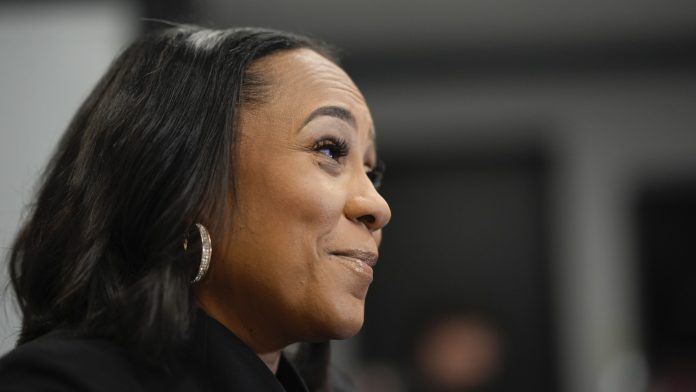
President Trump and Fulton County District Attorney Fani Willis began their second terms in office a few weeks apart. Willis is seen here on Oct. 22, 2024, in Atlanta.

Brynn Anderson/AP


hide caption

toggle caption

Brynn Anderson/AP

ATLANTA — A year ago, President Trump was fighting 13 felony counts in Georgia for trying to overturn the 2020 election, and the prosecutor who charged him was seen as a rising star.

Now Trump is president again, immune from prosecution for the next four years, and Fulton District Attorney Fani Willis has been rebuked by the courts and is fighting to keep the case alive.

Trump and Willis began their second terms in office a few weeks apart. To celebrate her inauguration, Willis hosted a gala and political fundraiser the night before Valentine’s Day with a black, pink and gold dress code. The theme: “For the Love of Justice.”

To celebrate her inauguration, Fulton DA Fani Willis hosted a gala and political fundraiser the night before Valentine's Day.

To celebrate her inauguration, Fulton DA Fani Willis hosted a gala and political fundraiser the night before Valentine’s Day.

Sam Gringlas/WABE


hide caption

toggle caption

Sam Gringlas/WABE

During her first term, Willis developed a reputation for prosecuting racketeering cases, indicting high-profile defendants like Trump and rapper Young Thug. But over time, both of those cases became mired in drama. At the gala, Willis expressed no regrets.

“In my first four years in office, I learned a really hard lesson,” Willis told supporters. “Folks are here for you during the good times, but the slightest bit of wind and folks quickly begin to fall to the wayside. See we are living in a time, not of a mild wind, but I submit to you, a tsunami.”

That wind began to pick up last January, when one of Trump’s co-defendants lodged a serious allegation: the DA was involved in a romantic relationship with Nathan Wade, the special prosecutor she hired for the case. Though a judge eviscerated Willis’ judgment, he found no evidence of an actual conflict of interest and allowed her to continue if Wade resigned.

But in December, the Georgia Court of Appeals ruled that Willis and her office should still be removed from the case. Willis appealed, and the Georgia Supreme Court has yet to decide if it will hear the case.

Trump praised the ruling. On stage at her gala, and with Wade seated at her table, Willis seemed to excoriate it.

“See, there are judges in my very state, s*** in my very courthouse, that are more interested in their next appointment than upholding the rule of law and following their oath,” Willis said.

Rather than speak at length about specific goals for her second term or accomplishments from her first, Willis devoted much of her remarks to grappling with how a man she indicted in 2023 was back in power. While she did not mention Trump by name, references like “convicted felon in the White House” were not lost on the crowd.

“There’s a lot of room for redemption here, but this case is much more on life support than it’s ever been before,” said Georgia State University law professor Anthony Michael Kreis.

Kreis says Trump had almost no chance of going to trial last year, no matter what Willis did, once the U.S. Supreme Court established broad presidential immunity. That decision complicated not only the Georgia prosecution, but Trump’s two federal criminal cases. The federal charges were dropped once Trump was elected president again.

“I think people wanted the criminal justice system to do something that perhaps the criminal justice system was just never built to do,” Kreis said. “Yes, we have a system of justice which is meant to protect democracy against election law crimes. But it’s just never been tested like this, a nationalized conspiracy to intervene and subvert a presidential election.”

Trump’s 14 remaining co-defendants in Georgia could still see trial in the next few years. But if Willis is disqualified from the case for good by the Georgia Supreme Court, Kreis says it is unlikely anyone will be appointed to take over the prosecution.

“If Fani Willis is removed and none of the co-defendants are ever brought to trial, I think this will be a real failure and a real mark of shame for the DA’s office, the criminal justice system in Georgia and for our constitutional principles more broadly,” he said.

Most Republicans, including the president, have praised the prosecution’s unraveling as a triumph of justice. A framed image of Trump’s Fulton County mug shot now hangs just outside the Oval Office. And GOP lawmakers in Congress and the Georgia Senate have continued their own investigations of Willis.

“It’s been a political circus for way too long,” state Sen. John Albers, a Fulton County Republican, said of the Georgia election interference case before a recent vote to renew the committee probing Willis. “The people who are stuck in the middle of this can’t move on with their lives and their very basic freedoms.”

But at the weekly farmer’s market on the grounds of the Carter Presidential Center in a progressive Atlanta neighborhood, Wendy Cooper said she feels empathy for the district attorney.

“As a Black woman living in America, this is to be expected,” Cooper said. “Powerful, smart, African American women are really the target of a lot of hatred.”

Cooper said she believes that even if Willis had pulled off a conviction, it probably would not have mattered. Trump had already been found guilty on separate criminal charges in New York.

“But did it have an impact on the election? No,” she said.

Stopping at the market, Atlanta residents Lorraine and Andy Ramey said they strongly disagree with the court decision to remove Willis. They believe her romantic relationship was an error in judgment that had nothing to do with the integrity of the charges.

But they also feel Willis bungled the best shot to hold Trump responsible for his actions after 2020, which included pressuring Georgia’s secretary of state to find him votes.

“That made it very personal,” Lorraine Ramey said. “I was hopeful, and then it slowly faded. She knew better.”

Andy Ramey said he’s fed up with the justice system, fed up with how Willis handled such an important case and fed up with a country that sent Trump back to the White House.

“The justice system has embarrassed itself, from Fulton County all the way to the Supreme Court,” he said.

Last fall, Lorraine Ramey begrudgingly voted to keep Willis in office — she voted for every Democrat on the ballot. But when Andy Ramey stepped into the voting booth, he said he made a decision he did not take lightly.

In the race for district attorney, he left his ballot blank.

Taiwan Detains a Chinese-Crewed Ship After Undersea Cable Severed

0

Taiwanese authorities said they had detained a cargo ship crewed by Chinese nationals, which investigators believe may have severed an undersea communications cable near the island on Tuesday. It was the latest in a series of murky incidents that have prompted theories that China and Russia may be turning to cable sabotage as a form of harassment at sea.

The cable that was damaged connected Taiwan to the Penghu Islands, which belong to Taiwan and lie about 30 miles west of the main island. Taiwan’s Coast Guard said that it was still investigating the latest incident and had not reached any conclusions about whether the severing was deliberate or accidental.

But Ou Yu-fei, a press officer for the coast guard, said initial clues pointed to the detained ship, a dilapidated cargo carrier that used more than one name, including “Hong Tai 58.” The ship had Chinese funding, the coast guard said in a statement.

“This was the only vessel in the area — that’s our judgment,” Mr. Ou said in a telephone interview, citing radar records of where the cable break occurred. “We’re not ruling out the possibility that it was engaged in an act of sabotage. We go by the evidence. It’s too early to reach conclusions.”

Mr. Ou added that the ship may have used a false registration number and appeared to have suddenly had its name changed, among other details.

The ship may have severed the cable — accidentally or deliberately — around the time that a Chinese coast guard ship warned it to leave the vicinity in the early hours of Tuesday, he said. “It is possible that it used the time when it was leaving to carry out sabotage,” he said.

The cable that was broken is one of several connecting the Penghu Islands, also called Pescadores, to the main island. Communications were quickly rerouted after the damage was detected, and there was no major outage, the authorities said.

Taiwan usually depends on undersea cables for its internet connections with outlying islands, such as the Penghu Islands, as well as for its connections to the rest of the world. Cables can be severed by natural factors like earthquakes or aging, but the most common cause is when ships drag anchors or fishing equipment that scrapes the sea floor.

Recent incidents off Taiwan and in the Baltic Sea have raised suspicions among some officials and experts that China and Russia may sometimes deploy commercial cargo ships or oil tankers to deliberately cut cables by dragging their anchors.

Two years ago, a cable between Taiwan and Matsu Island was severed. Earlier this year, a digital cable connecting Taiwan with South Korea, Japan, China and the United States was damaged, and Taiwanese authorities said that a Chinese ship may have dragged its anchor across the cable, either accidentally or deliberately. In November, two fiber-optic cables under the Baltic Sea were severed, and countries in that region have been investigating a Chinese-flagged commercial ship that may have been involved.

In January, two cables between Taiwan and Matsu suffered damage, but officials quickly said that the cause was natural deterioration of the cables.

Since those incidents, Taiwan’s government has stepped up monitoring of its subsea cables. The ship suspected of involvement in the latest severing had been watched by Taiwan’s Coast Guard since Saturday, partly because it seemed to be lingering in areas with undersea cables off Taiwan’s southern coast, said Mr. Ou, the press officer.

At about 2:30 a.m., a Taiwanese coast guard patrol ship that was in the cargo carrier’s vicinity — about seven miles out of a port — moved in closer and ordered it to leave, because it was too near an area with undersea cables and had its anchor down, Kuan Bi-ling, the minister of Taiwan’s Ocean Affairs Council said in an online statement.

Over half an hour later, the ship pulled up its anchor and began moving, Ms. Kuan said. But at 3:24 a.m., the coast guard received a report that the cable had been cut, and brought the ship into port, where it is being investigated. The coast guard said that it has also sent the case to prosecutors for additional inquiries.

Reconciliation is the key to unlocking Trump’s agenda. Here’s how it works : NPR

0

Republicans in Congress plan to use a tool of the budget process, known as reconciliation, to pass portions of President Trump’s agenda without the need for votes from Democrats in the Senate.

Zayrha Rodriguez for NPR


hide caption

toggle caption

Zayrha Rodriguez for NPR

The House Republican leadership plans to bring a budget resolution to the floor this week in what marks an early step in a lengthy process that Republicans hope to use to pass much of President Trump’s policy agenda without any input from Democrats.

Republicans in the House and Senate have their eyes on a special budget tool called reconciliation — a complicated process that enables them to avoid a filibuster in the Senate. The only catch is they have to agree on a budget and get that passed first.

So far, that has not been a simple task. Senate Republicans passed a competing budget resolution last week. The two chambers have been at odds over the best approach to advance legislation to increase funding to the southern border, boost military spending and extend the tax cuts passed in the first Trump administration, which are set to expire at the end of the year. And reconciliation works only if both chambers get on board with the same resolution.

What exactly is reconciliation?

Let’s start at the beginning. Bills need to pass both chambers of Congress to become laws.

In the House, a bill passes when at least 218 members (half of the 435 representatives plus one) support it. In the Senate, most bills need the support of at least 60 senators. Republicans have 53 seats today.

“It’s nice to have the Senate majority, and you get pretty titles and gavels, and you can nominally control the floor, but as Schoolhouse Rock! would tell us, unless you have 60 votes for most things, you can’t move forward,” said Liam Donovan, a political strategist.

One way to get around that 60-vote threshold and avoid the threat of a filibuster is budget reconciliation, a tool made possible because of the Congressional Budget Act of 1974.

Reconciliation allows the party in control to pass legislation with a 51-vote simple majority in the Senate. The aim is to make it easier for Congress to make adjustments to laws that either bring in revenue or change spending levels.

It was first used in 1980 for the 1981 fiscal year and is not used every year.

“It’s become the preferred tool over the past 25 years in this modern, partisan political era,” said Donovan.

For example, Republicans used reconciliation to pass tax cuts in 2017, and Democrats used it to pass elements of then-President Joe Biden’s agenda, like the COVID-19 relief package and the Inflation Reduction Act.

What is the process? 

Reconciliation is a two-stage process.

It starts with a budget resolution that gives instructions to congressional committees to write legislation that achieves certain budgetary outcomes. For example, a resolution might include instructions to the Committee on Armed Services to report changes in laws within its jurisdiction that result in increasing or reducing the deficit by a certain amount.

Once the budget resolution passes out of committee, all the committees that received instructions get to work.

The Budget Committee then incorporates all those bills into one big bill that’s considered by the House and the Senate.

If there are disputes between the chambers, they have to resolve them.

Why do I keep hearing about vote-a-ramas?

Vote-a-ramas can be dramatic and drawn-out affairs where senators take up a marathon of amendments ahead of a final budget vote.

They begin in the Senate when debate on the bill ends. Senators essentially keep offering amendments on the bill until they run out of amendments — or steam — and decide to stop.

It is a rare chance for the party in the minority to bring legislation to the floor and is an opportunity for senators to try to undo parts of the budget resolution through objections known as budget points of order.

There are two vote-a-ramas in the course of the reconciliation process: one on the budget resolution, which is less consequential, and the second on the final proposed legislation itself.

“The amendments that happen in the final legislative package are really important — you’re playing with live ammunition when you’re on that final stage of reconciliation,” said Donovan.

Why wouldn’t reconciliation be used all the time? 

There are limits to budget reconciliation. It’s used to make changes to the debt limit, changes to mandatory spending or adjustments in revenues. It cannot be used for discretionary spending.

There’s also what’s known as the Byrd rule, named after former Sen. Robert Byrd of West Virginia.

The rule allows anything determined not to have a direct budgetary consequence to be removed from the bill. The goal behind this is to prevent reconciliation from being used for measures unrelated to the finances of the federal government.

In other words, reconciliation is about money going out from the federal government and the money it takes in.

If a senator thinks a provision in the bill doesn’t pass muster with the Byrd rule, the senator can raise a “point of order.” The Senate parliamentarian advises the presiding officer on whether the provision violates the rule.

This could include anything that doesn’t result in changes to spending or revenues, doesn’t cause changes to Social Security or doesn’t raise the deficit beyond the point of the budget window, which is usually 10 years.

Ahmed al-Shara: The Evolution of Syria’s New Leader

0

As the commander of a rebel group allied with Al Qaeda during Syria’s long civil war, the man known by his nom du guerre, Abu Mohammed al-Jolani, welcomed foreign jihadists, dispatched suicide bombers to blow up military posts and vowed to create an Islamic state.

A decade ago, he told a journalist that Muslims should not enter Parliament to swear on a man-made constitution because they had to respect “the rule of God Almighty.”

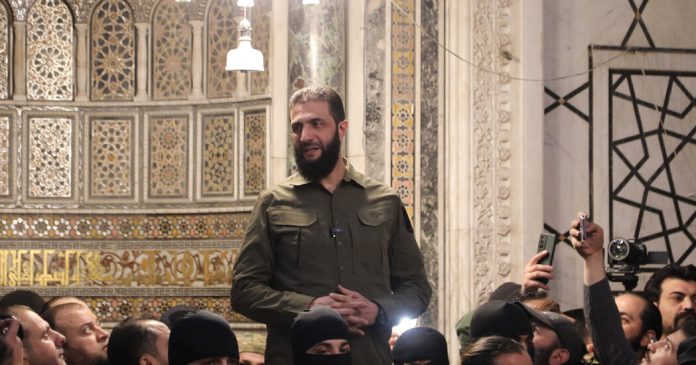
The same commander became Syria’s new president after a rebel alliance he led ousted the strongman Bashar al-Assad in December. He broke with Al Qaeda years ago and now goes by his real name, Ahmed al-Shara. He has swapped his military fatigues for suits and has embarked on a charm offensive to convince foreign leaders and his fellow Syrians that he can repair his shattered country and lead it toward democracy — or something like it.

“If democracy means that the people decide who will rule them and who represents them in the Parliament, then, yes, Syria is going in this direction,” he told The Economist in an interview published this month.

The sharp contrast between Mr. al-Shara’s jihadist past and his pragmatic, nationalistic present has left Syrians and foreign officials wondering what he actually believes and how he will govern a critical country in the heart of the Middle East.

On Tuesday, his interim government is holding a national dialogue with hundreds of attendees that organizers say seeks to build consensus around the nation’s political and economic future. But some key groups, like the U.S.-backed Kurdish militia that controls the country’s northeast, were not invited.

Many Syrians, exhausted after 13 years of civil war, saythat whatever he does will be better than the misery and destruction wrought by Mr. al-Assad. Syrian critics who distrust his Islamist approach charge that beyond his conciliatory rhetoric lies a sinister past that he has not clearly renounced.

Since he emerged as Syria’s new leader, senior Arab and Western officials have visited him in Damascus or hosted him in their capitals to press him on issues they care about, including combating Iranian influence, limiting Russia’s military presence, shutting down illegal drug exports, cracking down on violent jihadists and ensuring the rights of women and religious minorities.

Some of those officials have said privately that they are impressed with Mr. al-Shara’s inclusive messaging. But few have promised what he needs most: financial aid to bolster Syria’s economy and kick-start reconstruction, and the lifting of harsh sanctions imposed to punish Mr. al-Assad. On Monday, the European Union agreed to suspend restrictions on Syrian banks and energy and transport sectors, as well as to extend measures to facilitate humanitarian aid.

One factor hindering foreign engagement with his government is that the United States and other countries, along with the United Nations, still classify the rebel group he led, Hayat Tahrir al-Sham, or H.T.S., as a terrorist organization. Some countries still classify him as a terrorist, too.

Barbara A. Leaf, a senior State Department official for the Middle East during the Biden administration, was among the first U.S. officials to meet Mr. al-Shara in Damascus, the Syrian capital, in December. She said in an interview that he had clearly come prepared to hear what the United States had to say — and to respond.

“I found him to be a very methodical thinker with a strong degree of pragmatism,” Ms. Leaf said.

She said it was unclear how much his jihadist background still shaped his views as the leader of a newly liberated country desperately seeking international recognition and support.

“Either he is just a great actor or he has a kind of spongelike personality that takes on both experience and the context that is shaping the larger environment and adjusts his own thinking to it,” she said.

Mr. al-Shara faces tremendous challenges. The war killed more than 500,000 people, according to most estimates, forced millions more to flee abroad and decimated entire communities, leaving many refugees with no homes to return to.

His government is seeking to create a national army to absorb Syria’s many militias, but some are resistant to joining and control significant territory and resources like farmland and oil.

Many Syrians were widowed, orphaned, maimed or traumatized during the war, and war monitors have reported vengeance killings across the country. To salvage what he can of the state, Mr. al-Shara has called on civil servants to keep working, but salaries are meager, the economy is feeble, and electricity is limited in many homes.

Even before he was named president last month during a closed-door meeting with allied rebel leaders, Mr. al-Shara was working at home and abroad to rebrand both Syria and himself.

He has toured Syrian provinces and met with representatives from the Christian, Alawite and Druse minorities. While Islamist in outlook, his government has not banned alcohol or imposed dress codes on women.

On foreign trips, he has catered his message and attire to his hosts. To meet Crown Prince Mohammed bin Salman in Saudi Arabia, he wore a green tie; to meet President Recep Tayyip Erdogan in Turkey, he wore a red one — the colors of their flags.

Many conservative Muslim men keep their wives out of public view, but Mr. al-Shara’s spouse, Latifa al-Droubi, appeared with him for the first time during a pilgrimage in Saudi Arabia. On a subsequent trip to Turkey, Ms. al-Droubi met with Mr. Erdogan’s wife, Emine.

He has spoken cautiously of Israel, which has occupied territory in southern Syria, calling on it to adhere to a decades-old truce along the countries’ shared frontier, and of Russia, even though its military backed Mr. al-Assad and heavily bombed rebel communities. He has lashed out at Iran, which also backed the former regime, but has said that Syria will pose no threat to its neighbors.

His contact with the Trump administration appears to have been limited. But in a recent interview for the podcast “The Rest Is Politics — Leading,” he praised President Trump for his interest in “peace building” and his “positive approach to both the Middle East and future U.S. policy in the region.”

Mr. al-Shara’s critics accuse him of telling whoever he is meeting what they want to hear while eliding his extremist background and some of his associates’ violent records.

One of the rebels who appointed him president, Ahmad al-Hayes, was a commander accused by the United States of overseeing the torture and killing of detainees, the trafficking of women and children, and ransom and extortion schemes.

Another supporter, Mohammad al-Jasim, stands accused by the United States of commanding forces who displaced residents to seize their property and kidnapped people for ransom, “likely generating tens of millions of dollars a year.”

In 2017, Mr. al-Shara’s rebel group set up a “Salvation Government” to administer territory it controlled in northwestern Syria. After Mr. al-Assad’s fall, Mr. al-Shara brought that administration to Damascus to serve as the country’s interim government until March 1, when a new government is supposed to take over. Elections cannot be held for three or four years, he has said, because Syria is in such disarray.

The current government is made up of Mr. al-Shara’s loyalists. Some members have been with him since his jihadist days, and the health minister is his brother.

Many Syrians have been horrified by videos shared on social media of the justice minister, Shadi al-Waisi, presiding over the street executions in 2015 of two women for prostitution and “spreading corruption on earth.”

The media relations office of the new government did not respond to request for comment.

Extremists still influenced the government only a few months before it moved to Damascus.

Last August, hundreds of athletes gathered to kick off a local version of the Paralympic Games in northwestern Syria, and the organizers lit a giant torch. Ultraconservative clerics accused the participants of worshiping fire, a sin in Islam, and the local government suspended the games, citing “transgressions” that “violate our culture, customs and traditions.”

Fuad Sayed Issa, the founder of Violet, the group that organized the games, said in an interview that officials in the government had apologized for the cancellation but that they were afraid of what the extremists would do if they went forward.

Mr. Issa was optimistic now that the government was in Damascus and Mr. al-Shara was expressing more openness.

“We now feel that things are going better,” he said. “The leader has an open mind-set and they are taking Syria to a better place.”

Mr. al-Shara’s allegiances changed repeatedly during the war. He came to Syria from Iraq with the support of the Islamic State, but later broke with the group. He pledged allegiance to Al Qaeda before announcing a break with it, too, in 2016.

His original group, the Nusra Front, battled and allied with other rebels over the years and rebranded itself twice, becoming H.T.S. in 2017. In the years since, Mr. al-Shara has focused on governing the country’s northwest and has cracked down on extremists believed to be plotting attacks outside Syria.

Orwa Ajjoub, a doctoral candidate at Malmo University in Sweden who studies H.T.S., said Mr. al-Shara’s history suggested he was guided less by rigid convictions than by a quest for power.

“He has changed a lot, and he is genuine in this change,” Mr. Ajjoub said. “On one hand, there is a pragmatism that is encouraging and it gives you some hope. But on the other, the lengths to which he is willing to go to stay in power are scary.”

5 signs that a U.S.-Europe split is widening : NPR

0

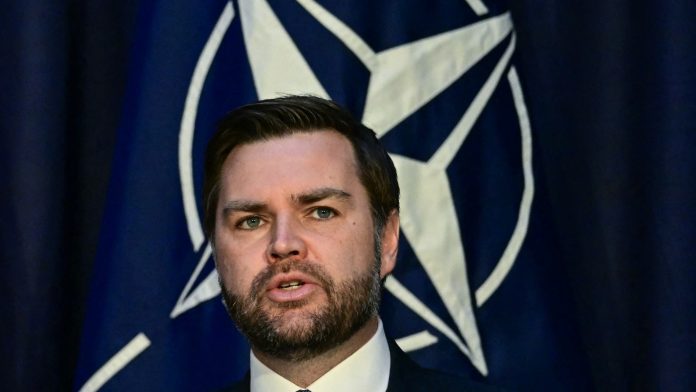
Vice President JD Vance talks in front of the NATO logo at the Munich Security Conference in Munich, Germany, on Feb. 14.

Tobias Schwarz/AFP via Getty Images


hide caption

toggle caption

Tobias Schwarz/AFP via Getty Images

Following the Russian invasion of Ukraine three years ago, there was plenty of talk about the revitalization of the NATO alliance in response to Kremlin aggression.

The alliance had grown languid in the decades since the Cold War. Its reputation suffered further under President Trump, who, during his first term, was openly dismissive of NATO, praised Russian President Vladimir Putin and threatened to withdraw U.S. protection under NATO’s mutual defense clause unless European allies increased their defense spending.

However, after Russia’s assault on Ukraine, U.S. military aid began to flow to Kyiv under the Biden administration, and many of these concerns seemed to fade. Sweden and Finland, who had long stayed out of NATO, reversed course and became members in the last two years. Last year, then-Secretary of State Antony Blinken declared NATO “stronger, larger than it’s ever been.”

But since Trump’s election in November, the situation has taken a sharp turn. The Trump administration has resumed criticizing NATO and offering praise for Putin, while positioning the U.S. at the center of peace talks aimed at ending the war in Ukraine — negotiations that many fear will either collapse or ultimately harm Kyiv’s position.

“When Biden won in 2020, I felt a huge sigh of relief in London and across European capitals,” says Michael Cox, a professor emeritus of international relations at the London School of Economics. But with Trump’s reelection, “Europeans are far more worried this time around than they were previously.”

Here are five developments in the last few weeks that highlight the growing distrust between the U.S. and Europe:

Vice President Vance scolds EU leaders

Trump’s return to office has left European leaders on edge about the future of NATO and the ongoing Russia-Ukraine war.

The transatlantic rift was on display in a Feb. 14 speech by Vice President Vance at the Munich Security Conference, where he harshly criticized European leaders, accusing them of attempting to stifle right-wing political views.

“To many of us on the other side of the Atlantic, it looks more and more like old, entrenched interests hiding behind ugly Soviet-era words like ‘misinformation’ and ‘disinformation,’ who simply don’t like the idea that somebody with an alternative viewpoint might express a different opinion, or — God forbid — vote a different way. Or even worse, win an election,” Vance said.

In a highly controversial move, Vance also met with Alice Weidel, co-leader of the far-right Alternative for Germany (AfD), a party notorious for its Nazi-era rhetoric and downplaying Germany’s responsibility for the Holocaust.

Other political parties in Germany have refused to work with the AfD. But after elections held on Sunday, the AfD has now become the second-largest party, a significant political shift.

In response to Vance’s speech, German Defense Minister Boris Pistorius shot back.

“This democracy was called into question by the U.S. vice president earlier, not just in Germany but in Europe as a whole. If I understood him correctly, he compares conditions in parts of Europe to those under authoritarian regimes,” he said. “That is not acceptable.”

Zelenskyy calls for “an armed forces of Europe”

Ukrainian President Volodymyr Zelenskyy arrives at the Munich Security Conference on Feb. 15 in Munich, Germany. He called for an armed forces of Europe to be created.

Ukrainian President Volodymyr Zelenskyy arrives at the Munich Security Conference on Feb. 15 in Munich, Germany. He called for an armed forces of Europe to be created.

Sean Gallup/Getty Images


hide caption

toggle caption

Sean Gallup/Getty Images

In response to Vance’s speech, Ukrainian President Volodymyr Zelenskyy called for the creation of an “armed forces of Europe,” saying that without Ukraine’s army, European forces alone would not be sufficient to counter Russian aggression.

The urgency has grown for European leaders as concerns rise that Trump might bypass both Ukraine and Europe to strike a peace deal with Putin.

A recent report by the European think tank Bruegel says that Europe would need around 300,000 additional troops, costing some $262 billion, to fully replace the U.S. in defense matters. The think tank concluded that “the numbers are small enough for Europe to replace the U.S. fully.”

U.S. holds separate talks with Russia over Ukraine

Top U.S. and Russian diplomats, including Secretary of State Marco Rubio and Russian Foreign Minister Sergey Lavrov, met in Saudi Arabia on Feb. 18.

Top U.S. and Russian diplomats, including Secretary of State Marco Rubio and Russian Foreign Minister Sergey Lavrov, met in Saudi Arabia on Feb. 18.

Evelyn Hockstein/Pool/AFP via Getty Images


hide caption

toggle caption

Evelyn Hockstein/Pool/AFP via Getty Images

Secretary of State Marco Rubio recently held talks with Russian Foreign Minister Sergey Lavrov in Saudi Arabia without Ukrainian representatives present. The discussions appeared to set the stage for peace negotiations, raising alarms in Europe that the U.S. might push for a deal that sidelines Ukraine.

Much of Ukraine’s defense against Russia has depended on U.S. support. The U.S. has appropriated just under $175 billion since 2022 in response to Russia’s war in Ukraine.

Trump himself has made clear his stance on Ukraine, stating in a Fox News Radio interview that he didn’t believe Zelenskyy was important to the peace process, dismissing the Ukrainian leader as holding “no cards,” adding, “you get sick of it.”

Many European leaders worry that Trump’s desire to end the war quickly might lead to Ukraine accepting a temporary ceasefire that could allow Russia to rebuild its forces.

Following a European Union meeting of foreign ministers in Paris earlier this month, seven European countries said in a statement that “Ukraine and Europe must be part of any negotiations.”

German leader questions U.S. commitment to Europe’s defense

Friedrich Merz, who is poised to be Germany's next chancellor, said Europe needs to prepare to defend itself.

Friedrich Merz, who is poised to be Germany’s next chancellor, said Europe needs to prepare to defend itself.

Maja Hitij/Getty Images


hide caption

toggle caption

Maja Hitij/Getty Images

Friedrich Merz, who is poised to become Germany’s new chancellor after elections on Sunday, has expressed serious doubts about the U.S. commitment to NATO. He fears that Trump may abandon NATO’s mutual defense pledge, leaving Europe vulnerable.

“We must prepare for the possibility that Donald Trump will no longer uphold NATO’s mutual defense commitment unconditionally,” Merz told a German broadcaster on Friday. “That is why, in my view, it is crucial that Europeans make the greatest possible efforts to ensure that we are at least capable of defending the European continent on our own.”

Since NATO’s inception in 1949, the U.S. has been the de facto guarantor of European security against threats from first the Soviet Union and the Warsaw Pact, and now Russia. NATO members had pledged to spend 2% of their GDP on defense by a deadline of last year. And while some have reached or exceeded that goal in recent years, others have fallen short. Now the Trump administration has asked for spending of 5% of GDP. (In 2023, the U.S. spent equivalent to 3.4% of its GDP on the military.)

Cox of the London School of Economics thinks the 5% goal the U.S. would like is “impossible,” but notes that Europeans “are genuinely feeling that they need to do more … not just to placate Trump, but also to make a greater contribution to their own security.” He also acknowledges that Europe will continue to rely on the U.S. for logistics, intelligence and subsidies.

At the U.N., the U.S. refuses to condemn Russia for Ukraine invasion

At the United Nations General Assembly on Monday, the U.S. voted against condemning Russia’s invasion of Ukraine. The U.S. chargé d’affaires ad interim, Dorothy Shea, said the resolution only perpetuated “a war of words rather than an end to the war.”

The vote places the U.S. in unusual company, as it sided with North Korea, Iran and 15 other countries against a Europe-backed Ukrainian resolution. China, along with 64 other countries, abstained.

The resolution passed, 93-18.