Friday, November 13, 2026
Home Blog Page 188

Elon Musk Congratulates AfD Leader on Germany’s Election Results

0

The hard-right Alternative for Germany might not have done as well in Sunday’s election as its leaders had hoped, but its groundbreaking performance was enough for a congratulatory phone call from Elon Musk.

Alice Weidel, the chancellor candidate for the party, known by its German initials, AfD, told journalists on Monday morning that she had slept through a call from Mr. Musk, the world’s richest man and a top adviser to President Trump. When she looked at her phone on the morning after her party won 20.8 percent of the vote, she said, she had a missed call from the United States, which turned out to be from Mr. Musk, who, she said, “congratulated me personally.”

Several hours later, Mr. Musk did it again publicly, when he reposted on X a congratulatory note from Hungarian authoritarian leader Victor Orban with an added note that read: “Indeed, congratulations @Alice_Weidel! At this rate of growth, @AfD will be the majority party by the next election.”

The AfD came in second place in Germany’s national election with more than 20 percent of the vote, nearly double its share in 2021 and a record for any far-right party since the end of World War II. But Friedrich Merz, leader of the first-place Christian Democrats and the presumptive future chancellor, has ruled out forming a coalition with the AfD, so Ms. Weidel and her party will continue to be sidelined.

Parts of the AfD, which campaigns on curbing irregular immigration, increasing deportations and improving the economy, have been classified as extremist by German domestic intelligence. But Vice President JD Vance met with Ms. Weidel earlier this month in Munich, after he shocked European leaders by telling them that mainstream parties should not exclude far-right factions like the AfD.

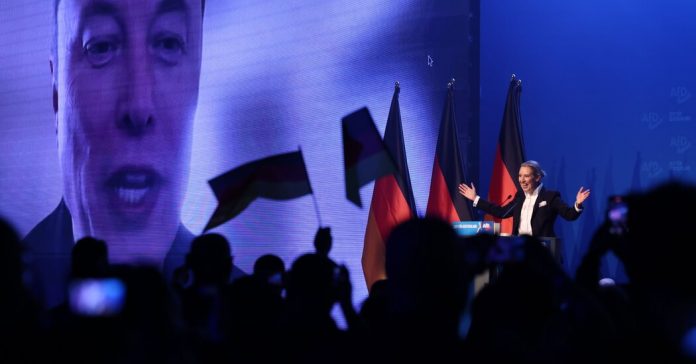
Mr. Musk made a splash in December when he publicly endorsed the AfD, first on X, his social media platform, and later in a 75-minute video conversation with Ms. Weidel that he hosted on X. In January, he tried once again to promote the party by calling into a raucous party meeting in Halle, where he encouraged the crowd to try to convince their neighbors, friends and family to vote for the AfD.

It was a very unusual public intervention by a foreign national and White House adviser in a German election, made all the more striking when Mr. Musk told AfD supporters that there was “too much of a focus on past guilt” in Germany.

But Mr. Musk’s push did not seem to have a significant effect on the party’s already high polling numbers. Tino Chrupalla, who is a co-leader of the party with Ms. Weidel, acknowledged before the election that Mr. Musk might not be a pull for potential AfD voters, but said that his endorsement had led to interest and donations from other business leaders.

Dan Bongino tapped as FBI deputy director. Who is he? : NPR

0

Dan Bongino, pictured in 2021, has been chosen for the role as FBI deputy director in the second Trump administration.

Calla Kessler/for The Washington Post via Getty Images


hide caption

toggle caption

Calla Kessler/for The Washington Post via Getty Images

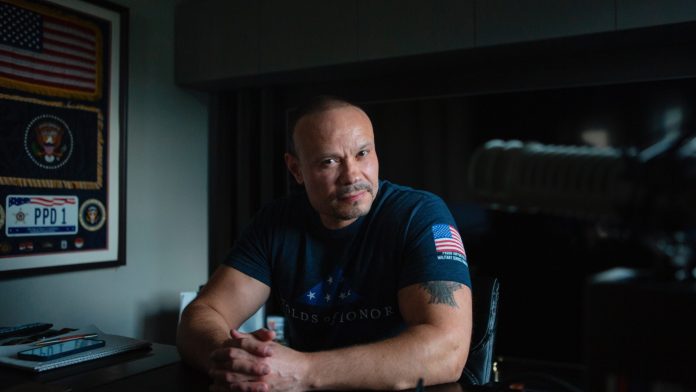
The Trump administration’s pick for FBI deputy director is Dan Bongino, a former U.S. Secret Service agent-turned-conservative commentator whose fiery support of President Trump has earned him a massive following — and seen him banned from YouTube for promoting misinformation.

Bongino, 50, hosts The Dan Bongino Show, a syndicated radio show and daily podcast that was ranked the 7th most-popular podcast in the U.S. in January, according to industry analyst PodTrac.

Trump said in his announcement that Bongino is “willing and prepared” to give up his show in order to serve.

“Great news for Law Enforcement and American Justice!” Trump wrote on Sunday night. “Dan Bongino, a man of incredible love and passion for our Country, has just been named the next DEPUTY DIRECTOR OF THE FBI, by the man who will be the best ever Director, Kash Patel.”

The role of deputy director, which supervises domestic and international operations, has traditionally gone to a career FBI agent. Bongino has never worked for the FBI, though he served in the New York police department.

Bongino defended Patel in an episode of his podcast that aired last week, titled “The Golden Age of Republican Politics.” Bongino said he had known Patel for a long time and “I can tell you with certainty that Kash Patel is there for one reason: He’s there to make the FBI great again.”

“Folks, if we do not have a credible deterrent to spies in this country, counterintelligence, to terrorists that are planning plots here openly, some coordination entity for both transnational and interstate crime, we’re not going to have a country,” he added. “Kash is committed to that and that only.”

Patel — a fierce critic of the FBI with no experience as a senior law enforcement official — was narrowly confirmed by the Senate and sworn in as FBI director last week, overcoming Democrats’ concerns about his loyalty to Trump and fitness to lead an agency that is supposed to be nonpartisan and independent from the White House.

Republicans welcomed his confirmation, arguing he could make changes to the bureau, which some on the right have accused of targeting conservatives in recent years. Patel, seeking to assuage doubts at his January hearing, said if confirmed he would “remain focused on the FBI’s core mission.”

NPR has reached out to Bongino for more information about his views on the traditional independence of the FBI and to ask whether Patel was involved in his selection.

With no Senate confirmation required, Bongino will soon be Patel’s right-hand man. Here’s what else to know about him.

He’s a veteran of the NYPD and Secret Service

Bongino holds an MBA from Penn State University, and master’s and bachelor’s degrees from the City University of New York.

An archived campaign website for Bongino’s 2012 Maryland Senate bid says he began his career with the New York Police Department in 1995, entering the Cadet program while attending CUNY and becoming a full-time officer two years later.

Bongino joined the U.S. Secret Service in 1999, first investigating federal crimes in the New York Field Office and eventually becoming an instructor at the Secret Service Training Academy in Maryland, according to the archived website.

He joined the Presidential Protection Division in 2006 and served on the details for presidents George W. Bush and Barack Obama.

New Yorker writer Evan Osnos, who profiled Bongino in 2022, told NPR’s Fresh Air that year that Bongino was known as a competent, well-liked agent who “never talked about politics.”

Osnos said that shortly after resigning from the Secret Service in 2011, when asked about working with Obama, Bongino praised him as a good man and father. In the years that followed, however, he repeatedly criticized the former president and his administration as “corrupt” and “divisive.”

“There’s been this rapid transformation of him over the course of the years since then, and I think it’s caught some of the people he worked with at the Secret Service very much by surprise,” Osnos said. “Somebody said in this article that it’s like there’s two Dan Bonginos: There’s the agent, and now there’s the politico.”

Bongino had political ambitions of his own, as it turned out.

He ran for a U.S. Senate seat in Maryland in 2012, winning the Republican primary but losing in the general election. He also ran unsuccessfully for congressional seats in 2014 and 2016 in Maryland and Florida, after relocating there with his family.

He created his own media empire

Dan Bongino pictured at Fox News Channel Studios.

Dan Bongino pictured at Fox News Channel Studios in June 2019. The former Fox host has one of the most popular podcasts in the U.S.

Roy Rochlin/Getty Images


hide caption

toggle caption

Roy Rochlin/Getty Images

After his foiled congressional bids, Bongino turned his focus toward the media and started a podcast in his basement. Originally called The Renegade Republican, it touted “downloads in the millions” by September 2016.

“To put it in clear terms, five or six years ago, he was starting a podcast in his basement, and he was putting moving blankets on the wall as a kind of homespun studio,” Osnos said in 2022. “And then he had this extraordinarily precipitous rise through the conservative broadcasting ranks, to the point that today, he has a podcast, which at some points has been the No. 1 in the world.”

Osnos attributed Bongino’s rapid rise to several factors, including his law enforcement background — which he says gave him a credibility that endeared him to other major conservative broadcasters — as well as his sensationalistic style and early support of Trump.

“When Trump was in the presidency, Bongino would go on in the morning on Fox and would praise the president for either things he had done or not done, and then Trump would see that and then tweet about Bongino and would often talk about him in the White House, according to sources,” Osnos said in the 2022 interview.

Bongino’s profile continued to rise throughout Trump’s first term, as his podcast grew increasingly successful. He hosted a show on the National Rifle Association’s web TV Channel, NRATV, for less than a year in 2018.

“My entire life right now is about owning the libs,” he said in one segment, helping popularize the Republican catchphrase.

In 2019, he launched Bongino Report, a pro-Trump news aggregation site in the style of the Drudge Report. That same year, Bongino officially joined Fox News as a contributor.

After the death of conservative talk show host Rush Limbaugh in 2021, podcast network Cumulus Media tapped Bongino to take over his slot. He also started hosting the Fox show Unfiltered on Saturday nights, a gig he held until parting ways with the network in 2023 over what he described as failed contract negotiations.

Bongino has also published about half a dozen books, some about his time in the Secret Service and others about the first Trump administration, with titles including Exonerated: The Failed Takedown of President Donald Trump by the Swamp and Follow the Money: The Shocking Deep State Connections of the Anti-Trump Cabal.

He’s been criticized for spreading misinformation

Misinformation experts say Bongino has used his platform to spread conspiracy theories and falsehoods, including about the Mueller investigation, the COVID-19 pandemic and Trump’s 2020 election loss.

The Institute for Strategic Dialogue cited Bongino as one of the key right-wing figures pushing false claims of voter fraud leading up to the 2020 election. He continued to amplify Trump’s lies about the election being stolen, leading the human rights group Avaaz to name him one of the top five “superspreaders of election misinformation” in the weeks that followed.

NPR reported in 2021 that Ashli Babbitt, the Trump supporter who was fatally shot by police while storming the U.S. Capitol on Jan. 6, had retweeted Bongino 50 times since the previous February.

Bongino also found himself in hot water over his stance on COVID-19 precautions. In late 2021, he threatened to quit his radio show over Cumulus Media’s vaccine mandate — despite having been vaccinated himself.

Bongino announced on his radio show in October 2020 that he had been diagnosed with Hodgkin’s lymphoma. He told Megyn Kelly in 2024 that he had been in remission for two years.

Bongino was permanently banned from YouTube in 2022 after violating its pandemic misinformation policy by posting a video questioning the effectiveness of masks. Following that decision, Google stopped serving ads on Bongino’s website.

Bongino has repeatedly criticized the agency he has now been tapped to help oversee, including calling it the FBI “lost, broken” and “irredeemably corrupt” in a lengthy 2022 monologue on his Fox show in which he cited the FBI’s search of Trump’s Florida residence — a court-authorized search related to an investigation into his handling of classified documents — as the final straw.

“I mean it when I say it: It’s way past time to clean this FBI house up,” he said. “They have burned every last shred of faith and trust freedom-loving Americans had in it.”

How TikTok Helped Germany’s Left to a Surprise Election Showing

0

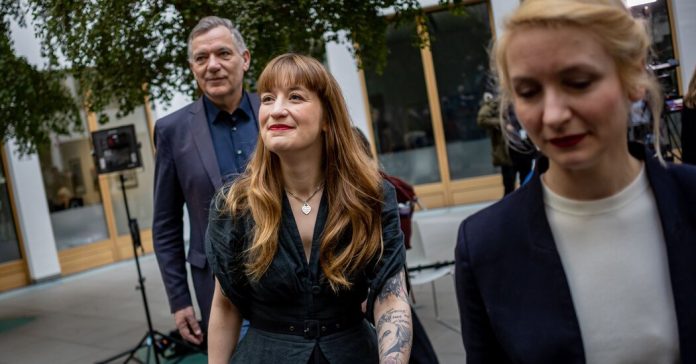
Her fans call her Heidi. She is 36 years old. She talks a mile a minute. She has a tattoo of the Polish-German revolutionary Rosa Luxemburg on her left arm and a million followers across TikTok and Instagram. She was relatively unknown in German politics until January, but as of Sunday, she’s a political force.

Heidi Reichinnek is the woman who led the surprise story of Germany’s parliamentary elections on Sunday: an almost overnight resurgence of Die Linke, which translates as “The Left.”

A month ago, Die Linke looked likely to miss the 5 percent voting cutoff needed for parties to earn seats in Germany’s Parliament, the Bundestag. On Sunday, it won nearly 9 percent of the vote and 64 seats in the Bundestag. “It was one of only five parties to win multiple seats in the new Parliament, joining the Christian Democrats, the Social Democrats, the hard-right Alternative for Germany and the Green Party.

It was a remarkable comeback, powered by young voters, high prices, a backlash against conservative politicians, and a social-media-forward message that mixed celebration and defiance.

At a time when German politicians are moving to the right on issues like immigration, and when the Alternative for Germany, or AfD, doubled its vote share from four years ago, Ms. Reichinnek, the party’s co-leader in the Bundestag, and Die Linke succeeded by channeling outrage from liberal, young voters.

They pitched themselves as an aggressive check on a more conservative government, which will almost certainly be led by Friedrich Merz, a businessman who has led the Christian Democrats to take a harsher line on border security and migrants.

Mr. Merz’s ascent, and his decisions in the middle of a campaign that his party led from the start, appear to have helped Ms. Reichinnek. In January, after a deadly knife attack by an immigrant in Bavaria, Mr. Merz pushed the Parliament to vote on a set of migration restrictions that could only pass with votes from the AfD — breaking decades of prohibition in German politics against partnering with parties deemed extreme.

Many analysts trace Die Linke’s surge to Ms. Reichinnek’s furious — for the German Parliament, anyway — speech denouncing Mr. Merz and his measures.

“You just said that no one from your party is reaching out to the AfD!” she shouted, in a speech that has since racked up nearly seven million views on TikTok. “That’s right! They’ve been happily embracing each other for a long time already!”

In the month that followed, she called the AfD a fascist party and demanded that the Christian Democrats fire Mr. Merz. She proposed strengthening immigrants’ rights, increasing pensions and imposing stricter rent controls to help people struggling with postpandemic price increases across Germany.

She also called Die Linke the country’s last great firewall against the far right.

Die Linke coupled those calls with an aggressive social media outreach and party-like atmospheres at its rallies. It added more than 30,000 new members in the last month of the campaign, said Götz Lange, the party’s press officer.

In the campaign’s final week, Ms. Reichinnek traveled to the Berlin suburb of Treptow-Köpenick to talk to Ole Liebl, a queer influencer, about “techno and TikTok.” Afterward there was a party, with a DJ set, including a techno mix with the voice of a famed left leader in Germany, Gregor Gysi.

The venue, an old brewery, was bursting at the seams: Instead of the allowed 400 guests, around 1.200 people showed up. Most of them were techno lovers in black hoodies, people with multicolored hair and T-shirts with “antifa” slogans written on them. They mostly appeared to be in their early 20s.

There wasn’t enough space inside for everyone, so around 800 guests followed the event outside and downstairs, on a livestream. Wearing a rust red-colored sweater and jeans, Mr. Reichinnek appeared after a 30-minute delay, smiling and waving to the crowd.

“Thank you for being here,” she said. “It’s crazy, I don’t even want to know what it looks like down there. If you need help, try banging on the ceiling really loudly, we’ll know.”

The crowd roared.

On Election Day, Die Linke surprised analysts and appeared to snatch votes from the Greens and the Social Democrats, the party of the incumbent chancellor, Olaf Scholz, and got new voters to turn out. In Berlin’s central Mitte neighborhood, it won areas previously dominated by the Greens.

Founded in 2007 and descended from the former ruling party of East Germany, Die Linke had recently been better known for its failures than any success.

Its most well-known leader, Sahra Wagenknecht, quit the party to start her own — which blended some traditional left economic positions with a hard line on migration and an affinity for Russia.

That may have been a blessing, said Sven Leunig, a political scientist at the University of Jena, a public research university in Germany. Ms. Wagenknecht’s positions had split the party. “They were torn,” Mr. Leunig said, and voters did not like it.

The departure also allowed Die Linke to enlist new candidates and leaders. Other mainstream parties continued to push familiar faces and may have paid the price.

Daria Batalov, a 23-year-old nursing student from the central town of Hanau, said she was won over by Ms. Reichinnek’s TikTok videos. “They really spoke to me,” she said, adding, “And it was clear to me after a few videos that, OK, my vote is going to Die Linke.”

Analysts said Ms. Reichinnek and her party also benefited from a backlash to Mr. Merz’s migration measures, and from fears about the rise of the far right. “She had good luck,” said Uwe Jun, a political scientist at the University of Trier.

Her supporters called it something else: the rebirth of a movement. At Die Linke’s election-viewing party in Berlin, the crowd erupted into cheers when early exit polls flashed across the screen. Jan van Aken, a party leader, was greeted onstage with confetti.

“The Left lives,” he said.

Adam Sella contributed from Berlin and Sam Gurwitt from Hanau.

A new document undercuts Trump admin’s denials about Tesla deal : NPR

0

A Tesla Cybertruck at a Tesla dealership on Dec. 20, 2024 in Corte Madera, Calif. A State Department procurement document suggested the Trump administration planned to buy $400 million worth of Tesla vehicles to transport diplomats. The administration now says no such purchase is planned.

Justin Sullivan/Getty Images


hide caption

toggle caption

Justin Sullivan/Getty Images

The controversy started in a very Washington way: as a line item in a government spreadsheet buried on the State Department’s website.

It appeared as if the State Department was taking steps to award Elon Musk’s Tesla a $400 million government contract to buy armored electric vehicles to securely transport diplomats. The move to set in motion a lucrative contract to a company controlled by a high-profile ally of President Trump’s seemed so bold it surprised even longtime observers of the norm-busting president.

When asked about it, the State Department issued a statement saying the plans are now on hold with no plans of fulfilling the contract, pointing out that talks with Tesla began during the Biden administration.

But NPR has obtained a State Department document detailing that Biden’s State Department planned to spend just $483,000 in the 2025 fiscal year on buying electric vehicles and $3 million for supporting equipment, like charging stations. It represented less than 1% of the hundreds of millions of dollars likely destined for Tesla vehicles after the Trump administration quietly revised a State Department procurement document.

The vast discrepancy in the numbers raises the question: Was it an error, or a deliberate action?

A former Biden White House official familiar with the State Department’s plans told NPR the steps taken to advance $400 million worth of government business to Tesla appear to be intentional.

“I don’t think this is a clerical error. It was likely someone who is new in [the] State [Department] who decided, ‘OK, we’re gonna do this with Tesla,'” said the former official, who was not authorized to speak about the matter.

The person said the State Department and Tesla had agreed during the Biden administration to conduct research about armoring electric vehicles, but no money had been set aside to purchase armored Teslas for the State Department. A total budget of $483,000 had been approved to begin prototyping light-duty EVs as possible State Department vehicles. That plan was moving forward as recently as November 2024.

The White House and Musk did not return multiple requests for comment.

In a statement to NPR on Monday, a State Department spokesperson said the $400 million figure was “an estimate,” pointing out that it was in the early stages and was not yet a full contract, but rather a proposal “strictly to gather information.”

The department spokesman added: “the Department of State has no intention to move forward with the solicitation.”

In a Feb. 13 post on his social media platform, X, Musk, who is also a top White House official, said: “I’m pretty sure Tesla isn’t getting $400M. No one mentioned it to me, at least.”

After the original procurement document attracted widespread attention, NPR reported that the Trump administration appeared to have quietly edited the document, changing the phrase “armored Tesla” to the more generic “armored electric vehicles” without explanation. Eventually, the item vanished from the State Department’s procurement document.

Screenshots from three different versions of a State Department procurement document that was posted online showing how the plans to procure armored Teslas morphed over time. The State Department says the plans to purchase $400 million of armored Teslas originated with the Biden administration but NPR's reporting only shows the Biden administration planned to spend less than $500,000 to explore whether electric vehicles could be armored for diplomatic use.

Screenshots from three different versions of a State Department procurement document that was posted online showing how the plans to procure armored Teslas morphed over time. The State Department says the plans to purchase $400 million of armored Teslas originated with the Biden administration but NPR’s reporting only shows the Biden administration planned to spend less than $500,000 to explore whether electric vehicles could be armored for diplomatic use.

Department of State


hide caption

toggle caption

Department of State

The document claims it was originally published in December, at the end of former President Joe Biden’s term, but it does not appear in the Internet Archive for that month.

The $400 million item in the procurement document caused a stir. Since then, Trump officials have not answered why the State Department appeared to be taking steps to pursue an acquisition of electric vehicles from Tesla, with the company’s stainless steel Cybertruck likely being the most suitable option for an armored vehicle. The proposed purchase amount would likely exceed what the entire federal government would spend on electric vehicles in 2025.

The prospect of such a purchase also puzzled security professionals who work with the State Department.

“I can’t imagine why the government would ever put dignitaries in a Cybertruck,” said Jim McGuffey, an armored car expert who does work with the State Department. “Compared to the other armored car companies out there, it just wouldn’t make any sense.”

State Department abandons Tesla plan after publicity

The potential purchase of armored Teslas emerged as Tesla CEO Musk has become one of the most influential officials in the White House, leading a cost-cutting initiative that has swept across the federal government.

President Trump and Tesla and SpaceX CEO Elon Musk in the Oval Office at the White House on Feb. 11, 2025.

President Trump and Tesla and SpaceX CEO Elon Musk in the Oval Office at the White House on Feb. 11, 2025.

Andrew Harnik/Getty Images


hide caption

toggle caption

Andrew Harnik/Getty Images

Musk’s team has orchestrated the firings of tens of thousands of career government workers, and tried to dismantle entire agencies. Ethics experts have grown concerned about how Musk could use his influence to benefit one of his six companies. Trump has vowed to remove Musk from any government matters that could affect one of his firms, even though Musk is already shaking up agencies, including the Consumer Financial Protection Bureau, that could have presented a regulatory headache for the billionaire.

The idea that the Trump administration would support a $400 million contract to buy Teslas would seem to run counter to Trump’s opposition to electric vehicles. Trump has revoked Biden’s executive orders backing funding and infrastructure for EVs, one of which sought to encourage the federal government to acquire electric vehicles.

Experts interviewed for this story raised this possibility: Trump’s State Department may have hoped to replace some or all of the department’s fleet of armored cars and SUVs with Teslas, with the most fitting model likely being the Cybertruck, a large and angular vehicle that began deliveries in 2023. Musk has called it a “futuristic battle tank.”

Replacing whole State Department fleet with Teslas? ‘It’s possible’

Security experts and former federal officials said $400 million would likely cover the purchasing and “up-armoring” of thousands of Cybertrucks.

According to the State Department document reviewed by NPR, there are about 3,000 armored cars and SUVs around the world that are used to transport diplomats, VIPs and other officials working for the State Department.

If every one of those vehicles was replaced with a new Cybertruck, which costs around $80,000 for an entry-level model, the bill would come out to about $250 million. The vehicles would then need to go through a process known as “up-armoring,” which can cost tens of thousands of dollars per car. Multiply those costs by the size of the State Department’s entire fleet and experts said $400 million would likely be a ballpark cost.

“It’s possible, diplomatic-level armoring starts in the mid-$70,000s,” said Mark Burton, chief executive of Armormax, a Utah firm that installs bulletproof glass and other security-enhancing modifications to vehicles. “We’re doing EVs all the time,” he said. “We’ve done Rivians, [Tesla] Model S and Cybertrucks.”

Musk stands in front of the shattered windows of the newly unveiled Tesla Cybertruck on Nov. 21, 2019. Musk has claimed the vehicle is bulletproof though experts say the 7,000 pound truck would need additional armoring to meet State Department standards.

Musk stands in front of the shattered windows of the newly unveiled Tesla Cybertruck on Nov. 21, 2019. Musk has claimed the vehicle is bulletproof though experts say the 7,000 pound truck would need additional armoring to meet State Department standards.

Federic J. Brown/AFP via Getty Images


hide caption

toggle caption

Federic J. Brown/AFP via Getty Images

Yet as of July 2024, when the State Department document was submitted to the White House, the department’s officials had serious reservations about converting its fleet to electric vehicles.

Among the issues was identifying an electric vehicle durable enough to be “armored up,” which would require securing the vehicle’s battery against something that could cause the battery to explode or catch fire, the State Department officials wrote. The officials wrote that “finding an electric vehicle that can hold the weight of armor and have viable range for protection driving are other initial challenges.”

Indeed, security industry experts say fully armoring a vehicle can add something like 1,000 pounds of weight. A Cybertruck already weighs around 7,000 pounds. The added armor could add stress to the entire vehicle and significantly reduce the electric vehicle’s range, a potential safety concern, especially in countries with limited EV charging infrastructure.

In a now-famous early demo of the Cybertruck, in 2019, Musk wanted to show a live crowd that the car was “bulletproof” and had Tesla’s chief designer throw a metal ball at one of its windows. He did, and the glass smashed.

“Well, maybe that was a little too hard,” Musk said.

Diplomats in Cybertrucks in Karachi and Mogadishu? Not likely, says former U.S. official

With those concerns in mind, the State Department officials in the agency’s document outlined a gradual timeline, writing it hoped to test the first electric vehicles prototypes in 2026, before discussion of wider adoption would begin.

But the Trump administration’s 2025 procurement document was on a far more aggressive timetable, noting it planned to begin accepting bids for the $400 million armored electric vehicle order this May, with the goal of completing a purchase by September.

When Michael Evanoff saw that figure, he was instantly skeptical.

Evanoff, a former senior State Department diplomatic security official with 40 years of experience, said the gold standard for diplomatic security are vehicles that are manufactured from the ground up with armor, not with armor added on later. Carmakers including Mercedes, BMW and GM offer such armored models. In fact, the State Department awarded GM a $300 million contract for armored SUVs in 2023.

A Cybertruck, he said, would not fit the bill.

“It would be hard for a Cybertruck to survive in a hostile environment,”said Evanoff, pointing to potential problems arising from the vehicle’s weight after being modified with armor and battery life issues. “You’re not going to see diplomats in Cybertrucks in Karachi and Mogadishu.”

Have information you want to share about the ongoing changes across the federal government? Bobby Allyn is available via the encrypted messaging app Signal at ballyn.77


As Trump Courts Putin, China’s Leader Xi Emphasizes Close Ties With Russia

0

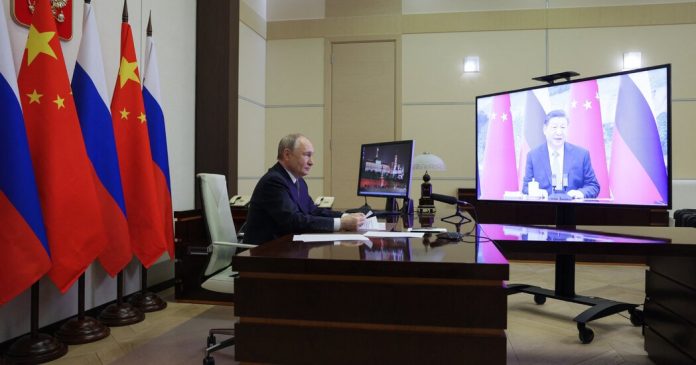
China’s leader said his country and Russia were “true friends who have been through thick and thin together” after a video call with President Vladimir V. Putin on Monday, part of a pointed mutual affirmation of allegiance between Beijing and Moscow as President Trump has turned toward the Kremlin.

The warm words attributed to Xi Jinping in Chinese state media were clearly intended to dampen speculation that the Trump administration, which has pursued a rapid rapprochement with Russia, might succeed in driving a wedge between Beijing and Moscow.

The call came on the anniversary of Russia’s 2022 invasion of Ukraine, after three years in which China extended a lifeline to Russia by helping Mr. Putin weather economic isolation from the West and struggles on the battlefield.

Shortly before the invasion of Ukraine, Mr. Xi and Mr. Putin heralded a “no limits” partnership. Since then, China has sustained Russia’s war machine with oil purchases and exports of dual-use technologies.

Mr. Xi and Mr. Putin also share an ideological opposition to the West. They blame the United States for holding back their global ambitions, and promote a reshaping of the global order to weaken Washington’s dominance.

“History and reality show us that China and Russia are good neighbors who won’t move away, and true friends who have been through thick and thin together, support each other and develop together,” Mr. Xi was quoted as saying by Chinese state media.

Mr. Xi said relations between China and Russia were not “affected by any third party,” in what appeared to be an oblique reference to the United States. And he said the two countries’ foreign policies were there for the “long term.”

The Kremlin issued a similarly cordial statement after the call, describing Mr. Xi and Mr. Putin’s conversation as “warm and friendly.” In a rebuff of the idea that President Trump could divide the two countries, the Kremlin added: “The leaders emphasized that the Russian-Chinese foreign policy link is the most important stabilizing factor in world affairs,” and said the relationship was “not subject to external influence.”

The call was the second between Mr. Xi and Mr. Putin in just over a month, coming less than two weeks after Mr. Trump upended U.S. strategy toward Russia by holding a phone call with Mr. Putin and appearing to side with him over the war in Ukraine. Mr. Trump blamed Ukraine for instigating Russia’s invasion, called President Volodymyr Zelensky of Ukraine a “dictator” and excluded Kyiv from early-stage peace negotiations.

Mr. Trump’s decision to side so favorably with Mr. Putin on the war has fueled speculation that Washington was aiming to split Russia and China, a country that many senior Trump administration officials consider a far more serious threat to U.S. interests.

Some incoming officials in the Trump administration have suggested drawing down American troop levels in Europe, which serve as a bulwark against Russia, so Washington can focus its military efforts on defending against China.

Trump’s special envoy to Ukraine, Keith Kellogg, told a panel earlier this month in Munich that the Trump administration was hoping to “force” Mr. Putin to fray his ties with North Korea, Iran and China.

Analysts, however, have expressed skepticism that China and Russia can be driven apart in what is being called a “reverse Nixon,” a reference to President Nixon’s rapprochement with Beijing in 1972 that was aimed at exploiting the worsening relations between China and the Soviet Union.

Unlike 53 years ago, ties between China and Russia today are at a high, with few prospects for domestic political change in either country.

“There’s strategic and geopolitical alignment for this relationship,” said Sergey Radchenko, a professor at the Johns Hopkins School of Advanced International Studies who specializes in Chinese-Russian relations. “They don’t see eye to eye on everything, but I think they both realize they need each other.”

Mr. Radchenko said Beijing was probably feeling uncomfortable with Mr. Trump’s bid to court Mr. Putin, but that it was unlikely that Mr. Putin would see his interests better served by aligning more closely with the United States over China.

“The idea that Putin can be manipulated as some kind of weapon against China, I think that’s naïve on the part of the Trump administration,” he said.

How much China knew about Russia’s plans in the run-up to Mr. Putin’s invasion of Ukraine three years ago remains unclear.

A Western intelligence report issued shortly after the invasion concluded that senior Chinese officials had told senior Russian officials in early February not to invade Ukraine before the end of the Winter Olympics in Beijing. But the intelligence did not necessarily indicate that direct conversations about an invasion had taken place between Mr. Putin and Mr. Xi.

China has denied any prior knowledge of the invasion, and Beijing didn’t evacuate its embassy or citizens from Ukraine in the days before the start of the war.

“Assertions that China knew about, acquiesced to or tacitly supported this war are purely disinformation,” Qin Gang, the Chinese ambassador to the United States at the time, wrote in a March 2022 article in The Washington Post.

Mr. Xi is set to visit Moscow in May to attend the commemorations of the Soviet victory over Nazi Germany in World War II, according to Russian state media. Mr. Putin has also invited Mr. Trump.

The call on Monday between the Chinese and Russian leaders came as the Kremlin tries to keep its partner nations on its side, while pursuing a warming of relations with the United States, a country Mr. Putin has long derided as an irresponsible global superpower.

“The president last week spoke about his desire to inform a series of government partners about the contacts with the Americans,” the Kremlin’s spokesman, Dmitri S. Peskov, said in a call with reporters on Monday. “In line with those intentions, that process started today.”

The Kremlin added in a statement that Mr. Putin had informed Mr. Xi during their call about “recent Russian-American contacts.” It also said China had “expressed support for the dialogue between Russia and the United States that has begun, as well as readiness to contribute to the search for a peaceful settlement of the Ukrainian conflict.”

Mr. Putin also spoke with the leader of Tajikistan on Monday, and the Russian foreign minister, Sergei V. Lavrov, met with President Recep Tayyip Erdogan of Turkey.

In the comments published by Chinese state media, Mr. Xi said he was “pleased” that Russia had started negotiations with “other parties” to end the “Ukrainian crisis.”

China has yet to describe Russia’s invasion of Ukraine as a “war.”

Amy Chang Chien contributed research.

Hamas Official Expresses Reservations About Oct. 7 Attack on Israel

0

For months, leaders of Hamas have defended the militant group’s decision to launch the Oct. 7, 2023 attack on Israel, even though it ignited a devastating Israeli offensive that has killed tens of thousands of Palestinians in Gaza and reduced the territory to rubble.

Hamas has declared “victory” over Israel, and some of its officials have vowed that their fighters will carry out more Oct. 7-style attacks in the future.

But now one of Hamas’s top officials is publicly expressing reservations about the assault, which also touched off a humanitarian crisis that displaced nearly two million and led to critical shortages of food and health care.

Mousa Abu Marzouk, the Qatar-based head of Hamas’s foreign relations office, said in an interview with The New York Times that he would not have supported the attack if he had known of the havoc it would wreak on Gaza. Knowing of the consequences, he said, would have made it “impossible” for him to back the assault.

Mr. Abu Marzouk has said that he was not informed about the specific plans for the Oct. 7 attack, in which roughly 1,200 people were killed and about 250 taken hostage, but that he and other Hamas political leaders had endorsed its overall strategy of attacking Israel militarily.

“If it was expected that what happened would happen, there wouldn’t have been Oct. 7,” as far as he was concerned, he said.

He also suggested that there was some willingness within Hamas to negotiate the future of the group’s weapons in Gaza — which has been a sticking point in negotiations with Israel — taking a position that other Hamas officials have rejected. A compromise might help Hamas and Israel avoid a renewal of the war, analysts say. Israel has said that it wants Hamas to dismantle its military capabilities.

Mr. Abu Marzouk, 74, the first leader of Hamas’s political office in the 1990s, made the remarks in a phone interview on Friday.

It’s unclear to what extent Mr. Abu Marzouk’s views on Oct. 7 are shared by other Hamas leaders, or if they were an attempt to influence negotiations with Israel or put pressure on fellow leaders within the militant group. Other Hamas leaders, especially those closely connected to Iran and the Lebanese militant group Hezbollah, have tended to take a harder line.

His comments suggest that there are differences among Hamas officials over the party line on Oct. 7 and its consequences. They also indicate that the frustrations of Palestinians in Gaza who say the attack has made them endure extraordinary suffering are having some impact within the Hamas leadership.

Mr. Abu Marzouk’s comments were similar to those made by Hassan Nasrallah, the leader of Hezbollah, in the aftermath of the 2006 war between Israel and Hezbollah. The scale of the destruction in that conflict led Mr. Nasrallah to concede that his group would not have kidnapped and killed several Israeli soldiers at the time had it known it would set off such a strong response.

In the coming days, Israel and Hamas are expected to start a discussion about the second phase of the cease-fire in Gaza, which calls for a permanent end to the fighting, a full Israeli withdrawal, and the release of more Israeli hostages and Palestinian prisoners. But delays in starting those talks coupled with disputes over the implementation of the first phase have reinforced fears that the truce could fall apart and the war could restart.

Mr. Abu Marzouk, who spent years living in the United States, has long been seen as one of the more pragmatic figures in Hamas. The war has exacted a heavy price on his family, with his 77-year-old brother, Yousef, killed in the fighting.

“He’s not a nihilist,” said Stanley Cohen, a lawyer and longtime friend of Mr. Abu Marzouk based in New York. “He would not support any action that he believed would bring unprecedented, wholesale retaliation by anyone on the people.”

Mr. Abu Marzouk said that Hamas’s survival in the war against Israel was itself a “kind of victory.” He also likened Hamas to an average person fighting Mike Tyson, the former heavyweight boxing champion: if the untrained novice survived Mr. Tyson’s punches, people would say he was victorious, he said.

In absolute terms, he said it would be “unacceptable” to claim Hamas won, especially considering the scale of what Israel inflicted on Gaza. .

“We’re talking about a party that lost control of itself and took revenge against everything,” he said, referring to Israel. “That is not a victory under any circumstances.”

The Israeli military has claimed that it has conducted its air and ground campaigns in Gaza in accordance with international law, and that it was carrying out attacks against Hamas, which the United States and other countries have designated a terrorist group. But legal experts have accused Israel of using force in a way that resulted in the deaths of too many civilians.

Mr. Abu Marzouk also suggested there is some openness within the Hamas leadership to negotiate the future of the group’s weapons in Gaza, a thorny issue that other Hamas officials have said is off limits.

“We are ready to speak about every issue,” he said, when asked about the weapons. “Any issue that is put on the table, we need to speak about it.”

Prime Minister Benjamin Netanyahu of Israel has insisted that his country will not end the war with Hamas without dismantling the group’s governing and military capabilities. While Hamas has expressed readiness to concede civilian governance in Gaza, it has refused to give up its weapons.

Mr. Abu Marzouk’s remarks appeared to contradict those of Osama Hamdan, another Hamas official, who told a conference in Doha, Qatar, in the middle of this month that “the weapons of the resistance” were not up for discussion, seeming to rule out a compromise.

When asked about Mr. Hamdan’s statements, Mr. Abu Marzouk said that no one leader could set the agenda on their own.

Ibrahim Madhoun, an analyst close to Hamas, said there were multiple views within the group about important issues, but when its institutions made a decision, everyone stood behind it.

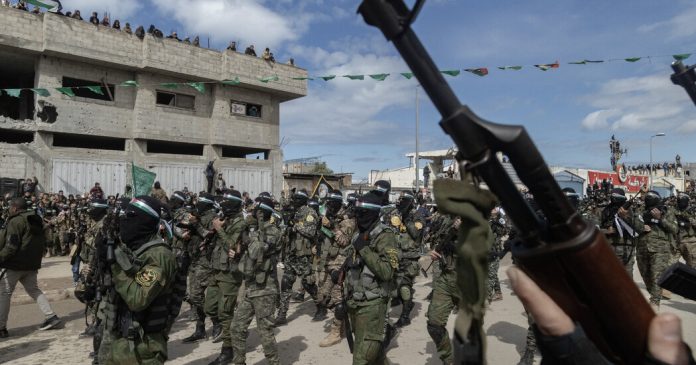
Since the cease-fire first came into effect on Jan. 19, Hamas fighters have been parading around Gaza with rifles — sending a message to Israel, the international community and Palestinians that the group was still in control.

Mr. Abu Marzouk declined to answer specific questions about possible compromises on the issue of Hamas’s weapons. Those compromises might include Hamas storing its weapons in internationally supervised facilities, agreeing to forgo rebuilding its tunnel network and rocket arsenal, or stopping the recruitment of fighters. Disarmament, experts say, is unlikely.

As the talks over the second phase of the cease-fire have been held up, Israeli and American officials have increasingly spoken about extending the first phase.

Releasing some more hostages and prisoners during an extension of the first phase, Mr. Abu Marzouk added, could be discussed. But he clarified that, under any circumstances, Hamas would demand far more prisoners in exchange for each hostage because the group considers the remaining Israeli hostages to be soldiers. He mentioned 500 and 1,000 prisoners as possible figures for each hostage.

During the first phase, hundreds of Palestinian prisoners have been released, but the number of prisoners released per hostage has generally not exceeded 50.

Mr. Abu Marzouk said Hamas was also open to releasing all hostages at the same time, if Israel was willing to free the thousands of Palestinians in its prisons, end the war and withdraw from Gaza.

“We’re ready to have a comprehensive deal,” he said.

Israeli officials have previously dismissed proposals to exchange all hostages for all prisoners.

Abu Bakr Bashir contributed reporting to this article.

Gaza Cease-Fire Could End in Days, With No Extension Agreed. What Happens Next?

0

When Israel and Hamas agreed to a six-week cease-fire in January, there were hopes that it would evolve into a longer and more stable truce.

Now, those hopes are dwindling.

Both sides have accused each other of breaking the terms of the existing deal, which have allowed for the exchange of Israeli hostages and Palestinian prisoners. Over the weekend, Israel delayed the release of several hundred prisoners, protesting the humiliating manner in which Hamas had paraded hostages before handing them over.

With just days before the current truce elapses on Sunday, the sides have yet to begin negotiations for an extension.

Steve Witkoff, the Mideast envoy for the Trump administration, said he would return to the region on Wednesday to push for a new truce.

While a brief extension is possible, the likelihood of a long-term arrangement — preventing the revival of fighting — seems remote.

Both sides have preconditions that make it hard to reach a permanent resolution. Israel’s leaders say they will only end the war once Hamas no longer exerts military and political power in Gaza. Hamas has indicated it could give up some civil responsibilities but its leaders have largely dismissed the idea of disarmament, at least in public.

Here’s how we got here, and what could happen next.

The deal struck in the final days of the Biden administration allowed for an initial six-week truce, which ends on March 1. The sides agreed to use that time to gradually exchange roughly 1,500 Palestinian prisoners in Israeli jails for 33 hostages captured by Hamas and its allies during their raid that ignited the war in October 2023.

The two sides were supposed to use the six weeks to negotiate the terms for a permanent truce that would have begun as soon as March 2. Those negotiations were expected to focus on who should govern postwar Gaza, as well as the release of roughly 60 other hostages.

Though punctured by disruptions, most of the exchanges have gone roughly to plan. The negotiations for a second phase have not. They have yet to begin in earnest — even though, under the terms of the January agreement, they were supposed to conclude by this past Sunday.

That failure is partly because, according to the agreement, the truce can only formally roll over if both sides agree to end the war. But Israel and Hamas have such differing visions of a postwar Gaza that the Israeli prime minister, Benjamin Netanyahu, has been unwilling to even restart talks.

Weak and isolated, Hamas has avoided explicit calls for a resumption in hostilities, even if the group has made war more likely by refusing to surrender.

By contrast, Mr. Netanyahu directly stated on Sunday that Israel was ready to resume fighting if Hamas would not disarm itself voluntarily. In a speech to soldiers, Mr. Netanyahu said he was only open to negotiations on the terms of Hamas’s surrender.

Many Israelis want the prime minister to agree to an extended truce in order to free the remaining hostages, even if it comes at the expense of keeping Hamas in power. But Mr. Netanyahu’s right-wing coalition allies see a defeat of Hamas as a bigger national priority and are pressing him to restart the conflict.

The Israeli military has already made extensive preparations for a new and intense campaign in Gaza, according to three defense officials who spoke on the condition of anonymity to speak more freely.

The officials said the new operations would include the targeting of Hamas officials who siphon off aid supplies meant for civilians, as well as the destruction of buildings and infrastructure used by the Hamas-run civilian government.

While the plan has yet to be approved by the Israeli cabinet, two of the officials said they believed that only President Trump could dissuade Mr. Netanyahu from renewed war.

The president has made several competing demands in recent weeks, variously calling for sustained peace, renewed war, as well as the expulsion of Gaza’s two million residents. The clearest recent signal from his administration was that it was seeking a temporary extension to the truce, perhaps involving a few more hostage-for-prisoner exchanges.

On Sunday, Mr. Witkoff, Mr. Trump’s Mideast envoy, said in an interview with CNN that he would return to the region on Wednesday to prolong truce’s first phase. He later told CBS that he would spend five days touring Egypt, Israel, Qatar, the United Arab Emirates and Saudi Arabia to build momentum toward an extension. Mr. Witkoff also said that he believed it was possible to achieve a longer agreement.

Not necessarily. The initial deal said that the “temporary cessation of hostilities” could be sustained beyond the March 1 deadline as long as Israel and Hamas were still negotiating over the terms of a permanent cease-fire. That allows for some wiggle room: If the sides do return to negotiations over a formal extension, the truce can technically continue even if the talks are far from a resolution.

Still, there will be fewer guardrails to keep the truce from collapsing. During the initial cease-fire, the sides were motivated to sustain the deal through several crises because every passing week allowed for the exchange of more captives. That arrangement suited both Israel and Hamas — every liberated hostage brought relief to the Israeli population, while Hamas’s prestige was bolstered among Palestinians every time a prisoner was released.

Those swaps are set to end on Thursday, with the release of four more Israelis, most likely captives who have died, for several hundred Palestinians. Unless new exchanges are arranged, both Hamas and Israel will have fewer reasons to keep the truce going.

There is particular concern about what happens after March 8.

In the January deal, Israel agreed to withdraw its forces by that date from the Gaza-Egypt border. But Mr. Netanyahu explicitly said last year that Israel would never pull back from the area, known in Israel as the Philadelphi Corridor, leading to predictions that he would break the terms of the cease-fire.

If those forces do not withdraw, the Israeli defense officials say they expect that Hamas may fire rockets at Israel, giving Israel a pretext to retaliate.

Johnatan Reisscontributed reporting from Tel Aviv.

Frank G. Wisner, Diplomat With Impact on Foreign Policy, Dies at 86

0

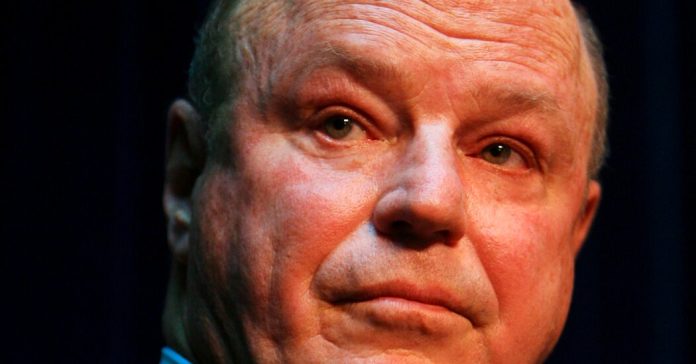
Frank G. Wisner, a veteran American diplomat, Washington insider and foreign affairs specialist who relished the prestige of ambassadorial life as much as the back-channel cajoling and arm-twisting of less public influence, died on Monday at his home in Mill Neck, N.Y., on Long Island. He was 86.

His son, David, said the cause was complications of lung cancer.

Over decades as a member of the policy elite, Mr. Wisner headed embassies in Zambia, Egypt, the Philippines and India, held high office under both Republican and Democratic administrations and was linked to initiatives that wrought change in regions as disparate as southern Africa and the Balkans.

He rose to prominence at a time when the Cold War rivalry with the Soviet Union turned an emergent world of newly-independent states into a checkerboard of competition between Washington and Moscow and their various surrogates.

Gregarious and often expansive, Mr. Wisner brought his own style to the task of promoting America’s vision. In Cairo, for instance, where he was ambassador from 1986 to 1991, he once invited a reporter along to join him for an evening of diplomacy and socializing, crisscrossing the city in an armored Mercedes-Benz followed by a chase car of bodyguards as he was feted in a series of formal receptions.

The guest list at his dinner parties offered a Who’s Who of the elite. And as the representative of Egypt’s most influential superpower ally, his interlocutors sometimes treated him like an affable viceroy.

Once, Mr. Wisner borrowed a friend’s apartment in Cairo to conduct unpublicized talks with exiled members of the Soviet-backed armed wing of Nelson Mandela’s African National Congress, at a time when official contact with such figures was unusual.

Mr. Wisner was the American ambassador in Egypt when Saddam Hussein invaded Kuwait in 1990, triggering a massive, American-led counter-invasion of Iraq — an event that sent tremors of apprehension through Western diplomatic corps across the Arab world. But while some missions evacuated their nationals or closed down their facilities, “we stuck,” Mr. Wisner said in an interview in 1998. “I had a sense of confidence in the Egyptian government’s ability to maintain control in the streets. I had confidence in the direction of our diplomacy and in the Egyptian association with us.”

“We read the Egyptians right,” he added. “They read us right. We and they were on the same wave length.”

During his time in Manila, where he had been posted as ambassador to help stabilize the coup-prone administration of Corazon Aquino, his office was part of the old American governor-general’s suite.

“Cigar in hand, he loved to take visitors out on the giant veranda overlooking the bay and describe the sweep of American interactions with the Philippines, back to the days of the Spanish-American War,” The New York Times reported.

But, long after he retired from public duty in 1997 and embarked on a lucrative career as a senior adviser to private companies, Mr. Wisner’s final act of public diplomacy during the so-called Arab Spring of 2011 turned sour when he found himself at odds with the Obama administration and isolated from the mainstream of American policymaking.

At the time, as huge crowds gathered in Cairo’s central Tahrir Square to demand the ouster of the pro-American President Hosni Mubarak, President Barack Obama dispatched Mr. Wisner to deliver a message to his Egyptian counterpart, whom Mr. Wisner had to come to know well during his ambassadorship there.

President Obama wanted Mr. Mubarak to agree to begin relinquishing power immediately. But after just one meeting with Mr. Wisner, Mr. Mubarak balked, saying only that he would not stand for re-election in a scheduled vote months later but that he wanted to remain in office until then. Mr. Wisner, who also met Vice President Omar Suleiman of Egypt during his mission, was ordered to return to the United States.

Days later, speaking by video link to a big security conference in Munich, Mr. Wisner said it was crucial for Mr. Mubarak to stay on to manage his transition from office.

Those remarks were instantly disavowed by both the State Department and the White House, whose representatives said that Mr. Wisner had been speaking in a personal capacity and that his views did not reflect official policy.

It was a rare and embarrassing public rebuke.

According to news reports at the time, Mr. Obama was furious with Mr. Wisner’s unexpected intervention, which seemed to reflect a cautious regard for regional stability among a foreign policy establishment that was keen to protect Egypt’s 1979 peace agreement with Israel — a cornerstone of American vision for the region — rather than support the revolutionary demands of the crowds calling for Mr. Mubarak’s ouster.

In the event, Mr. Mubarak, who died in 2020 at 91, was forced to step down within days to face trial as the protests against him multiplied.

Years later, in an online discussion sponsored by the Council on Foreign Relations, Mr. Wisner seemed unrepentant.

“During the Obama administration, I was asked to carry word to Mubarak about his leaving office,” he said. “I did as I was instructed.” But, he went on, “the policy changed, and that was disappointing to me.” He believed that the United States should be “seen to be helping solve problems,” he said, “not march at the head of a protest.”

He added: “It undercut our position in the region. And there was absolutely no way we were going to decide the future of the Egyptian revolution, as we subsequently learned.”

Frank George Wisner was born on July 2, 1938, in New York to Frank Gardiner Wisner and Mary Knowles Wisner. His father was an intelligence operative in World War II who went on to join the Central Intelligence Agency, where he was credited with masterminding coups in Guatemala and Iran. He died by suicide in 1965.

The younger Mr. Wisner had two brothers, Graham and Ellis Wisner, and a sister, Elizabeth Gardiner Wisner, who died in 2020. Graham died in January.

In his youth, Mr. Wisner spent a year at England’s upscale Rugby School before going on to Princeton. He joined the State Department in 1961 and had early assignments to newly-independent Algeria, war-ravaged South Vietnam, Tunisia and Bangladesh.

In 1969, he married Genevieve de Virel, a scion of a noted French family. She died in 1974. They had a daughter, Sabrina.

In 1976, he married Christine de Ganay, who was also from an aristocratic French family. She was the former wife of Pal Sarkozy, the father of former President Nicolas Sarkozy of France. David Wisner is their son. She had two children from her previous marriage, Olivier and Caroline Sarkozy. The couple later divorced. Mr. Wisner married Judy C. Cormier, an interior designer, in 2015.

In interviews after his retirement from the State Department, Mr. Wisner made frequent reference to his role during the Nixon administration on the staff of Henry A. Kissinger as the White House pursued diplomacy to end a guerrilla war in Zimbabwe, then called Rhodesia, in the 1970s.

At the time, Moscow and Washington jockeyed for influence in a swathe of restive African lands, including Mozambique, Angola, Namibia and ultimately South Africa. In Angola, the rivalry had drawn in Cuban and South African troops fighting in support of opposing liberation movements.

When Mr. Wisner was ambassador to Zambia, from 1979 to 1982, part of his mission was to rebuild a close relationship with President Kenneth D. Kaunda after sensational disclosures surfaced in 1981 about undercover C.I.A. activities there.

At the time, Lusaka, the tranquil-looking Zambian capital, teemed with representatives of liberation movements backed variously by the Soviet Union and China, along with Western spies who sought to track and subvert them. Zambia was also a leading player in the so-called Frontline States, which had long provided rear bases and critical diplomatic support for liberation movements across the region.

“There were some hairy moments” as he sought to undo the damage, Mr. Wisner said in a 1998 interview for the Library of Congress.

Indeed, Mr. Wisner himself was an influential player in the Reagan administration’s policy known as “constructive engagement,” led by Chester A. Crocker, the former assistant secretary of state for African affairs. The core of the policy was a belief that the white minority regime of apartheid South Africa could be persuaded to loosen its grip on absolute power rather than fight ruinous conflicts against Black adversaries demanding majority rule.

In “High Noon in Southern Africa,” an account of American regional diplomacy published in 1992, Mr. Crocker referred to Mr. Wisner as “the dean of Southern Africa specialists,” who “possessed a breadth of foreign affairs background unmatched in our government” and who displayed “a polished, low-key manner and personal warmth.”

Throughout his career, Mr. Wisner alternated between overseas assignments and senior positions in Washington, including stints at the State Department and the Pentagon.

Even after his retirement from the diplomatic corps in 1997, he continued to combine private sector advisory roles with official missions. In 2005, the George W. Bush administration appointed him as its special representative in talks that led to the disputed independence of Kosovo in 2008.

From 1997 onward he built a second career in private business, serving as a vice chairman of the insurance giant A.I.G. and as an international affairs adviser for Squire Patton Boggs, a legal and lobbying group based in Washington.

In his later years, Mr. Wisner voiced concern about the way the United States had exercised its global power, starting with the Vietnam War in the 1960s and through to the decades of conflict in Iraq and Afghanistan.

“We seem to be impervious to learning from our mistakes, and, therefore, ended up in tragic excesses in Iraq and now in Afghanistan,” Mr. Wisner told the Council of Foreign Relations in June 2021, months before the chaotic American withdrawal from Kabul.

“I hope this period of American history, from the late 1960s through the present, will somehow settle into the American mind,” he said, “and we will be careful about how we use American power.”

Mental health issues ripple through the federal workforce with firings : Shots

0

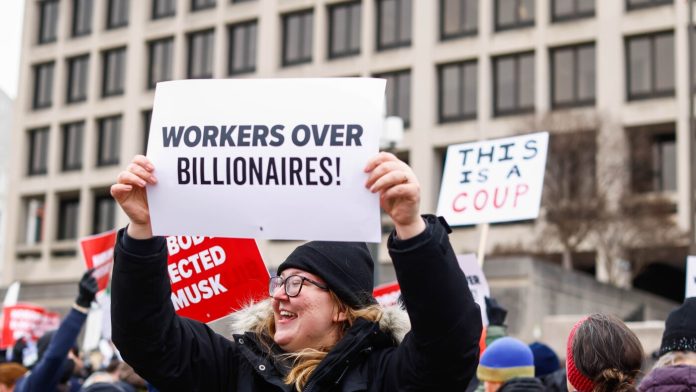
A protest at the U.S. Department of Labor on Feb. 5. (Photo by Kena Betancur/VIEWpress)

Kena Betancur/VIEWpress/Getty Images


hide caption

toggle caption

Kena Betancur/VIEWpress/Getty Images

Federal workers and contractors who have been fired hastily in recent weeks say among the many personal and financial costs of these terminations is their mental health.

Thousands of workers across the federal government including at the Department of Education, the Department of Veterans Affairs, USAID and the Environmental Protection Agency have been terminated — in many cases with little explanation or process — since President Trump took office. Elon Musk’s efficiency effort known as DOGE initiated the mass firings.

Nadia Shadravan was working as a contractor evaluating projects for USAID until she received a furlough notice. For the last three years she’s been living and working in Senegal with her husband and two children, ages 14 and 12.

“I can see the worry in their faces,” she says of her children. “I don’t want them to worry about me, but I do think it’s unavoidable and I see that they’re stressed about the idea of what this is going to mean for our family.”

A hit to productivity

Some experts warn that destabilizing the collective mental health of the workforce with these kinds of unprecedented firings will undermine productivity. “I have never seen anything that from the outside looks so random, sloppy — the impact is intimidation and fear,” says Amy Edmondson, who studies organizational psychology at Harvard Business School.

Employees still working in such environments will be less productive, Edmonson’s research shows.

Last week, Musk brandished a chainsaw on stage at the CPAC conference, referencing the job cuts. On Saturday, employees across the government got an email asking them to list five things they got done last week by midnight Monday. On X, Musk said not answering the email would amount to a resignation.

A tsunami across the field

Shadravan says she has no job prospects and no idea where her family will land. Her husband is employed as a teacher, but she worries his job is also in jeopardy given many of his students are the children of Americans posted abroad and also dependent on the funding ecosystem of USAID, which stands for the U.S. Agency for International Development.

Shadravan describes the USAID shutdown as a tsunami across the entire field. “Opening up LinkedIn and literally all you see is everyone with the same message,” she says. “Everyone you’ve ever worked with, everyone you’ve ever connected with professionally is in the exact same situation as you and is out of a job.”

The ripple effects of trauma are sweeping across federal agencies. For some, just the fear of being fired has induced mental health crises. One federal employee — Joe, who asked NPR not to use his full name over concerns about retaliation, describes his symptoms as, “spiraling, anxiety driven, heart palpitating, headache, can’t breathe.”

In January, Joe took an approved leave of absence to help a sick family member. “I was told ‘Do what you got to do,'” he recalls, and says he felt grateful to be able to support his family during a difficult time.

But when he opened up his computer after weeks of absence, Joe discovered he had missed the deadline for Elon Musk’s “fork in the road” offer to resign now and be paid through the summer. As a relatively recent hire, he felt he was a likely candidate to be fired and feared that he had missed his chance for any compensation.

“I had such an anxiety panic attack, I called the suicide hotline,” Joe recalls, referring to the 988 suicide and crisis lifeline.

After several debilitating weeks, Joe says he was finally informed that he would be able to take advantage of the offer — assuming the courts affirm its legality. He says staying in this job would be difficult as he was living in fear of getting fired: “Every time I went to open the emails, it was a knot in my stomach.”

Harvard Business School’s Edmondson says making healthy cuts at an organization is possible, but it takes time and “engaging deeply and clearly the question of what must this organization deliver, what will it require to deliver it, and then kind of who’s needed, who isn’t needed.”

Without that process, says Edmondson, organizations jeopardize something she calls team psychological safety. Workers who don’t feel safe aren’t very good at their jobs.

“Put them in trauma”

Administration officials have suggested that making federal workers feel targeted is one of its goals. Just before the election, ProPublica and Documented surfaced a speech from Russell Vought, now Trump’s Director of the Office of Management and Budget, in which Vought said, “We want the bureaucrats to be traumatically affected.”


ProPublica & Documented
YouTube

Vought’s office did not respond to requests for comments for this story, nor did other federal agencies contacted. “We want them to not want to go to work because they are increasingly viewed as the villains,” said Vought in the speech. He went on to say, “We want to put them in trauma.”

For federal workers Nadia Shadravan and Joe, that effort has been successful.

If you or someone you know is in crisis, you can call or text 988 for the Suicide and Crisis Lifeline.

Have information you want to share about the ongoing changes across the federal government? Katia Riddle is available through encrypted communications on Signal at Katia.75

Trial of Former Surgeon Accused of Abusing Nearly 300 Opens in France

0

A former surgeon went on trial in western France on Monday on charges that he raped or sexually assaulted hundreds of people, most of them former pediatric patients, in what is widely considered the biggest pedophilia case in French history.

The former surgeon, Joël Le Scouarnec, 74, is accused of raping or sexually assaulting 299 people over 25 years, between 1989 and 2014. Almost all of the victims are his former patients, and almost all of them were children at the time of the alleged abuse. The average age of the patients he is accused of sexually assaulting was 11.

The trial opened in the coastal town of Vannes, in Brittany, where Mr. Le Scouarnec was led in by police officers at the start of the trial.

Wearing a black vest, with a bald head and a ring of white hair on the sides, he spoke clearly as the court confirmed his name, date of birth, and other biographical information.

“Your profession before you were incarcerated?” Aude Buresi, the presiding judge, asked.

“Surgeon,” Mr. Le Scouarnec answered calmly.

The proceedings are expected to last nearly four months.

Mr. Le Scouarnec’s listed victims were spread around the west of France, following his career as he moved from the Indre-et-Loire area to Brittany, and finally south to Charente-Maritime, working in several private clinics and public hospitals.

The case is unprecedented in scale for Vannes, a picturesque town of about 54,000 people with colorful half-timbered houses and centuries-old ramparts.

Modeling their organization after the colossal trials held in Paris after devastating terrorist attacks in France in 2015 and in 2016, the local court authorities have had to make space for hundreds of people expected to attend the trial.

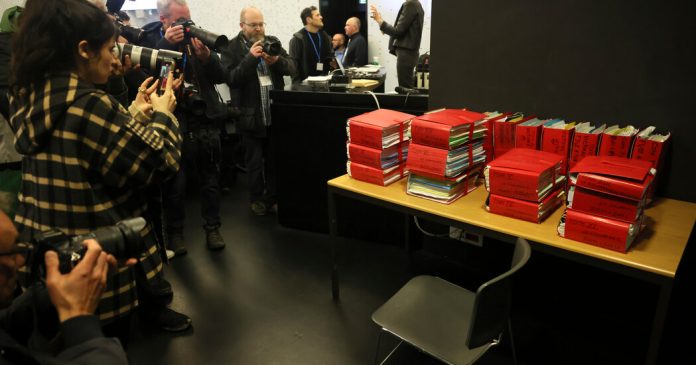
That includes the people listed as victims and their families, over 60 lawyers, the general public, and more than 450 accredited journalists from as far as Japan and Australia.

The local authorities have requisitioned a low-slung, former law school building that is a short walk from the courthouse to rebroadcast the proceedings in overflow rooms.

A psychologist and support dogs will be on hand, and as was the case in France’s biggest terrorism trials, listed victims will wear colored lanyards — green if they are willing to talk to the press, red if not.

Victims can ask to testify behind closed doors at any point during the trial, meaning some days may be closed to the press and public.

Mr. Le Scouarnec faces a maximum of 20 years in prison if convicted, as there are no consecutive sentences in France.

He has denied some charges of rape but admitted to touching some patients’ genitals during medical examinations. The rape charges are mostly related to penetration with fingers, which reflects the definition of rape in France.

Opening just two months after the verdicts in the widely publicized case of Gisèle Pelicot — in which dozens of men, including her husband, were convicted of raping her — this trial is expected to provoke more soul-searching about the extent of sex crimes in France.

Many of the victims were still under anesthesia or drowsy from it when they were believed to have been raped or sexually assaulted. Many of the victims experienced trauma in the years that followed, but few remembered the abuse until police contacted them.

Mr. Le Scouarnec has already been convicted twice. In 2005 he was found guilty of possessing child sexual abuse imagery, but he was allowed to continue to treat children until he was arrested in 2017.

Then, in 2020, he was found guilty of raping or sexually assaulting four children, including a girl who lived next door and two of his nieces.

After Mr. Le Scouarnec’s arrest in that case, investigators found hundreds of pages of his diaries as well as two spreadsheets on hard drives.

The diaries elaborately detailed the sexual abuse of individual children and the spreadsheets listed many of their names, ages, addresses and synopses of the abuse they suffered.