Friday, November 13, 2026
Home Blog Page 187

Trump administration backs off requiring email response : NPR

0

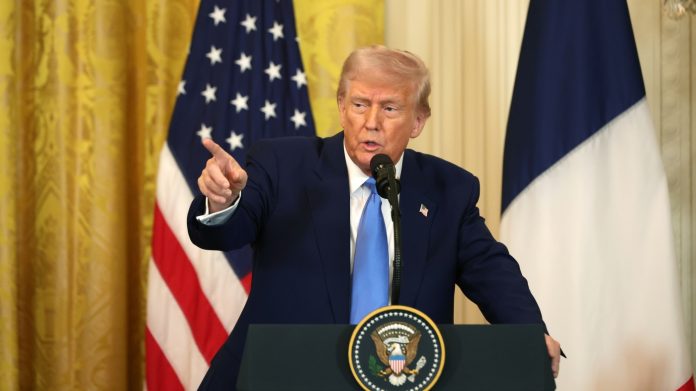
President Donald Trump delivers remarks during a joint press conference in the East Room at the White House on Feb. 24 in Washington, D.C.

Tasos Katopodis/Getty Images


hide caption

toggle caption

Tasos Katopodis/Getty Images

Federal agencies are split on whether employees should comply with Elon Musk’s directive to list five accomplishments in the past week, sowing more confusion as the midnight deadline for responding looms, according to emails seen by NPR, even as the agency overseeing the request issued guidance late Monday suggesting employee responses are ultimately voluntary.

Over the weekend, officials at the Departments of Defense, State, Homeland Security and Energy told workers not to respond to the government-wide “What did you do last week?” email sent by the Office of Personnel Management (OPM) on Saturday. At DHS, that contradicted earlier guidance from leaders at the Cybersecurity and Infrastructure Security Agency and FEMA, which are both housed within DHS.

Department of Health and Human Services (HHS) staff were initially told to reply, but then received a Sunday evening email asking them to “pause” responses pending additional guidance. Late Monday, a third email told employees, “There is no HHS expectation that HHS employees respond to OPM and there is no impact to your employment with the agency if you choose not to respond.”

For those that chose to respond, the Department advised them not to name other HHS employees they worked with, matters they are working on, or specific grants or contracts. “Assume that what you write will be read by malign foreign actors and tailor your response accordingly,” the email warned.

Meanwhile, agencies including the Treasury, Veterans Affairs, Commerce and Interior Departments instructed their employees to respond with a range of instructions on how to do so while also reminding them not to share classified information.

The internal emails were shared with NPR by current and former government employees who wanted to remain anonymous because they fear retaliation by the Trump administration and in some cases are still working at agencies where they are not authorized to share information.

By late Monday afternoon, OPM updated its guidance to agencies, according to messages circulated at HHS and the Equal Employment Opportunity Commission (EEOC). In a memo obtained by NPR, EEOC said that OPM told agencies to communicate to staff that “any employee response to the email is voluntary” and that “not responding will not be considered a resignation.”

The new guidance contradicts claims made by Musk and President Trump that those who did not respond were at risk of losing their jobs.

Trump, speaking in the Oval Office on Monday, made unfounded claims that some federal workers aren’t answering the email because “they don’t even exist.”

“And then if you don’t answer, like, you’re sort of semi-fired or you’re fired, because a lot of people are not answering because they don’t even exist,” he said, without giving evidence.

Trump added that agencies that told workers not to respond, including the State Department and the FBI, did so “in a friendly manner.”

“They don’t mean that in any way combatively with Elon. They’re just saying there are some people that you don’t want to really have them tell you what they’re working on last week,” the president said.

OPM did not respond to NPR’s request for comment or further clarification.

Questions over who is in charge 

The divided response among federal agencies is the most visible sign of pushback by some officials — including at the most powerful cabinet agencies that deal with national security — to Musk’s aggressive reshaping of the government through his Department of Government Efficiency effort.

That includes the State Department, where a senior official told staff the department would respond on its own behalf, according to a screenshot of the communication obtained by NPR. “No employee is obligated to report their activities outside their Department chain of command,” the official’s email said.

Energy Secretary Chris Wright also asserted his department’s authority to manage his staff in a message to employees on Sunday that NPR has seen. “The Department of Energy is responsible for reviewing the performance of its personnel and will conduct any review in accordance with its own procedures,” Wright wrote. “When and if required, the Department will provide a coordinated response to the OPM email.” His email used identical language to a message sent by the Defense Department the same day and also seen by NPR.

The shifting and at times contradictory guidance has left many federal workers confused and asking who is in charge, according to multiple interviews by NPR with those affected. They described a weekend of chaos sparked first by an X post from Musk previewing the email and warning that “failure to respond will be taken as a resignation,” and then by the OPM email itself, which included no such ultimatum.

“My entire weekend has been a stress-filled ball of crazy. No one seems to know who is running the country. No one knows what we are supposed to do,” said one federal employee who had received a series of changing instructions from supervisors on whether or not to comply with the request. This person spoke on condition of anonymity because they are still employed by a federal agency and fear retaliation in their job.

Despite the latest guidance that responding is voluntary, some federal workers feel they have little choice.

“I hate to comply but I feel it’s safer to respond,” said another federal employee who also spoke to NPR on condition of anonymity due to fear of retaliation. “Whiplash is an accurate description to micromanagement from a shadow office,” they added.

Unions update legal action

Many federal workers are covered by civil service protections that prevent them from being fired without cause.

Adding to the confusion, at least some contractors who do work for the government but are not federal employees also received the email asking for their output, NPR has learned. These contractors are not included in data that tracks federal workforce data and are not hired or fired directly by the government.

A coalition of groups, including labor unions, has asked a federal court in San Francisco to temporarily block the Trump administration from firing probationary employees and from soliciting responses to OPM’s email.

The lawsuit, originally filed on Feb. 19, argues that OPM has no authority to manage employees of federal agencies other than its own.

U.S. District Judge William Alsup gave the government until 10 a.m. PT Wednesday to file its opposition, and scheduled a hearing for Thursday afternoon.

NPR’s Tom Bowman, Geoff Brumfiel, Tamara Keith, Megan Lim, Hansi Lo Wang and Jenna McLaughlin contributed reporting.
Trump, Meeting With Macron, Says He Might Visit Russia

0

“No, in fact, to be frank, we paid,” Mr. Macron said. As in the case of the United States, he said, there has been a mix of grants, loans and loan guarantees. “We provided real money, to be clear,” he said.

Mr. Trump, smiling, made a skeptical face and waved his hand as if to say that he did not buy it.

Mr. Trump, who failed to broker an end to the war in 24 hours or before his inauguration, as he had promised to do on the campaign trail, said that talks he had started with Mr. Putin could end the war “within weeks, if we’re smart.” He added, “If we’re not smart, it will keep going and we will lose young, beautiful people.”

The president emphasized his demand that Ukraine sign over hundreds of billions of dollars in mineral rights to repay U.S. military aid, which Mr. Zelensky has resisted. Treasury Secretary Scott Bessent, however, said U.S. and Ukrainian negotiators were “very close” to a deal, at the “one-yard line,” and Mr. Trump said that Mr. Zelensky could come to Washington to sign it as soon as this week or the next.

Mr. Trump’s return to power is convulsing relations with European allies as he threatens to impose tariffs on their consumer goods, demands that they increase military spending even beyond a previous target and breaks with them over Ukraine. Relations were inflamed by a speech in Munich by Vice President JD Vance, who suggested that the biggest security threat to European nations was not Russia or China, but their own political and cultural policies.

Mr. Macron has organized two meetings of European leaders to formulate a plan for dealing with an America that appears to be shifting favor from its traditional allies to Russia. But he then rushed to Washington for a hurriedly organized meeting with Mr. Trump to fortify the president in negotiations over the fate of Ukraine.

Judge declines to lift White House ban on AP for now : NPR

0

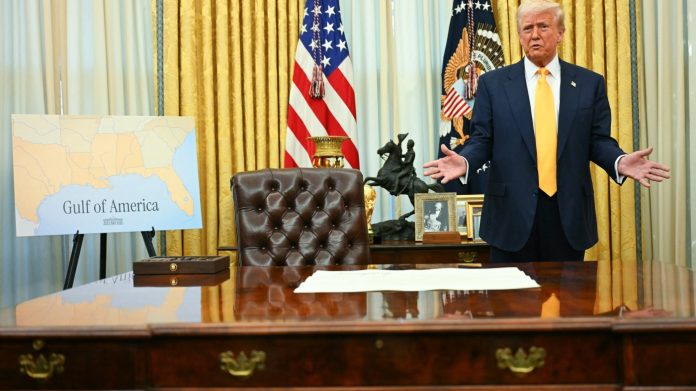
The Trump administration has blocked the Associated Press from covering several of the president’s events because it continues to refer to the body of water between Mexico and Florida as the Gulf of Mexico. Under President Trump’s direction, the U.S. has renamed it the Gulf of America.

JIM WATSON/AFP via Getty Images/AFP


hide caption

toggle caption

JIM WATSON/AFP via Getty Images/AFP

A federal judge has rejected the Associated Press’ plea that President Trump immediately let its reporters resume covering major events at the White House, on Air Force One and at his Florida estate Mar-a-Lago, according to a press rights group present at the hearing.

In denying the AP’s request for a temporary restraining order, however, U.S. District Court Judge Trevor McFadden ordered an expedited consideration of its lawsuit, the Reporters Committee for Freedom of the Press said. The AP is seeking to overturn the ban altogether; the judge set a court hearing for March 20th, at which he will consider the motion.

McFadden, a Trump appointee, found that there was not sufficient reason to issue an emergency degree; as Justice Department lawyers argued, the news agency has been able to rely on footage and coverage provided by other outlets.

However, the judge took pains to observe that the law has been “unhelpful” to administrations that have sought to put bans in place in the past. He advised government attorneys to reconsider their policy, the Reporters Committee for Freedom of the Press said.

A dispute over what to call the Gulf

For nearly two weeks, the Trump administration has kept AP reporters from covering major events due to the news service’s unwillingness to designate the Gulf of Mexico as the Gulf of America, as Trump had decreed in an executive order on his first day in office. The Justice Department argued, on the administration’s behalf, that access to the president is a privilege, not a right.

Trump told reporters last week, “We’re going to keep them out until such time as they agree that it’s the Gulf of America.”

The news agency had argued that the ban – which Edward Martin, the acting U.S. attorney for D.C, said in court papers emanated from Trump himself – was a violation of its First Amendment rights.

Judge McFadden “had a number of questions throughout the hearing that got to the fact that this is clearly viewpoint discrimination,” said Gabe Rottman, a senior attorney for the Reporters Committee for Freedom of the Press, who filed a friend of the court brief on the side of the AP. “And under the First Amendment, viewpoint discrimination is particularly disfavored. It’s almost never allowed.. It is ‘poison’ to a free society.”

After the ruling, the AP said it looked ahead to the March hearing. “We will continue to stand for the right of the press and the public to speak freely without government retaliation,” AP spokesperson Lauren Easton said in a statement. “This is a fundamental American freedom.”

The White House called the ruling a victory in a separate statement issued to NPR.

“As we have said from the beginning, asking the President of the United States questions in the Oval Office and aboard Air Force One is a privilege granted to journalists, not a legal right,” the White House press office said. The White House said it sought to hold “Fake News accountable for their lies” and called itself “the most transparent Administration in history.”

Martin also assailed the news agency in a social media post shortly before the judge’s ruling. “As President Trumps’ lawyers, we are proud to fight to protect his leadership as our President and we are vigilant in standing against entities like the AP that refuse to put America first,” he wrote. (The punctuation reflects that contained in Martin’s post.)

In taking the oath of office, Martin and other Justice Department attorneys swear fealty to the U.S. Constitution, not the president or any other person.

A historic presence in White House reporting pool

The AP serves audiences and news organizations across the globe; its stylebook is used by its journalists, as well as other news organizations and institutions. It recommends that writers use the body of water’s historic name, but acknowledge Trump’s desired shift in language.

In its lawsuit, the AP said that the White House’s retaliation is a threat to freedom.

Such events as Trump’s press conference with Indian Prime Minister Narendra Modi were off limits to AP reporters, as was Trump’s press conference at which he explained he intended to keep the ban on AP reporters at key events.

The AP’s lawsuit says it has “participated in the White House press pool since its creation over a century ago.”

The news agency says “that has made it possible for the AP to deliver to the public timely and thorough reporting on the president almost everywhere he goes, which is information critical to the public.”

In a written response filed ahead of the hearing, the Justice Department argued that the AP, like other news organizations, can cover the White House. There is no constitutional protection of what it termed “special media access,” wrote Martin and the head of the civil division in his office, Brian Hudak.

Their legal brief contained links to AP dispatches based on the materials it was able to acquire while not being allowed to attend events in person. (In one such instance, an AP visual journalist was present while a colleague who was a reporter was shut out.)

Members of the White House Correspondents’ Association, including the Trump-friendly outlets Fox News and Newsmax, wrote privately in support of restoring AP’s access to reporting pools.

AP guidance influences writers worldwide

On Tuesday, White House Chief of Staff Susan Wiles wrote that the White House took its action because the AP Stylebook is widely relied upon for writing and editing, by “journalists, scholars, and classrooms around our country.”

She added, “We remain hopeful that the name of the [Gulf] will be appropriately reflected in the Stylebook where American audiences are concerned.”

AP Executive Editor Julie Pace flew to Florida and met with Wiles in hopes of persuading her otherwise.

The AP’s legal briefs point to the interest of the president and the White House in insisting on specific word choices – what the news service considers to be independent editorial judgements – as the free speech violation demanding judicial correction.

White House spokesperson Steven Cheung had said that the White House would beat the AP in court, referring to its journalists as political partisans, and saying their “peanut-sized brains” had “rotted.”

Even so, Trump seemed to anticipate the White House might lose on the issue, musing aloud to a group of Republican governors last week, “Doesn’t matter. It’s just something that we feel strongly about.”

U.S. Votes Against U.N. Resolution Demanding Russian Withdrawal from Ukraine

0

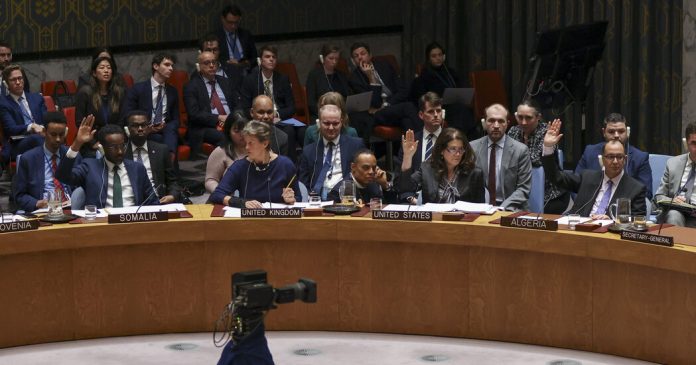
A showdown over Ukraine between the United States and its longtime European allies played out in the United Nations on Monday, as the United States opposed an effort to condemn Russian aggression and call for the immediate withdrawal of Russian forces from Ukraine.

After losing a vote on Ukraine in the U.N. General Assembly, the United States won approval in the U.N. Security Council for its own resolution calling for an immediate peace, without mentioning the Russian invasion of Ukraine or assigning any blame. Security Council resolutions, though sometimes flouted, are considered legally binding, giving added weight to President Trump’s push to negotiate an end to the war.

In both the General Assembly and the Security Council, the United States and some of its closest allies, including Britain and France, were in opposing camps on Monday, a remarkable public fissure between countries that have typically stood together when it comes to Russia and Europe’s security. Coming on the third anniversary of Russia’s full-scale invasion of Ukraine, it demonstrated the sharp turn in U.S. foreign policy under President Trump.

The U.S. “resolution puts us to the path to peace,” said Dorothy Camille Shea, the interim chargé d’affaires representing the United States, after the Security Council vote. “Now we must use it to build a peaceful future for Ukraine, Russia and the international community.”

But Britain’s ambassador, Barbara Woodward, in explaining its opposition to the measure, said: “The terms of the peace must send a message that aggression does not pay. This is why there can be no equivalence between Russia and Ukraine in how this council refers to the war.”

The face-off at the United Nations began with a three-page resolution introduced by Ukraine, demanding Russian withdrawal, calling for a “comprehensive, lasting and just peace,” and for accountability for Russia’s war crimes.

Three western diplomats and a senior U.N. official said that the Trump administration had tried last week to persuade Ukraine to withdraw its resolution, and when that failed the administration attempted to negotiate with European allies on a text that it would support.

But on Friday afternoon amid negotiations, the United States told its European allies that it planned instead to put forth its own resolution. Days earlier President Trump had called Volodymyr Zelensky, the Ukrainian president, a “dictator” and falsely asserted that Ukraine had started the war.

European diplomats said they were furious that their longtime ally had abandoned the talks and sided against them.

The U.S. resolution was three short paragraphs. It did not mention Russia’s aggression or condemn the invasion. It mourned the loss of life on both sides and said that the United States “implores a swift end to the conflict and further urges a lasting peace between Ukraine and Russia.”

When the U.N. General Assembly took up the dueling measures on Monday, it approved the Ukrainian resolution by a vote of 93 nations in favor to 18 against, with 65 abstaining. The Assembly broke out into applause.

Among the 18 countries that voted against Ukraine’s resolution were Russia, the United States, Israel, Hungary, Haiti, Nicaragua and Niger.

“This is a moment of truth, a historic moment,” Mariana Betsa, Ukraine’s deputy foreign minister, told the General Assembly, one that would define the future of Ukraine and the free world.

But Ms. Shea, the U.S. representative, noted that previous U.N. resolutions that condemned Russia and called for it to withdraw had failed to alter the course of a war that has killed hundreds of thousands of people.

“Those resolutions have failed to stop the war,” said Ms. Shea. “It has now dragged on for far too long, and at far too terrible a cost to the people in Ukraine, in Russia, and beyond.”

When the General Assembly took up the U.S. resolution, it approved three amendments by European countries, adding language that called out Russia as the invading aggressor. The Assembly then approved the amended resolution by a vote of 93 to 8, with 73 abstentions. The United States abstained on the amended version of its own resolution.

Hours later, the clash shifted to the 15-member Security Council, where the Trump administration once again sought approval of its resolution that did not lay blame for the war.

U.S. allies tried and failed to postpone a vote on the measure, which Ms. Shea called it “elegant in its simplicity.” Then they tried to amend the resolution, much as they had in the General Assembly, to be more favorable to Ukraine, but Russia exercised its veto power to defeat those attempts.

Finally, the Security Council voted on the U.S. resolution as it was introduced, approving it by a vote of 10 to 0, with 5 abstentions. Rather than use their own veto power, Britain and France were among those that abstained.

Nicolas de Rivière, France’s ambassador, said his country supports a just peace, “and not a capitulation of the victim.”

“There will be no peace and security anywhere if aggressions are rewarded and if the laws of the jungle wins,” he said.

Richard Gowan, the U.N. director for the International Crisis Group, which researches and monitors armed conflicts, said the United Nations had not seen such a consequential split between the U.S. and Europe since the war in Iraq, and that the current division was more pointed because it involved the security of Europe.

“European diplomats are livid with how the U.S. has maneuvered against them,” said Mr. Gowan. “The E.U. and Ukraine tried to keep Washington in the loop while drafting their resolution. The way the U.S. swung in with its own texts very aggressively at the last moment has left the Europeans off-balance.”

Lawsuit challenges Trump administration's mass firings and '5 things' email

0

Labor unions have sued the U.S. Office of Personnel Management over the Trump administration’s firing of tens of thousands of employees and its email to federal workers asking what they did last week.

Ukraine Nears a Deal to Give U.S. a Share of Its Mineral Wealth

0

Ukraine and the United States are closing in on an agreement that would grant Washington a share of Kyiv’s revenues from natural resources, President Trump and a Ukrainian government official said Monday, after an intense pressure campaign from the American president to strike a deal.

Mr. Trump said that President Volodymyr Zelensky of Ukraine may come to the White House this week or next week to sign the agreement. “The agreement’s being worked on now. They’re very close to a final deal,” Mr. Trump said on Monday at the White House.

Earlier in the day, Ukraine’s deputy prime minister, Olha Stefanishyna, posted on X that “Ukrainian and U.S. teams are in the final stages of negotiations regarding the minerals agreement.”

A version of the agreement being discussed Monday, which was reviewed by The New York Times, contained more favorable terms to Ukraine than previous drafts but did not include security guarantees Ukraine had been requesting as it struggles to fight Russia’s invasion.

Four people, who have been briefed on the deal and spoke on the condition of anonymity to discuss confidential negotiations, said those were the terms being discussed. Two of the people said the talks were still ongoing as of Monday evening. So the terms of the deal, which was not final, could still evolve.

The question of mineral wealth is tied up in conflicts over U.S. military and financial aid to Ukraine, and over how to end the war. Mr. Zelensky has said Ukraine must have Western arms and backing in any peace deal, to prevent a future Russian assault, while Mr. Trump has insisted the war must end quickly, without offering such security guarantees.

“This economic agreement with Ukraine will not be a guarantee of future aid for war, nor will it include any commitment of U.S. personnel in the region,” a White House official said on Monday.

The draft seen by The Times no longer included a U.S. demand that Ukraine commit to giving the United States $500 billion in revenue generated from natural resources, including oil, gas and minerals.

The White House has described that request as compensation for past American military and financial aid, but Ukraine balked, saying it would create a huge financial burden for future generations.

Nor would Ukraine be required to repay twice the value of future American aid, one of the conditions in an earlier draft.

But the version obtained by The Times showed that the United States is not offering the security guarantees to deter further Russian aggression that Ukraine has been requesting.

The request for U.S.-backed security guarantees has been a standing demand of Mr. Zelensky. The absence of any guarantee was one reason the Ukrainian leader refused to sign previous draft agreements.

Last week, Mr. Trump called Mr. Zelensky “a dictator” and appeared to falsely accuse Ukraine of starting the war, and on Monday his administration opposed a U.N. resolution, backed by most U.S. allies, that called Russia the aggressor.

The document obtained by the Times, dated Feb. 24, lists Mr. Trump and Mr. Zelensky as required signatories.

Under the terms of the draft agreement, Ukraine would relinquish half of its revenues from the future monetization of natural resources. Those revenues would be directed to a fund in which the United States would hold the maximum percentage of financial interest allowed under U.S. law, but not necessarily all of it.

Those provisions are an improvement for Ukraine. A previous draft agreement dated on Saturday said the U.S. would have 100 percent interest in the fund and that Ukraine would contribute to it with revenues from both current and future natural resource extraction projects.

The new draft agreement instead says the fund will reinvest revenues in Ukraine — though it remains unclear what percentage — and will be designed to attract further investment. It also says the United States will maintain long-term support for Ukraine’s economic development.

The White House has argued the mere presence of American economic interests in Ukraine would deter future Russian aggression, even without specific assurances spelled out in the deal.

“What better could you have for Ukraine than to be in an economic partnership with the United States?” Mike Waltz, the U.S. national security adviser, said on Friday.

Maggie Haberman contributed reporting.

President Trump names right-wing podcast host Dan Bongino as FBI deputy director

0

President Trump has named right-wing podcast host Dan Bongino as the FBI’s deputy director. That means Bongino will be the number two official behind the recently confirmed director Kash Patel.

Tuesday Briefing: The Ukraine War’s 3rd Anniversary

0

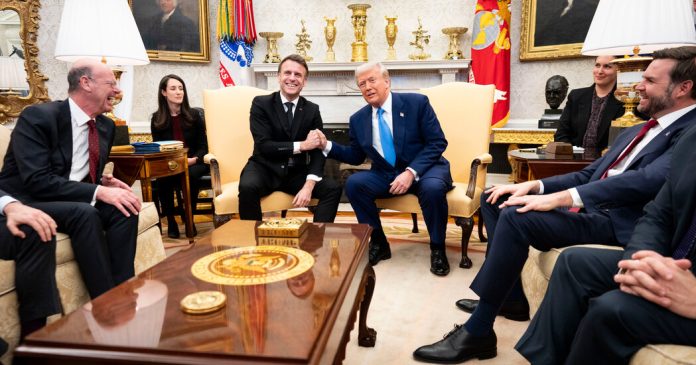
President Trump met with President Emmanuel Macron of France at the White House yesterday at a head-spinning time for Western alliances. It was the third anniversary of the war in Ukraine, and peace talks with Russia have sidelined Kyiv and European leaders. Here’s the latest.

Trump told reporters while sitting next to the French president that the fighting could be over “within weeks,” and he suggested that he may visit Moscow as soon as this spring. He refused to call President Vladimir Putin of Russia a dictator.

The U.S. opposed a European effort at the U.N. to condemn Russia and call for it to immediately withdraw from Ukraine. The Trump administration introduced its own resolution, which softened the language and called only for an end to the war, essentially siding with Moscow over longtime allies.

Analysis: Zelensky has mostly played weak hands wisely during the war, but his approach to Trump has resulted in hostility. Is his strategy ultimately harming Ukraine?

Mousa Abu Marzouk, the head of Hamas’s foreign relations office, told The Times that he wouldn’t have supported the Oct. 7, 2023, attack if he had known of the devastation Israel would wreak on Gaza. The Israeli offensive in the enclave has killed thousands of Palestinians and reduced it to rubble.

It’s unclear to what extent Abu Marzouk’s views on Oct. 7 are shared by other Hamas leaders, who have tended to take a harder line, or if he shared them in an attempt to influence negotiations with Israel.

What’s next: The truce between Hamas and Israel is set to end Sunday, but both sides have yet to begin negotiating an extension. Steve Witkoff, Trump’s Mideast envoy, said he would return to the region tomorrow to push for a new truce.

While a brief extension of the cease-fire is possible, the likelihood of a long-term deal seems remote. Here’s what could lie ahead.


Some North Koreans are assigned by their government to work on board Chinese tuna ships in the Indian Ocean. Their earnings go straight to Kim Jong-un’s regime, according to a report published yesterday by the Environmental Justice Foundation. The report described “forced labor” conditions in which workers went years without setting foot on land, and were often cut off from their families.

Context: The U.N. bans member states from hiring North Korean workers because it says Kim uses them to raise funds for a nuclear weapons program. But last year more than 100,000 North Koreans were reported to be still working in 40 countries.


Across the West, voters are lurching to the right. Yet, in Denmark, the governing Social Democrats have pursued bold progressive policies since 2019, cruising to re-election in 2022. One issue sets them apart from their progressive counterparts in Europe: A far more restrictive stance on immigration.

Lives lived: Roberta Flack, the singer and pianist whose blend of soul, jazz and folk made her one of the most popular artists of the 1970s, died at 88. Get to know her essential songs.

Many resorts around the world are embracing landscapes in their more natural states, instead of the social-media-perfect beaches of fine white sand and unobstructed ocean views. Most of those magical vistas are very much the work of humans, anyway.

Preserving native vegetation aids a healthy ecosystem, strengthens natural defenses against climate change and provides habitats to native species. It also transforms ideas about what kind of tropical beach is worthy of a week’s vacation. Read more here.

Trump says Putin will allow European peacekeepers in Ukraine : NPR

0

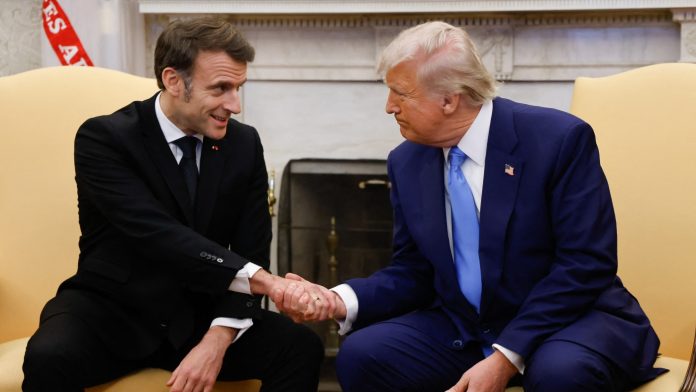
President Trump meets with French President Emmanuel Macron in the Oval Office of the White House on Monday.

Ludovic Marin/AFP via Getty Images


hide caption

toggle caption

Ludovic Marin/AFP via Getty Images

President Trump thinks the war in Ukraine could end “within weeks.” And he said that Ukraine’s President Volodymyr Zelenskyy could visit him at the White House in the next two weeks to sign a rare earth and critical minerals deal as part of a larger package of security guarantees.

In a meeting with French President Emmanuel Macron in the Oval Office Monday, Trump added that Russian President Vladimir Putin would accept European peacekeepers in Ukraine as part of a peace deal.

“Once we settle, there’s going to be no more war in Ukraine,” Trump predicted. “It’s not going to be a very big problem.”

Macron is meeting with Trump on the third anniversary of Russia’s large-scale invasion of Ukraine. Macron came to Washington as part of efforts by European leaders to coax Trump to not abandon Ukraine as he negotiates a peace agreement with Putin.

On Thursday, Trump will meet with U.K. prime minister Keir Starmer.

During their time together in the Oval Office, Macron confirmed that some European countries would be ready to send troops to Ukraine, but in a limited role.

“They would not be along the front lines. They would not be part of any conflict,” Macron said. “They would be there to ensure that the peace is respected,” he added.

The meeting was largely friendly with the two leaders exchanging stories and affectionate touches. But they did disagree on the extent of Europe’s support for Ukraine.

Trump described Europe’s help as a loan before Macron sought to correct him, noting the amount paid to Ukraine.

“If you believe that, it’s okay with me,” Trump responded, smiling. “They get their money back. We don’t, and now we do.”

Why Tensions Are Rising Over Israel’s Operations in the West Bank

0

Israeli operations against militants in the West Bank have escalated to a level not seen since the Second Intifada of the early 2000s. Tens of thousands have been forced to flee their homes, with Israel’s defense minister saying they will not be allowed to return. And for the first time in two decades, Israeli forces have sent tanks into the city of Jenin and established a military post in another, Tulkarm.

Israel appears to be laying the groundwork for a prolonged military presence in the area, and Palestinian officials are warning of a “dangerous escalation” that risks both a new generation of displacement and putting parts of the West Bank back under military control.

Here’s what to know about what is happening in the West Bank.

The biggest displacement in the West Bank since the 1967 war.

Just two days after Israel’s cease-fire with Hamas went into effect in Gaza on Jan. 19, Israeli forces shifted their focus to militants in the northern West Bank, namely Jenin, Tulkarm, and Tubas — and particularly on the refugee camps there.

Palestinians fear these expanding operations mask a plan for widespread displacement and reassertion of Israeli control over areas administered by the Palestinian Authority, the semiautonomous body that has run parts of the West Bank since the 1993 Oslo Accords.

Experts estimate that since Jan. 21, when the latest Israeli operation began, 40,000 people have been displaced. They are now sheltering everywhere from wedding halls and schools to mosques and municipal buildings.

Although about 3,000 people have since returned home in Tubas, where military operations have ended, the displacement of so many people evoked painful memories of the Nakba, the Arabic word that has been used to refer to the mass flight and expulsion of Palestinians during the 1948 war that created Israel. Most Palestinians forced to flee now are from the refugee camps made to house those displaced in 1948.

Israel vows an operation “as long as needed”

Israel says the campaign is a response to a rising threat of militancy from the West Bank. The Israeli military denies any forced evacuations, but has said it ordered people to leave buildings close to what it said were militant hide-outs.

On Sunday, Israel sent three tanks into the West Bank, after bombs exploded on three empty buses in Tel Aviv last Thursday and a fourth explosive was found and dismantled. No casualties were reported, but the police have said the devices resembled explosives made in the West Bank, and the news shocked Israelis, who feared a return to the deadly bombings of the mid-1990s and early 2000s.

Earlier this month, two Israeli soldiers were killed as the military broadened its campaign in the West Bank, not long after the Palestinian Authority had begun its own deadly operation against militants in the territory.

Benjamin Netanyahu, Israel’s prime minister, said on Sunday that Israeli forces would remain in the West Bank “as long as needed.” Israel Katz, the defense minister, said he had told the military “not to allow residents to return and terrorism to grow back.”

The comments came after both leaders visited a neighborhood in the Tulkarm refugee camp, an appearance seen as provocative to Palestinians because the region is under the control of the Palestinian Authority.

Palestinians fear expanding Israeli military control.

Palestinian municipal officials in Jenin say there are also indications that Israeli forces are seeking to impose long-term control over parts of the northern West Bank.

Mohammad Jarrar, the mayor of Jenin, said Israeli authorities sought to persuade locally elected officials to reopen the city despite ongoing Israeli military operations. They proposed plans to build new roads and, more alarmingly to the Palestinians, to turn the Jenin refugee camp into a district of the town. That could effectively force out UNRWA, the United Nations agency for Palestinian refugees, and shake up the social fabric of Jenin. But Mr. Jarrar said Israeli officials appeared determined to move forward with the plan without their consent.

The efforts also appear to be an attempt by Israel to sideline the Palestinian Authority, local officials have said.

“They want people to coexist and accept their presence in the area — this suggests a long-term plan,” Mr. Jarrar said. “What is happening in Jenin can only be described as a re-occupation of the city.”

Israeli West Bank operations have caused widespread destruction.

Last year, the Israel Defense Forces mounted some of their most damaging campaigns in the West Bank in decades. The campaigns this year unleashed a new wave of devastation, according to local officials.

The head of the refugee camp services in Tulkarm, Faisal Salameh, said that because of widespread raids in recent weeks, two refugee camps in Tulkarm city are under lockdown, and in some districts, shopkeepers have been harassed and detained for hours.

In Jenin, some 120 homes have been demolished, according to the local authorities, while local officials say more than 50 buildings have been demolished in Tulkarm.

Bulldozers have ripped up swaths of road and severed sewage lines. Electricity, water and communications services have been cut off in many areas.

Mr. Jarrar said that despite the ongoing campaigns, Israeli forces had asked officials in his city to begin work repaving roads, a request he called “absurd” because roads that have been repeatedly repaved are then ripped up by Israeli vehicles, creating work that has pushed the local authorities toward bankruptcy.

In another move that drew local suspicions, Israel offered to pay for the repaving, something Mr. Jarrar said locals could never accept.

“We refuse to cooperate with the occupation in any form,” the mayor said.