Friday, November 13, 2026
Home Blog Page 190

North Koreans on Chinese Tuna Boats Boost Revenue for Kim Jong-un

0

They spent up to 10 years at sea, toiling in some of the harshest conditions distant-water fishing crews ​can face. Many never set foot on land because their Chinese captains did not want them to be seen by the port authorities. Most of their salaries went directly to their government, and some of their catch has likely ended up on dining tables in Europe and Asia.

These were North Koreans assigned by their government to work on board Chinese tuna longliners operating in the Indian Ocean, according to a report ​published on Monday by the London-based Environmental Justice Foundation. Through them, North Korea’s leader, Kim Jong-un, established new source of revenue ​for his cash-strapped regime.

The United Nations bans member states from hiring North Korean workers because its Security Council says Mr. Kim’s government uses them to raise funds for its nuclear weapons program. But Mr. Kim sends tens of thousands of his people abroad to earn cash and other benefits for his regime.

They have worked in factories and restaurants in China, logging camps and construction sites in Russia and farms and shipyards in Eastern Europe​. They have sweated on construction sites in the Middle East and built monuments for dictators in Africa. An estimated 11,000 North Koreans were sent to fight for Russia in its war against Ukraine.

Until now, the fate of North Korean fishermen has drawn little global attention because they were in vast oceans, cut off from the rest of the world and even their own families for years at a time.

The conditions they faced “would constitute forced labor of a magnitude that surpasses much of that witnessed in a global fishing industry already replete with abuse,” the foundation said in its report, shared with The New York Times ahead of its publication.

Regulatory and other data available suggested that the products from these ships may be entering the European, British and Asian markets, the foundation said. The group discovered at least 12 Chinese-flagged tuna longliners using North Korean labor between 2019 and last year, and four of them were authorized to export fish to Europe and the United Kingdom, it said. Carrier ships suspected of collecting fish from these Chinese vessels at sea have visited markets in Asia, including Japan, Taiwan and South Korea, it said.

“If it was your husband, brother, father, son who’s being held on a vessel for months or years at sea with no option to get off, I think you can understand what it means and how this product is being produced and why we shouldn’t be eating it,” said Steve Trent, the foundation’s CEO. “These laborers are not free to choose how and when they work. They’re being coerced onto these vessels and kept there.”

The foundation, which campaigns on environmental and human rights issues, based its findings on evidence that included interviews with 19 Indonesian and Filipino shipmates who said they had worked with North Koreans. Its investigators also obtained video clips that mentioned North Koreans being on board and showed shipmates speaking in Korean. Three of the Indonesian seamen also spoke separately to The New York Times. The Times is not revealing their identities because they could work again on Chinese fishing vessels.

Crew members said they communicated with the North Koreans using body language and bits of Mandarin and each other’s languages that they picked up while working together.

They told how North Korean crews were usually transferred to sister vessels at sea before their ships docked, and moved back again later. Crewmen who landed could use their mobile phones to call families, but the North Koreans ​did not even have mobile phones.

If their presence was discovered by foreign port authorities, it could create legal trouble for their Chinese captain: In December 2022, news media in Mauritius reported the arrest of six North Korean workers and the captain of a Chinese fishing vessel.

“I docked in Somalia, Mauritius, Australia, Madagascar and Somalia again, and the North Koreans were always transferred,” said a former Indonesian fisherman who said he worked with six North Koreans from late 2022 to last June. “One of them told me that he has a wife whom he never contacted during the seven years he’s been gone.”

On these Chinese ships, most crew members had their passports taken so they could not abscond. They caught only five to six hours of sleep a day, but the North Koreans were often the most skilled workers on board because of the time they had spent at sea. The second former Indonesian fisherman remembered how the North Koreans on his ship urged others to work faster, shouting the North Korean phrase for “hurry up”: ppallihara.

The pandemic extended the time at sea for some North Koreans as their country kept its borders closed until late 2023. They worked through the pandemic, some transferring to other Chinese ships midocean after their three- or four-year-contract ended.

“Their families don’t have any idea whether they are still alive or not,” said the third Indonesian fisherman, who said he had worked with three North Koreans. “They never said how they felt. But I can’t imagine how you didn’t set foot on land for eight years.”

The Indonesian crewmen earned about $330 per month but did not know how much the North Koreans made. The North Koreans told them that their ​salaries went straight to their government. One Indonesian crewman said the North Koreans lived only on bonuses they earned. Another said they were allowed to keep $50 of their salary.

“They really save up all the money,” one of the Indonesian fisherman said. “They showed me all the cents they collected.”

The Chinese distant-water fleet is by far the world’s largest.​ The foundation​ said it could not estimate how many North Koreans were working on Chinese fishing vessels around the world​ until a more extensive study was done.

For more than three decades, North Korea has sent workers abroad, earning up to billions of dollars a year, according to South Korean estimates.

In 2017, the U.N. Security Council adopted a resolution ​requiring U.N. member countries to expel North Korean workers by the end of 2019. But more than 100,000 North Koreans were still working in 40 countries, a U.N. panel of experts reported last year.​

North Korean workers are ​required to spy on each other when they go abroad and to maintain a life of indoctrination.

The North Koreans’ former shipmates remembered them showing videos of military parades and their leader, Mr. Kim, giving speeches. They often put on their ​best clothes, hung their flag and sang, while standing straight. ​

But their former shipmates could tell how homesick the North Koreans were. One of the Indonesian shipmates recalled a time when a North Korean colleague was finally allowed to go home.

“He was so excited and anxious that when we told him to get some rest, go to sleep, he refused,” he said. “He just sat there out on the deck watching other crews working.”
Germany Election Maps: How Conservatives Regained Power

0

How the 630 seats will be distributed

Germany’s conservative Christian Democrats (CDU/CSU) won Sunday’s election as voters rebuked the nation’s left-leaning government for its handling of the economy and immigration.

Provisional results by party

Party Votes Pct. Seats
CDU/CSU 14,158,432 28.52 208
AfD 10,327,148 20.80 152
SPD 8,148,284 16.41 120
Greens 5,761,476 11.61 85
Die Linke 4,355,382 8.77 64
Others 2,273,817 4.58 1
BSW 2,468,670 4.97 0
FDP 2,148,878 4.33 0

Voters gave the far-right Alternative for Germany (AfD) party the second-highest number of seats in Parliament, ahead of Chancellor Olaf Scholz’s center-left Social Democrats (SPD) and the Greens, according to provisional results.

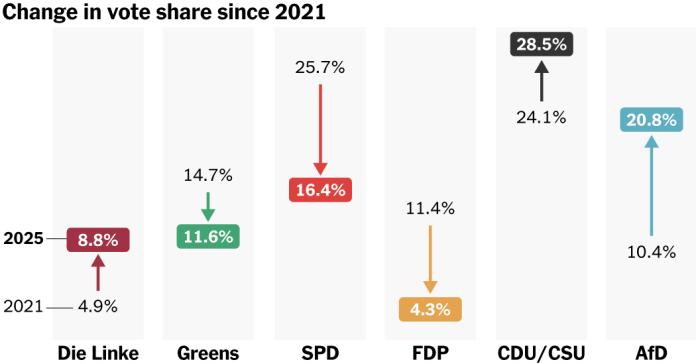
Change in vote share since 2021

The Christian Democrats, AfD and Die Linke won more votes than in the last general election.

There were smaller surprises, including the last-minute surge of the far-left party Die Linke. The liberal and pro-business Free Democrats (FDP), who had been a part of the last government until November, did not meet the 5 percent vote threshold they would need to maintain seats in Parliament. The Sahra Wagenknecht Alliance (BSW), a pro-Russia splinter from the old German left that formed last year, also fell just short of qualifying for parliamentary seats.

Highlighting the widespread discontent with Mr. Scholz’s government over the last three years, all three parties in the coalition — the Social Democrats, the Greens and FDP — lost support.

Vote shifts since 2021

Germans cast two votes when they go to the polls. The first vote goes to elect a direct representative for their district, while the second vote is cast for a party.

Arrows show the increase or decrease in each party’s vote share in the second vote, compared with the last general election.

Support for the Social Democrats plunged everywhere, but nowhere more than in the east. The Christian Democrats made gains throughout the southern and western districts.

The coalitions

The Christian Democrats will need to build a coalition to govern because they did not win an outright majority of seats. Given Sunday’s results, the most likely pairing is the CDU and the incumbent Social Democrats. That combination, known as a grand coalition, is historically stable and has been repeatedly tested, most recently during Angela Merkel’s final term as chancellor.

Mainstream two-party coalitions

CDU/CSU and SPD 328 total seats

CDU/CSU and Greens 293 total seats

Three party coalitions

SPD and Greens 205 total seats

CDU/CSU and Greens 293 total seats

CDU/CSU, SPD and Greens 413 total seats

Unlikely coalitions

CDU/CSU and AfD 360 total seats

316 seats needed
for majority

The largest possible coalition, the one between the Christian Democrats and AfD, is politically not an option, as mainstream parties have pledged not to work with the far-right party.

Kenyan Police Officer Deployed to Tackle Gangs in Haiti Killed

0

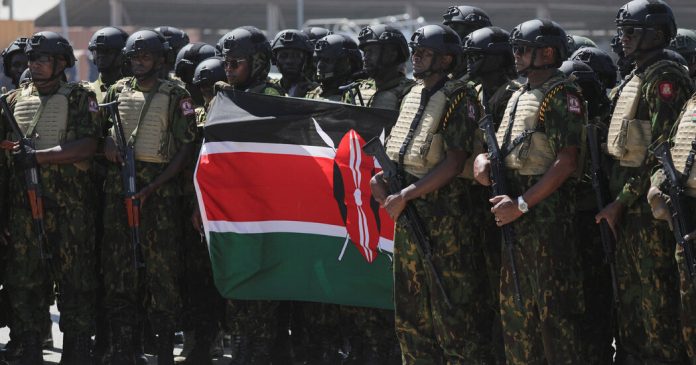
A Kenyan police officer was fatally injured in Haiti on Sunday in an operation that was part of the international effort to help combat gang violence and restore order to the Caribbean nation, officials said.

It appears to be the first death of a Kenyan officer working as part of the Multinational Security Support Mission, the international contingent that has been deployed in the Caribbean nation since June. The force is mostly made of Kenyan officers.

The officer was injured during an operation in the Artibonite region, north of the capital, Port-au-Prince, on Sunday, the Multinational Security Support Mission said in a statement on social media. The officer, who was not identified, was airlifted to the hospital but died later in the day, the mission said.

Hundreds of Kenyan police officers have been stationed in Haiti since June as part of a U.S.-sponsored mission to restore order. Since 2022, Haiti’s prime minister had appealed for a foreign armed intervention to help stop the rampant gang violence that has upended the nation.

The Multinational Security Support Mission, which also includes officers from Jamaica, the Bahamas, Belize, Guatemala and El Salvador, was deployed to Haiti to try to wrest control of Port-au-Prince from well-armed and highly organized Haitian gangs that had seized control of much of the capital.

This is a developing story that will be updated.

Israel and Hamas Accuse Each Other of Violating Cease-Fire Deal

0

Israel delayed the release of hundreds of Palestinian prisoners until Hamas assured the release of more hostages.

Monday Briefing: Conservatives Near Victory in Germany

0

The conservative Christian Democrats appeared to be on the cusp of victory in Germany’s parliamentary elections yesterday, exit polls show. The country’s next chancellor will almost certainly be Friedrich Merz, a businessman who has promised to crack down on migrants, and slash taxes and business regulations in a bid to kick-start economic growth.

Early exit polls indicated that the hard-right Alternative for Germany party, or AfD, was in second place with 19.5 percent of the vote, a result that was lower than predicted. With a voter participation of 83.5 percent, the election appears to have had the highest turnout since reunification 35 years ago.

President Trump was a late-arriving issue in the campaign. Merz vowed to bring stronger leadership in Europe at a moment when Trump had sowed anxiety on the continent by scrambling traditional alliances and embracing Russia. At a round-table debate yesterday, Merz slammed what he called “interference from Washington” in the election by Elon Musk and Vice President JD Vance.

What’s next: If the exit polls are correct, Merz is unlikely to have the easy option of forming a coalition with the second-place finisher. Like other party leaders, he has promised never to partner with the AfD, parts of which are classified as extremist by German intelligence.

The country’s defense minister, Israel Katz, said that tens of thousands of Palestinian residents who had been displaced by Israeli military actions in several West Bank cities would not be allowed to return to their homes. The Palestinian Authority’s Ministry of Foreign Affairs issued a statement saying that it considered Katz’s statements and Israel’s actions to be “a dangerous escalation.”

Context: The tank deployment came after bombs exploded on three buses in Tel Aviv last week. The police said the devices resembled those made in the West Bank. Nobody was killed or injured in the blasts.

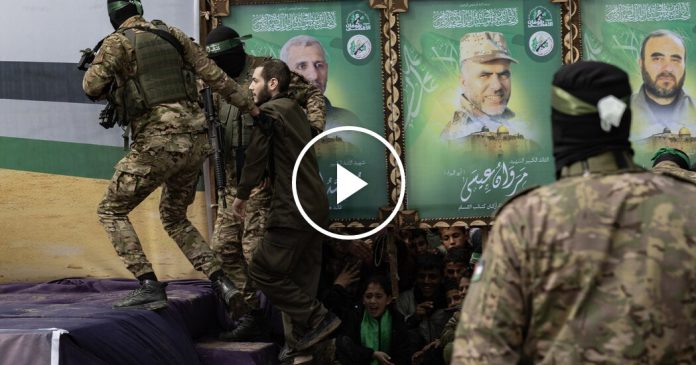
Cease-fire: Israel and Hamas yesterday accused each other of violating the Gaza truce after Israel delayed the release of Palestinian prisoners.

Lebanon: Hezbollah put on a show of strength yesterday with an elaborate funeral for its assassinated leader. The militant group hoped the event would revive its battered image.

President Volodymyr Zelensky of Ukraine said yesterday that he was willing to step down if it meant peace in Ukraine. He went so far as to say that he’d trade his departure for NATO membership for Ukraine — a highly unlikely scenario for several reasons. It was not immediately clear whether he had seriously considered stepping down or he was responding to the latest jabs from President Trump and Moscow.

Zelensky continued to push back against Trump’s insistence that he sign a minerals deal that Ukraine says is unpalatable. And he said that today over 30 countries would meet in a kind of coalition of support for Ukraine’s war effort.

Kneeling in the snow: For a Ukrainian village of only 400 people, a single battlefield casualty is a significant loss felt by the entire community.


A decade after the dream of mining asteroids in deep space crashed and burned, a private company is about to try again. This week, AstroForge plans to heave an oven-size spacecraft at an asteroid, hoping to kick off a rare-metal industry that could mean huge wealth for Earth. Success, though, is uncertain.

Lives lived: Carlos Diegues, a film director who celebrated Brazil and helped to forge a new path for cinema in his country, died at 84.

  • Beyond labels: Tate Modern in London is paying homage to Leigh Bowery, the indefinable performer whom Boy George once described as “modern art on legs.”

  • It takes a village: A writer bought a house, looking for a refuge. What she really needed was a community.

  • Waiting till after hell: Our critic A.O. Scott marvels at the power and paradox of a sonnet by Gwendolyn Brooks that is “at war with itself.”

Archaeologists have found a pharaoh’s tomb near the Valley of the Kings, in what Egyptian officials called the first excavation of a royal tomb since Tutankhamen’s over a century ago. The tomb belonged to Thutmose II, who is believed to have reigned around 1480 B.C.

The burial chamber is thought to have been built by his wife, Hatshepsut, who reigned after his death. Though the tomb was not filled with riches as Tutankhamen’s was, it contained clues — like alabaster jars and fragments of the royal netherworld book — that could offer insight into Egypt’s cosmopolitan 18th dynasty. Read more here.

OPM email stokes confusion and anger among federal workers

0

Some lawmakers and agencies diverged from an official Office of Personnel Management request for employees to document their work.

Germany Election Votes Are Cast. What Happens Now?

0

Now that the votes are cast, the real work in Berlin can begin.

While reconstituting parliament is relatively easy and must be done in the next three weeks, no party is expected to get enough votes to govern alone and outright. That means Germany is likely headed for a coalition government — and the process of building one could take months.

The party with the most votes on Sunday will have to find partners. Depending on how many small parties enter parliament and how well the big ones do, the next government could need two or three parties to get together.

In the coming days, Germany’s president, Frank-Walter Steinmeier, will invite the leader of the winning party — widely expected to be Friedrich Merz, from the Christian Democrats, or C.D.U. — to Bellevue Palace to ask him to try to form a government. That will involve talking with other parties to try to find the partners to get a majority — 316 seats — in parliament.

In reality, the leaders of parties have already been thinking about all that for some time, and certain options, like involving the hard-right Alternative for Germany, are unlikely. But the initial talks are important to show that all options are — theoretically, at least — on the table.

Next, parties that are open to a coalition will come together for pre-coalition talks. Held with just a few leaders from each party, those talks can be thought of as a really boring first date, where the parties check whether they might fit together. And sometimes, they don’t: In 2017, the leader of the liberal Free Democrats surprisingly broke off talks with Angela Merkel’s C.D.U. and Ms. Merkel had to start searching for a coalition partner all over again.

Once the parties agree that they can see a future together, they move on to formal coalition talks.

Those are the most complex part of the negotiations, and typically take the longest. Parties get together to agree on specific laws they hope to pass during their tenure and to divvy up ministerial posts. Just because party functionaries put so much time and effort into these discussions, however, does not mean that the coalition always ends in agreement.

As neighboring Austria showed when its conservative-far-right coalition talks surprisingly ended in January, the most likely outcome of such a failure would be to go talk with other parties again.

Once the coalition agreement is drafted, and the ministries set, parties may have to go back to their base to get approval. Only then do parties sign the agreement and return to parliament to elect the chancellor, who then names his ministers.

Until then, Olaf Scholz and his ministers will remain on as the caretaker government.

How long all of that would take remains to be seen; in the past, it has varied greatly from government to government. In 2017, it took 171 days. Ms. Merkel remained chancellor for 73 days after the 2021 election before being replaced by Mr. Scholz.

Relations sour across the U.S.-Canada border between Detroit and Windsor, Ontario

0

For decades, residents of Detroit, Mich., and Windsor, Ontario, across the river in Canada, have had close ties. A month into President Trump’s second term, relations have deteriorated.

Friedrich Merz, a Conservative, Appears Poised to Be Germany’s Next Chancellor

0

Germans voted for a change of leadership on Sunday, handing the most votes in a parliamentary election to centrist conservatives, with the far right in second, and rebuking the nation’s left-leaning government for its handling of the economy and immigration.

Early returns and exit polls almost certainly mean the country’s next chancellor will be Friedrich Merz, leader of the Christian Democrats. But he will need at least one or — in a possibility that Germans were hoping to avoid — two coalition partners to govern.

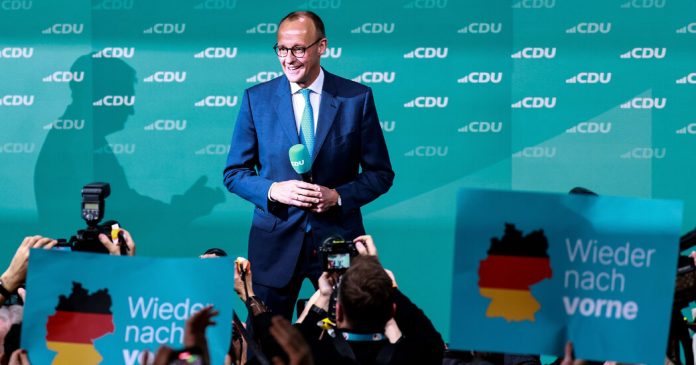
“We have won it,” Mr. Merz told supporters in Berlin on Sunday evening, promising to swiftly form a parliamentary majority to govern the country and restore strong German leadership in Europe.

The election, which was held seven months ahead of schedule after the collapse of Chancellor Olaf Scholz’s unpopular and long-troubled three-party coalition, will now become an essential part of the European response to President Trump’s new world order. It drew what appeared to be the highest voter turnout in decades.

Mr. Merz, 69, has promised to crack down on migrants and slash taxes and business regulations in a bid to kick-start economic growth. He also vowed to bring a more assertive foreign policy to help Ukraine and stronger leadership in Europe at a moment when the new Trump administration has sowed anxiety by scrambling traditional alliances and embracing Russia.

Mr. Merz, a businessman, was once seen as a potentially better partner for Mr. Trump, but in the campaign’s final days he mused about whether the United States would remain a democracy under Mr. Trump. He strongly condemned what Germans saw as meddling by Trump administration officials on behalf of the far-right Alternative for Germany, or AfD.

“My top priority, for me, will be to strengthen Europe as quickly as possible so that we can gradually achieve real independence from the U.S.A.,” Mr. Merz said in a televised round-table after polls closed. “I would never have thought I’d be saying something like this on TV, but after last week’s comments from Donald Trump, it’s clear that this administration is largely indifferent to Europe’s fate, or at least to this part of it.”

The first wave of returns and exit polls suggested that his Christian Democrats and their sister party, the Christian Social Union, would win a combined 29 percent of the vote. It was a low share historically for the top party in a German election, and the second-lowest showing ever for Mr. Merz’s party in a chancellor election.

Both are signs of the multiplying fissures in the nation’s politics and the weaknesses of the centrist mainstream parties that have governed Germany for decades.

There was great suspense on Sunday evening about the coalition Mr. Merz would be able to assemble, but he was clearly hoping for a rerun of the centrist governments that ran Germany for much of former Chancellor Angela Merkel’s 16-year tenure: the Christian Democrats in the lead, with the Social Democrats as a lone junior partner.

It was unclear if that would be possible. The Sahra Wagenknecht Alliance, which is a pro-Russia splinter from the old German left, was hovering near the 5 percent support needed to get into Parliament. If it clears the threshold, its presence could force Mr. Merz into a three-party coalition with two relatively liberal parties. Another party more ideologically aligned with Mr. Merz, the pro-business Free Democrats, appeared likely to fall below 5 percent and miss the cut.

The three-party scenario could mean the repeat of a potentially unwieldy and unstable government for Germany, reconfigured but with some of the same vulnerabilities as the one that recently collapsed.

The complication comes because Mr. Merz has promised never to join with the second-place finisher, the AfD, which routinely flirts with Nazi slogans and whose members have diminished the Holocaust and have been linked to plots to overthrow the government. But the returns showed that the AfD is a growing force in German politics, even if it fell short of its ambitions in this election.

The AfD doubled its vote share from four years ago, largely by appealing to voters upset by the millions of refugees who entered the country over the last decade from the Middle East, Afghanistan, Ukraine and elsewhere. In the former East Germany, it finished first.

Its vote share appeared to fall short of its high mark of support in the polls from a year ago, however. Many analysts had been expecting a stronger showing, after a sequence of events that elevated the party and its signature issue.

The AfD received public support from Vice President JD Vance and the billionaire Trump adviser Elon Musk. It sought to make political gains out of a series of deadly attacks committed by migrants in recent months, including in the final days of the campaign.

But that boon never materialized. Reaction to the recent attacks and the support from Trump officials may have even mobilized a late burst of support to Die Linke, the party of Germany’s far left, which campaigned on a pro-immigration platform, some voters suggested in interviews on Sunday.

For all of that movement, the most likely coalition partner for Mr. Merz appears to be the one analysts have predicted for months: Mr. Scholz’s center-left Social Democrats, even though they experienced a steep drop in support from four years ago.

The only other possible partner would appear to be the Greens, who appeared to be poised for fourth place in the voting. Negotiations with possible partners began soon after polls closed on Sunday.

Interviews and early returns suggested voters were angry at Mr. Scholz’s government over high grocery prices and inadequate wage growth.

Many voters, even those who backed the Christian Democrats, said they were not enthusiastic about Mr. Merz personally. But they hoped that he could forge a strong government to solve problems at home and abroad and keep Germany’s far right at bay.

“The biggest risk for Germany at the moment is that we will have an unstable majority,” said Felix Saalfeld, 32, a doctor in the eastern city of Dresden who voted for Mr. Merz’s Christian Democrats. “That’s why it’s best if the C.D.U./C.S.U. gets a lot of votes and we can somehow form a coalition with as few people as possible, even if it’s not my party.”

Mr. Merz will probably face a daunting task in attempting to reinvigorate a slumping economy that has not grown, in real terms, for half a decade. He also will seek to lead Europe in trade and security conflicts with Mr. Trump and an American administration that has rapidly been reshuffling its global alliances. Voters said they would look to the next government to cushion the pain of post-pandemic inflation.

“Everything is getting more expensive, and at the same time, wages are not rising,” said Rojin Yilmaz, 20, a trainee at Allianz in Aschaffenburg, a city where an immigrant with mental illness killed a toddler and an adult last month. Mr. Yilmaz voted for Die Linke.

In interviews in Dresden, a bastion of support for the AfD, some voters said they had lost faith in other parties to address immigration and other issues.

“I voted for the AfD,” said Andreas Mühlbach, 70. “It is the only alternative that is able to change things here.”

With support for the AfD on the rise, Martin Milner, 59, an educator and musician in Potsdam who split his ticket between the Greens and Die Linke, said he hopes German’s defensive democracy holds fast against the right-wing threat.

“I’m hoping that this system will show itself to be resilient enough,” Mr. Milner said, “that it can manage the problems we have without drifting to one extreme or the other.”

Reporting was contributed by Christopher F. Schuetze, Melissa Eddy and Tatiana Firsova from Berlin; Sam Gurwitt from Aschaffenburg; Adam Sella from Potsdam; and Catherine Odom from Dresden.

What does Trump's pick for labor secretary tell us about his priorities for workers?

0

NPR’s Don Gonyea speaks with labor historian Harley Shaiken about what President Trump’s pick for labor secretary, Lori Chavez-DeRemer, tells us about how he’s thinking about labor policy.