Friday, November 13, 2026
Home Blog Page 191

Friedrich Merz German elections – The New York Times

0

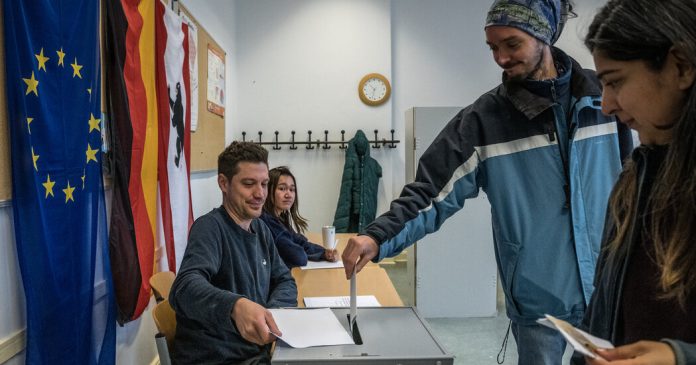
Germans voted for a change of leadership on Sunday, handing the most votes in a parliamentary election to centrist conservatives, with the far right in second, and rebuking the nation’s left-leaning government for its handling of the economy and immigration.

Early returns and exit polls almost certainly mean the country’s next chancellor will be Friedrich Merz, leader of the Christian Democrats. But he will need at least one or — in a possibility that Germans were hoping to avoid — two coalition partners to govern.

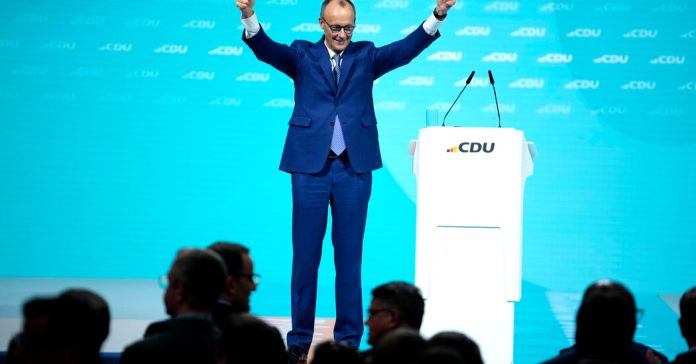
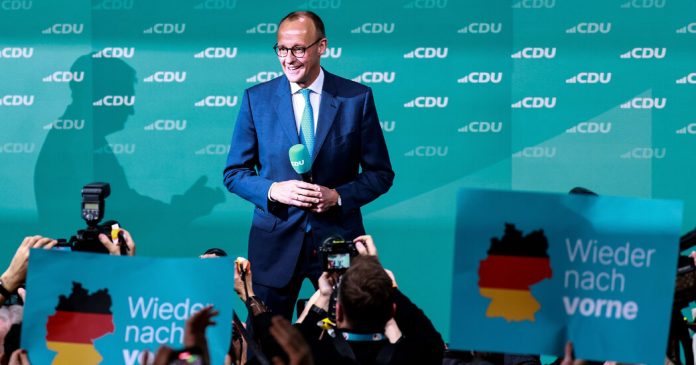
“We have won it,” Mr. Merz told supporters in Berlin on Sunday evening, promising to swiftly form a parliamentary majority to govern the country and restore strong German leadership in Europe.

The election, which was held seven months ahead of schedule after the collapse of Chancellor Olaf Scholz’s unpopular and long-troubled three-party coalition, will now become an essential part of the European response to President Trump’s new world order. It drew what appeared to be the highest voter turnout in decades.

Mr. Merz, 69, has promised to crack down on migrants and slash taxes and business regulations in a bid to kick-start economic growth. He also vowed to bring a more assertive foreign policy to help Ukraine and stronger leadership in Europe at a moment when the new Trump administration has sowed anxiety by scrambling traditional alliances and embracing Russia.

Mr. Merz, a businessman, was once seen as a potentially better partner for Mr. Trump, but in the campaign’s final days he mused about whether the United States would remain a democracy under Mr. Trump. He strongly condemned what Germans saw as meddling by Trump administration officials on behalf of the far-right Alternative for Germany, or AfD.

“My top priority, for me, will be to strengthen Europe as quickly as possible so that we can gradually achieve real independence from the U.S.A.,” Mr. Merz said in a televised round-table after polls closed. “I would never have thought I’d be saying something like this on TV, but after last week’s comments from Donald Trump, it’s clear that this administration is largely indifferent to Europe’s fate, or at least to this part of it.”

The first wave of returns and exit polls suggested that his Christian Democrats and their sister party, the Christian Social Union, would win a combined 29 percent of the vote. It was a low share historically for the top party in a German election, and the second-lowest showing ever for Mr. Merz’s party in a chancellor election.

Both are signs of the multiplying fissures in the nation’s politics and the weaknesses of the centrist mainstream parties that have governed Germany for decades.

There was great suspense on Sunday evening about the coalition Mr. Merz would be able to assemble, but he was clearly hoping for a rerun of the centrist governments that ran Germany for much of former Chancellor Angela Merkel’s 16-year tenure: the Christian Democrats in the lead, with the Social Democrats as a lone junior partner.

It was unclear if that would be possible. Two parties were hovering around the 5 percent of support needed to get into Parliament: the pro-business Free Democrats and the Sahra Wagenknecht Alliance, which is a pro-Russia splinter from the old German left. If both cleared the 5 percent threshold, Mr. Merz could be forced into a more difficult three-party coalition, unable to form a majority with just one partner.

That could mean the repeat of a potentially unwieldy and unstable government for Germany, reconfigured but with some of the same vulnerabilities as the one that recently collapsed.

The complication comes because Mr. Merz has promised never to join with the second-place finisher, the AfD, which routinely flirts with Nazi slogans and whose members have diminished the Holocaust and have been linked to plots to overthrow the government. But the returns showed that the AfD is a growing force in German politics, even if it fell short of its ambitions in this election.

The AfD nearly doubled its vote share from four years ago, largely by appealing to voters upset by the millions of refugees who entered the country over the last decade from the Middle East, Afghanistan, Ukraine and elsewhere.

Its vote share appeared to fall short of its support in the polls from a year ago, however. Many analysts had been expecting a stronger showing, after a sequence of events that elevated the party and its signature issue of migration.

The AfD received public support from Vice President JD Vance and the billionaire Trump adviser Elon Musk. It sought to make political gains out of a series of deadly attacks committed by migrants in recent months, including in the final days of the campaign.

But that boon never materialized for the AfD or for Mr. Merz, who drove his party to the right on migration in a bid to cut off a flow of voters to the AfD. Reaction to the recent attacks and the support from Trump officials may have even mobilized a late burst of support to Die Linke, the party of Germany’s far left, which campaigned on a pro-immigration platform, some voters suggested in interviews on Sunday.

For all of that movement, the most likely coalition partner for Mr. Merz appears to be the one analysts have predicted for months: Mr. Scholz’s center-left Social Democrats, even though they experienced a steep drop in support from four years ago.

Other possible partners include the Greens, who appeared to be poised for fourth place in the voting. Negotiations with possible partners began soon after polls closed on Sunday.

Interviews and early returns suggested voters were angry at Mr. Scholz’s government over high grocery prices and inadequate wage growth.

Many voters, even those who backed the Christian Democrats, said they were not enthusiastic about Mr. Merz personally. But they hoped that he could forge a strong government to solve problems at home and abroad and keep Germany’s far right at bay.

“The biggest risk for Germany at the moment is that we will have an unstable majority,” said Felix Saalfeld, a 32-year-old doctor in the eastern city of Dresden, who voted for Mr. Merz’s Christian Democrats. “That’s why it’s best if the CDU/CSU gets a lot of votes and we can somehow form a coalition with as few people as possible, even if it’s not my party.”

Mr. Merz will likely face a daunting task in attempting to reinvigorate a slumping economy that has not grown, in real terms, for half a decade. He also will seek to lead Europe in trade and security conflicts with Mr. Trump and an American administration that has rapidly been reshuffling its global alliances. Voters said they would look to the next government to cushion the pain of post-pandemic inflation.

“Everything is getting more expensive, and at the same time, wages are not rising,” said Rojin Yilmaz, 20, a trainee at Allianz in Aschaffenburg, a city where an immigrant with mental illness killed a toddler and an adult in January. Mr. Yilmaz voted for Die Linke.

In interviews in Dresden, a bastion of support for the AfD, some voters said they had lost faith in other parties to address immigration and other issues.

“I voted for the AfD,” said Andreas Mühlbach, 70. “It is the only alternative that is able to change things here.”

With support for the AfD on the rise, Martin Milner, 59, an educator and musician in Potsdam who split his ticket between the Greens and Die Linke, said he hopes German’s defensive democracy holds fast against the right-wing threat.

“I’m hoping that this system will show itself to be resilient enough,” Mr. Milner said, “that it can manage the problems we have without drifting to one extreme or the other.”

Reporting was contributed by Christopher F. Schuetze, Melissa Eddy and Tatiana Firsova from Berlin; Sam Gurwitt from Aschaffenburg; Adam Sella from Potsdam; and Catherine Odom from Dresden.
Musk’s ultimatum for federal workers doesn’t seem to line up with OPM policy : NPR

0

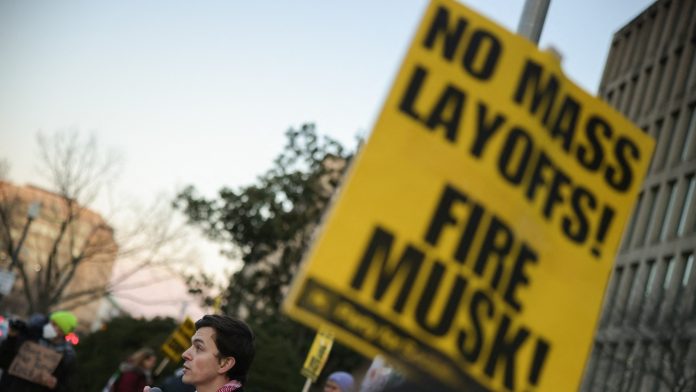
Demonstrators gather outside of the Office of Personnel Management in Washington, D.C., on Feb. 7 to protest federal layoffs and demand the termination of Elon Musk from the Department of Government Efficiency.

Bryan Dozier/Middle East Images/AFP via Getty Images


hide caption

toggle caption

Bryan Dozier/Middle East Images/AFP via Getty Images

A federal government-wide email asking employees “What did you do last week?” plunged workers and agencies into a weekend of confusion and conflicting directives.

Billionaire White House adviser Elon Musk said failure to reply would be taken as resignation. But some department officials told their employees they could hold off on responding.

Adding to the confusion is previous guidance from the Office of Personnel Management (OPM), the agency that sent the broad request, saying that responses to such mass emails were “voluntary.”

Federal workers resurfaced the OPM guidance after they received Saturday’s email, signaling their latest objection to changes pushed by Musk’s Department of Government Efficiency.

Musk teased the OPM notice Saturday afternoon, posting on his social media site X that “all federal employees will shortly receive an email requesting to understand what they got done last week.”

The leader of the DOGE initiative also said “failure to respond will be taken as a resignation.”

Many federal workers are covered by civil service protections that prevent them from being fired without cause, and the actual text of the email sent from an OPM address did not include the ultimatum. Employees were asked to reply with “approx. 5 bullets of what you accomplished last week and cc your manager” by Monday 11:59 p.m. ET.

The brief request would appear counter to a privacy impact assessment OPM published Feb. 5 that said any mass email sent from a government-wide email system would “explicitly” state engaging with the email would be voluntary.

The OPM assessment, published in response to a lawsuit challenging the Trump administration’s implementation of the email system, states seven different times that any response to the mass emails are “voluntary.” The government-wide email system was also used for the “fork in the road” deferred resignation offer.

“The Employee Response Data is explicitly voluntary,” the assessment reads. “The individual federal government employees can opt out simply by not responding to the email.”

The assessment notes that there is a risk that “individuals will not realize their response is voluntary,” a dynamic that quickly played out across the government in the hours after OPM’s Saturday email.

OPM did not immediately respond to NPR’s request for comment on Sunday about whether the email asking workers “What did you do last week?” aligned with the Feb. 5 guidance about voluntary responses.

OPM had said in an earlier statement that the emails are “part of the Trump Administration’s commitment to an efficient and accountable federal workforce,” and that “agencies will determine any next steps.”

Many supervisors and agencies instructed their employees to hold off on responding to the OPM email, according to emails reviewed by NPR, like a directive from new FBI Director Kash Patel that the agency would review its own processes first. The FBI email was confirmed by an individual at the bureau who isn’t authorized to speak publicly.

There are also questions about the legality of the request from OPM, which performs many human resources functions for the federal government.

Have information you want to share about the ongoing changes across the federal government? Reach out to Stephen Fowler through encrypted communications on Signal at stphnfwlr.25.

“The [“What did you do last week?”] email fails to identify any legal authority permitting OPM to demand the requested information,” Everett Kelley, national president of the American Federation of Government Employees, wrote in a letter to OPM’s acting director on Sunday. “OPM’s actions conflict with laws delegating the authority for the management of federal employees to their respective agencies and do not comport with OPM’s own regulations and guidance”

And though Musk wrote on X that responding to the OPM email would be simple and easy, Kelley said in her letter that she has “received numerous reports from dedicated civil servants, including those who care for our veterans and safeguard our nation, expressing frustration over the email’s tone and intent. Rather than fostering professionalism and respect for their work, this hastily written email left many feeling undervalued and intimidated.”

NPR’s Andrea Hsu and Ryan Lucas contributed reporting.

The Battle of Iwo Jima: A Photo History

0

Iwo Jima has always been beautiful, a volcanic chunk of rock surrounded by cobalt sea. But a World War II battle 80 years ago this month turned the Japanese island into a byword for desperate, deadly combat — and for American triumph.

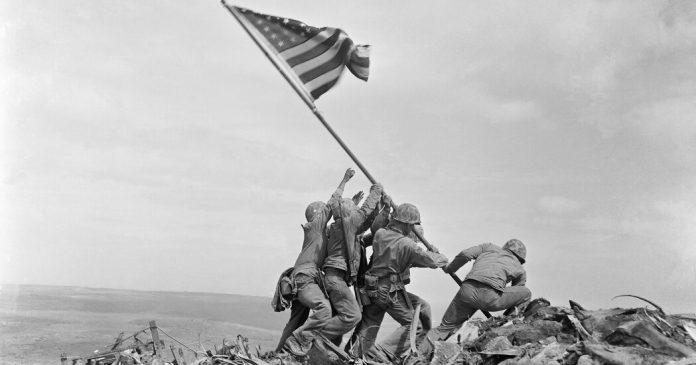
On Feb. 23, 1945, a contingent of American Marines climbed to the top of Mount Suribachi, the highest point of Iwo Jima. Atop the rubble of war and volcanic eruption, they pitched forward and raised an American flag. A photographer for The Associated Press, Joe Rosenthal, snapped an image, indelible and iconic.

My father, Keyes Beech, was also there, on that lonely island flung in the Pacific Ocean. He was a technical sergeant attached to the U.S. Marine Corps Fifth Division, a division that is no longer active in this more peaceful era. His job as a combat correspondent meant that he was to write about American valor and, hopefully, victory. But the conquest of Iwo Jima, despite the famous flag-raising four days into the battle, did not come for another month.

On the day the Stars and Stripes were unfurled on Mount Suribachi — twice, for good measure — my father told me he was jammed in a foxhole, trying not to get killed by the Japanese, something that would eventually happen to one of his friends, and then another, and then another.

Confined to an island then less than eight square miles, about the size of a busy international airport today, the Americans and Japanese were reduced to a kind of caged combat. Iwo Jima means “sulfur island” in Japanese, and Japan’s imperial army had fortified its caves with tunnels and other defenses. The charred island smoldered. Its bluffs and beaches became a vast cemetery, volcanic ash and black sand burying the dead.

Roughly 70,000 American soldiers fought to take Iwo Jima. More than 6,500 were killed. Of the 20,000 or so Japanese defending the island, about 19,000 were killed in combat. Some died in a final banzai charge; others ended their own lives rather than surrender to the Americans. Two hid in the warren of caves until 1949, emerging to a changed world nearly four years after the war had ended.

On March 26, 1945, Iwo Jima became the first chunk of Japanese land to be formally captured by the Americans. Less than five months later, the Japanese emperor surrendered, ending an imperial march across Asia that cut short millions of lives. American bombs, both atomic and incendiary, had devastated Japan as well.

After the war was over, the United States built a military base on Iwo Jima. In 1968, the island was given back to Japan. The Japanese villagers who were evacuated in 1944, as the island geared up for the coming battle, never returned. In 2007, the island was officially renamed Iwo To, as it was known before the battle, using a different pronunciation of the word “island.”

My father, like many veterans of that generation, did not talk much of World War II. He didn’t hold a grudge. He lived in Japan for about 30 years and married a Japanese woman, my mother.

He covered other battles in the Pacific, including ones Americans did not win. But Iwo, as he called it, pierced him. With American soldiers still fighting in the Pacific theater, my father joined a war bond tour, lurching around the United States with some of the flag-raising soldiers to drum up financial support for what turned out to be the waning days of World War II.

They drank far too much. It was the way back then. The term “post-traumatic stress disorder” didn’t exist.

When I was in middle school, we would drive in the Washington area, in our Nissan or our Plymouth — we had one car for each country — and we would sometimes pass the Marine Corps War Memorial, Mr. Rosenthal’s photo cast as a bronze statue. My father would go quiet. One hand stayed on the steering wheel. With his other, he would grip my hand. I knew to squeeze back.

Consider This from NPR : NPR

0

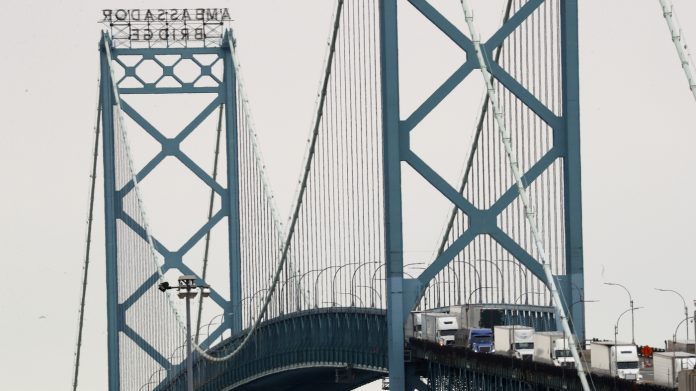
Vehicles move across the Ambassador Bridge between Detroit and Windsor, Ontario.

Paul Sancya/AP


hide caption

toggle caption

Paul Sancya/AP


Vehicles move across the Ambassador Bridge between Detroit and Windsor, Ontario.

Paul Sancya/AP

President Donald Trump’s tariffs and comments about turning Canada into the 51st state have tested U.S. relations with the country. One example is the deterioration of longstanding bonds between Detroit, Michigan and its neighbor across the river, Windsor, Ontario.

NPR’s Don Gonyea is a Detroit native and current resident of the city. He’s had a front row view to changing attitudes between the two populations who have long enjoyed a friendly, symbiotic relationship.

For sponsor-free episodes of Consider This, sign up for Consider This+ via Apple Podcasts or at plus.npr.org.

Email us at [email protected].

This episode was produced by Lauren Hodges and edited by Megan Pratz. Our executive producer is Sami Yenigun.

Why the Far-Right AfD Is Unlikely to Join Germany’s Next Government

0

Germany’s next government will almost certainly be a coalition of multiple political parties, to form a majority in Parliament. But one party will almost certainly be excluded from that coalition, no matter how well it ultimately performs: the hard-right Alternative for Germany, or AfD.

While early exit polls on Sunday showed the AfD in second place, largely on the strength of its opposition to mass migration and its pledge to deport some migrants, every other mainstream German party refuses to invite it into government. That blockade is known in Germany as the “firewall,” and it is a direct result of the country’s post-World War II efforts to suppress parties and voices labeled extreme.

Rival parties cite a wide array of evidence for calling the AfD extreme and for keeping it behind the firewall. Some parts of the AfD have been classified as extremist by German intelligence. Some of its members have been convicted of violating German law against the use of Nazi slogans, and others have been arrested for trying to overthrow the federal government. Recently, an AfD volunteer greeted fellow election canvassers, in front of a New York Times reporter, with a Nazi salute.

To date, Germany has been the most successful major European power at shutting its hard-right party out of power, along with France, where a group of rival parties engaged in strategic voting last summer to deny the hard-right National Rally a parliamentary majority.

Other such firewalls in Europe have fallen or come under pressure in recent years, including in the Netherlands, Hungary and Italy. Earlier this month, U.S. Vice President JD Vance urged all Europeans — including Germans — to work with hard-right parties that he cast as legitimate avatars of public anxiety over immigration. “There is no room for firewalls,” Mr. Vance said in Munich.

Germany’s political parties have promised to maintain the AfD firewall after the election — a pledge reiterated on Sunday night by Friedrich Merz, who is poised to become the next chancellor, after exit polls showed his party in the lead.

But if the AfD has an even stronger than expected showing — well above 20 percent — it could be harder for parties to work around it and may raise new questions about how long the blockade can last.

German Voters Took Note of Election Interference by Trump Administration Officials

0

Interference by Trump administration officials in the German campaign put off some left-leaning voters but was welcomed by others supporting the far-right Alternative for Germany, or AfD, according to a smattering of interviews at polling stations.

Several voters in the eastern city of Dresden took note of a speech by Vice President JD Vance at the Munich Security Conference this month, when he told European leaders to stop shunning parties deemed “extreme.”

Chris Buschmann, who said he is left-leaning but declined to say how he voted, said hearing Mr. Vance made him “anxious.” Mr. Buschmann, 27, said he is worried about the rise of right-wing populism both in Germany and around the world. He worries, he said, about “history repeating itself,” referring to Germany’s Nazi past.

Tim Adams, an engineer who split his ticket between the Green Party and Die Linke, the German left party, criticized attempts by the billionaire Trump adviser Elon Musk to influence the German election. Mr. Musk has endorsed the AfD and praised the party’s co-chair, Alice Weidel. Last month, he spoke at an AfD rally, telling the audience that Germany has “too much of a focus on past guilt.”

Those interventions have been “very bad for our politics,” Mr. Adams said.

Others voiced support for President Trump and his administration. Andreas Mühlbach and Anja Zeumer, both of whom voted for the AfD, said they welcomed the new American president.

In Aschaffenburg, Peter Kraus, a retired painter, said he voted for the AfD “with great joy” — and on the recommendation of Mr. Vance and Mr. Musk.

“When the American vice president says it, and Elon Musk, yeah, they have exactly my opinion,” Mr. Kraus said. “And I’m not as well-educated as those two.”

Who Is Friedrich Merz, the Man Poised to Be Germany’s Next Chancellor?

0

Friedrich Merz, the man favored by early exit polls to be Germany’s next chancellor after elections on Sunday, is a conservative businessman who has never been a minister and was forced out of government years ago in a power struggle with Angela Merkel.

The leader of the conservative Christian Democratic Union, Mr. Merz earned his fortune working in the private sector before returning to politics at 63.

That business background appealed to many Germans amid the political turbulence caused in part by stagnation in one of Europe’s largest economies.

Mr. Merz, now 69, was born and still lives in the Sauerland, a district of western Germany known for hills, heavy food and picturesque nature. It was from there that he was first elected into the European Parliament in 1989 and then the German Parliament in 1994.

While he comes from the same party as Ms. Merkel, the former chancellor, Mr. Merz — a pugnacious old-school politician — is in many ways her opposite.

He rose through the ranks to lead the Christian Democrats’ parliamentary group, but was ousted by a rising star in the party — Ms. Merkel. It was then that Mr. Merz pivoted from politics and started a lucrative law career.

He got rich working as a lawyer and a lobbyist. When Ms. Merkel was getting ready to retire, Mr. Merz got back into politics. In 2018, when he returned to the political stage, Mr. Merz promised he could stem the rise of the far-right Alternative for Germany party, known as the AfD, by moving his party further right on key issues like migration and crime.

Mr. Merz re-entered Parliament in 2021 and — after two failed attempts — won the party leadership in 2022.

As party leader, however, he made a number of gaffes — like claiming in September 2023 that refugees were having their teeth redone at taxpayers’ expense while regular German patients were unable to get appointments. (The head of the German Dental Association denied this.) And his insistence that he is just a regular member of the middle class — despite significant personal means — has been mocked by some Germans who see him as being divorced from the economic reality many members of the middle class face.

Still, Mr. Merz managed to coalesce his party around him and shift it to a more traditional conservative posture after Ms. Merkel’s long tenure took the party further to the left. His business experience is considered a strength, as he promises to restore growth to the German economy.

As chancellor, as a conservative and committed trans-Atlanticist, Mr. Merz would be considered a better match for President Trump than the current Social Democratic chancellor, Olaf Scholz. Mr. Merz is also expected to lead a foreign policy more aligned with Mr. Trump’s ideas about Europe’s taking responsibility for its own defense.

Still, Mr. Merz — who is known to be assertive and direct, if a bit awkward — pushed back strongly against Mr. Trump’s latest comments siding with Russia about Ukraine, as well as what was seen as interference in Germany’s election by Vice President JD Vance when he criticized Europe for sidelining far-right voters and their parties.

Boldness is characteristic of Mr. Merz, analysts say, and reflects a conviction that Germany must be more forcefully engaged in European and global affairs. Mr. Scholz has often been criticized for his tentativeness and caution, even from within his own coalition.

Just last month, Mr. Merz showed his willingness to act brashly when he presented a migration measure and then a bill in Parliament that he knew he could pass only with the hard-right AfD, despite earlier promises never to work with them. The political maneuver did not go well: It prompted hundreds of thousands of Germans to take to the streets in protest, dissent within his party and a rare public rebuke from Ms. Merkel.

Mr. Merz has vowed to carve out a more prominent German role inside the European Union and NATO, to pursue better relations with France and Poland, and to take a tougher stance against China, which he has described as a full member of the “axis of autocracies.”

He has also promised more forthright support for Ukraine’s battle against Russia — saying, for instance, that he would provide Ukraine with Germany’s long-range cruise missile, the Taurus. And Mr. Merz has pledged that Germany will meet and surpass the current NATO target of 2 percent of gross domestic product being spent on the military for the long term.

In a recent foreign-policy speech at the Körber Foundation, Mr. Merz, a former member of the European Parliament, promised to provide German leadership in Europe, which has not been a priority for Mr. Scholz, and to establish a national security council in the chancellery.

Germany Election 2025 Live Updates: Early Exit Polls Show Merz Poised to Be Next Chancellor

0

When Vice President JD Vance criticized his German hosts last week for sidelining far-right parties, he did not mention by name the Alternative for Germany, known as the AfD.

But soon after his speech at the Munich Security Conference, in which he stunned the room by comparing democracy in today’s Europe to Soviet-era totalitarianism, Mr. Vance met with Alice Weidel, the leader of the AfD.

A former investment analyst who is raising two sons with her Sri Lankan-born wife in Switzerland, Ms. Weidel, 46, has become the unlikely face of the AfD. Her nationalist party campaigns on a platform that is anti-immigrant and defines family as a father and a mother raising children.

A favorite of the new American administration — receiving an endorsement from Elon Musk — she has been essential to AfD’s effort to break into the mainstream, helping to vault the party into a comfortable second place ahead of Sunday’s national election.

Ms. Weidel, whose turtleneck sweaters or open-collared shirts and pearl necklaces have become signatures, has lent a more cosmopolitan image to a party that has been linked to neo-Nazis and plots to overthrow the state.

But her AfD is no less extreme. “With Alice Weidel at the helm, the AfD has steadily become more radical,” said Ann-Katrin Müller, an expert on the AfD who reports for Der Spiegel, one of Germany’s most prominent news outlets.

Ms. Weidel at an AfD rally in Halle, Germany, in December, when Elon Musk appeared by video link and endorsed the party.Credit…Hannibal Hanschke/EPA, via Shutterstock

The AfD is polling well ahead of the center-left Social Democrats of the incumbent chancellor, Olaf Scholz, and behind the conservative Christian Democrats of Friedrich Merz, the front-runner to be the next chancellor.

Those parties insist that they would never partner with Ms. Weidel’s party to form a government. But Ms. Weidel’s latest success in presenting the AfD as just another party came on Sunday, when she joined a televised debate with her mainstream rivals, who also included Robert Habeck, running for the Greens.

Ms. Weidel’s performance was widely judged to be uneven, but she left the event a winner nonetheless — it was the first time that AfD had been invited to such a debate, watched by millions of voters. At one point in the campaign, polls ranked her as the most popular chancellor candidate, across all parties.

But if Ms. Weidel’s professorial air and personal story suggest a softening of the party line, her language does not. She has promised to tear down wind turbines and to dismiss gender-studies professors. She has spoken about “remigration,” a term used by the far right that is widely interpreted as code for deportations.

“Make it absolutely clear to the whole world: German borders are closed,” she told a cheering crowd when the AfD officially nominated her as its candidate last month.

Ms. Weidel declined to speak to The New York Times for this article. In interviews with the German news media, she has been alternately charming and biting.

She has consistently refused to distance herself from her party’s most extreme members, some of whom have minimized the Holocaust and Germany’s Nazi past.

“She and the people behind her now dominate the party — and they are ideologically very close to Björn Höcke,” Ms. Müller said, referring to an AfD state leader who has been fined by a court for using Nazi language.

On Sunday Ms. Weidel told Bild, Germany’s largest tabloid, that she would put Mr. Höcke into her cabinet if she were to become chancellor.

Ms. Weidel grew up in a middle-class Catholic family in Harsewinkel, a town in North Rhine-Westphalia, in the country’s west, with two siblings and a dachshund. Her father was a salesman and her mother was a homemaker.

AfD activists campaigning for Ms. Weidel in Putlitz, Germany.Credit…Sergey Ponomarev for The New York Times

Her grandfather was a Nazi party member and was named a military judge in occupied Warsaw, Die Welt, a conservative daily, reported. Ms. Weidel responded that she did not know her grandfather, who died when she was 6, and that the Nazi past was never a topic of discussion in her family.

While finishing a Ph.D. in economics in Bavaria, she spent time in China. By her own account, she learned Mandarin. She later worked at Credit Suisse and Goldman Sachs as an analyst. In interviews with the German news media, she has spoken about her love of feng shui, and of swimming and tennis when she was a girl.

Officially she divides her time between her home in a small town in central Switzerland and a house in her voting district on Lake Constance, in southern Germany. But Ms. Weidel admitted that she does not spend much time at the German address.

She says it is because of safety concerns. Despite her party’s gains, she remains a lightning rod of public outrage in a country where a majority of Germans believe the AfD should be shunned.

Her absence from Germany has become something of a sore subject for the leader of a nationalist party. She walked out of an interview aired this week with a public broadcaster when she was asked how many nights she had slept at her German address. In the same interview, she admitted she did not know how many people lived in the district she represents as a member of Parliament.

In November, Ms. Weidel told a group of business leaders in Zurich that her security situation had grown so difficult that it was hard even to spontaneously go out dancing or to dinner with her spouse, Sarah Bossard, a filmmaker.

Ms. Weidel speaking with her wife Sarah Bossard in Zurich, Switzerland, in 2023.Credit…Michael Buholzer/EPA, via Shutterstock

“I am incredibly grateful to my wife for putting up with it,” she said.

Despite having been asked many times, Ms. Weidel refuses to explain how she reconciles the apparent contradiction between her personal life and the vision of society her party represents.

“I am not queer,” Ms. Weidel told an interviewer this summer, using the English word, “but I am married to a woman I have known for 20 years,” she said.

Experts say the fact that Ms. Weidel’s personal life defies party orthodoxy actually enhances her claim to carry the AfD banner and makes the party appear more mainstream.

“Ms. Weidel has become the face of the party because of her biography and her background, and also because of her ability to speak clearly — even if it is without much empathy,” said Werner Patzelt, a political scientist who has long studied the AfD.

Ms. Weidel joined the AfD in 2013, when it was virtually a single-issue party built on opposition to the common European currency, before working her way up to become its chancellor candidate — the party’s first.

Partially owing to the fact that no one will work with her party, she’s never held any government post before. She was elected to Parliament for the first time in 2017.

Even before her prominent new role, she was a fixture on political debate shows on German television. She argues that her party is libertarian, not right-wing nationalist, a position that puts her at odds with some of the AfD’s more fervent members.

Her fluent English has helped her build a relationship with Mr. Musk, President Donald J. Trump’s billionaire adviser, who interviewed Ms. Weidel on his social media platform X.

Mr. Musk surprised the party in December when he was beamed onto a big screen, at a campaign event in Halle, where he endorsed the AfD and told assembled members that Germans had “too much of a focus on past guilt.”

Mr. Musk himself stirred controversy by giving what was widely interpreted as a Nazi salute to a rally of supporters after Mr. Trump’s inauguration.

Throughout the X interview, Mr. Musk portrayed Ms. Weidel as “a very reasonable person” and distanced her and the AfD from the Nazis.

Despite efforts to downplay associations with the Nazi past, some party faithful seem to have missed the message.

As Ms. Weidel took the stage in Halle, the crowd started a chant that was a not-too-subtle play on a Nazi slogan, “Everything for Germany,” a phrase once carved on the knives of Nazi storm troopers. It is banned in Germany.

The crowd tweaked it ever so slightly. “Alice for Germany!” they cried.

AfD supporters at the rally in Halle in December.Credit…Sergey Ponomarev for The New York Times

Jim Tankersley contributed reporting.

Amid Regional Diplomatic Furor, Sudan’s Paramilitaries Forge a Rival Government

0

The Rapid Support Forces, the paramilitary group fighting Sudan’s military in the country’s calamitous civil war, signed a political charter with its allies late Saturday that aimed to establish a parallel Sudanese government in areas under their control.

The paramilitaries said the agreement, which was signed in Nairobi, the Kenyan capital, would pave the way for peace after nearly two years of a war that has killed thousands of people and set off a devastating famine. Critics called it an audacious gambit by a group that the United States has accused of genocide, and warned that the charter could further splinter Sudan.

The charter’s signatories included the deputy leader of the S.P.L.M.-N., a secular-minded rebel group that stayed out of the war until last week. Now it is firmly aligned with the Rapid Support Forces, more often referred to as the R.S.F.

The most immediate effect, though, was diplomatic. Triumphant appearances by R.S.F. leaders — many of them accused of war crimes and under American sanctions — in Kenya’s capital this past week set off a bitter public row between the two countries. Sudan’s military-led government accused Kenya of “disgraceful” behavior that it said was “tantamount to an act of hostility” and withdrew its ambassador from Nairobi in protest.

Kenya’s Foreign Ministry said it sought only to provide “a platform for key stakeholders” from Sudan, and to halt “the tragic slide of Sudan into anarchy.” Still, many in Kenya condemned the talks as a political blunder by President William Ruto, and called on him to reverse course.

The Kenyan chapter of the International Commission of Jurists said Mr. Ruto was “complicit in mass atrocities against the Sudanese people.” One Kenyan newspaper denounced the R.S.F.’s leader, Lt. Gen. Mohamed Hamdan, as “The Butcher” on its front page.

After holding a lavish political event in Kenya’s main convention center on Tuesday, the signing ceremony on Saturday occurred behind closed doors. A video supplied by an R.S.F. official showed the group’s deputy leader, Abdul Rahim Dagalo, holding aloft a copy of the charter in a hall filled with mostly turbaned delegates, some of whom pumped their fists in the air.

An Arabic-language version of the charter, a 16-page document, seen by The New York Times, called for a “secular, democratic and decentralized state” in Sudan that would respect the religious and ethnic identity of all citizens.

But many Sudanese question the R.S.F.’s ability, or even desire, to govern in such a manner. R.S.F. fighters have a reputation for brutality and abuses, rather than sound administration, in areas they control. The group has not announced a timeline for the formation of its breakaway government.

Sudan’s de facto leader, Gen. Abdel Fattah al-Burhan, has also promised to form a new and more inclusive administration based in the wartime capital, Port Sudan.

Some critics accused Mr. Ruto of bowing to pressure from the United Arab Emirates, the R.S.F.’s main foreign backer and an increasingly influential force across Africa. In Kenya, Mr. Ruto has assiduously courted the Emirates as funding from China and Western investors has dried up.

A $1.5 billion loan from the Emirates, which Kenya hopes will alleviate its crushing debt, has been under negotiation for over four months. The loan is expected to be finalized later this week, Bloomberg reported on Friday.

The Trump administration has not yet commented on the R.S.F.-led political initiative in Kenya. The State Department did not mention Sudan in a statement that followed a call between Secretary of State Marco Rubio and Mr. Ruto on Friday.

Mr. Rubio, though, criticized Emirati support for what he termed the R.S.F. “genocide” during his confirmation hearing in January. In recent days, senior Republicans expressed disquiet at the sight of accused war criminals parading through the capital of a major American ally.

Kenya “is helping the RSF legitimize their genocidal rule in #Sudan under the guise of peacemaking,” Senator Jim Risch, Republican of Idaho and the chairman of the Senate Foreign Relations Committee, wrote on social media.

The triumphant scene in the R.S.F. video contrasted with the group’s fortunes on the battlefield, where it has suffered a series of recent defeats. The military has recaptured swaths of the Sudanese capital, Khartoum, in recent months, and pushed the paramilitaries out of a key breadbasket region in central Sudan.

Still, the R.S.F. retains control over a significant portion Sudan, Africa’s third largest country. Its troops are pressing in hard on the besieged, famine-stricken city of El Fasher, an urban area in the western region Darfur.

The undiminished support of the United Arab Emirates remains a potent source of military strength for the paramilitaries, American officials say. They also appear to have at least tacit support from several of Sudan’s neighbors including Chad, South Sudan, Ethiopia — and now, perhaps, Kenya.

Israel and Hamas Trade Accusations of Violating Fragile Cease-Fire

0

Israel and Hamas on Sunday accused each other of violating the already fragile Gaza cease-fire deal after Israel delayed the release of hundreds of Palestinian prisoners who were supposed to be exchanged for hostages.

The office of Israel’s prime minister, Benjamin Netanyahu, said the prisoners would not be freed until the release of further hostages “has been assured,” and Hamas committed to letting them go without “humiliating ceremonies.”

The growing tensions come after a week of mutual recriminations and strained nerves on both sides. The delay raised more questions about the future of the cease-fire for Gaza, with a temporary, six-week truce set to expire on March 1.

There is no clarity yet about a possible extension, or even whether serious negotiations have begun. Some members of Israel’s right-wing government are pressing for a resumption of the fighting after the initial phase of the cease-fire, which has provided a brief lull in the devastating war set off by the Hamas-led attack on Israel on Oct. 7, 2023.

On Saturday, Hamas released six Israeli hostages, the last living captives set to be freed in the first phase of the cease-fire. Earlier it had handed over the remains of four hostages, including those of Shiri Bibas and her two young children, who were all taken alive during the 2023 assault.

Israel was supposed to release 620 Palestinian prisoners and detainees in return, the largest group of detainees to be let go since the cease-fire in Gaza began last month, but it delayed the move, citing what Mr. Netanyahu’s office described as Hamas’s “cynical exploitation” of the hostages for propaganda purposes.

Late Saturday, dozens of Palestinian families, their faces somber, left a venue in Ramallah in the Israeli-occupied West Bank where some prisoners were supposed to appear, after waiting there for hours in the hope of reuniting with their loved ones. Many families said they had received no official communication regarding the delayed release, relying instead on media reports and word of mouth.

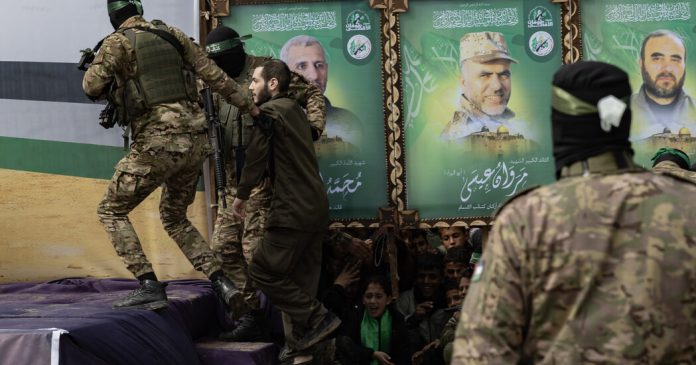
Hamas has been releasing hostages in performative ceremonies aimed at showing that it is still in control of Gaza, a practice that many Israeli officials have condemned. On Saturday, five of the six living hostages were paraded on a stage, flanked by masked gunmen, prompting outrage in Israel. One hostage was seen on a stage kissing the heads of masked gunmen, as if in gratitude. His relatives later said he had been instructed to do so by a Hamas cameraman.

Anger was further inflamed when Hamas published a propaganda video footage on Saturday night showing two other Israeli hostages who had been forced to watch three of their fellow captives being released.

Repeatedly putting their shorn heads in their hands, the pair pleaded on camera for their freedom. Rights groups and international law experts say that a hostage video is, by definition, made under duress, and the statements in it are usually coerced. Israeli officials have called past Hamas videos a form of “psychological warfare,” and experts say their production can constitute a war crime.

In a statement Sunday, Mr. Netanyahu’s office accused Hamas of violating its agreement with Israel and said the prisoner releases would be postponed “until the release of the next hostages has been assured, and without the humiliating ceremonies.” On Thursday, Hamas is supposed to hand over the bodies of four more dead Israelis under the terms of the initial phase of the cease-fire.

Izzat Al-Rishq, a member of Hamas’s political bureau, said in a subsequent statement on Sunday that Mr. Netanyahu’s decision to delay the prisoner releases “reflects a deliberate attempt to disrupt the agreement.” Mr. Al-Rishq also accused Israel of humiliating Palestinian prisoners and detainees during the release process, mistreating them “until the very last moments” and banning their families from holding celebrations.

Dozens of the prisoners slated to be released are serving life sentences for deadly attacks in Israel, while others had not been formally charged.

The recriminations came after an already turbulent week. On Thursday, Hamas returned four bodies it said were those of hostages who had died in captivity, among them that of Ms. Bibas. But forensic testing by Israel determined that the body was not hers. Late Friday, Hamas transferred another set of remains, which Israeli officials confirmed early Saturday as those of Ms. Bibas. The kidnapping and deaths of Ms. Bibas and her young children have become a symbol of Israeli grief and anguish.

Adding to the uproar, the Israeli authorities rejected Hamas’s assertions that Ms. Bibas’s young sons, Ariel, who was 4 when he was abducted, and Kfir, who was not even 9 months old, were killed in Israeli airstrikes, saying that an autopsy had shown that their captors had killed them “with their bare hands” then tried to make it look like they had died in a bombardment.

Dr. Chen Kugel, Israel’s chief pathologist, said on Saturday night that there was no evidence that Ms. Bibas, who was 32, had been killed in a bombing. He did not elaborate or present evidence for the assertion.

Hamas on Saturday accused Israel of lying regarding the fate of the Bibas family, without explaining the discrepancies. Israel’s military has said Ms. Bibas and her sons were held captive by a smaller armed group in Gaza, the Mujahideen Brigades.

About 60 hostages remain in Gaza, about half of them already assumed to be dead, according to the Israeli government.

The Hamas propaganda video of the two captives begging for their release unleashed a maelstrom of emotions in Israel, including a glimmer of hope for their families.

“I saw my son for the first time in 16 months,” Ilan Gilboa-Dalal, the father of Guy Gilboa-Dalal, one of the two hostages in the video, told Kan, Israel’s public broadcaster. “I heard his voice for the first time. For me, that gives me a bit of air, knowing that he’s okay,” he said.

On the other hand, he added, there was “nothing more cruel” than forcing his son and his friend, Evyatar David, the second hostage in the car, to watch the release ceremony.

Galia David, the mother of Evyatar, told Army Radio: “The consolation in that is that Evyatar and Guy are alive. But I could see through his eyes into his soul, and he is agonized.”

The two hostages in the car and the three on the stage were all abducted from a music festival, the Tribe of Nova, near the border with Gaza during the October 2023 attack.

Fatima AbdulKarim contributed reporting from Ramallah, in the Israeli-occupied West Bank, and Gabby Sobelman from Rehovot, Israel.