

Two gatherings of conservative activists, one supportive of President Trump and the other opposed, show how he has remade the Republican Party.
No Exit – The New York Times
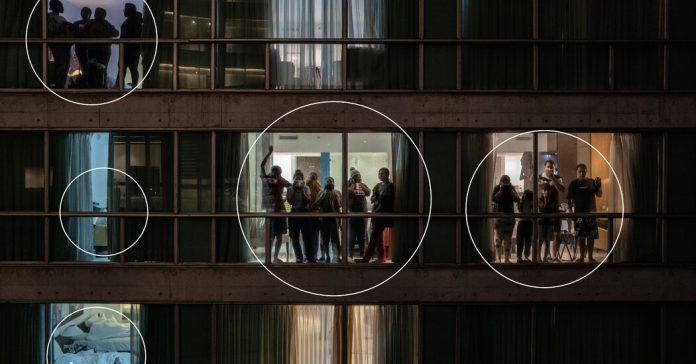
In furtive messages, sent through handmade signs, hidden phones and gestures behind glass, some of the migrants expressed a sense of constant, overwhelming fear.
Most did not want their faces to be seen, fearful of repercussions for being photographed by journalists. We did as much window-to-window communication as we could.
In the central room, Artemis Ghasemzadeh, a 27-year-old migrant from Iran, scrawled “Help” on the window in lipstick. She was one of the few who did not conceal their face.
Outside, my colleague, the New York Times reporter Julie Turkewitz, held up a notebook with her phone number, written for the migrants to see from their rooms — and message if they could.
We learned that the 10 Iranian migrants had converted to Christianity, which according to Iran’s Shariah law, is a crime punishable by death. They had illegally entered the United States in the last month, and were detained in San Diego before being deported to Panama.
We learned, too, that many of the migrants had arrived at the U.S. border from such countries as Afghanistan and China, hoping to seek asylum. Now they are trapped in Panama, where the Trump administration sent them because those nations will not accept them, or for other reasons.
Officials in Panama say they are adhering to international protocols in their treatment of the migrants, and that two United Nations organizations oversee the migrants. Lawyers in the country say it is illegal to detain people without a court order for more than 24 hours.
In the room below Ms. Ghasemzadeh, we established contact with three Chinese nationals. One man wrote “China” and his phone number in toothpaste on the window.
He held up a Chinese-language Bible and a crucifix to the window. He gave his surname as Wang, but in an interview expressed fear about being identified, saying it could be used against him if he were forcibly returned. “I would rather jump off a plane than go back to China,” he said.
Since the above picture was taken last week, officials in Panama have said that more than half of the migrants have agreed to be deported to their countries of origin.
Among them are the two Indian migrants, who entered the United States on Jan. 29 after a two-year journey, intending to seek asylum. Guards restrained them with handcuffs on their feet and hands.
In an interview from the hotel, they said they had signed papers to be deported back to India, and that they would not complain. They had been given medical treatment, food and a place to sleep, they said.
Migrants who did not agree to be deported would be taken to a detention camp on the outskirts of the jungle known as the Darién Gap, Panama’s security minister said. He described the decision to hold the migrants as part of an accord with the United States. Nearly 100 have already been moved from the hotel to the camp.
We have yet to see the migrants there, and even in downtown Panama City we could only see so much. Some people closed their curtains or stayed out of view. To the right of Mr. Wang’s room, someone paced back and forth between the bed and a night stand, the lights off.
We glimpsed just restless moving feet.
Alan Yuhas contributed.
Politics chat: Trump targets the Pentagon, local town halls respond to DOGE

President Trump is turning his attention to the Pentagon as he makes his way through the government in his bid to implement his agenda.
German Federal Election: What to Watch For
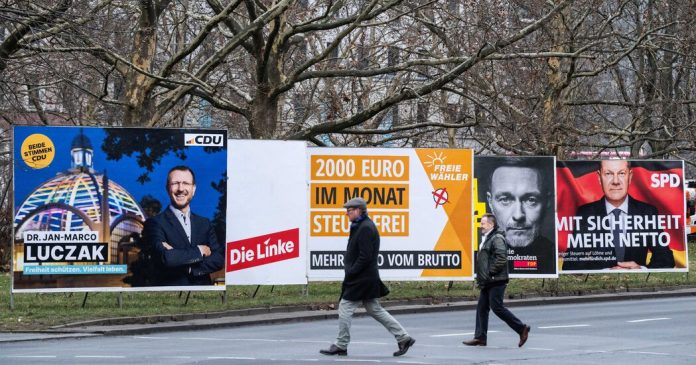
Germans are voting on Sunday in a rare snap election that has taken on outsize importance as the new Trump administration threatens European countries with tariffs, cuts them out of negotiations over Ukraine and embraces an authoritarian Russia.
The election for Parliament was called after Chancellor Olaf Scholz’s unpopular and long-troubled three-party government collapsed in November. Seven months earlier than scheduled, the voting now falls in the midst of Europe’s struggle for strong leadership and as it recalibrates its relationship with the United States.
Despite the effort by politicians and countless volunteers to bring excitement to the race during the short, dark winter campaign, polls never much shifted. Friedrich Merz and his conservative Christian Democratic Union have a comfortable lead.
The hard-right Alternative for Germany, or AfD, is expected to place second, riding on voter dissatisfaction with mainstream parties and fears of migration. Polls show it is likely to have its best showing ever.
Mr. Scholz’s Social Democrats, which eked out a victory in 2021, are expected to come in third, just ahead of the Greens. The Social Democratic party, the oldest party in Germany, may be poised for its worst showing since it was banned by the Nazis.
But uncertainties abound. Here are some things to watch for:
Two’s Company, Three’s a Crowd
No party is expected to get enough votes to govern alone and outright. The most important question will then be how many parties are needed to form a government.
Together, Mr. Merz’s center-right Christian Democrats and the far-right AfD are likely to have the broadest majority. But because the AfD is tainted by neo-Nazi associations, Mr. Merz and all mainstream party leaders say they will not form a government with it. Instead they will join together in what’s called the “firewall,” aimed at keeping extremists out of power.
That leaves the Social Democrats, though they are on the center-left, as Mr. Merz’s most likely partner. If the two of them don’t have enough support to form a majority, a third party will be needed.
The experience of the incumbent government showed just how difficult and unstable a three-party group can be. It’s an outcome that many analyst say would leave Germany almost back to when the last three-party government collapsed.
Little Kingmakers
It will be critically important, then, how well smaller parties will do and whether they get at least the 5 percent support needed to enter Parliament.
If polling is correct, the tiny Die Linke party, on the far left, seems likely to make it. Polls show it poised for a turnaround from last year when it appeared to be on its way to extinction after one of its most popular members, Sahra Wagenknecht, broke from it to form her own party.
The Sahra Wagenknecht Alliance, or BSW, as the new party is called, is running for the first time at a national level. Its prospects are uncertain.
Another party hovering near the threshold is the pro-business Free Democratic Party. Its leader, Christian Lindner, is the man who goaded Chancellor Scholz into kicking him out of the government, precipitating Sunday’s election. For him, the vote will be a test of whether that gambit to save his party pays off.
For all these parties, clearing the barrier to entering Parliament is an existential question; without seats in Parliament, they are much less visible and have access to much less funding.
But if they all make it into the Parliament, that is likely to complicate life for the bigger parties, reducing their number of seats and denying them the chance for a two-party coalition.
Will the ‘Firewall’ Hold?
If the AfD has an even stronger than expected showing — somewhere above 20 percent — and provokes an unwieldy effort to work around it, questions of how long the “firewall” by the mainstream can hold are likely to intensify.
Even among nationalist, anti-immigrant parties in Europe, the AfD is considered one of the more extreme. Parts of the AfD are closely monitored by German domestic intelligence agencies, which have labeled them extremist and potential threats to the Constitution. Party members have toyed with reviving Nazi slogans, downplayed the horror wrought by the Holocaust and have been linked to plots to overthrow the government.
Yet the party has been embraced by Trump administration officials. During the Munich Security Conference this month, Vice President JD Vance called on Germans to stop marginalizing far-right parties, saying, “there is no room for firewalls,” and he met with Alice Weidel, the AfD candidate for chancellor.
Elon Musk, the billionaire Trump adviser, interviewed Ms. Weidel on his social media platform X and endorsed her by video link before AfD supporters assembled at a rally, telling them that Germans had “too much of a focus on past guilt.”
The strength of the AfD’s showing, then, could prove a bellwether not only for German politics but also for political trends across Europe since Mr. Trump’s election to a second term.
And it may be judged as a gauge of whether those endorsements from Mr. Trump and Mr. Musk helped legitimize the party and gave it broader appeal, or potentially backfired, given the Trump administration’s newly antagonistic relationship with Germany and Europe.
When Will We Know?
First projections will come in once the polls close at 6 p.m. Sunday in Germany (noon E.S.T. in the United States). Because they are based on extensive exit polling, those numbers tend to be very accurate. During the last election, the exit polls were within 1 percent of the final vote that was posted hours later, once all ballots were counted.
But this year, exit polling could be less predictive. An unusual number of voters have told pollsters they had not yet made up their minds and an increasing number of voters use mail-in ballots and so they do not figure in exit polls.
Most Germans will be glued to their televisions at the close of polling. Expect pictures from various party headquarters, with everyone huddled around lead candidates — champagne flutes or beer steins in hand, depending on the party — waiting for those first results.
As U.S. and Ukraine Haggle Over Minerals, Russia Attacks With Drones
Ukraine and the United States remain locked in difficult negotiations over a deal to trade Ukraine’s natural resources for American aid, Ukrainian officials said Sunday morning, as Washington maintains pressure on Kyiv to sign an agreement quickly.
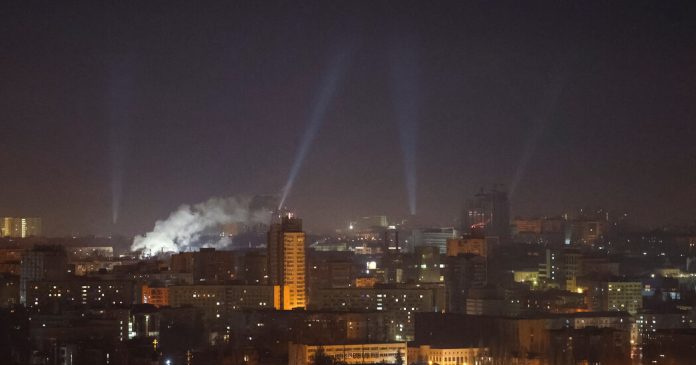
The timing of the talks, which stretched late into Saturday night, according to two Ukrainian officials briefed on the negotiations, coincided with a huge Russian drone assault on Ukrainian cities overnight. The Ukrainian Air Force said Russia had launched 267 drones, calling it a record since the war began three years ago. That claim could not be independently confirmed.
The buzz of attack drones flying over buildings echoed through the night in central Kyiv, followed by the sound of heavy machine guns trying to shoot them down. Ukraine said that most of the drones were shot down or disabled by electronic jamming, but that debris from destroyed drones damaged houses and sparked fires in parts of the capital.
On Saturday evening, President Trump ramped up pressure on Ukraine to sign the deal, which has now been under negotiation for more than 10 days. Several draft agreements have already been rejected by the Ukrainian side, because they did not contain specific U.S. security guarantees that would protect Kyiv against further Russian aggression.
“I think we’re pretty close to a deal, and we better be close to a deal,” Mr. Trump told the Conservative Political Action Conference on Saturday evening, noting that he wanted payback for past American military and financial assistance to the war-torn country. He also said, “We’re asking for rare earth and oil — anything we can get.”
Frustration over the drawn-out negotiations has fueled an escalating dispute between President Volodymyr Zelensky of Ukraine and Mr. Trump. The American president accused Mr. Zelensky of being a “dictator without elections,” echoing a Kremlin talking point. The Ukrainian leader also said that Mr. Trump was living in a “web of disinformation.”
Mr. Zelensky was scheduled to hold a news conference on Sunday, a day before the war’s third anniversary, where he is expected to address his escalating feud with Mr. Trump.
On Friday, the United States proposed a new draft agreement, obtained by The New York Times, which still lacked security guarantees for Ukraine and included even tougher financial terms. The two Ukrainian officials, speaking on the condition of anonymity to discuss the negotiations, said Ukraine sent back amendments on Saturday night.
The new draft agreement reiterated a U.S. demand that Ukraine relinquish half of its revenues from natural resource extraction, including minerals, gas and oil, as well as earnings from ports and other infrastructure.
Under the proposed deal, those revenues would be directed to a fund in which the United States would hold 100 percent financial interest, and Ukraine should contribute to the fund until it reaches $500 billion. That sum is more than four times as much as the value of U.S. aid committed to Ukraine so far.
The agreement does not commit the United States to security guarantees for Ukraine, or promise further military support for Kyiv. The word “security” was even deleted from a formulation contained in a previous version of the deal, dated Feb. 14 and reviewed by The Times, which stated that both countries aimed to achieve “lasting peace and security in Ukraine.”
Instead, the agreement says that a portion of the revenues collected by the fund will be reinvested into Ukraine’s reconstruction. It also states that the United States intends to provide long-term financial support for Ukraine’s economic development. This potential commitment aligns with an argument in the White House that the mere presence of American economic interests in Ukraine will deter future Russian aggression.
“This economic partnership would lay the foundations for a durable peace by sending a clear signal to the American people, the people of Ukraine, and the government of Russia about the importance of Ukraine’s future sovereignty and success to the U.S.,” Scott Bessent, the U.S. Treasury secretary, wrote in a Saturday opinion piece for The Financial Times.
This Christian Convert Fled Iran, and Ran Into Trump’s Deportation Policy.
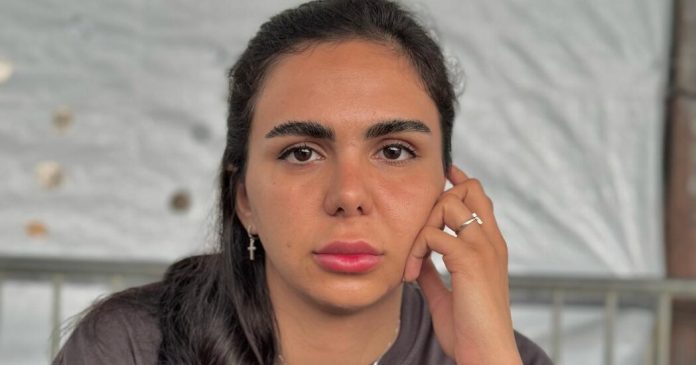
She first entered a church on a visit to Turkey. She remembers feeling a sense of calm so overpowering that she purchased a small Bible. She wrapped it in her clothes and smuggled it back to her hometown, Isfahan, in central Iran.
Artemis Ghasemzadeh’s conversion from Islam to Christianity evolved over a few years starting in 2019, through an Iranian network of underground churches and secret online classes. Three years ago, she was baptized and, in her words, “reborn.”
Converting was colossally risky. While Christians born into the faith are free to practice, Iran’s Shariah laws state that abandoning Islam for another religion is considered blasphemy, punishable by death. Some members of her Bible-study group were arrested.
So in December, Ms. Ghasemzadeh set out for the United States.
“I wanted to live freely, to live without fear, to live without someone wanting to kill me,” Ms. Ghasemzadeh, 27, said in a series of phone interviews.
Her journey has landed her in a migrant detention camp on the outskirts of the Darién jungle in Panama. She and nine other Iranian Christian converts, three of them children, are among dozens detained at the Saint Vincente camp. Their fate remains uncertain.
People fleeing violent religious persecution are normally eligible for asylum. But they have been caught in the Trump administration’s deportation push as the president tries to fulfill a campaign pledge to close the southern border.
“We don’t deserve this. We are in a place where we feel helpless” Ms. Ghasemzadeh said. “I am waiting for our voices to be heard, for someone to help us.”
Panama, which is separately under pressure from the Trump administration over control of the Panama Canal, has become a landing place for migrants who otherwise would have languished in detention in the United States — or potentially been released.
Panamanian officials have said that U.N. agencies are helping the migrants return to their countries or seek asylum in other nations, including Panama.
A Dangerous Conversion
Ms. Ghasemzadeh grew up in an upper-middle class family in Isfahan. Her businessman father was religiously conservative and strict with her and her three siblings. She did not tell him about her conversion.
Christianity appealed to her, she said, because its message sounded more peaceful and its rules less stringent than the version of Islam she had experienced in Iran.
The church applied extreme precautions to its underground gatherings, Ms. Ghasemzadeh said. Parishioners received one-time passwords to log into virtual meetings. In-person sermons and classes were hosted at different locations. Ms. Ghasemzadeh said she cherished her Christian community. Her older brother, Shahin, 32, also converted.
In 2022, a women-led uprising swept across Iran, sparked by the death of Mahsa Amini in custody of the morality police on allegations of violating the hijab rule. Ms. Ghasemzadeh said she protested nearly every day, chanting “Women, Life, Freedom.”
Like many women in Iran who have stopped wearing the hijab in an act of defiance, she let her long, dark hair flow in public. The government sent her text messages, summoning her before a judge, she said. She did not show up. If convicted of violating the hijab law, women can be fined.
Journey to America
In late December, Ms. Ghasemzadeh and her brother Shahin departed Iran, bound for the United States. She knew about Mr. Trump’s promise to crack down on migrants, but said she believed that he was only targeting criminals.
They went to Abu Dhabi, then South Korea and arrived in Mexico City. There, they asked around at a hotel and found a smuggler. He charged them each $3,000 and ferried them to Tijuana.
There, near the border wall in the middle of the night, the smuggler pointed to a ladder.
“Go,” she remembers the smuggler saying. “Climb the wall and go, quick.”
When her feet touched American soil, she burst into tears. “It’s over,” she said she told her brother. “We are finally here.”
The euphoria was short-lived. Minutes later, border agents surrounded them. They were transported to a detention facility and separated. She has not seen nor spoken to her brother since, she said. Her mother told her that he was taken to a facility in Texas, where he remains.
Ms. Ghasemzadeh said she repeatedly told the authorities that she was a Christian convert from Iran seeking asylum.
A Department of Homeland Security spokeswoman said that “not a single one of these aliens asserted fear of returning to their home country at any point during processing or custody.” Ms. Ghasemzadeh said that she was never interviewed about her asylum claim.
“They kept saying now is not the time, tomorrow morning,” she said.
She was shackled and put on a military plane to Panama on Feb. 12. The plane’s engine roared so loudly that her ears rang. The turbulence made her nauseous.
It was her 27th birthday.
Deported
Ms. Ghasemzadeh met nine other Iranians on the plane, all Christian converts, who remarkably shared a similar story. The group has since banded together.
For about a week, they were held inside a hotel under the watch of armed guards. The New York Times has been in daily contact with her since she arrived in Panama.
Ms. Ghasemzadeh, who like many Iranians of her generation is digitally savvy, made a video describing their plight and shared it with Persian news channels outside Iran. It went viral.
After she and others refused to sign documents that would pave the way for their repatriation, they were put on buses and sent to the jungle camp.
Ali Herschi, an Iranian-American human rights lawyer in Washington, represents the Iranians pro bono. Mr. Herschi said his priority was to stop Panama from deporting them to Iran. Then, he said, “appealing with American authorities to reverse course and allow the group re-entry to the U.S. on humanitarian grounds.”
The jungle camp, Ms. Ghasemzadeh said, looks like a large fenced cage. The sleeping area was muggy and the migrants did not have blankets. They were given one bottle of water and told to refill it from the bathroom faucet, she said.
Her arm was swollen and red from mosquito bites and one of the children in their group, Sam, 11, had fallen and injured his ankle. Medical staff told the Iranian parents the camp did not have an X-ray machine to determine if bones were broken, she said.
Panama has said the migrants have everything they need.
Every night Ms. Ghasemzadeh scribbles Christian quotes in a small notebook. On one page, she wrote to Jesus in Persian: “I am certain you can hear my voice from up there. So please help.” Next to it she drew a tiny red heart.
Pope Francis Had a Restful Night, Still in Critical Condition
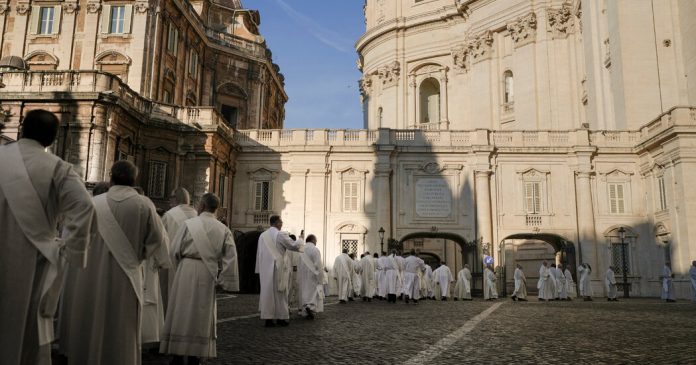
Pope Francis spent a restful night at the Rome hospital where he has been in critical condition as he undergoes treatment for pneumonia and a complex infection, the Vatican said Sunday morning.
Beyond the brief text — “The night passed quietly, the Pope rested” — the Vatican did not provide further details, as concerns mounted worldwide about the health of the 88-year-old pontiff.
On Saturday, the Vatican had said that Francis had had a long “asthmatic respiratory crisis” earlier in the day that required “high flows of oxygen.” He had also had a blood transfusion, but was alert, according to the Vatican, which is issuing bulletins in consultation with the medical staff at the hospital as well as the pope’s doctor at the Vatican.
Francis was admitted to the Policlinico Agostino Gemelli on Feb. 14 with a complex respiratory tract infection that developed into pneumonia in both lungs. Doctors said the calibration of his treatment was especially complex because of his age, and pre-existing lung disease.
Speaking to reporters on Friday, doctors had for the first time described Francis’s condition as critical, adding that his situation could change day by day. Sergio Alfieri, a surgeon who is on Francis’ medical team, has said that the pope had told him that he was aware of his own fragility and that “both doors are open.”
For days now, prayer vigils have been held around the world. Cardinal Baldassare Reina, vicar general of the Diocese of Rome, announced he would celebrate Mass to pray for Francis’ recovery at the Basilica of St. John the Lateran on Sunday afternoon.
White House Press Secretary Karoline Leavitt told reporters on Saturday that President Donald Trump had been updated about the pope’s health. “We’re praying for the pope,” she said. “Our thoughts and prayers are with him.”
Hezbollah Plans Show of Strength at Killed Leader’s Funeral
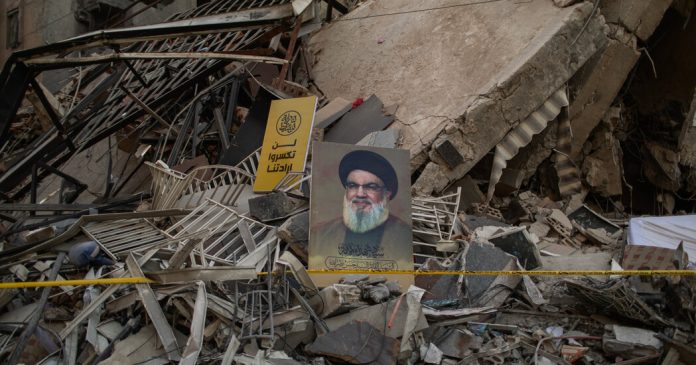
Hezbollah was preparing a show of strength on Sunday with an elaborate and sprawling funeral for its assassinated leader, Hassan Nasrallah, an event the Iran-backed militant group hopes will revive its battered image in Lebanon after the latest war with Israel.
Tens of thousands of people from across the country and region are expected at the ceremony on Sunday afternoon, including dignitaries from Iran. It will begin at Lebanon’s largest sports stadium on the southern outskirts of the capital, Beirut, which has been adorned with two-story tall posters of Mr. Nasrallah and slogans promising to carry on the Shiite Muslim resistance he led against Israel.
After the stadium service, Mr. Nasrallah will be buried at a dedicated site nearby that will be made into a holy shrine for the slain leader, according to Hezbollah officials.
Mr. Nasrallah’s funeral “is not a day of grief or a day of farewell, but a day of loyalty and renewal of our covenants and pledges to our leader,” Hussein Haj Hassan, a Hezbollah-affiliated member of parliament, said at a ceremony in Beirut’s southern suburbs on Saturday.
He said the funeral would be a moment to show to “allies as well as to our enemies and opponents that we have not and will not weaken or cower.”
“And if you increase the challenge,” Mr. Hassan continued, “we will respond with determination.”
The funeral comes five months after Israel killed Mr. Nasrallah on Sept. 27, dropping 80 bombs over several minutes on his bunker just south of Beirut. In killing Mr. Nasrallah, Israel eliminated a leader who enjoyed near-mythical status among Lebanon’s Shiite Muslims. His death was one of the seminal moments in the confrontation between Iran’s proxies and Israel, which Hezbollah has emerged from significantly weakened.
In the months that followed, the group was battered by Israeli forces and its iron grip on Lebanon’s politics came undone with many Lebanese blaming the group for dragging the country into one of its deadliest and most destructive wars.
Hezbollah and Israel agreed to a cease-fire in November that forced Hezbollah to withdraw from southern Lebanon and abandon its strongholds along the border with Israel. While Israel agreed to withdraw from Lebanon as part of that truce, Israeli forces have remained in parts of southern Lebanon past the deadline to do so.
Now, Lebanon is at an inflection point.
After decades of consolidating power, Hezbollah entered the war as the country’s most dominant political and military force. But it has become a shadow of its former self.
For the first time in 20 years, there is gathering momentum among Hezbollah’s political opponents within Lebanon to seize power back from the group. The country’s newly appointed president, Michel Aoun, has vowed to disarm Hezbollah and return the monopoly on military power to the state.
Last week, the newly appointed Lebanese cabinet adopted a policy statement that took a direct shot at Hezbollah, laying out that the state alone had the right to defend Lebanon’s territory. It was the first policy statement since the country’s civil war ended in 1990 that did not mention the Lebanese people’s right to resist Israeli occupation — a line that had long helped legitimize Hezbollah’s existence.
Mr. Nasrallah’s funeral looks set to reflect the power struggle playing out in Lebanon, with Hezbollah seizing on it as an opportunity to reassert itself as a political force.
With throngs of supporters expected to flood the streets to show their loyalty to Mr. Nasrallah, Hezbollah is seeking to send a message: Even though its leaders have been killed, its coffers drained, its Syrian ally, Bashar al-Assad, toppled and its patron, Iran, weakened, the group is here to stay.
“The funeral is a launchpad,” said Mohanad Hage Ali, a senior fellow at the Carnegie Middle East Center in Beirut. “They are trying to reinvent themselves” and use Mr. Nasrallah’s death “as a mobilizing tool to rally people around their cause, which has taken a great hit.”
The funeral on Sunday will also honor Hashem Safieddine, who effectively led Hezbollah for a week after Mr. Nasrallah’s death before he, too, was killed by Israel.
The war between Hezbollah and Israel broke out after the Lebanese militia started firing on Israeli military positions in solidarity with its Palestinian ally, Hamas, in Gaza. Hezbollah joined in shortly after the shock of the Hamas-led attack on Israel in October 2023 and the exchanges of strikes that followed displaced tens of thousands of people on either side of the Lebanese-Israeli border.
The conflict sharply escalated last September, with Israeli forces invading large swaths of southern Lebanon and launching an intense bombardment across the country that lasted about two months before the cease-fire was reached in late November.
Within Lebanon, Hezbollah was widely seen as having suffered a stinging defeat in the war.
“Hezbollah forced the whole country into this war but wasn’t powerful enough to put up a fight,” said Ali Mraay, 34, who works as a delivery driver in Beirut. “The south — the most beautiful part of the country — is destroyed because of Hezbollah. Everyone who died in the war, it’s because of this war by Hezbollah.”
The group is now facing difficult questions from its supporters about whether it will be able to provide the billions of dollars needed to rebuild towns and villages that were flattened in the war.
Providing that reconstruction support will be critical to reviving the group’s support among followers whose faith in Hezbollah has been tested by this war. After its last war with Israel, in 2006, Hezbollah responded immediately with cash handouts bankrolled by Iran. But its response has been slower this time around.
The group’s main land bridge for receiving cash from Iran through Syria was severed after the Assad dictatorship — an important ally to both Iran and Hezbollah — was toppled by rebels in December.
And last week, Lebanon halted Iranian flights to Beirut after the Israeli military accused Tehran of using civilian aircraft to smuggle cash to Hezbollah — stoking outrage and setting off protests among Hezbollah’s supporters.
The loss of Mr. Nasrallah has also been devastating to the group’s public image. Mr. Nasrallah took charge when the group was an underground guerrilla force fighting the Israeli occupation of southern Lebanon, which ended in 2000, and led the organization as it formally entered Lebanese politics.
He served many roles in the lives of Hezbollah members, acting as a religious leader, political strategist and commander in chief. His charm — a rarity among leaders in the region — was also key to unifying Hezbollah’s followers, with Mr. Nasrallah stirring up support in frequent speeches for their anti-Israel struggle and convincing them that victory was assured.
Before Mr. Nasrallah’s death, Hezbollah had not cultivated any other leaders with Mr. Nasrallah’s stature. The group’s current leader, Naim Qassem, lacks Mr. Nasrallah’s charisma and unwavering ability to reassure Hezbollah’s followers.
Still, experts warn against writing Hezbollah off.
The continued presence of Israeli forces in southern Lebanon offers Hezbollah leverage, effectively giving new force behind Hezbollah’s raison d’être: armed resistance against Israeli occupation.
And the group’s brewing showdown with the new government has many in Lebanon on edge.
Hezbollah, which the United States designated as a terrorist organization in 1997, has shown its willingness to sacrifice anyone — including Lebanese politicians and journalists — who challenges its authority.
One of the most stark examples of that was in 2005, when a car bomb in Beirut killed former Prime Minister Rafik Hariri and 22 others. A team of international investigators later concluded that Hezbollah was responsible.
“We know they have been dealt a blow, but at the same time they have not yet been disarmed,” said Sami Nader, the director of the Political Sciences Institute at Saint Joseph University of Beirut, referring to Hezbollah.
“They lost their battle with Israel,” he added. “But now there is a concern about what they will do next. If they can’t use their arms against Israel, will they use them against those inside Lebanon? This is the concern.”
Dayana Iwaza contributed reporting.
Germans Are Voting. Here’s What to Watch For.
Germans vote on Sunday in a rare snap election that has taken on outsized importance as the new Trump administration threatens European countries with tariffs, cuts them out of negotiations over Ukraine, and embraces an authoritarian Russia.
The election for Parliament was called after Chancellor Olaf Scholz’s unpopular and long-troubled three-party government collapsed in November. Seven months earlier than scheduled, the voting now falls in the midst of Europe’s struggle for strong leadership and as it recalibrates its relationship with the United States.
Despite the effort by politicians and countless volunteers to bring excitement to the race during the short, dark winter campaign, polls never much shifted. Friedrich Merz and his conservative Christian Democratic Union have a comfortable lead.
The hard-right Alternative for Germany, or AfD, is expected to place second, riding on voter dissatisfaction with mainstream parties and fears of migration. Polls show it is likely to have its best showing ever.
Chancellor Scholz’s Social Democrats, which eked out a victory in 2021, are expected to come in third, just ahead of the Greens. The Social Democratic party, the oldest party in Germany, may be poised for its worst showing since it was banned by the Nazis.
But uncertainties abound. Here are some things to watch for:
Two’s Company, Three’s a Crowd
No party is expected to get enough votes to govern alone and outright. The most important question will then be how many parties are needed to form a government.
Together Mr. Merz’s center-right Christian Democrats and the far-right AfD are likely to have the broadest majority. But because the AfD is tainted by neo-Nazi associations, Mr. Merz and all mainstream party leaders say they will not form a government with it. Instead they will join together in what’s called the “firewall,” aimed at keeping extremists out of power.
That leaves the Social Democrats, though they are on the center-left, as Mr. Metz’s most likely partner. If the two of them don’t have enough support to form a majority, a third party will be needed.
The experience of the incumbent government showed just how difficult and unstable a three-party group can be. It’s an outcome that many analyst say would leave Germany almost back to when the last three-party government collapsed.
Little Kingmakers
It will be critically important, then, how well smaller parties will do and whether they get at least the five percent support needed to enter Parliament.
If polling is correct, the tiny Die Linke party, on the far left, seems likely to make it. Polls show it poised for a turnaround from last year when it appeared to be on its way to extinction after one of its most popular members, Sahra Wagenknecht, broke from it to form her own party.
The Sahra Wagenknecht Alliance, or BSW, as the new party is called, is running for the first time at a national level. Its prospects are uncertain.
Another party hovering near the threshold is the pro-business Free Democratic Party. Its leader, Christian Lindner, is the man who goaded Chancellor Scholz into kicking him out of the government, precipitating Sunday’s election. For him, the vote will be a test of whether that gambit to save his party pays off.
For all these parties, clearing the barrier to entering Parliament is an existential question; without seats in Parliament, they are much less visible and have access to much less funding.
But if they all make it into the Parliament, that is likely to complicate life for the bigger parties, reducing their number of seats and denying them the chance for a two-party coalition.
Will the ‘Firewall’ Hold?
If the AfD has an even stronger than expected showing — somewhere above 20 percent — and provokes an unwieldy effort to work around it, questions of how long the “firewall” by the mainstream can hold are likely to intensify.
Even among nationalist, anti-immigrant parties in Europe, the AfD is considered one of the more extreme. Parts of the AfD are closely monitored by German domestic intelligence agencies, which have labeled them extremist and potential threats to the Constitution. Party members have toyed with reviving Nazi slogans, downplayed the horror wrought by the Holocaust and have been linked to plots to overthrow the government.
Yet the party has been embraced by Trump administration officials. During the Munich Security Conference this month, Vice President JD Vance called on Germans to stop marginalizing far-right parties, saying, “there is no room for firewalls,” and he met with Alice Weidel, the AfD candidate for chancellor.
Elon Musk, the billionaire Trump adviser, interviewed Ms. Weidel on his social media platform X and endorsed her by video link before AfD supporters assembled at a rally, telling them that Germans had “too much of a focus on past guilt.”
The strength of the AfD’s showing, then, could prove a bellwether not only for German politics but also for political trends across Europe since Mr. Trump’s election to a second term.
And it may be judged as a gauge of whether those endorsements from Mr. Trump and Mr. Musk helped legitimize the party and gave it broader appeal, or potentially backfired, given the Trump administration’s newly antagonistic relationship with Germany and Europe.
When Will We Know?
First projections will come in once the polls close at 6 p.m. Sunday in Germany (noon E.S.T. in the United States). Because they are based on extensive exit polling, those numbers tend to be very accurate. During the last election, the exit polls were within 1 percent of the final vote that was posted hours later, once all ballots were counted.
But this year, exit polling could be less predictive. An unusual number of voters have told pollsters they had not yet made up their minds and an increasing number of voters use mail-in ballots and so they do not figure in exit polls.
Most Germans will be glued to their televisions at the close of polling. Expect pictures from various party headquarters, with everyone huddled around lead candidates — champagne flutes or beer steins in hand, depending on the party — waiting for those first results.
Catholics Pray for Ailing Pope Francis at Sunday Mass

Roman Catholics worldwide prayed for Pope Francis, who is hospitalized in critical condition, at Mass on Sunday after the Vatican announced that he was “not out of danger.”
The 88-year-old pontiff went into the hospital on Feb. 14 with an infection that developed into pneumonia in both lungs. He had a long “asthmatic respiratory crisis” on Saturday that required “high flows of oxygen” and a blood transfusion, the Vatican said.
Francis has been the spiritual leader of almost 1.4 billion Roman Catholics around the world since 2013. And around the world, there have been prayers for his recovery.
At the Myeongdong Cathedral in Seoul, Pat Santos, a tourist from the Philippines, described the pope as “the symbol of Christianity.”
“Pneumonia is a serious illness for his age, that’s why we should be worried,” said Mr. Santos, 31, who was visiting South Korea with his family. “May he recover very well so that he can enjoy his retirement.”
Francis has suffered damage to his lungs in the past, and in recent days a few cardinals have openly spoken about the possibility of him resigning, as his predecessor, Benedict XVI, did in 2013.
Doctors had said on Friday that Francis would remain in the Policlinico Agostino Gemelli, a hospital in Rome, for at least another week. They had said he was in critical condition on Friday too, but the announcement on Saturday indicated a more complicated situation.
“Once more, we continue to keep in our prayers Pope Francis. May the Lord continue to extend to him his love, his mercy and his healing,” Father Vicente Gabriel Bautista said during Sunday Mass at the Manila Cathedral, which also held a special prayer vigil for Francis on Friday.
There were also prayers for the pope during Sunday services in Sydney and Melbourne.