Friday, November 13, 2026
Home Blog Page 193

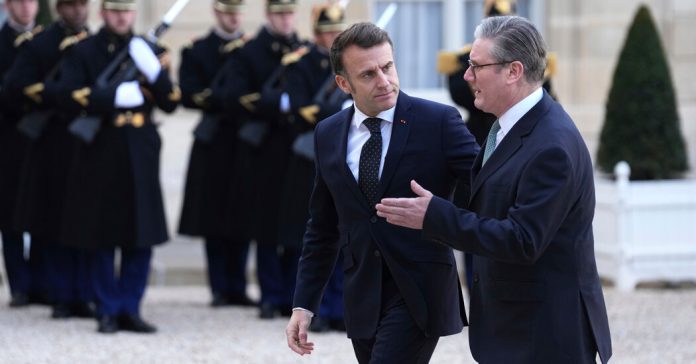
Macron and Starmer Have Played Trump’s Game Before, but the Rules Are Changing

0

“This is the moment of truth,” former Prime Minister Malcolm Turnbull of Australia said in an interview. “They simply have to have the steel to stand up to Trump and tell him what they think, namely, that siding with Putin against Ukraine is a devastating blow to America’s prestige and standing in the world.”

Mr. Turnbull, who had his own clashes with Mr. Trump over refugees early in the president’s first term, said that efforts to charm or cajole him on an issue this fundamental would likely go nowhere. “If the price of getting along with Trump is abandoning your allies, that is too high a price to pay,” Mr. Turnbull said.

A critical problem, said diplomats who dealt with Mr. Trump in his first term, is that he is not the same leader he was then.

“When Trump arrived in 2017, he knew nothing and nobody,” said Gerard Araud, who was France’s ambassador to Washington and accompanied Mr. Macron to multiple meetings with Mr. Trump. “Now he thinks he knows everything, he’s more radical on the substance, and he is surrounded by yes-men.”

That will make it harder for the European leaders to move Mr. Trump off his erroneous claim that the United States, in giving billions of dollars of military support to Ukraine, was essentially the victim of a con job by an unpopular, undemocratic Ukrainian leader. Nor will it be easy, diplomats say, to warn Mr. Trump of the dangers of giving too much away to Mr. Putin in a negotiation.

That doesn’t mean the leaders won’t try.

Mr. Macron, who arrives at the White House on Monday, said during a live broadcast on social media last week, “I’m going to say to him, basically: ‘You can’t be weak against President Putin. It’s not you, it’s not your trademark, it’s not in your interest.’”

Mr. Starmer, who will be in Washington on Thursday, has not publicly shared his strategy for dealing with Mr. Trump. But British diplomats said they expected him to emphasize Britain’s willingness to do more to provide for Europe’s defense by contributing troops to a Ukraine peacekeeping force. Mr. Starmer made the troop commitment last week, but said it would work only if the United States acted as a “backstop.”

“Trump doesn’t do gratitude,” said Kim Darroch, who served as Britain’s ambassador to Washington during much of Mr. Trump’s first term. “But you will at least get some recognition that you are the most forward-leaning of the European countries about buying into his idea of a peace deal.”

British officials said Mr. Starmer would tell Mr. Trump that Britain was considering additional military aid to Ukraine and planned to increase spending on its own defense. Mr. Darroch said Mr. Starmer should pledge to boost Britain’s military spending to 2.5 percent of economic output by a specific date. (Mr. Starmer has promised to reach that threshold but has not set a deadline.)

The prime minister, Mr. Darroch said, should also press Mr. Trump to describe the peace deal he is seeking with Russia and what pressure he plans to put on Mr. Putin to achieve it. While Britain is expected to announce additional sanctions against Russia before Mr. Starmer goes to Washington, Mr. Trump has signaled a willingness to end Russia’s economic and diplomatic isolation.

Mr. Starmer showed some daylight between him and Mr. Trump after the president’s condemnation of Mr. Zelensky, telling the Ukrainian prime minister by phone that he was a “democratically elected leader” within his rights to “suspend elections during wartime as the U.K. did during World War II.”

Having made his point, Mr. Darroch said, Mr. Starmer should avoid getting drawn into a debate with Mr. Trump over Mr. Zelensky. Instead, he said, the prime minister should play to Mr. Trump’s vision of himself as peacemaker.

Mr. Araud agreed, saying: “It would be a mistake for the Europeans to argue with Trump about who started the war, or whether Zelensky is a dictator. That is a non-starter for a Trumpian approach.”

Mr. Araud said he expected Mr. Macron to press Mr. Trump for security assurances in return for Europe’s assembling a deterrent force. France and Britain are trying to persuade Sweden, Denmark, the Netherlands and the Baltic countries to join such a force.

Other French officials said they worried that Mr. Trump would insist on putting a cease-fire in place in Ukraine within weeks, with a goal of celebrating it with Mr. Putin in Red Square in Moscow on Victory Day, which commemorates the Soviet victory over Nazi Germany, on May 9. He would be the first president to visit Russia in more than a decade — striking evidence of Mr. Putin’s diplomatic rehabilitation.

With little time to prevent that, French officials said they were scrambling to limit the damage. Among their deepest fears is that Mr. Trump will try to force an election in Ukraine, which would open the door to Russia-backed candidates, online smear campaigns and other forms of election interference.

Some experts argue that the leaders should appeal to Mr. Trump’s other priorities, notably America’s competition with China. Conceding too much to Mr. Putin, they said, could embolden China in its designs against Taiwan. It would also give China an incentive to draw closer to Russia in a coalition against the United States.

“If you make peace or impose peace in Europe and on Ukraine, on terms favorable to Russia, that actually makes it harder for you to deal with China,” said Nigel Gould-Davies, a former British ambassador to Belarus who is a senior fellow at the International Institute for Strategy, a research organization in London.

But Mr. Gould-Davies and other analysts said that drawing Mr. Trump into a discussion of grand strategy had its limits. “For Trump, even more than most leaders, the personal is the political,” he said.

On Friday, Mr. Trump described Mr. Macron as a friend, but complained that neither he nor Mr. Starmer had “done anything” to end the war.

Mr. Starmer and Mr. Macron have both worked to cultivate Mr. Trump. Mr. Starmer did not get to know him until a dinner at Trump Tower in New York last September, but the two seemed to get along. “I like him a lot,” Mr. Trump said recently. “He’s liberal, which is a bit different from me, but I think he’s a very good person.”

Mr. Macron’s relationship with Mr. Trump goes further back and has weathered more bumps. After a honeymoon period marked by Mr. Trump’s attendance at the French military parade, the two leaders clashed over Mr. Trump’s decision to pull out of the Paris climate accord and the Iran nuclear deal.

Mr. Macron continues to reach out. In December, he invited Mr. Trump to attend the reopening of the Cathedral of Notre-Dame in Paris. He also scrambled to get on the president’s calendar in Washington before Mr. Starmer, whose Washington trip has been in the works for a few weeks.

None of that guarantees that his diplomatic efforts will work this time. During a state visit to Washington in 2018, Mr. Araud recalled, Mr. Macron mistakenly believed he had talked Mr. Trump into not withdrawing from the Iran deal.

“There is this element of unpredictability and unreliability,” Mr. Araud said. “Whatever he says on Day 1 doesn’t mean anything on Day 2.”

Catherine Porter contributed reporting from Paris.
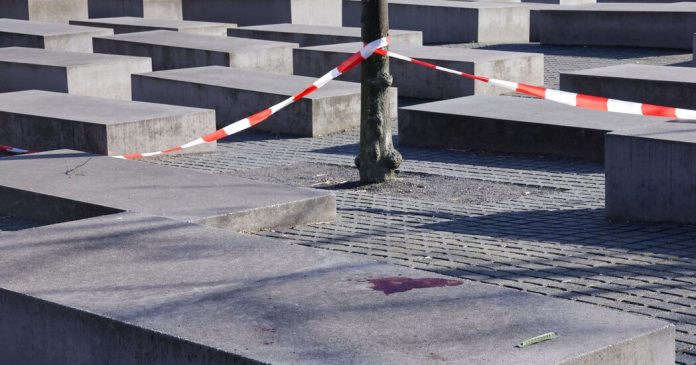
‘Religious Motivation’ Possible in Berlin Stabbing, Police Say

0

The man detained in connection with the stabbing of a Spanish tourist at Berlin’s Holocaust memorial on Friday may have been planning for weeks to kill Jewish people, according to German authorities.

The suspect, a 19-year-old Syrian refugee, was carrying a copy of the Quran, a prayer rug and a piece of paper with the attack’s date and Quran verses when he was apprehended, suggesting a “religious motivation,” the Berlin police said on Saturday. In a joint statement with the public prosecutor’s office, they added that things the suspect had said to the police suggested that over several weeks “a plan to kill Jews came together in his mind,” and that the location of the attack also reflected this idea.

The police said they had not ruled out connections to the Middle East conflict but had found no evidence linking the suspect to other groups or individuals. He came to Germany in 2023 as an underage refugee, was a legal resident and had no criminal record, the authorities said, adding that were also investigating if mental illness had played a role in the attack.

The 30-year-old victim, whose name was not made public, sustained neck injuries that required him to have emergency surgery and be placed in a medically induced coma, officials said, but his life was no longer at risk.

The attack took place at Berlin’s Memorial to the Murdered Jews of Europe, an expansive memorial across the street from the U.S. Embassy. It came as Germans prepared to vote in a divisive national election on Sunday, and amid a rise in antisemitism across Europe.

Germany’s economic problems, coupled with frustration over immigration, are central issues to voters in a parliamentary election where the far-right party, Alternative for Germany, or AfD, has risen in the polls.

The AfD party, which has been linked to neo-Nazis, has promised to crack down on immigration and deport some immigrants, a message that has gained traction in a country that has suffered a series of attacks perpetrated by people from Afghanistan and the Middle East.

An asylum seeker from Afghanistan rammed his car into a union demonstration in Munich on Feb. 13, injuring dozens, and in December, a Saudi citizen killed six people and injured hundreds more when he drove his car through a Christmas market in central Germany.

Lars Dolder contributed reporting.

Trump Appointees Fire Hundreds at U.S.A.I.D. Working on Urgent Aid

0

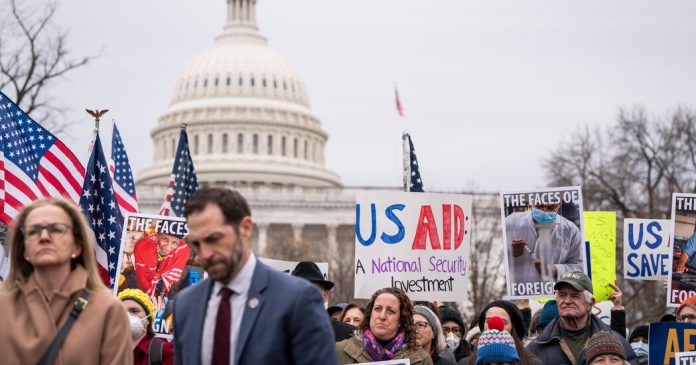
Trump administration appointees running the main United States aid agency have in recent days fired hundreds of employees who help manage responses to urgent humanitarian crises around the world, according to two U.S. officials and four recent employees of the agency.

The firings add to doubts raised about whether Secretary of State Marco Rubio is allowing employees for the United States Agency for International Development, or U.S.A.I.D., to carry out lifesaving humanitarian assistance, as he had promised to do late last month during a blanket freeze of almost all foreign aid from the U.S. government.

Trump appointees have fired or put on paid leave thousands of employees of U.S.A.I.D. A task force of young engineers working for Elon Musk, the billionaire tech businessman who is advising President Trump, has shut down many technical systems in the aid agency and barred employees from their email accounts. Mr. Musk has posted dark conspiracy theories about U.S.A.I.D. on social media, asserting with no evidence that it is a “criminal organization” and that it was “time for it to die.”

The latest round of dismissals occurred on Friday night, when hundreds of people working for the agency’s Bureau for Humanitarian Assistance got emails saying their jobs had been terminated. Two employees who got the emails said they were strange because they did not state any job titles specifically and did not have the recipients’ names in the “to” field. They were generic emails sent out in a large wave.

The New York Times obtained a copy and confirmed those descriptions. The employees who agreed to speak for this story did so on the condition of anonymity because they did not want to jeopardize the 15 days of pay they were scheduled to receive after being given a termination notice. The two U.S. officials feared retaliation.

In addition, 36 people were fired from the Office of Transition Initiatives, a unit in the agency’s conflict prevention bureau that specializes in helping partner countries with political transitions and democratic initiatives, said the U.S. officials and recent agency employees.

About 400 people were fired in recent days from humanitarian assistance positions, one U.S. official said. About 200 of those were contractors for the Bureau for Humanitarian Assistance, the officials said, and another 200 were part of a unit called the Support Relief Group, a collection of crisis experts who helped the bureau in responding quickly to natural disasters and armed conflicts. Now only about a dozen people remain in that group.

The fired employees were contractors who were employed directly by the U.S. government. Some had worked for U.S.A.I.D. in various capacities for 25 years.

Many of the contractors for the Support Relief Group had worked for the agency in war zones, including in Ukraine, Syria and Afghanistan. They often lived in different places around the world and spent weeks or months at a time in crisis areas. One employee who got the email on Friday said they were being flown home next week from a U.S. diplomatic mission overseas.

Another fired employee said the hundreds of dismissals meant that the aid agency now had only a skeleton crew to respond to humanitarian crises.

The appointee running day-to-day operations at U.S.A.I.D. is Pete Marocco, a State Department official overseeing foreign aid who was a divisive figure at the agency and other government departments in the first Trump administration. Early this month, Mr. Rubio announced he was taking over the aid agency as acting administrator.

Mr. Rubio has said all foreign aid will remain halted for 90 days during a review process. But officials and contractors working in foreign aid said they expected most of the aid to be cut permanently and many more employees to be fired, and what little remains of U.S.A.I.D. to be folded into the State Department. Although U.S.A.I.D. was created by Congress and lawmakers appropriated government money for foreign aid this year, few, if any, Republican lawmakers have raised objections to the aid freeze and the job cuts.

Foreign aid makes up less than 1 percent of the government budget.

Mr. Rubio said at the end of January that employees could apply for waivers to allow their aid programs, in particular “lifesaving humanitarian assistance,” to continue during the freeze. But few programs have gotten waivers. And even those with waivers could not operate because the U.S.A.I.D. payment system, known as Phoenix, had been rendered defunct, meaning partner groups could not get funds.

The State Department and a political appointee at U.S.A.I.D., Laken Rapier, who is said to be a press officer, did not return emails requesting comment for this story.

Hamas Frees 6 Hostages as Israel Delays Palestinian Prisoner Release

0

Hamas released six Israeli hostages from Gaza on Saturday, delivering the last living captives set to be freed in the first phase of a fragile cease-fire. That truce was already jolted this week when the militant group initially returned remains purportedly of an Israeli hostage that testing revealed to be someone else.

Early Sunday, Israel announced that it would continue to delay the release of 620 Palestinian prisoners whom it had pledged to free on Saturday, demanding that Hamas first release more captives from Gaza and commit to releasing them without “humiliation ceremonies.” Hamas has been releasing hostages in performative ceremonies aimed at showing that it is still in control of Gaza, which many Israeli officials have condemned.

The announcement, delivered in a statement from the prime minister’s office hours after the prisoner release had already been delayed without explanation, added tension to the shaky cease-fire between Israel and Hamas that is set to expire next week.

On Thursday, Hamas had returned four bodies it said were those of hostages who had died in captivity, among them Shiri Bibas, an Israeli women who had been abducted with her two young children during the Hamas-led attack of Oct. 7, 2023, that began the war. Forensic testing by Israel determined that the body was not Ms. Bibas, however.

Late Friday, Hamas transferred another body, which Israeli officials confirmed early Saturday as Ms. Bibas. Her kidnapping and death with her children have become a symbol of Israeli grief.

The delivery of the wrong remains set off an uproar in Israel. Additionally, Israeli authorities, rejecting Hamas’s assertions that Ms. Bibas’s children were killed in Israeli airstrikes, said that their captors had killed them “with their bare hands.” The episode raised doubts about the next steps of the cease-fire agreement, including whether Saturday’s exchange would proceed as planned.

In return for the release of the six living hostages and the bodies of four dead captives, Israel was expected on Saturday to release 620 Palestinian prisoners, the largest group of detainees to be released since the cease-fire in Gaza began last month. That did not occur.

The hostage transfer from Hamas had initially seemed set to keep the deal between the two sides on track after a turbulent week. Among Israelis, emotions have swung between joy and grief, as the families of the hostages being released offered their condolences to the Bibas family and other relatives whose loved ones were killed.

Palestinian families waiting for their relatives to be freed also expressed conflicting emotions. “These final hours are the hardest,” said Adeeb Saifi, the father of a Palestinian prisoner who was set to be released. “They bring together all contradictions — hardship and relief, hope and pain, love and hatred.”

The long-term future of the agreement remains unclear. The six-week truce, which began in late January, is set to expire in early March unless both Israel and Hamas agree to an extension. The two sides have yet to reach an agreement on the next stage of the cease-fire, raising fears that the fighting could soon begin anew.

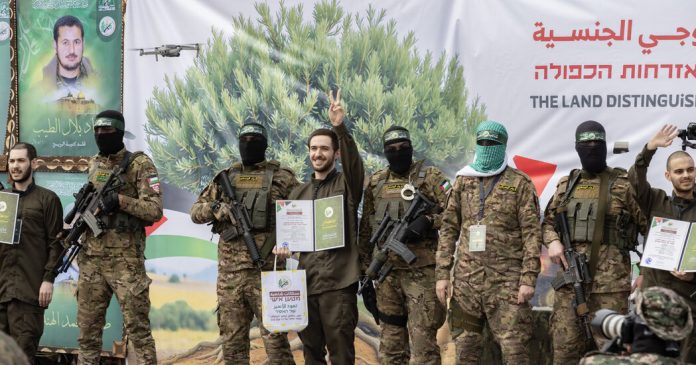
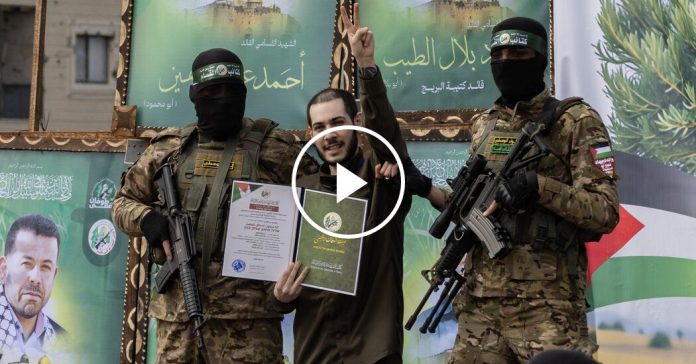
Hamas returned the six hostages on Saturday in two highly orchestrated public ceremonies and a third transfer that was not televised. The first two to be freed, Avera Mengistu and Tal Shoham, were turned over to Red Cross officials in the southern Gaza city of Rafah. The Israeli military said the two men had crossed into Israel and would receive medical assessments.

Mr. Mengistu, 38, had been the longest-held living Israeli hostage in Gaza. An Israeli of Ethiopian descent, he crossed into Gaza in 2014 and was taken hostage by Hamas, which claimed he was a soldier, though he had never served in the military.

Mr. Shoham, along with several family members, including his wife and two children, was abducted from Kibbutz Be’eri, where more people were killed in the Oct. 7 attack than in any other Israeli community. His wife, son and daughter were freed during a cease-fire in November 2023, and in a statement after his release on Saturday, his family said that “all emotions are rapidly mixing together.”

Three other hostages were handed over in Nuseirat, in central Gaza, and delivered to the Israeli military: Omer Shem Tov, Omer Wenkert and Eliya Cohen. All three were kidnapped while trying to flee a music festival near the border with Gaza, and are said to suffer from illnesses that allowed them to be prioritized for release.

During the handover ceremony, the hostages appeared thin and pale. They were dressed in khaki uniforms, though none were in military service when they were taken hostage.

In a video released by the Israeli government, Mr. Shem Tov, who was 20 when he was abducted, can be seen reuniting with his parents and telling them, “You have no idea how much I dreamed about you.”

In both ceremonies, masked gunmen escorted hostages onto stages and displayed release certificates — theatrical handovers that have become typical of Hamas’s hostage releases in this cease-fire, as the militant group aims to demonstrate that it is still in control of Gaza.

Late Saturday, Hamas published a propaganda video on social media that appeared designed to instill fear for the safety of the hostages still alive in Gaza. The video shows that the militant group brought two additional captives to a transfer ceremony on Saturday, where they were forced to watch from a van and beg for their own release.

Rights groups and international law experts say that a hostage video is, by definition, made under duress, and the statements in it are usually coerced. Israeli officials have called past Hamas videos a form of “psychological warfare,” and experts say their production can constitute a war crime.

The scenes during the transfers themselves on Saturday were more subdued than during some of the previous, more chaotic exchanges.

The sixth hostage, Hisham al-Sayed, 37, was turned over in Gaza City in a more private transfer. An Israeli citizen from a Bedouin town in the southern Negev desert, Mr. al-Sayed crossed into Gaza of his own accord in April 2015 and was taken hostage by Hamas.

Al Jazeera, the Qatari-funded TV channel, broadcast video of a man who appeared to be Mr. al-Sayed walking toward a Red Cross vehicle, and the Israeli military later released footage of him being transferred into the hands of Israeli forces in Gaza. Hamas held Mr. al-Sayed incommunicado for years before releasing a proof-of-life video in 2022, showing him lying in a bed with an oxygen mask on his face, apparently in poor health.

His family said in a statement that they were “moved by Hisham’s return home,” adding, “the long-awaited moment has arrived.”

Under the cease-fire agreement, Hamas committed to freeing at least 25 living Israeli hostages and the remains of eight more in exchange for more than 1,500 Palestinians jailed by Israel.

Palestinians in the West Bank and Gaza had eagerly awaited the return of their loved ones. Of those who were set to be freed on Saturday, 445 men, 23 minors and one woman were all arrested after the Hamas-led October 2023 attack on southern Israel, according to lists distributed by Palestinian officials. In addition, 151 Palestinians who have been imprisoned for years, including some convicted of participating in deadly attacks against Israelis, were scheduled to be released.

Whether the cease-fire extends into a second phase is still uncertain. The two sides were set to start talks over details on the next stage more than two weeks ago, but it is not clear if serious negotiations have started.

Musk tells federal employees to document work or be fired : NPR

0

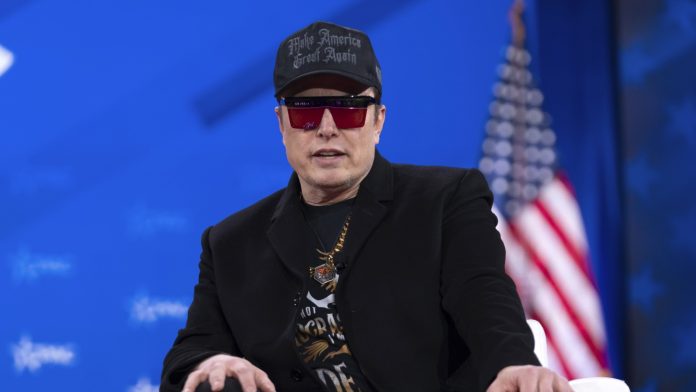
Elon Musk speaks at the Conservative Political Action Conference, CPAC, at the Gaylord National Resort & Convention Center, on Thursday in Oxon Hill, Md.

Jose Luis Magana/AP


hide caption

toggle caption

Jose Luis Magana/AP

Federal workers across the U.S. government received an email on Saturday afternoon asking them to account for what they did in the past week — and Elon Musk says they will be fired if they don’t respond.

The emails arrived several hours after Musk, who is leading the Department of Government Efficiency team that has orchestrated the mass firings of at least 20,000 government workers over the past month, gave notice about the apparent ultimatum.

“Consistent with President @realDonaldTrump’s instructions, all federal employees will shortly receive an email requesting to understand what they got done last week,” Musk wrote on X, which he owns. The post ends: “Failure to respond will be taken as a resignation.”

The emails, which NPR has confirmed, were sent by the Office of Personnel Management. They ask workers to reply and provide “approx. 5 bullets of what you accomplished last week and cc your manager,” and gives a deadline of Monday 11:59 p.m. ET. It asked that that no classified information be shared.

OPM said in a statement that the emails are “part of the Trump Administration’s commitment to an efficient and accountable federal workforce,” and that “agencies will determine any next steps.”

It’s unclear what legal weight the threat carries. Many federal workers are covered by civil service protections that prevent them from being fired without cause.

In a statement responding to the email notices, the head of the American Federation of Government Employees (AFGE) — which represents more than 800,000 civil servants — said it would challenge any unlawful firings of federal workers.

“Once again, Elon Musk and the Trump Administration have shown their utter disdain for federal employees and the critical services they provide to the American people,” AFGE National President Everett Kelley said.

“It is cruel and disrespectful to hundreds of thousands of veterans who are wearing their second uniform in the civil service to be forced to justify their job duties to the this out-of-touch, privileged, unelected billionaire who has never performed one single hour of honest public service in his life,” Kelley added.

The emails come as Musk and the new Trump administration continue to aggressively fire government workers and remove top leaders from federal agencies.

It’s a familiar management tactic for Musk. The billionaire pulled a similar move at the helm of at least two of his other companies, Twitter — before he rebranded the social platform as X — and Tesla, where he mandated weekly reports from his employees on productivity and attendance.

In Syria, Joy at al-Assad’s Demise Turns to Fear of Israeli Raids

0

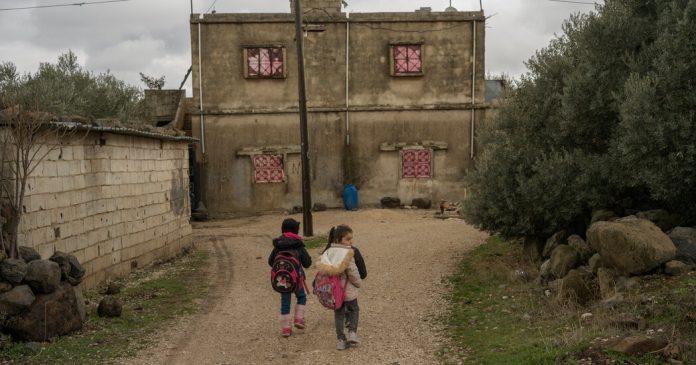
Ruwayda al-Aqaar was sleeping next to her husband and 3-year-old daughter in late December when they were awakened by the sound of approaching tanks and bulldozers. They rushed outside their small house and saw dozens of Israeli soldiers marching into their small farming village, she said.

“I was terrified,” Ms. al-Aqaar said recently in her home in the village of Suwaisah, in southeastern Syria, as her daughter watched “Tom and Jerry” cartoons. “We were afraid of being displaced and forced to leave our homes.”

For weeks, the family and their neighbors feared that Israeli forces would target their village after carrying out similar incursions into towns nearby. Just days after a coalition of Syrian rebels ousted President Bashar al-Assad in early December, Israel invaded border villages in Syria in what it described as temporary measures to protect its own security.

But the Israeli raids continued throughout January and into February, raising fears among Syrians that the incursions could become a prolonged military occupation. The Israeli troops have been targeting villages, particularly ones with military outposts.

In Suwaisah, the Israeli soldiers tore down a small military outpost that had been abandoned by Syrian troops who took their weapons with them after the Assad regime fell. And the Israelis demanded that residents hand over any weapons they may have had. This account of what happened is based on interviews with more than a dozen residents of Suwaisah and Al-Dawayah Al-Kabirah, a nearby village that was also raided, as well as photographs they shared from cellphones.

Suwaisah is a village of mostly one-story homes, its residents mostly farmers and herders. It was a little past 7 a.m. on Dec. 25 when the Israelis entered the village and were met by dozens of adults and children, residents said. Some of the Syrians tore off olive branches from nearby orchards as a symbol of peace, they said, adding that none of the residents who went out to meet the Israelis carried weapons.

“Syria is free, free,” the villagers chanted at the soldiers, who were armed with semiautomatic machine guns, “and Israel out!”

The Israeli military raids have terrified the villagers, who, like other Syrians, had celebrated the ouster of Mr. al-Assad and gathered in the streets, playing revolutionary songs and waving flags. But in this corner of Syria, the celebrations quickly dissipated into fear of an encroaching foreign army.

“They ruined our joy,” Ms. al-Aqaar said.

This part of southeastern Syria abuts the Golan Heights, territory that Israel captured from Syria during the Arab-Israeli War of 1967 and then annexed. The move is not recognized by most of the world, including the United Nations, which considers the land occupied.

Ms. al-Aqaar, like many Syrians in the region, feared that her village might meet the same fate.

Israel has in recent months seized a demilitarized buffer zone in the Golan Heights and territory in southwestern Syria — including Mount Hermon, the country’s highest point. It has also has carried out hundreds of airstrikes, destroying Syrian military assets, including tanks, weapons production facilities and air-defense systems, according to Syrian monitoring groups.

The Israeli military says it is acting “in order to protect the Israeli border.” Israel has long seen the Golan Heights as important to its security because it sits on the edge of Syria, Jordan and Lebanon, offering an important military vantage point. There is now concern in Israel that the fall of the Assad regime may have left a security vacuum in the area.

Prime Minister Benjamin Netanyahu of Israel has signaled that the military would occupy the lands it has taken for the foreseeable future, “until another arrangement is found that guarantees Israel’s security.”

Israeli forces continue to conduct cross-border incursions into Syria with bulldozers and armored vehicles, according to Etana, a Syrian reporting and analysis organization. On Jan. 16, an Israeli airstrike struck a Syrian government convoy, killing at least two people, including a mayor, according to Etana and another Syrian monitoring group, the Syrian Observatory for Human Rights.

They have raided former Syrian Army bases in the southern provinces of Quneitra and Daraa to demolish property, occupy land and demand residents hand over any weapons, Etana reported.

“This available evidence indicates that Israel may be expanding and entrenching its occupation over areas of Quneitra Province,” the group said in a report in January.

Israel’s recent incursions and taking of the buffer zone in the Golan Heights violates the 1974 agreement between the two countries that followed the end of the 1973 war, according to the United Nations. After that conflict, both sides had agreed that U.N. peacekeepers would monitor a 155-square-mile demilitarized zone between their forces.

The Israeli incursions have been condemned internationally. The United Nations said in January that “Syria’s sovereignty, territorial unity, and integrity must be fully restored.”

And in December, Geir Pedersen, the United Nations special envoy for Syria, called on Israel to halt its “very troubling” military attacks.

Ahmed al-Shara, the leader of Syria’s new government, has criticized Israel for its incursion, saying it was a violation of the 1974 armistice agreement.

Shadi al-Mleihan, a journalist who lives in Suwaisah, said he was among those who confronted the Israeli forces when they entered his village in December.

“We have been in a war for nearly 14 years,” he said. “We don’t want another war.”

In addition to destroying the outposts, the soldiers demanded that residents hand over any weapons in the village, Mr. al-Mleihan and other villagers said.

“They said you need to announce from the mosque speakers that we want all the weapons and if you won’t we have a megaphone,” Badir al-Krayat, Ms. al-Aqaar’s husband, said the soldiers told them. “We said, ‘We don’t have weapons; we are farmers.’”

As villagers confronted some soldiers, other troops were leveling the outpost, some olive trees and a small municipal building, several residents said. Two hours later, the soldiers withdrew toward Al-Dawayah Al-Kabirah, setting their sights on another abandoned Syrian military outpost there, residents said.

There, villagers gathered around the former outpost and sat on top of other structures in an effort to prevent the Israeli forces from destroying them. Then, according to multiple residents and a human rights group, Israeli troops fired on unarmed civilians.

At least five civilians, including a child, were wounded, according to residents and the British-based Syrian Observatory for Human Rights.

The Israel military said it “does not target its operations against civilians or civilian infrastructures.” In response to questions, the military said it “operated near the village in order to neutralize military infrastructures which posed a threat” to its forces.

“Several groups were observed approaching I.D.F. personnel in the area,” the military said. “After calling on the crowd to stand back and maintain a safe distance, individuals continued to advance towards the forces that responded with warning shots solely aimed at the air.”

Khalid al-Aaqal, 17, a high school senior, said he was among those shot in Al-Dawayah Al-Kabirah in late December. He said he and other villagers went to confront the Israeli troops, “and they started shooting” at the villagers’ feet with semiautomatic machine guns.

“We didn’t think they would shoot at us because we didn’t have any weapons,” Mr. al-Aaqal said.

His cousin was shot in the foot, Mr. al-Aaqal and his mother said, and when Mr. al-Aaqal went to rescue him, Mr. al-Aaqal was hit in both legs.

“They drowned our celebrations with their incursion,” said Alaa al-Aawad, 24, who was shot in the ankle and spoke as he lay on a pile of thin mattresses, his left leg propped up on a pillow.

Villagers in Suwaisah and Al-Dawayah Al-Kabirah said they were anxious about what comes next. The Israeli forces have left, but residents said they could still see them moving on two nearby mountain tops that the soldiers have seized.

“We don’t know what their goal is,” Hassan Muhammad, 32, who was one of the protesters who confronted the soldiers in Al-Dawayah Al-Kabirah, said of Israel. “But we as a people, our goal is to protect our lands. We just got rid of one tyrant and we don’t want another to come here and occupy it.”

Nine-Month Manhunt for French Fugitive Finally Produces an Arrest

0

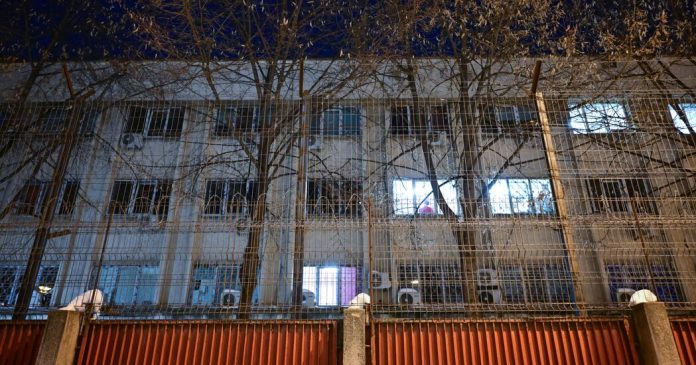
A French inmate who fled police after armed assailants attacked a prison convoy in May was apprehended in Romania, French officials said Saturday. His capture ended a monthslong hunt for the man, whose violent escape resulted in the deaths of two prison guards.

French Interior Minister Bruno Retailleau confirmed in a statement on X that Mohamed Amra, the man who was whisked away by two gunmen in a brazen daytime attack, had been taken into custody with the cooperation of the Romanian government.

President Emmanuel Macron hailed his capture as “a tremendous success,” and thanked investigators who had been tracking Mr. Amra “for months and months.” He added: “I am thinking of the families of the prison staff he had killed.”

The Paris prosecutor’s office said the man arrested was “very likely” to be Mr. Amra and that investigators were working to conduct the necessary verifications.

Violent prison breaks are rare in France. The two prison guards were the first to be killed in the line of duty in 32 years, and the case raised uncomfortable questions about France’s overburdened prison system and whether authorities had fully grasped how dangerous the inmate, a violent criminal known as La Mouche, or The Fly, was.

He had been sentenced to 18 months in prison for burglary, one of numerous convictions for crimes including extortion and assault. But he was also under investigation on more serious charges — in Marseille, in connection with a kidnapping and homicide and in Rouen, in connection with an attempted homicide and extortion case.

An undated photo of Mohamed Amra.Credit…Interpol

French news outlets had reported that Mr. Amra had been involved in international drug trafficking and organized crime, but Laure Beccuau, the top Paris prosecutor, said at a news conference in May that Mr. Amra had no drug-related convictions.

Officials have not released details about the investigation into the other people involved in the brutal ambush.

During the May attack, assailants rammed a police van carrying Mr. Amra and then hooded men with automatic weapons circled the van, firing bullets into the vehicle for over two minutes.

The attackers fled in stolen cars that were later found burned.

The attack, which came as France was trying to project an image of law and order ahead of the Paris Olympics, was captured on video by security cameras and bystanders, and videos were later shared on X.

It occurred on the same day that a Senate committee completed a report on rampant drug trafficking in France and recommended the creation of a French equivalent to the U.S. Drug Enforcement Administration.

France has been faced with a rise in drug violence and crime, not limited to traditional hot spots or big cities.

A 2024 Senate report found that “the intensification of trafficking in the rural areas and the moderate-sized cities” had come with particularly brutal violence.

Aurelien Breeden contributed reporting.

Hamas Frees 6 Hostages and Returns Remains of Shiri Bibas

0

It was a day of emotional homecomings for Israelis as six hostages were returned home from Hamas. But Israel delayed the handover of more than 600 Palestinians it was expected to free in the exchange.

CPAC is an annual meeting of conservative leaders. How's it changed in recent years?

0

The Conservative Political Action Conference, which meets on Saturday, has shifted toward President Trump and away from traditional conservatism.

Pope Francis in Critical Condition After ‘Respiratory Crisis,’ Vatican Says

0

Pope Francis was in critical condition on Saturday night after having a long “asthmatic respiratory crisis” earlier in the day that required “high flows of oxygen” as well as a blood transfusion, the Vatican said, adding to concerns about the health of the 88-year-old pontiff.

The announcement indicated that Francis’ medical condition had become more complicated since an update from his doctors on Friday evening, when he was also said to be in critical condition.

“The pope is not out of danger,” the Vatican said on Saturday evening.

As the pope’s hospital stay enters a second week, questions have grown about whether Francis — the spiritual leader of almost 1.4 billion Roman Catholics worldwide — will recover, pass away, or manage to fight his infection but emerge physically diminished.

The damage to his lungs was already chronic, and in recent days a few cardinals have openly spoken about the possibility of Francis resigning, as his predecessor Benedict XVI did in 2013.

A death or resignation would prompt a conclave of the church’s cardinals, who would elect a successor.

In an interview with Milan daily Corriere della Sera on Saturday, Pope Francis’ secretary of state, Cardinal Pietro Parolin, spoke of “useless speculation.” The only thing that mattered, he said, was “the Holy Father’s health, his recovery, his return to the Vatican.”

Francis was hospitalized on Feb. 14 with a respiratory tract infection that developed into pneumonia in both lungs. As a young man, Francis had part of a lung removed.

But the Vatican said on Saturday that Francis was alert and sitting up in an armchair, “though he was in more pain than yesterday.”

The blood transfusion was necessary because tests showed low platelet counts, associated with anemia, the Vatican said.

On Friday, his doctors had said that Francis was in critical condition and would remain in the hospital for at least another week.

His surgeon Sergio Alfieri said that the pope understood the risk of death at his age and had told him, “all doors were open.”

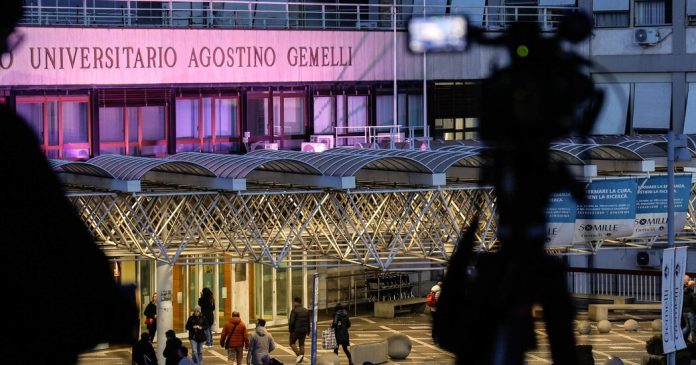
Speaking to reporters gathered at Policlinico Agostino Gemelli, the hospital where Francis is being treated, Dr. Alfieri had described the difficulties the pope’s medical team was facing to calibrate the right treatment for the pontiff, who has pneumonia but also a complex infection.

The pope’s medical doctor at the Vatican, Luigi Carbone, said that as in the case of any fragile patient, it would take very little for a medical situation “to become unbalanced.”

The doctors said that Francis was intermittently using oxygen.

This is the fourth time Francis has stayed at the Gemelli hospital. In 2021, he had colon surgery there. In 2023, he was admitted for a respiratory infection, but went home after three days. He was hospitalized again a few months later to undergo abdominal surgery for a hernia.

Dr. Alfieri, who performed both abdominal surgeries, said on Friday that when it came to those medical conditions, Francis was fine. The pope’s heart was strong, he added.

In recent years the pope has been prone to bouts of influenza and bronchitis during the cold winter months. Because of knee problems and sciatica, he often uses a wheelchair, walker or cane.