Friday, November 13, 2026
Home Blog Page 224

Why Mitch McConnell voted against RFK Jr. for HHS head : Shots

0

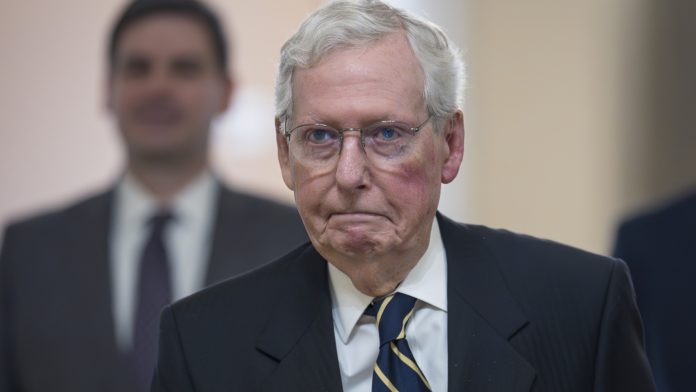
Sen. Mitch McConnell, R-Ky., is a survivor of childhood polio and was the only Senate Republican who opposed Robert F. Kennedy Jr. leading the Department of Health and Human Services.

J. Scott Applewhite/AP


hide caption

toggle caption

J. Scott Applewhite/AP

In a party-line vote, zero Democrats and 52 Republicans in the Senate voted Thursday to confirm Robert F. Kennedy Jr. as the new head of the Department of Health and Human Services. Sen. Mitch McConnell, R-Ky., was the sole Republican to oppose President Trump’s nominee.

Sen. Bill Cassidy, R-La., a physician and the chair of the Senate’s health committee, was originally hesitant but changed his mind last week after promises that Kennedy made to him.

The 82-year-old McConnell, who has served in the Senate since 1985 and is the longest-serving party leader in that body, recovered from polio when he was 4. He still walks with a limp and suffers health problems related to the illness.

He contracted the disease in 1944, before the polio vaccine was available, and experienced paralysis in his left leg. Immunization campaigns starting in the 1950s eventually eliminated the scourge in the United States.

During the coronavirus pandemic, McConnell was a supporter of the COVID-19 vaccine and the push to develop treatments, telling The Associated Press that the moment reminded him of the fear surrounding polio in his childhood.

He issued a statement Thursday on Kennedy’s nomination that explains his views in stark terms:

“I’m a survivor of childhood polio. In my lifetime, I’ve watched vaccines save millions of lives from devastating diseases across America and around the world. I will not condone the re-litigation of proven cures, and neither will millions of Americans who credit their survival and quality of life to scientific miracles.

“Individuals, parents, and families have a right to push for a healthier nation and demand the best possible scientific guidance on preventing and treating illness. But a record of trafficking in dangerous conspiracy theories and eroding trust in public health institutions does not entitle Mr. Kennedy to lead these important efforts.

“This Administration – led by the same President who delivered a medical miracle with Project Warp Speed – deserves a leader who is willing to acknowledge without qualification the efficacy of life-saving vaccines and who can demonstrate an understanding of basic elements of the U.S. healthcare system. Mr. Kennedy failed to prove he is the best possible person to lead America’s largest health agency. As he takes office, I sincerely hope Mr. Kennedy will choose not to sow further doubt and division but to restore trust in our public health institutions.”

McConnell was also the only Republican senator to vote against Tulsi Gabbard for director of national intelligence, and he voted against Pete Hegseth for defense secretary.

At a news conference on Thursday, Trump disparaged McConnell’s mental fitness and said that he didn’t know anything about McConnell having polio. “He’s a very bitter guy,” Trump said.

U.S.S. Harry S. Truman Carrier Collides With Commercial Ship Off Egypt

0

A United States Navy aircraft carrier collided with a merchant vessel in the Mediterranean Sea shortly before midnight on Wednesday near a port in Egypt, Navy officials said.

The U.S.S. Harry S. Truman, a Nimitz-class carrier, had been operating in the Red Sea while deployed under U.S. Central Command since Dec. 14, helping to launch attacks in Yemen against Houthi militias there that have been attacking civilian ships and vessels tied to Israel.

There were no reports of flooding or injuries aboard the Truman, and the Navy said in a statement on Thursday that the ship’s propulsion systems, powered by two onboard nuclear reactors, were “unaffected and in a safe and stable condition.”

The Navy also said the crash was under investigation.

The online ship tracking service Vessel Tracker reported that there were no injuries to the crew of the commercial vessel, the Besiktas-M, a bulk carrier built in 2003 and sailing under the Panamanian flag. The ship was traveling from the port of Aqaba in Jordan to Constanta, a port city in Romania by the Black Sea.

The collision near Port Said in Egypt breaks an apparent safety streak for the U.S. Navy when it comes to crashes with commercial ships. Before the Truman’s collision, the most notable recent ones had happened in 2017, and they led to an internal reckoning. Two such collisions in the Western Pacific killed 17 sailors that year. Navy investigations found they had been “avoidable,” resulting from crew errors.

Those crashes led to a safety stand-down of all Navy ships, and the commander of the Seventh Fleet in Japan, which oversees Navy operations between the Indian Ocean and the international date line, was relieved of duty. The Navy’s Pacific Fleet commander chose to retire after the two collisions, when he was told he was no longer in line for a promotion.

On June 17 that year, the U.S.S. Fitzgerald struck the ACX Crystal, a 30,000-ton container ship off the coast of Japan, ripping a hole in the destroyer’s hull. Seven U.S. sailors died, and the warship’s commander and executive officer were both fired after an investigation.

A little more than two months later, a second destroyer, the U.S.S. John S. McCain, struck the Alnic MC, a 600-foot oil tanker, off the coast of Singapore, punching through the warship’s hull. Ten Navy sailors died when their living quarters were flooded with seawater.

By historical standards, the Navy’s record in recent decades has been “extraordinarily good,” according to a 2022 report written by Samuel J. Cox, a retired admiral who leads the Navy’s History and Heritage Command.

And fatal collisions for Navy warships have been relatively rare. In 2004, the U.S.S. John F. Kennedy, an aircraft carrier of an earlier design than the Truman, collided in the Persian Gulf with a small traditional Arab sailing boat used mainly for transportation and fishing. The boat sank immediately, and all aboard are believed to have died. Two warplanes on the Kennedy were damaged.

The U.S.S. Greeneville, a Los Angeles-class fast attack submarine, collided with a Japanese fishing boat, the Ehime Maru, off the coast of Oahu, Hawaii, in 2001, killing nine passengers on the fishing boat, including four high school students.

The Truman has nine aviation squadrons embarked and has been accompanied by a cruiser and two destroyers. Together, the Truman Strike Group has recently launched attacks on the Iran-backed Houthi militias, according to Central Command. The U.S. military has carried out a series of strikes on the Houthis, who on Thursday suggested they would continue attacking Israel and ships in the Red Sea if the cease-fire in Gaza fell apart.

The collision on Wednesday was the second-known major mishap of the Truman’s current deployment.

On Dec. 22, an F/A-18 Hornet fighter flying from the Truman was mistakenly shot down by the U.S.S. Gettysburg, the cruiser accompanying the carrier, during an aerial refueling mission.

Trump administration begins laying off recent federal hires : NPR

0

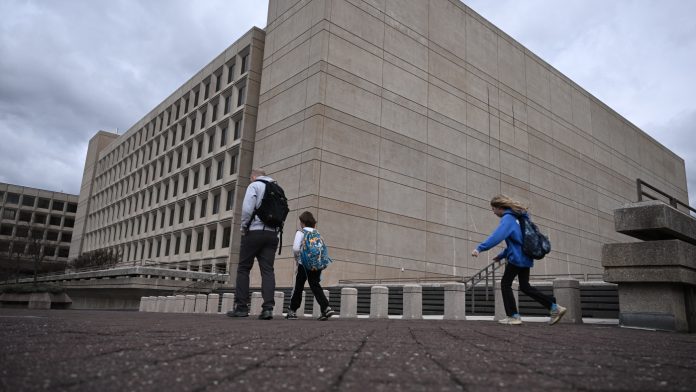
People walk past the U.S. Department of Energy building in Washington, D.C.

Brendan Smialowski/AFP via Getty Images


hide caption

toggle caption

Brendan Smialowski/AFP via Getty Images

Federal workers have begun receiving layoff notices as the Trump administration moves ahead with plans to drastically downsize the government.

While the full scale of layoffs isn’t yet clear, the first round of cuts appeared to target employees who were recently hired and still on probationary status, according to multiple federal officials and staffers who spoke to NPR on condition of anonymity, because they were not authorized to speak to the press and feared retaliation from the Trump administration.

The firings are affecting a wide swath of federal workers, and include employees responsible for education, small business grants, and the nation’s nuclear weapons stockpile.

Probationary periods vary by federal agency but typically last one or two years. According to government data, around 220,000 federal employees had less than one year of service in March 2024, the most recent time period available. Another 288,000 had between one and two years of service at that time.

President Trump signed an executive order on Tuesday directing federal agencies to start preparing to, quote, “initiate large-scale reductions in force.” Trump and his advisor Elon Musk have said they want to cut what they say is excessive government spending.

Compensation for federal employees amounted to around 3 percent of the federal budget in the 2024 fiscal year, according to government data.

The Department of Energy began firing its probationary employees on Thursday, according to two officials at the agency who spoke to NPR on condition of anonymity because they were not authorized to speak to the press.

The employees, who have worked for less than two years in the federal government, were being let go without any notice or severance. Although a formal letter was being prepared, some employees were being fired verbally.

Mass terminations of probationary workers also swept through the National Nuclear Security Administration, a semi-autonomous agency within the energy department that oversees the nation’s nuclear weapons.

According to an NNSA employee, roughly 300 of the agency’s 1,800 staff had been fired after the agency was denied a national security exemption. The small organization is responsible for maintaining and upgrading America’s arsenal of nuclear weapons, combatting nuclear terrorism, and preventing proliferation around the world.

According to one energy department official, the Office of Personnel Management (OPM) had suggested the agency use a template that cited “performance reasons” as the cause of the firings. The official said the energy department letter had removed that phrasing because many of the employees had performed well during their probationary period. The energy department’s press office did not immediately respond to a request for comment.

Probationary employees at the U.S. Office of Personnel Management were also terminated on Thursday, according to an official with the American Federation of Government Employees, which represents more than 800,000 civil servants, including workers at OPM, the Department of Education, the Small Business Administration, and other federal agencies. The union official spoke with NPR anonymously in order to share internal discussions.

Over a Microsoft Teams call with about 100 people, OPM staffers were told the reason for their dismissal was that they didn’t take the Trump administration’s “Fork in the Road” deferred resignation offer, the union official said. That offer gave two million civilian federal employees the option to resign while retaining pay and benefits through the end of September, or remain in their positions with the caveat that their jobs would not be not guaranteed.

The affected OPM employees were given until 3 p.m. ET Thursday to leave the building, the union official said. AFGE officials were not given access to the building.

“This administration has abused the probationary period to conduct a politically driven mass firing spree, targeting employees not because of performance, but because they were hired before Trump took office,” AFGE president Everett Kelley said in a statement late Thursday.

“Agencies have spent years recruiting and developing the next generation of public servants. By firing them en masse, this administration is throwing away the very talent that agencies need to function effectively in the years ahead,” Kelley said.

Probationary staff at the Department of Education began receiving written notifications on Wednesday night that they were being terminated effective immediately, according to four employees who shared their notices with NPR on condition of anonymity for fear of reprisal.

At least 60 probationary staffers across the education department received termination notices, according to the union official.

“This is just devastating to me,” one department staffer told NPR on the condition their name not be used for fear of retribution. “When I took my oath, that was the proudest moment of my career.”

In response to a request from NPR to confirm the firings, a spokesperson said the agency does not comment on personnel matters.

At the General Services Administration, many probationary employees were called into meetings on Wednesday afternoon and told they would be let go, according to three GSA employees who spoke to NPR. Some were told they had a final chance to take the government’s deferred resignation offer, which was officially closed hours later. As of Thursday, many affected GSA workers still had not received formal termination notices in writing, the GSA sources said.

At some agencies, the notification process has been confusing and chaotic.

At the Small Business Administration, probationary staff received emailed termination notices last Friday, only to be told in another email on Monday that that was an error, according to the union official. Then, on Tuesday, the SBA staffers got another termination notice. The union official said dozens of SBA probationary employees were let go.

Termination letters emailed to probationary employees at the Consumer Financial Protection Bureau on Tuesday appeared to have been the result of a failed mail merge, according to two terminated employees who got the letters.

The resulting notices were missing personal details, reading: “MEMORANDUM FOR [EmployeeFirstName] [EmployeeLastName], [Job Title], [Division]”.

CFPB’s union has identified approximately 73 “bargaining-unit” employees in their probationary period who were terminated, according to Jasmine Hardy, the executive vice president for NTEU Chapter 335.

Have information you want to share about the ongoing changes across the federal government? Reach out to these authors: Shannon Bond is available through encrypted communications on Signal at shannonbond.01, Geoff Brumfiel is on Signal at gbrumfiel.13, and Andrea Hsu is on Signal at andreahsu.08

NPR’s Stephen Fowler, Jonaki Mehta and Laurel Wamsley contributed to this report.

Judge Extends Halt on Trump Plan to Dismantle U.S.A.I.D.

0

A federal judge on Thursday moved to extend by one week a temporary restraining order preventing the Trump administration from carrying out plans that would all but dismantle the U.S. Agency for International Development.

The order, which Judge Carl Nichols of the U.S. District Court for the District of Columbia said he would file later Thursday, continues to stall a directive that would put a quarter of its employees on administrative leave while forcing those posted overseas to return to the United States within 30 days.

Judge Nichols said he would rule by the end of next week on whether to grant the plaintiffs’ request for a preliminary injunction that would indefinitely block key elements of the high-profile Trump administration effort.

The plan was driven in large part by Elon Musk, the billionaire tech entrepreneur tasked with making cuts to the federal budget, to shutter an agency he and Mr. Trump have vilified. The Trump directive would affect about 2,700 direct hires of U.S.A.I.D., including hundreds of Foreign Service officers.

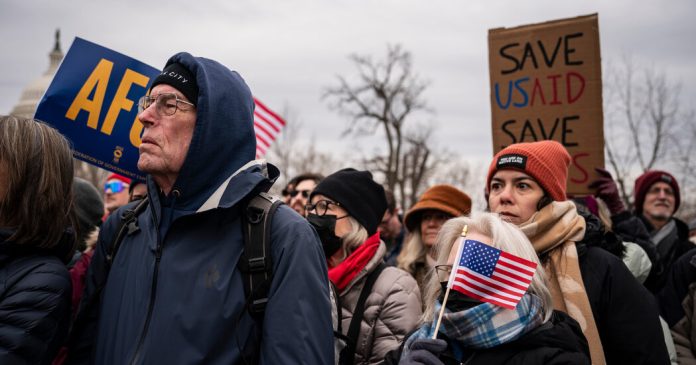
The lawsuit was filed by two unions representing the affected U.S.A.I.D. employees: the American Foreign Service Association, to which aid workers in global missions belong, and the American Federation of Government Employees, which represents other direct hires. They have argued that President Trump’s executive order freezing foreign aid for 90 days and subsequent directives to dismantle certain U.S.A.I.D. operations and reduce staff were unconstitutional, and have asked the court to overturn them.

Democratic lawmakers, U.S.A.I.D. workers, and the aid organizations that depend on U.S. foreign assistance have decried any moves to unilaterally shut down the agency as unlawful, as its role in the federal government was established by law and Congress funded it, like the rest of the government, through March 14.

During a hearing on Thursday, Judge Nichols pressed Karla Gilbride, the lawyer for the plaintiffs, on why being placed on administrative leave would cause irreparable harm to the employees.

He also asked Ms. Gilbride a series of questions about why the unions and the employees they represent had not first sought relief through established arbitration processes for the federal work force — an argument that the Justice Department had made in its responses to the lawsuit.

Ms. Gilbride said that if employees went through an arbitration process, there might not be a U.S.A.I.D. left to employ them by the time their cases were considered.

“This court is the only forum that can address these harms on the time scale that this urgent situation demands,” she said, noting that the administrative processes in question were designed to handle the grievances of individual employees, not an entire federal agency on the brink of dissolution.

Whether federal employee unions can experience the direct harm necessary to file a lawsuit — a concept known as standing — became an issue in another case against the Trump administration.

Unions, including the American Federation of Government Employees, challenged an offer to pay federal workers through September if they agreed to resign. The judge in that case, George A. O’Toole of the U.S. District Court for the District of Massachusetts, ruled on Wednesday that the unions did not have the standing to sue because they had not been directly affected by the offer.

Judge O’Toole also noted that Congress had established administrative processes for raising the type of claims at issue in the case.

Eric Hamilton, the Justice Department lawyer, made a similar argument about the U.S.A.I.D. employees on Thursday, pointing to the existence of administrative processes for settling labor disputes involving the federal work force.

“We certainly don’t think unions coming to district court is the right form to litigate,” he said.

But those administrative processes can take years, and Mr. Trump has also targeted some of them. On Monday, he fired the chairwoman of the Merit Systems Protection Board, which hears appeals to firings and other disciplinary actions against federal employees.

Ms. Gilbride on Thursday made a series of arguments about the uncertainties and dangers facing workers stranded overseas and in bureaucratic limbo, some of whom submitted testimonials about being in physical danger and struggling to get security guidance because they were unable to access their accounts to receive official communications. These included several officers posted to the Democratic Republic of Congo, who described how they were left to determine whether and how to flee Kinshasa amid protests, as demonstrators approached their houses and, in one case, looted all of one officer’s belongings.

Ms. Gilbride said they and the rest of the U.S.A.I.D. Foreign Service officers had been “forced under extreme time pressure” to choose whether to uproot their families and return to the United States, with the understanding that the Trump administration would not extend relocation assistance to those who resisted departing on the U.S. government’s timeline.

Mr. Trump’s political appointees and Mr. Musk, labeled a “special government employee” by the White House, are aiming to cut most of the around $70 billion of annual foreign aid money that is allocated through congressional mandates and legislation. About $40 billion of that amount is funneled through U.S.A.I.D., accounting for less than 1 percent of the annual federal budget.

Mr. Hamilton defended planned cuts to the agency’s work force as falling within Mr. Trump’s purview. He acknowledged the unique safety risks employees in high-risk locations faced and assured Judge Nichols that the administration was taking steps to protect them.

“You can understand, I’m sure, why I would not want to be in the position of having government employees overseas be at risk because they are placed on administrative leave,” Judge Nichols said.

“We share the concern about the security of U.S.A.I.D. employees,” Mr. Hamilton said.

Pressed by the judge to detail those additional measures, Mr. Hamilton said he did not know what they were.

Judge Nichols instructed him to provide the court with details about the safety measures. He also asked Mr. Hamilton to give the court information about what the administrative leave status meant for other nonsalary benefits that come with an overseas employee’s post, such as diplomatic housing and school tuitions.

The government has said employees on administrative leave would continue to be paid, but U.S.A.I.D. Foreign Service officers expect that they would lose many of the additional benefits afforded to those who work globally if they are forced to return to the United States. For an officer without a home base in the United States, losing those benefits could force a dip into savings to keep a roof over their head.

It is also not clear how long employees put on administrative leave would remain on that status.

Lawyers for the Trump administration have said that officials had determined that only 611 of U.S.A.I.D.’s approximately 10,000 workers were too “essential” to be put on administrative leave or terminated, for now. They defended the drastic planned cuts by arguing in court documents that “the president’s powers in the realm of foreign affairs are vast and generally unreviewable.”

The lawsuit is one of several seeking to beat back the Trump administration’s efforts to severely restrict foreign aid, which has affected not just U.S.A.I.D.’s work force, but the global network of aid organizations that depend on the U.S. to carry out humanitarian, health and development programs.

Another suit pending before the U.S. District Court for the District of Columbia, brought by a group of contractors and nongovernmental organizations who lost funding, asks the court to order the administration to restart disbursements of foreign aid funds and stop the dismantling of U.S.A.I.D.

What President Trump did today: Tariffs, India and government cost-cutting

0

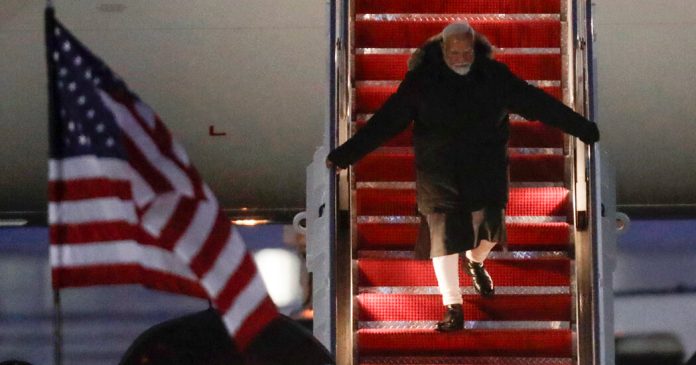
It was another busy day for President Trump. He signed a memorandum on trade that could lead to imposing more tariffs, met with Indian Prime Minister Modi, and spoke with the press multiple times.

As Ukraine Presses for Role in Russia Peace Talks, Trump Offers Reassurances

0

President Trump on Thursday offered reassurances that Ukraine would be involved in negotiations to end the war with Russia, a day after his remarks left that prospect in doubt and alarmed officials in Kyiv and Ukraine’s European allies that they would be left out of peace talks.

“Of course they would,” Mr. Trump said in response to a reporter’s question in the Oval Office in Washington about whether Ukraine would have a place at the table. “I mean, they’re part of it. We would have Ukraine, we would have Russia, and we would have other people involved, too.”

European leaders on Thursday demanded a role in any discussions between Mr. Trump and President Vladimir V. Putin of Russia to end the conflict, negotiations that could set the terms of peace and redraw the map of Europe.

Some of the closest allies of the United States, including Britain and Germany, were among those asserting that Ukraine — and their own countries — had a right to be at the negotiating table.

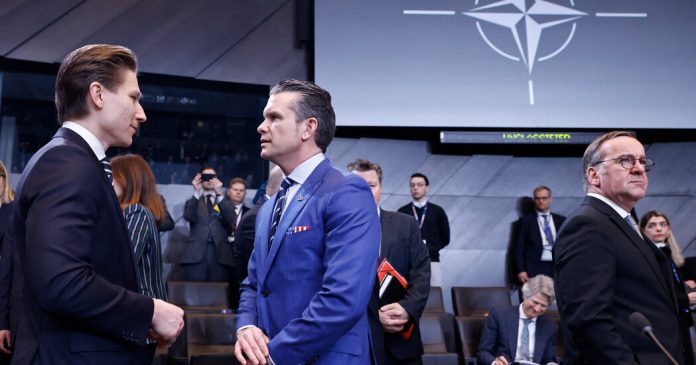
“Europe must be involved in the negotiations — and I think that’s very easy to understand,” said Boris Pistorius, Germany’s defense minister. The continent, he said, “will have to live directly” with the consequences of any deal, and may have “to play a central or the main role in the peace order.”

Mr. Pistorius and other NATO defense ministers made their comments at a meeting in Brussels on Thursday, a day after Pete Hegseth, the U.S. defense secretary, said a return to Ukraine’s pre-2014 borders would be “unrealistic” and Mr. Trump held a lengthy phone call with Mr. Putin that signaled a potential willingness to make concessions to Russia that Kyiv has previously deemed unacceptable.

Mr. Trump’s and Mr. Hegseth’s comments suggested that the United States may expect Ukraine to give up part of its territory now seized by Russia, as well as its goal of becoming a member of NATO, which Russia vehemently opposes. But some European officials argued on Thursday against prematurely surrendering on those issues, since they will be critical bargaining chips in any deal.

When Mr. Trump said on Wednesday that he and Mr. Putin of Russia had begun talks to end the war, he notably made no mention of Ukraine taking part in the negotiations — an omission that triggered alarm throughout nations allied with Ukraine in Europe that Kyiv’s interests would be sidelined in the process.

After speaking by phone with Mr. Putin — he then spoke with President Volodymyr Zelensky of Ukraine — Mr. Trump had suggested that borders could be redrawn and that NATO membership for Ukraine would be unrealistic.

Mr. Trump also said that reciprocal visits with Mr. Putin were likely. Saudi Arabia, he said, might host the peace talks. The Kremlin’s spokesman said on Thursday that Russia believed that a meeting between Mr. Putin and Mr. Trump should take place “fairly quickly” but that it was too soon to discuss dates.

Mr. Zelensky, reacting on Thursday to the Trump-Putin phone call, argued that his country must be involved in talks over its own fate.

“We, as a sovereign country, simply will not be able to accept any agreements without us,” he told journalists in Ukraine. It was “unpleasant,” he said, that Ukraine had not been notified to participate in the call.

Later on Thursday afternoon, Mr. Trump said that he had conferred with both Mr. Putin and Mr. Zelensky and that he believed Mr. Putin wanted peace.

“I think he would tell me if he didn’t,” Mr. Trump said.

The news of Mr. Trump’s initiative to end the war reverberated across Europe, from the gilded halls of power in Western Europe to the muddy trenches on the front line of the war. In Russia, financial markets skyrocketed, the ruble jumped, and business leaders in Moscow rejoiced.

The new American agenda came as little surprise to European leaders — Mr. Trump has been explicit about his views on the war in Ukraine — but the suddenness of the shift in the U.S. posture was, nonetheless, startling. Many in Europe shuddered at the prospect of renewed Russian influence on the continent and a diminished Ukraine.

This American posture on Ukraine risked straining some of the strongest trans-Atlantic alliances.

In Britain, where support for Ukraine crosses the political spectrum, Prime Minister Keir Starmer last month signed what Britain called a 100-year defense agreement with Ukraine, providing 3 billion pounds ($3.7 billion) a year in aid for the foreseeable future.

Now, Britain’s leaders must weigh their support for Ukraine against a determination to cultivate a friendly relationship with Mr. Trump.

“Let’s not forget, Russia remains a threat well beyond Ukraine,” John Healey, Britain’s defense secretary, said on Thursday. He added, “There can be no negotiation about Ukraine without Ukraine.”

Mr. Hegseth focused his remarks at the NATO meeting in Brussels on calling on European countries to spend more on defense. America’s allies, he said, must “make NATO great again.”

“President Trump will not allow anyone to turn Uncle Sam into Uncle Sucker,” he said at a news conference after the meeting’s conclusion on Thursday. He also criticized comments European leaders commonly make about prioritizing their values. “Values are important,” he said, “but you can’t shoot values.”

The Trump administration’s push to start negotiations to end the war comes at a time of dwindling prospects for a military resolution of the conflict.

The pace of Russia’s multipronged offensive across eastern Ukraine has been dropping since November, with the Kremlin’s forces occupying just 19 additional square miles so far this month, according to Deep State, a group that analyzes combat videos and has close links to the Ukrainian Army.

The Russian military is also struggling to dislodge Ukrainian soldiers from a sliver of Russian territory in the western Kursk region despite committing tens of thousands of fighters and reinforcements from North Korea to the campaign.

Russia and Ukraine are both seeking to replace soldiers that have been killed or injured on the battlefield. The Russian government has offered growing bonuses and salaries to attract new recruits, a financial spiral that is contributing to destabilizing the Russian economy. Ukraine, for its part, is resorting to more draconian mobilization tactics to make up for the decline in volunteers.

In Ukraine, soldiers greeted the news of Mr. Trump’s initiative with a mix of fear and resignation. Holed up in a small wooden house on a side road near the front, a Ukrainian battalion commander, Lt. Col. Vadim Balyuk, said he feared the worst for his country.

“If we stop the fighting right now, it will give Trump the opportunity to stop the flow of weapons and ammunition to us,” Colonel Balyuk said. “This will allow Putin to build up his army — and in two years he could take over Ukraine very easily.”

Amid the prospect of peace talks, the war continues to rage. Russia dropped two bombs on Thursday on the city of Kramatorsk, in the eastern Ukrainian region of Donetsk, according to the Ukrainian prosecutor’s office. The bombs killed a 46-year-old man and wounded five other people, the prosecutor said.

Some civilians in Ukraine said they were desperate for the war to stop. On a foggy winter morning in Kyiv, the capital, the square in front of St. Michael’s Golden-Domed Monastery was filled with soldiers who had come to the cathedral for the funeral of another fallen comrade.

Observing the funeral was Oleksandr Liubun, 63, who lives in Lukianivka, a district of the capital that is often attacked by the Russian military. “I want it to be finally over,” he said of the war.

Yulia Liubintsova, 41, the head of a ballet dancers union, also expressed hope for peace negotiations. “I understand that we will not return our territories as we have no people left to fight,” she said. “There are so much fewer of us, so much fewer, so only negotiations can help.”

But near the front line, Ukrainian soldiers said they felt isolated and abandoned. A soldier who identified himself by the call sign Kocubaka, following military protocol, said that even though troops were exhausted, negotiating with Russia felt “too painful” to even consider.

“We know that, in the end, it will only be us fighting for our freedom, for our independence,” he said. “We’ll keep fighting, because there is no other choice.”

Reporting was contributed by Mark Landler, Maria Varenikova, Anatoly Kurmanaev, Ivan Nechepurenko, Constant Méheut and Hank Sanders.

Trump's pick to lead the Bureau of Land Management is a petroleum industry lobbyist

0

President Trump’s nominee to lead the Bureau of Land Management, which oversees a lot of domestic energy production, is a petroleum industry lobbyist who contributed to Project 2025.

Friday Briefing: Trump Orders New Global Tariffs

0

President Trump yesterday ordered his advisers to calculate new “reciprocal” tariffs that would affect nearly every country around the world. India, Japan and the E.U. could be the hardest hit.

The new tariffs, which could go into effect on or after April 2, would be calculated by taking into account tariffs other countries place on goods from the U.S. as well as other taxes, subsidies given to their own industries and other practices Trump deems unfair. He made clear that his ultimate goal was to force companies to bring manufacturing back to the U.S.

“If you build here, you’ll have no tariffs whatsoever,” Trump said at the Oval Office.

The order came just hours before Trump was to meet at the White House with Prime Minister Narendra Modi of India, whose country charges the kind of higher levies on U.S. imports that Trump has found problematic. The leaders are scheduled to hold a news conference, and we will have live updates here.

Context: For decades, U.S. tariff levels have been decided in negotiations at international bodies like the World Trade Organization. Trump wants to effectively scrap that system in favor of one determined solely by U.S. officials and based on their own criteria.

Quotable: “These tariff proposals amount to a declaration of an all-out trade war against practically all major U.S. trading partners,” said Eswar Prasad, a trade policy professor at Cornell University. “It is stunning and disappointing to see the country that had been the leading proponent of free trade now engaged in a direct assault on the rules and principles underlying that system.”


President Volodymyr Zelensky of Ukraine and European leaders yesterday insisted that they must have a seat at the negotiating table after President Trump moved to open talks with Russia on ending the war.

On Wednesday, after speaking with President Vladimir Putin of Russia, Trump suggested that Ukraine’s borders could be redrawn and its NATO bid could be withheld. My colleague Steven Erlanger, our chief diplomatic correspondent in Europe, told me that leaders on the continent “are unhappy about concessions made to Putin that seem to have been granted without any negotiation or recompense.”

Some of America’s closest allies, including Britain and Germany, tried to assert a role in the peace effort. Boris Pistorius, Germany’s defense minister, said after a NATO meeting that Europe “will have to live directly” with the consequences of any deal and may have “to play a central or the main role in the peace order.”

Hamas said yesterday that it was ready to release Israeli hostages this weekend as long as Israel upheld its end of the cease-fire agreement. Earlier this week, the militant group said it was indefinitely suspending the next release to protest what it described as Israeli violations of the deal. Israel has not yet commented.


A dam project to protect a river near Prague and the endangered animals living in it was held up for years by negotiations. Then, nature took its course: A group of beavers built the dams themselves practically overnight, creating a wetland twice as large as planned and saving authorities about 1.2 million euros.

Lives lived: David Edward Byrd, who captured the spirit of eras with posters for concerts by Jimi Hendrix, the Who and the Rolling Stones, died at 83.

“Saturday Night Live” celebrates its 50th anniversary this weekend. The American sketch comedy and satire show has built a reputation of being cool, silly and endlessly quoted. It has also provided a launchpad for stars like Eddie Murphy, Tina Fey and Bill Murray.

3 top U.S. prosecutors resign over order to drop Eric Adams case : NPR

0

This undated image shows Danielle R. Sassoon, who resigned Thursday as acting U.S. attorney for the Southern District of New York. She was one of three federal prosecutors who resigned over the Justice Department’s decision to drop the Eric Adams case.

AP/U.S. Attorney’s Office, Southern District of New York


hide caption

toggle caption

AP/U.S. Attorney’s Office, Southern District of New York

Three senior federal prosecutors resigned Thursday in connection with the department’s decision to drop the criminal corruption case against New York City Mayor Eric Adams.

Danielle Sassoon, the acting U.S. attorney for the Southern District of New York, resigned, a spokesman for the U.S. attorney’s office said. Her decision came three days after Justice Department leadership instructed her to drop the criminal corruption case against Adams.

Sassoon, a veteran prosecutor who helped lead the prosecution and conviction of Sam Bankman-Fried, was appointed interim U.S. attorney by the Trump administration last month.

Emil Bove, the acting No. 2 official at the Justice Department, accepted Sassoon’s resignation, and placed three assistant U.S. attorneys who worked the case on leave pending investigations of their conduct by the Office of the Attorney General and the department’s Office of Professional Responsibility, according to a letter from Bove obtained by NPR.

“You lost sight of the oath that you took when you started at the Department of Justice by suggesting that you retain a discretion to interpret the Constitution in a manner inconsistent with the policies of a democratically elected President and a Senate-confirmed Attorney General,” Bove wrote in the letter.

Later Thursday, John Keller, the acting head of the Justice Department’s Public Integrity Section, and Kevin Driscoll, the senior-most career Justice Department official leading the Criminal Division, also resigned after being asked to take over the Adams case, according to two sources who spoke on condition of anonymity because they were not authorized to speak on the record.

Adams was indicted last year on corruption charges, with a trial scheduled for April.

A Justice Department memo made public Monday called for federal charges against him to be shelved “without prejudice.” Adams has long said he’s innocent of any criminal wrongdoing.

In court filings, his attorneys accused U.S. attorneys of mishandling the case, in part by leaking sensitive and privileged information to the media. The indictment filed last September in federal court in Manhattan alleged Adams used his official positions with New York City to leverage “illegal campaign contributions and luxury travel.”

NATO Worries Grow That Europe Will Be Left Out of Talks to End War in Ukraine

0

Even as Europeans sought to display a united front in their support of Ukraine at a meeting of defense ministers in Brussels on Thursday, concerns are mounting that they could be left out in the cold by a Trump administration push to work with Russia to end the war.

European leaders and top officials have insisted that Ukraine must have a seat at the table as peace plans are drawn and that the process should not be rushed because that could leave the embattled nation in a place of weakness during negotiations.

But there has been a growing concern among NATO allies that the United States will take a different approach — even as it is prodding Europeans to shoulder more of the bill for whatever peace plan comes to pass.

President Trump announced on Wednesday that he had a “lengthy and highly productive phone call” with President Vladimir V. Putin of Russia. He characterized it as the beginning of a negotiation to end the war in Ukraine without mentioning a role for Europe or Ukraine’s president, Volodymyr Zelensky, with whom he had a call as well. That, paired with comments from Mr. Trump and his defense secretary painting key Ukrainian goals as unrealistic, has helped to stoke fears that the United States could fail to take European concerns into account in its push for an end to the conflict.

“There will be no credible and successful negotiations, no lasting peace, without Ukraine and without the E.U.,” said Antonio Costa, the president of the European Council, part of the European Union’s government.

“Peace cannot be a simple cease-fire,” Mr. Costa wrote in a social media post on Thursday afternoon, and “Russia must no longer be a threat to Ukraine, to Europe, to international security.”

Leaders at the NATO meeting pushed back on the idea that Ukraine and European allies were being left out of the process.

“We are intensely consulting amongst each other, including with the United States,” Mark Rutte, the NATO secretary general, said during a news conference in Brussels on Thursday afternoon following the meeting. “What we did the last 24 hours was also very much about getting to the same page.”

Mr. Rutte emphasized the NATO meeting’s areas of agreement for the United States and Europe: European spending on defense is already ramping up, he said, in line with President Trump’s demands; Ukraine’s allies are dedicated to bringing the country a durable peace; and defense production must be increased.