Friday, November 13, 2026
Home Blog Page 225

Vance to lay out America’s priorities toward Europe in Munich : NPR

0

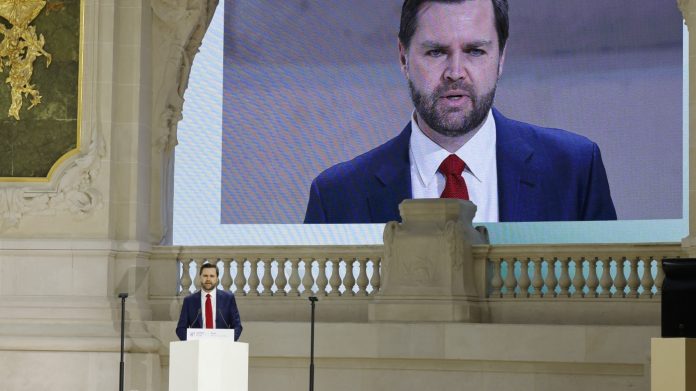
Vice President JD Vance speaks during a plenary session at the Artificial Intelligence (AI) Action Summit in Paris, on Feb. 11.

Ludovic Marin/AFP via Getty Images


hide caption

toggle caption

Ludovic Marin/AFP via Getty Images

Vice President JD Vance is set to meet with Ukrainian President Volodymyr Zelenskyy on Friday, along with Secretary of State Marco Rubio, on the sidelines of the annual Munich Security Conference.

The meeting with Zelenskyy comes as Ukraine is about to mark three years of war with Russia. The Ukrainian leader and Vance are also speaking just two days after President Trump jumped in on negotiations to end the war.

Earlier this week, President Trump held a lengthy phone call with Russian leader Vladimir Putin, and said the two would meet face-to-face in Saudi Arabia soon. Trump afterward spoke with Zelenskyy over the phone.

“I think we’re on the way to getting peace. I think President Putin wants peace, and President Zelenskyy wants peace and I want peace. I just want to see people stop getting killed,” Trump said to reporters after his conversation with Putin.

The conference in Germany is Vance’s second major event on the world’s stage this week. The vice president previously spoke at a conference on artificial intelligence in Paris on Tuesday before heading to Munich, where the Russia-Ukraine war has been a main focus at the conference in recent years.

But the Trump administration’s posture thus far has appeared to cede more in Russia’s favor — Trump said it’s “unrealistic” for Ukraine to join NATO, something Putin has long been opposed to, and something Zelenskyy argues Ukraine needs in order to prevent future threats from Russia. Trump also said it was unrealistic for Ukraine to gain back its territory from before the war.

Max Bergmann, the director of the Europe, Russia and Eurasia Program, said Trump’s rhetoric is sparking “grave concern” in Ukraine, because the U.S. is taking a more neutral role in negotiations rather than advocating for Ukraine.

“I think there’s a fear that the United States just simply doesn’t want to be a part of it anymore … and so therefore is willing to assert a lot of leverage on Ukraine to essentially agree to what Ukrainians perceive would be a bad deal for them,” Bergmann said.

“And so there’s uncertainty about whether this administration is actually on Ukraine’s side or is trying to act more as a neutral arbiter.”

A ‘whiplash’ for Europeans

Vance has attended the Munich Security Conference in the past, including last year, before he was tapped to be Trump’s running mate.

Last year, Vance said he thinks the United States should “pivot” from NATO and Europe to focus on East Asia. That is going to be the future of American foreign policy for the next 40 years. And Europe has to wake up to that fact,” Vance said.

Bergmann said he expects Vance to reflect this ethos in his remarks on Friday.

“What you see from Vance is the sense that Europe just doesn’t really matter very much to the United States … The U.S. wants a new bargain when it comes to transatlantic security, where it’s going to be Europeans that are responsible for Europe’s security, not the United States,” Bergmann said.

But Bergmann cautioned that there are downsides to de-prioritizing Europe.

“We sort of in some ways get what we pay for by providing Europe security,” Bergmann said. “I think there’s an argument to be made that we should begin to try to rebalance it, and I think the danger of what the Trump administration is trying to do is sort of rebalance it too quickly.”

“This is a real whiplash that the Europeans right now are experiencing and I think are likely to experience when Vance speaks to them at Munich.”

Between Russia and Elon Musk, German Voters Face a ‘Dual Front’ of Disinformation

0

Last week, Stephan Protschka, a member of Parliament for the far-right party Alternative for Germany, took to Facebook and Telegram to share a sensationalist article. The country’s Green Party, it claimed, was conspiring with the Ukrainian government to recruit migrants to stage terrorist attacks — and blame his party.

As intended, the post enraged Mr. Protschka’s followers. “People wake up,” one of them replied on Facebook. “This is criminal.”

The article was, in fact, part of a torrent of Russian disinformation that has flooded Europe’s biggest economic and diplomatic power ahead of its federal election on Feb. 23.

As the vote approaches, Russian influence campaigns have propagated wild claims about sexual, financial and criminal scandals involving German politicians, playing on social and political tensions that have divided the country, according to researchers who track disinformation and foreign influence operations.

The claims have appeared in fake news outlets and in videos that have been altered by artificial intelligence. They have been spread by an army of bot accounts on social media platforms like X, Facebook, Telegram and, in a new development, Bluesky.

The goal, according to the researchers and Germany’s domestic intelligence agency, is to undermine trust in mainstream parties and media and to bolster Germany’s far right, led by the Alternative for Germany, known as AfD.

Aiming at the same target is the world’s richest man, Elon Musk. His public support of the Alternative for Germany on X, the social media network he owns, has aligned with Russia’s strategic objective to destabilize Western democracies and support for Ukraine.

“We’re now dealing with a dual front,” said Sasha Havlicek, chief executive of the Institute for Strategic Dialogue, a nonprofit research organization that on Thursday released a report about the Russian disinformation campaign on X.

“Between Musk’s overt and the Kremlin’s covert operations,” she said, “it is clear from the content that there’s mutual reinforcement there.”

Germany’s election has become the latest battleground in Russia’s influence campaigns. The Kremlin hopes the outcome of the contest, called ahead of schedule after Chancellor Olaf Scholz’s center-left coalition collapsed late last year, could erode support in Europe for Ukraine, where Russian invaders are grinding down the country’s defenses after three years of war.

Mr. Musk, for his part, appears to have done little to curtail Russian bots promoting the AfD on his platform. Instead, he has told his 217 million-strong audience on X that the party is the country’s last hope.

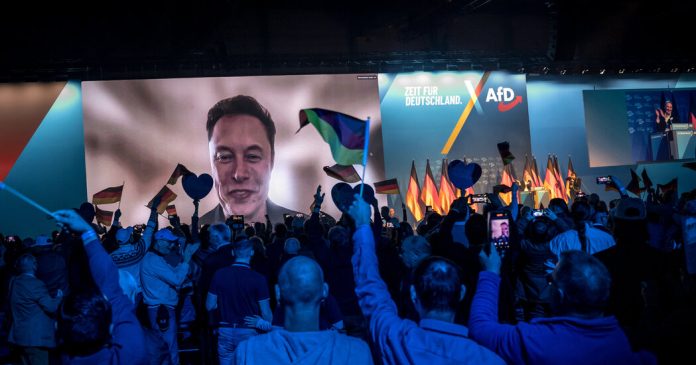
In January, Mr. Musk interviewed the party’s leading candidate, Alice Weidel, for 75 minutes on X, the same platform he gave Donald J. Trump during his run for office last August. Addressing the party’s conference by video link last month, he said it had the support of the Trump administration.

Russia’s propagandists have welcomed the convergence and sought to exploit it. Mr. Musk’s posts on X have been spread by bot accounts operated by a Russian influence operation known as Doppelgänger, according to CeMAS, an organization that tracks German online extremism. X did not respond to a question about the Russian activity.

In Germany, Russia is employing tactics it has honed in France, Moldova, Georgia, the United States and other countries that have recently held elections, according to disinformation researchers including from the Institute for Strategic Dialogue, CeMAS and Recorded Future, a threat intelligence company based in Massachusetts.

One key player is a former sheriff’s deputy from Florida, John Mark Dougan, who received political asylum and eventually citizenship in Moscow. Having previously built a network of more than 160 fake news websites that pushed Kremlin propaganda in the United States, Britain and France, he has now turned his attention to Germany.

Nine days after the snap election was announced on Nov. 12, Mr. Dougan began registering dozens of fake German news sites, according to a report by NewsGuard, a company that tracks online disinformation, and Correctiv, a nonprofit news organization in Germany.

By February the number had grown to 102 — some masquerading as national news outlets, others as local media in Berlin, Hamburg and other cities.

On Jan. 30, one of the sites uploaded a video claiming that Vice Chancellor Robert Habeck conspired with Ukraine to steal 50 paintings from a Berlin art gallery. Another claimed Friedrich Merz, the leader of the Christian Democratic Union and the front-runner to become the next chancellor, was a “person of interest” in a 20-year-old murder case.

“The network is showing its agility,” said Clément Briens, an analyst with Recorded Future, which also published a report detailing Russian disinformation in Germany on Thursday.

Mr. Dougan, reached in Moscow, declined to answer questions about his role, but criticized the current German government as a puppet of the United States. “All their leaders need to be replaced,” he said.

Not all fake videos feature prominent politicians. Another tactic that has been gaining momentum is altering videos that feature regular people.

In January, Natalie Finch, a mental health nurse, made a promotional video on Instagram for the college in Britain where she works, the University of Bradford. Two weeks later the video reappeared on Bluesky, except this time she was not speaking about nursing but the mental health of candidates for Germany’s Christian Democratic Union.

The new version was a fake, using an artificial intelligence tool to recreate her voice reading a different script over the same video, emblazoned with the university’s logo. “The video started with me introducing myself, introducing the university and then, very seamlessly I have to say, became a video about the German government,” she said in an interview.

The fake was one of several identified by Clemson University’s Media Forensics Hub. Others included manipulated audio of the presidents of several U.S. universities, and a fabricated video of a British policeman claiming to have passed on warnings of terrorist attacks in Germany.

“These are some of the clearest examples of deepfakes being used for disinformation that I’ve seen,” said Darren L. Linvill, a director of the hub who notified Ms. Finch about the manipulated video. “And what’s compelling about them is that some of them are just deepfakes of regular people.”

What impact Russia’s campaign will have on the outcome of the election remains uncertain. The researchers say the efforts have not so far meaningfully altered voter preferences, but the huge volume of disinformation has certainly seeped into the public discourse, carefully tailored to compound existing social grievances.

“The Russians very intricately study the newspapers, print media, television in their target countries,” Brian Liston, an analyst at Recorded Future, said. “They probably know more about a country’s politics than the country knows its own politics in many instances.”

Germany’s domestic intelligence agency said the quantity and sophistication of the disinformation have exceeded anything it has previously seen.

“The danger of disinformation campaigns is that they influence voters in their voting decision,” the Office for the Protection of the Constitution said in a statement to The Times. “There is also a risk that the election itself will be delegitimized and thereby cast into doubt by the public.”

There are signs that the campaign is intensifying. The 48 accounts traced to Russia on X over the past month have collectively received 2.5 million views, the Institute for Strategic Dialogue’s study found. Over the course of January, the number of engagements — likes or shares — tripled.

The Russian efforts benefit significantly when prominent politicians or influencers online, like Mr. Protschka of the Alternative for Germany, share the false claims, which researchers call “disinformation laundering.”

Mr. Musk, who is currently playing an outsize role in the Trump administration, may be the biggest influence. He has called the chancellor a “fool” and Germany’s president “an undemocratic tyrant.” Germany, he wrote in an opinion piece for a major newspaper in December, is “teetering on the brink of economic and cultural collapse.”

Mr. Musk has also amplified supporters of Alternative for Germany by sharing their posts on X. Some of these influencers were marginalized or even banned on the platform before Mr. Musk took over and reinstated them. Many, like Naomi Seibt, a 24-year-old vaccine and climate change skeptic, now post content in English to attract his attention.

Mr. Musk has also amplified Russian propaganda. In October 2023 he shared a meme created as part of an influence campaign run by Social Design Agency, an internet company in Moscow that has been sanctioned by the United States. Internal company documents from the Social Design Agency seen by CeMAS show that the Russians consider it a victory when their material is shared by public figures.

“This is the first German election where both the Kremlin and a powerful figure from the new U.S. administration are trying to influence the process and supporting the same far-right party,” said Julia Smirnova, an analyst at CeMAS.

“When figures like Musk share Russian propaganda narratives,” Ms. Smirnova said, “they ultimately normalize them, boost their reach and cause more damage than a network of inauthentic accounts.”

Trump Announces ‘Reciprocal’ Tariffs Across the Globe

0

President Trump signed a memorandum on Thursday ordering his advisers to calculate new tariff levels for other countries globally, an ambitious task that will shatter the rules of the global trading system and likely set off furious negotiations in the coming months.

The president directed his advisers to come up with new tariff levels that take into account a range of trade barriers and other economic approaches adopted by America’s trading partners. That includes not only the tariffs that other countries charge the United States, but also the taxes they charge on foreign products, the subsidies they give their industries, their exchange rates, and other behaviors the president deems unfair.

The president has said the step was necessary to even out America’s “unfair” relationships and stop other countries from taking advantage of the United States on trade. But he made clear that his ultimate goal was to force companies to bring their manufacturing back to the United States.

“If you build your product in the United States, there are no tariffs,” he said during remarks in the Oval Office.

Howard Lutnick, the president’s nominee for commerce secretary, and Jamieson Greer, his pick for trade representative, will come up with the numbers “quickly,” in concert with other advisers, a White House official, who did not have permission to speak for attribution, said in a call with reporters on Thursday.

The decision to rework the tariffs that America charges on imported goods would represent a dramatic overhaul of the global trading system. For decades, the United States has set its tariff levels through negotiations at international trade bodies like the World Trade Organization. Setting new levies — likely to be higher than what the United States charges today — would effectively scrap that system in favor of one determined solely by U.S. officials and based on their own criteria.

Timothy Brightbill, a lawyer at Wiley Rein, said a move toward a reciprocity-based tariff system would be “a fundamental change to U.S. trade policy, and among the biggest in more than 75 years — since the creation of the current multilateral trading system” in 1947.

The action seems likely to kick off intense negotiations with governments whose economies depend on exports to the United States. It could also elicit trade wars on multiple fronts if other countries choose to increase their own tariffs in retaliation.

The White House official said in the call that other countries would be given the opportunity to negotiate on the levies they will face.

Nearly every country would be affected, but the move could have particularly significant consequences for India, Japan and the European Union. Mr. Trump and his staff members have repeatedly pointed to Europe’s value-added tax as an additional injustice on top of tariffs.

Peter Navarro, the president’s senior counselor for trade, called the European Union’s VAT tax the “poster child” for unfair trade toward American business, saying that such treatment had allowed Germany to export to the United States many times the number of cars that it bought from it.

“President Trump is no longer willing to tolerate that,” Mr. Navarro said. “The Trump fair and reciprocal plan will put a swift end to such exploitation of American workers.”

The E.U. requires a standard value-added tax rate on most goods and services, and while they vary by country, they average about 22 percent across European nations. The tax is applied at each stage in a supply chain, and the cost is usually borne by the end consumer.

The United States is an outlier among advanced economies in not levying a value-added tax on products like cars.

Mr. Trump’s proposal marks a significant reversal in a decades-long push in trade policy toward lowering international barriers. While past presidents have often negotiated with foreign countries over tariffs, those agreements have typically led to lower levies, not higher ones. No president has taken Mr. Trump’s approach of raising U.S. tariffs to match other countries’ rates.

The reciprocal tariff plan is the latest move by Mr. Trump to punish allies and adversaries alike with an extraordinary array of trade actions. On Monday, the president signed a proclamation imposing 25 percent tariffs on all foreign steel and aluminum. Speaking to reporters from the Oval Office, he said the tariffs would be “the first of many.”

In addition to the reciprocal tariffs, Mr. Trump said his advisers would meet over the next four weeks to discuss measures on cars, pharmaceuticals, chips and other goods.

“They’ve been taking advantage of us for years and years and years,” he said of other countries. “They’ve charged us and we haven’t charged them. And it’s time to be reciprocal.”

In the past weeks, Mr. Trump’s almost-daily tariff threats have rocked diplomatic and economic relationships. The United States imposed an additional 10 percent tariff on all products from China last week, and came within hours of putting sweeping tariffs on Canada and Mexico that would have brought U.S. tariff rates to a level not seen since the 1940s.

The president had criticized Canada and Mexico for sending drugs and migrants to the United States, but agreed to put off the tariffs for 30 days after the countries offered him some concessions.

Reciprocal tariffs will likely broaden Mr. Trump’s trade fight to even more countries. It remains to be seen whether the president uses the strategy to dramatically raise U.S. barriers to imports, or as a lever to extract concessions from countries that end up opening foreign markets.

When asked which legal authority would be used to impose tariffs, the White House official said the president could draw on several according to the action and country, including Section 232, which relates to national security; Section 301, which relates to unfair trading; and the International Emergency Economic Powers Act.

The official said that Mr. Trump was not ruling out a further “universal” tariff later to reduce the U.S. trade deficit, but that for now the president had chosen to pursue reciprocal treatment.

Mr. Trump floated proposals in his first term and his 2024 campaign of making trade more reciprocal by matching the tariff rates that countries impose on American products.

He has often pointed to America’s lower tariff rate as evidence the country is being taken advantage of. The United States has an average tariff rate of around 3 percent, lower than other countries, but still roughly in line with those of Canada, Britain, Japan and the European Union. Globally, wealthy countries tend to have lower tariff rates, while poorer countries have negotiated higher ones, to protect their less developed industries and subsistence farmers.

But Mr. Trump has criticized other countries for charging higher tariffs on certain American products than the United States charges them. For example, he has pointed to the 10 percent tariff that the European Union charges on American cars, versus a 2.5 percent tariff for cars sold in the other direction.

The United States has set its tariff rates for imports lower than that of some trading partners, because for decades U.S. officials were convinced of the benefits of freer trade. They believed lower tariffs would allow the United States to import cheap products for U.S. consumers and raw materials for its factories, fueling the American economy.

Mr. Trump’s views differ. He argues that equaling out American tariff rates is essential to restoring U.S. manufacturing, and that higher tariffs will reduce the trade deficit. Some economists disagree, arguing that movements in currency could offset any effects on the trade deficit.

Economists and historians also say that the varying tariffs that countries put on each other’s products are not evidence of discrimination. Rather, they reflect the priorities that each government had when it agreed to maximum tariff rates in negotiations with other members of the World Trade Organization.

Those negotiations gave governments the opportunity to fight for higher tariff rates on industries they wanted to protect, and accept lower tariff rates on products they were more likely to import.

Inu Manak, a trade expert at the Council on Foreign Relations, said tariff rates were “a reflection of the specific domestic political economy concerns of a given country.” For example, she said, U.S. officials negotiated double-digit tariffs on wool sweaters and footwear to protect American producers at the time.

Other countries protect their industries, too, she said, but want to keep tariffs low “so that their consumers and manufacturers have access to a broad selection of items at the most competitive price.”

Douglas Irwin, a professor of economics at Dartmouth College, said that countries had come out of the Great Depression and World War II with wildly different tariff codes. When trade negotiations began in 1947, countries began to cut tariffs piecemeal. In the 1960s, many countries agreed to lower all tariffs, but there was no effort to equalize them on specific products.

“Reciprocity in this case was ‘let’s all cut by about the same amount’ not ‘let’s equalize our tariffs on a product by product basis,’ which seems to be what the Trump view of reciprocity should be,” he said.

Raising tariffs above the rate the United States has agreed to at the W.T.O. would violate the trade group’s commitments, and other members of the W.T.O. could challenge that action. But the panel at the W.T.O. in charge of resolving such disputes was effectively neutered in the first Trump administration when the United States refused to appoint any more members to it. The Biden administration continued that policy.

Jeanna Smialek contributed reporting from Brussels.

Trump Renamed the Gulf of Mexico, but Who Controls It?

0

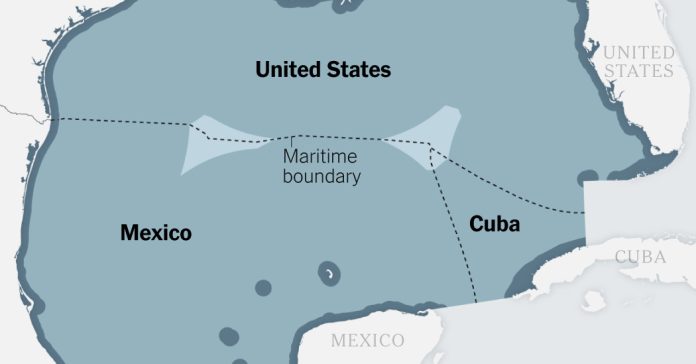
The Trump administration has renamed the Gulf of Mexico to the Gulf of America, but most of the body of water lies outside maritime regions controlled by the United States.

Maritime claims in the Gulf of Mexico

Source: Sovereign Limits

By Zach Levitt

According to calculations by Sovereign Limits, a database of international boundaries, the United States lays claim to 46 percent of the gulf, while Mexico lays claim to 49 percent.

Maritime zones are divided into categories based on distance from the coast. Territorial seas lie closest to a nation’s shore, and the laws of a country apply within and below those waters the way they do on land, for the most part.

Farther beyond the shore, a country’s exclusive economic zone is where it controls what is in the water, like fish, as well as what is in and below the seabed, like oil and gas. Additionally, the gulf contains sections of so-called high seas, where a country might also retain rights only to the natural resources of the seabed and subsoil.

Mexico

292,400

49%

Territorial Seas

23,700

4%

Economic zones

262,800

44%

High seas

5,800

1%

United States

273,200

46%

Territorial Seas

36,300

6%

Economic zones

232,300

39%

High seas

4,600

1%

Cuba

31,600

6%

Territorial Seas

3,400

1%

Economic zones

27,700

5%

High seas

500

Source: Sovereign Limits

Note: Figures may not add up to 100 percent because of rounding.

The gulf, like many regions around the world, has maritime boundaries that are mutually agreed upon by the countries along its coast. According to Kevin Danaher and Marissa Wood at Sovereign Limits, the gulf is “covered fully by established maritime boundaries.”

The Gulf of Mexico has appeared on maps for centuries, but geographic name changes are common throughout history. This name change has an immediate impact on U.S. federal agencies that map or refer to the gulf. Some companies such as Google and Apple now display Gulf of America for users in the United States. For others, the name change is optional.

Robert F. Kennedy, Jr. confirmed as Trump’s health secretary : Shots

0

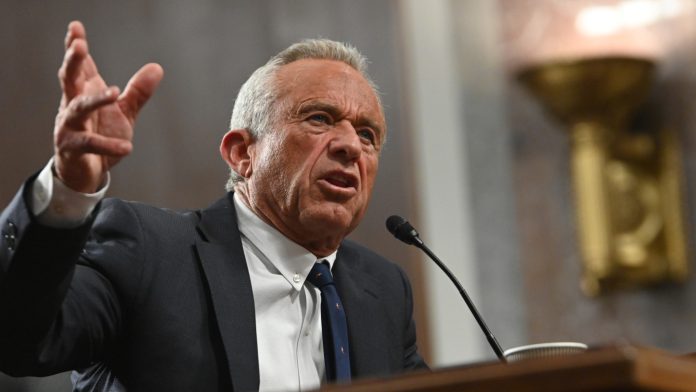
Robert F. Kennedy Jr. testifies during his confirmation hearing at the Senate Finance Committee on Jan. 29. The full Senate voted to confirm him as Secretary of the Department of Health and Human Services on Thursday.

Chen Mengtong/VCG via Getty Images


hide caption

toggle caption

Chen Mengtong/VCG via Getty Images

Despite millions of dollars spent by groups opposed to his nomination, the Senate voted to install Robert F. Kennedy Jr. at the helm of the Department of Health and Human Services.

Kennedy faced opposition from the left for his decades of espousing conspiracy theories on vaccines and from the right for his past support of abortion rights. For several weeks, it was uncertain whether he had enough senators backing him to get through. Yesterday, Democratic senators made speeches on the floor past midnight in protest. But on Thursday morning, he had the votes to be confirmed. The vote was 52 to 48. Sen. Mitch McConnell, the former Republican majority leader and a polio survivor, joined Democrats to vote against Kennedy.

There are many questions about what happens next for Medicare, vaccines and medical research. Here are a guide to five key issues to watch as Kennedy takes control at the huge health agency in the coming weeks:

1. Congress could cut Medicaid and (maybe) Medicare

Kennedy hasn’t spoken much about the future of Medicaid or Medicare and in his hearings fumbled basic questions about how they are set up. But he now oversees both popular programs that together insure about 140 million Americans.

As soon as the 119th Congress was sworn in, Republicans began to talk about ways to cut spending in Medicaid. That is a public health program for low-income people that is paid for partly by the federal government and partly by states. Historically it’s been very popular with the public — a KFF survey from last year found 71% of Americans wanted the program to continue mostly as it is.

Amid talks of cuts, President Trump declared that his team would “love and cherish” Medicare, Medicaid and Social Security, and that any cuts would be related to waste or abuse and wouldn’t affect beneficiaries.

But cuts well beyond waste and abuse may well be coming anyway to free up funds for Trump’s priorities like tax cuts and border security. Conservative groups and Republican lawmakers have long argued that Medicaid has grown too big — during the pandemic, enrollment grew to 80 million people. The proposal from House Republicans would seek to find $880 billion in cuts to Medicaid. States would likely cut benefits and limit eligibility. Medicare could also be in for cuts of some kind as well.

Dr. Mehmet Oz, the heart surgeon, TV personality and former candidate for Senate in Pennsylvania, is Trump’s pick to lead the Centers for Medicare & Medicaid Services, which is part of HHS. A date for Oz’s confirmation hearing is not yet set.

2. Future of vaccine policy after confusing signals in hearings

As senators voted to confirm Kennedy, a measles outbreak continued in Texas. As Marfa Public Radio reported, nine have been hospitalized in an outbreak of at least 24 measles cases in Gaines County, which has one of the lowest vaccination rates in the country. All cases are in people who were unvaccinated, most are children.

Kennedy is one of the country’s most prominent vaccine opponents. During confirmation hearings, he repeatedly claimed he was not anti-vaccine or against the vaccine schedule, and he said he supported certain vaccines, including polio. He would not accept, however, that the link between autism and vaccines had been thoroughly debunked.

Kennedy won confirmation on the strength of his promises to Sen. Bill Cassidy, R-La., a physician and the chair of the Senate’s health committee. Those promises included that he would not interfere with current vaccine policy and that Cassidy would have oversight over some of his decisions at HHS.

The committee’s former chair, Sen. Patty Murray, D-Wa., said in a press conference this week that those promises were not credible. “Republicans are choosing to pretend like it is in any way believable that RFK Jr. won’t use his new power to do exactly the thing he has been trying to do for decades: undermine vaccines,” she said.

There is a lot Kennedy could do on vaccines in terms of appointing advisors, directing NIH research, and changing public health messaging about the importance of vaccines. Public health and medical advocates will be watching closely to see what Kennedy does in this arena.

3. Will HHS get the DOGE treatment?

DOGE, the Elon Musk-led effort to unilaterally dismantle agencies through furloughs, firings and stop work orders, could well be coming to HHS.

Right now, HHS has a budget of nearly $2 trillion and a staff of 90,000 people. A huge part of that budget is Medicare and Medicaid, the public health programs for seniors and low-income people respectively. DOGE staffers have been at the Centers for Medicare and Medicaid Services for the past several weeks, CMS officials told NPR.

Other health agencies that are part of HHS include the Food and Drug Administration, the Centers for Disease Control and Prevention, and the National Institutes of Health.

Project 2025, the blueprint from the Heritage Foundation that has so far aligned closely with DOGE’s actions, proposes dramatic changes to HHS, including splitting CDC into two agencies and eliminating Head Start. Kennedy hasn’t spoken much about his plans for the agencies, except to say that he would fire 600 NIH researchers and instruct the agency to redirect resources from infectious disease and towards investigating the root causes of chronic diseases.

4. Science information and research in disarray

Already, without Congressional cuts or DOGE, actions by the Trump Administration have caused tectonic changes to science in America.

Several executive orders about “ideology” caused federal health agencies to delete scores of databases and web pages that included forbidden terms like “gender,” although seemingly unrelated websites on tuberculosis and natural disasters went dark as well. A federal judge has since instructed the agencies to restore those pages, but their sudden disappearance of resources — including those used by doctors routinely when treating patients — has alarmed many in public health and medicine. It’s especially unclear how research that involves groups that cannot be mentioned, like transgender people, can now proceed.

Biomedical research — long a source of bipartisan support and national pride — has not been spared either. NIH’s grants to research institutions have already been targeted for dramatic cuts, another move that is currently paused by a federal judge. Several Republican senators, including Cassidy, Susan Collins of Maine and Katie Britt of Alabama, have spoken out about how damaging this blanket policy could be to universities with large research institutions. Collins wrote in a statement that Kennedy promised her he would “re-examine” the policy when confirmed.

5. How can “MAHA” translate to policy

Kennedy spoke in his confirmation hearings about how he understood the health agencies from a unique point of view — as a science outsider who had spent decades filing lawsuits against many of them. He asserts that the agencies have lost their way and that is reflected in the fact that Americans have poor life expectancy and many chronic diseases.

He hasn’t yet laid out how he can use policy and his power overseeing the agencies to “put the health of America back on track.” He spoke a lot during the hearings about food programs outside of HHS’ jurisdiction, suggesting maybe he will seek to work with the Department of Agriculture to collaborate on programs like SNAP.

There are powerful industries that could push back against some of his goals like Big Food and Big Pharma, as NPR has reported. And some public health researchers question how realistic such an overhaul will be in a Republican-controlled, regulation-unfriendly federal government.


Toast, Trees and a Wassailing Queen: An Ancient English Ritual Is Back

0

A jet of steam rises with a hiss as a red hot poker plunges into a bowl of cider. A garlanded woman spears a piece of toast with a long fork and lodges the offering among the branches of a tree. Then, amid shouts from the watching crowd, the torch-lit ceremony ends with gunfire ringing out beneath the clear night winter sky.

For most of the year, Sheppy’s farm at Bradford-on-Tone in the west of England uses state of the art machinery to tend its 22,000 apple trees and produce more than half a million gallons of cider annually.

But for one evening in January, modern farming techniques are set aside for an ancient ritual called “wassailing,” where the coming year’s apple crop is blessed, evil spirits are chased away and cider is enthusiastically drunk by hundreds of spectators.

Dating from at least the 13th century, wassailing (the word derives from an Old English toast to good health, “waes hael”) seemed to have almost died out by the 1990s.

But recently, it has made a comeback at cider makers and community events, particularly in the west of England, spurred by growing interest in tradition and folklore, a renewed respect for the countryside and a desire among some Britons to liven up the grim winter months with a party.

“Wassailing fell by the wayside for a very long time and has had a huge revival,” said Louisa Sheppy, co-owner of Sheppy’s, a firm that has been making cider for more than two centuries, as she prepared the company’s farm for its seventh, consecutive year of hosting a wassail (one of dozens advertised around the region this winter).

Ms. Sheppy is not superstitious and does not really believe — as tradition holds — that the fate of the crop hinges on the annual wassail. But she values the event, which attracts more than 400 paying guests, promotes cider and features folk dancers known as Morris Men and a lively barn dance.

But before the dancing, visitors first joined in a song directed at two trees, imploring them to yield “hatfuls, capfuls, three-bushel bagfuls,” of fruit. Then the evening’s “wassail queen” (who symbolizes fertility and abundance) tasted heated cider, soaked a piece of toast in it and poured the rest around the tree roots.

Wearing a crown of ivy, mistletoe, hellebore and rosemary, the queen used a toasting fork to place the bread in the branches — a gesture designed to attract robins, which are seen as harbingers of spring — before shotguns were fired to drive away malevolent spirits.

Although her evening passed off smoothly, it was not stress free for Sheppy’s 2025 wassail queen, Em Sibley. Drinking the cider was fine (“Oh my god, it really is good, sweet and yummy,” she said) and so was pouring it around the tree.

Trickier, however, was soaking the toast in cider without rendering it soggy and then levering it off a long fork into the tree’s branches without sending the bread pieces tumbling.

“You don’t want to muck it up — just in case,” said Ms. Sibley, an employee at Sheppy’s, alluding to the possible celestial consequences of botching a ritual meant to guarantee the crop.

“When it all does go wrong, and the harvest is down, and we haven’t got as many apples for the year as normal,” said Ms. Sibley, “you don’t want to be the one who thinks ‘oh damn: It could have been the toast!’”

Once a Christmas or New Year tradition, wassailing now typically takes place around Jan. 18 or later.

The ceremonies have evolved over time, according to Ronald Hutton, a professor of history at the University of Bristol, who dates the first recorded wassails to the 13th century, when a large wooden bowl with alcohol was passed around by friends standing in a circle.

Someone would drink and call “waes hael” — be well — and the others would chorus back “drinc hael” or drink well, he said, adding that this could descend into a medieval drinking game.

“You’d carry on passing the wassail bowl from hand to hand and taking a slurp until either the host decided enough was enough — or people gradually keeled over and the winner was left standing,” said Professor Hutton, author of a book on English folklore.

By the 16th century, the link to agriculture was established, with farmers singing to and blessing bee hives, fruit trees, crops, sheep and cattle to encourage a bountiful harvest.

Interest in wassailing ebbed in the last century, said Professor Hutton, “with the growth of horticulture and fertilizers, a better knowledge of how trees and farms work, and a decline in the belief that singing to your trees or fields actually does any good.”

As he prepared to put on his multicolored costume, Mike Highfield, 64, a Morris dancer and master of ceremonies at Sheppy’s, where he gives visitor tours, welcomed the resurgence.

“We should celebrate our culture because cider really was the wine of England at one stage,” Mr. Highfield said, adding that the night brings people together over a beverage that, apart from its low alcohol version, typically ranges in strength from 4 percent to 7.5 percent alcohol.

“Once you let your hair down and scream at an apple tree — and you shout and you sing — you start to talk to people because you lose some of your inhibitions,” he said.

One spectator, Matthew Mudge, 62, a church musician from Cardiff, Wales, said he had wanted to attend a wassail for decades. “It’s a fantastic tradition. I’m sorry it’s taken me so long to get here,” Mr. Mudge said as he enjoyed a cider after the ceremony, adding, “All wassails involve drinking and perhaps that’s why they’ve lived for six centuries.”

In the village of Midsomer Norton, about 50 miles away, 100 people or so turned out for a community event to wassail three small apple trees in the local park. Instead of a queen, local children helped place pieces of toast in the branches. Trevor Hughes, 70, a Morris dancer, who conducted the ceremony, said the tradition had never disappeared here.

“We have always done wassails at this time of year. It may not have been advertised, there may have been just local village events, but it never really died,” he said. Lately, he added “there has been an explosion of wassails because it’s a simple means of having a laugh.”

While the fun of wassailing is irrefutable, does anyone really think it protects the crop?

“The rationalist in me says ‘of course not, how could it,’” said Professor Hutton, who spends a Sunday afternoon each January with friends in his garden, singing to his trees over a few drinks.

He noted, however, that his apple tree “never bore anything until I ‘wassailed’ it the first time.” adding: “It has borne bumper crops every year since.”

NATO insists Ukraine, Europe be part of Trump Russia talks : NPR

0

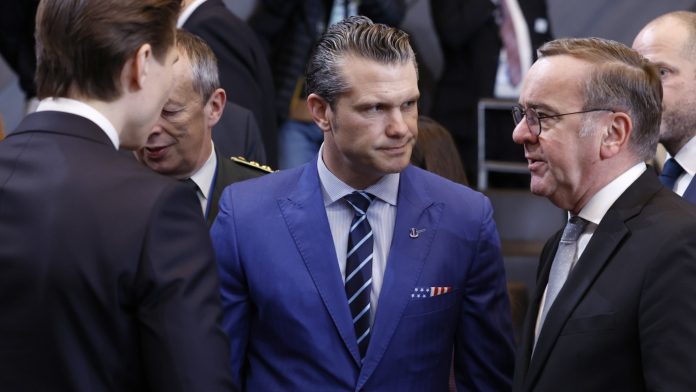
U.S. Defense Secretary Pete Hegseth (center) speaks with German Defense Minister Boris Pistorius (right) and Finland’s defense minister, Antti Hakkanen, at NATO headquarters in Brussels, Thursday.

Geert Vanden Wijngaert/AP


hide caption

toggle caption

Geert Vanden Wijngaert/AP

BRUSSELS — Several NATO allies stressed on Thursday that Ukraine and Europe must not be cut out of any peace negotiations as U.S. Defense Secretary Pete Hegseth denied that the United States is betraying the war-ravaged country.

European governments are reeling after the Trump administration signaled that it is planning face-to-face talks with Russia on ending the Ukraine war without involving them, insisted that Kyiv should not join NATO, and said that it’s up to Europe to protect itself and Ukraine from whatever Russia might do next.

“There can be no negotiation about Ukraine without Ukraine. And Ukraine’s voice must be at the heart of any talks,” U.K. Defence Secretary John Healey told reporters at NATO headquarters, as the organization’s 32 defense ministers met for talks on Ukraine.

German Defense Minister Boris Pistorius said: “For me, it’s clear … that Europe must be involved in the negotiations — and I think that’s very easy to understand,” particularly if Europe is “supposed to play a central or the main role in the peace order.”

Europe “will have to live directly” with the consequences, he added.

Hegseth denied that the U.S. has betrayed Ukraine by launching negotiations about its future without Kyiv’s full involvement. After talks with Putin and then Zelenskyy, Trump said on Wednesday he would “probably” meet in person with the Russian leader in the near term, possibly in Saudi Arabia.

“There is no betrayal there. There is a recognition that the whole world and the United States is invested and interested in peace. A negotiated peace,” Hegesth told reporters.

The European Union’s foreign policy chief, Kaja Kallas, expressed surprise that Hegseth and Trump had listed what appeared to be concessions to Russia even before talks have begun in earnest.

“We shouldn’t take anything off the table before the negotiations have even started, because it plays to Russia’s court,” she said. “Why are we giving them everything that they want even before the negotiations have been started? It’s appeasement. It has never worked.”

Hegseth warned that the war in Ukraine must “be a wakeup call” for NATO’s European allies to spend more on their own defense budgets.

Twenty-three of the 32 member countries were forecast to have met the organization’s guideline of spending 2% of gross domestic product on their national defense budgets last year, but a third still do not.

But Hegseth’s French counterpart, Sébastien Lecornu, described the wrangling over greater defense spending as “a false debate,” saying that governments and parliaments across Europe are already approving more weapons purchases and bigger military budgets while helping Ukraine stave off an invasion.

Lecornu warned that the future of NATO itself is now in question.

“To say that it’s the biggest and most robust alliance in history is true, historically speaking. But the real question is will that still be the case in 10 or 15 years,” he said, after the U.S. — by far NATO’s biggest and most powerful member — signaled that its security priorities lie elsewhere, including in Asia.

NATO Secretary-General Mark Rutte speaks with the media as he arrives for a meeting of NATO defense ministers at NATO headquarters in Brussels, Thursday.

NATO Secretary-General Mark Rutte speaks with the media as he arrives for a meeting of NATO defense ministers at NATO headquarters in Brussels, Thursday.

Harry Nakos/AP


hide caption

toggle caption

Harry Nakos/AP

NATO Secretary-General Mark Rutte, who was chairing Thursday’s meeting, said that whatever agreement is struck between Russia and Ukraine, it is crucial that the “peace deal is enduring, that Putin knows that this is the end, that he can never again try to capture a piece of Ukraine.”

Touting Europe’s investment in Ukraine, Swedish Defense Minister Pål Jonson said European nations provided about 60% of the military support to Kyiv last year and must be involved, especially given U.S. demands that Europe take more responsibility for Ukraine’s security in the longer term.

His Estonian counterpart, Hanno Pevkur, underlined that the European Union has driven sanctions against Russia, has invested heavily in Ukraine’s defense, and will be asked to foot the bill for rebuilding the war-ravaged country.

“We have to be there. So there is no question about it. Otherwise this peace will not be long lasting,” Pevkur warned.

Trump Says Saudi Arabia May Host Talks With Putin on Ukraine

0

When President Trump said on Wednesday that he might soon meet with his Russian counterpart, Vladimir Putin, to discuss an end to the nearly three-year war in Ukraine, he named what may have seemed like an unlikely venue for the talks.

“We expect that he’ll come here, and I’ll go there and we’re going to meet also probably in Saudi Arabia the first time,” Mr. Trump told reporters in the Oval Office. “We’ll meet in Saudi Arabia, see if we can get something done.”

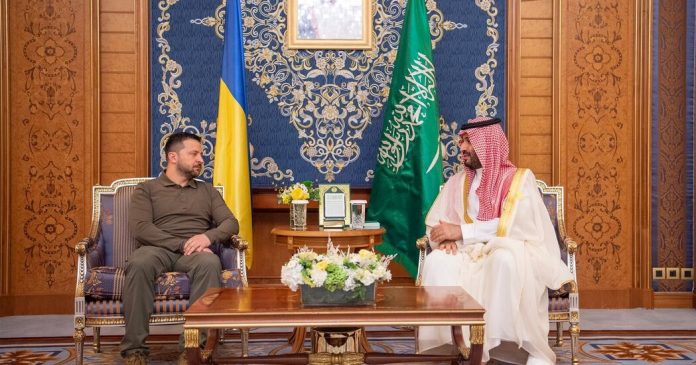
Mr. Trump cited both his and Mr. Putin’s relationship with Crown Prince Mohammed bin Salman, the de facto ruler of Saudi Arabia, as a reason for choosing the Gulf nation for their first meeting since he regained the White House. “We know the crown prince, and I think it’d be a very good place to be,” Mr. Trump said.

Saudi Arabia has increasingly played the role of mediator in the Russia-Ukraine war, along with its neighbor the United Arab Emirates.

For Prince Mohammed, mediating the war presents an opportunity to solidify his status as a global leader with influence that extends beyond the Middle East. It also enables him to position himself as a key intermediary capable of bringing powerful nations to the table, despite his continuing struggles to end Saudi Arabia’s involvement in the devastating war in Yemen.

In September 2022, Prince Mohammed helped to broker the release of 10 prisoners from various countries as part of a broader exchange process between Russia and Ukraine. Later, in May 2023, he invited Ukraine’s president, Volodymyr Zelensky, to speak at a gathering of Arab leaders in the Saudi city of Jeddah, where Mr. Zelensky called on Middle Eastern nations to support Ukraine against Russia.

Later that summer, Saudi Arabia and Ukraine jointly hosted closed-door talks in Jeddah aimed at ending the war, attended by diplomats from over 40 countries, though not from Russia.

U.S. Deports Migrants From Asia to Panama

0

The Trump administration deported migrants from several Asian nations to Panama on Wednesday night, Panamanian and U.S. officials said, in a move that could signal much faster removals of immigrants who have remained in the United States because their countries have made it difficult to return them.

The flight carrying the migrants, a military plane that took off from California, appears to be the first of its kind during the Trump administration. It came on the heels of Secretary of State Marco Rubio’s visit last week to Panama, which has been under tremendous pressure from President Trump over how it runs the Panama Canal.

The more than 100 migrants on the flight, including families, had entered the United States illegally from countries such as Afghanistan, China, Pakistan and Uzbekistan. It is often difficult for the United States to return migrants to those nations.

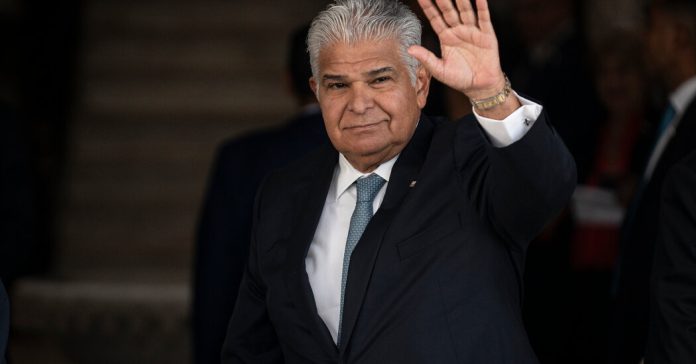
President José Raúl Mulino of Panama, speaking at a news conference on Thursday morning, said 119 people of “the most diverse nationalities in the world” had arrived the night before on a U.S. Air Force flight at an airport outside Panama City.

Mr. Mulino said they were being housed in a local hotel and would be moved to a shelter in Darién, a province in Panama’s east, a process managed by the International Organization for Migration. From there, he said, they would be repatriated.

“We hope to get them out of there as soon as possible on flights from the United States,” Mr. Mulino said, adding, “This is another contribution Panama is making on the migration issue.”

The flight could herald a new front in Mr. Trump’s efforts to conduct a mass removal of unauthorized immigrants, and it shows the willingness of at least some Latin American countries, under intense diplomatic pressure, to assist him. But it also raises questions about what will happen to migrants as they are shunted to another country where they may be unfamiliar with the language or culture.

The Panamanian government announced a proposal this week to send some newly arrived migrants to a small town at the end of the Darién Gap, a dangerous jungle in southern Panama, and then repatriate them “by air or sea to their countries of origin.”

Responding to reporters’ questions on Thursday, Mr. Mulino said two more U.S. Air Force flights were expected to bring a total of about 360 deported migrants to Panama. He said he expected they would quickly be flown to their countries of origin from Darién in an effort that would be paid for entirely by the United States. Mr. Mulino did not give a timeline for when the other flights were scheduled to arrive.

Migration at the southern U.S. border has shifted in recent years to include not just people coming from Mexico and Central America but also those from a wider range of countries, including ones that either do not accept deportation flights or take them sparingly.

The Trump administration has already received promises from El Salvador and Guatemala to accept migrants of other nationalities. Administration officials have indicated they are discussing similar deals with other countries.

But critics have noted that the United States could be sending migrants into more dangerous conditions. El Salvador, for example, has been accused of widespread human rights violations in its detentions, and Guatemala has one of the highest rates of violent crime in the world.

After meeting with Mr. Rubio this month, Mr. Mulino had also indicated a willingness to receive deportees from other countries. (Panama does not send large numbers of migrants to the United States, as Mr. Mulino noted.)

“We are completely certain that reverse immigrants will come at some point — that is, they will be sent back either along the same route or because the United States will bring them back to deport them from here,” Mr. Mulino said.

The government in Panama has been under greater pressure than other Latin American countries to show it is on board with Mr. Trump’s priorities for the region, including curbing China’s influence and controlling illegal migration. Mr. Trump has focused on what he sees as China’s role in the Panama Canal and threatened that the United States would retake control of it.

Mr. Mulino, who has sought to align himself with Mr. Trump on migration, made assurances that he would address the role of China in Panama. He also emphasized a 94 percent reduction over the past year in migration at the Darién Gap, where hundreds of thousands of migrants had been entering the country from Colombia on their way north to the U.S. border.

Federico Rios contributed reporting.

Trump is ignoring some checks on executive power. It's unclear if courts will step in

0

After the Watergate scandal, the political establishment ushered in a wave of reforms meant to constrain the president. Many have already fallen by the wayside, and Trump is challenging what’s left.