The question of where Ukraine’s borders with Russia should be drawn in any peace negotiations came into sharp focus this week after Pete Hegseth, the U.S. defense secretary, said that it was “unrealistic” for Ukraine to try to regain all of the territory Russia has seized since 2014.
Ukraine’s government has long said that its goal is to restore its borders to where they were before Russia launched its first invasion more than a decade ago.
Here is a look at Ukraine’s borders and Russia’s advances into its territory:
Independence borders
Ukraine’s borders were set when it gained independence in 1991 as the Soviet Union collapsed. It borders Belarus to the north; Poland, Slovakia and Hungary to the west; and Romania and Moldova to the south. It also borders its giant neighbor Russia to the east.
2014 invasion and Crimea annexation
Russian forces invaded Ukraine in 2014, seizing Crimea, a peninsula extending from its southern coast. President Vladimir V. Putin of Russia annexed the territory, a move that is not recognized internationally. Ukraine’s government has said that reclaiming Crimea, by force or diplomacy, is one of its most important goals in the war.
In 2018, Russia opened a bridge across the Kerch Strait linking its territory with Crimea. Ukraine has bombed the bridge on several occasions.
Military experts have long said that winning back Crimea by force is not a realistic option for Ukraine, given Russia’s military strength. Ukrainian forces have made little headway in opening a route toward Crimea.
In the 2014 invasion, Russian forces and proxy militias also seized territory in the Donbas region of eastern Ukraine, including the capitals of the two provinces it comprises, Donetsk and Luhansk. Moscow has held those cities and much of the surrounding areas ever since.
Full-scale invasion
The Kremlin launched a full-scale invasion of Ukraine in 2022. Russian forces failed in their goal of seizing the capital, Kyiv, but they did capture more territory in Donetsk and Luhansk, including the cities of Mariupol and Bakhmut.
Russia also won ground in the Zaporizhzhia and Kherson regions in southern Ukraine, in effect gaining control of a land corridor along the northern coast of the Sea of Azov. That connected Russian forces in Crimea with territory they controlled in eastern Ukraine.
In the fall of 2022, Moscow illegally annexed Zaporizhzhia, Kherson, Donetsk and Luhansk, just as it had done with Crimea, although it did not control the entirety of those provinces. Over the past year, the fiercest fighting in Ukraine has taken place in Donetsk, where Russian forces have gained control of several cities and towns.
Russia now controls around 20 percent of Ukraine’s territory, including areas in the south and east, Crimea and some ground north of Kharkiv, Ukraine’s second largest city.
The diamond ring effect as well as Bailey’s Beads are seen as the moon eclipses the sun on April 8, 2024 in Fort Worth, Texas.
Ron Jenkins/Getty Images North America
hide caption
toggle caption
Ron Jenkins/Getty Images North America
There is nothing like being in the path of totality during a total solar eclipse.
“For just a few minutes, it feels like the whole world stands still and yet everything changes,” says Corinne Brevik, a physicist at Southern Illinois University in Carbondale. The sky darkens, stars come out as the blaze of the Sun’s corona becomes visible. “It reminds me that we are all part of something so much bigger than ourselves,” she says.
But only a sliver of the country gets this first-hand view. For the 2024 eclipse, Brevik used money from a National Science Foundation grant to help middle schoolers host a live, interactive broadcast that brought together kids within the path of totality with those around the country outside the path. It meant thousands of students could share the experience.
“You can literally watch the kids watching the eclipse and hear that moment of, ‘Whoa!’ ” she says. “It got a lot of kids who wouldn’t necessarily have had a chance to see it out to observe.”
On Tuesday, Brevick was surprised to learn that her grant was one of over 3,400 NSF grants labeled by Sen. Ted Cruz, R-Texas, as “Woke DEI” research that may be advancing “neo-Marxist class warfare propaganda.”
A database released by Cruz this week formed the basis of an October report claiming over $2 billion of NSF’s $9 billion budget went to “left-wing ideological crusades masked as ‘academic research.'” The report also includes an appendix containing hundreds of DEI-related words. Parts of that appendix are currently being used by NSF staff to screen thousands of their active grants for compliance with President Trump’s executive orders targeting diversity, equity and inclusion measures across the government.
“It’s frustrating,” says Brevik. “The sole goal was to share what’s happening with everybody. It’s not propaganda, there’s no background agenda, our goal is to help educate our youth.”
Brevik was one of many scientists expressing dismay at how their basic research was being labeled.
The database included research grants from all corners of the country, large research institutions and small colleges. The list included projects aimed at finding better ways of synthesizing new medications; studying how to make self-driving vehicles safer; investigating how military service could help more women pursue science careers; figuring out why some proteins start to malfunction in ways that can lead to cancer.
“It’s ludicrous,” says Joshua Weitz, a biologist at the University of Maryland whose research was not flagged but who has received NSF grants. “[Cruz] is using his position as a Senator to make a big noise about fundamental research and mis-categorizing what’s going on in the research and technology sector in this country. If one looks at this list, you find things that we should absolutely be proud of funding.”
Many of the research proposals that seem wholly unrelated to DEI were likely flagged because they included language about broadening the participation of women and underrepresented groups in science, Weitz says, something that Congress has mandated NSF consider in its grantmaking since the 1990s.
Cruz’s office has not responded to multiple requests for comment. A press release accompanying the database says “DEI initiatives have poisoned research efforts, eroded confidence in the scientific community, and fueled division among Americans … Congress must end the politicization of NSF funding and restore integrity to scientific research.”
Broader impacts
Tammie Visintainer, a professor of science education at San Jose State University was one of three researchers explicitly called out by Cruz for her work aiming to engage underrepresented students in community-based science.
“I found out via a text from my dean who said ‘Let me know if you’re receiving any threats,’ ” she says. “It was chilling and alarming … I actually took my name off my office door, it felt like I don’t need people to know where I am.”
All NSF grants have to address how the research will impact society, including how they’ll broaden participation in science. “It’s one of the two main criteria the National Science Foundation uses to review grants,” says Visintainer. “In order to be competitive, you need to attend to those things, and should attend to those things because there are massive issues of inequity, and to pretend those aren’t real is not based on evidence.”
Her NSF grant supports a project aimed at helping teachers and students develop community-based science research on the causes and effects of extreme heat and urban heat islands in racially and ethnically diverse communities, which are hit harder than suburban communities, which tend to be whiter and more affluent.
“The radical work that is being attacked is students walking around in their community, collecting temperature data or looking at maps and identifying a local issue of heat,” she says. The overarching goal of her work is to try to understand, “how do we get students to see themselves as scientists or science type people?”
Kylea Garces, an ecologist at Miami University, has a similar goal. Her grant is also on Cruz’s list.
Garces was a first-generation college student. “I come from a blue collar family, my parents are farmers and construction workers,” she says. At times, she struggled to see a place for herself in science.
She later won an NSF postdoctoral fellowship to study how fungi interact with plants in ways that can boost resilience under stress. That grant also supports her efforts to develop ways of evaluating students in collegiate science classes that broadens participation.
In an environmental studies class for non-majors, for example, her students could pick the topic for their final project. One student decided to put together a visual presentation on climate change that she projected behind her punk band as it played.
“I think there’s a lot of mischaracterization done right now with throwing around of “DEI” or social justice,” she says. “There’s nothing political about wanting students to learn. That’s not social justice, that is simply giving all students an opportunity to get a good grade and be able to succeed in their future career.”
The release of Cruz’s database is just the latest in a flurry of actions from Republicans in Congress and the Trump administration targeting the very foundations of American science. Those behind these moves, including freezing grants, slashing funding and scrubbing websites, argue that they’re reining in science that’s become ideologically extreme.
While NSF says they can’t stop payments on existing grants because of non-compliance with those orders, the freeze on grants in late January has many scientists worried that funding could still be pulled.
Many within the scientific community argue it’s a direct attack on science that will ultimately hurt Americans. “What worries me is that the intent is to dismantle U.S. scientific leadership,” says Weitz. “If you stop this kind of work, how are you going to get the next advanced materials or quantum computing or the next cancer drug or treatment for heart disease?”
President Volodymyr Zelensky of Ukraine was already facing a daunting week as foreign officials gathered in Europe for talks about his country’s future.
The Trump administration was demanding $500 billion in Ukrainian mineral rights, it canceled Ukraine’s exemption from U.S. tariffs on steel, and a leading American skeptic of military assistance for Kyiv, Vice President JD Vance, was on his way to Europe for a meeting with the Ukrainian leader.
But on Wednesday, things went from bad to worse. Mr. Trump’s defense secretary delivered a harsh assessment of Ukraine’s prospects in its war with Russia. Then Mr. Trump announced that he had spoken with President Vladimir V. Putin of Russia, a call Mr. Trump characterized as the opening of talks to end the war — with no clear role for Mr. Zelensky.
The phone call also spelled the end of American efforts to isolate Russia diplomatically after its full-scale invasion of Ukraine nearly three years ago
“He’s on his heels geopolitically,” Cliff Kupchan, chairman of Eurasia Group, a risk analysis firm based in Washington, said of Mr. Zelensky.
Mr. Trump’s actions in the last two days — which also included a prisoner swap with the Kremlin that freed an American teacher — signaled a thawing relationship between the United States and Russia that could favor Mr. Putin in a peace deal while leaving Ukraine on the sidelines. Mr. Trump also called the Ukrainian leader on Wednesday, but in a social media post he did not mention how, or if, Mr. Zelensky would figure in peace talks.
Mr. Zelensky will meet with Mr. Vance and the secretary of state,Marco Rubio, at the annual Munich Security Conference, which opens on Friday, Mr. Trump said.
Negotiations to end the deadliest war in Europe in generations will shape the future of Ukraine, and the recent developments mean some of its territory likely to remain under Russian occupation.
And they will shape Mr. Zelensky’s political future. He has little choice but to go along with American-led talks despite his deep skepticism, shared by most Ukrainians, of Mr. Putin’s readiness to negotiate without imposing onerous conditions or bringing more military and economic pressure to bear.
By Thursday morning, it was a sentiment swirling widely in Kyiv, a city now hit nightly with Russian missiles and exploding drones.
Volodymyr Fesenko, a political analyst, wrote on Facebook that Mr. Putin was most likely playing the Trump administration for time. “He is not going to compromise on ending the war, as Trump’s team wants,” he wrote.
President Volodymyr Zelensky of Ukraine with Donald J. Trump in New York in September. Mr. Trump’s recent actions have signaled a warming relationship between the United States and Russia.Credit…Doug Mills/The New York Times
Mr. Trump wasn’t the only one to deliver sobering news to Ukraine. The new U.S. secretary of defense, Pete Hegseth, told European allies on Wednesday that it was “unrealistic” for Ukraine to return to its borders as they were before Russia’s military invasion began in 2014.
And he added that the United States did not support Ukraine’s goal of joining NATO to secure any peace settlement, calling it “unrealistic.”
Mr. Zelensky has played weak hands well before. In the opening days of Russia’s invasion, he popped out of a bunker to film selfie videos that rallied his country, and much of the world, to Ukraine’s cause.
Now he is again facing a pivotal moment for his country in a diminished position, sinking in domestic polls and getting a cold shoulder from his most important ally.
There have been some bright spots for Ukraine. Soon after his inauguration, Mr. Trump criticized Mr. Putin harshly, saying he was “destroying” Russia with the war.
And while Mr. Trump’s claim on Ukraine’s minerals comes at a big cost for Kyiv, it has also been viewed by Ukrainian officials as a hopeful sign. The talks on mineral rights, which began on Wednesday with a visit to Kyiv by the American Treasury secretary, Scott Bessent, open a path for Mr. Trump to continue military aid while claiming to have secured a benefit for the United States.
Inside a titanium mine in Ukraine’s Zhytomyr region. President Trump has repeatedly pushed the idea of trading U.S. aid for Ukraine’s critical minerals.Credit…Brendan Hoffman for The New York Times
“They’ve essentially agreed to do that, so at least we don’t feel stupid,” Mr. Trump said of Ukraine’s willingness to yield its natural resources, in an interview with Fox News that aired on Monday. “Otherwise, we’re stupid. I said to them, ‘We have to get something. We cannot continue to pay this money.’ ”
That was before Russia and the United States showed a new willingness to work together. On Tuesday, Mr. Trump’s friend and envoy, Steve Witkoff, flew a private jet into Moscow to retrieve an imprisoned American teacher, Marc Fogel, a notable gesture of conciliation by Moscow. In return, the Kremlin said, the United States would deliver a Russian cybercriminal, Alexander Vinnik, back to Russia.
Mr. Zelensky has twice in recent days said he is willing to negotiate with Mr. Putin if Western allies offer security guarantees in a settlement.
Mr. Putin, for his part, has signaled that Mr. Zelensky would need to face an election at home before Russia would accept his signature on a peace deal. The demand suggests a Russian view of a potential three-step process for negotiating a settlement to the war, according to Ukrainian officials and security analysts. It envisions an initial truce followed by elections in Ukraine and only then a binding cease-fire.
Mr. Zelensky has rejected Mr. Putin’s repeated claims that he is an illegitimate leader, and that Ukraine needs to lift martial law and hold elections. (Ukrainian elections were delayed under martial law after Russia invaded in 2022. Mr. Zelensky’s five-year term, which would have expired last May, was extended under the law.)
Kateryna Zakharuk visiting the grave of her husband, Ivan Zakharuk, a Ukrainian soldier, in the northern city of Sumy in January. The war so far is estimated to have killed and wounded about a million soldiers, counting both sides.Credit…Finbarr O’Reilly for The New York Times
Ukrainian officials say they view the Russian demand for democratic elections as part of a ploy to destabilize the government and compel Ukraine to let its guard down for a vote. They have urged the Trump administration not to endorse the idea.
“It is the Russians who are raising the topic of elections because they need their man in Ukraine,” Mr. Zelensky said in an interview with the British broadcaster ITV News that aired last weekend. “If we suspend martial law, we may lose the army. And the Russians will be happy because the qualities of spirit and combat capability will be lost.”
Inside Ukraine, however, his domestic opponents are quietly preparing for a possible campaign.
Despite his diminished status going into talks, it is too early to write off Mr. Zelensky, a former actor and an adept leader in a crisis, Mr. Kupchan, the Eurasia analyst, said. “He’s proven to be quite a skilled counterpuncher,” he said. “I don’t feel we’re in the final act of any play yet.”
Mr. Zelensky is preparing for talks as the momentum on the main front of the war, in the Donbas region of eastern Ukraine, has favored Russia for more than a year. It is unclear for how long Russia can sustain extraordinarily high casualties, which have been estimated by military analysts as at least in the hundreds daily.
Anti-tank defenses known as dragon’s teeth in the Pokrovsk district of Ukraine in November.Credit…Tyler Hicks/The New York Times
And Ukraine is entering talks with one bit of leverage: its control over a few hundred square miles of Russian territory in the Kursk region captured last summer, an incursion that was deeply embarrassing to the Kremlin. Mr. Zelensky said he wants to trade territory in Kursk for Russian-held Ukrainian land, something Mr. Putin would almost certainly resist.
If the momentum of a few dozen or hundreds of yards of advances per day continued through negotiations, it would give an advantage to Moscow. Then, any delay by Ukraine in accepting cease-fire terms would cost Kyiv territory.
Russia’s progress has, though, slowed since November in month-on-month measures of captured territory, according to the Institute for the Study of War, a U.S.-based analytical group. In January, for example, Russia captured about 40 fewer square miles than in December, the institute reported. Military analysts have cautioned it is not possible to determine how significant that decline is.
Good morning. You’re reading the Up First newsletter. Subscribe here to get it delivered to your inbox, and listen to the Up First podcast for all the news you need to start your day.
Today’s top stories
Linda McMahon, President Trump’s pick for secretary of education, is the latest nominee to face a confirmation hearing. Today’s hearing could be dramatic and unusual, as the president has made it clear he plans to dismantle the department she’s been nominated to lead. Here’s everything you need to know about McMahon, who led the U.S. Small Business Administration for two years under Trump’s first term and built World Wrestling Entertainment (WWE) into a multi-billion-dollar business.
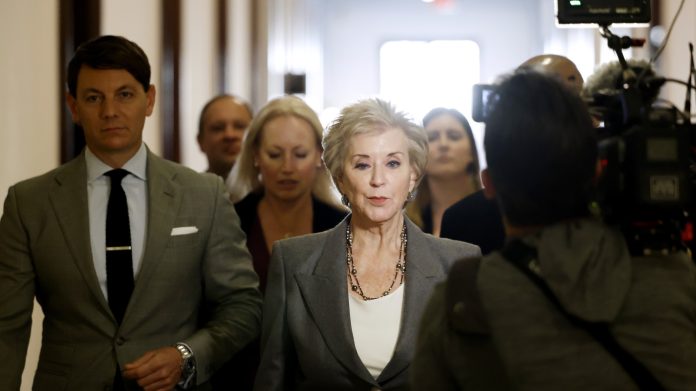
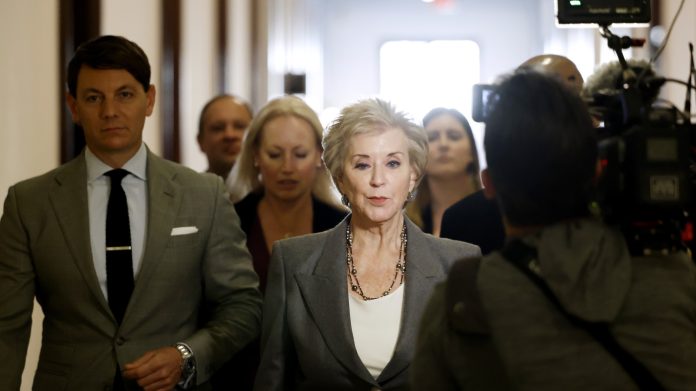
President Donald Trump’s nominee to be Secretary of Education Linda McMahon arrives to meet with Sen. Tommy Tuberville (R-AL) in the Russell Senate Office Building on Dec. 9, 2024.
Anna Moneymaker/Getty Images
hide caption
toggle caption
Anna Moneymaker/Getty Images
🎧 If confirmed, McMahon’s first order of business will probably be to slim the department down further, NPR’s Jonaki Mehta tells Up First. On Monday, Elon Musk’s DOGE unit, or the Department of Government Efficiency, made severe cuts to the Department of Education’s independent research arm. Only an act of Congress could dismantle the agency entirely.
➡️ With an annual budget of $79 billion and over 4,000 employees, the Department of Education is one of the smallest federal agencies. Here’s a guide to what it does — and doesn’t — do.
Dozens of probationary employees at the Consumer Financial Protection Bureauhad their jobs terminated this week, according to the union representing CFPB employees. The CFPB has been in Musk’s crosshairs as one of DOGE’s latest targets. His critics have pointed out a major conflict of interest, as Musk hopes to eliminate an agency that would directly regulate a new service he will soon offer on his app X. Linda Yaccarino, X’s CEO, recently announced the social media company had struck a deal with Visa to offer a mobile payments service called “X Money Account.”
➡️ The CFPB was created as a response to the 2008 financial crisis. Here’s what it does.
➡️ Trump hired Musk as a “special government employee,” a designation given to people who join the government for a short period of time typically to provide specialized expertise. Here’s what you should know about SGEs.
➡️ DOGE’s central tenet is to cut government spending. But there’s been little transparency and some exaggeration surrounding its claims of saving several billion dollars in less than a month, according to an NPR analysis of several public data sources.
Trump says he will meet with Russian President Vladimir Putin, after holding separate phone calls yesterday with the Russian leader and Ukrainian President Volodymyr Zelenskyy. “I think we’re on the way to getting peace,” Trump told reporters in the Oval Office.
🎧 Trump and Putin are “in sync,” NPR’s Russia correspondent Charles Maynes says. Kremlin spokesman Dmitry Peskov said after the phone call that both leaders agreed it was time for the two countries to work together. Maynes says there’s a “sense of celebration” in Russia, and the markets went up this morning. Meanwhile, he says yesterday was “clearly not a good day” for Ukraine. Defense Secretary Pete Hegseth told NATO allies he believed it was unrealistic for Ukraine to regain its prewar borders and ruled out NATO membership for the country.
Deep dive
A court found that President Trump’s administration had not complied with an earlier court order. Experts worry about the potential of a constitutional crisis.
Al Drago/Getty Images
hide caption
toggle caption
Al Drago/Getty Images
President Trump has signed dozens of executive orders in less than a month in office, and courts are now pushing back. One of the central roles of U.S. federal courts is to review the executive branch’s implementation of federal law. Executive branch employees are expected to comply with court orders and existing legal roles — but that’s mostly relying on good faith and tradition, according to UCLA law professor Blake Emerson. What happens if the president ignores these court orders? Several legal experts break it down:
⚖️ Courts can force compliance through fines, sanctions, finding someone in contempt or even jail time. Some experts, like retired federal judge Nancy Gertner, view these options as empty threats.
⚖️ The U.S. Marshals Service — which is part of the Department of Justice — could enforce a judge’s order, Gertner added. But the president could direct the Justice Department not to comply.
⚖️ Courts ultimately have few ways to punish a president for ignoring their rulings, but Congress still exists to intervene, according to Kristin Hickman, a professor of administrative law at the University of Minnesota. However, opposition is unlikely since Republicans control the House and Senate.
Picture show
SNL’s head makeup & hair designer Louie Zakarian in New York, on Thursday, Jan. 16, 2025.
Photo by Marco Postigo Storel
Marco Storel/for NPR
hide caption
toggle caption
Marco Storel/for NPR
Louie Zakarian has earned 10 Emmys and 10 Hollywood Makeup Artist Hair and Stylist Guild Awards throughout his three decades at Saturday Night Live. As head of SNL’s makeup department, he and his team of about 18 designers help bring writers’ and cast members’ wild ideas to life. Zakarian figures he’s made “tens of thousands of bald caps” over the course of his career.
An infrared image of Portrait of Mateu Fernández de Soto, revealing another portrait underneath.
The Courtauld Institute of Art/The Courtauld Institute of Art
hide caption
toggle caption
The Courtauld Institute of Art/The Courtauld Institute of Art
A hidden painting has been revealed under one of the earliest pieces from Pablo Picasso’s iconic Blue Period, thanks to advanced X-ray and infrared imaging technology.
Retailers like Trader Joe’s and Kroger have begun limiting the amount of eggs shoppers can buy as prices continue to climb.
Hamas suggested on Thursday that progress was being made in “positive” talks to bolster the teetering cease-fire with Israel, appearing to signal that an impasse was nearing its end and that hostages could be released this weekend. There was no immediate comment from the Israeli government on Hamas’s latest remarks.
Officials across the region had feared the fragile truce was at risk amid finger-pointing between Israel and Hamas. Earlier this week, Hamas argued that Israel was not upholding its end of the deal and indefinitely postponed the release of Israeli hostages set to be freed on Saturday.
This is a developing story. Please check back for updates.
You might know her from: Linda McMahon is most well-known for leading World Wrestling Entertainment (WWE), and helping to build it into a multi-billion-dollar business. She also led the U.S. Small Business Administration for about two years under President Donald Trump’s first term.
More about McMahon:
McMahon’s background in education is limited. She served for about one year on Connecticut’s State Board of Education.
Up until recently, not much was known about McMahon’s policy positions on education. In January she shared more about where she stands, including that she supports expanding school choice and career and technical education opportunities for students.
She held leadership positions at WWE for nearly three decades, including CEO.
If confirmed, McMahon would oversee an agency the president has already moved to diminish.
Watch Thursday’s confirmation hearing for Linda McMahon before the Senate Health, Education, Labor and Pensions Committee at 10 a.m. ET:
What the education secretary does: The education secretary leads one of the smallest federal agencies, the Department of Education. The agency safeguards the civil rights of students with disabilities, manages the federal student loan portfolio and sends billions of dollars to schools that serve low-income students, among its many responsibilities. Read more on what the department does here.
What to expect at McMahon’s confirmation hearing: In recent days, the Trump administration has made sweeping cuts to an independent research arm of the Education Department and put dozens of staffers on paid administrative leave. The White House has also confirmed the president’s plans to shutter department programs that are not protected by law and his plans to call on Congress to close the department entirely.
If a recent House education committee hearing is any indication, McMahon’s confirmation proceedings are likely to focus on how she would handle Trump’s plans to dissolve the department, what she would do to address poor K-12 student achievement and how she would work to enhance school choice.
Several people were injured when a car crashed into a union demonstration in Munich on Thursday, and the driver was taken into custody, the police said.
The police have not said whether the crash, which took place a few hundred yards north of the city’s central police station, was an accident or a deliberate attack.
The crash happened a day before the opening of the Munich Security Conference, which is being held less than a mile from the site of the crash and attracts high-profile participants and journalists from around the world.
Sandra Demmelhuber, a journalist for Bayerischer Rundfunk, the Bavarian public broadcaster, was at the site and described a chaotic scene.
“There is a person lying on the street and a young man was led away by the police. People sitting, crying and shaking on the ground,” she wrote on X.
The demonstration had been organized by Verdi, one of Germany’s largest unions, which had called a one-day strike for city workers.
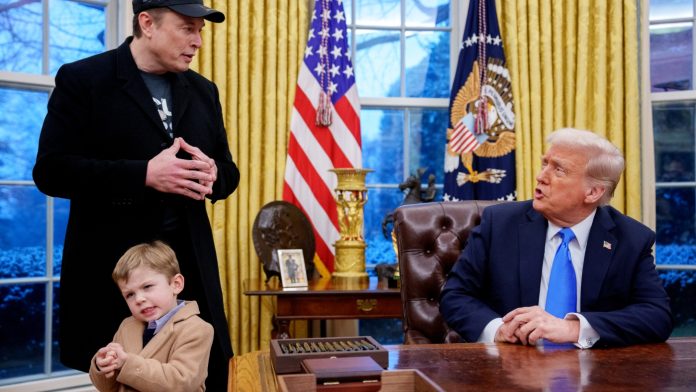
President Trump is joined by Tesla and SpaceX CEO Elon Musk, and his son, X Musk, during an executive order signing in the Oval Office at the White House on Tuesday.
Andrew Harnik/Getty Images
hide caption
toggle caption
Andrew Harnik/Getty Images
When Donald Trump took office for his second term, he moved quickly to bring his political adviser and top campaign donor — tech billionaire Elon Musk — into the government.
Musk is what’s known as a “special government employee,” a designation given to people who join the government for a short period of time typically to provide specialized expertise.
Here’s what you need to know about SGEs.
What is a “special government employee”?
In 1962, Congress created the role of “special government employee,” which allows the executive branch, the legislative branch and independent federal agencies to bring on employees for specific roles on a temporary basis.
Typically, SGEs are hired as experts or consultants or serve as members of federal advisory committees, of which there are roughly 1,000 across the U.S. government.
SGEs are limited to working for the government for no more than 130 days out of a 365-day period, though they can work multiple years, and they can either be paid or unpaid. NPR has reported that Musk is not being paid for his work with DOGE.
One reason government officials take on SGEs is that it’s less burdensome than hiring regular federal employees, according to Joanna Friedman, a partner with the Federal Practice Group, a Washington, D.C., law firm specializing in federal employment law.
“If you’re hired as a federal employee, you have to go through typically the competitive selection process, which means you have to apply for a job and you must be selected as the best-qualified candidate,” Friedman said. “This is just an easier way to bring someone on board without as much red tape.”
The Trump administration has also designated other members of Musk’s DOGE team as SGEs.
What powers do SGEs have?
According to Kathleen Clark, a professor specializing in government ethics law at Washington University in St. Louis, SGEs are mostly the same as regular government employees and can be given similar powers, including access to sensitive information. Musk and DOGE were granted access to a massive Treasury Department payment system that contains Americans’ Social Security numbers and bank account information.
Clark says what’s different about Musk’s case is that he is exercising power — such as purporting to shut down entire government agencies — that she says is beyond that of anyone in the White House.
“The president does not have that power and neither does Elon Musk under our Constitution, which grants Congress the power to control how money is spent by the executive branch,” Clark said.
Because many SGEs have jobs in the private sector, there are ethics rules in place to prevent them from using their government work for personal gain.
Depending on their pay grade, SGEs have to file either a publicly available or confidential financial disclosure form, which typically happens when they start working for the government. (The president, vice president, officials requiring Senate confirmation and certain White House appointees are required to file public financial disclosures.) SGEs may also be required to receive ethics training.
NPR reported that Musk had received an ethics briefing and would file a confidential financial disclosure report.
On top of that, criminal law prevents SGEs (as well as federal workers) from participating in any government matter that could impact their finances. When a conflict arises, SGEs can either recuse themselves from the matter or divest from the relevant financial interest.
In an Oval Office appearance on Tuesday, Musk told reporters that DOGE is operating transparently and announcing its actions on its X account. “Transparency is what builds trust,” he said. “And you can see, am I doing something that is benefiting one of my companies or not? It’s totally obvious.”
Trump, who appeared beside Musk, said he would bar Musk from any government work he believed might create a conflict. “If we thought that, we would not let him do that segment or look in that area, if we thought there was a lack of transparency or a conflict of interest,” Trump said. “We watch that also.”
White House press secretary Karoline Leavitt previously said that Musk would identify any conflicts that arose.
Clark, the Washington University professor, said it is typically government ethics officials — not the employee — whodecide whether an employee has a conflict of interest. That’s because the determination of a conflict can involve technical information, she said, and also because an employee may not be impartial about their own situation.
“You’re not supposed to judge your own case,” Clark said. “Even if you’re an expert, you might want to slant how you apply the law. And we don’t trust people, frankly, to apply that.”
Friedman, the federal employment attorney, said it would be up to the Justice Department to decide if Musk violated the federal conflict-of-interest law and whether to bring criminal charges.
Past SGEs have also faced scrutiny
Previous administrations have also used SGEs for high-profile roles in government.
During his first administration, Trump hired Dr. Scott Atlas as a science adviser in the summer of 2020 during the early days of the COVID-19 pandemic. Atlas, who was brought on as a special government employee, was not an infectious disease expert and clashed with other public health officials over his views on the coronavirus. He resigned in November of that year.
More recently, Anita Dunn, a founder of the consulting firm SKDK, was forced to divest a multimillion-dollar investment portfolio when she became a senior adviser to President Biden in 2022. She had previously worked as an SGE for the Biden administration.
And during the Obama administration, GOP Sen. Chuck Grassley of Iowa raised questions about the “special government employee” designation given to then Secretary of State Hillary Clinton’s aide Huma Abedin, who had also worked for the Clinton Foundation and the consulting firm Teneo.
For President Vladimir V. Putin, one phone call marked a turning point as great as any battle in his three-year war.
In a lengthy call on Wednesday, President Trump delivered a message to Mr. Putin that encapsulated much of how the Russian leader sees today’s world: that Russia and the United States are two great nations that should negotiate Ukraine’s fate directly and move on to addressing even weightier global affairs.
It was the clearest sign yet that Mr. Putin, despite Russia’s disastrous failures at the outset of his Ukraine invasion in early 2022, could still emerge from the war with a redrawn map of Europe and an expansion of Russia’s influence in it.
Taken together, the developments marked a payoff for Mr. Putin’s monthslong campaign of lavishing praise on Mr. Trump — apparently in the belief that the American president has the power to deliver a Russian victory in Ukraine.
“Putin is playing a very clever game,” Tatiana Stanovaya, a senior fellow at the Carnegie Russia Eurasia Center in Berlin, said. “He’s investing 100 percent into the effort to seduce Trump.”
In Moscow, news of the long-awaited call ushered in a wave of barely contained glee. Commentators claimed that the American-led three-year effort to isolate Russia had emphatically ended. They celebrated Mr. Trump’s glowing social media post after the call about “the Great History of Our Nations” and noted that the American president had spoken to Mr. Putin before he had called President Volodymyr Zelensky of Ukraine.
One Russian lawmaker said that Mr. Putin’s call with Mr. Trump “broke the West’s blockade.” Another said that Europeans were surely reading Mr. Trump’s post about it “with horror and cannot believe their eyes.” A third said it was a “day of good news.”
In a sign of the burst of optimism, Russia’s main stock market index jumped 5 percent on Thursday morning to its highest point since last summer, and its battered currency, the ruble, gained against the dollar to its strongest level since September.
Russian businesspeople hope that a peace deal with Mr. Trump could lead to sanctions against their country being dropped. The Kremlin said that, beyond Ukraine, Mr. Trump and Mr. Putin touched on “bilateral Russian-American relations in the economic sphere.”
Not all were happy. Some Russian cheerleaders of the war grumbled on social media that a deal with the United States could sell out the soldiers on the battlefield. A pro-war blog with more than a million followers, Two Majors, quoted a fighter who said that the discussion of Wednesday’s call “demoralizes and irritates me.”
Ms. Stanovaya and many other commentators noted that Mr. Putin’s chances of getting all he wants were far from assured. In particular, while Mr. Trump appears focused on ending the fighting in Ukraine, Mr. Putin wants a broader agreement with the United States that would push back NATO and allow Russia to reclaim a sphere of influence in Europe.
“Donald Trump spoke in favor of a speedy end to hostilities,” the Kremlin said in its summary of the call, hinting at that divergence. “Vladimir Putin, for his part, mentioned the need to eliminate the root causes of the conflict.”
The call sets up a complex negotiation whose contours — and participants — are still unclear. Mr. Zelensky will try to make the case for American support in a meeting with Secretary of State Marco Rubio and Vice President JD Vance in Munich on Friday.
Mr. Putin is likely to keep the military pressure on Ukraine while appealing to Mr. Trump’s ambitions as a peacemaker. Analysts say that what Mr. Putin cares about most is not how much territory he captures in Ukraine; rather, he wants a more comprehensive deal that keeps Ukraine out of NATO, limits the size of Ukraine’s military and reduces the Western alliance’s presence across Eastern and Central Europe.
Analysts doubt that Mr. Putin will agree to stop the fighting before he receives assurances that at least some of those wider demands will be met.
Ilya Grashchenkov, an analyst of Russian politics based in Moscow, said that the call with Mr. Trump made Mr. Putin’s repeated doubling down on the Ukraine war “look like a successful bet in a casino.”
Russia absorbed huge losses in Ukraine, gambling that, eventually, “the global paradigm would change” and the West would tire of supporting the country, Mr. Grashchenkov said in a phone interview. “This change has happened, and now it is unclear how this bet will play out in the future.”
After the Watergate scandal, the political establishment ushered in a wave of reforms meant to constrain the president. Many have already fallen by the wayside, and Trump is challenging what’s left.