Friday, November 13, 2026
Home Blog Page 227

Taiwan Prepares for Trump’s Tariffs, and a Changed Washington

0

Not so long ago, Taiwan basked in seemingly boundless, bipartisan support in Washington, where the island has long been regarded as a valiant democratic partner against China.

Now, a few weeks into President Donald J. Trump’s second term, Taiwan is adjusting to a shift in its relationship with the United States, its primary backer — one that does not focus on shared democratic ideals, and that is more uncertain and transactional. Mr. Trump has accused Taiwan of spending far too little on its own security and of gaining an unfair dominance in making semiconductors.

Taiwanese officials and businesspeople have been trying to assure the new administration of their commitment to cooperation. They have traveled to Washington for meetings, bearing charts detailing their military outlays, and attended inauguration events filled with the MAGA faithful. They have floated new deals that Taiwanese companies could broker with American businesses in gas and other fields, and tried to explain the value of Taiwan’s semiconductor manufacturing to American interests.

Underlying their efforts is an anxiety over what Mr. Trump may do, for instance, to press Taiwanese companies to move advanced semiconductor production to the United States. Mr. Trump has said he might soon impose tariffs on semiconductors. Taiwanese officials have been preparing to help Taiwanese businesses soften the blow of any such move.

“I think Taiwan just convinced itself that they had good relations with the U.S. and they had lots of friends in Congress, and they would be able to weather the storm,” said Bonnie S. Glaser, the managing director of German Marshall Fund’s Indo-Pacific program, who often speaks with Taiwanese politicians. “When Trump made those comments, I think it was a wake up call for people in Taiwan that they really didn’t know what was coming next.”

Governments around the world are trying to adjust to Mr. Trump’s combative approach. But the stakes for Taipei are especially high. The island depends on the United States for nearly all its major weapons. It sends nearly a quarter of its exports directly to the United States, and Washington is crucial in giving Taiwan political support against Beijing, which claims that Taiwan is its territory and must accept unification — by force, if deemed necessary.

Taiwanese officials and policy advisers said the island would quickly roll out measures to help its businesses hurt by any new U.S. tariffs. They spoke on condition of anonymity because of the sensitive and provisional nature of the plans, and declined to give details. Some officials have publicly hinted at the preparations. “We’re preparing for a range of scenarios,” the minister of economic affairs, Kuo Jyh-Huei, told reporters when asked about Mr. Trump’s threatened tariffs. “If we showed our hand now, that would not work to the benefit of everyone.”

Even if Mr. Trump holds off on the tariffs, Taiwan faces more pressure from his administration on other issues. They include the island’s big trade surplus with the United States, which climbed to a record $74 billion last year according to U.S. data, and its military spending and preparations, which many in Washington see as lacking, even though billions of dollars worth of orders of American military equipment are stuck in a backlog. The United States is committed by law to help Taiwan defend itself, and leaves open the possibility of intervening militarily if China tried to conquer the island.

“There’s a basic mismatch. We’ve been thinking that America and Taiwan are in a strong partnership, but America under Trump thinks Taiwan doesn’t do enough,” said Jason Hsu, a former Taiwanese lawmaker and technology investor who is now a senior fellow at the Hudson Institute. “Sooner or later, the Taiwan government will need to show up in town with a package ready to offer Trump.”

Publicly, the Taiwanese government is projecting calm confidence about relations with Washington. But Taiwanese officials’ efforts to build bridges into Mr. Trump’s inner circle during trips to Washington last month and in December, have yielded little so far, said three American officials familiar with their attempts, who described the interactions as limited.

Taiwan sent two economic officials to Washington this week to “better explain ourselves to Mr. Trump’s circle,” Mr. Kuo, the economic affairs minister, told reporters before their departure. Taiwan also hopes to buy more liquefied natural gas from Alaska, he has said.

“Taiwan is preparing some presents for Trump,” said Jeremy Chih-Cheng Chang, the chief executive officer of the Research Institute for Democracy, Society and Emerging Technology in Taipei. “They have already indicated some, as you have seen in news reports — like buying liquefied natural gas — but there are sure to be others.”

In January, executives from Taiwan Semiconductor Manufacturing Company — TSMC, the world’s most advanced chip maker — held talks with Mr. Trump’s nominee for commerce secretary, Howard Lutnick, said several people familiar with the talks who spoke on condition of anonymity.

In December, Taiwanese officials visiting Washington showed officials and Republican politicians a presentation designed to demonstrate that Taiwan has been rapidly increasing military preparations, according to people familiar with those discussions. They met with Michael Waltz, then a Florida congressman known for being hawkish on matters of national security, according to one of the people.

Taiwanese officials remain hopeful that they will find robust supporters in two men who were deeply critical of China in Congress: Marco Rubio, the secretary of state, and Mr. Waltz, now Mr. Trump’s national security adviser. But some former officials who strongly supported Taiwan in Mr. Trump’s first term have not been brought into his new administration, including Mike Pompeo, the former secretary of state.

“It’s very telling that some hard-line hawks on Taiwan have been left out,” said Christopher K. Johnson, the president of China Strategies Group, a consulting firm, and a former U.S. government intelligence officer. “It looks like Taiwan bet on some of the wrong horses.”

Half a dozen or so officials poised to take senior positions in the Pentagon have rejected the G.O.P.’s tradition of backing an expansive foreign reach, in favor of limiting U.S. military commitments abroad. They represent an ascendant foreign policy doctrine in a party that in recent years has chafed at committing more military support to Ukraine, and pushed NATO allies to spend more on their militaries.

In an opinion essay published last May, Mr. Trump’s nominee to serve as the Pentagon’s under secretary of defense for policy, Elbridge Colby, warned that Taiwan should not assume that it was indispensable to the United States. “America has a strong interest in defending Taiwan, but Americans could survive without it,” he wrote. He and other Pentagon officials have suggested that Taiwan should increase its military spending to at least 5 percent of its economic output, or about twice what it currently is spending.

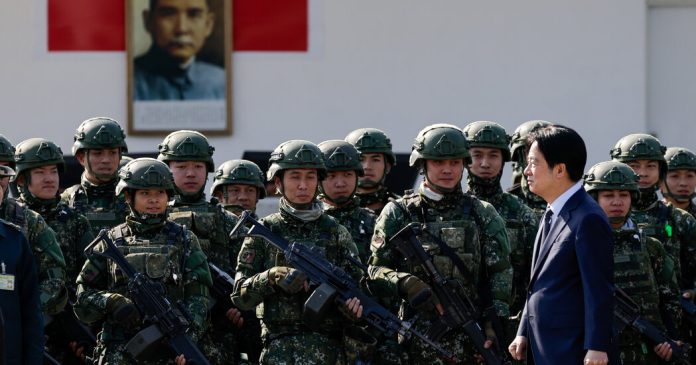
The Taiwanese government has said it is committed to expanded military spending, though many Taiwanese experts and officials, privately, question the 5 percent target. President Lai Ching-te of Taiwan also faces a legislature controlled by opposition lawmakers who have accused his government of wasteful spending and reined in parts of this year’s defense budget.

At the same time, Taiwan has its own frustrations with the United States, including the big backlog of undelivered orders of arms and military equipment to the island.

“I do sense a soreness of being told to spend more when they haven’t received what they’ve already paid for,” said Steve Yates, a senior research fellow at the Heritage Foundation, referring to Taiwan. “The U.S. has to fix its defense manufacturing supply chain before it can reasonably put pressure on others to do and buy more.”

Ana Swanson in Washington and Amy Chang Chien in Taipei contributed reporting.

North Korea Is Caring for Russia’s Wounded Soldiers, Envoy Says

0

North Korea is restoring its Cold War-era comradeship with Russia by looking after Russian soldiers wounded in the war against Ukraine, as well as hosting Russian children who lost parents in the fighting, according to Moscow’s ambassador to Pyongyang.

The presence of hundreds of wounded Russian troops, as well as an unspecified number of Russian war orphans, in North Korea was revealed by Alexander Matsegora, the Russian ambassador to North Korea, in an interview published on Sunday by the state-run news outlet Rossiyskaya Gazeta.

Mr. Matsegora made the revelation, which could not be independently corroborated, while emphasizing the friendly ties between Russia and North Korea. It is also notable as one of the first public admissions by either side of North Korea’s practical support for its ally’s war effort. The bilateral relations have deepened rapidly since Russia’s invasion of Ukraine three years ago, and North Korean troops have recently started fighting alongside the Russian forces.

North Korea has suffered thousands of casualties in the war. But it has also been taking care of injured Russian soldiers, according to Mr. Matsegora.

“One of the clear examples of our brotherly ties is the rehabilitation of hundreds of soldiers wounded in the special military operation at Korean sanitariums and clinics,” the envoy said, referring to the war against Ukraine.

Last year, North Korea also received Russian children whose fathers died on the battlefield, housing them in the Songdowon children’s recreation center in Wonsan, on the east coast of North Korea, he said. The North Koreans were looking after the Russian soldiers and children free of charge, he said. The Russian envoy offered no details about the children, including how long they planned to stay in North Korea.

“When we offered our friends to cover at least some of those expenses, they were genuinely offended and asked us not to do this ever again,” he said. The Songdowon center was originally built as a camp for foreign children, part of North Korea’s international propaganda efforts.

Although the idea of Russian troops being rehabilitated in North Korea, one of the poorest and most isolated countries in the world, may sound unusual, communist countries had a long tradition of building solidarity by looking after each other’s wounded soldiers, orphans and widows during war times, said Kim Deog Young, a documentary filmmaker.

Mr. Kim is the director of “Kim Il Sung’s Children,” a ​documentary about thousands of war orphans that North Korea sent to countries like Poland, Hungary and East Germany during the 1950-53 Korean War before bringing them home in 1956.

“Kim Jong-un is rebuilding the old tradition of solidarity as he sees the emergence of a new Cold War,” Mr. Kim said.

From Mr. Matsegora’s interview, it was unclear when the wounded soldiers from Russia arrived in the North or whether they and the Russian orphans were still there. But in June last year, the South Korean cable channel TV Chosun reported that North Korea was treating wounded Russian soldiers in Wonsan before it began sending its troops to Russia later that year.

When President Vladimir V. Putin of Russia visited North Korea to restore a Cold War-era mutual defense treaty with its leader, Kim Jong-un, in June last year, he had planned to travel to Wonsan to meet the Russian soldiers, TV Chosun reported. But the planned visit to Wonsan was canceled when Mr. Putin’s arrival in North Korea was delayed, it added.

It also isn’t clear what type of medical care the Russian soldiers were receiving in North Korea.

North Korea’s public health system collapsed in the wake of a famine of the 1990s when doctors were forced to use beer bottles to construct intravenous systems, according to defectors. The country still suffers an acute shortage of medicine. But Wonsan is one of the better developed areas in the country. Kim Jong-un has been building a seaside resort complex there, hoping to attract foreign tourists.

In a report published on Monday, the Washington-based Institute for the Study of War cast some doubt on the report that Russia was letting its wounded troops recuperate in North Korea.

“The Russian military command has reportedly been sending wounded personnel back into assault groups without treatment, demonstrating a general disregard for soldiers’ health,” it said. Such brutal tactics were “calling into question official Russian claims to be sending Russian soldiers abroad for treatment, particularly to North Korea,” it said.

But the institute added that “the arrival of combat-experienced Russian soldiers, particularly if they include officers or noncommissioned officers, to North Korea may allow the Russian military to work with North Korean forces and disseminate lessons from the war in Ukraine while ostensibly recuperating.”

If confirmed, the recuperation of Russian troops in North Korea is the latest example of deepening ties between the two countries.

North Korea has sent about 11,000 soldiers to Russia, as well as large shipments of artillery shells, rockets and missiles, according to United States, South Korean and Ukrainian officials. In return, Russia has been providing North Korea with oil, food and help in upgrading weapons, South Korean officials said. Russia is also accepting more North Korean construction workers, a key source of cash for Mr. Kim’s regime, they said.

North Korea’s intervention came with a heavy cost, as 4,000 of its troops have been killed or injured in combat, according to Ukrainian and Western intelligence estimates. But South Korean intelligence officials have said that despite the heavy loss, North Korea may send more troops to Russia.

“Our army and people will invariably support and encourage the just cause of the Russian army and people to defend their sovereignty, security and territorial integrity,” Mr. Kim said in a speech on Saturday, according to state media.

Nataliya Vasilyeva contributed reporting.

State Dept. Draws Up List of Cartels to Be Labeled Terrorist Groups

0

The Trump administration plans to designate more than a half-dozen criminal groups with roots in Latin America as foreign terrorist organizations, said five U.S. officials with knowledge of the imminent action.

The move, to be carried out by the State Department, follows an executive order President Trump signed on Jan. 20 calling for a crackdown on major cartels. The designation is expected to be applied to eight groups, said two of the officials, though the list could change before a public announcement. The officials who spoke for this article did so on the condition of anonymity to talk about an action that has not been made public yet.

The executive order called for the designations, saying the cartels “constitute a national-security threat beyond that posed by traditional organized crime” and that the United States would “ensure the total elimination” of the groups.

Mr. Trump gave Secretary of State Marco Rubio two weeks to make the designations in consultation with several other cabinet members. The criminal groups and their members could be labeled foreign terrorist organizations or specially designated global terrorists, according to the order. The designations mean the U.S. government can impose broad economic sanctions on the groups and on people or entities linked to them.

The executive order referred in general to cartels in Mexico. It also specifically named Tren de Aragua, a group with roots in Venezuela, and Mara Salvatrucha, or MS-13, a gang founded by Salvadoran immigrants in the United States that plays a lesser role in the transnational drug trade.

Besides those two groups, the State Department plans to designate the Clan del Golfo, based in Colombia, and five others based in Mexico. The Mexican organizations that will be designated are the Sinaloa cartel, Jalisco New Generation cartel, the Northeast cartel, the Michoacán family and the United cartels, according to U.S. officials.

The State Department has informed several congressional committees of the upcoming designations, which could be announced by the White House as early as this week. The department did not reply to a request for comment.

Clan del Golfo, or Gulf Clan, has worked for over two decades with Mexican cartels, supplying cocaine for them to smuggle into the United States. After the price of cocaine plunged in 2017, the Colombian cartel moved aggressively into migrant smuggling to make up its financial losses.

A U.S. official with knowledge of the designation list said that the Gulf Clan was likely being added for its involvement in migrant trafficking. The group largely controls the Darién Gap, the narrow land bridge that connects South and North America.

Migrants from around the world — from China to Sudan to Venezuela — often fly to more permissible South American countries before heading to the Darién Gap on their journeys north to the United States. Many of those migrants pay thousands of dollars to operatives working for the Gulf Clan, as a protection fee for traversing the land bridge.

The designation list was supposed to be completed last week, but may have been delayed because the State Department expanded it from the groups outlined in the executive order last month, according to a person familiar with the matter. Whether or not to include organized crime groups involved in migrant trafficking was discussed at length, partly causing the delay.

The Mexican cartels included on the list work closely with the Gulf Clan to smuggle migrants across Latin America into the United States.

Mr. Rubio completed his first trip as secretary of state this month, visiting five countries in Latin America. He spoke with his counterparts about migration and security issues, though he did not visit Mexico.

In an interview with the podcast host Megyn Kelly on Jan. 30, Mr. Rubio talked about the need to dismantle Mexican drug cartels, saying that “there are parts of Mexico, many parts of Mexico, in which the government doesn’t control those areas.”

“They’re controlled by drug cartels,” he continued. “They are the most powerful force on the ground, and they are plowing into the United States.”

“They’re facilitating illegal migration, but they are also bringing in fentanyl and deadly drugs to our country,” he added. “That’s a national security threat, and that needs to stop.”

In a call with his counterpart in Argentina on Monday, Mr. Rubio had discussed “shared security priorities in the region, including combating transnational organizations,” the State Department said.

Mexican officials have been in drawn-out negotiations with the Trump administration to stave off the terror designation for the cartels and organized crime groups that operate in their country, according to people familiar with the talks.

Of the eight groups designated, five are Mexican. The Sinaloa and Jalisco New Generation cartels are the country’s largest and have cornered much of the fentanyl market for the United States, producing the synthetic opioid in Mexico before smuggling it north. A growing amount of fentanyl is being used by Mexican citizens, leading to rising addiction rates in the country.

The designation list includes a smaller cartel, Northeast, and two Mexican groups that American officials say are more akin to organized criminal organizations: the Michoacán Family and United cartels. Those groups tend to act as on-the-ground muscle for Mexico’s cartels to help them spread their territorial control.

An organized crime group is considered a cartel only if it controls enough of the drug trade to allow it to determine the price of any given narcotic in places like New York or London.

The net profits from the international operations of Mexico’s cartels could reach up to $20 billion annually, nearly 2 percent of Mexico’s gross domestic product, according to an American official.

Thursday Briefing – The New York Times

0

President Trump said that he had a “lengthy and highly productive phone call” with President Vladimir Putin of Russia, which he characterized as the beginning of a negotiation to end the war in Ukraine. Afterward, Trump said he had spoken with President Volodymyr Zelensky of Ukraine.

“We each talked about the strengths of our respective Nations, and the great benefit that we will someday have in working together,” Trump wrote on social media of his call with Putin. “But first, as we both agreed, we want to stop the millions of deaths” — in fact, an estimated several hundred thousand — “taking place in the war.”

The call signifies the collapse of Western efforts to isolate Putin diplomatically.

Trump did not say how Ukraine’s interests would factor into the negotiations. But Secretary of Defense Pete Hegseth said earlier at a NATO meeting in Brussels that a peace deal restoring Ukraine’s borders to those of 2014, when Russia annexed Crimea, was “unrealistic.” Russia now occupies about 20 percent of Ukraine. Trump, Hegseth added, does not support Ukraine’s membership in NATO as part of a peace plan.

Minerals deal: Ukraine’s valuable mineral resources have become a prominent component in the maneuvering over the country’s future after Trump pushed the idea of trading U.S. aid for Ukrainian minerals. The U.S. Treasury secretary was in Kyiv for talks about a possible deal.

Prime Minister Narendra Modi of India is expected to try to ease any potential friction between his country and the U.S. when he meets with President Trump today in Washington. Modi has spoken of a warm relationship with the president, but Trump can be a fickle friend.

Two glaring issues could complicate Modi’s goals: trade and immigration. Modi “will be trying to show Trump that he is cooperating on his fixation on tariffs and illegal immigration,” Mujib Mashal, our South Asia bureau chief, said. “Trump has singled out India as one of the main abusers of tariffs that enjoys a trade deficit with the U.S., mentioning India in the same breath as China.”

India’s trade surplus with the U.S. is growing, and Modi could offer lower duties on U.S. goods like bourbon and pecans, which are produced mainly in Republican states.

Deportations: India is also the largest source of illegal immigration to the U.S. after Latin America. Modi’s government has made it clear that it will cooperate with Trump’s deportation effort, even as it caused an uproar in India last week.


Jordan and Egypt are moving with speed to try to dissuade President Trump from forcing them to take in two million Palestinians from the Gaza Strip. The two Arab nations view the proposal as an existential threat.

The strategy appears to be to placate Trump with offers to work together to rebuild Gaza, bring peace to the region and expand humanitarian aid efforts. That could help them buy time, analysts say — perhaps enough for the idea to be jettisoned altogether, or for its strategic and security drawbacks to become apparent. And with Trump, flattery can be highly effective.

Related:

The new season of “The White Lotus” takes place on the resort island of Koh Samui in Thailand. Its roughly 68,000 residents may be in for a shock, if a tidal wave of tourists decides to check it out for themselves.

For Valentine’s Day, the “Modern Love” podcast asked readers to share the moments when they knew they were falling in love. Their stories spanned decades and regions.

The team also revisited one of the most memorable stories they have ever published: Mandy Len Catron’s piece about the 36 questions that can help us fall in love. Mandy joined the podcast to provide an update on her romance and to read her essay, which starts on a bridge at midnight, “staring into a man’s eyes for exactly four minutes.”

Listen to the podcast and read Mandy’s original essay here.

For more: For decades, these heart-shaped bathtubs drew love-struck couples to a honeymoon getaway in Eastern Pennsylvania. What happened to them when it closed?


That’s it for today’s briefing. Thanks for starting your day with The New York Times. — Natasha

Reach Natasha and the team at [email protected].

Trump administration set to purchase $400 million worth of armored Teslas : NPR

0

A Tesla Cybertruck moves along the beach in Boca Chica, Texas, Monday, Nov. 18, 2024. (AP Photo/Eric Gay)

Eric Gay/AP


hide caption

toggle caption

Eric Gay/AP

The Trump administration is expected to purchase $400 million worth of armored Tesla vehicles, according to a new State Department document detailing procurement for fiscal year 2025.

Tesla Chief Executive Elon Musk is a top White House official who has been leading the Department of Government Efficiency, a unit focused on shrinking the federal workforce and ferreting out corruption.

The document does not specify what Tesla vehicles will be purchased by U.S. officials, but Musk’s Cybertruck, with its militaristic design and stainless steel exterior, could be an option.

After reports circulated Wednesday night of the State Department’s intent to purchase Tesla vehicles, the document was edited, at 9:12 p.m., and now says the federal contract is for $400 million worth of “armored electric vehicles,” but the word “Tesla” was removed.

Responding to a segment by MSNBC’s Rachel Maddow about the $400 million contract, Musk wrote on X on Wednesday night: “Hey @Maddow, why the lie?”

The State Department and Musk did not return requests for comment.

Musk, who spent more than a quarter-billion dollars to help elect Trump, has used an X account devoted to DOGE to highlight what he views as excessive or unnecessary federal contracts.

As Musk’s deputies have gained access to nearly two dozen federal agencies, ethics experts have raised concern about the billionaire running into conflicts of interest, since Musk runs six companies, some of which are under investigation by government authorities. Musk’s companies, including Tesla and SpaceX, also have multi-billion-dollar contracts with the federal government.

Most of the federal money Musk has received has gone to SpaceX, the rocket company, for projects including work for NASA to launch Musk’s Starship with astronauts to the moon.

A new Cybertruck starts at around $82,000, and about 38,000 were sold last year, according to Cox Automotive. Since the vehicle’s launch in 2019, the truck has faced complaints about rust, finger pinchies and defective accelerator pedals.

The State Department document also shows that some Tesla competitors are expected to receive lucrative, yet considerably smaller, contracts for armored vehicles, including from BMW, which the document shows is set to supply about $40 million worth of SUVs to the federal government.

In Trump’s Cross Hairs Over Taking Gazans, Egypt and Jordan Try Diversion

0

Finding themselves in the fickle cross hairs of President Trump, Jordan and Egypt are moving with speed — and uncertain prospects of success — to dissuade, distract and divert him from forcing them to take in Palestinians from the Gaza Strip.

For the two Arab governments, who view Mr. Trump’s proposal that they take in two million Palestinians as an existential threat, the strategy appears to be to placate the U.S. president with offers to work together to rebuild Gaza, bring peace to the region and expand humanitarian aid efforts. That could help them buy time, analysts say — perhaps enough for Mr. Trump to discard the idea as too complicated, or to recognize the strategic and security drawbacks of destabilizing two of the closest allies of the United States in the region.

Jordan’s King Abdullah employed a conciliatory tone in his meeting with Mr. Trump in the Oval Office on Tuesday, telling the U.S. president that his country would take in 2,000 Palestinian children with cancer and other illnesses from Gaza. Still, he otherwise gave no ground on the question of resettling more Gazans, and later repeated Jordan’s rejection of the plan in a statement on social media.

Jordan has been treating some cancer patients from Gaza for months already, making the offer more of a token than a real concession. But Mr. Trump called it a “beautiful gesture.”

Other world leaders have found that flattering Mr. Trump tends to help them get their way. King Abdullah seemed to be following their example on Tuesday, heaping praise on the president as “somebody that can take us across the finish line to bring stability, peace and prosperity” to the Middle East.

Even as the king pushed back against Mr. Trump in the post to make clear he was rejecting the mass displacement of Palestinians, he noted that the United States had a key role to play. “Achieving just peace on the basis of the two-state solution is the way to ensure regional stability,” he said in the post. “This requires U.S. leadership.”

Egypt, too, said it wanted to work with Mr. Trump to “achieve a comprehensive and just peace in the region by reaching a just settlement of the Palestinian cause,” according to an Egyptian statement released later Tuesday.

But the statement made no mention of participating in Mr. Trump’s proposal, and reiterated Egypt’s position that peace could be achieved only by giving the Palestinians statehood. Palestinians and many other Arabs have rejected Mr. Trump’s proposed forced displacement of Palestinians from Gaza not only as ethnic cleansing, a war crime that flies in the face of international law, but also as the death knell for their long-held dream of a Palestinian state.

Egypt sought instead to serve up an alternative plan for Mr. Trump, saying in the statement that it would “present a comprehensive vision for the reconstruction of the Gaza Strip in a manner that ensures the Palestinian people remain in their homeland.” The Palestinian Authority joined in with its own plan for helping Gaza recover from the war on Wednesday.

In recent days, as alarm over the president’s idea has mounted in Cairo, Egyptian officials have emphasized that Egypt stands ready to help rebuild Gaza, with which it shares a vital border crossing, as it did after previous conflicts there.

An Egyptian real estate tycoon, Hisham Talaat Moustafa, who like Mr. Trump has developed a chain of residential properties and hotels, went on an evening news show on Sunday to outline a $20 billion proposal for building 200,000 housing units in Gaza, as if trying to talk to Mr. Trump developer to developer.

But Mr. Moustafa, who is closely linked to the Egyptian president, Abdel Fattah el-Sisi, said he envisioned reconstructing Gaza without moving any Palestinians out of the strip.

During the Tuesday meeting, King Abdullah also alluded several times to the need for consultations with Egypt and other Arab countries before responding to Mr. Trump’s proposal, mentioning an upcoming meeting in Riyadh with Crown Prince Mohammed bin Salman of Saudi Arabia. Egypt has also called for a summit of Arab leaders to discuss the issue in Cairo on Feb. 27.

Despite the pushback from Egypt and Jordan, Mr. Trump seems to be sticking to the core of his out-of-left-field proposal for the United States to “own” Gaza and redevelop it into a “Riviera” for tourism and jobs. During the Tuesday meeting with King Abdullah and his son, Crown Prince Hussein, he said that “we will have Gaza” and “we’re going to take it.”

But he appeared to soften his previous threat to cut funding to Jordan and Egypt, two of the top recipients of U.S. aid, if they did not accept Gaza’s Palestinians, saying, “We’re above that.”

Mr. Trump also suggested that he was looking at a broader group of countries that could receive Gazans. “We have other countries that want to get involved,” he said, and when a journalist asked whether two of those countries could be Albania and Indonesia, he responded, “Yeah, sure.” (The leaders of both countries have dismissed any such possibility.)

Middle East experts say Mr. Trump appears to be ignoring previous U.S. calculations about the importance of stability in Egypt and Jordan, Arab neighbors of Israel who both made peace with Israel years ago and cooperate closely with the United States on security matters.

“The way that he talks about these relationships, it is as if these countries are takers, and that we get very little out of them,” said Brian Katulis, a senior fellow at the Middle East Institute who focuses on Egypt, Israel, Jordan and the Palestinians.

In fact, many human rights advocates and critics of Egypt have questioned how wise the U.S. investment in Egypt is, arguing that it props up a repressive regime that often goes against U.S. interests. But analysts say the cooperation of Egypt and especially Jordan on regional security has been valuable to the United States.

Egypt, which receives $1.3 billion a year in U.S. military assistance to buy weapons, making it the second-largest recipient of such financing after Israel, has worked with the United States on counterterrorism efforts.

Jordan has been the United States’ gateway to the Middle East for decades, hosting a U.S. military base and a large Central Intelligence Agency station and acting as a diplomatic hub. Like Egypt, the Jordanian monarchy shares the U.S. view of militant Islam as a major threat and has supported the United States in its fight against Al Qaeda and then the Islamic State, among other common enemies.

When Iran targeted Israel with missiles and drones last year, Jordan also helped to shoot some of them down.

Jordan has “been with us lock step,” Mr. Katulis said.

Egypt and Jordan both accepted Palestinian refugees after they were displaced during the 1948 war surrounding the creation of the state of Israel, and Egypt has now taken in at least 100,000 Palestinian medical evacuees and other people who fled Gaza.

But analysts say both countries would rather risk losing U.S. aid than alienating their populations by appearing complicit in the ethnic cleansing of Gaza.

For Jordan, taking in large numbers of Palestinians forced out of Gaza is unacceptable because it could widen an existing rift between citizens who are of Palestinian descent and those who are not, destabilizing the monarchy, analysts say. More than half of King Abdullah’s 12 million subjects are of Palestinian descent.

Jordan already hosts about 700,000 refugees, including Syrians and Iraqis as well as Palestinians. That largely impoverished population has all but overwhelmed the small country’s limited resources.

Mr. Trump’s proposal also inflames fears that Israel will next drive Palestinians out of the occupied West Bank into Jordan, a long-held ambition of far-right Israelis.

The secretary general of the Arab League, Ahmed Aboul Gheit, alluded to such fears on Wednesday, saying, “Today the focus is on Gaza and tomorrow it will shift to the West Bank, with the objective of emptying historic Palestine of its indigenous people, something that is unacceptable.”

Egypt also sees the possibility of Palestinians resettling in Egypt as a serious security threat. Forcibly displaced Palestinians could launch attacks on Israel from Egyptian soil, officials say, inviting Israeli military retaliation.

Rania Khaled contributed reporting from Cairo.

USAID Lifesaving Aid Remains Halted Despite Rubio’s Promise

0

When Secretary of State Marco Rubio announced last month that lifesaving humanitarian work would be exempt from a freeze on foreign aid, global health workers breathed a collective sigh of relief.

But a new directive has put such exemptions on hold.

Several senior employees at the U.S.A.I.D. Bureau of Global Health received an email Tuesday telling them to “please hold off on any more approvals” pending further directions from the acting chief of staff, according to a copy reviewed by The New York Times.

Senior officials at the Bureau of Humanitarian Assistance received similar instructions during a meeting this week, according to a person familiar with what transpired.

For weeks, U.S.A.I.D. officials and the organizations, contractors and consultants who partner with them have struggled to continue the kind of work that Mr. Rubio promised to preserve — “core lifesaving medicine, medical services, food, shelter and substance assistance.”

Some waivers have been issued to programs that fall under Mr. Rubio’s definition of “lifesaving” aid, but the payments system called Phoenix that U.S.A.I.D. relies on to disburse financial assistance has been inaccessible for weeks. That means even programs that received waivers have struggled to continue, according to multiple employees of U.S.A.I.D. and the partner organizations that rely on the funding they distributed.

The State Department did not reply to a request for comment for this article.

On Tuesday, Elon Musk, the billionaire tech entrepreneur empowered by President Trump to combat the agency, told reporters in the Oval Office that the administration had “turned on funding for Ebola prevention and for H.I.V. prevention.” But in reality, the Ebola funding and virtually all of the H.I.V. prevention funding remains frozen, according to two U.S.A.I.D. employees and several aid groups.

Young engineers working for Mr. Musk seized control of the agency’s payments system as they took over in recent weeks. And as part of the dismantling overseen by Mr. Musk, the State Department also recently circulated plans to reduce U.S.A.I.D. staff from about 10,000 workers to 611 who had been deemed essential personnel.

Without access to funding, organizations that partner with U.S.A.I.D. have been unable to pay their workers and suppliers for projects that were dependent on U.S. government funding.

The Norwegian Refugee Council, which does U.S.-backed humanitarian work in about 20 countries, said it has been unable to take advantage of the waivers because the agency’s payments had stopped.

“We currently have millions of dollars in outstanding payment requests to the U.S. government,” the group said in a statement, noting that civilians in conflict zones like Ukraine, Afghanistan and Sudan would suffer if its work stopped. “Without an immediate solution we may, at the end of February, be forced to halt U.S.-funded lifesaving humanitarian programs.”

New political appointees at the State Department and U.S.A.I.D. have put other hurdles in place.

At one mission in Asia, officials received waivers for three programs, including one for malaria eradication, but then were told they needed waivers for individual projects under those programs, a person with knowledge of the impasse said.

Beleaguered U.S.A.I.D. staff members said this week that the waiver pause was a sign that the end of their lifesaving work and other projects may be near.

Agency officials were notified this week that some 350 awards would be canceled. It was not immediately clear how many of those contracts were on a list that circulated last week identifying about 800 potential award cancellations.

Unlike previous notifications, emails sent to staff on Wednesday alerting them to some of the most recent cancellations did not encourage them to check for potential exemptions.

People deputized by Mr. Trump and Mr. Musk have accused U.S.A.I.D. officials of delaying and trying to undermine efforts to terminate programs by conducting their own reviews of contracts to ensure lifesaving work is not canceled. However, those reviews would be needed to grant the waivers promised by Mr. Rubio.

As the reductions get underway, unions representing U.S.A.I.D. staff as well as companies and organizations that work with the aid agency have been scrambling to push back against the cuts through a series of lawsuits. Some have succeeded in obtaining temporary restraining orders against the president’s efforts to dismantle the agency.

The plaintiffs have argued that the downsizing measures are unconstitutional and illegal, as Congress appropriated the funds for the agency and, by law, has to approve their withdrawal.

In one lawsuit, filed by companies that have had U.S.A.I.D. contracts for global programs, a development firm reported that $250 million worth of health supplies were stuck in transit or “stranded in warehouses around the world” because of the stop-work orders that accompanied the freeze. The firm, Chemonics, had to furlough about two-thirds of its U.S.-based staff in recent weeks.

Lawyers for the Trump administration argued in a response to one of the lawsuits that “the president has broad discretion to set the terms and conditions” on the provision of aid.

As the legal battles wear on, the drastic changes to the U.S. government’s premier foreign aid agency continue.

On Tuesday, the Trump administration fired the inspector general for U.S.A.I.D., Paul K. Martin, just one day after he released a report warning that staff reductions and spending freezes risked the misuse and waste of hundreds of millions of taxpayer dollars, according to three people familiar with the dismissal.

The report documented confusion around the waivers. It warned that nearly half a billion dollars of food aid was at risk of spoiling, and that a reduced ability to vet partner organizations had made it more difficult to ensure no U.S. money would go toward terrorism.

Also on Tuesday, the agency made another round of cuts to contractors, the latest at U.S.A.I.D. to be forced to leave.

And the General Services Administration, a federal agency that oversees building leases and other contracts, in recent days terminated the U.S.A.I.D.’s lease for headquarters space in the Ronald Reagan Building in downtown Washington. The General Services Administration said in a statement on Tuesday that it took down the aid agency’s signs and that the 570,000-square-foot space would be “repurposed for other government needs.”

U.S.A.I.D. employees in the building lobby on Monday reported seeing officials from other agencies, including U.S. Customs and Border Protection, surveying the office space. Employees learned on Tuesday that they had lost parking privileges because the agency’s leases had been canceled, according to a copy of an internal email obtained by The New York Times.

Almost all of the agency’s employees have been barred from entering its headquarters for more than a week, though some of them were given access to their work email accounts this week in order to prepare for their departures.

Foreign Service officers working for the agency overseas have been ordered to leave their posts and return to the United States this month, as part of a move putting the vast majority of direct hires on administrative leave. The order has been temporarily delayed by a federal judge, who will next hear arguments in the case on Thursday.

Employees say they expect most of U.S.A.I.D.’s work force to be fired or pushed out, and the few remaining to be absorbed into the State Department. Both Mr. Trump and Mr. Musk, who has posted dark conspiracy theories about the aid agency on his social media platform, X, have called for its demise.

Federal jury convicts Chicago Democrat Michael Madigan of 10 counts of corruption : NPR

0

Illinois politician Mike Madigan made history as the longest serving state House leader in the country. Now, his legacy may also includes corruption.


MARY LOUISE KELLY, HOST:

Michael Madigan made history as the country’s longest-serving speaker of the House in a state legislature. Now he’s a felon. The Chicago Democrat served nearly 40 years atop Illinois politics. A federal jury in Chicago convicted him of 10 of 23 counts of corruption, and he joins a long line of Illinois politicians brought down by criminal wrongdoing. David McKinney of member station WBEZ has more.

DAVE MCKINNEY, BYLINE: Michael Madigan was nicknamed the Velvet Hammer because of his ability to crush his rivals without ever raising his voice. His enemies loathed him. His supporters dubbed him a political genius. In a mixed verdict, a federal jury convicted him of bribery, conspiracy and wire fraud – the most serious charge, which could carry a 20-year prison term. Here’s Chicago’s acting U.S. attorney, Morris Pasqual.

(SOUNDBITE OF ARCHIVED RECORDING)

MORRIS PASQUAL: This is a historic conviction, which ranks high in the annals of criminal cases tried in this court.

MCKINNEY: The government took 10 years to build its case against Madigan, relying on nearly 150 FBI recordings secretly made, in part, by a pair of undercover informants. Madigan was found guilty of a scheme aimed at enhancing his political power while steering financial benefits to him and his political allies. For example, the jury found Madigan pressured a utility company to give those allies high-paying, no-work contracts in exchange for his support of legislation worth hundreds of millions of dollars for the company. And the prosecution argued the no-show utility company hires continued their political work for Madigan at no cost to him. In this wiretap played at trial, Madigan laughs about that arrangement with his codefendant, Michael McClain, whom the jury did not convict.

(SOUNDBITE OF ARCHIVED RECORDING)

MICHAEL MCCLAIN: Well, if you remember…

MICHAEL MADIGAN: Some of these guys have made out like bandits, Mike.

MCCLAIN: Oh, my God, for very little work, too.

MADIGAN: Yeah.

MCKINNEY: Madigan and McClain were defendants in this case, but prosecutors’ real target arguably was a long-ensconced way of doing city and state business. Nobody mastered it like Madigan, a famously old-school politician who didn’t carry a cell phone or communicate by email. He was a protege of Chicago’s late mayor, Richard J. Daley, an iconic political boss who controlled as many as 40,000 patronage jobs. Madigan was every bit as powerful. And like Daley, he also put people in jobs if they agreed to work in his Democratic political organization. That, prosecutors say, is how Madigan built and expanded his power over the years. Political analyst David Axelrod first cross paths with Madigan in the 1970s, when Axelrod was a Chicago political reporter.

DAVID AXELROD: It’s hard to compute that this guy who was, for more than a generation, a colossus astride the politics and government of Illinois is now this diminished figure standing before the bar of justice.

MCKINNEY: Axelrod says the illustrious political legacy Madigan built for himself now has an irreparable taint.

AXELROD: It’s in the first sentence of his obituary. You can’t deny the sweeping power that he leveraged over government and politics in the state of Illinois for four decades. You can’t take that away from him. But the way it ended will be the coda on his career.

MCKINNEY: Over 36 years as Illinois House speaker, Madigan outlasted six governors, including two who went to federal prison, Republican George Ryan and Democrat Rod Blagojevich, who was pardoned by President Trump this week. Now the 82-year-old Madigan faces prison as well. For NPR News, I’m Dave McKinney in Chicago.

(SOUNDBITE OF MUSIC)

Copyright © 2025 NPR. All rights reserved. Visit our website terms of use and permissions pages at www.npr.org for further information.

NPR transcripts are created on a rush deadline by an NPR contractor. This text may not be in its final form and may be updated or revised in the future. Accuracy and availability may vary. The authoritative record of NPR’s programming is the audio record.

U.N. Calls Bangladesh Protest Crackdown a Possible Crime Against Humanity

0

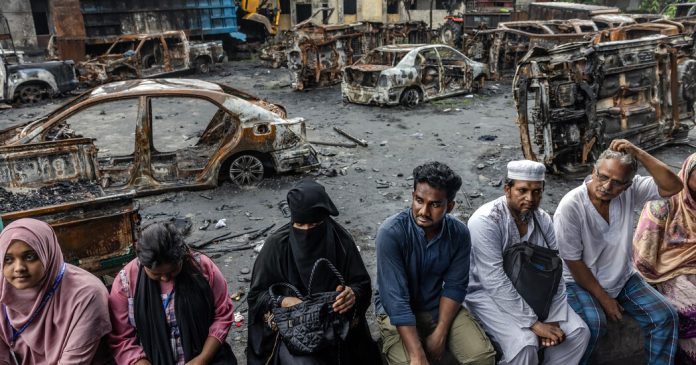
The brutal crackdown on student protesters last year by Bangladesh’s former prime minister, Sheikh Hasina, killed as many as 1,400 people, a toll much higher than previously estimated, according to a U.N. report issued on Wednesday.

Ms. Hasina’s violent response to the student-led revolt, which ultimately ended her 15-year rule, involved extrajudicial killings, arbitrary arrests and torture, according to a U.N. fact-finding mission. The actions by Ms. Hasina and senior Bangladeshi officials possibly amounted to crimes against humanity, the U.N. report said.

“The testimonies and evidence we gathered paint a disturbing picture of rampant state violence and targeted killings that are amongst the most serious violations of human rights, and which may also constitute international crimes,” Volker Türk, the U.N. human rights chief, said in a statement.

It is clear that “the top echelons of the former government were aware and in fact involved in the commission of very serious violations,” Mr. Türk told reporters. Abuses included torture and ill-treatment of children and sexual violence against women, he said.

Ms. Hasina fled to India in August as the student protesters descended on her home. The government of Prime Minister Narendra Modi continues to harbor her as she uses her perch in India to intervene in Bangladesh’s politics, complicating the interim government’s efforts to rebuild the country’s democracy.

The caretaker administration, led by the Nobel Peace Prize laureate Muhammad Yunus, has applied for Ms. Hasina’s extradition on charges of genocide and crimes against humanity. The Indian government, long an ally of Ms. Hasina, has shown no sign of complying with the request.

The U.N. report examined clashes involving Ms. Hasina’s security forces, supporters of her political party and antigovernment protesters during a three-week period from July 15 to Aug. 5.

The great majority of those killed — 12 or 13 percent of whom were children, the United Nations estimated — were shot by security forces. Thousands of people suffered life-changing injuries from high-caliber rifles and shotguns often fired at close range, it said.

The U.N. fact-finding team’s 103-page report relied mainly on more than 230 interviews, including with protest leaders as well as current and former police and security officials. It also drew on video and geolocation technology to reconstruct and corroborate accounts of the protests.

According to graphic witness testimony, the police used an anti-riot vehicle to run over protesters while firing at them. In another case, a protester described how a police officer had shot and killed a wounded demonstrator she was holding in her arms, and then had shot at her.

In addition to the hundreds of young protesters killed, the police said that 44 of their officers had died during the demonstrations. Mr. Türk said that investigators had documented acts of revenge against supporters of Ms. Hasina’s political party after the protests, as well as against the police and some religious and Indigenous minorities.

The United Nations called for an investigation to determine criminal responsibility for the violations.

Mr. Türk said that many cases had already been filed with Bangladesh’s domestic tribunal handling international crimes. But he noted “challenges and deficiencies” in the Bangladeshi legal system and flagged the possibility of pursuing cases through countries with universal jurisdiction or through the International Criminal Court.

Mr. Türk emphasized the importance of legal accountability in helping Bangladesh transition out of its descent into authoritarianism and break the cycles of violence that have long shadowed Bangladeshi politics.

The release of the U.N. report came after a flare-up of political violence this month ignited by a speech that Ms. Hasina broadcast from India. Angry students bulldozed and set fire to a museum that had once been the residence of Ms. Hasina’s father, Sheikh Mujibur Rahman, a founder of Bangladesh.

The students then clashed with supporters of Ms. Hasina’s party, which the interim government has barred from participating in the effort to remake the country’s political system.

The violence prompted the government to launch what it called Operation Devil Hunt, in which police and paramilitary units arrested more than 1,300 people, officials said.

Dozens of CFPB workers are fired as the agency remains shuttered : NPR

0

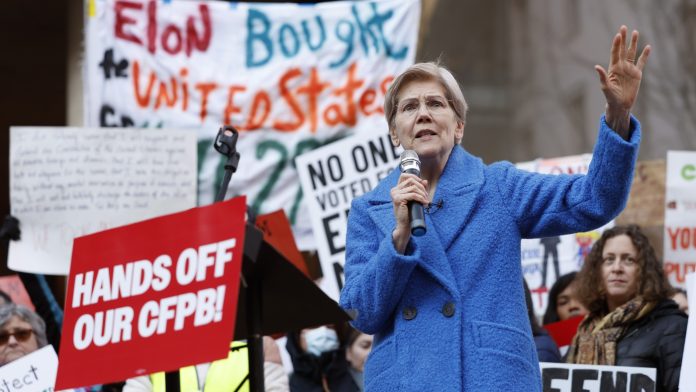
Sen. Elizabeth Warren, D-Mass., speaks at a rally outside the Consumer Financial Protection Bureau in Washington, D.C., on Feb. 10, 2025. Dozens of CFPB workers were laid off on Tuesday, the agency’s union said.

Anna Moneymaker/Getty Images/Getty Images North America


hide caption

toggle caption

Anna Moneymaker/Getty Images/Getty Images North America

Dozens of probationary employees at the Consumer Financial Protection Bureau had their jobs terminated on Tuesday night, according to the union representing CFPB employees.

CFPB’s union has identified approximately 73 “bargaining-unit” employees in their probationary period who were terminated, according to Jasmine Hardy, the executive vice president for NTEU Chapter 335, but is still working to confirm the final numbers. Hardy said she believed non-union employees were also fired.

“We believe this was an illegal firing and we are prepared to take action against it,” Hardy said in a statement to NPR. “All we want is to get back to work protecting American consumers and ensure markets for consumer financial products are fair, transparent and competitive. Let us work!”

The length of the probationary period for federal employee depends on the job, but is generally one or two years, during which time they are much easier to fire.

The agency did not respond to a request for comment from NPR.

The firings come as President Trump nominated Jonathan McKernan to be the next director of the CFPB, the country’s consumer finance watchdog. He would replace Russell Vought, an architect of Project 2025 and the White House budget director who was named acting director late last week.

The termination letters were sent via email, many with no personalization in what appears to be a mail merge failure, two terminated employees who got the letters told NPR.

The letter reads: “MEMORANDUM FOR [EmployeeFirstName] [EmployeeLastName], [Job Title], [Division]”. The letters were sent from Adam Martinez, who’s the acting Chief Human Capital Officer for the agency.

‘A bit insulting’

Taylor Sonne is one CFPB employee who said he received notice of termination on Tuesday. He had been employed at the agency since last March as a compliance examiner, supervising financial institutions. Because he had worked at the bureau less than a full year, he was considered probationary.

The letter Sonne received said he was being terminated because “the Agency finds that that you are not fit for continued employment because your ability, knowledge and skills do not fit the Agency’s current needs.”

Sonne believes this language was included to suggest he was fired for cause.

“But my supervisor wasn’t consulted. Nobody’s supervisor was consulted,” Sonne told NPR. “These firings are a reduction in force,” he says, “and it needs to be treated that way, not how they’ve done it.”

“It’s a bit insulting considering I just got a promotion and a fantastic performance review,” Sonne says, adding that he has several years of experience in compliance examination as a mortgage examiner for the state of Texas.

Johanna Hickman was also terminated on Tuesday after serving as a Senior Litigation Counsel with CFPB’s enforcement division since June 2023. She says her letter included the same sentence as Sonne’s, and that the termination letters received by staffers Tuesday appear to be identical.

The termination letters note that fired employees can file an appeal if they “believe this action is being taken based on partisan political reasons.”

Sonne plans to appeal, and Hickman says she is exploring all available avenues.

“We do have the very strong belief that this was unlawful,” Hickman told NPR. “It was not conducted in compliance with the regulations, and we think we do have options. So, yeah, we’re going to fight.”

President Trump is joined by Elon Musk and his son, X Musk, at the Oval Office in the White House in Washington, D.C., on Feb. 11, 2025. The Trump administration and the DOGE team are looking to cut the federal workforce.

President Trump is joined by Elon Musk and his son at the Oval Office in the White House in Washington, D.C., on Feb. 11, 2025. The Trump administration and the DOGE team are looking to cut the federal workforce.

Andrew Harnik/Getty Images/Getty Images North America


hide caption

toggle caption

Andrew Harnik/Getty Images/Getty Images North America

Federal workers brace for more job cuts

The firings at the CFPB come as the Trump administration is looking to drastically reduce the federal workforce.

The moves follow a similar playbook that the Trump administration is using to dismantle USAID, where staff members were given a stop-work order, headquarters were closed and all but a small number of staff members were put on administrative leave. Last week, a federal judge paused the leave order.

The team called the Department of Government Efficiency under billionaire Elon Musk is leading the efforts to massively cut the size of the federal workforce. More than 2 million government employees were sent an email offering full pay until September if they resign from their jobs.

More probationary workers could also be targeted across the federal workforce. On the first day of Trump’s new term, a memorandum was sent from the Office of Management and Budget advising agencies to send a list of all probationary workers.

Three leaders in two weeks

CFPB has been in tumult since last week, as staff have been told by Vought to stop all work and the bureau’s headquarters has been shuttered for the week.

The agency has seen two leaders in the span of two weeks, after previous head Rohit Chopra was fired by Trump. The president then appointed Treasury Secretary Scott Bessent as acting head of the CFPB before replacing him days later with Vought.

After President Trump fired Rohit Chopra as the head of the CFPB, the agency has had three leaders in the span of two weeks. Trump appointed yet another

After President Trump fired Rohit Chopra as the head of the CFPB, the agency has had two leaders in the span of two weeks. Trump has now picked a new head for the agency.

Michael A. McCoy/Getty Images/Getty Images North America


hide caption

toggle caption

Michael A. McCoy/Getty Images/Getty Images North America

The CFPB could have a fourth leader this year under McKernan, who was previously at the board of the FDIC before resigning on Monday. McKernan previously was a counsel to Pat Toomey, R-Penn., on the staff of the Senate Banking Committee. He also has served as a senior counsel at the Federal Housing Finance Agency and a policy adviser at the Treasury.

Banking industry groups welcomed the news of McKernan’s selection.

“If confirmed, we look forward to working with Mr. McKernan to undo many of the most recent actions by the Chopra CFPB that stand to harm millions of consumers, ensure the Bureau operates within its statutory authority, and to require it to fulfill its regulatory mission based on data and facts,” the Consumer Bankers Association said in a statement.

The CFPB is unpopular with many Republicans and executives at Wall Street and Silicon Valley who say it is too heavy-handed with its regulation of banks, payment apps, and other financial products and services. The bureau, which was created in the wake of the 2008 financial crisis to prevent another such disaster, is part of the Federal System and receives its funding from the Federal Reserve.

Reflecting on his time at FDIC in a post on X, McKernan struck a tone critical of Biden-era regulation. “I’ve every confidence that under the new FDIC leadership, the FDIC will succeed in its mission while also reversing the regulatory overreaches of the last few years,” he wrote.