Friday, November 13, 2026
Home Blog Page 233

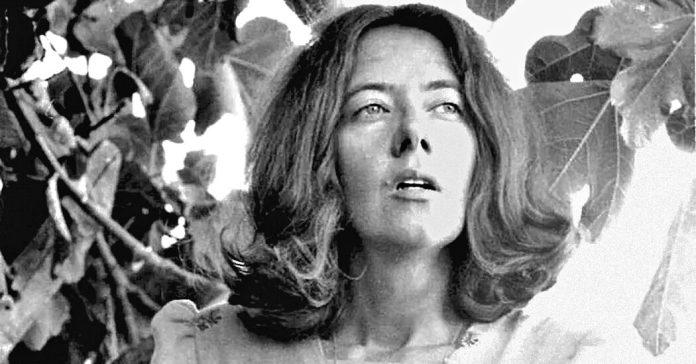
Maria Teresa Horta, the Last of Portugal’s ‘Three Marias,’ Dies at 87

0

Maria Teresa Horta, a Portuguese feminist writer who helped shatter her conservative country’s strictures on women, died on Feb. 4 at her home in Lisbon. She was 87.

Her death was announced on Facebook by her publisher, Dom Quixote. The Portuguese prime minister, Luis Montenegro, paid tribute to her on X, calling her “an important example of freedom and the struggle to recognize the place of women.”

Ms. Horta was the last surviving member of the celebrated writers known as the “Three Marias,” who together wrote the landmark 1972 book “Novas Cartas Portuguesas” (“New Portuguese Letters”). A collection of letters the women wrote to one another about their problems as women in Portugal, it opened up a world of repressed female sexuality, infuriated the country’s ham-fisted dictatorship and led to their arrest and criminal prosecution on charges of indecency and abuse of freedom of the press.

“To feminists around the world, as well as to champions of a free press, the police action against the Portuguese women in June 1972 was an outrage that slowly became the focus of an international protest movement,” Time magazine wrote in July 1973.

The Three Marias — Ms. Horta, Maria Isabel Barreno (1939-2016) and Maria Velho da Costa (1938-2020) — became international feminist folk heroes, and the book’s fame alerted the world to repression under the Portuguese dictatorship. Simone de Beauvoir, Marguerite Duras and Adrienne Rich were among the writers who declared their public support. The National Organization for Women voted to make the case its first international feminist cause.

The case was not Ms. Horta’s first brush with controversy.

In 1967 she had been “beaten in the street” after the publication of her breakthrough volume of poetry, “Minha Senhora de Mim” (“My Lady of Me”), she told her biographer Patrícia Reis in 2019. That book “challenged something deeply rooted in this country,” she said: “the silencing of female sexuality.”

Frequent knocks on the door by the Portuguese secret police became part of her life.

The themes of her work grew from what she characterized as a dual oppression: being a woman in Portugal’s male-dominated society and growing up in a police state.

“I was born in a fascist country, a country that stole liberty, a country of cruelty, prisons, torture,” she told an Italian interviewer in 2018. “And I understood very early on that I couldn’t stand for this.”

She also wouldn’t stand for the oppression of women in Portugal’s traditional macho culture. “Women are beaten or raped just as much by a doctor, a lawyer, a politician, whoever, as by a worker, a peasant and so on,” she told the Lisbon daily Diário de Notícias in 2017. “Women have always been beaten and have always been raped. People do not consider the violence that goes on in bed, in the sexual act with their husband.”

In 1971, these preoccupations inspired Ms. Horta to start meeting every week with two friends and fellow authors, Ms. Barreno and Ms. da Costa, to share written reflections on the common themes that troubled them.

They were inspired by a classic work from the 17th century, “Letters of a Portuguese Nun,” supposedly written by a young woman shut up in a Portuguese convent to the French cavalry officer who had abandoned her. Scholars now believe the work was fiction, but its powerful expression of pent-up longing and frustration resonated with the three Marias.

Like the nun in the book, they used letters to one another, as well as poems, to express their unhappiness as women in their early 30s, educated by nuns, married and with children, in a Lisbon stifling under a 35-year dictatorship, rigid Catholicism and ill-judged colonial wars in Africa.

When they published the writings as “New Portuguese Letters,” they vowed never to reveal to outsiders, much less the police, who had written what.

“Their views and natures were far apart,” Neal Ascherson wrote in The New York Review of Books in a review of the 1975 English translation, titled “The Three Marias.” “Maria Isabel the coolest, Maria Teresa the gaudiest personality, Maria Fátima the one who swerved away from pure feminism toward social and psychological analyses of a whole people’s oppression.”

The strange hybrid — Mr. Ascherson called it “a huge and complicated garland” — is suffused with repressed rage at the condition the women find themselves in.

“They wanted the three of us to sit in parlors, patiently embroidering our days with the many silences, the many soft words and gestures that custom dictates,” one of the letters says. “But whether it be here or in Beja, we have refused to be cloistered, we are quietly, or brazenly, stripping ourselves of our habits all of a sudden.”

Another letter says, “We have also won the right to choose vengeance, since vengeance is part of love, and love is a right long since granted us in practice: practicing love with our thighs, our long legs that expertly fulfill the exercise expected of them.”

Although Mr. Ascherson found the book “often maddeningly imprecise, self-indulgent and flatulent,” he said that “where it is precise, the book still bites” and “where it is erotic, it is neither exhibitionist nor coy but well calculated to touch the mind through emotion.”

A few Portuguese reviewers welcomed it as “brave, daring and violent,” as the author Nuno de Sampayo put it in the Lisbon newspaper A Capital. They predicted a difficult reception.

Prime Minister Marcello Caetano attempted to put the authors in jail, calling them “women who shame the country, who are unpatriotic.”

On May 25, 1972, the state press censor banned the book. The next day it was sent to the criminal police department in Lisbon. When the authors’ trial opened in 1973, the crowd was so great that the judge ordered the courtroom cleared.

In May 1974, nearly two years after their arrests and two weeks after the Portuguese dictatorship was overthrown, the Three Marias were acquitted.

Judge Artur Lopes Cardoso, who had been overseeing the case, became a sudden convert, declaring the book “neither pornographic nor immoral.” “On the contrary,” he said, “it is a work of art of high level, following other works of art produced by the same authors.”

Maria Teresa de Mascarenhas Horta Barros was born in Lisbon on May 20, 1937, the daughter of Jorge Augusto da Silva Horta, a prominent doctor and a conservative who supported the dictatorship, and Carlota Maria Mascarenhas. Her paternal grandmother had been prominent in the Portuguese suffragist movement.

Maria attended Filipa de Lencastre High School, graduated from the Faculty of Arts at the University of Lisbon, and published her first book of poetry at 23. She would go on to write nearly 30 more, as well as 10 novels.

She was also a critic and reporter for several newspapers and the literary editor of A Capital.

In the 1980s, she edited the feminist magazine Mulheres, which was linked to the Portuguese Communist Party. (She was a member of the party from 1975 to 1989.)

No matter the genre — poetry, fiction or journalism — she considered writing a public duty.

“The obligation of a poet is not to be in an ivory tower; it is not to be isolated but to be among people,” she told the online magazine Guernica in 2014. “As a journalist, I never isolated myself. I was a journalist at a daily newspaper and every day I went out on the street. Every day I had contact with people.”

She won most of her country’s top literary prizes, but she caused a stir in 2012 when she refused to accept the D. Dinis Award because she objected to the government’s right-leaning politics.

She is survived by her son, Luis Jorge Horta de Barros, and two grandsons. Her husband, the journalist Luis de Barros, a former editor of the newspaper O Diário, died in 2019.

“People ask me why I am a feminist,” Ms. Horta told Guernica in 2014. “Because I am a woman of freedom and equality and it is not possible to have freedom in the world when half of humanity has no rights.”

Kirsten Noyes and Daphné Anglès contributed research.

Elon Musk defends his work from Oval Office as Trump signs EO to boost DOGE efforts

0

Elon Musk joined President Trump in the Oval Office for an unusual discussion of his work slashing government spending.

Cardi B blames Trump for ruining her shoes at the Super Bowl, demands he bring back her deported uncle

0

Rapper Cardi B ranted in a new video that President Donald Trump ruined her Super Bowl experience and should not have attended.

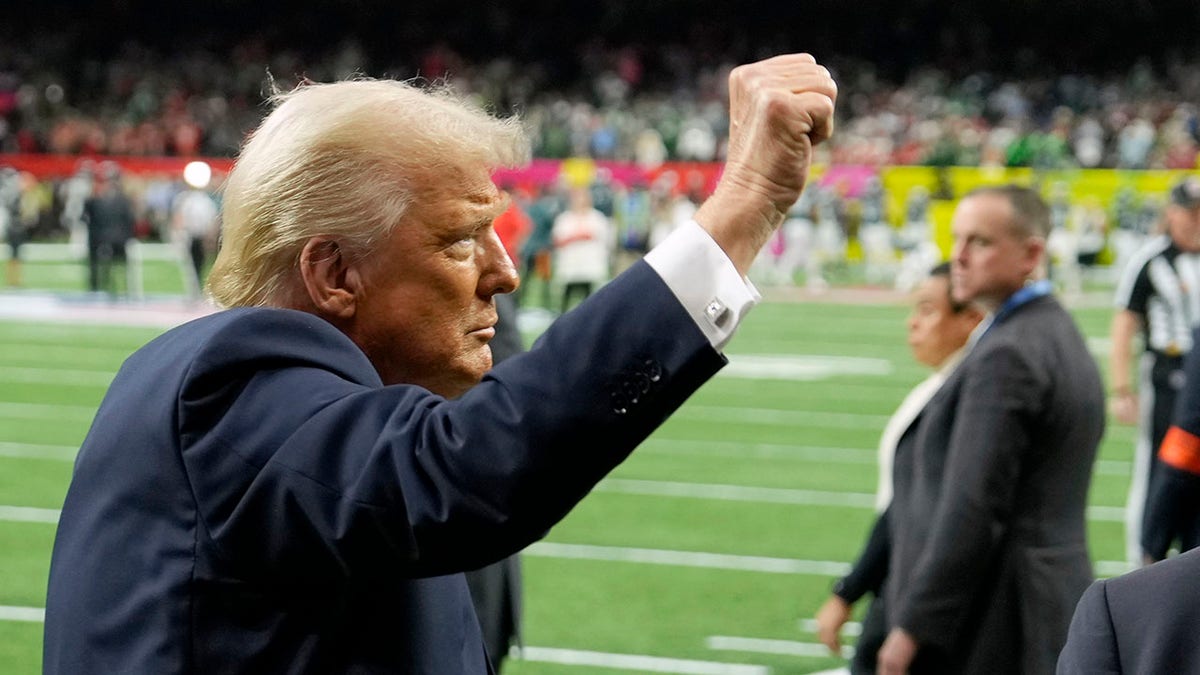
Trump made history this past Sunday by being the first sitting president to attend the Super Bowl. The event was hosted in New Orleans, just a month after the New Year’s Day terrorist truck-ramming attack against Bourbon Street revelers killed 14 victims and injured 35 others, and security was tight.

Cardi B, who supported then-Vice President Kamala Harris during the 2024 election, emphasized in a social media post that the Secret Service went to great lengths to protect Trump, to her chagrin.

TRUMP GREETS CHIEFS STAR ON FIELD AT SUPER BOWL LIX AFTER PICKING THEM TO WIN LOMBARDI TROPHY

Rapper Cardi B was annoyed President Donald Trump went to the Super Bowl on Sunday. (Cardi B photo by Evan Agostini/Invision/AP, File | Trump photo by Celal Gunes/Anadolu via Getty Images)

“Yo, I was too f—ing mad today because, you know, Donald Trump and s—,” Cardi B said in the unscripted video. “He was at the Super Bowl today, and they was giving us a hard time. Oh my gosh. The Secret Service was not playing at that mother—er. The Secret Service was not playing to get in that motherf—in’ stadium. Oh my god.”

She then blamed Trump, saying the Secret Service wasn’t allowing carts near the stadium so her expensive shoes were ruined.

“This shoe cost me three bands,” Cardi B said, referring to the slang word for $1,000, while loudly chewing chips and holding up a high heeled shoe covered in decorative spikes. “All ‘cause of Trump. Now I like him lesser!”

The rapper went on to rant that Trump shouldn’t have gone to the Super Bowl.

‘THE VIEW’ CO-HOST QUIPS TRUMP WILL SIGN EXECUTIVE ORDER ‘BANNING BLACK PEOPLE FROM HALFTINE’ AFTER SUPER BOWL

Donald Trump gestures to crowd

President Donald Trump gestures to the crowd before the start of the NFL Super Bowl 59 football game between the Philadelphia Eagles and the Kansas City Chiefs, Sunday, Feb. 9, 2025, in New Orleans.  (AP Photo/Ben Curtis)

CLICK HERE TO GET THE FOX NEWS APP

“Now I like him lesser! Because you didn’t have to go to no damn Super Bowl. F—ing up my shoe!” she said.

“Now he’s gonna have to, well-he definitely ain’t gon’ do that,” the rapper said said, re-thinking her statement before proposing Trump should instead “bring my uncle, bring my uncle to come back because my uncle got deported!”

It was not immediately clear what happened to her uncle, Fox News Digital reached out for clarification.

Fox News’ Danielle Wallace contributed to this report.

Jordan’s King Faces a Bind as He Meets With Trump

0

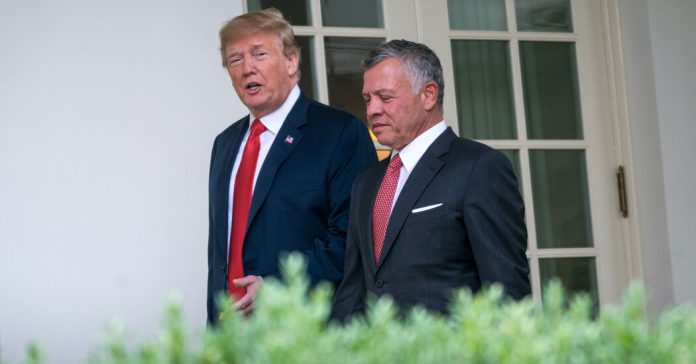
In July 2021, the first time that King Abdullah II of Jordan met with President Joseph R. Biden Jr., he was greeted warmly as a reliable American partner whose country is a bulwark for security in the Middle East.

“You live in a tough neighborhood,” Mr. Biden said as they sat in the Oval Office.

The king, who will meet with President Trump on Tuesday, may find Washington to be the tougher neighborhood this time around.

Mr. Trump has reiterated his intention to expel Palestinians from the Gaza Strip as part of his plan for the United States to “own” the territory, and on Monday he suggested he could consider slashing aid to Jordan and Egypt if their governments refused to take in an estimated 1.9 million Palestinians from Gaza.

Both Jordan and Egypt flatly rejected the idea when Mr. Trump first raised it last week, putting King Abdullah in a bind as he prepares to meet with the president.

Rebuffing Mr. Trump’s demands could imperil the more than $1.5 billion in foreign aid that Jordan receives each year from the United States. A separate, classified stream of American money flows to Jordan’s intelligence services.

At the same time, more than half of King Abdullah’s approximately 12 million subjects are of Palestinian descent, and Middle East experts say that the survival of his family’s rule depends on his digging in against Mr. Trump’s plan.

“King Abdullah cannot go along with it,” said Paul Salem, the vice president for international engagement at the Middle East Institute in Washington. “He cannot survive the idea that he’s colluding on the ethnic cleansing of Palestinians.”

“It’s existential for him and his government.”

King Abdullah is also expected to use his meeting with Mr. Trump to push against any attempts by Israel to annex part or all of the West Bank, which far-right members of Israel’s government speak openly about and some of Mr. Trump’s appointees have long advocated. The West Bank sits directly on Jordan’s border, and an Israeli move to take more Palestinian land could lead to violence and unrest that could spill into Jordan.

Jordan is already home to approximately 700,000 refugees, most of them Syrians who fled from that country’s civil war.

Unlike some of its Middle Eastern neighbors that are drowning in oil wealth, Jordan is heavily reliant on American aid. King Abdullah works hard to cultivate close ties across the U.S. government, and makes it a point to be the first Arab leader to meet with every new president.

Jordan allows U.S. troops access to its military bases, and for decades has received millions of dollars from the C.I.A. to support its intelligence services — secret payments that began during the reign of the current king’s father, King Hussein.

American aid to Jordan, including military aid, is currently frozen as part of the Trump administration’s blanket halt to foreign assistance. The U.S.A.I.D. office in the country is being shuttered.

King Abdullah, who assumed the throne in 1999, is the longest currently serving leader in the Middle East. Bruce Riedel, a former top Middle East analyst at the C.I.A., said that the king is likely to use his strong relationships with the Pentagon, the C.I.A. and Congress to try to advise the president that a U.S. takeover of the Gaza Strip and the expulsion of Palestinians is “a bad idea.”

The king met on Sunday with Pete Hegseth, the defense secretary, and Mr. Riedel says that Jordan “has a lot of supporters on the Hill, including a lot of Republican supporters.”

Still, King Abdullah might need to find new patrons if Mr. Trump decides to cut funding to Jordan over its refusal to go along with his plan for Gaza. If this happens, he might find willing donors in the governments of wealthy gulf countries like Saudi Arabia and the United Arab Emirates, which have also strongly opposed Mr. Trump’s plan for an American takeover of Gaza and expulsion of Palestinians from their land.

Mr. Salem believes that Mr. Trump’s biggest goal in the Middle East is still a grand deal that would involve Saudi Arabia’s officially recognizing Israel, something it would be extremely unlikely to agree to if Mr. Trump follows through on his plans for Gaza.

The Saudi government has said that there must be concrete steps toward an independent Palestinian state before the kingdom considers normalizing diplomatic relations with Israel.

For this reason, King Abdullah could have a bit of leverage. He could try to convince a mercurial American president to keep his eyes on the larger prize, and convince him that Jordan is essential to helping him attain it.

Efforts to fight foreign influence and protect elections in question under Trump : NPR

0

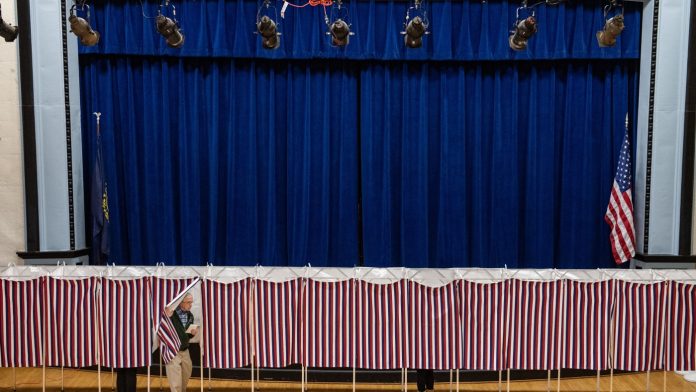
A man exits a voting booth at a polling station in Lancaster, N.H., on Election Day, Nov. 5.

Joseph Prezioso/AFP via Getty Images


hide caption

toggle caption

Joseph Prezioso/AFP via Getty Images

The new Trump administration is moving quickly to roll back long-standing work to counter foreign influence in U.S. elections, work that began in the first Trump term after revelations about the extent and ambition of Russia’s efforts to sway the 2016 election.

Staffers working on countering foreign mis- and disinformation as well as a team of 10 regional election security advisers at the Department of Homeland Security’s Cybersecurity and Infrastructure Security Agency (CISA) have been put on administrative leave, according to two sources directly familiar with the matter who spoke to NPR on condition of anonymity out of fear of reprisal.

In addition to the disruption to CISA’s work, Attorney General Pam Bondi also ordered an end to an FBI task force to combat foreign influence campaigns in American politics by Russia, China and other countries. The order seeks to “free resources to address more pressing priorities, and end risks of further weaponization and abuses of prosecutorial discretion, the Foreign Influence Task Force shall be disbanded.” She also rolled back the Justice Department’s enforcement of the Foreign Agents Registration Act that has been used to prosecute Americans receiving covert funding from other countries.

Experts working on technology, human rights and digital governance at the United States Agency for International Development can no longer do their work during a Trump administration effort to shut down the agency, leaving a vacuum for Russia and China to step in, experts have argued.

In his first term, President Trump frequently aired his frustrations about the allegations that Russia interfered on his behalf. U.S. government officials have also outlined attempts by adversaries like Iran to damage Trump’s candidacy for office. Trump has also repeatedly alleged that the 2020 U.S. presidential election was “stolen” without any evidence, claims that CISA directly countered at the time and led to the dismissal of the agency’s head at the time.

CISA and DHS did not respond to requests for comment.

Election security experts NPR talked to have been deeply concerned about the Trump administration’s targeting of civil servants who counter threats to elections, from mis- and disinformation to regional security threats ranging from ransomware to problems with voting technology. While there are some employees still working on election security issues at CISA, it’s unclear whether or not they will also be put on administrative leave in the coming weeks, the two sources familiar with CISA’s internal operations said.

“Every cut made to our election security and foreign malign influence operations is like handing a gift on a silver platter to our foreign adversaries such as Russia, China and Iran,” said Kathy Boockvar, president of consulting firm Athena Strategies and former secretary of state for Pennsylvania. “It directly strengthens their ability to invade our national security and interfere in our elections, leaving every American citizen more vulnerable.”

Boockvar, who served as the co-chair of the Elections Committee of the National Association of Secretaries of State during the 2020 election, was particularly concerned about the loss of cybersecurity support to regional election administrators. She said CISA’s regional officers, alongside the members of FBI’s foreign influence task force, were a “tremendous support” to the people securing state and local elections across the country, and their loss will be costly and challenging.

Trump signed the bill that created CISA in 2018

In remarks Trump made at the 2018 bill signing that created CISA, it was needed in order to “confront the full range of threats from nation-states, cyber criminals, and other malicious actors, of which there are many.”

Like several other government agencies tasked with national security and defending U.S. critical infrastructure, CISA also took on an election security portfolio.

However, there was already bad blood between Trump and investigators who sought to illustrate the impacts of widespread Russian disinformation on the 2016 U.S. presidential election. Department of Justice special counsel Robert Mueller did not find evidence to definitively prove the Trump campaign colluded with Russian officials to influence the outcome of the election, but he did find evidence of Russian interference to bolster Trump’s campaign and denigrate Democratic candidate Hilary Clinton.

Trump has long called the Mueller investigation a “hoax” that never should have happened.

But during the 2020 U.S. presidential election, Trump then spread and promoted more false narratives, including about widespread voter fraud, before President Joe Biden ultimately won. CISA and others debunked many of those claims through a webpage called Rumor Control. Those public contradictions led Trump, in part, to dismiss the then director of CISA, Christopher Krebs.

Since then, Republicans have attacked CISA, arguing the agency exceeded its job description and infringed on conservative free speech, an allegation CISA leadership has vehemently denied.

In her confirmation hearing, Homeland Security Secretary Kristi Noem vowed to shrink CISA. She said the agency has gone “far off mission” and committed to limiting its role in combating online fake news from adversaries like Russia, China and Iran.

In the weeks after Trump was inaugurated for his second term, experts hoped there might be a window to preserve CISA’s functions and independence. Republicans toned down attacks on the agency, particularly after CISA was instrumental in revealing a widespread Chinese espionage campaign targeting U.S. telecoms that directly impacted Trump and Vice President JD Vance. CISA was initially excluded from a broader effort to shrink the federal government by President Trump’s government team called the Department of Government Efficiency, or DOGE.

However, late Feb. 5, eligible CISA employees were offered the chance to take deferred resignation offers in exchange for eight months pay. It’s still unclear if those offers are legal or if they will be funded by congressional appropriations beyond March.

Have information you want to share about the ongoing changes at CISA or across the federal government? Reach out to Jenna McLaughlin, who is available through encrypted communications on Signal at JennaMcLaughlin.54

Daily average of known gotaways at southern border plummets, down 93% from Biden admin highs

0

Join Fox News for access to this content

You have reached your maximum number of articles. Log in or create an account FREE of charge to continue reading.

By entering your email and pushing continue, you are agreeing to Fox News’ Terms of Use and Privacy Policy, which includes our Notice of Financial Incentive.

Please enter a valid email address.

FIRST ON FOX: The daily average number of known gotaways — illegal migrants who successfully entered the U.S. without apprehension — at the southern border since the beginning of February has plummeted to just 132 per day, down 93% from the highest numbers when former President Joe Biden was in office, according to a senior Department of Homeland Security (DHS) source.

During the Biden administration, Fox News submitted a Freedom of Information Act (FOIA) request to U.S. Customs and Border Protection (CBP) for FY 2023 statistics and learned there were 670,674 known gotaways recorded that year, a jaw-dropping average of more than 1,800 per day.

President Donald Trump took office on Jan. 20, and has taken extensive measures to secure the southern border, resulting in a 93% drop in the daily average of known gotaways, who are “known” because they are seen/tracked on cameras, sensors, or other means, but border patrol agents were not able to apprehend them. These numbers are kept internally by CBP and are typically not released to the public.

FRUSTRATED CHICAGOANS BACK ICE DEPORTATIONS, APPLAUD DOJ LAWSUIT TARGETING SANCTUARY POLICIES

Migrants at the southern border in Arizona. (U.S. Border Patrol)

“Delivering consequences has results. Illegal crossings are down, gotaways are down. Criminal prosecutions are on the rise,” the senior DHS official told Fox News. “Daily reports of large groups in Mexico, Guatemala, turning back south and surrendering to authorities, requesting to go home, and we have only just begun. Policy matters.”

The country began to see the effects of Trump’s policies in his second week in office, with the White House implementing tariffs on Mexico, Canada and China; border crossings plummeting; diversity, equity and inclusion (DEI) programs shuttering; the federal workforce being faced with the decision to return to the office or to resign; and more.

MIGRANTS TURNING BACK DUE TO TIGHTER BORDER SECURITY, CBP MEMO SHOWS

Southern border

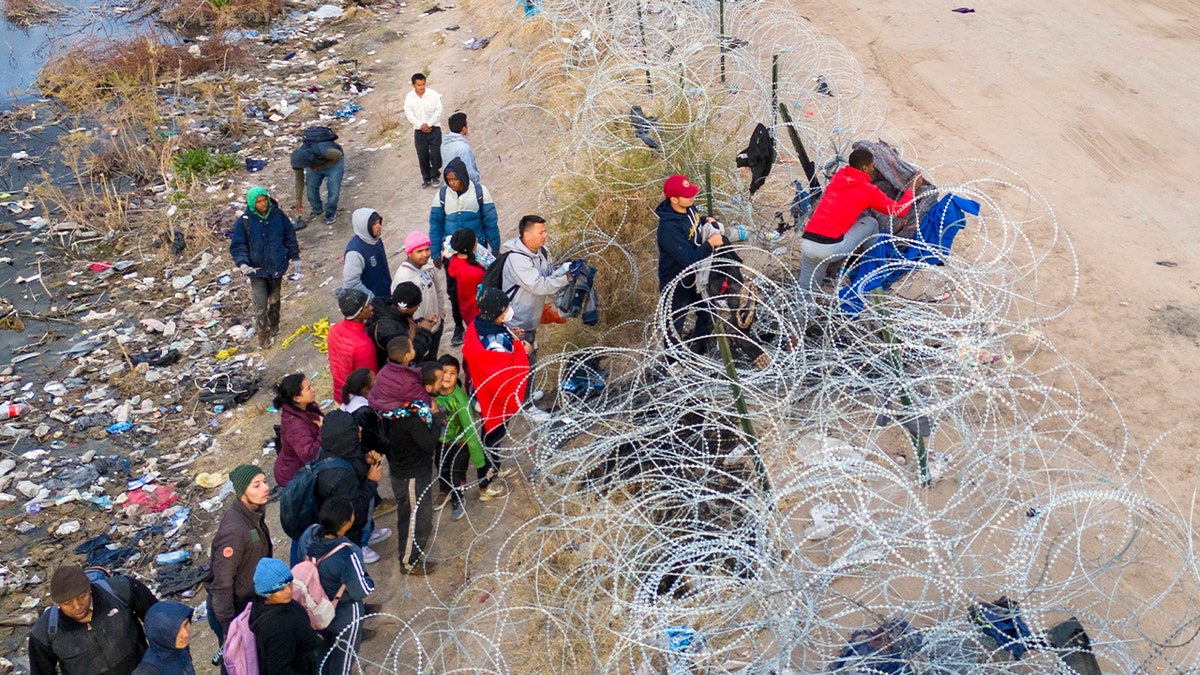
Migrants try to pass over razor wire after crossing into the U.S. at the southern border into El Paso, Texas. (Getty Images/John MooreGetty)

By Feb. 1, the number of migrants arriving at the southern border plummeted by 63%.

There were 7,287 migrant encounters at the southern border in the first seven days of the Trump administration, Jan. 20 through Jan. 26, with a daily average of 1,041 encounters a day.

CLICK HERE TO GET THE FOX NEWS APP

That compares to 20,086 encounters a day during the final days of Biden’s presidency, Jan. 13-19. 

Border czar Tom Homan said that after the first week, the Trump administration had removed and returned 7,300 illegal immigrants and had deported them to Mexico, Jordan, Brazil and El Salvador.

Fox News Digital’s Brooke Singman contributed to this report.

Who Is Marc Fogel? The American Teacher Caught in a Global Power Struggle.

0

Marc Fogel had traveled readily to and from Russia many times before his fateful last return to the country in August 2021. He had taught history for almost a decade, mostly to the children of diplomats, at the Anglo-American School in Moscow.

But on entering Russia ahead of what he had decided would be his final year teaching at the school, Mr. Fogel was arrested and accused of smuggling drugs — less than an ounce of cannabis that he used to treat chronic back pain. In June 2022, he was sentenced to 14 years in a high-security prison; in Russia, lesser sentences have often been given to convicted murderers.

After lobbying by the U.S. government, Mr. Fogel, now 63, was set free on Tuesday after three-and-a-half years in custody.

He and his wife, Jane, had been global adventurers nearing retirement, having lived in Colombia, Malaysia, Oman, Venezuela and Russia. But like other Americans imprisoned in Russia, like the basketball star Brittney Griner and the journalist Evan Gershkovich, he became a pawn in the power struggles between Moscow and Washington surrounding the Russian invasion of Ukraine in February 2022

Until a year before his arrest, Mr. Fogel, like all the teachers at the Anglo-American School, had diplomatic immunity. But as tensions rose with the United States, Russia stripped the teachers of that protection. In 2022, Russia forced the school to close and confiscated its property.

Eric Rubin, a former American diplomat in Moscow who knows Mr. Fogel and worked on getting him released, said his was “essentially a hostage-taking situation.” He said he suspected that the Russian authorities knew Mr. Fogel would be carrying cannabis vape canisters when he landed at Sheremetyevo Airport near Moscow with his wife, Jane.

“This was definitely a setup,” Mr. Rubin said, and the sentence was “outrageously inconsistent” with the penalties meted out for similar offenses by Russian citizens, who often get probation rather than prison time.

Mr. Fogel had a doctor’s prescription for medical marijuana and, according to a website maintained by his family, “he planned on declaring his medical marijuana at Russian customs.” The site says, “Marc suffered from physical ailments including severe back and associated knee, hip, and shoulder problems,” and even displays X-rays showing pins and screws in his lower spine.

None of that mattered to the authorities in Russia, where medical use of marijuana is not recognized — although, the family’s website says, “Russia had previously let foreigners bring in marijuana with a physician’s prescription.”

Mr. Fogel was tried by the same court as Ms. Griner, who was convicted of a similar crime and sentenced to nine years in a penal colony. She was exchanged in December 2022, after almost 10 months in custody, for Viktor Bout, a convicted Russian arms dealer.

After his conviction, Mr. Fogel was sent to a remote labor camp north of Moscow, a location that made it difficult for diplomats to visit, where his family said he received substandard medical care and his “deterioration has been dramatic.” Last year, they spoke out about his “severe health issues,” their fear that his 95-year-old mother would never see him again, and the urgency to “save him from potentially dying in a Russian prison.”

The family grew angry with the Biden administration for not paying as much attention to the plight of Mr. Fogel as it had to those of Ms. Griner, Mr. Gershkovich, the Wall Street Journal reporter who was released last August in a prisoner swap, or Paul Whelan, an American who was held in Russia from 2018 until he was released with Mr. Gershkovich. In effect, they said, his own government had abandoned him.

On the website that calls for his release, Mr. Fogel’s supporters said that before getting elected, President Trump had promised his mother that he was “committed to bringing” Mr. Fogel home. At the end of December, the State Department said that the American government had declared Mr. Fogel as wrongfully detained — a move his family said was three years overdue.

“Now that we have the full force of the U.S. government behind us, we must do everything in our power to bring Marc home as quickly and safely as possible,” the family said in a statement following the announcement.

Speaking during his Senate confirmation hearing in January, Secretary of State Marco Rubio said that it would be impossible to improve relations between Washington and Moscow unless Mr. Fogel was released.

“If they are not willing to do this,” Mr. Rubio said, “then I think chances of improvement of Russia-U.S. relations are impossible.”

AP calls it Gulf of Mexico, angering White House : NPR

0

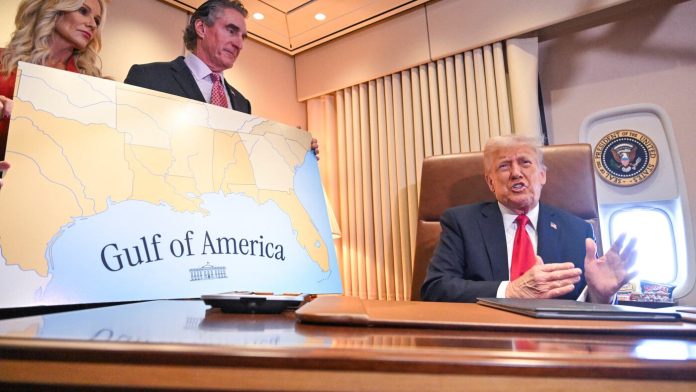
President Trump speaks to the press before signing a proclamation renaming the Gulf of Mexico as the Gulf of America aboard Air Force One en route to New Orleans, Louisiana on Feb. 9, 2025.

ROBERTO SCHMIDT/AFP via Getty Images/AFP


hide caption

toggle caption

ROBERTO SCHMIDT/AFP via Getty Images/AFP

The Associated Press says the White House blocked it from covering an official event on Tuesday because it did not refer to the Gulf of Mexico as the Gulf of America.

AP Executive Editor Julie Pace said that the White House informed the news agency that its journalists would be barred from attending President Trump’s signing of a new executive order because it had not aligned its editorial standards with Trump’s preferred name for the body of water.

“It is alarming that the Trump administration would punish AP for its independent journalism,” Pace wrote in a statement posted on its website. “Limiting our access to the Oval Office based on the content of AP’s speech not only severely impedes the public’s access to independent news, it plainly violates the First Amendment.”

The event was newsworthy; Trump and his adviser, billionaire Elon Musk, spoke of the sweeping cuts they were making to the federal government as part of Musk’s government efficiency effort known as DOGE.

Trump signed an executive order on his first day renaming the Gulf “in recognition of this flourishing economic resource and its critical importance to our Nation’s economy and its people,” according to the order.

The White House has not replied to NPR’s request for comment. It comes as the Trump administration applies increasing pressure on mainstream news outlets, through limiting access to key venues and launching investigations.

AP’s Stylebook is used not only by its own journalists, but by other news outlets and institutions around the globe. In its guidance, the AP advises that the body of water to the east of Mexico that stretches from Texas to Florida should retain its historic title.

“The Gulf of Mexico has carried that name for more than 400 years,” the updated Stylebook entry states. “Refer to it by its original name while acknowledging the new name Trump has chosen.”

The U.S. Geological Service has officially adopted “Gulf of America.” Apple and Google Maps also call it by that name when searched by users based in the U.S.

Outside the country, “Gulf of Mexico” is still used.

As the AP Stylebook notes, “Trump’s order only carries authority within the United States. Mexico, as well as other countries and international bodies, do not have to recognize the name change.”

Other news organizations offered support for the AP. “The White House cannot dictate how news organizations report the news, nor should it penalize working journalists because it is unhappy with their editors’ decisions,” said Politico’s Eugene Daniels, president of the White House Correspondents’ Association. “The move by the administration to bar a reporter from The Associated Press from an official event open to news coverage today is unacceptable.”

The move is in keeping with others against the press.

Under Defense Secretary and former Fox News host Pete Hegseth, the Pentagon has dislodged eight news organizations from their work stations there, including NPR, the New York Times, NBC News, CNN, the Washington Post, Politico, the Hill, and the War Zone.

Seven conservative and right-wing sites took their spots, including Breitbart radio, One America News Network, Newsmax and the New York Post. A liberal-leaning site that also was offered a workstation, HuffPost, had not asked for one.

Trump had filed lawsuits against ABC News and Facebook; their parent companies recently settled his suits by paying millions of dollars apiece to his future presidential library. CBS’s parent company, Paramount, appears poised to settle another lawsuit Trump filed over a 60 Minutes interview with then-Vice President Kamala Harris during last year’s presidential race, according to several people with knowledge. They spoke on condition of anonymity given the ongoing litigation.

Legal observers say the strength of Trump’s cases ranged from weak (ABC) to frivolous (Meta and CBS).

Trump’s chief regulator over broadcast media, Federal Communications Commissioner Brendan Carr, has opened investigations of ABC, CBS, NBC, PBS, and NPR. On Tuesday, Carr sent a letter to the chairman and chief executive of Comcast, the parent company of NBC, over its diversity, equity and inclusion efforts companywide.

“Promoting invidious forms of discrimination cannot be squared with any reasonable interpretation of federal law,” Carr wrote, according to Newsmax, which first reported on his letter Tuesday. The FCC did not reply to NPR’s request for comment.

In a statement shared with NPR, Comcast said it would respond to the FCC’s questions and that its company “has been built on a foundation of integrity of respect for all our employees and customers.”

Coast Guard detains Mexican fishermen with over 1,600 pounds of illegally caught fish

0

The U.S. Coast Guard apprehended 11 Mexican fishermen in federal waters off southern Texas, while seizing roughly 1,600 pounds of illegally caught red snapper and nine sharks.

Last Thursday, Coast Guard Station South Padre, along with several other Coast Guard divisions and the U.S. Customs and Border Protection (CBP) located and stopped four boats, or lanchas, off the Texas coast, which were in federal waters just north of the maritime boundary line.

Lanchas, the Coast Guard said, are slender fishing boats used by Mexican fishermen that are about 20 to 30 feet long and outfitted with an outboard motor and capable of traveling at speeds over 30 mph.

COAST GUARD INTERCEPTS BOAT CARRYING ILLEGAL MIGRANTS AS EXPULSION FLIGHT OPERATIONS BEGIN

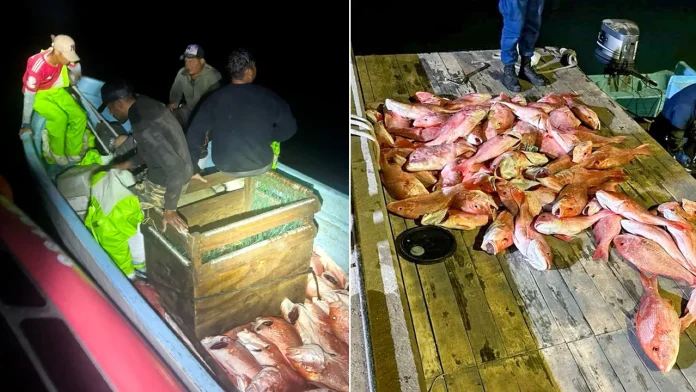
Coast Guard Station South Padre Island boat crews, in coordination with Coast Guard Sector Corpus Christi watch standers, Coast Guard Air Station Corpus Christi aircrews, and Coast Guard Cutter Donald Horsley, located and stopped a total of 11 Mexican fishermen engaged in illegal fishing off the Texas coast on Feb. 6. (U.S. Coast Guard photo, courtesy Station South Padre Island)

Oftentimes, lanchas are used to transport illegal narcotics into the U.S., but also for illegal fishing in the U.S. Exclusive Economic Zone near the U.S. and Mexico border in the Gulf of America.

When Coast Guard crews encountered the lanchas in federal waters, they discovered there were about 1,600 pounds of red snapper on the boats, as well as nine sharks.

COAST GUARD CUTTER INTERCEPTS BOAT WITH 16 MEXICANS OFF COAST OF CALIFORNIA

The Coast Guard interdicted three lanchas, detained 11 Mexican fishermen, and seized nearly 1,600 pounds of illegally caught red snapper and nine sharks in federal waters off southern Texas.

The Coast Guard interdicted three lanchas, detained 11 Mexican fishermen, and seized nearly 1,600 pounds of illegally caught red snapper and nine sharks in federal waters off southern Texas. (U.S. Coast Guard photo, courtesy Station South Padre Island)

The fish were seized along with the fishing gear and highflyers, which are used to mark the beginning and end of long fishing lines.

Authorities also took all 11 fishermen into custody and transferred them to CPB officials for further processing.

CLICK HERE TO GET THE FOX NEWS APP

“Our crews will not pull back from efforts to end illegal fishing and trafficking of valuable natural resources on the maritime border. We remain committed to enforcing the laws of this nation,” said Lt. Shane Gunderson, commanding officer of Station South Padre Island. “Whether on the southern border or along the maritime boundary line in the Gulf of America, the Coast Guard will detect, deter, and interdict illicit activity that threatens our nation’s sovereignty and territorial integrity.”

Italian Police Arrest 181 in ‘Important Blow’ to Cosa Nostra

0

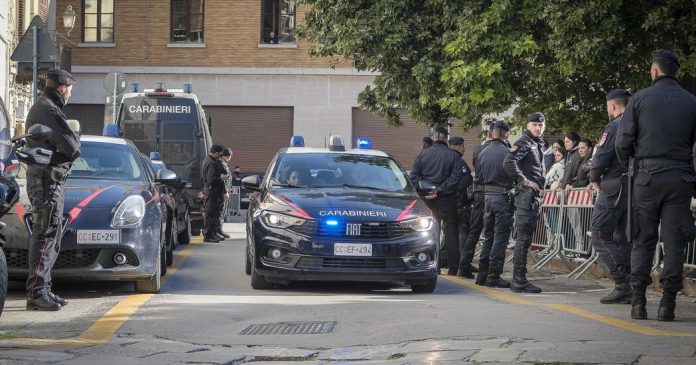
Italian police officers on Tuesday arrested 181 people believed to be affiliated with the Cosa Nostra, as the Sicilian mafia is known, dealing what officials said was an “important blow” to a criminal organization that has held the region in its grip for generations.

“Cosa Nostra is far from dead,” even after years of being targeted by prosecutors and police raids, Domenico La Padula, a lieutenant colonel with the Carabinieri police who oversaw the investigation, said in a telephone interview. The investigation, he said, showed that the group had reorganized and “had found new energy and new strength,” by enlisting new recruits and setting aside differences to instead focus on profiting from new criminal ventures, like online gambling.

The organization had been able to survive because it remained “strongly tied to the rules of its founding fathers and its ancient rituals,” even as it modernized, the Carabinieri said in a statement — for example, by using encrypted smartphones that “limited the need for traditional meetings and gatherings to the bare minimum.”

Tuesday’s arrests were carried out in Palermo, the Sicilian capital, and neighboring towns, and involved about 1,200 Carabinieri officers. Video released by the police showed hundreds of officers waiting for orders to enter homes as helicopters patrolled the skies during overnight raids. The arrests, which came after two years of investigations, covered a range of charges, including mafia affiliation, drug trafficking, extortion and attempted murder.

Even though police and prosecutors were able to restrict the Cosa Nostra’s activities for years, the Carabinieri said in a statement, the group had not lost its grip and was still “well anchored in its territory over which it exercises constant control, significantly affecting the economic fabric through extortion and the imposition of products.” It “used force, when it saw fit,” and had an ample supply of weapons.

For decades the Cosa Nostra was dominated by the so-called Corleonesi crime family — associated with the town of Corleone, a name first made famous by Mario Puzo’s book, “The Godfather” — whose affiliates included Matteo Messina Denaro, a top boss who died in 2023. But investigators said that Palermo had regained primacy within the organization, and its “clans have become central to the dynamics of Cosa Nostra,” Lt. Col. La Padula said.

The investigation also found that different clans in Palermo had opted, for now, to set aside differences to achieve a common goal: making money. The Cosa Nostra also found synergy with the ’Ndragheta, the dominant organized crime group in Calabria in southern Italy, when it came to drug trafficking.

Drug dealing also allowed the Cosa Nostra clans to have direct contacts within Sicily, “a form of control, and so, a signal of strength and power,” Mr. La Padula said. Online gambling, which replaced the raffles and lotteries once controlled by the mob, was another profitable enterprise that demonstrated the transition from the traditional to the modern, he added.

The investigations that led to Tuesday’s arrests involved many youths, a sign that “Cosa Nostra continues to exert its appeal in certain environments like suburbs where young people have limited life alternatives and identify with representations of power that the mafia still enjoys,” Palermo’s chief prosecutor, Maurizio De Lucia, told reporters at a news conference on Tuesday. “We have to be particularly careful” about the new recruits, because “that is the future of the mafia,” he said, according to the ANSA news agency.

The investigation also showed that Cosa Nostra still used old-time tricks — like informers inside the prosecutor’s office and lawyers — to stay ahead of investigators, officials said.