Friday, November 13, 2026
Home Blog Page 236

Nations Denounce Trump Tariff on Metals and Warn of Retaliation

0

Nations targeted by President Trump’s tariffs on steel and aluminum decried the measures as unfair Tuesday and threatened to retaliate in a growing trade dispute that threatens to further roil economic markets and strain the United States’ relations with major allies.

Prime Minister Justin Trudeau of Canada, the United States’ biggest supplier of both metals, described Mr. Trump’s 25 percent tariffs on all steel and aluminum imports as “unjustified” and “unacceptable.”

Mr. Trudeau said he hoped to avert the imposition of the tariffs — which will not go into effect until March 12 — by highlighting their “negative impacts on Americans and Canadians.”

He added that Canada would “also be working with our international partners and friends” to pressure the Trump administration. Asked whether he was ready to respond with countertariffs, Mr. Trudeau said Canada “will stand up strongly and firmly if we need to.”

European countries also warned of retaliation in response to Mr. Trump’s tariffs. Ursula von der Leyen, the president of the European Commission, called the levies “unjustified.’’

Leaders in Mexico said the tariffs were “unjustifiable” and risked undermining the economic integration of the North American market that was forged over the past two generations.

Noting that the United States has a trade surplus with Mexico in steel and aluminum, Marcelo Ebrard, the country’s secretary of the economy, said he planned to appeal to Mr. Trump’s common sense to try to fend off the tariffs.

“We take his word for it — common sense — not shooting ourselves in the foot, not destroying what we have built in 40 years,” Mr. Ebrard told reporters.

Mr. Trump’s announcement of the tariffs on Monday took leaders in Canada and Mexico, the United States’ biggest trading partners, especially by surprise. Last month, the president threatened 25 percent tariffs on all imports from both nations, prompting them to warn of retaliation.

But a trade war was averted at the last minute when Mr. Trump and the leaders of both countries reached separate deals that yielded a 30-day postponement of the tariffs last week. Both agreements involve beefing up security at the borders the United States shares with Mexico and Canada.

The sudden imposition of tariffs on Canada’s steel and aluminum weeks before the end of the reprieve left political and business leaders in the country feeling whipsawed. Canada’s economy is much smaller than the United States’ and would suffer significantly from the tariffs. It now faces a repeat of the down-to-the-wire negotiations that have dominated news coverage in recent weeks.

The tariffs are likely to deepen Canada’s mistrust of the Trump administration, heighten feelings of betrayal among Canadians and further fuel discussions about the need to strengthen ties to countries other than the United States.

Mr. Trump revealed that he was prepared to impose 25 percent tariffs on all steel and aluminum imports into the United States on Sunday while speaking to reporters aboard Air Force One en route to the Super Bowl.

Canada was the biggest supplier of steel to the United States last year, followed by Brazil and Mexico. It is also a major supplier of aluminum to the United States.

Canada’s steel industry, which employs 23,000 people, exports almost all of its products to the United States. There is little demand for Canadian steel in other markets, which are increasingly dominated by China.

The aluminum sector, which employs 9,000 people in Canada, is more competitive globally, though the United States is its major buyer.

During his first term, Mr. Trump levied tariffs on steel and aluminum imports from all over the world, angering Canada, Mexico and other allies. He eventually exempted major steel-producing countries like Brazil, South Korea and Australia in exchange for quotas limiting their exports to the United States. He removed the barriers on steel and aluminum for Canada and Mexico with the signing of a revised trade agreement among the three countries.

This time, Mr. Trump has laced tariff threats against Canada with talk of annexing the country and turning it into the 51st state. While the government of Prime Minister Trudeau initially dismissed Mr. Trump’s comment as a joke, he told business leaders on Friday that he regarded the threat as real.

Mr. Trump, in an interview with Fox News on Sunday, said that he was serious about annexing Canada.

On Tuesday, Mr. Trudeau pushed back against Mr. Trump.

“This is a moment of pride,” Mr. Trudeau said, speaking in Paris where he was attending a conference on artificial intelligence. “This is a moment of pulling together. This is a moment for Canada to be solid in our identity.”

Mexico was the third largest supplier of steel to the United States in 2024, according to the American Iron and Steel Institute.

A spokesman for the Mexican steel trade association, Canacero, said it would wait to assess the impact on the industry, which is concentrated in northern Mexico and supplies steel for everything from cars to washing machines to construction materials.

When Mr. Trump imposed tariffs in his first term — 25 percent on steel and 10 percent on aluminum — Mexico retaliated with countertariffs on key American products, including pork, apples, cheese, cranberries, bourbon whiskey and Harley Davidson motorcycles, according to Valeria Moy, the general director of the Mexican Institute for Competitiveness.

The tariffs were lifted about a year later with the signing of the revised free trade agreement among the United States, Canada and Mexico.

While the short-lived tariffs on steel and aluminum did not lead to significant gains for American manufacturers, Ms. Moy said that it was not surprising that Mr. Trump was considering turning to them again.

“It represents a win that’s easy for Trump to communicate,” Ms. Moy said. “It benefits — in the short term — an industry that’s become emblematic in the United States.”

Brazil exported $4.5 billion worth of steel to the United States last year. The United States was by far the largest international market for Brazilian steel, but that represented only about 11 percent of Brazil’s steel sales, most of which are domestic.

The last time Mr. Trump implemented tariffs against steel imports, he largely exempted Brazil. Experts believed at the time that because the United States had a trade surplus with Brazil, Mr. Trump did not see it necessary to target the country with tariffs, said Carla Beni, an economist who tracks international trade at the Fundação Getulio Vargas, a university in Brazil.

Tariffs on Brazilian steel could backfire on the United States, Ms. Beni said. Brazil imports more than $1 billion a year in coal from the United States — much of it to make steel — so harming the Brazilian steel industry could hit the American coal industry, she said.

“This could be very interesting for Brazil at the negotiating table,” she said. “Because if I produce less steel, I’m going to need less coal.”
Trump welcomes Jordan’s king amid push for Gaza takeover : NPR

0

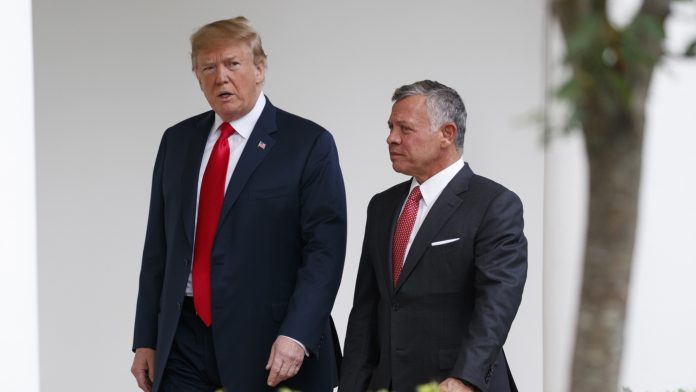
President Trump walks with King Abdullah II of Jordan at the White House, on June 25, 2018, in Washington.

Evan Vucci/AP


hide caption

toggle caption

Evan Vucci/AP

AMMAN, Jordan — Jordan’s King Abdullah II is heading into what is expected to be one of the toughest meetings of his quarter-century reign Tuesday at the White House.

President Trump set the stage for a fraught face-to-face with a plan he announced last week to relocate some 2 million Palestinians from the Gaza Strip to Jordan and Egypt. Both countries have said they are strongly opposed to the plan, which Israel’s leadership has embraced.

“Yeah maybe, sure, why not?” Trump told reporters when asked if he was considering cutting aid to Jordan and Egypt if they did not agree to take Gaza’s 2 million Palestinians the day before the White House meeting.

“If they don’t I would conceivably withhold aid,” he said.

Trump’s plan, articulated without consultation with Jordan or Egypt, would involve the U.S. taking over Gaza, a small Palestinian territory with a Mediterranean coastline. The “Riviera” of the Middle East he said he envisions would be rebuilt from the destruction of more than a year of war between Israel and Hamas. United Nations officials say 70% of the Palestinian territory’s structures are damaged or destroyed.

Seizing Gaza and expelling its population would be illegal under international law, United Nations officials and legal experts have warned.

It would also breach a key part of the peace deal Jordan signed with Israel three decades ago.

“Jordan signed a peace treaty with Israel precisely because it did not want a solution at Jordan’s expense,” said former Jordanian foreign minister Marwan Muasher.

“This is an existential issue to Jordan that does not lend itself to any economic pressure from the United States,” said Muasher, now vice president for studies at the Carnegie Endowment for International Peace.

Many of Jordan’s citizens are descendants of Palestinian refugees who fled or were expelled from their homes during and after the creation of Israel in the late 1940s and were never allowed back. Jordan and other Arab countries have historically resisted accommodating more Palestinian refugees out of fear that it would weaken the case for a Palestinian state and the refugees’ right to return.

Muasher said the brake to Trump’s plans could be Saudi resistance. Trump has made clear he wants to broker a normalization agreement between Saudi Arabia, the most powerful Gulf state, and Israel. Saudi Arabia last week said expelling Palestinians would stand in the way of any normalization talks.

“Those are very strong words,” says Muasher. The White House “probably will take the Saudi position very seriously.”

Judge blocks Trump admin directive capping costs tied to federal research grants

0

A judge temporarily halted a directive by the Trump administration that imposed a cap on overhead costs that go to universities and other institutions that host federally funded research projects.

The directive, which went into effect Monday, sparked an outcry of criticism from research institutions that argued the new rule would have devastating consequences. It was immediately challenged in court by 22 Democratic state attorneys general, as well as by several leading research universities and related groups in a second lawsuit. 

U.S. District Court Judge Angel Kelley subsequently ruled in favor of the 22 state attorneys general, granting their request for a temporary restraining order that prohibits agencies from taking any steps to implement, apply or enforce the new rule that imposed a cap on facilities and administrative costs that are part of federally funded research grants.

‘WHAT A RIPOFF!’: TRUMP SPARKS BACKLASH AFTER CUTTING BILLIONS IN OVERHEAD COSTS FROM NIH RESEARCH GRANTS

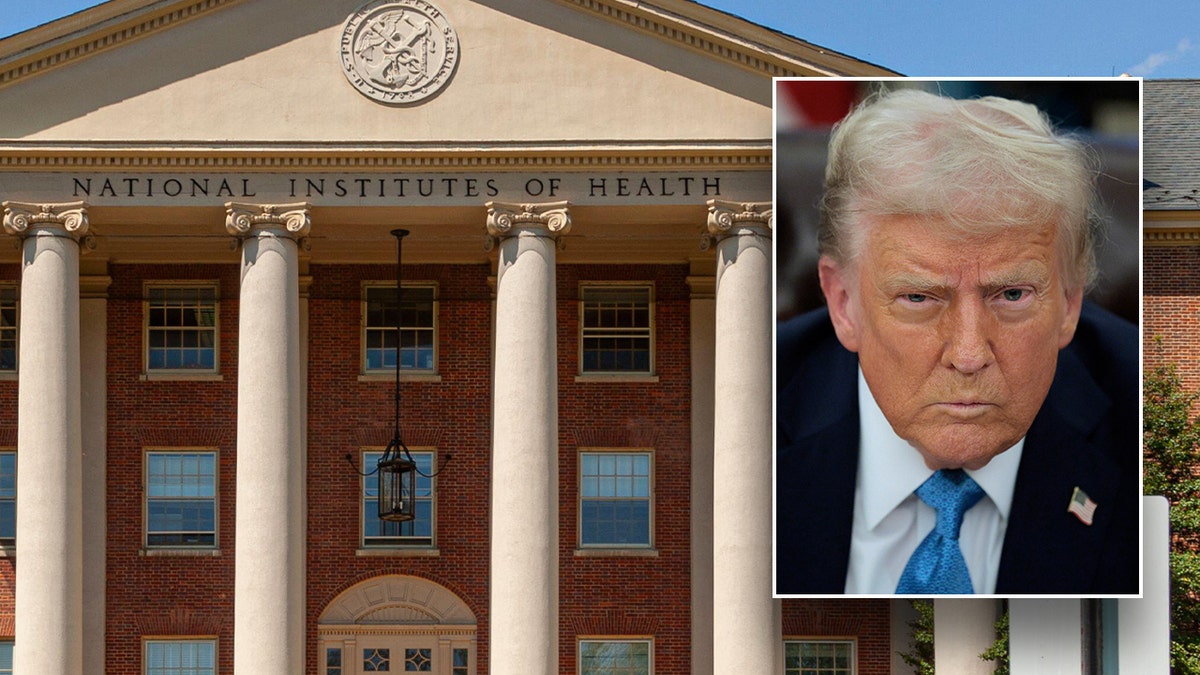
The rule capped overhead costs associated with National Institutes of Health (NIH) funded research grants at 15%. 

When a grant is awarded to a scientist by the NIH, an additional percentage, on top of the allocated research funding, goes to the facility housing their work to cover these “indirect costs.” According to an announcement about the new funding cap from the Trump administration, that percentage has historically been around 27% to 28% for each grant. But in some cases, negotiated rates can be even higher, such as at the University of Michigan where the negotiated rate for indirect costs is 56%.

Medical research

In fiscal year 2023, the NIH spent around $35 billion on roughly 50,000 grants that go to research institutions, such as universities and hospitals. Of that $35 billion, according to the Trump administration, $9 billion was allocated for “indirect costs” that cover expenses related to depreciation on buildings, equipment, capital improvements, interest on debt associated with certain buildings, and operations and maintenance expenses. (iStock)

The lawsuit from the attorneys general argued the move violated federal law governing the procedures federal agencies must follow when implementing new regulations. They also argued that the move usurped the will of Congress, which, in 2018, passed legislation prohibiting the NIH or the Health and Human Services Department from unilaterally making changes to current negotiated rates, or implementing a modified approach to the reimbursement of indirect costs.

UNIVERSITY PROFESSOR HAILS THAT SCIENCE ‘THRIVED’ UNDER HITLER IN ATTACK ON TRUMP’S NIH CUTS

Kelley’s temporary restraining order requires the Trump administration agencies that are impacted by the new rule to file reports within 24 hours to confirm the steps they are taking to comply with her order. Meanwhile, Kelley set an in-person hearing date on the matter for Feb. 21.

Fox News Digital reached out to the White House for comment on the restraining order, but did not hear back at press time. However, after the directive went into effect on Monday, White House spokesperson Kush Desai told Fox News Digital, “Contrary to the hysteria, redirecting billions of allocated NIH spending away from administrative bloat means there will be more money and resources available for legitimate scientific research, not less.” 

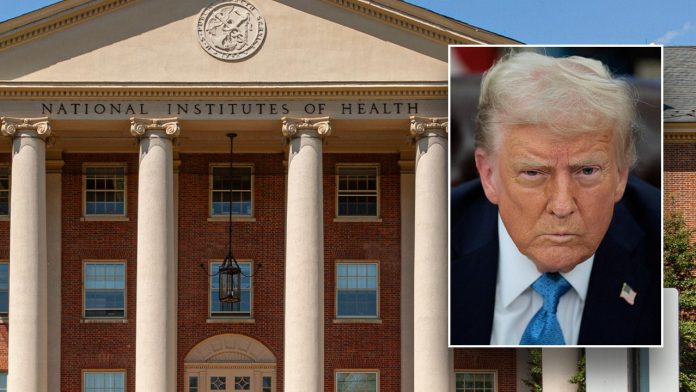
The National Institutes of Health (NIH) and President Donald Trump.

The National Institutes of Health (NIH) announced a $9 billion spending cut in response to a new mandate from the Trump administration. (Alamy/Getty Images)

Earlier on Monday, U.S. District Judge John J. McConnell said the Trump administration had violated his order halting a federal aid funding freeze that sought to pause “all activities related to obligation or disbursement of all Federal financial assistance,” to ensure federal disbursements aligned with the president’s executive actions.

CLICK HERE TO GET THE FOX NEWS APP 

McConnell ordered the government to “immediately restore frozen funding,” noting that plaintiffs had provided adequate evidence to show the Trump administration “in some cases [has] continued to improperly freeze federal funds and refused to resume disbursement of appropriated federal funds,” despite his “clear and unambiguous” order lifting the freeze.

Gaza Cease-Fire Deal Hangs in the Balance Ahead of Trump’s Meeting With Jordan’s King

0

The future of the cease-fire in Gaza, along with the territory’s long-term fate, hung in the balance on Tuesday as President Trump prepared to meet with King Abdullah II of Jordan amid a public spat between the American leader and Hamas.

Mr. Trump envisions taking over Gaza and expelling Palestinians to nearby countries, including Jordan. He has threatened to end American financial support for Jordan if the king refuses to accept that vision.

The dispute is one of several that imperil the fragile truce between Hamas and Israel. Hamas threatened to derail the agreement on Monday night, warning that it would delay the release of some hostages on Saturday if Israel did not send more aid to Gaza.

In response, Mr. Trump threatened “all hell” if every hostage were not released by the weekend. Hamas later softened its position, while Mr. Trump included a caveat that suggested his threat was a negotiating tactic, not an ultimatum.

While the immediate crisis is likely to be resolved soon, analysts said, another hurdle looms in March, when the cease-fire is set to elapse unless Hamas and Israel negotiate an extension.

“It’s likely that they will reach a compromise before Saturday,” said Ibrahim Dalalsha, director of the Horizon Center, a political research group in Ramallah, in the West Bank. “But this crisis is a prelude for a much bigger crisis that is coming in early March.”

All the major players have made negotiations harder.

Israel’s prime minister, Benjamin Netanyahu, has delayed the talks, wary of an extension that would allow Hamas to remain the dominant military force in Gaza.

Hamas, though nominally willing to share control with other Palestinian factions, has given no sign that it will disarm.

And Mr. Trump’s pronouncements — including his threats to expel Gaza’s residents — have angered Hamas and amplified the sense of chaos surrounding the negotiations.

Mr. Trump has repeatedly called for the United States to occupy and rebuild Gaza, threatening on Monday to withdraw financial support for Egypt and Jordan if they do not house Palestinians displaced by that effort.

Such a forced migration would destabilize both countries, and King Abdullah is expected to present alternatives to Mr. Trump.

Analysts are divided about whether Mr. Trump’s idea is serious, but the dispute highlights the growing unpredictability about Gaza’s future.

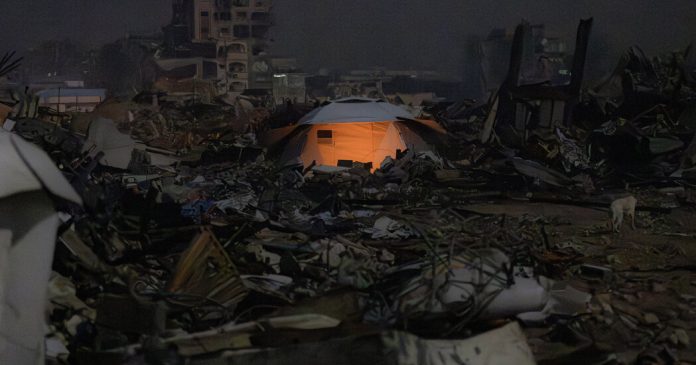
The current standoff stems in part from Hamas’s accusation that Israel has not upheld its promises for the first phase of the cease-fire. Israel was required to send hundreds of thousands of tents into Gaza, a promise that Hamas says Israel has not kept.

Speaking on the condition of anonymity to discuss a sensitive matter, three Israeli officials and two mediators said that Hamas’s claims were accurate.

But COGAT, the Israeli military unit that oversees aid deliveries, said in a written response that Hamas’s claims were “completely false accusations. Hundreds of thousands of tents have entered Gaza since the beginning of the agreement, as well as fuel, generators and everything Israel pledged.”

Regardless, officials and commentators say this dispute can be resolved relatively easily if Israel allows more aid to Gaza.

The more serious issue is the widespread perception that Mr. Netanyahu is undermining the negotiations over an extended truce.

Those talks were meant to begin early last week. Instead, Mr. Netanyahu delayed sending a team to Qatar, which is mediating talks, until early this week.

That delegation consisted of three officials who have not previously led Israel’s negotiating effort, according to five Israeli officials and an official from one of the mediating countries. And their mandate was only to listen, not to negotiate.

That created the perception that Mr. Netanyahu was playing for time rather than trying to extend the truce.

All of the officials spoke on the condition of anonymity to discuss the private talks more freely.

Asked for comment, Omer Dostri, a spokesman for the prime minister, said that Mr. Netanyahu was “working tirelessly to return all hostages held by the Hamas terrorist organization.” Mr. Dostri added that Israel would send negotiators to discuss the deal’s extension after Israel’s position had been set by the cabinet.

Mr. Netanyahu has often said that Hamas will not remain in power after the war. And key members of Mr. Netanyahu’s governing coalition have expressed a desire to resume the war to oust Hamas, despite calls from much of the Israeli public for an extension of the truce to free more hostages, even if it leaves the militant group in power.

A Hamas official, Mahmoud Mardawi, said that the group’s warning on Monday had been in response only to the disagreements over humanitarian aid. But analysts said that it was also an attempt to force Mr. Netanyahu to negotiate earnestly and was probably a reaction to Mr. Trump’s recent statements about depopulating Gaza.

Michael Milshtein, an Israeli analyst of Palestinian affairs, said, “There’s an anger among Hamas about the demands of both Netanyahu and Trump that Hamas will be kicked out of Gaza.”

“The announcement yesterday was a kind of a signal that, if you continue demanding this, there will be several dramatic crises,” Mr. Milshtein added.

Natan Odenheimer, Gabby Sobelman and Adam Rasgon contributed reporting.

DOGE versus bloated tech, drama between Taylor Swift and Blake Lively, and more from Fox News Opinion

0

NEWYou can now listen to Fox News articles!

Welcome to the Fox News Opinion Newsletter.

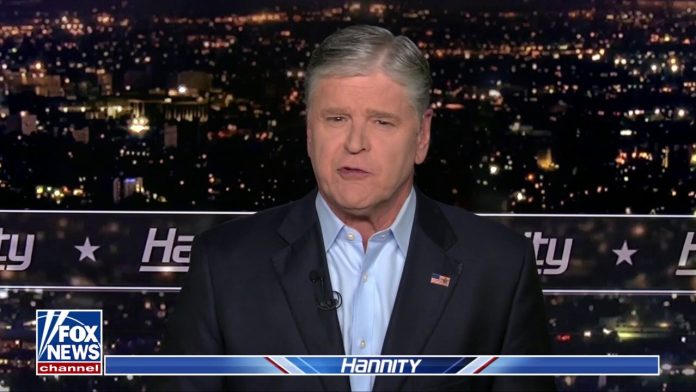
HANNITY – Fox News host lambasts the Democratic Party for its response to President Donald Trump and DOGE leader Elon Musk’s commitment to rooting out government waste. Continue watching…

HUGH HEWITT – Legacy media’s long slide into obscurity. Continue reading…

UNTANGLE THE MESS – Let DOGE sink its teeth into our bloated tech infrastructure. Continue reading…

VIBE SHIFT – Trump’s ‘golden age’ is rolling across America. Look at the latest evidence. Continue reading…

CONDI RICE – China’s DeepSeek AI escalates fight to innovate. 4 trends we don’t dare miss. Continue reading…

RAYMOND ARROYO – Fox News contributor analyzes the drama between Taylor Swift and Blake Lively. Continue watching…

NO CAP – Capping credit card interest is a truly awful idea. Continue reading…

4 SIMPLE GOALS – Make your marriage easier and help you love your spouse for life. Continue reading…

USAID WHISTLEBLOWER – Musk is mostly right about agency’s waste. Continue reading…

CARTOON OF THE DAY – Check out all of our political cartoons…

Vance, in First Foreign Speech, Tells Europe That U.S. Will Dominate A.I.

0

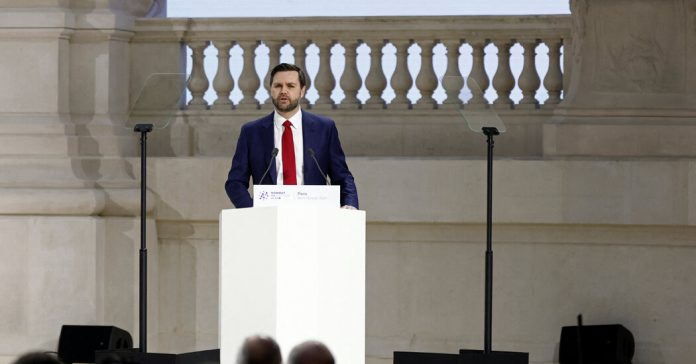
Vice President JD Vance told European and Asian leaders in Paris on Tuesday that the Trump Administration was adopting an aggressive, America First approach to the race to dominate all the building blocks of artificial intelligence, and warned Europeans to dismantle regulations and get aboard with Washington.

On his first foreign trip since taking office, Mr. Vance used his opening address at an A.I. summit meeting hosted by France and India to describe his vision of a coming era of American technological domination. Europe, he said, would be forced to chose between using American-designed and manufactured technology or siding with authoritarian competitors — a not-very-veiled reference to China — who would exploit the technology to their detriment.

“The Trump administration will ensure that the most powerful A.I. systems are built in the U.S. with American design and manufactured chips,” he said, quickly adding that “just because we are the leader doesn’t mean we want to or need to go it alone.”

But he said that for Europe to become what he clearly envisions as a junior partner, it must eliminate much of its digital regulatory structure — and much of its policing of the internet for what its governments define as disinformation.

For Mr. Vance, who is on a weeklong tour that will take him next to the Munich Security Conference, Europe’s premier meeting of leaders, foreign and defense ministers and others, the speech was clearly intended as a warning shot. It largely silenced the hall in a wing of the Grand Palais in the center of Paris. Leaders accustomed to talking about “guardrails” for emerging artificial intelligence applications and “equity” to assure the technology is available and comfortable for underserved populations heard none of those phrases from Mr. Vance.

He spoke only hours after President Trump put new 25 percent tariffs on foreign steel, essentially negating trade agreements with Europe and other regions. Mr. Vance’s speech, precisely composed and delivered with emphasis, seemed an indicator of the tone Mr. Trump’s national security leaders plan to take to Europe this week.

Defense Secretary Pete Hegseth will be talking about Ukraine with European leaders on Wednesday, and Secretary of State Marco Rubio arrives in Munich when the conference opens at the end of the week. That session is likely to be dominated by competing American and European views on how to negotiate an end to the war in Ukraine.

With a brief background in Silicon Valley and venture capital, Mr. Vance is the image of a new generation of Republicans soaked in Mr. Trump’s America First ideology. After Mr. Vance left the hall, not staying to hear the European response, the United States and Britain declined to sign the summit’s communiqué.

Mr. Vance started off his speech with a direct reference to the A.I. Safety Summit, held at Bletchley Park, the grand estate in Britain where code-breakers cracked the German Enigma codes in World War II. That conference ended with a dire warning of “serious, even catastrophic harm, either deliberate or unintentional, stemming from the most significant capabilities of these A.I. models.” Twenty-eight nations, including the U.S., vowed to “work together in an inclusive manner to ensure human-centric, trustworthy and responsible A.I.”

Mr. Vance went out of his way to separate himself from that summit and the speech given by his predecessor, Kamala Harris. “I’m not here this morning to talk about A.I. safety,” he said. “I’m hear to talk about A.I. opportunities,” warning that America’s response to the challenge of A.I. could no longer be “self-conscious” or “risk averse.”

“The A.I. future is not going to be won by hand-wringing about safety,” he said.

At a moment that Mr. Trump is disbanding government boards and units that were hunting down disinformation, much of it from Russia, China and Iran, Mr. Vance made the case that American technology firms were still dealing with “massive regulations” in Europe.

He did not propose scrapping all such rules but said, “It is one thing to prevent a predator from preying on a child on the internet, and it is something quite different to prevent a grown man or woman from accessing opinions that the government thinks is misinformation.”

Of course in Washington, that is exactly what many federal employees charge Mr. Trump is doing, as he orders all references to D.E.I. — diversity, equity and inclusion — stripped from government websites, and has banned government employees from putting their preferred personal pronouns in their signatures.

At the same time Mr. Vance warned about how “hostile foreign adversaries have weaponized A.I. software to rewrite history, surveillance users and censor speech.” But he did not explain how to monitor or remedy that issue.

European officials knew roughly what was coming, even if they did not know Mr. Vance would be so blunt. In the opening day of the conference, France’s president, Emmanuel Macron, spoke of a need to simplify European regulation. He has announced over $100 billion in private investment in France on AI technologies, and the power to generate them. That is a huge figure for France, but a fraction of what the private sector is spending in the United States, and what China and its state-owned firms, and startups, are committing.

Mr. Vance got to the heart of a central dispute that is likely to widen in the coming year: The European Union regulates tech companies much more forcefully than the United States.

The bloc’s Digital Services Act, passed in 2022, aims to combat misinformation and force social media companies to more aggressively police and moderate their platforms for illicit content — or risk billions of dollars in fines. The Digital Markets Act, also passed in 2022, gives European regulators wide authority to force the largest online gatekeepers to change their business practices, to prevent tech giants from boxing in users and to foster more competition.

Europe has also sought to be at the forefront of regulating A.I. by pushing to raise the level of oversight and attempting to limit the use of the technology. But with the United States and China racing ahead in A.I. development, Mr. Macron has urged Europe to ease up and prioritize innovation over regulation.

Regulators in Brussels have targeted U.S. tech companies with multiple investigations and fines. Apple and Google have faced billions in fines over issues like unpaid taxes and preferential treatment in search results. Meta has been accused of violating European competition rules and of having insufficient safeguards to counter election disinformation. Last month, regulators opened an investigation into X over the spread of illicit content.

The United States has argued that Europe’s approach unfairly targets American tech titans. Mark Zuckerberg, the head of Meta, called on Mr. Trump to defend U.S. tech companies from what he called European “censorship,” and to demand that the European Union stop fining them.

“We’re going to work with President Trump to push back on governments around the world that are going against American businesses,” Mr. Zuckerberg said last month, shortly after he announced that Meta would end its fact-checking program.

Ursula von der Leyen, the president of the European Commission, who spoke on Tuesday right after Mr. Vance, did not forcefully confront her predecessor — who had already left the room. Echoing Mr. Macron, she herself acknowledged that “we have to make it easier, and we have to cut red tape, and we will.”

“Too often I hear that Europe is late to the race, that the United States and China have already gotten ahead,” she said. “I disagree. The A.I. race is far from being over.” Ms. von der Leyen said Europe aimed to invest $200 billion in A.I in the coming years.

But she also defended the European Union’s regulatory approach and suggested there was a “distinct European brand of A.I.” that focused on “complex applications,” that was cooperative, and that embraced an open-source approach, meaning the underlying software is widely shared.

“Yes, A.I. needs competition,” she said. “But A.I. also needs collaboration. And A.I. needs the confidence of the people, and has to be safe.”

Liz Alderman and Aurelien Breeden contributed reporting from the A.I. summit in Paris.

Fever make number of moves to give Caitlin Clark help, including superstar she had playoff spat with

0

The Indiana Fever needed to make some upgrades to the roster in order to vie for a WNBA championship and give Caitlin Clark extra firepower on both sides of the ball.

The team has done just that.

CLICK HERE FOR MORE SPORTS COVERAGE ON FOXNEWS.COM

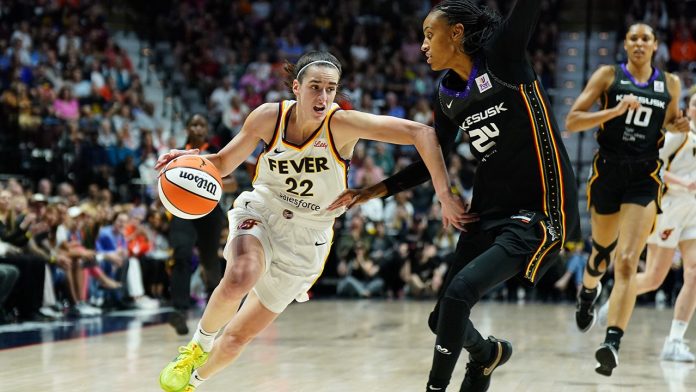
Indiana Fever guard Caitlin Clark, #22, brings the ball up court against the Chicago Sky during the first half at Wintrust Arena in Chicago on Aug. 30, 2024. (Kamil Krzaczynski-USA TODAY Sports)

The Fever re-signed Kelsey Mitchell, acquired Sophie Cunningham from the Phoenix Mercury and added Natasha Howard, DeWanna Bonner and Sydney Colson. In an offseason that saw the Las Vegas Aces trade Kelsey Plum to the Los Angeles Sparks, the Fever may have made some of the shrewdest moves that have gone under the radar.

“I got to work out with DB. As some offseason leagues and overseas stuff kinda wraps up, a lot of them will start getting back and I think it will be a lot of fun to get in the gym and be with my teammates and just starting putting the pieces together and see what works or what doesn’t,” Clark said at Bonner’s introductory press conference, via CBS Sports. “But I think we’re going to have a lot of different options to do a lot of different things. I think that’s what’s super exciting.”

CAITLIN CLARK RESPONDS TO CRITICS AHEAD OF IOWA JERSEY RETIREMENT: ‘I REALLY DON’T CARE’

DeWanna Bonner drives

Connecticut Sun forward DeWanna Bonner, #24, works toward the basket as Minnesota Lynx guard Natisha Hiedeman, #2, defends during the first half of Game 5 of a WNBA basketball semifinals on Oct. 8, 2024 in Minneapolis. (AP Photo/Abbie Parr, File)

Clark, Mitchell and Aliyah Boston shined bright in the 2024 season. Clark won the Rookie of the Year award and received some MVP votes. Mitchell was an All-Star for the second straight season. Boston was also an All-Star for the second time and built momentum after her rookie year.

Add players with playoff experience and a coach in Stephanie White, who coached the Connecticut Sun the last two seasons to at least 27 wins, and the Fever have turned into formidable contenders for the WNBA title in 2025.

Bonner is a six-time All-Star and two-time WNBA champion in her own right. She is also not one to be intimidated or messed around with, as she has proven to back up her teammates no matter which team she is playing for. She proved that in the playoffs last season when she and Clark had an in-game spat.

“I think it’s just two competitive players that want to win and push their team to get over the finish line. It was the playoffs, so emotions are high, tensions are high,” she recalled, via the Indy Star.

Bonner added she and Clark had a good workout to build chemistry with Clark.

Caitlin Clark drives on DeWanna Bonner

Indiana Fever guard Caitlin Clark, #22, drives the ball against Connecticut Sun forward DeWanna Bonner, #24, in the first quarter at Mohegan Sun Arena on May 14, 2024 in Uncasville, Connecticut. (David Butler II-USA TODAY Sports)

“I’m just here to hopefully give my leadership advice,” Bonner added. “I don’t think I need to push her to be any type of player that she isn’t already is, and I’m just happy to be here, and I hope I can give her some knowledge to bring her game to a different level.”

CLICK HERE TO GET THE FOX NEWS APP

Expectations will be high for Clark and the Fever in her second WNBA season.

Follow Fox News Digital’s sports coverage on X, and subscribe to the Fox News Sports Huddle newsletter.

Luis Rubiales, Spain’s Former Top Soccer Official, Testifies About Kissing Star Player

0

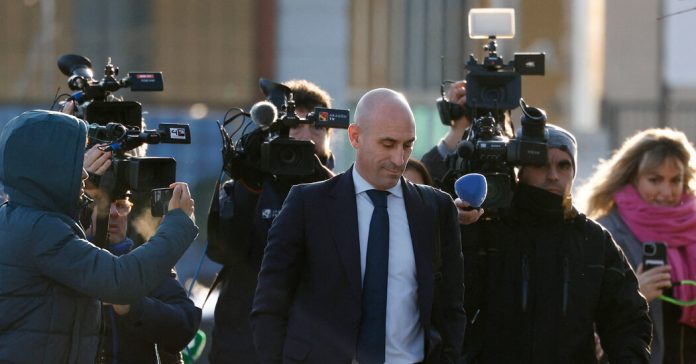
Luis Rubiales, who resigned as Spain’s top soccer official after he forcibly kissed a player, testified at his sexual assault trial on Tuesday that he did so as a sign of affection in “a situation of extraordinary joy.”

Mr. Rubiales has also been charged with coercion in connection with the episode, in which he pressed a kiss on the player, Jennifer Hermoso, on the field during the medal ceremony after Spain won the 2023 Women’s World Cup.

Mr. Rubiales denied doing anything wrong during the encounter with Ms. Hermoso. Speaking in a courtroom near Madrid, he said, “You don’t win a World Cup every day,” and he added that he had kissed other players in celebratory moments.

He also said that he had asked for permission before kissing Ms. Hermoso, describing it as a peck. “I asked her, ‘Can I give you a little kiss?’ and she said, ‘OK,’” he told a prosecutor. Ms. Hermoso said shortly after the episode that “at no time did I consent to the kiss that he gave me.”

“I couldn’t react — it was a thousandth of a second,” she later testified, adding that she had known immediately that the act was not normal.

“My boss was kissing me,” she said. “This should not happen.”

The kiss, and the ensuing fallout, became a moment of reckoning in the country as well as in the sport, pitting a culture of machismo against more recent progress in gender equality in Spanish soccer.

Mr. Rubiales, 47, faces two and a half years in prison if convicted. Three other men, including Jorge Vilda, the team’s coach at the World Cup, are accused of coercion, with prosecutors saying that they pressured Ms. Hermoso to drop her claim and downplay the incident. Each could face 18 months.

The trial opened last week with the testimony of Ms. Hermoso, 34, who described the kiss as the moment that “ruined one of the happiest days of my life.”

Ms. Hermoso, who plays in Mexico, also testified that top soccer officials had pressured her to say that Mr. Rubiales had done nothing wrong.

Ms. Hermoso was left off the Spain team after the episode, but on Monday the current head coach of the Spain women’s team, Montse Tomé, testified that Ms. Hermoso’s exclusion “was not a punishment.”

Ms. Tomé, who became the team’s coach in September 2023 after Mr. Vilda was fired, appeared at the court near Madrid as a witness for the defense.

In August 2023, Ms. Tomé and 10 other members of the Spain women’s coaching staff published a collective statement condemning Mr. Rubiales’s “unacceptable attitudes and actions.”

Ms. Tomé’s appointment as Mr. Vilda’s successor, however, was seen by some as a continuation of the old leadership. She had worked with Mr. Vilda as his assistant and ordered players to attend training camp. She was also seen by players as offering little practical support for Ms. Hermoso and ignoring calls for structural change in the soccer federation.

Ms. Hermoso, during her testimony, said that the federation had all but abandoned her after her complaints. She said that officials wanted only “to save their reputation.”

In the immediate aftermath of the kiss, Mr. Rubiales offered a tepid apology and resisted calls to resign. The Spanish soccer federation released a statement that quoted Ms. Hermoso calling the kiss “a totally spontaneous mutual gesture.” During her testimony, Ms. Hermoso said that she had never approved the statement.

Amid mounting pressure and waning support, Mr. Rubiales resigned as head of the national soccer organization, the Royal Spanish Football Federation, in September 2023.

Poll finds Trump has highest approval rating now than any point in 1st term

0

President Donald Trump has the highest approval rating now compared to any point during his first term in office, according to a new poll. 

Forty-seven percent of Americans approve of Trump’s job performance in the less than a month since he was sworn in as the 47th president, the latest national survey by the Pew Research Center found. 

While that’s higher than at any point while he served as the 45th president, Trump’s inaugural approval rating sinks below that of most other presidents since Ronald Reagan. George W. Bush’s approval rating early in his second term, however, was about the same as that of Trump now. 

TRUMP PARDONS FORMER ILLINOIS GOV. ROD BLAGOJEVICH: ‘HE WAS SET UP BY A LOT OF BAD PEOPLE’

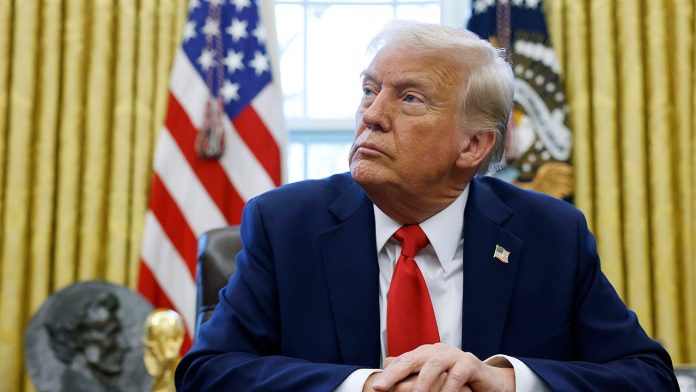
President Donald Trump speaks to reporters in the Oval Office of the White House on Feb. 3, 2025, in Washington, D.C. (Anna Moneymaker/Getty Images)

The poll, conducted Jan. 27 to Feb. 2 among 5,086 adults, found nearly three in ten adults, or 28%, view Trump’s actions as better than expected, while 36% said they have been what they expected. 

His actions are viewed as worse than expected by 35% of adults. 

Americans are fairly evenly split over how they believe Trump’s White House will affect the federal government. The survey found 41% of adults said they believe Trump’s administration will improve the way the federal government works, and 42% said they believe the state of the federal government will worsen with him in office. 

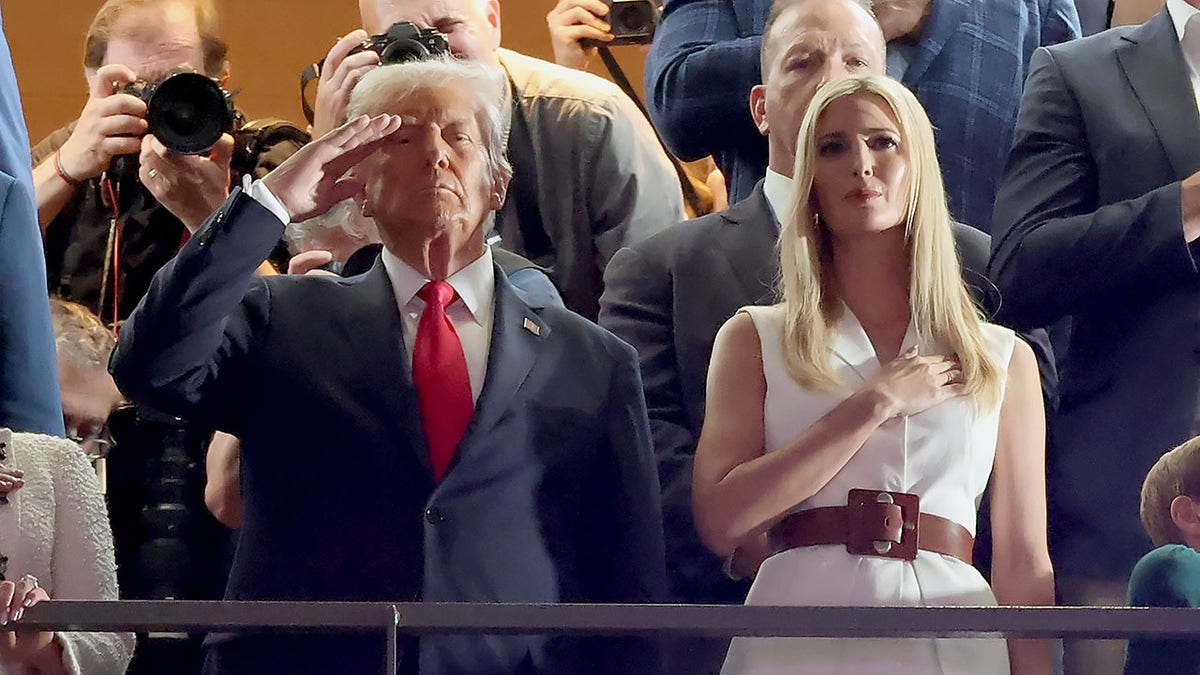
Trump salute at Super Bowl

President Donald Trump and Ivanka Trump stand for the National Anthem during the Super Bowl LIX Pregame at Caesars Superdome on Feb. 9, 2025, in New Orleans, Louisiana.   (Kevin Mazur/Getty Images for Roc Nation)

Public opinion on Trump’s agenda remains starkly divided along partisan lines. The poll found 67% of Republicans, including those who lean red, support all or most of Trump’s plans and policies. For Democrats and those who lean blue, 84% support few or none. Almost an identical share of Republicans, 76%, said Trump will improve the way the federal government operates, as Democrats, 78%, said Trump will make the federal government run worse. 

NOEM: ‘GET RID OF FEMA THE WAY IT EXISTS TODAY’

For Republicans, 53% viewed Trump’s recent actions as better than expected, while the poll found 60% of Democrats view the president’s accomplishments as worse than expected. 

As Trump enters his fourth week back in office, his efforts to slash wasteful federal government spending through the Department of Government Efficiency (DOGE) have caused a stir in Washington. 

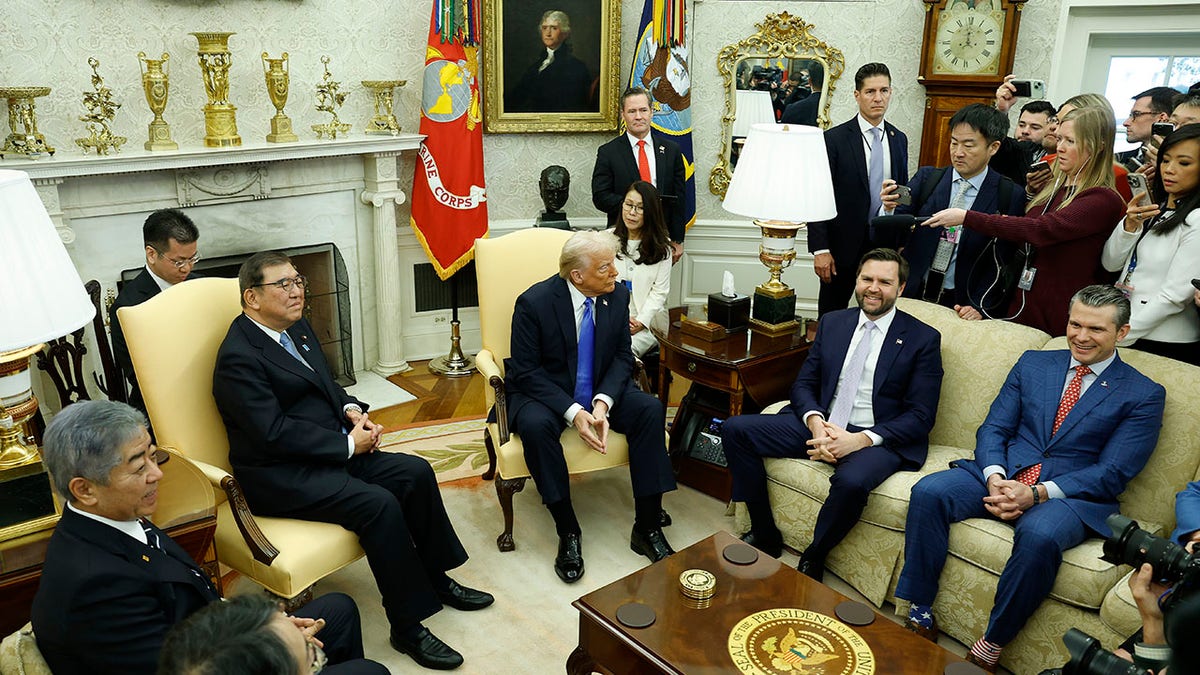
Trump, Vance and Hegseth in Oval Office during meeting with Japanese PM

President Donald Trump, Vice President JD Vance and Secretary of Defense Pete Hegseth meet with Japanese Prime Minister Shigeru Ishiba in the Oval Office of the White House on Feb. 7, 2025, in Washington, D.C. (Anna Moneymaker/Getty Images)

His threat of tariffs against Canada and Mexico and levied against China over the flow of deadly fentanyl across American borders has similarly raised concerns. Trump’s angling for the Panama Canal and Greenland amid the increasing Chinese presence in the Western Hemisphere, as well as his administration overseeing a collapsing ceasefire agreement between Hamas and Israel in the Middle East have put the world on notice. 

CLICK HERE TO GET THE FOX NEWS APP

Trump’s advisers are expected to meet with Ukrainian President Volodymyr Zelenskyy this week in Munich as the war with Russia stretches into its third year. Raging wildfires in California, a deadly military helicopter-passenger jet collision in D.C., and the continuing aftermath of last year’s hurricane devastation in the southeast, particularly in North Carolina, are putting Trump’s new Cabinet chiefs to the test on the domestic front, as is Trump’s crackdown on criminal illegal immigration. 

Can European ‘Boots on the Ground’ Help Protect Ukraine’s Security?

0

President Trump has vowed to end the fighting in Ukraine. Just how he could do that remains unclear, given that President Vladimir V. Putin of Russia believes he is winning. But in his own blunt way, Mr. Trump has opened up the possibility of some kind of negotiations for a cease-fire.

If a deal was to be reached, analysts say, Mr. Trump would be likely to ask Europe to put it in place and to take responsibility for Ukraine, wanting to reduce the American commitment.

But a key question remains: How to secure what is left of Ukraine and prevent Mr. Putin from restarting the war, even several years from now?

The prospect of a deal has accelerated debate over so-called European boots on the ground to keep the peace, monitor a cease-fire and help deter Russia from future aggression. The question is whose boots, and how many, and whether Mr. Putin would ever agree.

It is a topic sure to be a central focus for discussion this week at the annual Munich Security Conference, which Vice President JD Vance and Secretary of State Marco Rubio are scheduled to attend.

Some European countries, among them the nations of the Baltics, as well as France and Britain, have raised the possibility of including some of their own troops in a force in Ukraine. Senior German officials have called the idea premature.

Short of NATO membership for Ukraine, which seems unlikely for many years, the idea of having large numbers of European troops from NATO nations seems reckless to many officials and analysts.

Without clear American involvement in such an operation — with American air cover, air defenses and intelligence, both human and technical — European troops would be at serious risk from Russian probing and even attacks.

President Volodymyr Zelensky of Ukraine has indicated that he is ready for serious talks about a deal to end the war, so long as his allies provide security guarantees, not just assurances.

In the absence of NATO membership, which he prefers, Mr. Zelensky has spoken of as many as 200,000 foreign troops on the ground in Ukraine. But that is nearly three times the size of the entire British Army and is regarded by analysts as impossible.

A senior European official said that the continent doesn’t even have 200,000 troops to offer, and that any boots on the ground must have American support, especially faced with the world’s second-largest nuclear power, Russia. If not, they would be permanently vulnerable to Russian efforts to undermine the alliance’s political and military credibility.

Even a more modest number of European soldiers like 40,000 would be a difficult goal for a continent with slow economic growth, troop shortages and the need to increase military spending for its own protection. And it would likely not be enough to provide realistic deterrence against Russia.

A real deterrent force would typically require “well over 100,000 troops assigned to the mission” for regular rotations and emergencies, said Lawrence Freedman, emeritus professor of war studies at King’s College London.

The danger would be a policy of what Claudia Major, a defense expert with the German Institute for International and Security Affairs, called “bluff and pray.”

“Providing too few troops, or tripwire forces without reinforcements, would amount to a bluff that could invite Russia to test the waters, and the NATO states would hardly be able to counter this,” she wrote in a recent paper with Aldo Kleemann, a German lieutenant colonel, about how to secure a Ukrainian cease-fire.

That is why Poland, which neighbors Ukraine and is deeply involved in its security, has so far dismissed taking part in such a force.

“Poland understands it needs the United States to be involved in any such proposal, so wants to see what Trump wants to do,” said Alexandra de Hoop Scheffer, acting director of the German Marshall Fund. “It wants guarantees from Trump that there will be U.S. security help to support Europeans in the front line.”

But that is not at all clear, she said. “Trump will do the deal and look for a Nobel Prize and then expect the Europeans to pay for it and implement it,” she said.

Still, European “willingness to be ready to do something useful” for Ukraine without the Americans will be important to ensure that Europe has a seat at the table when negotiations finally happen, said Anthony Brenton, a former British ambassador to Russia.

Mr. Putin’s stated aims have not changed: the subordination of Ukraine into Russia, a halt to NATO enlargement and a reduction in its forces, to force the creation of a new buffer zone between the Western alliance and the supposed Russian zone of influence.

Nor is it likely that Russia would agree in any deal to the deployment of NATO or NATO- country forces in Ukraine in any case, even if they were ostensibly there to train Ukrainian soldiers. The Russian Foreign Ministry has already stated that NATO troops in Ukraine would be “categorically unacceptable” and escalatory.

Mr. Freedman described three possible models — peacekeeping, tripwire and deterrence — all of which have significant flaws.

Peacekeepers, intended to reinforce agreed-upon cease-fires and keep belligerents apart, are lightly armed for self-defense and often contain troops from many countries, usually under the United Nations. But given that the line of contact in Ukraine is some 1,300 kilometers, or more than 800 miles, he said, “a huge number of troops” would be required.

Before the 2022 invasion, there was an international monitoring mission of the Organization for Security and Cooperation in Europe, with Russian agreement, to supervise observance of a much shorter cease-fire line in eastern Ukraine. It was a failure, said Michael Bociurkiw, who was its spokesman from 2014 to 16.

“The Russians did everything to block the mission,” he said. “They pretended to cooperate, limited access and hid various nefarious activities. When things don’t work the way they want, they shut it down.”

A tripwire force is essentially what NATO has deployed in eight member countries closest to Russia. There are not enough troops to stop an invasion or to be seen by Moscow as provocative, but the concept only works if there is a clear, unbreakable link between the troops on the ground and larger reinforcements committed to fight once the wire is tripped.

But there are always doubts about the absolute nature of that guarantee. And an attacking force would gain significant territory before any reinforcements arrive, which is why NATO itself is increasing the size of its tripwire forces from battalion to brigade level, to enhance deterrence against a newly aggressive Russia.

The third type, a deterrent force, is by far the most credible, but needs to be very large and well-equipped, and would require up to 150,000 well-equipped troops, plus significant commitments of air defense, intelligence and weaponry — and American help with the strategic enablers Europe continues to lack, from air transport to satellites to missile defense.

But it would be hard to imagine that Russia would agree to any such force for precisely the same reasons that Mr. Zelensky wants one, Mr. Freedman said.

So the best answer for the near future after a potential cease-fire may be some version of the “porcupine” model: giving the Ukrainian military enough weaponry, resources and training — including by Western forces — to convince Russia not to try again. Such a commitment, however, would have to be for the long term.

But first Ukraine must stop Russia’s slow advance in the east and Mr. Putin must be convinced to end the war, with further battlefield losses and economic pressure. How to do that will be one of the main tests for Mr. Trump if he is to have success in ending the killing, as he promises to do.