Friday, November 13, 2026
Home Blog Page 237

Why economists got free trade with China so wrong : NPR

0

Narumon Bowonkitwanchai/Getty Images

By now, many economists are hoarse screaming that higher tariffs and a trade war will raise prices and hurt the U.S. economy.

But many Americans aren’t listening. A recent poll by Quinnipiac University, conducted in late January, found that 42% of Americans believe tariffs will help the U.S. economy. The United States’ recent history with free trade might help explain the disconnect between economists and a large swath of the American public.

For decades, mainstream economists claimed that free trade would be a clear win for the United States. Sure, they said, there would be some losers. But those losers would get new jobs in a growing economy and basically everything would ultimately be fine.

Everything turned out not to be fine. No research has made that more abundantly clear than a series of studies over the last decade-plus on what’s known as the “China Shock.” The shock refers to what happened to American communities after China joined the World Trade Organization in 2001. These studies have found that as a flood of Chinese imports came rushing into the U.S., it destroyed well over a million manufacturing jobs and created basically miniature depressions in communities around the country. Contrary to the assumptions of old-school economists, manufacturing workers struggled to adapt and move to new jobs in the aftermath.

Spearheaded by economists David Autor, David Dorn and Gordon Hanson, the research project on the China Shock has led to a big reevaluation of trade policies in econ wonk circles.

Back in 2011, when the economists began unveiling their research, one of their big, eye-opening findings was that, for displaced workers, “the adjustment process was wrenching, slow and scarring,” says Autor, an economist at the Massachusetts Institute of Technology. That was not like classic economic theory, “where you lose one job and you get another almost equally good job at another firm.”

The economists, as well as others in their wake, also found that the broader communities hit by the China Shock suffered enormously. They saw higher unemployment rates. They saw declines in wages and in upward mobility. They saw an explosion in the use of welfare programs. And they became plagued by social ills, from higher rates of child poverty and single parenthood to an increase of deaths from drugs, alcohol and suicide.

The China Shock research has helped convince more economists and policymakers to begin supporting greater government intervention in markets, like strategically using tariffs and subsidies to boost certain industries (“industrial policy”) and “place-based policies,” which take special measures to help left-behind communities succeed.

Recently, the economists published a new installment in their series (this time Autor, Dorn and Hanson are joined by co-authors Maggie Jones and Bradley Setzler). Equipped with even better, more precise data — as well as the benefit of being able to see what happened to these communities with the greater passage of time — the economists take another look at the aftermath of the China Shock. Their analysis goes through 2019, the eve of the COVID-19 pandemic.

The economists look at the effects of the China Shock from two angles: how it affected places and how it affected people. They find that on metrics such as employment rates, the places hit by the China Shock mostly recovered by 2019. A different set of industries rose in the ashes of manufacturing, offering residents jobs at places like big-box stores, restaurants, schools and health care facilities.

But, the economists find, the people who were hurt by the China Shock did not recover. Manufacturing workers did not transition to these new sectors. The economists find that the people who took the new jobs, concentrated in the service sector, were often newcomers and demographically different, including immigrants, U.S.-born Latinos and younger workers with college degrees. Meanwhile, the ladders in manufacturing that once provided workers without a college diploma a solid wage and upward mobility were kicked over. The research on the China Shock had already illuminated why so many Americans have been swayed by President Trump’s brand of populist, nativist politics. This new installment is even more eye-opening on that front.

So why did economists get free trade so wrong? And could tariffs help? We asked Autor.

Some reasons why economists blundered on free trade

In their new study, the China Shock economists throw a bit of shade on the economics profession for getting the effects of free trade so wrong in the past. “That China’s rise severely disrupted local labor markets in high-income countries came as something of a surprise, to both economists and policymakers,” they write. Even as Chinese imports were inflicting long-lasting damage in manufacturing communities across the U.S., they write, many economists remained “sanguine” about how those communities were adjusting.

But it’s not like no one saw the destruction coming. In 1999, there were violent protests in Seattle against the World Trade Organization. Labor unions were shouting from the rooftops that foreign competition was devastating for their members. And politicians like Bernie Sanders, Ross Perot — and, yes, Donald Trump, then running to get the presidential nomination of the Reform Party — vociferously opposed the bipartisan free trade movement.

Why did so many economists and policymakers minimize the potential devastation that free trade with China would wreak on many Americans?

For one, Autor says, the preceding history of free trade had not been as disruptive. “A lot of trade in the 20th century was trade among rich countries,” Autor says. “So it was more like, we sell some jet engines to France — they sell some Champagne to us.” Trade wasn’t really about cutthroat price competition. “We weren’t used to major trade expansions with much lower-income countries,” Autor says. When the U.S. and the rest of the world opened their doors to Chinese-made products, many economists and policymakers underestimated the effects of something that is painfully obvious in retrospect: All of a sudden, rich-world workers had to compete with a vast sea of other workers willing to work for cheap wages.

Autor also suggests that the field was failing to ask the right questions and look carefully at the evidence, and that economists didn’t have the same data-crunching abilities back then. In the years since, economics has seen what some have called an “empirical revolution,” where statistical techniques have seen big improvements, data sources have gotten much bigger and richer, and evidence looms larger than traditional theory.

A bedrock theory in economics has been the theory of comparative advantage, which basically says “free trade among consenting nations raises GDP in all of them,” Autor says. And, we should say, that may still be true. Autor and his colleagues’ research focuses on how manufacturing workers and their communities adjusted to the trade shock. They don’t look at the overall costs and benefits of free trade with China.

Trade with China also had winners. For example, it benefited American farmers, who got access to a massive new market for their goods. It benefited high-skill workers, like lawyers, designers, stock traders and consultants. It benefited Silicon Valley, Wall Street and a host of big corporations, which got access to cheap labor to manufacture their products and a massive market in which to sell goods and services. Big profits in this trans-Pacific relationship helped boost the stock market. And trade with China benefited American consumers, who could now get access to cheaply made products that fill the aisles of stores like Dollar General and Walmart.

That all may be true, Autor says. But looking at the devastation in many former manufacturing towns, he says, “Every Day Low Prices” — a reference to Walmart’s slogan — “doesn’t compensate for not having a job.”

The theory of comparative advantage also acknowledges there will be losers from trade. But, Autor says, economists began using theoretical models that painted this rosy picture about what would happen to those harmed by it. These models contributed to wishful thinking that labor markets would adjust pretty easily to the trade shocks and that the workers harmed by trade would easily move to new sectors or places as the economy grew and changed.

Autor says they were surprised to find that workers, on average, did not follow these pathways for better jobs. First, their data shows that only a low percentage of workers moved out of manufacturing into nonmanufacturing jobs. Second, he says, they don’t see an increase in these workers moving to new places. In fact, he says, it’s the opposite.

“They became less likely to move out,” Autor says. One potential reason is “they were in such dire straits.” Or, maybe, in many cases, “they didn’t see better opportunities available to them. Many of the places they might have gone to were similarly affected.” And there are, of course, a whole bunch of noneconomic reasons people don’t move, including wanting to remain close to family and friends.

Instead of moving to new sectors or places, manufacturing workers either dropped out of the labor force or clung to jobs in their dying industries. Even those who were able to keep jobs in declining manufacturing businesses still suffered. They saw their wages stagnate and their opportunities for upward advancement disappear.

As stated earlier, in their new research, the China Shock economists find that employment in these places did eventually rebound. It took like a decade or more. And the jobs were different. But local economies did come back.

However, they find, the new jobs in new industries were taken by different people. Rather than the sort of storybook version of trade adjustment, where workers rather quickly find new jobs, Autor says that he and his colleagues find “a lot of this adjustment process is generational. It really is a different generation of workers doing a different set of jobs in the same places.”

Are tariffs a good idea?

Now, President Trump is leading the charge against free trade. Supporters of Trump’s tariffs come in at least two different stripes.

One camp seems to believe that, yes, tariffs will have costs for the American economy but they’re worth it for political reasons. Trump has sold his tariff threats against Canada and Mexico, for example, as helping the United States reduce immigration and the flow of drugs into the country. Trump’s threat of tariffs, this camp believes, can also help the United States get more out of its trade relationships, like compelling foreigners to buy more of America’s stuff.

Another camp seems to believe that higher tariffs are an end in themselves. They seem to believe that tariffs can make the U.S. economy stronger and maybe even reverse the damage of trade shocks. Marc Short, who served in the Trump White House during Trump’s first term, was recently on a panel on NBC’s Meet the Press, and he said he believed this camp was more powerful in the Trump 2.0 administration.

“The first administration had economic advisers and national security advisers who believed in trade, for both economic benefit and national security benefit,” Short said. “The team he has around him today has a very different viewpoint, a very mercantilist viewpoint that says you should be paying for access to American markets, regardless of the reality that Americans are the importers paying that tariff — that tax.”

Widespread use of tariffs, especially with close trading partners, Autor suggests, will ultimately harm the economy — including the manufacturing sector. “So much of the stuff that is manufactured here uses foreign parts,” Autor says. “There is bicycle manufacturing in the United States, but almost all their parts are coming from Taiwan, for example.” American auto manufacturers rely on parts “moving freely across the border between Canada, Mexico and the United States. And when you raise tariffs, you’re basically creating costs and frictions for all of those transactions.  You’re gonna raise costs for U.S. manufacturers. And we saw the first round of Trump tariffs didn’t do much for U.S. manufacturing. We don’t see any evidence that actually caused a rebound. It mostly caused prices to rise.”

But, Autor says, that doesn’t mean there’s no role for tariffs to strengthen the American economy and create good-paying jobs. He suggests that temporary use of tariffs on strategic products — in conjunction with public investments — can nurture growing industries of the future and can help working-class Americans thrive in the 21st century.

The China Shock research suggests that classic, free market economic theory blinded many to the reality that free trade can destroy the livelihoods of many people and that they have a hard time adjusting.

The late and great psychologist Daniel Kahneman — winner of the Nobel Memorial Prize in Economic Sciences — called this sort of thinking in economics and other realms “theory-induced blindness.” “Once you have accepted a theory and used it as a tool in your thinking, it is extraordinarily difficult to notice its flaws,” Kahneman wrote.

Eagles’ CJ Gardner-Johnson trolls Travis Kelce after Super Bowl LIX win

0

Join Fox News for access to this content

Plus special access to select articles and other premium content with your account – free of charge.

By entering your email and pushing continue, you are agreeing to Fox News’ Terms of Use and Privacy Policy, which includes our Notice of Financial Incentive.

Please enter a valid email address.

Philadelphia Eagles safety C.J. Gardner-Johnson trolled Kansas City Chiefs tight end Travis Kelce in a post on social media following the team’s Super Bowl LIX victory on Sunday.

Gardner-Johnson, who had an interception return for a touchdown nullified late in the game, posted a message seemingly directed toward the star tight end and his romantic life.

CLICK HERE FOR MORE SPORTS COVERAGE ON FOXNEWS.COM

Philadelphia Eagles safety C.J. Gardner-Johnson, #8, celebrates after winning Super Bowl LIX at Caesars Superdome in New Orleans on Feb. 9, 2025. (Geoff Burke-Imagn Images)

“Should’ve stayed w that thick s***” he wrote as the caption.

Gardner-Johnson seemed to reference Kelce’s ex Kayla Nicole and made a comparison towards the tight end’s current flame, pop star Taylor Swift. Both women were on hand to watch the Eagles rout the Chiefs, 40-22.

Nicole was on the field blowing the green and white confetti around while celebrating the Eagles’ win. Kelce was seen after the game going up to Swift’s suite to meet with her before he left with the team. Kelce appeared downcast as he walked off the field following the loss.

CHIEFS’ PATRICK MAHOMES LEAVES OUT TEAMMATE WHILE SHAKING HANDS DURING SUPER BOWL LIX LOSS

Travis Kelce and Kayla Nicole

Kansas City Chiefs tight end Travis Kelce and Kayla Nicole arrive for the 2018 ESPYS at Microsoft Theatre in Los Angeles on July 18, 2018. (Kirby Lee-USA TODAY Sports)

The question will be whether Kelce returns to the Chiefs for the 2025 season or whether he walks into the sunset and retires.

For Gardner-Johnson, he will be with the team on Friday when they celebrate their title win in Philadelphia. He had three tackles in the Super Bowl.

CLICK HERE TO GET THE FOX NEWS APP

CJ Gardner-Johnson on the field

Philadelphia Eagles safety C.J. Gardner-Johnson, #8, practices before Super Bowl LIX against the Kansas City Chiefs at Caesars Superdome in New Orleans on Feb. 9, 2025. (Kirby Lee-Imagn Images)

Gardner-Johnson played in 16 games for the Eagles in 2024. He tied his career high with six interceptions. He returned one during the regular season for a touchdown.

Follow Fox News Digital’s sports coverage on X, and subscribe to the Fox News Sports Huddle newsletter.

Gaza Cease-Fire Deal’s Long-Term Future Is Bleak, Analysts Say

0

Despite competing overnight threats from Hamas and President Trump to derail the truce in Gaza, officials and analysts in the region remained hopeful on Tuesday morning that the arrangement would survive beyond the weekend — though maybe not much longer.

The deal appeared close to collapse when Hamas said it would delay the next release of Israeli hostages. Mr. Trump fired back, pledging “all hell” in retaliation. But within hours, Hamas seemed to soften its stance. And even Mr. Trump’s statement had a caveat that suggested he might not follow through with his threat.

Still, the standoff highlighted the deal’s inherent fragility and the decreasing likelihood that it would last much longer than early March, when the cease-fire is set to elapse unless Hamas and Israel can negotiate an extension.

All the major players have made it harder for that to happen.

Israel’s prime minister, Benjamin Netanyahu, has delayed the negotiations, wary of an extension that would allow Hamas to remain the dominant military force in Gaza. Hamas, though nominally willing to share administrative control with other Palestinian factions, has given no sign that it will disarm.

“It’s likely that they will reach a compromise before Saturday,” said Ibrahim Dalalsha, director of the Horizon Center, a political research group in Ramallah, West Bank. “But this crisis is a prelude for a much bigger crisis that is coming in early March.”

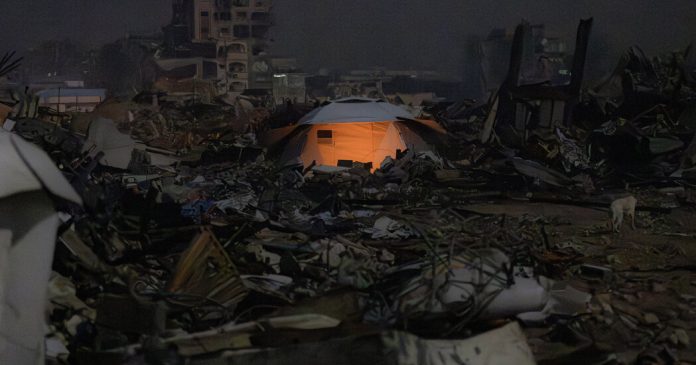
The current standoff stems in part from Hamas’s accusation that Israel has failed to uphold its promises for the first phase of the cease-fire — a six-week period that started on Jan. 19. Under the terms of the deal, Israel was required to send hundreds of thousands of tents into Gaza, among other humanitarian supplies, a promise that Hamas says Israel has not kept.

Speaking on the condition of anonymity to discuss a sensitive matter, three Israeli officials and two mediators said that Hamas’s claims were accurate.

But COGAT, the Israeli military unit that oversees aid deliveries to Gaza, said in a written response that they were “completely false accusations. Hundreds of thousands of tents have entered Gaza since the beginning of the agreement, as well as fuel, generators and everything Israel pledged.”

Regardless, officials and commentators say this aspect of the dispute can be resolved relatively easily if Israel allows more aid to Gaza.

The more serious issue is the widespread perception that Mr. Netanyahu is attempting to undermine the negotiations over whether to extend the truce beyond early March.

Those talks were meant to begin early last week. Instead, Mr. Netanyahu delayed sending a team to Qatar, which is mediating between the two sides, until early this week.

That delegation consisted of three officials who have not previously led Israel’s negotiating effort, according to five Israeli officials and an official from one of the mediating countries. And their mandate was only to listen, not negotiate.

According to two of the officials, the Israeli delegation listened to a general Qatari proposal about the next phase of negotiations, then announced that it would return to Israel.

That created the perception that Mr. Netanyahu was playing for time rather than seriously trying to extend the truce.

All of the officials spoke on the condition of anonymity to discuss the private talks more freely.

Asked for comment, Omer Dostri, a spokesman for the prime minister, said that Mr. Netanyahu was “working tirelessly to return all hostages held by the Hamas terrorist organization.” Mr. Dostri added that Israel would send a negotiating team to discuss the deal’s extension after Israel’s position had been set by the cabinet.

But Mr. Netanyahu has often said that Hamas will not remain in power at the end of the war. And key members of Mr. Netanyahu’s governing coalition have called repeatedly to resume the war to oust Hamas, despite calls from much of the Israeli public for an extension of the truce to free more hostages, even if it leaves Hamas in power.

Hamas’s threat on Monday was an attempt not only to accelerate aid deliveries to Gaza, analysts said, but also to force Mr. Netanyahu to negotiate earnestly.

It was also most likely a response to Mr. Trump’s recent statements about depopulating Gaza, which envisage no future for Palestinians, let alone Hamas, in the postwar territory.

Hamas did not immediately respond to a request for comment.

Michael Milshtein, an Israeli analyst of Palestinian affairs, said, “There’s an anger among Hamas about the demands of both Netanyahu and Trump that Hamas will be kicked out of Gaza.”

“The announcement yesterday was a kind of a signal that, if you continue demanding this, there will be several dramatic crises,” Mr. Milshtein added.

Natan Odenheimer and Gabby Sobelman contributed reporting.

Trump supporters happy with his actions in first weeks back in office, polls say

0

President Trump’s supporters are happy with the moves he’s taken in his first weeks back in office. NPR speaks with political strategist Sarah Longwell about his favorable poll ratings.

Trump signs executive order ending ‘forced use of paper straws’

0

President Donald Trump signed an executive order on Monday ending the “procurement and forced use of paper straws.”

The order directs the federal government to stop purchasing paper straws and ensure they are no longer offered in federal buildings, according to a White House fact sheet.

It also requires the development of a “National Strategy” to end the use of paper straws within 45 days and “alleviate the forced use of paper straws nationwide.”

‘BACK TO PLASTIC!’: TRUMP VOWS EXECUTIVE ORDER ENDING ‘RIDICULOUS’ PUSH FOR PAPER STRAWS

President Donald Trump signed an executive order on Monday to eliminate the “procurement and forced use of paper straws,” stating paper straws are more expensive than plastic and use harmful chemicals. (AP Photo/Evan Vucci)

The White House said paper straws are more expensive than plastic straws and use chemicals that may carry risks to human health.

“The irrational campaign against plastic straws has forced Americans to use nonfunctional paper straws,” the fact sheet reads, adding: “This ends under President Trump.”

The order comes after Trump vowed last week to end bans and restrictions on plastic straws.

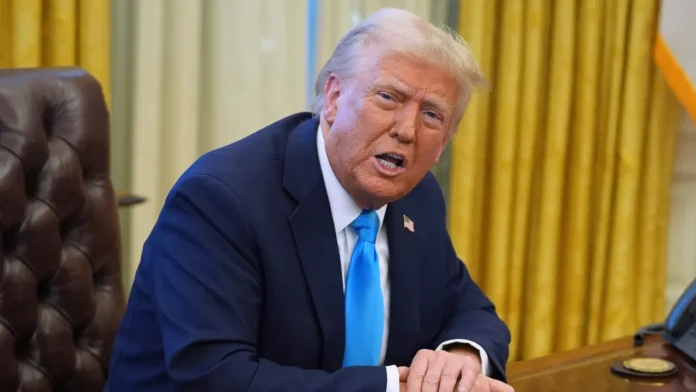
Donald Trump in the Oval Office

President Trump stated last week he would be ending the “forced use” of paper straws via an executive order. (AP Photo/Evan Vucci)

“I will be signing an Executive Order next week ending the ridiculous Biden push for Paper Straws, which don’t work,” Trump said Friday on Truth Social. “BACK TO PLASTIC!”

Several Democrat-run states, including California, Colorado, New York, Maine, Oregon, Vermont, Rhode Island and Washington, have bans or restrictions on single-use plastic straws.

Some of those states currently have laws limiting the use of single-use plastic straws in full-service restaurants unless requested by the customer.

FEDERAL AGENCIES SCRUB CLIMATE CHANGE FROM WEBSITES AMID TRUMP REBRANDING

Trump

President Trump had previously said “liberal paper straws don’t work.” (Jabin Botsford/The Washington Post via Getty Images)

CLICK HERE TO GET THE FOX NEWS APP

Democrat-led states have also adopted the use of paper straws as a more environment-friendly alternative, which Trump has criticized for years. He said in a 2019 social media post that “liberal paper straws don’t work.”

This comes after former President Joe Biden’s administration announced plans in July to phase out single-use plastic in the federal government.

Fox News’ Aubrie Spady contributed to this report.

Israel’s Security Cabinet Meets as Pressure on Hamas Cease-Fire Rises

0

Prime Minister Benjamin Netanyahu of Israel held an emergency cabinet meeting on Tuesday after Hamas said it was postponing the next release of Israeli hostages from the Gaza Strip, increasing the pressure on an already fragile three-week cease-fire.

The security cabinet was set to consider how — or whether — to move forward with ongoing negotiations to secure the safe release of all hostages this spring. The meeting began shortly after midday in Jerusalem, according to three Israeli officials.

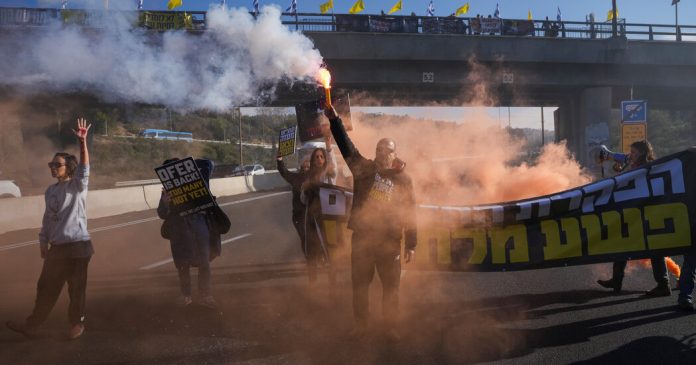
Ahead of the meeting, relatives of the hostages blocked Israel’s main highway Tuesday morning with protest signs and orange smoke bombs. Even as one family rejoiced in receiving a proof-of-life message about 27-year-old twins Gali and Ziv Berman, another was told that Shlomo Mantzur, the oldest hostage at 86, had been killed.

Mr. Netanyahu moved up Tuesday’s meeting after Hamas said on Monday it would indefinitely postpone the release of several more hostages who had been expected to be freed on Saturday. Hamas accused Israel of violating parts of the cease-fire agreement.

Hours later, President Trump threw down a gauntlet of his own, demanding that all of the remaining hostages be released by 12 o’clock on Saturday or “all hell is going to break out.”

Only a handful of Israeli hostages have been released each week since the cease-fire began, coinciding with the freeing of hundreds of Palestinian prisoners from Israeli jails as required under the first stage of the negotiated deal.

Sixteen of 33 Israeli hostages have been released so far as required in the initial part of the deal that is set to expire in early March. About 60 other hostages, some of whom are believed to be dead, would be released in a second phase intended to last six weeks.

But some Israeli officials have resisted a second stage of the deal that would include talks on how to fully end the 15-month war, urging instead to continue fighting Hamas and, potentially, rescue the hostages sooner.

“Trump is right! Go back and destroy now!” the far-right lawmaker Itamar Ben-Gvir said in a social media post on Tuesday morning.

Others want the negotiations, which have been held in Doha with the United States, Egypt and Qatar serving as intermediaries, to continue as the only way to ensure the hostages’ safety and usher in a lasting peace.

“The sign of life from twins Gali and Ziv Berman is a wake-up call this morning to the Israeli government,” the opposition leader Yair Lapid wrote on social media. “Netanyahu, go to Doha. Bring everyone home. Time is running out.”

Hamas’s announcement of a delay in the next hostages-for-prisoners exchange was issued after Mr. Trump repeatedly said last week that Palestinians should be removed from Gaza and relocated to Jordan and Egypt. The forced deportation of a civilian population is a war crime under international law.

In an interview on Fox News that aired Monday night, Mr. Trump said the roughly two million Palestinians in Gaza would not have the right to eventually return to their homeland, “because they’re going to have much better housing — in other words, I’m talking about building a permanent place for them.”

On Tuesday, Arab media reported that Hamas was undeterred by Mr. Trump’s most recent comments. “Trump should remember that there is an agreement that must be respected by both sides, and this is the only path for the hostages’ return,” Hamas official Sami Abu Zuhri told Alaraby TV.

Palestinians, Arab states and even some American allies in Europe have roundly rejected his proposal to force Gazans from their homes.

King Abdullah II of Jordan was to meet with Mr. Trump in Washington on Tuesday. But plans for an upcoming visit by President Abdel Fattah el-Sisi of Egypt appear to have been scrapped, Arab media reported.

The specter of the cease-fire falling apart rattled other world leaders.

“We must avoid at all costs resumption of hostilities in Gaza that would lead to immense tragedy,” António Guterres, the United Nations secretary general, wrote on social media. “I appeal to Hamas to proceed with the planned liberation of hostages. Both sides must fully abide by their commitments in the cease-fire agreement & resume serious negotiations.”

Gabby Sobelman, Natan Odenheimer, and Aaron Boxerman contributed reporting.

Vance to attend international AI and security summits : NPR

0

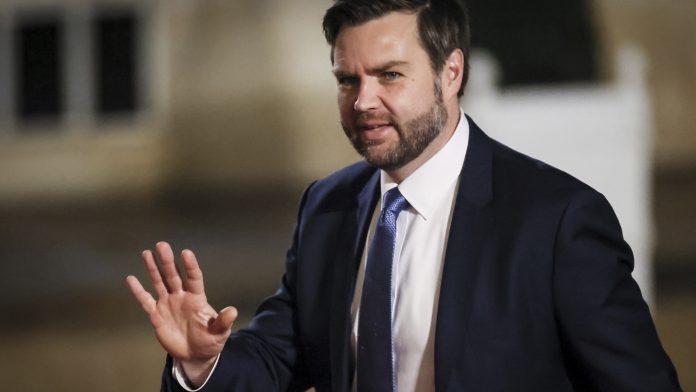
United States Vice-President JD Vance arrives for a dinner at the Elysee Palace, during an event on the sidelines of the Artificial Intelligence Action Summit in Paris on Monday.

Thomas Padilla/AP


hide caption

toggle caption

Thomas Padilla/AP

U.S. Vice President JD Vance has arrived in France as part of a European trip that will focus the new Trump administration’s attention on the regulation of artificial intelligence and the war in Ukraine, as Vance plans meetings with world leaders ranging from French President Emmanuel Macron to Indian Prime Minister Narendra Modi.

The new vice president, who had served less than two years in the Senate before Trump picked him as a running mate, will attend the AI summit in Paris hosted by Modi and Macron, who has already announced more than $100 billion in planned European investment into the technology.

Vance will then travel on to the German city of Munich for an annual security conference, that in recent years has become a key discussion forum on support for Ukraine in its defense against Russia. There Vance may once more meet with Ukrainian President Volodomyr Zelenskyy, as he did last year, and perhaps give a clearer indication of the Trump administration’s plans for Ukraine.

In recent days, Trump said he had spoken with his Russian counterpart Vladimir Putin, and has said he is considering stronger sanctions against Moscow. But during his presidential campaign last year he questioned the Biden administration’s costly military support for Kyiv in the form of U.S. funding and weapons.

In Paris, Vance may also outline American opposition to a tighter global AI regulatory framework, at a time when U.S. technology firms are moving quickly to develop artificial intelligence tools that may have significant impacts on the government and economies of developed countries, as well as significant security implications.

Europe has earned a reputation in recent years for a more stringent and even cautious approach to the new technology, while the U.S. and – more recently – China boast booming businesses in the sector, with authorities in Beijing and Washington vying to help those domestic champions dominate the new industry.

Vance will likely use the summit in Paris to push back on further AI regulation, as part of the Trump administration’s muscular “America First” approach to global affairs in general, before reiterating a common Trump refrain while in Europe: that military allies need to further ramp up spending that supports NATO and Ukraine.

The vice president has said he hopes his meetings with world leaders in Paris will also lead to a breakthrough on the grinding Ukraine-Russia conflict as it approaches its fourth year. “I think there’s a lot that some of the leaders who are present at the AI summit could do to, frankly — bring the Russia-Ukraine conflict to a close,” he told Breitbart news.

Trump had once promised to end the conflict on his first day back in office, but has recently altered that prediction to allow for the first six months of his new administration.

European officials and policymakers will also listen carefully to any pronouncements from Vance about the possibility of trade tariffs on European products, after Trump imposed 10% duties on Chinese goods and continues to threaten tariffs against Mexico and Canada. Indeed, Trump introduced some against European products including Italian cheese and French wine during his first administration.

MAHA, RFK Jr. confirmation puts MMR childhood vaccines in spotlight

0

Amid RFK Jr.’s push to improve healthcare as part of the Make America Healthy Again (MAHA) movement, there is a growing focus on vaccine transparency.

One of the most common childhood inoculations — the measles, mumps and rubella (MMR) vaccine — has been a requirement for school attendance since its development in the 1970s.

Fox News medical contributor Dr. Nicole Saphier answered some frequently asked questions regarding the vaccine in a video sent to Fox News Digital. (See the video at the top of the article.)

MAKE AMERICA HEALTHY AGAIN: WHAT TO KNOW ABOUT THE MOVEMENT

People often ask why the three vaccines are combined, which Saphier said is simply for convenience.

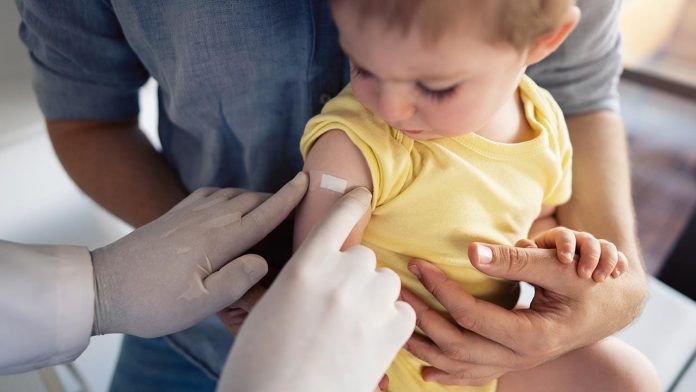
One of the most common childhood inoculations — the measles, mumps and rubella (MMR) vaccine — has been a requirement for school attendance since its development in the 1970s. (iStock)

“From a public health standpoint, if the goal is to vaccinate as many children as possible to reach that herd immunity and keep these infections at bay, again, parents are more likely to only bring their child to the pediatrician that one time,” the doctor said.

“And on a child, isn’t it easier to give one injection as opposed to three separate injections?”

LARA TRUMP ON FOOD, HEALTH AND AMERICA’S CHILDREN: ‘WE WANT THE TRUTH’

Saphier also addressed some concerns about MMR vaccine side effects, including inflammatory reactions at the site of the injection, where the skin can become red and warm.

Children can also have low-grade fevers and feel irritable or lethargic, which is “likely to happen” even with each individual vaccine – not just when they are combined.

Sick child and mother touching child's forehead.

Kids can also have low-grade fevers and feel irritable or lethargic, which is “likely to happen” with any of the three individual vaccines, Saphier said. (iStock)

“The reality is there are always side effects when it comes to any sort of healthcare intervention,” she said in the video. “But with vaccines in particular, you can have the more mild side effects, and there are some severe, more rare side effects that are well-documented.”

The potential for autism being linked to vaccinations has been a deterrent for many parents when choosing to vaccinate their children, but Saphier said the “overwhelming majority” of “good research” shows no causal link.

BILL GATES LIKELY HAD AUTISM AS A CHILD, HE REVEALS: ‘WASN’T WIDELY UNDERSTOOD’

One of the largest studies, which was conducted in Denmark, found a lower risk of autism in more than 650,000 vaccinated children, the doctor noted.

Close upshot of healthcare professional sucking liquid medication or vaccine into a syringe from a glass vial with suction cap.

The threat of autism being linked to vaccinations has been a deterrent for many parents, but Saphier said the “overwhelming majority” of “good research” shows no causal link. (iStock)

While the U.S. has a higher incidence of autism compared to other countries, specifically Europe, the doctor revealed that European nations have higher rates of MMR vaccine uptake.

“Isn’t it easier to give one injection as opposed to three separate injections?”

“The signs and symptoms [of autism] start to show around the time we’re giving all these vaccines, so it makes sense to kind of think they may be related,” she said. 

“And it made sense to do as much research as we can to make sure there isn’t a link.”

MAHA MOMS CALL FOR ‘RIGOROUS TRANSPARENCY’ INTO HEALTH CONCERNS

“But I think we need to be looking really hard at our environment, what we’re ingesting, the pollutants, the toxins, everything in big agriculture, big pharma, in our food industry and everything else.”

Saphier suggested that a link to autism may be found after diving into the “harmful chemicals” consumed by Americans that other nations do not consume.

Rearview shot of three children looking out the window on a rainy day

Saphier suggested looking into environmental factors that could increase autism risk.

The doctor also said that medical agencies — such as the Centers for Disease Control and Prevention and the American Academy of Pediatrics — should be “less stringent” on vaccination schedules, leaving the decision to the parents.

“It should be a conversation between the doctor and the patient.”

“If parents don’t want to give these vaccines when their babies are so little, I think it’s OK to have that conversation and let them wait until their child’s a little bit older before they head off to kindergarten,” said Saphier, who is a mother of three boys.

For more Health articles, visit www.foxnews.com/health

“Because maybe at that time, you start to see signs of autism between about 1 to 3 years of age for the most part. So maybe let the parent get their child through that time, and if there aren’t signs of autism, then maybe they’ll feel better about … being able to vaccinate their children.”

Parents with their kids during a spring day on a patio.

Saphier said she supports returning autonomy to the parents when it comes to vaccines for children. (iStock)

“It should be a conversation between the doctor and the patient,” she said. “Unfortunately, during the COVID pandemic, the CDC and a lot of healthcare professionals really took away this conversation.” 

CLICK HERE TO GET THE FOX NEWS APP    

“By putting the COVID vaccine and booster for children in the same basket as MMR and some of the other vaccines, when it comes to children, that was the biggest mistake they could have ever [made],” Saphier continued. 

“That has caused more vaccine hesitancy and concern.”

CLICK HERE TO SIGN UP FOR OUR HEALTH NEWSLETTER

Saphier expressed her hope that the MAHA movement will help identify safety signals in vaccines, which will “give parents the confidence they need to continue with the vaccine programs, because they really can save lives.”

Fox News Digital’s Khloe Quill contributed reporting.

Four Colombian nationals arrested in Oregon for string of home burglaries

0

Four Colombian nationals were arrested by Oregon authorities following a recent string of home burglaries.

The Tigard Police Department (TPD) confirmed the arrests were in connection with 39 burglary cases targeting what appeared to be affluent Asian-American households beginning in late September.

Investigators said the suspects used a similar break-in method each time.

A warning was sent out in November alerting residents across three jurisdictions of the home burglaries, including four in Tigard, four in Washington County and two in Beaverton. 

FBI WARNS SOUTH AMERICAN CRIME GROUPS TARGETING STAR ATHLETES IN BURGLARIES: REPORT

The Tigard Police Department have arrested four Colombian nationals in connection with a string of 39 home burglary cases allegedly targeting Asian-American households since September. (Tigard Police Department)

On Feb. 2, search warrants were executed in Oregon City, Bend and Portland related to this investigation.

The first was in Oregon City where TPD, the Clackamas County Sheriff’s Office SWAT team and many other agencies served a warrant in an apartment complex in the 14100 block of South Beavercreek Road. 

The second was in Bend where Bend police and the Central Oregon Emergency Response Team executed a warrant in an apartment complex in the 55000 block of Gross Drive.

Stolen goods

Investigators recovered cash, evidence, stolen jewelry and seized multiple vehicles in the execution of the warrants. (Tigard Police Department)

BODYCAM SHOWS WILD HOUSTON GUNFIGHT AS OFFICERS RESPOND TO ACTIVE HOME INVASION ROBBERY

Investigators recovered cash, evidence, and stolen jewelry, and seized multiple vehicles during the execution of the warrants.

Four suspects, all of whom are Colombian nationals, were arrested by Tigard police on felony charges. They were extradited back to Washington County.

They were identified as Herbert Grueso-Vergara, 30; Maria Castro-Gamboa, 26; Fabio Vergara-Cortes, 29; and Fatima Gomez-Aragon, 33.

police shield

Tigard Police Department, along with other agencies, took action on a string of home burglaries that appeared to be connected. (Tigard Police Department)

An additional warrant was served on Feb. 5 by the TPD, the Portland Police Bureau and PPB’s Special Emergency Reaction Team (SERT) at an apartment complex in the 9400 block of North Bristol Avenue. 

Stolen jewelry and other evidence linked to the investigation were also recovered at this location. 

CLICK TO GET THE FOX NEWS APP

The TPD also thanked the handful of Oregon and Washington officials involved in the investigation.

This is an ongoing investigation and authorities expect more charges to be filed.

Fresh Violence as Bangladesh’s Ousted Ex-Leader Addresses Nation

0

Bangladesh is facing a fresh bout of violence as members of a student protest movement that toppled the authoritarian government of Sheikh Hasina in August clashed again with her supporters, highlighting the fragility of a country struggling to rebuild itself.

The violence started on Wednesday, after the Awami League, the political party of Ms. Hasina, the former prime minister, said that she would address the students and citizens of Bangladesh via audio from India, where she has been based since her Aug. 5 ouster. Student protesters said the virtual speech would instigate violence. Thousands of students then bulldozed and set fire to a museum that had once been the residence of Ms. Hasina’s father, Sheikh Mujibur Rahman, a founder of Bangladesh.

Clashes between student protesters and supporters of the Awami League lasted three days before the interim government led by the Nobel Peace Prize laureate Muhammad Yunus instituted “Operation Devil Hunt,” bringing in Bangladesh police and paramilitary forces on Saturday to crack down on sympathizers. The Awami League has threatened to protest against the students’ actions.

After Ms. Hasina’s live speech in which she reminded Bangladeshis of the sacrifices her father had made and how the country had flourished during her tenure, protesters and Awami League supporters in the Dhaka area began attacking one another. Mr. Yunus began the police operation on Feb. 8, after reports of spiraling violence and injuries.

“The government is urging all the citizens to abide by the law,” Mr. Yunus said in a statement. “The new Bangladesh we are working together to build, moving away from the old Bangladesh under fascist rule, will be distinguished by following the rule of law.”

Officials said more than 1,300 people had been arrested since the latest round of violence erupted — mostly from the Awami League — and things were calm for now. Although the interim government has sought to ban Ms. Hasina’s party, the Awami League is trying to reassert itself. Members recently called for protests and strikes this month. They have tried to tag student groups as Islamist militants, comparing them to supporters of Pakistan during Bangladesh’s war of independence from it.

The recent descent into violence in Bangladesh threatens to destabilize the effort by university students to build a new democracy with free and fair elections, calling for a Constitution immune to manipulation and governance without corruption. What started as a revolt in July against a system of reserving jobs for the descendants of freedom fighters erupted into widespread anger at Ms. Hasina, who had become increasingly authoritarian during her 15-year rule.

More than 800 people died during the student revolution last summer, according to officials. To avenge their deaths, the Yunus government has repeatedly sought Ms. Hasina’s extradition from India to be tried for crimes against humanity. India has yet to provide a response.

Ms. Hasina has participated in Awami League meetings virtually, according to videos posted on Facebook and other clips of her speeches. But her first public address was on Feb. 5.

The day after Ms. Hasina’s audio broadcast, the Yunus government said in a statement that she had “insulted and disrespected” those who had given their lives in last summer’s uprising. “Despite the fact that she fled the country, she continues to use the same tone of threats, as she used to when she was in power through corruption, terror and inhuman repression,” the statement read.