Friday, November 13, 2026
Home Blog Page 266

Texas school district warns parents Border Patrol may question or deport students

0

A Texas school district sent parents a letter Wednesday warning that Border Patrol agents may be boarding school buses and their children may be detained or deported.

The letter, which was also posted to Facebook but later deleted, warned that U.S. Border Patrol agents would possibly be boarding the school buses used for extracurricular activities at highway checkpoints and asking to see proof of legal citizenship.

“We want to bring to your attention an important matter regarding student travel for extracurricular activities, including sports, band, and other co-curricular events,” Alice Independent School District Superintendent Anysia Trevino wrote in the letter. “We have received information that U.S. Border Patrol agents may be boarding school buses at highway checkpoints in and out of the Valley to question students about their citizenship status.”

OKLAHOMA SUPERINTENDENT WHO BRAWLED WITH CNN OVER ICE ENTERING SCHOOLS DOUBLES DOWN: ‘DEPORTED TOGETHER’

Parents in Texas’s Alice Independent School District were warned in a letter signed that Border Patrol agents may start boarding school buses and their children may be detained or deported. (Facebook)

The letter stated the ramifications if the student could not produce proper identification or documentation and went on to warn that if a student lies about their immigration status it could hinder them getting U.S. citizenship in the future.

“We strongly encourage families to be aware of the potential implications of these encounters. If a student is found to be without proper documentation, they may be removed from the bus, detained, and possibly deported under current immigration policies. Additionally, if a student provides false information regarding their citizenship, and it is later discovered, this could result in a permanent bar to future U.S. citizenship.” 

Federal immigration law currently states that an individual that lies about being a U.S. citizen may be disqualified from receiving a green card or U.S. citizenship.

US Immigration and Customs Enforcement (ICE) agents, along with other federal law enforcement agencies, attend a pre-enforcement meeting

US Immigration and Customs Enforcement (ICE) agents, along with other federal law enforcement agencies. (Christopher Dilts/Bloomberg via Getty Images)

SCHOOLS NATIONWIDE BRACE FOR TRUMP, INCLUDING MEASURES COMPELLING TEACHERS NOT TO COOPERATE WITH ICE

The superintendent did advise she was looking at ways to add measures to lessen the impact and stated that any parent with concerns should reach out.

“To ensure that families are fully informed, we are reviewing our student travel waivers and may include language advising parents of this possibility,” the letter read.

“Furthermore, we are considering additional measures, such as having a designated chaperone vehicle travel with school buses. In the event that a student is detained, a school administrator in the chaperone vehicle would be able to stay with the student while the rest of the group continues their journey.”

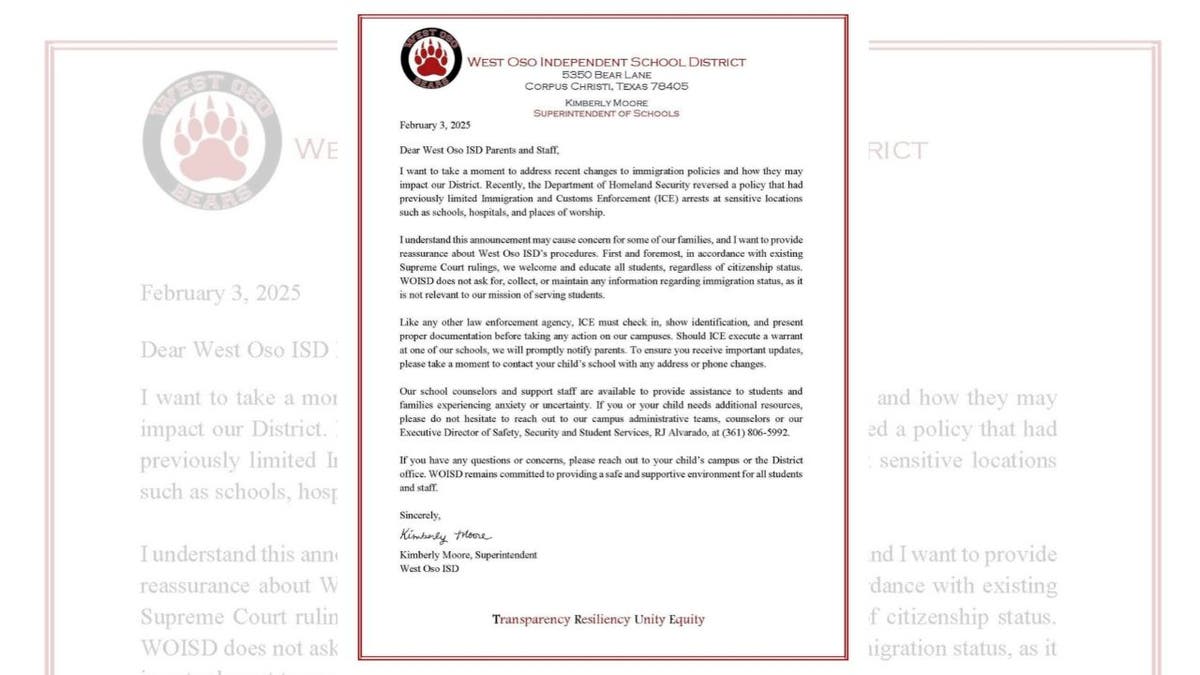
This is not the first school district to address the change in immigration policies.  West Oso ISD recently sent out a letter to its parents warning them of the change in policy and informing them of the procedures for its schools.

“I want to take a moment to address recent changes to immigration policies and how they may impact our District. Recently, the Department of Homeland Security reversed a policy that had previously limited Immigration and Customs Enforcement (ICE) arrests at sensitive locations such as schools, hospitals, and places of worship,” it read.
Letter

A letter from parents, signed by the West Oso ISD.  (Facebook)

The letter went on to say that they welcome all students regardless of their citizenship status.

“WOISD does not ask for, collect, or maintain any information regarding immigration status, as it is not relevant to our mission of serving students. Like any other law enforcement agency, ICE must check in, show identification, and present proper documentation before taking any action on our campuses. Should ICE execute a warrant at one of our schools, we will promptly notify parents,” the letter stated.

A statement released in January by a DHS spokesperson clarified that Acting Department of Homeland Security Secretary Benjamine Huffman issued two directives empowering law enforcement to protect Americans.

Hillsborough parents blast sex education curriculum

The letter went on to say that they welcome all students regardless of their citizenship status. (iStock)

The first of those directives rescinds the Biden Administration’s guidelines for Immigration and Customs Enforcement (ICE) and Customs and Border Protection (CBP) enforcement actions that thwart law enforcement in or near so-called “sensitive” areas.

CLICK HERE TO GET THE FOX NEWS APP

“This action empowers the brave men and women in CBP and ICE to enforce our immigration laws and catch criminals including murderers and rapists who have illegally come into our country. Criminals will no longer be able to hide in America’s schools and churches to avoid arrest. The Trump Administration will not tie the hands of our brave law enforcement, and instead trusts them to use common sense.”

This action now allows law enforcement to enter schools, medical facilities, and places of worship to arrest undocumented immigrants. It also allows ICE agents to operate at events that had previously been protected under the policy, including weddings, funerals, and public demonstrations.
Trump and Netanyahu Leave Little Daylight Between Them

0

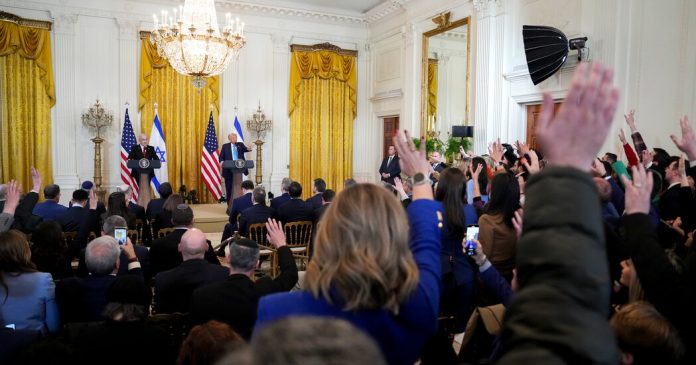
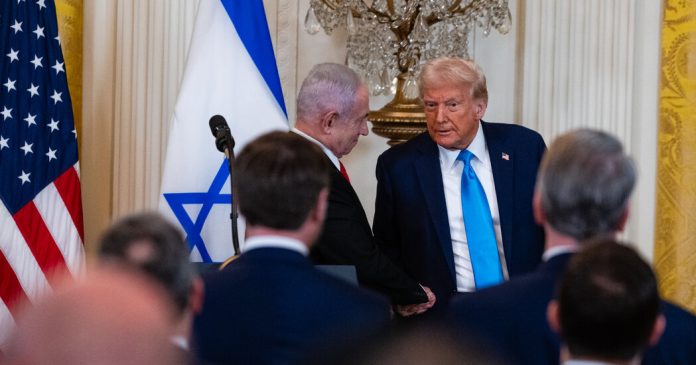
As he sat next to President Trump on Tuesday, Prime Minister Benjamin Netanyahu of Israel had a grin on his face that he rarely had during the last administration. And why not? He got most everything he came to Washington for.

Put aside the president’s far-fetched notion of a U.S. takeover of Gaza. Mr. Trump made clear that he had no intention of pressing Mr. Netanyahu as President Joseph R. Biden Jr. did at times since the Israeli leader returned to power in 2022.

In fact, Mr. Netanyahu’s mere presence in the White House was a sign of how much has changed. Mr. Biden did not host the prime minister at the executive mansion until last July, more than 18 months into Mr. Netanyahu’s latest term and six months before the end of his own. By contrast, Mr. Trump made Mr. Netanyahu the first foreign leader he has invited since his own return to power a little over two weeks ago.

During their meetings, Mr. Trump indicated that he would not try to stop Israel from continuing to wage war against Hamas even at the expense of the temporary cease-fire now in effect. Just before Mr. Netanyahu’s arrival at the White House on Tuesday, Mr. Trump signed an order reinstating “maximum pressure” on Iran and later, with the Israeli leader at his side, vowed again to prevent Tehran from obtaining a nuclear weapon.

Mr. Trump also recommitted to brokering a diplomatic rapprochement between Israel and Saudi Arabia, a potentially legacy-making priority for Mr. Netanyahu, while dropping any support for a Palestinian state, something the prime minister has rejected despite pressure from the Saudis and others. He has also canceled sanctions imposed by Mr. Biden on violent West Bank settlers and has released weapons held up by the former president.

“All of the hoopla on the U.S. taking over Gaza caused us to miss the real story from the meeting,” said Aaron David Miller, a longtime Middle East peace negotiator now at the Carnegie Endowment for International Peace. “Bibi leaves the White House among the happiest humans on the planet. If there ever was a demonstration of no daylight between Israel and the U.S., this was it.”

Mr. Netanyahu alluded to the tension with Mr. Biden during his meeting with Mr. Trump. Despite his strong support for Israel over a half-century in public life and particularly after the Oct. 7, 2023, terrorist attack by Hamas that killed 1,200 people, Mr. Biden periodically pushed the Israeli leader to do more to avoid civilian casualties in Gaza, alleviate the humanitarian crisis there and bring the war to an end. Mr. Netanyahu resisted and made clear on Tuesday how happy he was that Mr. Biden was gone.

“When Israel and the United States work together — and President Trump and I work together, you know — the chances go up a lot” for success, Mr. Netanyahu said in the Oval Office. “It’s when we don’t work together, Israel and the United States don’t work together, that creates problems. When the other side sees daylight between us — and occasionally in the last few years, to put it mildly, they saw daylight — then it’s more difficult.”

At another point, Mr. Netanyahu was asked who deserved more credit for the cease-fire agreement reached last month, Mr. Biden or Mr. Trump. Mr. Biden first put the cease-fire deal on the table and his team spent months negotiating all the details, but Mr. Trump’s pressure at the end forced the negotiators to finally sign off.

In response to the question, Mr. Netanyahu praised Mr. Trump’s “great force and powerful leadership” and said nothing about Mr. Biden.

The duet sung by the two leaders papered over the rift that developed during the final year of Mr. Trump’s first term, when he bristled at what he considered Mr. Netanyahu’s presumption and erupted when the Israeli leader congratulated Mr. Biden on his victory in the 2020 election.

But there were still a couple of discordant notes. It was somewhat surreal to listen to Mr. Trump repeatedly lament all the “death and destruction” wrought on the Palestinian people in Gaza while sitting next to the prime minister who gave the orders for the war that has killed 47,000 people, according to Gaza health authorities.

The two also gave different assessments of Iran’s strength. Mr. Netanyahu boasted of everything that he has done in the past 16 months to damage Iran and its proxy forces Hamas and Hezbollah. “The Iran terror axis has never been weaker,” he said.

But that does not fit the narrative Mr. Trump has been pushing. He has been arguing that Mr. Biden was too soft on Iran, which in this version has grown ever more powerful during the past four years. “They’re not weak,” Mr. Trump insisted. “They’re very strong right now.”

Still, those disparities went largely unnoticed amid the bonhomie. Two leaders, both of whom have faced criminal trials, both of whom have recaptured office after being defeated, relished their renewed alignment and did all they could to avoid any daylight.

Guatemala gives U.S. another migrant deportation deal : NPR

0

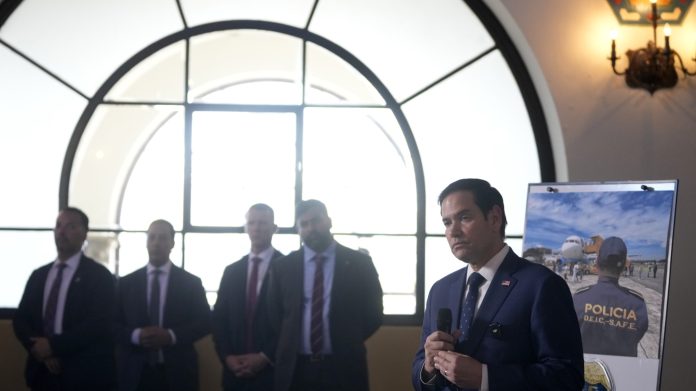
U.S. Secretary of State Marco Rubio speaks after a tour of a migrant return center and a demonstration of a dog trained to sniff out narcotics, at La Aurora International Airport in Guatemala City on Wednesday.

Mark Schiefelbein/Pool AP


hide caption

toggle caption

Mark Schiefelbein/Pool AP

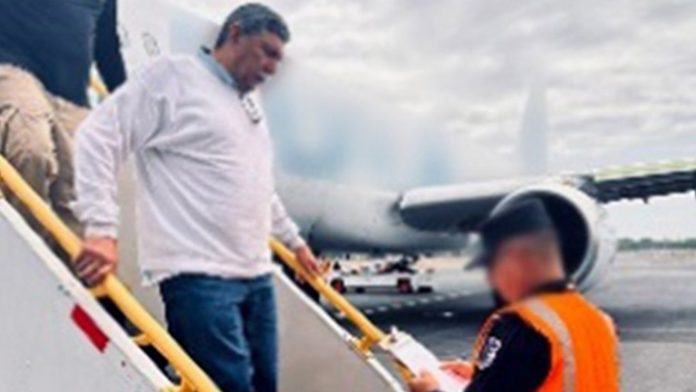
GUATEMALA CITY — Guatemalan President Bernardo Arévalo said Wednesday his country will accept migrants from other countries who are being deported from the United States, the second deportation deal that Secretary of State Marco Rubio has reached during a Central America trip that has been focused mainly on immigration.

Under the agreement announced by Arévalo, the deportees would be returned to their home countries at U.S. expense.

“We have agreed to increase by 40% the number of flights of deportees both of our nationality as well as deportees from other nationalities,” Arévalo said at a news conference with Rubio.

Previously, including under the Biden administration, Guatemala had been accepting on average seven to eight flights of its citizens from the U.S. per week. Under President Donald Trump it’s also been one of the countries that have had migrants returned on U.S. military planes.

El Salvador announced a similar but broader agreement on Monday. Salvadoran President Nayib Bukele said his country would accept U.S. deportees of any nationality, including American citizens and legal residents who are imprisoned for violent crimes.

Both Trump and Rubio acknowledged the legal uncertainty of sending Americans to another country for imprisonment.

“I’m just saying if we had a legal right to do it, I would do it in a heartbeat,” Trump told reporters Tuesday in the Oval Office. “I don’t know if we do or not, we’re looking at that right now.”

Rubio called it a very generous offer but said there were “obviously legalities involved. We have a Constitution.”

Immigration, a Trump administration priority, has been the major focus of Rubio’s first foreign trip as America’s top diplomat, a five-country tour spanning Panama, El Salvador, Costa Rica, Guatemala and the Dominican Republic.

The agreements with El Salvador and Guatemala potentially help the Trump administration address what has always been a key sticking point in immigration enforcement since not everyone in the U.S. illegally can be easily sent back home.

Venezuela, for example, has been a major source of migrants coming to the U.S. in recent years, but rarely can the U.S. deport Venezuelans back to their home country. But the U.S. already has a robust network set up to send people to several Central American countries.

Guatemala will expand its capacity to receive not just Guatemalans, but also migrants from other countries who will then be repatriated to their home countries. The details still need to be worked out.

“However, the permanent answer to immigration is to bring development so that no one has to leave the country,” Arévalo said. To that end, a high-level Guatemalan delegation, including from the private sector, will travel to Washington in the coming weeks.

Arévalo also announced the formation of a new border security force that will patrol Guatemala’s borders with Honduras and El Salvador. The force will be made up of police and soldiers and will combat transnational crime of all kinds, he said.

Rubio’s trip has been dogged by the administration’s dismantling of the U.S. Agency for International Development, including a late Tuesday order abruptly pulling almost all agency staffers off the job.

After the news conference with Guatemala’s president, Rubio headed directly to the U.S. Embassy, where staffers and their families who were unsure of their futures gathered to hear from their new boss.

The meet-and-greet event was closed to the press, as was an earlier similar event in El Salvador. Both Guatemala and El Salvador have significant USAID missions. In Panama on Sunday before the shut down announcement, Rubio’s embassy event had been open to journalists.

From there Rubio wrapped up his Guatemala stop by visiting a local migration facility near an air force base where deportees are processed for integration back into their home communities. Under the measures announced Wednesday by Guatemala’s president, the number of deportees is expected to rise by as much as 40%. The program has been supported by the U.S. State Department and Department of Homeland Security.

Rubio also got a briefing on Guatemala’s counternarcotics efforts, including the interception of at least four shipments of fentanyl precursors since late November totaling 127.5 kilograms (280 pounds), enough to produce more than 114 million doses of the drug.

Rubio, who has offered exemptions to Trump’s sweeping freeze on foreign assistance, has signed waivers to allow funding for both programs to continue, officials said.

“This is an example of foreign aid that’s in our national interest. That’s why I’ve issued a waiver for these programs. That’s why these programs are coming back online. And they will be functioning because it’s a way of showing to the American people this is the kind of foreign aid that’s aligned with our foreign policy, with our national interest,” Rubio said.

Rubio also spoke Wednesday with Mexican Foreign Secretary Juan Ramón de la Fuente to discuss ways to secure the U.S.-Mexico border, fight fentanyl and transnational criminal organizations and end illegal immigration, according to a State Department statement.

ICE Philadelphia removes El Salvador fugitive accused of raping a child back home

0

An El Salvador man wanted for sex crimes involving a minor in his home country was detained in Philadelphia by U.S. Immigration and Customs Enforcement.

ICE removed Francisco Javier Melendez Torres, who was wanted by law enforcement in El Salvador for aggravated rape of a minor and sexual harassment, on Jan. 31. He entered the United States illegally and had a final order of removal issued in December 2024.

“The removal of Francisco Javier Melendez Torres, a dangerous criminal alien wanted for aggravated rape of a minor in El Salvador, highlights the dangers individuals like him pose to our communities,” said Brian McShane, ICE Enforcement and Removal Operations acting Philadelphia field office director.

McShane said ICE is “committed to ensuring that dangerous individuals like Melendez Torres do not find safe harbor” in the U.S. or threaten American citizens.

ICE SCOOPS UP ILLEGAL IMMIGRANTS WITH MURDER, ROBBERY CONVICTIONS IN WEEKEND CRACKDOWN

Francisco Javier Melendez Torres, of El Salvador, who was wanted for raping a child in his home country, was detained by Immigration and Customs Enforcement Philadelphia on Jan. 31. (ICE Philadelphia)

Melendez Torres was first arrested by U.S. Border Patrol on Feb. 5, 1986, near Rio Grande, Texas. He was served with an order to show cause and notice of hearing, charging inadmissibility, according to ICE Philadelphia. He was released the same day on an order of recognizance.

He was granted voluntary departure on Nov. 17, 1986, by an immigration judge in Harlingen, Texas, and was required to return to El Salvador by Dec. 29, 1986. 

He was deported once he failed to leave by that date.

In this June 5, 2014 photo, a Border Patrol agent uses a headset and computer to conduct a long distance interview by video with a person arrested crossing the border in Texas, from a facility in San Diego. Hit with a dramatic increase of Central Americans crossing in South Texas, the Border Patrol is relieving staffing woes by enlisting agents in less busy sectors to process arrests through video interviews. (AP Photo/Gregory Bull)

Melendez Torres was first arrested by U.S. Border Patrol agents near Rio Grande, Texas, on Feb. 5, 1986. (AP Photo/Gregory Bull)

ICE REMOVES ‘FOREIGN FUGITIVE’ WANTED IN MEXICO ON RAPE CHARGE

At some point, Melendez Torres returned to the U.S. and was convicted of driving while impaired in Hempstead, New York, on Sept. 12, 1994. The court sentenced him to five days in jail.

He left the U.S. again at an unknown date, and returned without inspection or parole by an immigration official.

He was convicted in Hempstead, New York, again, of disorderly conduct on April 30, 2014, and was sentenced to time served.

ICE arrested him in Levittown, New York, on Oct. 25, 2024, during “a targeted enforcement action” and served him with a notice to appear, charging inadmissibility.

US Immigration and Customs Enforcement (ICE) agents, along with other federal law enforcement agencies, attend a pre-enforcement meeting

Melendez Torres had a criminal history in the U.S. and had been deported several times before he was scooped up by ICE Philadelphia last month. (Christopher Dilts/Bloomberg via Getty Images)

CLICK HERE TO GET THE FOX NEWS APP

An immigration judge in Elizabeth, New Jersey, ordered him to be removed on Dec. 12, 2024. 

He remained in the U.S. until ICE Philadelphia scooped him up on Jan. 31.

To Keep Aid Coming, Ukraine Appeals to Trump Allies: Conservative Christians

0

Ukraine is sending its largest-ever delegation to a gathering of politically influential Christian leaders in Washington this week, seeking to lay out an argument that protecting religious freedom is a strong reason for continuing U.S. aid to resist Russian aggression.

The Ukrainian pastors, members of Parliament and military chaplains who will be attending the National Prayer Breakfast say they hope the message of combating religious persecution will resonate with the Trump administration officials and members of Congress who are sure to also be there.

The prayer breakfast, a major event on Washington’s social calendar since 1953, presents an opportunity for business executives, religious leaders and diplomats to jockey for access to influential coreligionists in government to sway policies. While the meeting is open to all faiths, its purpose, according to its website, is ”gathering together in the Spirit of Jesus of Nazareth.”

The Ukrainians will argue to those gathered that further Russian advances would expand a zone of repression of several Christian denominations, as well as the destruction and looting of churches and the arrests of pastors and priests — actions that rights groups have documented in areas already under Russian occupation.

“Russia doesn’t just kill people, doesn’t just destroy our cities — Russia also destroys and bans religious communities” in areas under its control, said Roman Lozynskyi, a member of Parliament with the opposition Holos Party.

Mr. Lozynskyi is a member of the Greek Catholic Church, part of a branch known as Eastern Rite Catholicism that follows the Vatican, that is persecuted in Russian-held parts of Ukraine. He recalled the deportation of a friend and Greek Catholic priest in the Russian-held city of Melitopol as an example of the suppression of Catholic congregations under occupation.

More than 100 Ukrainian pastors, politicians, military chaplains and priests, including the head of the Ukrainian Orthodox Church, Metropolitan Epiphanius I, are in Washington for the prayer breakfast on Thursday and related events through the week, said Pavlo Unguryan, a former Parliament member organizing the Ukrainian effort.

Ukrainian Orthodox priests and parishes are among the targets in eastern Ukraine. An estimated 50 priests in Russian-occupied territories — including the most senior church official in Kherson, who refused to join the Russian Orthodox Church — have been killed over the last three years, Metropolitan Epiphanius I said in an interview. Other priests have been forced to leave or to celebrate Mass in secret.

The Ukrainians also intend to highlight the plight of evangelicals, said Mr. Unguryan, who is Baptist. Within its borders, Russia has targeted evangelical Christians with investigations and has arrested Jehovah Witnesses. The repression extends to occupied Ukraine.

“Ukraine is the center of the Bible Belt of Europe,” said Mr. Unguryan, and expressions of evangelical faith there are now under threat. About one million Ukrainians attend evangelical services weekly, he said.

Russia occupies about 19 percent of Ukrainian territory and is making slow but steady gains. Ukraine is defending itself in fierce trench fighting along an about 600-mile front.

“A part of this war is spiritual,” Mr. Unguryan said. “It is important for America to know about this.”

The Ukrainians attending the prayer breakfast want to showcase the vitality of Christian churches in the country, where about 70 percent of the population say in surveys they are religious.

The effort is aimed at swaying supporters of Mr. Trump, who has voiced skepticism about the Biden administration’s heavy military and financial aid to Ukraine. This week Mr. Trump said continued aid could be exchanged for U.S. access to Ukrainian minerals.

Previous religious outreaches in the United States have already yielded results for Ukraine.

Last summer, the speaker of the House, Mike Johnson, gave a video address to a Christian gathering in Ukraine. Ukrainian Baptists have appealed to him for military and diplomatic support for their country. Mr. Johnson is a Southern Baptist who has put his conservative Christian faith at the center of his political career.

Ukrainian churches and the country’s Parliament have sent delegations to the breakfast since the early 2000s, but in recent years have ramped up attendance, calling the annual visit “Ukraine Week” in Washington. In past years, several dozen religious and political leaders turned up. The larger delegation this year, Mr. Unguryan said, is in recognition of the importance of Christianity for many supporters of Mr. Trump.

“These are absolutely important issues which can unite Ukraine, a very conservative, Christian country, with a very conservative, Christian America,” said Mr. Unguryan, who has promoted conservative social policies in Ukraine.

Ukrainian protestant pastors have volunteered widely as military chaplains during the war, Liudmyla Filipovych, a Ukrainian scholar of religion, said in an interview. Ukrainian evangelicals have opened about 100 churches in other European countries to provide Ukrainian-language services to the country’s refugees, she said.

Russia under President Vladimir V. Putin has sidelined or banned churches outside what the Kremlin has called the four “traditional” religions — Orthodox Christianity, Judaism, Islam and Buddhism. Russia is on a U.S. government list of “countries of particular concern” for restricting freedom of religion.

In occupied territory in Ukraine’s east and south, Catholic and Protestant churches face “threats, interrogations and arbitrary arrests,” according to a report released in January by Mission Eurasia, a group promoting evangelical Christianity in former Soviet States.

“The Russian occupation authorities have also extensively engaged in illegal imprisonment and convictions on fabricated charges of extremism, torture and even murder,” the report said. It described instances of closing and looting churches, and removing their crosses. Overall, Russia’s invasion has destroyed, damaged or led to the looting of at least 630 religious sites, the report said.

Metropolitan Epiphanius’s visit to Washington is part of his efforts to win international recognition of his church and support from religious leaders for its stand against Russia. His church won independence in 2019 from the Russian Orthodox Church, but some congregations continued to follow the hierarchy in Moscow.

Last year, Ukraine banned the Orthodox branch aligned with the Russian Church, drawing criticism from the Kremlin and from Pope Francis. Ukrainian officials have said the restrictions were necessary, as some priests served as Russian spies or encouraged congregants to pray for the head of the Russian church, which has blessed the invasion.

“The Russian church has tried to block our activity abroad, and we are trying to unblock it, because the church is one of the most important elements for the future of the existence of the Ukrainian state,” Metropolitan Epiphanius, the Ukrainian church leader, said in an interview in December in Rome. “We are trying to destroy these blocks, speaking the truth, because truth destroys the walls.”

Recently, he has preached that message to as many religious leaders as he can reach. He says he talks regularly to Ecumenical Patriarch Bartholomew I of Constantinople, the spiritual leader of the world’s Orthodox Christians.

With discussions swirling among Western officials over how to negotiate an end to the war, Metropolitan Epiphanius said the outcome for Ukraine was unpredictable, but he left little doubt of his hopes for Ukraine’s destiny.

“We believe that God could create the miracle, the same as he created a miracle for Syria, and Assad left Syria,” he said. “We ask everybody for the spiritual weapons, the prayers.”

Mexico deploys National Guard troops to U.S. border : NPR

0

Mexican National Guard members patrol along the Mexico-US border in Ciudad Juarez on Wednesday.

Christian Chavez/AP


hide caption

toggle caption

Christian Chavez/AP

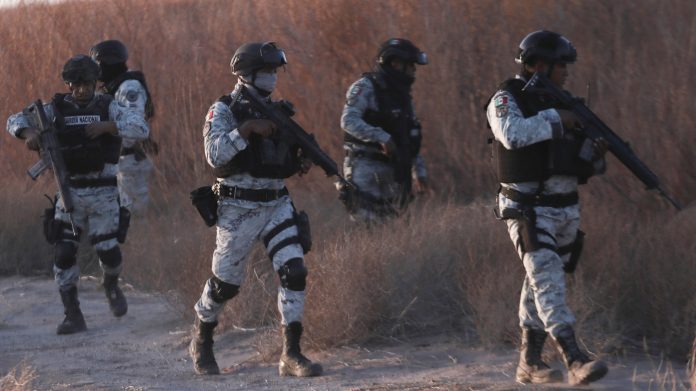
CIUDAD JUÁREZ, Mexico — A line of Mexican National Guard and Army trucks rumbled along the border separating Ciudad Juárez and El Paso, Texas, on Wednesday, among the first of 10,000 troops Mexico has sent to its northern frontier following tariff threats by President Donald Trump.

Masked and armed National Guard members picked through brush running along the border barrier on the outskirts of Ciudad Juárez, pulling out makeshift ladders and ropes tucked away in the trenches, and pulling them onto trucks. Patrols were also seen on other parts of the border near Tijuana.

It comes after a turbulent week along the border after Trump announced he would delay imposing crippling tariffs on Mexico for at least a month. In exchange, Mexican President Claudia Sheinbaum promised she would send the country’s National Guard to reinforce the border and crack down on fentanyl smuggling.

Trump has declared an emergency on the border despite migration levels and fentanyl overdoses significantly dipping over the past year. The U.S. said it would, in turn, do more to stop American guns from being trafficked into Mexico to fuel cartel violence, which has rippled to other parts of the country as criminal groups fight to control the lucrative migrant smuggling industry.

On Tuesday, the first of those forces arrived in border cities, climbing out of government planes. Guard members in the Wednesday patrol confirmed that they were part of the new force.

“There will be permanent surveillance on the border,” José Luis Santos Iza, one of the National Guard leaders heading off the deployment in the city, told media upon the arrival of the first set of soldiers. “This operation is primarily to prevent drug trafficking from Mexico to the United States, mainly fentanyl.”

At least 1,650 troops were expected to be sent to Ciudad Juárez, according to government figures, making it one of the biggest receivers of border reinforcements in the country, second only to Tijuana, where 1,949 are slated to be sent.

During U.S. Secretary of State Marco Rubio’s trip through Latin America — where migration was at the top of the agenda — the top American diplomat thanked the Mexican government for the forces, according to a statement by the Mexican government.

The negotiation by Sheinbaum was viewed by observers as a bit of shrewd political maneuvering by the newly elected Mexican leader. Many had previously cast doubt that she’d be able to navigate Trump’s presidency as effectively as her predecessor and ally, former President Andres Manuel Lopez Obrador.

Pete Alonso returning to Mets on short-term deal: reports

0

The New York Mets are bringing back first baseman Pete Alonso on a two-year, $54 million deal, according to multiple reports. 

The deal reportedly comes with an opt-out after 2025. The deal also reportedly comes with a $10 million signing bonus and a $20 million salary for 2025, with a $24 million player option for 2026.

Alonso was the team’s second-round pick out of the Florida Gators’ program in 2016, and he’s spent his first six seasons hitting home runs (226), including a rookie record 53 that aided his Rookie of the Year resume in 2019. He’s also made four All-Star teams, including each of the last three, and has a career .854 OPS. 

SIGN UP FOR TUBI AND STREAM SUPER BOWL LIX FOR FREE

Oct 8, 2024; New York City, New York, USA; New York Mets first baseman Pete Alonso (20) reacts after walking in the sixth inning against the Philadelphia Phillies during game three of the NLDS for the 2024 MLB Playoffs at Citi Field. (Brad Penner-Imagn Images)

Alonso’s uncertain return to the Mets was one of the most-discussed storylines of the MLB offseason. Team owner Steve Cohen expressed skepticism the team would re-sign the star sluggers during an appearance at the Mets’ Amazin’ Day in late January. 

There, Cohen said the negotiations with Alonso were going “worse” than they had with the team’s offseason big offseason signing, Juan Soto. 

HOW TO WATCH SUPER BOWL LIX BETWEEN CHIEFS, EAGLES STREAMED ON TUBI

Pete Alonso looks on field

Pete Alonso #20 of the New York Mets reacts after flying out to left field to end the bottom of the ninth inning against the San Francisco Giants at Citi Field on May 25, 2024 in New York City. (Mike Stobe/Getty Images)

“We’ve made a significant offer to Pete, and, you know, what David said is correct. He’s entitled to go out and explore his market,” Cohen said. “That’s what he’s doing. Personally, this has been an exhausting conversation and negotiation. I mean, Soto was tough. This is worse.”

Still, Cohen never ruled out Alonso’s return. 

“I will never say no. There’s always the possibility. But the reality is we’re moving forward, and we continue to bring in players. As we continue to bring in players, the reality is it becomes harder to fit Pete into what is a very expensive group of players that we already have. That’s where we are,” Cohen said.

CLICK HERE TO GET THE FOX NEWS APP

Pete Alonso in action

New York Mets first base Pete Alonso (20) runs the bases after hitting run in the sixth inning against the Philadelphia Phillies during game two of the NLDS for the 2024 MLB Playoffs at Citizens Bank Park.  (Kyle Ross-Imagn Images)

“I’m being brutally honest. I don’t like the negotiations, I don’t like what’s been presented to us, and maybe that changes. Certainly, I’ll always stay flexible. If it stays this way, I think we’re going to have to get used to the fact that we may have to go forward with the existing players that we have.”

Now, Alonso is back in Queens and will be paired with Soto for at least one season. 

Follow Fox News Digital’s sports coverage on X, and subscribe to the Fox News Sports Huddle newsletter.

Thursday Briefing

0

Here’s what you need to know.

Moms and influencers rally behind MAHA movement, calling for transparency

0

Fox News’ Health newsletter brings you stories on the latest developments in health care, wellness, diseases, mental health and more.

TOP 3:

– Meet the top influencers in the Make America Healthy Again movement

– MAHA moms call for ‘rigorous transparency’ into health concerns

– Marla Maples advocates for healthier food choices amid RFK Jr. hearings

Moms in the U.S. are showing enthusiastic support for the Make America Healthy Again movement by promoting transparency, alternative medicines and changes in food. (AP Photo/Ben Curtis / iStock)

MORE IN HEALTH

SAFE PAIN RELIEF – FDA approves opioid-free pain medication with “no sign of addiction.” Continue reading…

‘LIQUID BIOPSY’ – A common cancer type could be detected with new blood test. Continue reading…

UP IN SMOKE – Heavy cannabis use could pose this threat to the brain. Continue reading…

FOLLOW FOX NEWS ON SOCIAL MEDIA

Facebook

Instagram

YouTube

Twitter

LinkedIn

SIGN UP FOR OUR NEWSLETTERS

Fox News First

Fox News Opinion

Fox News Lifestyle

Fox News Health

Fox News Autos

Fox News Entertainment (FOX411)

DOWNLOAD OUR APPS

Fox News

Fox Business

Fox Weather

Fox Sports

Tubi

WATCH FOX NEWS ONLINE

Fox News Go

STREAM FOX NATION

Fox Nation

Trump Proposes U.S. Takeover of Gaza and Says Palestinians Should Move

0

President Trump declared on Tuesday that the United States should seize control of Gaza and permanently displace the entire Palestinian population of the devastated seaside enclave, one of the most brazen ideas that any American leader has advanced in years.

Hosting Prime Minister Benjamin Netanyahu of Israel at the White House, Mr. Trump said that all two million Palestinians from Gaza should be moved to countries like Egypt and Jordan because of the devastation wrought by Israel’s campaign against Hamas after the terrorist attack of Oct. 7, 2023.

“The U.S. will take over the Gaza Strip, and we will do a job with it too,” Mr. Trump said at a news conference Tuesday evening. “We’ll own it and be responsible” for disposing of unexploded munitions and rebuilding Gaza into a mecca for jobs and tourism. Sounding like the real estate developer he once was, Mr. Trump vowed to turn it into “the Riviera of the Middle East.”

While the president framed the matter as a humanitarian imperative and an economic development opportunity, he effectively reopened a geopolitical Pandora’s box with far-reaching implications for the Middle East. Control over Gaza has been one of the major flash points of the Arab-Israeli conflict for decades, and the idea of relocating its Palestinian residents recalls an era when great Western powers redrew the maps of the region and moved around populations without regard to local autonomy.

The notion of the United States taking over territory in the Middle East would be a dramatic reversal for Mr. Trump, who first ran for office in 2016 vowing to extract America from the region after the Iraq war and decried the nation-building of his predecessors. In unveiling the plan, Mr. Trump did not cite any legal authority giving him the right to take over the territory, nor did he address the fact that forcible removal of a population violates international law and decades of American foreign policy consensus in both parties.

He made the proposal even as the United States was seeking to secure the Israel-Hamas cease-fire’s second phase, which is designed to free the remaining hostages in Gaza and bring a permanent end to the fighting. Negotiators had described their task as exceptionally difficult even before Mr. Trump announced his idea of ousting Palestinians from their homes.

Hamas, which has ruled in Gaza for most of the past two decades and is re-establishing control there now, immediately rejected mass relocation on Tuesday, and Egypt and Jordan have rejected the idea of taking in a large influx of Palestinians, given the fraught history, burden and destabilizing potential.

Sami Abu Zuhri, a senior Hamas official, said that Mr. Trump’s proposed relocation was “a recipe for creating chaos and tension in the region.”

“Our people in Gaza will not allow for these plans to come to pass,” he said in a statement distributed by Hamas. “What is needed is the end of the occupation and the aggression against our people, not expelling them from their land.”

Mr. Trump waved aside the opposition from Arab countries like Egypt and Jordan, suggesting that his powers of persuasion would convince them.

“They say they’re not going to accept,” Mr. Trump said during an earlier meeting with Mr. Netanyahu in the Oval Office. “I say they will.”

Mr. Netanyahu, sitting at Mr. Trump’s side, smiled with satisfaction as the president first outlined his ideas. Later, during the joint news conference, the Israeli prime minister heaped praise on Mr. Trump.

“You cut to the chase,” Mr. Netanyahu told Mr. Trump. “You see things others refuse to see. You say things others refuse to say, and after the jaws dropped, people scratch their heads and they say, ‘you know, he’s right.’”

“This is the kind of thinking that will reshape the Middle East and bring peace,” he added.

In his remarks, Mr. Trump insisted that Palestinians would quickly warm to his idea.

“I don’t think people should be going back to Gaza,” Mr. Trump said. “I heard that Gaza has been very unlucky for them. They live like hell. They live like they’re living in hell. Gaza is not a place for people to be living, and the only reason they want to go back, and I believe this strongly, is because they have no alternative.”

He suggested that nations in the region could finance the resettlement of Gazans to new places — perhaps “a good, fresh, beautiful piece of land” — that would provide better living conditions, either as a single territory or as many as a dozen. “It would be my hope that we could do something really nice, really good, where they wouldn’t want to return,” he said without offering details of what that would entail.

Asked how many Palestinians he had in mind, he said, “all of them,” adding, “I would think that they would be thrilled.” Pressed repeatedly on whether he would force them to go even if they did not want to, Mr. Trump said, “I don’t think they’re going to tell me no.”

Gaza has a long and tortured history of conflict and crisis. Many Gazans are descendants of Palestinians who were forced out of their homes during the 1948 war after Israel’s independence, an event known around the Arab world as the Nakba, or catastrophe. Now Mr. Trump is suggesting that they be displaced again, even though the Geneva Conventions — international agreements that the United States and Israel both ratified — bar forcible relocation of populations.

Egypt captured Gaza during the 1948 war and controlled it until Israel seized it, along with other Palestinian territory, in a 1967 war against a coalition of Arab nations seeking to destroy the Jewish state. Palestinians in Gaza waged violent resistance for years afterward, and Israel eventually withdrew from Gaza in 2005.

But within two years, Hamas, an avowed enemy of Israel that the United States and other nations have designated a terrorist group, took control of the enclave and used it as a base for war against Israel.

For years, Israel blockaded Gaza while Hamas fired rockets and staged terrorist attacks, culminating in the October 2023 operation that killed 1,200 people and led to the capture of 250 more. Israel retaliated with an unrelenting military operation that killed more than 47,000 people, according to Gazan health officials, whose count does not distinguish between civilians and combatants.

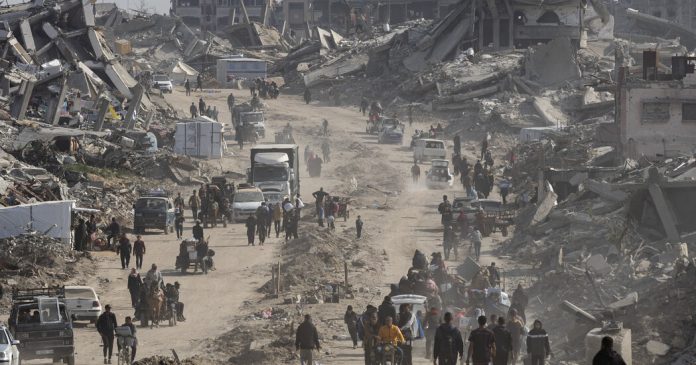
In the weeks since a cease-fire that President Joseph R. Biden Jr.’s administration negotiated and that Mr. Trump pushed came into effect, hundreds of thousands of Palestinians who were repeatedly displaced throughout the war have returned to their homes in Gaza to find them and their communities demolished. Steve Witkoff, Mr. Trump’s Middle East envoy, visited Gaza last week and said it would take 10 to 15 years to reconstruct.

“If you had damage that was one-hundredth of what I saw in Gaza, nobody would be allowed to go back to their homes,” Mr. Witkoff told reporters on Tuesday. “That’s how dangerous it is. There’s 30,000 unexploded munitions. It is buildings that could tip over at any moment. There’s no utilities.”

Picking up on the theme later in the day, Mr. Trump said it was not realistic to have Palestinians return to Gaza. “They have no alternative right now” but to leave, Mr. Trump told reporters before Mr. Netanyahu’s arrival.

“I mean, they’re there because they have no alternative,” he said. “What do they have? It is a big pile of rubble right now.” He added: “I don’t know how they could want to stay. It’s a demolition site. It’s a pure demolition site.”

Mr. Trump suggested the resettlement of Palestinians would be akin to the New York real estate projects he built his career on. “If we could find the right piece of land, or numerous pieces of land, and build them some really nice places with plenty of money in the area, that’s for sure,” he said. “I think that would be a lot better than going back to Gaza.”

“I do see a long-term ownership position” for the United States, Mr. Trump said, adding that “everybody I’ve spoken to loves the idea of the United States owning that piece of land, developing and creating thousands of jobs with something that will be magnificent.”

Mr. Trump’s summit with Mr. Netanyahu was his first in-person meeting with another world leader since his return to power two weeks ago. It was part of a multiday visit to Washington by Mr. Netanyahu that was meant to demonstrate the close ties between the two leaders.

Mr. Trump and Mr. Netanyahu forged a close partnership during the president’s first term but fell out toward its end over a number of issues, including the Israeli leader’s willingness to congratulate Mr. Biden on his victory in the 2020 election, which Mr. Trump insists he won. Mr. Trump and Mr. Netanyahu have since sought to smooth over their rift.

But Mr. Netanyahu went into his meeting at odds with Mr. Trump on several important issues, according to analysts, likely including how to confront Iran’s nuclear ambitions and how quickly to end the war in Gaza.

The Trump administration has made clear that it wants to see all of the hostages held by Hamas returned and then move on to a grand bargain involving Saudi Arabia that formalizes relations with Israel.

Saudi Arabia reiterated support for an independent Palestinian state on Tuesday and said forging ties with Israel would depend on the creation of such a state.

Advisers to Mr. Trump told reporters on Tuesday morning that the president and Mr. Netanyahu were united behind the idea that Hamas should not be allowed to remain in power.

With Mr. Netanyahu’s right-wing government in jeopardy if the war ends with Hamas still in control in Gaza, and with no other plan for the area in place, analysts expect the Israeli prime minister to try to delay moving toward a permanent cease-fire.

“Netanyahu made this salami deal,” said Shira Efron, the senior director of policy research at the Israel Policy Forum, a New York-based research group, referring to the three-phased agreement with Hamas. “He’s always playing for time and kicking the can down the road.”

Adding to the anxiety in the region were reports on Monday that U.S. intelligence officials believe Iran is seeking to build a cruder atomic weapon that could be developed quickly if the leadership in Tehran decided to do so.

It remains unclear whether that decision has been made, and Iran’s new president has indicated that he would like to begin a negotiation with Mr. Trump’s administration even as the country’s nuclear scientists push ahead with their efforts.

Mr. Trump on Tuesday signed an order directing a return to the policy of “maximum pressure” on Iran through sanctions, but avoided hostile language and refused to say whether he would support an Israeli strike on Iranian nuclear facilities, an indication of his interest in reaching an agreement. “This is one I’m torn about,” he said as he signed the order. “Hopefully, we’re not going to have to use it very much.”

Edward Wong contributed reporting from Washington, and Adam Rasgon from Jerusalem. Ephrat Livni contributed research.