Thursday, November 12, 2026
Home Blog Page 318

Chastened by Past Wars, Kremlin Tries to Elevate Its Veterans

0

When Ilya Rusinov returned to the Russian work force after rehabilitating a vertebra damaged in the Ukraine war, his first job was teaching in a school.

But he had also launched a side project, a patriotic club he called Zveno, or “Squad,” that provides military training for different age groups, including teenagers. After struggling at first, it found growing demand for its training sessions, including from instructors at similar patriotic organizations. Mr. Rusinov eventually left his teaching job to help run Zveno full time.

Almost three years after a mortar shell blew a hole in his back, Mr. Rusinov, who fought as part of the Wagner mercenary group, is one of a growing group of veterans whom Russian officials claim are being rewarded with an enhanced standing in society — speaking at public events, school lectures and with local news outlets.

It is part of the Kremlin’s very public effort to elevate veterans to leadership positions, offering business opportunities and some forgiveness on loans, all while priming society to accept and appreciate them.

Today, veterans address school groups as young as kindergarten age and give basic weapons training to students, which since September is a mandatory part of every curriculum starting in eighth grade. Billboards proclaiming the heroism of soldiers line major roads, and the Kremlin has made a show of appointing veterans to top jobs.

An hourlong daytime TV show on state-owned Rossiya 1 called “Ours” features breathless coverage of veterans. Some give live performances of frontline ballads, others tell of their “heroism” on the front.

To be sure, veterans’ re-entry into society can be rocky. A lingering stigma endures. Badly injured or visibly traumatized soldiers are a rarity in public. Psychological struggles are left undiscussed, and there is a lack of mental health support. Some of the programs created for veterans are charades and do not lift up rank-and-file veterans, critics say, while Ukrainians have alleged that some of those being lauded were involved in war crimes.

Analysts say Moscow is attempting to learn from the experiences of the Afghan and Chechen wars, when traumatized veterans with access to weapons returned to a society that questioned why they had been fighting and looked down on them as killers.

Mr. Rusinov heard about those days from his father, who fought in Afghanistan for the Soviet Army. At the time, the Kremlin was trying to minimize society’s awareness of how many soldiers the country had deployed, and just how many of them died — sending the dead home in zinc coffins.

“My father told me that they came back, nobody really needed them and, in general, they were pushed aside and viewed with skepticism,” he said of the soldiers returning from Afghanistan. “You went and fought, you know a lot of things, but nobody needs you.”

“Now the situation is completely different,” said Mr. Rusinov.

The withdrawal from Afghanistan is still seen as an embarrassment to Moscow. But this time, the Kremlin has sought to burnish the image of veterans in public life.

One of the most trumpeted components of its plan is a postgraduate program, “Time of Heroes,” that aims to foster a generation of warrior leaders.

The Kremlin has billed Time of Heroes as a pathway to remake the country’s elites — reducing the presence of oligarchic businessmen and elevating patriotic veterans. The program, which mixes management and leadership courses for veterans with the opportunity to intern in administrative positions, attracted more than 44,000 applicants for its first 83 spots. It is accepting a second round of applicants.

“The elite are those who serve Russia, not those who lined their pockets in the 1990s,” President Vladimir V. Putin said when he announced the creation of the program last February. “In the future, Russia can be handed over and entrusted to people like the current heroes” of the war in Ukraine.

Mr. Putin announced his candidacy for a fifth term as president in a carefully choreographed public appearance in which a veteran asked him to “finish what he had started.” The veteran, Artem Zhoga, originally from Ukraine’s Donbas region, later joined Time of Heroes in its inaugural class.

Members of Time of Heroes soon found themselves on an upward career track. Mr. Zhoga became the presidential envoy to the Urals district, and in October was invited to join the Security Council.

Another participant in Time of Heroes, Yevgeny Pervyshov, a former mayor of the southern city of Krasnodar who signed up to fight in Ukraine in 2022, was named interim governor of the Tambov region. In December, one former member was given a role advising the leadership of Rosatom, the state nuclear corporation. Another became the deputy chairman of a St. Petersburg committee on law and order.

“As Vladimir Vladimirovich Putin said, we are forming a new elite of people who have shown that they can give everything for their homeland and for the state, including their lives,” said Oleg V. Panchurin, a career officer who leads the Association of Veterans of the Special Military Operation (the Kremlin’s euphemism for the war).

After being injured in the leg by a Ukrainian drone, Mr. Panchurin returned to Moscow and was among hundreds of veterans encouraged to run in the primaries of the ruling party, United Russia. The party allocated Ukraine veterans 25 extra percentage points on top of the votes they received, to give them a leg up.

Mr. Panchurin returned to the front and didn’t advance in the elections. But he has returned to Moscow, recently took the admission exam for the second class of Time of Heroes and aims to join Russia’s lower house of Parliament.

But independent observers say Time of Heroes is largely recycling people of means and not benefiting the lower rung of society, including many veterans, by giving them access to good administrative jobs.

“We still do not yet see any appointments to really high positions,” besides Mr. Zhoga, said Andrey Pertsev, a journalist with the exiled media outlet Meduza who covers the Russian presidential administration. “It is a P.R. tool.”

Mr. Pertsev noted that the region where Mr. Pervyshov was interim governor had a population and a budget smaller than the city where he was mayor. And a Time of Heroes alumnus appointed to Russia’s upper house of Parliament in September, Aleksey Kondratyev, had already served in the body on behalf of a different region from 2015 to 2020.

On top of that, Mr. Pertsev said, applicants for Time of Heroes are required with rare exceptions to already have a university degree.

Novaya Gazeta Europe, another independent outlet operating in exile, studied the biographies of 80 of the 83 participants in the first Time of Heroes cohort, and found that almost 80 percent were career military personnel, with only three mobilized soldiers. At least three of the participants have also been named by Ukrainian security services in war crimes accusations.

That hasn’t stopped the program from featuring heavily in the Kremlin’s messaging celebrating the war effort. Overseen by Mr. Putin’s powerful deputy chief of staff Sergei V. Kiriyenko, Time of Heroes has been heavily supported by Kremlin funding and is regularly featured in the media. Mr. Putin spoke about it repeatedly last month, including during a visit to a rehabilitation center, when he pledged to replicate Time of Heroes on a regional level.

Each appointment for a Time of Heroes graduate receives broad coverage in state and local media. Some of the men will play a role shaping Russia’s youngest generation, just as Mr. Rusinov hopes to.

Late last month, for instance, one Time of Heroes alumnus was appointed head of the Yunarmia, or Youth Army, a militarized throwback to the Young Pioneers of the Soviet era; it has more than one million participants, according to the state news agency TASS.

Mr. Rusinov hopes to follow suit. Since his return from the war he has lectured at schools and universities in the Samara region, and is training instructors in military-patriotic education.

In November, he sat the entrance exam for Time of Heroes and said he dreams of one day becoming the director of what he called a “military version of Hogwarts.”
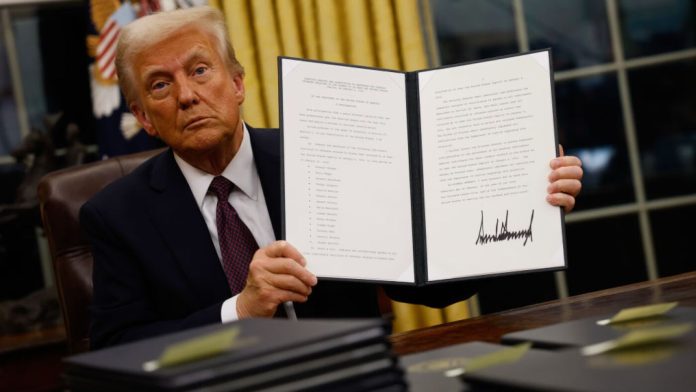
Trump signs executive order taking aim at DEI programs in the military : NPR

0

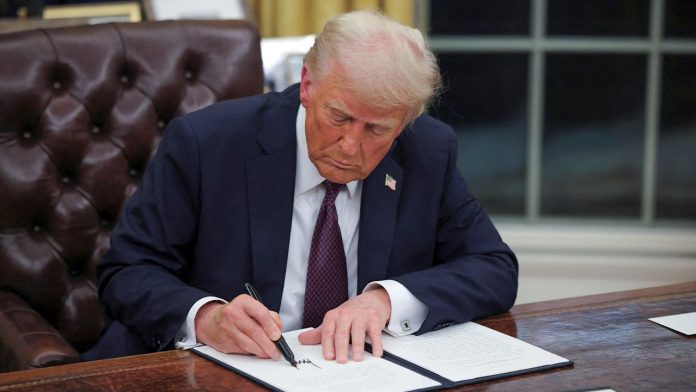
President Trump signs executive orders in the Oval Office on Jan. 20.

Anna Moneymaker/Getty Images


hide caption

toggle caption

Anna Moneymaker/Getty Images

President Trump signed an executive order Monday ending diversity programs in the nation’s military.

The directive was among a series of executive orders the White House released Monday night that sought to reshape the country’s armed forces. Trump also signed executive orders tasking Pentagon officials with reviewing its policy on transgender troops and reinstating many service members who were dismissed for refusing the coronavirus vaccine.

A fourth executive order released Monday announced plans to build a missile defense system likened to Israel’s “Iron Dome” air defense systems.

In his order directing the Pentagon to end diversity, equity and inclusion initiatives, Trump said the programs discourage merit and leadership, and discriminate on the basis of race and sex. The order also applies to the Coast Guard, which is governed by the Department of Homeland Security.

Trump said he is “committed to meritocracy and to the elimination of race-based and sex-based discrimination within the Armed Forces of the United States. No individual or group within our Armed Forces should be preferred or disadvantaged on the basis of sex, race, ethnicity, color, or creed.”

Pete Hegseth, the new secretary of defense, has 90 days to submit a report to the Trump administration detailing all of the department’s current DEI programs and offices, according to Trump’s executive order. Both the departments of defense and homeland security have 30 days to submit a plan to meet the guidelines laid out in Monday’s order, and 180 days to present a progress report.

The order additionally prohibits the military from telling its members that “America’s founding documents are racist or sexist,” or from teaching them about gender ideology – defined by the administration as “an ever-shifting concept of self-assessed gender identity.”

“In addition, these institutions shall be required to teach that America and its founding documents remain the most powerful force for good in human history,” the order said.

The president recently signed an executive order cutting DEI programs from the federal government, subsequently placing employees in those departments on paid leave.

Healthy, satisfying snack alternatives to potato chips: ‘You’ll adjust’

0

Ever reached into a bag of potato chips and found yourself unable to put them down?

There’s a psychological reason for this behavior — but there are healthier alternatives that can satisfy the same cravings. 

“When under stress, the body releases cortisol, which then increases desire for comfort food, such as sweets and salty foods,” Jonathan Alpert, a New York-based psychotherapist and author, told Fox News Digital. 

CAN’T STOP THINKING ABOUT YOUR NEXT MEAL? IT’S CALLED FOOD NOISE, HERE’S WHAT TO DO

“These foods then lead to a feeling of satiation or even indulgence, providing a temporary reprieve from negative or difficult emotions, such as stress and anxiety,” he said.

Performance coach and wellness expert Jacob Zemer, also in New York, shared some of his favorite alternatives to potato chips – snacks that are salty and satisfying, but with a side of added nutrients.

Potato chips are a salty and satisfying snack that can provide a temporary reprieve from stress and anxiety, according to a wellness expert — but there are healthier options to consider.  (iStock)

“There’s nothing wrong with potatoes, and that’s a common misconception,” Zemer said.

“The problem comes when you start to fry things. Then you’re adding fat plus carbohydrates — which is a recipe for diabetes.”

Potato chips, he said, “basically are saturated fat, combining refined carbohydrates.” 

Zemer added, “Potato chips are highly palatable and that’s the term we use to describe them on a nutrition level. And that happens when you have something that has both carbs and fats in it. And [potato chips] are very savory because of that salty element.” 

TOP 5 FAST-FOOD BURGERS FOR YOUR HEALTH, SAYS NEW STUDY

When seeking alternatives to chips, Zemer said he looks for products that pass the “protein test” – having at least 10 grams of protein for every 100 calories. 

In particular, Zemer counts himself as a fan of Quest Chips and Legendary Chips, both of which pass this test, he said.

Zemer also looks for salty foods that contain a high level of fiber, which helps create a full feeling. 

Young man relaxing by watching movie eating chips.

Potato chips are “highly palatable” due to the carbohydrate content and fat. (iStock)

“You’re less likely to binge on those,” he said of those types of foods. 

“There’s a great pretzel alternative that’s found currently at Costco,” Zemer also told Fox News Digital.

FAST-FOOD MENU ITEMS THAT CHEFS LIKE TO EAT

“It’s called Crisp Power. And they actually have high protein and high fiber, and they’re essentially pretzels.” 

In addition, Zemer said he recommends what he called “single-ingredient foods” that can be salted, such as edamame. 

“Only keep foods that are good options in your house.”

These are a “great solution” that can satisfy a salty craving without empty calories, he said. 

For more Lifestyle articles, visit www.foxnews.com/lifestyle

While making dietary changes can be a challenge, Zemer said he encourages people to hang in there when adjusting to a new situation. 

Close-up of a bowl of cooked edamame soy beans.

Edamame is a “single-ingredient food” that can help curb a salty craving, said an expert.  (Smith Collection/Gado/Getty Images)

He shared his three biggest tips for adopting new habits, especially with food. 

“I think the biggest thing is to find something in the meantime that actually satiates that salty craving,” he said. 

CLICK HERE TO SIGN UP FOR OUR LIFESTYLE NEWSLETTER

Once that item is found, then get rid of the unhealthy options. 

 “The reality is, over time, you’ll adjust to it.”

“Only keep foods that are good options in your house,” Zemer said. 

“Don’t bring the potato chips home. Don’t bring them with you. Give yourself the options.”

CLICK HERE TO GET THE FOX NEWS APP

The third piece of advice, he said, is to stick with it. 

“Taste buds shed about every 30 days,” he said. “So, even if at first you’re not in love with something, the reality is, over time, you’ll adjust to it.”

For Children in Rural Mozambique, the Future Comes Into Focus

0

Over the past year, Muanema Fakira noticed something odd about the eyes of her 1-year-old daughter Sumaya. Her left eye was cloudy. It did not gleam with curiosity or glint in the sun. When the problem persisted, Ms. Fakira made the rounds to health clinics in their town in central Mozambique. Doctors said they could not help.

But they knew of someone who could, if Ms. Fakira could take Sumaya, now 2, on a 100-mile journey to the coast.

The family made the trip to the city of Quelimane, where Dr. Isaac Vasco da Gama examined Sumaya’s eyes and quickly diagnosed a congenital cataract.

Ms. Fakira was skeptical — cataracts are for old people, she said. But Dr. da Gama explained that an infection at birth, or shortly after, can cause cataracts in children. The condition is particularly worrying because vision problems affect the development of a child’s physical function. But the good news, he said, was that the problem can be solved with a simple surgery, one he does a dozen times a week at Quelimane Central Hospital.

This was particularly lucky for Sumaya because Dr. da Gama is one of just three pediatric ophthalmologists in Mozambique, a country of 30 million people.

Sumaya had her surgery in November, and a day later headed home, already recovering. Dr. da Gama was pleased to have seen her while she was still young, before permanent damage was done.

It was a sign that a system he and colleagues have been trying to put in place for the last few years might be taking hold: Sumaya’s parents sought help from the medical system for an eye problem — rather than a traditional healer, or a sorcerer to remove a curse.

When Sumaya was referred for care, it was a long and expensive trip, but she got help relatively quickly for a problem that might otherwise have blighted her life. Ideally her cataract would have been spotted at birth by a midwife.

“I do believe that by pushing forward, we can slowly overcome this challenge,” Dr. da Gama said.

In Mozambique, as in much of sub-Saharan Africa, awareness of vision problems is so low, and access to help so limited, that few children get the care they need, even though many suffer from easily treatable problems.

In 2021, a global commission on eye health reported that 510 million people around the world, 90 percent of them in low- and middle-income countries, had uncorrected vision impairment. That is, they could not see properly because they did not have glasses.

The consequences are enormous: Children with vision loss in these countries are significantly less likely to be in school. One study found that for those who do attend school, those with uncorrected vision problems learn half as much as their peers with normal vision.

Access to treatment is so limited because of a scarcity of trained staff and a failure to integrate vision care into health systems. Children are not screened for vision loss, and parents and teachers don’t understand the simple causes of eye trouble that can manifest in distraction, lack of physical coordination and behavior issues.

Mozambique has just 20 ophthalmologists, up from six two decades ago. Almost all of them are based in the capital, Maputo, in the south.

Dr. da Gama completed his studies in India in 2017 and set up a clinic in Quelimane, a seaport town halfway up Mozambique’s long Indian Ocean coastline. But to his surprise, he saw very few patients in the first year. He discovered that no one was being referred to him because health workers did not recognize treatable eye diseases. He started traveling to local clinics to tell medical workers about screening and solutions.

Then he teamed up with the charity Light for the World, which had sponsored him to complete specialized training in pediatric eye care in Tanzania. They designed an outreach program to show teachers, community health workers, traditional healers and local leaders how to spot vision problems and to refer children to the new ophthalmology ward at the Quelimane hospital.

Now, a couple of times a year, for up to a month at a time, he takes a mobile clinic to small communities to do surgeries on children with cataracts, glaucoma or strabismus (misaligned eyes).

Cataracts cause nearly half the preventable blindness in Mozambique’s children; they can be genetic, or the result of trauma (like a stick or a stone in the eye), or of an untreated eye infection.

On his outreach journeys, Dr. da Gama teaches other health care workers how to perform the simple surgeries, and how to spot the conditions. “Operating per se is not a problem: We can train in a week, two weeks, how to operate on a cataract,” he said. “But it is how to identify the children who need the operations.”

Mozambique’s Ministry of Health is trying to build awareness of vision problems and refractive errors, for which a pair of glasses is a life-altering intervention.

Glasses or simple surgeries that keep children in school can change the future for their families, and for the country as a whole. “If you have children less educated or with fewer skills,” he said, “the future of the economy is affected.”

In Quelimane, Dr. da Gama also sees cases of retinoblastoma, a cancer of the retina. When patients come early enough, he can save their lives, if not their eyes.

Camilo Rosario brought his daughter Grace, 3, to his clinic in November, from their home in a village 300 kilometers (about 185 miles) away. She had a tumor protruding from her eye that caused her excruciating pain. Mr. Rosario said she had begun to complain about her eye just weeks before. He shifted anxiously from foot to foot while Dr. da Gama explained that he would operate quickly to remove the tumor, but that he feared the disease was already in her brain.

Grace soon recovered from the first surgery, clinging to her father with a bulky bandage around her head. But as Dr. da Gama had feared, she had come to him too late; she died in early January.

Aminata Kaba was screened alongside her classmates in high school last year — and was surprised to learn that she was myopic. After she got glasses, school became significantly easier, she said, and her grades soon improved. Now, she said, she will continue on in school, and she hopes to be a lawyer.

Screening older children is easy; coaxing cooperation out of the small ones is a much greater challenge, Dr. da Gama said. They rarely look where he needs them to for eye exams. The eyedrops, the equipment, even his white coat, all can be frightening. He said he smiles and sings to distract, removing the coat when required.

“I like difficult things,” he said.

‘Non-sanctuary’ coastal enclave sues California for right to enforce own laws

0

Join Fox News for access to this content

Plus special access to select articles and other premium content with your account – free of charge.

By entering your email and pushing continue, you are agreeing to Fox News’ Terms of Use and Privacy Policy, which includes our Notice of Financial Incentive.

Please enter a valid email address.

A Southern California city is suing the state over sanctuary laws that limit cooperation between local authorities and immigration officials. 

The lawsuit, which also names California Gov. Gavin Newsom and state Attorney General Rob Bonta, is one of several filed by Huntington Beach against Sacramento in recent years in an effort to manage its affairs without state interference. It focuses on the California Values Act, or SB 54, which limits local and state law enforcement from cooperating with federal immigration authorities except in certain cases. 

“On the one hand, the sanctuary state law acts as a barrier to any communication or coordination. It forces or directs our local officials to violate certain federal immigration laws, and then it stands in the way of voluntary cooperation with federal agencies,” Huntington Beach City Attorney Michael Gates told Fox News Digital. “On three levels, it’s completely improper.”

‘PROMPT REMOVAL’: TRUMP DHS EXPANDS EXPEDITED DEPORTATION POWERS AS OPERATIONS RAMP UP

The Huntington Beach City Council declared itself a “non-sanctuary city” on Tuesday. (Leonard Ortiz/MediaNews Group/Orange County Register via Getty Images)

Like other opponents of the law, Huntington Beach maintains it should have full control of its police department.

“To put a fine point, as a Charter City, Huntington Beach’s Police Department does not belong to the State,” the filing states. “Rather, the Huntington Beach Police Department belongs to the City – and as such, the Police Department should be free from State interference and control.”

“The City and its Police Department should be, therefore, entirely at liberty to employ every lawful means to combat crime and promote public safety for the City’s 200,000 residents,” the complaint said. 

Huntington Beach argues that the state is breaking the law by telling local municipalities not to work with federal authorities and that the sanctuary state law is unconstitutional. 

“We are fighting the Sanctuary State Law because it obstructs our ability to fully enforce the law and keep our community safe,” Mayor Pat Burns said in a statement. “When the stakes are currently so high, with reports of increases in human trafficking, increases in foreign gangs taking over apartment buildings in the U.S., killing, raping, and committing other violent crimes against our citizens, we need every possible resource available to fight crime, including federal resources.”

TRUMP BORDER CZAR REVEALS ICE TEAMS ARE ALREADY ARRESTING ‘PUBLIC SAFETY THREATS’

Huntington Beach, California

Waves roll past the Huntington Beach Pier, epicenter of the city’s beach culture, in Huntington Beach, California, on Feb. 22, 2024. (Rick Loomis for The Washington Post via Getty Images)

“Huntington Beach will not sit idly by and allow the obstructionist Sanctuary State Law to put our residents at risk of harm from those who seek to commit violent crimes on U.S. soil,” he added. 

Gates said SB 54 forces cities to violate federal law and harbor illegal criminal immigrants. 

“The stakes are a lot higher with some of the crimes committed by illegal immigrants,” he said. “It’s very obstructive, this sanctuary state law, and it prevents good, sound law enforcement practices.”

He cited the recent death of a woman in New York City who was allegedly set ablaze by an illegal immigrant on the subway, members of the Venezuelan Tren de Aragua gang that briefly terrorized an apartment complex in Aurora, Colorado, and an illegal migrant allegedly caught with a flamethrower near where wildfires raged in Los Angeles County. 

Supporters of the law say it provides protection for illegal immigrants who report crimes that would otherwise go unreported, such as victims of human trafficking or domestic violence, doesn’t impede criminal investigations, and that local prosecutors, not the state, can use their authority and existing laws to hold criminals accountable. 

TRUMP’S ICE RACKS UP HUNDREDS OF ARRESTS, INCLUDING ILLEGAL IMMIGRANTS ARRESTED FOR HORROR CRIMES

In response to the lawsuit, Bonta’s office told Fox News Digital that he plans to defend SB 54, noting that March 6 is the deadline for his response to the complaint. 

“The Attorney General is committed to protecting and ensuring the rights of California’s immigrant communities and upholding vital laws like SB 54, which ensure that state and local resources go toward fighting crime in California communities, not toward federal immigration enforcement,” his office said. “Our office successfully fought back against a challenge to SB 54 by the first Trump administration, and we are prepared to vigorously defend SB 54 again.”

CLICK HERE FOR MORE IMMIGRATION COVERAGE

Bonta noted that SB 54 doesn’t prevent the federal government from conducting immigration enforcement, but says “that they cannot make us do their jobs for them.”

Last week, Burns, the mayor, and the rest of the City Council unanimously voted to declare Huntington Beach a “non-sanctuary” city. The move directs the city’s police officers to cooperate with immigration authorities. 

In addition to the most recent lawsuit, Huntington Beach is currently fighting Sacramento on several fronts. Earlier this month, Bonta announced that he is appealing a ruling that bounced a case out of court after voters in the city approved a ballot measure to require identification be shown for those voting in person within city limits. 

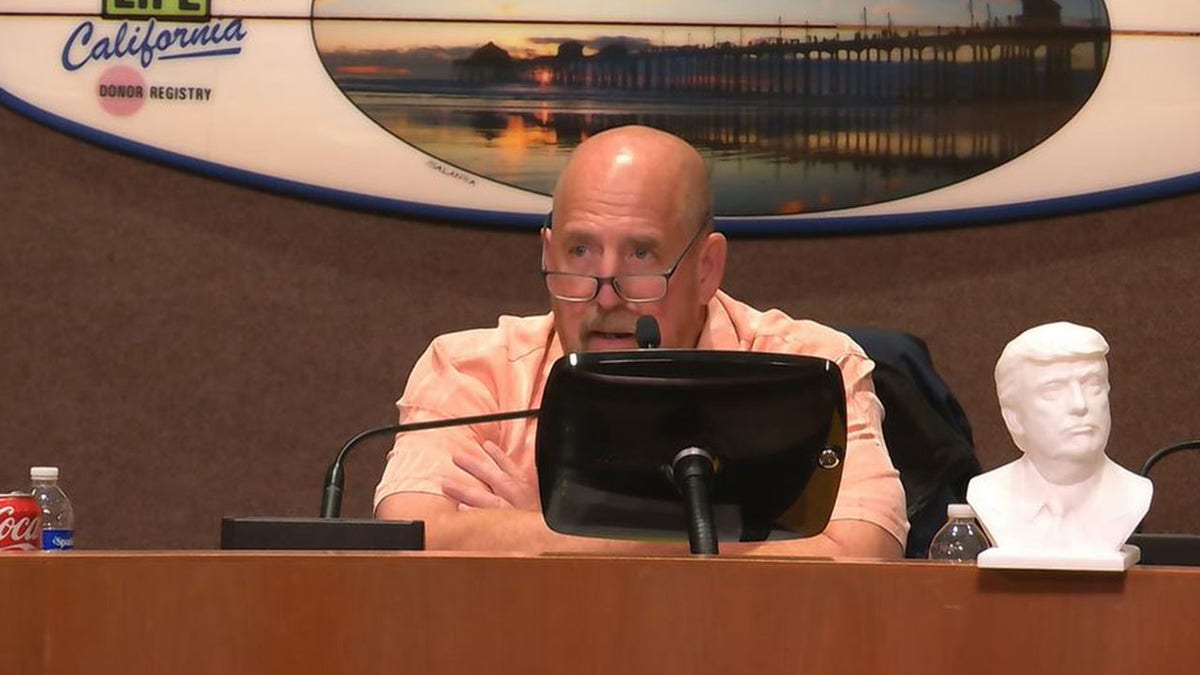
Huntington Beach Mayor Pat Burns next to a bust of President Trump

Huntington Beach Mayor Pat Burns introduced a resolution to make the city a “non-sanctuary” city. (City of Huntington Beach)

CLICK HERE TO GET THE FOX NEWS APP

In October, the city lost an appeal after losing a lawsuit to circumvent state housing mandates. 

“The state wants to consolidate all power in Sacramento and that’s why we’ve been in court fighting back and pushing back,” Gates said. 

In Seattle, a Meeting of 5,444 Mathematical Minds

0

The world’s largest gathering of mathematicians convened in Seattle from Jan. 8 to Jan. 11 — 5,444 mathematicians, 3,272 talks. This year the program diverged somewhat from the its traditional kaleidoscopic panorama. An official theme, “Mathematics in the Age of A.I.,” was set by Bryna Kra, the president of the American Mathematical Society, which hosts the event in collaboration with 16 partner organizations. In one configuration or another, the meeting, called the Joint Mathematics Meetings, or the J.M.M., has been held more or less annually for over a century.

Dr. Kra intended the A.I. theme as a “wake-up call.” “A.I. is something that is in our lives, and it’s time to start thinking about how it impacts your teaching, your students, your research,” she said in an interview with The New York Times. “What does it mean to have A.I. as a co-author? These are the kinds of questions that we have to grapple with.”

On the second evening, Yann LeCun, the chief A.I. scientist at Meta, gave a keynote lecture titled “Mathematical Obstacles on the Way to Human-Level A.I.” Dr. LeCun got a bit into the technical weeds, but there were digestible tidbits.

“The current state of machine learning is that it sucks,” he said during the lecture, to much chortling. “Never mind humans, never mind trying to reproduce mathematicians or scientists; we can’t even reproduce what a cat can do.”

Instead of the generative large language models powering chatbots, he argued, a “large-scale world model” would be the better bet for advancing and improving the technology. Such a system, he said in an interview after the lecture, “can reason and plan because it has a mental model of the world that predicts consequences of its action.” But there are obstacles, he admitted — some mathematically intractable problems, their solutions nowhere in sight.

Deirdre Haskell, the director of the Fields Institute for Research in Mathematical Sciences in Toronto and a mathematician at McMaster University, said she appreciated Dr. LeCun’s reminder that, as she recalled, “the way we use the term A.I. today is only one way of possibly having an ‘artificial intelligence.’”

Dr. LeCun had noted in his lecture that the term artificial general intelligence, or A.G.I. — a machine with human-level intelligence — was a misnomer. Humans “do not have general intelligence at all,” he said. “We’re extremely specialized.” The preferred term at Meta, he said, is “advanced machine intelligence,” or AMI — “we pronounce it ‘ami,’ which means friend in French.”

Dr. Haskell was already sold on the importance of “using A.I. to do math, and the huge problem of understanding the math of A.I.” An expert in mathematical logic, she is working on the equivalent of a textbook: a collection of results that can be used by A.I. systems to generate and verify more complex mathematical research and proofs.

For Kenny Banks, an undergraduate at the University of North Carolina at Greensboro who attended the J.M.M., artificial intelligence does not appeal as a tool for guiding exploration. “I think the mathematics that people currently love is driven by human curiosity, and what computers find interesting cannot be the same as what humans find interesting,” he said in an email. Nevertheless, he regretted not squeezing any A.I.-related talks into his itinerary. “The math + A.I. theme was definitely of interest, it just ended up not working with all the things I had planned!”

Here are some other highlights from the mathapalooza in Seattle:

At 6 p.m. on Wednesday, Jan. 8, after a ribbon-cutting and awards ceremony, attendees stampeded to the grand-opening reception in an exhibit hall. The draw was a) free food, and b) exhibitor booths occupied by publishers and purveyors of various mathy wares. At Booth 337, Robert Fathauer was selling an impressive inventory of dice — including the new “5-Player Go First Dice,” a colorful set of five 60-sided dice that share no number in common, allowing five game players an equal shot when they roll to determine who starts first. Dr. Fathauer, who is based in Arizona, was also co-organizer of the meeting’s art exhibit and contributed two ceramic sculptures of his own, “Hyperbolic Helicoid” and “Cubic Squeeze.”

The exhibit’s award-winning art submissions were “Saddle Monster,” crocheted in wool, copper and nylon, by Shiying Dong of Greenwich, Conn., a mathematical artist with a Ph.D. in physics …

… and “Twisted” and “Untwisted,” created using a vector graphics app on an iPad, by Rashmi Sunder-Raj, a mathematical artist in Waterloo, Ontario.

Rebecca Lin, a Ph.D. student in computer science at M.I.T., received an honorable mention for a laser-cut engraving on paper titled “Disintegrating (State of Mind).”

On Thursday, Jon Wild, a music theorist at McGill University in Montreal who does math on the side, was invited to a session on applied mathematics to discuss his investigations into “counting arrangements of circles” in the plane. Given certain constraints, there is one way to draw one circle, three ways to draw two circles, 14 ways to draw three, 173 ways for four, and 16,951 ways to draw five. (The enumeration of six circles is yet to be computed.) Dr. Wild was surprised to learn that this research was relevant to 3-D printing: that is, to how multiple printer heads could each trace circular arcs while avoiding collisions. “I was tickled,” Dr. Wild said.

During a session on mathematics and the arts, Susan Goldstine, a mathematician at St. Mary’s College of Maryland, lectured about her “Poincaré Blues” craft project. Named for the French mathematician Henri Poincaré, the project involved making a patchwork denim skirt from old jeans. As she described in a write-up: “After noodling around with different patterns, I settled on the tiling of the Poincaré disk model of the hyperbolic plane by 30º-45º-90º triangles,” which was familiar to her from an illustration by the classical geometer H.S.M. Coxeter (and which also inspired the Dutch artist M.C. Escher).

At midday, the undergraduate poster session buzzed with expositions on topics including lunar time synchronization; the math of piano tuning; loops in four-dimensional space; and a model for wildfire containment, smoke spread and their public health consequences.

During another session on mathematics and the arts, Barry Cipra, a mathematician from Minnesota, gave a talk about “gelbes feld” (“yellow field”), a painting by the Bauhaus-trained Swiss artist Max Bill.

It may appear to be a solid canvas of color, Dr. Cipra said, but there is a faint pattern of contrasting dots, or, more precisely, squares. “Let’s look at an abstract version of Bill’s abstract,” he said. “Can you spot what Bill is up to?”

By Dr. Cipra’s analysis, the artist encoded in the painting a classic 3-by-3 magic square — a square array of numbers that form a logic puzzle wherein the sum of each row, column and diagonal equals 15.

Another peculiarity was that each row, column and diagonal had five pips (as on dice or dominoes):

Dr. Cipra noted, “It looks like Bill posed and solved an original mathematics problem and hid it in a painting: Can you place the pips within each square of the 3-by-3 magic square so that there are exactly five pips along each row, column and main diagonal of the 9-by-9 subgrid?” The same question could be asked for 5-by-5 and larger magic squares of odd sizes, he said. “But it’s far from clear what the answer is going to be.”

Dr. Goldstine found Dr. Cipra’s discovery compelling. “I am always excited when math turns up in a place where you wouldn’t expect it,” she said in an email. “I often use these surprising connections to get students who might be afraid of or bored by math to see some of its beauty.”

The final day offered a number of public events, including a mini math festival with hands-on puzzles and games.

“Why is it math?” asked Aleksandra Upton, 7, of a geometric puzzle.

“Because we can count all the different ways that we put the shapes together,” said her mother, Karolina Sarnowska-Upton, a software engineering manager at Microsoft in Redmond, Wash.

In one public lecture, Ravi Vakil, a mathematician at Stanford and the incoming president of the American Mathematical Society, explored the simultaneously playful and profound “mathematics of doodling.”

In another, Eugenia Cheng, a mathematician and pianist at the School of the Art Institute of Chicago, addressed “Math, Art, Social Justice.” One of her salient messages: “Pure mathematics is a framework for agreeing on things.” She sang some of the lecture alongside a recorded video of herself playing the piano.

And there was a world premiere of a documentary film, “Creating Pathways,” the second in the “Journeys of Black Mathematicians” series by the director George Csicsery. (It airs on public television stations in February.) The film’s senior consultant was Johnny Houston, an emeritus professor at Elizabeth City State University in North Carolina. After the screening, Dr. Houston remarked on the timeliness of the 2025 premiere: In 1925, Elbert Frank Cox became the first African American — and first Black person in the world — to receive a Ph.D. in mathematics. Of his own journey, and that of many Black mathematicians, Dr. Houston said that with exposure, experience and opportunity, “we can do as well as any mathematician in earning a Ph.D. and beyond.”

The last of the talks wound down that evening. By 3 a.m. the next morning, as some attendees headed to the airport, two mathematicians were just heading to bed, but not before riding the elevator down to the hotel lobby to ask reception for a late checkout.

Trump signs orders banning ‘radical gender ideology,’ DEI in the military

0

President Donald Trump signed a handful of executive orders on Monday, including two banning “radical gender ideology” and Diversity, Equity and Inclusion (DEI) initiatives from all branches of the U.S. military.

Trump stated that both orders, titled “Prioritizing Military Excellence and Readiness” and “Restoring America’s Fighting Force,” should be in the process of being implemented by Defense Secretary Pete Hegseth and the secretary of homeland security within 30 days.

Under “Restoring America’s Fighting Force,” Trump states that DEI programs have undermined “leadership, merit and unit cohesion, thereby eroding lethality and force readiness” and have “violated Americans’ consciences by engaging in invidious race and sex discrimination.”

“No individual or group within our Armed Forces should be preferred or disadvantaged on the basis of sex, race, ethnicity, color or creed,” the order states, adding that no branch should operate on race or sex preference.

DEFENSE SECRETARY PETE HEGSETH SAYS ‘NO MORE DEI AT DEPARTMENT OF DEFENSE’: ‘NO EXCEPTIONS’

President Donald Trump signed two executive orders on Monday related to the military that will ban “radical gender ideology” and DEI initiatives from all branches and their academies. (REUTERS/Carlos Barria)

The order includes an internal review conducted by Hegseth within 90 days to document all instances of discrimination or promotion based on race or sex.

It also includes banning all “un-American, divisive, discriminatory, radical, extremist and irrational theories” from being taught in the Armed Forces and educational institutions operated or controlled by the military. Those theories include “gender ideology,” divisive concepts surrounding race or sex stereotyping or scapegoating and the idea that “America’s founding documents are racist or sexist.”

Instructors hired to teach at military academies will also be carefully reviewed to ensure “alignment with this order.”

“In addition, these institutions shall be required to teach that America and its founding documents remain the most powerful force for good in human history,” the order states.

Progress related to this order must be submitted by Hegseth and the homeland security secretary to the Deputy Chief of Staff for Policy within 180 days to track implementation and to find recommendations, if any, to fulfill the order’s objective.

3 IN 10 VOTERS THINK ENDING DEI PROGRAMS IS EXTREMELY IMPORTANT, POLL SHOWS, AS FEDERAL DEADLINE LOOMS

The order “Prioritizing Military Excellence and Readiness” states that the U.S. military has one mission – “to protect the American people and our homeland as the world’s most lethal and effective fighting force.”

military

Trump stated in his executive order that all service members are required to be at peak mental and physical fitness, which eliminates those struggling with gender identity. (iStock)

Trump states in the order that the mission cannot be met if the military is accommodating “political agendas or other ideologies harmful to unit cohesion.” He also said longstanding DoD policy says service members must be free of medical conditions and physical defects that would require excessive treatment or hospitalization.

The “hormonal and surgical medical interventions” involved when an individual claims to be a gender differing from their sex do not meet the “rigorous standards” required of service members, including the commitment to being honorable, truthful and disciplined, the order states.

Fox News Digital previously reported that while exact figures are not publicly available, there are an estimated 9,000 to 14,000 transgender people serving in the military.

CRACKING DOWN ON TRANS TROOPS: TRUMP ORDER NIXES PREFERRED PRONOUNS, RESTRICTS FACILITY USE

“For the sake of our Nation and the patriotic Americans who volunteer to serve it, military service must be reserved for those mentally and physically fit for duty,” the order states. “The Armed Forces must adhere to high mental and physical health standards to ensure our military can deploy, fight, and win, including in austere conditions and without the benefit of routine medical treatment or special provisions.”

The DoD reportedly spent approximately $15 million on surgical and nonsurgical gender-affirming care for 1,892 active duty service members between Jan. 1, 2016, and May 14, 2021, per the Congressional Research Service.

The order also states that males and females are not allowed to use or share sleeping, changing or bathing facilities unless it is absolutely necessary during an operation.

US soldiers

The two executive orders are aimed at returning the focus of all military branches and corresponding academies to “lethality and force readiness.” (iStock)

Hegseth was already ordered to immediately end preferred pronoun usage within the DoD, and within 30 days, he must identify what is needed to implement the above order and submit a report summarizing the steps to the president.

CLICK HERE TO GET THE FOX NEWS APP

The orders are two of many things Trump promised to change during his 2024 campaign and fall in line with the hundreds of executive actions issued during his first week in office.

India, China to Resume Direct Flights After Nearly Five Years

0

India and China have agreed to resume direct flights between the two countries after nearly five years, the latest thaw between the two Asian giants that until recently were on war-footing over a deadly border dispute.

The rapprochement also included agreements on improving access to journalists from both sides and facilitating pilgrimages to a Hindu shrine in Tibet. They were announced by both sides on Monday, after India’s foreign secretary, Vikram Misri, visited Beijing.

The two nations have made substantial progress in recent months to restore some normalcy in ties. Their relationship had plunged to its worst in decades following an incursion by Chinese soldiers into the Indian side of a disputed border in 2020. The skirmishes left soldiers dead on both sides.

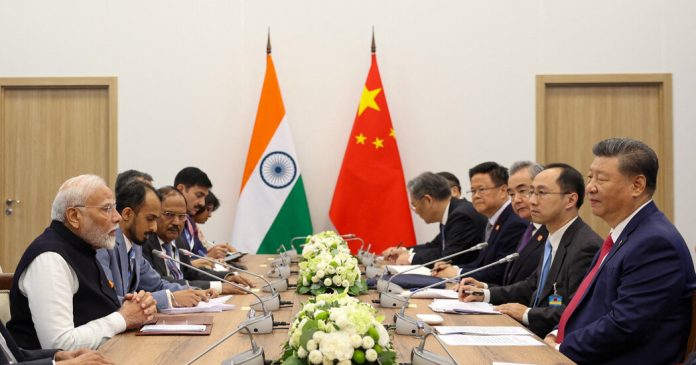
In October, Prime Minister Narendra Modi of India met with China’s leader, Xi Jinping, on the sidelines of a summit in Russia. It was the first time the two leaders had sat down for proper talks in five years. That conversation was made possible by more than two dozen rounds of negotiations between military leaders and diplomats over disengaging their forces along the border high in the Himalayas.

Mr. Misri’s trip to Beijing was to follow up over a series of “people-centric steps to stabilize and rebuild ties,” India’s foreign ministry said in a statement after the visit.

A still image taken from a video showed China’s foreign minister, Wang Yi, meeting with India’s foreign secretary, Vikram Misri, in Beijing, on Monday.Credit…Phoenix TV via APTN, via Associated Press

The ministry added that officials from the two sides would meet to discuss the technical details of resuming flights, which have remained suspended since the Covid-19 outbreak in 2020. Flights to Hong Kong resumed after the pandemic lockdowns eased, but those to mainland China did not because of the tension between the two countries.

In his meeting with Mr. Misri, Wang Yi, China’s foreign minister, called on both sides to “seize the opportunity, meet each other halfway” in the hopes of ending “mutual suspicion, mutual alienation and mutual attrition,” according to a statement from the Chinese foreign ministry.

Berry Wang contributed reporting from Hong Kong.

Trump border czar has blunt message for Selena Gomez

0

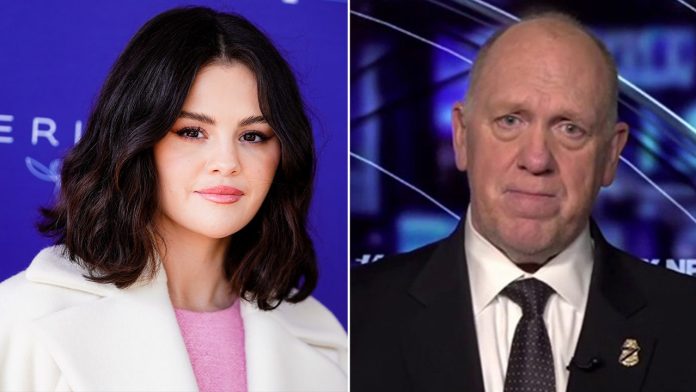
Border czar Tom Homan asked singer and actress Selena Gomez where her tears are for the hundreds of thousands of Americans who have died from fentanyl coming across the southern border after she filmed herself crying about the Trump administration’s deportation efforts across the country.

“I met with hundreds of Angel moms and dads who are separated from their children because they buried them because they were killed by illegal aliens,” Homan said Monday on “Hannity.”

“We got a half a million children who were sex trafficked into this country, separated from their families, put in the hands of criminal cartels to be smuggled into the country. This administration can’t find over 300,000. Where’s the tears for them?”

This split shows illegal immigrants being arrested across the U.S. (ICE)

TRUMP’S ICE RACKS UP HUNDREDS OF ARRESTS, INCLUDING ILLEGAL IMMIGRANTS ARRESTED FOR HORROR CRIMES

Gomez uploaded a now-deleted video of her crying to her Instagram page, where she lamented the nationwide U.S. Immigration and Customs Enforcement (ICE) raids targeting illegal immigrants who have committed crimes in the United States. 

“All my people are getting attacked, the children. I don’t understand. I’m so sorry. I wish I could do something, but I can’t,” she said. “I don’t know what to do. I’ll try everything, I promise.”

ICE reported more than 1,100 arrests on Monday as President Donald Trump’s immigration crackdown moves into its second week. 

ice agent

A US Immigration and Customs Enforcement (ICE) agent, along with other Federal law enforcement agencies, attends a pre-enforcement meeting in Chicago, Illinois, US, on Sunday, Jan. 26, 2025. (Christopher Dilts/Bloomberg via Getty Images)

Homan addressed the mass arrests of illegal immigrants, telling Fox News host Sean Hannity agents are working to protect U.S. national security. 

“Plus, [the] overdose of fentanyl is going to drop. Illegal alien crime is going to drop. Sex trafficking of women and children is going to drop. It’s worth the investment,” he stressed. “It’s a one-time cost to secure this nation and make America safe again.”

Trump signed multiple executive orders (EOs) in his first few hours after being sworn in as the 47th president, designating cartels as foreign terrorist organizations and declaring a national emergency at the southern border amid a flurry of other EOs.

FIRST IMAGES OF ICE MASS DEPORTATION EFFORTS SHOW ARRESTS OF MS-13 GANG MEMBERS, MURDER SUSPECTS

The border in Texas

United States border, El Paso, TX (Kelly Laco/Fox News Digital)

Homan praised Trump for wanting to seal the border after an estimated 2.2 million known “gotaways” entered the country during the Biden administration.

CLICK HERE TO GET THE FOX NEWS APP

“He’s gonna put the cartels out of business. He declared them a terrorist organization. We’ve got the whole of government — it’s going to dismantle these people and wipe them off the face of the earth. They’re not going to go lightly,” the longtime law enforcement officer said. “We’re taking them out of the trafficking business. We’re taking them out of the smuggling business. We’re taking them out of the dope business.” 

Tuesday Briefing

0

Here’s what you need to know.