Thursday, November 12, 2026
Home Blog Page 323

Bill Gates: ‘Foolish’ to spend time with Jeffrey Epstein

0

Bill Gates is again speaking about his friendship with pedophile Jeffrey Epstein by calling himself “foolish” and saying that spending any time with him was a “huge mistake.”

Gates spoke with the Wall Street Journal in a Friday-released interview, echoing remarks he has made in years past, ahead of his new book release.

The Microsoft co-founder, 69, authored “Source Code: My Beginnings,” that is set to release on February 4.

“In retrospect, I was foolish to spend any time with him,” Gates said of Epstein. “I think I was quite stupid. I thought it would help me with global health philanthropy. In fact, it failed to do that. It was just a huge mistake.”

BILL GATES MET WITH JEFFREY EPSTEIN ‘A NUMBER OF TIMES,’ ADMITS IT WAS ‘HUGE MISTAKE’

Bill Gates, left, has publicly addressed his relationship with convicted pedophile Jeffrey Epstein, right, several times over the years.  (Getty/AP)

Epstein, a notorious predator, pleaded guilty to procuring underaged girls in 2008, and began to pursue a relationship with Gates in 2010 to help sanitize his own marred image at the time, according to a New York Post report.

JEFFREY EPSTEIN ALLEGEDLY THREATENED BILL GATES OVER REPORTED AFFAIR WITH RUSSIAN CARD PLAYER: REPORT

Bill Gates, Melinda Gates

In this Feb. 1, 2019, file photo, Bill and Melinda Gates smile at each other during an interview in Kirkland, Wash. (AP Photo/Elaine Thompson, File))

Gates and Epstein had met a handful of times before Epstein’s death in 2019, when Epstein hanged himself in a jail cell in 2019 while awaiting trial on sex trafficking charges. 

Gates said the situation made him more wary of his connections. 

Jeffrey Epstein sitting at a dinner table and wearing a black polo shirt

Billionaire Jeffrey Epstein in Cambridge, MA on Sept. 8, 2024. Epstein was connected with several prominent people, including politicians, actors and academics. Epstein was convicted of having sex with an underaged woman.  (Rick Friedman/Corbis)

CLICK HERE TO GET THE FOX NEWS APP

Gates’ ex-wife, Melinda Gates, has said she was wary of his interactions with Epstein and met him personally on one occasion.

She told Gayle King in an interview in 2021 that Epstein was “evil personified.”

Fox News’ Emma Colton contributed to this report. 

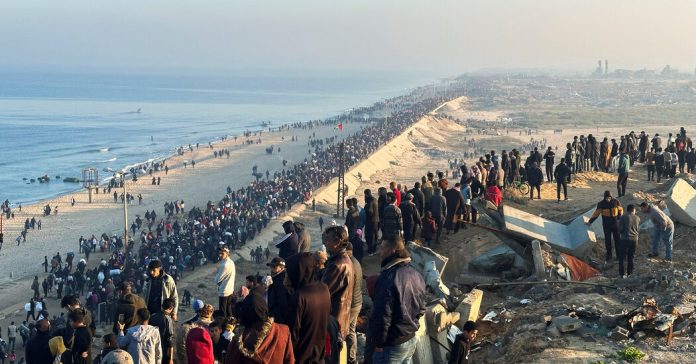
Displaced Palestinians Trek Home to Northern Gaza as Israel-Hamas Cease-Fire Holds: Live Updates

0

The cease-fires in Gaza and Lebanon will most likely hold for now, despite being tested to their limits over the weekend, because all sides want to avoid full-scale fighting at least for a few weeks, analysts said.

In southern Lebanon, Israeli troops remained in position past the deadline on Sunday for their withdrawal, amid Israeli claims that Hezbollah had broken its own pledge to leave the area. In Gaza, Hamas failed to release a female hostage whom Israel had hoped would be freed on Saturday, prompting Israel to delay the agreed return of displaced Palestinians to their homes in northern Gaza.

But even as each side accused the other of reneging on their deals, analysts said, both Israel and its opponents had reasons to remain flexible and temporarily overlook the other’s transgressions.

Hezbollah, though angry at Israel for keeping troops in southern Lebanon, would risk a devastating Israeli counterattack if it renews its rocket strikes on Israeli cities. Hamas wants to retain power in Gaza and risks losing it if war returns. And Israel needs to maintain the current arrangement in Gaza long enough to free at least two dozen more hostages. Israeli leaders have also appeared eager to placate President Trump, who campaigned on a promise to keep peace in the Middle East.

Illustrating their desire to prolong the Gaza truce, Israel and Hamas seemed to resolve the weekend’s crisis close to midnight on Sunday. The government of Qatar, a mediator between the sides, said that the female hostage, Arbel Yehud, would be freed this week along with two others who would be released ahead of schedule. In return, Israel said that it would allow displaced Palestinians to return to northern Gaza on Monday morning.

As for Lebanon, the White House announced that the truce there would be extended until Feb. 18, though there was no immediate comment from Israel or Hezbollah. The Lebanese prime minister’s office confirmed the extension.

Hezbollah flags at a barricade in southern Lebanon on Sunday.Credit…Rabih Daher/Agence France-Presse — Getty Images

Aaron David Miller, a former U.S. negotiator in Middle East peace talks, said, “They’re going to get through the next few weeks — beyond that is anyone’s guess.”

“These are not agreements between the United States and Switzerland. They’re agreements that depend on each side giving the other a certain discretion and margin for maneuver,” he added. “That is their weakness, but also their strength.”

That wriggle room ultimately allowed both truces to survive the weekend, even as Israeli troops shot and killed people in both Lebanon and Gaza who were trying to return to areas still controlled by Israel.

The Lebanese Health Ministry said that 22 people had been killed by Israeli fire in southern Lebanon, and the Palestinian Authority’s news agency said that one person had been killed in Gaza as large crowds in both places gathered near Israeli troops, demanding to go home.

But by Monday morning, the standoff in Gaza appeared set to ease. In Lebanon, Hezbollah issued a statement praising the residents attempting to return and calling on foreign powers to force Israel to withdraw. But Hezbollah did not resume its rocket fire.

Analysts say that Hezbollah is unlikely to risk further losses while its leadership is decimated and its benefactor, Iran, is weakened. Also, the group’s main arms supply route, through Syria, was blocked in December when the Syrian president, Bashar al-Assad, an ally of Hezbollah, was ousted by rebels.

Displaced Palestinians heading north in Gaza on Monday.Credit…Abdel Kareem Hana/Associated Press

Hezbollah’s commanders do “still have some rockets, they have some guns, they can do something,” said Hanin Ghaddar, a Lebanese analyst at the Washington Institute for Near East Policy, a foreign affairs research group.

“But it’s suicidal if they do this, because they know that any kind of attack by Hezbollah in Israel means that Israel will take the opportunity to come back full blast and annihilate whatever is left of them,” Ms. Ghaddar added.

Hezbollah is also probably wary of losing support among its Shiite Muslim base, particularly in next year’s parliamentary elections, Ms. Ghaddar said. Lebanon’s Shiite community paid the largest price for Hezbollah’s decision to go to war with Israel in October 2023 in solidarity with its ally Hamas. Shiite villages and towns in southern Lebanon bore the brunt of Israel’s ensuing air campaign and ground invasion.

“If the Shia do not vote for them, this is the end of Hezbollah,” said Ms. Ghaddar, the author of a book about Hezbollah’s relationship with its base. “They cannot really do anything if they don’t know 100 percent that the Shia community is going to support it.”

Because Hezbollah is less likely to resume fighting, the Gaza cease-fire is considered the frailest of the two truces.

But its biggest stress test is not expected until the beginning of March, when Hamas and Israel must decide whether to extend the arrangement beyond an initial 42-day truce.

Heading north in Gaza on Monday. Israel and Hamas seemed to resolve the weekend’s crisis close to midnight on Sunday, illustrating both sides’ desire to prolong the truce.Credit…Mohammad Abu Samra/Associated Press

For now, Israel has signaled it wants to maintain the cease-fire to sustain the flow of hostage releases. But an extension would require both sides to agree to a permanent end to the war — a bridge that Prime Minister Benjamin Netanyahu of Israel has appeared unwilling to cross. Mr. Netanyahu’s coalition government relies on far-right lawmakers who seek permanent Israeli control of Gaza, and his administration could collapse if the war ends with Hamas still in charge.

The terms of the agreement allow for some flexibility. The truce can continue beyond the 42-day mark as long as both sides remain negotiating about whether to make the arrangement permanent.

But Israeli officials say they will not remain locked in endlessly fruitless negotiations, especially if Hamas stops releasing hostages. And Hamas is unlikely to keep freeing the hostages, its main bargaining chip, without an Israeli promise to cease hostilities permanently.

“Hamas wants a cease-fire but not at all costs,” said Mkhaimar Abusada, a Palestinian political scientist from Gaza. “They want a cease-fire that ends the war.”

Much could depend on President Trump’s willingness to cajole Mr. Netanyahu toward a more lasting truce. Mr. Trump’s private messages to the Israeli prime minister were crucial to the forging of the initial phase, but it remains to be seen whether the American president will maintain that position beyond a few weeks.

“If Netanyahu succeeds in convincing Trump of the need to renew the war, there’ll probably be a renewal of the war,” Mr. Abusada said. “If Trump keeps his promise that he doesn’t want any wars and he wants more peace — whether it’s in Gaza, Ukraine or all over the world — that’s a different thing.”

Demi Moore’s Oscar nomination marks career high after nearly quitting Hollywood

0

Demi Moore’s Oscar nomination is the cherry on top of her Hollywood comeback year.

Moore, who was nominated for best actress by the Academy, also just took home her first Golden Globe at age 62.

“Being nominated for an Oscar is an incredible honor and these last few months have been beyond my wildest dreams,” Moore said in a statement. “Truly there are no words to fully express my joy and overwhelming gratitude for this recognition. Not only for me but for what this film represents. I am deeply humbled.”

“This is a time of incredible contrasts and right now, my heart is with my friends, family, neighbors and community here in L.A.” she added, referencing the Los Angeles fires that have devastated the city in January. “The fires have devastated so many lives but to see the way our community has united leaves me in awe of the resilience and compassion that defines us, and this moment is a reminder of how incredible we are when we stand together.”

DEMI MOORE RODE BIKE 60 MILES A DAY TO LOSE BABY WEIGHT AFTER 2ND CHILD WITH BRUCE WILLIS

Demi Moore was nominated for her first Oscar for her performance in “The Substance.” (Jeff Kravitz/FilmMagic, Paramount Pictures/Getty Images)

The other four stars up for best actress include Cynthia Erivo for “Wicked,” Mikey Madison for “Anora,” Karla Sofia Gascon for “Emilia Perez” and Fernanda Torres for “I’m Still Here.”

Moore’s recognition in Tinseltown came after the actress starred in “The Substance” alongside Margaret Qualley, Dennis Quaid and more.

In the film, Moore’s character is fired from her fitness show at age 50 after being deemed too old. She uses a wonder drug, which creates a younger version of herself – Margaret Qualley’s character. However, the move comes with a brutal price.

Demi Moore

Demi Moore stars in “The Substance” alongside Margaret Qualley. (The Everett Collection)

Moore began her career as a model and transitioned to TV with a role in “General Hospital.” The actress gained traction in the film industry with “St. Elmo’s Fire,” “One Crazy Summer” and “The Seventh Sign.” In the ’90s, Moore saw success with movies such as “Ghost” and “Disclosure.”

However, the actress also struck out at times, like with the movies “Striptease” and “G.I. Jane.”

Demi Moore in Ghost

Demi Moore and Patrick Swayze in “Ghost,” released in 1990. (Photo by CBS via Getty Images)

LIKE WHAT YOU’RE READING? CLICK HERE FOR MORE ENTERTAINMENT NEWS

Demi Moore in "Striptease"

Demi Moore holds her daughter, Rumer Willis, in a scene from the 1996 film “Striptease.” (Photo by Columbia Pictures/Getty Images)

Despite the setbacks, Moore kept working for years before landing the part in “The Substance.”

“It was a very hard film, very raw, very vulnerable to make, but at the same time liberating,” Moore told The Guardian.

“I had less pressure than Margaret [Qualley], because she had the added pressure to look amazing. I degrade throughout [the movie], and I knew going in that I wasn’t going to be shot in the most glamorous way or with the edges softened; in fact, the opposite. But there was something freeing about that.”

CLICK HERE TO SIGN UP FOR THE ENTERTAINMENT NEWSLETTER

Demi Moore wears strapless silver dress at Golden Globes.

Demi Moore was “in shock” upon winning her first Golden Globe Award. (Matt Winkelmeyer)

Moore admitted after winning best performance by a female actor in a musical or comedy at the 2025 Golden Globes that she had nearly quit acting before she received the script for “The Substance.”

“I thought a few years ago that this was it,” she said, in part, during her acceptance speech. “Maybe I was complete, I’d done what I was supposed to do. At a low point, this bonkers script came across my desk. The universe told me I’m not done.”

Moore recalled being told to stop competing with others, and that she would never “be enough,” but it was important to know the value of herself if she would just “put down the marking stick.”

Before walking off the stage, the “G.I. Jane” actress said that the award was “a reminder that I do belong.”

CLICK HERE TO GET THE FOX NEWS APP

Fox News Digital’s Tracy Wright contributed to this report.

Israeli Forces Again Open Fire in Lebanon

0

Israeli forces opened fire toward residents of southern Lebanon for a second straight day on Monday as people pressed on with attempts to return to their homes along the border, a day after at least two dozen people were killed and scores injured in Israeli attacks, Lebanese officials said.

The Israeli fire on Sunday was the deadliest bout of violence in Lebanon since the war between Israel and Hezbollah, the Lebanese militia, ended with a truce in November. At least two people were injured in the renewed violence on Monday, including a child, according to Lebanon’s health ministry. The Israeli military did not immediately respond to a request for comment.

The Israeli military said on Monday that it had redeployed in areas of southern Lebanon, and repeated calls for Lebanese residents to wait for their approval before returning home. The Lebanese military had sent reinforcements to parts of southern Lebanon earlier in the day, preparing to enter some towns and safeguard civilians, Lebanon’s state-run news agency reported.

Israeli forces killed at least 24 people and injured over 134 others on Sunday, Lebanese officials said, after thousands of Lebanese marched to southern towns and villages. Those areas remain occupied by Israel past a 60-day deadline for its withdrawal under the November cease-fire agreement, which called for both Israel and Hezbollah forces to leave southern Lebanon and for the Lebanese Army and U.N. peacekeepers to deploy in force there.

The Israeli military said in a statement on Sunday that it had fired “warning shots” to disperse what it called “rioters.” Last week, Israel had indicated that it would remain in southern Lebanon despite the deadline, amid doubts about the Lebanese Army’s ability to stymie Hezbollah’s resurgence.

Negotiators had hoped that the U.S.-brokered cease-fire by now would have given way for a more permanent settlement. But as the 60-day deadline elapsed on Sunday, the White House issued a statement stating that the initial agreement would be extended until Feb. 18. The Lebanese prime minister’s office confirmed the extension, which they said followed discussions with U.S. officials. The flurry of diplomatic activity appeared designed to buy time and stave off further bouts of violence.

The bloodshed on Sunday sparked urgent calls for restraint by the U.N. amid growing fears of a sustained Israeli occupation and renewed hostilities between Israel and Hezbollah. Hezbollah, however, stopped short of their characteristic calls for revenge in the wake of the killings.

Battered by the deadliest war with Israel in decades, experts say the group has little impetus to reignite a conflict that would only weaken the group further as it attempts to recover. Instead, Hezbollah called on the international community in a statement to “assume its responsibilities” and pressure Israel to “withdraw completely from our lands.”

President Trump fired more that a dozen inspectors general. Here's why that matters

0

President Trump fired more than a dozen inspectors general at federal agencies. NPR’s Leila Fadel talks to Glenn Fine, who was an inspsector general for more than a decade, about why it matters.

Trump to reinstate service members discharged for not getting COVID-19 vaccine

0

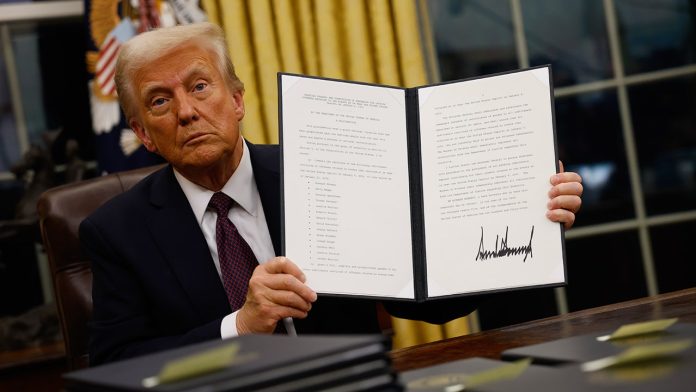
President Donald Trump will sign an executive order to reinstate service members booted from the military for declining to get COVID-19 vaccine jabs, according to the White House.

Those reinstated will be returned to their prior rank, and be provided back pay and benefits.

The White House fact sheet indicates that just 43 of the over 8,000 service members discharged over their COVID-19 vaccination status opted to return to the military.

This is a breaking news story and will be updated

Republicans in Congress Who Love Trump Now Disagree With Some of His Policies

0

When Donald J. Trump huddled with Republican senators at a closed-door meeting in the Capitol days before his inauguration, Senator Rick Scott of Florida rose and gushed to him about the exhilarating opportunity the party had to “right-size” the federal government by slashing it mercilessly, a long-held conservative goal.

Mr. Trump brusquely agreed but quickly steered the conversation in a different direction, according to two people who attended the meeting. What he was really excited to discuss was tariffs, and he launched into a lengthy discourse about his plans, pulling out a paper from his jacket pocket and laying out calculations of potential revenue the nation could bring in from taxing imports.

The exchange underscored the chasm between Mr. Trump and many members of his party who are setting to work to push his agenda through a closely divided Congress. Even as Republicans have coalesced around broad fiscal policies like cutting spending and extending the tax cuts Mr. Trump enacted in 2017, many do not share his enthusiasm for several ideas he has proposed, including implementing broad tariffs and lowering the corporate tax rate.

Those disagreements are at the heart of Republican leaders’ efforts to piece together legislation carrying the bulk of Mr. Trump’s domestic policy agenda — a massive bill cutting taxes, slashing spending and slowing immigration that they plan to fast-track over the objections of Democrats. It will be a central topic of discussion this week as House Republicans convene in Miami for a retreat entitled “Delivering the America First Agenda.”

Mr. Trump is expected to address them Monday evening to kick off the gathering.

The president — who is famously vindictive and can count on a contingent of MAGA allies ready to hector and threaten any Republican who stands in his way — is likely to demand unbending loyalty from his party when it comes to domestic policy.

At a meeting with lawmakers this month at Fort McNair in Washington, Stephen Miller, Mr. Trump’s deputy chief of staff, described the major legislation taking shape in existential terms. His message, according to a person who attended the private session, was: You may not think the bill is perfect, but this is the be-all and end-all — and you will be with us.

While Republicans have traditionally agitated for less government spending, Mr. Trump has displayed a laissez-faire attitude toward cutting costs and proposed a number of policies that would actually increase the nation’s debt.

Some Republicans have privately made it clear that they’d rather not include some of Mr. Trump’s most expensive proposals in the legislation, especially as they battle concerns from hard-right Republicans that the bill will cost too much.

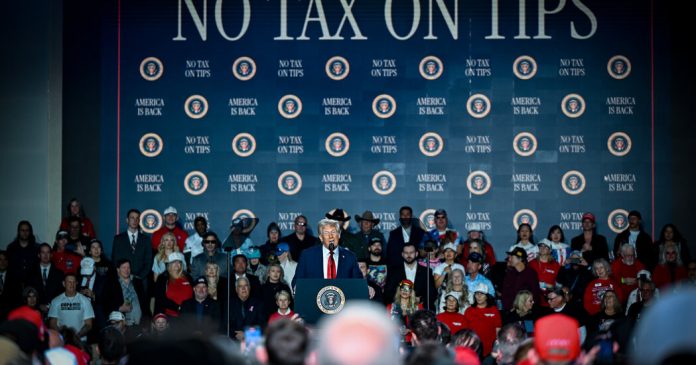
But Mr. Trump has personally been lobbying lawmakers on some of the issues he campaigned on. In a private meeting with Republican congressional leaders in the Cabinet Room at the White House on Wednesday, he urged them to implement his campaign promise to eliminate taxes on tips.

He told them repeatedly that he saw the move as a winning issue, according to two people familiar with his comments who were not authorized to discuss the private meeting.

Of the suite of tax cuts Mr. Trump proposed during the campaign, terminating taxes on tips has gained the most traction on Capitol Hill. The idea won bipartisan support during the campaign, and Republican aides are working on legislation that would translate the “no tax on tips” slogan into policy that won’t kick off a gold rush of tax avoidance.

There are several other promises Republicans would rather avoid. Free traders on Capitol Hill have particularly bristled at Mr. Trump’s vows to enact across-the-board tariffs. While the president has the authority to unilaterally impose tariffs, some Republicans have studied the possibility of imposing tariffs through law — an idea that quickly proved unpopular within the party.

Senator Rand Paul of Kentucky emerged from the closed-door meeting with Mr. Trump and the other Republican senators saying that the main way the president discussed paying for the massive reconciliation bill was through “big, beautiful tariffs.”

“I still don’t think tariffs are a good idea,” Mr. Paul said. “International trade has made the entire world incredibly prosperous, and if you look at G.D.P. per capita over the last 70 years, it’s a hockey stick going straight up. I think trade is a good thing, and international trade is a great thing, and it makes everybody richer.”

Despite the warnings from members of his own party on trade, Mr. Trump, who has been dispensing threats to close trading partners, is likely to move ahead with sweeping tariffs. Much of the rest of his campaign agenda — like making interest payments on car loans tax deductible — will require nearly unanimous support from his party in Congress.

Among Mr. Trump’s ideas is to lower the corporate tax rate to 15 percent for companies that make their products in the United States. While Republicans on Capitol Hill are throwing around different ideas for new manufacturing incentives, some in the party, and even some corporate lobbyists, hope to leave the rate at 21 percent. They worry that lowering it further would raise the cost of the bill and potentially imperil its passage.

“I think that digs us a deeper hole,” said Senator Thom Tillis, a member of the Finance Committee. “I’m sympathetic to it, but arguably I think if we were at a percentage point or two more we’d have been OK and had less of a revenue problem.”

Mr. Trump has not weighed in on many of his promised tax cuts publicly since he won the election, and he is still assembling the members of his team who will put forward the administration’s policy positions.

Some Republicans are waiting to see how hard the Trump administration actually pushes for proposals like eliminating taxes on overtime pay before digging too far into their specifics. Other pledges are already considered dead: Republican lawmakers and aides expect that exempting Social Security benefits from taxes would run afoul of procedural rules in the Senate and are preparing alternative ways to cut taxes for older Americans.

It is unclear how much dissent Mr. Trump will tolerate as the package comes together. Representative Marjorie Taylor Greene, a close ally of Mr. Trump and ultraconservative firebrand, urged her colleagues at a House hearing this week to commit themselves to the full sweep of Mr. Trump’s fiscal agenda.

“When I saw him and heard him campaign saying loudly ‘No tax on tips,’ ‘No tax on Social Security’ and ‘No tax on overtime,’ people rose to their feet and cheered loudly — standing ovation after standing ovation,” she said. “I promise you President Trump, especially for Republicans, is more popular than you are in your district.”

Mr. Trump recently invited more than a dozen House Republicans to visit him at Mar-a-Lago, his Florida estate, to discuss raising the $10,000 limit on the state and local tax deduction. The president endorsed raising the cap during the campaign, delighting Republicans from high-tax states like New York who have made doing so a political priority for years. At the Florida meeting, he asked the Republicans focused on the issue to come up with a compromise that could become law, according to lawmakers who attended.

But many in the party detest the state and local tax deduction, often called SALT, and would rather see it eliminated entirely than expanded. Republicans created the $10,000 limit in their 2017 tax law — which Mr. Trump signed — to help offset cost of the cuts they are now trying to extend.

“It’s a giveaway to the wealthy and the states that prioritize the woke agenda over good governance and it’s paid for by the hardworking taxpayers in states that do things right,” Representative Keith Self, a Republican from Texas, said.

Those divisions have left some Republican leaders convinced that the only way they will be able to quickly paper over longstanding policy disagreements is by rolling all the measures into one enormous bill, forcing lawmakers to go on the record in a single up-or-down vote on Mr. Trump’s agenda.

That would essentially dare Republicans to challenge the president, a move many have privately said they believe their colleagues are loath to make after Mr. Trump went after Representative Chip Roy of Texas last month for opposing his push to raise the debt limit.

A North Carolina Republican is challenging some 65,000 votes : NPR

0

Standing in front of the North Carolina Supreme Court in Raleigh on Jan. 14, Ted Corcoran reads a list of over 60,000 people who cast ballots in the November 2024 election but whose votes have been challenged by Republican court candidate Jefferson Griffin in his extremely close race with Democratic Justice Allison Riggs.

Chris Seward/AP


hide caption

toggle caption

Chris Seward/AP

CHARLOTTE, N.C. — Tory Grimm-Oropesa moved to Charlotte from northern California in 2022. She then voted in two elections without incident. But after voting in November of last year, she received an unusual piece of mail.

“I got a postcard in the mail with a QR code on it that said my ballot was being challenged,” she said.

That postcard was from the campaign of Republican Jefferson Griffin, in a contest for a seat on the North Carolina Supreme Court. After two recounts in the swing state, Griffin is trailing Democratic incumbent Allison Riggs by a miniscule 734 votes out of more than 5.5 million ballots cast.

Griffin hasn’t pointed to any case of voter fraud, but he is contesting Grimm-Oropesa’s vote — along with roughly 65,000 others.

His challenge means that a bitter fight over a state high court seat is still working its way through the courts, more than 80 days after Election Day.

The next step comes Monday, when the 4th U.S. Circuit Court of Appeals will hear arguments, before ultimately deciding whether the case should be decided in federal court or in state court.

Meanwhile, Grimm-Oropesa is upset.

“It’s not a matter of I did something wrong or I’m trying to cheat in voting,” she said. “I voted in three different elections now, perfectly fine, never had an issue. So I don’t understand why this one and just this one result should be thrown out.”

3 buckets of challenged ballots

Riggs was appointed to the North Carolina Supreme Court in 2023 by then-Democratic Gov. Roy Cooper. She has recused herself from this case, and possibly deciding her own election.

But she has publicly criticized Griffin’s challenge. In a recent statement, Riggs said Griffin was wasting taxpayer dollars in “a baseless attempt to overturn his electoral loss.”

Griffin has said he can’t comment on his legal effort.

The list of challenged voters includes some elected officials. It also includes Riggs’ parents. The contested ballots are in three buckets:

  • A little more than 60,000 of them are due to voters having incomplete registrations. At one point, North Carolina’s voter registration forms didn’t explicitly say that a driver’s license number or the last four digits of a Social Security number were needed. More than 200,000 voters statewide are believed to have missing information.
  • Griffin is also challenging a small group of overseas voters who haven’t lived in North Carolina. 
  • And then roughly 5,500 of the challenged ballots are also from overseas. Those voters didn’t show a copy of their photo ID when voting, and Griffin has argued they should be thrown out. These challenged ballots come from just four Democratic-leaning counties in the state.

The state Board of Elections had approved rules that didn’t require photo ID for overseas ballots. Those rules were then unanimously approved in March by the North Carolina Rules Review Commission, whose 10 members were selected by the Republican leaders of the state House and Senate.

And both Republicans and Democrats on the state Board of Elections in December rejected Griffin’s push to disqualify those voters.

Certification of the election has been blocked

GOP political consultant Paul Shumaker, who advised Griffin’s campaign, said it’s reasonable for a court to review the decisions made by the elections board and other agencies — even if they were bipartisan.

“Why are we going to have an appointed board be the final determination of the interpretation of our laws? Do we really want that?” he said. “We have judicial review of the legislative process. [What] about judicial [review] of the administrative process and how our elections are handled?”

The North Carolina Supreme Court has blocked certification of the election. But last week it said the challenge should first be heard in lower state courts, a setback for Griffin.

However Chief Justice Paul Newby, a Republican, appeared to support Griffin’s challenge. He also cast doubt over the entire election process.

In the ruling, he said Riggs’ ability to erase Griffin’s lead of 10,000 votes on election night was a “highly unusual course of events.” (It’s common in elections for one candidate to appear to be leading and then fall behind as all results are tallied.)

Newby wrote: “[T]his case is not about deciding the outcome of an election. It is about preserving the public’s trust and confidence in our elections through the rule of law.”

The state Board of Elections, which has a Democratic majority, has said the post-Election Day counting of mail ballots and provisional ballots followed state law.

Some Republicans are uneasy with Griffin’s challenge

As the dispute has dragged on, some Republicans say Griffin has gone too far.

Republican state Supreme Court Justice Richard Dietz wrote earlier this month that it would invite “incredible mischief” to have post-election litigation that “seeks to rewrite our state’s election rules” and “remove the right to vote in an election from people who already lawfully voted under the existing rules.”

Andrew Dunn, the communications director on an unsuccessful GOP campaign for governor four years ago, said the Democratic Party’s talk about threats to democracy are, in his view, usually overblown.

“However this case to me is different,” he said. “This case is about complaining about the results of an election and trying to go back and retroactively disqualify voters who cast ballots in good faith.”

Depending on court rulings, the state supreme court race could be re-tabulated — or a new election could be ordered.

Meanwhile, voters like Annie Rickenbaugh of Charlotte wonder if their challenged ballots will still count.

“I’m a regular person trying to pay my rent,” she said. “I don’t want to have to deal with this.”

She said she went to the county board of elections to re-register in the hopes her ballot is never challenged again.


Birthright citizenship clause too many forget, but Trump is right to question

0

Join Fox News for access to this content

Plus special access to select articles and other premium content with your account – free of charge.

By entering your email and pushing continue, you are agreeing to Fox News’ Terms of Use and Privacy Policy, which includes our Notice of Financial Incentive.

Please enter a valid email address.

NEWYou can now listen to Fox News articles!

Few of President Donald Trump’s new executive orders have caused as much alarm as the one on birthright citizenship.  

That order prohibits federal agencies from issuing or accepting citizenship documents for children born in the U.S. when neither parent is a U.S. citizen or lawful permanent resident at the time of the child’s birth.   

Critics paint it as flagrantly unconstitutional, including a misinformed federal judge in Seattle who issued a temporary injunction against it last week. But the new policy fits squarely within the text and original meaning of the Fourteenth Amendment.

‘BLATANTLY UNCONSTITUTIONAL’: US JUDGE TEMPORARILY BLOCKS TRUMP’S BAN ON BIRTHRIGHT CITIZENSHIP

For the first century following the Fourteenth Amendment’s ratification, few legal scholars would have batted an eye at a directive like Trump’s. If anything, they’d have been more confused as to why the federal government started issuing passports to the U.S.-born children of illegal aliens, tourists, and “temporary sojourners” in the first place.   

Migrants from a caravan in Tapachula, Chiapas state, Mexico, march while heading to the US border on January 20, 2025. (ISAAC GUZMAN/AFP via Getty Images)

Contrary to popular belief, the Fourteenth Amendment doesn’t say that all people born in the U.S. are citizens. It says that “all persons born or naturalized in the United States and subject to the jurisdiction thereof” are citizens. That second, critical, conditional phrase is conveniently ignored or misinterpreted by advocates of “universal” birthright citizenship.    

This was intended to constitutionalize the protections of the 1866 Civil Rights Act, which provided that “all persons born in the United States, and not subject to any foreign power” would be considered citizens.   

The change in language didn’t reflect a desire on Congress’s part to abrogate the statutory definition or adopt universal birthright citizenship. In fact, the Civil Rights Act remained valid law for another 70 years, with courts and legal scholars alike assuming that it was perfectly consistent with the Citizenship Clause.   

That’s because the sponsors of the Fourteenth Amendment made it clear that “subject to the jurisdiction” of the U.S. means owing your political allegiance to the U.S., and not to another country. Children born to aliens are citizens of their parents’ native land, and thus owe their allegiance to, and are subject to the jurisdiction of, that native land.  

Legislative history shows that Congress intended the Fourteenth Amendment to eliminate permanent race-based barriers to citizenship – not to bestow citizenship on everyone born within the geographical confines of the United States. Congress didn’t intend birthright citizenship to apply to the U.S.-born children of those who owed only a limited allegiance to the United States. 

Even modern proponents of “universal birthright citizenship” admit that the children born on U.S. soil to diplomats or tribally affiliated Native Americans don’t obtain birthright citizenship. In fact, they and their children were only made citizens through the Indian Citizenship Act of 1924 — legislation that wouldn’t have been necessary if the Fourteenth Amendment adopted common law rules of universal birthright citizenship.  

While critics of Trump’s order claim that universal birthright citizenship is “the settled law of the land,” the Supreme Court has never definitively addressed this issue.  

The first time the nation’s highest court opined on the meaning of the Citizenship Clause — in the famous Slaughter-House cases of 1872 — it stated that the phrase “subject to the jurisdiction thereof” excluded “children of ministers, consuls, and citizens or subjects of foreign States born within the United States.”   

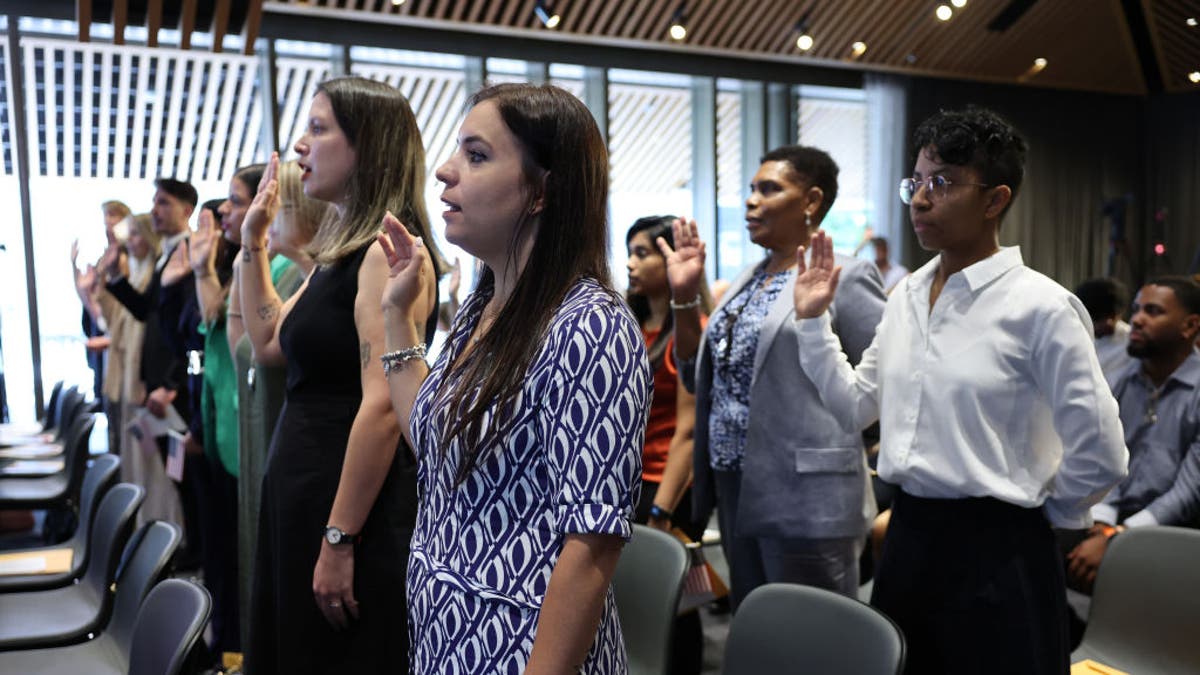
People raise their hands as they take the Oath of Allegiance during a Naturalization Ceremony at the Stavros Niarchos Foundation Library on July 02, 2024, in New York City. (Photo by Michael M. Santiago/Getty Images)

People raise their hands as they take the Oath of Allegiance during a Naturalization Ceremony at the Stavros Niarchos Foundation Library on July 02, 2024, in New York City. (Photo by Michael M. Santiago/Getty Images)

The Court confirmed this understanding in 1884 in Elk v. Wilkins, denying birthright citizenship to an American Indian because he “owed immediate allegiance to” his tribe and not the United States.   

Most legal arguments for universal birthright citizenship ignore these early cases and point to the 1898 decision U.S. v. Wong Kim Ark. However, that decision simply held that U.S.-born children of lawful permanent residents are U.S. citizens.  

CLICK HERE FOR MORE FOX NEWS OPINION 

Further, that decision concerned the constitutionality of acts that created a class of lawful permanent residents who, just like Black people under Dred Scott, were perpetually excluded from citizenship based solely on their race – exactly the situation the Fourteenth Amendment was designed to prevent.   

Our nation’s current immigration and nationality laws no longer create this type of permanent race-based barrier to citizenship. Today, the federal statute defining citizenship (8 U.S.C. § 1401) simply repeats the language of the Fourteenth Amendment, including the phrase “subject to the jurisdiction thereof.”   

Even modern proponents of “universal birthright citizenship” admit that the children born on U.S. soil to diplomats or tribally affiliated Native Americans don’t obtain birthright citizenship.

That language retains the same meaning today as it had when it was drafted and ratified. It doesn’t evolve to mean something else just because previous administrations erroneously interpreted it more expansively.   

As a result, the president has the authority to direct federal agencies to act in accordance with the original meaning of the Fourteenth Amendment, and to issue government documents and benefits only to those individuals who are truly subject to United States jurisdiction.  

CLICK HERE TO GET THE FOX NEWS APP

Far from being an attempt to rewrite the Constitution or “end birthright citizenship,” Trump’s order is a much-needed and long-overdue course correction, reversing a decades-long policy that was never constitutionally mandated in the first place. 

Amy Swearer is a Senior Legal Fellow in The Heritage Foundation’s Edwin Meese III Center for Legal and Judicial Studies. Hans von Spakovsky is the Manager of the Election Law Reform Initiative and a Senior Legal Fellow in The Heritage Foundation’s Edwin Meese III Center for Legal and Judicial Studies. 

CLICK HERE TO READ MORE FROM AMY SWEARER

CLICK HERE TO READ MORE FROM HANS VON SPAKOVSKY

Hans von Spakovsky is a senior legal fellow in The Heritage Foundation’s Meese Center for Legal and Judicial Studies and manager of the think tank’s Election Law Reform Initiative.

Gaza and Lebanon Truces Are Fragile, but All Sides May Keep Them Going

0

The cease-fires in Gaza and Lebanon will most likely hold for now, despite being tested to their limits over the weekend, because all sides want to avoid full-scale fighting at least for a few weeks, analysts said.

In southern Lebanon, Israeli troops remained in position past the deadline on Sunday for their withdrawal, amid Israeli claims that Hezbollah had broken its own pledge to leave the area. In Gaza, Hamas failed to release a female hostage whom Israel had hoped would be freed on Saturday, prompting Israel to delay the agreed return of displaced Palestinians to their homes in northern Gaza.

But even as each side accused the other of reneging on their deals, analysts said, both Israel and its opponents had reasons to remain flexible and temporarily overlook the other’s transgressions.

Hezbollah, though angry at Israel for keeping troops in southern Lebanon, would risk a devastating Israeli counterattack if it renews its rocket strikes on Israeli cities. Hamas wants to retain power in Gaza and risks losing it if war returns. And Israel needs to maintain the current arrangement in Gaza long enough to free at least two dozen more hostages. Israeli leaders have also appeared eager to placate President Trump, who campaigned on a promise to keep peace in the Middle East.

Illustrating their desire to prolong the Gaza truce, Israel and Hamas seemed to resolve the weekend’s crisis close to midnight on Sunday. The government of Qatar, a mediator between the sides, said that the female hostage, Arbel Yehud, would be freed this week along with two others who would be released ahead of schedule. In return, Israel said that it would allow displaced Palestinians to return to northern Gaza on Monday morning.

As for Lebanon, the White House announced that the truce there would be extended until Feb. 18, though there was no immediate comment from Israel or Hezbollah. The Lebanese prime minister’s office confirmed the extension.

Aaron David Miller, a former U.S. negotiator in Middle East peace talks, said, “They’re going to get through the next few weeks — beyond that is anyone’s guess.”

“These are not agreements between the United States and Switzerland. They’re agreements that depend on each side giving the other a certain discretion and margin for maneuver,” he added. “That is their weakness, but also their strength.”

That wriggle room ultimately allowed both truces to survive the weekend, even as Israeli troops shot and killed people in both Lebanon and Gaza who were trying to return to areas still controlled by Israel.

The Lebanese Health Ministry said that 22 people had been killed by Israeli fire in southern Lebanon, and the Palestinian Authority’s news agency said that one person had been killed in Gaza as large crowds in both places gathered near Israeli troops, demanding to go home.

But by Monday morning, the standoff in Gaza appeared set to ease. In Lebanon, Hezbollah issued a statement praising the residents attempting to return and calling on foreign powers to force Israel to withdraw. But Hezbollah did not resume its rocket fire.

Analysts say that Hezbollah is unlikely to risk further losses while its leadership is decimated and its benefactor, Iran, is weakened. Also, the group’s main arms supply route, through Syria, was blocked in December when the Syrian president, Bashar al-Assad, an ally of Hezbollah, was ousted by rebels.

Hezbollah’s commanders do “still have some rockets, they have some guns, they can do something,” said Hanin Ghaddar, a Lebanese analyst at the Washington Institute for Near East Policy, a foreign affairs research group.

“But it’s suicidal if they do this, because they know that any kind of attack by Hezbollah in Israel means that Israel will take the opportunity to come back full blast and annihilate whatever is left of them,” Ms. Ghaddar added.

Hezbollah is also probably wary of losing support among its Shiite Muslim base, particularly in next year’s parliamentary elections, Ms. Ghaddar said. Lebanon’s Shiite community paid the largest price for Hezbollah’s decision to go to war with Israel in October 2023 in solidarity with its ally Hamas. Shiite villages and towns in southern Lebanon bore the brunt of Israel’s ensuing air campaign and ground invasion.

“If the Shia do not vote for them, this is the end of Hezbollah,” said Ms. Ghaddar, the author of a book about Hezbollah’s relationship with its base. “They cannot really do anything if they don’t know 100 percent that the Shia community is going to support it.”

Because Hezbollah is less likely to resume fighting, the Gaza cease-fire is considered the frailest of the two truces.

But its biggest stress test is not expected until the beginning of March, when Hamas and Israel must decide whether to extend the arrangement beyond an initial 42-day truce.

For now, Israel has signaled it wants to maintain the cease-fire to sustain the flow of hostage releases. But an extension would require both sides to agree to a permanent end to the war — a bridge that Prime Minister Benjamin Netanyahu of Israel has appeared unwilling to cross. Mr. Netanyahu’s coalition government relies on far-right lawmakers who seek permanent Israeli control of Gaza, and his administration could collapse if the war ends with Hamas still in charge.

The terms of the agreement allow for some flexibility. The truce can continue beyond the 42-day mark as long as both sides remain negotiating about whether to make the arrangement permanent.

But Israeli officials say they will not remain locked in endlessly fruitless negotiations, especially if Hamas stops releasing hostages. And Hamas is unlikely to keep freeing the hostages, its main bargaining chip, without an Israeli promise to cease hostilities permanently.

“Hamas wants a cease-fire but not at all costs,” said Mkhaimar Abusada, a Palestinian political scientist from Gaza. “They want a cease-fire that ends the war.”

Much could depend on President Trump’s willingness to cajole Mr. Netanyahu toward a more lasting truce. Mr. Trump’s private messages to the Israeli prime minister were crucial to the forging of the initial phase, but it remains to be seen whether the American president will maintain that position beyond a few weeks.

“If Netanyahu succeeds in convincing Trump of the need to renew the war, there’ll probably be a renewal of the war,” Mr. Abusada said. “If Trump keeps his promise that he doesn’t want any wars and he wants more peace — whether it’s in Gaza, Ukraine or all over the world — that’s a different thing.”