Thursday, November 12, 2026
Home Blog Page 342

Immigrants and advocacy organizations brace for Trump’s Day One actions : NPR

0

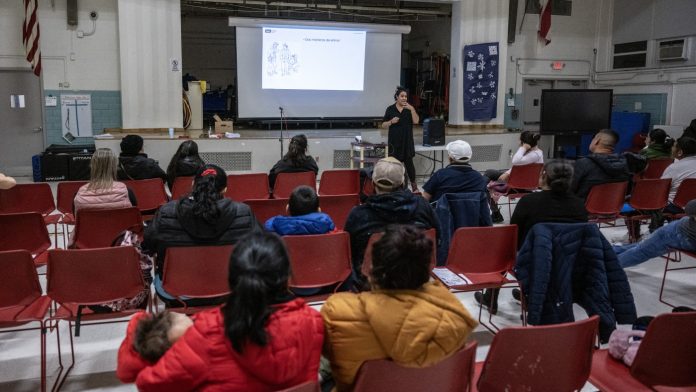
Amica Center for Immigrant Rights (formerly known as CAIR Coalition) attorney, Atenas Burrola Estrada speaks during an presentation on immigration enforcement at a school in Washington, DC on January 10, 2025.

ANDREW CABALLERO-REYNOLDS/AFP via Getty Images


hide caption

toggle caption

ANDREW CABALLERO-REYNOLDS/AFP via Getty Images

Days before President-elect Donald Trump starts his second term, many immigrants in the U.S. are scared and anxious.

Trump’s promise to deport people without legal status in the U.S. has put many communities on edge.

Nicolás, a 20-year-old from South America, told NPR he worries about the potential for mass raids by federal agencies, including Immigration and Customs Enforcement, in neighborhoods and workplaces which rely heavily on immigrant labor.

“People’s rights will be violated,” Nicolás said in Spanish.

He’s an organizer with Resistencia en Acción, which advocates for immigrant rights and the working-class in New Jersey. NPR is only identifying Nicolás by his middle name because he worries about being targeted for his immigration status.

When Trump is sworn in on Monday, Nicolás says he won’t be at the restaurant where he works “because of all the attacks against us and all of the things we know could happen.”

So, instead of going to work, Nicolás is joining a rally hosted by an immigration advocacy organization in New Jersey he works with. The event, he says, “is so people know we are fighting for our people.”

It’s unclear what actions Trump will take to target people who are living in the U.S. without legal status in his first days or weeks in office.

The Republican has said he will start mass deportations on Day One. He’s also vowed to end automatic citizenship for those born in the U.S. to parents without legal status.

Trump won a second term in part by promising to crackdown on illegal immigration and bolster border security. He has vowed to prioritize the deportation of those without legal status who pose a public safety or national security threat. However, he hasn’t ruled out expanding deportations to include mixed-status families and other groups. According to an NPR/PBS News/Marist poll released this week, 49 percent of Americans back mass deportations. 49 percent oppose his plans.

A spokesperson for Trump’s transition team told NPR in a statement that “he will deliver” on his promises, although she didn’t answer a question about timing and the incoming administration’s priorities.

Felicia Gomez, a senior policy advocate at the ACLU of San Diego and Imperial Counties, told reporters Wednesday her organization has been planning for a wide range of scenarios.

“We are prepared to meet the impending Trump administration head on — in the courts, in Congress, and at the state and local levels,” Gomez said. “We will use every tool in our tool box to defend civil rights and liberties of all people in our region.”

The ACLU is offering “know your rights” training for migrants in different languages. It’s also putting in teams to rapidly respond to any potential workplace or at-home raids.

CASA, a nonprofit organization that advocates for immigrant workers, has set up a hotline for people to call in and report raids, or ask for help for loved ones who’ve been detained. The line will be staffed around the clock.

Gustavo Torres, CASA’s director, said organizations also have to turn their attention to the local governments.

“We continue to push for state and local protections – blocking ICE access to DMV databases, restricting facial recognition surveillance, and shutting down immigrant detention centers,” Torres said in a statement. “We’ve secured countless state and local protections, and we will not stop until our communities are safe.”

Fear during Biden’s term

But Trump’s promises are not the only reason why immigrant communities are on edge. Under the Biden administration — which has deported a record number of migrants since 2014 — many haven’t felt safe.

Last week, Customs and Border Protection conducted arrests in California’s Central Valley. According to CBP, 78 migrants without legal status were detained during the 3-day operation. The agency says those arrested had broken the law.

Mario Gonzalez, the Deputy Director of Centro La Familia Advocacy Services in Fresno, Calif., told NPR people in his community are scared.

“Over the weekend, and days after people were not coming out, people were not leaving their homes,” Gonzalez said.

He said his organization has been receiving non-stop calls from people asking what they can do to protect themselves.

Employers have also gotten involved.

“This time around we are seeing employers actually reach out ahead of time and ask us for us to show up and do know-your-rights training to their employees,” Gonzalez said. “This is something new as well — not something that we saw a lot of prior to this.”

He says this is a sign of how some employers see the value of the immigrant workforce, one that could be decimated if mass deportations were to take place.

Biden’s legacy questioned by NBC with White House sentiment ‘like a morgue’

0

NBC News shed light on President Biden’s legacy and the somber mood engulfing the White House in the president’s final days in an article on Thursday.

The article contrasted Biden’s pledge “to unite the country, strengthen his party and defend democracy,” when he took office, to what actually manifested during his term as president.

Biden “leaves a nation divided, a party in tatters and the American people questioning the self-described institutionalist’s respect for the rule of law,” according to the report.

MSNBC’S LAWRENCE O’DONNELL GUSHES OVER BIDEN’S ACHIEVEMENTS IN FINAL INTERVIEW: ‘LIKE A MAGIC TRICK’

US President Joe Biden delivers his farewell address to the nation from the Oval Office of the White House in Washington, DC, on January 15, 2025. (Photo by MANDEL NGAN/POOL/AFP via Getty Images) ((Mandel Ngan/Pool via AP))

This disconnect between Biden’s pledge when he took office, and his actions as president, has led to many Democrats “blaming Biden for handing the White House to Donald Trump, criticizing the aging politician for staying in office too long and reeling after he pardoned his son,” said NBC News.

According to a person directly familiar with Biden’s comments, the president “privately mused about the idea of pardoning [President-elect Donald] Trump as a magnanimous move,” while at the same time, the president was “not on speaking terms with some of his closest allies.”

Prominent Democratic political strategist James Carvile is quoted in the article, giving his take on Biden’s legacy and his final days in office.

“The Joe Biden story is one of the great tragedies of American politics. I really mean that. He should be having a glorious, well deserved, highly acclaimed retirement. And he’s not,” Carville said, adding, “It’s hard to blame anybody but him.”

BIDEN ENTERED OFFICE AS MEDIA DARLING, BUT INACCESSIBILITY, SECRECY AND TRUMP WIN LEAVES LEGACY TATTERED

According to a person who recently met with officials at the White House, the current mood feels “like a morgue,” with one White House official saying that personnel are trying to hold back emotions until Biden officially leaves the Oval Office.

“It’s hard to reflect, it’s hard for it to sink in that we’re done here — until we’re actually done and out the gates with our stuff,” one White House official told NBC, adding, “it hasn’t sunk in for people who are still here yet because we’re working until the last minute.”

White House and Joe Biden split image

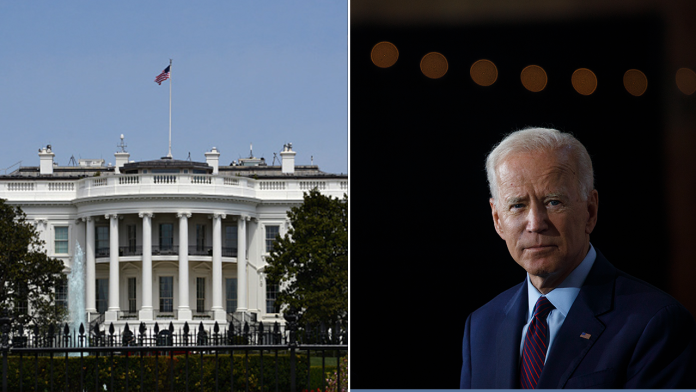
The current mood at the White House feels “like a morgue” according to a person who recently met with White House officials. (Photo by Getty Images) (Getty Images)

The article details Biden’s “many fractured friendships,” claiming, “He is estranged from some of the people who were once among his most powerful allies.”

According to NBC News, “He [Biden] harbors, along with first lady Jill Biden, a simmering resentment toward former President Barack Obama, former House Speaker Nancy Pelosi and several former aides, including Bob Bauer and Anita Dunn, all of whom he believes either failed him or pushed him out of the 2024 race, according to several people close to him.”

An aide to ex-Speaker Nancy Pelosi, D-Calif, revealed she and Biden have not had a substantive meeting together since she pressured him to drop out of the presidential race in July. 

A person close to Biden corroborated this claim, saying, “That relationship is permanently damaged.”

Jill Biden also told the Washington Post in an article published this week that she was “disappointed” in Pelosi’s actions.

BIDEN COMMUTES NEARLY 2,500 MORE SENTENCES IN FINAL DAYS OF PRESIDENCY

Although President Biden has not pubically expressed his frustrations with former President Obama, Ben Rhodes, a former aide to Obama, pointed out Biden’s recent decision to name aircraft carriers after former Presidents George W. Bush and Bill Clinton, seemingly snubbing Obama.

“Barack H. Obama did not get a f—ing personnel carrier named after him,” Rhodes said on an episode of the “Pod Save The World” podcast.

NBC News was also critical of Biden pardoning his son Hunter Biden, claiming, “Biden went back on his promise to protect the norms he said undergirded the nation’s stability by pardoning his Hunter Biden on federal gun and tax charges.”

Hunter Biden and Melissa Cohen Biden arrive at federal court

Hunter Biden and his wife Melissa Cohen Biden walk outside the federal court during his trial on criminal gun charges, in Wilmington, Delaware, U.S., June 11, 2024. (Photo by REUTERS/Hannah Beier) ((REUTERS/Hannah Beier))

The article also alleges that former Biden advisor, Anita Dunn, and former Biden lawyer, Bob Bauer, blamed members of Biden’s family for them being “unceremoniously” cut from the president’s inner circle.

“Dunn and Bauer resented being unceremoniously cast out of the president’s inner circle and blamed two Biden family members in particular for that — Hunter Biden and Jill Biden,” claimed NBC News.

CLICK HERE FOR MORE COVERAGE OF MEDIA AND CULTURE

A mournful quote from James Carville at the end of the article seems to encapsulate the overall energy surrounding the end of the Biden presidency.

“Joe Biden had many successful acts in his life. Unfortunately, you get remembered for your last act,” he said. “Right now, he’s remembered as the guy who stayed too long.”

CLICK HERE TO GET THE FOX NEWS APP 

A Big, Bold TikTok Ban

0

It has become a cliché to lament that the U.S. government no longer does big, audacious things. But banning TikTok — a social media platform that roughly half of Americans use — would certainly qualify as big and audacious.

That outcome became more likely yesterday, even if it is far from assured. The Supreme Court unanimously upheld a bill that Congress passed last year forcing ByteDance, the Chinese company that owns TikTok, to sell it. If ByteDance refuses, as Chinese officials have so far insisted, the app will no longer be available for downloads or updates in the U.S. as early as tomorrow.

The potential ban of a media platform as large as TikTok has little precedent. It would create inconveniences and costs for millions of Americans. Many would have to alter their daily habits, and some would lose business opportunities.

Yet allowing a Chinese company — and, by extension, the Chinese government — to control a U.S. communication platform and vast amounts of Americans’ personal data also has major downsides. Congress and the Supreme Court have decided that the risks are large enough to justify the disruption. It’s a sign of the intensity of the U.S.-China competition for global influence.

Both the boldness of the TikTok law and its bipartisan nature wouldn’t have seemed so unusual decades ago. U.S. history is full of ambitious projects whose rationale was at least partly to confront foreign adversaries, including the space program, the Interstate Highway System, the post-Sputnik investment in scientific research, and the industrial mobilization during World War II.

Forcing the sale of TikTok, or shutting it down, obviously doesn’t approach the scale of those projects. Still, it is far-reaching in its own way. It’s a big enough change that many Americans have found it hard to believe that the federal government will go through with it. And it is on the cusp of happening because a broad range of policymakers have decided the alternative is unacceptable.

During the oral arguments at the Supreme Court last week, Justice Brett Kavanaugh, a Republican appointee, talked about the possibility that China could use TikTok’s extensive data collection “to turn people, to blackmail people, people who, a generation from now, will be working in the F.B.I. or the C.I.A. or in the State Department.” Justice Ketanji Brown Jackson, a Democratic appointee, also worried aloud about potential spying. Justice Sonya Sotomayor, another Democratic appointee, said, “It’s about the data control.”

TikTok claims that the Chinese government is unlikely to force the company to hand over sensitive information, such as users’ contacts. But that claim seems inconsistent with recent history, as the justices noted in their ruling. China “has engaged in extensive and yearslong efforts to accumulate structured datasets, in particular on U.S. persons, to support its intelligence and counterintelligence operations,” the ruling pointed out.

The vote in Congress also showed deep, bipartisan concern. The bill passed 360 to 58 in the House and 78 to 18 in the Senate. In addition to data security, members of Congress worried that China would use TikTok to spread misinformation and propaganda. Independent research has found that the platform already seems to do so, making it hard to find videos sympathetic to Taiwan, Tibet, Ukraine and other causes to which the Chinese Communist Party is hostile.

The biggest question now is what the incoming Trump administration will do. When he was president before, Donald Trump helped start the crackdown on TikTok, calling it a national security risk. He has since changed his position for reasons that remain unclear. A TikTok investor and Republican donor apparently lobbied Trump shortly before he came out against a ban. He also enjoys his popularity on the app.

The Biden administration said yesterday that it would not enforce the ban in the brief window — 36 hours — after it takes effect and before Trump takes office. Trump is reportedly considering an executive order to delay the ban while his administration tries to help negotiate a sale to a non-Chinese owner. The Chinese government, for its part, insists that it will not allow ByteDance to sell TikTok. Beijing evidently considers TikTok too valuable.

The range of outcomes over the next few weeks remains wide — including a shutdown, a sale or some version of the status quo combined with a continuing legal fight.

Go inside the decision: To understand the Supreme Court’s reasoning, I recommend Adam Liptak’s article.

Immigration

Other Big Stories

📺 “Prime Target” (Wednesday): Few of us thrill to a mathematical proof. A conspiracy-minded eight-episode series on AppleTV+ has other ideas. Leo Woodall (last seen in “The White Lotus” Season 2 doing bad things on yachts) stars as a Cambridge University numbers genius who makes a breakthrough — a formula that can pierce any digital security system. (Even two-factor authentication? Whoa.) What will nefarious government agents do to get their hands on it? Here, as occasionally in calculus, there are no limits. Quintessa Swindell (“Black Adam”) plays an N.S.A. agent with some dangerous equations of her own.

A three-day weekend is always a great excuse for having people over for a long, leisurely brunch — preferably one centered around a dish that can be made almost entirely in advance. Sarah Copeland’s croque-monsieur breakfast casserole is exactly that, a golden, custardy beauty filled with sliced baguettes, ham, and a melty cap of Gruyère cheese. It only takes about 15 minutes to assemble everything in the baking dish, which is easily done the night before. Then you can sip your morning coffee while the casserole bakes, and let its toasted, buttery scent be a warm welcome to greet your guests when they arrive.

The Hunt: After leaving prison, a single mother looked for a home in Tennessee where she could rebuild her life. Which did she choose? Play our game.

Wooden spoons are a great alternative to plastic ones. But they are finicky: They’re incompatible with dishwashers, they’re prone to warp, and they can get grimy if you don’t properly care for them. Fortunately, restoring wooden spoons to their full glory is simple. When they begin to look dry, coat them with food-grade mineral oil and let them sit overnight. Then use a paper towel to rub a dime-size dollop of beeswax across the surface — this helps lock in the moisture and keep the wood in tip-top condition. Well-hydrated spoons should last years, and maybe even a lifetime. — Maki Yazawa

Notre Dame vs. Ohio State, college football championship: Notre Dame and Ohio State had the two best defenses in the country, in terms of points allowed, and each is tailored to stop the other’s offensive strength. Ohio State excels against the run; Notre Dame is great against the pass. The outcome might depend on which star breaks through: Notre Dame’s speedy running back Jeremiyah Love or Ohio State’s freshman wide receiver Jeremiah Smith. Monday at 7:30 p.m. Eastern on ESPN

Trump’s return recalls when inaugurations have been more than ceremonies : NPR

0

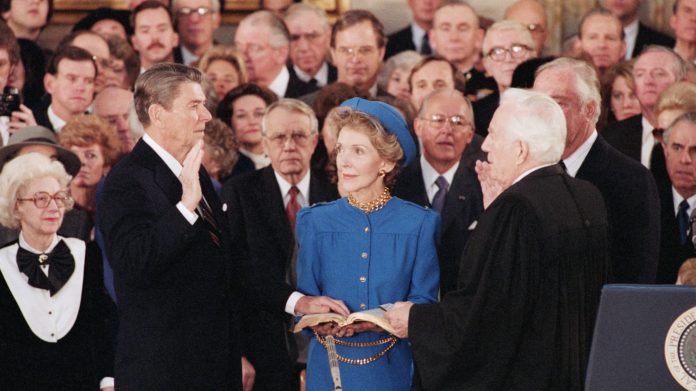
President Ronald Reagan is sworn in by Chief Justice Warren Burger in an Inauguration ceremony in the Capitol Rotunda in Washington, D.C., on Jan. 21, 1985.

Bill Creighton/Bettmann/Getty Images


hide caption

toggle caption

Bill Creighton/Bettmann/Getty Images

Presidential inaugurations are by definition historic acts, but when we think of past Inauguration Days there is clearly a hierarchy of historical pop.

Who could forget John F. Kennedy’s “Ask not what your country can do for you, ask what you can do for your country” in 1961. Or Ronald Reagan 20 years later relocating the ceremony for the first time from the East Front of the U.S. Capitol to the magnificent West Front facing the National Mall and the Washington Monument? Or the surprise of seeing the grand stage and spectacle reduced to the indoor space of the Capitol Rotunda in 1985 due to severe cold? The latter scene will have a reprise on Monday as plunging temperatures have moved the second Trump inaugural ceremony indoors.

As a rule, the biggest splash has been made by the newly elected presidents coming to the office for the first time, especially those elected in opposition to the party previously in control of the White House. These have drawn the largest crowds and inspired the most breathless anticipation.

Guests and spectators attend the 59th Presidential Inauguration on the West Front of the U.S. Capitol on Jan. 20, 2021, in Washington, D.C.

Guests and spectators attend the 59th Presidential Inauguration on the West Front of the U.S. Capitol on Jan. 20, 2021, in Washington, D.C.

Susan Walsh/Pool/Getty Images


hide caption

toggle caption

Susan Walsh/Pool/Getty Images

The atmosphere itself seems to ask: How will things be different now in Washington, in the country at large and in the wider world? Such questions do not accompany the reelected incumbents, no matter how gratifying reelection and the continuation in power may be at the time. The thrill of Day 1 has rarely been as great the second time around.

Two transformative inaugurals

We have seen this transformative kind of Inauguration Day twice in recent years, with Barack Obama in 2009 and then with Donald Trump in 2017. Both were considered unlikely winners of their respective parties’ nominations. Both had overcome those odds on the strength of things they had done far from Washington and its measures of importance.

And so their inaugurations spoke of dramatic departures, even as they acted out the day’s rituals and touched all the traditional bases. The movements Obama and Trump inspired were quite distinct. Obama’s was later dubbed “the coalition of the ascendant,” an amalgam of younger voters, women and people of color. While these categories had leaned Democratic for several cycles, they came out in force for Obama and easily overcame the margin by which the Republican ticket still carried the white vote.

Attendees line the Mall as they watch ceremonies to swear in Donald Trump on Inauguration Day on Jan. 20, 2017, in Washington, D.C.

Attendees line the Mall as they watch ceremonies to swear in Donald Trump on Inauguration Day on Jan. 20, 2017, in Washington, D.C.

Lucas Jackson/Pool/Getty Images


hide caption

toggle caption

Lucas Jackson/Pool/Getty Images

Trump’s movement had its own demographics, somewhat at odds with Obama’s, but it clearly revived the idea of populism as a force. In its earlier eras of prominence, the term had belonged to rebellious farmers and workers who felt Wall Street and the wealthy had locked them out. Trump’s voters shared a more political sense of grievance, a conviction that they had been sidelined, if not outright ignored, by recent presidents of both parties. They understood what Trump meant when he called the nation’s industrial base “American carnage” and knew he was talking about jobs and immigration and looming social change.

Different as they were, the Obama and Trump messages each met their respective moments. And the people — or at least many of the people — responded in numbers that overwhelmed previous notions of Inauguration Day turnout.

Obama drew a crowd that stretched from the Capitol grounds to the Washington Monument and beyond. While officials have stopped estimating crowd sizes, various fact-checking organizations have said Obama’s 2009 crowd was nearly double the size of his 2013 crowd, which still appeared somewhat larger than Trump’s 2017 gathering. Trump famously disputed this and gave various estimates roughly twice as high as most fact-checkers reported.

Barack H. Obama arrives to his inauguration as the 44th President of the United States of America at the Capitol Jan. 20, 2009, in Washington, D.C.

Barack H. Obama arrives to his inauguration as the 44th President of the United States of America at the Capitol Jan. 20, 2009, in Washington, D.C.

Jim Bourg/Pool/Getty Images


hide caption

toggle caption

Jim Bourg/Pool/Getty Images

But the larger point was that both candidates drew outsized crowds energized by many who had perhaps never thought of attending an inauguration before. In that sense they were like the streams of frontier folk who trekked muddy roads to Washington in the late winter of 1829, intent on celebrating their hero Andrew Jackson and crowding into the White House to do so. That too was a surge of populism, long before the term was in use.

Jackson’s first inaugural celebration has its place in history, along with a few others from the nation’s first century. American schoolchildren learn about George Washington taking the oath in Federal Hall in New York back before the designated capital of Washington existed. Many memorize portions of Abraham Lincoln’s first or second inaugural addresses, delivered from a stage built on the steps of the U.S. Capitol’s East Front steps. Lincoln seemed to be holding off the Civil War with such phrases as “mystic chords of memory” and “better angels of our natures;” and then seeking to “bind up the nation’s wounds,” in his second inaugural “with malice toward none, with charity for all.”

Dramatic addresses and developments

Few addresses could rival the tragic tale of William Henry Harrison.

“Tippecanoe” Harrison was elected the 9th president of the U.S. in 1840 but ran into exceptionally foul weather on his Inauguration Day. Ill but persevering, he delivered a lengthy speech hatless and coatless, went home to bed and died there a few weeks later.

But most Inauguration Days have been far more auspicious than Harrison’s, and some have marked turning points in the nation’s sense of itself. Far from being ceremonies only, they foretold much of what the new presidency would mean.

Franklin D. Roosevelt making his inaugural address as 32nd President of the United States on Jan. 1, 1933.

Franklin D. Roosevelt making his inaugural address as 32nd President of the United States on Jan. 1, 1933.

Keystone/Getty Images/Hulton Archive


hide caption

toggle caption

Keystone/Getty Images/Hulton Archive

The template for this in the 20th century was Franklin D. Roosevelt’s first taking of the oath in 1933. He had already promised the American people “a new deal” in a campaign speech the previous summer. But it was on the day of his first inaugural that he broadcast the motto: “We have nothing to fear but fear itself.”

The previous four years had seen the national economy plunge into what has been known since as The Great Depression. Roosevelt, a Democrat, won in a sweeping landslide over the incumbent Republican Herbert Hoover and carried in powerful majorities in the House and Senate – tall talk for someone who had never been elected outside New York before, but the phrases would define the spirit of the era.

One two-term president in recent decades actually may have had a more celebratory second inaugural event than his first. George W. Bush, who had been the Republican governor of Texas, lost the popular vote in 2000 to the Democratic Vice President Al Gore. But Bush prevailed by a narrow margin in the Electoral College because the Supreme Court in effect awarded him the electoral votes of Florida by calling off a weeks-long effort to recount the vote there. Bush was declared the winner in Florida by exactly 537 votes out of 5.8 million cast. Much of the country was still absorbing the shock of the events in Florida and the courts when Inauguration Day arrived.

Hundreds of demonstrators wave signs and shout as they march through the streets of Washington, D.C., Jan. 20, 2001, in protest of the inauguration of U.S. President-elect George W. Bush.

Hundreds of demonstrators wave signs and shout as they march through the streets of Washington, D.C., Jan. 20, 2001, in protest of the inauguration of U.S. President-elect George W. Bush.

Rachel Griffith/AFP via Getty Images


hide caption

toggle caption

Rachel Griffith/AFP via Getty Images

At least partly as a consequence of that, and the 5-4 decision in the high court, Bush’s first inauguration in January 2001 brought out an unusually large contingent of vocal and visible protestors. But four years later, after the terror attacks of Sept. 11, 2001 had driven the president’s approval rating to record highs and fueled a win in the popular vote as well as the Electoral College, the atmosphere was more restrained. Because protests were expected, unusual numbers of law enforcement officers and National Guard troops worked the parade route in the afternoon and Bush and first lady Laura Bush got out of their bulletproof limousine to walk part of the route.

Testing and renewing traditions

That was a move introduced to the modern era by the 39th president, Jimmy Carter, who wanted to eschew the limo ride and walk the route at least in large part from the Capitol to the White House. He and his wife Rosalynn did that in 1977, a story that was often retold at Carter’s funeral and in other remembrances earlier this month. Carter died Dec. 29 at the age of 100.

Another president who renewed the get-out-and-walk tradition was Bill Clinton, who did it in 1993 when celebrating his first Inaugural Day. Clinton also revived the inclusion of an Inauguration Poem, inviting Maya Angelou to present her work “On the Pulse of Morning.” Kennedy had initiated the feature by asking Robert Frost to read in 1961. Joe Biden refreshed the memory in 2021 when he asked 22-year-old Amanda Gorman to read her “The Hill We Climb.”

Youth Poet Laureate Amanda Gorman speaks during the inauguration of U.S. President Joe Biden on the West Front of the U.S. Capitol on Jan. 20, 2021, in Washington, D.C.

Youth Poet Laureate Amanda Gorman speaks during the inauguration of U.S. President Joe Biden on the West Front of the U.S. Capitol on Jan. 20, 2021, in Washington, D.C.

Alex Wong/Getty Images


hide caption

toggle caption

Alex Wong/Getty Images

Yet another tradition sure to be discussed during this year’s observations is the raising of private money to pay for Inauguration Day activities beyond the basics of the swearing in. These include the balls that are sponsored by the president-elect’s inauguration committee and by states and others. Debate over the influence donors might be purchasing with such participation reached a new high in 1981 when Reagan’s committee raised a reported $19 million.

This year’s committee, featuring million-dollar donations from tech giants Elon Musk, Jeff Bezos and Mark Zuckerberg, is expected to raise $200 million. The trio will attend the inauguration ceremony on Monday.


Los Angeles water chief given police security detail amid ‘threats’ against her, employees

0

The Los Angeles water chief has been given a police security detail amid “threats” against her and water employees, as wildfires swept through Southern California, two Los Angeles police sources told Fox News.

Los Angeles Department of Water and Power’s CEO Janisse Quinones now has a 24/7 LAPD detail in response to the threats, the sources said.

One LAPD source cited the recent shooting in New York of United Healthcare CEO Brian Thompson.

ESSENTIAL PHONE NUMBERS FOR LOS ANGELES-AREA RESIDENTS AND HOW YOU CAN HELP THEM

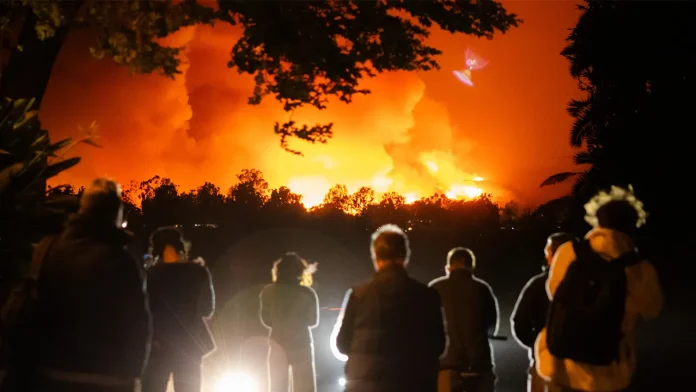
People watch the smoke and flames from the Palisades Fire in the Pacific Palisades neighborhood on Jan. 7, 2025 in Los Angeles, California. (Tiffany Rose/Getty Images)

Quinones reportedly makes $750,000 per year.

She is facing public criticism over Los Angeles’ fire preparedness and water distribution amid the wildfires in the area.

“We can confirm that threats have been made against our employees, including incidents in the field … that occurred at a DWP facility downtown Tuesday evening,” the Department of Water and Power told Fox News.

Aftermath of the California wildfires

A view of smoke covering the sky due to Eaton wildfire in Altadena of Los Angeles County, California, on January 9, 2025. (Tayfun Coskun/Anadolu via Getty Images)

“We take every threat and incident seriously and report them immediately to law enforcement,” the department continued. “We do not discuss security measures in place at our facilities in order to protect our employees.”

The department added: “Our employees are working tirelessly around the clock to support the City’s response, and their work is critical to those efforts. They are an essential part of the City family, they are part of this community, and there is no place in society or in our City for any threats to their safety.”

LA WILDFIRES: AERIAL FIREFIGHTERS LEADER SAYS FLAMES SHOULD BE ‘WAKE UP’ CALL

Aftermath of the California wildfires

Fire burns during the Sunset Fire in Hollywood Hills area of Los Angeles, California, US, on Wednesday, Jan. 8, 2025. (Jill Connelly/Bloomberg via Getty Images)

CLICK TO GET THE FOX NEWS APP

Quinones has also previously said she views her position through an “equity lense” and uses it to provide social justice.

Israel’s Cease-Fire With Hamas Set to Begin Sunday: Live Updates

0

The Israeli authorities are making preparations to welcome home dozens of hostages held incommunicado by Hamas for over a year in Gaza, without knowing whether they will return starved, traumatized or dead.

Thirty-three hostages are supposed to be freed in the first phase of the Gaza cease-fire agreement between Israel and Hamas, in the first such major release since a weeklong cease-fire seven weeks into the war. Some families have caught glimpses of their loved ones in Hamas-directed hostage videos. But it is far from clear in what condition the captives will return.

At Israeli hospitals, health officials have been preparing isolated areas where the hostages can begin recuperating in privacy. Israel’s Health Ministry has drafted an extensive protocol for their psychological and physical treatment. There are particular concerns that they may be severely malnourished.

“The ones who were freed back then were already poorly nourished,” Hagar Mizrahi, a senior Israeli health ministry official, said of the hostages freed during the 2023 truce. “Imagine their situation now, after an additional 400 days. We are extremely worried about this.”

After Hamas led the Oct. 7, 2023, attack on Israel, killing about 1,200 people and capturing about 250 others, about 105 Israeli and foreign hostages were freed in the weeklong truce in November that year. A few were later released in Israeli military operations, and Israeli soldiers recovered the bodies of dozens of others.

But around 98 hostages remained in Gaza, dozens of whom are presumed dead by the Israeli authorities.

Of the women, older men and other hostages returning under the first phase of this cease-fire deal, many are believed to have been held in the militant group’s warren of tunnels in Gaza, conditions likely to leave physical and psychological scars.

Health officials have been poring over every piece of intelligence — including the hostage videos — in an effort to discern the hostages’ condition, Dr. Mizrahi said. A committee of officials that includes Dr. Mizrahi has determined that some were killed.

Israeli officials say the logistics of the release will be broadly similar to those during the previous cease-fire, when 105 hostages were released in exchange for 240 Palestinians jailed in Israel.

In that exchange, Hamas fighters handed over hostages — mostly women and children — to the International Committee of the Red Cross. The Red Cross’s workers ferried the captives from Gaza in a marked ambulance to Egypt before taking them to Israel.

At the border crossing, Israeli intelligence agents verified their identities. Around the same time, Israeli security officials released a specified group of Palestinian women and teenage prisoners.

This time, the Israeli authorities have established three reception points to receive the hostages along the Gaza border, according to an Israeli military official. Those will be staffed by Israeli soldiers, as well as doctors and psychologists, said the official, who spoke on condition of anonymity in accordance with protocol.

From there, the hostages will be taken to the Israeli hospitals that have been preparing to care for them, the official said.

The 105 hostages released in November 2023 came home after roughly 50 days in captivity in Gaza. They arrived in a country that had fundamentally changed; some learned only then about friends and loved ones who had been killed in the Hamas-led attack.

At first, officials aimed to reintegrate returning hostages as quickly as possible, according to Dr. Mizrahi. Now, the health authorities recommend that the hostages being released remain in the hospital for at least four days, if not longer, she said.

In the meantime, the hostages’ family members — some of whom themselves survived captivity — can only wait.

“Last time, we saw the Red Cross transferring the hostages, and some of them were running to the relatives, hugging them,” said Einat Yehene, a clinical psychologist working with the Hostage Families Forum, an advocacy group. “It’s not going to be easy and similar this time, given the physical and the emotional conditions we expect.”

After major 2024 defeats, the Democratic Party searches for a new direction : NPR

0

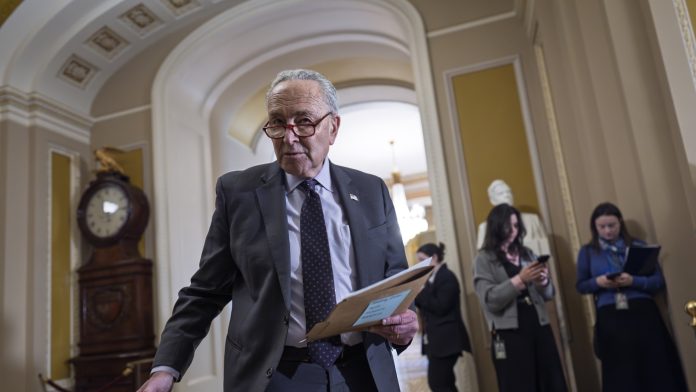
Senate Minority Leader Chuck Schumer, D-N.Y., pauses during a news conference at the Capitol on Tuesday. With Democrats out of power in Washington, D.C., the party faces a challenging 2025.

J. Scott Applewhite/AP


hide caption

toggle caption

J. Scott Applewhite/AP

DETROIT — The Democratic Party begins 2025 with several looming questions about its future.

Among them: how to recover from losing the White House and the Senate, in an election that saw Democrats lose ground across nearly every demographic group; who will lead its national party apparatus; and how it will handle President-elect Donald Trump’s second term.

But as Trump prepares to retake the White House Monday, Democratic leaders have highlighted other results that show November’s losses are not fatal.

For example, many down-ballot Democrats outperformed the top of the ticket in competitive races, with the party managing to gain one seat in the House. That shrunk the margin for an already-tight GOP majority that struggled with infighting during the last Congress.

Democrats also saw record fundraising last year, and point to years of behind-the-scenes investment in voter data and campaign resources that they say has created a more coordinated and robust party infrastructure for future election cycles.

“No DNC has ever invested more resources into strengthening our state parties than this DNC,” Democratic National Committee Chair Jaime Harrison said Thursday. “So as a former state party chair, as a former state party vice chair and now as DNC chair, I take great pride in passing along this mantle to the next generation of Democratic national leadership.”

Harrison is not seeking a second term as leader of the DNC, so the current 448 DNC members will elect a new chair and other leadership positions at the party’s winter meeting on Feb. 1.

What new leadership will bring

At an in-person forum in Detroit Thursday, candidates seeking to help run the DNC largely agreed on the path forward for Democrats to regain power and the trust of voters who stayed home or supported Trump: year-round organizing efforts, more resources for state and local parties and spreading the Democratic message beyond traditional and friendly media sources.

Without control of the White House or either chamber of Congress, the new DNC chair is likely to be one of many national faces that will help shape the party’s messaging until the next presidential election, rather than serve as a singular figure with outsize influence dictating the path ahead for Democrats.

The two leading candidates for chair, Minnesota Democratic-Farmer-Labor Chair Ken Martin and Wisconsin Democratic Party Chair Ben Wikler, offered their views on how the role should fit into the larger party ecosystem.

Martin said he thinks Democrats should go on the offense against Trump and positioned himself as a more authentic representative of the party’s working class constituents than Wikler.

He also noted the party has a deep bench of Democratic elected officials who are the most effective messengers for what the party stands for.

“I mean, who better to talk about public safety than our mayors? Who better to talk about disaster relief than county commissioners? Who better to talk about education funding and other issues on the state level than our governors?” he said. “And so we have to tap into the rich, rich, rich diversity of elected officials we have throughout this country who are actually delivering on our party values right now.”

For his part, Wikler said Democrats should make their opposition known if and when Trump has unpopular policies around things like health care, education and Social Security. He also touted organizing victories in the purple state of Wisconsin compared to Martin leading the more-reliably blue Minnesota, and said that was the type of experience needed to head the party.

“Candidates are the people who carry the message to voters,” Wikler said. “A DNC chair needs to energize volunteers, needs to inspire people to run for office, needs to inspire people to donate, needs to lift people up, then we need to mobilize, and that means building a strategy in each state.”

When to fight, when to seek common ground

It’s not just national party leaders trying to decide whether a second Trump term should be met with full opposition, or an effort to find common ground where possible.

Members of Congress are also split, especially around the major Republican policy priority of illegal immigration.

A Republican-crafted measure that would direct federal officials to detain and deport migrants without legal status who have been charged, arrested or convicted of burglary, theft, larceny or shoplifting, also known as the Laken Riley Act, cleared a key procedural vote Friday in the Senate.

Ten Democrats joined with the GOP majority to advance the bill, while 48 Democrats in the House voted to pass that chamber’s version of the bill earlier this month.

Then there are Democratic elected officials who will be on the ballot in 2026 — or who could run for the party’s presidential nomination in 2028 — who find themselves in a balancing act of signaling willingness to work with Republicans while also defending the party’s ideals.

“Now I don’t want to pretend we’re always going to agree, but I will always seek collaboration first,” Michigan Gov. Gretchen Whitmer said in a speech at the Detroit Auto Show Wednesday. “I won’t go looking for fights. I won’t back down from them, either, ’cause I’m not here to play games. I’ve got a job to do.”

While the Democratic Party searches for new leadership and grapples with its direction as the party out of power, Republican unity around Trump and his visions for governance provides a sharp contrast.

This week, members of the Republican National Committee voted to keep Michael Whatley, Trump’s pick to lead the national party, as chair while celebrating the success of the party’s integration with Trump’s campaign and political views.

I’m saying farewell as FBI director. America’s future is secured by focusing on threats, not divisions

0

Join Fox News for access to this content

Plus special access to select articles and other premium content with your account – free of charge.

By entering your email and pushing continue, you are agreeing to Fox News’ Terms of Use and Privacy Policy, which includes our Notice of Financial Incentive.

Please enter a valid email address.

NEWYou can now listen to Fox News articles!

Serving as FBI Director for the past seven-plus years has given me an unparalleled view of the threats to our country’s public safety and national security. From where I sit, these threats are more dangerous and complex than at any time I can recall since I began my career in law enforcement almost 30 years ago.

Our adversaries—whether they be violent gangs, child predators, cartels, hackers, hostile nation-states, or terrorists—are more emboldened, better resourced, savvier with technology, and more relentless than ever before. With a keystroke, a foreign hacker can shut down a hospital or take our critical infrastructure offline. A would-be terrorist can communicate with plotters overseas through encrypted apps to secretly plan an attack on U.S. soil. Cartels can manufacture loads of deadly drugs with a potency no one has ever seen before using chemicals acquired half a world away.

The terrorism threat is elevated across the board. Foreign terrorist organizations have drawn inspiration from Hamas’s horrific attacks on October 7th to plot coordinated attacks here in the Homeland, while violent extremists inspired by a variety of ideologies and grievances are mobilizing more quickly than ever and leaving fewer dots for investigators to connect and even less time to connect them. 

FBI DIRECTOR WRAY REVEALS WHY HE IS RESIGNING DURING ‘SUCH A DANGEROUS TIME’

The tragedy in New Orleans on New Year’s Day is a recent illustration of the danger posed by individuals radicalized online using easily accessible weapons to go after soft targets—everyday people going about their everyday lives—making the terrorism threat even harder to detect, investigate, and disrupt.

Foreign adversaries like China, Russia, and Iran are not just stealing government secrets, they’re targeting the American people directly and going after the things we rely on most. Hostile nation-states are stealing the personal data of Americans on a staggering scale, conducting widespread theft from businesses large and small, exporting their own brands of repression to our shores, and engaging in audacious cyber operations aimed at our critical infrastructure. The Chinese government, in particular, has engineered an unprecedented effort to gut American innovation, steal our most precious personal data, and meddle in our free and open society. History will mark this as the defining threat of our generation.

CLICK HERE FOR MORE FOX NEWS OPINION

Beyond terrorism and nation-state threats, violent crime, which reached alarming levels in recent years, still plagues far too many communities. Cartels are flooding our country with fentanyl and other deadly drugs claiming countless American lives each year. And child predators lurk in the dark recesses of the internet targeting the innocent and vulnerable.

From my seat, I see serious grown-up threats that demand serious grown-up attention. But I’ve also seen something else the past seven-plus years: the inspiring men and women of the FBI, who are tackling these threats every day with passion, skill, and a fierce commitment to public service and the rule of law. I’ve seen up close the work they’re doing alongside our brothers and sisters in state and local law enforcement and across government in record numbers to keep our communities safe.  

FBI DIRECTOR WRAY REVEALS WHY HE IS RESIGNING DURING ‘SUCH A DANGEROUS TIME’

In recent years, working together, the FBI and our partners have arrested nearly 50 violent criminals per day, every day. They’ve rescued hundreds of children from their tormentors and put hundreds of predators behind bars. They’ve dismantled hundreds of gangs terrorizing neighborhoods all over the country and seized enough fentanyl to kill nearly 80 percent of all Americans. They’ve innovated to tackle emerging threats by taking the fight to cyber criminals, saving victims around the world nearly $800 million in ransom payments. And they’ve kept watch against the ever-present threat of terrorism, thwarting attacks targeting houses of worship in Las Vegas, Long Beach, and Pittsburgh, a crowded pier in San Francisco, a Fourth of July parade in Cleveland, and countless other communities across the nation. I could not be prouder of the work they’ve done and the sacrifices they’ve made to keep us all safe.

CLICK HERE TO GET THE FOX NEWS APP

Still, this is no time for complacency or distraction. Looking ahead, the challenges to our security will grow even more daunting, and our margin for error will continue to shrink. America’s adversaries will keep trying to take advantage of our country’s divisions to ramp up their efforts against us. But our focus must be on the threats and our work, rather than on what divides us. We must continue to tackle the dangers facing our country with objectivity, rigor, and professionalism. It’s what the American people expect and deserve.  

I know the men and women of the FBI, working alongside our partners, are up to the task. But I also know our future security depends on the FBI being at its very best. The FBI needs the resources to match what our adversaries are throwing at us and the public’s continued support for its essential work. The stakes couldn’t be higher. We simply cannot afford to lose focus or be unprepared.

CLICK HERE TO READ MORE FROM CHRISTOPHER WRAY

How the Oct. 7 Attacks Transformed the Middle East

0

When Hamas militants led a deadly cross-border raid on Oct. 7, 2023, they triggered a war with Israel that has devastated Gaza. They also set off shock waves that have reshaped the Middle East in unexpected ways.

Powerful alliances were upended. Long-established “red lines” were crossed. A decades-old dictatorship at the heart of the region was swept away.

Fifteen months after the October attacks, with a cease-fire deal between Israel and Hamas set to start on Sunday, here is a look at how the region has been radically transformed.

Israel has reasserted its military dominance but may face heavy diplomatic and domestic costs.

The country’s leaders treated the Hamas-led attacks as an existential threat and have been determined to defeat Hamas and weaken its main backer, Iran. Israel has not only succeeded in debilitating Hamas in Gaza but has also decimated the Lebanese Shiite group Hezbollah and dealt a heavy blow to Iran’s network of Middle Eastern allies.

Closer to home, and in the realm of global public opinion, Israel’s successes have been more ambiguous. While its assault on Gaza has severely weakened Hamas, it has not destroyed it, as the government had vowed to do.

Israel’s economy has been battered by the war, and the country’s polarized politics — briefly overlooked when the war began — seem to have returned to their fractious state of affairs. The country’s international standing is in tatters, threatening its diplomatic goals, such as the normalization of relations with Saudi Arabia.

These dynamics could shift once again with Monday’s inauguration of President-elect Donald J. Trump, who pushed in his first term to normalize ties between Arab states and Israel and may seek to revive those efforts.

In the longer term, it is hard to predict what threats Israel may face from a generation of young Lebanese and Palestinians who have been traumatized by the death and destruction that Israel’s bombardment has wrought on their families and homes.

Hamas and its leader at the time of the Oct. 7 attacks, Yahya Sinwar, wanted them to set off a wider regional war between Israel and Hamas’s allies. But the group failed to anticipate how the conflict might end.

For Palestinian civilians, the future looks bleaker than ever.

Israel’s bombardment and invasion have forced almost all Gazans from their homes and killed more than 45,000 people, according to the Gazan health authorities, who do not distinguish between civilians and combatants. Israel has reduced vast swaths of the enclave to rubble.

Israel has killed off Mr. Sinwar and the rest of Hamas’s top military and political brass, and the group’s popularity among Gazans has faded, though U.S. officials estimate that Hamas has recruited almost as many fighters as it has lost over 15 months of fighting.

And yet, its remaining leaders may claim that its survival is a victory.

Israel insists Hamas cannot rule the enclave after the war but has resisted calls to lay out a plan for postwar Gaza. Gulf States like Saudi Arabia now say they won’t normalize relations with Israel unless it commits to a path to establish a Palestinian state.

A shattered Hezbollah, once the crown jewel of Iran’s so-called axis of resistance, has loosened its grip on Lebanon. But Israel’s invasion and bombardment have left Lebanon facing billions of dollars in reconstruction costs amid an economic crisis that predated the war.

Hezbollah, formerly Lebanon’s dominant political and military force, has suffered a stark reversal of fortunes since the 2023 attacks. Israel has killed most of its top leaders, including Hassan Nasrallah. Its patron Iran has been weakened. And its supply lines through Syria are in jeopardy. More broadly, the group’s core promise to Lebanon — that it alone can protect the country from Israel — has been gutted.

Years of political gridlock, largely blamed on the militant group, eased up enough this month to enable the Lebanese Parliament to elect a new president and appoint a prime minister who is backed by the United States and Saudi Arabia.

Despite the blows, Hezbollah can still call on thousands of fighters, and has support from Lebanon’s large Shiite Muslim community. It may yet find a way to rebuild within Lebanon’s fractious political system.

The toppling of Bashar al-Assad last month — one of the most dramatic and unexpected consequences of Oct. 7 — dismantled a brutal authoritarian regime. But the inevitable turmoil that followed has created the conditions for new power struggles.

For nearly 13 years, Mr. al-Assad had largely contained a rebellion against his family’s five-decade grip on power — with help from Russia, Hezbollah and Iran.

But as Moscow focused on its war in Ukraine, and Iran and Hezbollah reeled from Israeli attacks, rebels led by the Turkish-backed Islamists of Hayat Tahrir al-Sham sensed an opportunity. They surged through Syria and toppled the government in a matter of days.

With Iran and Russia on the back foot, Turkey is now in a prime position to play a pivotal role in Syria. Moscow hopes to maintain some of its naval and air bases, but the fate of its negotiations with Hayat Tahrir al-Sham is uncertain.

Meanwhile, the United States has maintained a small military presence in Syria to fight the Islamic State terrorist group and is allied with Kurdish-led forces that Turkey regards as an enemy. And Israel has seized Syrian territory near the Golan Heights as a buffer zone and has been carrying out extensive airstrikes on what it says are Syrian military and weapons targets.

Syria’s neighbors and European nations — hosting millions of Syrian refugees — are watching closely to see whether the country can achieve stability or will descend once more into violent chaos.

Iran’s powerful network of regional alliances has unraveled, leaving the country vulnerable — and potentially incentivized to build a nuclear weapon.

Long seen as one of the Middle East’s most influential powers, Iran has emerged severely diminished from the reordering of the past 15 months. It has effectively lost much of its once-potent “axis of resistance,” the network of allies it used to counter the influence of the United States and Israel.

Its closest partner, Hezbollah, is now too weak to pose a serious threat to Israel. And with Mr. al-Assad ousted from Syria, Iran has lost influence over the country that provided a critical supply line for weapons and militants.

Previous red lines that kept the region from all-out war have been erased: Since Israel assassinated Hamas’s political leader, Ismail Haniyeh, while he was a guest in Tehran, Iran and Israel have carried out direct airstrikes against each another.

Where exactly that leaves Tehran is unclear. A weakened Iranian government that feels increasingly vulnerable may be compelled to weaponize its decades-old nuclear program. U.S. officials have warned Iran may need only a few weeks to enrich uranium to bomb-grade levels.

Vermont accused in lawsuit of tracking pregnant women considered unsuitable to be mothers

0

A lawsuit filed this week accuses Vermont’s child welfare agency of using baseless allegations about a pregnant woman’s mental health to secretly investigate her and win custody of her daughter before the baby’s birth.

The ACLU of Vermont and Pregnancy Justice, a national advocacy group, filed the lawsuit on Wednesday against the Vermont Department for Children and Families, a counseling center and the hospital where the woman gave birth in February 2022.

In the lawsuit, the state also faces accusations that it routinely tracks pregnant women deemed unsuitable to be mothers.

The lawsuit asks for unspecified monetary damages for the woman, who is identified only by her initials, A.V., and an end to what it describes as an illegal surveillance program.

PREGNANT WOMAN AND BABY SAVED AFTER DOCTORS FIND GRAPEFRUIT-SIZED TUMOR: ‘EXTREMELY RARE’

A copy of the lawsuit seen against the the Vermont Department for Children and Families.  (Google Maps; Vermont Superior Court)

The director of a homeless shelter where A.V. stayed in January 2022 told the child welfare agency that she appeared to have untreated paranoia, dissociative behaviors and PTSD, according to the lawsuit. The state began investigating and eventually spoke to the woman’s counselor, midwife and a hospital social worker without her knowledge, even though it had no jurisdiction over fetuses.

The woman remained unaware of the probe until she gave birth and her daughter was immediately taken away, according to ACLU senior staff attorney Harrison Stark.

A.V. had no knowledge that hospital officials were giving updates to the state while she was in labor, including details of her cervix dilation, and that she had lost temporary custody of her baby. The state even sought a court order forcing the woman to undergo a cesarean section, although it was rendered moot because she agreed to the surgery.

The woman was not able to win full custody of her child until seven months later.

“It’s a horrific set of circumstances for our client,” Stark said. “It’s also clear from what has happened that this is not the first time the agency has done this. We have learned from several confidential sources that DCF has a pattern and practice of looking into folks like our client who are pregnant, who are of interest to the agency based on a set of unofficial criteria and who the agency is tracking on what is called a ‘high risk pregnancy docket’ or ‘high risk pregnancy calendar.'”

Department for Children and Families commissioner Chris Winter said the agency will not comment until officials have reviewed the lawsuit and investigated its accusations.

“We take our mission of protecting children and supporting families seriously and work hard to balance the safety and well-being of children with the rights of parents,” he said.

Officials at Lund counseling center, which was named as a defendant, said they learned of the allegations from news reports.

Gavel in court room

The ACLU of Vermont and Pregnancy Justice filed the lawsuit on Wednesday against the Vermont Department for Children and Families, a counseling center and the hospital where the woman gave birth. (Getty Images )

“We take these matters very seriously and we are actively working to gather more information to understand the situation fully,” interim CEO Ken Schatz said.

Copley Hospital has not commented on the lawsuit.

Several states across the country allow the civil commitment of pregnant women to take custody of a newborn, Pregnancy Justice senior staff attorney Kulsoom Ijaz said. However, it is unclear how common these situations are in the U.S.

Ijaz said what happened to A.V. shows how pregnancy is increasingly used as a justification to block people’s rights.

The organization released a report in September detailing an increase in women being charged with pregnancy-related crimes in the year after the U.S. Supreme Court overturned Roe v. Wade, allowing states to make their own laws regarding abortion. Most of those cases, in which the baby was listed as the victim, included women charged with child abuse, neglect or endangerment over allegations of substance use during pregnancy.

SMOKING AND VAPING HAVE THESE DETRIMENTAL EFFECTS ON FERTILITY, DOCTORS WARN

ACLU logo

This photograph shows the logo of the American Civil Liberties Union. (KAREN BLEIER/AFP via Getty Images)

CLICK HERE TO GET THE FOX NEWS APP

“What DCF did here is incredibly cruel,” Ijaz said. “It’s discriminatory. Its state sanctioned surveillance and stalking, and it violates Vermont’s newly enshrined right to reproductive autonomy in its state constitution. This is an opportunity for Vermont to signal to other states, as a leader, and say that these rights don’t just exist on paper. They exist in practice, too.”

Stark said the allegations in Vermont are particularly troubling since the state has described itself as a haven for reproductive rights.

“To discover evidence that a state agency is essentially colluding with certain medical providers to collect information without folks’ knowledge or consent and expanding its jurisdiction unlawfully to investigate folks based on what are essentially decisions about their own reproductive health is incredibly alarming,” he said.

The Associated Press contributed to this report.