Tuesday, November 10, 2026
Home Blog Page 6

Horse racing industry fears illegal immigration enforcement : NPR

0

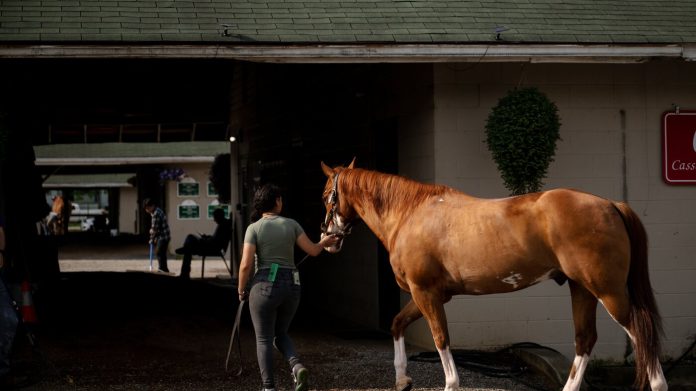
A worker leads a racehorse back to the stables on the backside of a horse racing track in Louisville, Ky., on April 29.

Lydia Schweickart for NPR


hide caption

toggle caption

Lydia Schweickart for NPR

On the front side of a horse racing track, one finds bright, decadent hats, pastel suits and $22 mint juleps.

And on the backside of the track, one finds hundreds of workers, primarily immigrants, washing and exercising muscular thoroughbreds at 3 a.m. on the soft, thick track.

“If we couldn’t have an immigrant workforce on the backside, I don’t know how horse racing exists,” said Dale Romans, a racehorse trainer in Kentucky. “We can’t send them home and ask them to come back. There’s nobody to do the work when they’re gone.”

Horse racing generated some $36 billion in 2023, the latest figure available, and supports nearly half a million jobs, according to the American Horse Council. It’s considered one of the oldest sports in America. Beyond the racetrack itself, getting one horse to race is itself a multimillion-dollar endeavor, from the training and the grooms to the feed and the farms.

That effort primarily relies on H-2B visas to get workers. But there are also plenty of workers without visas or other legal status, industry experts say.

Immigration enforcement largely left the industry untouched during the first Trump administration. Industry leaders say that’s because President Trump recognized the sizable impact of immigrant labor and catered to his agriculture voting base, which tends to be largely Republican.

No specific figures are available for horse racing, but estimates show that some 42% of hired crop farmworkers, for example, don’t have legal status. Estimates are even higher among workforces that deal with animals or livestock.

This time, industry observers aren’t sure they’ll again be able to avoid a larger crackdown.

“We have concerns of [Immigration and Customs Enforcement] coming in and sweeping people away,” Romans said. “I’ve worked with immigrant workers my whole life, and I’ve never seen people under the stress they’re going through for the last six months.”

In this photo, President Trump stands behind a lectern at a rally in Warren, Michigan, on April 29. He's surrounded by rally attendees, many of whom are wearing red shirts and holding signs.

President Trump during a 100th-day rally in Warren, Mich., on April 29.

Bloomberg/via Getty Images


hide caption

toggle caption

Bloomberg/via Getty Images

Tougher on enforcement in second term

Employers and industry representatives say they see a difference between Trump’s immigration enforcement during his first term and that during the start of his second.

During his first term, his administration focused on worksite enforcement, boasting record I-9 inspections — though efforts then stalled with the COVID-19 pandemic.

Immigration agents in 2018 ended up pausing raids in Saratoga Springs, N.Y., for the racing season — only to conduct a worksite operation afterward that resulted in backstretch workers’ arrests.

Now, industry leaders feel that more such raids are likelier, as Trump administration officials came into office with the goal of focusing even more on worksite enforcement.

“The fact of the matter is that I am a little bit worried — but there’s still part of me that believes that this president, his hotels, his businesses — he’s relied on the same labor that we do,” said Tom Rooney, president of the National Thoroughbred Racing Association.

Trump’s flagship hotels and golf courses have used temporary seasonal labor.

But the Trump administration has held its tough-on-immigration approach even when discussing the reliance that several industries have on workers without legal status.

During an interview with Fox Noticias last month, Trump said he wanted to make it easier to secure workers for farms and hotels, both of which use forms of temporary work visas and have a sizable percentage of workers without legal status.

“If a farmer wants to give recommendations to people, we’re going to be very soothing,” Trump said. But he added that ultimately he wants people to self-deport.

Trump has also suggested that employers like farmers may be able to write a letter recommending that specific individuals be returned to the U.S. after being deported, according to remarks at an April Cabinet meeting. But so far, there are apparently no specific plans to secure the workforce as a whole.

Republican Rep. Dan Newhouse, who represents central Washington state, questioned the secretary of homeland security at a recent hearing about any new plans to protect workers of key businesses.

But Kristi Noem, the head of the Department of Homeland Security, said the administration’s focus is on encouraging people to leave the country.

“President Trump has been very clear that the people who are here illegally need to go home,” Noem said. She said that then people have a chance to “come back to America, the right way,” though it isn’t always clear how that would work.

The White House did not respond to a request for comment on any possible plans to assist employers.

Other programs that afforded people legal status to work in the U.S. — including temporary protected status, the parole process for Cubans, Haitians, Nicaraguans and Venezuelans, and the ability to seek asylum and refugee statuses — have been curtailed by the administration.

A worker reads a newspaper on the backside of a horse racing track in Louisville, Kentucky, on April 29.

A worker reads a newspaper on the backside of a horse racing track in Louisville, Ky., on April 29.

Lydia Schweickart for NPR


hide caption

toggle caption

Lydia Schweickart for NPR

Horse racing employees are feeling the pressure

Rooney, the association president, said some trainers report that usually reliable workers aren’t coming to work — though that hasn’t halted business yet. Other workers stay inside the tracks’ perimeters, for fear of potential raids.

Racetracks, like other industries, are preparing their workers and trainers for what to do if there are encounters with immigration officials.

The California Horse Racing Board issued a memo at the end of April providing guidance to all staff.

“If a subpoena or a warrant is provided, you and your supervisor must consult with the department’s legal office before taking any further action,” the memo states. “Do not permit access to restricted areas or release information until legal counsel has reviewed the situation.”

Since February, Immigration and Customs Enforcement has issued more than 1,600 notices of inspection to employers, which kicks off the process of checking that employees are legally allowed to work in the U.S.; the agency separately audits companies found in violation. At least 1,400 people have been arrested at worksite operations, according to an ICE spokesperson.

Worksite investigations and arrests have varied by industry, including in construction, manufacturing and other businesses.

Employers say they need immigrant workers

Trainers told NPR that they face consistent workforce shortages and struggle to find domestic workers to wake up before dawn to care for and train the horses.

It’s a demand for labor felt across seasonal industries, including in agriculture, hospitality, manufacturing and entertainment.

“There’s a reason why we bring all these people in: to actually make the machine of the United States work,” Rooney said. “If you take away that labor force, then you’re really going to be putting cogs in that machine that it’s not going to be able to work.”

Trump has argued that voters elected him with a mandate to crack down on illegal immigration and deport more people in the U.S. without legal status.

But in horse racing, many still believe they may be left alone because of their industry’s economic contribution and its reliance on immigrant workers.

In this photo, spectators watch Kentucky Derby racehorses walk on soft dirt as they make their way onto the track for training at Churchill Downs in Louisville, Kentucky, on April 30.

Spectators watch as Kentucky Derby racehorses make their way onto the track for training at Churchill Downs in Louisville, Ky., on April 30.

Lydia Schweickart for NPR


hide caption

toggle caption

Lydia Schweickart for NPR

“We may have a false sense of security,” Izzy Trejo, executive director of the New Mexico Racing Commission, said about the tracks in his state. He said the horse racing industry in New Mexico is particularly facing a labor shortage, even with immigrant labor, as higher-paying jobs and better working conditions can be found elsewhere.

“They’re living in the environment, dust, grime, lack of climate control,” Trejo said about workers in the industry. He described some housing at New Mexico’s tracks as essentially in the same stalls as the horses use, with makeshift flooring out of pallets.

Will Velie is an Oklahoma-based lawyer who specializes in immigration law in horse racing.

He likes to walk around the tracks early in the mornings and pass out hats that say “emigración para caballerangos” — emigration for horsemen.

Tucked inside is a phone number; many workers call with questions about how to receive a work visa, how to turn that visa into a green card or how to achieve any legal status at all. He also meets with workers in the kitchens on the backside of the tracks.

“We go through all the questions, and about 20 or 30 percent of the time, there is something we can do,” Velie said. “If there’s not, we just say be careful — don’t drink and drive, don’t fight with your spouse — and pray for the amnesty.”

Verizon ends DEI policies to get FCC’s blessing for its $20 billion Frontier deal : NPR

0

The Verizon logo is displayed on the exterior of a Verizon store. The FCC approved its $20 billion deal to buy Frontier Communications, a day after Verizon told the U.S. regulator that it would end many of its diversity-related policies.

Justin Sullivan/Getty Images


hide caption

toggle caption

Justin Sullivan/Getty Images

Verizon has become the latest big company to end policies around diversity, equity and inclusion, or “DEI,” in order to keep the U.S. government happy.

It seems to have worked: on Friday, the Federal Communications Commission approved Verizon’s $20 billion deal to buy broadband provider Frontier Communications. The FCC said that the deal will allow Verizon to upgrade the technology providing internet access to 25 states, including rural communities, and to deploy fiber-optic access to at least 1 million homes per year.

The FCC also touted the changes this deal will make to Verizon’s internal policies. In its announcement approving the deal, the FCC specifically cited Verizon’s commitment “to ending DEI-related practices.”

The approval came a day after Verizon sent a letter to the FCC, outlining how it is ending many efforts related to diversity, equity and inclusion. The telecommunications giant is removing references to DEI from its training materials and external websites; ending bonuses and goals tied to increasing the percentage of workers who are women or minorities; and dissolving its internal human resources department devoted to diversity-related policies, while reassigning those employees to general “HR talent objectives.”

“We are committed to creating a culture that leverages and values each person’s unique strengths and talents,” Verizon chief legal officer Vandana Venkatesh said in the Thursday letter to FCC Chairman Brendan Carr. (Spokespeople for Verizon did not respond to NPR’s requests for comment.)

“However, we recognize that the regulatory and policy landscape surrounding diversity, equity, and inclusion (‘DEI’) has changed,” Venkatesh added in her letter.

That’s an understatement. Five years ago, after George Floyd’s murder sparked national protests over systemic racism, corporate America rushed to promise workers and customers that it would create more equitable opportunities for people from all backgrounds — especially the minorities and women who have traditionally faced discrimination. But now, President Trump and his administration have declared war on such pledges.

Within hours of his January inauguration, Trump signed two executive orders seeking to end what he calls “illegal DEI” programs and policies in the federal government. His administration’s actions have accelerated an ongoing DEI retreat across corporate America, where some private employers are federal contractors, and thus subject to the executive orders — and others, like Verizon and rival T-Mobile, are actively seeking U.S. government approval for business dealings.

In late March, T-Mobile also told the FCC that it was ending some of its DEI-related goals and programs. A day later, the FCC approved T-Mobile’s deal to buy the fiber operator Lumos.

The FCC has taken an especially active role in the Trump administration’s campaign against diversity-related programs. Earlier this year, Carr opened investigations into Comcast, which owns NBCUniversal, and Walt Disney Co., which owns the ABC television network, over what he called concerns that they are “promoting invidious forms of DEI discrimination.”

But even many companies that aren’t regulated by the FCC, or actively seeking U.S. government approval for business deals, are quietly abandoning their DEI efforts. As NPR reported in February, many U.S. companies have now scrubbed the very word “diversity” from even their most boring public documents.

Trump’s FDA wants natural food dyes to replace synthetic ones. Is it that easy? : Shots

0

Even foods you may not guess would have food coloring added often do, like pickled banana peppers.

BWFolsom/iStockphoto/Getty Images


hide caption

toggle caption

BWFolsom/iStockphoto/Getty Images

The Trump administration’s Make America Healthy Again effort hopes to eliminate potentially harmful synthetic dyes from the food supply.

Manufacturers use those dyes to make foods, drinks and medicines in vivid colors, but the government argues that those cosmetic additives are both harmful and easy to substitute.

Dr. Marty Makary, the new commissioner of the Food and Drug Administration, addressed the issue at a recent event attended by a contingent of “MAHA moms” in addition to media outlets. Makary told food and beverage companies that switching to all-natural food dyes should be easy.

“Try watermelon juice,” Makary suggested, holding up a sequence of small jars of liquid as the audience laughed, “or beet juice.”

Experiments and expense

But how simple is it to switch to all-natural dyes?

Mark Oliveria, owner of Oliveria Peppers based in Clarksburg, W. Va., found out for himself about five years ago, when his grocery-chain buyers pointed to greater consumer demand for more all-natural products. They asked Oliveria if he could remove the Yellow Dye No. 5 he’d used in his bright yellow banana pepper recipe.

So Oliveria ran kitchen experiments, initially using ground turmeric root, the powdered spice that makes curry so easily stain clothes.

“It took me a little while to get the color exact, because within six to eight weeks in the jar, it would start lightening up,” he says. “So the first year, we had a little bit of a tough time, and it was mainly because we were using the powdered form, which didn’t hold its color as long.”

Oliveria then found a liquid version of the turmeric dye that was pricier and required more quantity but worked perfectly and did not fade. And although he says Yellow Dye No. 5 still remains approved to use in food, he’s now happy he’s able to remove it from his ingredients.

That move five years ago put Oliveria ahead of the curve.

Europe has since banned more synthetic dyes, and required manufacturers to include warning labels about the dyes in their food products. Canada imposed limits on the amount of dye that can be used in food, and requires dyes to be listed on labels.

Government actions

In the U.S., the Biden administration banned Red Dye No. 3 in January just before leaving office. Last month, the Trump administration said it wants to go further, getting food, beverage and pharmaceutical industries to voluntarily eliminate all petroleum-based dyes by the end of next year. The FDA also recently approved three new all-natural dyes for manufacturers to use.

For Oliveria, who relied on only a single dye, finding an alternative was relatively easy, but he says that likely won’t be the case for other companies more reliant on petroleum-based dyes like Red No. 40, or Blue No. 1 or Blue No. 5 across more of their products.

“I think in the snack industry, in the drink industry, they’re going to have a tougher time,” he says.

Indeed, Rep. Chuck Fleischmann, R-Tenn., raised the snack industry’s concerns last week during a House Appropriations Committee hearing where Health Secretary Robert F. Kennedy Jr. testified. Fleischmann said he represents many snack companies that have factories in his district in eastern Tennessee.

“Candidly, I think these dyes are safe,” Fleischmann said, referring to synthetic dyes. He also noted that the current dyes have been used for many years, and manufacturers are seeing costs five to 10 times higher for the natural substitutes.

It takes a lot of red cabbage

One cost driver is that extracting large volumes of color from natural sources is far more complex than mixing chemical dyes, says Melissa Wright, a food-safety expert at Virginia Tech University.

“If you’re using red cabbage extract in place of Red 40, you’re going to have to plant and harvest and extract raw material to be able to derive that natural color material,” says Wright. And finding enough quantity is a problem.

She says some colors are harder than others to reproduce, because some, such as yellow, have lots of common natural alternatives – including turmeric, paprika and annatto. Not so with blue.

“Blues are going to be a really hard one,” Wright says. “Blue, there’s not a lot of natural sources. Supply is going to be limited and that’s going to make a difference as to what the cost is, as to reformulation.”

And, because green is a mix of both blue and yellow, it, too, can be costly and difficult to source.

Two of the recently approved natural dyes produce blue. One comes from Galdieria sulphuraria, an algae, and the other is a butterfly pea flower extract that can make purples and greens, in addition to blue, according to a press release from the Department of Health and Human Services.

Heat, acid, and the way people ‘eat with their eyes’

Wright says the cooking process can add to the complexity.

“These naturally derived colors tend to not be as stable, especially with heat or acid,” which means they can degrade or change color when added to an acidic soda or if they are baked like a cookie.

“Products that you have to heat, it’s going to become a problem because they’re just not going to be as vivid as the customer’s used to seeing,” Wright says.

Loyal consumers can vocally revolt when cherry flavors suddenly turn dull purple – as they did when General Mills briefly switched its Trix cereal to all-natural dyes nine years ago – or when cheese snacks appear more rust-colored than safety-tape yellow.

Those consumer habits and preferences can be hard to break, says Wright. Consumers might think the new product is defective, bad, or simply less pleasurable: “When I eat Doritos and Cheetos, I have that orange dust on my fingers, right? And if I don’t have that, is that really a Doritos-eating experience?”

Mark Oliveria, the pickled pepper maker, sees that preference in his product line, too. The cauliflower he dyes bright yellow with turmeric sells far better than his giardiniera vegetable mix, in which he includes no dye at all.

“So people like that color,” Oliveria concludes. “Ninety percent of the people eat with their eyes. And I think ninety percent of the people don’t read and don’t care what’s in that jar.”

How Trump’s threatened cuts would hit Maine’s rural schools : NPR

0

Reading interventionist Roxanne Davis works with a first grader on forming words at Mill Stream Elementary School.

Greta Rybus for NPR


hide caption

toggle caption

Greta Rybus for NPR

Jonathan Moody runs a rural school district in and around Skowhegan, Maine, about 90 miles north of Portland. His office is in an old, converted farmhouse; the conference room was once a chicken coop.

“I drive 30 minutes to work and I have no stoplight,” Moody says with a chuckle.

Moody grew up going to rural schools nearby, and now he’s dedicated his career to leading them. But the rurality of his district, MSAD 54, coupled with high poverty, has made school funding “a tremendous challenge,” Moody says.

Because of that, his schools rely heavily on federal dollars: Seventy-four of the district’s staff positions are funded by federal grants, and federal money helps pay for free school meals, special education, mental health services and a robust after-school program, among other things

Moody says federal funds help educate “our most needy students. They’re the backbone of our [academic] intervention system. They help students get on pace.”

Students wait for buses in front of Mill Stream Elementary School.

Students wait for buses in front of Mill Stream Elementary School.

Greta Rybus for NPR


hide caption

toggle caption

Greta Rybus for NPR

But as Maine schools find themselves in the middle of a political battle with the Trump administration, that federal support is at risk. President Trump threatened to cut federal funding for K-12 education in Maine, which amounts to hundreds of millions of dollars a year, after Gov. Janet Mills refused to follow an executive order banning transgender athletes from school sports.

In a now famous exchange, Trump told Mills, “you’re not going to get any federal funding at all” if her state refused to follow the administration’s interpretation of sex-discrimination laws. Mills’ response: “See you in court.”

There is now ongoing litigation that could take months to resolve.

“This is the Trump administration basically holding funding for our most vulnerable students, largely low-income students, hostage for states and school districts to implement their policies of preference,” says Rebecca Sibilia of Ed Fund, a school finance research nonprofit. “This is completely unprecedented in terms of the history of funding for schools.”

Superintendent Jonathan Moody, of the MSAD 54 school district, looks out of the window of his office, which is housed in a converted farmhouse.

Superintendent Jonathan Moody, of the MSAD 54 school district, looks out of the window of his office, which is housed in a converted farmhouse.

Greta Rybus for NPR


hide caption

toggle caption

Greta Rybus for NPR

For educators in Maine, it’s also incredibly unsettling.

“Probably more so today than ever, the national narrative impacts staff,” Moody says, “and they’re nervous.”

What federal dollars do for public schools

U.S. schools get most of their funding from state and local sources, but between 6 and 13% of overall school funding comes from the federal government, according to a 2018 report from the U.S. Government Accountability Office. The money is supposed to help schools serve students who need more support to succeed, including those from low-income families, English language learners and students with disabilities.

Sibilia says while those federal dollars may seem like an expendable fraction of a school budget, “it actually becomes very tangible when you think about laying off 1 out of 10 teachers, when you think about reducing teacher salaries, when you think about reducing the number of classrooms in a school. That all becomes very real.”

Barbara Welch has been an educator in the MSAD 54 district for nearly four decades. She helps a student tie their shoe in the library of Mill Stream.

Barbara Welch has been an educator in the MSAD 54 district for nearly four decades. She helps a student tie their shoe in the library of Mill Stream.

Greta Rybus for NPR


hide caption

toggle caption

Greta Rybus for NPR

Two of the largest federal funding streams for K-12 schools are Title I, which supports schools serving low-income students, and the Individuals with Disabilities Education Act (IDEA), which helps provide specialized services for students with disabilities.

The federal government is legally required to provide Title I and IDEA funding, and, unless Congress steps in, any effort to cancel that money would lead to a lengthy judicial process, Sibilia says.

How Title I serves students in one rural Maine district

Title I is the largest federal grant at Mill Stream Elementary School, which sits above a tributary of the Kennebec River outside Skowhegan.

Rural schools like those in Jonathan Moody’s district are especially reliant on federal funds because they have a smaller local tax base to support school funding.

Second grader Mia Martin (right) shares a moment outside of school with younger sister Sophia Martin, who is not yet school age.

Second grader Mia Martin (right) shares a moment outside of school with younger sister Sophia Martin, who is not yet school age.

Greta Rybus for NPR


hide caption

toggle caption

Greta Rybus for NPR

And part of the benefit of federal grants is they are relatively flexible and allow local leaders to use the money to best serve their unique student population.

Title I has helped Mill Stream – and all the elementary schools in the MSAD 54 district – pay for trained interventionists who provide targeted instruction for struggling students. It also pays for roving teaching assistants, and helps keep class sizes small, which benefits all students.

Barbara Welch, who has been an educator in this district for 37 years, says her salary is paid for entirely by Title I. Her primary job is to coach other teachers, and to track how well their interventions are working.

Welch says the district strategically focuses Title I services on the youngest students, especially those in kindergarten through second grade.

Barbara Welch, a former classroom teacher, currently coaches other teachers and roves through classrooms to work with students. Her position is completely funded by Title I, a federal grant.

Barbara Welch, a former classroom teacher, currently coaches other teachers and roves through classrooms to work with students. Her position is completely funded by Title I, a federal grant.

Greta Rybus for NPR


hide caption

toggle caption

Greta Rybus for NPR

“The sooner that we can get to our students that are struggling, and help them get untangled, the chances of them needing services later are greatly decreased.”

And their efforts seem to be working: “Our data reveals that we’re doing the right thing because our students enter third grade not needing Title I interventions,” she says.

In addition to what happens during the school day, Welch says “parent outreach is a huge part of our Title I funding.”

The district uses Title I money to host events like “Learning Paloozas,” where families can engage in enrichment activities with their children, and take home books and other school supplies, to encourage learning beyond school.

Teaching assistant Nicki Longyear works one-on-one with a kindergartener in the hallway outside a classroom at Mill Stream Elementary School.

Teaching assistant Nicki Longyear works one-on-one with a kindergartener in the hallway outside a classroom at Mill Stream Elementary School.

Greta Rybus for NPR


hide caption

toggle caption

Greta Rybus for NPR

“The school brings us all together, it provides opportunities for those in our communities to come together for a common reason and they build friendships and connections,” says Welch.

Without federal dollars, schools like Mill Stream would have to pull back on these kinds of enrichment and intervention efforts.

But Moody says there isn’t much left to cut. “[We are] already at a bare minimum, and so if you’re going to reduce, you reduce staffing, which is programming for kids.”

Beyond the classroom, federal dollars help feed students and support their mental health

Moody says his district has long benefited from federal programs that provide free meals at school.

About two-thirds of the school community struggles with poverty, and food insecurity is a major issue for his students. The state of Maine participates in several U.S. Department of Agriculture (USDA) programs that provide free meals at school. Students who attend MSAD 54’s after-school programs also receive a substantial snack.

But in April, the Trump administration froze funding for school meals over its legal battle with the state. Maine prevailed in the litigation, and funds were restored. Still, the incident created a sense that the administration’s threats can quickly become reality.

“There’s certainly a fear, and it comes up frequently in conversations with community members. For example, ‘What are you going to do if this is cut, or that is cut?’ ” says Moody.

School mental health services have been similarly at risk in Maine and across the country.

Catharine Biddle, who studies rural education at the University of Maine, says families in the state frequently encounter long waitlists for private mental health services for their children. Trained school clinicians can often meet students’ needs faster, and at no cost to families.

A fifth-grader at Mill Stream plays with a fidget toy in her counselor Jordan Chighali’s office.

A fifth-grader at Mill Stream plays with a fidget toy in her counselor Jordan Chighali’s office.

Greta Rybus for NPR


hide caption

toggle caption

Greta Rybus for NPR

“So schools are this really, really important funnel for resources, for families, and they need funds to be able to deliver those services,” Biddle says.

MSAD 54 was able to hire three licensed counselors after the federal government began sending grant money to schools for mental health services through the 2022 Bipartisan Safer Communities Act.

Jordan Chighali is one of those counselors.

“We’re seeing a lot of anxiety, more depression, parents maybe struggling with substance use,” she says. Some of her students don’t have heat at home, or live in campers.

Chighali says getting mental health support at school is often the only option for her students, and many tell her it helps them do better in class.

Around the same time the legal case over USDA school meal funding came to a close this month, the administration announced it would cut $1 billion in mental health grants for schools. For MSAD 54, the funds will run out this December, a year and a half sooner than they had planned for.

“I was disappointed, and just devastated for the kids, honestly,” Chighali says.

Barbara Welch hugs a student goodbye at the end of the day.

Barbara Welch hugs a student goodbye at the end of the day.

Greta Rybus for NPR


hide caption

toggle caption

Greta Rybus for NPR

Superintendent Jonathan Moody says counseling  services are too important to cut staff positions, so he’ll find the money elsewhere. In the meantime, counselors like Chighali will likely have to reduce the number of students they can see.

Despite recent developments, Moody remains optimistic that the federal cuts won’t continue.

“Federal funding of education is an investment worth making. It changes lives,” he says. “It absolutely is essential.”

Radio story edited by: Steve Drummond and Lauren Migaki
Digital story edited by: Nicole Cohen
Radio story produced by: Janet Woojeong Lee
Visual design and development by: Mhari Shaw

Trump DOJ changes to civil rights division spark mass exodus of attorneys : NPR

0

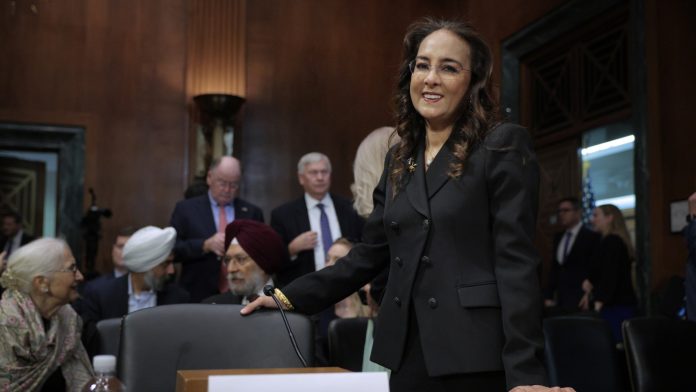
Harmeet Dhillon, now the assistant attorney general in charge of the civil rights division, prepares for her confirmation hearing before the Senate Judiciary Committee in February 2025.

Chip Somodevilla/Getty Images


hide caption

toggle caption

Chip Somodevilla/Getty Images

The Justice Department’s Civil Rights Division is in upheaval amid a mass exodus of attorneys as the Trump administration moves to radically reshape the division, shelving its traditional mission and replacing it with one focused on enforcing the president’s executive orders.

Some 250 attorneys — or around 70% of the division’s lawyers — have left or will have left the department in the time between President Trump’s inauguration and the end of May, according to current and former officials.

It marks a dramatic turn for the storied division, which was created during the civil rights movement and the push to end racial segregation. For almost 70 years, it has sought to combat discrimination and to protect the constitutional rights of all Americans in everything from voting and housing to employment, education and policing.

Now, the administration is redirecting the division to enforce the President Trump’s executive orders, including ending the alleged radical indoctrination in schools, defending women from “gender ideology extremism,” and combatting antisemitism and purported anti-Christian bias.

Five current or former department officials, most of whom spoke on condition of anonymity for fear of retribution, say the current effort amounts to the dismantling of the division and its traditional mission.

“The Civil Rights Division exists to enforce civil rights laws that protect all Americans,” said Stacey Young, a former division attorney who left the department in late January. “It’s not an arm of the White House. It doesn’t exist to enact the president’s own agenda. That’s a perversion of the separation of powers and the role of an independent Justice Department.”

It is normal for the division’s priorities to shift from administration to administration, particularly from one party to another. But the changes underway now are far beyond the normal recalibration, current and former employees and outside observers say.

The changes are being implemented by the division’s new head, Harmeet Dhillon, a conservative attorney whom Trump appointed and the Senate confirmed in April.

Speaking at a recent Federalist Society event, Dhillon likened the division’s work under Democratic administrations to a speeding train. She said Republican administrations typically try to “just slow the train down.”

“There really hasn’t been a focus on turning the train around and driving it in the opposite direction. And that’s my vision of the DOJ civil rights [division],” she said. “We don’t just slow down the woke. We take up the cause to achieve the executive branch’s goals. This is the opportunity where we can ensure that our nation’s civil rights laws benefit all Americans, not just a select few.”

180-degree turn

Already, the administration has started to execute that 180-degree turn. Under the new leadership, the department has dropped investigations, and withdrawn statements of interest or amicus briefs in some 30 cases, according to public court records. Those include cases related to voting rights, alleged racial discrimination in hiring, and civil actions against anti-abortion activists.

Dhillon has issued new mission statements for the division’s 11 sections that push Trump’s priorities and redirect resources to enforcing his executive orders. Those missions include “Protecting Children from Chemical and Surgical Mutilation,” “Keeping Men Out of Women’s Sports,” “Eradicating Anti-Christian Bias” and “Additional Measures to Combat Antisemitism.”

Young said the changes amount to the destruction of the division and its traditional work.

“The division right now is being decimated,” said Young, who now runs Justice Connection, a group of department almuni that provides support to DOJ employees. “The head of the division and the Justice Department have decided that the division is going to enforce laws only with respect to favored communities of people.”

Craig Futterman, a professor at the University of Chicago Law School, said the changes underway “are turning the Civil Rights Division on its head.” The Trump administration, he added, “is using a division that has a history of protecting the most vulnerable among us to actually wage an all-out assault on the civil rights of vulnerable people, including Black people, brown people, women, LGBTQIA folk.”

“I grew up in the wake of the civil rights movement where we celebrated all the heroes in the progress and the gains, and knowing that there’s still so much work that needs to be done in this country. And this is the most dramatic backward turn that I’ve experienced in my lifetime,” Futterman said.

Attorneys quitting en masse

The changes being imposed under the Trump administration have prompted attorneys in the division to leave en masse. Certain sections have been particularly hard hit by departures, including voting, education and special litigation.

Some of those who have left have quit, while others have taken the administration’s deferred resignation program or retired early.

The latest round of mass departures occurred in recent weeks as the leadership began reassigning managers—widely seen as a push to have them quit—and forcing attorneys to work on task forces dedicated to certain Trump priorities like antisemitism or transgender issues.

Dhillon, in her remarks at the Federalist Society event, acknowledged the departures.

“We wish them well in their future endeavors and their passions,” she said. “They need to pursue them elsewhere. That’s not going to be happening at the DOJ.”

Different from first Trump term

By and large, attorneys in the division feel like they can no longer do the work they’ve always been able to do, including during the first Trump administration.

Then, there was no mass exodus, department veterans say. Attorneys stayed put and continued their normal work. The administration scaled back—but did not end—work in a few priority areas, like policing.

But now, current and former officials say, there’s a sense that the division is weaponizing the country’s civil rights laws against populations it’s supposed to be protecting. They say the abandonment of the traditional mission has been devastating. One official recalled attorneys walking around the hallways in tears or sobbing through meetings.

“The division has a few hundred lawyers who were diligent in making sure that people were held accountable for discrimination,” Young said. “Without that enforcement, without the knowledge that unlawful discrimination can be tamped down through the division’s work, we’re going to see, I think, a whole lot more unlawful discrimination.”

Trump’s bill advances in rare weekend vote as House conservatives negotiate changes : NPR

0

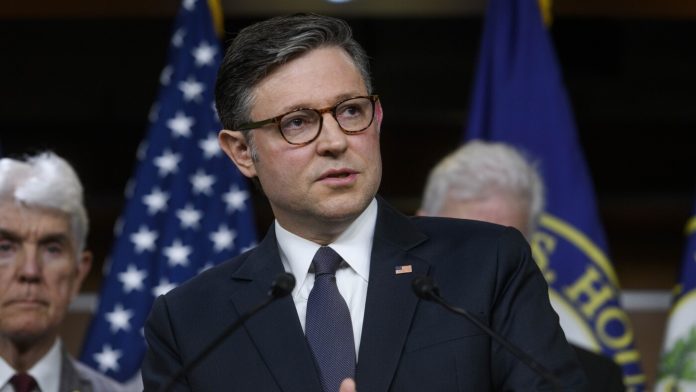
Speaker of the House Mike Johnson, R-La., speaks during a news conference at the Capitol on May 6, 2025, in Washington.

Rod Lamkey/AP


hide caption

toggle caption

Rod Lamkey/AP

WASHINGTON — Republicans advanced their massive tax cut and border security package out of a key House committee during a rare Sunday night vote as deficit hawks who had blocked the measure two days earlier allowed it to move forward, citing what they called progress in negotiations on the package’s spending cuts.

Speaker Mike Johnson met with Republican lawmakers shortly before the meeting and told reporters that some changes had been agreed to, but he did not offer specifics. He described them as “just some minor modifications. Not a huge thing.”

Democrats on the panel pressed for more details. But Rep. Jodey Arrington, the chairman of the House Budget Committee, said the bill remained under negotiation.

“Deliberations continue at this very moment,” Arrington said. “They will continue on into the week, and I suspect right up until the time we put this big, beautiful bill on the floor of the House.”

The four conservatives who have been voicing concerns about the bill’s impact on the deficit voted present so that the measure could advance by a vote of 17-16.

More talks are ahead, but Johnson is looking to put the bill on the House floor before the end of the week.

“This is the vehicle through which we will deliver on the mandate that the American people gave us in the last election,” he said on “Fox News Sunday.”

The first time that Republicans tried advancing the bill out of the House Budget Committee last week, the deficit hawks joined with Democratic lawmakers in voting against reporting the measure to the full House.

The Republicans criticizing the measure noted that the bill’s new spending and the tax cuts are front-loaded in the bill, while the measures to offset the cost are back-loaded. They are looking to speed up the new work requirements that Republicans want to enact for able-bodied participants in Medicaid. Those requirements would not kick in until 2029 under the current bill.

“We are writing checks we cannot cash, and our children are going to pay the price,” said Rep. Chip Roy, R-Texas, a member of the committee. “Something needs to change, or you’re not going to get my support.”

Johnson said the start date for the work requirements was designed to give states time to “retool their systems” and to “make sure that all the new laws and all the new safeguards that we’re placing can actually be enforced.”

Roy had been joined Friday in voting no by Reps. Ralph Norman of South Carolina, Josh Brecheen of Oklahoma and Rep. Andrew Clyde of Georgia. Rep. Lloyd Smucker of Pennsylvania switched his vote to no in a procedural step so it could be reconsidered later.

After Sunday’s vote, Roy tweeted on X that the bill will “move Medicaid work requirements forward and reduces the availability of future subsidies under the green new scam,” a reference to the green energy tax breaks from the Inflation Reduction Act. But he also warned that more changes were needed and “the bill does not yet meet the moment.”

Norman pointed to a recent downgrade of the nation’s credit rating in making his arguments for steeper reductions.

“We’ve got a lot more work to do,” Norman said. “We’re excited about what we did. We want to move the bill forward.”

At its core, the sprawling legislative package permanently extends the existing income tax cuts that were approved during Trump’s first term, in 2017 and adds temporary new ones that the president campaigned on in 2024, including no taxes on tips, overtime pay and auto loan interest payments. The measure also proposes big spending increases for border security and defense.

The Committee for a Responsible Federal Budget, a nonpartisan fiscal watchdog group, estimates that the House bill is shaping up to add roughly $3.3 trillion to the debt over the next decade.

Democrats are overwhelmingly opposed to the measure, which Republicans have labeled “The One, Big, Beautiful Bill Act.” Rep. Pramila Jayapal, D-Wash., called it, “one big, beautiful betrayal” in Friday’s hearing.

“This spending bill is terrible, and I think the American people know that,” Rep. Jim Clyburn, D-S.C., told CNN’s “State of the Union” on Sunday. “There is nothing wrong with us bringing the government in balance. But there is a problem when that balance comes on the back of working men and women. And that’s what is happening here.”

Johnson is not just having to address the concerns of the deficit hawks in his party. He’s also facing pressure from centrists who will be warily eyeing the proposed changes to Medicaid, food assistance programs and the rolling back of clean energy tax credits. Republican lawmakers from New York and elsewhere are also demanding a much large state and local tax deduction.

As it stands, the bill proposes tripling what’s currently a $10,000 cap on the state and local tax deduction, increasing it to $30,000 for joint filers with incomes up to $400,000 a year.

Rep. Nick LaLota, one of the New York lawmakers leading the effort to lift the cap, said they have proposed a deduction of $62,000 for single filers and $124,000 for joint filers.

If the bill passes the House this week, it would then move to the Senate, where Republican lawmakers are also eyeing changes that could make final passage in the House more difficult.

Johnson said: “The package that we send over there will be one that was very carefully negotiated and delicately balanced, and we hope that they don’t make many modifications to it because that will ensure its passage quickly.”

Low prices and Trump’s trade war are pushing these Northwest farmers to the brink : NPR

0

Jim Moyer’s great grandfather first started growing wheat in eastern Washington in the 1890s. The farm has been in the family ever since.

Kirk Siegler/NPR


hide caption

toggle caption

Kirk Siegler/NPR

EATON, Wash. – Back in the New Deal era, the Northwest’s mighty rivers were dammed allowing barges to cheaply bring grain from the wheat fields of eastern Washington to the coast for export.

Today, at ports along the Snake River, trucks unload grain to five-storey high bins along the banks. Most barges that pull up to the terminals carry the equivalent of 150 semi trucks worth of grain downriver to Portland.

Typically more than 90 percent of all the wheat grown here ends up in countries like Japan, Korea and the Philippines, where it’s used for noodles, confections and crackers. This is how it’s been for as long as Jim Moyer can remember. His family first started farming along the rolling, fertile Palouse region of Washington in the 1890s.

“You can see the house and the buildings,” Moyer says, walking through a newly planted field of Spring wheat above the family’s old farmhouse and barns. “They’ve been there for well over a hundred years.”

To his west, snow is melting fast off the Blue Mountains on the remote Washington-Oregon border. These last few weeks have been drier than he’d prefer.

It’s never been easy out here but right now, like almost never before, things feel like they’re on the brink. Wheat prices have been stubbornly low for years while inflation continues to be high.

“A combine now is a million dollars, a tractor is 500- to 750-thousand, a sprayer can be $750,000,” Moyer says.

And it’s not looking like the tariffs will bring those prices down.

“The assumption was that it would have been done strategically, with some thought and planning,” Moyer says. “We need certainty.”

Farmers are still recovering from the first Trump trade war

Uncertainty is something people across America’s heartland are talking about, whether it be wheat farmers in states like Washington or Montana, or corn and soybean growers in North Dakota and Indiana. It’s yet unclear what farmers stand to gain from the second Trump administration’s trade policies. Across the rural Midwest and West, plenty of farmers still fly Trump 2024 flags over their barns, but quietly worry his latest trade war will bankrupt them.

The U.S. government spent decades building overseas markets for crops like soybeans and wheat. But now all those agreements are in limbo.

Winter wheat growing on the Palouse in eastern Washington state

Winter wheat growing on the Palouse in eastern Washington state

Kirk Siegler/NPR


hide caption

toggle caption

Kirk Siegler/NPR

In Washington state, Jim Moyer says wheat farmers are still recovering from the trade war in Trump’s first term when the popular Trans-Pacific Partnership was torn up. He’s worried that irreparable damage has already been done with trade deals that took decades to build.

“If you turn the relationship off, it’s a lot harder to turn it back on and get that back when, in the interim, the person that you’ve traded with, they’ve found somebody else,” Moyer says.

Asked if there’s a feeling of disconnect right now between the White House and farm country, Moyer replied: “You know, I don’t know, I try not to go there, I don’t have much control over it.”

There’s still broad support for Trump in farm country

People here don’t want to talk politics much right now with everything so polarized, and with tariffs being on, then pulled off, then back on. Washington may be a blue state in national politics but there is only one county east of the Cascade Mountains that hasn’t voted for Trump in three cycles since 2016.

“Obviously farm communities are pretty much Republican,” says Byron Behne, a merchandiser with the Northwest Grain Growers, a farmer-owned cooperative in Walla Walla, Washington.

Behne grew up on a wheat farm near the Grand Coulee Dam. He says farmers are puzzled by the White House rhetoric, especially after Trump said on his social media platform that farmers should get ready to supply America, and to, “have fun.”

“Even the people that are some of his strongest supporters were kind of looking at that and going, what does that truly mean?” Behne says.

The Northwest states – Washington, Idaho, Montana and Oregon – have some of the highest wheat yields in the world; more than the U.S. could ever consume. Behne says it would be hard to abruptly downscale all of this or slow down or stop exporting.

A lot of things farmers also need, from tractor parts to fertilizer, have to be imported.

“You can’t just build a new factory to produce that stuff here,” Behne says. ” I mean, I understand that’s the stated goal by the administration, but that stuff doesn’t happen overnight.”

It would equate to a generation of pain, Behne says.

Why farmers are worried about a looming depression

Farmer Jim Moyer, who recently retired as a scientist and dean at Washington State University, worries a lot of his neighbors won’t survive if the uncertainty persists.

“Next year it’s not going to be pretty,” Moyer says. “Farming will be changed forever.”

This is dryland wheat country. Most farmers don’t have much, if any irrigation and they can’t just easily switch crops either.

The anxiety is palpable out here. Just over the state line in Oregon, Paul Reed and his family are trying to ride it out and stay upbeat.

Paul Reed, 20, is poised to take over his family's wheat, turf and canola farm near La Grande, Ore. when his uncle retires

Paul Reed, 20, is poised to take over his family’s wheat, turf and canola farm near La Grande, Ore. when his uncle retires

Kirk Siegler/NPR


hide caption

toggle caption

Kirk Siegler/NPR

“Yup, so most of this my great grandfather started,” Reed says, standing in a field of perfect rows of winter wheat, its stalks about a foot and a half high, lush and green.

Reed is only twenty years old. He’s just finishing an associate’s degree in crop management at Blue Mountain Community College in nearby Pendleton, Oregon. He’ll be the 4th generation running his family’s farm when his uncle retires.

“Yeah it’s hard, I mean, everyone tells me you’re going in at the worst time,” Reed says. “It’s probably true, but if we’ve been able to do it for as long as we have – gotta have hope.”

No one out here is spending any money really, investing in new equipment or doing much hiring. Reed’s trying not to look at the news.

“It’s all talk until it actually happens. I don’t spend much of my day worrying about any talk that I hear unless it’s starting to become something that’s actually going to happen,” he says.

Reed is switching more of his operation to grass and lawn turf where he can. He also hopes to send more grain to local feedlots instead of down to the river for export. He’s one of scores of farmers searching for some positives, when uncertainty rules the day.

This story is part of American Voices, an occasional NPR National Desk series that explores how President Trump’s early policies are playing out across the country.

Former US Ambassador to Ukraine on why she left her post under President Trump

0

NPR’s Scott Detrow speaks with Bridget Brink, who recently resigned her post as US Ambassador to Ukraine, on President Trump’s handling of the war in Ukraine and his posture towards Vladimir Putin.

Former president Joe Biden diagnosed with aggressive form of cancer

0

Former President Joe Biden has been diagnosed with prostate cancer, which has metastasized to the bone, according to a statement from his personal office.

Joe Biden diagnosed with aggressive prostate cancer : NPR

0

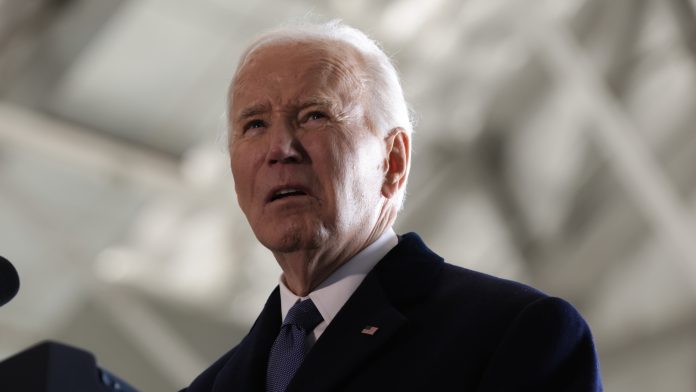
Former President Joe Biden speaks at Joint Base Andrews.

Samuel Corum/Getty Images


hide caption

toggle caption

Samuel Corum/Getty Images

Former President Joe Biden has been diagnosed with prostate cancer, which has metastasized to the bone, according to a statement from his personal office.

Biden, 82, was seen for further tests last week after a finding of a prostate nodule.

The cancer has a Gleason score of 9, representing a more aggressive case. (Gleason scores combine how many cancerous cells are seen in a needle-biopsy tissue sample, and how aggressive the cells appear to be.)

“While this represents a more aggressive form of the disease, the cancer appears to be hormone-sensitive which allows for effective management,” according to the statement, which says Biden and his family are reviewing treatment options.

This is a breaking news story and will be updated.